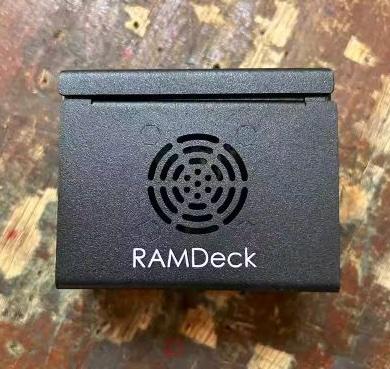
RAMDeck eliminates the network bandwidth bottleneck in distributed AI by keeping model weights parked in local memory while passing only micro-activations between machines.
One of the most persistent misconceptions we hear about clustering hardware for local LLMs is:
"Ethernet is too slow. DDR5 runs at 60–90 GB/s and GPUs run at 500+ GB/s, while 1 Gbps Ethernet is only 0.125 GB/s. How can you pool RAM without hitting a massive network bottleneck?"
If you're mapping an operating system pagefile or virtual memory drive across the network, that objection is completely accurate—your OS freezes because it constantly requests gigabytes of random memory pages over the wire.
Large Language Models, however, don't work like virtual memory drives.
The Architecture: Weights vs. Activations
Distributed inference operates via layer-pipeline parallelism:
Weights Stay Parked Locally: When an 18 GB 30B model or 42 GB 70B model loads across two or three computers, each machine holds its assigned layer blocks permanently in its own local physical RAM or GPU VRAM. Zero weights ever cross the network during token generation.
Local Silicon Bandwidth: Node A evaluates its layers reading weights from its own local memory bus at full hardware bandwidth (500+ GB/s on an RTX GPU, or 100–400 GB/s on Apple Silicon).
Only Micro-Activations Travel: When Node A finishes its layer block, it only hands off the mathematical hidden state (the activation vector) to Node B. For a 30B–70B model, this activation state is only 3 KB to 8 KB.
The Latency Math: Transferring a 4 KB activation tensor over standard 1 Gbps Ethernet takes 0.03 milliseconds (virtually instantaneous). Even over a 6 ms regional Tailscale internet connection, the 6 ms transit happens concurrently within the 25–35 ms computation window of the GPU layer block.
That is why RAMDeck clusters stream 30B MoE models at 28 to 39 tokens/sec over standard home Wi-Fi and Ethernet.
What Does the $199 Hardware Hub Actually Do?
Another common question is why a dedicated hardware appliance exists:
The RAMDeck Hardware Hub is a dedicated, low-power Control-Plane Coordinator:
Sips Under 5 Watts: Eliminates the need to keep an expensive, power-hungry 500-watt gaming desktop running 24/7 as an always-on cluster master.
Dynamic Primary Promotion: It doesn't run heavy matrix math itself; it discovers all LAN devices via mDNS and dynamically promotes the fastest compute device on your network (like an RTX PC or Apple Silicon Mac) to host the primary execution context.
40-Hour Self-Healing Watchdog: Real-world home networks are messy—laptops close lids, and Wi-Fi roams. The Hub's continuous heartbeat watchdog detects node drops, cleans up dead sockets, and recovers active models without crashing your application.
Unified OpenAI Gateway: Exposes a single /v1/chat/completions endpoint and Web Dashboard, plus built-in 1-click Tailscale remote access with an automatic 25ms latency guardrail.
Mobile & Laptop Safety
For people asking about battery drain or overheating on contributing mobile nodes:
The iOS and Android companion apps actively monitor kernel memory pressure watermarks in real time.
Memory allocation is strictly capped within safe headroom limits, ensuring mobile Low Memory Killers (LMK) or iOS Jetsam never terminate background tasks.
Heavy sustained workloads are automatically directed to wall-powered desktop/laptop hardware, keeping phones and laptops cool.
Full architectural teardown and technical data:
https://ramdeck.com/how-ramdeck-bypasses-network-bandwidth-bottlenecks/
Happy to discuss the network telemetry and latency math in the comments.
— The TradeMAV Team