r/learnwithcodelivly • • Sep 01 '26

The first time I got handed a "preserve this evidence" request, I almost destroyed the case before I even started.

Thumbnail
gallery
6 Upvotes

Same disclosure as always: I run a cybersecurity education site. Not selling anything in this post, just telling you what happened.

I'd done some SOC work, some basic IR, thought I understood investigations. Then someone handed me a laptop that was allegedly used in an internal data theft case and said "just image it and pull whatever's relevant."

I did not know what I didn't know.

I booted the thing up to "just take a quick look first." Which, if you know anything about forensics, is the exact thing you're never supposed to do. Wrote to the disk. Changed access timestamps on files that might have mattered. Didn't document a single step before I touched anything. No hash verification, no chain of custody notes, nothing.

Nobody ended up going to court over that particular case, thankfully, because if they had, everything I touched would've been thrown out or torn apart by opposing counsel in about four minutes. I got lucky. It taught me that "I know how computers work" and "I know how to conduct a forensically sound investigation" are two completely different skills, and only one of them was true about me at the time.

What actually fixed it wasn't a certification, it was forcing myself to relearn the basics in the right order: acquire before you analyze, hash before you touch, document every action like someone's going to question it later, because someone eventually will. Chain of custody isn't paperwork theater, it's the only thing standing between "we found evidence" and "we found nothing admissible."

Once that clicked, disk images, memory captures, and timeline reconstruction stopped feeling like separate mystery skills and started feeling like one repeatable process I could trust myself to follow under pressure.

I ended up putting everything I wish I'd known before that laptop incident into a book, because I kept explaining the same mistakes to junior analysts one at a time. It's a 250+ page field manual, not another "here's what digital forensics is" theory book, it's built to sit next to you while you're actually doing the work:

📖 https://resources.codelivly.com/product/digital-forensics-playbook/

If you want a place to ask "wait, am I about to ruin this evidence" questions before it's too late instead of after:

💬 Discord: https://discord.gg/9Y29aH3Qq

✈️ Telegram: https://t.me/codelivly

If you're new to DFIR, learn the acquisition and documentation discipline before anything else. It's the boring 20% nobody wants to talk about, and it's the part that actually decides whether your findings mean anything.


r/learnwithcodelivly • • 12d ago

If she texts you first, block him. 😂 | Cybersecurity 101

Post image
15 Upvotes

r/learnwithcodelivly • • Sep 03 '26

Put together a 240-page practical AWS/Azure security book because I was tired of certification guides that don't teach you how to actually review a re

Thumbnail
gallery
21 Upvotes

Been working in cloud security for a while now, and one thing kept bugging me: most resources either teach you the exam version of AWS/Azure security (memorize this service name, pick the right answer) or they're so broad they never get specific enough to actually be useful when you're staring at a real account trying to figure out if something's exposed.

So I put together a book that tries to close that gap. It's called Cloud Security Engineer: The Practical AWS & Azure Security Playbook, 35 chapters covering IAM/Entra ID, network security, storage, compute, containers, serverless, logging/detection, incident response, IaC security, and a full assessment methodology with two buildable lab environments (AWS and Azure) that have intentional misconfigurations you find yourself instead of being told where to look.

It also has three real breach writeups (Capital One, Tesla, Microsoft's SAS token leak) where I was careful to separate what's actually documented from my own analysis, since I can't stand resources that blur that line and just state assumptions as fact.

Every chapter has a hands-on lab and a knowledge check, not just a wall of text.

Link if you want to check it out: https://resources.codelivly.com/product/the-cloud-security-engineers-handbook/

Not going to pretend this isn't self-promotion, it is, but I'd genuinely rather get torn apart in the comments by people who know this space than have it sit there unchallenged. If you've got questions about what's covered or think something's missing, happy to answer.


r/learnwithcodelivly • • Aug 22 '26

A clean automated scan report is not the same thing as a clean app

Thumbnail
reddit.com
0 Upvotes

r/learnwithcodelivly • • Aug 20 '26

I am LinuxMan

Post image
15 Upvotes

r/learnwithcodelivly • • Sep 01 '26

rideapp dispatch system - i am the driver

1 Upvotes

I am a licensed taxi driver in a small country where corruption is unfortunately normal. I work through the local ridesharing platform, which operates as Uber.

During a conversation with an individual IT engineer, he offered, in exchange for a monthly payment, to manipulate the platform’s ride-dispatch system so that I would receive preferred ride requests. RIdes of higher value or rides meeting criteria selected by me ON PRICE.

He explained that, through access to the platform’s backend, he could alter the way ride requests are allocated to my driver account.

I have not agreed to this or made any payment, or provided any account credentials. I am worried that this is also fraud, unauthorized access to a computer system, manipulation of the platform’s algorithms, abuse of privileged access, and/or a scheme designed to obtain money from drivers under false pretenses.

My question first is: is it actually possible to do so seamlessly? Is this technically possible?

Best.


r/learnwithcodelivly • • Sep 01 '26

Spent a year doing random THM rooms with zero clue what I was building toward. Here's what actually clicked.

Thumbnail
gallery
16 Upvotes

I burned about a year doing whatever room looked interesting that week. Could clear easy boxes, had no real idea why half the commands worked. Then hit a Windows AD room and it was a wall. Kerberoasting, BloodHound, SPNs, none of it connected to anything I already knew. Closed the tab, tried a different course, same thing happened three more times.

Turned out the issue wasn't effort, it was order. Networking basics, then Windows/Linux internals, then tooling, then AD, actually sequenced instead of whatever's trending in a sidebar that week.

I ended up building that sequence out myself: Junior Penetration Tester. It's free, no card needed, 13 paths stacked in order with labs you actually run instead of videos you watch. You get a verifiable certificate at the end, so it's not just "trust me I did some rooms," it's something you can actually link on LinkedIn or drop in an application. AD stopped being gibberish once the fundamentals under it were solid, and I finished the simulated engagement with an actual pentest report instead of a badge list. That's what recruiters look twice at, not a flag screenshot.

If you get through that path and junior level stuff starts feeling easy, the next wall is enterprise AD, cloud identity, malware dev, and the social engineering side almost nobody teaches properly. That's exactly what's in the Red Team Operator L1+L2 bundle: Red Team Operator L1+L2. It's basically the shortcut past the same wall I hit, laid out step by step instead of pieced together from forum posts, so you're not spending months figuring out what order to learn Active Directory attacks or malware dev in. Cheaper than buying the four books separately too.

Also run a Discord if you want to bounce questions off people instead of googling in circles: https://discord.gg/9Y29aH3Qq

Happy to answer anything here.


r/learnwithcodelivly • • Aug 30 '26

I solved a networking lab today. Here’s the report.

Thumbnail
gallery
35 Upvotes

I started this lab with what looked like a pretty straightforward Cisco networking problem.

A few VLANs. Some switches. Routing between networks. Nothing that should have been particularly scary.

Then, as usual, the network decided otherwise.

One host could reach another VLAN, but another couldn't. The interfaces looked fine. The cables were fine. The configuration looked almost right.

So I stopped guessing and started going through it properly.

I checked the VLAN assignments first.

Then the trunk.

Then the allowed VLANs.

Then the router configuration.

Then I went back to the switch and checked what was actually happening instead of what I thought I had configured.

That ended up being the important part.

The problem wasn't some exotic Cisco command. It was a small configuration mistake that was easy to overlook when you're staring at the whole topology.

I documented the troubleshooting process and put together the network report here.

Cisco Network Report

It covers the topology, configuration, troubleshooting process, findings, and the final working setup.

I'm sharing it because I think this is the part of networking that gets missed when you're learning from purely theoretical material.

You can memorize what a trunk is.

You can memorize VLAN commands.

You can memorize routing concepts.

But eventually you have to look at a broken network and ask:

“Okay... why the hell isn't this working?”

That's where the real learning starts.

If you're learning Cisco/network engineering, I've also been building some practical resources around that:

CCNA Practical: The Hands-On Network Engineer Guide
CCNA Practical Guide

Network Engineer Complete Bundle — L1, L2 & L3
Network Engineer Complete Bundle

SOC Analyst Complete L1, L2 & L3
SOC Analyst Complete Bundle

The goal with these isn't to make networking sound complicated.

It's to get you comfortable enough that when something breaks, you know where to start looking.

Report attached/shared above. Hope it helps someone working through their own lab.


r/learnwithcodelivly • • 4d ago

We built a free SOC Analyst Level 2 path: 8 learning paths, hands-on labs and 4 capstone cases

3 Upvotes

If you’ve covered SOC fundamentals and are wondering what to study next, we have a free SOC Analyst Level 2 career path on Codelivly.

I’m behind the platform, so sharing this as the creator.

It picks up where Level 1 ends, with 8 learning paths covering:

  • Advanced triage and investigating alerts escalated from L1.

  • Building and tuning detections.

  • Threat hunting and incident response.

  • Working with cloud and identity logs.

  • Automating repetitive SOC tasks.

There are hands-on labs and quizzes along the way, followed by four full capstone investigations and a career path exam. You can earn a verifiable completion certificate too.

The whole path is free. Create an account to see the roadmap and save your progress.

Explore the SOC Analyst Level 2 path

For people already working in a SOC: what was the hardest skill to pick up when moving from L1 to L2? I’d like to hear what you wish you’d had more practice with.


r/learnwithcodelivly • • Oct 14 '26

Looking to get into GRC? I put together a handbook covering the fundamentals and key frameworks

Thumbnail
gallery
13 Upvotes

GRC is an important part of cybersecurity, but knowing where to start can be confusing when you're faced with frameworks, audits, risk assessments, and compliance requirements.

I put together The Complete GRC Analyst Handbook to help learners explore governance, risk management, compliance, SOC 2, ISO 27001, NIST frameworks, cybersecurity audits, and career fundamentals.

If you're learning GRC or preparing for a GRC Analyst role, check it out here:

📘 https://resources.codelivly.com/product/the-complete-grc-analyst-handbook/

What would you recommend beginners focus on first when learning GRC: risk assessments, ISO 27001, or compliance audits?


r/learnwithcodelivly • • Aug 28 '26

I put together a few cybersecurity resources for people preparing for SOC, networking, and red team roles

Thumbnail
gallery
37 Upvotes

I’ve been curating and building practical cybersecurity resources around different career paths, so I figured I’d share them here.

I’m also sharing a SOC Analyst interview questions image that covers some of the stuff worth revising before an interview alert triage, SIEM, networking, logs, common attacks, incident response, etc.

For anyone who wants the more structured material, I’ve put together:

SOC Analyst — L1 + L2 + L3
From the basics and alert triage through advanced detection engineering:
https://resources.codelivly.com/product/soc-analyst-the-complete-l1-l2-l3/

Network Engineer — L1 + L2 + L3
Networking fundamentals through advanced architecture and troubleshooting:
https://resources.codelivly.com/product/network-engineer-complete-bundle-l1-l2-l3-foundations-to-advanced-architecture/

Red Team Operator — L1 + L2
From offensive security fundamentals to more advanced adversary simulation concepts:
https://resources.codelivly.com/product/red-team-operator-the-complete-l1-l2-bundle/

The interview questions image is probably the most useful part if you’re currently job hunting. Save it and use it as a quick revision checklist.

Hopefully this helps someone preparing for their first SOC/networking/security interview.


r/learnwithcodelivly • • Aug 23 '26

🚩 STOP JUST WATCHING. START HACKING. - CTF Chanllenges

Post image
8 Upvotes

Ready to test your cybersecurity skills?

🔥 64+ hands-on CTF challenges
🌐 Web Exploitation
🐧 Linux & System Security
🔐 Cryptography
🔎 Forensics & OSINT
⚙️ Reverse Engineering
🤖 AI Security
☁️ Cloud Security
🪟 Active Directory

Start as a beginner. Work your way to **Hard & Insane** challenges.

🚩 Capture flags.
⚡ Gain XP.
🏆 Climb the leaderboard.
💻 Build real-world hacking skills.

👉 Start hacking: codelivly.com/ctf


r/learnwithcodelivly • • Sep 06 '26

IT Journey 😀🤪

Post image
25 Upvotes

r/learnwithcodelivly • • Aug 30 '26

I made a SOC Analyst Level 1 roadmap

9 Upvotes

Been working on Codelivly and put together a SOC Analyst Level 1 career path for people starting from scratch.

It covers the basics first, then moves into Windows/Linux, networking, SIEM, alert investigation, incident response, and other stuff you'd actually run into in a junior SOC role.

There are also practical labs, quizzes, investigations, and a simulated SOC shift.

It's free:

https://codelivly.com/career-paths/soc-analyst-level-1

Feel free to use it or tear it apart. I'm still improving it.


r/learnwithcodelivly • • Sep 29 '26

When you’re thinking about starting a CCNA career… 😂

Post image
93 Upvotes

Everyone starts somewhere.

You don’t need to know everything about networking on day one. Start with the fundamentals: OSI model, TCP/IP, IP addressing, subnetting, VLANs, routing, switching, DHCP, DNS, NAT, ACLs, and then actually practice what you learn.

If you’re serious about getting into network engineering, CCNA is a solid place to build that foundation.

Learn the concepts.
Build the labs.
Break things.
Troubleshoot them.
Repeat.

If you’re looking for a structured way to get started, here are two resources:

📘 CCNA Practical: The Hands-On Network Engineer Guide
https://resources.codelivly.com/product/ccna-practical-the-hands-on-network-engineer-guide/

🌐Free Network Engineer Career Path
https://codelivly.com/career-paths/network-engineer

No need to rush it. Start with the basics, practice consistently, and build your way up.

Future Network Engineer loading… 👶🌐


r/learnwithcodelivly • • Sep 06 '26

The Ethical Hacker’s Field Manual: What You Actually Need to Know to Hack Like a Professional

Thumbnail
gallery
106 Upvotes

One thing that took me a while to understand about ethical hacking:

Knowing a bunch of tools doesn't automatically make you good at penetration testing.

The real skill is knowing how to approach a target.

You start with reconnaissance.
Then enumeration.
Then you figure out what is actually exposed.
From there, you look for weaknesses, test your assumptions, build an attack path, and see how far you can legitimately go.

A solid ethical hacking workflow usually looks something like:

• Reconnaissance and information gathering
• Network and service enumeration
• Web application testing
• Vulnerability identification
• Exploitation
• Privilege escalation
• Post-exploitation
• Credential and access analysis
• Lateral movement in controlled environments
• Maintaining a clear record of what you discovered
• Writing a proper penetration testing report

The important part is connecting these stages.

Finding an open port isn't the goal.

Finding out what that port tells you about the target is.

Finding a vulnerability isn't the goal either.

Understanding whether it can actually be exploited and what impact it has is where the real work starts.

If you're learning ethical hacking, I'd recommend spending less time trying to memorize tool commands and more time building labs, attacking intentionally vulnerable machines, taking notes, and learning to explain why you took each step.

That's where hacking starts feeling less like running commands and more like solving a problem.


r/learnwithcodelivly • • Sep 13 '26 Heartwarming

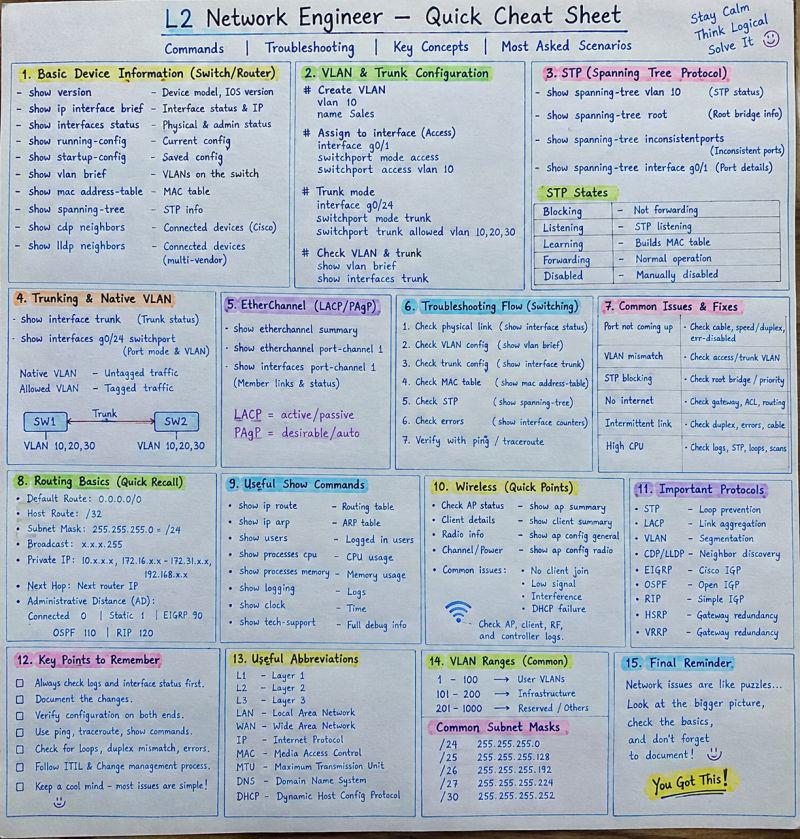
L2 Network Engineer cheat sheet I wish I had earlier

Post image
522 Upvotes

If you're working toward an L2 Network Engineer role, having a basic troubleshooting flow and knowing what to check first can save a lot of time.

I put together a quick cheat sheet covering:

  • Basic switch & router commands

  • VLANs and trunking

  • STP and root bridge

  • Native vs allowed VLANs

  • EtherChannel (LACP/PAgP)

  • Switching troubleshooting

  • Common network issues and fixes

  • Routing basics

  • Useful show commands

  • Wireless troubleshooting

  • Important networking protocols

  • Subnet masks and VLAN ranges

  • ITIL and change management reminders

The main troubleshooting flow is pretty simple:

Check → Verify → Isolate → Fix → Test → Document

The biggest thing I've learned is that knowing the command isn't enough. You need to understand what the output is actually telling you.

If you're learning networking or already working in L1/L2 support, hope this helps.

Also, if anyone wants to discuss networking, labs, troubleshooting or career stuff, we have a Discord community here:

https://discord.gg/RTZyZXATE


r/learnwithcodelivly • • Sep 18 '26

This puts me off

Post image
35 Upvotes

How on earth do ppl learn this in only few months?

I have a full time job and a family. It tool me a little more than a year to prep for CCNA.

Now I’m doing ENCOR, but with my progress it will definitely take at least 2 years.

And here ppl bragging on Linkedin it took them only 3.5 months? Like what the fuck…this really just makes me feel like an idiot to IT.

I’m just curious to read your take on this.


r/learnwithcodelivly • • Oct 20 '26

Free Cybersecurity Career Paths to Learn Pentesting, SOC Analysis, Digital Forensics and More

13 Upvotes

Getting started in cybersecurity is a lot easier when you have a clear path to follow instead of jumping between random tutorials.

At Codelivly, we've put together career paths for people who want to build practical cybersecurity skills, explore different specializations, and work toward their first role in the industry.

Here are a few paths worth checking out:

The goal is simple: make cybersecurity easier to learn and give people a starting point for developing real skills.

If you're learning cybersecurity, check out the paths that interest you and see where you want to go next.

We're also sharing cybersecurity resources and updates on LinkedIn:
https://linkedin.com/company/codelivly

Which cybersecurity career path are you working toward right now?


r/learnwithcodelivly • • Sep 29 '26

What are you actually studying for SOC Analyst interviews?

Post image
94 Upvotes

I’ve been going through SOC Analyst interview prep recently, and I’m realizing that knowing definitions isn’t really enough.

You can memorize what a SIEM is, what an IOC means, or what the incident response lifecycle looks like. But when someone gives you an actual alert and asks “What would you do next?”, you need to be able to think through it.

The areas I’m focusing on:

  • SOC fundamentals and analyst responsibilities

  • SIEM and security monitoring

  • Windows and Linux log analysis

  • Common attacks and suspicious activity

  • Incident response

  • Basic malware analysis

  • Networking fundamentals

  • MITRE ATT&CK, IOCs, TTPs and hashing

  • Scenario-based questions

One scenario I’m practicing:

You notice multiple failed login attempts coming from a foreign IP. What do you do?

I’d want to explain how I would validate the alert, check the source IP, identify the targeted account, look for a successful login afterward, correlate other logs, determine the scope, and decide whether it needs escalation or containment.

That seems much more useful than simply saying “it could be a brute-force attack.”

A lot of current SOC interview prep also emphasizes explaining your investigation process and reasoning, rather than just recalling terminology.

For anyone else preparing for SOC roles, what questions or scenarios are you practicing?

Learn → Practice → Investigate → Improve

Free Learning : https://www.codleilvy.com


r/learnwithcodelivly • • Oct 26 '26 Bravo

Cisco CCNA IOS Command Cheat Sheet (10 Pages)

Thumbnail
gallery
440 Upvotes

I put together a 10-page Cisco CCNA IOS command cheat sheet covering commands you'll use when configuring and troubleshooting networks.

It covers:

  • CLI basics and device management

  • Interfaces, switching, and VLANs

  • STP and EtherChannel

  • IPv4, IPv6, and static routing

  • OSPF configuration

  • ACLs and network security

  • DHCP, NAT/PAT, and network services

  • Troubleshooting and verification commands

It's handy to keep alongside your Packet Tracer labs, CCNA study sessions, or whenever you need a quick reminder of a command.

If you're working toward a career in networking or cybersecurity, you can also explore Codelivly's free career paths here: https://codelivly.com/career-paths

Start your journey for free!

What's the one Cisco IOS command you use most often? Mine would be show ip interface brief because it's a quick way to check interface status and IP addresses.

What commands would you add to this cheat sheet?


r/learnwithcodelivly • • Sep 04 '26

Some network troubleshooting commands worth remembering

Post image
45 Upvotes

When a network issue comes up, these are usually the first commands I reach for.

Windows
ipconfig /all — IP, DNS, DHCP info
ipconfig /flushdns — Clear DNS cache
tracert <IP> — Trace the route
netstat -ano — Connections, ports, PIDs

Linux
ip addr — Interfaces and addresses
ss -tulpn — Listening ports/services
dig <domain> — DNS checks
curl -I <URL> — Quick HTTP response check

Cisco
show ip interface brief — Interface status
show ip route — Routing table
show mac address-table — MAC addresses
show cdp neighbors — Connected Cisco devices

For a basic issue, I normally go:

IP → gateway → target → DNS → route → interface → logs

Nothing fancy, but it saves a lot of time when you're staring at a machine wondering why nothing works.

What command do you use the most?

Discord if anyone wants to hang out: https://discord.com/invite/RTZyZXATE


r/learnwithcodelivly • • Aug 31 '26

Free cybersecurity career paths if you're not sure what to learn next

17 Upvotes

I've been building Codelivly with a simple idea: you shouldn't have to pay for a course just to figure out where to start in cybersecurity.

There are currently two career paths available for free:

🔴 Junior Penetration Tester

A structured path for learning the basics of pentesting, recon, enumeration, vulnerability assessment and offensive security.

Start the Junior Penetration Tester path

🛡 SOC Analyst Level 1

Covers the fundamentals you'll need for SOC work, including networking, Windows, Linux, logs, SIEM and alert investigation.

Start the SOC Analyst Level 1 path

They're completely free to learn.

If you're stuck wondering whether to start with networking, Linux, pentesting, SOC or something else, picking a structured path is probably easier than jumping between random YouTube videos.

More paths and hands on material are being added to Codelivly.

Codelivly

Also for Cybersecurity Resources: https://resources.codelivly.com

Well not promoting but sharing what we offer to our students


r/learnwithcodelivly • • Sep 20 '26 Bravo

Old SOC Analyst vs New SOC Analyst

Post image
79 Upvotes

SOC work has changed a lot.

It used to be mostly log checking, signature-based alerts, manual investigation, and following playbooks. Now there’s a lot more focus on automation, threat hunting, behavioral detection, EDR/XDR, SOAR, threat intel, and actually understanding what’s happening across the environment.

Made this quick comparison for anyone learning SOC or trying to figure out what skills to work on next.

What would you add to the “New SOC Analyst” side?


r/learnwithcodelivly • • 4d ago

CCNA practice with 41 labs and projects, subnetting exercises and an enterprise capstone

Post image
18 Upvotes

I’m behind Codelivly, the publisher of CCNA Practical: The Hands-On Network Engineer Guide.

It’s a 324-page PDF with 41 labs and projects, 150+ subnetting problems and 200+ practice questions with answers.

Topics include Cisco IOS, VLANs, OSPF, NAT, ACLs and troubleshooting. There’s also an enterprise network capstone to work through.

Most labs can be completed in Packet Tracer.

Book details