The 40k character count interrupted our last series of graphics and review. Allow me to continue the monograph.....
Cis-(1,3-Diaxial) Fused “IMINO-ETHANO” Innuendo
The most influential steric constant in the entire morphinan superfamily is the cis-(1,3-dixial) fusion of the piperidine ring (ring D).
The centrally located piperidine shares a border with rings B and C. The Piperidine ring contains all three chiral centers in the tetracycles (9C, 13C, 14C).
The fused geometries about the B:C and C:D ring junctions define the stereochem of the series. The one fusion that remains constant in these many stereoisomers is that of the cis-(1,3-diaxial) fusion of the iminoethane system.
The portion of the piperidine system that is mounted above the rest of the molecule is a three member chain (2 carbon + 1 nitrogen; not counting substituents) known as the imino-ethano system.
In other words, the nitrogen-containing half of the piperidine is mounted above the morphinan system in a geometric plane that is roughly perpendicular to the rest of the molecule.
As you can see in the above figure, the piperidine D-ring shares C9, C13, C14 with other rings. The iminoethane portion is anchored to C9 and C13.
When we refer to the iminoethano system being locked in a cis-(1,3-diaxial) orientation we are referring to the anchor points at C9 (position 1) and C13 (position 3). The cis simply means both legs of the iminoethane system are oriented in the same Geometric plane.
This is a fancy-pantsmack-momademic way of saying that this D-ring is carried at a high center of gravity on the bosom of morphy. In others words, morphy has a very ample bosom. A pi-pair-o-D’s. A 44D-(ring) bust. Morphinan is top heavy*.
Morphy is the Dolly Parton of the polycycles. Dolly = D-ring, Parton = Piperidine. Hence the nomenclature.
The same applies to Morphy's awkward teenage daughter: Lil’ Thebby. Her parents call her Thebitha. We know her as Thebaine.
Lil’ Thebby inherited the 3-methoxy from her father (*Coddy). She has her father's large feet. (Don't make fun; she's already self conscious)
Thebby inherited the ample D-ring of her mother, Morphy. This leaves Thebby awkward and top heavy. Despite the added methoxy shoe size, she is still learning the quantum balancing act.
Her C-ring has yet to fully fill-out. Her 6,7,8,14-diene (*derriere) is rather flat. Her pi-orbital pair of skinny jeans still fit, but the diene system makes her C-ring very nearly planar; that is, nearly as flat as her Aromatic A-ring.
If the A and C rings were her thighs, she has one 2D flat thigh, another looking like it's been half run over by a truck, her leg brace (the 4,5 epoxy bridge) attaches her flattened thighs and makes it so she can only waddle. Quack! At least that’s what the mean spirited 4-anilidopiperidines say at school.
One moleculestor who has taken note of that Lil’ Thebby Snack, is the rough n tumble dienophile, known as Diels-Alder. He’s in the adduction business. He’s determined to help fill-out the less defined traits of our dear Thebby.
The nature of the double D-ring mounted out front serves as steric hindrance to reactive groups, such as the dienophile, seeking front-side access to the diene system. The planarity (flat) of the C-ring provides another side of attack.
The orientation of all this piperi-cleavage weighs down the more flexible non-aromatic rings, causing the frontwards heroin hunch. (her mother always tells her to stop slouching and maintain better posture) This bent-over Thebby Snack presents an ideal target for the adduct-friendly dienophile.
[6,14-endoetheno-tetrahydrothebaine: iminoethane system projecting towards viewer; 6,14-endoetheno bridge projecting away from viewer; hanging off the C-ring like an endonk-ethonk]
This 6,14 endo geometry is ideally paired with a C-7 lipophilic chain that has a 19-tert-OH oriented in (R)-config (eutomer). The (S)-config is the distomer.
[(S)- and (R)-config; shows the Hydrogen bond formed between the 6-OCH3 and the 19-OH; forming the “russian nesting doll” situation in which bonds of all sorts wrap up the C-ring in the bridged derivs]
Wonderful reviews on the chemistry of the bridged oripavines have been prep’d by Bentley, “The Alkaloids, Vol. 13” p. 1 (1971); Ann Rev Pharmacol Toxicol, 1971, 11, 241. And others: J Med Chem, 1973, 16, 9; Adv Biochem Psychopharmacol, 1974, 8, 124; Prog Drug Res, 1978, 22, 149]
[a view of the geometries about alt axis of the antags of the 4,5,6-ringed morphinans; changes in the C-ring have drastic consequences for geometries]
As we just reviewed, the addition of the dienophile to thebaine is restricted to the exposed face of the C-ring, which gives us the 6,14-endoetheno derivs. Here, endo implies that the 6,14-bridge lies in a config opposite to the 14-H and the 6-methoxy. The literature designates this orientation as alpha.
[rel stereochem of bridged thebaines with numbering]
The Diels-Alder addition of dienophiles may occur in such a way as to give C7 Beta-epimers (seen in diagram below). The different epimers could have formed w/ equal likelihood. But stereochem control of Diels-Alder addition results in products with C7-alpha geometry and very minute qty of the opposite C7-beta adduct.
Without taking into account the greater electronic-steric control of the system, it appears that the use of asymmetric dienophiles (alkyl vinyl ketones, acrylonitriles, acrylic esters, etc) could result in both C7 and C8 substituted adducts. The electro-steric effects of the system gave only C7-substituted products. [JACS, 1967, 89, 3267; Nature, 1965, 206, 102]
The comments section will have additional images that reddit did not allow me to post due to their system limits. The Comments will also feature a few of my opinions and commentary that are parenthetical deviations from the main narrative of the stereochem lecture. I will eventually include some autobiographical info about my many adventures in chemistry and other entertaining miscellany.
The next part (PART III) will delve into the exciting world of the Cis and Trans-B:C ring fusions in the cis-morphinans and trans-isomorphinans, stereoisomerism about the 14-carbon, that is,14(R) and 14(S) isomers, the world of chair and boat conformational/geometric isomerism, and their effects on biological activity.
Future updates to this series will be posted at r/AskChemistry but also syndicated here for your convenience and hopefully to help bring attention to the wonderful corner of SAR that you have established on this sub.
Communications of a general nature can be directed to my reddit handle u/jtjdp
Communications of more private/confidential nature should be directed to the protonmail email listed on my u/jtjdp Reddit profile.
Hello and welcome back to SAR! Today we move below the belt to talk about a surprisingly contentious piece of the penis: the foreskin. You may not think about your lack or abundance of a foreskin very often but the role of the foreskin was incredibly important to our ancestors for thousands of years. Today it is estimated that nearly 40% of all males are circumcised, which is the process by which the foreskin is removed from the head of the penis for religious reasons or cultural benefits. The vast majority of those individuals had their foreskin removed when they were newborns or infants but we will explore some situations in which older children or adults have their foreskin removed as well. So let's take a look at the role of the foreskin, how and why its removed, and the world of what happens when men think with their other head.
Oh and in case it wasn’t obvious—there will be images of penises. You’ve been warned!
Sometimes it's better to keep things covered, but other times, you just gotta let it all hang out
Before we can get to the Foreskin we should talk a little bit more about where it all comes from. Obviously the mother is responsible for creating all of the male bits that eventually pop out but when we look at the chromosomal sex determination in mammals we see some interesting things. Humans have 23 pairs of Chromosomes which hold all of the DNA information responsible for turning a sperm and egg into a fully functioning person. The last pair of Chromosomes are called the Sex Chromosomes and in most cases having two X chromosomes (XX) will determine a female while having an X and Y chromosome creates a male. Even in cases where someone has multiple copies of either Sex Chromosome the presence of a single Y chromosome determines the male’s sex, such as in Klinefelter Syndrome (XXY) or Jacob’s Syndrome (XYY).
Interestingly, each person starts off developing as a female but then males branch off around week 9 to create male genitalia while females progress into female genitalia. We are unsure if it is the presence of the Y chromosome or the lack of the second X chromosome that causes this switch, but regardless we can tract how the former female genitalia develops into the male genitalia. This overlap, called the Homologies of Sex Organs, may be intuitively known by people as well since the function of many of the organs remain the same in both sexes. For example, the Glans in females is the Clitoris while in males it is the head of the penis—each is exceptionally sensitive and leads to stimulation of the sex organs when used. The shape of these organs can be quite different, such as the Labia Majora becoming the Scrotum or the Labia Minora being integrated into the shaft of the penis. For today’s tale we can see how the Prepuce of the Clitoris becomes the Prepuce of the head of the penis. To start talking about the Prepuce, also known as the Foreskin, we must make our way back to the beginnings of human civilization itself, because as long as men gathered around they were sure to talk about their penis.
Joking aside, the role of the Foreskin isn’t really understood and there is a lot of evidence to say that it was never really understood. Obviously the largest question surrounding the Foreskin is its removal in a surgery called Circumcision which removes the extra skin to permanently expose the penile head. The first illustrations of male Circumcision pop up around 6000 BCE in Egypt based on engravings found on the walls of tombs and on ancient mummies. Interestingly the Egyptian removal of the Foreskin is not the same as the Jewish rite that most people are familiar with. In Egyptian tradition only the ‘top’ of the Foreskin was removed while the bottom portion. It is known that the Egyptian way of Circumcision was abandoned by the time that Herodotus (450s BCE) visited Egypt. Moving outside of Egypt we get to what Herodotus called the Semitic Peoples which included the Colchians near modern day Georgia, the Phoenicians occupying the modern day Levant, Syrians of Palestine and those among the hills and rivers on the inner plane. Interestingly Herotodus mentions that when the Phoenicians made the switch from Egypt to Greece as their major trading partner, they abandoned the practice of Circumcision.
Moving outside of Egypt we get to the Jewish practice of Circumcision which leads to an interesting conundrum as Judaism eventually became Christianity and the spread of the latter across the world. Now this means I need to explain religious doctrine, of which I am no expert, and please be kind in any corrections you’d like to make. Likewise, for those who are not religious I’d ask you to understand the historical significance of the biblical stories as we continue as the history of the interpretation of the Bible is the history of the world. In any regard, in Genesis, God instructs Abraham to make the covenant of flesh by Circumcising himself to ensure that his descendants will return to Canaan, thus creating the Abrahamic Covenant. This covenant would be passed on to all of Abraham’s descendants (the Jews) which by performing would ensure the continued promise of the return to the promised land. What's important to understand about the ancient world is that covenants, which are exceptionally important agreements, were sealed by the cutting and sacrifice of an animal. Modern scholars believe that the removal of the Foreskin would continue the binding agreement between God and the Jews as symbolized in the Torah and their laws. For the Jews, Circumcision represented fertility, their nearness and fidelity to God, and change in good fortune.
Now of course removing a piece of flesh from a quite sensitive part of the body requires precise tools. Flint knives, such as the one above, were primarily used during the ritualistic removal of the Foreskin due to flint maintaining a razor thin edge that metal tools couldn’t rival. Remember, only the top of the foreskin was removed during ancient circumcisions—so unlike modern circumcisions that provide a ‘type 1 penis’, ancient surgery resulted in ‘type 3’ or ‘type 4’. Evidence of this is actually quite interesting: removal of the front of the foreskin as done by Abraham was called the Milah and the Jewish Circumcision rite is known as the Bris Milah or Brith Milah.
In fact we can see this previous version of circumcision in interesting ways. Michaelangelo’s David is arguably one of the best sculptures ever produced. Michelangelo produced David in 1501 for the Florence City Council and it is generally considered that the statue was a political statement for the Florence Republic—you see at the time the Republic was exerting its newly found independence from the Medicis and what better way to represent liberty than David who slew Goliath thus beginning a golden age for the Philistines. David would then become Israel’s most famous and beloved king, would pen Psalms of Israel, and is the father of Solomon (who built the first temple in Jerusalem). When you look at Michaelangelo’s David you notice that he is circumcised according to Milah tradition.
So what happened? How did we go from a low and loose haircut to a high and tight? Well it’s at this point we have to introduce the Romans. By the first century BCE we start to see the influence of non-Jews in Judea. In other words, the dominant political class was the people who were not Jewish and who were not circumcised. This led to practice by which young men would pull their foreskin forward in an attempt to appear uncircumcised for social benefits and for sports competitions. By the time we get to the turn of the millenia, we start to see the development of the Brit Periah in which more of the infant’s Foreskin was cut back from the Glans. Periah consisted of stripping back the remaining inner mucosal layer of the Foreskin from the gland and then with a sharp fingernail the inner mucosal layer would be removed. Remember, this is 100 AD, they didn’t exactly have surgical instruments. This more “radical” form of circumcision was dictated by the Rabbinate and may have been a way to prevent Jewish men from ‘hiding’ the covenant with God. This may be where we get the word Pariah—or an outcast—as in someone who is not properly circumcised is outcast from Jewish society.
So this is neat and all, but why all this talk about Circumcision—surely there can’t be a history-defining reason why Circumcision was or was not practiced? Well yes—for you see Circumcision was incredibly important for the conversion of Jews into early Christians. Remember, the Circumcision represented your supreme covenant with God and not doing so would be like turning your back on God Himself. So one of the earliest changes that the Christians did was to eschew the practice of Circumcision in their new faith. Afterall imagine telling new parents that their child could enter the Kingdom of Heaven without Circumcising their 8 day old infant. Wouldn’t you jump at that chance? To avoid the potential infection that was rampant at this time due to the lack of antibiotics and knowing about bacteria.
This is why you get Paul, one of the apostles (first followers) of Jesus, describing over and over again why the gentiles (the non-Jews) don’t need to get Circumcised. In fact his language is very strong in Galatians and anti-Circumcision in order to impress upon the new church and its followers that Circumcision is not needed to get into heaven. Why? Well the Greco-Roman world viewed Circumcision as barbaric and in order to evangelize (convert) the non-Jews, the first Christians knew they had to remove practices from Judaism that would be off putting to the people who they wanted to convert. And so this is where we start to see the divide between Jews and Christians—it was a deliberate cutting of customs.
Modern Circumcision—Personal Preference or Medical Necessity?
Globally the practice of male Circumcision is…murky. No country has officially banned Circumcision but there have been major pushes in some countries to limit it or ban it altogether. South Africa has a circumcision rate of nearly 50% but a law in 2010 prevents male circumcision on boys under the age of 16 unless it is for more religious or medical purposes. Germany (MC rate ~12%) has similar national laws to South Africa but in May 2012, Cologne's regional court ruled that male circumcision amounts to bodily injury and is a crime within its jurisdiction. The United Kingdom (MC ~21%) “presumes' ' that male circumcision is legal and there have been similar attempts to outlaw it as the United States. However in 2015 during a debate about female genital circumcision or mutiliation, Sir James Munby argued that “FGM amounts to significant harm, as in my judgment it does, then the same must be so of male circumcision.” And although a technicality, in 2018 an amendment of an earlier 2005 law banning female genital mutilation in Iceland (MC ~0.1%) changed verbiage to be more gender neutral. This ultimately changed words such as “girl child” to “child” and “her sexual organs” to “their sexual organs” which effectively banned male circumcision as well. It appears that the biggest determinant if a country limits the practice of male circumcision is its historical practice or the relative proportion of Jews or Muslims in the country.
Male circumcision’s legality is murky at best and is often a battle between tradition and practicality. Those in favor of male circumcision make great strides in countries where circumcision was never or is in declining popularity. It appears that many governments recognize benefits of the practice but are happy to limit its practice when it becomes convenient to vote upon. The debate surrounding male circumcision is one that centers around utility and body autonomy. Almost all western governments agree female circumcision features no medical benefit, aesthetic benefit, and results in irreparable harm but those same countries can be divided on male circumcision.
IntactAmerica, which has the best name for adherents ever—The Intactivists—is the leading non-profit dedicated to abolishing male circumcision, arguing that circumcision is sold to parents through marketing and solicitation rather than actual medical benefit. They say that, “1.5 million baby boys are circumcised” through medical solicitation each year but believe that “if circumcision solicitations were to cease, 600,000 boys… would be spared every year.” IntactAmerica’s data is derived from a survey they conducted where they found, “94% of mothers were solicited to have their baby boys circumcised” and “the average number of solicitations was 8,” per mother. The survey data was not available for review however and could not be found among their promotional material.
Likewise, IntactAmerica argues that males who undergo circumcision undergo an ACE, or an adverse childhood experience, which harms child brain development. They argue that the male circumcision can create an “abnormal and painful neonatal experience,” that can result in “increased anxiety, altered pain sensitivity, stress disorders, hyperactivity, and attention deficit disorder,” when those males grow to adults. The CDC has an eleven question Behavioral Risk Factor Surveillance System questionnaire that ascribes an ACE score. The original 1998 questionnaire did not contain a question about circumcision but, in 2018 one question was added.
Those in favor of male circumcision often fall into three camps: for primarily medical reasons. for primarily religious reasons, for aesthetic reasons. For medical practice, the main argument centers around the increased cleanliness and increased hygiene of a circumcised penis. The American Academy of Pediatrics have changed this recommendation several times in the past 50 years. In 1975 and 1977, the AAP argued that there was no medical indication for the procedure. In 1989, the AAP reversed their decision and declared that circumcision male have advantages that outweighed the risks involved in the procedure. Finally, in 1999 they again switched positions and argued that “despite recent scientific proofs present the potential medical utilities of neonatal circumcision, these data are not sufficient for recommending routine circumcision.”
Studies have suggested that circumcision can reduce the risk of penile cancer (0.9/100000% in the USA), decrease incidence of penile warts, and be protective against UTIs. Most notably the incidence of febrile UTI, a major complication in infancy, was significantly decreased in circumcised males than uncircumcised males. Likewise, many parents cite aesthetics as the main reason why they circumcise their child. In a survey, only 3 in 1000 American women preferred the uncircumcised penis and most women surveyed agreed that circumcising the penis made it more attractive.
Male circumcision is found in a cultural gray area where the ethical applications of the procedure is firmly decided by your upbringing or the consequence decades later. This ethical dilemma is based on two competing factors: what are the parent’s feelings on the procedure and is this a country where the medical community perceives a benefit to male circumcision. The combination of these principles is what ultimately determines if circumcision is status quo or the level of push back parents receive when they go against a doctor’s recommendation. The ethical nature of male circumcision can only be described by analyzing the quadrant of situations:
In cases where the parents and doctor both agree that circumcision is necessary and readily expect the procedure to happen. This decision can be described as a direct, weak paternalistic, coercion on the child to have a certain outcome determined largely by societal norms. The child’s fate is chosen by their parents and has no ability to exert their own influence resulting in them living with the consequences. In this situation, the child has no self-determination nor body autonomy and the ethical issue only arises if the child later disagrees. Inactivists often cite these two reasons as their call to action.
In an opposite circumstance, where the parents and doctors both refuse the procedure, it would seem to be because they want to preserve bodily autonomy for the child, but this is not the case. When the procedure is declined by both parties, it is normally because of societal expectations rather than a moral dilemma. Despite this, the child is able to determine their own decision later in life and may choose to circumcise themselves later but will face the same social pressure to not do so. They may find doctors unwilling to perform the operation, exhibiting a beneficence stance to justify refusing the patient’s wishes in order to maintain the best outcome for the patient.
When the parents and doctor disagree on performing the operation, there is a feud between the family’s autonomy and the doctor’s want to keep the patient’s best interest in mind. In these cases, the doctor establishes a paternalistic stance common in medicine to advocate on behalf of the patient’s perceived desire. The doctor’s guardian-like stance is in direct conflict with the family’s paternalistic right to determine what they will do for their child. The perceived correct outcome is largely what that society has decided regardless if it is pro- or anti-circumcision rather than an absolute position. The correctness of any situation is largely undeterminable because of how all parties are interacting. The family and doctor come to a decision and outcome without the input of the child and years later the child must reckon the outcome with themselves. If the child disagrees, then the ethical dilemma is clear. When the child agrees, it is impossible to know if the decision was correct because the child agrees or was incorrect but societal shapes the perception.
Male circumcision is unlikely to be permanently banned in the United States within the near future. Culturally, parents have their own preconceived opinions on circumcising their children and the societal pressures reinforce the decision. The medical community remains divided and is likely to continue to oscillate on supporting and opposing the procedure. Regardless of the outcome, the ethical nature of male circumcision must follow the grand principles of moral decision making: the goals of the persuader align with the person being persuaded. Unfortunately, until infants are able to articulate their desire to be circumcised or not, the ethical debate is likely to continue.
Both compounds are not dissolving in acetone, and as far as the research I've seen is able to tell, they should both be soluble in acetone. Has anyone else out there has tried a complexation using beta cyclodextrins and acetone.
Fun Pharma Meets Filarial Pharma - The Intersection of Benzodiazepines, Bilharzia, and Bill Cosby: Meclonazepam, the Antischistosomal Underdog - The 1,4-Benzodiazepine Pharmacophore as an Atypical Antischistosomal - Meclonazepam Analogues as the Proverbial Samuel L. Jackson of Badass Antiparasitics
An unusual and insightful look at the `conventional 1,4-benzodiazepine and imidazolonobenzodiazepine pharmacophores as highly efficacious antiparasitics. The history of the development of Meclonazepam, modern SAR efforts underway to help determine the active site and the elucidation of the X GABA(A)R in simple flatworms of the Trematoda class, the putative evolutionary ancestor of our own GABA(A) receptor, yet with a divergent pharmacophore that makes it far less sensitive to modern benzodiazepines and serving a unique biological purpose.
P.S. I tried posting this discussion last week on here and was unable to post due to the number of images and character length restrictions. Henceforth, I will be crossposting all of my content at my substack link listed above.
Hi all, tomorrow at 3pm EST we will be hosting a live event (recording posted later) of our talk regarding benzodiazepines. BZDs are a diverse class of medications that are commonly used to treat acute anxiety but have found success in emergency medicine for the treatment of status epilepticus. Topics we will be discussing:
History of hypnotic-sedatives starting from barbiturates to benzodiazepines and ending with Z-drugs.
Discussing the chemistry and creation of benzodiazepines and what makes them unique.
The applications and use of benzodiazepines in acute syndromes as well as emergency medicine
A discussion on benzodiazepine dependence and withdrawal
A Q&A portion where you can ask questions about what was discussed.
Thanks for coming to Part 2! Missed part 1? Click here!
From a Macro-look at Cannabis to a Micro-look
Oh, you’re still here? Thanks for sticking around! Now that we have a firm grasp on Cannabis’ history we should look at the some of the chemicals that make Cannabis so different. The chemicals of note are classified as Cannabinoids although aren’t only found in Cannabis plants. Plants such as rhododendron (which is toxic, please don’t smoke it), licorice, liverwort (also toxic), and Echinacea also contain Cannabinoids. Of the 113 Cannabinoids, the two chemicals you probably have heard of most are tetrahydrocannabinol (THC or Delta-9-THC) and Cannabidiol (CBD) and less known is Cannabinol (CBN). THC is the primary psychoactive chemical found in Cannabis, and like other psychoactive chemicals, is most likely evolved as a natural insect-repellent (like cocaine in coca plants) or to relieve the oxidative stress due to ultraviolet light. But before we can dive into the chemical we have to understand why our body even reacts to it.
Its kind of an interesting idea to think that our body has to have evolved the ability to be affected by a chemical in order to have an effect. For Cannabis we have the Endocannabinoid System (EndoCS) which was named so after it was discovered that Cannabinoids activate this system. The EndoCS includes two receptors, the Cannabinoid Receptor 1 and 2 (CB1 & CB2). CB1 is mainly found centrally in the nervous system while CB2 is found peripherally and in the immune system. Now, to have a system inside the body means we must have an endogenous (natural) chemical that activates the system. For the opiate receptors we have endorphins and for the EndoCS we have N-arachidonoylethanolamine (AEA) or better known as Anandamide.
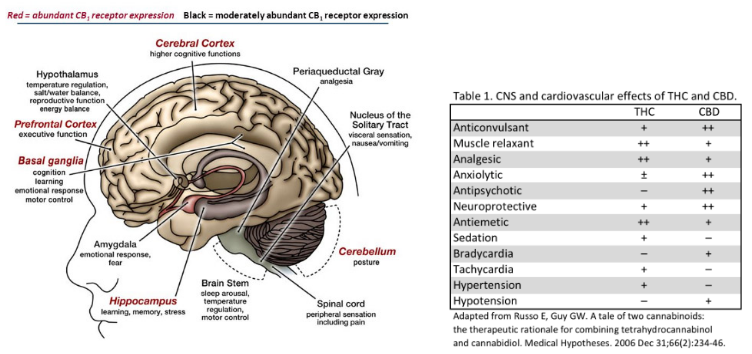
Activation of the EndoCS depends on which receptor and where you are doing it. Activating the CB1 receptor, which is mainly found in the brain, leads to a decrease in the neurotransmitters GABA and glutamate. This effect is found where CB1 is dense, namely the prefrontal cortex and the hippocampus, which explains the decreased cognition and short-term memory impairment. CB1’s effects in the spine reduce the incoming signals from sensory neurons from the periphery which ultimately results in decreased sensation (which means less pain). In the eye however the CB1 receptor causes a fluctuation across the retina which may explain the visual effects of potent Cannabis.
Broadly we can look at the effect of the EndoCS and see how the activation of CB1 and CB2 results in the effects of Cannabis we expect. CB1’s activation in the hypothalamus decreases the release of Leptin, the main hormone that tells the body that it is satiated which results in the munchies. Likewise, CB1’s effect on the hypothalamic-pituitary-adrenal axis decreases the release of pro-stress Glucocorticoids such as cortisol that tell the body its in danger. One pathology of anxiety is the inappropriate release of the stress hormone which causes people to think something is wrong even though they logically know nothing is. Activation of CB1 reduces the stress hormone which would relieve anxiety and make social inhibition lower thus making someone more sociable.
While CB1 is found mainly in the nervous system, CB2 is found mainly in the periphery, especially in the immune system and the GI tract. As an inhibitory receptor, CB2 reduces the effect of inflammation on the tissues where it is found which explains its effect in decreasing nausea, improving appetite in patients with sensitive intestinal linings due to disease (such as Crohn’s) or due to other drugs (like in chemotherapy). On the immune system, CB2 reduces the response of immune cells to pro-inflammatory signals and essentially makes them chill out as well as making them more sluggish moving around the body.
Of our two chemicals, THC and CBD, they each affect different receptors. THC primarily only effects CB1 but it does have good binding to CB2 allowing for all those lovely peripheral effects. CBD however activates CB2 only and is minimally effective at CB1 which means that it is essentially non-psychoactive. The potency of Cannabis has increased over time and samples nowadays contain up to 400% more THC than samples from the 1950s and 60s. This may sound like a bad thing but is more of a function of dose—the more potent you are, the less drug required to get the same effect.
THC Derived - Following the synthesis of THC in 1964, multiple studies were conducted and produced families of potencies based on their modification strategies.
The n-pentyl side chain on C3 is the key pharmacophore of THC. A shorter side chain reduces the potency of the compound. THCV, a C3 propyl derivative, shows a 75% reduction in potency at CB1. An increase in alkyl side chain (hexyl, heptyl, octyl) increased affinity and potency at CB1 and CB2.
Opening the pyran ring (ring B) create the Cannabidiol family. These chemicals have very low psychoactive effect due to decreased affinity for CB1. Swapping the pyran (O-ring) for an N or ring expansion by one carbon can retain activity.
The benzopyran structure (O-ring bonded with benzene ring) with an aromatic C1 hydroxyl is required for potency. However, as with CBD, the benzopyran ring is a definite requirement for activity but does confer activity. This is why CBD can be active but cannabichromene is inactive.
The C1 phenolic OH is incredibly important for activity. Structures that swap the C1 phenolic OH with the C3 alkyl side chain are completely inactive. Removing the OH at C1 eliminates activity too.
Esterification at C1 however retains activity. This is due to the rapid ester hydrolysis reestablishing the phenolic OH quite easily. Etherification however eliminates activity.
Replacing the OH with NH maintains activity but SH eliminates activity.
Placing a C10 methyl group decreases the activity of the C1 OH group. This is due to the close proximity of the substituent.
Substitution of the aromatic ring can greatly change the activity of the molecule. Electronegative groups like carboxyl, carbomethoxy, and acetyl groups eliminate activity possibly by decreasing the pka of the OH too much. Alkyl or hydroxyl groups retain the activity when placed at C2. Alkyl or hydroxyl in C4 reduce activity.
The alicyclic ring (ring C) creates unique properties. A double bond C9=C10, C8=C9 are still active. C10=C11 retain activity but decreased potency. A methyl at C9 increases and is best for activity. Axial groups decrease affinity while equatorial groups increase affinity. Likewise, fully saturated rings are active. Activity is still retained even with ketones, alcohols, or epoxides.
A C-ring substituted by nitrogen or sulfur retain activity. Optimum placement is at C7 or C9.
So Cannabis works, should we use it in medicine?
The question of should we use something? is a very difficult question to answer. The Anthracyclines like the drug Doxorubicin cause an irreversible cardiotoxicity, that when it is caused, has a 79% mortality rate. Doxorubicin is also one of the most effective drugs in the treatment of leukemias, a notoriously dangerous and aggressive cancer that is the most common cancer in children. Should we use doxorubicin despite the risk of cardiotoxicity? I’m not sure but there is a couple of things to note here: firstly, despite the fearmongering, Cannabis is not nearly as dangerous as Doxorubicin or other Schedule 1 drugs. Hell, I’d wager that its safer than alcohol, one of the most ubiquitous chemicals in human history. Secondly Cannabis has benefits in prescribed medicine and recreational use BUT it is not without danger entirely. In researching this post I came across some websites purporting the no-risk use of Cannabis which is just not true—we know that the use of Cannabis is harmful in pregnancy and can have negative impacts on children who smoke and to say its 100% safe is more dangerous than saying it's worse than heroin in my eyes. Regardless, let’s take a look at where the medical world stands on the most controversial plant.
One of the first uses of Cannabis in medicine is in the treatment of cancer. In the treatment of cancer, we often use chemotherapeutic agents which attack the fast dividing cancer cells while leaving the slower dividing cells of the body unscathed. Well, partially unscathed, because we do have some cells that get targeted by the cancer drugs which creates nasty side effects to the regiments. Namely the cells that line the GI tract which makes the stomach and intestines incredibly sensitive to acids, salts, and fats. Now, you find me a food devoid of acid, salt, and fat and I’ll go tell the cancer patients to only eat that (you can’t also take the eyeroll). As such, Cannabis has been used for its CB2 effects to decrease GI sensitivity as well as its CB1 effect to induce appetite. The goal is to get the patient eating more and getting nourishment while enabling them to keep the food down and prevent vomiting or nausea. Likewise it calms the patient who is likely stressed, anxious, or depressed due to their condition or disease.
If you look at the cancer world and see the recommendations about the use of Cannabis in cancer you’ll keep reading this, “we support the need for more scientific research.” I mean yes, but what do these experts say about the current level of research!!!! According to the National Cancer Institute, the data does support the use of Cannabinoids in the treatment of chemotherapy induced-nausea and vomiting in patients being treated for cancer. However with one big caveat, the use of only Dronabinol and Nabilone have been cited as useful, not necessarily smoking or ingesting Cannabis. Dronabinol, which is synthetic THC and is identical to the natural drug was developed for anorexia associated with AIDS while Nabilone is a THC analog. Both come as a tablet or solution (depending on brand and availability) and would have the same effect as smoking or ingesting, so once again, why the distinction with these pharmaceuticals over the plant? Is it for money? Well…
While i'm sure the drug companies profit from the use of tablet THC instead of the plant, institutions are recommending using the tablet for one big reason: they are chemically pure and exact. In order to distribute a pill, the manufacturer must ensure that the amount of ingredient on the label is what is in the pill. So if you take 100mg of Dronabinol, you’ll get 100mg. Smoking a plant? Well there is more variability—a portion of that plant might have slightly more concentration of THC than the next time you get some and so, technically, the dose you are receiving changes. With mountains of varieties nowadays, the likelihood that the amount of drug you are receiving by smoking or ingesting plant THC versus a pharmaceutical pill. Stepping outside of a dispensary, a person might be ingesting an unknown concentration of Cannabis that might be laced with unknown chemicals.
Now, does this discrepancy in concentration of the plant from product to product amount to a clinically significant effect in which a person should not smoke if receiving cancer treatment? Yes…and no. When we are looking at cancer it's important to put the situation in perspective and look at all the factors. Let’s break it down:
Remember that Cannabis has an effect at dulling pain signals which can be pretty severe in cancers. Currently cancer patients are some of the largest consumers of opiates due to the severity of the pain they experience and so its thought that using Cannabis may reduce or prevent the need for using opiates. Some studies have shown there to be a reduction in opiate use when patients used Cannabis, especially in pain syndromes like Fibromyalgia. In a 4-year non-cancer pain study, patients were divided into 3 categories: no use, light use, and near daily/daily use of inhaled Cannabis. For patients who did not use Cannabis, their pain scores increased by -0.4 points over the course of 4 years versus Cannabis users which decreased by 0.2 points. Likewise, 20.9% of non-users discontinued their opiates while 21.5% of near daily/daily users discontinued theirs. Not much difference between the groups which suggests that Cannabis is unlikely to be the answer for pain and the National Institute of Drug Abuse (NIDA) does not believe that legalization of Cannabis has decreased opiate use. So why is Cannabis claimed to cause reduction in pain? My guess is it has more to do with making the person sleepy rather than actually modulating the intense pain signals.
Okay well what about nausea and vomiting? Well Cannabis has a lot of research in its benefit in curtailing nausea and vomiting associated with cancer treatment. Great, case closed! Well… not so much. The issue comes with how the nausea and vomiting is decreased—mainly through CB2 by decreasing the sensitivity of the GI tract. Which chemical mainly activates CB2? CBD, not THC. So the hiccup that many physicians have with using inhaled or ingested Cannabis in treatment is that you get both the psychoactive chemical AND the anti-nausea chemical that we were looking for. While some patients may like the psychoactive effects of smoking Cannabis, the plant is known to alter one’s senses and reaction times which makes it dangerous if they have to drive or operate machinery. Technically, it would be much safer to have someone take CBD than smoke Cannabis for the anti-nausea effect as they would get the benefit without the impairment.
This is another big issue of not using pharmaceutical grade CBD in the form of Epidiolex (100% CBD). If you go online and look at some of the vendors of CBD, there are many claims that CBD cures cancer, which is just false. CBD has been shown to react with cancer cells in a positive way but it is far from a cure which resulted in thousands of people delaying treatment in favor of a natural remedy. Many of those advertisers were fined and jailed for these claims. Additionally, a study of the concentrations of online and brick-and-mortar CBD found that concentrations fluctuated wildly when tested for purity. Of the 300 vendors tested, only 35 had a product that tested with 0.1% of the concentration they were reporting on the package. Those vendors were notified (as well as the FDA) and when the study was repeated, only 26 passed (280 repeat vendors).
Besides chemotherapy induced-nausea and vomiting, one of the most common conditions to also have severe nausea and vomiting is pregnancy. According to the American College of Obstetricians and Gynecologists, Cannabis use may be teratogenic (causing deformations) resulting in reduced fetal growth and long term neurologic complications. These conditions are impaired attention, learning and memory deficits, and behavioral problems in the children born from mothers who smoked during pregnancy. Autism, schizophrenia, bipolar disorder, and depression are all conditions that have a pretty clear link of mothers who smoke THC during pregnancy. This also includes using Cannabis while breastfeeding as about 2.5% of the maternal dose crosses into the milk during feedings. In fact, THC accumulates in the milk and may stay there up to 6 weeks after stopping ingestion of THC products. As such it is recommended that pregnant mothers should not use Cannabis. A study in 2018 was conducted in which a ‘customer’ called 400 dispensaries saying she was 8 weeks pregnant and experiencing morning sickness. 70% of the dispensaries recommend using Cannabis for the customer. 65% of the recommendations were based on personal opinion and 36% stated that it was safe during pregnancy. Talk to your doctor about the use of Cannabis during pregnancy if you have questions.
One of the complications of using Cannabis is that it can have the opposite effect on nausea and vomiting. Using Cannabis at least once weekly puts a person at risk of developing Hyperemesis Gravidarum, a severe nausea/vomiting condition normally seen in 1-2% of pregnancies. Called Cannabis Hyperemesis Syndrome (CHS), people experience significant vomiting and nausea that may last for a few days following ingestion. I couldn’t find an exact number on this but it appears the rate for developing CHS is extremely low (<1%).
If it seems like I am bashing Cannabis in cancer, I really don’t want that to be the only impression that you get of Cannabis from me. When someone is going through chemotherapy they may be unable to ingest something as small as crackers or drink small sips of water. Cannabis is incredibly useful in what it does—decreasing nausea/vomiting and stimulating appetite which allows us to ensure the person has the nutrients they need to fight the cancer and go through chemotherapy. What I want you to understand is that there are drawbacks to smoking Cannabis that may make it unreasonable to use, and like any drug, we must acknowledge the risks and benefits. If I had a cancer patient asking if they should smoke Cannabis for their nausea and vomiting, would I recommend it? I would definitely recommend the use of a CBD oil that is approved by the National Community Pharmacists Association (NCPA) which runs a list of brands that have a pure product (link here and here).
Why not THC? Well smoking THC can increase the risk of heart attacks and doubles the risk in patients age 18-44 years old. Even low doses of THC can cause tachycardia and low blood pressure which can cause the heart’s blood vessels to spasm while also reducing the oxygen carrying capacity of our blood. I don’t think the risk of developing a heart attack (especially if you have other risk factors) is less than the benefit of ingesting THC with your CBD. Cannabis, just like other drugs, also interacts with the metabolism of other drugs and can pose a major interaction depending on the other drugs being taken. So if you smoke, tell your doctor so, so they can effectively treat you. THC can also induce withdrawal if someone stops smoking suddenly, which can last up to 14 days depending on frequency and potency of the THC. So in short, THC has more risks than CBD which I just can’t overcome to recommend it.
I used Cannabis to relax, so what about that?
Oh boy. Well this is the question I often get and the short answer is use everything in moderation! I firmly believe in patient autonomy and I don’t believe it is my place to force a person to stop using something—people can make their own choices, but I do want to make sure they are educated about the benefits and risks. My goal for this section is not to influence someone away from using Cannabis if it helps them relax but just be aware that, on average, there is a wide range of effects. Hell, everyone has a friend that has tried smoking Cannabis and it made that person paranoid or super anxious rather than relaxed (looking at you Dad). As such we will take a look at Cannabis in the treatment/modulating conditions such as anxiety, depression, and other similar psychiatric illnesses. After we dive into what Cannabis is useful for, I want to dispel some of the myths/rumors/conspiracy theories that Cannabis is supposedly able to treat. Sometimes I hear that since Cannabis is a natural plant, it is completely safe and harmless. This statement is not only over-simplified but also very false, and I wholeheartedly believe that those who are serious of the use of Cannabis recognize both the big benefits and the big risks.
Anxiety is a bit of a monster—it can creep up on us in ways that we don’t fully understand and often by the time we realize that we are anxious it has already ruined the moment/day. Before we get to Cannabis, let’s take a look at what we think causes Anxiety: the big players that we first have to understand are the Amygdala, the Thalamus, and the Raphe Nuclei, and the Locus Coeruleus. Our main character here is the brave Amygdala, standing proud in the middle of the brain and is responsible for mediating the fear emotion. I think most people believe that the Amygdala causes fear but its more accurate to say that it is able to modulate the level of fear we possess based on the stimuli that its receiving from the other parts of the brain that affect it.
For example, two of the biggest troublemakers in the brain are the Thalamus and the Frontal Cortex. The Thalamus, which is heavily involved in the acknowledge of social behavior, and the Frontal Cortex, which is our logic center both produce an excitatory neurotransmitter named Glutamate (GLUT). Glutamate’s function is to turn on the parts of the brain that it is released on…like the Amygdala. During times of stress, say when you see a bear or accidentally spilt red wine all over a white carpet while house sitting, the release of Glutamate onto the Amygdala tells it that something bad has happened. Once activated, the Amygdala immediately starts yelling at the Hypothalamus to start waking up the organs to get ready to fight or flight (or get paper towels and say “shit shit shit”) and turns the Hippocampus off which would resist this change to baseline. The result is that the heart starts beating faster, the adrenal gland releases Cortisol (the stress hormone) which tells the liver to release stored energy, and gets the muscles ready for some action.
Now, the Frontal Cortex and Thalamus only interact in an excitatory way, so if we had nothing to counteract them, we’d be in fight mode all day long, which would be exhausting. Once that initial stimulus has arrived, the Amygdala alerts the Locus Coerulus who then produces copious amounts of NorEpinephrine—another stimulatory neurotransmitter. In this way the LC keeps the fear going and keeps our body in a heightened state of arousal so we don’t lose focus of fighting or fighting. In order for the LC to keep producing NorEpi it needs the Amygdala to periodically tell it to go on high alert. In the event that the Amygdala is not getting stimulated by the Thalamus or Frontal Cortex, i.e. because there is no danger, then the LC has no reason to be turned on and eventually it stops keeping us in that heightened state.
Probably one of the most important structures next to the Amygdala in the procurement of Anxiety is the Raphe Nuclei. Despite it being used in multiple areas of the brain, the Raphe Nuclei is responsible for producing and delivering the majority of the Serotonin (5-HT) that is used by the brain. Serotonin is an inhibitory neurotransmitter and so when the Raphe Nuclei is alerted that is danger, it immediately starts producing Serotonin. If the danger persists, then the amount of inhibition is much less than the amount of stimulation which means we still are fearful. But, as that stimulation goes down, Serotonin is slowly able to calm us down and eventually we get past the Anxiety. It is believed that one of the major pathologies of Anxiety is the lack of Serotonin in the brain which prevents the calming effect. No Serotonin = No ability to turn off the fear = Anxiety.
So this is all well and good but, ahem, what about Cannabis? Remember that the Endocannabinoid system (EndoCS) is primarily made up of the CB1 and CB2 receptors. In the image above we can see that CB1 is mostly found in the areas of the brain that generate stimuli or interpret that data such as the Cortices (decision making, cognitive functions) or the Hippocampus which is responsible for memory recall. This is why using Cannabis can create the sense of relaxation since it interrupts the brains ability to think and may be why some people call it the “stupid high.” While CB1 is found in the other structures in black, the density isn’t enough for it be a major receptor compared to other neurotransmitters. What you’ll notice is that the amygdala is NOT a major structure where CB1 is found BUT CB2 is found there! CB2 is an inhibitory receptor and when activated in the Amygdala it dulls the generation and fear interpretation—so while the Frontal Cortex or Thalamus may be trying to say, “OI something scary is happening,” the Amygdala isn’t listening. Remember that CB2 is mainly activated by Cannabidiol, not THC. This is why CBD oil and supplements are able to calm someone and be used in the treatment of anxiety without the need for THC. Smoking Cannabis would deliver both chemicals and they would have a synergistic effect that would lead to more anxiolysis (decreased anxiety) but using THC is not a requirement.
Studies surrounding the use of Cannabis for Anxiety show that it is mostly useful acutely, meaning that its beneficial in the short term and with smaller doses rather than higher freq/high dose/longer use. As of 2022, there is not state that allows the use of medicinal Cannabis. That being said, about ⅓ of patients who use Cannabis report that they use it specifically for Anxiety symptoms, about 16% said for panic attacks, and more than half said it was for purely relaxation purposes. In a large 2016 investigation, it was found that Cannabis use was correlated with increased prevalence of alcohol or other drug use, not necessarily Anxiety disorder which means that people used it more for the high effect rather than medicinally (n = 34,516). A 2014 meta-analysis of 31 studies (n = ~112,000) from 10 countries found a small positive association with Anxiety and Cannabis use but the effect diminished rapidly over 1 year of daily to near daily use (5-7 uses in a week). The most common disorder in which Cannabis is used is for Social Anxiety Disorder (SAD) which is the most associated with problematic Cannabis use (inability to stop, withdrawal, or other maladaptive behaviors).
What many studies suggest is that when Cannabis is used specifically to treat Anxiety (not for relaxation primarily), the largest chance for success is if the person uses Cannabis in addition to other coping mechanisms. A 2015 study purported a possible mechanism for why many people who smoke Cannabis regularly develop worsening Anxiety overtime is due to the brain decompensating. In a sense, since Cannabis is turning off the Amygdala, the brain starts to send MORE stimuli to the Amygdala to get the same response. So during periods where there is no Cannabis to act as inhibition, you get the full brunt of the heightened fear signal and thus worsening anxiety overtime. This may be a reason for why some people say they must smoke when they wake up in the morning since the Cannabis would have left their system while sleeping. Its been suggested that doses equal to or less than 7.5mg of THC reduced negative emotions while doses close to or above 12.5mg increase fear. Likewise doses of 300-600mg of CBD create an anti-Anxiety like effect while doses above 1500mg create more Anxiety. So does this mean Cannabis is bad for Anxiety? No! But like everything, moderation is key. Just like how some people use alcohol to dull Anxiety, the amount is the most important factor in determining if it's helpful or harmful.
So what about depression then? Well once again the main chemical we believe is acting as an antidepressant is CBD, not necessarily THC. We believe that there is some interaction with serotonin receptor 5HT-1a which leads to a decrease in depression symptoms as well as decreased anxiety. One of the main effects of CBD is to decrease Anhedonia or reduced excitability to pleasurable things. This may be why Cannabis has the effect of making things more interesting than they previously would be—you physically care more about things. Unlike Anxiety, Cannabis hasn’t shown an explicitly positive relationship with Depression symptoms and may be either neutral or negative. Likewise it does have the effect of making depression worse similar to Anxiety as discussed above.
One of the big changes with Cannabis over time is that the average concentration of THC has skyrocketed while CBD has remained the same. This is probably due to growers selectively breeding strains so there is an increase is the mind-altering/psychedelic aspects of Cannabis rather than for the insecticide nature of the chemical. A study of 11,000 Cannabis smokers in the UK Biobank who smoked at least once or more per month has a significantly higher risk of heart disease than nonusers and that their risk of a first heart attack before 50 was much higher. There are two major effects of THC in the blood vessels: firstly, THC causes the liver to increase Triglycerides (TG) synthesis which eventually leads to an increase in Cholesterol. An increase in Cholesterol puts a person at much higher risk of Atherosclerosis or a blocked artery which can lead to a heart attack or stroke. In addition, CB1 has a direct affect on blood vessels to increase inflammation which further reduces the size of the blood vessels allowing for Cholesterol to be trapped easier.
In the lung, smoking Cannabis appears to be an open question if it causes lung cancer or not. Studies have found that Cannabis smoke contains 50% more benzopyrene and 75% more benzanthracene than cigarette smoke. Likewise, since Cannabis smoke is generally inhaled deeper and held for longer, the deposition of tar is about 4 times that of cigarette smoke. That being said, there are few good studies that have showed a clear link between Cannabis smoke and lung cancer. THC and CBD are known to have anti-cancer effects inherently which may be why we see less (not none) cancer due to smoking Cannabis.
These two points aren’t meant to scare someone off of using Cannabis if they do, but they should be aware of the very real dangers and risks of using Cannabis. It is not a harmless plant. It does harm. It can kill. To discount these facts is to be disingenuous BUT, again, that doesn’t mean people should stop using; alcohol can be just as harmful. Again, moderation.
And that’s our story! Hopefully you learned something new. If you have any questions, please let me know! Want to read more? Go to the table of contents in the comments of this video!
Likewise, check out our subreddit: r/SAR_Med_Chem Come check us out and ask questions about the creation of drugs, their chemistry, and their function in the body! Have a drug you’d like to see? Curious about a disease state? Let us know!
So I uhh....sort of didn't pay attention to how much I wrote and instead wrote about 12,000 words worth of information into this post. Look--there is a lot to talk about and now its an 75 minute read. Sorry! As such it was just impossible for me to post this to reddit so instead it is posted to Substack. Going forward I will probably continue to put stuff on Substack (and then post the link on reddit) since it allows me to put triple the amount of pictures into the post. Reddit only allows 20 images and I usually need double that.
So, please head on over to this link and let me know why you think old men kept dying after publishing their big drug legislature.
Hello and welcome back to SAR! Much like the groundhog poking its head out of its burrough, the world is starting to wake up from the dark cloud that was COVID-19. Now this isn’t to say that COVID is gone, SARS and MERS from earlier in this century prove that the Corona Virus is a fact of our lives, but I do think that the worst is over. BUT before people start to click off this post because I dare to say the C-word, today I want to talk about an epidemic that has fallen to the wayside of history: the 1889-1890 Pandemic. Also called the Asiatic Flu or the Russian Flu this was a respiratory viral pandemic that struck the Russian Empire before being transported globally via newly established railroads and steamships. Despite being the first true global pandemic, we don’t really remember this blip of history and the question is: why? Well today we shall explore this forgotten disease and answer the question that wasn’t in your mind at all, there is a COVID-OC43?
Exit, Pursued by a Bear
+2 extra credit points for anyone who knows what this section title references. Before we can talk about the pandemic we have to talk about what was going on in 1890. At this point in time the world was engrossed in what is considered the second Industrial Revolution, also called the Technological Revolution, this period began in 1870 due to the discovery of great synergies. Firstly, the invention of the Blast Furnace by Scottish James Neilson allowed for iron to be heated at higher temps and being tempered with coal in a more efficient manner thus leading to an increased production of Steel. The use and manipulation of Steel cannot be understated—cheap Steel allowed for building larger bridges and skyscrapers, opened up the agricultural sector by providing more robust steam-driven farm equipment to feed the burgeoning industrial working class, built the next standard for war equipment, and most importantly for our story, laid the foundation of rail and steamship transport. The use of rail cannot be understated either: a railway could turn the week long trip from Scotland highlands to London into a day affair (albeit a long one). This ability to transport people or cargo in a day when it would take upwards of a week at times is what changed the idea of distance and made the world much much smaller. Afterall, nowadays if it takes 6 hours to drive somewhere far away we think what a long trip, while in 1810 a 6 hour trip might have been just to get to the next village over.
We call this temporal shortening of distance Globalization and the end of the 19th century represented the first hard step in that effort. Looking at the graph we can see that over the 60 years that rail development took off, rail development was the driving force behind Globalization. A quick look at the rail maps of the German Empire in 1840 vs 1880 shows that having a rail line close to your city or port was crucial for the economic (and defense) of the country. Russia…is a different story or rather an even bigger story. Much bigger.
If you are unaware the Russian Empire was HUGE; at its peak it covered 22.8 MILLION square miles and is the third largest empire in history (after the British Empire and the Mongol Empire). For much of its history, upwards of 80% of the population of Russia lived west of the Ural Mountains in what is called European Russia. But with that area of Russia being occupied densely for thousands of years, most of the natural resources were extracted from Siberia while farming was extracted from the Chernozem region (modern day Ukraine and Kazakhstan). So in order for food or raw materials to be shipped from the outer edges of the empire into the heartland, it would have to cover upwards of one thousand kilometers. Before rail, this was a 2 week journey and all the while you are racing against the clock so the food doesn’t spoil before it gets to the markets in the middle of St. Petersburg.
Up until the creation of the railroad, like most civilizations, trade was done via rivers and luckily the Volga River runs north-south straight through the middle of European Russia. Despite this centrally located river traversing the upper portions of the river were frozen for 6-7 months per year making it basically useless for transferring cargo. Peter the Great built the Vyshnii Volochek System, an extensive canal system, that linked the newly created St. Petersburg with the old capital of Moscow in 1709. Although the canals improved travel it still took 3 months to travel from Moscow and St. Petersburg. To go from Astrakhan on the Black Sea up to St. Petersburg (traversing the entire length of European Russia) was a notable 2 year trip. One way.
Well why not roads? Well Russia at the time was known for very wet soils that made roads extremely muddy and dangerous. In fact, the best time to traverse by road was during the winter when the mud was frozen but this added the danger of trying to transport people and animals in the sub-zero temperatures. Alexander I laid the first real roads in 1817 between Moscow and St. Petersburg which was finished in 1834. If weather held, a small cart could make the trip between the two cities in 10 days but the road was small and could only really allow for small non bulky goods to be moved. The true time was closer to 70 days. In response to this Nicholas I founded a committee to study plans for road development in 1833 that would be studied and funded by central, provincial, and local authorities so all roads in Russia were improved slowly but surely. Despite the good intention, the plan failed due to a lack of funds, engineers, and labor.
Despite the problems with river and road transport, Russian leaders were hesitant to embrace the railroad. Minister of Finance Count Kankrin and Minister of Ways and Communication Count K F Toll believed that money should be spent improving the agricultural sector rather than building these large and expensive machines and rail systems (completely looking over the fact that there was plenty of food it just couldn’t be transported quick enough). The first railroad would then be privately sponsored for mining and would instantly prove their usefulness over horse and cart. In just 15 years the cost of the railroad would be paid for. In response to this the Russian Government believed that private industry should take the financial risk rather than embracing the technology.
On January 6, 1835 Austrian engineer Franz Anton von Gerstner sent a letter to Nicholas I and proposed an extensive Russian railway system. Von Gerstner was probably the most qualified person in Europe due to being the first person to build a railway on continental Europe (Danube-Moldavia line) and he provided statistics about the usefulness of rail. Probably the most important of which was the English’s ability to suppress Irish disorder quickly with easy troop movements. The first line to be completed was between Moscow and Tsarskoe Selo in 1836, with a new St. Petersburg-Moscow line in 1851. With great attribution to the Crimean War (1853-1856), the total amount of rail would increase from 5000km in 1860 to over 53,200km in 1899.
Probably most important among these railways was the Trans-Siberian Railway started by Tsar Nicholas II in 1891. Starting in Moscow in the West, this railroad would stretch 9,289km (5,772mi) to its terminus at Vladivostok in the East. To put this in perspective,if you were standing in San Francisco and boarded a train, the final destination would be Spain, yeah you’d go over the Atlantic Ocean*.* That’s how long this thing is! Despite being the largest province in the country, Siberia represented the least developed part of the country mostly due to its vastness and inability to traverse laterally. Several rivers flow through the region but are untraversable except for 5 months of the year due to freezing over. Walking the distance could take upwards of a year but once the railway was completed it took a mere 7 days. That’s nuts!
Wow you really love trains don't you?
Well… not really i'm pretty indifferent to them but they are fairly important to the beginning of our story! Close your eyes and imagine it is 1889 in the city of Bukhara in modern day Uzbekistan. Bukhara is an ancient city, probably founded sometime in the 6th century BC, the Bukhara region was a regional capital for the Persian Empire when it reigned in this area. Bukhara remained a servant to the dominant empire of the region for the majority of its history and following the invasion of Russia into Iran in 1804, Bukhara once again shifted hands into the Russian Empire. By May 1889 the city was like any other bustling regional power in the late 19th century: merchants hustled their products to passerbys, children played in the street kicking an air filled sheep’s bladder, and doctors made house calls. One doctor, Oskar Heyfelder, was working one warm May day going from house to house when he encountered a sickly old matron of a large family. She was dying—a respiratory influenza had taken hold of her and she was quickly fading. The doctor stood over the old woman with his hat in his hand and recommend opium and a priest. There was nothing more he could do.
Little did Heyfelder know but he had just encountered one of the first people to be infected in the 1889 pandemic and the disease would spread quickly via—you guessed it—railroad. See back in 1879 a new Trans-Caspian Railway was built along an old Silk Road corridor which would have bypassed Bukhara entirely. That is if it wasn’t for the last Emir of Bukhara Muhammad Alim Khan (1880-1944) who was unhappy with the nearest station being dozens of miles away in Kagan so he built a private spur to Bukhara itself. With the rail connection established the disease spread quickly up the railway into Russia and then exported to the rest of the world over weeks. I found a great map from a 1892 book published on the Russian Flu that shows the spread of disease by coloring the map. [In case it's hard to read, go to the link and then page 218 of the pdf].
From the first cases reported in Bukhara, Russian Flu would travel up to Tomks in Western Siberia, Ufa (100 km east of Moscow), Kazan (700 km east of Moscow), Ukraine, and Novgorod (near St. Petersburg) by October of 1889. By November Moscow was hit with 20,000 cases alone which crippled the growing worker’s population and grinded production to a halt. Somewhere between 25-50% of soldiers and students were taken ill which added an extra burden on families. Mid-November saw 180,000 of the one million citizens of St. Petersburg infected. The bread-basket of the Russian Empire was struck next when Kiev and the rest of Ukraine fell to the disease although luckily it hit after the Autumn harvest had already come in.
Once established in Russian the disease was able to spread out of the motherland to other regions. Via St. Petersburg the infection hopped aboard Baltic ships and was exported to Finland, Sweden, Germany, and Denmark. In Sweden up to 60% of the population would be infected within 2 months of the Flu landing. As a major trading hub, Posen had an extensive rail network that allowed for the Flu to move throughout Germany infecting half of the 1.5 million residents of Berlin. Vienna and Rome got it by early December; Paris by Christmas; Spain in January where up to 300 people died a day in Madrid alone. London, Birmingham, Glasgow, and Dublin took a punch by Christmas as well.
Remember that this is the age of small Earth where globalization has made a trip across the Atlantic as short as 7 days. Russian Flu entered Boston and New York City on December 18th, 1889 before being sent West towards Chicago and San Francisco (who would particularly be hit bad). Once in the United States it would spread north to Montreal and south to Mexico and the rest of South America. By February the disease reached East via the Dutch trading companies and spread liberally among the South East Asian population. Japan, Australia, and New Zealand all caught it in April; China in May.
The Deadly Disease Wasn’t That Deadly
Now if it feels like I’m leaving something important out, that's because I am. Usually when you talk about pandemics we talk about how quickly it spread and then the death toll. All told, the pandemic killed about 1 million people worldwide—now don’t get me wrong this is an enormous loss of life and its unfortunate that these people died but in the grand scheme of things it just wasn’t that deadly. During this same period, a global Cholera pandemic was going on which killed at least 4 million people, Russian Typhus Epidemic in 1919 killed 3 million, and in 1918 the Spanish Flu would devastate the globe with somewhere between 17 and 100 million people dead. That being said, some important people did catch the disease: future King Edward VII of England nearly died before his mother, Queen Victoria, left the throne, although many suspect that his catching this disease ultimately led to his death in 1910. His son Prince Albert Victor, the grandson of Queen Victoria and 2nd in line for the throne, caught it in January of 1892 and died at the age of 28 making way for Queen Elizabeth II to eventually be crowned. Augusta, Queen Empress consort to Emperor Wilhelm I of Germany fell ill in 1890 and died within 4 months. Alexander III of Russia managed to just survive the condition which prompted him to make major public health changes in St. Petersburg. I could go on.
So what even happened then? It would start with typical cold symptoms: sweating, fever and chills, sneezing, watery eyes, and dry cough. But contemporary doctors did identify 4 distinct clinical forms of Russian Flu: a simple fever that would increase over 48 hours and then subside within 3 or 4 days; a gastrointestinal form in which people had severe diarrhea, fevers, and stomach aches (which honestly could have been a co-infection with the raging Cholera epidemic at the time); a rarer catarrhal form (profuse mucus production that would fill the sinuses and lungs and progress to pneumonia); and finally the worst one, a “nervous” form that caused intense nerve pain in the hands and feet driving people mad. Regardless of which form someone got the worst symptom, and the most common reason why someone would die outside of catching pneumonia (fluid in the lungs) is developing skin lesions. These bullae (large blisters filled with white fluid) were painful, itchy, and formed in the creases of the feet, hands, and extremities which were prone to popping—once popped they were open sores ripe for infection. If you didn’t manage to die from the skin lesions then kidney failure, digestive inability, or spinal nerve damage that would drive people towards suicide was another common way to die.
Here’s the problem with Russian Flu…it doesn’t appear to be a Flu. Nowadays we attribute the word Flu to the Influenza Virus, a small RNA virus from the family Orthomyxoviridae but back in previous centuries the word Influenza meant any disease that affected humans. The word is derived from the Latin influentia meaning “to flow into” and it was believed that the stars gave off an intangible fluid that flowed into humans and caused sickness. Eventually this idea would morph into the Humoral Theory of Disease in which there are 4 fluids in the body that need to be balanced else they cause disease. There are 4 types of Influeza Virus: A and C which infect a variety of different animals (human, pig, bird, horse, bat), B which exclusively infects humans (although seals have been seen with Influenza B), and D which exclusively infects pigs and cows. If you’re older than 10 years old, you’ve almost certainly been infected with Flu at some point—already the 2022-2023 Flu season has 26 million infections in just the US alone.
Real quick I want to talk about the names of Influenza Viruses. The Influenza Virus is a sphere shaped particle that has primarily two proteins on its surface: Hemagglutinin (HA or H) and Neuraminidase (NA or N). These proteins are incredibly important for the virulence of the pathogen—the Hemagglutinin helps the virus bind to the target cell and infect its viral genome into the cell while the Neuraminidase helps burst the cell when the baby viruses are ready to be released. So far 18 HA subtypes (called serotypes) and 11 NA serotypes have been isolated in nature allowing for considerable genetic variation. Thus we classify Influenza A viruses based on what version of the H and N proteins they have: H1N1 caused the Spanish Flu of 1918 (killing 20-100 million people) and the Swine Flu of 2009 (killing about 400,000 people); or H3N2 caused Hong Kong Flu in 1968-9 (1 million dead). Even still there are several combinations that only infect animals, such as H5N1 is Avian Flu and is tracked by many governments to prevent a possible transmission from bird to humans. All Flu A viruses are also classified by a standard nomenclature based on where and when they were first discovered. For example, Swine Flu was referred to as A/Brisbane/59/2007 since it was first discovered in Brisbane in 2007.
The thing is, Russian Flu may not be an Influenza like we first thought. Traditionally it is believed that the Russian Flu was caused by H3N8 (which primarily infects horses) or H2N2 (which caused the Asian Flu of 157-8). The problem with this is that Russian Flu does not share many of the common Flu symptoms we have seen in other outbreaks—Flu follows a pretty consistent 2-8 day pattern focusing mostly in the lungs. Severe complications of Flu can lead to more severe respiratory distress, meningitis, or encephalitis but other organ involvement is pretty limited. Russian Flu almost always involved other organs. This idea isn’t a contemporary one either, people had suspicions on just what Russian Flu really was.
Following the discoveries of Louis Pasteur and Robert Koch in the field of microbiology, the race of finding the causative agents for common diseases was on. In 1891, German Richard Pfeiffer isolated an unknown bacteria from the nose swabs of patients infected with Influenza. On January 4th, 1892 he announced he had found it, the cause of Influenza: Haemophilus influenzae. There was a momentous uproar in the scientific community because if we know what causes a disease it indicates that we can treat the disease. The problem is that Pfeiffer could not replicate the infection of H. influenzae showing definitively that it caused Flu. But as more and more people kept finding H. influenzae in patients affected with Flu, the observations were corroborated and later was accepted as fact—by 1900 it was believed that the cause of Flu (any lung infection) was due to this bacteria. This fact was firmly cemented in the medical psyche as H. influenzae was found over and over again in Flu victims during the Spanish Flu epidemic of 1918.
But there was some skeptics—one of the big reasons to doubt was that antibiotics at the time did not touch Flu. Now this was before Penicillin but drugs like Salvarsan were the goto agent to kill a multitude of bacteria (you can read more about this arsenic containing ‘medicine’ in my post here!) but it couldn’t touch the Flu. It wouldn’t be until 1931 that the disease Influenza was discovered to be from a virus not a bacteria like once thought. When the development of genome sequencing came about, we were able to sequence Spanish Flu (1918) as H1N1, the same one that caused the Asian Influenza epidemic in 1957 and later Swine Flu in 2009. In 2005 we used samples from graves to ‘revive’ the 1918 virus and found that it was incredibly infectious in primates. When Flu was discovered in 1933, scientists back-dated all epidemics that were called Influenza and claimed it was caused by H1N1. There is additional evidence to support this claim though that Flu may have caused Russian Flu. By looking at serotypes in corpses of adults born between 1863 and 1886, they discovered higher antibodies for the H2 subtype. But when they analyzed samples from corpses from 1910, they had the same levels.
The Hunt for Red Corona
Following the COVID-19 pandemic, researchers started to take another look at the Russian Flu and see if it was infact Flu. COVID-19 does resemble Influenza epidemics due to its similar respiratory symptoms but with other organ involvement, a Coronavirus was implicated more than a Influenza one. There are 7 Coronaviruses that are infectious to humans—3 caused deadly epidemics SARS-CoV-1 (9% mortality) usually referred to the SARS outbreak in 2002-2004, MERS-CoV (30% mortality) which popped up in 2012, and SAR-CoV-2 (0.6-2%) which we are in right now. The other 4 Coronaviruses are implicated in 15-30% of common colds and have been in the population for decades (probably centuries), HCoV-229E, HCoV-NL63, HCoV-OC43, and HCoV-HKU1. The milder viruses are seasonal and show up every 3-4 years during the normal Flu season of autumn to early spring.In 2005 Belgian researchers found that HCoV-OC43’s genome was very similar to another coronavirus found in cow, BCoV. The DNA sequence of OC43 was almost identical to that of BCoV isolated from corpses from 1890. Does this mean that a coronavirus was the cause of Russian Flu? Well let’s look at the evidence:
Firstly, we know viruses can jump between species, especially when there is big populations of that species in prolonged contact with the second—this is why giant pig or bird farms can be hotbeds for viral transmission. With the development of railways in Russia in the second half of the 19th century, cows started to be transported in mass quantities along the railway. This meant that thousands of cattle were packed into tiny poorly ventilated compartments allowing for easy transmission of disease. From 1870 to 1890, the bacteria Mycoplasma mycoides completely crushed cattle populations due to them being packed in close quarters and herds had to be slaughtered quickly to prevent the spread from going worldwide. What would those workers have been exposed to as they started to slaughter more and more animals? Diseases, specifically cow diseases that could have made the jump. This isn’t as far-fetched as it seems—the 2002 SARS epidemic became much worse following the slaughter of thousands of civets for human consumption. Likewise it was noted in 1889 that the cows showed the same symptoms as humans. So it's possible that HCoV-OC43 is the virus that mutated from cows into humans. So between the similarity in symptoms between COVID-19 and Russian Flu, the industrialization of the railways allowing for viruses to mutate and then for people to spread it quickly and globally, and the use of genomic science, we now believe that Russian Flu was really Russian COVID. Let’s just be glad that HCoV-OC43 is now a mild cold and doesn’t cause painful blisters and horrible nerve pain. Cheers!
Morphine is considered to the the Proteus of Organic Molecules.
As the first alkaloid isolated from plant matter and done so on an industrial scale, it became the Proteus of the modern pharmaceutical industry and inspired the field of natural product chemistry. The first major SAR elucidation efforts were conducted by the American NRC team of LF Small, NB Eddy and EL May beginning in 1929 in order to find morphine derivatives that had reduced addiction liability. Thus, morphine, or the search for safer mu-opioid receptor agonist analgesics, is the forefather of the field of Medicinal Chemistry and modern SAR Elucidation is based upon techniques developed during these early SAR invesgitations. --------------------------------------------------------
In one of the many ironic twists of history, white European Cartels of the 19th century forced Chinese merchants to continue purchasing their opium. When the Chinese passed some of the first drug control laws, the economic importance of Indian Opium sales to China necessitated gunboat diplomacy and sparked a brief series of wars.
After America had their own devastating Napoleonic-era conflict, the generation that fought that war, inherited a condition of morphinomimetic habituation to a degree and scale not observed since. Known as the "Soldier's Disease" it affected many Civil War veterans throughout their entire lives. The opioid crises of today is nothing new. History is cyclical and there is always something to be learned through well versed retrospectives.
I've spent 15 years of my life working as a medicinal chemist in the arena of opioid development. I've worked with all the subtypes: mu, delta, kappa, and NOP/ORL1. I've studied them on three continents and worked with them under a variety of regulatory regimes.
Unlike most professionals in the healthcare field, I'm not afraid to discuss my own personal struggles with opioid addiction, which I certainly took to "another level" and developed some monster tolerances to some novel and highly potent agonists. While I don't consider addiction to be a moral or criminal issue, it rarely improves the lives of those trapped it in its cycles. It's a disease state just like any other and, unfortunately, the responsibility for this generation's "crises" rests at the feet of my own industry.
The literature survey I present here are filled w/ sarcasm, lighthearted humor and a few personal anecdotes. There's plenty of meat and potatoes to be had. But through anthropomorphizing these quantized molecules, perhaps I can make the topic of classical morphinan SAR more fun, flippant and digestible.
Molecusexuality of Opioid Stereochemistry: The Morphinan In the Mirror, Part IA: non-IUPAC approved Molerotic adventure in anthropomorphic Molecular sterics
By:
Edie Norton w/ a Fire Crotch, Sufentstress of the morphinomimetic mattress, the π-pair-o-skinny-jeansmolecuho, Mini-Thinny Mouse, the RemiFennySkank, the μ-gμrμ…
Dμchess Vσn δ
A well cited exploration into the Stereochemistry, Geometry and Sterics of the Opiosphere
-------
The idea for this post came about as I was working on another post about N-aralkyl substituted morphinans entitled “Tetracycles in Tiaras”. [see u/jtjdp for this post]
In prep’n for that post, I did my typical image hosting on Imgur. The concepts of cis-(1,3-diaxial) piperidine fusion, cis-B:C and trans-C:D ring fusion are important to the morphinan and polycyclic classes. As such, several of my images featured these cis/trans (molecular) orientations quite prominently. It soon earned a slew of downvotes.
I discovered the reason for this lack of opio-enthusiasm when a confused Imgurian left an interesting comment:
“Yo, why do you gotta assign genders? Can't they just make up their own minds and live their own lives w/o you forcing your own binary genders?”
For chemists out there, this certainly was hilarious, but i decided to humor this Imgurian and imagine a world where his polarimetry correct views applied to quantized matter like any other civil or fundmaental human right.
Technically these molecusexualorientations were assigned by people. While they aren’t genders as much as geometricorientations, either way, it is forcing nomenclature onto a quantized state of matter. And forced conformations are no a laughing matter.
Forcing a Fetty to be a Frannie, or a Diladdy to be a Maddy, or a Thebby to be Thaddy, is in contravention to the “UN Resolution on Stereochemical Self-Determination.”
A clear cut “heroin rights violation**.**”
------I'm going to pause for a moment, and allow that rapid fire burst of punnery to fully set in------
But enantiomers don’t resolve themselves. They need a helping hand.
And that’s how I came up with the idea for Molecusexuality.
Clearly there is a need to explain the long history of the brave pioneering molecules that came out of the cis/trans closet long before the LGBTQ community was even a thing. Nature lead the charge. Humanity eventually followed.
There are some reactions, such as the Knoevenagel (benzaldehyde + nitroalkane + n-butylamine), which still remain in the closet, at least until the resulting nitrostyrene provides the confidence needed to stand proud outside of said closet.
The DEA has been engaging in molecular eugenics for fifty years. They split hairs on matters of cis/trans 4-methylaminorex, dextro-/levo-methorphan and countless other higgedy-piggedly matters. Forcing molecules to conform to arbitrary legal codes is as absurd as the concept of prohibition.
Statistically speaking, molecules are braver than man. This, of course, was left out by the mainstream press during Pride Month. I’m here to set the record 109.5 degrees/Tetrahedral.
I’m a medicinal chemist, self-experimentalist in the same vain as Hoffmann and Shulgin, but when it comes to morphinans and 5,9-dialkyl-6,7-benzomorphans, I’m all about the absolute configuration of C(14).
In fact, even among the 14(R)-cis-morphinans, i.e. Morphine, cis/trans isomerism is always in play within the the same molecule. The B:C rings exist in a cis-decalin fusion while the C:D rings are fused in trans-decahydroisoquinoline arrangement.
The quantum duality of cis-trans ligand-bendery among the morphinans is Quantum Pride. I’ve made only a few novel discoveries over my career. But I have made many ligands and many of those have graced my spoon.
Of the ~ 25 of these that are of the Opioid variety (especially near and dear to my blood-brain barrier), many have been chiral. As such, they involve a range of stereochemical relationships that are important to their chemical reactivity and bioactivity.
That’s only counting successes. Many were failures. And many of those were due to incorrect stereochemistry. I will share examples with you during the intermissions, entitled: “Epic Failures in Stereoisomerism.”
In humans, mu-stereotypy tends to suppress libido. Making them less sexy. What about other mammals?
While the lab mice are remaining mum as church mice on these topics, their behavior says all we need to know.
This is known as a Straub tail. It has been a hallmark of mu-mediated activity since Straub first noted the phenomena in 1911. They call this a "narcotic cue." And it is still used today as indicative of mu-mediated stereotypy.
I'm here to make opioids and the average SAR narrative into a soap operatic adventure. Perhaps not as sexy as John Stamos on General Hospital, but with a little help from my brand of prose, help guide you into ligand lust. Welcome to the world of Molecu-sexuality.
This is far from a comprehensive review of the topic. If you seek a deeper dive, I recommend the works of AF Casy, PS Portoghese, NB Eddy, EL May, P Janssen, Leysen, and Van der Eycken.
As with my other chemical musings, these are finger friendlyMorph-Dives into the chem. lit. They're "abbeaviated", but there's enough page flicking to advise protection. Be sure to wear thimbles (or at least lubrication), as thumbs are bound to get pricked. I am not responsible for any paper cuts.
Fundamentals
VOCAB-REHAB
Stereoisomers - isomers with same connectivity; different configuration (arrangement) of substituents
Enantiomers - mirror-image asymmetry; non-superimposable (i.e right-/left-handed morphittens); only differ by the direction (d,l or +,-) of optical rotation
Diastereomers - stereoisomers that are not mirror images; different compounds w/ diff phys properties
Asymmetric Center - tetrahedral carbon w/ sp3 hybridized orbital; capable of σ-bond; (4 different groups attached)
Stereocenter - an atom at which the interchange of two groups gives a stereoisomer
Asymmetric Carbons and cis-trans isomerism are the most common stereocenters
Cis/Trans isomerism - aka: geometric isomerism; applies to orientation of specified groups about a fixed bond, such as a fused heterocyclic morphinan system or an alkene (dbl bond) - cis = same geometric plane; trans = opposite geometric plane; in the morphinan series this refers to fixed constrained alicyclic ring fusions where the amount of rotational freedom is limited
E/Z notation - (E = opposite geometric plane, Z = same geometric plane) Using such notation would make trans-fats become E*-fats* and I don’t believe in furthering the cause of trans-fat bigotry. Thus I will be sticking to the conventional terminology using cis = same side of bond (same geometric plane) and trans to indicate the opposite.
Optically active/Chiral Compound - rotates plane of polarized light in polarimeter (achiral = no rotation) - chiral molec must have an enantiomer
Stereospecific Binding - SSB - The Hallmark of Morphanity
The μ-opioid receptor (MOR) is characterized by stereospecific binding (SSB).This is not the only G-protein Coupled Receptor (GPCR) that demonstrates SSB, but it was one of the first to be well recognized and is considered a classical model for the SSB of GPCRs.
There are other features that set the MOR apart from other GPCRs, such as the size of the mouth of its ligand binding pocket (active site), which allows it to fit a wide-range of diverse structures including highly flexible acyclic diphenylheptanones (methadone), the high-mol weight (but mostly planar) etonitazene, the atypical bezitramide, spirodecanones (R5260, R6890), and the most rigid and highly-constrained system in the opiosphere, the 6,14-endo-ethano bridged oripavines. (etorphine, buprenorphine). This versatile orifice will be explored later.
The crystalline structure of the murine MOR was elucidated in 2011, the same year I finished grad school. There are new discoveries made every day in this area. It can be difficult to keep track of them all, but the link below contains some of the highlights. The molecular dynamics and mechanics of ligand-receptor interactions and the binding modes of the lig-rec complex are important, but are beyond the scope of this monograph.
Stereospecificity, that is, a preferential affinity for one enantiomer over another, depends upon the ligand’s absolute configuration. That is, the 3D arrangement of substituents as they are configured around a chiral center in real life.
As a matter of convenience and convention, the medical and pharma literature uses optical rotatory stereodescriptors when referring to enantiomers. Examples include d-(+)-amphetamine (Dexedrine) or l-(-)-amphetamine (Lamedrine).
The reason that d-amphetamine is more bioactive than its antipode is due to the receptor-preferred absolute config of its asymmetric carbon, which is configured as (S), which means the substituents about the chiral center (as designed by a convention known as CIP Priority Rules) are oriented in a counterclockwise or left-handed direction.
This is the opposite direction that dextroamphet rotates polarized light. D-(+)-amphet rotates light in a clockwise, (+), or right-handed rotation. But its substituents are oriented in a counterclockwise manner according to CIP priority rules, giving it the designation dextro-(S)-amphetamine.
The less active levo-antipode has the (R) abs config, while rotating light to the left or (-).
The optical rotation, in and of itself, does not tell you the abs config about a stereocenter. Nor does the abs config indicate the optical rotation of a compound. Bioreceptors, however, will favor a particular absolute config over another.
Absolute configuration and optical rotation are two separate concepts that are related as they are different ways of classifying stereochemistry, but are not interchangeable. They are measured/determined in different ways.
The most important is absolute configuration. This is the most fundamental property of mol geometry and changes to abs config alters the activity and optical rotation of the molecule. Configuration is determined with spectroscopy.
Optical rotation is an inherent molecular property that can be measured with polarimetry. A pure optical isomer will have a very specific value. The direction and degree that polarized light is rotated by an enantiomer is an important analytical value found in the Merck Index and the anal. chem. lit. Combined with other data, it can be used to identify and characterize optically active products and even identity unknowns.
Left-handed (like me) or counterclockwise rotation is designed levorotatory, levo-, l-, or (-).
Right/clockwise rotation = dextrorotatory, dextro-, d- or (+).
Optical rotation is determined with a polarimeter and polarized light source (typically 589 nm) at a standard temp (listed alongside the [alpha] value in the procedure).
Beyond helping to distinguish enantiomers and analysis of asymmetric products, it is of little use when visualizing the actual spatial arrangement of ligands about a chiral center. For this we need to know the abs config about that chiral center.
The more active enantiomorph is referred to as the eutomer.
It's the one you want in your spoon. As in, “You da man, homie, for hookin’ a brotha/cister/non-gender conformer up w/ da good shiz.”
Examples: l-(-)-levorphanol, cis-(+)-3MF, d-(+)-dextromoramide, etc.
Generally, the eutomer is more euphoric. I was trying to make a mathematics joke involving Euler, but I'm shite at maths and nothing comes to mind.
The less active enantiomer is the distomer.
If it's included with the eutomer this is typically acceptable. An equal mole fraction of enantiomers is referred to as a racemate. A Racemic mixture is not necessarily a bad thing. In fact, it makes you a Mix Master Racemate. Or a Mixture of Ceremonies.
If they want to pay out the nose for Lortabby, go to Walgrabby. If they want reasonably priced mu-tuba goodness, they come to mu-mommy. “Muuu!”
Of course if you sell dextromethorphan (DXM) as white bird (“Heron”), you risk getting a Codone stomp. This is a form of levo-larceny and is frowned upon. (cf. “fentafraud”)
Selling a distomer while claiming it is the eutomer is a sign of disrespect.
Hence the dis in distomer.
The *eudismic ratio is the ratio of the activity of the eutomer over distomer.
Most opioid distomers are essentially inert or low-efficacy ligands that interfere very little with eutomer binding. These have little effect on the bioactivity of the Racemate. But sometimes they have antagonistic effects and/or undesired agonism at another receptor. We will cover case studies (some from my gag reel of personal embarrassment) as we continue.
Reversing the configuration of chiral centers will change the direction of optical rotation. Natural l-morphine has the opposite config of the synthetic d-morphine (the distomer) about it's five chiral carbons.
Simpler molecules are easier to visualize.
Switching the config of the chiral center of levo-(-)-(R)-methadone to the (S)-isomer, will give you the antipode with the opposite optical rotation: d-(+)-(S)-methadone (this is the distomer and has 1/40th the potency of the eutomer).
The eudismic ratio, activity/affinity of eutomer/distomer, is approx 40:1 in the case of methadone.
We will see how this works in multi-chiral ligands, such a morphinans later on.
Abs config refers to the arrangement of substituents about a chiral center. This is determined spectroscopically via NMR and crystallography, that is, interpreting scatter-patterns formed by beaming X-rays through a high purity crystal (Scat Pat).
In the organic realm, the chiral carbon is king. Inorganicists (Judas Priests) can concern themselves with the supra-ligancy of (hair) metals. We will stick with the simpler tetrahedral axis of Carbonity.
Official IUPAC nomenclature has adopted a handy convention known as CIP Priority Rules**.** These were developed by the trio Cahn-Ingold-Prelog. When the nobel laureate trio formed a posse, they played around w/ their initials forming ICP. As such, they became the first juggalos to have been honored with a handshake by the Swedish Sovereign. (seriously, CIP rules are important and there’s a whole load of interesting ancillary backstories/anecdotes that are entertaining - ICP = Insane Clown Possee; for anyone who got that joke, I hope you have better taste in music).
The easiest way to pop one’s stereo-cherry is to start with a single point of chirality: one chiral center, one pair of diastereomers. The simplest chiral opioids are those of the acyclic 3,3-diphenylpropylamines. These highly flexible lipophiles pair strong affinity with favorable lipid solubility.
These are simple molecules with a single stereocenter and a high degree of flexibility, allowing their active species to assume different conformations. The eutomers and distomers of the three ligands reviewed have a variety of optical rotations and abs configuration. They help illustrate the difference between the two stereodescriptors.
Simpler Case-Studies: Single Point Chiralities - Methadone/Isomethadone/Moramide
The MOR-active enantiomer of methadone rotates polarized light to the left and is therefore designated as levo-(-)-(R)-methadone. [Acta Cryst., 11, 724 (1958)]
The config around the asymmetric beta-carbon is assigned (R). Crystallography has revealed that the aminopropyl chain of R-methadone exhibits a gauche conformation. [Cryst. Struct. Comμn. 2, 667 (1973); Acta Chem. Scand., Ser. B 28, 5 (1974)]
The aminopropyl chain of the distomer, dextro-(+)-(S)-methadone, assumes an extended conformation. Despite the extended conformation being unfavorable in the ethylketone series, we will see that this same extended conformation is observed in the more active d-(+)-(S)-moramide (below).
Was is das? We also have the μch more euphorigenic (albeit slightly less analgesic; μch higher therapeutic index) alpha-methyl isomer, known as levo-(-)-(S)-isomethadone. The protonated salt has the same guache conformation as protonated l-(R)-methadone. [J Med Chem, 17, 1037 (1974)].
Despite the shared optical rotation of the iso-/methadone eutomers, their chiral carbons are of opposing abs configs l-(S)-methadone vs. l-(R)-isomethadone. Reversing abs config will only cause a reversal of optical rotation in the same molecule. An (S)-molecule X is not necessarily going to have the same dextro/levo-rotation as its structural isomer, (S)-molecule Y.
The methyl positioned immediately adjacent (alpha) to the bulky 3,3-diphenyl ring system, restricts the low-energy conformations available to isomethadone, resulting in its slightly lower affinity and potency compared to the olympian gymnast methadone. [J Med Chem, 17, 124 (1974); J Pharm Sci, 55, 865 (1966)]
l-(S)-Isomethadone is 40 x more active than its d-(R) antipode. This is 40:1 is a similar eudysmic ratio seen in the methadone series as well.
In case that wasn’t confusing enough, let’s throw in the optically-opposite diastereomers of the moramide persuasion.
The Moramide eudismic ratio > 10,000. This is the highest recorded ratio in the opiosphere. Featured in a series of opioid diastereomers tested in a MOR affinity study at Janssen involving [3H]-sufentanil displacement, in vitro, rat homogenates, Leysen et al., http://sci-hub.se/10.1016/0014-2999(83)90331-x.
B/c of their drastic difference in affinity, the moramide diastereomers were a popular set of ligands cited by Janssen in his stereospecific investigations within MOR ligands.
In this study, levo-(-)-(R)-moramide had a K(i) > 10,000 and dextro-(+)-(S)-moramide had K(i) of ~ 1.03.
As you will recall, the less active distomer, d-(S)-methadone, assumes an extended aminopropyl conformation. It is l-(R)-methadone that retains most activity and assumes a gauche configuration. In the moramide series, the opposite is true.
The active eutomer d-(S)-moramide assumes an extended confirmation along the morpholino-propyl axis. (angle -159 deg) The moramide eutomer has both the opposite abs config and opposite optical rotation of the R-methadone eutomer.
This is reversed (yet again) in isomethadone, where the l-(S)-isomethadone is the eutomer. The abs config is preserved among the isomethadone-moramide eutomers, but the the optics are not. [Act Chem Scand, Ser B 30, 95 (1976); Bull Soc Chim Fr., 10, 2858 (1965); Act Chem Scand Ser B 29, 22 (1975)]
In the rat hot-plate assay, d-moramide has ~ 20 x potency of morphine (sub-Q). The dur of action (rats, s.c.) is slightly longer than methadone. This is decidedly not so in human clinical practice. d-Moramide is noted for a short dur of action (one-fourth methadone) and a high oral bioavail. In man, however, moramide is far less potent than it is in man. [J Pharm Pharmacol, 9, 381 (1957), Postgrad Med J, 40, 103 (1964)]
I’ve highlighted the discrepancies between rodentine-human potencies in prior monographs. Rats are especially insensitive to the effects of 3,3-diphenylpropylamines. For example, The analgesic ED50 in rats is 10-15 mg/kg for methadone (IV). This would equate to ~ 450 mg dose (IV) or a ~ 900 mg dose (PO) in yours truly.
Even if one had an opioid tolerance capable of handling such ratdiculous doses, the HERG inhibition and other non-specific binding would be more than enough to give a Mini-Thinny mouse some Chipmunky Cheeks (squeaks!). The analgesic ED50 dose in rats is equivalent to > 10 x the (estimated) lethal dose in humans. That's mouserageous!
The d-/l- (+/-) and the (R)/(S) stereodescriptors are independent of one another. The absolute configurations of eutomers and distomers, even those closely related within the same chemical class, do not always agree.
I would throw Fisher’s (now deprecated) “Genealogical System” of (Small Caps) D- and L- into the mix, but juggling two systems is difficult enough, a tri-juggle seems like a jug-to-far.
Let’s Juggalo-along, shall we…
Aminotetralin’ Around
While most opioids with a stereo-center will demonstrate stereo-specific binding, there are some interesting exceptions. The above pair of aminotetralin stereo isomers can be thought of as cyclic methadone analogues in which the ethyl ketone moiety has been replaced with a simple methyl group (methadone drawn in the same orientation for comparison). Both of these stereoisomers have the same analgesic ED50, which is on par with pethidine. [J Med Chem, 1973, 16, p 147; p 947]
Novel Ligands 'N Curiosities
This is meant to be a survey of 3D opioid geometries and stereochemistry. But to help wet your novel bespokioid ligand whistle, I will include occasional intermissions highlighting the more unusual and atypical ligands that I’ve encountered during my 14 yrs of exploration. The first is here:
The only “-azocine” that I’ve found worthwhile is the misnomer N-phenethyl 9-(m-hydroxyphenyl) deriv of Anazocine. (despite the shared nomenclature, this has nothing to do with the 6,7-benzomorphans.)(
This is a 3-azabicyclo[3.3.1]nonane (3-ABN), which is akin to a 4-phenyl-4-prodinol with a 3,5-propano bridge gaping the piperidino-divide, m-OH substitution such as that seen in ketobemidone (known to enchance potency in a variety of related compounds; assumed to be analogous to the meta-phenol observed in morphinans) and an unusual 4-methoxy ether at the C(4). The 4-OMe ether is more metabolically stable than 4-propionoxy derivs of prodines (the reversed esters of pethidine). The addition of a 3-Methyl on the piperidine ring stabilizes the 4-propionyl on prodines, making the C(4) less metabolically labile. In a similar manner, the 3,5-propano bridge would be expected to provided steric hindrance and protection against 4-O-demethylation. The m-OH of the phenol can be enhanced further by O-acylation with optimal potency observed by propionyl substitution.
The activity of the N-phenethyl deriv is far less potent in humans than the murine assay suggested (1600 x morphine). The low synthetic yields were the reason that this otherwise worthwhile ligand was only pursued on a single occasion. NIDA dropped interest in using it as a novel opioid receptor probe in the mid 80s. But the Chinese had already been investigating the supra-anazocine derivs since their initial discovery in Japan in the 70s. Much of the Chinese literature of that area remains accessible only at University Archives, which, during my years in grad school, I was able to take full advantage of the opportunity to compile a substantial dossier of literature on this series. In spite of NIDA's unenthusiastic pursuit of a proper SAR elucidation of the series, the Chinese developed over 10,0000 different derivatives and as of today, continue to investigate the series in through the patent literature, hinting that the unique properties of the class may make for marketable research probes that could be commercially useful for opioid research.
The most unique property among some of the optimal Chinese variants is the incredible affinity that these super-agonists have for the MOR. Using CHO assays, the Chinese observed that several derivs strugggled to be displaced by radiolabelled [3H]-lofentanil and [3H]-ohmefentanil. Some required three washings and three successively more cocentrated titrations of [3H]-lofentanil in order for the agonists to be displaced from the receptor. As a full agonist with a Sodium-Index of unity, Lofentanil is unique among agonists, and is believed to form the lowest engergy ligand-receptor binding complex of any kown opioid.
Additional surprises were the fact that nearly all of the Chinese derivs were potent Kappa-antagonists. But that they also had very high therapeutic indices. In several ligands, doses up to 2000 x the therapeutic ED50 analgesic dose were required to depress the rodent's respiration rate by 33%. I'm not sure why they chose to report these ratios in the way they did, except to say that alot of this was done back in the 80s, and many testing and pharmacology standards that we use in the west had not yet been standardized in the Chinese literature.
If you want to get the skinny on this lusty ligand, you’ll have to ball-N-stick around until the end. If you’re ready to get your mind blown, allow me to get down on my kneepads and start the show.
Morphy’s I’d Like to Spoon
This is my favorite graphical representation that helps demonstrate the varied geometries of the many morphinan geometric isomers. The above figure (representing levorphanol) is often called the "T-shaped Barrel Plug" orientation.
The elucidation of the absolute configuration of natural l-morphine allowed for several assumptions to be made about the abs config about the shared analogous stereocenters of other morphinans and 6,7-benzomorphans. These configuration-activity relationships held (mostly) true across the conformationally rigid bonds that compose the morphinans and 6,7-benzomorphans.
The morphinan superfamily consists of three subgenres + closely related 6,7-benzomorphans.
These four polycycles, sometimes referred to as the classical polycyclic opioids, are easily grouped by the number of adjacent fused rings in the system:
Hexacycles: 6,14-endoethano bridged tetrahydrooripavines (Bentleycompounds) - semi-synthetic, Diels-Alder adducts of Thebaine [AF Casy, Opioid Analgesics (1986), Chap 4] - KW Bentley discovered these useful Diels-Alder adducts of thebaine and oripavine while working at Reckitt-Benkister and found that the diene system of thebaine was compatible with a plethora of dienophiles.
Pentacycles: 4,5-epoxymorphinans (morphine, oxymorphone) - semi-synthetics, w/ the chracteristic 4,5-epoxymorphinan ring, derived from the three major alkaloids (morphine, codeine, or thebaine) https://sci-hub.se/10.1055/s-2005-862383
Tetracycles: synthetic morphinans (racemorphan, DXM) - fully synthetic, derived from Grewe Cyclization of 1-benzyloctahydroisoquinolines (octabase) [their chemistry along with that of the benzomorphans has been thoroughly reviewed by Schnider et al. in “Organic Chemistry, Vol. 8: Synthetic Analgesics, Part IIa” (1966)]
Tricycles: 5,9-disubstituted 6,7-benzomorphans (phenazocine, pentazocine, metazocine; all clin relevant derivs are of the 5,9-dimethyl variety) - fully synthetic; a variety of synthetic methods are available, but some of the most efficient use a Grewe Cyclization-mimetic strategy [chemistry reviewed by Palmer, Strauss, Chem. Rev. 1977, 77, 1; orig synth by Barltrop, J Chem Soc 1947, 399]
While 5,9-disubstituted 6,7-benzomorphans are often treated as a separate class, they are included here. The benzomorphans C5 and C9 correspond to C14 and C13 in the morphinans. These analogous carbons shares the same cis/trans structure-activity relationships that are present in the morphinans.
[The all-carbon stereocenter, corresponding to C13 of the morphinan scaffold (red), is shared among all three morphinan subgenres. The 5,9-disubstituted 6,7-benzomorphans (phenazocine) contain an analogous all carbon center at C5 (same relative position; diff numbering). The unsubst- and 9-mono-substituted benzomorphans lack this feature and are of much lower potency]
The morphinans share a common 5,6,7,8,9,10,13,14-ocatahydrophenanthrene core, as well as much of the same configurational asymmetry (see below). Other than the additional E-ring (formed by the 4,5-ether bridge), the key differences between the three subtypes are variations of the C-ring.
4,5-Epoxymorphinans
Natural l-(-)-Morphine is a T-shaped pentacycle with a central 4-phenylpiperidine (highlighted in bold in figure below) shared with other polycycles and some monocyclic opioids
Morphine w/ official numbering and rings A-E. The 4-phenylpiperidine core in bold (derived from Rings A + D). The five chiral centers are the bold dots. Note the cis-octalin arrangement of the B:C rings. The C:D rings assume a trans-octahydroisoquinoline arrangement. The cis- and trans-orientation are explained in next section.
The above model is accurate for other 7,8-unsaturated derivs, i.e. codeine, nalbuphine. The partial boat conformation of the C-ring differs from the fully saturated morphinans, (hydromorphone, oxycodone, etc) which have C-rings that conform to the receptor-favored chair conformation.
A brief summary of the boat/chair geometries of the morphinan nucleus is provided in later sections of this monograph.
More in depth discussion of this is avail from J Chem Soc (RSC), 1955, p 3261; Acta Cryst 1962, 15, 326; Chem Pharm Bull, 1964, 12, 104; Eur J Med Chem, 1982, 17, 207, Tetrahedron, 1969, 25, 1851 (trans-B:C fused isomorphine); the latter 3 refs are based on more modern H-NMR, which reached the same conclusions as the earlier crystallography studies).
The five asymmetric carbons of naturally occurring l-(-)-morphine possess the following absolute configurations: C5 (R), C6 (S), C9 (R), C13 (S), C14 (R).
[See the appendix for a brief overview of the CIP Priority Rules that govern these designations; Cahn, Ingold, Prelog - Experientia, 1956, v 12, p 81]
The N-CH3 group is oriented equatorial. The 7,8-double bond causes ring C to assume a half-boat conformation, w/ C6, C7, C8, and C14 lying ~ in the same geometric plane. The three hydrogens at 5-H, 6-H, 14-H are oriented cis, while 9-H is oriented trans. [G. Stork - “The Alkaloids, Vol VI” (1960) p 219; KW Bentley “Chemistry of Morphine Alkaloids” (1954); “The Alkaloids, Vol I” (1956); D. Ginsberg “The Opium Alkaloids” (1962)]
All of these terms and geometries are reviewed in further detail in later sections.
[natural l-(-)-morphine and its mirror-image enantiomer d-(+)-morphine. Diagram of the basic 3-point receptor model proposed by Beckett & Casy in 1954. The simple Model held true for many decades with little revision and was still being cited in several reviews from the 1980s and 90s. (J Pharm Pharmacol 1954, v 6, p 896; ibid. 1956, v 8, p 848; AF Casy “Opioid Analgesics” (1986) p. 474) (other receptor models developed after the Beckett-Casy postulate include an interesting clay-plaster mold by Martin - https://archives.drugabuse.gov/sites/default/files/monograph49.pdf
The five stereocenters of the inactive d-(+)-morphine are oriented in the exact opposite configuration: 5-(S), 6-(R), 9-(S), 13-(R), 14-(S). [Gates, JACS, 1952, 74, 1109; ibid. 1956, 78, 1380; ibid. 1954, 76, 312]
[Seminal work on morphine stereochem: J Chem Soc, 1955, p 3261; p 3252; Helv Chim Acta 1955, 38, 1847]
Using the 2n formula (n = # chiral centers), 25 = 32 theoretical stereoisomers. Geometric constraints on the morphinan system reduce that number by half (16 isomers). These geometric constraints are due to a number of ring fusions in the morphinan nucleus.
The structure and functional groups attached to the C-ring vary widely among the 4,5,6-ring morphinans. As a result, switching the key ring fusions have a variety of effects on bioactivity and the safety profile of the isomer. Juxtaposition of the cis-B:C rings at the C13-C14 bond results in trans-B:C fused isomorphinans. This is reviewed more thoroughly in later sections.
[commentary on Multi-Chiral Molecules (such as morphine) is provided in the comment section]
Despite the hella complicated enantiomeric zoo brought about by five stereocenters, morphine, has rather straightforward chemistry. This is thanks to a series of ring-fusions inherent in the morphinan system.
Hello and welcome back to SAR! Today we talk about a very tricky topic—the Methamphetamine Epidemic. Methamphetamine is a highly addictive stimulant that has recently seen a rise in the United States (as well as other Western countries) that is slowly starting to take over Opiates as the illicit substance of choice for substance abuse. Meth isn’t a new recreational drug, we saw the first wave in the 1990s, but in the current Opiate Epidemic viewpoint we hold we now have different approaches to an addictive and destructive drug. There have been some approaches that have worked and many that haven’t and in order move forward we should acknowledge both. As always I try to stay incredibly neutral on these current topics because unlike Pellagra from 1910, we are seeing the effects of Meth right here, right now. See this post as a springboard to learn more and educate yourself on what is currently going on and if you are inspired considering getting involved yourself. So let’s chat about Amphetamines, Stimulants, and Meth!
Meth by any other name is still just as… sweet? Addictive?
Methamphetamine is one drug part of a larger drug class called Amphetamines which are considered Stimulants. Stimulants, which include other non-Amphetamines like Cocaine, Caffeine, Khat, and Nicotine all cause feelings of increased energy, euphoria, and confidence which are the main reasons they are used or misused. Methamphetamine comes in several forms and each one has different properties and reasons why its used. Powdered Meth, commonly called Crank, is fine enough that it can be snorted or applied to the inner lower lip for a quick ‘bump.’ Crystal Meth is a smokeable form or injectable form of Meth that causes a more potent reaction due to the higher dose. Less popular is Base which is an oily form that is melted down and injected or sometimes swallowed.
The onset and duration of Methamphetamine's rush (the intense euphoria feeling) is entirely dependent on what form is used and how it enters the body. Snorting has an onset within 5 minutes and usually lasts about 30 minutes; IV injection happens within one minute and lasts 10-20 minutes; smoking has an instant effect and lasts for about 5-10 minutes. It should be noted that the rush that someone feels is seconds long the quicker the onset is meaning that someone needs to take multiple hits to continue the euphoric rush. The high, which is the mind/body altering feelings after the rush can last anywhere from 4 to 24 hours with most people landing around 12 hours.
“I’ll be your master, you’ll be my slave. Don’t fear being lonely, I'll walk with you to your grave.”
Before we can start about the epidemic we have to understand the drug. Inside the brain we have several neurotransmitters that coordinate the generation, transfer, and termination of information. Now, the complexities of this neurotransmission is a little bit too broad for this post but we do have three neurotransmitters that we need to think about: Dopamine (DA), Serotonin (5-HT), and NorEpinephrine (NE). As you can see in the diagram on the right, all three of these neurotransmitters come from a common precursor molecule so we dub this triad the Monoamines since they contain a single amine group on the tail of a hydrophilic aromatic ring. Chemistry aside we can see broadly 4 mechanisms of Amphetamine drugs:
Increasing the Release of Monoamines from their neuronal storage so that their signal is boosted
Inhibits Monoamine Ruptake Inhibitors so that any released neurotransmitter is kept in the synapse causing the signal to be boosted.
Reverses transporter exchange so any neurotransmitter that is removed from the signal is released again thus boosting the signal
Weakly inhibits Monoamine Oxidase which prevents the breakdown of the neurotransmitters to have a longer lifespan and thus boost the signal.
If you can’t tell, the overall effect is BOOST THE DOPAMINE, NOREPINEPHRINE, AND SEROTONIN SIGNAL. But this effect of boosting NorEpi, Serotonin, and Dopamine is not unique; lots of drugs increase the concentrations of these neurotransmitters in the body and have a wide range of effects. Many antidepressants increase Serotonin or NorEpi concentrations and Bupropion (Wellbutrin) is a unique antidepressant in that it increases NorEpi and Dopamine. To explain Methamphetamine I want to take a novel approach—I want to pull Methamphetamine out of the nebulous environment of “street drug” and compare its effects to prescription drugs. Now keen readers know that there is a prescribed form of Methamphetamine called Desoxyn for ADHD but that would be a cheap comparison; its the same drug! So let’s dive in.
Central Nervous System - Euphoria, Increased Energy, and Feelings of Power. Some of the main reasons why people misuse stimulants is their ability to increase energy, prevent sleepiness, conquer tasks, and of course the euphoria of a high. One of the most common forms of Amphetamine misuse in young adults ages 18-26 is buying prescription drugs like Adderall and Ritalin to help with studying in college. As I went over in my post about ADHD (link), this condition is not cause by a person having too much energy and so we take a drug to dampen that but rather that the person physically does not have the energy to focus. An analogy would be that it is incredibly hard to focus when you are tired, ADHD is similar except the person is not tired but doesn’t have the energy to focus. In a fatigued state the decision making region of the brain, the Prefrontal Cortex, lacks pro-focus neurotransmitters Dopamine and NorEpi. By administering stimulants we are boosting these neurotransmitters in the brain enabling the person to have enough energy to focus. Now its important to note that this effect of focusing is seen at clinical doses (i.e. prescription dose) but when someone is abusing stimulants for a high, they are taking 5 to 50 times the dose of someone taking their prescribed medication. This means we would see the effect of the medication at the lower dose but also the toxicities of taking the stimulant at these enormously high doses.
One of the biggest effects of abusing Amphetamines is that Dopamine levels will sky rocket. In pop culture we see Dopamine as the happy chemical in the brain but the more accurate way to describe it as the Motivational Salience chemical or in other words it enhances the desirability of doing a task while simultaneously dampening aversion to that same task. We can see this in the Cognitive-Behavioral sense where doing a task becomes pleasurable which encourages us to do it again—taking Methamphetamine would make tasks a more pleasurable experience (the Dopamine concentration rise alone ensures that) and so it drives the brain to seek out those activities more.
A parallel to this are the Dopamine Agonists like Ropinirole (Requip), Pramipexole (Mirapex), and Rotigotine (Neupro) which are used primarily in the treatment of Parkinson’s Disease (oh look we have a post on it!). Parkinson’s is caused by the neurodegeneration of Dopamine neurons meaning that there are physically fewer neurons producing Dopamine in the brain. Other than its role in motivation, one of the other main functions of Dopamine receptors is in the initiation and progression of movements. As the illness progresses the number of Dopamine receptors being activated by Dopamine starts to decrease leading to the characteristic movement dysfunction we see in Parkinson’s. This is where the Dopamine Agonists come in—they directly bind to the Dopamine receptor and activate the receptor to replace the Dopamine production that is slowly disappearing.
At lower doses, drugs like Ropinirole works primarily with the Dopamine-2 receptor to improve movement but in people who are extra sensitive to the drug we start to see some unwanted side effects. When the drug works on the Dopamine-1 and Dopamine-5 receptors we start to see the feelings of euphoria and behavioral changes in the patient. It is well documented that people who take a Dopamine Agonist are at risk of developing addictions like shopping, gambling, and even sex after they start one of these drugs. Why? Well for similar reasons to an Amphetamine—the drug is activating the Dopamine receptor causing pro-motivation towards those rewarding behaviors thus reinforcing them. In fact there was a big lawsuit in 2012 in France when a patient sued the manufacturers of Ropinirole for his risky hypersexual behaviors and excessive gambling while he was taking the medication from 2003-2010. The behaviors immediately ceased upon discontinuation of the drug and this is why doctors and pharmacists must warn patients to watch out for these extreme behavioral changes.
Central Nervous System - Feelings of Paranoia. As we have discussed, low doses of Amphetamines allows for an increase in Dopamine and NorEpi in the Prefrontal Cortex allowing them to focus but at abuse levels we see enormous concentrations. The effect of this excess Dopamine in this region of the brain, as well as elevation in the Hippocampus and Amygdala (emotional and fear regions of the brain) is the development of Anxiety and especially Paranoia. Part of this plays into the Reward Circuit of the brain and the addictiveness of the drug but the other is Methamphetamine-Induced Psychosis. Because reward and paranoia are so closely linked, the more someone chases the Euphoria of misuse the more paranoid they are likely to become. Someone can develop visual or auditory hallucinations that can be incredibly scary. All of these are incredibly distressing thoughts but because Methamphetamine can cause a significant withdrawal the person has almost no choice but to continue using the drug else they become incredibly sick.
A parallel to the Methamphetamine Psychosis is Schizophrenia—a severe mental illness marked by delusional thoughts, bizarre behaviors, and/or blunted emotions (and yes we do have a post on Schizophrenia found here). It is believed that Schizophrenia is caused by an excess of Dopamine in many different regions of the brain resulting in the wide range of symptoms we see. The hallmark symptom of Schizophrenia is Psychosis or thoughts that do not align with reality—this is where the stereotype that the government is watching the individual come from. The mainstay treatment of Schizophrenia are Antipsychotics (a.k.a Neuroleptics) which act as Dopamine-2 Inhibitors. These drugs block over stimulation of the Dopamine receptor thus preventing overactivation of the Dopamine systems in select regions in the brain to hopefully decrease Psychosis. In a way, Methamphetamine abuse can be seen as a drug-induced Schizophrenia that is very dose dependent.
As discussed in the Schizophrenia post there are two generations of Antipsychotics: the first generation almost exclusively works on the D2 receptors while the later second generation focuses on D2 and a Serotonin receptor 5HT2a and Alpha-2 receptor (A2). Generally we find better efficacy with these later agents because of their broader effects which suggests that Schizophrenia may have some pathology in Serotonin and NorEpi circuits as well. Remember that Amphetamines also increase Serotonin and NorEpi concentrations so its no wonder why we see this drug-induced psychosis that mimics many symptoms of Schizophrenia.
Now, does this mean we should treat Methamphetamine use with D2 antagonists? When someone is currently using Amphetamines it would be a terrible idea because we would immediately precipitate withdrawal which is why doctors have to be careful when diagnosing true Schizophrenia vs Methamphetamine Psychosis. It is not hard to imagine a scenario in which a person is brought to the ER in an acute psychotic episode and pumped full of Haloperidol (Haldol) immediately causing a Methamphetamine withdrawal which thankfully is not fatal (unlike Alcohol withdrawal). That being said Antipsychotics do have a role in maintaining sobriety from using Methamphetamine and they are increasingly becoming a go-to treatment for helping people stay away from Meth.
Cardiovascular - Arrhythmias, Hypertensive Crisis, and Heart Attacks. So far we have focused on Dopamine but now we are going to switch focus to the other main neurotransmitter NorEpi. NorEpi is a widely distributed neurotransmitter in the brain and in the rest of the body. We see the effects of NorEpi when the Sympathetic Nervous System (SNS) is activated such as during Fight or Flight; let me set the scene: you just get to class and discover that, shock, you forgot to wear trousers today! You are ass naked in the middle of the lecture hall and desperately need to get back to your dorm to put on the clothes that you somehow forgot. In addition to the stress hormones Cortisol and Epinephrine, the main effect we are going to see is NorEpi to take your wind-chilled butt all the way back home. All of the actions of the SNS are to ensure that you can MOVE QUICKLY to avoid whatever danger you are in (cue bear attack analogy that is normally talked about).
In the eyes we see the pupils dilate so that more light can enter to let you see more of your surroundings. Likewise blood is shunted away from the digestive tract (because this is no time for energy to be wasted on something so slow) to the muscles so they can get the extra oxygen delivered. This means that the stomach will secrete less acid, the intestines stop moving waste, and the mouth stops secreting saliva (which is why people get dry mouth when scared). In the lungs the airways dilate to allow more air to be inhaled to oxygenate the blood and the heart is stimulated to beat faster and harder to move that blood to where it's needed, the muscles. We also see smaller blood vessels near the surface of the skin constrict to shunt blood to more important places, like the muscles.
Running home to get some pants is all well and good but, ahem, what about Methamphetamine? Well remember that Amphetamines cause an increased release and decrease reuptake (removal) of NorEpi in the central nervous system. This means that we are increasing NorEpi concentrations which would simulate Fight or Flight when we don’t need it.
Even though Methamphetamine will cause a wide range of effects I want to focus specifically on the heart because the relationship between Methamphetamine abuse and Cardiotoxicity is huge. Let me not mince my words: abusing Methamphetamine is incredibly toxic to the heart. (A) Firstly remember that NorEpi causes constriction of blood vessels and we see that Methamphetamine also causes constriction. If the blood vessels that nourish the heart are constricted we see the development of a Myocardial Infarction or Heart Attack which is potentially fatal. This risk of a Heart Attack is cumulative and the risk of having a Heart Attack increases exponentially for every year that someone uses.
(C) Next we see the effect of NorEpi on regulating heart rate. The ability for the heart to contract and move blood across the body is an incredibly essential mechanism for us to stay alive. During Fight or Flight more NorEpi is released causing the heart to beat faster and harder so that more blood is moved per minute. Like any muscle the heart can get tired and become dysfunctional if it constantly pushed to its limits—luckily people don’t live in a constant Fight or Flight mode else they would see Cardiomyopathy or weakening heart muscle. With constant Methamphetamine use we see two effects: first the constant stimulation disrupts the very carefully coordinated electrical stimulation on the heart to cause a heart beat. The result is pretty significant arrhythmias or a bad heart beat sequence. Secondly constant stimulation on the heart causes thickening of the heart wall making it more stiff and harder to contract. A stiffer heart means it is less able to move blood in the body and may develop a clot that could potentially cause a stroke. This remodeling is irreversible most of the time and is a real long term consequence of abusing Methamphetamine.
(D) We also see Methamphetamine being directly toxic to heart cells leading to induced cell death and necrosis. This means patches of the heart are dead and won’t be repaired even if the person stops using Meth. This process takes place by Methamphetamines binding to the Sigma-1 Receptor on the Mitochondrion (makes energy for the cell, but you already knew that) and the Endoplasmic Reticulum (remember this one from biology? It makes and stores proteins) which are essential for the continued survival of the cell. No Mitochondria or ER? Dead cell.
Teeth and Skin — Meth Mouth and Crank Bugs. Now that we have talked about the effects of Dopamine and Norepinephrine we can talk about the most recognizable signs of Methamphetamine use. I want to talk about it not to shame a user but because it's important to understand the complications related to the teeth and skin to avoid serious infections and further health complications. Despite how shocking they appear, its important to know that these conditions don’t happen overnight and through repeated misuse they get worse. Let’s dive in.
“Meth Mouth” as it is known is the characteristic breaking, decay, and loss of teeth and gums in those who use Methamphetamine. The mouth (which is featured in this post about sugar) is both tough and sensitive to the different conditions we put it under—in a lot of ways it is incredibly dynamic to the very different kinds of things we put in it. For instance we can put exceptionally acidic foods like lemonade which wears away teeth, too hot food that burns the palate, and not brush for weeks at a time without dying. Seriously, humans have been neglecting their dental health for all of time except for 60 years ago and we made it! Well barely, there is a lot of evidence that says good oral health is good general health (seriously go brush AND FLOSS). Looking at the cause of mouth damage due to Methamphetamine is multifactorial with the outcome being more of AND than one or the other.
1) Meth is acidic — Okay this is a bit of a misnomer because any chemist will tell you that an amine is very basic BUT bear with me. Acidic foods wreak havoc on the teeth because they erode the protective enamel on the teeth allowing for them to become very sensitive and potentially damaged. Meth itself is not acidic but Crystal Meth is manufactured via the Red, White, and Blue Method which uses primarily Red Phosphorus (usually sourced from matches or flares), Pseudoephedrine tablets (white in color), Iodine (blue in color) in addition to a whole list of unsafe and toxic solvents. This manufacturing process utilizes the strong acid Hydroiodic Acid which may be left in the final product thus eroding the teeth.“Meth mouth” typically begins with the yellowing of the user’s teeth and rapidly deteriorating enamel “flaking” off from the underlying tooth structure. Repeated use of the drug eventually leaves the user’s teeth looking grayish-brown or black stained, decayed to the gum line, and often non-restorable. The rapid destruction of tooth enamel is thought to be a result of the heated vapors released by toxic chemicals produced while smoking methamphetamine.
2) Meth dries out the mouth — remember how I said that Methamphetamine turns on the Sympathetic Nervous System which turns off digestion? Well one of the effects is that the salivary glands stop producing saliva which dries out the mouth. Saliva is protective because it dilutes any acid in the mouth AND washes away bacteria on the teeth that could be doing damage.
3) Meth users clench and grind their teeth — similar to another Amphetamine, Ecstasy, people who use Methamphetamine are activating Dopamine receptors that cause the muscles in the jaw the clench. Sometimes the person is clenching so hard that they can crack and break their teeth and if the teeth are already weakened from erosion then the likelihood of breaking is greater.
4) Addicts are concerned with their next high not about dental health — probably most sadly is that the engrossing nature of Meth addiction is that it removes any motivation for anything other than the drug. Someone who is in the middle of their addiction is less likely to take care of their teeth because it's just not a priority for them.
Moving onto the skin we encounter “Crank Bugs.” Remember that Methamphetamine causes a hyper-Dopaminergic state that is similar to the pathology of Schizophrenia which can result in intense hallucinations. This can result in pretty significant disordered thinking, especially Delusional Parasitosis or the idea that the body is infested with parasites and bugs leading to severe agitation. A person using Methamphetamine may start to scratch their skin to remove the bugs from their skin which can lead to lesions that can become infected very quickly. If someone does not have the delusions they may still pick at their skin like a tic (which is also a hyper-Dopaminergic state) causing skin lesions. Like the teeth, someone using Meth is not likely to care about the lesions when they are looking for their next high. Likewise someone who chooses to inject Methamphetamine may have degradation of the tissue around the injection site. Also remember that Methamphetamine causes vasoconstriction of the blood vessels of the skin shunting blood away from it which means its not being nourished with oxygen and nutrients that it needs preventing adequate repair.
The next epidemic? Or just an old one becoming worse?
Whew, what a lot of information. What was this post about again? Oh yeah the Meth Epidemic as a whole not just what is Meth. Fly over the middle states in the US and you will see countless communities decimated by this drug and now that you know the effects of the drug you can imagine how devastating it is. Methamphetamine was originally discovered in 1893 from the precursor Ephedrine in 1893 but found popular use in WWII by Axis soldiers as a way to stay awake and fight despite fatigue during the war. It’s utility in the war wasn’t lost on militaries and the US used Amphetamines in both the Korean War and Vietnam War as an unofficial way of making sure soliders stayed alert. In fact during the Vietnam War, the US military adminsitered upwards of 225 million dextroamphetamine tablets to soldiers and up to 50% of personnel were taking the drug. By 1973 when America started to leave Vietnam, that number jumped to 70%.
The domestic use of Amphetamines in the US starts a bit differently than the military however. As I detailed in the ADHD post, the original use of Amphetamines was in the diagnosis of a type of encephalitis vs flu in children. By the 1950s Amphetamines were marketed towards housewives for weight loss, athletes and students for performance enhancers, and truck drivers to stay awake on long hauls. In 1959 the FDA banned Amphetamine inhalers to curb the rise in abuse and in 1962 we saw the first use of “Speed Freak” to describe users of Amphetamines. To combat the continued rise of Ampethamine misuse among biker gangs, the Controlled Substances Act of 1970 established Amphetamine-derivatives as Schedule II classified substances which designated them as highly addictive prescription drugs. In 1980 the federal government tightly regulated the movement and sale of Phenyl-2-Propanone (P2P), the original precursor, meaning that home Meth cooks had to turn to other sources to make Meth.
In the early 1980s, Mexican Cartels, bike gangs, and home cooks turned to the drugs Ephedrine and Pseudoephedrine (Sudafed) as a better precursor thus birthing the Red, White and Blue Method we talked about earlier. This enabled the DEA to regulate Ephedrine and Pseudoephedrine but big pharma companies pushed back against any regulation so the DEA compromised by regulating powdered Ephedrine and Pseudoephedrine but not finished tablets in the pharmacy in 1986. The switch to using Ephedrine tablets instead of powders was not difficult for home Meth labs and by 1993 the majority of home labs were using over the counter Sudafed tablets to make meth OR purchasing it in bulk from Mexico.
In 1993 legislation was passed to require pill sellers, like pharmacies, to register with the DEA to hopefully catch and stop any major diversion. Meth cooks switched to using Psuedoephedrine tablets which required flammable solvents to extract the ingredients from the tablet—the Meth task force said that 60% of explosions and fires in labs was due to this switch. In 1996 the DEA required all Pseudoephedrine to be sold in blister packs believing it would be too much hassle for people to acquire enough precursor. It did not and up to 73% of raided labs showed evidence of blister packs being used int he cook. FINALLY in 2004 Oklahoma was the first state to require the purchaser to show ID and sign at the register when buying Pseudoephedrine. By 2005, 35 other states passed similar laws and the federal government passed the Combat Methamphetamine Epidemic Act of 2005 to move Pseudoephedrine behind the counter and require ID.
When we look at the trends of Methamphetamine we see an alarming increase. In the last 10 years, especially since the beginning of the pandemic, we have seen a sharp increase in the use of Methamphetamine. Methamphetamine use remains incredibly high and the drug of choice in the Western half of the United States (West of the Mississippi River) while the East is mostly Fentanyl. When compared to other drugs, Methamphetamine remains one of the highest rated harmful drugs, and is one drug that is most likely to cause harm to the user. \
In just 20 years we have seen overdose and death due to Methamphetamine skyrocket as seen in this graph from Utah. Methamphetamine was associated with a 16,200% increase in mortality in urban Black users when compared against urban White users. Perhaps scariest is that the rate of Methamphetamine deaths independent of other drugs has sharply risen meaning that the Meth Epidemic is becoming a distinct issue outside of the Opiate Epidemic. This has led some public health officials to state that we are seeing the rise of a Second Wave, the first being in the 1990s to 2000s. Right now there is heavy lobbying in the US to combat Meth production inside and outside of the states but progress is extremely slow. Some states that instituted the electronic system to track Pseudoephedrine purchases by showing ID have seen no decrease in Meth use since the program started. So where does this leave us? Well we are stuck at the beginning of a second wave that we may not be prepared for because we have yet to recognize the danger that is looming. Should there be more done to combat the Meth Epidemic? Yes, no doubt but it's plotting the right course that is extremely tricky. And those solutions will have to wait for another post. Cheers!
Hello and welcome back to SAR! After a few weeks hiatus, I am back! I hit some major writer's block and after a lovely Friendsgiving I got my mojo back. So without further ado... One of the interesting trends that we see in medicine is men dying earlier from diseases that have established treatments. I believe this is due to the fact that men are much less likely to visit their doctor for non-emergency visits, like the yearly physical, and there aren’t as many established check-ups for men as there are for women, like PAP smears or mammograms. That being said, if you haven't gotten a physical recently, please do! One of the conditions that is specific to men relates to a little golf ball size gland that wraps around the urethra like a doughnut: the Prostate. The Prostate helps in the ejaculation of sperm by providing the nourishing seminal fluid for the sperm to survive in. That being said, the Prostate can become inflamed which can create some major issues for reproductive or urinary function but we are jumping ahead. Today we will jump in and explore the male genitourinary system and how all that tubing and fluid. Is sperm sweet and salty? Does male ejaculate contain enzymes that stop a vagina from removing it? Is pee stored in the balls? Let's find out!
A Man is more than just a Dick and Balls
When we look at the male anatomy, what is unique is that the reproductive and urinary system converge at the urethra to carry fluids out of the body. We define this as the Genitourinary system and the regulation of this system is based on a complex system of tubing, glands, and sphincters to regulate what flows when. Above the Penis inside the abdomen we have the organs relating to the waste like the Bladder and Detrusor Muscle and below the Penis we have the Testicles, Vas Deferens, and Prostate (located just under the bladder) which function in reproduction. Throughout the tubing of the Genitourinary system we have Sphincters which pinch off the flow of fluids just like a kink in a hose preventing water from flowing.
Let's take a closer look at the Urinary organs. Starting at the top most organ we have the Bladder which acts as a big bag that holds urine until it is time to urinate. Over time our body processes fluids and substances in the blood and slowly makes urine which deposits into the Bladder. When empty the bladder is about 2in by 6in or about the size and shape of a pear sitting in the middle of your pelvic region. A regular size bladder will hold about 1 cup of urine before the urge to Micturate (fancy term for urinate) engages and will be able to hold about 2 cups max (less in women).
You know when you clench you can prevent the flow of urine? Well that ability to squeeze the Pelvic Floor Muscles allows you to directly control some of the sphincters that are located in the Genitourinary system. In a region of the brainstem called Barrington’s Nucleus there are a series of nerves that allow us to squeeze the sphincters around the outside of the bladder, the uterus, and the anus. This is the same innervation that allows men to lift their penis by clenching the pelvic floor muscles. Because these sphincters are controlled by these muscles, sometimes they can weaken leading to Urinary Incontinence due to loosening of the sphincter—think of it like a leaky spigot. This is a common condition that happens to women following birth and they may need to perform pelvic floor strengthening exercises like kegels.
Surprisingly the bladder does not have any control over its size—it's just a stretchy bag that slowly expands to allow more and more urine to collect in it. Much like how the lung size is controlled by the diaphragm, the Detrusor Muscle is wrapped around the Bladder and squeezes it. This pressure allows for urine to be sent down and out through the urethra. In older adults the Detrusor Muscle may weaken creating Urinary Retention issues in which a person is unable to pee despite having the urge to do so. Is it bad to hold your urine? Yes! Children who hold their urine are delayed in potty training and may need to be in diapers longer. Likewise holding your urine can put significant pressure on your Detrusor Muscle which may result in weakening prematurely or may herniate (outpouching into a region it shouldn’t be). If you have the urge to pee, go do it!
You just spent the entire day at school, hop off the bus, walk the 15 minutes to your house, and then open the front door. As soon as you step inside your house, you have the overwhelming urge to pee—ever get that? Well it’s a phenomenon known as Latchkey Incontinence or the urge to pee when certain stimuli happen. The most common stimuli is a Portal-Environment Shift, or in other words, walking through a door and getting the urge to urinate. This is akin to Pavlov’s Dog experiment in classical conditioning in which a dog salivates when it hears a dinner bell.
Male Reproduction is a Mess of Tubes and Fluids
Let’s refocus on the major reproductive organs inside males. The Testes are an egg shaped organ filled with about 600 Seminiferous Tubules which produce the sperm and the majority of the Testosterone in males. As the Seminiferous Tubules produce semen, it flows a complex series of ducts and tubes to be collected in a coiled collect duct called the Epididymis. Unlike females who’s eggs release during specific times during their cycle, males produce several million sperm per day (about 1,500 per seccond) and will continue to produce until death. The Epididymis is an extremely important structure in the Testis because it's where the sperm gains the ability to swim up the Vagina and Uterus to meet with the egg for fertilization. It takes about 2-6 days for a sperm to make its way through the maze of Epididymal tubes where it is eventually stored.
Remember that sperm has one goal: SWIM FOR YOUR LIFE. As such a sperm would eventually swim its way through the Epididymis and then attempt to exit the Testis prematurely. To combat this, the Epididymis secretes Immobilin, a viscous protein that thickens the liquid in the Testis to a molasses texture thus making it incredibly difficult for the sperm to swim through. When a male is being stimulated, fluid flows into the Epididymis and muscles squeeze the testicle to push the sperm out of the testicle and up into the Vas Deferens.
The Vas Deferens carry the sperm and around the bladder where they merge into the Urethra to then be carried out of the body. It’s that many glands combine to ready the sperm for ejaculation outside the body. First the Seminal Vesicles are a pair of ~7cm long glands that secrete seminal fluid which makes up about 70-85% of the total fluid in the semen. This fluid is made up of sugars like fructose that will nourish the sperm as they try to swim up to the Fallopian Tubes for reproduction as well as citrate and Fibrinogen which gellifies the semen so it doesn’t flow out of the vagina. Also included are Prostaglandins which soften the Cervix allowing for the sperm to swim up into the Uterus.
Briefly I want to touch upon Epididymal Hypertension aka Sexual Arousal Orchialgia aka Blue Balls. When a male is stimulated and the fluid starts to pool inside the Epididymis, that causes a build up pressure as the Testes wait for the signal to release and push out the sperm. If that stimulation ends prematurely, the fluid needs time to slowly leave the Epididymis which creates significant pain. The best treatment is generally ejaculation but if that is not warranted, a person can try lifting heavy objects from a squatting position to force the fluid out.
By the way, that citrate in the urine is also important in changing the acidity of the urethra and vagina as the sperm leave the penis. Pre-Seminal Fluid, the fluid that is released prior to ejaculation as a man is stimulated, is basic in composition. Other than loving a pumpkin spice latte, the basic fluid helps neutralize the acidic remnants of urine in the urethra and also neutralizes the acidity inside the vagina. Normally the slightly acidic environment of the Vagina would make it inhospitable to the sperm, so making it more alkaline creates a more forgiving environment.
This brings us to the big doughnut shaped elephant in the room: the Prostate. If there is one organ in the male body that causes the most problems, it would be this tiny gland that surrounds the urethra just under the Bladder. We will talk more about these issues in a little bit so for now let's talk about what the Prostate is supposed to do. The Prostate is where the urinary function and the reproductive function of the Urethra meet and is also where the Seminal Vesicles dump their products. As the crossroads of all these tubes and glands, the Prostate finalizes the composition of the seminal fluid and makes sure that the sperm is mixed with the fluid efficiently.
How it accomplishes this is by changing shape and pinching off one tube or the other to allow either urine or semen to flow. It is normally impossible to both urinate and ejaculate at the same time, and doing so is usually a sign of some sort of dysfunction in the Prostate. The two muscles that control this are the musculus dilatator urethrae or the Urethral Dilator and the musculus ejaculatorius or Ejaculatory Muscle. Depending on which state the body is in, the muscles open or clamp the correct tube preventing the outflow of urine or sperm.
Testicles are Ovaries, the Penis is the Clitoris, and the Labia is the Shaft
When an egg and sperm meet and begin the process of producing a fetus, the first decision that is made is if the child will be male or female. The lack of a second X chromosome is what drives development towards male organs developing instead of producing female organs. Because of this many of the structures in both sexes are just modified instructions on how to turn the pertinent tissues into what we normally think of. Testes develop as the male equivalent of the Ovaries and the Fallopian Tubes are modified into the Vas Deferens to carry sperm instead of the egg. In fact, the movement of the testicles from inside the pelvis to “drop” outside the body is how the testicles end up outside and below the body.
Many of the other structures are also analogous between the two sexes. The head of the penis and the Clitoris are the same organ called the Glans and the Scrotum is formed when the Labia Majora closes to form the pouch that holds the testicles. The Labia Minora also closes and fills with special tissues and muscles to form the Shaft of the Penis in which the Urethra runs down the middle of it. Even the Prepuce, a.k.a. the foreskin, is the hood of the Clitoris and shares similar functions. You can see this when you look at the variations of normal of the skin and tissues of the two genitals.
The Hardy Boys: Why is it Hard to Pee?
Despite being small, the Prostate can create some major issues for men, especially as they get older. One of the most common conditions for older males, about 50% of men by age 50 and 80% of men by age 80, have Benign Prostatic Hyperplasia or overgrowth of the Prostate tissue. Thankfully, BPH is not cancer and is not a risk factor for getting Prostate Cancer either. Unfortunately though we aren’t really sure what causes BPH but have many theories about hormones, age, and genetics. As you can see, BPH is when the tissue starts to Hypertrophy or grow larger which eventually squeezes the Urethra. Remember that the Prostate is a doughnut fully surrounding the Urethra, so any amount of swelling would tighten the tube. In extreme cases the tissue may grow up and towards the Bladder, compressing it; this may make the total urine volume a male can hold smaller and thus mean more frequent urination. So what causes BPH then?
The principal sex hormone in males is Testosterone which helps produce the male sex characteristics like larger muscle mass, heavier skull and bone structure, growth of body/facial hair, and more. The active form of Testosterone, DHT, has a dual function for the cells inside the Prostate: in the Prostate cells it balances the Proliferation or growth of new cells with Cell Death so that the Prostate’s overall size doesn’t change. As a male ages, the amount of DHT in the body starts to wane which can dysregulate DHT’s balanced action resulting in more proliferation than death. The result is an enlarged Prostate without it being cancerous and able to metastasize. This is why BPH is not a risk factor for developing Prostate cancer—BPH is due to a change in hormone control not because of some genetic defect in a cell that causes a tumorous growth.
BPH can be very annoying and frustrating to deal with. Traditionally we divide the symptoms into two categories:
Irritative Symptoms or storage lower urinary tract symptoms (LUTS) are conditions in which the body is sending the signal to urinate. This manifests as Urinary Frequency and Urgency as the bladder is compressed from the enlarged Prostate. This can also result in Nocturia or peeing during the middle of the night requiring the man to wake up multiple times a night. Very annoying!
Obstructive Symptoms or voiding LUTS are all conditions that make it hard to move the urine outside the body. Now this isn’t the person trying to pee when there isn’t anything—they can feel the urine inside their bladder—but it's hard or impossible to void. Urinary Hesitancy and Straining during urination are two extremely common symptoms. Dribbling or intermittent streams can make it hard to feel like all the urine is being voided and many times someone may feel they have Incompletely Voided.
Treating BPH—Adding Enough without Overdoing It
There are two approaches to treating BPH. The first is to relieve the symptoms of BPH without affecting the underlying mechanism (Testosterone hormonal issues) and medications that do work on Testosterone. Before we get to the meds though there are some non-pharmacological techniques that we can use to mitigate mild symptoms of BPH. One of the easiest fixes that pharmacists always fix is when a diuretic (a medication that makes you pee more to lower blood pressure) is administered. If you take your Furosemide (Lasix) at night and don’t like how much you have to pee at night, take it in the morning! LIkewise dietary changes can make a big difference in managing BPH. Avoiding excessive fluid intake before leaving the house or going to bed can help mitigate a lot of the urination sensation issues and limit the anxiety around finding a bathroom. Limiting caffeine and alcohol intake also avoids the diuretic effect (inc urination) of those substances!
One of the first medications that are used are the Alpha Blocker, specifically those that block the Alpha-1a receptor. The Alpha-1 receptor is found on the smooth muscles that surround many of the sphincters, organs, and blood vessels in the body. In the Prostate, the Alpha-1a receptors are densely packed around the neck of the Bladder when the urine would be trying to flow out of it. When the Alpha-1a receptors are activated, it causes the contraction of those muscles—everything squeezes thus causing the Prostate to squeeze shut and reduce the flow of urine out of the body.
One of the most popular medications to try in BPH is Tamsulosin (Flomax) but recently Silodosin (Rapaflo) and Alfuzosin (Uroxatral) have started to enter the scene. These three drugs are active only at the Alpha-1a receptor and block the receptor thus preventing the Prostate from squeezing the Urethra shut. Now you have a nice and relaxed Prostate that won’t be preventing the urine from flowing out. Nice!
Now there are two subtypes of the Alpha-1 receptor—we have just seen how inhibiting the Alpha-1a receptor will open the Prostate, but what about Alpha-1b? Well those are primarily found around the blood vessels! When Alpha-1b is activated, the blood vessels constrict which would cause the blood pressure to rise. Now a rise in blood pressure when you are exercising or running from a bear isn’t a bad thing but when you have high blood pressure while resting, we start to see some issues. Hypertension, or high blood pressure, is called the silent killer—the high pressure in the blood vessels can put subtle pressure on the smaller blood vessels and over years (think a few decades) we start to see heart failure, kidney failure, and liver failure. Not great, so take your blood pressure meds!
Anyways, what does blood pressure have to do with BPH? Well tangentially not much BUT remember that BPH is common in older people. What else is common in older people? High blood pressure! So instead of giving a selective Alpha-1a inhibitor to only affect the Prostate we could give a nonselective Alpha-1a/binhibitor which would stop the Prostate from squeezing AND cause the blood vessels to relax thus reducing blood pressure. Dual action in a single pill. Woot! These drugs, Prazosin (Minipress), Terazosin (Hytrin), Doxazosin (Cardura) are the nonselective Alpha-1 inhibitors we love to see.
Alpha Blockers are the first step in treating BPH and are for when the Prostate is enlarged but still small. As the size of the Prostate grows, and symptoms become worse, we start to move onto the next block of drugs: the 5-alpha reductase inhibitors (5-ARIs). Remember that the Prostate is linked to the action of Testosterone very tightly, specifically the action of the more potent Dihydrotestosterone (DHT). That dysregulation of the action of DHT is what causes enlargement of the Prostate without the cell death we expect.
The enzyme that converts Testosterone to DHT is 5-Alpha Reductase which removes a double bond on the lower left half of the molecule. This removal of the double bond allows the DHT to form a more complex shape and thus bind more tightly to the Androgen Receptors found on the Prostate. By using an inhibitor of the enzyme, like Finasteride (Proscar, Propecia) or Dutasteride (Avodart) we are preventing the creation of DHT and thus preventing the enlargement of the Prostate. Generally 5a-ARIs are more effective at controlling the symptoms and management of larger prostates that Alpha-1 blockers are just not able to touch. The longer the 5a-ARIs are used, the more cell death is promoted and the size of the Prostate starts to go down. Great!
While they do work better, 5a-ARIs do have more side effects that some men may find unmanageable. Because we are blocking the production of the more powerful Testosterone, we start to see effects of lower testosterone like a lower libido, erectile dysfunction, and ejaculatory dysfunction. In people taking higher doses we may see the development of Gynecomastia or enlargement of the breast tissue. On the bright side, many men find their baldness or thinning hair to reverse so it's not all bad (and not everyone experiences all the symptoms).
BPH vs Prostate Cancer
I think the correct way of ending this post is talking about the difference between hum-drum BPH and Prostate Cancer. Prostate cancer represents the number 2 most fatal cancer in men (after lung) because of its severity and the fact that many men do not go to the doctor regularly. So first off: if you suspect something may be wrong, GO TO YOUR DOCTOR. If you have a history of Prostate Cancer, GO TO YOUR DOCTOR. Many of the signs of BPH and Prostate Cancer overlap, so don't assume that just because you have some of the symptoms in this post, you have something benign. So if you have trouble urinating, feel like urine isn't completely coming out, or that it is getting harder to pee, you must see your doctor. If you have blood in your urine, that is not normal and you should see your doctor.
While we are here talking about checking yourself for cancer, also double check for testicular cancer. Remember that your testicles should be uniformly shaped, squishy (relatively), and have NO hard lumps. If you feel like there is an irregularity, go ask your doctor for their recommendation. Early detection is the key to surviving cancer.
And that’s our story!. If you have any questions, please let me know! Want to read more? Go to the table of contents!
Likewise, check out our subreddit: r/SAR_Med_Chem Come check us out and ask questions about the creation of drugs, their chemistry, and their function in the body! Have a drug you’d like to see? Curious about a disease state? Let me know!
Hello and welcome back to SAR! Today we discuss the most ubiquitous molecule in human history: ethanol! Drinking alcohol6 is as old as the human race and despite attempts to eliminate it from society, time and time again we have shown that to be human is to ingest alcohol. As we will discuss, brewing alcohol allowed for early man to ingest water that would have been otherwise contaminated with harmful bacteria. From its evolution from beer to spirits, alcohol has followed human evolution both culturally and technologically as we plowed deeper into uncharted and foreign lands. That being said, alcohol can be habit forming and lead to maladaptive behaviors and health effects, so for some the vice can be a struggle. Today we explore the chemistry of this small molecule, toxicity, and some related drugs!
Disclaimer: this post is not designed to be medical advice. It is merely a look at the chemistry of medications and their general effect on the body. Each person responds differently to therapy. Please talk to your doctor about starting, stopping, or changing medical treatment.
Yes I am going to explain alcohol to you
Let’s set the scene: you just stepped out of your car and are sidling up to the frat house at your university ready for an awesome night of drinking. It’s the last weekend before finals so you know you gotta get fucked up in order to make these past four years worth it so you prep yourself for an intense night. You didn’t pregame so when you get to the fake wood countertop in the kitchen and spy the bottle of Jagermeister sitting next to some shot glasses, you know things are about to get ‘lit’. You pour the first shot and throw it back—the first of many that night. Bottoms up! When we drink Ethanol, the chemical responsible for the fantastic and drastic effects of drinking alcohol, we see a wide range of effects both immediately and over time. We can track these effects over the course of drinking and how much you drink. Let’s dive in:
The first effect you’ll notice is the burning sensation as it travels its way down your throat. Ethanol is anhydrous meaning that it lacks water, so as it makes its way through the mouth and throat it draws water out of the cells that line the passageway. Normally when this happens it's because the cells are being burned and so the cells and nerves transmit this sensation to the brain as a burn which then interprets the signal as such. This is why higher proof spirits (contain a higher ethanol to water ratio) burn more than their more watery counterparts like beer and wine.
You probably were unaware of this but inside the body are a type of cell that floats dormantly throughout the body like a landmine waiting to be tread upon. These little bombs, mast cells, contain little balloons of histamine that are just waiting to be released and pop in the blood. Ethanol is one molecule that can cause mast cell degranulation thus dumping the histamine into the blood causing blood vessel dilation which is sensed by the body as warmth. In fact, the histamine release causes other effects some people see with alcohol—namely getting flushed in their face (due to facial surface vessels dilating, i.e. you are literally seeing more blood in the face) or getting itchy.
Once the alcohol hits the stomach there are a few factors that determine how quickly it is absorbed through the GI membrane. When a foreign substance hits the stomach and induces stretch, the stomach senses that there is something to digest and will slow the rate of the stomach emptying into the intestines to control the rate of absorption via the small intestines. Alcohol that is at least 40% alcohol by volume will more rapidly decrease gastric emptying and inhibiX absorption (i.e. you get drunk slower). Drinks aerated with carbon dioxide speed up gastric emptying which increase absorption (looking at you White Claw). We all know that food decreases absorption but I bet you didn’t know that even a small amount of food can decrease blood alcohols to just ¼ the amount on an empty stomach.
Now that the alcohol has been absorbed through the small intestine and is in the blood, it will be distributed throughout the water in our body. Almost all tissues in the body will have a fairly consistent level of alcohol except the liver which will have the greatest exposure to alcohol. The main reason is that all food when absorbed from the digestive tract must first go to the liver for detoxification. Since the alcohol is going to the liver first after absorption and will need to return there to be cleared out of the body, the liver is getting a double exposure. Alcohol diffuses slowly out of organs due to the high level of blood vessels in the organ tissue which is why there is greater effect in organs than surrounding organ systems.
Alcohol is metabolized via the liver into its main metabolite Acetaldehyde where it needs to be broken down immediately into Acetate. Creating the Acetate metabolite is important because the Acetaldehyde is extremely toxic and is responsible for the liver-destroying powers of ethanol. The enzyme of importance is Aldehyde Dehydrogenase (ALDH) which creates acetate from the toxic metabolite. Since there are many pathways of creating Acetaldehyde, the toxic metabolite can accumulate and damage liver cells, inducing inflammation inside the liver and after enough time can lead to alcoholic cirrhosis of the liver.
Alcohol dehydrogenase (ALDH) is an inducible enzyme however and the more a person is exposed to ethanol, the greater the number of ALDH enzymes are available to detoxify. As you can see in the graph, new drinkers (in green) take a longer time to clear the alcohol from their body than experienced drinkers. This is due to experienced drinkers physically having a greater number of enzymes to do the job—y’know experience builds character.
If you’ve ever done flambé, you know that you pour some nice bourbon on top of the caramel sauce and heat it. Ethanol is easily volatilized, so it easily turns from liquid to gas which allows you to light it on fire causing your guests to gasp and clap with delight. So what’s this got to do with drinking? Alcohol is miscible in water so it will go anywhere that water goes in the body. Organs that are highly vascularized, meaning that they contain lots of blood vessels, will have more water flowing through them and so alcohol will accumulate there. This is one big reason why the liver controls ethanol metabolism, there’s lots of blood vessels but the lung also plays a role in ethanol’s journey. The combination of the body heat and high surface area inside the lung allows the ethanol to volatilize into a gas which is expelled when you exhale. Thisis what allows breathalyzers to detect if and how much you’ve been drinking.
How does the machine do it? Well inside the machine is a solution of Potassium Dichromate and Sulfuric Acid which helps oxidize the ethanol to a carboxylic acid. For those who have taken Organic Chemistry, can you remember which named reaction this is? I’ll give you a hint—rhymes with Shmones Shmoxidation ;) Anyways, once the ethanol is oxidized it produces a tiny current which is measured by the Alcosensor. The more alcohol that is being expelled by the lungs is directly linear to the amount of current so the more you drink the more current you produce.
That being said, the reaction is pretty general. As long as you have something in your lungs/mouth/throat that can be oxidized via this reaction, it can provide a false positive BUT this reaction is tailored to ethanol being oxidized per mole (a measure of amount of molecules). A different substance blowing positive would show up false once the data from the breathalyzer is downloaded but that’s if it can even generate enough current to get you above the safe BAC limit.
Now, in the interest of science I will type this but you didn’t hear it from me if you get pulled over (also please don’t drive drunk). Remember that the device is measuring the amount of alcohol in your breath, so if we can modify that concentration, we can change the result. If you held your breath and then blew, you’d be increasing the total amount of ethanol in your breath which would make you blow a higher result. Hyperventilating right before you blow would dilute your breath and blow lower. Not that you would ever use this trick to do anything illegal…
And no, mints, pennies, eating toilet paper/tissues or even smelling… ahem… feces before you blow won’t change the result.
Dude this party is lit!
Let’s head back inside the party, shall we? So you’re like 6 shots of tequila deep and oh boy are you feeling it now and in your inebriated state you start to wonder: why does such a small molecule alter consciousness so much? Alcohol is described as pleiotropic—it has several effects on the body which can appear to be incredibly different but its dose depends. There is a ladder of symptoms and the more you ingest, the higher up the ladder you go.
Alcohol’s effects move from the front of the brain, towards the back, and then down the brain stem. We start in the frontal cortex which is labeled pink and houses your judgment and logical skills. Surprising no one, alcohol impairs a person’s ability to make complex decisions and access higher order thoughts. It does this by increasing the action of the GABA-a receptor found throughout the brain. The GABA-a receptor is an inhibitory receptor that decreases the function of neurons and cells it is connected to—by ethanol binding and activating it, ethanol is potentiating the inhibitory effects thus turning off the function of the brain.
You’ll notice on the GABA-a receptor is the binding sites of a few other drugs, notably Barbiturates and Benzodiazepines like Lorazepam (Ativan), Diazepam (Valium), and Clonazepam (Klonopin). Mixing these substances with alcohol increases the action of GABA-a IMMENSELY which can easily result in seizures, respiratory depression, and often death. Alcohol with these drugs is a deadly combo.
Alcohol’s anti-anxiety effects are thought to be because of its impact on the frontal cortex. By turning off our ability to think, a person isn’t able to overthink what’s going on and is able to relax because they aren’t thinking. This is why social drinking is so popular among humans; it can help ‘loosen’ someone up allowing them to have fun without the normal anxiety of being a thoughtful, thinking person.
Not all GABA-a receptors are made equally. The barrel shaped receptor can have multiple different arrangements of subunits which can make the receptor more resistant or more susceptible to the effects of alcohol. This factor combined with higher amounts of alcohol being able to reach further back in the brain gets us to our next two sections: the motor cortex and the somatosensory cortex.
Once ethanol enters the motor cortex (which extends deep into the brain like a slice of cake), it is able to interact with the nigrostriatal system which houses Dopaminergic neurons. While we tend to think of dopamine as the happy chemical (which is the title of another post), it is heavily involved in the initiation AND continuance of movement. Thus, when the effects of ethanol reach this area of the brain, it messes with the binding of dopamine to its receptor which makes fine motor control go wonky.
Now this isn’t the stumbling drunk, yet. That happens once the alcohol reaches the cerebellum which is the little ball regions found underneath the brain. The cerebellum is responsible for initiating large movements and balance which if impaired makes walking and standing incredibly difficult. You can see how the voluntary movement done via the frontal cortex would be inebriated first but balancing wouldn’t be affected until the motor cortex starts to be impaired.
Another effect in this region is on the mesolimbic system which is found in the region labeled A9 and A10 but extends upwards into the nucleus accumbens (NAc), the olfactory tubercle, and the central amygdala. These regions are involved in the somatosense, which is responsible for sensing things like touch, heat, itch, pain, and proprioception (where the limbs are in space). This is when the body loses its ability to sense hot/cold (I’m looking at you, a person who wore booty shorts walking to the club in Winter) and also our ability to correctly place our hand or foot in the correct place. This is why people fail the touch-finger-to-nose roadside test when they get pulled over—the body isn’t able to correctly sense where the finger is without directly looking at it.
Now that the forebrain has been taken down, it's on to the midbrain. The midbrain is arguably the most varied part of the brain and houses very specific regions which regulate many ‘us’ processes.
First up we have the effect on the Language Center which is part of the Angular Gyrus found in the middle of the brain. When sound is heard by the brain and determined to be speech, it is first sent to Wernicke’s Area (said like Ver-nicky) which is responsible for interpreting the speech that is being spoken. Once processed, the brain can then decide to respond by transmitting the data to Broca’s Area which is responsible for converting thought into proper speech with correct grammar and inflection. When ethanol reaches these areas, it disrupts the function of both areas AND decreases the function of the Arcuate fasciculus which helps the two areas communicate.
As a side note, damage to these areas in the brain are called Aphasias. Wernicke’s aphasia would be a lesion/damage to that specific area which would make it hard for someone to understand language whether written or spoken. Since understanding language is connected with speaking back, often both understanding and conveying a message can be impaired. More common is Broca’s aphasia, which amounts to someone understanding language but having trouble or not being able to speak or write correctly. They’d still be able to form words but it would come out jumbled as they are unable to place it in the correct order or they’d swap words. They often omit small words like ‘is’, ‘the’ and ‘and.’ An example of Broca’s speech would be ‘walk dog’ instead of ‘I will take the dog for a walk’ or ‘book book two table’ instead of ‘there are two books on the table.’ People with aphasia are generally oblivious that they are speaking incorrectly.
Contained in the Lateral Ventricle is the Amygdala, Hippocampus, and Thalamus. These three structures are heavily involved in creating the personality and behavior of a person. The Amygdala, which is latin for almond, is a series of cell clusters that are each responsible for a separate but related function. One of the major functions is emotion regulation which is stored in dense synapses in the very tip of the almond. It's in this location that our ability to start, stop, and control our emotions is housed and through emotional learning in our childhood, more complex emotions are housed. The more complex an emotion is, the easier it is to lose since it requires cognitive processing in order to correctly initiate. This leaves the core emotions: happiness, sadness, fear/surprise, and anger. Since the ability to regulate which emotion is impaired, inebriated people can quickly cycle between the emotions since nothing is keeping them focused on one emotion.
The Hippocampus is made up of two lobes on each side of the head, which if you could push a pencil through your ear into your head you’d poke it. The Hippocampus is where short term memory and long term memory is stored and processed. It also houses spatial memory which helps with navigating a space. To recall memories, the brain needs to find the correct synapse and transmit that information to the frontal cortex for recognition; a process that relies heavily on speed and accuracy. Ethanol messes with the myelin sheath of these dense neurons which slows neuronal conduction which disrupts the ability to recall memories. It's often why drunk people start to remember something but eventually can’t remember—they just can’t transmit the information fast enough for the brain to retain attention.
Last up is the Thalamus which can be viewed as a major subway station in a mega-city. Located in the Diencephalon (which would be an awesome name for a dog or kid), the Thalamus helps connect many different parts of the brain (like the motor cortex to the cerebellum) but also creates consciousness and alertness. As such when impaired, the signals coming into the brain from the periphery (like pain) aren’t correctly recognized and the brain isn’t alerted thus allowing you to jump off the roof into the pool (which you totally made and didn’t crack your head on the stone). Cool scar by the way. Eventually the Thalamus isn’t able to maintain keeping the brain awake and shuts down. The shutdown of the thalamo-cortical-thalamic circuit (what a name) is what causes a blackout, and so ⬛⬛⬛ ⬛⬛⬛⬛ ⬛⬛⬛ ⬛ ⬛⬛⬛ ⬛⬛⬛⬛ ⬛⬛⬛ ⬛⬛ ⬛⬛⬛. ⬛⬛⬛—⬛⬛⬛; ⬛⬛⬛⬛⬛ ⬛⬛⬛⬛⬛⬛.
Technically at this point in your journey at the party, you shouldn’t remember what I am writing but we still have the hindbrain to talk about. The hindbrain is made of three major structures: the Cerebellum which we have covered, the Pons, and the Brain Stem. This is also what’s referred to as the Lizard Brain since it contains the bare minimum to live and also some of the most Star Wars sounding areas of the brain. Anakin opened the door to the Pons and saw Darth Vermis, his fist raised as he choked out Anakin’s love: Medulla Oblongata. In these areas are where a majority of the cranial nerves are found, of which life is given.
The Pons houses the trigeminal nerve (Cranial nerve V), abducens nerve (CN VI), facial nerve (CN VII) and a little bit of the vestibulocochlear nerve (CN VIII). The trigeminal nerve is the most complex cranial nerve that we have as it innervates a majority of the structures inside the face. It is what allows you to open and close your jaw, swivel your eyes (along with the Abducens), and move the tongue, not to mention all the feeling and sensation that goes with it. The facial nerve facilitates all the muscle movement of the skin on the face and some of the neck allowing for facial expression, lip movement, and facial sensation. The vestibulocochlear governs the inner ear and is heavily involved in initiating the sense of balance that is processed in the cerebellum as well as collecting sound information.
At the bottom is the Medulla Oblongata which houses the most important reflexes for life via its cranial nerves. First up is cranial nerve IX, the glossopharyngeal nerve which innervates the back of the mouth, back of the tongue, and throat. Two major functions are the control of the Epiglottis, the thin flap of muscle that covers the Trachea to prevent food from going into the lung and also the gag reflex. These two reflexes help keep the lungs clear, which when enough alcohol is drunk and if someone vomits are unable to clear the throat of the obstruction, allowing the person to choke to death.
The vagus nerve (CN X) provides sensory data from the neck and abdomen and also allows control of the peripheral organs (i.e. everything but the brain). When impaired, there is a loss of tight control of organs which can be seen as a rise in blood pressure and heart rate. It also helps with vasomotor control which allows for blood vessels to dilate and constrict, making sure that the liver and kidney are adequately working.
Skipping over cranial nerve XI (the accessory nerve which helps with shoulder elevation and head turning), we get to the final cranial nerve, the hypoglossal nerve (XII). The hypoglossal nerve controls the precise movement of the tongue and is responsible for the other palatal reflexes. Without such the person isn’t able to clear the mouth of contents and will probably choke on whatever substance is sitting in the mouth.
So we have explored the choking hazard of ethanol which is why a person should be put in the recovery position if they have been drinking but that doesn’t prevent this last impairment. Inside the Medulla and Pons is the respiratory center, two clusters that help control the initiation, speed, and control of breathing. Inside the Medulla are the Pre-Botzinger complex and Solitary Nucleus which control the force of exhalation and timing of inhalation. The Pons houses the Pneumotaxic Center and the Apneustic Center which tightly control the inhalation and exhalation muscles. With too much alcohol, these four centers become impaired and a person is unable to breathe correctly and suffocates regardless of what’s in their throats.
Can you guess which class of drug targets these four centers exceedingly quickly? Opiates. This is why mixing Opiates with Alcohol is another dangerous combo—you speed up the respiratory depression that either chemical would cause. Seriously, mixing these is playing with fire.
Real quick I want to explain how the body determines how and when to breathe. As we know, cells need oxygen to do their work and produce carbon dioxide which gets dumped into the blood. Along the Carotid Arteries (the two arteries that feed blood up to the head) are chemosensitive cells that measure the amount of carbon dioxide in the blood. When there is too much carbon dioxide, it triggers the receptory center to breathe via the glossopharyngeal nerve (CN IX). So the reason why we breathe is not due to lack of oxygen but due to too much CO2; kinda neat! (Well as much as suffocation can be.)
So who discovered beer?
Well enough with the doom and gloom, eh? While alcohol should be respected as a drug like any other substance, I don’t want this post to be about bashing alcohol. So let’s move onto some interesting things I know about alcohol! To our ancestors, alcohol was much more than just a way to pass time and as the world stepped away from subsistence farming, it was able to integrate into more pieces of our culture. Hell, the ability to metabolize alcohol was a trait passed on from our evolutionary predecessors who likely ate fermented fruit and evolved the ability to detoxify the toxins.
The first alcoholic drinks were likely fermented mixtures of rice, honey, and fruits. A chemical exploration of the Henan Province in Northern China revealed that as far back as 9,000 years ago large scale alcohol production was beginning. Fermentation occurs when bacteria convert the natural sugars inside the food into a byproduct, in this case ethanol, to make energy for the bacterial cell. Nowadays we use yeasts, a type of fungi, to ferment grain mixtures to their fermented counterparts whether that be bread, beer, or wine but how did we as a species know to use yeast? Yeast naturally occurs on grain stalks whether they be corn, wheat, rye, barley, and many other species of cereals. It’s thought that humans discovered the leavening power of yeast by placing bowls of dough in fields or by open windows which allowed the wind to blow the fungi spores over the bowl. Once landed in the dough, it was able to make the dough rise or if transferred into a barrel full, could be made into beer.
Brewing of beer reached civilization sustaining levels around 3400 BC in multiple places. In Ancient Egypt brewing mainly happened in Hierakonpolis but would spread as trade routes made the sharing of secrets easier. Ancient China perfected rice and grape wine by the 4000 BC and was able to reach brews up to 20% ABV, making them ideal for integration into Chinese medicine and religious life. By the time Marco Polo reached China in 1292, alcohol made up the largest source of revenue for the Chinese government. Several Native American groups also developed their own alcohols based on what was available in their respective regions. Honey could be made into Balche, Pineapples from Mexico into Tepache (which is delicious by the way), and Maize in Chicha beer.
With alcohol’s purely social nature now it's easy to forget the origins the beverage truly had. Don’t get me wrong, alcohol was a mainstay of fireside communities but it offered an important benefit: it made water safe to drink and was more nutritious than water. Before the discovery of boiling water to make it safe, many natural sources of water were too dangerous to drink from, especially from sources near cities. Wells and streams could easily be contaminated from human sewage, dead bodies, or contamination from industry, making the water breeding grounds for bacteria. Disease like Cholera could devastate communities but beer and wine barrels were resistant to the contamination because it was already contaminated with fungus or bacteria. Essentially, if a bacteria tried to make its way into the barrel it would be out competed by the good bacteria and unable to multiply OR there would be no food left for it to grow anyways.
Beer also represented a high percentage of nutrition for people from ancient times all the way up to the modern age. Ancient Egyptians were infatuated with beer making and meticulous in their recipes and researchers in the 1980s were able to copy a recipe on the tomb of Tutenkhamen. Through recreating it, they were able to discover a nutritious beverage filled with essential vitamins which otherwise would have been lacking in the limited diets of laborers. Hell, the laborers who built the pyramids at Giza had a daily ration of 10 pints of beer! Even up to the Medieval period, beer (and to a lesser extent wine) represented a major portion of a person’s daily consumption of calories.
Don’t say I never taught you anything
We’ve all been there: the birds are chirping and a sunbeam lands directly on your eyes. Shielding your eyes with your hand, you squint through the blasting light and discover that you spent the night on a random person’s couch. You think their name is Derrick or Cole, either way you are miles from your house and your car keys are missing. And great, your head is POUNDING from a hangover. Through the throbbing pain you remember that a hangover is a physical and psychological process that follows the consumption of alcohol and can last upwards of 48 hours. Headache and drowsiness are often the hallmark symptoms but people can experience vomiting, diarrhea, light sensitivity, and irritability (a shock to no one).
While it's common, we still don’t really know what causes veisalgia, the medical term for the hangover. Interestingly this is one medical term that is Norwegian in origin: Kveis = uneasiness following debauchery and Greek Algia = pain. What we do know is that the accumulation of the byproduct acetaldehyde plays a major role in the initiation of the hangover and how much dehydration a person experiences is the severity. Likewise Congeners which are the natural or added substances in alcohol that help impart flavor (think tannins or poly-ols for flavor) contribute to types of hangovers. This might be why some liquors sit better than others—looking at you tequila.
One of the most important things to do following a night of drinking (even light drinking) is to replace the vitamins and electrolytes lost. Electrolytes are the ions present in the blood that help maintain an electrical difference across the membrane allowing for cells to operate correctly and are involved in cell signaling. When alcohol is ingested, it inhibits the secretion of Vasopressin, a hormone responsible for retaining water. Without it, a drinking person generates more urine which wastes water (starting dehydration) and electrolytes. This is similar to when you sweat out water and electrolytes when exercising which creates cramping from the muscles lacking the electrolytes needed to contract together. The result is headaches, cramping, and muscle fatigue.
Likewise, alcohol prevents the uptake of essential B vitamins and Vitamin C as well as minerals like potassium, magnesium, and zinc (which all play a role in alertness and muscle ache). A single night’s drinking (or even a weekend binge) isn’t really enough to deplete your body of vitamins, but chronic alcoholism does lead to a critical lack of Vitamins, creating massive muscle and liver problems. While I won’t be diving into alcoholism in this post (we’ll cover substance abuse in about three weeks), replacing vitamins is easy with a meal following drinking.
And what better meal than one backed by science, eh? Just for you dear reader, I traveled through the bowels of PubMed and found a few journal articles that scientifically found the best foods to eat after a night of drinking. According to the 2019 paper, Influence of food commodities on hangover based on alcohol dehydrogenase and aldehyde dehydrogenase activities, by Shraddha Srinivasan, et. al (read here), they discovered the best combination of foods to stave off a hangover. The authors searched for foods that speed up the activity of Acetaldehyde Dehydrogenase (ALDH), the enzyme that detoxifies Acetaldehyde into harmless metabolites. Take a look at some of the results they found:
For fruit, the best foods to eat were Sweet Limes (+33.47% activity), Orange (+15.48%), and Pears (+90%) as they increased the activity of ALDH tremendously. Vegetables such as Cucumber (+87.25%) and Tomato (+41.19%) also had a significant impact on the activity of ALDH. Interestingly, some of the worst fruits and veggies to eat were Apples (-76%), Mango (-61.97%), Watermelon (-57.39%), Papaya (-50.55%), Grapes (-33.44%), Garlic (-42.23%), and Coriander (-58.38%). In fact, they tested a commercial anti-hangover product and found that it inhibited ALDH activity almost as much as the worst tested foods (-82.50%). Fuckers >:(
They also tested some other food groups like dairy products and found that Buttermilk (+17.5%) and Cheddar Cheese (18.63%) had a positive effect while regular Milk was slightly worse (-3.93%). All grains and pulses tested decreased activity and should be avoided (Oats, peanuts, millet, sorghum, maize, wheat). All spices too decreased activity with Nutmeg (-97.89%) and Mace (-82.48%) being the worst. Others tested were Pepper (-34%), Cloves (-61%), Cumin (-3.54%), Cinnamon (-61.1%), Ginger (-36%), and Turmeric (-24%).
For some miscellaneous products, they found the following:
Vitamin C = -88.97%
Coffee = -53.44%
Egg yolk = -38.93%
Coconut water = +13.95%
Cocoa = -29.04%
Black tea = +5.37%
Dates = -26.77%
Green tea = +2.64%
Egg white = -3.47%
Fenugreek seeds = -62.4%
I hope you were taking notes. If not I gotchu for a delicious and scientifically backed breakfast that should boost your enzymatic activity and kick the hangover! According to the authors, a smoothie of Pear, Orange, Sweet Lime, and Coconut Water (with or without added sugar) increases the activity of ALDH and snacking on a meal of Cucumber, Tomato, and Cheddar Cheese can further boost activity. To be honest, it doesn't sound like a bad meal, right?
And that’s our story! Hopefully you learned something new. If you have any questions, please let me know! Want to read more? Go to the table of contents!
Likewise, check out our subreddit: r/SAR_Med_Chem Come check us out and ask questions about the creation of drugs, their chemistry, and their function in the body! Have a drug you’d like to see? Curious about a disease state? Let me know!
Hello and welcome back to SAR! I have been working on a few projects where I’d stay up late working and as those projects finished up I was thinking of a next topic and realized that sleep disorders would be a great place to start. Sleep is a physiological process that is an important part of life and not having enough sleep can lead to decreased function, cognition, and even death. While we tend to think of insomnia as the only sleep disorder, there are a few others like narcolepsy, restless legs syndrome, and obstructive sleep apnea.
Disclaimer: this post is not designed to be medical advice. It is merely a look at the chemistry of medications and their general effect on the body. Each person responds differently to antidepressant therapy. Please talk to your doctor about starting, stopping, or changing medical treatment.
We all sleep but we don't know why
When you think about sleep from an evolutionary standpoint, we just aren’t sure why it became such an important physiologic process—afterall, having an animal unconscious for 6-8 hours completely exposed is kinda nuts. Regardless sleep is here to stay and while we humans don’t need to worry about lions and bears attacking us at night, we need sleep each night to perform even the most remote tasks the next day. Sleep is a reversible process in which sensory and motor activity decreases significantly but that doesn’t mean the brain is turned off. While cortical activity (such as decision making and operations you’d do while awake) decreases, the rest of your brain is working hard to either regulate sleep or do certain operations to make you refreshed for the next day.
When we image the brain with EEG during sleep, we see that there is a specific cycle of electrical activity inside the brain that correlates to five stages of sleep which we can see with different types of brain waves:
When someone is awake and alert (eyes open), their brain would show Beta waves but as soon as you close your eyes, the brain waves decrease to Alpha waves due to decreased sensory input (you’re not looking at anything).
When someone is ready to sleep, they enter into the initial period of sleep called stage 1 which lasts about 5 to 15 minutes. This period represents the transition from being awake to falling asleep and is that period of time when you can remember falling asleep but nothing thereafter until you wake up. During this transition period, alpha waves (from closed eyes) transition to Theta waves which show a slowing of electrical activity in the brain as it relaxes. This would be considered light or drowsy sleep.
Stage 2 sleep lasts between 15 and 20 minutes and is mostly the theta waves of light sleep with spikes/bursts of longer sleep waves characteristic of deep sleep. While there isn’t much change in the brain, the brain disengages the body’s control over skeletal muscle, disabling your ability to fling your arms and legs during the night. If you’ve ever been woken during this stage, you might have experienced sleep paralysis—your body lags behind your brain waking up from sleep and you aren’t able to control your limbs.
Stages 3 and 4 are referred to as slow wave sleep and show high amplitude, slower frequency Delta waves. This is considered the deepest sleep and is the least similar to being awake. The brain has the smallest amount of activity it will have during the sleeping period and the body is rejuvenating.
Finally, we reach stage 5 which most people know as REM sleep. REM stands for Rapid Eye Movement which is named after the phenomenon of the eyes moving quickly back and forth under the eyelids. Likewise breathing increases but the brain activity remains in delta waves. The increase in brain activity is when dreaming increases, the muscles are paralyzed the most, and metabolic changes occur (such as the creation of muscle and fat, bones elongating during puberty, etc.) Due to this, we commonly refer to REM sleep as active sleep.
Sleep cycles normally repeat every 90-100 minutes throughout the night but sleep doesn’t necessarily go through each stage of sleep in order. A healthy adult usually enters sleep through the progression of stages with the first REM stage occurring after 75-90 minutes and then cycling through stages 2 and 3. As the sleep progresses, the amount of time spent in REM increases so that an 8 hours sleep period is about 60% stage 1 and 2 (light sleep), 20% stage 3 and 4 (deep sleep), and 20% stage 5 (REM).
Often you’ll hear people talk about the circadian rhythm which most people think of as the cycle that regulates when we should go to bed, in actuality its a bit more complex. The circadian rhythm is a cycle over 24 hours where the body regulates feeding, hormone production, body temperature, and sleep. Generally there are two hormones we think are implicated in the regulation of sleep over the day: cortisol, the stress hormone, and melatonin, the sleep promoting chemical.
Sleep all begins with a decrease in light that is detected by the photosensitive melanopsin-containing retinal ganglion cells (mRGCs). Melanopsin is a photopigment that is found in the light containing cells called rods and cones inside the retina of the eye. mRGCs are sensitive to the amount of light exposure and can send signals depending on the intensity of light, what kind of light, and how long they have been exposed. That light exposure stimulus is sent along the retinohypothalamic tract (RTH) where it travels from the eye to the suprachiasmatic nuclei (SCN) via the optic nerve. The SCN is the ‘body block’ that coordinates the regulation of sleep.
Once the SCN realizes that a) there is a decrease in light and b) it is time for sleep, it release norepinephrine onto the hypothalamus. The hypothalamus is the control center of the body—it regulates the release of neurohormones that make sure your arteries and heart work right, your sugar and fat stores are adjusted, you have enough oxygen in your blood, and so much more. In sleep, the hypothalamus tells the pineal gland to release Melatonin, the first domino in the initiation of sleep. From there many other hormones get involved that allow sleep to progress through the cycles, namely by preventing Cortisol from being released which would wake you up.
Not all sleep disorders are created equal
As previously said, not all sleep disorders are just lack of sleep, although that is one of the most common forms of disruptive sleep disorders. Sleep disorders are classified into two categories:
Dyssomnias: a person who has difficulty falling asleep, staying asleep, or excessive daytime sleeping.
Circadian rhythm sleep-wake disorder—a group of disorders characterized by persistent sleepiness, insomnia, or sleep disruption due to alteration of the circadian system. This could be due to a disconnect in light levels and what the body thinks the time should be (such as seasonal changes or jet lag) or a change in the body’s internal clock and the individuals need (such as 3rd shift workers who awake at night and sleep during the day).
Insomnia which is broken into 3 different types:
Inability to initiate sleep
Inability to stay asleep (sleep-maintenance insomnia)
Waking up early the next morning
Hypersomnolence—increased sleeping throughout the day
Narcolepsy—a neurological disorder in which the person has sleep attacks. The person will literally drop and be instantly asleep making daily living extremely difficult.
Sleep apnea—blockage of the airways during sleep resulting in decreased oxygen during the night waking someone up. This can be central sleep apnea due to a respiratory center issue or obstructive sleep apnea due to blockage of the trachea during sleep (normally by the tongue).
Parasomnias: a group of disorders that exhibit abnormal behaviors or experiences while falling asleep, during sleep, or when waking up from sleep.
Non-REM parasomnia—repeated episodes of brief but incomplete awakenings
Sleepwalking disorder
Sleep terror disorder
REM-related—a dissociation between REM sleep and awake state
Nightmare disorder
REM sleep behavior disorder
Recurrent isolated sleep paralysis
Restless legs syndrome
Are these all the sleep disorder? No! There are many more but these are what are referred to as primary sleep disorders, meaning that these are generally not the result of another diseases. Mental health illnesses are often causes of secondary sleep disorders such a depression/anxiety and insomnia or hypersomnolence.
Solving sleep has been important since we’ve been awake
The beginnings of sleep medications are a great example of trial and error and once again I find myself saying, “how the fuck did we make it as a species?” Alright, fasten your seat belts as we dive into the entire history of sleep!
Egyptian scrolls written in 1600 BC and 1350 BC dictate the connection between sleep and dreams as contrary predictions—if you dreamed of death you were going to live a long life. Ancient Egyptians believed that the gods Thoth and Imhotep were responsible for sleep and praying to them would help cleanse the Metu, a series of channels inside the body that all bodily fluids flowed through (sound familiar).
The Egyptians were extremely concerned with cleanliness and believed that the metu could be contaminated, particularly by…ahem…feces. As such, vomitives and enemas were used frequently to clear the body of the offending feces and restore sleep. How did they accomplish this vomiting or diarrhea? Well of course with the good ol’ favorites: purposefully infecting yourself with malaria, parasites, smallpox, or leprosy. If that didn't work, alcohol always worked and medicinal plants like belladonna and deadly nightshade (which contain hyoscyamine and scopolamine which you can read about here) and Papver somniferum—the opium poppy.
Unsurprisingly, the Egyptians weren’t the only civilization to use plants to induce a more restful night. Over 700 vegetables have been identified as Indian sleep aids, nominally Rauwolfia serpentina which contains Reserpine (read more here!).
Ancient Chinese viewed sleep as a balance of the universe: “everything is one; during sleep the soul undistracted, is absorbed into the unity; when awake, distracted it sees the different beings (Chinese philosopher Chuang Tzu, 300 BC”. The most important medical compendium of ancient Chinese medicine, Nei Ching by Yu Hsiung (2600 BC) notes two herbs as important remedies for sleep: Ephedra (where ephedrine is derived from) which helps treat breathing disorders related to sleep and Ginseng which was used as a cureall for many ailments.
The Greeks and Romans also had many ideas of what dictated good sleep and what was interruptive sleep. Much of what we know of early Greek medicine is due to Homer’s Illiad (900 BC) in which Hypnos would deliver sleep to the soldiers. Homer also mentions Asclepios (the god of healing) and his two sons Machaon (the father of surgery) and Podalirius (the father of internal medicine). Greek physician Alcmaeon of Croton (b. 510 BC) hypothesized that sleep was due to lack of circulation to the brain or the drop in body temperature during sleep caused sleep. Aristotle (384 BC - 322 BC) thought that sleep was a lack of ‘consciousness’ of the heart since the heart beat decreased while Roman physician Galen (129-216 AD) correctly identified that sleep originated in the brain.
During the Medieval period when Europe was fighting, Arabic scholars became the center of the scientific world. Moses ben Maimon (known as Maimonides, 1135-1204) combined the thoughts of Hippocrates, Galen, and Avicenna to see sleep as: “The day and night consist of 24 hours. It is sufficient for a person to sleep one third thereof which is eight hours. These should [preferably] be at the end of the night so that from the beginning of sleep until the rising of the sun will be eight hours. Thus he will arise from his bed before the sun rises (Mishneh Torah, Hilchoth De’oth, ch. IV, no. 4).”
By the end of the dark ages (around 1100 AD), monastic medicine was using mysticism to treat illnesses. One of the most important medicines was Theriac, a mixture of 64 plants and animals, some of which were helpful additives like ginger (calming), Valerian (sedative), water germander (calming), St. John’s Wort (sedative), anise (calming), wine (y’know alcohol), and some not so beneficial items like bitumen (literally asphalt), boli armen. Verae (clay), castoreum (beaver anus), Cypriot turpentine (toxic when ingested), spicy peppers, and spoiled almonds (which contain cyanide!!!!!). By the 1600s, many of the additives were replaced by opium until eventually it was just opium for obvious reasons.
Sleep changed dramatically in the 1800s when medicine shifted away from the theory of humors to a more biological focus. Previously, insomnia would be treated with mercury, bloodletting, and purgatives (read more here!) but now the idea of organs and glands needing treatment started to take over. Now, don’t get me wrong, opium was still a mainstay therapy during this time and purging and bloodletting would have a resurgence in the mid 1800s, but hey, progress. In fact, Linnaeus (1707-1778) created the theory of cyclical sleep patterns after observing flowers opening and closing throughout the day.
Welcome to modern times, you may never wake up again!
Woah feel that whiplash rushing through time? If you want to read the whole comprehensive history of sleep, I highly recommend reading this paper by Michael J. Thorpy. Now that we have arrived in the previous century, we can start looking at the modern treatment of insomnia. There are two categories of drugs to consider: sedatives whose purpose is to reduce anxiety by depressing brain activity and hypnotics whose job is to put the person to sleep.
The latter half of the 1800s is referred to as the ‘alkaloid era’ due to the reliance on chemicals derived from plants that follow a specific backbone. The most famous is opium, which continued to be a mainstay therapy due to its ability to relieve anxiety and induce sleep. Other alkaloids like hyoscyamine, atropine, and scopolamine along with opium were common cocktails to administer to agitated and manic patients in psychiatric institutions. These would be considered sedatives though since their intent was to decrease agitation rather than cause a more restful sleep.
The first true hypnotic was Chloral Hydrate, discovered in 1832 by Justus von Liebig but not used until 1869 by Oskar LIbreich. Inside the body, Chloral Hydrate is quickly broken down into formaldehyde (toxic) and chloroform which puts the person to sleep. Originally it was a medicated gas that needed to be inhaled but later formulations allowed for capsules (huge 7.5 gram pills; about the size of small baby carrot). Chloral hydrate was preferred over opium because it didn't need to be injected making it easier to administer to resistant and psychotic patients.
Chloral Hydrate would be replaced by the Bromides, a wide range of inhalants introduced by Sir Charles Locock in 1857. As an obstetrician, Locock was influential in the treatment of women diagnosed with hysteriaform—a form of psychosis where women would have such silly ideas like wanting to vote, be independent, and hold property.
By 1900, the toxicities associated with 19th century drugs was catching up to patients which pushed physicians to find safer alternatives. One such alternative was Barbituric Acid (named after the discoverer’s wife, Barbara), a sedative or hypnotic depending on the dose, which wasn’t outwardly toxic! First synthesized by Adolf von Baeyer in 1864, it would be perfected by the French in 1879 before becoming a main staple of Bayer Chemical Co.’s list of products by 1890. von Baeyer would win the Nobel Prize in 1905 for this discovery. In 1904 the first true Barbiturate was synthesized, Barbital which was brought to market as Veronal. By making small changes to the structure of Barbital, over 2500 different compounds where synthesized.
Barbiturates’ success was pushed by their use in psychiatric institutions looking for faster acting and longer acting agents to sedative patients. By 1915, Phenobarbital (Luminal) was being administered regularly to patients to get them to calm down, sleep, and be out of everyone’s way. You'll notice that the di-substitution at C5 is really what makes barbiturates different. The type of substituent changes the duration of action of the drugs which makes them short acting or long acting. The duration is based on how easy it is for the body to metabolize (deactivate) the drug and remove it from the body. In general there are two trends:
Aliphatic Hydroxylation - metabolizing alkyl chains. This is done by adding an OH to the chain turning it from a hydrophilic non-polar region to a hydrophilic polar region. Thus deactivating it!
2) Aromatic Hydroxylation - metabolizing aryl rings. This is done by adding an OH to the ring turning it from a hydrophilic non-polar region to a hydrophilic polar region. Thus deactivating it!
While having the aromatic ring may seem larger and cause it to fall under the above rule, aromatic centers generally resist reacting due to stability. The overall resonance of the structure stabilizes the substituent preventing reaction. So, the presence of an aromatic functional group resists hydroxylation which means a longer acting drug.
Phenobarbital's duration of action is about 15 hours
So what about thiopental? Will it be long acting due to the smaller side chain? Drum roll please........ its ultra-short acting (3 hours)! What? Why?
The reason has nothing to do with chemistry and everything to do with biology (damn you biology! Always ruining our rules). Although metabolism rate is a big factor in duration of action, the ability for the drug to penetrate tissues is another huge factor. Most other barbiturates are able to be stored in the fat (high lipophilicity) and so hide from being metabolized. Thiopental however has low fat tissue penetration and so cannot hide. Can't hide → faster metabolism.
So what happened? We had useful drugs that would patients to sleep in minutes and could be swallowed orally instead of injected. There were two main issues: firstly the half of the drugs were around 15 to 20 hours meaning that patients woke up tired (or did not wake up) and secondly tolerance built quickly. Barbiturates are known to induce their own metabolism, causing them to become less effective over time meaning that higher doses needed to be used. This put people into CNS depression (coma), respiratory depression (stopped breathing), and circulatory collapse not to mention that any mixture with alcohol could be deadly (like with Marilyn Monroe).
Their replacement came in 1960 with Chlordiazepoxide (Librium), the first benzodiazepine. BZDs would change the face of insomnia treatment for one reason: they are MUCH safer than barbiturates. They aren’t without risks but in terms of the risk of accidental overdose or toxicity is much much lower. However barbiturates would remain in use until 1971, with more than half of insomnia prescriptions being barbiturates. In 1973 they were classified as schedule II (controlled medications) and by the end of the decade, barbiturate use fell to less than 20%. Benzodiazepines would become the mainstay insomnia treatment throughout the 80s supplemented with sedating antidepressants (which work through Histamine).
Unlike the hydantoin backbone of barbiturates, BZDs featured a bicyclic backbone with a phenyl substituent. This change in structure had a surprising effect on how BZDs work on the GABA-a receptor versus Barbiturates. Both classes of drugs bind to the GABA receptor but in different ways which is why they can have similar effects but much different safety profiles. The GABA receptor is an inhibitory Chloride channel whose function is to decrease the activity of the brain. Both barbiturates and BZDs open this channel which calms the brain so much that the person feels like they should sleep—hence the fact they are sedating agents.
Barbiturates are full agonists at the GABA-a receptor. When they bind, they keep the channel open allowing for more chloride to flow and for more brain activity to be suppressed. If someone takes too much Phenobarbital, they quickly progress from being sedated (sleepy but arousable) to anesthetized (sleeping and unrousable) to medullary depression (lungs and heart stop working) and eventually coma. Mix in alcohol (which you’ll notice also binds to GABA-a) and less barbiturate is required to get there. Not good.
Benzodiazepines however have a max ceiling since they are positive allosteric modulators. Essentially, they make it easier for the endogenous GABA to do its job but not so much that its crazy. On the graph you’ll notice that the effect of BZDs eventually flattens although a person can still stop breathing when overdosing on benzodiazepines. Again, alcohol is terrible mix with BZDs since it can easily push someone to stop breathing or coma.
There are at least 30 known benzodiazepines with many more being created all the time. As much as I would love to go through each and every structure I think it would get incredibly repetitive. As such, lets cover some important features of BZDs!
Firstly in blue, you’ll notice the two most important features of the benzodiazepine: the C5 Phenyl and the C7 Chlorine. The phenyl group allows for the benzodiazepine to interact with the the hydrophobic region of the allosteric site while the chlorine increases affinity for the receptor.
In red we have a methyl group attached to a nitrogen as seen in Diazepam. This methyl is actually deactivating and so Diazepam is completely inert and has no action! The body removes the methyl group which activates the metabolite, Nordiazepam, allowing it to function. Both Diazepam and Clonazepam are some of our longest acting BZDs.
In purple we have a C3 Hydroxyl group. This group doesn’t affect affinity for the receptor but makes it so the drug can be metabolized and eliminated quicker! This means drugs containing this C3 OH group are much shorter acting than drugs that do not have this OH.
Finally in orange we have the imidazole basic center with that incredibly deactivating methyl group. Drugs that have this combination of aromatic center with a methyl are the shortest acting drugs on the market and are the preferred agent if needed for sleep. Why? Well we want the person to fall asleep quickly but have the drug leave their system by the time they need to wake up. The half life of the drugs are about 1-4 hours, perfect for inducing sleep.
Benzodiazepines are extremely effective at putting people to asleep but are also dangerous if used incorrectly and without medical supervision. Particularly with the risk of drug dependence that drug companies under reported when they were manufacturing the drug. By the 90s it was clear that BZDs were addictive and could cause withdrawal symptoms and resulted in the largest ever class-action lawsuit in UK history against the drug manufacturers. Due to this the overuse of BZDs was scaled back dramatically and are used when the situation is pretty dire and specific for their need. Benzodiazepine illicit use is on the rise in the United States, particularly among teens, with much of it being laced with Fentanyl—not good. That being said, if used correctly BZDs are often life-changing medications for the betterment of the patient whether they are being used in insomnia, anxiety, or another condition!
Attempting to take the addiction out of Benzos
Advances in technology allowed us to gather new information about the GABA-a receptor. We had known that the receptor was made of 5 subunits but we could now classify those subunits and determined that there are three main subunits: alpha, beta, and gamma. Further studies revealed that there were multiple subtypes of the subunits allowing for even more variability in the receptor! Likewise we determined that drugs bind between specific subunits—barbiturates bind between a1 and b1, the most common combination while benzodiazepines bind between the a1 and gamma. Due to this new information and the realization of the risk of benzodiazepines (and the fact they were handed out like candy), the 90s saw developments to try to make new drugs that decreased the disadvantages of BZDs like next day sleepiness, dependence, and withdrawal.
The first drug, Zopiclone (Imovane) was released in 1989 in the United Kingdom as a new class of drug that still binded to the same benzodiazepine spot. As such it was called a nonbenzodiazepine benzodiazepine-receptor agonist or less confusingly, Z-drugs. Unlike Benzodiazepines, the Z-drugs dose-response curve barely reached into dangerous toxicity territory when taken (but could with alcohol) making them more safe than their counterparts. As such, by the mid 1990s the use of benzodiazepines fell by almost 300% in the treatment of insomnia. For Americans you’ll be more familiar with the enantiomer of Zopiclone, Eszopiclone (Lunesta). For an explanation of the ‘handedness’ of drugs and how methamphetamine is in Vicks vapor rub, read here! In 1992 the second Z-drug was synthesized, Zolpidem (Ambien) followed by Zaleplon (Sonata) in 1999. All four drugs bind with less affinity than benzodiazepines allowing for the initiation of sleep with less next sleepiness. There is still a risk for dependence but it's much less.
Stepping away from GABA and looking at Melatonin
I know, I know—the only reason why you are reading this is to find out if melatonin is worth taking. The answer is yes! And also no! Okay thanks for reading, good bye…Alright fine :| Melatonin as we read earlier is the endogenous chemical involved in promoting sleep when the eyes do not detect light and when the body is ready to sleep. There are two melatonin receptors, MT1 and MT2 (birds have a third) and are found all throughout the body: the retina, the heart and blood vessels, the liver and gallbladder, colon, skin, and many many other places. There is still so much about melatonin we don’t know and many potential uses of using it. Lets take a look at what we do know for sleep!
MT1 and MT2 are closely involved in the initiation of sleep. MT2 regulates and adjusts the circadian rhythm while MT1 works on inducing sleep. Studies have shown that when melatonin interacts with these receptors, the receptors are internalized inside the cell and sleep is promoted. This is why people who chronically use melatonin supplements may feel like it works less over time—higher levels of melatonin for longer may internalize the MT receptors more decreasing effectiveness. So what should we do then?
Setting up the ideal conditions for sleep is the best thing to do. Good sleep hygiene is less about taking the melatonin supplement and more about working with your body to promote sleep. Melatonin levels start to rise 2 hours before bed and are their maximal level at the time your body wants to sleep. What interrupts that rise is blue and green light which is produced in large quantities by screens, so yes, turn off your phone and computer 1-2 hours before bed. Melatonin also takes 30 minutes to be absorbed once taken so don’t expect to fall asleep immediately after swallowing the pill. Use that 30 minutes to relax, meditate, or read. Below the post ill put other tips for building good sleep hygiene.
Thankfully, melatonin isn’t the only substance that activates the MT receptors although data is pretty limited on its efficacy. Ramelteon (Rozerem) was released in 2005 while its brother Tasimelteon (Hetlioz) hit the market in 2014.
Honorable mention: Trazodone
It wouldn’t be right to talk about insomnia without at least mentioning the black sheep of the family: Trazodone (Desyrel). Trazodone is an antidepressant and it’s primary action is through antagonism of serotonin receptors to benefit against anxiety and depression. It also is an Histamine-1 receptor antagonist which includes other over the counter medications like Diphenhydramine (Benadryl), Dimenhydrinate (Dramamine) or prescription only Hydroxyzine. Unlike those three medications, Trazodone does not have nearly as much cognitive impact while still promoting a restful night’s sleep. There is some data to suggest that Trazodone also allows for more REM time which is beneficial in having a good night's rest. All around a good choice in patients who have sleep difficulties as well as depression or anxiety at bed time.
And that’s our story! Hopefully this provides some insight into another class of drugs and you learned something new. If you have any questions, please let me know! Want to read more? Go to the table of contents!
Likewise, check out our subreddit: r/SAR_Med_Chem Come check us out and ask questions about the creation of drugs, their chemistry, and their function in the body! Have a drug you’d like to see? Curious about a disease state? Let me know!
Hello and welcome back to SAR! Here’s a riddle for you: what goes in like a ball, causes a massive release, and then comes out as a ball? Well its a ball of lead that people would swallow to cause diarrhea to overcome constipation! As horrifying as that sounds, that isn’t the worst thing that lead was used for but the topic of toxic metals in medicine is an extremely interesting topic. Metals are trace elements in the body meaning that they are found in milligram amounts (total)—even Iron only reaches a few grams in total (and in women its only about 300 mg due to menstruation). Because of this, the overconsumption of certain essential metals can cause issues such as copper, iron, and cobalt but what about the metals in which we should have none of? The truly toxic metals are an enigma because in many ways they are chemically similar to other metals but for one reason or another they cause death through horrible mechanisms rather than promulgate health. So let’s step into the age of heavy metals and figure out why lead was just so delicious!
Consider the hateful brew compounded with gleaming, deadly white lead whose fresh color is like milk
Every conversation about toxic metals should start with Lead. Lead is a soft and malleable metal that has a relatively low melting point (327.46C or 621F) allowing it to be easily extracted from its ores. But in order to talk about Lead we have to talk about its sister element, Silver. Silver is a rare metal on Earth and is mostly found in its free “native Silver” form meaning that miners can find stripes of Silver metal trapped in rock. That being said Silver veins are incredibly rare and the majority of Silver is found in minerals as an alloy with other metals meaning that refining the Silver out of the rock is required. Sometime around 7000 BCE early civilizations invented the process called Cupellation in which pieces of rock slag are heated in devices called Cupels in which Silver could be separated from the other alloyed metals. Where do we find a good amount of Silver? In the ore Galena which also contains copious amounts of Lead.
So in the pursuit of wealth via Silver, humans started to also produce large amounts of Lead as well. The use of Lead is incredibly old and dates back to at least 6500 BCE in which civilizations attempted to find uses for this by-product. The Ancient Egyptians were the first to use lead as cosmetics which was then exported across the Mediterranean where it was adopted by many other cultures. Due to being malleable at a lower temperature, using Lead in tools, coins, decorations was a natural way of taking advantage of this product. By the Classical Era (8th century BC to 5th century AD), Lead was used by many cultures as a durable and rust resistant metal in complex metal workings. Lead tablets were used for writing since it was so malleable and eventually Lead piping became a mainstay in Roman architecture. In fact, many aqueducts were lined in Lead to ensure that water wouldn’t destroy the rock and concrete creations. Lead use was falling but still very prevalent even during the Middle Ages. Although Iron was preferred for tools and architecture, it was easier to work with Lead in situations like roofing and piping. By the Renaissance, Lead was the key metal in producing the printing press and it was Lead that allowed for the distribution of books and materials at a greater rate than ever before. By the industrial revolution it was still in piping but also found its home in paints and many houses built in the 19th and early 20th century contain Lead piping and Lead paint on the walls.
So in that brief summary of the entire use of Lead, there is one thing that should stick out as peculiar. It’s alright I’ll give you a moment to reread the paragraph and see if you can identify the odd-use out. [plays Jeopardy music]. It was used as cosmetics! Like a lot of metals, Lead forms brilliantly colored Oxides or rusts when exposed to air and Lead Acetate is a brilliant white color making it a perfect base to make white cosmetics with. What this meant is that since the Egyptians, Lead was being used in cosmetics to paint the face white as a beauty standard. Perhaps most famously, in 1521 a new product hit the market: Venetian ceruse which was a mixture of Cerussite (a natural Lead Carbonate), vinegar, and water. This created a paste or powder that was applied to skin creating a white complexion which became increasingly fashionable during the 1500-1600s. Elizabeth I of England was the most prolific example of a user and most of her portraits show her with a white countenance. It is thought that she died from chronic Lead poisoning in addition to using Mercury and Arsenic.
But Lead cosmetics didn’t last but it wasn’t because of the death of a queen. Back before we had socialities like Oprah and Kim K we had 18th century London socialite Maria Conventry (nee Gunning). She and her two sisters were known as the Three Graces due to their amazing beauty and infectious charisma. According to her diaries, her face started to break out in nasty blisters which would make her apply even more ceruse thus making it worse and worse. Eventually she would die in 1760 at the age of 27 from Lead poisoning from her makeup. What’s strange is that people during this time knew that Lead was dangerous—they fully believed that Elizabeth I died from it and when famous actress Kitty Fisher (who had an affair with Maria Convetry’s husband) also died from the paint, the public referred to them as “”Death by Vanity. If you want to read more about the use of Lead cosmetics read this amazing article by Gigi Alberti.
So here’s a question for you: why did so many Roman emperors and nobles have to adopt instead of having their own children? Other than its use on the face, Lead was also used in food pretty liberally. Now it was known that acute ingestion of lots of lead did cause paralysis and seizures but people did not realize that chronic exposure of tiny amounts was just as dangerous. Originally it was thought that the use of Lead pipes was a natural way for Lead to slowly leach out and into the drinking supply thus infecting people and since only the rich could afford to have plumbing, it made sense that the wealthy had this issue instead of the poor. But there is an issue with this theory: Lead doesn’t leach out of Roman pipes. Now this isn’t to say it never did but unlike 19th and 20th century Lead pipes, the water during Roman times came from mountain sources that were loaded with minerals. These minerals would deposit and coat the inside of the Lead pipes thus preventing direct contact between the pipe and water. In more modern times, because the water came from reservoirs or lakes, there was much less mineral content and so the chance of getting Lead leaching was much higher. So if it wasn’t the pipes, what was making it hard to get babies for the upper Roman echelons?
Well the wine. “Wine?” you say, “there is Lead in wine?” Well normally no, grape vines are unable to pick up Lead from the ground and transfer it into the fruit but it is possible if you artificially flavor the wine. Another form of Lead is Lead Acetate which has the peculiar property of being fairly sweet. In a time when natural sources of sugar was lacking, adding “sugar of Lead” was an easy way of making bad wine taste better. This was done by cooking sapa, which is grape juice before fermenting, in Lead containers to sweeten the wine as it matures. Sapa comes from the Latin sapio which means “to taste good.” So back to our original question; since only the rich could afford to drink wine daily, they were ingesting Lead constantly and thus causing disruptions to their reproductive ability.
This property of Lead is also why kids would eat Lead paint when it was used on walls and toys in the 18th and 19th century. Like the carbonate salt, Lead Acetate was also very white meaning it was a perfect base for mixing paint colors but it had the added property of being sweet. So when children inevitably put the object in their mouth, they’d taste something sweet and then want more of it thus ingesting a lot of Lead.
So what does Lead actually do to the body? Lead poisoning, also called Plumbism from the Latin Plumbum which was the ancient word for Lead, can be either acute (large amounts in a short amount of time) or chronic (large amounts over a long period of time). Both would cause the same symptoms but the more severe symptoms are seen quicker in the acute setting due to the higher exposure. Lead needs to enter the body through a mucous membrane (or if it’s in a liquid it can dissolve through the skin) so ingestion and inhalation are the two biggest pathways. In fact, 35-40% of inhaled lead compounds deposits in the lungs and 95% of that inhaled amount enters the bloodstream (is this a bad time to bring up that gasoline contained Tetraethyllead from the 1920s to 1993 and are now required to be unleaded). By ingestion, only about 15% of the Lead is absorbed but that number increases in children (up to 50%), pregnant women (up to 65%) and people with calcium, zinc, or iron deficiencies (up to 80%).
See Lead can mimic very important minerals in our body and replace them. Calcium, Zinc, and Iron all have a natural charge of +2 in the body which Lead can mimic and thus be swapped out for them. This means that absorbed Lead can be swapped for Calcium in the teeth or bone (being stored for months to years), Zinc in the lungs, and Iron where there is a high concentration of red blood cells (which normally contain Iron to carry oxygen but are swapped with Lead). This means that places like the Brain, Kidneys, Spleen, and Liver accumulate Lead quickly.
Once in the tissues, Lead starts to do damage immediately. It prevents the correct synthesis of DNA and cell membranes causing dysfunctional cells, produces free radicals which rip apart protein structures, and prevents the work of key enzymes. One of the key vitamins hurt by Lead is Vitamin D which makes up the cell membrane leading ot very fragile red blood cells likely to burst. Because it swaps for Calcium, children are at particular risk for Lead accumulation since the body craves Calcium to build bone. It can also harm developing immune systems and may be a reason for childhood asthma. Most importantly, Lead passes through the blood brain barrier and substitutes for Calcium in neurons. It then sits in the pores for the neurons preventing their function and eventually kills them. The end result: neuronal death and prevention of growth.
Green with Envy and with Arsenic
Next up we have Arsenic. The word is derived from Syriac zarnika where zar means gold and nikh is colored after the gold-colored mineral Orpiment. Like Lead, Arsenic is found in many ores and was often mixed into early Bronze alloys to make it stronger (called arsenical bronze). Arsenic was first isolated from its minerals as a pure element in 815 and then again in 1250 by heating soap with Arsenic Trisulfide. Unlike Lead, we have known Arsenic is poison since we have discovered it and is known as the “King of Poisons.” Hippocrates described colic (general malaise) of miners who mined the metal and this knowledge was passed down to other famous early physicians. Arsenic is odorless and tasteless so it makes it an easy poison to slip into food or wine and the symptoms would initially look like food poisoning (diarrhea, vomiting) but would eventually progress to paralysis and death. By the Renaissance, Arsenic was a favorite poison among the elite and was the go to substance for the Borgias. In France, Arsenic was known as the “inheritance powder” due to its ability to bring about an early end and a quick windfall. But this begs the question: if it was known as a poison and was used so greatly, why was it so accessible to get Arsenic? The answer is in how it works.
Arsenic is extremely similar to Nitrogen and Phosphorus in function, meaning it can replace them in the body during normal functioning. This has two major implications: firstly, Arsenic replaces Phosphorus in the formation of Acetyl-CoA in the Krebs Cycle preventing the cell from generating energy for itself. Likewise it replaces Nitrogen in proteins and DNA meaning that you create very unstable and very destructive Arsenic compounds hell bent on degrading everything around it. A build of reactive oxygen species causes so much oxidative stress inside the molecule that it eventually causes the cell to burst open and die. The reason why Arsenic is more toxic than Lead is probably because Lead replaces minerals in the body at a very slow rate while Arsenic actively and progressively destroys the structures its incorporated in—or in other words it damages a protein or piece of DNA and then causes a cascade of damage while Lead tends to just sit there.
The symptoms of Arsenic poisoning once again depends on if its an acute or chronic exposure. The first symptoms to appear is headaches, severe diarrhea, and drowsiness. If a large dose is administered, the stomach lining dissolves and the person starts to vomit blood and the kidney starts to hemorrhage blood into the urine. Eventually it reaches the brain where it causes convulsions and heart attacks. Chronically the small doses of Arsenic start to cause cumulative damage that slowly gets worse and worse until finally it causes heart failure, kidney failure, and/or liver failure. The first symptoms would be hair loss and hyperkeratosis (darkening of the skin in thick black lesions). Because Arsenic destroys the sulfurous bonds in collagen and in the hair, someone can start to smell like garlic. Likewise during Arsenic exposure the nail growth is interrupted and brittled causes Mee’s Lines (not to be confused with Beau’s Lines which are a sign of nail injury or Muehroke’s Lines which is due to low protein, both of which are NOT signs of metal poisoning).
Remember that Arsenic is toxic to DNA so cells that divide quickly would be very sensitive to Arsenic poisoning. Stomach, hair, and skin cells all would be effected quickly which is why we see their effects first. The disruption to DNA is also a mature promoter of cancer which may mask the true Arsenic poisoning behind a misdiagnosis.
Now I could talk all about the famous poisonings linked to Arsenic: Francesco the First de’Medici (1587), George III of Great Britain (1820), Napoleon Bonaparte (1821), Simon Bolivar (1830), King Faisal I of Iraq (1933) and many many more. But really the story would be the same: person does something someone doesn’t like, the target enjoys some food, target dies. Bish bash bosh. But really the more interesting tale is how people used this KNOWN POISON as an everyday commodity.
During the Elizabethan era, once people figured out that women were dying from Lead-filled Venetian ceruse, a new product needed to replace the deadly cosmetic. The replacement was a mixture of vinegar, chalk, and Arsenic which was mixed into a paste and applied in very thick layers to get that white face complexion. Remember that Arsenic causes a darkening of the skin which would have necessitated more Arsenic powder. And just because I want to really drive home how insane beauty standards were during this time, here are the other things that were added for the perfect look in order to mimic Queen Elizabeth’s chosen look. To get a red lip, a lipstick made from the ore Cinnabar would be grinded and mixed with oil and then applied to the lips—Cinnabar is the ore that contains Mercury. Since her face was smeared in white poison, Elizabeth would draw back on her eyebrows in thin high arches and paint eyeshadow using a gray ore Stibnite which is where we get Antimony, another toxic metal. Likewise the wide-eyed fair maiden look would be achieved by administering eye drops of Belladonna (which means beautiful woman) also known as Deadly Nightshade. This plant is a muscarinic antagonist and does dilate the eyes which would cause light blindness and make the world exceptionally blurry (if not just make you blind outright). Oh and remember that all this stuff was incredibly expensive so it was worn for upwards of a week to make the most of the product before being washed off with a solution of lemon juice, mercury, egg whites, honey and alum (aluminum/potassium). Oh by the way, alum causes hair loss.
But makeup wasn’t the only place we saw Arsenic. During the Victoria era, England opened the Levant Arsenic Mine in Cornwall which was the largest supplier of Arsenic worldwide. During this period in time, coal was king and the coal-fired range stove was the standard for many middle- and upper-class kitchens. Using coal caused it to billow into the home creating a thick layer of coal dust on all surfaces, including the walls. During this time cheap mass produced commodities became accessible for the middle-class meaning that the idea of wealth could be brought home, if you could see it under the grime. This meant that brightly colored objects were favored over their duller, paler counterparts. In 1775, Carl Wilhelm Scheele invented a new green dye and became an instant hit—before it the only way to get green anything was using grass or dark green stems of certain flowers making it a tedious and seasonal driven dye. With this new artificial dye made of Copper and Arsenic, green could be easily mixed and applied into paint, or more popularly, wall paper. Green wallpaper became the biggest thing since…well whatever the 18th century equivalent of sliced bread is. Eventually in 1814 Scheele’s Green would be improved by two chemists Russ and Sattler who came up with the even more famous and even more brilliantly green Viridian Green (aka Paris Green, Emerald Green, Schweinfurt Green, etc.). By the mid 1800s Arsenic was used in red, yellow, blue, and magenta dyes. Well at least they weren’t applying it to their skin right?
Well yes and no. Yes it wasn’t on their skin but it was being applied in almost every room in the house. See Copper Arsenate has this peculiar property in which it flaked off in humid conditions (of which England is famous for). So people would go down to their parlor room and be enjoying the Sunday Times when they would start to develop headaches, confusion, and generally feel unwell. Overtime, people started to avoid the wallpapered parts of their home entirely until eventually people realized that it was the Arsenic in their wallpaper that caused the issue. Fortunately many countries started to ban the wallpaper and places like Sweden, France, and Germany banned it in the early 1830s. Britain however…well wallpaper was a major product on the island (between 1834 and 1874 there was a 2,615% increase in wallpaper sales) so it wouldn’t be until 1889 that the UK government would ban the use of Arsenic wallpaper. So slowly overtime people were being poisoned by more and more Arsenic and slowly being killed. Just another example of “how the hell did we as a species survive all this time?”
The incredibly famous short-story “The Yellow Wallpaper” by Charlotte Perkins Gilman was published in 1892 in The New England Magazine. It is a [spoilers ahead, you should really read it it's amazing] collection of journals entries from the protagonist, a young woman whose physician husband rented an old mansion. In order to treat her “nervous depression,” the husband forbids writing or working and locks her in the nursery which is wallpapered in yellow. Over the course of the story it is revealed the length at which she is imprisoned: barred windows, metals ring in the walls, floor is ‘scratched and gouged and splintered,’ bed bolted to floor, but she blames the children who must have lived in the mansion. The narrator describes the wallpaper in the room as ‘sickly’ and its ‘yellow’ smell and how its leaves yellow smears on her skin and clothes. She describes how the longer she stays there, the more the wallpaper mutates. Believing that the wallpaper is trapping a woman in the walls, she rips the wallpaper off. When her husband returns home that day, she refuses to open the door and is seen creeping along the wall fully believing that she is the woman trapped in the walls. “The Yellow Wallpaper” is largely considered one of the first pieces of horror fiction and is an excellent short read. I highly recommend it!
Every cloud has a silver lining but a person’s silver lining turns them blue
Our last metal that we will take a look at is Silver whose Latin name is Argentum which means ‘shiny’ or ‘white.’ Silver has long been a coveted metal as I talked about earlier with Lead and due to its rarity it really wasn’t wasted. Unlike Lead or Arsenic which were a) abundant and b) not valued as highly, Silver became a mineral that you did not waste. The story of Silver in medicine begins with Herodotus (484-425 BC), the Father of History, who said that no Persian king would drink from a water vessel if it was not made from Silver. Likewise we have evidence that the ancient Phoenicians, Greeks, Romans, and Egyptians all used Silver in the preparation of food and drink. In fact the use of Silver in preservation of foodstuffs was practiced right up through WWII. And the question is why?
Short answer: Silver is antibacterial. Slightly longer answer: it’s antibacterial and is not toxic to humans. Most metals are toxic to bacteria and will kill a good amount of what it comes in contact with, even metals like Lead and Arsenic have a pretty good killing capacity. The catch is that we have known that these metals are toxic for millennia, the ancients knew Lead could kill and cause adverse symptoms, but the poorer classes couldn’t afford to make pots and pans out of Silver which is not toxic to humans. Okay it can still be toxic otherwise I wouldn’t be talking about it here but compared to Lead or Arsenic, Silver is basically inert. The first clear use of Silver is reported by Avicenna in 980 AD who used Silver filings as a blood purifier and to prevent heart palpitations. The Persians would also use the filings to cure bad breath. In 1520, Paracelsus used Silver on wounds to treat wounds which is still practiced to this day as a way of making sure wounds don’t get infected. Later during the beginnings of mental health treated, alchemists used Silver as a way to purge the body of spirits or humors that were causing lunacy or epilepsy. Back in those days, the seven planets were connected ot the seven days of the week and to seven areas of the body—Silver became connected to the moon and brain hence Lunatic being derived from the word luna meaning moon and us using the description “The Silver Moon.” By the 1700s it was discovered that Silver prevented epilepsy after a patient swallowed a silver coin that was being used to prevent the patient from biting their tongue. Today we know this does nothing.
What’s really interesting is the early pioneering days of North America. In the New World there was no established methods of preserving food so pioneers would drop Silver coins into transport vessels to preserve water. This eventually morphed into people dropping coins into milk jugs to reduce spoilage. More prosperous families used Silver utensils and plates and would develop a distinct blue hue to their skin. This blue hue became associated with nobility and they became known as “blue bloods” and surprisingly these individuals survived pandemics better than non-blue people. To this day we still see examples of people who have Argyria or an accumulation of Silver in the body. Silver forms a blue-grey compound when it comes in contact with sulfur in the body which form microscopic deposits in the skin turning it blue.
Generally people develop localized Argyria if they are using a Silver based product on their skin or eyes but inhaling or swallowing large amounts of silver over a long time can cause a generalized blueing. In previous centuries this could be seen in people who manufacturer Silver products and inhale the shavings but we saw a rise in people turning blue during the Y2K panic in which people believed that antibiotics would be unavailable. In reaction to this, people starting to drink Colloidal Silver, an antiseptic that is not intended for chronic ingestion. Likewise in 2007 a man named Paul Karason [right] purposefully turned his skin blue after drinking homemade Colloidal Silver to treat his sinusitis, dermatitis, and acid reflux. At the time he claimed it was extremely effective but would die of a heart attack in 2013 (he was a known smoker and underwent a triple bypass surgery in 2008).
So how does Silver work on bacteria? Well there are 4 main mechanism in which it causes bacterial death:
Firstly it adheres to the cell membrane and starts to alter the membrane structure. Slowly the Silver starts to attach to important Peptidoglycan cross links and inhibit the fluidity of the membrane thus causing rigid sections that pull apart from each other. Likewise it impairs transport of needed nutrients from outside the cell into the cell effectively starving it.
2) Next it penetrates into the nucleus of the cell and other organelles where it starts to rip them apart. In the Mitochondrion, it prevents the proper generation of energy and so the cells die. In the ribosomes it prevents proteins from being formed meaning damage cannot be repaired. In the nucleus it forms new bonds with DNA and rips in two thus killing the control center of the cell.
3) As if it wasn’t bad enough, Silver (like other metals) creates oxidative species that start to rip apart the smaller structures of the cells causing a cascade of antibacterial action.
4) And most importantly, it prevents the bacteria from communicating with other nearby bacteria that something is wrong. Not that the bacteria could flee but instead prevents them from making spores or toxins that could potentially resisting the medication.
One of the most common formulations you'll see of Silver is Silver Sulfasalazine, an antibacterial cream that is applied to wounds to help prevent fresh wounds from getting infected. Now before you start hoarding Silver Sulfasalazine to extract the Silver, know that in this 50g tub there is only 16mg of Silver total—that’s about $0.01. The tub itself costs about $10 so you’d make more money just selling it as medicine. Another great product is Silver Impregnated Dressings which has microscopic filings of Silver integrated into the fibers. The dressings can then be laid on a wound and help keep it dry and provide antibacterial effects.
Regardless of what metal enters our body, I just want you to think of one thing: just don’t ingest Mercury.
Hello and welcome back to SAR! When people think of Tinnitus (tin-eye-tus), they imagine a ringing or high pitched noise that goes eeeeeeeeeeeeeeeeeee. And in a way that’s not wrong but Tinnitus is much more than just a ring, it's a loud, sustained noise that can make it hard to hear other sounds. That’s right, Tinnitus isn’t generally a background noise, it's one that is one the foreground of our audio consciousness that can be very distracting and make it hard to hear quieter sounds. Surprisingly Tinnitus is not a specific disease but is considered a symptom of a wide variety of other diseases but is most commonly associated with hearing loss. The majority of people with mild Tinnitus do recover (about 80%) but for those with chronic and significant Tinnitus they are less likely to (about 25%). I would also like to introduce Elena! She is a 34 year old Journalist based out of Spain who I can tell is the very definition of relaxation, serenity, and everything I hope to experience when I travel to her country in a year or so (hmu Elena!). An avid reader and a practitioner of yoga, Elena was diagnosed with Tinnitus in March and has been learning to live with the ringing for the past year. So without further ado, let’s jump into the ear, one of the most complex and fascinating structures in the human body! [Before we do start though, I highly recommend watching this 2 minute video as an overview]
Disclaimer: this post is not designed to be medical advice. It is merely a look at the chemistry of medications and their general effect on the body. Each person responds differently to therapy. Please talk to your doctor about starting, stopping, or changing medical treatment.
How much do you really know about the ear?
The ear is incredibly complex and, unlike other organs in which you might talk about or see diagrams of, the parts of the ear rarely get talked about. Broadly, the ear is an organ of Hearing and Balance, two major senses that allow us to take in stimuli around us and correctly orient ourselves in space. Beyond these two senses we also see a cross-function with the nose and throat which offers its name to the kind of specialist: ENTs! The ear is divided into three sections and each has a distinct function that relates to how sound is funneled down the ear canal and towards the structures that translate the vibratory energy of sound to the electrochemical signals of hearing. Let’s take a look:
1) Outer Ear - the external portion of the ear
The outer ear is what you can see when you look at another person on the street plus the ear canal—think of it as the areas of the ear in which air would touch. The entire portion of the outer ear is called the Auricle (or the Pinna) and works to take sound and push it towards the ear canal. The channels formed by the Helix, Antihelix, and Concha is able to pick up the sound wave, amplify the sound, and then funnel it towards the opening of the ear canal. The Tragus, the little flap that sits in front of the ear canal prevents sound from escaping the ear once it has been captured.
Then comes the Lobule or Earlobe which isn’t thought to be for sound but for the other function of the ear, balance. The Earlobe lacks the Cartilage that gives the other portions of the ear structure and rigidness and so is highly vascularized (has lots of arteries and veins). This increased blood supply warms the entire ear and special nerves in the earlobe help the brain determine which way the outer ear is facing—right side up or upside down.
Here’s a fun piece of trivia for you with kids. There are two types of earlobes out there (technically there is a third but we are simplifying it to:) attached earlobes and free earlobes. Attached earlobes are those in which the earlobe is securely connected to the side of the face and free earlobes are those that only connect closer to the Tragus. Free earlobes (upper case F) are the dominant trait while attached earlobes (lower case f) are recessive meaning that we can predict what kind of children someone would have based on their genes. The only time someone could show attached earlobes (f) is if both parents gave them the recessive gene, so ff. Otherwise, one or two copies of the dominant trait (F), would result in a free earlobe (FF, fF, or Ff).
Moving from the Auricle into the Ear Canal which is divided into the cartilaginous part (outer ⅓) and the bony inner ⅔s. The outer portion of the Ear Canal contains follicle cells for producing hair and specialized sweat glands that produce Cerumen or Earwax. Earwax is incredibly fascinating: it is a mixture of dead skin cells, fatty acids and waxy lipids, and hair (for structure). Since the Ear Canal is open to the outside world, Ear Wax functions to keep out and prevent bacteria from growing inside the ear and causing an infection. Ear Wax also comes into different…flavors: the wet type (dominant) is honey-brown or dark orange gel while the dry type (recessive) is more gray and flaky. The change is due to more lipids in the wet earwax making it more waxy and sticky. Interestingly, the gene that produces wet earwax is associated with increased armpit sweat production.
The Ear Canal is self cleaning (like the eye and vagina) and does not need to be cleaned. In fact, you shouldn’t clean it and definitely NOT with Q-tips. The opening and closing of the jaw is actually helps move the Ear Wax from the Umbo (the inner most portion of the Ear Canal) to the outside of the ear and the Ear Wax marches out at the same rate your fingernail grows. Using Q-tips does nothing but force 70% of the earwax back into the Ear Canal and become impacted. 85% of non-neurological hearing loss cases are due to Ear Wax build up! If you want to clean your ears, only clean the outside (Auricle) and just inside the Meatal Opening, and by no means push the Q-tip into the ear. The safest way to clean the ear is with a washcloth.
For pharmacists, we see a lot of supposed “cures” for impacted Ear Wax. We dub these treatments as Cerumenolytics which soften the Ear Wax and help it exit the Ear Canal. They come in two flavors: the first are water based and include Hydrogen Peroxide solutions with or without Urea. Sterile water can also be used to help flush out the Ear Wax too. Oil based products include Mineral Oil or types of cooking oils like Almond Oil, Peanut Oil, or Olive Oil. Again, the ear does NOT need to be cleaned, it will do it on its own. Talk to your doctor about when to use these products.
Alright, we have made it down the Ear Canal and have reached the back: the Tympanic Membrane. Now because the Tympanic Membrane separates the outer ear from the middle ear and also has major interplay with the structures in the middle ear, let’s go there to understand how the Tympanic Membrane works!
2) Middle Ear - Amplification of Sound
So back to that Tympanic Membrane. The Tympanic Membrane is like a thin sheet of plastic wrap that is stretched over the end of the Ear Canal. When sound travels down the Ear Canal it vibrates the three tiny bones (called Ossicles) inside the middle ear: the Malleus, the Incus, and the Stapes. These three bones are suspended in this air-filled space called the Tympanic Cavity and are moved as the Tympanic Membrane is vibrated. The three bones, which act like an anvil and hammer, tap tap tap against the Oval Window, another small membrane that separates the middle and inner ear.
So why this middle space and not just have the sound waves directly tap against the oval window? Well a couple of reasons. Firstly, the Tympanic Membrane separates the outside world (which is filled with gross bacteria and debris) from the soft fleshy meat inside the head. By this point we are squarely inside the skull, so having an open hole would be very dangerous for infection. The second is that sound isn’t very loud (relatively speaking) and so we need a process that Amplifies the energy of the sound so that our brain can register it. The three bones inside the ear specifically move in such a way that tap tap taps on the Oval Window louder than what the normal sound wave would be able to do.
You’ll notice on the bottom of the Middle Ear is a tube that runs out of the ear into the sinus that is found just behind the cheek. This tube, Eustachian Tube, is normally collapsed and prevents the air from moving along the tube-space. When swallowing, the tube gapes open allowing the middle ear’s pressure to adjust to the atmospheric pressure—this is why chewing gum or opening the jaw can help when you go up in an airplane. As we go up in altitude, the atmospheric pressure goes down and causing the middle ear’s air to expand, needing us to open the Eustachian Tube to open and re-equilibrate the pressure. BUT this only happens when you swallow, not open the jaw, so to relieve pop your ears make sure you are swallowing not just moving the jaw.
The Eustachian Tube is also responsible for draining the middle ear’s secretions into the nasopharynx (the throat) for removal. Middle ear infections, called Otitis Media, is when bacteria climb the Eustachian Tube and take hold in the moist rich space of the middle ear. You’ll notice that in an infant, the Eustachian Tube is shorter and more horizontal which makes it easier for the bacteria to be flushed up into the ear—this is the exact reason why children are more prone to ear infections than adults.
3) Inner Ear - Hearing and Balance
Alright here we are, the inner ear! There are two parts to the inner ear, the Labyrinth (which most people haven’t heard of) and the Cochlea (the more famous brother of the inner ear). The Labyrinth is easily my most favorite part of the body because its just so…ingenious! Okay buckle in, we have a bunch of vocab words that WILL be on the exam.
The first part of the Labyrinth is called the Utricle and Saccule which is a large sac-like space filled with a viscous fluid called Endolymph. The inner surface of the Utricle and Saccule is filled with Hair Cells, special finger-like projections, which are pushed and pulled by tiny stones called Otoliths. So, what happens? When you move horizontally (such when walking or driving), the fluid lags behind in the movement ever so slightly which causes a shift in the Otolith stones. The horizontally oriented Utricle is able to detect this horizontal movement and transmits this information to the brain as horizontal movement—moving forward bends some Hair cells via the stones to detect that motion! So Utricular Hair cells detect horizontal movement while Saccular Hair cells detect vertical movement (see how the Saccule is vertically oriented?).
So we have a way of detecting sliding motion (Utricle and Saccule) but what about rotation? Well that’s where the Semicircular Canals come in. Just like the Utricle and Saccule, the three Canals are filled with Hair cells, the viscous Endolymph, and Otoliths which detect the movement of the axis of the Canals. The Superior (or Anterior) Canal, which points upwards, detects backwards motion (head over heels) or if you did a somersault like a front- or backflip. The Posterior Canal detects motion such as a Cartwheel where the head rotates to one side (such as touching your ear to your shoulder). Finally the Lateral Canal detects long axis spinning or like a ballerina’s pirouette on her toes. This is the brilliance of the Semicircular Canals—because the body needs to detect rotational movement the body forms the Canals as semi circles so that the fluid moves in the same angle as the head does (in an arc!).
Okay so hopefully you were able to slog through all that vocabulary but that isn’t the end of the Vestibular System (balance system). When the head is spinning, the eyes actually look in the opposite direction to help balance the body. This counterbalance stops the brain from thinking we are moving faster than we are and is why closing your eyes while spinning makes you more dizzy (you have no counter-information against the spinning!). Motion Sickness or Sea Sickness is caused by the repeated rhythmic Vestibular System stimulation BUT there isn’t the same motion registered by the eyes. This means that the ear detects a motion but the eyes don’t see the motion and the brain starts to think its spinning/moving faster than it really is and the result is the nausea and vomiting you’d expect. Motion Sickness can take on three types: feel motion but don't see it (on a boat), see movement but don’t feel it (in a car) or both systems detect motion but they don't correspond.
If Motion Sickness is for sliding movement (horizontal or vertical). Vertigo however is a bit different. Vertigo is when the ear is detecting rotational movement but the eyes are not. This is likely due to the Otoliths inside the Semicircular Canals becoming dislodged OR the Hair cells being super sensitive thus making the body think it is constantly spinning. The result is constant and chronic dizziness, nausea, and vomiting. Remember too that the eyes look the opposite direction during spinning so in severe Vertigo cases you can end up with Vestibular Nystagmus or uncontrolled shaking of the eyes due to the eyes jerking from the Vestibular response.
So what drugs do we use to solve these motion issues? Well unfortunately we don’t really have any good options (mostly because we just don’t understand how the Vestibular System works). Antihistamines like Diphenhydramine (Benadryl) or Dimenhydrinate (Dramamine) work by suppressing the illusion of motion but we think its more because they make you sleepy (and thus turn off your brain) than some Histamine connection. Anticholinergics like Scopolamine or Atropine work by dampening the signals from the Hair cells and suppress the action of the Vestibular System. In severe Motion Sickness or Vertigo cases, these are generally the go to agents. Antidopaminergic agents like Droperidol and Promethazine help by decreasing the body’s natural vomiting mechanism in the brainstem.
Turning away from balance, let’s get back to the hearing part of the ear. The Cochlea is the coiled snail-like structure found on the innermost portion of the ear and is where the energy from sound is finally registered. So, sounds is funneled from the Auricle into the Ear Canal, amplified through the Ossicles in the middle ear and then tap tap tapped against the Oval Window. Just like with the Vestibular System, the Cochlea is lined with Hair cells that get bent by Otolith stones as the vibration of the sound is transmitted. The Hair cells nearest the Oval Window at the base of the Cochlea are thinnest and most rigid so they can detect the higher pitches (like a flute). Moving further along the spiral we get lower and lower pitches until the Apex which detects the lowest sounds. You’ll notice at the end of the sound pathway is the Round Window which bulges when the Oval Window is tapped by the Ossicles. This opposite motion is required to allow the hair cells to move. Finally, the data generated by the hair cells in the Cochlea is transmitted by the Cochlea Nerve to the auditory region of the brain called the Temporal Lobes.
Wasn’t this post about Tinnitus?
I started having tinnitus problems in March: few days with ringing and pain in one ear, as if something was being stuck in that ear. It lasted a few hours a day. They told me it was because of my jaw (and it is true that I had a strong contracture on those days from clenching my teeth at night). Then it went away. However at the end of April / beginning of May I started with the Buzz. It coincided with a very strong flu and tt was fading away, but on June 8th I had an anxiety attack and everything went crazy.
Yes it was but I couldn’t talk about dysfunctions of the ear without going through (an in-depth) explanation of the ear! Anyways, back to the topic at hand. Tinnitus is the perception of sound when no corresponding external stimuli is found. It is common for most people to have a “normal tinnitus” or very faint continuous noise when in a completely quiet room. Tinnitus becomes pathological when the noise becomes louder and is bothersome and/or interferes with hearing normal sound. Generally we think of Tinnitus as a loud high pitched noise but it can be any pitch (the majority describe it as a flute but some do describe a tuba-like sound) and some individuals report a softer sound that is more like the roar of waves than some loud noise (like a siren). Tinnitus is fairly common, about 10-15% of people report some level of sound that doesn’t correspond to actual sound but in 1-2% of people it is a significant problem.
Tinnitus is not a disease; it is a symptom of hearing loss. This may seem a little weird but Tinnitus is classified as a symptom of hearing loss because having Tinnitus is what happens when you have hearing loss. Because of this, there are many different potential etiologies (causes) of why Tinnitus happens but we generally divide them into two categories:
Subjective Tinnitus - A sound that is only perceived by the affected person
This could be because of Structural Hearing Loss due to Cochlear dysfunction (such as Hair cell hypersensitivity due to loud noise or music), Eustachian Tube dysfunction (causing pressure on the Oval Window), problems with the Otoliths pushing against the Hair cells, and much more. SensorineuralHearing Loss is when the hearing loss (and thus the Tinnitus) is centered on the connection between the Cochlea and the nerves interacting with it. While loud music or noises could against cause hypersensitivity in the Hair cells some of the more unusual causes are Mercury or Lead Poisoning (causing nerve damage) or from Ototoxic (ear toxic) medications. Many many more possible causes remain.
Objective Tinnitus - A sound that can be perceived by others
This one is a bit weirder. In this case you are able to hear a sound that your brain would normally ignore either because it is so quiet OR because the sound is louder than normal. Conditions like Carotid Artery Stenosis which is narrowing of the Carotid Artery (which feeds blood up into the face) due to plaque. This narrowing creates a WHOOSHING noise and when the narrowing is close to the Cochlea, you can actually hear it. Imagine hearing a loud WHOOSH with every heartbeat for every minute of every day. See that joint of the jaw in the picture? Well if that joint, which is TMJ, is misaligned it can result in a high pitched ringing sound or a lower hissing/clicking sound. Generally people who have this Tinnitus are because they clench their jaw and grind their teeth throughout the day thus constantly producing the noise.
Objective TInnituses (Tinniti?) are the easiest to solve as curing the primary problem should hopefully fix the Tinnitus as well.
So what’s the big deal, it’s just a sound? Well it can be very anxiety or depression inducing for multiple reasons. Firstly it is a form of hearing loss because the Tinnitus is louder than other sounds that do exist. Coping with losing any sense can be a very tough process and one of the hallmarks of Tinnitus treatment is therapy to learn to cope with the change. Secondly the loud persistent noise can trigger a fight-or-flight response in people meaning that they are at a constant state of hypervigilance. Living with severe Tinnitus can be a very disturbing and life changing condition and acknowledging that is what brings us closer to understanding the treatments.
By treatments I mean the lack thereof. We have tried many different things to try to treat or even cure Tinnitus but there is very little evidence for the majority of those treatments that they work. Let’s start with the one that does work though: therapy. As stated, Tinnitus can be extremely distressing and initiating talk therapy can be extremely helpful for those who are experiencing severe Tinnitus. The goal isn’t to stop hearing the sounds but to learn the skills and tools to better cope with having Tinnitus and adjust your life around the symptom. Skills like Distraction Techniques help the person learn how to ignore the very LOUD sound they are constantly hearing or even dampen the loudness of the Tinnitus. Sound Therapy via hearing aids or a cochlear implant can also help with the hearing loss associated with Tinnitus and help overcome the problems with losing that sense.
The role of depression, anxiety, and stress in Tinnitus should not be understated. One of the more common causes of Tinnitus can be chronic and intense stress which results in a very high pitched whine. Y'know the trope in the movies where the protagonist gets some bad news and then the audio cuts out except for eeeeeeeeeeeeeeeeeeeeeeee—is it close to what happens? Maybe. Most people describe their stress-induced Tinnitus as manageable except when they feel stressed of which the Tinnitus increases in volume and adds another burden to them. Often this leads to a vicious cycle where stress causes the Tinnitus and the Tinnitus causes more stress.
The ENT who treated me in the emergency room is the one who told me about stress as a cause of tinnitus. I think he was the one good ENT(previously I saw another one and told me nothing). Seeing everything from the future: first problems in March due to clenching of the jaw (stress) and then during the flu I got together working at home while I was sick, with my 3-year-old son also home sick and a partner of work that harassed me. Knowing the cause was a relief to me. The ENT also told me that the vast majority of cases improve or even disappear, since all my tests were correct. The last time I saw him was in September he told me to continue patiently but that it could be very long way.
At first it conditioned me a lot. The first few months I was afraid of everything (any noise, swimming in the pool...) in case it damaged my hearing (although my hearing was actually perfect). I lived with great anxiety; I couldn't read, I couldn't be in a quiet place because I would hear the buzzing and it would drive me crazy, I didn’t want to be with my child because he is loud (of course, he’s just 3…) Now I’ve overcome it. I read at night before bed, I do yoga in quiet places... Even if my neighbors are noisy at night, I can use earplugs to sleep. Sometimes I hear it and it bothers me, but I know it's more my anxiety than the noise itself, because it's really low and monotonous (and sometimes it's not there). The thing is: I had stress and anxiety, it gave me tinnitus, and now my tinnitus gives me anxiety. a circle.
In terms of drugs though…not much good to report unfortunately. Antidepressants can be helpful in managing the anxiety or depression due to the hearing loss but they would have no real effect on the Tinnitus symptom itself. Anticonvulsants such as Gabapentin, Lamotrigine, Phenytoin, and Valproic Acid have not routinely shown benefit but there are reports of some people improving with them. Ginkgo biloba, an alternative medicine made of the leaf of the tree, is a well-known treatment of Tinnitus and anecdotally has good benefit but when studies have been done there isn’t conclusive evidence of benefit. Other options like Melatonin or Zinc supplements have shown similar lack of benefit.
Some Final Words
The first thing that helps success is having an ENT that is empathetic. It gave me a lot of confidence. I would say that it does seem true that most cases improve, have confidence and patience.- Even though it is very, very, VERY difficult when you suffer from it. I know of cases of people who have had tinnitus and have been cured (two from anxiety, one from acoustic trauma) and others who have healed (one from hearing loss). Everyone told me, 'calm down, it will go away with time' or 'calm down, you get used to it and it doesn't bother you anymore'...but, while you're suffering, it's impossible to believe it. That's why I found psychological therapy very comforting, so I recommend it to everyone who has anxiety.
It's hard for people to understand what it's like if they haven't been through it. Those who have it have understood me but those who don’t, won’t. My current philosophy is that the most important thing is to accept it. You get used to everything. And when you accept it, it improves, either because it lowers your tone or because it improves your emotional response.
And that’s our story!. If you have any questions, please let me know! Want to read more? Go to the table of contents!
Likewise, check out our subreddit: r/SAR_Med_Chem Come check us out and ask questions about the creation of drugs, their chemistry, and their function in the body! Have a drug you’d like to see? Curious about a disease state? Let me know!
Hello and welcome back to SAR! I have a riddle for you: what lurks in the soil, spread to rodents, and killed one third of Europe’s population over the course of four years? That’s right, Bubonic Plague! As the world adjusts to a post COVID-19 world, I wanted to take some time to look at another epidemic that rocked the world multiple times but has been effectively eradicated thanks to modern medicine and hygiene. Unlike the current epidemic, Plague is caused by a bacteria known as Yersinia pestis but due to its killing power (called virulence) it is able to wipe out millions of people if the proper precautions are not kept. While not totally gone, we now have a better understanding of how Plague operates and how to best mitigate it before it gets bad. So without further ado, let’s step into the world of the Black Death!
[NOTE: There are some pretty gnarly photos in this post. If you may be squeamish seeing pictures of necrosis or lesions, I would skip it. Gross factor 5/10]
Disclaimer: this post is not designed to be medical advice. It is merely a look at the chemistry of medications and their general effect on the body. Each person responds differently to therapy. Please talk to your doctor about starting, stopping, or changing medical treatment.
Something so small causes so much destruction
The Plague is the kind of thing we hear about and see dramatized but before I started researching the topic I didn’t realize just how much nuance there was in the topic. Yersinia pestis is a gram-negative bacillus bacteria but most surprisingly, they are non-motile meaning that they are unable to propel themselves. When we talk about infectious disease, we have to start with where the bacteria lives, how it spreads, and what it does, so let dive in:
The Plague bacteria naturally lives on the skin and inside the gut of small rodents such as rats, squirrels, and marmots. Just like the bacteria inside of us, Yersinia pestis is kept in check by the host’s immune system which has developed specifically to clean up the pathogen when it gets out of control. Thus, these animals can be described as asymptomatic carriers of the disease since they do not get sick from the bacteria but can spread it.
In order to infect humans, the bacteria must penetrate the natural barrier humans have: our skin. This could be due to the rodent physically biting the human and transmitting the bacteria or through a different host like the noble flea. It is well characterized that the Black Death (Bubonic Plague of the Middle Ages) was caused by fleas biting and drinking the blood of the rodent. Since the bacteria exists on the skin, the bacteria is transferred into the gut of the flea and starts to multiply. From there the flea can jump to a human and during the feeding process, vomits up its gut contents thus infecting the person with the Plague bacteria. Yay! When we have this transmission of infection from one reservoir (the rodent) to humans, we call it a vector (in this an insect vector).
While infection via flea is the most common way that Plague is transferred, when there is a high enough concentration of rodents in an area, the bacteria can spread via the air. This leads to a respiratory infection rather than skin, causing a different transmission and pathology. It should be noted that people bitten by a flea and then develop a respiratory infection which can be distributed via droplets.
The presentation of Bubonic Plague is not a happy one. Within hours of being bitten, the person develops fever, headaches, and chills. Within the next 48 hours, the lymph nodes located near the groin, armpits, or neck (closest to site of infection) start to swell. As the body starts to ramp up the immune system, the lymph nodes (which house white blood cells) start to swell in size causing nasty, large, buboes to form.
Slowly the body starts to become worse as the person develops limb pain and coughing which eventually causes tears in the throat leading to coughing up blood. The buboes which have become so swollen burst releasing the infection into the bed and linen thus infecting the caregivers. Coughing and fever prevents drinking water and the person starts to dehydrate and dives into delirium and organ failure. As the immune and vascular system fail, the extremities like fingers, toes, and nose start to necrotize turning black and snapping off. By day 5, you are dead.
If that doesn’t sound bad, there are two other types of Plague to discuss. While all those buboes were bursting, Yersinia pestis was being flung into the air allowing people nearby to inhale the bacteria, this causes the Pneumonic Plague I mentioned earlier. Here the bacteria is able to work quicker and causes fever and shortness of breath within hours. By the end of the day, it crosses into the blood causing Septicemic Plague allowing it to travel unhindered throughout the body. Within 36 hours, the person is dead. A person who is infected with Bubonic Plague in the Middle Ages had a 30% chance of living through the infection. If they contracted Pneumonic Plague, their chance dropped to 5%. Septicemic has a 100% fatality rate.
Anyone else feeling itchy?
That time the breadbasket almost destroyed Rome
Plague is old and has likely affected humans since we became what we are however that doesn’t make an interesting post. So, let me set the scene: you are Justinian the Great, Emperor of the Byzantine Empire. You rose to power from peasant stock and single handedly turned the Eastern Roman Empire from a failing civilization to one ruled by a strong centralized government, codified the 400 years of Roman Law, and unified the competing sects of early Christianity to produce Eastern Orthodoxy. And there you stand, O mighty Justianian standing with your wife Theodora on the balcony of the Palatium Magnum, hearing the moans of a dying citizenry.
While we tend to think of the Black Death in the Middle Ages as the only Bubonic Plague, we believe that the first epidemic started during the rule of Justinian I in 541 to 547 AD. The Justinianic Plague was the first pandemic that affected Byzantium (modern day Constantinople) before being spread through trading which caused 18 waves of Plague over the next 200 years. It’s believed that the plague originated in the Near East and was deposited in Egypt in 540 AD. From there it traveled up the coast of the Levant into the Byzantine Empire but would also be spread on ships through the Mediterranean.
Gregory of Tours, a bishop-chronicler in France during the 6th century was a prolific writer about pandemics and sickness. Gregory wrote about the waves of sickness that would plague the French southern countryside and described in detail the high fevers, pustules, and dysentery (diarrhea) that would sweep through. His accounts of the plague in France as well as compiling information from other plagues across the Mediterranean allows us to paint a more complete picture of how people responded to the sickness: praying, hoping, wishing, and dying. If you want to read a very in depth summary of Gregory, I highly recommend reading this article from the University of Chicago.
By the end of the century, 30 to 50 million people died across Europe, China, North Africa, and Arabia which was about half of the total world population at the time. The ability for rats to hide in grain cargo trains and ships and then be deposited in major trading ports allowed for a swift and deadly execution. In the end, the only reason why the plague stopped is that there wasn’t enough people around to spread it anymore. Its no surprise that we refer to this time period of 500-700/800 as the Migration Period as people fled cities and densely populated regions for the countryside. Likewise, with the light of civilization being stamped out we get the more common name for this period: the Dark Ages.
With 1 of 2 people surviving this period, the amount of newly generated medical literature is small and the majority of the works written during this period were large collections combining Greek, Roman, and Arabic sources from previous centuries. Paul of Aegina (c. 630 AD) wrote a 7 book encyclopedia titled Medical Compendium in Seven Books and is considered to be the father of early medical writing. In his chapter on Bubonic Plague, he starts: “In the plague there is everything which is dreadful, and nothing of this kind is wanting as in other diseases.”
The book mentions plenty of potential cures and with the high mortality rate these probably did little more than ease a person into their death. To prevent the disease, a journey to a distant place or gentle exercise in the open air may be enough to prevent catching the Plague. Alternately sipping water then wine also would prevent a person from acquiring the deadly infection.
If a person caught the disease, that’s when things ramped up. The recommendation is to lance the boils as soon as they are present and drain the infection. If the pain is too severe, inducing vomiting should be enough to prevent the earliest of infections. If by the end of the first day the person was not improving, the ancient doctors recommended Clysters, the ancient term for enemas. Up to 3 bucketfuls of hot water mixed with soap, salt, and baking soda would be loaded in and repeated until… well until something happened. A usual Clyster would include coffee, herbs such as cinnamon (which burns), chamomile, valerian (read about it here!), a little honey, and a good amount of mercury (lead salts work if you can't find mercury).
As the disease progressed and the patient slowly died, more expensive and rare treatments were applied either by mouth to induce vomiting, via rectum for a good ol’ enema, or inserted into the urethra for some reason. These would include barley tea with saffron seeds, Armenian bole which is a clay filled with arsenic, lead, and zinc, or lapis lazuli. Some Egyptian doctors recommended a dead rat be placed into the mouth of the patient, allowing them to…*checks notes* “derive the cure from the perpetrator.” There is so much more here that is just over the top and while we chuckle now it strikes me how desperate these people were to have a cure. Entire cities were wiped out over the course of months and unless you had the wealth to escape the city during plague times, no amount of Camphor rubbed into the skin will save your loved ones or yourself.
“The sun goes down, she never saw it rise again.”
As far as I can tell, the waves of Plague that struck around the Mediterranean are considered part of the Justinian pandemic although the period stretched just under 200 years. While there would be minor pockets of Plague popping up, the world wouldn’t see the devastating disease hopping onto ships and being transported to far away lands. That being said the world would see a new pandemic in the late Medieval period, rushing in early modern Europe. Bubonic Plague struck Europe, North Africa, and the Near East in 1346 and would last until 1353 and would be dubbed the Pestilence, the Great Mortality, or ominously, the Black Death.
600 years was enough time for trade routes to be recovered and the world’s population to bounce back allowing a critical mass of people to now be infected. The disease originated in Central Asia and made its way across the Mongolian steppes before depositing in Crimea (modern day Russia) in 1347 along northern silk roads. During one battle between the Tartars and Genoese in northern Turkey, the Tartar army was struck down by Plague. Not wanting to waste an opportunity, the Tartars began catapulting the dead bodies over the Genoese walls who fled back to Italy. The rats and fleas hopped on those ships and were transported throughout the Greek isles before being deposited in Sicily. As the predominant trading city in the Mediterranean, Plague would wind its way through the Afroeuroasian trade network and kill as many as 200 million people.
All horrors beg the question: why? Leading the medical community at the time was the Hôtel-Dieu, the predominant hospital in Paris who blamed the disease on the alignment of Jupiter, Saturn and Mars in the 40th degree of Aquarius (typical Aquarius, amirite?). At this time medical thought revolved around the idea of miasma, or bad air, that caused disease. Muslim scholars taught that the Plague was religious in nature and a punishment from God man’s sins.
Nowadays we know that Plague spread due to poor hygiene and people migrating to escape the disease. In the 14th century streets were lined with filth, refuse, and well… shit. Between animals leaving their remains in the street and humans emptying their waste into the gutters, many city streets were reservoirs of disease even in non-Plague times. In fact many streets in France are named after the french word for shit, “merde,” such as Merdeux, rue Merdelet, rue Merdusson, and rue des Merdons. In London, slaughterhouses would allow their byproducts to run directly into the street which would flood gutters, lanes, and basements. In general the only Medieval sanitation law was that a person must shout “Look out below!” three times before dumping a chamber pot out the window.
With tightly packed homes and animals being driven inside the home for warmth and safety, they became a good transmission source for fleas. Rats could deboard their vessel and easily find stores of food in poorly constructed larders or stay in barns filled with straw. There their fleas would jump to barn animals or directly onto humans and start the transmission of Bubonic Plague. And you by now what would happen to a person infected.
At this point in time, medical theory was centered on the idea of the 4 humors: blood, black bile, yellow bile, and phlegm. The thinking was that disease was caused by an imbalance of the 4 humors and that by prescribing medicines or draining certain fluids, the humors could be rebalanced. Likewise the Doctrine of Signatures was popular among herbalists and apothecaries which stated that plants and herbs that appeared to look like parts of the body would treat those parts of the body. Above you can see a picture of Eyebright flowers which supposedly cured ailments of the eye (btw Phallus impudicus is latin for shameless penis). This is also how you get all those names like lungwort, spleenwort, teethwort, etc.
Regardless, Medieval Plague doctors would use mixtures of foods and herbs to create tinctures and medical cuisines to cure their patients. Popular additives were the mixture of vinegar, garlic, and onion served with rue (aka herb-of-grace), borage, and blessed thistle. Garlic and other alliums contain sulfurous compounds like Allicin and Nitric Oxide which facilitate vasodilation which would help with the lack of blood flow present in Plague. Likewise, garlic has natural mild antibacterial properties. Rue contains coumarins like Chalepensin which is an anti-inflammatory (to lower fevers) and anticoagulant (prevent necrosis of tissue). Blessed thistle or St Benedict’s Thistle contain Cnicin which is a potent anti-inflammatory agent and a pretty good antibacterial agent. In fact Cnicin would inspire later antibiotic design by copying its lactone ring (bottom most ring) and beta-allylic ester (off to the right).
Armenian bolus would also rear its head again but would eventually be replaced by Terra sigillata (Lemnian earth) which contained higher amounts of iron which prevented diarrhea and was nutritional since many people lacked the ability to eat meat regularly allowing them replace their iron. As such their bodies could reproduce the lost blood cells during infection. Parisian doctors raved about the health benefits of the red clay and would dub its the antipestiliential bestowed from God.
While these all sound wonderful there was no greater cure for Plague than Theriac, a rare but effective (for the time) medicinal concoction of anything they had on hand. A 13th century manuscript describes a recipe for making the perfect Theriac with over 70 different ingredients (some of which were more helpful than others). Some of the important ones in the bunch are: ginger (antibacterial, anti-inflammatory), garlic, saffron (settles stomach), gum arabic (thickener), storax (anti-bacterial), myyrh (for smell), anise (anti-inflammatory), honey (anti-microbial and taste).
Some of the more creative ingredients was viper venom (vasoconstrictive to stop infection but also can cause heart attacks), several ounces of opium (for pain relief but could kill outright), spoiled almonds (contains cyanide!!), ground coral (for minerals but creates sharp shards that puncture the throat), castoreum (this is beaver anus, see doctrine of signatures), Cypriot turpentine (contains lead, for vomiting). Once measured and mixed it would be steeped in wine and fermented for up to a month.
Over the course of the plague the amount of opium would increase until it was basically just flavored (horribly) opium. The recommended dose for opium by the end of the 1300s was 194mg of opium (note that we give at maximum 24mg of opium today). If the plague didn’t kill the person, at least they had no pain, got a nice sleep, and would hopefully not overdose.
“It spreads across the seas, never respecting the artificials boundaries that keeps humans on their side of the world”
Like the first pandemic, the Black Death would kill half of the world’s population over the course of 10 years, leaving cities devastated and ushering in a new age. While the human loss is almost unimaginable, one result of the Black Death was the end of serfdom and the beginning of modern Europe’s “free” people. By the 19th century, trade routes charted the globe and distant nations were connected through mercantilism. In 1850 the first reports of a new bubonic plague were bubbling in central China in Yunnan province. Remember that Yersinia pestis is natural to rodents and none more so than Chinese rats and when mining companies sent in huge amounts of Han workers to extract minerals from the province, Plague spread rapidly. By the end of the 19th century, Bubonic Plague would reach Hong Kong and then be transported across to Europe, Africa, and North America.
To me, this third pandemic establishes many of the reasons behind some peculiar policies established in the late 1800s and early 1900s. When Plague reached Hong Kong in 1894, the Chinese government was put under pressure by the British Empire to prevent the spread of rats. This led to a massive snake breeding program that was unsuccessful and later a massive rat culling project that ended when beetles normally eaten by rats decimated crops. Once in Hong Kong the Plague spread quickly to other British colonies causing oppressive policies of separating native inhabitants from white colonists.
When Plague reached Hawaii in 1899 it resulted in the destruction of Hawaii’s Chinatown leaving just under 10,000 Chinese and Japanese homeless. This led to a massive immigrations of Chinese and Japanese into San Francisco which resulted in a quarantine of just Chinatown after one case of Bubonic Plague was discovered. In fact, the San Francisco pandemic in Chinatown was the impetus for making the Chinese Exclusion Act of 1882 permanent instead of letting it expire in 1902. The disease persisted throughout the Western United States until 1924 when it was effectively stamped out. All told, 15 million people were killed by the pandemic which is thankfully a much smaller number than previous outbreaks.
Currently there are about 7 cases of Bubonic Plague in mostly the Western United States with higher numbers being reported in central African and eastern Asia. In this last 20 years in the United States there have only been 106 reported cases of Plague and of those only 12 were fatal and were in adults older than 80 or children under 5. Even now delaying treatment can result in death and treatment should not be delayed for a diagnosis due to the high mortality rate. For those in the midwest, they know to steer clear of Prairie Dogs which are a major carrier of Bubonic Plague.
Gentamicin vs. Plague Warning
One of the most effective antibiotics for the treatment of Human Plague is Gentamicin, an aminoglycoside. Gentamicin is derived from a species of fungi called Micromonospora who produce an antibacterial agent called 2-deoxystreptamine. To this day it is produced by the fermentation of fungi in a big vat and slowly introducing bacteria into the tank thus causing the fungi to release the antibiotic. The process was discovered in 1963 after many failed attempts at deriving the sugar-based drug.
And that’s our story!. If you have any questions, please let me know! Want to read more? Go to the table of contents!
Likewise, check out our subreddit: r/SAR_Med_Chem Come check us out and ask questions about the creation of drugs, their chemistry, and their function in the body! Have a drug you’d like to see? Curious about a disease state? Let me know!
A Treatise on the Plague and Yellow Fever; With an Appendix, Containing Histories of the Plague at Athens in the Time of the Peloponnesian War; at Constantinople in the Time of Justinian; at London in 1665; at Marseilles in 1720; &c By James Tytler · 1799
Hi everyone! In a bit of a personal post I'd like to introduce my new pet bird, Haldol! Yes, my bird is named after a medication called Haloperidol. In an outpatient setting, Haloperidol is used as an antipsychotic in conditions such as Schizophrenia and Bipolar Disorder. One of the major side effects of Haloperidol is sedation which is why an injection of Haldol is often used on inpatient psychiatric wards to help calm combative patients. This is why Haldol got his name: he's so chill!
Anyways, enough about Haldol the drug and back to Haldol the bird. Unless you are my neighbor, you probably can't here the incessant coughing that has been plaguing me for the better of 3 weeks. Despite taking copious amount Dextromethrophan (Robitussin) for cough suppression, it wasn't getting better. I went to my doctor and she gave me a Azithromycin prescription to clear the lower respiratory infection and Codeine/Guaifenesin cough syrup to clear whatever infection it was. 6 days later and I felt better but the cough came back in 2 days. We were stumped!
Right now I am researching about Prions, transmissable infectious proteins that cause fatal diseases, for an upcoming post. Since prions can be transmitted animal to human they are classified as Zoonotic disease (i.e. those that can be transmitted to humans from animals). As I was scrolling through a list of zoonotic diseases I came across Psittacosis, a bacterial infection caused by the bacteria Chlamydia psittaci. What's the major transmitter of C. psittaci? Birds. How are humans mostly infected by C. psittaci? Owning birds. Yeah, my bird gave me Chlamydia
In a bit of laughing at my own misfortune, I thought I would talk about Psittacosis as a warning to other bird owners and other pet owners. Learn the diseases that your pets can give you! Im looking at you Toxoplasmosis (a disease spread by cat feces). Anyways, let's take a look!
My Own Little Typhoid Mary
Parrot Fever or Ornithosis was the original name of the disease as we thought it was only caused by birds. C. pscittaci is a bacteria that normally lives in birds like chickens, guinea fowl, and geese but lives on and in parrots like Macaws, Budgies, Cockatoos, Conures, African Greys, Cockatiels and Lovebirds (like my little Haldol). We now know that animals like Cattle, Sheep, and Pigs can also transmit the disease if they are infected by a bird (which is why it was renamed from Parrot Fever to the general Psicttacosis). Birds produce dander, a powdery dust that helps keep feathers nice and soft as well as picking up excess oils produced by bird skin. This dander (as well as bird droppings) can harbor C. pscittaci bacteria which can aerosolize into the human lung. Yum :| Btw, dandruff is mammal dander but instead of dust its sloughed off skin cells. Yum yum :|
Apparently while snuggling my bird, a bit of the dander entered my lung and won out against my immune system. Traditionally Pscittacosis causes mild-to-moderate fever, a non-productive cough (meaning mucus is sitting in the lungs but coughing is unable to lift it out), headaches, and joint or muscle pain. Suspicion of Psicttacosis isn't really warranted unless someone is exposed to infected birds and even a minor exposure can result in infection. This is why its a disease of pet keeping or an occupational disease (such as for poultry farmers).
Diagnosis is done two fold. The first is a blood test for the antibodies associated with C. pscittaci (which is what I will be doing Monday). Alternatively a PCR test can be done to quickly test for the presence of bacterial components of C. pscittaci but its generally not as accurate. An Xray of the lung to determine pneumoniae is also helpful although I won't be getting one.
I will be treated with Doxycycline, a tetracycline antibiotic that is highly effective against this bacterium. Interesting Doxycyline regiments are usually given for 7 to 10 days with 100mg given daily. Pscittacosis doesn't play by these rules however and I will have to take it 200mg for 14 days. How come?
C. pscittaci has an interesting lifecycle that makes it hard to treat. Chlamydia is special as it exists as something called an Elementary Body, an infectious particle that the bacteria creates and spits out to infect other cells. The EB is not alive but it enters the cell and starts to replicate inside the Lung cell. It resists degradation by Lung Lysosomes by fusing with the organelle and hiding. Now that its inside the cell the EB transforms into a Reticulate Body and starts replicating. Eventually it burts the cell which releases more Elementary Bodies ready to infect more cells. And so the chest burster lifecycle of C. pscittaci continues. Its this infect and burst that creates the longer incubation period of 10-14 days. The bacteria needs time to invade, replicate, invade, replicate, and so on for a few cycles before it can effectively cause an immune response. Its also why my treatment will be a bit longer since the Chlamydia can only be killed once its outside of the cell, a very small window.
If you're interested in reading about Chlamydia trachomatis, the bacteria that is transmitted sexually, read my post here!
So does this mean little Haldol is also sick? Well yes and no, he's sort of a Typhoid Mary. He is currently infected with the bacteria but its not harming him although he is able to spread it to others. So on Monday I will be calling the vet and asking if treating him is an option so I don't reinfected.
All in all, I can't believe that I got Chlamydia from a 40g bird. What a life amirite?
Hello and welcome back to SAR! Today is the first part in a series on cigarettes. I think most people nowadays know that using tobacco products is linked to harmful health consequences, and while we will be discussing how cigarettes, chewing tobacco, and vapes cause cancers, I don’t want to rehash the same thing as others. Because to understand cigarettes you need to understand the force that is the cigarette industry and how both the public, the government, and the companies defended cigarette use. Cigarettes were not just a commodity, they were torches of freedom for women’s suffrage, they were the escapism of the Great Depression, and are why we know sugar is harmful. They also invented modern advertising. Oh and Betty Crocker wants your eggs (and I don’t mean chicken eggs). And so before we discuss the harmful effects of cigarettes we should understand what they meant to society.
A sweet smelling smoke, like Gabriel’s kiss upon my lips
The quote that titles this section is from Pope Alexander VI, the Spanish Borgia who fell in love with tobacco when Cristoforo Colombo (that’s his real name) sent the good back from his first exploration. Even before it reached Europe, the plant had a long history of enjoyment among the first peoples of the Americas. Archeological digs in Mesoamerica found tobacco as far back as 12,000 years, making it one of the longest cultivated non-nutritious plants out there (wheat and grains are the longest nutritious plants). Tobacco was also used medicinally and spiritually among the American tribes and was a major trade item for them as well.
The plant we all think of is Nicotiana tobacum, which was the most cultivated plant but it didn’t start the trend of smoking plants outside of North and South America. Herodotus (c. 480BC) reported that Scythian Greeks would smoke hemp seeds for rituals and recreation. Cannabis has its roots in central Asia and western China as far back as 2800 BC. Spikenard, the biblical name for Lavender, was a particularly rich commodity for smoking and was heavily connected to religious life. When Mary laid Jesus down in a field, a Lavender bush sprouted beneath him, forever enrobing the Son in the smell. Royal families would demand Lavender scents in each place they went.
Okay so smoking wasn’t new but tobacco would corner the market on recreational drug use because it wasn’t opium which was what everyone really wanted to use. By the 1500s opium had been a mainstay treatment (named Laudanum) but it would remove someone’s wits and leave them inebriated. Tobacco on the other hand has Nicotine, a stimulant alkaloid naturally found in high quantities in N. tobacum. People. Loved. It. Nicotine reaches the brain within 10 seconds of inhalation and creates a buzz of pleasure and release of adrenaline that boosts energy. For a society just stepping out of the age of temperance, tobacco was a perfect addition to the new Renaissance era of indulgence. When tobacco was in great enough supply in Europe (for rich merchants and royalty) it quickly became the favorite pastime. Eventually tobacco replaced lavender at passover, then the weeks leading up to Easter, and eventually each night. Eventually it found its way into personal pipes and was the best way to wind down and become numb to the stress of the day.
We credit French ambassador Jean Nicot for bringing tobacco to the royal courts. France’s Francis II was afflicted by constant headaches and was gifted some snuff by Nicot. Instantly his headaches ceased—huzzah the king is cured by this powerful magic herb! Although Francis would die two years later (after reigning for two years), it was Francis’ mother, Catherine de Medici, who became a huge user of snuff and would gift it regularly to her relatives across the European continent. It would be renamed herb de la Reine (queen’s herb) in 1560. In honor of the man who put Tobacco on the world stage, French botanists named the plant Nicotiana in honor of Jean Nicot.
After the cure of the King, tobacco was used in every major court by the end of the 1570s. It reached England due to exportation from the Roanoke colony by Sir Walter Raleigh. There the Native American word tobah would combine with the business ability of the plant and tobah companies became tobacco. A famous English song, “Tobacco is like Love” was extremely popular in the early 1600s.
There is one aspect of Tobacco that is consistent no matter the country: taxation. If the people want it, the government will get their share. One of the first taxes levied on Tobacco was actually to protect the 13 Colonies’ monopoly on English production—taxing British-grown tobacco to support colonial imports. Spanish and Portuguese exports of baskets of dried tobacco ropes also helped export one of the first terms for tobacco, canasters, after the word for basket, canastro. Russian Tsar Peter the Great learned of smoking when staying in England, and since he was trying to drag Russia out of the old ways of medieval serfdom by studying western European customs, he introduced a royal monopoly on Tobacco. Russia would import 1.5 million pounds of Tobacco per year, one of the largest imports.
Bugs begone!
One of the questions we don’t ask enough about plants is why they have the molecules they produce. Why does a strawberry have its fruit on the outside (did you know the “seeds” on the outside of the strawberry are actually the fruit? The red part is the swollen fruit receptacle). So why does Tobacco produce Nicotine, there must be an evolutionary purpose? The Nicotine promotes the growth of the bacteria Pseudomonas sp. which help reduce lead contents and prevent fungal growth. But, as it turns out, Nicotine is a pretty potent insecticide and is able to easily kill native insects in North and South America who try snacking on the plant.
Nicotine is an agonist of the Nicotinic Acetylcholine Receptor (nAChR) found in the central nervous system. In fact, these receptors are named Nicotinic because it was Nicotine binding to it that led us to its discovery. These Nicotinic receptors have two major functions: 1) they are the primary receptor at the motor nerve-muscle junction which helps us control skeletal muscle and 2) transmit outgoing signals from the parasympathetic and sympathetic nervous systems. For humans the effect on muscle control is limited but its ability to change how the body maintains itself is what we feel.
The Nicotinic receptors are responsible for neuronal signals leaving the brain, enhancing that signal and which neuron has the Nicotinic receptor that Nicotine binds to? Dopamine. When nicotine binds to the receptor it causes a downstream release of Dopamine in multiple areas in the brain. This leads to the calming effects of nicotine by making the brain worry less and also relaxing the baroreflex, the part of the brainstem that controls blood pressure and heart rate. With the baroreflex being less sensitive, it lets the heart beat slower, a physical reinforcement manifestation of being less anxious. The other effect of an increase in dopamine release is behavioral modifications and reinforcement. Dopaminergic neurons are ones that form new neural connections quickly and solidly allowing a quick propagation of behaviors. This prompts a person to try a second use of tobacco which further supplants the use. The result: addiction.
“I never smoked a cigarette until I was nine.”
While there is a lot to be said about nicotine addiction that isn’t the focus of today’s post; I want to look at the public health history of the cigarette rather than the physiological history (we’ll tackle it in the post about addictions). The book I’ll be using to reference material is “Cigarette Century” by Allan M. Brandt—fantastic read and I highly recommend it. The rest of this post will be a synopsis of some of the fantastic research and storytelling this book does. Brandt explains that despite Tobacco being a huge cash crop for the American South, very little of it was going into cigarette making. In fact, the majority of Tobacco products before the Civil War were cigars, chew, snuff, and pipe Tobacco. The original cigarettes were wrapped in corn husk and eventually swapped with paper when new cigarette companies wanted to make a small compact good.
Very few people before the 1860s would smoke cigarettes because of the culture associated with the poor urban youth—cheap Tobacco for cheap citizens. The first cigarette brand, Sweet Caporals, was a fad among the East Coast cities and was a low cost alternative for Northern and Western European immigrants flocking to new opportunities in America. The economic depression of 1873 forced many higher end tobacco users to switch to cigarettes and by the end of the decade multiple other cigarette companies had popped up.
It was James Buchanan Duke (aka Buck) who would invent the modern cigarette by using a new brighter blend than his competitors. In 1882 Duke employed just 10 cigarette rollers but by 1885 he would have over 700 rollers across two factories. It would be James Bonsack in 1881 who would invent the first automated cigarette roller capable of delicately filling and rolling the paper casing around the fine tobacco leaves. The device was one ton in weight and required three people to run but it produced 200 cigarettes a minute (one roller could produce one cigarette a minute). Although it was wildly efficient, Bonsack demanded $200 in royalties (about $5,000) and $0.30 per thousand cigarettes produced ($8.71). Most major cigarette brands of the day balked at the price but it was Duke who saw the potential in consistent quality and machine-made efficiency. He bought 10.
Duke DOMINATED the market. His competitors tried to capitalize on the old techniques but none could compete with the volume and consistent quality of the Bonsack machine. By being his biggest customer Duke boosted the machine’s patent and controlled its advantage over the market. In fact this relationship would be the first situation in which a patent protected the product of a company rather than protecting the individual inventor (kinda like drug patents for pharmaceutical companies nowadays). Although Duke did well, cigarettes made up less than 2% of the tobacco market.
Many times in this post you will find people going, “I need this improbable thing to happen” and while we may be able to think of an easier solution, those people come up with the most elaborate schemes out there. Duke knew that Tobacco’s success depended on getting new customers—after all people do die. While advertising wasn’t a new concept, Duke invented modern advertising in all its unabashed discontent. With new color lithography printers, Duke added collecting cards of sports, Civil War generals, fashion, beauty, educational flags or stamps, risque actresses (which was very popular among the young boys). He encouraged people to collect the cards and complete the set thus inventing the first trading card ‘game’ and young boys loved it. With coupons and incentive premiums, Duke began the first campaign centered explicitly on children, mainly under 12 years, which would have them buy up to 12,000 cigarettes to complete their collections (and many did). In 1889, Duke’s company spent $800,000 in advertising alone (about $4.5 million).But capturing the young boy market with a pretty smile wasn’t going to get more customers. In 1884 Duke purchased 400,000 chairs with advertisements printed on them and sent them to retailers. While it would get more customers, it had another important side effect: it kept new players out of the game by requiring a lot of capital to be spent on advertising.
Once he knocked out new competitors, Duke focused on the ones already established. With loads of advertising, special rates with Bonsack on his machines, and the cheapest product on the market, Duke rounded up 4 other companies into one—the American Tobacco Company. He controlled 90% of all cigarette sales in the United States and the “Tobacco Trust” became the first American monopoly. Duke specialized “departments” into each part of the Tobacco production: one would buy leaves, another cut paper, another rolls, etc. thus making an interconnected web of complex corporate structure. The Tobacco Trust was founded in 1890, the same year as the Sherman Antitrust act, which would eventually bust the monopoly in 1910.
Duke, who spent decades building the Trust into an efficient cigarette making mega-machine would have to chop and cut it apart to appease the government intervention. The break up of American Tobacco would create 4 new companies: American Tobacco Co., Liggett & Myers, R.J. Reynolds, and P. Lorillard. After the breakup, customers wouldn’t notice a difference in quality or taste because the monopoly became an oligopoly with each company focusing on a single brand.
Despite the rise and climb of Cigarettes, Duke thought the fad would soon be over. Hell, in 1912 over 13 billion cigarettes were produced and why shouldn’t the market be saturated? Little did he know.
Guess what really won the war
The turn of the 20th century was an interesting time for America—temperance was about to get major wins and the turn away from immoral and cultural offenses was huge. Cigarettes represented a dirty habit of disreputable boys (and men) who sucked down sticks to collect dirty pornography cards. The anti tobacco movement, born out of the prohibition movement, tried to fight against the cosmic rise of cigarettes. “An 1884 New York Times editorial stated the national crisis in no uncertain terms: ‘The decadence of Spain began when the Spaniards adopted cigarettes, and if this pernicious practice obtains among adult Americans the ruin of the Republic is close at hand.’” Many states had banned the sale of cigarettes to children and in 1900, North Dakota, Tennessee, and Iowa banned their sale altogether.
One of the contributing factors to the Tobacco Trust’s downfall was their alleged bribing of political figures. Hey, most of the trusts were doing it, go ask Standard Oil how they got so much leeway. It wouldn’t work, by 1909 Kansas, Minnesota, South Dakota, and Washington would completely ban them as well. Anticigarette leagues were winning and their propaganda spreading was doing as they hoped—doctors worried about the health implications of smoking and eugenicists believed that the cigarette was a sign of being lowborn. Anti-smokers would say that cigarettes polluted the air (while cigars and pipes made it pleasant) and the demand for nonsmoking sections of subways, restaurants, and public buildings grew. One health reformer, John Harvey Kellogg (yes, that Kellogg) said, “Smoking has become so nearly universal among men, the few non-smokers are practically ignored and their rights trampled upon.” A bit dramatic, but you get it.
Smoking in the military was slightly different. After the Spanish-American war in 1898, most military officials were against young men smoking cigarettes. When the United States entered WW1 in 1914, those sentiments were eroded almost entirely. I mean, you have an 18 year old witnessing the deaths of thousands of men from terrible machines of war, who cares if he takes a puff? Who cares of the health concerns if he was just exposed to some mustard gas rolling across the trenches? One pro-cigarette proponent stated, “The men who for us have so long breathed the battle-smoke are to be defended from the dangers of tobacco smoke. We might as well discuss the perils of gluttony in a famine as those of nicotine on a battlefield.” How could the boys fighting for their country be viewed as delinquents? They were men, strong capable men. When General Pershing was asked how American citizens at home could help the war effort, he said, ““You ask me what we need to win this war. I answer tobacco, as much as bullets.”
One of the first groups to step up to the request was the YMCA and if you lived at the time you probably would have gotten whiplash from the 180-switch the YMCA’s opinion of cigarettes took. Volunteers would organize smoke funds to assure enough supply on the front. The “Sun Fund” collected 137 million cigarettes in just 2 months. By 1918, the War Department made sure equitable distribution of cigarette rations was done at four-tenths of an ounce per day of loose tobacco or 4 ready made cigarettes.
So the war changed public opinion? Yes and no. Most swapped their opinion but some notable holdouts became staunch anti-indulgence proponents. But to be anti-cigarette was to be anti-supporting the troops and who could be so heartless?
Guess who’s backkkkkkk? Well the companies formed after American Tobacco was demolished (but not really) profited immensely from the rise in popularity of cigarettes. As cigar, snuff, and pipe smoke declined due to Temperance, the war ensured that cigarettes never wavered. Tobacco advertising then took on three important tenants: 1) advertise to cigarette smokers, 2) advertise to non-smokers or non-cigarette smokers, 3) make sure they know their cigarettes taste good.
The “Coming of the Camel” campaign by Reynolds Tobacco Company was the first advertising campaign focused on reinventing the failed American Tobacco brand, Red Kamel. R.J. Reynolds, the CEO, created the first blended cigarette by using American and Turkish tobacco strains that had a mild taste similar to more expensive brands. At $0.10 a pack ($2.96), Camels competed nicely against low-end and high-end brands and the ‘mildness’ of Camels appealed to trepidatious new smokers. Notably Reynolds offered no coupons or promotions—a good product need not sully itself since people would pay full price for good cigs.
Reynolds used a new technique to promote: he put ads in newspapers multiple days in a row saying “the Camels are coming.” Then the cryptic “TOMORROW, there’ll be more in this town than all of Asia and Africa combined.” Finally the product was revealed—”Camel cigarettes are HERE!” Needless to say he built hype and it worked. Introduced in 1913, Camels became a nationally recognized brand favorite by 1915 and by the end of the war was the most popular brand of cigarettes. Market share determined government purchasing and Camel accounted for over 1⁄3 of all cigarettes. Two other post trust-busting companies would follow Reynolds’ advertising strategy and by the 1920s three companies constituted 80% of all cigarettes: R.J. Reynolds’ Camel, Liggett & Myers’ Chesterfield, and the American Tobacco Company’s Lucky Strike.
Hi ho for Liberty and Women!
Here’s an interesting question for you: is it moral to advertise to women? These were the questions the cigarette companies were toying with—can you advertise to women a product that is for men? Would they even like it? Would a new smoker be accepted by her non-smoker friends? Can you still put risque cig cards in the packs if women could buy them? The 1920s represented a change in how society treated women and cigarette companies took advantage of that initial shift. While Reynolds’ basked in the success of Camels, American Tobacco launched Lucky Strikes with its own niche slogan, “They’re toasted,” pitched by its CEO George Washington Hill. In Hill’s mind, customers needed a “reason why” they should choose his Luckies but he knew it wouldn’t be enough. Hill invented a reason why men should reach for Lucky Strikes instead of another, but what reason did women have?
You might think that it was the beauty industry that started the trend of advertising dieting to get the perfect fit. Although the practice had been around for decades, it was Albert Lasker’s “Reach for a Lucky” campaign that would be the most successful campaign of the 20s. Lasker’s campaign twisted the turn of the century slogan “Reach for a Vegetable” into “Reach for a Lucky Instead of a Sweet.” In addition to the diet implications, Lasker had prominent heroines pose with Lucky Strikes, such as a 1928 ad of Amelia Earhart with Luckies before her famous Atlantic flight. Further capitalizing, Lasker launched ads saying, “For a Slender Figure—Reach for a Lucky Instead of a Sweet.”
The “Reach for a Lucky” campaign was genius on multiple fronts. Firstly it put cigarettes into the world of fashion and beauty. Campaigns with famous women helped connect the brand to Women’s Suffrage and evolving female roles that other brands hadn’t established. The use of testimonials also provided a “reason why” as CEO Hill wanted and created a public image of women smoking that citizens could identify with. Aggressive testimonial campaigns became the new norm in advertising and the idea that companies were just trading on a famous name plagued campaigns. In the October 1927 issue of Liberty magazine, movie star Constance Talmadge endorsed a dozen products including Lucky Strikes which said, ““Light a Lucky and you’ll never miss sweets that make you fat.”
Generally companies avoided direct combat on the advertising field but the “Reach for a Lucky” campaign created the idea of “Instead.” No, I don’t mean instead of another cigarette, I mean instead of candy. Yeah, the candy industry was FURIOUS at the notion that cigarettes were stealing customers. The National Confectioners Association formed a ‘defense committee’ which threatened to sue American Tobacco for taking their customers away. The group even contacted the head of the health commission for Chicago to release a pamphlet on the “importance of candy as food.” Ads defended candy by saying, “You can get thin comfortably ‘on candy,’” Despite the opposition, especially with advertising to young people again, Lucky Strike became the leading cigarette by 1931.
Unlike sodas or potato chips, cigarettes varied only slightly in their composition, flavor, and taste which meant that most consumers were buying for the brand rather than the actual product. Despite consumers saying they could identify their brand in blindfold tests, they failed time and time again and people would defend their favorite brand intensely. “Brand differentiation—and the rise of the cigarette—was viewed by critics as representative of a new and dangerous element: the artificial creation of desire for purposes of profit.” Advertising became the vehicle, driver, and destination of consumerism while allowing for the individuality of joining the crowd.
Many of the modern facets of advertising and brand building were born out of the cigarette industry in ways we thought would have grown organically. George Washington Hill, the advertising guru for American Tobacco, contracted the help of the nephew of Sigmund Freud, one Edward Bernays. Bernays marks a turning point in the story since he single handedly (basically) invented the idea of public relations. With his family’s ideas of psychology and a drive to appeal to the public, he moved advertising from an education scheme to a science. And while we are talking about the concepts that Bernays would invent, let’s detail them:
While working for Betty Crocker, the food company that was up to this point doing alright in their own market, Bernays and a few colleagues were having trouble understanding exactly what their consumer wanted. What should the packaging be? What flavors of the new boxed cakes and foods should they be? What did people think of the product? And so the idea of bringing in a selection of people into a room and showing them exclusive products ahead of release—the result was the invention of the focus group. During this time in the 40s, women were working in factories and businesses to support the war and post-war industrialism birthed new cheap alternatives to old problems. And so women in the focus group liked the product but they felt that just adding water and oil into the box was… a bad product. Sure it tasted good but wouldn’t the women’s husbands think less of them for only adding liquid to a box and making a cake?
Using Freudian psychoanalysis techniques the team ‘realized’ that the women felt guilt for putting so little work into the dessert. Apparently adding only water or oil robbed the women of feeling like they made a home cooked meal. Subconsciously the women were searching for a way to add their mother and nurture status back into the meal preparation and so the team developed the perfect solution! Just add an egg—like a woman adding her own eggs (ovaries), she would feel like she’s contributing to the product and lessen her own eggs. As crazy as this sounds, cake mix sales skyrocketed. And that is the reason why we add an egg to cake mixes.
In order to solicit new female smokers, Bernays wanted to further exploit the success of the “Reach for a Lucky” campaign by explicitly contacting the fashion industry instead of just insinuating the impact of the cigarette. He sent out hundreds of Parisian haute couture photos to newspapers and magazines, each with a Lucky Strike in their mouth. Likewise he contacted doctors to publish articles about the determinants of sugar on one's health. But the real breakthrough came in 1929 when Bernays asked an important question: “‘How can we get women to smoke on the street? They’re smoking indoors. But damn it, if they spend half the time outdoors and we can get ’em to smoke outdoors, we’ll damn near double our female market.” And so Bernays used the public relations monster to destroy taboos.
When women were emancipated and got the right to vote, the idea of doing masculine activities to show that the fairer sex could rough and tumble with the boys became commonplace. In fact smoking a cigarette was seen as a symbol of freedom that the cigarette industry sponsored by linking liberty to smoking. Bernays focused on this idea of “torches of freedom” and fought to introduce women smoking in public—at the 1929 New York City Easter parade, he employed a group of debutantes who marched down Fifth Avenue smoking their Lucky Strikes. Notable feminist Ruth Hale lauded the demonstration and encouraged women to “Light another torch of freedom!” and other feminists picked up the voice of smoking outside.
This one is a bit crazy. Apparently women were not as enthused with the green packaging of the Lucky Strikes box because the dark green clashed with their fashion. Any normal person would tell his client American Tobacco, “gee guys maybe you should think about changing your packaging.” Instead CEO Hill and Bernays sought to change fashion—Bernays would make green fashionable. He sponsored and funded green balls where people would wear green gowns, “Green Fashion Fall” luncheons to promote the color, and sponsored new clothing lines all with the hue of dark green. And. It. Worked. What?!?! “Bernays later explained, “I had wondered at the alacrity with which scientists, academicians and professional men participated in events of this kind. I learned they welcomed the opportunity to discuss their favorite subject and enjoyed the resultant publicity. In an age of communication, their own effectiveness often depended on public visibility.”
Okay okay, I might have painted a picture of snickering Hill and Bernays cackling away at the idea of turning women into zombie smokers. They weren’t the only force in getting women to turn to the death sticks but they did elevate cigarettes into a commodity that should be smoked instead of an item solely for men. The cigarette industry as a whole promoted the idea that, to be a flapper, a feminist, and independent was to have a cigarette in hand. The term that Bernays coined was “engineering consent” in which the illusion of agency was just as important as the product itself.
With all this focus on Bernays and Hill over at American Tobacco you might have forgotten that there were two other major brands that constituted the Big Three. R.J. Reynolds Co. originally relied on traditional slogans like “No Better Cigarette Is Made” for their Camels but with the explosion of Lucky Strikes’ success from 1927 to 1931 (which dropped Camels market share from 45% to 28%), Reynolds needed to switch it up to maintain their status. Reynolds would retain the help of William C. Esty to become the next cigarette advertising IT-couple. Esty introduced the campaign of “whizz and whoozle” in which the company would do and spend whatever it takes to make Camels number one. Esty needed to turn Camels from a truck driver brand to one that the newly emerged middle-class women’s market could grab with both fingers…cause you hold cigarettes with two fingers. Oh be quiet, it was funny.
Anyways, Esty turned to sports figures, movie stars, and socialites to promote Camels as well as using “(wo)man on the street” testimonials to show that the every-(wo)man liked Camels best. See cigarettes didn’t erode while the entire country grappled with the worst years of the Great Depression. Poorer individuals smoked cigarettes to emulate the better life they saw in advertisements and movies and the richer folks smoked to maintain their status. In this regard advertisements made it clear that any woman, no matter her status, could smoke the brand of Beverly Hills socialites and imagine themselves walking the red carpet. Smoking was independent of all barriers in society: status, race, gender, and means.
But connecting Camels to famous people wasn’t going to do it—hell Lucky’s was doing the same thing and doing it better, Esty needed a slogan that jumped into national debates. Following a 1934 Science article in which it revealed that smoking increases sugar in the bloodstream, Esty jumped on the idea that smokers could “Get a Lift.” The article wasn’t wrong, Nicotine stimulates the sympathetic nervous system to release epinephrine which increases blood sugar but Esty’s claim that cigarettes were beneficial for diabetics was a diabolical retelling. And It. Worked.
Think of modern brands—huge global brands—and think of their smaller competitors. Hell, take a moment and think of all the root beer brands that are out there. The Big Three brands were plagued by their smaller rivals ever since the big breakup of the Tobacco Trust in 1911 and they nipped at the heels of the industry titans. In the 1920s you had brands like Stephano Brothers’ Marvels, Brown & Williamson’s Wings, Axton Fischer’s Twenty Grand, and Pinkerton Tobacco’s Sunshines all of which made up 20% of the market share of cigarettes. However, unable to keep up with the advertising requirement of millions (in 1920s money) and the Great Depression crushing small companies in the first four years of the Great Depression (1929-1939), those same companies only made up 6.4% of the market share by 1933.
Lorillard Tobacco Company launched Old Gold with a “Reach for a Lucky”-inspired campaign that stated, “Eat a chocolate. Light an Old Gold. And enjoy both! Two fine and healthful treats.” A later campaign stated “Not a Cough in a Carload” and was the first to use comic strips in advertising. By the early 1930s Old Gold only held 7% of the market which made it the 4th leading brand, but why? Catchy slogans were used by every brand and tens of companies went under. Philip W. Lennen, the advertising guru for Old Gold, innovated blindfold tests, double cellophane wrapped packages, and prize contests worth thousands of dollars. Let’s see how you do with the puzzle up above (by the way it was worth $100,000). Here’s the answer: spectator is shouting “Ho”, they are watching a “Race”, the dog is growling “Gr”, a racer has an “E”, and the woman is saying “Lee” ⇒ Ho-Race Gr-E-Lee ⇒ Horace Grelee, the famous publisher!. Did you get it? Neither did I…
People LOVED these with over 2 million people playing for their chance at the $100,000 ($2,057,472) which would take apparently up to 80 hours of hard work to figure out. The sale of tip sheets was a big side hustle for crafty entrepreneurs for $1.45 ($29.83). Of the 2 million entries, 54,000 people got all 90 puzzles correct and so a tie-breaker of another 90 puzzles was done. A final third round let to 8,160 winners which necessitated a FINAL tie-breaker—contestants had to write an essay about how the puzzle contest made people desire Old Gold. Yes, homework. As crazy as it sounds, by 1937 it was the contests that were holding up the company by boosting sales by over 70%. And thus the Big Three became the Big Four.
But Lorillard wasn’t the only smaller brand to survive the culling of the small guy. In 1933, at the height of the Big Four another fighter entered the ring: Phillip Morris with the aptly named cigarette: Philip Morris. Surprisingly Philip Morris took off (mostly because of being a left over from the Tobacco Trust breakup) but one of its 50 brands was the best—Marlboro. Despite it becoming the brand of the manly man in the 1970s, Marlboro started out as a brand specifically for women. Philip Morris did well because of a new casing, diethylene glycol, that was less irritating than other brands. Now where have I heard of DEG before? Hmmm… oh yeah! Its a poison. :|
Taking a page from Bernays, Philip Morris produced the campaign of the “the best bellhop in New York City” featuring Johnnies Roventini (who became Johnnie Morris). Johnnie was a 43in high dwarf who was plastered on billboards and ads in every major newspaper and magazine. Johnnie earned $20,000 a year ($411,494) and was insured for $100,000 against “growing an inch.” Philip Morris would also pay college students to introduce their cigarettes to their friends. And. It. Worked. Basically overnight Philip Morris grew to a position where, as the cigarette industry entered the 1950s, there would be the Big Five: Lucky Strikes, Chesterfields, Camel, Old Gold, and Philip Morris
And that’s our story! Hopefully you learned something new. Again this was a synopsis of the great book Cigarette Century by Allan M. Brandt, if you need a new book to read, do this one! If you have any questions, please let me know! Want to read more? Go to the table of contents!
Likewise, check out our subreddit: r/SAR_Med_Chem Come check us out and ask questions about the creation of drugs, their chemistry, and their function in the body! Have a drug you’d like to see? Curious about a disease state? Let me know!
Hey, welcome to part two of Typhoid Mary! Miss part 1? Click here.
Typhoid woman denies she is a “walking incubator”
The quote that is the title of this section appeared in The Detroit Times on July 20th, 1909 and followed by the subtitle: “Woman who is doomed to be prisoner for life will continue fight for freedom.” Despite the setback to her freedom in the courts, many in the health department were exceptionally sympathetic to Mary’s plight. Charles Chapin, then editor of the Joseph Pulitzer’s paper Evening World wrote several articles supporting Mary and lambasting the public health department. At this point the pressure for the government started to mount and they searched for an alternative that would give Mary her freedom but would keep her away from other people. Chapin argued that Mary should be prevented from cooking for others but “there are many occupations in both city and country in which she could do little harm. . . . there are hundreds of occupations in any one of which she might be free, but under a sort of medical probation, and be shorn of her injurious powers.” Health Commissioner Darlington doubted the need to “detain the germ woman” and when he ousted in 1910 the new Commissioner Ernst J. Lederle wanted her out of the department’s problems.
But that being said why was Mary the only one being detained and why was the conversation centered on her while there were acknowledged thousands that would be just like her. Firstly health officials considered her and other women to be more dangerous due to the occupations she would choose, like cook. Women were in domestic service and thus more likely to transfer the bacteria to others than men (apparently). This idea was confirmed in 1923 when a health carrier roster was analyzed and found that of 106 carriers, 82 were women (with no acknowledgement that women carriers were more likely to be identified). George Soper targeted middle-class women as dirty and made several talks where he bluntly stated that they were more likely to transmit the infection than upper-class women. But Mary was more than that; she was a proud outspoken women who spoke her mind in addition to being a Catholic, Irish-born, single, working woman which was just about the worse thing you could be during this period in time. It was her gender, class, immigration and marital status that explained why she was treated differently as the first.
When Soper went on tour talking about Mary he always threw in descriptions of the loud combative woman who refused to understand the danger she posed. He described her in The Medical Record as “a perfect Amazon, weighing over 200 pounds…different, deviant, and unfeminine.” His description of Mary’s apartment that Soper went to during his second confrontation encapsulated his idea of Mary: “I found that Mary was in the habit of going, when her work for the day was finished, to a rooming house on Third Avenue below Thirty-third Street, where she was spending the evenings with a disreputable looking man who had a room on the top floor and to whom she was taking food. His headquarters during the day was in a saloon on the corner. I got to be well acquainted with him. He took me to see the room. I should not care to see another like it. It was a place of dirt and disorder. It was not improved by the presence of a large dog of which Mary was said to be very fond.”
The divide went further in his description of the danger’s that cooks posed to those of means. He often referred to the working class as them and those who utilized domestic staff as we and us. Soper was above Mary and her only saw her as unclean. In fact the descriptions of Mary as this unreasonable woman who couldn’t see reason were embellished by Soper’s actions towards Mary. In his accounts of dealing with Mary he said, “it was impossible to deal with her in a reasonable and peaceful way,” which is hardly a way to gain trust with a patient. “You would not be where you are now if you had not been so obstinate. So throw off your wrong-headed idea and be reasonable.” In 1909 Mary told reporters that she felt there to be “two kinds of justice in America,” where there was innocent until proven guilty as presumed for murderers but then she was :”flung into prison without a fair trial, denied the priviledge of seeing her lawyer and given no chance to clear herself. All the water in the ocean wouldn’t clear me from this charge, in the eyes of the Health Department. They want to make a showing; they want to get credit for protecting the rich, and I am the victim.”
There were several attempts to get rid of Mary. Health Commissioner Darlington asked mary to sign a paper saying she would go to Connecticut to be with her sister but Mary refused to lie since she had no family in the United States (they wanted her gone even if it meant making her someone else’s problem). Then came the gallbladder removal offer which Mary refused. Finally in February 1910 Health Commissioner Ernst J. Lederle, with the approval of the board of health, allowed for the release of Mary Mallon from North Brother Island and let her return to her old life in Manhattan. But with one very important consideration: she must NOT return to cooking in any capacity. After signing the agreement on February 19, 1910 Mary Mallon swore she would be a cook no more and stepped onto a boat back to the mainland for the first time in 3 years. But Mary still didn’t really believe that she was the source of infection. In her release, she stated, ““I have read and considered the said [board of health] resolution and am willing to abide by the provisions thereof. I shall change said occupation upon being released from Riverside Hospital. And take measures to protect any and all persons with whom I may come in contact from any infection, which it is possible I may cause.” And that last part is very important—here she is saying that she would not be a cook but she did not believe that she was the cause of Typhoid.
It appears that Mary was faithful to the agreement from February 1910 through September 1912 but the change was incredibly difficult. As a cook she was an important person in the household and made good money doing it. As a laundress she made pennies (literally and figuratively) compared to her old job. So she sued the city for false imprisonment for lost wages and her labor status but the suit was dropped quickly for unknown reasons. Soper for his part said Mallon immediately disappeared and tried to purposefully hide from the Health Department but this is a mischaracterization. It wasn’t until November 1914 that the Health Department admitted that Mary, like other Typhoid carriers they tracked, had fallen off the radar. Sometime between September 1912 when the Health Department proudly claimed that they had protected the public from Mary Mallon and November 1914 when they officially stated losing her, Mary returned to cooking.
The Health Department claimed that Mary was working as a cook for an inn in New Jersey in 1913 and 1914 and then turned to working privately for a family in Newfoundland, New Jersey in 1915. While these sites are disputed what is known is that the Sloane Maternity Hospital in Manhattan hired a Mrs. Brown was a cook in October 1914 and then suffered multiple cases of Typhoid in January and February of 1915. Health Officials were concerned about the outbreak among the mothers and infants were shocked to find none other than Typhoid Mary in the kitchen. She was returned to North Brother Island in March, 1915 to the same cottage she was imprisoned in during her initial stay.
For Christ’s sake woman, why'd you go back to cooking???? Well first of all it made better money and it was what she was good at. Secondly her male companion Albert Briehof who she lived with in that small apartment and was her connection to the outside world (and smuggled her samples to the private lab) died. While he did betray her in 1907 which led to initial confinement he had made up for it by being her rock to build her defense on.
Regardless she was sent back to the island but this time conditions were different. Five 4.5 story buildings were built since she was just on the island adding 240 more patients which meant other new facilities were built. Mary’s only friend on the island, Nurse Adelaid Offspring, was still there and she was able to resume her friendship with the young woman. She also had the freedom to leave her one room cottage and she started a business making and selling goods to hospital staff and Tuberculosis patients. Edmund Edington, the son of the ambulance boat engineer, recalled that Mary would bake cakes and sell them to the other women on the island.
Despite these peaceful moments, Mary wrote letters constantly to the two people she blamed most for her predicament: Hermann Biggs, the NYC HD medical officer who first got the city involved to apprehend Mary and Dr. Josephine Baker, the woman who sat on her (among other complaints). Apparently the letters she sent were nasty, violent, and threatening. Baker stated that Mary threatened to kill her if she ever got off the island. While this gives us insight to what Mary was thinking, her actions speak louder. In 1918 she was allowed day trips for shopping and in that same year she gained employment as the cook for the hospital on the island. Just kidding, she was a domestic worker (laundress), but wouldn’t that be ironic. In 1922 her title changed to Nurse and then in 1923 she became a “hospital helper.” In late 1925 she became a lab assistant and was processing samples for Influenza and Typhoid in the same lab that processed her initial samples 18 years earlier.
Despite integrating into the island life she still refused to submit further stool samples. A clerk in the division of epidemiology wanted samples and asked the health commissioner for advice, “Mary Mallon is loath to give any specimens of her stools claiming she odes not see any improvement in her case and thinks it is useless.” In the margins of that memo is a note from the commissioner stating to “use persuasive methods.” Mary soon resumed giving samples but she never accepted her role in giving other people disease.
Mary made friends with several people on the island was described as pleasant as long as Typhoid never came up. As you can see in the photo from 1931/2, Mary was hardly the Amazon woman Soper claimed and she was described as perfectly pleasant. Others who knew Mary during her final years on the island said she was satisfied with her life at Riverside Hospital. On December 4th, 1932 Mary did not come to work on time. Her colleague and good friend Emma Sherman went to her cottage to check on her and found Mary on the ground having suffered from a stroke. She dictated a will in 1933 and remained bedridden for the remainder of her life. Mary Mallon died on November 11th, 1938. Her funeral was well attended by the friends she made on the island and those part of her former life.
Part Human, Part Concept, Wholly Dramatized
Mary Mallon, known as Typhoid Mary, was more than the depraved cook infecting people with Typhoid Fever that she is often represented in the media. Since her induction into the public eye Mary was pointed at, ridiculed, pitied, and above all else never left alone which is really what she wanted. Typhoid Mary would be forgotten by the 1920s but the death of George Soper in 1948 would spark a revival of his most famous case in the 1950s. New Yorker medical writer Berton Roueche wrote a chronicle of Mary Mallon which turned the person Mary Mallon into the concept of Typhoid Mary—the stubborn woman selfishly putting people in danger. Most of Rouche's notes came from Soper which painted the woman as nothing but stubborn, culpable, and capable. The dehumanization of Mary Mallon began not when she was alive, although it could be argued elsewise, but after her death when she was not able to defend herself. She was encapsulated as the “Innocent Killer” and people became enthralled with the myth of Mary Mallon. In a 1959 article M. F. King wrote in American Mercury that Mary was an “Irish Pariah” and when she was sent back to North Brother Island in 1915 she was ““now terrified by the awful knowledge of her guilt.”
Further still, and perhaps saddest of all, is that many authors did not acknowledge that Mary was not the only Typhoid carrier known to the health board AND she did not infect nor kill the most people. Afterall, did you know that there were others but none other were imprisoned? Another illustration in 1966 shows Mary callously watching other staff mourn the death of someone while she remains tight-lipped about her culpability. Afterall there was someone worse than Mary:in 1924, bakery and restaurant owner Alphonse Cotils was identified by the city as a healthy carrier of Typhoid and forbidden from preparing food. He defied the health order and kept serving but unlike Mary who was sentenced by a judge to quarantine, Cotils was allowed freedom as long as he promised to stay out of the kitchen. The reason? Alphonse was healthy and you can’t imprison a healthy man. Alphonse will infect 100 people and kill 15. No imprisonment.
At the peak of her story in the 1980s was when another silent carrier popped up—HIV and AIDS. While there are no healthy carriers of the disease, there is an incubation period in which you can infect before showing any signs of the disease and the idea of Mary Mallon came back and applied to the men and women affected by HIV. The idea of HIV Jane, a fictional carrier of the disease, scared health experts into thinking that people could be infected with a deadly disease and spread it. Interestingly we didn’t see a revival of Mary during COVID—maybe she is finally at rest away from her hated nickname. Either way, Typhoid Mary, the cook of death, was more than just a disease and now you know a little more. Cheers!
Welcome back to SAR! Ahh Summer, the sun is shining as you walk down a meadow path. Perhaps a butterfly flutters by and you hear the song of a yellow-rumped warbler calling for sexy times. What’s that in the tall grass? Why it's your favorite flower! You quickly dash in and out of the grass and check yourself for ticks. Finding none you head home and fall asleep on the couch, dreaming blissfully of the wonderful day you just had. And then you wake up and find massive welts that itch horribly all across your legs and by scratching it you spread it to other places on your body. Who doesn’t love poison ivy!
I'm just gonna say it: fuck you poison ivy
Alright now I got that off my chest we can jump into today’s quick topic: allergenic plants! Many of us have heard the common idiom: “Leaves of Three, Let it Be” because a simple brush against this plant can cause a nasty rash, welts, and even burns. While we tend to think of Poison Ivy as being the only poisonous plant, there are several in the genus Toxicodendron that cause damage to the skin. This includes Poison Oak (Western NA: T. diversilobum Eastern NA: T. pubescens), Poison Sumac (T. vernix),the Lacquer Tree (T. vernicifluum), and Wax Tree (T. succedaneum). The offending agent is Urushiol Oil, a leaf surface element that is a mixture of diphenols with varying tails. Today we will explore why Urushiol wreaks havoc on the skin and what remedies are out there!
While Europeans would discover these plants when they traveled to the New World, the East knew about these plants for millenia. In fact Chinese and Japanese craftsmen would slice open the bark of the Lacquer and Wax trees to harvest the resin inside. They could reine this resin to form a lacquer that would add strength and resilience to woodenware that was far superior to Western pine or balsam varnishes. In 1880, German geographer Johannes Justus Rein studied the lacquer making process and said:
“It is a peculiar, not very painful, and not at all fatal, but always very disagreeable disease, always attacking one new to the work. . . . It appears in a mild reddening and swelling of the back of the hands, the face, eyelids, ears, the region of the navel and lower parts of the body, especially the scrotum. In all these parts great heat is felt and violent itching and burning, causing many sleepless nights. In two or three days the crisis is reached, and the swelling immediately subsides. In severe cases, small festering boils form also.”
While the liquid lacquer is poisonous the dried lacquer was inert allowing artists to inlay pigments, gold, and pearls into it. The process was so popular that Westerners attempted to copy the art with black and gold in a style called Japanning. See if you can guess which one is an original Japanese lacquer versus a 1600s copy. Answer at the bottom of the post!
Native Americans were also familiar with the plant and had novel uses for the plant. Various tribes like the Meskwaki, Ojibwe, and Potawatomi would carefully pick the Poison Ivy or Oak leaves and smash it to a poultice to apply to the skin. This would cause the skin to welt and open where other more potent medicines could be applied. Navajos also used the poultice as a poisoned arrow along with deer blood and charcoal. Some tribes would chew the leaves for good luck while gambling or use Poison Oak branches as a spit to roast meat. The Yuki tribe of California was also known to take the sap of Poison Sumac and mix it with hemlock (also poisonous) and suet to make tribal markings. These people are legit metal.
Joseph Pitton de Tournefort would establish the original genus for these plants, Rhus, in 1700 and later botanists would add the species slowly over the next half century. In an interesting, literal screaming match among botanists these plants were reassigned from Rhus to their own genus Toxicodendron to separate them from their non-poisonous cousins. Let me describe both sides and you tell me who you agree with in the comments:
Pro-Toxicodendron botanists say that since these poisonous plants (specifically Poison Ivy, Oak, and Sumac) have leaves divided into three ovate leaflets, variously indented, lobed, and downy beneath. In June, they all have greenish-white flowers and bear grayish-white waxy, berry-like fruits. When interacting with skin, they all give the same reaction.
Anti-Toxicodendron botanists scream NO! While these species have the ability to cause contact dermatitis due to the Urushiol Oil, that doesn’t mean they should be split. Splitting them off reduces the description of the Rhus family arbitrarily. It does not make sense to take a group of plants and split them off despite having clear similarities to other Rhus members. They say there can be Rhus poison varieties and Rhus non-poison varieties.
Anyways, let's talk about the poison some more. As we said Urushiol Oil’s composition can vary based on the type of plant or the place on the plant you brush against. These compounds are called alkyl catechols containing a diphenol head with a long waxy/greasy tail that repels water. It’s the long lipophilic tail that allows Urushiol to easily pass through the skin. Once the Urushiol enters the skin, it is oxidized by the body rapidly and attaches to proteins in the skin. White blood cells recognize this toxin and activate the immune system to search and destroy the proteins that are connected to the Urushiol. The result: inflammation, itchiness, welts, and blisters.
Urushiol isn’t just unique to Toxicodendron, it's surprisingly common among many plants. Other plants in the same family like Mango, Pistachio, and the Cashew Shell contain Urushiol which may account for why you can get a lip blister from eating too many mangoes (pistachios and cashews are roasted). Unrelated to these plants is Ginkgo biloba, a common Chinese herbal supplement.
Last thing before we dive into drugs and methods to reduce poison ivy rashes. Let’s go through some myths of Poison Ivy (and its siblings)!
Scratching poison ivy blisters will spread the rash. False. The rash is caused by the Urushiol Oil that penetrates the skin. By the time you start to see the blisters forming and want to scratch it, the oil has already been absorbed into the skin. That being said, if you have the oil still on the skin (pre-rash) and scratch a different part of the body you will spread the oil. This is how you can get it on your face or sensitive areas. Also, try to avoid scratching as it just lets infection get in and complicate matters.
Poison Ivy can be spread through the blisters. False. Again the oils have already penetrated the skin and are gone by the time you know you touched the plant. Rubbing your oozing blister on a younger sibling won’t spread it but is pretty gnarly. Now stop fighting in the backseat.
Dead poison ivy plants are not toxic. False! Even dead plants still have the waxy coating on their leaves which can be transferred onto clothes or skin.
You can only get poison ivy from direct contact with the plant. False. Urushiol can survive on clothes and surfaces for months to years! Yup, wash your clothes once you’ve been out where you think poison ivy may be. LIkewise pet fur can pick up the oil and transfer it to your skin, so be careful when you let the dog off the leash.
You can build immunity to poison ivy or already be immune. True, kind of! About 10-15% of the population is able to tolerate Urushiol Oil. I am one of those people, my family not so much. However, you cannot build immunity by exposing yourself to the plant repeatedly because the chemical itself is not noxious. Its our immune system that freaks out so you’d have to be born without that antigen receptor.
Okay I touched it. Now what?
Generally the rash appears 12 to 48 hours after exposure so what you can do varies based on when you noticed you came in contact with the plant. I will be describing the products you can find over-the-counter in the US and some other tips that work best for most people!
I have yet to touch the plant but I was close to it. You're fine. Don’t touch it. Although you can use a physical barrier like Bentoquatam to stop Urushiol from sticking to the skin when you brush against it and prevents absorption into the skin. Bentoquatam does nothing for the immune reaction, so applying it after the reaction has started does nothing. Bentoquantam is a topical agent (lotion or cream) that is a combination of Bentonite (natural hydrated colloidal aluminum silicate clay) and Quaternium-18. If you are an avid hiker and allergic to poison ivy, getting this to prevent the rash is a must have.
I just got Urushiol Oil on my skin/clothes by brushing up against the plant. There is some evidence that soap and water will remove the Urushiol oil from the skin if done within 30min but it also has the potential for washing it to other areas of the body (especially if you shower, just wash thoroughly top to bottom). Other surfactants like Ethoxylate/Sodium Laural Sarcosinate are able to quickly pick up the oil from the skin and contain it in droplets as you wash the product off your skin. If applied between 2 to 8 hours, the chance of preventing a rash is about 80%!
There are a bunch of different products that contain the mixture of Ethoxylate/Sodium Laural Sarcosinate but the one I have seen work is Tecnu. Originally developed in by Dr. Robert Smith 1962 as a way to remove radioactive fallout. Smith’s wife noticed that she didn’t develop a rash when she used the product after touching a Poison Oak tree and in 1977 Tecnu was marketed to foresters and firefighters as a Poison Ivy preventative. Another option is GOOP although it's not sold near where I am.
The rash is forming but it hasn’t started to itch yet. Well looks like ya got poison ivy champ :/ At this point, no amount of washing your skin will prevent the rash from continuing (although you should wash the clothes you were wearing, including shoes) but there are drugs available to slow it down and reduce symptoms.
Topical steroids are your friends in this case. Remember that the rash is not due to the chemical but due to the immune system. Topical steroids like hydrocortisone cream inhibit the immune system locally thus decreasing its effects. By using steroids round the clock for the next 24 hours, you can stop the progression of the rash or decrease the symptoms you have. Remember to read the instructions on the label and check with your doctor or pharmacist if you have concerns.
Oh God, the itching is terrible and I can’t stand it. For those of you who are very sensitive to the oil and itch a ton, there are a few different options that can be done together to limit the itchiness and relieve symptoms.
Another option is Oral Antihistamines like sedating Diphenhydramine (Benadryl) or Dimenhydrinate (Dramamine) or non-sedating options like Cetirizine (Zyrtec), Loratadine (Claritin) or Fexofenadine (Allegra). This drugs work by preventing the binding of histamine to nociceptors (touch sensors) in the skin.
Now, this is something that I think most medical professionals may not know: when you have an allergic skin reaction, use an H1 blocker with a H2 blocker. In the skin we have two histamine receptors, H1 (85%) and H2 (15%). By only using H1 antagonists like the drugs listed above, you only block 85% of the itchiness so adding a H2 antagonist helps block the remaining itch factor. You can find Famotidine (Pepcid) over the counter. Remember to read the instructions on the label and check with your doctor or pharmacist if you have concerns. ‘
Other options for itchiness relief are Astringents which dry out the skin and reduce weeping and itchiness. These are your lotions and creams like Calamine, Zinc Oxide, or Aluminum Acetate (Burow's Solution). Another is using an Antipruritic like Colloidal Oatmeal (Aveeno) to block itchiness. Do not use astringents (which dry out the skin) with something that will hydrate the skin (like aloe).
Finally, avoid topical anesthetics like Lidocaine, Phenol, or Pramoxine. While they provide relief in the short term, the amount of product you’d have to apply to get complete symptom relief is pretty dangerous. Likewise the highly inflamed area increases the systemic effects of these products which can cause unwanted side effects.
“An old fox hunter living in the neighborhood came to see me…”
Now that you are experts on preventing and treating poison ivy, we can now look at previous treatments of poison ivy and see how spot on they were. The following are some excerpts from 1800s treatment books I found and… well they’re clever to say the least.
Our first remedy from a Mr. James Wersick from New Jersey described his remedy for curing poison ivy. His use of olive oil or glycerine is like using soap to wash off the Urushiol. Instead of removing it with a surfactant, he is dissolving the oil in oil and then washing it off afterwards. Clever! Using 15 grains of Bromine however is… accurate although contemporary practices were wonky. Bromine, often formulated as potassium bromide, is an antiseptic that is still used to this day to kill bacteria on the surface of the skin. Today however the concentration is controlled but back then it could be a low concentration causing muscle relaxation or anti-itching, or could be potent causing convulsions, coma, or death. Yikes!
In this case the magical solution uses two completely not dangerous in any way (pinky promise) ingredients: cyanide and lead! While i'm unsure how the lead would help with the itching, the hydrocyanic acid would effectively kill the neurons and skin where applied. The alcohol isn’t a bad touch though since it is an astringent, something we learned is helpful with poison ivy.
New remedy: find an old fox hunter. (By the way, poison oak has leaves of 5 soooo…)
Again not a bad remedy. We learned that bentonite clay is useful in occluding the skin and creating a barrier. While I am skeptical of its use in rheumatism (like arthritis) or dropsy (edema or fluid accumulation in the legs), it would be a good preventative for poison ivy.
Okay this one has nothing to do with poison ivy but I couldn’t not put it in.
And that’s our story! Hopefully this provides some insight into a less known drug class and you learned something new. Want to read more? Go to the table of contents!
Likewise, check out our subreddit: r/SAR_Med_Chem Come check us out and ask questions about the creation of drugs, their chemistry, and their function in the body! Have a drug you’d like to see? Curious about a disease state? Let me know!
The man wakes up in the darkness of the early morning and wipes his bleary eyes. He goes through his usual motions of putting on his work clothes and boots, kissing his wife on the forehead as she spends a few more moments in bed, and takes a moment of solemn prayer. He is hoping to stave off an infection that dwells below the soil on the children he has cultivated for the past eight months. Blight took his neighbor’s crop last week and his brother reported blight on his farm one town over. He walks down the short path to his field and surveys the rows of dark green plants standing tall in the early morning Sun. The scent strikes him: rot, pungent and stinking, heralding bad news. He digs up a potato and cuts it in half with his pocket knife; black ooze seeps from the stained white flesh of the potato. Dead. He throws it down to the soil and crushes it with his foot and wonders what his next step is as he tramps back to his bed. Even though his crop is dead, he will be fine. In fact this lost crop will have little impact on him when next year's crop comes around. He is an Irish potato farmer from Pennsylvania and the year is 1843; two years before the same fungus would wreak havoc on his countrymen back in the old country.
Hello and welcome back to SAR! For many individuals in developed nations the ability to get a balanced, nutritious diet is a mixture of the prosperity of their country, the social networks that the government have set up, and a history that has overcome leaner times. We often hear “for a complete breakfast” or “jam packed with vitamins and minerals” but what makes a diet complete and what even are vitamins and minerals? While this post could be explicitly focused on the effects of a lackluster diet, that wouldn’t paint the full picture of what a diet devoid of certain nutrients looks like. Today we explore one of history's largest famines and the scattering of people to escape empty bellies, gaunt eyes, and a slow agonizing death. The Great Famine, known outside of Ireland as the Irish Potato Famine, is one piece of history that most people know about but don’t really understand. Sure, crops failed and the Irish fled their island, but why? And why didn’t they return? And so we will look at the topic of diet through the lens of the greatest period of mass starvation in the last few centuries and how one plant kept a nation together (until it didn’t).
“The children looked like remnants of themselves…”
It's hard to understate just how important the potato was to the world, not just Ireland. Imported from Peru, the potato quickly spread across Europe as a nutritious and cheap crop to bulk up food supplies with. By the 1700s potato was being introduced as a major crop in rotation since each plant could produce multiple pounds of potato that required little processing unlike traditional grains. It was a staple food for the burgeoning middle industrial class which was slowly coming into its prime by the start of the 1800s. In fact, in 1815 France produced 21 million hectoliters of potatoes which shot up to 117 million in just 30 years (that’s the same volume as 4.2 billion Monster energy drinks if that helps). In Britain, hundreds of thousands of pounds of potatoes were shipped into the city centers to support the Industrial Revolution as well as being used in backyard garden plots since potatoes are so easy to grow.
In Ireland the potato wasn’t initially popular but a series of campaigns sponsored by the British government encouraged the people to try planting potatoes over more traditional crops like barley and wheat. Although potatoes were brought to Ireland by Sir Walter Raleigh in 1560, the plant wouldn’t be used widely until the 1750s due to a decade of wetter weather causing grain crops to fail. Potatoes replaced the milk-reliant diet of the peasantry allowing the island to step away from cow and goat farming to almost solely on potatoes and within 30 years the majority of crops being planted in Ireland were potatoes.
One of the main driving forces for potato planting in Ireland was the British’s entry into the Napoleonic Wars (1805-1815) that demanded more food for a population at war. In addition to a series of anti-Catholic laws that divided Irish inheritance’s down so sons only inherited less than 5 acres of land at a time, potatoes were the best choice for planting on small and wetter plots of land. By 1810, one in three families was planting potatoes as their staple food and a decade later the plant would be eaten year-round instead of just in the Spring when food was short.
The 1841 census revealed that, of the 8 million people on the island, two thirds of them relied on agriculture for survival and did not receive a wage. Instead the farmers would till the land for their landlords which would “grant” the land to the family as long as the potatoes came in. Due to English laws that prevented Catholics from voting or being elected, own land in their own names, lease land for longer than 31 years, could not send their children to school either home or abroad, and all land must be divided equally among sons rather than the eldest inheriting most (which would have allowed families to gain land). By the way, 80% of the Irish were Catholic so these laws essentially enslaved an entire population through bureaucratic nonsense to prevent them from prospering.
By the 1830s, the potato was 90% of the crop yield grown and made up 40% of the total diet of the Irish. The other 60% was made up from cows, pigs, and chickens that were fed with potatoes to produce meat, milk, and eggs. But there was something that especially irked the English—those damn Irish peasants were just so… good looking! During a time of ‘scientific’ eugenicism, the Irish peasant was consistently outperforming other gentry from countries with similar conditions. About 50% of the Irish at this time were eating 10 poundsof potatoes each day! And oh boy are potatoes chock full of the good stuff:
As you probably know, potatoes contain a ton of carbohydrates or carbs. Carbs are the main source of energy for animals and need to be ingested (or created) each day in order for the body to work. During times of starvation, our body breaks down glycogen, a kind of sugar-storage molecule to provide short bursts of energy when they are needed. In plants, they utilize starch as their storage molecule which our bodies are incredibly good at breaking down and absorbing the sugars. Without carbs in our diet, there is no energy, and while we have fats which can be used during times in between eating, they still need to be reconverted back to sugars to be useful.
Potatoes are exceptionally high in vitamins too. Vitamins are small molecules that are used for the proper functioning of our metabolism and cell function. With the exception of Vitamin D, all vitamins are classified as essential nutrients meaning that they need to be obtained from our diet since we cannot synthesize them. In total there are 13 vitamins although some include a 14th, choline:
Vitamin A - all-trans-retinol
Vitamin B1 - thiamine
Vitamin B2 - riboflavin
Vitamin B3 - niacin
Vitamin B5 - pantothenic acid
Vitamin B6 - pyridoxine
Vitamin B7 - biotin
Vitamin B9 - folic acid/folate
Vitamin B12 - cobalamin
Vitamin C - ascorbic acid
Vitamin D - ergocalciferol
Vitamin E - tocopherols and tocotrienols
Vitamin K - phylloquinone
We will dive into the specific vitamins later but for now know that potatoes are a major source of Vitamin C, pyridoxine, niacin, and folate. Likewise they contain a significant amount of minerals like potassium, manganese, magnesium, and phosphorus.
By the 18th century, multiple potato derived products were being made, especially in Ireland. In 1736 starch was first extracted from potatoes allowing for an alternative to wheat flour in cooking. This allowed for the production of potato bread. With the popular use of milk or butter in the cooking of potatoes, people were able to recover the vitamins that were most missing like vitamin A and D as well as simple fats. By 1840, the majority of Europe’s population was subsisting almost exclusively on potatoes and milk.
So back to why the English hated the Irish for their good looks. Since the Irish’s diet relied so heavily on potato, they were able to produce stronger, taller laborers than other countries in Europe. This meant that the poor stupid farmer of Ireland was bigger and stronger than the refined, intelligent gentleman of the English city. The healthy diet of the potato also allowed Ireland’s population to explode and rapidly catch up to England’s which constituted a national security issue for the people suppressing the Irish population. Generals reported that one plow boy from the Irish countryside was worth two city boys in both strength and temperament. While there are no reports of Irish recruits being stronger during the Napoleonic Wars, multiple letters do state that they are able to weather harsh conditions better than their English or Scottish counterparts. At the Battle of Waterloo, perhaps the most consequential battle, over 60% of the fielded army was Irish.
The Irish Potato Famine did not start in Ireland and the Emerald Isle wasn’t the only country devastated by the blight of the 1840s. Pennsylvanian and New York farmers reported a new kind of blight in 1843 to their local agricultural boards and were able to get government support due to potato being only a small crop in America. By 1845 the blight was found as wide as Illinois to the East Coast and down as far as Virginia. It's thought that the fungus spores were carried by westerly winds across the Atlantic Ocean where they landed in Belgium OR seed-potatoes being transported by Belgian farmers were infected by the fungus. Being the first countries to report the blight, both the Netherlands and Belgium reported almost 90% crop loss which constituted 11% of their arable crop—bad but not mass starvation.
Slowly the potato blight traveled out of the epicenter and into the rest of Europe. Belgium saw 14% of their total food wiped out, Prussia approximately 11%. France was just starting to plant potatoes and saw only about 6% of their food turned to sludge and Spain only saw 2%. Ireland…32%. Simultaneously to the potato blight was a poor pan-European rye and wheat harvest that saw up to ⅔ of grain crops fail in some places. Together these two events constituted a continental food crisis in which no country had any food to spare to their ailing neighbors. Unlike grains which are planted using actual seeds, potatoes are sewn by using seed potatoes or small segments of chopped potato that are able to grow into full potatoes over the season. The issue with this is that if all your potatoes died then there are no seed potatoes available to plant next year’s crop. So while other countries switched from potato to other grains, Ireland had neither the money nor seed potato to replant or prosper.
Potatoes: Little Brown Bundles of Nutrition
As stated, potatoes are surprisingly nutritious for how they look. Like with many blights that wipe out specific food sources, we tend to see specific conditions arise due to the diet lacking that essential nutrient. For potatoes that is Vitamin C and a few important B vitamins. Now, just because the potatoes failed doesn’t mean people started to see vitamin deficiency diseases immediately—it takes time for the body’s stores of vitamins to be depleted. As such we can guess what was happening on a large scale to the Irish population as the failed potato crop didn’t come in and why the effects of the Irish Potato Famine caused the Irish diaspora.
First up, let's take a look at Vitamin C more closely. Vitamin C, or ascorbic acid, is a vitamin that we mainly associate with citrus fruits. While sour fruits do have the highest concentration of Vitamin C they are not the only Vitamin C packed food—in fact potatoes and cabbage are two vegetables full of it. Now if I had to guess one thing you know about Vitamin C it would be something about pirates and you’d be right! Vitamin C is a major component of how Collagen is made in the body which is the most abundant protein in the body. Collagen provides strength and organization to our connective tissues and allows for our body to be semi-rigid so tissues are sheared off by pressure (like if I pull your skin, it won’t instantly rip off). Anywhere there is protein and structure in the body there is collagen to support it and without it we wouldn’t be able to hold our protein structures together.
Collagen is made in a multi-step process that (1) begins with protein synthesis. Collagen is mainly made of three amino acids: glycine, proline, and lysine. The total amount of proline and lysine can fluctuate allowing the collagen to be made fit to purpose for where it needs to go. One of the most important steps in collagen synthesis is (2) the hydroxylation of the proline and lysine residues. These hydroxylated residues can then be (3) labeled by specific sugar residues so when the collagen fibers are (4) twisted and (5) exported they are transported to the right place. From there the collagen bundles are (6-7) connected into collagen fibers which slowly build the single collagen unit into (8) larger and more complex structures.
Without labeling the collagen correctly in step 2, the collagen would be exported without a location. In order to hydroxylate the proline and lysine, Vitamin C-dependent enzymes called Prolyl Hydroxylase and Lysyl Hydroxylase are used.
It takes about 8-12 weeks of not ingesting Vitamin C for Vitamin C deficiency to form. This deficiency, known as Scurvy, was effectively eradicated by the 19th century due to discoveries made in the previous century. One of the main places scurvy could be found was on ships since fresh fruit and vegetables were an impossible foodstuff to transport. As such, most sailor diets were made up of dried meat or fish, hardtack bread, and ale. The effects of Scurvy are grizzly—the first symptoms of Scurvy are malaise and lethargy since Vitamin C is a major proponent of Carnitine metabolism. Carnitine allows the body to utilize stored fat reserves for energy in lean times, so without Vitamin C you’d be unable to pull the energy your body has stored for later use.
Eventually normal wear and tear on the body would require the body to replace the broken protein structures with new collagen…except it can't. This would cause Petechiae (microbruising) as blood vessels leak under the skin and wounds heal slower (or not at all). Eventually the gums, which are under the most strain due to chewing, degrade and the teeth start to loosen and fall out. As the person becomes tired, they become more irritable and depressed. Eventually the liver is unable to heal itself and jaundice forms. Larger blood vessels leak more fluid leading to edema and neuropathies. Finally, structures in the brain cannot be replaced and the person dies. Gnarly…
Although scurvy is widely known now, it could be argued that it is a fairly modern disease. Sure, anywhere there is famine or isolation there will be vitamin deficiencies but scurvy didn’t become a real issue until sailing evolved in the Age of the Exploration (circa 1500). Before Columbus’ time, most voyages were short or hugged the shoreline which allowed people to restock on food as they needed it. It wasn’t until larger ships with sails could tackle the open water for months that we saw scurvy pop up. One 16th century ship surgeon is one of the first accounts of scurvy:
“It rotted all my gums, which gave out a black and putrid blood. My thighs and lower legs were black and gangrenous, and I was forced to use my knife each day to cut into the flesh in order to release this black and foul blood. I also used my knife on my gums, which were livid and growing over my teeth. . . . When I had cut away this dead flesh and caused much black blood to flow, I rinsed my mouth and teeth with my urine, rubbing them very hard. . . . And the unfortunate thing was that I could not eat, desiring more to swallow than to chew. . . . Many of our people died of it every day, and we saw bodies thrown into the sea constantly, three or four at a time.”
Between 1500 and 1870 scurvy killed upwards of two million sailors before the cause of scurvy was discovered. Like any mysterious disease, many tried to find cures for it ranging from opium for the pain or seawater. One prominent English surgeon, Thomas Daly, thought that scurvy was caused by a “lack of land” and that people suffered the awful disease because they were unable to be on soil. His theory was tested by bringing a barrel of good ol’ English soil on board a ship and unsurprisingly it didn’t help. Despite this, the cure for scurvy was so close you could taste it. Vasco de Gama wrote about the power of citrus when he went exploring in 1497 but the cure was lost. When French explorer Jacques Cartier reached the St. Lawrence River, local Native Americans had his crew boil pine needles which are extremely high in vitamin C. Captain James Lancaster specifically went to Sumatra, Indonesia to get oranges and lemons to test the citrus theory. Of his four ships, one received regular doses of citrus while the other three didn’t—about 60% of the non-citrus crew died before returning home of, you guessed it, scurvy.
The tale keeps repeating itself over and over again. Hell, de Gama lost 116 of his crew of 170 to scurvy despite knowing the cure! Eventually the disease caught up to Captain George Anson who was tasked with harassing Spanish towns in the Caribbean when England declared war on Spain in 1739 (War of Spanish Succession). To do so Anson needed to refit his ships and gather a crew of about 2,000 in order to be fully supplied. Since his mission was low on the totem pole, the press-gangs weren’t able to fully supply his ships of sailors and he was left 500 men short. As such the Royal Navy had the bright idea of pressing wounded sailors from Chelsea Hospital into service to fill up ships and to empty the hospital of veterans for new wounded. These men were sick, wounded, crippled, or metnally ill and most were in their 60s or 70s.
Needless to say, Anson was pissed to get such a ragtag crew. The Royal Navy instead gave him the best cures for scurvy they knew of: vinegar (no good), Elixir of Vitriol (sulfur dissolved in alcohol which smelled like rotten eggs), and Ward’s Drop and Pill (balsam and antimony which is a major laxative). Clearly they didn’t help. By the time the crew was rounding Cape Horn in April of 1741, most of the crew was so weak from scurvy they were blown overboard or were unable to heal their wounds. The crew was so weak that they were unable to lift dead sailors overboard. By the time he returned home in June 1744, only 300 men of his 2,000 survived.
Despite the loss of life, Anson was made First Lord of the Admiralty in 1751 and made scurvy a main priority for the Royal Navy. One Scottish ship’s surgeon, James Lind, took up the cause and showed that scurvy could be cured with citrus fruits in 1747. In his paper, A Treatise on the Scurvy (1753), Lind detailed his trials with a multitude of potential cures: hard cider, Elixir of Vitriol, vinegar, seawater, citrus fruits, garlic, myrrh, and radish. Like others of his time, he believed that scurvy was caused by a mixture of hard work, bad water, and consuming too much salted meat. Lind said that lemons were the best cure but unfortunately dictated that they should be boiled first which would have destroyed the Vitamin C. Through multiple iterations, eventually a drink of lemon juice and sugar was found to be the cure and by 1795 scurvy was effectively eradicated from ships.
The Graves are Walking
Back to Ireland then. By the time of the Great Famine in 1843, the world knew about scurvy and what solved it. In fact, over the first half of the 19th century there were 8 other smaller or regional potato crop failures that needed lemons to be shipped in to stave off scurvy. That was fine, England could supplement its Irish population by importing lemons and grain when these failures happened. But if everywhere in Europe failed? At the same time?
We aren’t sure of the rate of scurvy prior to the Irish potato famine but we do know that it was common among the upper classes, which ate mostly meat and alcohol, than the lower class farmers. The first reported cases of scurvy popped up in the final months of 1845 which is right on track with the 8-12 weeks it would take for Vitamin C deficiency to pop up. Several patients complained of “rose colored patches” and the “swollen state of the muscles of the neck, shoulders, and arms.” Despite the clear similarities with land scurvy (which is just scurvy), many doctors thought it had to do with eating diseased potatoes rather than a lack of Vitamin C. By summer of 1846, entire communities were scorbutic and Dr. Leeper of Armagh County reported, “'scurvy, which formerly was the very rarest of diseases in Ireland, has within the last two years been making its appearance in various towns and rural districts, and has latterly become exceedingly prevalent in all parts of the kingdom.”
Dr. Bellingham of St. Vincent’s Hospital was convinced of the diet origin of this new epidemic. As a former ship’s surgeon, he noted how similar the disease was to sea scurvy and began questioning his patients on their consumption of fruits and vegetables. With the exception of one patient, no one had eaten vegetables other than the grain the government shipped in for a year. Bellingham concluded that the potato prevented scurvy and without most of Ireland would become scorbutic. But so what? There wouldn’t be a good potato crop until 1849, six years from when this discovery happened. Ireland was still starving.
The Corn Laws, which refers to grains not corn specifically, was a series of regulations in Britain that tried to keep cheap American grain out of British markets. The import tariffs were set up after Mount Tambora exploded in 1815 causing the 1816 crops to fail thus necessitating price regulations. So when the potato crop and wheat/rye crops failed in 1845 across most of Europe, then current Prime Minister Robert Peel (...like peel potatoes :P) sought to help the starving Irish and support the English and Scottish. Famously Peel imported corn from the United States in secret as an attempt to provide relief to the Irish people who had little food or opportunity on the island.
Importing corn was a start but it didn’t exactly solve the problem. Firstly, corn is not readily edible once it has been dried and shipped across an ocean—it has to be ground in a mill. At the time, only two mills in all of Ireland had the ability to grind cornmeal which then had to be distributed on rocky, dirt roads through the countryside. But more importantly what were the Irish going to do with it? They didn’t know how to cook with corn, and while high in carbohydrates for energy, corn lacks vitamins. Added to the fact that Peel’s policy that “Ireland must feed Ireland” meant that corn was sold at cost to counties to provide for the poor. This meant that the poorest counties, who needed the relief the most, didn’t have the funds available to purchase food.
Likewise the corn was sold at cost to the poor, but what money did they have to buy it? If they had money they would just spend it on food. As such Peel set up road work projects in which poor Irish could engage in back breaking labor to earn a wage. Eventually the Corn Laws would be repealed which helped get cheap American grain to the Irish but it had an unintended effect—Peel had pegged the Corn Laws to helping the Irish effectively making the relief project a political issue. If the government wanted to help the Irish they also had to rewrite international trade law without affecting the price of British grain and crushing domestic agricultural markets. Yeah, that wasn’t going to happen. And so Ireland starved.
One of the biggest measures that Peel put in place was putting famine relief on the absentee landlords of Ireland. See at the time, the majority of landlords were 4 or 5 times removed from actually managing their properties through complex webs of hiring someone, to manage someone, to finding someone, to hiring someone to manage the tenants. Often the person who actually owned the land was English and hundreds of miles away from the problem. So when Peel told landlords that it was now their job to feed their starving tenants, the landlords decided to do the most sensible thing: evict. Whole villages could be evicted when the landlords called in constables to remove non-paying tenants. So without their land and without food we get the main drivers of what causes 2-3 million people to emigrate from Ireland in the span of 5 years while an additional 1 million die in their beds.
Eventually the Temporary Relief for Destitute Persons (Ireland) Act, better known as the Soup-Kitchen Act, of 1847 was passed. The soup shops were opened across the country in which soup was sold at one penny ($0.37) for a quart of soup and a piece of bread. We even have a recipe for the soup—to make 30 gallons, add one oxhead (without the tongue), 28lbs of turnips, 3.5lbs of onions, 7lbs of carrots, 21lbs of pea-meal, 14lbs of Indian corn-meal, and water. And it's that last ingredient that is so important because counties would add so much water to bulk up soup that it made it inedible and disgusting. Apparently it was so vile that even the starving refused it else they would get diarrhea. It wasn’t so much a soup for the poor but just poor soup. The nutrient value of the soup was incredibly low and none of the vegetables added had much, if any, vitamin C and boiling it would destroy whatever did make it into the soup.
The soup scheme only lasted about 5 months mostly because so many of the poor were being infected with dysentery and soup wasn’t seen as good for that disease. The remedy would come in the form of rice which, when combined with cornmeal, adsorbed water which was leaking out of the dysentery patients. At its height, 3 million people were living exclusively off of rice and cornmeal. What does rice not contain? Vitamins.
People were forced to enter workhouses in order to get a diet that would sustain them. Since the Irish entered the workhouse force as A) a low-class citizen and B) diseased, they would be given the most backbreaking, dangerous work that was offered. If they couldn’t keep up they would be sent out on the street. Despite the horrible conditions, the workhouses did serve 3lbs of potatoes with milk a day to each person. Although not adequate was the reason why people flocked to the workhouses rather than living in the ditches being built across the country.
Hopefully this post puts in perspective two things: firstly is why the Irish Potato Famine was so consequential in Irish history. Yes, other countries also faced scurvy pandemics but since the potato was a smaller portion of the peoples diet, they fared much better. But with over 60% of Irish people relying on the crop exclusively either directly or indirectly, the country couldn’t support itself when crops kept failing year after year. As a result, Ireland remains the number one provider of food aid across the globe. The second was presenting a different take on scurvy than just arrghhhh pirates. Hopefully this sparks your interest in other aspects of disease and history, so let me know if you want another! There’s a bunch more vitamins to look at. And that’s our story! Hopefully you learned something new. If you have any questions, please let me know! Want to read more? Go to the table of contents!
Likewise, check out our subreddit: r/SAR_Med_Chem Come check us out and ask questions about the creation of drugs, their chemistry, and their function in the body! Have a drug you’d like to see? Curious about a disease state? Let me know!
Hello and welcome back to SAR! Alright this one should be interesting, although all my posts are hopefully, but I think this one especially should be. One of the big things I try to do with posts is take a new look at information that people may already know some about like the Scurvy during the Irish Potato Famine post and History of Antibiotics. This post started as a recounting of one woman’s fight against unjustified justified quarantine but I kept finding myself facing one issue: the 10th Amendment of the United States. The 10th Amendment states: “The powers not delegated to the United States by the Constitution, nor prohibited by it to the states, are reserved to the states respectively, or to the people,” which means that the powers not explicitly given to the federal government are reserved to the states. This is the story of one man’s attempt to chase fame, one woman’s attempt to be left alone, and quarantining. So let’s talk ethics, constitutionality, and Mary Mallon—the Cook of Death.
[Note: if you like this story you should read the book Typhoid Mary: Captive to the Public’s Health by Judith Walzer Leavitt! Amazing book and great source.]
A 14-year old Irish girl boards a boat for a foreign land, alone.
Mary was born on September 23rd, 1869 in Cookstown, Northern Ireland during a time when there wasn’t much to have. While we tend to focus on the Irish Potato Famine years of 1845-1852 which caused the flight of 3 million people, the country only recently passed 5 million people in 2021. In total, by 1900 over 6 million people left the island—so it's no surprise that in the immediate years after the Famine that there still wasn’t much to go around even though the potato crops weren’t failing. Mary was born into a family that did not own any plates or utensils to eat their food, which is unsurprising because there was no food to really need expensive things like plates to eat with. As such, at the age of 14 her parents decided to put her on a boat alone to the United States to go live with her aunt and uncle in Bel Air—I mean New York City.
From 1883 to 1900 we know little about what Mary was up to but we do know her occupation—cook.What’s important to understand is that being a cook back then was one of the most important positions an unmarried working woman could enter into and it paid pretty well. During the Edwardian period the cook was responsible for coordinating the servant staff in large manor houses and was one of the senior female positions in the household. They were also responsible for coordinating the meal including staying up to date on the latest culinary trends from England, France, Germany, and Italy all without robust education. To be a cook during the beginning of the 20th century was a well respected job and coveted among those who tried to move up the ranks.
We know that in 1897 Mary was working for a family in Manhattan, New York as the house cook for about 3 years. In the Summer of 1900 the family went to their summer house in Mamaroneck, NY to a 12 room house at Orienta Point. On September 4th a young gentleman came to the house to stay with the family for 10 days when he suddenly came down with the disease Typhoid. As unfortunate as it was, the man had just come from a soldier’s camp at Montauk Point, Long Island before he arrived at the house and the infection was choked up to that extended stay there. None of the other family members nor staff contracted the disease while the man was there.
Before we continue we should talk about what Typhoid is so we can get a full understanding of what this disease is and isn’t. First of all, Typhoid Fever is NOT Typhus Fever—the former is caused by Salmonella enterica while the latter is caused by Rickettsia prowazekii (which you can read more about here!). Typhoid Fever is a nasty one that usually takes two weeks to incubate and then about 3 weeks of very horrible symptoms. Week 1 starts with a rise in body temperature to a low grade fever which causes a slowing of the heart rate. By week 2 a persistent fever without chills that won’t respond to Antipyretics (anti fever) medications develops and often rises to a very dangerous temperature. Also small rose-colored spots develop on the lower chest and abdomen in about 30% of individuals along with a gray-yellow coated tongue called Typhoid Tongue. By this time the person is developing alternating constipation and diarrhea with a very distinct bright green tinge that smells like rotting food. Oh and while this is all going on the person is developing delirium and possibly slipping into a coma. Finally week 3 (if you make it that far) adds all of the previous weeks problems plus stomach and intestinal ulceration, perforation of the intestines leading to gut bacteria actively spilling into other tissues and organs, and swelling of the Spleen and Liver. Nowadays people face a 12-30% chance of dying without treatment but in 1900 that number was as high as 85%.
It’s important to understand how Salmonella enterica does its job to wreak havoc on the human body. There are three Serotypes or subspecies of the bacteria: S. enterica Enteritidis and S. enterica Typhimurium are most commonly associated with infections from animals that lay eggs like Chicken—in fact when we talk about Salmonella at popular burrito restaurants’ lettuce supply we are normally referring to these subspecies. S. enterica Typhi and S. enterica Paratyphi are the ones this story is about in which humans are the ONLY known carriers of the bacteria. That being said, it requires a significantly large dose of bacteria to infect a human and cause all those gastro issues because the bacteria is particularly sensitive to our stomach acid. This is why you can normally eat an egg that has been poorly washed and be fine but eating or drinking contaminated food that has been allowed to fester almost certainly will cause disease (looking at you burrito chain). Yes, I do have a grudge.
In any case Salmonella is transferred from person to person via the Fecal-Oral vector which is as gross as it sounds. Essentially someone gets infected and the bacteria isn’t destroyed like normal. This causes an infection that is still infectious during the incubation period before symptoms start to appear. Let’s say this person works at a restaurant, went to the bathroom, wiped and then didn’t wash their hands. Well now they have the ability to transfer the bacteria from their feces onto food which can then infect other people. This is part of the reason why places of employment have those signs about ALL EMPLOYEES MUST WASH THEIR HANDS BEFORE RETURNING TO WORK. Nowadays we have a vaccine against the disease and it is mostly eradicated from society.
It’s important to understand the implications of the Fecal-Oral route. While the infection of food from unwashed hands is important, the bacteria is very heat sensitive so any amount of cooking would likely kill the bacteria. But what if a latrine is placed too close to a drinking source? Or the basin of a toilet was not secure and it leaks into the drinking supply? Well now you have a contaminated source of water that people may not know about for weeks AND may still continue to drink because they think the food is bad, not the water. It’s not hard to see the impact of this in history: we think the Plague of Athens (430 BC) which killed 75,000-100,000 people in as little as 8 months was because of a Typhoid Fever infection of the drinking water. During this period in the Peloponnesian War the Spartans had forced massive amounts of Athenians into the walled city overwhelming the limited sanitation of an already huge city.
Sat upon by Dr. Baker herself
Let’s get back to Mary. Following the Typhoid case of the gentleman in Mamaroneck Mary decided to find work with another family. This wasn’t as abnormal as it may sound, other staff wanted to leave else they catch the deadly disease and her contract was almost up anyways. Like any large city in the early 1900s Typhoid outbreaks with not uncommon and finding a place away from them in such a populated place was difficult. Unfortunately for Mary her attempts to escape the condition would not be successful—in 1901 she started as the cook for a wealthy Manhattan family when the laundress came down with Typhoid a month after her arrival. Not wanting to change so quickly Mary stuck out for another 11 months before finding a new job with an important New York lawyer. In 1902 she accompanied the lawyer, four family members, and five servants to their other house in Dark Harbor, Maine for the summer. Sickness would creep in and all but the lawyer (who had Typhoid as a child) and Mary contracted Typhoid Fever (including a day worker and nurse who visited the house). After her contract finished Mary went to the home of Henry Gilsey in Sands Point, Long Island in 1904 as the head cook. Along with a few other houses in the neighborhood, a laundress and 3 servants came down with Typhoid of which 2 died. If this seems like a pattern it might be but then again Typhoid was a common uncommon infection during this period. Typhoid was the 4th most common death in 1900 and milkmen were reported to be the go-to spreader of the disease during the period.
We now turn to the plight of the Warrens who had recently taken up residence in a summer house in Oyster Bay, Long Island. The family of wealthy NY banker Charles Henry Warren arrived at the house on August 12th and by August 27th six of the eleven people in the house came down with Typhoid. Fearing that it would be impossible to rent the summer house in the future, the Oyster Bay landlord hired an investigator to determine if the house was infected with Typhoid. This wasn’t super unheard of since an infected water supply would be an immediate dissuader for tenants and knopwing early allowed for the owners to correct the issue and guard against the disease. The landlords, Mr. and Mrs. George Thompson hired George Soper, a civil engineer, to look into the injection. Soper was a graduate of Resselaer Polytechnic Institute of Troy, NY and Columbia University in which he achieved his PhD in sanitary engineering in 1898. By the time the Thompsons hired him he had already worked with the Boston Water Works and successfully determined the cause of several Typhoid outbreaks in Ithaca, NY; Chicago, IL; and Boston, MA.
Soper started with the fact: the outbreak started on August 27th when the Warrens’ daughter fell ill. In 48 hours two maids and Mrs. Warren also became sick then another daughter and the gardener. Soper worked systematically to rule out common sources of infection: water and samples came back negative; clams from the bay and other food were clean; no contact between infected house members and people from the outside happened. Soper asked the family if anyone unusual came to the house. No, no one. Any dinners that the family attended? Well yes but that wouldn’t explain why the maids and gardener were sick. Any foods from a new vendor? You’d have to ask the new cook. New cook you say? Yes she arrived a week or so before we became sick, her name is Mary. But Mary was never sick during the time she was here.
As it turns out Mary had contracted with the Warrens and then left three weeks after the outbreak started. Soper believed that Mary was the prime suspect and believed that she must have used contaminated food either knowingly or unknowingly and decided to flee before any consequences caught up to her. But Typhoid was easily destroyed by heat…except Mary’s specialty was peach ice cream that began with fresh peaches being hand mashed. Soper embarked on a painstaking “shoe-leather” epidemiology called so after the work of John Snow (1813-1858) who would walk from place to place gathering data about cases thus wearing down the shoe’s leather. Soper went to Mary’s employment agency and discovered that of the 8 families she was previously employed at, 7 had come down with Typhoid. Mary was purposefully infecting people with contaminated food to get them sick and had already killed 3.
When recounting his discovery at this point Soper commented, “There is a remarkable resemblance between these seven fragments. In each instance one or more cases of typhoid have occurred in households from ten days to a few weeks after the cook has arrived or among people who have, within that period, come to live near her and eaten the food which she has prepared.” By his count Mary had infected 22 people from 1900 to 1907 which in the grand scheme of things is pretty small indicating that most people were already immune to Typhoid because they already had it prior to coming in contact with her. But what was the motive? Anger against the upper class? Well 14 of the 22 were servants so not class warfare.
Then Soper was reminded of something less sinister, what if Mary was unknowingly infecting people because she was infected herself. A recent paper published in the American Journal of Medicine described Asymptomatic Carriers or people who were actively infected and thus could transmit the disease but did not have any symptoms of the disease. In this way a person could interact with others, continuously infect them, and never know that they were the ones doing it. The problem was that all of the previous incidents with Mary had been investigated and other sources identified as the cause. Soper was unswayed though and convinced that Mary was the true cause of the outbreaks and so he needed samples from her to prove that she was the cesspool.
After leaving the Warrens, Mary took a job with the Walter Bowen family of 688 Park Avenue, NYC for the winter of 1906-1907. George Soper arrived at the house and asked the family if anyone was infected with Typhoid. Yes, a chambermaid became sick with Typhoid and then a daughter died of the disease soon after. Did you hire a new cook recently? Yes. Soper then demanded to speak with the woman and confront her with the evidence that she was infecting people with Typhoid. When he approached Mary working to prepare the day’s dinner, one of the most important meals of the day, he could have used more…tact. George came in explaining that 1) Mary was infected with a deadly disease, 2) she was spreading that disease to other people, and 3) I need samples of your urine, feces, and blood to test in my laboratory.
Unsurprisingly Mary was incredulous—no, I won’t be giving you my bodily fluids, I am perfectly healthy and have never caught this disease in my life. Remember that this during a time when bacteriology was fairly new, Robert Koch had only proved that bacteria cause disease in 1876 and it was just barely entering the public’s understanding by 1900. The picture of perfect health Mary chased the man out with a carving fork and told him to stay away. Not to be swayed, Soper enlisted a colleague of his and staked out of the place that Mary was staying: a small apartment which she shared with another man. The man as it turns out was a drunk and Soper approached him while he was at a local bar and explained where he was coming from. Whether because the man was drunk enough not to care or truly believed what Soper said, he handed the key to Soper and off engineer went to confront Mary for her feces, urine, and blood. This time Mary chased him away with a rolling pin.
Not to be dismayed, Soper decided to present his findings to a sympathetic friend in the New York City Health Department, Hermann Biggs. Biiggs was the NYC HD medical officer and would have the authority to compel a citizen to present samples for testing and wouldn’t you know it Briggs believed the evidence presented to him. This time however the men decided to send official city health inspector Dr. Josephine Baker to Mary as probably the only time that someone considered what Mary might feel in this situation. After all she was a working woman in a very demanding job in which she could be dismissed for any rumor and then be barred from further job agencies. So to handle this situation tactfully, Dr. Josephine Baker rolled up with 5 police officers and a horse drawn ambulance TO HER PLACE OF WORK. When Dr. Baker told Mary to present samples Mary bolted into the house and the officers ran around trying to find her. In a show of solidarity the other servants were tight lipped and Mary was in the wind. Fanning out in the neighborhood, it was an officer who discovered a piece of fabric caught in the door of an outhouse where old large cans had been stacked against the outside (meaning someone had helped Mary hide). Mary was finally apprehended after 3 officers and Dr. Baker (who had to sit on her) got her into the ambulance.
Mary was transported to Willard Parker Hospital where she was forcibly restrained and forced to give samples. For four days she was tied to a bed and not allowed to get up or go to the bathroom on her own. Unfortunately for Mary her stool samples showed remarkably high levels of Typhoid bacteria which indicated an infection of the Gallbladder, an organ that helps with the digestion of fats in food. Somehow Mary had become infected with Typhoid mild enough that she didn’t realize it and became one of the 5% of infected that becomes an asymptomatic carrier—the first to be discovered for this disease. Mary admitted that she almost never washed her hands which wasn’t surprising for this point in time, again Germ Theory was only just entering the public sphere and the idea of washing hands wasn’t seen to be important. Even more unfortunately Mary was sentenced to quarantine on North Brother Island, a small island in New York’s East River next door to Rikers Island. She would spend the next 26 years of her life there.
Can you quarantine one person and let others get away with it?
The legality of quarantine has changed over the years and the notion of what forced quarantine is very specific. If I was making this post, oh lets say January of 2020, none of us would really know what quarantining would feel like but we are in 2023 and times are different. That being said there is an interesting history to quarantining that should be discussed. While the idea of segregating certain individuals away from the rest of the population is not new, the most popular model of quarantining follows the Venetian Model which was developed in the 1300s. Up to the 1800s a council of 3 (sometimes up to 9) would have the sole authority to detain ships, cargoes, and individuals in the harbor for up to 40 days. At the time when this was developed, 1348, this made sense since Bubonic Plague (which we have a post on) was almost exclusively spread via ships. In 1808 we saw the Boston Model which detained all ships from the Caribbean, Mediterranean and other tropical ports for 3-25 days to prevent the spread of tropical diseases. In 1863 New York established the new Quarantine Act which established a quarantine office run by the health officer who can detain any ship indefinitely. In 1879 the US Congress establishes the National Board of Health (which eventually became the CDC) to prevent the spread of Yellow Fever but was ultimately dissolved in 1883. Finally, at least for this story, we get the National Quarantine Act of 1893 which creates a national system of quarantine allowing state-run quarantines. At the time this allowed for states to establish Boards of Health that would have the power to quarantine individuals as long as the danger to public health was established. Under the passage of the 1893 Quarantine act, the NYC Department of Health decided to build a new hospital for its Tuberculosis patients at Riverside Hospital on North Brother Hospital.
This takes us back to Mary who by 1909 has spent two full years on the island submitting samples 3 times a week to be tested for Typhoid. Interestingly the level of bacteria would fluctuate with some samples having high levels while others had none. Mary was subjected to constant scrutiny by curious doctors and students who would come by and ask her to recount the same history that she had given thousands of times. But worse still was the article George Soper published in the Journal of American Medical Association (JAMA) on June 15, 1907. The article was sensational for medical professionals and the public alike who birthed a new moniker for the cook: Typhoid Mary. Mary railed against this name and was adamant that she be released. In a heart breaking letter she sent to director of NYC hygiene laboratory, William Park, Mary explains: “When I first came here I was so nervous and almost prostrated with grief and trouble. My eyes began to twitch, and the left eyelid became paralyzed and would not move. It remained in that condition for six months. There was an eye specialist [who] visited the island three and four times a week. He was never asked to visit me. I did not even get a cover for my eye. I had to hold my hand on it whilst going about and at night tie a bandage on it.”
Mary wasn’t the only one skeptical of the legality of her forced quarantine. Park questioned if the city had the right to deprive someone of their liberty indefinitely and what about the 38 other people currently identified as asymptomatic carriers? Should they be quarantined like Mary? For the rest of their lives? The result is that no, only Mary would be quarantined, an outcome that Mary would constantly bring up during her first two years on the island. Mary was incredulous—she had never been sick with the disease and was not sick now no matter how much these supposed doctors kept saying. Of the 163 samples that the lab took over 25% of them were negative which fueled her skepticism and the idea that she was a healthy carrier was utterly stupid.
So what to do about this walking infection? Well the go to treatment for Typhoid of the urine was a drug called Urotropin which was a known cure for that form. The problem is that Mary’s source of infection was in her gallbladder and so the doctors recommended that she undergo a very dangerous (and likely not to work) surgery to remove her gallbladder. She absolutely refused to undergo this surgery which I don’t blame her in the slightest. The double standard also prompted the NYC Health Department to develop policies that specifically spelled out why Mary was to be held indefinitely while others could go free. Over the course of years of epidemiologic work the NYC HD decided that two health carriers may both create deadly bacteria but the actions of the individual were not equal. A person who works outside of food preparation, like a lawyer, could live among the public as long as he swore that he would never prepare food for others and promised to wash his hands regularly. On the flip side those who were purposefully resistant and did not swear to stay away from food should not be released and would need to be held for the interest of the public.
But even with these policies in place, Mary was treated differently and separately from others. Health officials prevented Mary from using phones or sending letters to friends or family and was only permitted to talk to surgeons and her guards. When she became restless inside the hospital grounds they placed her at a cottage on North Brother Island where the constitutionality of her being held was obscured. This is why it took the newspapers two years to hear about this deadly woman and why the first mention of Typhoid Mary popped in July 1909. In a March 1915 article of a nurse of the hospital her cottage was described as a shack, a pigsty, and not fit for living.
Mary was determined to be released. As early as 1908 she started sending her urine and feces to a private lab on 42nd street in Manhattan. From July 1908 to April 1909 she sent samples and was told by the lab that none of her samples showed any sign of being infected with Typhoid. Luckily for Mary her fortunes changed when an article in the New York American published a sympathetic piece on July 20th, 1909. It appears that the wealthy of New York took up the case of Mary and supported her efforts for release because “pity for the lone woman who has not a relative or friend to whom she can turn.” It’s unknown what wealthy benefactor helped Mary and her lawyer George Francis O’Neill begin habeas corpus proceedings but it is believed that the famous newspaper magnate William Randolph Hearst was involved (which wasn’t unusual for him since her release would generate more news and thus interest his readers). Either way it was this article in the American that allowed Mary to bring a lawsuit against those imprisoning her.
Regardless of who bankrolled O’Neill to take on Mary’s case the lawyer pursued Mary’s release feverishly. In two notes scrawled in the margins of court documents we get the thought process of O’Neill: “had a right to examine first and then take, not take and then examine,” in regards to how Mary was procured. O’Neills argument laid the idea that there was a lack of due process meaning that if Mary should be quarantined it had to be done the correct way but now it was too late and so she should be released. In a writ of habeas corpus O’Neill demanded that the health department present Mary in front of a NY Supreme Court judge and in early July Mary was finally brought before Judges Mitchel Erlanger and Leonard Giegerich. When asked why Mary was on North Brother Island the health department said that it was because she was receiving treatment for her infection (even though no active was being pursued).
From a legal perspective its interesting that everyone was concerned about Mary’s confinement but not the harm done to the families she worked for. None of those families brought a suit against Mary even after her name was published in the newspaper with a full timeline of her employment. This could be explained by the fact that early articles were sympathetic to Mary and filing a suit would look bad in the public eye. Another interesting perspective is how legal viewpoints have changed from then to now. In the 21st century legal proceedings look squarely on the role of an individual’s freedoms but in the early 20th century legal authority was thought from the point of view from social control rather than one person’s autonomy. It’s why courts during this period upheld public health laws that would be considered overreaching nowadays. This is why Mary’s habeas corpus suit was summarily dismissed and she was returned to North Brother Island no closer to being a free woman. This was the last time Mary’s case would be seen in front of a judge.
Oops, did it again. I hit the character limit for Reddit. Guess you should head over to part 2!
Hello and welcome back to SAR! Now that we have gotten through the holiday season you inevitably had more and more sweet, delicious foods thrust in front of you and I hope you indulged! But, there is a darker side to the white gold. Did you know sugar… may not be healthy for you!!!!! Shock I know. All kidding aside sugar is a super interesting molecule because we are acutely attuned to tasting it and we have spent our history seeking it out. Whether its derived from cane sugar (which is from the Middle East and Asia originally) or sugar beets (which supplies most of Europe’s sugar), we just love it. But why is sugar unhealthy? Well that’s what we will find out today as we explore the white death!
Everything you’ve ever wanted to know about the sweet stuff
Before we dive into the history we should discuss the chemical(s) itself and before we talk about the chemical we have to talk about what allows us to taste sweet things. Not every animal has the same taste receptors, birds don’t have receptors that detect spicy foods (Capsaicin) which is why putting a few tablespoons of chili flakes in your bird seed can help keep the squirrels away but the birds don't care! Sweetness is classified as a basic taste and is joined by saltiness, bitterness, sourness, and savoriness (umami). Taste is part of the sensory system and is detected by Taste Buds, a type of papillae (finger-like projection) that is found on the upper surface of the tongue, soft palate (roof of the mouth), upper esophagus, and cheek. Taste Buds aren’t just limited to the oral cavity; there is increasing evidence that there are some in the intestines and pancreas to help detect what kind of chemicals and their concentration in the gut. See, the only reason why we sense taste is because the information from the taste bud is sent to the Insular Cortex in the brain for taste processing—the gut and pancreas taste buds use the taste bud information for local control, not for sensation processing. This is also why you find taste buds in the anus and testicles! They don’t send information centrally, just for local use.
On average each person have between 2000 to 8000 taste buds in the mouth and they react to certain characteristics in molecules that dictate the flavor of that molecule. So what makes a molecule taste like it does? Each Taste Bud contains surface receptors that allow for a molecule to bind or interact with the Taste Receptor Cell. So let’s break down each taste:
Salty - the simplest of the tastes is Salty because it is just the interaction of Alkali Earth Metals (the first column of the periodic table) with a channel. When a Sodium atom (Na) floats to the exposed end of the Taste Receptor, it is internalized into the cell via the Epithelial Sodium Channel (ENaC). This internalization of the cell causes a change in the electrical potential of the cell which can be sent as a nerve impulse to the brain for recognition. The saltier a food is, the more Sodium ions are present and thus creates a stronger Depolarization for the receptor which our brain registers as more salty.
Table salt is made up of Sodium and Chlorine in the formula NaCl. Sodium is what imparts, well, the salty taste we expect. Potassium Chloride (KCl) is often used as a low-Sodium alternative for people who are trying to cut out salt and has a less salty taste (and slightly bitter). Many low salt brands however are not no-salt and just contain a higher ratio of KCl than NaCl (common is 2:1). Pink Himalayan salt gets its hue from trapped minerals like magnesium, potassium, and calcium which all impart different flavors making it taste slightly different. Even sea salt tastes a bit different due to the presence of trace minerals. Does that mean Pink Himalayan salt or sea salt is a good alternative to table salt for a low salt diet? No—those types are still about 98% NaCl. Sorry!
Sour - Sour taste is also one of the more simpler tastes out there because we are detecting one thing: hydronium ion (H+)! All acids have some degree of dissociation where they liberate a hydrogen atom from their structure with stronger acids being more likely to disassociate. Just like the Sodium ion, that H+ ion can be internalized through the Otopterin-1 Channel (OTOP1). The stronger the acid OR the higher the concentration of acid, the more H+ there will be and thus a stronger stimulus.
The problem with sour molecules is that they are acidic and what do acids do? Burn things. This is why if you eat a whole bag of sour patch kids or warheads your tongue feels raw—you are literally burning off the top layer of your tongue. Luckily the tongue is one of the fastest regenerating parts of your body (the eye is the fastest) and the burned off tongue cells and Taste Buds will regenerate in a few days. If you do go overboard with the sour stuff (or burn your tongue enough) it can take up to a week or two to get the receptors back. Why don't you put the bag of candy down, eh?
This begs the question: why do we pucker and scrunch up our face when we eat something sour? I have an experiment for you first—pucker your face as hard as you can. What do you notice? Well if you did it right (and you are sufficiently hydrated, if not go drink some water!) then you would have squeezed some saliva out of your salivary glands into the oral cavity. Our body does this as a well of releasing more water to dilute the harsh acid on the tongue and hopefully reduce the impact of the acid. Likewise it is a way for the body to communicate “that’s bad, spit it out!” and convince us not to do that again (unless you're a masochist).
Next up is Umami or Savoriness. The Umami taste utilizes a Dimer (two receptors) of T1R1 and T1R3 that responds to certain amino acids binding. The principle amino acid is Glutamate which takes on one of three forms: the first is the protonated form Glutamic acid which has no interaction at the receptor. Deprotonating the molecule creates the active form which activates the Umami receptor and registers the taste. The food additive MonoSodium Glutamate or MSG is pure form of Glutamate and is a popular Umami additive. Other molecules that tightly trigger Umami are Guanosine MonoPhosphate (GMP) and Inosine MonoPhosphate (IMP). All three molecule, Glutamate, GMP, and IMP are found in abundance in proteins which is why meat and meat derivatives take on that delicious Savory flavor.
The best kind of chemistry is the edible kind. Y’know when you sear a steak or fry a dumpling and it creates that delicious brown crust on the food? Or when sear chicken and that delicious browned meat bits is left stuck to the pan (called the Fond) and you deglaze with wine to make an amazing sauce? Or how a marshmallow turns from overly sweet to a ooey-gooey pillow of deliciousness when you put it in a fire? Those are examples of non-enzymatic browning which takes place at temperatures between 280-330°F (140-165°C). This reaction is called the Maillard Reaction named after French chemist Louis Camille Maillard who discovered it in 1912. This process is done by sugar molecules found in the food combining with amino acids creating Ketosamines that deliver that delicious Sweet-Umami flavor.
Maillard is done with many foods: baked goods such as bread, popcorn, and tortilla all change flavor via Maillard. Rice undergoes a Maillard reaction when it is being heated to create the taste we associate with it. Frying onions, frying French fries, the color and taste of condensed milk, black garlic, chocolate, roasted peanuts, any browning on meats, and much more. It should be noted that Caramelization is NOT the same as Maillard—Caramelization is when sugar molecules break down into polymers called Carmelans.
Bitter is an interesting taste because it is less about detecting something good but detecting something bad. Tasting Bitter is a defense mechanism and we associate Bitter things with harmful molecules that we shouldn’t put in our mouths. Bitter molecules activate the TAS2R receptor and its been shown that Bitter molecules activate the immune system locally. We eat something Bitter and our body thinks it's a poison and so activates processes to terminate and detoxify the toxin. Interestingly, the thing that activates the Bitter receptor the most are bacteria which is another reason for the body to respond quickly to these disgusting molecules. As such we have Bitter receptors in most exposed areas of the body like the nasal passages, vagina, lungs, skin, and breasts (in case the baby has bacteria while nursing).
Lastly is Sweet which is often presented as the opposite of Bitter even though many molecules display a bitterness and sweetness at the same time. In order to quantify the relative sweetness of a molecule we compare it against a standardly sweet molecule; in this case Sucrose. Sucrose, or table sugar, is the Taste Detection Threshold for Sweetness while Quinine (tonic water) is the TDT of Bitterness (btw NaCl is the TDT of Saltiness and dilute hydrochloric acid is the TDT for Sourness!). Groundbreaking research in 2001 revealed that the sweet receptor is actually a combination of two receptors: T1R2-T1R3. When it is moved into the oral cavity and binds to this T1R2-T1R3 complex, the body is able to register it as Sweet and the tighter and longer it binds, the sweeter it is.
Generally we can divide sweet tasting molecules into categories based on their closeness to Sucrose. Sucrose is a Disaccharide (Di = 2, saccharide = sugar) and is made up of two monosaccharide groups, Glucose and Fructose. As stated, Sucrose is the quintessential table sugar that you would get from the supermarket. Combining two Glucose molecules together would give you Maltose or Malt Sugar which is what malted beverages are sweetened with. Malt Sugar is also present in partially hydrolyzed starch products like Maltodextrin and Corn Syrup. The other sugar you probably run into a lot is Lactose, another disaccharide made up of Galactose and a Glucose molecule. Lactose is the sugar that is found in milk and cream and gives it its sweetness.
Each one of these molecules are fairly sweet (see the table below for the relative sweetness of them all) but we can make things much sweeter! Taking the monosaccharide found in these common disaccharides we can create another group of molecules called Alditols (or polyols). These molecules are made by reducing monosaccharides into their Alditol form which changes the sweetness of the molecule greatly. Sorbitol, which is found the reduced form of Glucose**,** is 60% as sweet as Sucrose while Xylitol is 95% as sweet. The benefit of these molecules is that they generally have less calories than their full sugar cousins which makes them good Sugar Alternatives.
You’ll find polyols in products that flavored mint and are sugar free since the polyols commonly have a minty/refreshing taste to them as well as in sugar free alternatives of gums and candies. Sugar alcohols are not absorbed very well and usually wind their way through the gut where they are fermented by our gut bacteria. This can result in gas, bloating, and diarrhea which is why some people find sugar-free gum to cause intestinal problems. Unlike other sugar alternatives, polyols do not promote tooth decay!
The next molecule you probably heard a boatload about is Aspartame. Aspartame is a artificial non-saccharide sweetener that is 200 times more sweet than Sucrose! Aspartame was submitted as a food ingredient in 1974 to the FDA and was approved in 1981. Found in the brand Equal (blue packet) and NutraSweet now represents the number 1 most used artificial sweetener. Aspartame is not heat stable and does degrade when heated so it is not a good substitute for baking. With the success of Aspartame other alternatives eventually came out like Neotame which is between 8,000 and 13,000 sweeter than table sugar (approved in 2002).
You may have heard of some controversy surrounding Aspartame and causing cancer that cropped up in the late 80s. The problem was a suspicious link with Aspartame and brain cancer which was promulgated by a conspiracy email chain dubbed “Nancy Markle.” The email alleged that since Aspartame (and Neotame) would release methanol as part of their metabolism it would lead to a multitude of health effects such as brain cancer, multiple sclerosis, lupus, blindness, spasms, seizures, migraines, depression, anxeity, memory loss, birth defects, coma, death, the explosion of the Sun, and the heat death of the universe. These effects will summarily debunked. Yes, Aspartame does release methanol in its metabolism BUT the amount of methanol found in Aspartame-laden foods is less than the amount of methanol that is allowed to be in fruit juice. Needless to say, in 1987 the U.S. Government Accountability Office concluded that the FDA did its job in vetting the substance.
Next up is Saccharin and is the oldest artificial sweetener that is still on the market (the oldest is actually Lead Oxide but for obvious reasons we don’t use it anymore. In fact Lead Oxide is why kids used to eat Lead paint, it tasted like sugar!). Anyways, Saccharin. Commonly found in the pink packet Sweet’N Low, Saccharin is 300x sweeter than Sucrose but is noted for a bitter taste. It rose to popularity during WW1 went reserves of sugar ran low and the need for a sugar alternative was in high demand—since Saccharin is 300x than Sucrose, you needed 300x less in a recipe. Unlike Aspartame, the FDA did try to ban Saccharin in 1972 after it was shown to cause bladder cancer in rats but in 2000 the National Institute of Health (NIH) removed Saccharin from its list of carcinogens.
Finishing up our diner packets of artificial sweeteners we have the yellow packet, Sucralose which is sold under the name Splenda. Sucralose is a chlorinated form of Sucrose and is about 600x sweeter than table sugar. Unlike Aspartame and Saccharin, Sucralose is stable at hot and cold temperatures so is a good alternative in baking. The second molecule listed is Steviol Glycoside which is sold under the brand name Stevia (green packet but also sometimes yellow). Steviol is the name of the molecule, Stevia is the name of the plant that we crush and extract the 300x sweeter molecule from. Stevia is marketed as a supplement NOT a food additive in the United States because there is not enough scientific evidence to certify it as a food additive. A similar compound Rebaudioside A was approved by the FDA in 2008 as a food additive.
Alright, now we know what tastes sweet, what does it do?
Sugar as a whole isn’t necessarily a bad thing and like most foods its less about what it is and more about how much you eat. But today we are going to focus on the mouth and how sugar plays a role in developing illness in the oral cavity. Tooth Decay, also known as Cavities, are a breakdown of the teeth due to bacteria on our teeth, not necessarily the presence of sugar itself. If you could prevent any bacteria from existing in your mouth than you would never develop cavities and there are some people who naturally have lower amounts of mouth bacteria and thus would need to brush less. That being said, please brush twice a day to ensure that you are taking care of your mouth! So let’s see how this all works.
The tooth is made up of three layers: the Pulp which contains the nerves and blood vessels that feed the tooth tissues, the middle Dentin layer which produce the hard Enamel layer on the outside of the teeth. The Enamel is the most mineralized part of our body and is biologically the hardest substance produced by animals. The tooth extends downwards through the Gum tissue (known as the Gingiva) and into the jaw bone where it is attached by the root. A modified version of Enamel called Cementum is what attaches the tooth into the Gum and keeps it from falling out.
When we eat food some of that food remains stuck to our teeth where the bacteria in our mouth start to feast. These bacteria breakdown the sugars in our food into acids that start to wear away the Enamel which starts to produce that black Cavity associated with tooth decay. Plaque or the yellow film found on unbrushed teeth is a visible indication of bacteria—essentially if you can see Plaque, there is enough microscopic bacteria to be visible by the naked eye. Yum! Eventually that Plaque can calcify and mineralize and turn in Tartar (aka Calculus) and become a hard, rock like layer that forms around teeth.
The biggest risk factor for developing Cavities is a diet full of simple sugars because the bacteria can directly turn that in acids and dissolve the teeth. Having less saliva is also another risk factor and that may seem a little backwards; wouldn’t having less saliva be a good thing? Saliva’s function is to help wet our food and guide it to the back of the throat BUT it also functions to wash any bacteria, acids, or food remnants off the teeth and flush them away. In conditions where people produce less saliva such as in Diabetes, Sjogren Syndrome, or from some medications, they have less saliva to wash the leftover bits away and thus have a higher risk of Cavities. Taking care of our teeth is an important part of general health—people with better oral health tend to get sick less and have lower incidences of disease. The thinking is that poor oral health can create ulcers, Cavities, and sores that can be infected resulting in some nasty infections.
Here’s a question for you: why does the dentist say I need to floss more if he just spent an hour poking my gums with sharp tools? Well its because you haven’t flossed! Okay, let me explain. If your skin gets exposed to a bacteria, what happens? Well it becomes inflamed and starts to get red and angry; most importantly the blood vessels around that infected area dilate and increase the blood supply. The same thing happens in our mouth. When you don’t floss, the bacteria is able to hug the tooth for an extended period of time and causes the tissue to become inflamed. This inflamed tissue increases blood flow and is more likely to bleed thus the comment from the dentist. Eventually that inflammation can become so bad that it starts to erode the Gum tissue around the tooth and create a pocket exposing the bone. Eventually this Periodontitis can progress so far that massive divots in the bone more and eventually the tooth can become loose and fall out.
So what about Fluoride, the chemical additive in drinking water and toothpaste that is supposed to do something for our teeth? Fluoride is a simple ion that actually has a few different functions. Firstly, it is directly toxic to the bacteria in our mouth and helps kill them at levels that are not toxic to humans. The second is that it helps with Remineralization of the teeth. Our Enamel is made out of a compound called Hydroxyapatite which is structurally very tough, it is literally a rock. The issue with Hydroxyapatite is that it is able to dissolve in acidic conditions quite easily and so when we drink acidic beverages or don't brush, the Enamel can start to wear away. Using Fluoride replaces the Hydroxide component of the Enamel to produce the more resistant Fluorapatite. It also reacts with the free floating Calcium ions to produce the very strong Calcium Fluoride which provides a secondary layer of protective coating. The best part of this process is that it prefers acidic conditions meaning that even if you have lots of acid in your mouth, the Fluoride has a higher action due to the preferred conditions!
In the second picture you can see how Fluoride works inside the tooth as well. Despite how they look, the tooth is filled with tiny tubules that help with maintaining the Enamel layer on the very outside of the teeth. The issue is that those tubules can become hubs for bacteria and start to dissolve themselves. Fluoride can help remineralize those tubules as well as creating a protective film on the surface of the tubules to prevent bacteria and acids from getting inside of them as well.
One of the public health inventions of the 20th century was to start Fluoridating water supplies and data has shown that societies with Fluoridated water tend to have better oral health. Estimates find that children with Fluoridated water and no other source of Fluoride had a 35% reduction in baby teeth Cavities and a 26% reduction in adult teeth Cavities. According to WHO, the recommended Fluoride level is about 0.5-1.5mg/L but that can fluctuate from place to place due to climate, pH of the water, and temperature. In some places where there is no public water supply (such as areas that use well water) the government may add Fluoride to table salt in a similar way that Iodine is added to table salt to prevent hypothyroidism (read more here!). Much of the controversy that surrounds Fluoridating the public water supply is less about the positives of using Fluoride and more about freedom of choice which is outside the scope of this blog. Fluoride is incredibly safe and most cases of Fluorosis or excess Fluoride is due to children swallowing toothpaste and ingesting the Fluoride. For comparison the average person drinks about 2mg of Fluoride a day in public water. That is the equivalent of drinking 2 cups of tea or drinking a bottle of wine.
Top Tips from your Local Dentist
As I said, oral health is one of the biggest predictors of overall health—societies in which brushing or dental care is not prevalent generally have higher incidences of disease and lower life expectancies. This is mostly due to the fact that the mouth is the most common entry point for bacteria and having any kind of open sore, tear in the gum, or inflammation will allow bacteria to jump from the mouth into the tissues or blood stream. There is a big link between hidden tooth infections and increased risk of heart disease and one of the more common (but still rare!) complications of poor oral health is Endocarditis or infection of the heart. What happens is that bacteria on the surface of the teeth are able to enter into the blood stream, circulate quickly to the heart, and then get lodged in the valves of the heart creating a pocket of infection that can be pretty difficult to clear. As such, here are some things to keep in mind when thinking of your dental health.
1) ANYTHING is BETTER than NOTHING
I'm sure any dentist would love it if you did the standard morning and night teeth brushing with flossing throughout the day, but for one reason or another that isn’t always possible. It is always better to brush once a day or use mouthwash once a day than not use it at all! Likewise if you have to choose one time to brush, try to do it at night before bed. During the day, your saliva and eating food will help stop some bacteria from growing on your teeth but during the night when saliva production is low and you aren’t eating, plaques form. Best to remove the bacteria from your teeth before they have time to create acids on your teeth.
2) Front, Back, Sides, and Tongue
The majority of people are very good at getting the front and points of the teeth but they leave behind a good amount of bacteria and food on the back of their teeth. Always make sure to brush behind the teeth and to brush closer to the gums where the plaques are likely to form. Likewise brushing the tongue is super important for maintaining tongue health and reducing bad breath. Always brush your tongue gently before finishing.
3) Yes, you really should be flossing
I know I know, flossing isn’t fun but bleeding gums is a sign of something wrong not something right. Like we said, gums become inflamed with blood due to bacteria being present on the teeth and flossing helps remove the bacteria from in between the teeth that brushing will NOT get out. That’s right, brushing alone is not enough to remove the plaques in between teeth. Flossing can be made easier by getting flossing picks rather than the string or experiment with flossing brushes if that is more your style.
4) Whitening your teeth doesn’t mean you have healthy teeth
Contrary to what some may believe, a whiter tooth is not a healthier tooth. Teeth naturally stain due to food in our diet (looking at your coffee) and having a slight color to your tooth doesn’t necessarily mean something bad. Some people use whitening strips as an alternative to brushing, and while the whitener would kill the bacteria in the mouth, it does nothing for replenishing the enamel coating on the tooth OR preventing subsequent bacterial build up. You still need to brush if you whiten your teeth.
5) Mouthwash is a substitute for brushing or flossing
Sorry, it's not. Remember, brushing and flossing is about physically abrading off the bacteria on the teeth that form in a layer. Mouthwash, which contains alcohol and is toxic to bacteria, does kill them but only the top most layer that is exposed to the alcohol. Without actually brushing the plaque off the tooth, you aren’t removing all the bacteria from the tooth and aren’t properly cleaning your teeth. Does that mean you shouldn’t use it? No! Mouthwash is a perfectly fine after brushing rinse or during the day way to make the mouth feel fresher but just know that it doesn’t replace brushing or flossing.
6) You should cut canker sores or tongue bumps off
Um… no. Please don’t. Aphthous Stomatitis or a Canker Sore is benign non-contagious mouth ulcer (called an aphthae) while the inflamed taste bud is called a Transient Lingual Papillitis. Both are benign so you don’t need to go and see your doctor but are a sign that something in the mouth isn’t right. Canker sores form on the gums, cheek, or inside of the lips and are from the immune system causing an ulceration of the tissue. Most of the time this is because the tissue is sitting against plaque but there are other causes like stress, local trauma (like biting your cheek), or allergies. Most will resolve in 10-14 days and please don’t cut it out, it will just heal slower.
Tongue bumps or swollen taste buds are slightly different but along the same lines. What happens is that some form of irritation, such as constant contact with bacteria or an irritating substance like spicy or acidic foods, causes a single taste bud (called a papillae) to become inflamed and can hurt quite badly. Sometimes these can be caused by allergies or trauma (sometimes medication) but for the most part constant contact with the causative agent is what does it. While researching for this I found an enormous amount of people claiming that cutting them off is the best treatment and will cause instant relief. I mean you do you but you can also swish with warm salt water for 15 minutes and it would have the same effect without slicing a bit of tongue off.
And that’s our story!. If you have any questions, please let me know! Want to read more? Go to the table of contents!
Likewise, check out our subreddit: r/SAR_Med_Chem Come check us out and ask questions about the creation of drugs, their chemistry, and their function in the body! Have a drug you’d like to see? Curious about a disease state? Let me know!