r/SAR_Med_Chem • • Nov 25 '22

[18 min read] Do you like bats? Well not for long! - How Rabies devastates the body

807 Upvotes

Hello and welcome back to SAR! If there is one infectious disease that people know about, but may not know about, is Rabies. This viral disease is 100% fatal and while there are case reports of people surviving their Rabies infection they still had to die in order to survive—if you are confused so am I. Seriously, we really don’t know a lot about how the Rabies virus works and how it is so effective at killing the host. Generally the goal of any bacteria or virus is to keep the host alive long enough to spread it to other hosts; killing the person quickly and violently doesn’t really increase the spreadability of the virus. Regardless, Rabies is a special disease that deserves to be talked about for all the people and pets that have been killed by the virus. So let’s dive in!

A Virus is not Alive

Despite seeing it in movies, TV shows, and the news, Rabies is not a very common infection among living things. Now this map is a little bit misleading because it makes it seem like Africa and Asia are hotbeds for Rabies but this map is showing which regions have more fatal infections of Rabies. Remember, it's 100% fatal so it's not like people are less likely to die from Rabies in the Congo than they are in Los Angeles BUT there is a difference in the number of animals who are infected. More developed nations have a more robust eradication system for animals infected with Rabies virus and so have a lower spread than less developed countries. Likewise more developed nations have access to the Rabies Vaccine which mitigates many of the Rabies infection cases that would arise. This divide is stark: about 3 people die each year in the United States from Rabies while there are about 70,000 cases of Rabies worldwide each year.

  • When we think of Rabies we generally have a very specific mental image: a foaming mouth dog runs up out of the woods and bites you on the arm. BAM, you got the Rabies and that’s not too far off. Dogs represent the most common reservoir for Rabies worldwide (>90%) but in the United States and Europe you are more likely to get Rabies from bats, raccoons, skunks, and foxes. The ultimate question becomes: how does rabies spread before it gets to the human?

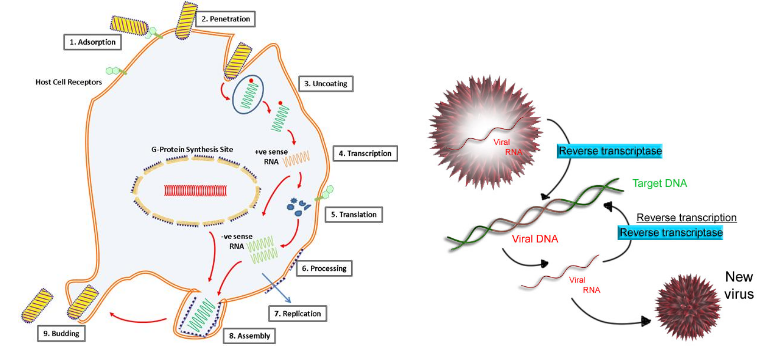
  • Rabies is caused by the Rabies lyssavirus, a kind of neurotropic virus (one that infects nerve tissues) which includes other more…common? famous? More infamous viruses like Polio, Hand-Foot-Mouth Disease, and Coronavirus. Unlike our cells which use a double-stranded helix of DNA to store genetic information, the Rabies virus is a single strand of RNA tightly wound around viral nucleoproteins. In fact the entire Rabies genome is just five genes which take over our cells’ protein factories like a—well, a virus to produce more viral components. Now this should seem weird: our cells only know how to use DNA for making proteins, so how does a virus turn its viral RNA into DNA so it can be made into proteins? Well that’s where a special enzyme called RNA Reverse Transcriptase comes in! RNA Reverse Transcriptase has a very specific pathway: turn viral RNA (vRNA) into viral DNA (vDNA) so it can be incorporated into the human DNA and cause them to make viral proteins. But we are getting ahead of ourselves, let’s look at how the virus reproduces:

    • A) Firstly the virus needs to infect the host and then get to the kind of cell that it will infect. Polio infects the nerve cells found in the brain stem which is why it is so devastating to movement and breathing. Coronavirus is known to infect the outside layer of throat cells and lung cells while HIV infects specific white blood cells called CD4 cells. In order to bind, the virus Adsorbs (1), or sticks tightly, to the surface of the cell and then waits for the cell to curiously internalize the virus. Since most cells are lower in pH (more acidic), the cell allows the virus to penetrate into the cell where the outside coating of the virus peels off. The virus has now Penetrated (2) into the cell.

    • B) Once inside the cell, the outside coating of the cell Uncoats (3) leaving just the viral RNA and the Reverse Transcriptase enzyme. The enzyme then runs over to the vRNA and uses the cell’s resources to form a double strand of viral DNA through Transcription (4).

    • C) Now that we have the vDNA inside the cell, the cell gets to work processing that information. Think of DNA like baking instructions—it tells the cell exactly how to build new proteins from the vDNA. The 5 genes inside the vDNA encode for 5 proteins (N P M G L) which take over the protein making ability of the cell. Instead of producing the protein the cell needs to do its job, the cell switches to only Translating (5) the viral DNA into viral proteins effectively becoming a virus making machine.

  • D) One of the cleverest parts of those 5 proteins is that they know how to spontaneously assemble once a critical amount of them has been made. After generating a few hundred thousand proteins, the 5 proteins come together (6, 8) to form baby viruses ready to be expelled and infect other cells. The viruses then Bud on the outside of the cell and are released (9). Scary eh?

You must destroy the head to stop them from coming back

In order to be effective a parasite has to get to the cell of infection. For HIV that is easy because white blood cells circulate freely in the blood, so simple exposure to the HIV virus can almost certainly lead to infection. The Herpes virus infects skin cells which is why it is so easy to get a Herpes infection simply by rubbing up against a Herpes flare up. The Ebola virus has lots of targets: nerve cells, endothelial cells which line blood vessels and tubes, adrenal cells which produce hormones, and liver cells. This is why Ebola infections lead to such severe symptoms like major hemorrhage. Rabies’ goal however is to get to the brain, a not so easy task considering we have many defenses that prevent foreign objects from getting into the brain. But like any infection, the first step is the cell getting into the body which in this case comes from direct contact with saliva infected with the virus.

  • Let’s set it soon: you are out in the woods enjoying a walk when a raccoon comes out of nowhere and attacks you. You managed to fight it off and punt it away but it scraped your hand with a tooth before you were able to get away. You decide to head back to your car and by the time you get home to wash your hand it has been more than 2 hours. Since it's a pretty minor cut you don’t go to the hospital (first mistake!) and decide to treat it with antibiotics and a BandAid. So what happens?

    • Well Rabies goal is to get into a nerve cell and replicate inside of it and the skin is full of many different kinds of nerve cells. Those nerves, which sense things like hot/cold, pain, and movement, all eventually lead to the spinal cord and brain via a series of Synapses. If the Rabies virus is able to infect one nerve cell, eventually it is able to replicate and then get released onto the next closest nerve to the brain. Then replicate and get released to the next one. Then the next, and next, and next until eventually it gets to the brain. This is not a quick process (unlike becoming a zombie) and takes about 3 to 12 weeks (shorter if closer to the brain).

      • The initial symptoms are pretty non-specific: you’ll have some flu-like symptoms like fever, malaise, and maybe some night sweats. This’ll occur about 1 week after the initial infection and by then you’ll probably think you caught some sort of cold. A more telling Prodromal sign is local numbness and pain at the bite site—which you may think is soreness from the bite but the numbness is from your nerve cells being destroyed by the virus.

  • Once the Rabies virus reaches the brain, things are pretty much over. Because the brain is so dense in Synapses, the virus is able to jump from nerve to nerve easily and infect rapidly. By this time the body knows something terrible is happening and the person will experience anxiety and agitation which may result in physically fighting those who are trying to help them. The lack of clear signals and stimulus results in confusion, hallucinations, and eventually seizures as the cells die. Intense stimuli, like light, results in Photophobia making the person (or animal) search for dark places to shield their eyes. Instability in the central nervous system leads to overexcitation of the Autonomic Nervous System which is our rest and digest drive. This is seen as the Hypersalivation and Hyperhidrosis (excessive sweating) which gives the scary stereotype of the Rabies infection.

    • The telltale sign of a Rabies infection is Hydrophobia or fear of water. Literally. Rabies patients experience an involuntary, painful throat muscle spasm while trying to drink water. Later on in the disease, the sight of water alone is enough to induce vomiting, panic, and violence. Now is this actual fear of water? Well…not exactly but it is as close as it gets to a fear of water. Because the throat is spasming and the person is unable to swallow effectively, the body refuses to ingest anything that needs to go through the esophagus. The fear of swallowing is so severe that the body refuses to ingest water or swallow the excessive saliva they are producing. This is what creates the foaming mouth, dripping with saliva. To see an example of this fear, here is a video of a 48 year old male with Rabies refusing to drink water.

    • The cause of death for Rabies victims is usually due to prolonged seizures, respiratory failure due to the atrophy of the brain stem, or cardiac arrest. Death comes within one week of central nervous symptoms and there is almost no chance of survival (<0.0001%).

But that one girl survived Rabies!

You do not know how much editorializing I had to sift through in order to get to the actual protocol that this patient went through in order to survive Rabies. See, the media has this issue where it will take the most headline part of a report and cherry pick the details to fit a more accessible narrative for their audience. So how did this one person move the needle from 100% fatal to 99.99% fatal? It was a fateful night in September of 2004, “Yeah!” by Usher was probably playing and Facebook was launched. 15-year old Jeanna Giese (Gee-See) was walking in the woods near St. Patrick’s Church in her hometown of Fond du Lac, Wisconsin when she came across a bat struggling on the ground. Wanting to rehabilitate the animal, Giese picked up the bat and sustained a small bite on her left forefinger. Giese dropped the animal and went home where she treated the wound with hydrogen peroxide and her mother decided that medical attention wasn’t warranted.

  • Over the next thirty days Giese started to become fatigued and a tingling or numbness in her left hand. By day 32 the girl started to lose her balance and experiencing diplopia (double vision) and the next day was so nauseous she couldn’t ingest anything. Her pediatrician referred her to a neurologist who observed the double vision and partial-bilateral sixth-nerve palsy (ocular muscle paralysis). MRIs revealed that the brain wasn’t experiencing a stroke or aneurysm so she was sent home without a definite answer as to what was causing her illness. On day 34 she was admitted to her local hospital for lumbar puncture (spinal tap) to test the spinal fluid and for supportive care. On this day she was alert, un-feverish, and able to follow complex instructions but still showed an unsteady gait, double vision and the sixth nerve palsy. The lumbar puncture revealed a high white blood cell count which would indicate some sort of infection but it would take at least a day to get cultures back for what kind of bacteria she was infected with.

    • On day 36 the bat bite was reported to the hospital staff and Rabies was included as a possible diagnosis. By this time her speech was becoming slurred, had sustained tremors in her left arm, and her temperature rose to 102F (38.9C). Now that Rabies was considered, spinal fluid and saliva samples were sent to the CDC for Rabies testing and multiple MRIs revealed deterioration of the brain tissue. By the end of the 36th day she was presenting hypersalivation and needed to be sedated and intubated (have a breathing tube put in place) in order to manage her care. The CDC called back that Rabies antibodies were positive in her blood and Giese was infected with the virus and currently in the throes of late stage Rabies.At this point Giese was placed in a drug-induced coma and was using a ventilator to breathe.

  • This is when the insane part of the story jumps in. Jeanna Giese’s doctor, who I believe is Rodney E. Willoughby Jr M.D. counseled John and Ana Giese about two options: either the medical team could provide hospice care until Jeanna ultimately died or they could try an experimental and untested theory that would combine anti-excitatory and antiviral drugs. Despite the high risk of failure or severe disability, the Gieses decided to try the protocol and the team started to prepare for their hypothesis. The two parts of the theory were to use antiexcitatory drugs to shut down the viral replication that the virus was hijacking inside the cells and to administer antivirals to kill the virus when it burst out of the cells and tried to infect new cells. Ketamine and Midazolam was administered so that brain activity was limited to just one to two seconds every 10 seconds.

    • On day three of her coma, the team administered the first antiviral Ribavirin. Ribavirin is known to work well in the periphery but has a very hard time penetrating into the brain and spinal cord from the blood, so the drug was administered directly into the spinal space. Amantadine, another antiviral, was added on the fourth day to synergize with the Ribavirin and because it should have anti-excitotoxic effects (reduces the toxicity of the other drugs).

    • To maintain the burst suppression of her brian activity, Barbiturates like Phenobarbital were swapped with the Benzodiazepine Midazolam. This was mostly because there were no preservative free Midazolam products on the market so they had to settle for one that contained 1% Benzyl Alcohol and monitor for red blood cell breakdown and acidosis (making her blood too acidic). In addition to maintaining adequate levels of oxygen in the blood, she was constantly being transfused with oxygenated blood since her brain was not telling her heart to beat anymore (remember, they are actively suppressing her brain’s ability to control the function of the organs).

  • By day eight of her coma the amount of hypersalivation was decreasing and the disruption of the virus on the heart's function was decreasing. Her skin started to regain some color, bowel function returned, and liver function started to increase. A new lumbar puncture revealed that her body was producing antibodies against the virus and was starting to take over the fight against the virus. Jeanna was starting to fight back. On day 12 her fever peaked and did not respond to multiple antipyretics (anti fever) like Ibuprofen, Acetaminophen, Ketorolac, or external cooling (via an ice bath). Day 14 saw an increase in anti excitatory drugs Ketamine and Diazepam which also didn’t touch the fever. At this point her fever was staying right at 103F (39.5C) and would not go down. Luckily a reduction in the room temperature by 40F (5.5C) did result in a drop in fever temperature to 65F (18C). Yes, that is very cold.

  • Despite the scariness, her knees remained sensitive to patellar tendon reflex (when they whack your knee with the hammer to test the response) and on day 14 her eyes blinked in response to eye drops. On day 16 she opened her mouth and raised her eyebrows when she heard speaking. Three days later she was able to wiggle her toes and squeeze her hand when commanded. Day 20 saw an attention span of 10 to 30 seconds and by day 23 she was sitting up in bed with her head held upright. At the end of the week she was extubated from the ventilator and maintained 60 seconds of alertness. On day 30 she burst into tears spontaneously due to sadness rather than fear or pain and reported no numbness in her skin. On her 31st day of being hospitalized, Jeanna was declared non-transmissible and no longer kept in isolation for fear of transmitting the virus. On day 76 she was discharged and returned home.

  • By November of 2005 (~1 year later), Jeanna did not show any signs of significant neurological damage and was able to walk on her own, returned to school, and learned to drive. She did experience left sided weakness and has difficulty functioning and balancing with that side of her body. Despite the odds, Jeanna graduated from highschool and graduated with a degree in biology from Lakeland College in 2011. She is now married with three children in Wisconsin and is an advocate for rabies education.

So what does the Milwaukee Protocol teach us?

I think the wild success of Jeanna Giese can be a beacon of hope for those affected by Rabies and their families—it moves the needle from a 100% fatal condition to one that, with a lot of good medicine and luck, there is a chance. When we have these radical discoveries however, I think we tend to overlook that this was experimental and since 2004 there have been 8 revisions to the Milwaukee Protocol and it isn’t always successful. Since 1998, there have only been 10 people who have died from Rabies in the United States. In May 2006, Texas doctors attempted the Protocol on 16-year old Zachary Jones who was bit by a bat that had flown into his room while he was napping. Jones caught the bat in a towel and released it. Zach returned to swimming and football the next day and didn’t think much of the strange encounter with the animal. Zach was bit on May 4th, 2006 and died on May 12, 2006—just 8 days despite the Milwaukee Protocol being attempted. In November 2006, 10-year old Shannon Carroll also died despite the Milwaukee Protocol being applied. And yes it was a bat.

  • So what should we get from these other examples? First off, if you get bit by a bat, GO TO THE HOSPITAL (we will talk about the vaccine soon). Secondly, if you get bit by a bat, GO TO THE HOSPITAL DUMMY. Okay seriously. Since Jeanna Giese there have been 36 patients treated with the Milwaukee Protocol and only 5 have survived. A 14% success rate doesn’t seem very great but remember the flip side—a 100% fatality rate—so any number above 0% is a success in my eyes. Some doctors in the infectious disease community believe that the Milwaukee Protocol is a failure and shouldn’t be applied but I haven’t found any offers of a better alternative. Some aspects have been improved upon, like which drugs to use and the timing of the drugs, but using the MP is less of a science and more of an art. Would I want it to be used on myself or a loved one? Yes. Would I use the MP on a patient that I had? Probably and if I get permission. But is the MP an end-all be-all success? No, unfortunately enough.

I will never go outside again and I now hate bats

Woah there. Before you start sealing up all the bat caves you can find and destroying an important mammal in our ecosystem, we do have a treatment against Rabies that is very successful and that would be the Rabies Vaccine. Unlike other viral vaccines, studies have continuously shown that the Rabies Vaccine is 100% effective when it is immediately and appropriately administered to someone who was bitten by a suspected Rabies animal. Notice those two words: immediately and appropriately. So what should you do?

  • First off, if you have been bit by a wild animal, go to the hospital or clinic THAT DAY and get a rabies shot (and/or tetanus). Now there are certain animals that are known not to carry Rabies like reptiles, amphibians, birds, or insects which leaves only mammals as potential suspects. Generally herbivores like ungulates (llamas, horses, pigs, deer, and cows) do not transmit Rabies due to running from humans rather than seeking them out in their Rabies agitation. Carnivores however do seek out prey and if you get bit by a carnivore (wild or domesticated), you should go to the hospital immediately, THAT DAY. Do. Not. Wait. If you do wait and develop a fever within a few days of getting bit, GO TO THE HOSPITAL AND GET A RABIES SHOT. Please?

    • The Rabies Vaccine can take on two different forms. Passive Immunization is done by injecting the site of infection with viral antibodies to teach the body and scare it into thinking there is a Rabies infection and produce antibodies. Now this passive immunization is good for the immediate time—it will provide immunity for a few weeks to a couple of months. But sometimes Rabies can incubate for up to a year which is why we give the next vaccine: active immunity. This consists of 4 intramuscular Rabies shots given on day 0, 3, 7, and 14. Yes it’s not fun to get 4 shots but it’s LESS fun to get full blown Rabies, so pick your battles. On day 14 we take a blood sample to make sure there are sufficient anti-Rabies antibodies in the blood. This 4 shot series gives about 2 years of exposure prevention but could be as little as six months. So don’t think that getting one earlier in the year will prevent another bite later in the year.

So take this as a big warning: even the smallest bites and scratches can be incredibly deadly. If you think you need help, get it!

And that’s our story!. If you have any questions, please let me know! Want to read more? Go to the table of contents!

Likewise, check out our subreddit: r/SAR_Med_Chem Come check us out and ask questions about the creation of drugs, their chemistry, and their function in the body! Have a drug you’d like to see? Curious about a disease state? Let me know!


r/SAR_Med_Chem • • Aug 23 '22

Article Discussion [20min read] Pour me a tall one boys! - How Humans Handle Ethanol and an Exploration of Alcohol in the Brain (Plus a Scientifically Backed Hangover Cure!)

221 Upvotes

Hello and welcome back to SAR! Today we discuss the most ubiquitous molecule in human history: ethanol! Drinking alcohol6 is as old as the human race and despite attempts to eliminate it from society, time and time again we have shown that to be human is to ingest alcohol. As we will discuss, brewing alcohol allowed for early man to ingest water that would have been otherwise contaminated with harmful bacteria. From its evolution from beer to spirits, alcohol has followed human evolution both culturally and technologically as we plowed deeper into uncharted and foreign lands. That being said, alcohol can be habit forming and lead to maladaptive behaviors and health effects, so for some the vice can be a struggle. Today we explore the chemistry of this small molecule, toxicity, and some related drugs!

Disclaimer: this post is not designed to be medical advice. It is merely a look at the chemistry of medications and their general effect on the body. Each person responds differently to therapy. Please talk to your doctor about starting, stopping, or changing medical treatment.

Yes I am going to explain alcohol to you

Let’s set the scene: you just stepped out of your car and are sidling up to the frat house at your university ready for an awesome night of drinking. It’s the last weekend before finals so you know you gotta get fucked up in order to make these past four years worth it so you prep yourself for an intense night. You didn’t pregame so when you get to the fake wood countertop in the kitchen and spy the bottle of Jagermeister sitting next to some shot glasses, you know things are about to get ‘lit’. You pour the first shot and throw it back—the first of many that night. Bottoms up! When we drink Ethanol, the chemical responsible for the fantastic and drastic effects of drinking alcohol, we see a wide range of effects both immediately and over time. We can track these effects over the course of drinking and how much you drink. Let’s dive in:

  • The first effect you’ll notice is the burning sensation as it travels its way down your throat. Ethanol is anhydrous meaning that it lacks water, so as it makes its way through the mouth and throat it draws water out of the cells that line the passageway. Normally when this happens it's because the cells are being burned and so the cells and nerves transmit this sensation to the brain as a burn which then interprets the signal as such. This is why higher proof spirits (contain a higher ethanol to water ratio) burn more than their more watery counterparts like beer and wine.

  • You probably were unaware of this but inside the body are a type of cell that floats dormantly throughout the body like a landmine waiting to be tread upon. These little bombs, mast cells, contain little balloons of histamine that are just waiting to be released and pop in the blood. Ethanol is one molecule that can cause mast cell degranulation thus dumping the histamine into the blood causing blood vessel dilation which is sensed by the body as warmth. In fact, the histamine release causes other effects some people see with alcohol—namely getting flushed in their face (due to facial surface vessels dilating, i.e. you are literally seeing more blood in the face) or getting itchy.

    • Once the alcohol hits the stomach there are a few factors that determine how quickly it is absorbed through the GI membrane. When a foreign substance hits the stomach and induces stretch, the stomach senses that there is something to digest and will slow the rate of the stomach emptying into the intestines to control the rate of absorption via the small intestines. Alcohol that is at least 40% alcohol by volume will more rapidly decrease gastric emptying and inhibiX absorption (i.e. you get drunk slower). Drinks aerated with carbon dioxide speed up gastric emptying which increase absorption (looking at you White Claw). We all know that food decreases absorption but I bet you didn’t know that even a small amount of food can decrease blood alcohols to just ¼ the amount on an empty stomach.

    • Now that the alcohol has been absorbed through the small intestine and is in the blood, it will be distributed throughout the water in our body. Almost all tissues in the body will have a fairly consistent level of alcohol except the liver which will have the greatest exposure to alcohol. The main reason is that all food when absorbed from the digestive tract must first go to the liver for detoxification. Since the alcohol is going to the liver first after absorption and will need to return there to be cleared out of the body, the liver is getting a double exposure. Alcohol diffuses slowly out of organs due to the high level of blood vessels in the organ tissue which is why there is greater effect in organs than surrounding organ systems.

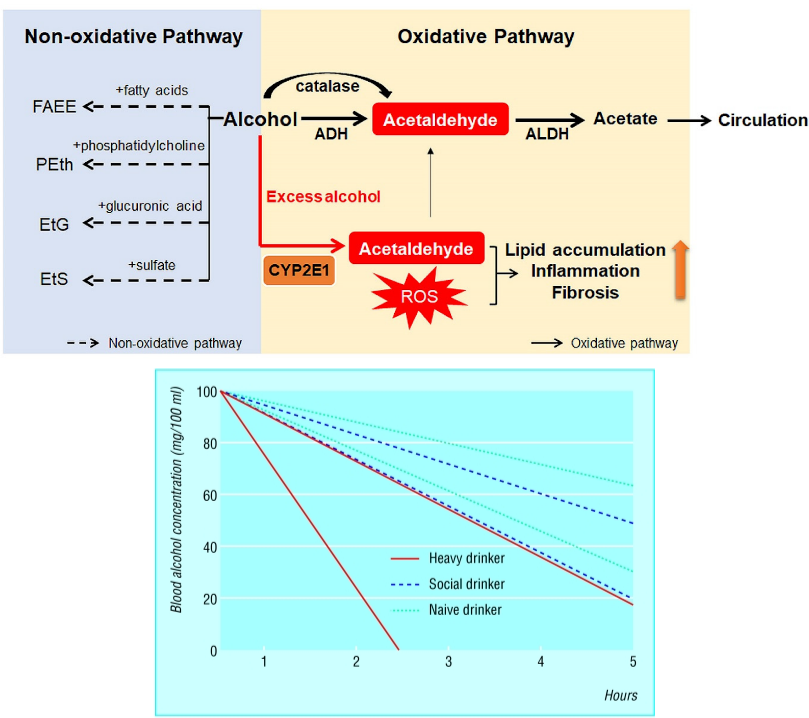
  • Alcohol is metabolized via the liver into its main metabolite Acetaldehyde where it needs to be broken down immediately into Acetate. Creating the Acetate metabolite is important because the Acetaldehyde is extremely toxic and is responsible for the liver-destroying powers of ethanol. The enzyme of importance is Aldehyde Dehydrogenase (ALDH) which creates acetate from the toxic metabolite. Since there are many pathways of creating Acetaldehyde, the toxic metabolite can accumulate and damage liver cells, inducing inflammation inside the liver and after enough time can lead to alcoholic cirrhosis of the liver.

    • Alcohol dehydrogenase (ALDH) is an inducible enzyme however and the more a person is exposed to ethanol, the greater the number of ALDH enzymes are available to detoxify. As you can see in the graph, new drinkers (in green) take a longer time to clear the alcohol from their body than experienced drinkers. This is due to experienced drinkers physically having a greater number of enzymes to do the job—y’know experience builds character.

  • If you’ve ever done flambé, you know that you pour some nice bourbon on top of the caramel sauce and heat it. Ethanol is easily volatilized, so it easily turns from liquid to gas which allows you to light it on fire causing your guests to gasp and clap with delight. So what’s this got to do with drinking? Alcohol is miscible in water so it will go anywhere that water goes in the body. Organs that are highly vascularized, meaning that they contain lots of blood vessels, will have more water flowing through them and so alcohol will accumulate there. This is one big reason why the liver controls ethanol metabolism, there’s lots of blood vessels but the lung also plays a role in ethanol’s journey. The combination of the body heat and high surface area inside the lung allows the ethanol to volatilize into a gas which is expelled when you exhale. This is what allows breathalyzers to detect if and how much you’ve been drinking.

    • How does the machine do it? Well inside the machine is a solution of Potassium Dichromate and Sulfuric Acid which helps oxidize the ethanol to a carboxylic acid. For those who have taken Organic Chemistry, can you remember which named reaction this is? I’ll give you a hint—rhymes with Shmones Shmoxidation ;) Anyways, once the ethanol is oxidized it produces a tiny current which is measured by the Alcosensor. The more alcohol that is being expelled by the lungs is directly linear to the amount of current so the more you drink the more current you produce.

    • That being said, the reaction is pretty general. As long as you have something in your lungs/mouth/throat that can be oxidized via this reaction, it can provide a false positive BUT this reaction is tailored to ethanol being oxidized per mole (a measure of amount of molecules). A different substance blowing positive would show up false once the data from the breathalyzer is downloaded but that’s if it can even generate enough current to get you above the safe BAC limit.

      • Now, in the interest of science I will type this but you didn’t hear it from me if you get pulled over (also please don’t drive drunk). Remember that the device is measuring the amount of alcohol in your breath, so if we can modify that concentration, we can change the result. If you held your breath and then blew, you’d be increasing the total amount of ethanol in your breath which would make you blow a higher result. Hyperventilating right before you blow would dilute your breath and blow lower. Not that you would ever use this trick to do anything illegal…

      • And no, mints, pennies, eating toilet paper/tissues or even smelling… ahem… feces before you blow won’t change the result.

Dude this party is lit!

Let’s head back inside the party, shall we? So you’re like 6 shots of tequila deep and oh boy are you feeling it now and in your inebriated state you start to wonder: why does such a small molecule alter consciousness so much? Alcohol is described as pleiotropic—it has several effects on the body which can appear to be incredibly different but its dose depends. There is a ladder of symptoms and the more you ingest, the higher up the ladder you go.

  • Alcohol’s effects move from the front of the brain, towards the back, and then down the brain stem. We start in the frontal cortex which is labeled pink and houses your judgment and logical skills. Surprising no one, alcohol impairs a person’s ability to make complex decisions and access higher order thoughts. It does this by increasing the action of the GABA-a receptor found throughout the brain. The GABA-a receptor is an inhibitory receptor that decreases the function of neurons and cells it is connected to—by ethanol binding and activating it, ethanol is potentiating the inhibitory effects thus turning off the function of the brain.

    • You’ll notice on the GABA-a receptor is the binding sites of a few other drugs, notably Barbiturates and Benzodiazepines like Lorazepam (Ativan), Diazepam (Valium), and Clonazepam (Klonopin). Mixing these substances with alcohol increases the action of GABA-a IMMENSELY which can easily result in seizures, respiratory depression, and often death. Alcohol with these drugs is a deadly combo.

    • Alcohol’s anti-anxiety effects are thought to be because of its impact on the frontal cortex. By turning off our ability to think, a person isn’t able to overthink what’s going on and is able to relax because they aren’t thinking. This is why social drinking is so popular among humans; it can help ‘loosen’ someone up allowing them to have fun without the normal anxiety of being a thoughtful, thinking person.

  • Not all GABA-a receptors are made equally. The barrel shaped receptor can have multiple different arrangements of subunits which can make the receptor more resistant or more susceptible to the effects of alcohol. This factor combined with higher amounts of alcohol being able to reach further back in the brain gets us to our next two sections: the motor cortex and the somatosensory cortex.

    • Once ethanol enters the motor cortex (which extends deep into the brain like a slice of cake), it is able to interact with the nigrostriatal system which houses Dopaminergic neurons. While we tend to think of dopamine as the happy chemical (which is the title of another post), it is heavily involved in the initiation AND continuance of movement. Thus, when the effects of ethanol reach this area of the brain, it messes with the binding of dopamine to its receptor which makes fine motor control go wonky.

      • Now this isn’t the stumbling drunk, yet. That happens once the alcohol reaches the cerebellum which is the little ball regions found underneath the brain. The cerebellum is responsible for initiating large movements and balance which if impaired makes walking and standing incredibly difficult. You can see how the voluntary movement done via the frontal cortex would be inebriated first but balancing wouldn’t be affected until the motor cortex starts to be impaired.

    • Another effect in this region is on the mesolimbic system which is found in the region labeled A9 and A10 but extends upwards into the nucleus accumbens (NAc), the olfactory tubercle, and the central amygdala. These regions are involved in the somatosense, which is responsible for sensing things like touch, heat, itch, pain, and proprioception (where the limbs are in space). This is when the body loses its ability to sense hot/cold (I’m looking at you, a person who wore booty shorts walking to the club in Winter) and also our ability to correctly place our hand or foot in the correct place. This is why people fail the touch-finger-to-nose roadside test when they get pulled over—the body isn’t able to correctly sense where the finger is without directly looking at it.

  • Now that the forebrain has been taken down, it's on to the midbrain. The midbrain is arguably the most varied part of the brain and houses very specific regions which regulate many ‘us’ processes.

    • First up we have the effect on the Language Center which is part of the Angular Gyrus found in the middle of the brain. When sound is heard by the brain and determined to be speech, it is first sent to Wernicke’s Area (said like Ver-nicky) which is responsible for interpreting the speech that is being spoken. Once processed, the brain can then decide to respond by transmitting the data to Broca’s Area which is responsible for converting thought into proper speech with correct grammar and inflection. When ethanol reaches these areas, it disrupts the function of both areas AND decreases the function of the Arcuate fasciculus which helps the two areas communicate.

      • As a side note, damage to these areas in the brain are called Aphasias. Wernicke’s aphasia would be a lesion/damage to that specific area which would make it hard for someone to understand language whether written or spoken. Since understanding language is connected with speaking back, often both understanding and conveying a message can be impaired. More common is Broca’s aphasia, which amounts to someone understanding language but having trouble or not being able to speak or write correctly. They’d still be able to form words but it would come out jumbled as they are unable to place it in the correct order or they’d swap words. They often omit small words like ‘is’, ‘the’ and ‘and.’ An example of Broca’s speech would be ‘walk dog’ instead of ‘I will take the dog for a walk’ or ‘book book two table’ instead of ‘there are two books on the table.’ People with aphasia are generally oblivious that they are speaking incorrectly.

  • Contained in the Lateral Ventricle is the Amygdala, Hippocampus, and Thalamus. These three structures are heavily involved in creating the personality and behavior of a person. The Amygdala, which is latin for almond, is a series of cell clusters that are each responsible for a separate but related function. One of the major functions is emotion regulation which is stored in dense synapses in the very tip of the almond. It's in this location that our ability to start, stop, and control our emotions is housed and through emotional learning in our childhood, more complex emotions are housed. The more complex an emotion is, the easier it is to lose since it requires cognitive processing in order to correctly initiate. This leaves the core emotions: happiness, sadness, fear/surprise, and anger. Since the ability to regulate which emotion is impaired, inebriated people can quickly cycle between the emotions since nothing is keeping them focused on one emotion.

    • The Hippocampus is made up of two lobes on each side of the head, which if you could push a pencil through your ear into your head you’d poke it. The Hippocampus is where short term memory and long term memory is stored and processed. It also houses spatial memory which helps with navigating a space. To recall memories, the brain needs to find the correct synapse and transmit that information to the frontal cortex for recognition; a process that relies heavily on speed and accuracy. Ethanol messes with the myelin sheath of these dense neurons which slows neuronal conduction which disrupts the ability to recall memories. It's often why drunk people start to remember something but eventually can’t remember—they just can’t transmit the information fast enough for the brain to retain attention.

  • Last up is the Thalamus which can be viewed as a major subway station in a mega-city. Located in the Diencephalon (which would be an awesome name for a dog or kid), the Thalamus helps connect many different parts of the brain (like the motor cortex to the cerebellum) but also creates consciousness and alertness. As such when impaired, the signals coming into the brain from the periphery (like pain) aren’t correctly recognized and the brain isn’t alerted thus allowing you to jump off the roof into the pool (which you totally made and didn’t crack your head on the stone). Cool scar by the way. Eventually the Thalamus isn’t able to maintain keeping the brain awake and shuts down. The shutdown of the thalamo-cortical-thalamic circuit (what a name) is what causes a blackout, and so ⬛⬛⬛ ⬛⬛⬛⬛ ⬛⬛⬛ ⬛ ⬛⬛⬛ ⬛⬛⬛⬛ ⬛⬛⬛ ⬛⬛ ⬛⬛⬛. ⬛⬛⬛—⬛⬛⬛; ⬛⬛⬛⬛⬛ ⬛⬛⬛⬛⬛⬛.

  • Technically at this point in your journey at the party, you shouldn’t remember what I am writing but we still have the hindbrain to talk about. The hindbrain is made of three major structures: the Cerebellum which we have covered, the Pons, and the Brain Stem. This is also what’s referred to as the Lizard Brain since it contains the bare minimum to live and also some of the most Star Wars sounding areas of the brain. Anakin opened the door to the Pons and saw Darth Vermis, his fist raised as he choked out Anakin’s love: Medulla Oblongata. In these areas are where a majority of the cranial nerves are found, of which life is given.

  • The Pons houses the trigeminal nerve (Cranial nerve V), abducens nerve (CN VI), facial nerve (CN VII) and a little bit of the vestibulocochlear nerve (CN VIII). The trigeminal nerve is the most complex cranial nerve that we have as it innervates a majority of the structures inside the face. It is what allows you to open and close your jaw, swivel your eyes (along with the Abducens), and move the tongue, not to mention all the feeling and sensation that goes with it. The facial nerve facilitates all the muscle movement of the skin on the face and some of the neck allowing for facial expression, lip movement, and facial sensation. The vestibulocochlear governs the inner ear and is heavily involved in initiating the sense of balance that is processed in the cerebellum as well as collecting sound information.

  • At the bottom is the Medulla Oblongata which houses the most important reflexes for life via its cranial nerves. First up is cranial nerve IX, the glossopharyngeal nerve which innervates the back of the mouth, back of the tongue, and throat. Two major functions are the control of the Epiglottis, the thin flap of muscle that covers the Trachea to prevent food from going into the lung and also the gag reflex. These two reflexes help keep the lungs clear, which when enough alcohol is drunk and if someone vomits are unable to clear the throat of the obstruction, allowing the person to choke to death.

    • The vagus nerve (CN X) provides sensory data from the neck and abdomen and also allows control of the peripheral organs (i.e. everything but the brain). When impaired, there is a loss of tight control of organs which can be seen as a rise in blood pressure and heart rate. It also helps with vasomotor control which allows for blood vessels to dilate and constrict, making sure that the liver and kidney are adequately working.

    • Skipping over cranial nerve XI (the accessory nerve which helps with shoulder elevation and head turning), we get to the final cranial nerve, the hypoglossal nerve (XII). The hypoglossal nerve controls the precise movement of the tongue and is responsible for the other palatal reflexes. Without such the person isn’t able to clear the mouth of contents and will probably choke on whatever substance is sitting in the mouth.

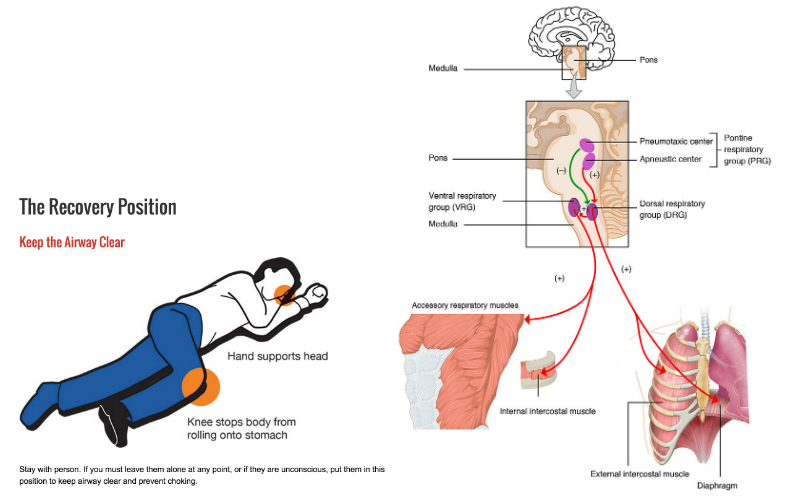
  • So we have explored the choking hazard of ethanol which is why a person should be put in the recovery position if they have been drinking but that doesn’t prevent this last impairment. Inside the Medulla and Pons is the respiratory center, two clusters that help control the initiation, speed, and control of breathing. Inside the Medulla are the Pre-Botzinger complex and Solitary Nucleus which control the force of exhalation and timing of inhalation. The Pons houses the Pneumotaxic Center and the Apneustic Center which tightly control the inhalation and exhalation muscles. With too much alcohol, these four centers become impaired and a person is unable to breathe correctly and suffocates regardless of what’s in their throats.

    • Can you guess which class of drug targets these four centers exceedingly quickly? Opiates. This is why mixing Opiates with Alcohol is another dangerous combo—you speed up the respiratory depression that either chemical would cause. Seriously, mixing these is playing with fire.

  • Real quick I want to explain how the body determines how and when to breathe. As we know, cells need oxygen to do their work and produce carbon dioxide which gets dumped into the blood. Along the Carotid Arteries (the two arteries that feed blood up to the head) are chemosensitive cells that measure the amount of carbon dioxide in the blood. When there is too much carbon dioxide, it triggers the receptory center to breathe via the glossopharyngeal nerve (CN IX). So the reason why we breathe is not due to lack of oxygen but due to too much CO2; kinda neat! (Well as much as suffocation can be.)

So who discovered beer?

Well enough with the doom and gloom, eh? While alcohol should be respected as a drug like any other substance, I don’t want this post to be about bashing alcohol. So let’s move onto some interesting things I know about alcohol! To our ancestors, alcohol was much more than just a way to pass time and as the world stepped away from subsistence farming, it was able to integrate into more pieces of our culture. Hell, the ability to metabolize alcohol was a trait passed on from our evolutionary predecessors who likely ate fermented fruit and evolved the ability to detoxify the toxins.

  • The first alcoholic drinks were likely fermented mixtures of rice, honey, and fruits. A chemical exploration of the Henan Province in Northern China revealed that as far back as 9,000 years ago large scale alcohol production was beginning. Fermentation occurs when bacteria convert the natural sugars inside the food into a byproduct, in this case ethanol, to make energy for the bacterial cell. Nowadays we use yeasts, a type of fungi, to ferment grain mixtures to their fermented counterparts whether that be bread, beer, or wine but how did we as a species know to use yeast? Yeast naturally occurs on grain stalks whether they be corn, wheat, rye, barley, and many other species of cereals. It’s thought that humans discovered the leavening power of yeast by placing bowls of dough in fields or by open windows which allowed the wind to blow the fungi spores over the bowl. Once landed in the dough, it was able to make the dough rise or if transferred into a barrel full, could be made into beer.

  • Brewing of beer reached civilization sustaining levels around 3400 BC in multiple places. In Ancient Egypt brewing mainly happened in Hierakonpolis but would spread as trade routes made the sharing of secrets easier. Ancient China perfected rice and grape wine by the 4000 BC and was able to reach brews up to 20% ABV, making them ideal for integration into Chinese medicine and religious life. By the time Marco Polo reached China in 1292, alcohol made up the largest source of revenue for the Chinese government. Several Native American groups also developed their own alcohols based on what was available in their respective regions. Honey could be made into Balche, Pineapples from Mexico into Tepache (which is delicious by the way), and Maize in Chicha beer.

  • With alcohol’s purely social nature now it's easy to forget the origins the beverage truly had. Don’t get me wrong, alcohol was a mainstay of fireside communities but it offered an important benefit: it made water safe to drink and was more nutritious than water. Before the discovery of boiling water to make it safe, many natural sources of water were too dangerous to drink from, especially from sources near cities. Wells and streams could easily be contaminated from human sewage, dead bodies, or contamination from industry, making the water breeding grounds for bacteria. Disease like Cholera could devastate communities but beer and wine barrels were resistant to the contamination because it was already contaminated with fungus or bacteria. Essentially, if a bacteria tried to make its way into the barrel it would be out competed by the good bacteria and unable to multiply OR there would be no food left for it to grow anyways.

  • Beer also represented a high percentage of nutrition for people from ancient times all the way up to the modern age. Ancient Egyptians were infatuated with beer making and meticulous in their recipes and researchers in the 1980s were able to copy a recipe on the tomb of Tutenkhamen. Through recreating it, they were able to discover a nutritious beverage filled with essential vitamins which otherwise would have been lacking in the limited diets of laborers. Hell, the laborers who built the pyramids at Giza had a daily ration of 10 pints of beer! Even up to the Medieval period, beer (and to a lesser extent wine) represented a major portion of a person’s daily consumption of calories.

Don’t say I never taught you anything

We’ve all been there: the birds are chirping and a sunbeam lands directly on your eyes. Shielding your eyes with your hand, you squint through the blasting light and discover that you spent the night on a random person’s couch. You think their name is Derrick or Cole, either way you are miles from your house and your car keys are missing. And great, your head is POUNDING from a hangover. Through the throbbing pain you remember that a hangover is a physical and psychological process that follows the consumption of alcohol and can last upwards of 48 hours. Headache and drowsiness are often the hallmark symptoms but people can experience vomiting, diarrhea, light sensitivity, and irritability (a shock to no one).

  • While it's common, we still don’t really know what causes veisalgia, the medical term for the hangover. Interestingly this is one medical term that is Norwegian in origin: Kveis = uneasiness following debauchery and Greek Algia = pain. What we do know is that the accumulation of the byproduct acetaldehyde plays a major role in the initiation of the hangover and how much dehydration a person experiences is the severity. Likewise Congeners which are the natural or added substances in alcohol that help impart flavor (think tannins or poly-ols for flavor) contribute to types of hangovers. This might be why some liquors sit better than others—looking at you tequila.

  • One of the most important things to do following a night of drinking (even light drinking) is to replace the vitamins and electrolytes lost. Electrolytes are the ions present in the blood that help maintain an electrical difference across the membrane allowing for cells to operate correctly and are involved in cell signaling. When alcohol is ingested, it inhibits the secretion of Vasopressin, a hormone responsible for retaining water. Without it, a drinking person generates more urine which wastes water (starting dehydration) and electrolytes. This is similar to when you sweat out water and electrolytes when exercising which creates cramping from the muscles lacking the electrolytes needed to contract together. The result is headaches, cramping, and muscle fatigue.

    • Likewise, alcohol prevents the uptake of essential B vitamins and Vitamin C as well as minerals like potassium, magnesium, and zinc (which all play a role in alertness and muscle ache). A single night’s drinking (or even a weekend binge) isn’t really enough to deplete your body of vitamins, but chronic alcoholism does lead to a critical lack of Vitamins, creating massive muscle and liver problems. While I won’t be diving into alcoholism in this post (we’ll cover substance abuse in about three weeks), replacing vitamins is easy with a meal following drinking.

  • And what better meal than one backed by science, eh? Just for you dear reader, I traveled through the bowels of PubMed and found a few journal articles that scientifically found the best foods to eat after a night of drinking. According to the 2019 paper, Influence of food commodities on hangover based on alcohol dehydrogenase and aldehyde dehydrogenase activities, by Shraddha Srinivasan, et. al (read here), they discovered the best combination of foods to stave off a hangover. The authors searched for foods that speed up the activity of Acetaldehyde Dehydrogenase (ALDH), the enzyme that detoxifies Acetaldehyde into harmless metabolites. Take a look at some of the results they found:

    • For fruit, the best foods to eat were Sweet Limes (+33.47% activity), Orange (+15.48%), and Pears (+90%) as they increased the activity of ALDH tremendously. Vegetables such as Cucumber (+87.25%) and Tomato (+41.19%) also had a significant impact on the activity of ALDH. Interestingly, some of the worst fruits and veggies to eat were Apples (-76%), Mango (-61.97%), Watermelon (-57.39%), Papaya (-50.55%), Grapes (-33.44%), Garlic (-42.23%), and Coriander (-58.38%). In fact, they tested a commercial anti-hangover product and found that it inhibited ALDH activity almost as much as the worst tested foods (-82.50%). Fuckers >:(

      • They also tested some other food groups like dairy products and found that Buttermilk (+17.5%) and Cheddar Cheese (18.63%) had a positive effect while regular Milk was slightly worse (-3.93%). All grains and pulses tested decreased activity and should be avoided (Oats, peanuts, millet, sorghum, maize, wheat). All spices too decreased activity with Nutmeg (-97.89%) and Mace (-82.48%) being the worst. Others tested were Pepper (-34%), Cloves (-61%), Cumin (-3.54%), Cinnamon (-61.1%), Ginger (-36%), and Turmeric (-24%).

    • For some miscellaneous products, they found the following:

      • Vitamin C = -88.97%

      • Coffee = -53.44%

      • Egg yolk = -38.93%

      • Coconut water = +13.95%

      • Cocoa = -29.04%

      • Black tea = +5.37%

      • Dates = -26.77%

      • Green tea = +2.64%

      • Egg white = -3.47%

      • Fenugreek seeds = -62.4%

    • I hope you were taking notes. If not I gotchu for a delicious and scientifically backed breakfast that should boost your enzymatic activity and kick the hangover! According to the authors, a smoothie of Pear, Orange, Sweet Lime, and Coconut Water (with or without added sugar) increases the activity of ALDH and snacking on a meal of Cucumber, Tomato, and Cheddar Cheese can further boost activity. To be honest, it doesn't sound like a bad meal, right?

And that’s our story! Hopefully you learned something new. If you have any questions, please let me know! Want to read more? Go to the table of contents!

Likewise, check out our subreddit: r/SAR_Med_Chem Come check us out and ask questions about the creation of drugs, their chemistry, and their function in the body! Have a drug you’d like to see? Curious about a disease state? Let me know!

https://www.iflscience.com/can-you-beat-a-breathalyzer-test-51006

https://www.ncbi.nlm.nih.gov/pmc/articles/PMC6826820/

https://www.ncbi.nlm.nih.gov/pmc/articles/PMC165791/#:~:text=A%20study%20of%20the%20single,channel%20bursts%20and%20burst%20duration.

https://www.nidcd.nih.gov/health/aphasia#:~:text=For%20example%2C%20a%20person%20with,speech%20of%20others%20fairly%20well.

https://www.penn.museum/research/project.php?pid=12#:~:text=Chemical%20analyses%20recently%20confirmed%20that,in%20the%20Yellow%20River%20Valley.

https://blog.britishmuseum.org/a-sip-of-history-ancient-egyptian-beer/


r/SAR_Med_Chem • • Jul 01 '22

[25 min read] Gifting the Energy to Focus - The treatment, history and chemistry of treating the worlds most understood condition, ADHD!

110 Upvotes

TYPO: Treating the worlds most MISUNDERSTOOD condition*** Sorry!

Hello and welcome back to SAR! Today we will be discussing Attention Deficit-Hyperactivity Disorder (ADHD), a condition we often think afflicts only children but is actually lifelong illness. Treating ADHD early is less about making the kids less hyper and more about giving them the energy to focus so they can excel in school, shine socially, and be able to compete on equal footing. For many adults who had untreated childhood ADHD the struggle of trying to focus and achieve can be debilitating. Thankfully we have great effective treatments for ADHD that are literal life savers. Likewise, say hello to Emily, a 25 year old french-canadian who is diagnosed with Attention Deficit Disorder (like ADHD but without hyperactivity) and Dyscalculia (trouble with math and arithmetic). When Emily isn’t working on her master’s thesis in career counseling she is a master cook improvising recipes or perfecting baking recipes, has been slowly getting into running (good on you Em, lord knows I can’t) and trying her hand at learning Spanish! Like all of us, Emily does procrastinate with Netflix but it's a big balance of what the day-to-day requires. Without further ado, let’s dive in!

Disclaimer: this post is not designed to be medical advice. It is merely a look at the chemistry of medications and their general effect on the body. Each person responds differently to antidepressant therapy. Please talk to your doctor about starting, stopping, or changing medical treatment.

ADHD is not having too much energy, it's a lack of it

“I was 18 years old when I went to see the neuropsychologist, a few months after starting Cegep (12th grade). Since I was living on my own for the first time, just started a new relationship and the courses were longer and harder than in high school, I wasn’t able to keep up anymore. Both diagnoses were a relief. Since primary school I had a hard time keeping up, I was trying, especially in maths, but the results just weren’t there. I was lucky to have parents with resources and who never made me feel less intelligent because of it. They put the emphasis on my emotional intelligence. I passed my classes, for some of them I wasn’t too bad at it. I was glad to finally have an explanation, as to why all my efforts to have better grades did not pay off. During my classes, I was the calm type, except for the few times I was seated with a fun person who liked to talk. But still, I wasn’t particularly disruptive. I was often lost in my thoughts, drawing on my agenda and all, and I did forget on occasion to complete some homework, or study enough in advance for a test. When I was maybe 15-16 years old and not shy anymore, I would ask to go to the bathroom, and just walk in the corridors for a few minutes, as I was just too bored and not listening anyway. Although I don’t have the H part, I was a very spontaneous and enthusiastic person.”

ADHD has a pretty distinct clinical picture: a person unable to focus at school/work and struggles to accomplish tasks with or without fidgeting, inability to sit still, and impulsivity. Previously it was believed that these kids had too much energy and dampening down that energy would force the child to sit and pay attention, else the ruler would rap their knuckles. Oh how wrong we were.

  • The pathophysiology of ADHD is more complex than many people believe. Many different parts of the brain are involved but today we are going to focus on the frontal cortex (in light green) which is responsible for our complex thinking and rational thought. In ADHD, a person lacks the ability to fully regulate attention, behavior, and emotion because they lack the energy required to do so. Yeah! ADHD is actually a lack of energy, not too much energy.

    • In the fatigued state, the decision making center of the brain (frontal cortex) lacks Dopamine (DA) and Norepinephrine (NE) which act to regulate network activity. Dopamine and adrenergic receptors (NE) encourage focus and attention while promoting active organization of thoughts, actions, and information. Because of this, both dopamine and norepinephrine are important in the treatment of ADHD and boosting their action leads to decreased ADHD symptoms.

    • When the levels of dopamine and norepinephrine are too high, such as in the stressed state, the mind is kicked in overdrive trying to synthesize and organize information—essentially its thinking too much. This could be caused by taking too much ADHD medication but its more common in stressful fight-or-flight situations.

  • Let me not understate this enough, ADHD is so much more than just underperforming in school as a kid. It had lifelong impacts that when left untreated can be seriously debilitating. Its been proven that children with untreated ADHD tend to struggle academically and socially in school which leads to an increase in risky behaviors such as sex, drugs, or situations. This lack of success can also be a lifelong feeling of underperformance that makes it hard to feel like an achiever. Other manifestations are trouble keeping relationships or long-term opportunities resulting in further depression or blows to self-confidence.

    • Now is this doom and gloom? Yes, a bit. But I also think that people tend to overlook ADHD as a serious condition because its just about focusing—”who can’t focus for 10 minutes?” These people and these people deserve treatment that gives them the ability to succeed and achieve to their fullest potential.

“Even though I was able to do pretty much anything a person with a typical brain would do, I think I just have to put more energy into accomplishing things. I’ll be under-stimulated very easily and will disengage from what I’m doing. People think it’s laziness and it does feel like that sometimes, but in reality I never stopped doing what I was supposed to do because I didn’t want to anymore, at least not something big like getting my diplomas. What is sad to me is that I have all those ideas and projects and I can be very enthusiastic toward them, but I won’t start or finish them anyway. I’ll just forget about them. It’s like a part of my brain wants to accomplish great things, and also small random fun things, and the other part is like “ehhh, maybe some other time”. I wish people understood it’s not as stupid as “not being able to concentrate”, and that it’s not only when we don’t want to do something.”

Sit down, pay attention, and keep your mouth shut!

“I never really felt bad about having ADD (and dyscalculia), since I finished high school without really knowing I had it, and I would consider myself very functional, compared to some people who seem to have it harder than me. If you don’t know me well, you wouldn't know about it. The hard part is that sometimes people who are relatively close to me don’t really consider me as an ADD person, because they don’t see me struggling, and maybe forget that to be like I am, I have to take medication. To be fair, even I don’t believe I have it sometimes. It really just felt like I finally had an explanation, but it wasn’t a shock or anything. My parents apparently suspected it for a while, but they didn’t want me to start any medication when I was a child and my brain was still developing a lot. I think I would struggle more if I had to stop taking medication. That thought scares me, like I don’t really remember how I was before so I don’t know how I would be without it now. Would I be doing my master's degree? Would I be able to maintain my long term relationship?”

Unsurprisingly mental illness and neurological disorders were extremely misunderstood for much of medicine’s history and it wasn’t until the last three centuries that we saw real progress. Our new perspective we can see that ADHD is a function of humanity rather than a modern day phenomenon. Lets take a walk down the weird history of ADHD:

  • Our story begins in Germany in the office of a German psychiatrist Heinrich Hoffman (1809-1894). Hoffman worked at a pauper’s clinic and had a private practice but neither made very much money. Pre-Freudian psychology wasn’t a glamorous profession but for those who wanted to find a cure for the hundreds of people being relegated to poorhouses (similar to English workhouses in the Victorian and Georgian eras). Unlike the harsh treatments his contemporaries were using, Hoffman is described as a caring psychiatrist who was able to treat acute illnesses effectively.

  • In 1845 Hoffman started to write satirical poems and cartoons aimed at the government and general society. A publisher friend asked Hoffman if he could illustrate some verses Hoffman sent to his son for Christmas and Hoffman agreed. The result is probably the most terrifying story book I have seen (although contemporaries thought it was great): Der Struwwelpeter (“Shock-headed Peter” or “Shaggy Peter”).

    • Each book consisted of 10 illustrated and rhyming stories about children dying, being maimed, or generally terrified as a result of misbehaving. Of particular popularity was the Tailor (or Scissorman) who would cut off the thumbs of children who suck on them too much:

    • “One day Mamma said "Conrad dear,I must go out and leave you here.But mind now, Conrad, what I say,Don't suck your thumb while I'm away.The great tall tailor always comesTo little boys who suck their thumbs;And ere they dream what he's about,He takes his great sharp scissors out,And cuts their thumbs clean off—and then,You know, they never grow again."Mamma had scarcely turned her back,The thumb was in, Alack! Alack!The door flew open, in he ran,The great, long, red-legged scissor-man.Oh! children, see! the tailor's comeAnd caught out little Suck-a-Thumb.Snip! Snap! Snip! the scissors go;And Conrad cries out "Oh! Oh! Oh!"Snip! Snap! Snip! They go so fast,That both his thumbs are off at lastMamma comes home: there Conrad stands,And looks quite sad, and shows his hands;"Ah!" said Mamma, "I knew he'd comeTo naughty little Suck-a-Thumb." - Heinrich Hoffman, 1845

  • For what its worth, Peter was an incredible success and funded Hoffman’s altruistic nature for the rest of his life. After Grimms’ Fairy Tales, Der Struwwelpeter is the most published German children’s book in the world. Mark Twain even translated an 1891 version although he changed the name to Slovenly Peter. In fact the format would spawn an entire genre of books that covered politics like 1914’s Swollen-headed William: painful stories and funny pictures after the German! referring Kaiser William II. Hitler was satirized in Truffle Eater: Pretty Stories and Funny Pictures (1933), Struwwelhitler (1941), and Schicklgruber (1943). Richard Nixon was featured in one as Tricky Dick and His Pals (1974) and one was even written about gynecology (1855). Hoffman would be a major influence for other children’s writers like Ronald Dahl and Maurice Sendak.

  • Okay, that was a bit of a tangent but I just couldn't not share this wild part of ADHD’s story. Oh… I haven’t actually explained how its connected. Hoffman is considered to have written the first account of ADHD and with his psychiatric background likely did so to illustrate childhood conditions. One of the stories in Struwwelpeter was Zappel-Philipp or Fidgety Philip. In this story, a child is being disruptive at the dinner table in which the father says in an “earnest tone”, “Let me see if Philip can be a little gentleman; Let me see if he is able to sit still for once at table”. Over the course of the story the boy could easily meet ADHD criteria even by todays standards. Philip would end up not listening to his father and leaning back in his chair too far. Desperate not to fall, Philip grabs the tablecloth but still falls back, ripping the entire dinner off the table. In early versions, he is beaten. Another story, Hans Guck-in-die-Luft or Johnny Look-in-the-Air provides another description of a young boy constantly distracted by what's around him and being highly inattentive. While looking at the clouds in the sky, Johnny falls in a river and… well you can guess.

“I think it’s in the small things, like the unlogical way I unpack a box after moving, the mess I make while cooking because I don’t want to cut my fun with cleaning, how I’m writing this instead of finishing something that my teacher is waiting for, or just the irresistible desire to cut my own hair as soon as the idea pop in my head. It’s hard to explain because for me, it’s not the obvious “forgetting to put an alarm for the morning, having difficulties maintaining friendships or being in a relationship, interrupting someone speaking”, etc. It’s more about the effort it takes to do everything normally. But that’s invisible.”

  • Alright, back on track. ADHD as a diagnosis began with Sir George Frederic Still in 1902. As an English pediatrician, Still wrote many textbooks and papers about childhood diseases and spent his entire career collecting and organizing the multitude of pediatric disease. In 1902 Still gave three lectures on “abnormal defect of moral control in children” which he believed had three characteristics: deficit in cognitive relation to environment, lack of moral consciousness (social awareness), and inability to control volition. He further differentiated children based on known physical defects (like epilepsy, head injury, or typhoid fever) and those without “general impairment of intellect and without physical disease.”

    • In 1932 the German physicians Franz Kramer and Hans Pollnow reported on a new disease: hyperkinesis of infancy. They defined hyperkinesis as children with motor restlessness but admitted that this condition had been reported as symptoms of something else, not its own disease directly. They noticed that hyperkineses existed in children without any physical ailment (the second time this has been noticed). The description of hyperkinetic disease was extremely accurate to what we know as ADHD today and established the backbone of the condition. At this point ADHD has been discovered as a separate disease ready to receive its own treatment. Over the next century ADHD would go by different names and opinions as psychology and neurology developed until it landed at its current state in the 90s.

      • As a side note rant, recently the DSM-V (the book that governs mental health diagnosis) has combined ADHD with its brother, Attention Deficit Disorder (ADD). ADD is similar but generally these kids don’t have so much motor involvement—they sit still but don't pay attention. Now we say ADHD without hyperactivity instead of ADD. Just dumb :P

“I got the diagnosis and gradually started taking the medication (Methylphenidate). Like probably everyone else, I was falling asleep even later than usual for a while and was less hungry. In maybe 3 months, I had lost a significant amount of weight. Of course the medication cut off the appetite, but I was taking advantage of it a lot. My dad saw through it and to scare me, told me that if I continued like that I would have to stop the medication. That indeed scared me, so I agreed to go see a psychologist, reduce my dosage and gain a few lbs. Since then I’m kinda controlling my weight at a healthy number, but I fear the time I’ll have to stop taking concerta.”

An epidemic of ADHD? Or something else?

Now I may not be doing contemporary physicians due justice—they did know that some kids were just hyperactive or inattentive but there was a reason why they were hesitant to say it was just personality. In 1915 a new pandemic swept through Europe on the back of WW1: encephalitis lethargica. Encephalitis is a swelling of the brain due to viruses, bacteria, or trauma although we aren’t completely sure what caused this outbreak. Patients would initially present with fever, movement disorders, and excessive sleepiness; hence the name Sleeping Sickness (note: this is different than the disease transmitted by the Tsetse fly in Africa). If a patient could survive the acute phase, they would face lifelong Parkinson-like symptoms: tremors, shakes, and slow to initiate movements. Over 500,000 people were killed by the disease outright and even those who survived would develop the post-encephalitis movement disorder months to years later. Just to add more to the shitty situation, remember that the influenza pandemic was 1918 to 1927 :(

  • One of the complication of post-encephalitis was a behavior disorder where polite children would show extremely rude or “rambunctious” behavior. The trend of kids coming down with the disease and then turning into “hyperactive, distractible, irritable, antisocial, depressed monsters” was extremely clear. There is no treatment for post-encephalitic behavior disorder but there is for ADHD. See what the issue is?

  • The confirmatory tests to see if encephalitis had occurred (instead of flu) was to perform a pneumoencephalogram in which most of the cerebrospinal fluid is drained from the brain and replaced with air or helium to X-ray the brain. NUTS! Thankfully it was phased out in the 70s. One physician in 1937, Charles Bradley, realized that sucking out that much fluid can cause headaches and he wanted to prevent it in his young patients. He decided to inject Benzedrine to relieve the headaches (which didn’t work) but the parents reported that their children behaved better that same day. Bradley then performed a small experiment and found that the children he injected “were more interested in their work and performed it more quickly” and “became emotionally subdued without losing interest in their surroundings.” And thus, the first treatment was discovered for ADHD!

  • Benzedrine, the 1930s brand name of Amphetamine, is a stimulant that has been used to treat ADHD since its discovery in 1937. Remember that ADHD is caused by a lack of dopamine and norepinephrine preventing someone from being able to focus and control their movements. As such, Amphetamine works by inhibiting the reuptake of dopamine and norepinephrine allowing them to sit in the synapse longer and boosting their effect. Likewise it prevents the degradation of dopamine and norepinephrine and also stimulates the neurons to release more dopamine and norepinephrine. The result: increased levels of dopamine and norepi and now someone has the energy to focus. A cousin to Amphetamine, Lisdexamfetamine (Vyvanse) would be released in 2008.

  • Most of know of Amphetamine as Adderall, a combination product of Amphetamine and Dextroamphetamine (its enantiomer, more here!). The story of how Adderall came about is interesting: originally this mixture of stimulants was contained in a drug called Obetrol which was marketed for weight loss in the 1950s. One of the side effects of stimulants is weight loss (woot!) because of a lack of appetite (oof!). In fact, some users of stimulants today will tell you they have to force themselves to eat cause they know they need to, not cause their hungry. Anyways, the FDA tightened its restrictions on stimulants in the 1973 which caused Obetrol Pharmaceuticals to be absorbed into Rexar Pharmaceuticals who rebranded Obretrol as Adderall.

  • Finally I just want to talk about how Adderall is formulated. For many taking Adderall they start with an Adderall XR in the morning followed by Adderall IR in the afternoon, but why? In the IR formulation, or immediate release, the drug dissolves in the stomach/intestines and is quickly absorbed into the body. You can see this in the first diagram: the over coating (which keeps everything together) dissolves and the drug is exposed and ready to be absorbed. In the XR, or extended release, the bead has a polymer that resists dissolving in certain pH’s. By resisting dissolving in stomach, it can slowly release as it travels over the course of the intestines and have a longer effect.

  • Bradley published his findings on using Amphetamine but the majority of practitioners ignored the results probably due to the fad of using Freudian psychoanalysis. The assumption at the time was that all mental illnesses were psychological in nature and no biology was involved and a kid could analyze his way out of being unable to focus (good luck). By 1950, Freud’s grip on psychology and neurology was waning and people started to look at what treatments were out there. As such Ciba-Geigy Pharmaceutical Company happened upon a drug called Methylphenidate which was synthesized in 1944 by Leandro Panizzon. The company named the drug after his wife Marguerite who went by Rita, and boom we have Ritalin.

    • Methylphenidate is generally considered baby Adderall—it has a less pronounced effect but its more tolerated and sustained. It also has a higher success rate than Amphetamine (70-80% of patients) and is available in many different release formulas. Its older brother, Dexmethylphenidate (Focalin) is longer acting since its requires stomach enzymes to activate.

“I’ve been taking my medication for almost 7 years now, and I don’t really feel like it’s doing anything that much. If I forget it and realize I did, I will feel tired all day long, but I attribute this to withdrawal. If I forget but don’t realize at the moment, and I’m with people doing something, I’ll definitely be more excited and unable to concentrate. My grades have gone up since the last 7 years, and it definitely impacted my identity. I used to identify as someone struggling in school, but now I’m used to having grades over 80%, sometimes 90%, and I might even do a phd or some other certificate if I survive my master’s degree! I did have some moments even on medication, where I forgot to bring my books to an open-book test, or got to class at the wrong time even though I knew what time the class was (still don’t understand that one).”

Drug diversion: stepping away from stimulants

“I’m currently in a good spot in my life. I feel good most of the time. I live with my boyfriend in a city I like. I adapted really well in my new university when I started my master’s degree. I have a cat and I love her so much, she follows me everywhere. It’s summer and I don’t have classes because I’m writing my thesis. In reality, I’m having trouble being productive. The main reason I think is because of the noise; I’m in a very big apartment building and they are remaking balconies, since maybe March and until December I think. IT IS SO MUCH NOISE. I’m not exaggerating at all, it’s like having someone drill in your walls all day long. One of my main symptoms is sensitivity to noise, some rhythms or sounds can be very irritating and overwhelming for me. In April I had a 30 minutes oral presentation to do in front of my teacher and my class, on Zoom. My brain just wasn’t working, I couldn't form any sentences by myself. I wanted to cry because I had work all week for it, and I’m usually pretty good at presentations. Of course, the noise would have fucked with a normal brain too, but I think this describe how it is for me in general, it’s just that this time was amplified.”

If it wasn’t clear, Amphetamine is extremely close to Methamphetamine which we generally think of as an illegal drug rather than a pharmaceutical. Although Methamphetamine is marketed as Desoxyn for treating ADHD, its generally not used because the risk of abuse is so high. Unlike opiates which can be highly addictive even at therapeutic doses, stimulants are generally not addictive at the levels they are prescribed at. That being said, with the rise of addictive diet pills in the 1950s/60s (which was essentially just taking Meth) and the sale of contaminated methamphetamine in the 80s, the need for non-stimulant ADHD treatments was needed.

  • One of those options is Atomoxetine (Strattera) released in 2002. Unlike the stimulants (Methylphenidate, Amphetamine), Atomoxetine only blocks Norepinephrine reuptake thus only increasing levels of NorEpi. It has extremely minimal effect on raising dopamine levels which prevents it from being addictive like the stimulants. Interestingly, it was originally discovered as an antidepressant and may be helpful in those with ADHD and depression together. It is currently used as an adjunct to stimulant use.

    • Similar to Atomoxetine is Viloxazine (Qelbree, Vivalan) which was originally an antidepressant for 30 years before the benefit in ADHD was realized. Originally sold as an immediate release in 1972 until 2002, Viloxazine was pulled from the market due to being unprofitable but was brought back in April of 2021 as an extended release as an alternative to stimulants. Like Atomoxetine, it works by inhibiting norepinephrine uptake but has negligible effects on dopamine.

  • Finally we stumble upon an interesting side effect that turns out to be incredibly useful. Clonidine (1966) and Guanfacine (1986) are alpha-2 adrenergic agonists originally used to treat high blood pressure. How they work for ADHD, is little bit interesting so bare with me:

  • There are two thoughts that dictate how these drugs affect ADHD. The first is that by activating the A2 receptors in the brain, it widens blood vessels allowing more blood flow to the prefrontal cortex thus increasing attention and focus. The other theory is a bit more roundabout but just as valid: when A2 is activated on certain neurons in the Locus Coeruleus (blue arrow) it actually decreases the amount of norepinephrine released in many other parts of the brain. Its thought that by activating A2 with clonidine allows norepinephrine to be decreased just enough to stop unwanted, jumpy thoughts and allows the person to only focus on one thought at a time. You can see in the diagram that the LC is responsible for promoting wakefulness so essentially its like Clonidine or Guanfacine is causing a little bit of tiredness to let someone focus.

    • That being said, one of the main side effects of Clonidine is sedation for fairly obvious reasons. Clonidine or Guanfacine are usually used as adjuncts to stimulants since they a) increase focus and attention and b) counteract the increased heart rate and blood pressure caused by stimulants. Win-win!

Some final words from Emily

“What I think saved me, is that my parents never made me feel bad, stupid, or whetever when I wasn’t good in school. They always insisted on what I was good at. Before my diagnosis, I never really considered not going to university because it was harder for me, because I knew I was still intelligent. They never made me feel bad for my grades and like I had to be a lawyer to be successful. So I think it’s important to focus on our strengths, and what is success for ourselves, not for others. As a parent, the self-esteem of your child literally depends on you. Put your own expectations of what your child should be like and help them adapt without restraining their originality. I wouldn't have made it without my dear friend who was always there to answer me when I asked when the test was, or where the class was. So if you have a friend with ADHD, be patient but of course know your limits.

I don’t see it that much like an illness. I feel like all brains are different, and it’s not a spectrum for nothing. It may not be considered an illness if our school system wasn’t so strict, but since everything has to be done this exact same way for everyone, it feels like an illness. Same for everything: careers, relationships, etc. Why is it bad to change careers every now and then? It doesn’t have to be bad to not be able to maintain a traditional relationship or way of living either. But we’re socialized to think there are very few ways of doing things. This probably doesn’t apply to others who have difficulties functioning in general, and my philosophy is biased by my privilege as a white woman with lots of resources.

Are there any benefits to ADD? I suppose there is. Like the bad aspects, it’s hard to know what is due to the ADD and what is my personality. I can be bubbly when in groups, and I guess some people find me a little quirky in a good way. I’m pretty intuitive and can have good ideas. I like to do things when there is space for interpretation and personalization, in contrast to many colleagues in my classes who disliked when the teacher leaves room for interpretation. There would be way more benefits if we lived in a society that left a place for different ways of living, working, learning and doing things, but we are very restricted. I’m bored easily and can't see myself enjoying a job for more than a few months, but I supposed it could also be a benefit if I play my cards right and gain experiences from different short term contracts, or find a job in which I can start new projects. While I’m not impulsive I can be spontaneous, which helps me adapt in new environments.”

And that’s our story! Hopefully this provides some insight into a less known drug class and you learned something new. Want to read more? Go to the table of contents! Maybe start with this one about how contraceptives originated from horse urine or how Vicks vapor rub contains methamphetamine! Huge thank you to Emily for sharing her journey and her perspective!

Likewise, check out our subreddit: r/SAR_Med_Chem Come check us out and ask questions about the creation of drugs, their chemistry, and their function in the body! Have a drug you’d like to see? Curious about a disease state? Let me know!

https://www.ijnpnd.com/article.asp?issn=2231-0738;year=2016;volume=6;issue=4;spage=146;epage=151;aulast=Jamkhande

https://psychopharmacologyinstitute.com/publication/methylphenidate-for-adhd-mechanism-of-action-and-formulations-2194

https://www.ncbi.nlm.nih.gov/pmc/articles/PMC3000907/

https://adhdrollercoaster.org/adhd-news-and-research/the-tragic-truth-of-prescription-adderal-or-madderall/

https://www.researchgate.net/figure/Locus-coeruleus-LC-efferent-pathways-and-relevant-functions-LC-projects-throughout-the_fig1_338194613

https://academic.oup.com/brain/article/140/8/2246/3970828

https://link.springer.com/chapter/10.1007/978-1-4939-0384-9_3

https://psychscenehub.com/psychinsights/neurobiology-of-adhd/


r/SAR_Med_Chem • • Aug 27 '22

[5 min read] My bird gave me Chlamydia :(

109 Upvotes

Hi everyone! In a bit of a personal post I'd like to introduce my new pet bird, Haldol! Yes, my bird is named after a medication called Haloperidol. In an outpatient setting, Haloperidol is used as an antipsychotic in conditions such as Schizophrenia and Bipolar Disorder. One of the major side effects of Haloperidol is sedation which is why an injection of Haldol is often used on inpatient psychiatric wards to help calm combative patients. This is why Haldol got his name: he's so chill!

Anyways, enough about Haldol the drug and back to Haldol the bird. Unless you are my neighbor, you probably can't here the incessant coughing that has been plaguing me for the better of 3 weeks. Despite taking copious amount Dextromethrophan (Robitussin) for cough suppression, it wasn't getting better. I went to my doctor and she gave me a Azithromycin prescription to clear the lower respiratory infection and Codeine/Guaifenesin cough syrup to clear whatever infection it was. 6 days later and I felt better but the cough came back in 2 days. We were stumped!

  • Right now I am researching about Prions, transmissable infectious proteins that cause fatal diseases, for an upcoming post. Since prions can be transmitted animal to human they are classified as Zoonotic disease (i.e. those that can be transmitted to humans from animals). As I was scrolling through a list of zoonotic diseases I came across Psittacosis, a bacterial infection caused by the bacteria Chlamydia psittaci. What's the major transmitter of C. psittaci? Birds. How are humans mostly infected by C. psittaci? Owning birds. Yeah, my bird gave me Chlamydia

    • In a bit of laughing at my own misfortune, I thought I would talk about Psittacosis as a warning to other bird owners and other pet owners. Learn the diseases that your pets can give you! Im looking at you Toxoplasmosis (a disease spread by cat feces). Anyways, let's take a look!

My Own Little Typhoid Mary

Parrot Fever or Ornithosis was the original name of the disease as we thought it was only caused by birds. C. pscittaci is a bacteria that normally lives in birds like chickens, guinea fowl, and geese but lives on and in parrots like Macaws, Budgies, Cockatoos, Conures, African Greys, Cockatiels and Lovebirds (like my little Haldol). We now know that animals like Cattle, Sheep, and Pigs can also transmit the disease if they are infected by a bird (which is why it was renamed from Parrot Fever to the general Psicttacosis). Birds produce dander, a powdery dust that helps keep feathers nice and soft as well as picking up excess oils produced by bird skin. This dander (as well as bird droppings) can harbor C. pscittaci bacteria which can aerosolize into the human lung. Yum :| Btw, dandruff is mammal dander but instead of dust its sloughed off skin cells. Yum yum :|

  • Apparently while snuggling my bird, a bit of the dander entered my lung and won out against my immune system. Traditionally Pscittacosis causes mild-to-moderate fever, a non-productive cough (meaning mucus is sitting in the lungs but coughing is unable to lift it out), headaches, and joint or muscle pain. Suspicion of Psicttacosis isn't really warranted unless someone is exposed to infected birds and even a minor exposure can result in infection. This is why its a disease of pet keeping or an occupational disease (such as for poultry farmers).

    • Diagnosis is done two fold. The first is a blood test for the antibodies associated with C. pscittaci (which is what I will be doing Monday). Alternatively a PCR test can be done to quickly test for the presence of bacterial components of C. pscittaci but its generally not as accurate. An Xray of the lung to determine pneumoniae is also helpful although I won't be getting one.

    • I will be treated with Doxycycline, a tetracycline antibiotic that is highly effective against this bacterium. Interesting Doxycyline regiments are usually given for 7 to 10 days with 100mg given daily. Pscittacosis doesn't play by these rules however and I will have to take it 200mg for 14 days. How come?

  • C. pscittaci has an interesting lifecycle that makes it hard to treat. Chlamydia is special as it exists as something called an Elementary Body, an infectious particle that the bacteria creates and spits out to infect other cells. The EB is not alive but it enters the cell and starts to replicate inside the Lung cell. It resists degradation by Lung Lysosomes by fusing with the organelle and hiding. Now that its inside the cell the EB transforms into a Reticulate Body and starts replicating. Eventually it burts the cell which releases more Elementary Bodies ready to infect more cells. And so the chest burster lifecycle of C. pscittaci continues. Its this infect and burst that creates the longer incubation period of 10-14 days. The bacteria needs time to invade, replicate, invade, replicate, and so on for a few cycles before it can effectively cause an immune response. Its also why my treatment will be a bit longer since the Chlamydia can only be killed once its outside of the cell, a very small window.

  • If you're interested in reading about Chlamydia trachomatis, the bacteria that is transmitted sexually, read my post here!

  • So does this mean little Haldol is also sick? Well yes and no, he's sort of a Typhoid Mary. He is currently infected with the bacteria but its not harming him although he is able to spread it to others. So on Monday I will be calling the vet and asking if treating him is an option so I don't reinfected.

All in all, I can't believe that I got Chlamydia from a 40g bird. What a life amirite?


r/SAR_Med_Chem • • Dec 27 '22

[20 min read] A Taste for the Sweet Stuff - Exploration of Sugar, Sense of Taste, and our Mouth!

88 Upvotes

Hello and welcome back to SAR! Now that we have gotten through the holiday season you inevitably had more and more sweet, delicious foods thrust in front of you and I hope you indulged! But, there is a darker side to the white gold. Did you know sugar… may not be healthy for you!!!!! Shock I know. All kidding aside sugar is a super interesting molecule because we are acutely attuned to tasting it and we have spent our history seeking it out. Whether its derived from cane sugar (which is from the Middle East and Asia originally) or sugar beets (which supplies most of Europe’s sugar), we just love it. But why is sugar unhealthy? Well that’s what we will find out today as we explore the white death!

Everything you’ve ever wanted to know about the sweet stuff

Before we dive into the history we should discuss the chemical(s) itself and before we talk about the chemical we have to talk about what allows us to taste sweet things. Not every animal has the same taste receptors, birds don’t have receptors that detect spicy foods (Capsaicin) which is why putting a few tablespoons of chili flakes in your bird seed can help keep the squirrels away but the birds don't care! Sweetness is classified as a basic taste and is joined by saltiness, bitterness, sourness, and savoriness (umami). Taste is part of the sensory system and is detected by Taste Buds, a type of papillae (finger-like projection) that is found on the upper surface of the tongue, soft palate (roof of the mouth), upper esophagus, and cheek. Taste Buds aren’t just limited to the oral cavity; there is increasing evidence that there are some in the intestines and pancreas to help detect what kind of chemicals and their concentration in the gut. See, the only reason why we sense taste is because the information from the taste bud is sent to the Insular Cortex in the brain for taste processing—the gut and pancreas taste buds use the taste bud information for local control, not for sensation processing. This is also why you find taste buds in the anus and testicles! They don’t send information centrally, just for local use.

  • On average each person have between 2000 to 8000 taste buds in the mouth and they react to certain characteristics in molecules that dictate the flavor of that molecule. So what makes a molecule taste like it does? Each Taste Bud contains surface receptors that allow for a molecule to bind or interact with the Taste Receptor Cell. So let’s break down each taste:

  • Salty - the simplest of the tastes is Salty because it is just the interaction of Alkali Earth Metals (the first column of the periodic table) with a channel. When a Sodium atom (Na) floats to the exposed end of the Taste Receptor, it is internalized into the cell via the Epithelial Sodium Channel (ENaC). This internalization of the cell causes a change in the electrical potential of the cell which can be sent as a nerve impulse to the brain for recognition. The saltier a food is, the more Sodium ions are present and thus creates a stronger Depolarization for the receptor which our brain registers as more salty.

    • Table salt is made up of Sodium and Chlorine in the formula NaCl. Sodium is what imparts, well, the salty taste we expect. Potassium Chloride (KCl) is often used as a low-Sodium alternative for people who are trying to cut out salt and has a less salty taste (and slightly bitter). Many low salt brands however are not no-salt and just contain a higher ratio of KCl than NaCl (common is 2:1). Pink Himalayan salt gets its hue from trapped minerals like magnesium, potassium, and calcium which all impart different flavors making it taste slightly different. Even sea salt tastes a bit different due to the presence of trace minerals. Does that mean Pink Himalayan salt or sea salt is a good alternative to table salt for a low salt diet? No—those types are still about 98% NaCl. Sorry!

  • Sour - Sour taste is also one of the more simpler tastes out there because we are detecting one thing: hydronium ion (H+)! All acids have some degree of dissociation where they liberate a hydrogen atom from their structure with stronger acids being more likely to disassociate. Just like the Sodium ion, that H+ ion can be internalized through the Otopterin-1 Channel (OTOP1). The stronger the acid OR the higher the concentration of acid, the more H+ there will be and thus a stronger stimulus.

  • The problem with sour molecules is that they are acidic and what do acids do? Burn things. This is why if you eat a whole bag of sour patch kids or warheads your tongue feels raw—you are literally burning off the top layer of your tongue. Luckily the tongue is one of the fastest regenerating parts of your body (the eye is the fastest) and the burned off tongue cells and Taste Buds will regenerate in a few days. If you do go overboard with the sour stuff (or burn your tongue enough) it can take up to a week or two to get the receptors back. Why don't you put the bag of candy down, eh?

  • This begs the question: why do we pucker and scrunch up our face when we eat something sour? I have an experiment for you first—pucker your face as hard as you can. What do you notice? Well if you did it right (and you are sufficiently hydrated, if not go drink some water!) then you would have squeezed some saliva out of your salivary glands into the oral cavity. Our body does this as a well of releasing more water to dilute the harsh acid on the tongue and hopefully reduce the impact of the acid. Likewise it is a way for the body to communicate “that’s bad, spit it out!” and convince us not to do that again (unless you're a masochist).

  • Next up is Umami or Savoriness. The Umami taste utilizes a Dimer (two receptors) of T1R1 and T1R3 that responds to certain amino acids binding. The principle amino acid is Glutamate which takes on one of three forms: the first is the protonated form Glutamic acid which has no interaction at the receptor. Deprotonating the molecule creates the active form which activates the Umami receptor and registers the taste. The food additive MonoSodium Glutamate or MSG is pure form of Glutamate and is a popular Umami additive. Other molecules that tightly trigger Umami are Guanosine MonoPhosphate (GMP) and Inosine MonoPhosphate (IMP). All three molecule, Glutamate, GMP, and IMP are found in abundance in proteins which is why meat and meat derivatives take on that delicious Savory flavor.

    • The best kind of chemistry is the edible kind. Y’know when you sear a steak or fry a dumpling and it creates that delicious brown crust on the food? Or when sear chicken and that delicious browned meat bits is left stuck to the pan (called the Fond) and you deglaze with wine to make an amazing sauce? Or how a marshmallow turns from overly sweet to a ooey-gooey pillow of deliciousness when you put it in a fire? Those are examples of non-enzymatic browning which takes place at temperatures between 280-330°F (140-165°C). This reaction is called the Maillard Reaction named after French chemist Louis Camille Maillard who discovered it in 1912. This process is done by sugar molecules found in the food combining with amino acids creating Ketosamines that deliver that delicious Sweet-Umami flavor.

  • Maillard is done with many foods: baked goods such as bread, popcorn, and tortilla all change flavor via Maillard. Rice undergoes a Maillard reaction when it is being heated to create the taste we associate with it. Frying onions, frying French fries, the color and taste of condensed milk, black garlic, chocolate, roasted peanuts, any browning on meats, and much more. It should be noted that Caramelization is NOT the same as Maillard—Caramelization is when sugar molecules break down into polymers called Carmelans.

  • Bitter is an interesting taste because it is less about detecting something good but detecting something bad. Tasting Bitter is a defense mechanism and we associate Bitter things with harmful molecules that we shouldn’t put in our mouths. Bitter molecules activate the TAS2R receptor and its been shown that Bitter molecules activate the immune system locally. We eat something Bitter and our body thinks it's a poison and so activates processes to terminate and detoxify the toxin. Interestingly, the thing that activates the Bitter receptor the most are bacteria which is another reason for the body to respond quickly to these disgusting molecules. As such we have Bitter receptors in most exposed areas of the body like the nasal passages, vagina, lungs, skin, and breasts (in case the baby has bacteria while nursing).

  • Lastly is Sweet which is often presented as the opposite of Bitter even though many molecules display a bitterness and sweetness at the same time. In order to quantify the relative sweetness of a molecule we compare it against a standardly sweet molecule; in this case Sucrose. Sucrose, or table sugar, is the Taste Detection Threshold for Sweetness while Quinine (tonic water) is the TDT of Bitterness (btw NaCl is the TDT of Saltiness and dilute hydrochloric acid is the TDT for Sourness!). Groundbreaking research in 2001 revealed that the sweet receptor is actually a combination of two receptors: T1R2-T1R3. When it is moved into the oral cavity and binds to this T1R2-T1R3 complex, the body is able to register it as Sweet and the tighter and longer it binds, the sweeter it is.

  • Generally we can divide sweet tasting molecules into categories based on their closeness to Sucrose. Sucrose is a Disaccharide (Di = 2, saccharide = sugar) and is made up of two monosaccharide groups, Glucose and Fructose. As stated, Sucrose is the quintessential table sugar that you would get from the supermarket. Combining two Glucose molecules together would give you Maltose or Malt Sugar which is what malted beverages are sweetened with. Malt Sugar is also present in partially hydrolyzed starch products like Maltodextrin and Corn Syrup. The other sugar you probably run into a lot is Lactose, another disaccharide made up of Galactose and a Glucose molecule. Lactose is the sugar that is found in milk and cream and gives it its sweetness.

  • Each one of these molecules are fairly sweet (see the table below for the relative sweetness of them all) but we can make things much sweeter! Taking the monosaccharide found in these common disaccharides we can create another group of molecules called Alditols (or polyols). These molecules are made by reducing monosaccharides into their Alditol form which changes the sweetness of the molecule greatly. Sorbitol, which is found the reduced form of Glucose**,** is 60% as sweet as Sucrose while Xylitol is 95% as sweet. The benefit of these molecules is that they generally have less calories than their full sugar cousins which makes them good Sugar Alternatives.

  • You’ll find polyols in products that flavored mint and are sugar free since the polyols commonly have a minty/refreshing taste to them as well as in sugar free alternatives of gums and candies. Sugar alcohols are not absorbed very well and usually wind their way through the gut where they are fermented by our gut bacteria. This can result in gas, bloating, and diarrhea which is why some people find sugar-free gum to cause intestinal problems. Unlike other sugar alternatives, polyols do not promote tooth decay!

  • The next molecule you probably heard a boatload about is Aspartame. Aspartame is a artificial non-saccharide sweetener that is 200 times more sweet than Sucrose! Aspartame was submitted as a food ingredient in 1974 to the FDA and was approved in 1981. Found in the brand Equal (blue packet) and NutraSweet now represents the number 1 most used artificial sweetener. Aspartame is not heat stable and does degrade when heated so it is not a good substitute for baking. With the success of Aspartame other alternatives eventually came out like Neotame which is between 8,000 and 13,000 sweeter than table sugar (approved in 2002).

    • You may have heard of some controversy surrounding Aspartame and causing cancer that cropped up in the late 80s. The problem was a suspicious link with Aspartame and brain cancer which was promulgated by a conspiracy email chain dubbed “Nancy Markle.” The email alleged that since Aspartame (and Neotame) would release methanol as part of their metabolism it would lead to a multitude of health effects such as brain cancer, multiple sclerosis, lupus, blindness, spasms, seizures, migraines, depression, anxeity, memory loss, birth defects, coma, death, the explosion of the Sun, and the heat death of the universe. These effects will summarily debunked. Yes, Aspartame does release methanol in its metabolism BUT the amount of methanol found in Aspartame-laden foods is less than the amount of methanol that is allowed to be in fruit juice. Needless to say, in 1987 the U.S. Government Accountability Office concluded that the FDA did its job in vetting the substance.

  • Next up is Saccharin and is the oldest artificial sweetener that is still on the market (the oldest is actually Lead Oxide but for obvious reasons we don’t use it anymore. In fact Lead Oxide is why kids used to eat Lead paint, it tasted like sugar!). Anyways, Saccharin. Commonly found in the pink packet Sweet’N Low, Saccharin is 300x sweeter than Sucrose but is noted for a bitter taste. It rose to popularity during WW1 went reserves of sugar ran low and the need for a sugar alternative was in high demand—since Saccharin is 300x than Sucrose, you needed 300x less in a recipe. Unlike Aspartame, the FDA did try to ban Saccharin in 1972 after it was shown to cause bladder cancer in rats but in 2000 the National Institute of Health (NIH) removed Saccharin from its list of carcinogens.

  • Finishing up our diner packets of artificial sweeteners we have the yellow packet, Sucralose which is sold under the name Splenda. Sucralose is a chlorinated form of Sucrose and is about 600x sweeter than table sugar. Unlike Aspartame and Saccharin, Sucralose is stable at hot and cold temperatures so is a good alternative in baking. The second molecule listed is Steviol Glycoside which is sold under the brand name Stevia (green packet but also sometimes yellow). Steviol is the name of the molecule, Stevia is the name of the plant that we crush and extract the 300x sweeter molecule from. Stevia is marketed as a supplement NOT a food additive in the United States because there is not enough scientific evidence to certify it as a food additive. A similar compound Rebaudioside A was approved by the FDA in 2008 as a food additive.

Alright, now we know what tastes sweet, what does it do?

Sugar as a whole isn’t necessarily a bad thing and like most foods its less about what it is and more about how much you eat. But today we are going to focus on the mouth and how sugar plays a role in developing illness in the oral cavity. Tooth Decay, also known as Cavities, are a breakdown of the teeth due to bacteria on our teeth, not necessarily the presence of sugar itself. If you could prevent any bacteria from existing in your mouth than you would never develop cavities and there are some people who naturally have lower amounts of mouth bacteria and thus would need to brush less. That being said, please brush twice a day to ensure that you are taking care of your mouth! So let’s see how this all works.

  • The tooth is made up of three layers: the Pulp which contains the nerves and blood vessels that feed the tooth tissues, the middle Dentin layer which produce the hard Enamel layer on the outside of the teeth. The Enamel is the most mineralized part of our body and is biologically the hardest substance produced by animals. The tooth extends downwards through the Gum tissue (known as the Gingiva) and into the jaw bone where it is attached by the root. A modified version of Enamel called Cementum is what attaches the tooth into the Gum and keeps it from falling out.

    • When we eat food some of that food remains stuck to our teeth where the bacteria in our mouth start to feast. These bacteria breakdown the sugars in our food into acids that start to wear away the Enamel which starts to produce that black Cavity associated with tooth decay. Plaque or the yellow film found on unbrushed teeth is a visible indication of bacteria—essentially if you can see Plaque, there is enough microscopic bacteria to be visible by the naked eye. Yum! Eventually that Plaque can calcify and mineralize and turn in Tartar (aka Calculus) and become a hard, rock like layer that forms around teeth.

      • The biggest risk factor for developing Cavities is a diet full of simple sugars because the bacteria can directly turn that in acids and dissolve the teeth. Having less saliva is also another risk factor and that may seem a little backwards; wouldn’t having less saliva be a good thing? Saliva’s function is to help wet our food and guide it to the back of the throat BUT it also functions to wash any bacteria, acids, or food remnants off the teeth and flush them away. In conditions where people produce less saliva such as in Diabetes, Sjogren Syndrome, or from some medications, they have less saliva to wash the leftover bits away and thus have a higher risk of Cavities. Taking care of our teeth is an important part of general health—people with better oral health tend to get sick less and have lower incidences of disease. The thinking is that poor oral health can create ulcers, Cavities, and sores that can be infected resulting in some nasty infections.

  • Here’s a question for you: why does the dentist say I need to floss more if he just spent an hour poking my gums with sharp tools? Well its because you haven’t flossed! Okay, let me explain. If your skin gets exposed to a bacteria, what happens? Well it becomes inflamed and starts to get red and angry; most importantly the blood vessels around that infected area dilate and increase the blood supply. The same thing happens in our mouth. When you don’t floss, the bacteria is able to hug the tooth for an extended period of time and causes the tissue to become inflamed. This inflamed tissue increases blood flow and is more likely to bleed thus the comment from the dentist. Eventually that inflammation can become so bad that it starts to erode the Gum tissue around the tooth and create a pocket exposing the bone. Eventually this Periodontitis can progress so far that massive divots in the bone more and eventually the tooth can become loose and fall out.

  • So what about Fluoride, the chemical additive in drinking water and toothpaste that is supposed to do something for our teeth? Fluoride is a simple ion that actually has a few different functions. Firstly, it is directly toxic to the bacteria in our mouth and helps kill them at levels that are not toxic to humans. The second is that it helps with Remineralization of the teeth. Our Enamel is made out of a compound called Hydroxyapatite which is structurally very tough, it is literally a rock. The issue with Hydroxyapatite is that it is able to dissolve in acidic conditions quite easily and so when we drink acidic beverages or don't brush, the Enamel can start to wear away. Using Fluoride replaces the Hydroxide component of the Enamel to produce the more resistant Fluorapatite. It also reacts with the free floating Calcium ions to produce the very strong Calcium Fluoride which provides a secondary layer of protective coating. The best part of this process is that it prefers acidic conditions meaning that even if you have lots of acid in your mouth, the Fluoride has a higher action due to the preferred conditions!

    • In the second picture you can see how Fluoride works inside the tooth as well. Despite how they look, the tooth is filled with tiny tubules that help with maintaining the Enamel layer on the very outside of the teeth. The issue is that those tubules can become hubs for bacteria and start to dissolve themselves. Fluoride can help remineralize those tubules as well as creating a protective film on the surface of the tubules to prevent bacteria and acids from getting inside of them as well.

    • One of the public health inventions of the 20th century was to start Fluoridating water supplies and data has shown that societies with Fluoridated water tend to have better oral health. Estimates find that children with Fluoridated water and no other source of Fluoride had a 35% reduction in baby teeth Cavities and a 26% reduction in adult teeth Cavities. According to WHO, the recommended Fluoride level is about 0.5-1.5mg/L but that can fluctuate from place to place due to climate, pH of the water, and temperature. In some places where there is no public water supply (such as areas that use well water) the government may add Fluoride to table salt in a similar way that Iodine is added to table salt to prevent hypothyroidism (read more here!). Much of the controversy that surrounds Fluoridating the public water supply is less about the positives of using Fluoride and more about freedom of choice which is outside the scope of this blog. Fluoride is incredibly safe and most cases of Fluorosis or excess Fluoride is due to children swallowing toothpaste and ingesting the Fluoride. For comparison the average person drinks about 2mg of Fluoride a day in public water. That is the equivalent of drinking 2 cups of tea or drinking a bottle of wine.

Top Tips from your Local Dentist

As I said, oral health is one of the biggest predictors of overall health—societies in which brushing or dental care is not prevalent generally have higher incidences of disease and lower life expectancies. This is mostly due to the fact that the mouth is the most common entry point for bacteria and having any kind of open sore, tear in the gum, or inflammation will allow bacteria to jump from the mouth into the tissues or blood stream. There is a big link between hidden tooth infections and increased risk of heart disease and one of the more common (but still rare!) complications of poor oral health is Endocarditis or infection of the heart. What happens is that bacteria on the surface of the teeth are able to enter into the blood stream, circulate quickly to the heart, and then get lodged in the valves of the heart creating a pocket of infection that can be pretty difficult to clear. As such, here are some things to keep in mind when thinking of your dental health.

  • 1) ANYTHING is BETTER than NOTHING

    • I'm sure any dentist would love it if you did the standard morning and night teeth brushing with flossing throughout the day, but for one reason or another that isn’t always possible. It is always better to brush once a day or use mouthwash once a day than not use it at all! Likewise if you have to choose one time to brush, try to do it at night before bed. During the day, your saliva and eating food will help stop some bacteria from growing on your teeth but during the night when saliva production is low and you aren’t eating, plaques form. Best to remove the bacteria from your teeth before they have time to create acids on your teeth.

  • 2) Front, Back, Sides, and Tongue

    • The majority of people are very good at getting the front and points of the teeth but they leave behind a good amount of bacteria and food on the back of their teeth. Always make sure to brush behind the teeth and to brush closer to the gums where the plaques are likely to form. Likewise brushing the tongue is super important for maintaining tongue health and reducing bad breath. Always brush your tongue gently before finishing.

  • 3) Yes, you really should be flossing

    • I know I know, flossing isn’t fun but bleeding gums is a sign of something wrong not something right. Like we said, gums become inflamed with blood due to bacteria being present on the teeth and flossing helps remove the bacteria from in between the teeth that brushing will NOT get out. That’s right, brushing alone is not enough to remove the plaques in between teeth. Flossing can be made easier by getting flossing picks rather than the string or experiment with flossing brushes if that is more your style.

  • 4) Whitening your teeth doesn’t mean you have healthy teeth

    • Contrary to what some may believe, a whiter tooth is not a healthier tooth. Teeth naturally stain due to food in our diet (looking at your coffee) and having a slight color to your tooth doesn’t necessarily mean something bad. Some people use whitening strips as an alternative to brushing, and while the whitener would kill the bacteria in the mouth, it does nothing for replenishing the enamel coating on the tooth OR preventing subsequent bacterial build up. You still need to brush if you whiten your teeth.

  • 5) Mouthwash is a substitute for brushing or flossing

    • Sorry, it's not. Remember, brushing and flossing is about physically abrading off the bacteria on the teeth that form in a layer. Mouthwash, which contains alcohol and is toxic to bacteria, does kill them but only the top most layer that is exposed to the alcohol. Without actually brushing the plaque off the tooth, you aren’t removing all the bacteria from the tooth and aren’t properly cleaning your teeth. Does that mean you shouldn’t use it? No! Mouthwash is a perfectly fine after brushing rinse or during the day way to make the mouth feel fresher but just know that it doesn’t replace brushing or flossing.

  • 6) You should cut canker sores or tongue bumps off

  • Um… no. Please don’t. Aphthous Stomatitis or a Canker Sore is benign non-contagious mouth ulcer (called an aphthae) while the inflamed taste bud is called a Transient Lingual Papillitis. Both are benign so you don’t need to go and see your doctor but are a sign that something in the mouth isn’t right. Canker sores form on the gums, cheek, or inside of the lips and are from the immune system causing an ulceration of the tissue. Most of the time this is because the tissue is sitting against plaque but there are other causes like stress, local trauma (like biting your cheek), or allergies. Most will resolve in 10-14 days and please don’t cut it out, it will just heal slower.

    • Tongue bumps or swollen taste buds are slightly different but along the same lines. What happens is that some form of irritation, such as constant contact with bacteria or an irritating substance like spicy or acidic foods, causes a single taste bud (called a papillae) to become inflamed and can hurt quite badly. Sometimes these can be caused by allergies or trauma (sometimes medication) but for the most part constant contact with the causative agent is what does it. While researching for this I found an enormous amount of people claiming that cutting them off is the best treatment and will cause instant relief. I mean you do you but you can also swish with warm salt water for 15 minutes and it would have the same effect without slicing a bit of tongue off.

And that’s our story!. If you have any questions, please let me know! Want to read more? Go to the table of contents!

Likewise, check out our subreddit: r/SAR_Med_Chem Come check us out and ask questions about the creation of drugs, their chemistry, and their function in the body! Have a drug you’d like to see? Curious about a disease state? Let me know!


r/SAR_Med_Chem • • Jun 09 '23

[30 min read] The Opioid Epidemic before the Opioid Epidemic - Exploring Morphine Derivatives and the First Opium War (Part 1)

77 Upvotes

Hello and welcome back to SAR! I have written and rewritten this post a few times now and I think I have landed on a format I am happy with. When we talk about the impact of medicine on history its important to get the context right, and I think I have found a way to talk about our topic. So what is it? No chemical is more important to the world of medicine than Opium, okay maybe Penicillin, but today we will say its Opium. Principally an analgesic (anti-pain), the Opium Poppy allowed for humans to take away pain in great degrees and further development on the natural chemicals has opened up surgery and post-op recovery. While we tend to look at the recent Opioid Epidemic as the only issue regarding Opiates, history reveals to us a very similar precursor. Also please head over to u/jtjdp post about morphine derivatives here! She does an amazing job explaining the higher level concepts of medicinal chemistry that I just wouldn’t do justice. Alright, enough quibbling, let’s get to the good stuff.

Disclaimer: this post is not designed to be medical advice. It is merely a look at the chemistry of medications and their general effect on the body. Each person responds differently to therapy. Please talk to your doctor about starting, stopping, or changing medical treatment.

How Much do you Know About Pain?

To be alive is to feel pain, and emo sentiments aside, this is one of the biggest biological properties of the central nervous system. When you think about it, how does the body take external stimuli and allow you to recognize it? The answer is the sensory nervous system which is responsible for sensing many different types of stimuli: temperature, pressure, pain, and chemicals. These sensory neurons carry the information from the extremities and transmit it up the spinal cord into the brain for processing. From there the brain alerts you to the issue allowing you to correct whatever problem is causing the pain. Let’s take a look:

  • We call these receptors Nociceptors and activation of these neurons in the periphery leads to a signal being sent towards the spinal cord. Those peripheral nerves eventually complex with the Dorsal Horn of the spinal cord and interface with the central nervous system to transfer the pain signal. This signal is then sent Ascending to the Thalamus where the pain signal is recognized and initiates a response (such as pulling your hand away from the hot stove). But that’s not the full story, the brain also sends signals back down Descending to modify the incoming signal and dampen it. Its this modifying that makes pain fade over time when you aren’t focusing on it—otherwise the brain would be overwhelmed by the repetitive signal and continuously think injury is still happening. Now let’s divide this process into its two parts, first up the Ascending pathway.

  • As the Action Potential travels from the periphery towards the Spine it causes the influx of Calcium into the Presynaptic Neuron. This neuron is what carries the original signal to then transfer into the Spine for further traveling. Eventually we reach the Synapse where the finger-nerve and spine meet and we get the transfer of information via Neurotransmitters. In this case, two chemicals are released: Glutamate and Substance P (which literally stands for Substance Pain). Glutamate will activate two receptors (AMPA and NMDA) which are Excitatory and stimulate the continuation of the pain signal up to the brain. Substance P activates the NK1 receptor which enhances the frequency of the pain signal (the throbbing) and the intensity of the pain burst. So to simplify, Glutamate allows the signal to be passed up to the brain but depending on the strength of the original pain signal more or less Substance P is released which modulates the strength and attention-grabbing nature of it. Okay great, we sent the pain pathway up and it will get processed in multiple different parts of the brain. But the brain can’t have that signal stinging it so it must send information back down to dampen that pain signal. This is where that aforementioned Descending pathway comes in. Above you can see how the blue line reaches down out of the brain and back into the spine to turn ‘off’ the signal. This is the basis of Analgesia or pain relief.

  • Okay so now we have to divide the action of the Descending pathway which acts to dampen and modulate the original signal coming into the brain. Now, normally at rest this Descending neuron is inhibited so any fresh incoming signal is not inhibited from the get go but once that pain signal does come in, we get the good stuff! In response to pain the brain releases substances called Endorphins which activate the mu Opioid Receptor (MOR) located on the Descending pathway. Now MOR are inhibitory in nature so they are inhibiting the inhibitory resting state of neurons, or in other words, are allowing the Descending neuron to activate. And this is an important fact to recognize, Opiates do not inhibit pain, they inhibit the physiology of the nervous system that prevents modulation of the pain signal.

    • Once the inhibition is inhibited, the Descending neuron is free to release two neurotransmitters onto the nerve that was carrying the original pain signal. Both Norepinephrine and Serotonin are released to activate their respective receptors which inhibit the release of Substance P and Glutamate thus decreasing the incoming pain signal. Likewise MOR receptors are found directly on the incoming nerve and further prevent the release of Glutamate and Substance P as well as being found on the Ascending neuron preventing the activation of the NMDA/AMPA and NK1 receptors. The result: dampened incoming signal and decreased pain sense being sent to the brain.

The Stars Align in the Shape of a Poppy

To start our story about Opiates we need to turn to the great precursor—Opium. Opium itself is not a chemical but rather a really thick liquor (called latex) that contains a high concentration of Morphine (and some Codeine). There are 38 species of Poppy plants but only two produce Opium is great enough supply that it is worth farming them and humans have been cultivating these varieties for as long as we have known about the plants. When humans settled into Mesopotamia (near modern day Iraq), Poppies were one of the few plants grown in plots as large grain or vegetable fields (meaning that they were thought of as valuable as food). Throughout the Greek age of medicine (pre-500 BCE) through the Islamic medicinal revolution (500 BC-1500 AD), Opium was a major component of treatment, assisted suicide, and poison. In fact its through the rise of the Muslim Caliphates that we see the export of Opium to other parts of the world, especially through the Mediterranean Sea once the Crusaders return. Opium trading to the East via the silk roads was an almost continuous affair since time immemorial and Pakistan was a major growing area for the Eastern Poppy trade.

  • By the time after the Crusades (11-13th centuries), we start to see the West’s fixation on Opium. For many reasons Europe didn’t develop many psychoactive plants to the same degree as more humid/hot climates like Africa, the Middle East, and India. This is why the importation of Opium (and also Marijuana) was such a trade commodity and staple in the development of Western medicine. During the Renaissance and the revival of Greek philosophy we start to see the re-fascination with Opium and by the 1600s we see merchants importing Laudanum into Europe for recreational and medicinal use. The standard use of Tincture of Opium (which is Opium dissolved in ethanol, a DEADLY combination) was a particularly favorite preparation which was prescribed to the lowest day-worker all the way up to kings.

    • The importation and use of Opium exploded in the late 1700s once the British conquered a major Poppy growing region of India. This region (western India and most of Pakistan) was originally slated to grow cotton like the American colonies but the region wasn’t wet enough to sustain the plant—it could however grow copious fields of Poppy plants to create Opium. Throughout the 18th century the British Raj became the largest exporter of Opium to Europe and after the discovery that Mercury and Arsenic may not be safe, Opium took over their duties. By 1780 almost all major remedies incorporated the use of Opium in some capacity and with the huge supply, it was incredibly cheap.

  • Poppy wasn’t only important to the British for its medicinal properties but also to bolster the huge amount of loss they were incurring in global trade to one trade partner—China. After she made contact with China in the mid-1500s, Britain starting to import HUGE amounts of tea as the Brits became literally addicted to the substance. By 1800 a full 15% of the ENTIRE British Empire’s revenue was being spent on importing tea, that’s 30 million pounds per YEAR, leading to a massive trade deficit. This means that more money was being sent to China literally enriching a foreign country while the British public was getting their fix on the black stuff. Oh and just in case you think things haven’t changed, Britain still accounts for 42.6% of the world’s tea consumption—seriously Brits, ever heard of coffee? Anyways, all this money leaving the British economy to be spent on non-Empire sustaining commodities was a major national security risk for the British. It would be different if they were importing gunpowder like the Dutch were or Silver as the Spanish had but literally they were consuming the riches they were spending the money on.

    • Remember too that the British were not in the best position by the turn of the 19th century—they had just lost their colonies in the Americas, involvement in the Napoleonic Wars killed a generation of men, and the push to develop industries over public health led to a focus on fast growth rather than smart growth. One of the results of the Napoleonic Wars was the British occupation of the Island of Java which developed a very potent Opium which was traded with Chinese merchants regularly. Soon British merchants realized they could rebalance the trade deficit by selling Javanese Opium into China but the small island was unable to produce enough Poppies to meet the demand. So Britain turned to another one of its colonies, India.

  • India by the end of the 1700s was a bit of a challenge. The British hold on the subcontinent was firm but they couldn’t grow the cash crops they wanted. Indian cotton was nothing compared to Egyptian or Southern American (i.e. Virginia/North Carolina/Georgia) cotton and the Indian tobacco was known for being bitter. But by the 1770s the British government realized that Poppy was an easy crop to grow and the demand across the border with China was an easy market; British traders brought their cargo to small islands off the coast of China where it was sold for silver. Initially the Chinese didn’t mind the sale of Opium in their territory—when the British traders collected the silver from the sale they would almost immediately use it to buy Chinese goods, thus driving tax revenue for the Chinese government.

  • But if you buy Opium, people are going to use that Opium. By the 1810s all trade with foreigners was restricted to just one port, Canton, and slowly the city started to develop a habit for the drug. The use of mind altering substances was curtailed pretty quickly for hundreds of years in China—the Ming Dynasty banned tobacco in 1640 and the Qing banned Madak (a powdered Opium containing tobacco) was similarly banned in 1729. But by 1790 more and more Chinese citizens were becoming addicted to the substance; what started as a recreational drug slowly became a crippling addiction that took hold over Canton. For a rigid society, the crippling Opiate addiction was a moral corruption for the Qing government and forced them to curtail Opium importation in 1780 and then an outright ban in 1796.

  • Knowing just how devastating the Opium was having on the inhabitants of Canton, as well as how it spread further inland, British merchants kept peddling their drug. Older ships with larger hulls were converted into floating warehouses and parked just outside of navigable waters. Once set up, Opium smugglers would pull up, purchase the Opium and avoid any oversight by the Chinese government to prevent the sale of the drug. Following their mother country, American merchants started to sell Turkish Opium, an inferior variety, at a much cheaper rate leading to drug peddling competition with more and more tons of Opium being sent into China. This drove down the price of Opium considerably which ultimately increased the demand.

    • This demand eventually led to reversal of trade, meaning that more silver was leaving China to pay for Opium than the British were using to pay for Chinese goods. American and European traders could show up in Canton with holds full of Opium, sell it off for a profit, and then make a tidy silver profit to bring back to Europe. Likewise the importation of cheap machine-made cotton, furs, clocks, and steel into China driving down domestic profits.

Let’s Look at the Drugs a Bit

Stepping away from the history a bit, let’s introduce the Family. Okay so we understand how pain is sent to the brain and how it modulates but there is so much more to the mu Opioid Receptor and that’s not the only kind of Opioid receptor that we have. The two most clinically useful receptors are the Mu and Kappa Opioid Receptors (KOR) because they result in analgesia but there is a Delta Opioid Receptor (DOR) that is worth mentioning. The majority of the Opiates that we know and love are Mu agonists but there are some very interesting Kappa agonists that are worth mentioning as well.

  • Above is a chart that shows the binding affinities of select Opiates to the Mu receptor. The smaller the number is, the more tightly they bond. Now affinity is different than potency—potency is a measure of how much drug (in g) is required to produce the same effect. So even though morphine has a higher affinity than fentanyl, fentanyl has a MUCH more potent effect (which is why it can be so dangerous, you only need a little). Now many of the opiates cause the same effect so I want to spend more time on what makes them all so different:

  • First up we have the 5-Ring Morphinians which are derived from the natural product Morphine. These structures have 5 component parts: an aromatic benzene ring (A), a completely saturated bridge ring (B), a partially unsaturated ring with an alcohol attachment (C), a piperidine heterocycle above the rest of the structure (D) and finally a ether linkage between the top and bottom of the structure to keep it fairly rigid (E). Truthfully we are only going to focus on two locations—firstly the top alcohol (red circle) can be methylated to form Codeine, a natural Prodrug of Morphine. A Prodrug is one that is biologically inactive but goes through an initial metabolism once ingested that makes it active.

  • In fact it’s this initial metabolism of Codeine that makes it very interesting. In order for Codeine to exert any pain relief it needs to be converted to Morphine which actually exerts the desirable properties. This is done by the liver enzyme CYP2D6 which is a pretty minor pathway for Codeine—only about 10% of the Codeine is actually converted to Morphine to have some action. Because of this 2D6 dependent pathway we have to be careful about administering drugs that might inhibit the 2D6 pathway because that would mean we are preventing codeine from being active. Drugs like Fluoxetine (Prozac) and Paroxetine (Paxil) are strong 2D6 inhibitors and so if we administered Codeine to someone taking this drug they’d never get any benefit from the Codeine. In addition there are genetic/ethnic differences that pharmacists can account for such as 2D6 activity. If you are someone with very little 2D6 activity then you would also not convert Codeine to Morphine and thus get no action from the drug—this may be a reason why some people say Codeine doesn’t work for them. Another reason could be that they are Rapid Metabolizers and quickly convert the Codeine to Morphine and thus get a massive hit quickly after ingestion—in that cause you’d need a much smaller dose than another person for the same effect.

  • A different drug that is the opposite of Codeine is Hydromorphone (Dilaudid) which has a Ketone on ring C. This ketone and the lack of the double bond on this ring increases the lipophilicity of the drug and increases its ability to penetrate into the brain and thus have a greater effect. In fact Hydromorphone is 5-10x more potent than Morphine due to its greater ability to penetrate into the brain and increased receptor affinity for the mu receptor. Because the A ring OH is not capped with a methyl group, we don’t need to rely on 2D6 to metabolize Hydromorphone into an active drug form which again increases the activity of this drug compared to Codeine.

  • So combine these two structural changes—the capped OH on ring A as seen in Codeine and the increased affinity found with the ketone in Hydromorphone and we get Hydrocodone (Norco, Lorcet). Well in this case you’d get a drug that has very good affinity for the mu receptor (better than codeine) BUT is still reliant on the small 2D6 pathway for activation (worse than morphine). In this regard only about 10% of Hydrocodone is active at a time. We can see this effect in the relative doses for equivalent effect: to match the effect of 30mg of Morphine, we’d need only 7.5mg of Hydromorphone (more active) but need 200mg of Codeine (less active).

  • This brings us to our last drug of this class, Oxycodone which has a special OH group found on Ring B. What you’ll notice is that Oxycodone has that capped OH on ring A so it requires metabolism through 2D6 just like Codeine and Hydrocodone. When it is uncapped it becomes Oxymorphone which has 3 times as much effect as Morphine BUT that extra OH makes Oxycodone an exclusive Mu receptor agonist. Unlike the other drugs which may go to other receptors causing side effects (more on this later).

  • Next up I want to look at some Mu opioid receptor Antagonists or those than inhibit the function of the opioid receptor. Looking at the first two drugs, Naloxone and Naltrexone, we can see that they have the structure similar to Hydromorphone so they would have incredible brain penetration and affinity for opioid receptors BUT they contain that funky Nitrogen tail. Now normally there is a short methyl tail that is required for the function of Morphine but by adding a bulkier tail the drug is able to fit inside the receptor but prevent activation. What’s most important about these two drugs is that they have much more affinity for the receptor than other opiates. We can see this effect in the graph above: when no Naloxone is present, Fentanyl occupies the opiate receptor about 75% of the time. But as soon as Naloxone is administered that number drops swiftly (within minutes)--this is because Naloxone has a higher affinity for sitting in the receptor than Fentanyl. Think of it like the bully Naloxone coming up and pushing the poor defenseless Fentanyl off the swings so the bully can play on it (except in this instance Fentanyl is causing an overdose and we need to save someone’s life).

  • Buprenorphine is similar but it is a Partial Agonist instead of being a full antagonist. Buprenorphine is not a 5-ring Morphinian byt a 6-ring Oripavine that has a few different modifications. The biggest additions is that it has the bulky Nitrogen tail found in full Antagonists but it has this funky C ring tail which fights the antagonism. The result is a tug of war between the antagonism of the Nitrogen tail and the agonism of this new C-ring tail resulting in Partial agonism—so if you took Buprenorphine you’d notice a markedly decreased pain relieving ability but importantly there is a ceiling effect, its much harder to overdose on Buprenorphine than other full agonists. In addition in the second graph we can see that Buprenorphine has the greatest affinity for the receptor than our other agonists which prevents someone from taking a more potent opiate while taking Buprenorphine. In this case the bully is already sitting on the swing and scaring away the other kids thus preventing them from having a turn (and potentially causing an overdose). This does mean that if someone was taking a more potent drug (like Fentanyl) and then took Buprenorphine, it would cause withdrawal just like Naloxone or Naltrexone.

  • Speaking of withdrawal, let’s take a look at how that happens. Remember that the pain signal is caused by the activation of AMPA and NMDA receptors from the peripheral nerve. AMPA is a type of receptor called a G-Protein Coupled Receptor or GPCR which in this case is linked to an Excitatory G-protein which leads to the activation of the nerve. When AMPA is activated, the G-protein (Ga) activates an enzyme called Adenylate Cyclase (AC) which increases the production of pro-activity cAMP—or in simpler terms—when AMPA is activated, it leads to an increase in levels of pro-pain molecule cAMP. The Opioid receptor is also a GPCR but it is linked to an inhibitory G-protein which prevents the action of Adenylate Cyclase and thus leads to a decrease in cAMP levels. So Opiates prevent pro-pain cAMP signaling from continuing.

    • In the second graph we can see how tolerance forms. Initially (A), Adenylate Cyclase and cAMP levels are not affected by having opiates even though their ability to push along the pain signal is blocked. After a few hours, the leftover cAMP is degraded and cAMP levels start to drop significantly (B). In response to these levels going down, the activity of Adenylate Cyclase starts to increase and increase (C) which raises the level of cAMP. This rise in Adenylate Cyclase activity opposes the action of the opiate which necessitates the need for increased doses of Opiates and is why tolerance forms. As sustained inhibition of Adenylate Cyclase continues, the body upregulates Adenylate Cyclase activity to create more cAMP and to combat this we increase the dose.

    • Now what if after years of taking an Opiate we suddenly administer Naloxone, an Opiate antagonist. Well after weeks to months of taking an Opiate, the level of Adenylate Cyclase activity is WAY above baseline. When you administer the antagonist, suddenly Adenylate Cyclase is able to produce a TON of cAMP that normally is blocked which leads to a MASSIVE amount of downstream signaling. The result is intense nausea and vomiting, stomach cramps, fever, anxiety, insomnia, and cravings. Thankfully the withdrawal process ends after about 72 hours but is one of the worst experiences someone can go through which is why proper down-tapering of Opiates is extremely important.

A Change in Trade Policy

Oh, you’re still here. Neat! So by the 1820s the Qing dynasty was running into many problems regarding Opium. Firstly they needed the Opium taxes to fund their efforts to put down the White Lotus Rebellion and retain power. But after almost 30 years of trade the effects on Chinese communities could not be ignored along with local officials operating under the imperial trade department, the Hong, profiting from bribes to allow Opium. Regardless of initial efforts things were getting out of hand for the Qing government. In 1800, about 4000 chests of Opium or 560,000 pounds entered the country but by 1830 that number exploded to 20,000 chests or about 3 million pounds. But more than the amount of Opium actually entering the country was the incessant rudeness of the British government to open trade.

  • One of the “problems” for the British traders was how clamped down trade was with China. By 1800 all trade was limited to just Canton and the Hong was a strict master of trade. Foreigners were not allowed to appeal decisions made by the Hong and only Chinese traders could sell goods further inland than Canton. Traders chafed against this extreme oversight and sent hundreds of letters to the Hong requesting special dispensations which were summarily denied. Things changed significantly in 1834 when the Chinese trade was de-monopolized away from the East India Company allowing any private trader to get involved in the Eastern trade.

  • In August of 1834, the British sent Lord William John Napier to Macau as superintendent of Chinese trade with the explicit order to follow all Chinese regulations. Thinking he knows best, Napier decided that the restrictive Chinese trade system was too restrictive and sent a letter to the Viceroy of Canton. This was unheard of—NO foreign traders were allowed to speak directly with Chinese officials and the Viceroy refused to accept it. So why not double down by ordering two British ships to BOMBARD two Pearl River forts as a show of force? Luckily Napier died of Typhus almost directly after else it would have resulted in a full blown war.

  • In 1839 the Qing government appointed Lin Zexu as the Opium czar to completely eradicate the Opium trade from China. Lin banned the sale of Opium in China completely, set up rehabilitation centers for those affected by the drug, and put addicts to work to distract them while detoxing. Lin demanded that all Opium supplies must be surrendered to Qing authorities and any Chinese citizen disobeying the order would be punishable by death. He even went as far as closing the Pearl River Channel, trapping British traders in Canton and seizing their Opium warehouse stockpiles.

  • The replacement for Napier was Admiral Sir Charles Elliot who protested the seizure of the Opium stockpile but knew that they could do nothing. He ordered all Opium ships to flee and prepare for battle which caused Lin Zexu to beseige a group of traders inside a Canton warehouse. Elliot convinced the traders to cooperate with the Chinese government and surrender their stock, saying that the British government would compensate for the lost Opium (which he had no authority to do). During April and May 1839 the British (and American) traders to surrender 20,000 chests of Opium which was burned for three days outside Canton. Following the burning, trade resumed to normal except no more Opium was allowed. Like many other instances of the government removing legitimate sale of a drug, the black market increased markedly.

  • In July 1839 a new scandal rocked the British-Chinese trade system; two British sailors became drunk and beat a man death outside of his village. In response, Superintendent Elliot arrested the two men and paid compensation to the villager’s family for the loss of the man but Elliot refused to hand over the sailors to the Qing government. Lin Zexu saw this as a blatant disregard for Chinese law—afterall traders needed to understand that they can’t just come to China and violate Chinese law as they saw fit. Elliot offered to hold a trial on a British ship in front of Chinese officials to show that the men would not get off free. This incident would start the smoldering.

    • On September 4th, Elliot sent two ships to Kowloon to buy food and provisions from Chinese peasants. While approaching the harbor, three Chinese war junks gave permission to the two British ships to trade but that permission was rescinded by the commander of Kowloon fort. Elliot fumed against the slight and said that if the British were not allowed to trade by 3pm, he would fire on the fort. 3pm passed and the British opened fire on the fort causing the Chinese junks to return fire. The fighting continued for 7 hours until nightfall and Elliot had to prevent the British officers from pressing the attack, thus ending the Battle of Kowloon. Having driven off the Chinese ships, the British purchased the supplies they needed while the Kowloon commander claimed that both ships were sunk and 50 British sailors killed.

    • The reaction in Britain was about as much as you expect. Prime Minister Palmerston sent out letters to the Governor General of India to prepare marines to invade China and another letter to the Chinese Emperor telling him that Britain would send a military force. He sent a letter to Superintendent Elliot to set up a blockade on the Pearl River and capture Chusan Island. He also instructed Elliot to accomplish the following objectives:

      • Demand the respect as a British envoy from the Qing Government.

      • Secure the right for British law to be doled out on British subjects

      • Get recompense for destroyed British property, especially the illegal drugs that they destroyed

      • And most important, End the Canton System thus opening up China to free trade for the first time, ever.

Alright this is where we will leave things off for now, on the brink of war with China. Stay tuned!


r/SAR_Med_Chem • • Apr 29 '23

[30 min read] Alone yet surrounded - The Story of Typhoid Mary and 30 years of Imprisonment [Part 1]

75 Upvotes

Hello and welcome back to SAR! Alright this one should be interesting, although all my posts are hopefully, but I think this one especially should be. One of the big things I try to do with posts is take a new look at information that people may already know some about like the Scurvy during the Irish Potato Famine post and History of Antibiotics. This post started as a recounting of one woman’s fight against unjustified justified quarantine but I kept finding myself facing one issue: the 10th Amendment of the United States. The 10th Amendment states: “The powers not delegated to the United States by the Constitution, nor prohibited by it to the states, are reserved to the states respectively, or to the people,” which means that the powers not explicitly given to the federal government are reserved to the states. This is the story of one man’s attempt to chase fame, one woman’s attempt to be left alone, and quarantining. So let’s talk ethics, constitutionality, and Mary Mallon—the Cook of Death.

[Note: if you like this story you should read the book Typhoid Mary: Captive to the Public’s Health by Judith Walzer Leavitt! Amazing book and great source.]

A 14-year old Irish girl boards a boat for a foreign land, alone.

Mary was born on September 23rd, 1869 in Cookstown, Northern Ireland during a time when there wasn’t much to have. While we tend to focus on the Irish Potato Famine years of 1845-1852 which caused the flight of 3 million people, the country only recently passed 5 million people in 2021. In total, by 1900 over 6 million people left the island—so it's no surprise that in the immediate years after the Famine that there still wasn’t much to go around even though the potato crops weren’t failing. Mary was born into a family that did not own any plates or utensils to eat their food, which is unsurprising because there was no food to really need expensive things like plates to eat with. As such, at the age of 14 her parents decided to put her on a boat alone to the United States to go live with her aunt and uncle in Bel Air—I mean New York City.

  • From 1883 to 1900 we know little about what Mary was up to but we do know her occupation—cook.What’s important to understand is that being a cook back then was one of the most important positions an unmarried working woman could enter into and it paid pretty well. During the Edwardian period the cook was responsible for coordinating the servant staff in large manor houses and was one of the senior female positions in the household. They were also responsible for coordinating the meal including staying up to date on the latest culinary trends from England, France, Germany, and Italy all without robust education. To be a cook during the beginning of the 20th century was a well respected job and coveted among those who tried to move up the ranks.

    • We know that in 1897 Mary was working for a family in Manhattan, New York as the house cook for about 3 years. In the Summer of 1900 the family went to their summer house in Mamaroneck, NY to a 12 room house at Orienta Point. On September 4th a young gentleman came to the house to stay with the family for 10 days when he suddenly came down with the disease Typhoid. As unfortunate as it was, the man had just come from a soldier’s camp at Montauk Point, Long Island before he arrived at the house and the infection was choked up to that extended stay there. None of the other family members nor staff contracted the disease while the man was there.

  • Before we continue we should talk about what Typhoid is so we can get a full understanding of what this disease is and isn’t. First of all, Typhoid Fever is NOT Typhus Fever—the former is caused by Salmonella enterica while the latter is caused by Rickettsia prowazekii (which you can read more about here!). Typhoid Fever is a nasty one that usually takes two weeks to incubate and then about 3 weeks of very horrible symptoms. Week 1 starts with a rise in body temperature to a low grade fever which causes a slowing of the heart rate. By week 2 a persistent fever without chills that won’t respond to Antipyretics (anti fever) medications develops and often rises to a very dangerous temperature. Also small rose-colored spots develop on the lower chest and abdomen in about 30% of individuals along with a gray-yellow coated tongue called Typhoid Tongue. By this time the person is developing alternating constipation and diarrhea with a very distinct bright green tinge that smells like rotting food. Oh and while this is all going on the person is developing delirium and possibly slipping into a coma. Finally week 3 (if you make it that far) adds all of the previous weeks problems plus stomach and intestinal ulceration, perforation of the intestines leading to gut bacteria actively spilling into other tissues and organs, and swelling of the Spleen and Liver. Nowadays people face a 12-30% chance of dying without treatment but in 1900 that number was as high as 85%.

    • It’s important to understand how Salmonella enterica does its job to wreak havoc on the human body. There are three Serotypes or subspecies of the bacteria: S. enterica Enteritidis and S. enterica Typhimurium are most commonly associated with infections from animals that lay eggs like Chicken—in fact when we talk about Salmonella at popular burrito restaurants’ lettuce supply we are normally referring to these subspecies. S. enterica Typhi and S. enterica Paratyphi are the ones this story is about in which humans are the ONLY known carriers of the bacteria. That being said, it requires a significantly large dose of bacteria to infect a human and cause all those gastro issues because the bacteria is particularly sensitive to our stomach acid. This is why you can normally eat an egg that has been poorly washed and be fine but eating or drinking contaminated food that has been allowed to fester almost certainly will cause disease (looking at you burrito chain). Yes, I do have a grudge.

  • In any case Salmonella is transferred from person to person via the Fecal-Oral vector which is as gross as it sounds. Essentially someone gets infected and the bacteria isn’t destroyed like normal. This causes an infection that is still infectious during the incubation period before symptoms start to appear. Let’s say this person works at a restaurant, went to the bathroom, wiped and then didn’t wash their hands. Well now they have the ability to transfer the bacteria from their feces onto food which can then infect other people. This is part of the reason why places of employment have those signs about ALL EMPLOYEES MUST WASH THEIR HANDS BEFORE RETURNING TO WORK. Nowadays we have a vaccine against the disease and it is mostly eradicated from society.

  • It’s important to understand the implications of the Fecal-Oral route. While the infection of food from unwashed hands is important, the bacteria is very heat sensitive so any amount of cooking would likely kill the bacteria. But what if a latrine is placed too close to a drinking source? Or the basin of a toilet was not secure and it leaks into the drinking supply? Well now you have a contaminated source of water that people may not know about for weeks AND may still continue to drink because they think the food is bad, not the water. It’s not hard to see the impact of this in history: we think the Plague of Athens (430 BC) which killed 75,000-100,000 people in as little as 8 months was because of a Typhoid Fever infection of the drinking water. During this period in the Peloponnesian War the Spartans had forced massive amounts of Athenians into the walled city overwhelming the limited sanitation of an already huge city.

Sat upon by Dr. Baker herself

Let’s get back to Mary. Following the Typhoid case of the gentleman in Mamaroneck Mary decided to find work with another family. This wasn’t as abnormal as it may sound, other staff wanted to leave else they catch the deadly disease and her contract was almost up anyways. Like any large city in the early 1900s Typhoid outbreaks with not uncommon and finding a place away from them in such a populated place was difficult. Unfortunately for Mary her attempts to escape the condition would not be successful—in 1901 she started as the cook for a wealthy Manhattan family when the laundress came down with Typhoid a month after her arrival. Not wanting to change so quickly Mary stuck out for another 11 months before finding a new job with an important New York lawyer. In 1902 she accompanied the lawyer, four family members, and five servants to their other house in Dark Harbor, Maine for the summer. Sickness would creep in and all but the lawyer (who had Typhoid as a child) and Mary contracted Typhoid Fever (including a day worker and nurse who visited the house). After her contract finished Mary went to the home of Henry Gilsey in Sands Point, Long Island in 1904 as the head cook. Along with a few other houses in the neighborhood, a laundress and 3 servants came down with Typhoid of which 2 died. If this seems like a pattern it might be but then again Typhoid was a common uncommon infection during this period. Typhoid was the 4th most common death in 1900 and milkmen were reported to be the go-to spreader of the disease during the period.

  • We now turn to the plight of the Warrens who had recently taken up residence in a summer house in Oyster Bay, Long Island. The family of wealthy NY banker Charles Henry Warren arrived at the house on August 12th and by August 27th six of the eleven people in the house came down with Typhoid. Fearing that it would be impossible to rent the summer house in the future, the Oyster Bay landlord hired an investigator to determine if the house was infected with Typhoid. This wasn’t super unheard of since an infected water supply would be an immediate dissuader for tenants and knopwing early allowed for the owners to correct the issue and guard against the disease. The landlords, Mr. and Mrs. George Thompson hired George Soper, a civil engineer, to look into the injection. Soper was a graduate of Resselaer Polytechnic Institute of Troy, NY and Columbia University in which he achieved his PhD in sanitary engineering in 1898. By the time the Thompsons hired him he had already worked with the Boston Water Works and successfully determined the cause of several Typhoid outbreaks in Ithaca, NY; Chicago, IL; and Boston, MA.

    • Soper started with the fact: the outbreak started on August 27th when the Warrens’ daughter fell ill. In 48 hours two maids and Mrs. Warren also became sick then another daughter and the gardener. Soper worked systematically to rule out common sources of infection: water and samples came back negative; clams from the bay and other food were clean; no contact between infected house members and people from the outside happened. Soper asked the family if anyone unusual came to the house. No, no one. Any dinners that the family attended? Well yes but that wouldn’t explain why the maids and gardener were sick. Any foods from a new vendor? You’d have to ask the new cook. New cook you say? Yes she arrived a week or so before we became sick, her name is Mary. But Mary was never sick during the time she was here.

    • As it turns out Mary had contracted with the Warrens and then left three weeks after the outbreak started. Soper believed that Mary was the prime suspect and believed that she must have used contaminated food either knowingly or unknowingly and decided to flee before any consequences caught up to her. But Typhoid was easily destroyed by heat…except Mary’s specialty was peach ice cream that began with fresh peaches being hand mashed. Soper embarked on a painstaking “shoe-leather” epidemiology called so after the work of John Snow (1813-1858) who would walk from place to place gathering data about cases thus wearing down the shoe’s leather. Soper went to Mary’s employment agency and discovered that of the 8 families she was previously employed at, 7 had come down with Typhoid. Mary was purposefully infecting people with contaminated food to get them sick and had already killed 3.

      • When recounting his discovery at this point Soper commented, “There is a remarkable resemblance between these seven fragments. In each instance one or more cases of typhoid have occurred in households from ten days to a few weeks after the cook has arrived or among people who have, within that period, come to live near her and eaten the food which she has prepared.” By his count Mary had infected 22 people from 1900 to 1907 which in the grand scheme of things is pretty small indicating that most people were already immune to Typhoid because they already had it prior to coming in contact with her. But what was the motive? Anger against the upper class? Well 14 of the 22 were servants so not class warfare.

  • Then Soper was reminded of something less sinister, what if Mary was unknowingly infecting people because she was infected herself. A recent paper published in the American Journal of Medicine described Asymptomatic Carriers or people who were actively infected and thus could transmit the disease but did not have any symptoms of the disease. In this way a person could interact with others, continuously infect them, and never know that they were the ones doing it. The problem was that all of the previous incidents with Mary had been investigated and other sources identified as the cause. Soper was unswayed though and convinced that Mary was the true cause of the outbreaks and so he needed samples from her to prove that she was the cesspool.

    • After leaving the Warrens, Mary took a job with the Walter Bowen family of 688 Park Avenue, NYC for the winter of 1906-1907. George Soper arrived at the house and asked the family if anyone was infected with Typhoid. Yes, a chambermaid became sick with Typhoid and then a daughter died of the disease soon after. Did you hire a new cook recently? Yes. Soper then demanded to speak with the woman and confront her with the evidence that she was infecting people with Typhoid. When he approached Mary working to prepare the day’s dinner, one of the most important meals of the day, he could have used more…tact. George came in explaining that 1) Mary was infected with a deadly disease, 2) she was spreading that disease to other people, and 3) I need samples of your urine, feces, and blood to test in my laboratory.

  • Unsurprisingly Mary was incredulous—no, I won’t be giving you my bodily fluids, I am perfectly healthy and have never caught this disease in my life. Remember that this during a time when bacteriology was fairly new, Robert Koch had only proved that bacteria cause disease in 1876 and it was just barely entering the public’s understanding by 1900. The picture of perfect health Mary chased the man out with a carving fork and told him to stay away. Not to be swayed, Soper enlisted a colleague of his and staked out of the place that Mary was staying: a small apartment which she shared with another man. The man as it turns out was a drunk and Soper approached him while he was at a local bar and explained where he was coming from. Whether because the man was drunk enough not to care or truly believed what Soper said, he handed the key to Soper and off engineer went to confront Mary for her feces, urine, and blood. This time Mary chased him away with a rolling pin.

  • Not to be dismayed, Soper decided to present his findings to a sympathetic friend in the New York City Health Department, Hermann Biggs. Biiggs was the NYC HD medical officer and would have the authority to compel a citizen to present samples for testing and wouldn’t you know it Briggs believed the evidence presented to him. This time however the men decided to send official city health inspector Dr. Josephine Baker to Mary as probably the only time that someone considered what Mary might feel in this situation. After all she was a working woman in a very demanding job in which she could be dismissed for any rumor and then be barred from further job agencies. So to handle this situation tactfully, Dr. Josephine Baker rolled up with 5 police officers and a horse drawn ambulance TO HER PLACE OF WORK. When Dr. Baker told Mary to present samples Mary bolted into the house and the officers ran around trying to find her. In a show of solidarity the other servants were tight lipped and Mary was in the wind. Fanning out in the neighborhood, it was an officer who discovered a piece of fabric caught in the door of an outhouse where old large cans had been stacked against the outside (meaning someone had helped Mary hide). Mary was finally apprehended after 3 officers and Dr. Baker (who had to sit on her) got her into the ambulance.

    • Mary was transported to Willard Parker Hospital where she was forcibly restrained and forced to give samples. For four days she was tied to a bed and not allowed to get up or go to the bathroom on her own. Unfortunately for Mary her stool samples showed remarkably high levels of Typhoid bacteria which indicated an infection of the Gallbladder, an organ that helps with the digestion of fats in food. Somehow Mary had become infected with Typhoid mild enough that she didn’t realize it and became one of the 5% of infected that becomes an asymptomatic carrier—the first to be discovered for this disease. Mary admitted that she almost never washed her hands which wasn’t surprising for this point in time, again Germ Theory was only just entering the public sphere and the idea of washing hands wasn’t seen to be important. Even more unfortunately Mary was sentenced to quarantine on North Brother Island, a small island in New York’s East River next door to Rikers Island. She would spend the next 26 years of her life there.

Can you quarantine one person and let others get away with it?

The legality of quarantine has changed over the years and the notion of what forced quarantine is very specific. If I was making this post, oh lets say January of 2020, none of us would really know what quarantining would feel like but we are in 2023 and times are different. That being said there is an interesting history to quarantining that should be discussed. While the idea of segregating certain individuals away from the rest of the population is not new, the most popular model of quarantining follows the Venetian Model which was developed in the 1300s. Up to the 1800s a council of 3 (sometimes up to 9) would have the sole authority to detain ships, cargoes, and individuals in the harbor for up to 40 days. At the time when this was developed, 1348, this made sense since Bubonic Plague (which we have a post on) was almost exclusively spread via ships. In 1808 we saw the Boston Model which detained all ships from the Caribbean, Mediterranean and other tropical ports for 3-25 days to prevent the spread of tropical diseases. In 1863 New York established the new Quarantine Act which established a quarantine office run by the health officer who can detain any ship indefinitely. In 1879 the US Congress establishes the National Board of Health (which eventually became the CDC) to prevent the spread of Yellow Fever but was ultimately dissolved in 1883. Finally, at least for this story, we get the National Quarantine Act of 1893 which creates a national system of quarantine allowing state-run quarantines. At the time this allowed for states to establish Boards of Health that would have the power to quarantine individuals as long as the danger to public health was established. Under the passage of the 1893 Quarantine act, the NYC Department of Health decided to build a new hospital for its Tuberculosis patients at Riverside Hospital on North Brother Hospital.

  • This takes us back to Mary who by 1909 has spent two full years on the island submitting samples 3 times a week to be tested for Typhoid. Interestingly the level of bacteria would fluctuate with some samples having high levels while others had none. Mary was subjected to constant scrutiny by curious doctors and students who would come by and ask her to recount the same history that she had given thousands of times. But worse still was the article George Soper published in the Journal of American Medical Association (JAMA) on June 15, 1907. The article was sensational for medical professionals and the public alike who birthed a new moniker for the cook: Typhoid Mary. Mary railed against this name and was adamant that she be released. In a heart breaking letter she sent to director of NYC hygiene laboratory, William Park, Mary explains: “When I first came here I was so nervous and almost prostrated with grief and trouble. My eyes began to twitch, and the left eyelid became paralyzed and would not move. It remained in that condition for six months. There was an eye specialist [who] visited the island three and four times a week. He was never asked to visit me. I did not even get a cover for my eye. I had to hold my hand on it whilst going about and at night tie a bandage on it.”

    • Mary wasn’t the only one skeptical of the legality of her forced quarantine. Park questioned if the city had the right to deprive someone of their liberty indefinitely and what about the 38 other people currently identified as asymptomatic carriers? Should they be quarantined like Mary? For the rest of their lives? The result is that no, only Mary would be quarantined, an outcome that Mary would constantly bring up during her first two years on the island. Mary was incredulous—she had never been sick with the disease and was not sick now no matter how much these supposed doctors kept saying. Of the 163 samples that the lab took over 25% of them were negative which fueled her skepticism and the idea that she was a healthy carrier was utterly stupid.

      • So what to do about this walking infection? Well the go to treatment for Typhoid of the urine was a drug called Urotropin which was a known cure for that form. The problem is that Mary’s source of infection was in her gallbladder and so the doctors recommended that she undergo a very dangerous (and likely not to work) surgery to remove her gallbladder. She absolutely refused to undergo this surgery which I don’t blame her in the slightest. The double standard also prompted the NYC Health Department to develop policies that specifically spelled out why Mary was to be held indefinitely while others could go free. Over the course of years of epidemiologic work the NYC HD decided that two health carriers may both create deadly bacteria but the actions of the individual were not equal. A person who works outside of food preparation, like a lawyer, could live among the public as long as he swore that he would never prepare food for others and promised to wash his hands regularly. On the flip side those who were purposefully resistant and did not swear to stay away from food should not be released and would need to be held for the interest of the public.

  • But even with these policies in place, Mary was treated differently and separately from others. Health officials prevented Mary from using phones or sending letters to friends or family and was only permitted to talk to surgeons and her guards. When she became restless inside the hospital grounds they placed her at a cottage on North Brother Island where the constitutionality of her being held was obscured. This is why it took the newspapers two years to hear about this deadly woman and why the first mention of Typhoid Mary popped in July 1909. In a March 1915 article of a nurse of the hospital her cottage was described as a shack, a pigsty, and not fit for living.

    • Mary was determined to be released. As early as 1908 she started sending her urine and feces to a private lab on 42nd street in Manhattan. From July 1908 to April 1909 she sent samples and was told by the lab that none of her samples showed any sign of being infected with Typhoid. Luckily for Mary her fortunes changed when an article in the New York American published a sympathetic piece on July 20th, 1909. It appears that the wealthy of New York took up the case of Mary and supported her efforts for release because “pity for the lone woman who has not a relative or friend to whom she can turn.” It’s unknown what wealthy benefactor helped Mary and her lawyer George Francis O’Neill begin habeas corpus proceedings but it is believed that the famous newspaper magnate William Randolph Hearst was involved (which wasn’t unusual for him since her release would generate more news and thus interest his readers). Either way it was this article in the American that allowed Mary to bring a lawsuit against those imprisoning her.

    • Regardless of who bankrolled O’Neill to take on Mary’s case the lawyer pursued Mary’s release feverishly. In two notes scrawled in the margins of court documents we get the thought process of O’Neill: “had a right to examine first and then take, not take and then examine,” in regards to how Mary was procured. O’Neills argument laid the idea that there was a lack of due process meaning that if Mary should be quarantined it had to be done the correct way but now it was too late and so she should be released. In a writ of habeas corpus O’Neill demanded that the health department present Mary in front of a NY Supreme Court judge and in early July Mary was finally brought before Judges Mitchel Erlanger and Leonard Giegerich. When asked why Mary was on North Brother Island the health department said that it was because she was receiving treatment for her infection (even though no active was being pursued).

      • From a legal perspective its interesting that everyone was concerned about Mary’s confinement but not the harm done to the families she worked for. None of those families brought a suit against Mary even after her name was published in the newspaper with a full timeline of her employment. This could be explained by the fact that early articles were sympathetic to Mary and filing a suit would look bad in the public eye. Another interesting perspective is how legal viewpoints have changed from then to now. In the 21st century legal proceedings look squarely on the role of an individual’s freedoms but in the early 20th century legal authority was thought from the point of view from social control rather than one person’s autonomy. It’s why courts during this period upheld public health laws that would be considered overreaching nowadays. This is why Mary’s habeas corpus suit was summarily dismissed and she was returned to North Brother Island no closer to being a free woman. This was the last time Mary’s case would be seen in front of a judge.

Oops, did it again. I hit the character limit for Reddit. Guess you should head over to part 2!


r/SAR_Med_Chem • • Apr 01 '22

Article Discussion [20 min read] Normalcy, but at what cost? - Treatment of Schizophrenia and Living with Tardive Dyskinesia

71 Upvotes

Welcome back to a very special SAR post everyone! First off, thank you for the kind messages, amazing questions, and fantastic involvement. Just over a month ago we started diving into chemistry of medicine together and I am delighted by how much people engage with this cross-section of science.

So why is this post special? Recently I made a post about Parkinson’s Disease and as an afterthought I decided to mention pseudo-parkinson's at the bottom of the post. Pseudo-parkinson's is a side effect typical of antidopaminergics like Neuroleptics (also known as antipsychotics). Another motor side effect is Tardive Dyskinesia, an irreversible movement disorder. One redditor, u/Hamshira, was willing to talk about their life with Tardive Dyskinesia and I am here to share that story (and some chemistry).

So without further ado, let’s dive into the drugs that treat serious mental illnesses such as Schizophrenia and Bipolar Disorder (among others).

Disclaimer: this post is not designed to be specific medical advice. It is merely a look at the chemistry of neuroleptic drugs and their general effect on the body. Each person responds differently to drug therapy. Please talk to your doctor about starting, stopping, or changing medical treatment.

Location location location

There are five dopamine receptors (D1-5) that have been discovered across many different tissues inside and outside of the brain. Currently there are no drugs or techniques that are specific enough to discern differences between the five receptors enough to find their structure. As such, the only classification we can make is if the subtype is stimulatory (D1 and D5) or inhibitory (D2, D3, D4).

From a physiological standpoint, the forebrain bundle contains the majority of the dopamine receptors distributed in the brain. While we tend to think of dopamine as the happy chemical, it is implicated in other important processes like balance and motor initiation. Deterioration of dopamine neurons (hypo-dopaminergic state) results in the motor disorder Parkinson’s. Schizophrenia is believed to be a function of changing dopamine levels in the brain too. It is hypothesized that a decrease in dopamine in the prefrontal cortex (mesocortical) accounts for negative symptoms while an increase in dopamine in the mesolimbic area creates positive symptoms. Other receptors implicated in schizophrenia include adenosine (A2), histamine (H1) and serotonin (5HT-2a).

“The diagnosis of mental illness is an extremely externalized phenomena”

To the internet, Hamshira is like any other bloke based out of London. During the week they work in marketing and on the weekend they taught English literature for those interested sonnets and hopeful socialites wishing Mr. Darcy would choose them to marry. A drummer/singer, Hamshira also produces their own music and while a lofty goal, would love to make it big (talent agents please reach out!). Like many others, their story is a lot more complex: at the age of 19, they were diagnosed with schizoaffective disorder, a combination of both schizophrenia symptoms and bipolar disorder symptoms (or MDD).

Broadly, bipolar disorder is defined by two phases: a manic state and a depressive state (hence the older name manic depression). The manic phase is an unusually elevated level of happiness that lasts days to weeks that may lead to a state of psychosis (a disconnect from reality). During mania, the person can be extremely energetic, happy or irritable, and can act impulsively without care for consequences. During periods of depression, the person’s mood drops and develops a negative outlook on life while developing other typical symptoms of depression. The cause of bipolar disorder is not fully understood but there is a strong genetic factor in developing bipolar disorder.

Schizophrenia is often misrepresented in the media as dangerous individuals who roam the streets at night causing injury to others. In reality, people with schizophrenia are more likely to be victims of manipulation, abuse, and injury than causing it themselves. This disorder is marked by two distinct sets of symptoms: positive and negative. Positive symptoms are the manifestations often seen in media: hallucinations (visual, auditory, touch, etc.) or delusions (a belief that is not true). Negative symptoms are deficits in normal emotional or thought processes: anhedonia (inability to feel pleasure), asociality (lack of desire to form relationships), blunted affect (showing little emotion), and many others. Schizophrenia can be a combination of positive, negative, or both. Like Bipolar Disorder, we are unsure of a cause but there are strong genetic ties to this disorder as well.

“The diagnosis of a mental illness, from the point of view of the patient, is always an extremely externalized phenomena. What I mean by that is throughout my life I pretty much lived as anyone else did, with no thought or view as to whether my mood swings or personality were seen as abnormal or alternative.

It’s when the said behaviors begin to interfere with your progression in life or with your social dynamics that other people begin to place you in the “Other” category and you are then subsequently checked out by professionals. It was an extremely difficult struggle, which led to two hospitalisations, and after the second visit, a comprehensive plan was made to treat my symptoms.”

Trial and error, rinse and repeat

The development of the first antipsychotic is a fantastic story of trial and error. By 1937, histamine receptor research was hot and Bovet was searching for substances that antagonize the histamine receptor (to prevent allergic reactions). His search started with known chemicals that acted on the autonomic nervous system.

  • Research started with the benzodioxanes (I), a group of chemicals that showed particularly good antihistaminergic properties.

    • By deleting the second oxygen and making it acyclic (II) and adding another benzene ring (III) even more potent antihistamines drugs were discovered. These drugs, such as diphenhydramine (Benadryl), Doxylamine, Dimenhydrinate (Dramamine).

  • Substituting the oxygen in ethanolamines for another nitrogen created the ethylenediamines (IV). Incorporation of the nitrogen into the phenothiazine ring system produced two notable drugs (VI):

  • Phenothiazine shows potent antihistamine properties and is useful in allergic reactions. Interestingly, in 1883, Bernthsen successfully synthesized Phenothiazine and marketed it as an anthelmintic (an anti-parasite drug) almost 50 years before its rediscovery.

  • Diethazine based drugs were more useful in Parkinson’s than as anti-histaminergic.

Finally, the success of Promethazine based drugs led two chemists, Charpentier and Courvoisier, to develop the first antipsychotic Chlorpromazine in 1950. Due to its ability to sedate patients, Chlorpromazine was useful with psychotic patients as it induced sleep and made patients disinterested in their surroundings. In 1952, Jean Delay and Pierre Deniker became convinced that Chlorpromazine could be used to treat mentally ill patients rather than sedating them. They believed that this drug provided symptomatic relief to psychosis rather than make managing the person easier. Because of their research, more than 20 phenothiazine drugs are used widely across the globe.

Neuroleptics become the mainstay of therapy

Schizophrenia’s modern treatment really began with Dr. Emil Krapelin in the 1800s. Krapelin described an illness, Dementia Praecox (premature dementia) and believed that the condition worsens over time. By 1911, a Swiss psychiatrist Eugen Blueler wrote the first medical classification of schizophrenia and would change thinking from irreversible disease to reversible and treatable.

The 19th and early 20th centuries was horrible for people with psychosis and serious mental illness across the globe. The English County Asylums Act of 1808 established new asylums across the country and by the turn of the century more than 70 asylums housed over 74,000 patients. By 1930, an extra 20 hospitals were built but the population of patients doubled. Treatments in the United States were just as horrible and backwards as they were in the United Kingdom: bloodletting, purgatives (induced vomiting), electric shock therapy, and brain surgery (such as the lobotomy). Although patient abuse was reported in only a few institutions, the biggest criticism of the asylum system was institutionalization—or the confinement of patients to small rooms and refusal to discharge patients despite improvement.

By the mid 1950’s, Delay and Deniker had proven the efficacy of Chlorpromazine as an antipsychotic and became first line treatment for patients with schizophrenia. Unfortunately the medical community was slow to adopt their treatment as the field was filled with “cures” with limited efficacy. Chlorpromazine would be the first drug included in the first generation of antipsychotics (FGA).

  • Remember that schizophrenia is a hyper-dopaminergic state (too much dopamine stimulation) and so the goal is to find a drug that blocks the receptor. Chlorpromazine (1952) looked similar enough to dopamine to sit in the receptor BUT had no action. Sort of like standing in the doorway to a house: you standing inside the doorway but you’re preventing its function.

    • In this case chlorpromazine’s functional groups aligned perfectly with dopamine. The fit allowed for the drug to block the receptor and is the first D2 receptor antagonist.

  • Perphenazine (1957) was the first improvement on Chlorpromazine. By integrating the amine into a pyrazine ring, improved neuroleptic function (more D2 blockade). Interestingly, the optimal distance between the two nitrogens is 2 carbons. Substituent sizes longer than 3 carbons lack antipsychotic effects.

  • Fluphenazine (1987) further developed the chlorpromazine pharmacophore. This time Fluphenazine improved on the chlorine atom by introducing a trifluoromethyl group. This increased electron withdrawing increased D2 selectivity and increased efficacy tremendously.

  • The other first generation antipsychotic worth mentioning is Haloperidol (1958, US 1967), discovered by Paul Jannsen (yes, that Jannsen). Currently Haloperidol is the most prescribed first generation antipsychotic currently on the market and is the 296th most commonly prescribed medication in the United States (>1 million prescriptions per year).

    • Haloperidol is not a derivative of Chlorpromazine, it comes from a different development pathway. Meperidine (Demerol) is an analgesic (pain reliever) that was developed as an alternative to opioids. Elongating the propiophenone backbone (3 carbons) to butyrophenone (4 carbons) reduced analgesic properties but created antipsychotic effects.

  • A derivative of Haloperidol is Pimozide (Orap). By replacing the keto function with two fluorophenyl groups creates the new diphenylbutyl piperidine neuroleptics. All three drugs in this class, Pimozide, Penfluridol, and Fluspirilene show potent neuroleptic effects. They are especially useful in treating acute schizophrenia symptoms.

    • Some of you might recognize Orap as a treatment for Tourette syndrome—a movement disorder characterized by facial tics, grimaces, and uncontrollable sounds. Tourette can actually be misdiagnosed as schizophrenia in young patients and was initially treated with haloperidol.

Balancing Symptoms and Side Effects - “The Sedation was so Intense that I Would Sleep for 20 Hours or More.”

I can’t understate enough, antipsychotics are not without risks. While they are extremely effective, they do come with a myriad of side effects, especially the first generation antipsychotics. Unfortunately these drugs are fairly non-specific and so block multiple receptors in the brain causing a bucket full of potential side effects:

  • Anticholinergic effects ⇒ dry mouth, constipation, racing heart, inability to urinate

  • Metabolic effects ⇒ weight gain, hyperglycemia (making it difficult to manage in diabetics)

  • Cardiac effects ⇒ inflamed heart, arrhythmias

  • Histamine effects ⇒ Intense sedation

  • Hot flashes alternating with shivers

  • Increased prolactin levels

    • Men ⇒ gynecomastia, erectile dysfunction, reduced libido

    • Women ⇒ galactorrhea (milk discharge), dysmenorrhea (inconsistent menses), reduced libido

Now, a patient wouldn’t experience all of these symptoms but even a few of these can be very hard to manage for patients. While intense sedation is reported as a big reason why patients stop taking their medication, often patients can develop a movement disorder taking these meds.

“So I began treatment at the age of 22, and we started on a medication called Quetiapine (or Seroquel), Which then increased and [made] an extended release. The sedation was so strong that I would sleep for 20 hours or more. At the time where mania would essentially keep me awake and force me to rely on micro-sleeps, this a welcome side-effect and I would argue there was some repairing done by forcing my body back into the deep sleep that it needed. But at the same time I was entering university and I needed to be able to focus and pay attention in order to finish my education.”

Later Hamshira would switch to a different medication that resulted in the development of Extrapyramidal Symptoms or EPS. These symptoms cause disruptions in motor function.

My second diagnosis, which is fairly recent, is Tardive Dyskinesia, which is a neurological movement or tic-disorder which mostly affects my jaw, tongue and lips (giving it quite a scary look compared to other movement disorders) but it also extends to my fingers, legs and toes.

The easiest way to explain it is with blinking: if you keep your eyes open for as long as you can without blinking, a pressure will start to build up in your eyelids which will manifest as a twitchiness as you try your hardest not to blink. Eventually your brain will manually override your volitional control of your eyelids and force a blink. That tingling or twitching sensation in your eyelids as you force them to stay open is basically what I feel in my jaw, mouth, lips, fingers, lower legs and toes. If I let them move then the pressure goes away and I can go about my day almost as if nothing is happening but obviously everything is moving at its own rate.

I can voluntarily suppress them but with holding your breath or forcing your eyes not to blink it takes so much concentration to do that it is easier to just let it go and do its thing. This has really big consequences for social contact and in the workplace, which is how I first found out about my symptoms.

A day-to-day with a movement disorder like this one means everything has to happen a lot slower. When you combine that with a mood disorder, which my neurologist said stress will really exacerbate the tics, then the first half of the day is entirely spent on making sure my mind and body is as relaxed as it can be, before I even start to do anything productive. In practical terms this means from 9am to 1pm is spent entirely on remaining relaxed.

The morning is usually the worst time, which means my jaw is moving constantly or clenching. My tongue will constantly be moving making speech quite difficult. My toes constantly are moving on their own so getting out of bed is also difficult. TD can also affect your breathing, making it irregular. It can take an hour or so to be able to get out of bed and go down the stairs safely. Throughout the day I’ll move to the computer to begin writing or composing or to research. This is entirely dictated by how well my body is able to tolerate sitting still and at some points I’ll either need to get up and stretch or move to the bed with my laptop. There are good days and bad days.

At work around 3 years ago I noticed people were looking at me differently or avoiding me. They would look at my mouth occasionally when I was speaking but I was completely unaware of what was happening. I didn’t understand what was happening but because it was occasional I just put it down to me saying something stupid which happens more than I’d like to admit. I remember switching off my laptop and seeing my reflection in the black screen and seeing how my mouth was moving and realized what was happening. At that point I referred myself to the doctors and an MRI scan was run, EMG tests, qTC interval tests, bloodwork and psychiatry referral.

This all took place underneath the pandemic so all of my appointments were several months apart, longer than usual than what I had experienced pre-pandemic. The stress of which drew me indoors, leaving work, living off state benefits and living as a hermit while friends and family didn’t understand what was happening. Reading papers online about TD they talk about how the onset is slow and insidious, which means that it happens so subtly that the medication can even mask the symptoms while you are taking. I look back at times where I would suddenly drop something I was holding, trip over my feet, stutter all of a sudden for no reason, or make very weird faces at the gym which made people avoid me, I realize now I was unconsciously suppressing my symptoms which were subtle enough to not even be noticed or taking seriously. People also put it down to my eccentric, bipolar personality and so it was overlooked.

A new generation of drugs—aiming for less side effects: “The Sedation was less Intense but I Suffered from Intense Shaking”

The 60s and 70s saw horrible treatment of institutionalized patients and with many closing down at the end of 70s, the need for outpatient drug management that is both effective and tolerable was increasing. Thus, a new generation of antipsychotics was born.

The second generation of antipsychotics was not based on the phenothiazine rings of the previous generation. Instead, these drugs were based on a benzazepine core with a variable aryl side chain.

  • While the majority of the drugs we will be looking at were developed in the 80s, Clozapine was discovered in 1958 and introduced to general practice in 1971 in Europe. Compared with first generation drugs, Clozapine had great efficacy and fewer side effects. Compared with the previous generation, Clozapine had negligible rates of EPS thus eliminating the concern of movement disorders.

    • Clozapine was removed from the market in 1975 however due to one serious side effect: agranulocytosis. While rare (about 1% of patients), agranulocytosis essentially deletes the immune system leaving patients open to very serious and life threatening infections. The risk is greatest in the first 6-18 weeks of treatment. Thankfully if treatment is stopped, the agranulocytosis can be reversed.Nowadays Clozapine is part of a Risk Evaluations and Management System (REMS). Because of this program, Clozapine was brought back to market in 1989. Patients receiving Clozapine must get a weekly blood test for the first 26 weeks, every 2 weeks for the next 26 weeks, then monthly thereafter.

      • So why do we give it? Well its third line treatment because of the risk. But it is very effective for patients. So as long as a patient is willing to undergo the monitoring they are likely to be put into symptom remission, which is the big goal.

  • Jump forward to 1996, we have Olanzapine (Zyprexa), which is the 185th most prescribed medication in the US (3 million prescriptions). Olanzapine is a thienobenzodiazepine which is structurally a cousin to benzodiazepines like Lorazepam (Ativan) and Diazepam (Valium). Olanzapine has a higher affinity for D2 and serotonin receptors than clozapine and first generation antipsychotics leading to a marked decreased in “junk” side effects. Likewise, Olanzapine has a half life of 20-50 hours allowing for once daily dosing. Nowadays there are intramuscular injections available allowing for once monthly dosing too.

    • Quetiapine (Seroquel) was developed earlier than Olanzapine (1985 vs 1991) but Quetiapine wasn’t brought to market until 1997. Quetiapine is the 56th most prescribed medication in the US at 13 million prescriptions. This drug features a dibenzothiazepine backbone (nitrogen and sulfur) which decreases the selectivity a bit. Notably quetiapine can be sedating which can make it difficult for patients to take this medication—hard to live life asleep. As such, many patients take it at night as a sleep aid. As a plus though is that Quetiapine shows the lowest rate of EPS among any drug on the market.

"So we made a switch to Olanzapine, which I noted was the maximum dose. This time while the sedation was less severe, I suffered terrible shaking in my entire body. I put up with it for a year, on which I was prescribed an anticholinergic, Procylclidine, in conjunction with what I was already taking. I put up with it for about 3 months or so until I stopped taking it and switched to smoking a pack of cigarettes a day which seemed subjectively to help more. Smoking increases your risk of tardive dyskinesia, but it was never put to me in any other way other than “cut down on your smoking.”

  • Developments in the understanding of schizophrenia led to association of dopamine and serotonin in treatment. Chemists tried to combine the effects of D2 antagonists and serotonin antagonists (5-HT2a) leading to a new class of drugs: the benzisoxazoles.

  • Risperidone (Risperdal) was developed in the late 1980s and brought to market in 1993. It is the 149th most prescribed medication at 4 million prescriptions. These two drugs feature a high affinity for 5-HT2a and D2 receptors and effectively block both providing marked relief from symptoms. Risperidone’s metabolite, Paliperidone (Invega) was approved in 2006.

    • These drugs have little affinity for other receptors and so have a smalled side effect profile (less sedation, less dry mouth, etc.). Unfortunately, both of these drugs have a high risk of developing EPS side effects and are associated with a higher risk of developing tardive dyskinesia.

"Another switch was made to a depot injection, Paliperdone, because the doctors rightly suspected that I wasn’t taking my meds on time. The thought was if I had a more sustained release over a month, the side effects would be less pronounced on day to day basis so I could study with a bit more ease. Again, the side effects were entirely motor function based, which they called Extrapyramidal Symptoms or EPS.”

  • Ziprasidone (Geodon) was approved in 2001. Structurally it is incredibly similar to Risperidone but features a piperazinyl and benzoisothiazole moiety. Like Risperidone, Ziprasidone shows high affinity for the dopamine and serotonin receptors with little affinity for other receptors. It does show a lower incidence of EPS than Risperidone.

“The most difficult part of TD is interfacing with people. I have seen what my face looks like when the tics are severe, and so I know it’s difficult for people to look at. I could honestly write an essay on how people treat you when you have a disability. Since TD develops overtime, I remember my life when there were no tics. Therefore I have an extremely efficient way to compare a “before and after” feeling of how the dynamic has changed.

The worst is that people will yell insults across the street to you (but never in front of you) or that while you’re in the store shopping for something, people will whisper to each other under their breaths pointing at you, or assume you are homeless/drug addict and are looking to steal something. The best is that people will genuinely take their time to help you, helping you carry something or even the simple humanity of not flinching/judging or talking to you as if your tics are not there. I really feel I’ve seen both the best and worst of people at times.

If there is a benefit to having a movement disorder, since it directly interfaces with things like diet, sleep, stress and you have an instant feedback loop. When I’m relaxed, I truly know it. And because I’m constantly fighting for those few hours of relief, whatever I do in those few hours is all the more impactful.”

  • Briefly I want to talk about Aripiprazole (Abilify), which has a bit of an interesting history. Otsuka Pharmaceuticals discovered Aripiprazole in 1968 but did not investigate it until 1995. They partnered with Bristol-Myers Squibb in 1999 to finish development and brought Abilify to market in 2002. Aripiprazole is an arylpiperazine quinoline derivative and is structurally related to Trazodone (Desyrel), an antidepressant. Aripiprazole features high affinity for D2/D3 receptors and shows partial activity at serotonin. While weaker than other neuroleptics, it is definitely a mainstay in therapy.

Some final advice: “Learn as much as you can”

"To people with mood disorders, I would say be very careful about how you treat your diagnosis. Because if you were born with this brain, then it only starts to become an issue when your own internal reality begins to mismatch with social reality. These things are gifts as much as they are curses. It shouldn’t be treated as a “disorder” per se, but as a unique way of approaching the world. I mean that from the patient’s point of view. Because the alternative is to focus so much on your dis-order that you pathologize yourself, and neutralize the potential that your uniquely different brain actually offers to the world. I also don’t mean to ignore what problems/symptoms you may be facing, but always approach things from a fundamental position of restoring balance.

To people with movement disorders, so Parkinsons, Tourettes, Dystonia and TD, etc, I would say it’s so important to accept that your body works this way, to learn to love it regardless, to be open and transparent with people so that they don’t make their own assumptions, and above all listen to what your body is saying, because the body keeps the score. Be very careful of what you are taking, always read the label and always ask questions. After all, you are the one taking it. Most doctors will never have to take a neuroleptic in their life and experience withdrawal. Doctors who prescribe benzodiazepines read a lot about what the side effects are, but very rarely are they going to subjectively experience what a benzodiazepine withdrawal feels like.

I have a lot of respect for people who work in the healthcare profession, and especially now more than ever before, but even as you are driving you check your blind spots. Most healthcare professionals do not have a subjective insight into what these things feel like, and that is their blind spot.

So if you are in the healthcare profession, I would say do not make the mistake that patients are stupid. I met with a schizophrenic in the mental health ward who believed Hiroshima and Nagasaki were all his idea, that the USA had stolen his plans and continue to do so. Overlooking his symptoms you could see he was incredibly capable and smart, compared to another patient who was catatonic and would stand and stare at a point in the wall for 4 hours a day. But because we live in an age of broad classifications, these two people would get put together underneath the same box.

Empowering patients with the full picture, even if you think they won’t understand the intricate science will still put them in a better position. For example, if I was told about the risk of TD given my smoking addiction, anti-cholinergic prescription, and extremely high prevalence of EPS in side-effects compared to other patients, we may have been able to explore other options and this road may not have happened. I only learnt the signs because I read the leaflet, and that people in my family are doctors.

Lastly, for people with afflictions, learn as much as you can. That does not mean sensationalized articles written by “experts” in trendy, green-coloured websites, but actual papers, actual science, published in the NIH, Cambridge online and journals that have public access and written by people with PHDs. Ask your doctor what something means. Become curious. Don’t patronize doctors by contradicting their opinion, but genuinely ask with an open mind to learn more.

By being proactive you can start controlling the trajectory of your illness and have it sit in the background while you firmly resume control in the driver seat."

And that's our story! Hopefully this provides some insight into the treatment of Schizophrenia and one of the major and irreversible side effects, Tardive Dyskinesia. If you have any questions please let me know. A huge thank you to u/Hamshira for his answers and sharing a little bit about his life. Want to read more? Go to the table of contents!

Likewise, check out our brand new subreddit: r/SAR_Med_Chem Come check us out and ask questions about the creation of drugs, their chemistry, and their function in the body! Have a drug you’d like to see? Curious about a disease state? Let me know!

Huge thank you to - Foye’s Principles of Medicinal Chemistry

https://livingwithschizophreniauk.org/information-sheets/schizophrenia-a-brief-history/

https://www.alliancehealthplan.org/document-library/60034/

https://bmcchem.biomedcentral.com/articles/10.1186/s13065-018-0422-5


r/SAR_Med_Chem • • Apr 22 '23

[30 min read] Miss the First Wave? Well the Next One is Coming -- Discussing Methamphetamine and a New Epidemic

62 Upvotes

Hello and welcome back to SAR! Today we talk about a very tricky topic—the Methamphetamine Epidemic. Methamphetamine is a highly addictive stimulant that has recently seen a rise in the United States (as well as other Western countries) that is slowly starting to take over Opiates as the illicit substance of choice for substance abuse. Meth isn’t a new recreational drug, we saw the first wave in the 1990s, but in the current Opiate Epidemic viewpoint we hold we now have different approaches to an addictive and destructive drug. There have been some approaches that have worked and many that haven’t and in order move forward we should acknowledge both. As always I try to stay incredibly neutral on these current topics because unlike Pellagra from 1910, we are seeing the effects of Meth right here, right now. See this post as a springboard to learn more and educate yourself on what is currently going on and if you are inspired considering getting involved yourself. So let’s chat about Amphetamines, Stimulants, and Meth!

Meth by any other name is still just as… sweet? Addictive?

Methamphetamine is one drug part of a larger drug class called Amphetamines which are considered Stimulants. Stimulants, which include other non-Amphetamines like Cocaine, Caffeine, Khat, and Nicotine all cause feelings of increased energy, euphoria, and confidence which are the main reasons they are used or misused. Methamphetamine comes in several forms and each one has different properties and reasons why its used. Powdered Meth, commonly called Crank, is fine enough that it can be snorted or applied to the inner lower lip for a quick ‘bump.’ Crystal Meth is a smokeable form or injectable form of Meth that causes a more potent reaction due to the higher dose. Less popular is Base which is an oily form that is melted down and injected or sometimes swallowed.

  • The onset and duration of Methamphetamine's rush (the intense euphoria feeling) is entirely dependent on what form is used and how it enters the body. Snorting has an onset within 5 minutes and usually lasts about 30 minutes; IV injection happens within one minute and lasts 10-20 minutes; smoking has an instant effect and lasts for about 5-10 minutes. It should be noted that the rush that someone feels is seconds long the quicker the onset is meaning that someone needs to take multiple hits to continue the euphoric rush. The high, which is the mind/body altering feelings after the rush can last anywhere from 4 to 24 hours with most people landing around 12 hours.

“I’ll be your master, you’ll be my slave. Don’t fear being lonely, I'll walk with you to your grave.”

Before we can start about the epidemic we have to understand the drug. Inside the brain we have several neurotransmitters that coordinate the generation, transfer, and termination of information. Now, the complexities of this neurotransmission is a little bit too broad for this post but we do have three neurotransmitters that we need to think about: Dopamine (DA), Serotonin (5-HT), and NorEpinephrine (NE). As you can see in the diagram on the right, all three of these neurotransmitters come from a common precursor molecule so we dub this triad the Monoamines since they contain a single amine group on the tail of a hydrophilic aromatic ring. Chemistry aside we can see broadly 4 mechanisms of Amphetamine drugs:

  1. Increasing the Release of Monoamines from their neuronal storage so that their signal is boosted

  2. Inhibits Monoamine Ruptake Inhibitors so that any released neurotransmitter is kept in the synapse causing the signal to be boosted.

  3. Reverses transporter exchange so any neurotransmitter that is removed from the signal is released again thus boosting the signal

  4. Weakly inhibits Monoamine Oxidase which prevents the breakdown of the neurotransmitters to have a longer lifespan and thus boost the signal.

If you can’t tell, the overall effect is BOOST THE DOPAMINE, NOREPINEPHRINE, AND SEROTONIN SIGNAL. But this effect of boosting NorEpi, Serotonin, and Dopamine is not unique; lots of drugs increase the concentrations of these neurotransmitters in the body and have a wide range of effects. Many antidepressants increase Serotonin or NorEpi concentrations and Bupropion (Wellbutrin) is a unique antidepressant in that it increases NorEpi and Dopamine. To explain Methamphetamine I want to take a novel approach—I want to pull Methamphetamine out of the nebulous environment of “street drug” and compare its effects to prescription drugs. Now keen readers know that there is a prescribed form of Methamphetamine called Desoxyn for ADHD but that would be a cheap comparison; its the same drug! So let’s dive in.

  • Central Nervous System - Euphoria, Increased Energy, and Feelings of Power. Some of the main reasons why people misuse stimulants is their ability to increase energy, prevent sleepiness, conquer tasks, and of course the euphoria of a high. One of the most common forms of Amphetamine misuse in young adults ages 18-26 is buying prescription drugs like Adderall and Ritalin to help with studying in college. As I went over in my post about ADHD (link), this condition is not cause by a person having too much energy and so we take a drug to dampen that but rather that the person physically does not have the energy to focus. An analogy would be that it is incredibly hard to focus when you are tired, ADHD is similar except the person is not tired but doesn’t have the energy to focus. In a fatigued state the decision making region of the brain, the Prefrontal Cortex, lacks pro-focus neurotransmitters Dopamine and NorEpi. By administering stimulants we are boosting these neurotransmitters in the brain enabling the person to have enough energy to focus. Now its important to note that this effect of focusing is seen at clinical doses (i.e. prescription dose) but when someone is abusing stimulants for a high, they are taking 5 to 50 times the dose of someone taking their prescribed medication. This means we would see the effect of the medication at the lower dose but also the toxicities of taking the stimulant at these enormously high doses.

  • One of the biggest effects of abusing Amphetamines is that Dopamine levels will sky rocket. In pop culture we see Dopamine as the happy chemical in the brain but the more accurate way to describe it as the Motivational Salience chemical or in other words it enhances the desirability of doing a task while simultaneously dampening aversion to that same task. We can see this in the Cognitive-Behavioral sense where doing a task becomes pleasurable which encourages us to do it again—taking Methamphetamine would make tasks a more pleasurable experience (the Dopamine concentration rise alone ensures that) and so it drives the brain to seek out those activities more.

    • A parallel to this are the Dopamine Agonists like Ropinirole (Requip), Pramipexole (Mirapex), and Rotigotine (Neupro) which are used primarily in the treatment of Parkinson’s Disease (oh look we have a post on it!). Parkinson’s is caused by the neurodegeneration of Dopamine neurons meaning that there are physically fewer neurons producing Dopamine in the brain. Other than its role in motivation, one of the other main functions of Dopamine receptors is in the initiation and progression of movements. As the illness progresses the number of Dopamine receptors being activated by Dopamine starts to decrease leading to the characteristic movement dysfunction we see in Parkinson’s. This is where the Dopamine Agonists come in—they directly bind to the Dopamine receptor and activate the receptor to replace the Dopamine production that is slowly disappearing.

    • At lower doses, drugs like Ropinirole works primarily with the Dopamine-2 receptor to improve movement but in people who are extra sensitive to the drug we start to see some unwanted side effects. When the drug works on the Dopamine-1 and Dopamine-5 receptors we start to see the feelings of euphoria and behavioral changes in the patient. It is well documented that people who take a Dopamine Agonist are at risk of developing addictions like shopping, gambling, and even sex after they start one of these drugs. Why? Well for similar reasons to an Amphetamine—the drug is activating the Dopamine receptor causing pro-motivation towards those rewarding behaviors thus reinforcing them. In fact there was a big lawsuit in 2012 in France when a patient sued the manufacturers of Ropinirole for his risky hypersexual behaviors and excessive gambling while he was taking the medication from 2003-2010. The behaviors immediately ceased upon discontinuation of the drug and this is why doctors and pharmacists must warn patients to watch out for these extreme behavioral changes.

  • Central Nervous System - Feelings of Paranoia. As we have discussed, low doses of Amphetamines allows for an increase in Dopamine and NorEpi in the Prefrontal Cortex allowing them to focus but at abuse levels we see enormous concentrations. The effect of this excess Dopamine in this region of the brain, as well as elevation in the Hippocampus and Amygdala (emotional and fear regions of the brain) is the development of Anxiety and especially Paranoia. Part of this plays into the Reward Circuit of the brain and the addictiveness of the drug but the other is Methamphetamine-Induced Psychosis. Because reward and paranoia are so closely linked, the more someone chases the Euphoria of misuse the more paranoid they are likely to become. Someone can develop visual or auditory hallucinations that can be incredibly scary. All of these are incredibly distressing thoughts but because Methamphetamine can cause a significant withdrawal the person has almost no choice but to continue using the drug else they become incredibly sick.

    • A parallel to the Methamphetamine Psychosis is Schizophrenia—a severe mental illness marked by delusional thoughts, bizarre behaviors, and/or blunted emotions (and yes we do have a post on Schizophrenia found here). It is believed that Schizophrenia is caused by an excess of Dopamine in many different regions of the brain resulting in the wide range of symptoms we see. The hallmark symptom of Schizophrenia is Psychosis or thoughts that do not align with reality—this is where the stereotype that the government is watching the individual come from. The mainstay treatment of Schizophrenia are Antipsychotics (a.k.a Neuroleptics) which act as Dopamine-2 Inhibitors. These drugs block over stimulation of the Dopamine receptor thus preventing overactivation of the Dopamine systems in select regions in the brain to hopefully decrease Psychosis. In a way, Methamphetamine abuse can be seen as a drug-induced Schizophrenia that is very dose dependent.

  • As discussed in the Schizophrenia post there are two generations of Antipsychotics: the first generation almost exclusively works on the D2 receptors while the later second generation focuses on D2 and a Serotonin receptor 5HT2a and Alpha-2 receptor (A2). Generally we find better efficacy with these later agents because of their broader effects which suggests that Schizophrenia may have some pathology in Serotonin and NorEpi circuits as well. Remember that Amphetamines also increase Serotonin and NorEpi concentrations so its no wonder why we see this drug-induced psychosis that mimics many symptoms of Schizophrenia.

  • Now, does this mean we should treat Methamphetamine use with D2 antagonists? When someone is currently using Amphetamines it would be a terrible idea because we would immediately precipitate withdrawal which is why doctors have to be careful when diagnosing true Schizophrenia vs Methamphetamine Psychosis. It is not hard to imagine a scenario in which a person is brought to the ER in an acute psychotic episode and pumped full of Haloperidol (Haldol) immediately causing a Methamphetamine withdrawal which thankfully is not fatal (unlike Alcohol withdrawal). That being said Antipsychotics do have a role in maintaining sobriety from using Methamphetamine and they are increasingly becoming a go-to treatment for helping people stay away from Meth.

  • Cardiovascular - Arrhythmias, Hypertensive Crisis, and Heart Attacks. So far we have focused on Dopamine but now we are going to switch focus to the other main neurotransmitter NorEpi. NorEpi is a widely distributed neurotransmitter in the brain and in the rest of the body. We see the effects of NorEpi when the Sympathetic Nervous System (SNS) is activated such as during Fight or Flight; let me set the scene: you just get to class and discover that, shock, you forgot to wear trousers today! You are ass naked in the middle of the lecture hall and desperately need to get back to your dorm to put on the clothes that you somehow forgot. In addition to the stress hormones Cortisol and Epinephrine, the main effect we are going to see is NorEpi to take your wind-chilled butt all the way back home. All of the actions of the SNS are to ensure that you can MOVE QUICKLY to avoid whatever danger you are in (cue bear attack analogy that is normally talked about).

    • In the eyes we see the pupils dilate so that more light can enter to let you see more of your surroundings. Likewise blood is shunted away from the digestive tract (because this is no time for energy to be wasted on something so slow) to the muscles so they can get the extra oxygen delivered. This means that the stomach will secrete less acid, the intestines stop moving waste, and the mouth stops secreting saliva (which is why people get dry mouth when scared). In the lungs the airways dilate to allow more air to be inhaled to oxygenate the blood and the heart is stimulated to beat faster and harder to move that blood to where it's needed, the muscles. We also see smaller blood vessels near the surface of the skin constrict to shunt blood to more important places, like the muscles.

  • Running home to get some pants is all well and good but, ahem, what about Methamphetamine? Well remember that Amphetamines cause an increased release and decrease reuptake (removal) of NorEpi in the central nervous system. This means that we are increasing NorEpi concentrations which would simulate Fight or Flight when we don’t need it.

  • Even though Methamphetamine will cause a wide range of effects I want to focus specifically on the heart because the relationship between Methamphetamine abuse and Cardiotoxicity is huge. Let me not mince my words: abusing Methamphetamine is incredibly toxic to the heart. (A) Firstly remember that NorEpi causes constriction of blood vessels and we see that Methamphetamine also causes constriction. If the blood vessels that nourish the heart are constricted we see the development of a Myocardial Infarction or Heart Attack which is potentially fatal. This risk of a Heart Attack is cumulative and the risk of having a Heart Attack increases exponentially for every year that someone uses.

    • (C) Next we see the effect of NorEpi on regulating heart rate. The ability for the heart to contract and move blood across the body is an incredibly essential mechanism for us to stay alive. During Fight or Flight more NorEpi is released causing the heart to beat faster and harder so that more blood is moved per minute. Like any muscle the heart can get tired and become dysfunctional if it constantly pushed to its limits—luckily people don’t live in a constant Fight or Flight mode else they would see Cardiomyopathy or weakening heart muscle. With constant Methamphetamine use we see two effects: first the constant stimulation disrupts the very carefully coordinated electrical stimulation on the heart to cause a heart beat. The result is pretty significant arrhythmias or a bad heart beat sequence. Secondly constant stimulation on the heart causes thickening of the heart wall making it more stiff and harder to contract. A stiffer heart means it is less able to move blood in the body and may develop a clot that could potentially cause a stroke. This remodeling is irreversible most of the time and is a real long term consequence of abusing Methamphetamine.

  • (D) We also see Methamphetamine being directly toxic to heart cells leading to induced cell death and necrosis. This means patches of the heart are dead and won’t be repaired even if the person stops using Meth. This process takes place by Methamphetamines binding to the Sigma-1 Receptor on the Mitochondrion (makes energy for the cell, but you already knew that) and the Endoplasmic Reticulum (remember this one from biology? It makes and stores proteins) which are essential for the continued survival of the cell. No Mitochondria or ER? Dead cell.

  • Teeth and Skin — Meth Mouth and Crank Bugs. Now that we have talked about the effects of Dopamine and Norepinephrine we can talk about the most recognizable signs of Methamphetamine use. I want to talk about it not to shame a user but because it's important to understand the complications related to the teeth and skin to avoid serious infections and further health complications. Despite how shocking they appear, its important to know that these conditions don’t happen overnight and through repeated misuse they get worse. Let’s dive in.

    • “Meth Mouth” as it is known is the characteristic breaking, decay, and loss of teeth and gums in those who use Methamphetamine. The mouth (which is featured in this post about sugar) is both tough and sensitive to the different conditions we put it under—in a lot of ways it is incredibly dynamic to the very different kinds of things we put in it. For instance we can put exceptionally acidic foods like lemonade which wears away teeth, too hot food that burns the palate, and not brush for weeks at a time without dying. Seriously, humans have been neglecting their dental health for all of time except for 60 years ago and we made it! Well barely, there is a lot of evidence that says good oral health is good general health (seriously go brush AND FLOSS). Looking at the cause of mouth damage due to Methamphetamine is multifactorial with the outcome being more of AND than one or the other.

  • 1) Meth is acidic — Okay this is a bit of a misnomer because any chemist will tell you that an amine is very basic BUT bear with me. Acidic foods wreak havoc on the teeth because they erode the protective enamel on the teeth allowing for them to become very sensitive and potentially damaged. Meth itself is not acidic but Crystal Meth is manufactured via the Red, White, and Blue Method which uses primarily Red Phosphorus (usually sourced from matches or flares), Pseudoephedrine tablets (white in color), Iodine (blue in color) in addition to a whole list of unsafe and toxic solvents. This manufacturing process utilizes the strong acid Hydroiodic Acid which may be left in the final product thus eroding the teeth.“Meth mouth” typically begins with the yellowing of the user’s teeth and rapidly deteriorating enamel “flaking” off from the underlying tooth structure. Repeated use of the drug eventually leaves the user’s teeth looking grayish-brown or black stained, decayed to the gum line, and often non-restorable. The rapid destruction of tooth enamel is thought to be a result of the heated vapors released by toxic chemicals produced while smoking methamphetamine.

  • 2) Meth dries out the mouth — remember how I said that Methamphetamine turns on the Sympathetic Nervous System which turns off digestion? Well one of the effects is that the salivary glands stop producing saliva which dries out the mouth. Saliva is protective because it dilutes any acid in the mouth AND washes away bacteria on the teeth that could be doing damage.

  • 3) Meth users clench and grind their teeth — similar to another Amphetamine, Ecstasy, people who use Methamphetamine are activating Dopamine receptors that cause the muscles in the jaw the clench. Sometimes the person is clenching so hard that they can crack and break their teeth and if the teeth are already weakened from erosion then the likelihood of breaking is greater.

  • 4) Addicts are concerned with their next high not about dental health — probably most sadly is that the engrossing nature of Meth addiction is that it removes any motivation for anything other than the drug. Someone who is in the middle of their addiction is less likely to take care of their teeth because it's just not a priority for them.

  • Moving onto the skin we encounter “Crank Bugs.” Remember that Methamphetamine causes a hyper-Dopaminergic state that is similar to the pathology of Schizophrenia which can result in intense hallucinations. This can result in pretty significant disordered thinking, especially Delusional Parasitosis or the idea that the body is infested with parasites and bugs leading to severe agitation. A person using Methamphetamine may start to scratch their skin to remove the bugs from their skin which can lead to lesions that can become infected very quickly. If someone does not have the delusions they may still pick at their skin like a tic (which is also a hyper-Dopaminergic state) causing skin lesions. Like the teeth, someone using Meth is not likely to care about the lesions when they are looking for their next high. Likewise someone who chooses to inject Methamphetamine may have degradation of the tissue around the injection site. Also remember that Methamphetamine causes vasoconstriction of the blood vessels of the skin shunting blood away from it which means its not being nourished with oxygen and nutrients that it needs preventing adequate repair.

The next epidemic? Or just an old one becoming worse?

Whew, what a lot of information. What was this post about again? Oh yeah the Meth Epidemic as a whole not just what is Meth. Fly over the middle states in the US and you will see countless communities decimated by this drug and now that you know the effects of the drug you can imagine how devastating it is. Methamphetamine was originally discovered in 1893 from the precursor Ephedrine in 1893 but found popular use in WWII by Axis soldiers as a way to stay awake and fight despite fatigue during the war. It’s utility in the war wasn’t lost on militaries and the US used Amphetamines in both the Korean War and Vietnam War as an unofficial way of making sure soliders stayed alert. In fact during the Vietnam War, the US military adminsitered upwards of 225 million dextroamphetamine tablets to soldiers and up to 50% of personnel were taking the drug. By 1973 when America started to leave Vietnam, that number jumped to 70%.

  • The domestic use of Amphetamines in the US starts a bit differently than the military however. As I detailed in the ADHD post, the original use of Amphetamines was in the diagnosis of a type of encephalitis vs flu in children. By the 1950s Amphetamines were marketed towards housewives for weight loss, athletes and students for performance enhancers, and truck drivers to stay awake on long hauls. In 1959 the FDA banned Amphetamine inhalers to curb the rise in abuse and in 1962 we saw the first use of “Speed Freak” to describe users of Amphetamines. To combat the continued rise of Ampethamine misuse among biker gangs, the Controlled Substances Act of 1970 established Amphetamine-derivatives as Schedule II classified substances which designated them as highly addictive prescription drugs. In 1980 the federal government tightly regulated the movement and sale of Phenyl-2-Propanone (P2P), the original precursor, meaning that home Meth cooks had to turn to other sources to make Meth.

  • In the early 1980s, Mexican Cartels, bike gangs, and home cooks turned to the drugs Ephedrine and Pseudoephedrine (Sudafed) as a better precursor thus birthing the Red, White and Blue Method we talked about earlier. This enabled the DEA to regulate Ephedrine and Pseudoephedrine but big pharma companies pushed back against any regulation so the DEA compromised by regulating powdered Ephedrine and Pseudoephedrine but not finished tablets in the pharmacy in 1986. The switch to using Ephedrine tablets instead of powders was not difficult for home Meth labs and by 1993 the majority of home labs were using over the counter Sudafed tablets to make meth OR purchasing it in bulk from Mexico.

  • In 1993 legislation was passed to require pill sellers, like pharmacies, to register with the DEA to hopefully catch and stop any major diversion. Meth cooks switched to using Psuedoephedrine tablets which required flammable solvents to extract the ingredients from the tablet—the Meth task force said that 60% of explosions and fires in labs was due to this switch. In 1996 the DEA required all Pseudoephedrine to be sold in blister packs believing it would be too much hassle for people to acquire enough precursor. It did not and up to 73% of raided labs showed evidence of blister packs being used int he cook. FINALLY in 2004 Oklahoma was the first state to require the purchaser to show ID and sign at the register when buying Pseudoephedrine. By 2005, 35 other states passed similar laws and the federal government passed the Combat Methamphetamine Epidemic Act of 2005 to move Pseudoephedrine behind the counter and require ID.

  • When we look at the trends of Methamphetamine we see an alarming increase. In the last 10 years, especially since the beginning of the pandemic, we have seen a sharp increase in the use of Methamphetamine. Methamphetamine use remains incredibly high and the drug of choice in the Western half of the United States (West of the Mississippi River) while the East is mostly Fentanyl. When compared to other drugs, Methamphetamine remains one of the highest rated harmful drugs, and is one drug that is most likely to cause harm to the user. \

  • In just 20 years we have seen overdose and death due to Methamphetamine skyrocket as seen in this graph from Utah. Methamphetamine was associated with a 16,200% increase in mortality in urban Black users when compared against urban White users. Perhaps scariest is that the rate of Methamphetamine deaths independent of other drugs has sharply risen meaning that the Meth Epidemic is becoming a distinct issue outside of the Opiate Epidemic. This has led some public health officials to state that we are seeing the rise of a Second Wave, the first being in the 1990s to 2000s. Right now there is heavy lobbying in the US to combat Meth production inside and outside of the states but progress is extremely slow. Some states that instituted the electronic system to track Pseudoephedrine purchases by showing ID have seen no decrease in Meth use since the program started. So where does this leave us? Well we are stuck at the beginning of a second wave that we may not be prepared for because we have yet to recognize the danger that is looming. Should there be more done to combat the Meth Epidemic? Yes, no doubt but it's plotting the right course that is extremely tricky. And those solutions will have to wait for another post. Cheers!


r/SAR_Med_Chem • • May 10 '22

Article Discussion [14 min read] The Sweet Smell of Methamphetmine - A look at the 'handedness' of drug molecules (chirality and enantiopurity of drugs)

60 Upvotes

Sneak peak: “Raise your hand if you’ve ever used Vicks Vapor Inhaler for a stuffy nose or chest congestion—I mean, who doesn’t love that mixture of menthol and methamphetamine. Yeah! Vicks has methamphetamine in it, betcha gonna read packaging more closely now right?”

Welcome back to SAR! In this day and age, we can be assured that the drugs we take are a pure, single substance—well not exactly. According to the FDA a drug must be shown to be safe and effective to be sold and part of that is showing purity. But purity doesn’t always mean a single substance. Today we discuss instances when someone may ingest a mixture of products inside one pill or when one single substance is only acceptable. Today, we discuss enantiopure drugs!

Disclaimer: this post is not designed to be medical advice. It is merely a look at the chemistry of medications and their general effect on the body. Each person responds differently to antidepressant therapy. Please talk to your doctor about starting, stopping, or changing medical treatment.

We draw in 2D but we live in a 3D world

One of the biggest misperceptions about chemistry is that how we draw drugs is how they exist in the real world. In reality, all molecules are 3D in nature, made up of atoms that occupy a volume of space that must be accounted for.

Pictured are 3 representations of the same molecule: caffeine. Typically we see the molecule that makes coffee worth ingesting as the left picture: the bond-line form. At the corner and ends of each line we assume a carbon unless another atom is present like Oxygen (O) or Nitrogen (N). Bond-line is the most common way to represent a molecule as it is easy to draw and easy to generate in text. The biggest limitation to bond-line is that it doesn’t show any 3D character.

  • In the middle we see the ball and stick model. This model shows all atoms that are present in the molecule, like the Hydrogens (H) that were not shown in the bond-line. You can see them as the white spheres which spin like tops around their respective carbons. Ball and stick details more 3D character by showing us where “spinning” regions of atoms can be, but it still doesn’t show the full volume that an atom occupies.

  • That’s where van der Waal Spheres come in. The diagram shows the true space that each atom occupies and the total surface area that is occupied by caffeine. Its this model that shows us how a molecule can interact with a receptor causing an effect. How that blobby molecule looks dictates exactly how it will act along with other properties like hydrogen bonding and polarity (a topic for another time).

    • So why do we care? While van der Waal Spheres is a great model because it shows the closest representation of the molecule, it isn’t easy to list in a paper or textbook. As such, we default to bond-line but we must remember that bond-line is a drawing not a true diagram.

Our topic today focuses on how changes in the 3D shape of a molecule can contribute to major differences in the action of a drug. So lets dive in!

Changes in the handedness of a molecule lead to an epidemic of defects

Take a look at your hands. One is very good at writing, catching a ball, and feels stronger despite it just being the mirror image of the other hand. I favor my left hand (lefties rise up!) and can do infinitely more with it than with my right yet they look almost exactly the same despite being mirrors. Drug molecules follow the same concept—some fit better inside a receptor as a left-hand form rather than a right-hand form. For those who have taken organic chemistry, we know this as optical isomers like enantiomers or diastereomers. When drugs are produced and brought to market, they must be analyzed for their handedness—a simple change in it being a lefty or righty can be the difference between a fantastic drug or a poison. Let’s see some examples:

  • There is not a single person who will argue that pregnancy is a breeze, especially the morning sickness that some women have during the first trimester. For some, the morning sickness persists throughout the day and can make the first 3 months of pregnancy almost unbearable. Luckily in 1952, Chemical Industry Basel (CBA) synthesized a new chemical called Distaval**.** The patent was acquired by German pharmaceutical company Chemie-Grunenthal where drug trials were done to understand its safety as an antiemetic (anti-vomiting) drug. Toxicities reports were performed in mice, rabbits, dogs, and humans and found to be fairly well tolerated with the only notable side effect being intense sedation (helpful for stopping severe nausea). As such, on October 1st, 1957 Distaval was brought to the European market and sold as a wonder drug for insomnia, coughs, colds, and morning sickness.

    • Distaval was incredibly useful because of its use in children and pregnant women—two populations that many are wary to treat because of obvious concerns of causing harm. Luckily Distaval proved to be incredibly safe to both with little worries of liver or kidney toxicities making it a favorite prescription by the beginning of the 1960s.

    • By 1962, reports of an epidemic of misformed fetuses and babies was being compiled. Epidemiologists began looking for it as a common thread and discovered that women prescribed Distaval in their first trimester had a high chance of giving birth to ‘flipper babies.’ To the public’s horror, the drug often prescribed to pregnant women caused was a major teratogen—a chemical that deformed fetuses. More than 10,000 children in 46 countries were born deformed. Thalidomide, the chemical behind Distaval was never tested on pregnany animals and so it’s hidden effect was never discovered until it was too late.

  • The tragedy of Thalidomide is extreme but dictates a great example of how the 3D shape of a drug dictates its function. Distaval was produced as a mixture of its two forms: the right handed form (R) and its left handed form (S). The only difference between the two forms are their 3D structure causing drastic results: S-thalidomide caused the birth defects while R-thalidomide was effective for morning sickness.

  • Since only the R form causes the birth defects, could you produce an enantiopure R form and administer that? Technically yes, but Thalidomide undergoes racemization where the R form converts into the S form inside the body, leading to the same problem.

  • Interestingly, this wasn’t the end of Thalidomide’s story. In 1964, thalidomide was used as a treatment for leprosy, a long term bacterial infection and is the third-line choice to this day. Likewise, thalidomide is used in the treatment of multiple myeloma and is being investigated as a treatment for HIV-associated wasting syndrome, Kaposi’s sarcoma, and Chrohn’s disease. Obviously, if a male or female patient is receiving this drug they must sign acknowledging the dangers, must promise to use contraceptives or be abstinent, and in some countries must be willing to terminate a pregnancy.

To connect back to section one, you can see how the small difference in 3D shape is enough to produce enormous difference in effects and outcomes.

Some less extreme examples of handed molecules

A molecule having two different 3D forms is extremely common and I would argue that there are more drugs with different 3D forms than those without. Since thalidomide, drug manufacturers must prove the safety of both isomers or be willing to produce an enantiopure version for consumption (which adds to the cost considerably). Nowadays there are a number of drugs on the market that show differences in function, efficacy, and toxicities based on their 3D form.

  • Ibuprofen is a great example of handedness in an everyday drug. (S)-Ibuprofen is sold as Advil and Motrin while its R form, Dexibuprofen, is sold as Seractil. Interestingly, only the S form shows any anti-inflammatory and pain relieving properties while dexibuprofen is completely inactive. Does that mean buying Seractil is useless? No, like Thalidomide, dexibuprofen undergoes a chiral switch and converts to S-Ibuprofen once ingested in the body. As such, dexibuprofen can take up to an hour longer to show any pain relieving or anti inflammation properties.

    • Note: you will see how drug names can often be derived from their chemical structure (a shock i'm sure). If you see the prefix levo- or es- it usually refers to the S form while dex-, dextro, and ar- refer to the R form.

  • Ketamine is used clinically as an induction medication for anesthesia (and also for pain relief more recently). It exists as two forms: S-Ketamine (Esketamine) and R-ketamine (Arketamine). Clinically, ketamine is usually administered as a mixture of the two forms but the S form shows stronger properties as an anesthetic and pain reliever. Interestingly, Arketamine produces longer lasting antidepressant properties and is currently under investigation for treatment-resistant depression. Esketamine shows a higher hallucinogenic property making it the preferred abused drug.

  • Methorphan is a drug that shows two different distinct properties based on its structure. The S isomer, levomethorphan, is an opioid analgesic that is about 5 times stronger than morphine. Levomethorphan is converted to levorphanol which activates all three of the opioid receptors: mu, kappa, and delta. The mu opioid receptor is the traditional receptor we think of with opiates: the pain blocking, euphoria effect. However, levomethorphan more strongly activates the kappa receptor leading to potent dysphoria (feelings of unease) and hallucinations. As such it is listed as a schedule II narcotic and is under heavy regulation.

  • Dextromethorphan has a bit of a different story: Dextromethorphan is sold over the counter in most pharmacies as a cough suppressant as Delsym Cough or Robitussin cough syrup. As the R form, it shows little activity at the opioid receptors and works by suppressing the cough center in the medulla oblongata found in the brain stem. However, some people take dangerous amounts of dextromethorphan (known as DXM on the street) producing the hallucinogenic effect similar to levomethorphan. As such, people who overdose on dextromethorphan exhibit extreme sedation, suppressed breathing, and a high risk of heart attack. Due to its similarity to other morphinian opiates, someone overdosing on dextromethorphan should be administered naloxone.

    • [Side note] This is more of a rant and public service announcement to save you all some money. If you have a really heavy cough that produces mucus, do not purchase the combo of Dextromethorphan and Guaifenesin.. Guaifenesin is an expectorant—it thins the mucus in your lungs to help you cough up the thick junk inside your lungs and help you breathe easier. Dextromethorphan is a cough suppressant—its job is to stop you from coughing. Getting this as a combo inhibits each other, making you purchase more. Spend your money wisely! Don’t purchase them as a combo. If you have questions about which product is right for you at the pharmacy, speak to the pharmacist.

  • Warfarin is a blood thinner that is given to prevent the development of blood clots inside the veins and arteries. Blood clots can produce a litany of issues but we generally worry about the development of strokes and heart attacks due to a major blockage. Warfarin works by inhibiting the production of clotting factors that produce clots inside the veins and arteries. The result: protection from strokes and myocardial infarctions (heart attacks).

    • Warfarin exists in two forms and is administered as a mixture of the two isoforms. The S form is about 100 times more potent and effective than the R form. Unlike other drugs, the two forms of Warfarin are metabolized by two distinct sets of liver enzymes leading to inactivation.

  • However, if a person is administered another drug that inhibits the metabolism of R-warfarin, it can actually lead to the build up of S-warfarin (the more potent form). This means that accumulation of the more potent S form can cause major bleeding which could result in a hemorrhage.

  • In 1979 a new revolutionary drug, Isotretinoin (Accutane) was discovered for the treatment of cystic acne. Isotretinoin belongs to a class of drugs called retinoids which are derived from Vitamin A. Unlike thalidomide, chemists and scientists reported its potential birth defects the year it launched in 1982 but it was still prescribed widely among dermatologists and general practitioners. By 1983, the FDA advised blood banks not to accept blood that was exposed to isotretinoin and added a black box warning for the birth defects. Likewise, they mandated that women taking isotretinoin must take oral contraceptives for one month before and during their treatment. By 1988 it was estimated that 1,000 babies were born with defects due to Accutane, about 1,500 miscarrigers and 5,000-7,000 elective abortions due to isotretinoin. After a leaked memo, the FDA recommended stronger restrictions on Accutane for its creator Roche and mandated that women must sign informed consent documents acknowledging the risk. Roche readily accepted the increased restrictions and the drug was kept on the market.By 2002, the issues surrounding Accutane were still low but Roche’s patent on isotretinoin was expiring. As such, other drug companies started producing the drug leading to a bump in birth defects. Finally, the iPLEDGE program was started in 2005 to mitigate isotretinoin risk in which both males and females must follow strict criteria for use.

  • Unlike our other drugs so far, isotretinoin is not a difference of chirality but a change of double bonds. Tretinoin (Retin-A) is the synthetic form of Vitamin A and is the all-trans (opposite) example of this group. Isotretinoin (Accutane) is the ‘kinked’ form of the drug where 13th carbon’s bond is flipped to the cis (same side) form. Alitretinoin (Panrentin) is also a ‘kinked’ form except at carbon 9 instead of 13.

    • Interestingly, it is thought that the all-trans ‘unkinked’ form of retinoic acid (tretinoin) is the birth defective molecule. It is believed that isotretinoin is transformed into tretinoin leading to severe teratogenic effects like spontaneous abortion, craniofacial and heart malformations, and improper nervous system formation.

  • So why do we only care about isotretinoin then? Well, it has to do with administration rather than the drug itself. All 3 drugs can lead to birth defects and mitigation of pregnancy while using them should be used. However, tretinoin and alitretinoin are administered topically (tretinoin for acne, skin wrinkles, and hyperpigmentation while alitretinoin for AIDS-related Kaposi’s sarcoma) resulting in very little drug is absorbed systemically. This means that the total amount of exposure to tretinoin or alitretinoin is very small. Isotretinoin however is given as a pill or capsule, resulting in high blood concentrations which can cross the placental barrier, thus exposing the fetus to isotretinoin.

  • Raise your hand if you’ve ever used Vicks Vapor Inhaler for a stuffy nose or chest congestion—I mean, who doesn’t love that mixture of menthol and methamphetamine. Yeah! Vicks has methamphetamine in it, betcha gonna read packaging more closely now right?Levmetamfetamine is methamphetamine!

  • I'm sure you can guess from the other drugs in this post that just because a drug has the same structure doesn’t mean it has the same effect. There are two forms of methamphetamine: the levo form is an over the counter nasal decongestant while dextro-methamphetamine is a central nervous system stimulant that is used to treat ADHD and narcolepsy (as Desoxyn) as well as being abused as a euphoriant. Neat eh?

    • Unlike its right handed form, levo-methamphetamine doesn’t act on the release of neurotransmitters like serotonin, dopamine, and norepinephrine like its brother does. Instead it acts on the TAAR1 receptor (like methamphetamine) leading to norepinephrine exclusively, leading to vasoconstriction and eventually nasal decongestant. Likewise, it has a longer half life at 15 hours rather than dextro methamphetamine half life of 10.5 hours. Even when taken in excess, levomethamphetamine doesn’t produced euphoria symptoms and instead leads to sympathomimetic effects like hypertension, elevated heart rate, dizziness, anxiety, and intense nausea.

  • This begs a question then: what happens if you take Vicks Vapor Inhaler and then are drug tested? Well this leads to a very interesting diagram linking a bunch of different drugs that get metabolized into the same molecules. This diagram shows the connection between different pharmaceuticals that are metabolized to amphetamine and methamphetamine isomers. In the field of forensic toxicology, understanding the connection between over the counter drugs like Vicks Vapor Inhaler and prescription only drugs like Desoxyn (dextro-methamphetamine) is key for correctly identifying when abuse could have happened.

    • Selegiline (Eldepryl) is used for the treatment of Parkinson’s disease (we have a post about it here) but can be detected as methamphetamine. Fenproporex is an appetite suppressant used for weight loss and resulted in widespread workplace drug testing failures.

And that’s our story! Hopefully this provides some insight and you learned something new. Want to read more? Go to the table of contents!

Likewise, check out our subreddit: r/SAR_Med_Chem Come check us out and ask questions about the creation of drugs, their chemistry, and their function in the body! Have a drug you’d like to see? Curious about a disease state? Let me know!

https://www.ncbi.nlm.nih.gov/pmc/articles/PMC3614593/

https://academic.oup.com/toxsci/article/110/1/4/1668162

https://www.sciencedirect.com/science/article/abs/pii/S0731708513001428

https://www.google.com/url?sa=i&url=https%3A%2F%2Fwww.ch.imperial.ac.uk%2Frzepa%2Fblog%2F%3Fp%3D8246&psig=AOvVaw1bhN4Flr40T_4oVHu0zJuW&ust=1650044654589000&source=images&cd=vfe&ved=0CA0QjhxqFwoTCKCJwsONlPcCFQAAAAAdAAAAABAI


r/SAR_Med_Chem • • May 02 '22

Article Discussion [23 min read] Our Most Lacking Resource is Listening - History, Chemistry, and Treatment of Borderline Personality Disorder w/

58 Upvotes

Welcome back to SAR! Ahh May—the grass is coming back, the birds are yelling in the morning, and it's Borderline Personality Disorder Awareness Month! Oh what a coincidence, that’s our topic for today! This week we also feature **Alex (**u/smokeytaboo477), a 24 year old American diagnosed with borderline personality disorder, generalized anxiety disorder, and major depressive disorder. I came into contact with Alex through this SAR blog and we got to chatting about his journey through mental health and finding care. Alex’s story is representative of other young patients who desperately need help while juggling lack of resources and lack of listening. Today we will look at his story as it augments our understanding of the history of BPD and one example of how mental health is treated.

Disclaimer: this post is not designed to be medical advice. It is merely a look at the chemistry of medications and their general effect on the body. Each person responds differently to antidepressant therapy. Please talk to your doctor about starting, stopping, or changing medical treatment.

Stuck in the Middle of Neurotic and Psychotic

“To my friends and family on the outside at the time, everything seemed “normal”. I was bubbly and appeared to be in a good mood, but I became very good at hiding my emotions and I learned how to manipulate certain situations and people. For those who don’t know, one symptom of BPD is intense emotions and unstable/rapid emotional shifts that happen from moment to moment at a time. I was never taught how to cope with strong emotions, so I began cutting myself at around the age of 13. I became very good at hiding my inner turmoil from everyone. “

Our story begins in a dimly lit room; a young woman lays uncomfortably on a leather sofa while an old man with wiry white hair scribbles on his notepad. She has just explained her childhood and the man has hummed and murmured under his breath the entire time. She lays still, uncomfortably waiting for the next line of berating questions that delve into each part of her psyche and being. The psychiatrist underlines a word twice at the bottom of the page and flips the pad closed. “I'm sorry Madam, but your diagnosis is unclear. You are on the border of one or another diagnosis. Your mind is incredibly unclear. I cannot help you.” She leaves, feeling more helpless than before.

  • The history of borderline personality disorder is quite modern compared to other disorders. Depression was first cataloged in the early 1600s (although you could claim the Greeks did it first), obsessive compulsive disorder was characterized in 1834, and schizophrenia by the end of the 1800s. Borderline personality disorder still sat uncharacterized.

    • Up till the 20th century, most psychiatrists and physicians believed mental illness to be organic in nature—they were caused by the deterioration of a part of the brain resulting in a psychological change. It was Freud who popularized psychoanalysis and the belief that mental health might be psychological in nature first. As such, patients fell into two categories: neurotic or able to be analyzed and psychotic unable to be analyzed.

  • Adolph Stern, a Hungarian-American psychiatrist was enraptured by the ideas set forth by Freud. In 1915 he became a member of the American Psychoanalytic Association and by 1920 was psychoanalyzed by Freud himself. With Freud’s health deteriorating by the beginning of WW2, it was Stern and other notable psychiatrists that picked up the psychoanalysis torch.

    • Now as a bit of an aside, there is a tendency to believe that psychoanalysis was creepy, weird, and overall a pseudoscience. While Freud may have been, psychoanalysis was the gateway needed to open up psychology to a more scientific and less superstitious practice. Through Carl Jung and Erik Erikson, psychoanalysis transformed into its modern counterpart cognitive-behavioral theory which was expanded over the course of the late 20th century. I wish I could go through each detail but unfortunately I am entirely underqualified (psychologists hit me up!).

  • Practicing out of New York, Stern was diligent at looking at old pathologies in the new view of psychoanalysis. When speaking to the New York Psychoanalytic Society in 1927, Stern characterized a group of patients who “fit frankly neither into the psychotic (non-analyzable) nor into the psychoneurotic group (analyzable)” and coined the term borderline.

So what is this mystery disease? Borderline personality disorder is part of Cluster B personality disorders. This cluster is dubbed the antisocial personality cluster and is characterized by behavioral traits that are generally outside of cultural norms. BPD can present in many different ways, but is generally identified by a few distinct symptoms:

  • Impulsivity (e.g. risky behaviors, substance abuse, promiscuity)

  • Suicidaility (about 70% of BPD patients attempt suicide, 10% complete it)

  • Heightened affectivity (increased response to emotions like happiness, stress, sadness, etc.)

  • Anger

  • Brief psychotic episodes (disconnect from reality with or without delusions)

  • Intolerable aloneness often culminating in fears of abandonment

  • Close relationships marked by idealization or devaluation.

“Just before being diagnosed with BPD, I was hospitalized. My mother found out I was cutting myself and she forced me to show her where I had been self harming (at this point I was doing it on my thighs to be more secretive) and she immediately took me to the ER. I was admitted to the psychiatric ward and put on Zoloft [Sertraline], a few months later I was diagnosed with BPD by an outpatient psychiatrist and put on Lamictal [Lamotrigine]. I was told to “make sure I was in therapy” but he never specified the type- so I just went to a standard CBT therapist. For those who don’t know, Dialectical behavioral therapy is the “gold standard” for borderline personality disorder but the psychiatrist did not specify that. I wish I was in DBT at this time.

Moving forward, I wasn't feeling better. I was still throwing up everything I ate (which my parents didn’t know about until later on- I was very good at hiding all of it). I was taking medication, going to weekly therapy, but I just didn’t feel better. I began to smoke a lot of weed to cope, along with cutting myself, throwing up whatever I ate, binge drinking, and it just got worse. Not to mention, both of my siblings and both of my parents are addicts.”

Otto Kernberg b. 9/10/1928

Adolph Stern pulled back the curtains on BPD but didn’t ascribe to it being a distinct condition in itself. Almost three decades after Stern’s talk introducing borderline into the psychiatric lexicon, Otto Kernnberg took a swing at defining the untreatable patients. Kernberg made waves in the psychiatry world with his theory on ego psychology—changing it from a Freudian model to a more modern perspective. He used psychoanalytic psychotherapy to focus on listening to the patient and using their words to modify the treatment. In a sense, he listened first, listened some more, and then made a decision.

  • In 1967 Kernberg released a paper defining the boundaries between neurotic and psychotic patients and firmly defined the criteria that established borderline personality organization. He used Stern’s cluster of symptoms and behavioral traits to develop the beginnings of a diagnosis.

    • This work was expanded by Roy Grinker the following year with the release of a case series on a few BPD patients. This long term study of a few patients integrated the idea that BPD often overlaps with other conditions, not excludes them. We now identify other comorbid conditions associated with BPD like eating disorders, self-harm, and substance use disorders. In fact, the extent of comorbidity is so great, that having a patient with pure BPD is almost unheard of.

“In January of 2016 when my parents divorced (I was about 17-18 at the time), I found a primary care physician who was oblivious. She prescribed me everything I wanted- I didn’t/don’t have an abuse problem with z-drugs/benzos, but I LOVED adderall. I manipulated her into prescribing it for me. I “faked” an ADHD diagnosis. Every month I asked her to increase the dose. I ended up on the maximum dose. It may seem stupid to have an adderall prescription and use crystal meth at the same time, but I don’t care. There was just something about adderall. I don’t know how my doctor didn’t see the warning signs. I was rapidly losing more and more weight. I was skeletal at this point.

I complained about anxiety, so she put me on ativan. I genuinely knew nothing about benzos. I didn’t care. I was in a very bad place at the time. I decided to ask her to keep me on adderall 60mg per day (which was gone in days, every month felt like Christmas morning when I got it filled. When I ran out I’d use meth or just buy adderall from a girl I knew), klonopin 2mg 2x per day (did not abuse it- it just countered the anxiety and panic attacks from the speed), and lamotrigine which didn't do anything anyways.”

  • In Kernberg’s paper, he famously defined BPD as a “good-mother bad-mother dichotomy first experienced in infancy” that resulted in a “split, tearing the world in two.” As a result, Kernberg viewed BPD patients as a “matter of extremes: Hero and Villain, savior and persecutor, victim and torturer. A relationship of chaos as well as cognitive, emotional, and behavioral instability.” Geez Otto, keep it light.

    • Despite providing little actual evidence in his paper, Kernberg banged on the psychoanalysis drum the loudest. His ideas were repeated constantly and would remain influential in the understanding of BPD. Since the disorder is more common in women, Kernberg pitched the idea that this was a gendered disease reviving the Victorian practice of female hysteria.

“Over the next few years, EVERYTHING got worse- not just with my own mental health, but my family life. I was hospitalized again after a really bad explosive argument with my family- I tried to impulsively down my bottle of lamotrigine and 911 was called. The hospital was useless. My eating disorder got so bad that I had a grand mal seizure in the middle of my high school class room. I began to use methamphetamines/adderall(amphetamine salts) to lose even more weight. I stopped taking my medication. My therapist moved, so I stopped seeing a therapist. My parents divorced in January of 2016 and when I thought I had already reached rock bottom, well, I found out rock bottom had a basement. I won't go into all of the details of that year, but it was a very, very, very dark year for me and my family.”

Okay we lied, mental health is actually biological in nature

“Fall of 2016. I was depressed, severely suicidal, addicted to speed, dependent on benzodiazepines, unstable, and I was literally dying from an eating disorder. I saw a therapist for a few months and she went to a seminar and she found an eating disorder program in my state that will take my insurance. That therapist/admissions persons/insurance agent who fought for me to be admitted SAVED my life. Honestly, I did not want to go to treatment. I wanted my ED and drugs to kill me. But I needed to leave the abusive environment that I was in. I had nowhere else to go, so I went to rehab 9 hours away.”

With the success of psychoanalysis during and after WW2 (especially when treating PTSD associated with the war), you would be hard pressed to find a single psychiatrist who didn’t believe in the merits of psychoanalysis. After all, we saw the greatest works of Carl Jung on personality (which later gave rise to the Myers-Briggs personality test), Hermann Rorschach (the psychiatrist not the DC supervillain), and Erik Erikson (who defined the extremely famous theory of life stages and development). The 1950s and 60s was full of introspection (and LSD), so investigating the mind was extremely groovy. Well, until the 70s came knocking.

  • It was Stern that first defined the criteria for borderline personality disorder but he mischaracterized it as a catchall term for those who couldn’t fit into other established disorders. To Stern, these patients sat on the border of truly sick and healthy and most patients were thought of as atypical presentations of anxiety disorders, bipolar disorder, depression, or schizophrenia. This foundation of “untreatable” would persist for decades impacting treatment of those who needed it most.

“Finding a new psychiatric practitioner was tricky. I have been turned away from others, but I kept looking on Psychology Today. I called several, and off the bat I just ask “Hi, do you guys treat borderline personality disorder?” If not, move on to the next. Some practitioners just refuse to treat personality disorders- my guess is the stigma, and people with personality disorders are (hate to say it but it's true) “difficult” to treat.”

  • The medical community was turned on its head in the 1950s with the discovery of receptors that bound to common neurotransmitters in the brain. Likewise the development of antidepressants and discovery of antidepressants that target those specific neurotransmitters revolutionized the idea of mental health. Again.

    • By the beginning of the 1970s, the world was embracing the race to discover the biologic basis of the brain. The invention of CT scanning changed the game completely as doctors could see the brain working while the patient was alive and without their skull removed.

  • This new perspective of BPD as biological changed the inciting factor of BPD from Freudian in nature to a more modern concept. Now seen as a result of one's upbringing or trauma (nurture) or genetics (nature), psychology was changing its view on many of the most solidified disorders. This change in thinking was pushed firmly by John Gunderson throughout the early 1970s culminating in ground breaking BPD research in 1975. It is Gunderson’s data that was integrated into the Diagnostic and Statistical Manual for Mental Disorders (DSM) in 1980 as part of the third edition. [If you are interested in learning from Gunderson, he has a great series on youtube about BPD.]

    • Since Gunderson’s paper, a number of different subsequent studies have been done to further characterize the biological nature of the “untreatable disease:”

      • Twin studies suggest that the heritability factor for BPD is 0.69—suggesting that if one twin is diagnosed with BPD, the other twin has a ~70% chance to also be diagnosed. This suggests a strong inheritable genetic factor to BPD, especially the impulsive aggression and mood dysregulation symptoms. It should be noted that the chance to develop BPD if a first order relative has BPD (father, mother, non-twin sibling) is around 23-30% while the chance to develop it without a familial history is around 10%.

      • Psychosocial factors of BPD also play a major role in the development and progression of the disease. A history of substance misuse in the family home can precipitate BPD in susceptible individuals. Likewise, childhood sources of trauma such as neglect or physical/sexual/emotional abuse can all occur in high rates among those diagnosed with BPD. Few studies however point to how the features of the environment specifically create a vulnerability to BPD. For right now we can only classify connections, not causes.

“The talk I had with my prescriber was not easy. I needed her to fill out paperwork/”recommendation” for insurance basically saying I medically need this treatment. needed to be honest with the doctor prescribing adderall. I told her: “look.. I have an eating disorder, I have been abusing the adderall this whole time. Can you please fill out the paperwork required so I can get help?”. She was not happy at all, but she did it. Looking back, I am one brave motherfucker.”

Treating the (formally) Untreatable

“While I was in rehab, the psychiatrist said something that threw me off. He said: “You don’t abuse people. You don’t manipulate people. You behave, so you don’t have borderline personality disorder. You have bipolar disorder. I'm gonna start you on seroquel (Quetiapine).”. I didn’t know what the hell seroquel was. This was my first ever antipsychotic medication, and from this point on, a series of medications were tried over the course of the next 5 years. While I was in the facility, I was diagnosed with bipolar 1 disorder with mixed features, generalized anxiety, and ADHD (a serious ADHD diagnosis? Who knew?) And obviously my eating disorder: Anorexia Nervosa purging type.”

Since then, I have tried different medications. Several antipsychotics, I experienced this lovely side effect called: akathisia. For me, akathisia was this severe sense of restlessness that I could not control. I felt like I was crawling out of my skin. I could not physically stop moving, I couldn’t stop pacing. I would walk back and forth for hours. I experienced akathisia on low doses of Geodon (Ziprasidone) and Vraylar (Cariprazine). Low dose Latuda (Lurasidone) was activating and I didn’t like how I felt on it. Rexulti (Brexipiprazole) actually helped my depressive symptoms but stopped working for a year and caused me to gain 40 pounds with no change in appetite or activity. I can go on and on, I have tried about 20+ medications to help manage my conditions. They all just didn’t work and I got really bad side effects. But don’t let my experience scare you.”

Alright, chemistry time! When we look at treating the so-called ‘serious mental illnesses’ like BPD, schizophrenia, and bipolar disorder, the path is not as clear. Often the answer is not where to begin but will it work? For patients, the road to finding a drug therapy that works for them is a myriad of trial and error, and feelings of failure are rampant among this population. Sometimes it can take up to a dozen medications before finding the one that solves the issue, that’s not the fault of the patient but an example of how each brain is different. Generally, about 10% of BPD patients will be prescribed an antipsychotic, 27% a mood stabilizer, 35% an anxiolytic, and 61% an antidepressant. Often the prescribed drug is continued in an attempt to prevent stress-related symptoms but if there is, another drug class is added. About 75% of BPD patients are polypharmacy.

Mood stabilizers are a group of drugs that are used to treat symptoms of mania or depression and bring ‘calmness’ to the brain. This is a pharmacological class of drugs, not a chemical class as they are made up drugs from anticonvulsants (such as for epilepsy, oh look another post), antipsychotics, and lithium. As such, the structures of these drugs vary but we do see their relative effects to be similar—hence pharmacological not chemical class.

  • Our first drug is Carbamazepine (Tegretol). This antiseizure medication was developed in 1968 as an improvement of Phenytoin, an hydantoin. Carbamazepine needs to be titrated up to its effective anti-seizure dose (800-1600mg) on a slow weekly schedule. This slow weekly increase of 200 mg showed a mood stabilizing effect (lower highs and higher lows) which prompted researchers to investigate its usefulness in mood disorders (like bipolar disorder). They found that lower doses of carbamazepine actually improved mood symptoms and so the extended release of the drug was marketed as a mood stabilizer in 2004.

  • Oxcarbazepine (Trileptal) is the 10-keto version of carbamazepine. Unlike carbamazepine, oxcarbazepine shows significantly less auto-inducing of its own metabolism, and so a smaller dose of medication can be given. Also, oxcarbazepine levels do not need to be monitored as closely in new patients or those undergoing intense antibiotic regimens. Oxcarbazepine is used off label for bipolar disorder and BPD.

  • Carbamazepine is used for its ability to improve impulsivity and can be extremely useful in younger patients who naturally show more proclivity towards risky behavior. This can be why it is also used in the treatment of substance use disorder, especially cocaine. Unfortunately it can lead to a worsening in depressive symptoms which may result in an increase in suicidal thinking in non-suicidal patients.

  • Topiramate (Topamax) is among my top 5 drug structures. Any organic chemistry student will have flashbacks to furiously studying hemiacetals, acetals, and sugars. My question for them is: what kind of structure is topiramate? If you said a sulfamate-substituted monosaccharide derived from fructose then good on you! (easy amirite?) Topiramate was approved in 1996 for partial and tonic-clonic seizures. Later, it was found to be useful in a myriad of behavioral and mood disorders like augmenting alcohol dependence, binge eating disorder, bipolar disorder, bulimia nervosa, and BPD. It is also indicated for obesity and type 2 diabetes mellitus due to its side effects of loss of appetite and weight loss.

    • Due to sulfamate moiety, topiramate is excreted 80% unchanged by the kidneys. This means that most of the drug is not even processed in the liver, making it a great option for patients with heavy drug therapies or liver dysfunction. This does require good kidney function to be maintained and so older patients who may develop renal insufficiency should be closely.

    • Topiramate has demonstrated teratogenicity or that it affects fetal development. As such, females of reproductive age are advised to be on oral contraceptives to prevent unwanted pregnancy. Even though Topiramate does not undergo much liver metabolism, it does affect the liver’s processing of other drugs. Notably, it affects the Cytochrome P450 enzymes CYP2C19 and CYP3A4. Oral contraceptives are metabolized through CYP3A4 making them less effective. As such, patient taking this drug while using oral contraceptives should use a secondary form of backup (like condoms).

    • Topiramate’s usefulness comes from its effect on strong emotions like anger, sadness, and anxiety. Patients report an increase in interpersonal relationships though, which helps with integration in social settings which probably is the reported increase in quality of life.

  • Next up on our list is Lamotrigine (Lamictal) is a 5-phenyl-1,2,4-triazine derivative originally indicated for adult partial seizures and adjunctly to patients with a rare form seizure disorder called Lennox-Gastaut syndrome. Uniquely, Lamotrigine requires a very slow up-titration schedule with most dose increases happening once every two weeks. This is done to avoid precipitating a life threatening immune condition called Steven-Johnson syndrome (SJS) and Toxic Epidermal Necrolysis (TEN). These adverse events are a life-threatening skin rash that can cause large portions of the skin to become ulcerated. That being said, lamotrigine is a safe medication that when used correctly can be life saver for many patients.

    • Lamotrigine combines the benefits of Topiramate and Carbamazepine. It has a benefit on strong emotions like anxiety and anger while also improving impulsivity.

“I eventually found a psychiatric nurse practitioner who specifically said they treat trauma and personality disorder, along with mood and anxiety disorders. She is now my current prescriber and she is amazing. We found a medication combination that works wonders: Lithium Carbonate and Pregabalin (Lyrica). I'm also on other as needed medications: Hydroxyzine, Clonidine: both PRN for anxiety/sleep. She is also the only doctor who is willing to do the Ashton Manual: Because I’ve had issues tapering off of Klonopin itself, we are currently cross tapering from Klonopin (clonazepam) to valium (diazepam), and will eventually taper off. Besides occasional cannabis use, I have stayed clean from everything else.”

  • Lithium carbonate (Eskalith, Lithobid) is a unique drug because it is actually not a drug! Well… not in the traditional sense. Lithium is an ion, not a organic chemical like most other drugs. We think that Lithium works by reducing neuron excitability and increasing inhibitory neuronal processes, thus stabilizing brain activity. Likewise, as an ion similar to sodium, it regularly enters the cell and affects intracellular secondary messaging.

  • Lithium is titrated to a certain blood level of 0.6-1.2 milliequivalents per liter (mEq/L). This range is called the therapeutic index/window or the blood concentration range needed to show the desired effect. In this case, lithium improves emotional instability and brings a person back to ‘normal’ quicker than without it. Below the range, patients see a sub-therapeutic effect—in this case the return of the BPD symptoms. Above the therapeutic range, the person would see lithium toxicity. It should be noted that a person can see “chronic toxicity” or side effects even at therapeutic levels.

  • As an ion, Lithium is not metabolized by the liver at all like other drugs. Instead, it is completely handled by the kidneys. As such, ensuring kidney function is key for preventing acute lithium toxicity. As such, patients who show rapid renal decompensation could present seizures, heart attacks, delirium, coma, or death. Lithium is thus considered a narrow therapeutic index drug since the range is very small and the potential effects are so dangerous.

“Lithium has been the main game changer. My level ranges between 0.2-0.3, so it’s “sub-therapeutic” and my doctor has seen this in practice. The typical “effective” range is 0.5-0.8, but this low level has made a significant difference in my emotional lability, rage outbursts, depressive symptoms, and some of my emotional reactivity. I feel like I can actually utilize the skills I’m supposed to use. Side note: Not saying medication is a cure, but my medication regimen has made a HUGE difference compared to before taking it.”

The gold standard is NOT drug therapy

When discussing mental health, treatment should not be a discussion of drugs or therapy. Studies have shown therapy alone to be superior to medications alone and a synergistic effect when the two are combined in an intentional way. As such, drugs and therapy are instances where 1 + 1 = 5.

“When I was hospitalized for my 4th time, the psychiatric practitioner told me I was bipolar and that I was having a mixed episode, but I was told by a weekend doctor (during the weekends there's a different psychiatric nurse practitioner than during the week) and he went over my symptoms and told me “you don’t have bipolar disorder. You have borderline personality disorder. You really need DBT. I knew it. It always confused me because when you read literature on bipolar, episodes of mania last for several days at a time- I didn’t have that. My moods/emotions are highly changeable and can be extremely reactive, but they never last for several days in a row. I meet the full diagnostic criteria for BPD- every single symptom.
While I was in treatment, my family moved across the country. So when I completed treatment, I didn’t return back to my hometown. I didn’t have the connections I did to get drugs. Anytime I would bring up misdiagnosis, they would blow me off so I felt kind of hopeless. I didn’t know how to find DBT. DBT is not readily available in my area.”

  • For many the use of Cognitive Behavioral Therapy (CBT) is key for understanding how our thoughts and emotions dictate our behaviors and vice versa. CBT gives individuals the ability to recognize maladaptive thoughts and gives them tools for better thought patterns, perceptions, and behavioral goals.

  • For personality disorders like BPD, cognitive behavioral therapy is not the best approach. These individuals struggle to regulate the emotion before it generates into a thought (hence the high prevalence of impulsivity). As such, these individuals benefit from a more specific kind of CBT, called Dialectical Behavior Therapy (DBT).

    • DBT relies on using mindfulness skills to help regulate emotions, tolerate distress, and improve relationships. DBT helps teach individuals how to live with discomfort and accept the way things are rather than reacting to the discomfort in unhelpful ways.

“I moved to a nearby city, and because of the clinic’s policy they don't treat people in the county I’m living in. Damn. I’m scared. I’ve tried a benzo taper before, who is willing to keep me on it? How do I find a good therapist? What should I do? I called at least 10 places. Most either didn’t get back to me, didn’t accept BPD patients for whatever reason even though it’s on their profile, OR they don't take my insurance. I left a message for one who takes my insurance. I was just done. I was ready to give up.

  • The origin of DBT is incredibly interesting. In 1950, a 17 year old girl was locked in a seclusion room at the Institute of Living in Hartford, Connecticut. She was admitted for being suicidal and formally diagnosed with schizophrenia. Early treatment notes labeled her the “most disturbed patient on the ward” and was subjected to electroconvulsive therapy. One year later, Linehan left the Institute of Living and attended Loyola University, Chicago in 1968. She would graduate cum laude with a BS in psychology, an MA in 1970, and finally her PhD in 1971 after studying social and experimental personality psychology. She is diagnosed with BPD.

    • Through her work, Linehan developed two important concepts related to personality disorders. Taking inspiration from Eastern meditation and zen, she described how people must learn to accept the way the world is to achieve a meaningful and happy life as well as how change is needed for growth and happiness. She culminated these teachings in dialectical behavioral therapy and started treating BPD, eating disorders, and substance abuse disorders with DBT.

  • Linehan faced immense pushback from the psychiatric community—when she debuted DBT in 1991, behaviorism was on the rise. She used her research on suicide and sociological phenomena to dismantle Kernberg and his theories that were developed with little evidence. Her DBT model showed higher rates of recovery than using traditional CBT and patients felt validated and empowered.

  • Linehan was awarded the Career Achievement Award from the American Psychological Association in 2005 and The Outstanding Educator Award from the New England Educational institute in 2004.

“About a week later in November or so, I got a call back from the last person I called and left a message for. She takes my insurance, specializes in BPD, and is accepting patients. Weekly appointments, it was perfect. I am not exaggerating when I say this therapist was the most thorough therapist I have ever seen. She wanted every detail about my childhood, my symptoms, and just everything about me. It was a very intricate process. I told her about my previous bipolar diagnosis and she pulled out her handy DSM-5 (I think it’s hilarious when professionals just whip a DSM out) and went over the criteria for bipolar disorder. She ruled out bipolar because of my exact reasoning: My episodes DO NOT last for days and days and days, like a bipolar person would. She diagnosed me with everything at the beginning of this “short novel”. She is my current therapist and I am currently learning DBT.”

“Always advocate for yourself and what you believe in”

"For anyone reading going through anything similar to my story, there’s a few things I would like to share. Some things that I wish I knew back when I was 14.

First, psychiatric medication is serious business. It’s not something to be scared of IF it’s prescribed for the right reasons. ALWAYS DO YOUR RESEARCH. Do not let 1 side effect scare you, but it’s good to be educated on what you are putting in your body, what you may experience as a result (side effect), hell, now when I’m prescribed something I spend hours researching the medication. Reviews from drugs.com. Reddit experiences. But again, if you’re prescribed an antidepressant for example, and you read 1 horror story, don’t let that deter you from taking it. Don’t let MY experience with the meds I stated earlier scare you. Some have wonderful success with Geodon for example, and that’s great! It just was not for me. I will say, It’s almost never recommended to take benzodiazepines long term. Strictly as needed is okay, but even then there's better alternatives for panic attacks, like clonidine (in my opinion). [Side note: When you google something for research, pull information from websites that end in .org, .gov, .edu, or from verified organizations such as WebMD, MayoClinic, NAMI, etc.]

Second, they always say “listen to your doctor”- which is true- but if something sounds off, or even if you just want a second opinion, I recommend getting a consult from another physician just to see what they say, OR do your research on what they say. For example, when that psychiatrist in the rehab center said “You don’t abuse people. You don’t manipulate people. You behave, so you don’t have borderline personality disorder. You have bipolar disorder. I'm gonna start you on seroquel.” I should have said something. I didn’t know what I know now about BPD. ALWAYS ADVOCATE FOR YOURSELF AND WHAT YOU BELIEVE IN. Plenty of doctors refuse to diagnose personality disorders, and would rather diagnose bipolar and prescribe an expensive brand name antipsychotic so they can have some kickback from the pharmaceutical industries. I have experienced this, being on all of these expensive brand name antipsychotics and it's disgusting. If it works, great!! Bottom line: Do your research. Just because someone with an expensive piece of paper is telling you something does not mean you have to listen to it OR that it’s true.

I hope this reaches someone in time of need and helps in some way. My inbox is always open for any questions or just someone to talk to :)"

And that’s our story! Hopefully this provides some insight into borderline personality disorder and you learned something new. Huge thank you to u/smokeytaboo477 for sharing his story. Want to read more? Go to the table of contents!

Likewise, check out our subreddit: r/SAR_Med_Chem Come check us out and ask questions about the creation of drugs, their chemistry, and their function in the body! Have a drug you’d like to see? Curious about a disease state? Let me know!

Foye’s Principles of Medicinal Chemistry

Pharmacotherapy of Borderline Personality Disorder, Rex William Cowdry

"Expert on Mental Illness Reveals Her Own Fight". The New York Times. 23 June 2011.

https://pep-web.org/browse/document/paq.028.0149b?index=40

https://www.ncbi.nlm.nih.gov/books/NBK55415/

https://www.optimumperformanceinstitute.com/bpd-treatment/the-history-of-bpd/

https://www.psychiatrictimes.com/view/colloquialism-full-recognition-evolution-bpd

https://overlandiop.com/bpt-or-borderline-personality-disorder/

https://kevinredmayne.medium.com/the-strange-history-of-borderline-personality-disorder-fc3ce583869

https://www.uspharmacist.com/article/controlling-symptoms-of-borderline-personality-disorder

https://www.ncbi.nlm.nih.gov/pmc/articles/PMC3811092/

https://pubmed.ncbi.nlm.nih.gov/23371914/#:~:text=At%20a%20neuronal%20level%2C%20lithium,by%20way%20of%20compensatory%20changes.

http://www.differencebetween.net/science/health/the-difference-between-cbt-and-dbt/


r/SAR_Med_Chem • • May 11 '23

Who'da thunk a little mold could cause soooo many issues!

Post image
57 Upvotes

r/SAR_Med_Chem • • Jan 26 '23

[15 min read] The Aztecs discovered how to make Corn nutritious--Pellagra and the Bum Doctor

56 Upvotes

Hello and welcome back to SAR! When we think of insects the most common reaction is “ew!” and “gross!” and “get that thing away from me” but today I want to explore a different side to insects. No, we wont be exploring ways in which we use insects as medicine (which is an excellent topic) but how one insect prevented a disease from happening. That’s right! Pictured above is the Boll Weevil with its cute little face, cute little stance, and its cute little ability to decimate acres of cotton crops across the American South. And because of that ability the Boll Weevil prevented about 2-3 million deaths due to a disease we don’t see anymore: Pellagra. So in the world of public health legends, we should add the Boll Weevil to the likes of Alexander Fleming and Florence Nightingale. So without further ado, let’s explore a disease that kills no more.

Disclaimer: this post is not designed to be medical advice. It is merely a look at the chemistry of medications and their general effect on the body. Each person responds differently to therapy. Please talk to your doctor about starting, stopping, or changing medical treatment.

Make sure to get all your vitamins and minerals

We’ve all heard it before-a balanced diet will have all your necessary vitamins and minerals for survival, so make sure you eat [insert sponsored breakfast cereal] when you start your morning! The idea of a balanced diet is only a few decades old but the concept of diet-induced disease is as old as cooking itself. Ancient Egyptians would prescribe liver to patients with night blindness, a condition in which the night is much darker due to the eyes being weaker in low light, in which the liver would have loads of Vitamin A to improve eyesight (carrots are a major source too). During the Age of Discovery (15th-17th centuries), lack of Vitamin C would cause scurvy and other hypovitaminosis diseases to be rampant on ships as they crossed leagues of open water. Low vitamin D results in Rickets, a disease that affected so many young children in Victorian workhouses because they weren’t allowed outside or the coal dust that caked their skin prevented the sunlight from reaching the skin.

  • But before we head more into the science, I want to lay the foundation of the story historically. By the war of 1812 when the British would bite back after the success of the American Revolution, the American South was embroiled in a cotton boom. From the time it was first settled, the American South was used to produce cash crops for huge profit: things like tobacco and sugar but the main crop that dominated Southern planting was Cotton. Seeing little planting before the Revolutionary War, it was Eli Whitney’s cotton gin that allowed for the hard, sharp seeds to be removed quickly from the soft ball of fluff.

    • This turn of the 19th century invention transformed back breaking field labor into a decidedly less back breaking (but still morally corrupt) practice that was way more profitable. Soon cotton would dominate the cash crop market of the South. After the War of 1812, commercialization of the cotton gin created a boom in cotton and the beginning of the Napoleonic Wars in Europe ensured the demand for the material was very high. By 1800, only about 300,000 acres of cotton was growing in the entire South but by 1860, that number rose to 8 million acres. Cotton would continue to be a boom crop up until synthetic fabrics in the 1940s.

  • By 1902, a new disease was being reported. The first signs started in the skin: rashes around the collar bone, hair loss, and sun sensitivity would eventually be followed by intense diarrhea. Eventually the tongue would become red and swollen while the muscles lost their coordination. Later still cognitive decline resulting in dementia and paralysis would lead to the death of the patient within a few months. By 1912, South Carolina would report 30,000 cases of Pellagra with 40% of them being fatal. By 1940, 3 million Americans would be affected by the disease and more than 100,000 would die each year. But the biggest mystery was not in what Pellagra is, but how it showed itself.

    • Pellagra was a seasonal affliction; it would pop up in the late spring and early summer and then all but disappear by the fall and winter. This went against the traditional bacterial/viral pathology—usually the colder months brings people indoors and puts them at risk of communicable diseases. Even still, Pellagra affected women and children who stayed home more than the men who would be around others and thus at risk of spreading it.

  • Enter one of the most brilliant detectives of his age: Joseph Goldberger. Goldberger was born in Austria-Hungary in a town located in modern day Czechia but in 1881 at the age of six, his family moved to Manhattan. At 16, Goldberger entered City College in New York to study engineering but after attending a lecture at Bellevue Hospital Medical College he switched his major to medicine and would graduate in 1895 from that school. In 1899 he joined the Marine Hospital Service, a program set up by congress in 1798 to treat merchant seamen to prevent epidemics from spreading internationally. After the discovery of germs in the late 1800s, the Marine Hospital Service was renamed to the Public Health Service in 1902. By 1912 Goldberger had already tackled the root cause of many different outbreaks in the US: typhus, cholera, tropical fevers but Surgeon General William Gorgas tapped Goldberger to study Pellagra in 1914.

Is there anything more delicious than eating the scab of another person?

Goldberger took a novel approach to Pellagra, building off of the successes from his previous epidemic investigations. Pellagra was a known problem in the South reaching back until the 1840s but it wasn’t until the turn of the 20th century that it became so…prevalent. Goldberger traveled relentlessly and spoke with anyone he could find: doctors, nurses, local officials but also patients, their families, their employers, and even the homeless. Everywhere he went, it seemed to be the same story: things were fine over the winter but as soon as the cotton was planted and started to grow, Pellagra would rear its head.

  • Eventually people started to make the connection between corn and Pellagra. Since so much time and acreage was dedicated to planting cotton, which is inedible, corn was shipped in from the Midwest to bulk up the diet of the workers. By the 1900s, the majority of a poor farmer’s diet consisted of pork fat back, corn mush, and molasses. High calorie but not very nutritious. This beget the development of the second kind of theory—the corn-origin. Psychiatrist Cesare Lombroso theorized in 1892 that Pellagra plagued people due to the ingestion of a toxin found in deteriorating corn and the Spoiled Maize Theory became the prevailing idea. The problem with this theory is that its not consistent. People ate corn across the country but Pellagra was centralized to the American South, so why wasn’t it more widespread?

  • Perhaps then it was caused by a bacteria. We are in the age of microscopes and finding a causative bacteria for the cause of every disease was in vogue. Fresh and decayed corn was sampled but no microbe could be isolated that definitively caused Pellagra. Well maybe it wasn’t the corn but a communicable disease like cholera or tuberculosis. The problem is that those diseases don’t discriminate against race, social class, and means—they kill indiscriminately and you were just unlucky if you got it. Pellagra was almost exclusively centered around the poor and black population rather than the white, rich elite. And why the women and children? Why not the men who would come home and kiss their family members and share the living space?

  • Well this led to a third prevailing category of theory. Pellagra shared some characteristics with another condition called Scurvy which would result in painful welts and bleeding gums/tongue. At this point we knew how to prevent scurvy, give citrus fruits or vegetables like cabbage, but we didn’t know why it worked (Vitamin C wouldn’t be discovered until 1928). And this is where Joseph Goldberger fell in—Goldberger noticed that people who were exposed to each other did not spread the disease. His first hint at this was that doctors would examine their patients very thoroughly but no doctor ever caught Pellagra. This needed further investigation.

  • Goldberger’s main hypothesis was thus: Pellagra was tied to poverty. It seemed that the poorer that someone was, the likelier they were to develop the disease. He then traveled to prisons, asylums, and orphanages to observe the diet of the personnel who worked at the institution and those housed inside of them. What he found was the same as with the hospital: none of the employees had the disease while a significant population of those inside did. The breakthrough came in when he discovered that the orphans and inmates would eat a different meal than those who worked for the facility, and when he went back to the hospital he found that the doctors also ate differently to their patients. Those affected by Pellagra mostly ate corn-based meals with little meat or vegetables while those without it tended to eat more varied.

    • In 1915 Goldberger performed his best experiment at the Rankin State Prison Farm in Mississippi. With the cooperation of the Governor, 11 prisoners were offered a pardon if they participated in Goldberger’s experiment to give their Pellagra. All they had to do is eat a corn only diet for a few months and then they would be set free. After 5 months, 6 of the 11 prisoners developed rashes consistent with Pellagra and Goldberger had showed that the disease was diet related. He continued this experiment in the orphanages and mental institutions by feeding the Pellagrins with fresh, nutritious foods: eggs, milk, peas, oatmeal, legumes, and meat. Everyone who had Pellagra was cured within a few weeks of this new diet. Goldberger proved that it was the lack of something in their diet not a toxin that caused it.

  • So what does this have to do with the Boll Weevil? Well in 1905 a major outbreak of the insect completely decimated the crop driving many plantations into ruin. This meant that farms had to abandon the previously inedible but profitable plant for growing less profitable (but more nutritious) vegetables or fruit. The result was an influx in variety into the Southern diet that was previously missing and those that were affected by the blight always had better health than those who managed to hold onto their cotton.

  • It should have ended there but Goldberger was going to face an even bigger problem than trying to find the cause of a mysterious disease. Submitting his report to the Public Health Service, Goldberger directly contradicted an earlier report from 1913 which stated that Pellagra was caused by poor sanitation and bad sewers. Goldberger’s report was a condemnation of the politicians and elite of the Southern states—by linking Pellagra to a poor diet and thus poverty due to the inability to buy a more varied diet, Goldberger was saying that the government was perpetuating this disease.

  • As we stated above, the profitability of the cotton crop meant that plantations were growing more cotton than food to feed the Southern population. This meant that cheap foodstuffs needed to be imported into the state and Southern governments opted to feed their poor, jobless, and often black citizens with corn. Not only was a Northern yankee coming down South to tell them what to do but now he was condemning the actions of the powerful elite by saying they caused Pellagra in their population. The resentment and pushback was fierce and the rallying call was that Pellagra was not due to some food they weren’t eating but because of a bacteria. Has to be. Must be.

  • And so, the Filth Party™ was born. Goldberger hosted eight parties in the Spring of 1916 that included 17 different guests. Most were prominent doctors but his wife Mary also joined him in the reverie. In order to prove that Pellagra was not infectious, the group would eat the scabs off of Pellagra patients, swish and spit shots of blood, suck on nasal and throat swabs from patients, and eat tablets of…feces mixed with flour and bread crumbs. Goldberger explained, “if anyone ever got Pellagra that way, we…should certainly have it good and hard! We just feasted on filth.”

The hunt for Vitamin P-P

The filth parties did their job—they won over the skeptics—but those in power still refused to believe in Goldberger’s theory of diet. The primary reason being that it would be way too expensive to feed the poor fresh foods needed to prevent Pellagra. The problem with trying to cure Pellagra wasn’t a medical problem but an economic one. Goldberger would spend the next decade searching for the substance that prevents Pellagra when included in the diet. He could identify many different foods, some of them very cheap, that could prevent and cure the disease but it still wasn’t the answer.

  • In 1922, Goldberger returned to the lab and tried to discover what he called the P-P factor (for Pellagra Preventative). He began by taking dogs (which were rampant in the South) and restrict their diet to that of the poor Southerner. Corn mush isn’t so appetizing to dogs so he added small amounts of brewer’s yeast to incentivize the dogs to eat the slop but none of the dogs developed Black Tongue, the canine equivalent of Pellagra. The dogs remained healthy for months and despite Goldberger adjusting the diet to be more and more restrictive, he couldn’t get Black Tongue to propagate…until he got rid of the yeast. The removal of the yeast saw Black Tongue develop in the dogs and subsequent experiments on human subjects also developed Pellagra. The discovery of brewer’s yeast as a P-P factor saved the poor in the South. Yeast was easy to cultivate and cheap to buy so governments could buy large quantities of the stuff and distribute it at almost no cost.

  • So Goldberger solved the Pellagra issue and after this discovery and report in 1923, Pellagra would slowly be eradicated from the American South. But yeast wasn’t a compound, a solution sure, but it wasn’t the reason why people got Pellagra. During this time the scientific community was enamored with the discovery of a new class of essential nutrients called vitamins. Following the discovery of Vitamin A in 1913 (originally dubbed Factor A which is why Goldberger called his P-P factor), the race was on to discover other vitamins. Vitamin E was found in 1922 but it was the discovery of Vitamin B1 (thiamine) in 1926 and the subsequent discovery that administering Vitamin B1 to those suffering from Beriberi (B1 deficiency) cured the disease. Goldberger knew that Pellagra was a vitamin issue, but he couldn’t prove it.

  • Goldberger fought against social criticism and social superstition due to being a northern Jew from the federal government but he couldn’t conquer this final hill. He would die on January 19th 1929 from kidney cancer, never winning the Nobel Prize that he was nominated for four times (1916, 1925, and twice in 1929). His wife Mary would receive a special Congressional pension of $125 a month for the work her husband (and herself) put in to solving Pellagra. He was cremated and his ashes spread on the Potomac River in a private ceremony. He was just 54 years old. Despite the claims that he was a yankee coming from the North to force his opinion on the South, Goldberger was far from that. Often saying that he was “Just a bum doctor. That’s all,” Goldberger strived to conquer a disease that was plaguing those who had so little they couldn’t even feed themselves. As far as I can tell, no monument, institution, nor plaque has been dedicated to the work of this public health defender, which is a shame considering his work for the good of those who had nothing. Today he is a forgotten name in the list of those preventing disease but today we recognize the work he did.

  • It wouldn’t be until 1936 that the compound that prevented Pellagra would be discovered: Niacin (Vitamin B3). Also known as Nicotinic Acid, it was actually first discovered in 1867 by the oxidation of Nicotine and found its place in photography. And in 1912 German scientists actually re-discovered Niacin while searching for the vitamin cure for Beriberi, which is due to Thiamine deficiency (Vitamin B1) and because it was the wrong vitamin, the Germans discarded the work. Eventually the true structure of the anti-Pellagra vitamin would be discovered from liver extracts and would be named Niacin after Nicotinic Acid vitamin.

  • The problem is that corn does contain Niacin and in fact it contains a pretty significant amount. But the problem was the way we were processing the corn—we were destroying the nutrients before we were able to unlock its potential. The corn seed contains a nutrient-dense mass on the inside called the Germ. The germ contains loads of nutrients for the seed to grow into a seedling and eventually a full fledged plant but the Niacin is locked inside in a form called Hemicellulose-bound Niacin or Niacytin for short. When corn is processed by boiling and then mashing, the Niacin isn’t converted to a human useable form and up to 98.2% of the vitamin is completely lost. But people have been growing corn as a staple food for thousands of years, so why didn’t they develop Pellagra?

  • We turn to the Aztecs who relied on maize as a major source of calories and nutrients. We believe that this special process, called Nixtamalization originated in Guatemala somewhere around 1500-1200 BC and spread throughout the Aztec and Mayan nations. Nixtamalization requires two main steps: first the corn kernel is dried and then cooked in a very alkaline solution as hot as it can be. This high temp cooking in basic solution dissolves the pectin and hemicellulose that locks in the Niacin as well as hydrating the corn kernel. This gelatinizes the grain and increases the amount of available calcium and potassium while making the grain much easier to grind. Once cooked, the liquid is poured off and the kernels are washed, and the protective Pericarp is removed leaving the supple and delicious Endosperm. This mash is called Nixtamal (also known as Hominy) and can be dried and powdered into a flour called Masa Harina. In one of those great ironies of history, NIxtamalization was actually practiced by the Spanish when they settled in Florida. When the Spanish conquered the Aztecs in the 1500s they learned of this process but they didn’t write down the information. In fact the word Pellagra comes in 1735 as a Spanish mistranslation of the Italian description of “rough skin.”

  • Starting in the 1930s in the midst of the Great Depression, the United States and other nations started to enrich their grain based products with vitamins to stave off disease. The United States adopted the Nixtamalization process and required that any cornmeal be processed in the Aztec way. Subsequent mass production and extraction of vitamins allowed wheat flour to be enriched directly with B vitamins effectively eliminating the need for the brewer’s yeast. When the United States entered WW2 and mandated that they would only purchase enriched flour, all flour manufacturers switched to making enriched flour and to this day it has stuck. In fact, there is no law that states flour must be enriched but in order to say so on the package it must meet specific FDA requirements. When bleached flours became popular in the 1950s, the USDA required that vitamins destroyed in the bleaching process be repleted. This is why those who grind their own wheat are advised to supplement their flour with outside sources.

  • So what's did we learn from Pellagra? Well besides the need for adequate nutrition of micronutrients we now have a new field: Nutritional Anthropology. This subject is focused on the role of nutrition in how societies and civilizations grow and cultivate their food supply. The biggest topic being undernutrition of a population, of which about 35% of infant and young children deaths are due to undernutrition or starvation. On the flip side we are seeing the rise of overnutrition which we know as the obesity epidemic that is rising in many developed countries—which isn’t so much eating too much but having too much of the wrong things. Pellagra also reminds us the danger of mono diets and that eating too little of many things is the fastest way of developing non-starvation undernutrition. This is highlighted in very restrictive diets like veganism in which it is encouraged to supplement with a multivitamin to ensure all vitamins are taken. So, why don’t you go have a piece of whole wheat bread and make sure you get your Vitamin B3 for today?

And that’s our story!. If you have any questions, please let me know! Want to read more? Go to the table of contents!

Likewise, check out our subreddit: r/SAR_Med_Chem Come check us out and ask questions about the creation of drugs, their chemistry, and their function in the body! Have a drug you’d like to see? Curious about a disease state? Let me know!


r/SAR_Med_Chem • • Apr 08 '23

[20 min read] How many times can I say moist in a post? - An exploration of Fungal Infections! Antibiotics part 3!

55 Upvotes

Hello and welcome back to SAR! When we speak of infectious disease we often go to two types of agents, viruses and bacteria, but there is another that lurks in the background: fungus. Fungi are an ancient branch of life that broke off from the evolutionary tree about 1300 million years ago, about 600 million years before we see the first land plants. Like their animal or plant counterparts, fungi are incredibly diverse and take on an infinite amount of shapes and have spent millions of years learning to live in some incredibly niche places. One of those places is the human body. Fungal infections are both common and not very common at the same time—the human body is infected with fungal spores often but the majority of people have a strong enough immune system to deal with it quickly. Where fungal infections become dangerous is in individuals with a compromised immune system in which fungal infections can become a very serious and life threatening condition. So the question then becomes: how close are we the Last of Us? [Warning, this post contains some gnarly pictures. If you are a bit squeamish I recommend skipping this one! Seriously.]

Oh yeah, this is part three about antibiotics. Read part 1 here and part 2 here.

Disclaimer: this post is not designed to be medical advice. It is merely a look at the chemistry of medications and their general effect on the body. Each person responds differently to therapy. Please talk to your doctor about starting, stopping, or changing medical treatment.

Life is too short to stuff a mushroom

Okay okay, I didn’t intentionally choose this topic to be trendy with a popular show on Netflix but I knew I had to mention it for the almighty algorithm. Anyways, before we dive in I have a bit of a preamble about how I am going to refer to the specific fungi that cause the diseases we are going to look at. While there are differences at the species level, for the most part the antifungal agents that we use work on a family or genus as a whole. Because of this I am not going to get too much into the weeds of the species of an infection unless it's important to the discussion but know that an individual species of fungus may be more resistant to one agent than another. In any regard, while there are literally hundreds of types of fungi, we generally reduce the kinds down to three clinically relevant groups: Dermatophytes, Yeasts, and Molds. While there are some other dimorphic fungi to discuss for brevity we will be focusing on these three which constitute over 90% of all fungal infections.

  • First up we have Dermatophytes which all hail from the evolutionary family Arthrodermataceae and of one of three genera: Trichophyton, Epidermophyton, and Microsporum (among others). All three genera occur worldwide and occur across all socioeconomic statuses although those without robust access to healthcare tend to become infected more. All Dermatophyte fungi produce an enzyme called Keratinase which breaks down the long polymers of Keratin commonly found in skin, hair, and nails. This changes the nice smooth Keratin walls into pocketed and scarred surfaces allowing for the fungal cells to adhere and multiply into. Because these cells work on Keratin they infect areas of the body that have lots of Keratin i.e. the skin, hair, and nails. We then classify the type of infection based on where it is. The majority of Dermatophyte infections are classified as Tinea which is the medical term for Ringworm but later was generalized to mean any fungal infection of the skin, hair, and nails.

  • The quintessential fungal infection is Tinea Corporis (Ringworm) which is an infection by T. rubrum in the feet, scalp, nails, or groin but mostly occurs in the arms or upper body. Despite its name, it's never been thought that Ringworm is caused by a worm or parasite but it's thought that the ring-like shape is what gave the name. Ringworm is extremely itchy and extremely infectious making it easily transmissible on the body as well as to other people. In fact Ringworm is one of the most common diseases transmitted among close-contact sports like wrestling as well as among young children who don’t keep their hands to themselves. Once the itchy plaque forms, it forms a raised ring-like border with a clear center. Often people scratch it so much it wears away the top layer of skin and starts to weep as an open wound.

    • Moving to the extremities of the body we get Tinea Pedis (Athlete’s Foot) and Tinea Manuum (which surprisingly does not have a cute nickname). Pedis occurs on the feet while Manuum occurs especially in between the toes and fingers which may not be cleaned as well. Both can be caused by T. rubrum if someone touches an infected skin sore on a different part of the body and transfers it but Trichyphyton interdigitales is more known causing hand/foot only infections. Generally it occurs in between the digits in the webbing causing an itchy scaling sore that can become incredibly thick on the soles of the feet. If someone did not have Ringworm to begin with, the most common way to catch this infection is using a public shower and not using protective shoes to prevent the infected water from reaching their hands/feet.

    • Next up we have Tinea Cruris or Jock Itch. Also caused T. rubrum, this condition is centered around the genital area and can have a very…impressive presentation. Like the other infections it can be easily spread but generally the sores are so painful that it may be hard for someone to engage in sex with the infection. Generally this condition is not sexually transmitted but rather caused by transfer of other sites to the groin area. One common transmission pathway we see is someone putting their clothes down in a public shower, it gets covered in infected water, and the person puts it on thus transferring the infection to the moist and warm crotch.

  • If we are going to talk about the hands and feet we also need to talk about the nails. Tinea Unguium is an infection of the nail bed in which the fungus is able to make a home in the moist and nourish regions under the nail. When the infection is perpetrated by T. rubrum we call it Tinea Unguium but if it is called by a yeast or mold it would be referred to as Onychomycosis. Generally the release of keratinase makes the nails discolored and very brittle causing a flaking that can spread to other nails.

  • Moving to the scalp we get Tinea Capitis which can be caused by Trichophyton tonsurans or less commonly Microsporum canis or Microsporum audouinii. Either way it presents as a round itchy plaque that causes hair follicles to break creating a bald patch. There are two more severe forms of Tinea Capitis that I will not be showing: Kerion is when the fungus triggers an immune response causing very deep “boggy” pustules that are known to ooze and burst easily. Among individuals of African, Middle Eastern, or Mediterranean descent there is another form called Favus in which a yellow foul-smelling crust can form instead creating large bald patches.

  • Finally we have Tinea Barbae which is centered on the neck and chin specifically in the bearded skin areas. Surprisingly we only really see this infection among farmers and the reason is because…they come in contact with animals! Unlike the others, Barbae is caused by T. verrucosum and T. metangrophytes which are found exclusively on ungulates like cows, sheep, and horses. Rarely a human can transfer it to another human.

  • So this all leads to a very important question: why do we see such variation in the presentation of these conditions despite them being caused by the same type of fungus? Well because each region has a distinct make up of skin cells! So even though T. rubrum could infect the arm or thigh because the skin cell distributions are different we get different looks to the infection—so the thigh does not have the empty center while skin found on less supple regions of the body would. Broadly we could group skin as either thick skin (hairless) or thin skin (hairy).

Break bread while the iron is hot

Next up we move from the surface of the body into the nice moist cavities inside the body. Dermatophytes are able to exist on the skin because they have that Keratinase enzyme that allows to break down the tough skin/nail/hair structures, Yeasts and Molds do not have that adaptation. As such we see Yeasts and Molds growing in places that are warm, wet, and generally not patrolled by the immune system as regularly or the fungi can take hold strong enough to stave off the immune system’s attacks. The three main places we see Yeast or Mold infections are exposed to the outside and regularly have things enter into them like the mouth, vagina, and lung. That being said, we do find fungal infections in other places like the milk ducts if an infant has oral fungal infection and is feeding or the urinary tract for older females who may not be wiping as effectively.

  • To begin with we need to talk about the big name yeast, Candida species but primarily C. albicans. C. albicans is described as a ubiquitous meaning that it exists naturally on our skin, mouth, GI tract, urethra, and vagina and that’s not a bad thing. Its only when the fungi is able to multiply and then do damage to the body that we consider it an active infection rather than simple colonization. One of the main reasons why the fungi can take hold and cause infection is a disruption to the normal microflora found in that location OR a decrease in the action of the immune system. For example, someone using an Inhaled Corticosteroid (ICS) as part of their asthma or COPD treatment needs to swish and spit out the medication following using the inhaler because the steroid can decrease the action of the immune system in the mouth leading to a fungal infection. Another common reason is a female taking an antibiotic for a urinary tract infection which kills off the normal bacteria in the vagina allowing the normal fungi in the vagina to take hold and cause a vaginal infection. In any regard let’s look at Candida a little closer.

  • Oropharyngeal Candidiasis (Oral Thrush) - The mouth is an exceptionally wet environment that constantly has a source of food being additive at consistent times throughout the day. As such when Candida is able to grow past its normal levels we get Oral Thrush. During this infection the fungi is able to form white plaques on the palate, uvula, and cheeks which can be scraped off to reveal red, inflamed or bleeding areas. People describe this as a “cottony” feeling resulting in a loss of taste and sometimes pain while eating. Now before you reach for the toothbrush please know that Oral Thrush is almost always caused by medication use or due to an underlying immunosuppressive condition. My earlier example of inhaler use is the number one reason why people develop Oral Candidiasis and is a major portion of education for pharmacists when we have patients starting a new inhaler. If you use an inhaler other than albuterol for the treatment of asthma, COPD, or emphysema you may being using an inhaler that requires swishing and spitting with water after use so please ask your pharmacist if you need to.

  • Vulvovaginal Candidiasis (Vaginal Yeast Infection) - Moving downwards we get Vaginal Yeast Infections which is the second most common cause of vaginal inflammation, about 39% of all cases (bacterial is first). Like the mouth, C. albicans exists naturally in the vaginal canal but can take hold causing an infection that looks very similar to Oral Thrush. White, crumbly, and sticky vaginal discharge is the hallmark sign but unlike a bacterial infection is generally odorless. In addition a burning sensation due to the fungi producing acids that burn the vaginal wall, intense itching, and pelvic pain. Luckily the infection is easily diagnosed and treated.

  • Moving out of the cavities and onto the skin we get a very common infection among individuals who have skin folds. A type of Erythrasma (skin infection) is Intertrigo, or an infection of the top layer of the skin primarily in the skin folds. Intertrigo happens when the skin folds over allowing for heat and moisture to collect which can be aggravated further the presence of fluids (bath water, urine, vaginal discharge, or feces). Since the fold cannot dry the top layer of the skin breaks down and the normal skin flora can invade causing a red macerative sore. Intertrigo is usually found in people who have large breasts or are obese and are unable to completely wash and dry themselves on a regular basis. Luckily these infections are quite easy to clear up despite how they look.

  • Alright we have reached our last group of fungi—Molds! Molds are a very interesting organism because they form long stringy Hyphae that tend to cover the entire surface (think of mold growing on food). Likewise Molds release tons and tons of spores which is a major source of allergies for people in the community. Like the Dermatophytes and Yeasts there is only one real principle group that causes problems: Aspergillus spp. Unlike the previous categories of fungi Aspergillus only becomes a concern if it gets into the Lungs via inhaling the spores and oh boy does it cause problems.

  • Asthmatic Bronchopulmonary Aspergillosis - Remember that molds are endemic to our evironment and some people can develop a hypersensitivity to their spores. ABPA is the technical name for the allergy to Aspergillus spp. and it manifests in the very typical presentation: shortness of breath, wheezing, and needing to catch your breath. Unlike other air allergies like pollen, dust, or dander, Aspergillus causes a productive cough with brown mucus. Likewise the spores can develop into a Fungal Ball in the sinuses causing major congestion that doesn’t clear with medications.

  • Aspergillosis - If ABPA is when the spores enter the lung and airways then Aspergillosis is when you have an active infection of the mold inside the lungs. Remember that the lungs are a very warm and moist environment so the mold is able to take hold and grow rapidly unless you have a working immune system. Aspergillosis is a pretty fragile fungi and even the slightest involvement of the immune system is enough to get rid of it before it can take hold—but if you are immunocompromised or taking immunosuppressant medications then Aspergillosis can begin. Generally fungal lung infections are quite nasty and very serious—an undertreated or undiagnosed lung infection by a fungus of any kind can be fatal.

    • For Aspergillus, it begins as a dry cough that progresses to a bloody productive cough. By this time the person presents with severe fever, weight loss, and chronic fatigue which may progress to septic shock. This infection can also spread to other areas of the body: the eyes potentially causing blindness, the brain causing a serious and often fatal infection, the skin creating large and weeping wounds, and the heart where it can decrease function.

    • Now please know that Aspergillosis is very rare with only about 1-2 cases per 100,000 people per year and most survive it. It becomes deadly in the immunocompromised population, especially those with HIV and AIDS, in which the mortality rate is around 60%. More on a similar infection later.

How do you antifungal the antifungal?

When we look at the history of antibiotics they always start with a fungus because the original antibiotics were all naturally derived from a fungal source. Take Penicillin for instance—it was discovered because a green mold had grown on the bacterial plate causing cell death. Later it was found that fungi naturally produce substances that kill bacteria and over the subsequent decades more potent antibiotics would be discovered by isolating the antibiotics produced by fungi. So if antibacterial agents are derived from fungi, what are antifungals derived from? Well from the natural enemy of fungi—bacteria! Now there are dozens of antifungals but for the purposes of this post we will be focusing on the poster children of the antifungal world. If people are interested, I can dive into chemistry a little more.

  • Polyenes - Streptomyces spp. | No conversation about Antimycotics can begin without the Polyenes, a group of antifungals that contain many double bonds in their structures. Before the 1950s, antifungal therapy was limited to topical therapies that used potent weak acids (benzoic acid, salicylic acid, undecylenic acid derivatives) to burn off the fungi. The discovery of the polyenes changed fungal infection treatment because it allowed us to have a topical OR systemic drug to administer. What’s interesting about the Polyenes is that the number of double bonds (found on the bottom portion of the ring) is directly proportional to its antifungal properties—the more double bonds there are the better it becomes at killing fungi and becomes less toxic. This means that Polyenes with less than 7 double bonds are too toxic to use systemically.

  • The mechanism of Polyenes is also super interesting! These molecules have an affinity for a component of the cell wall called Ergosterol, one of the main structural molecules that allow the cell to make its “skin.” Polyenes bind to these Ergosterol molecules and create a pore which allows for cellular components to leak out—essentially they are creating a hole in a balloon, killing the fungi. What’s even more interesting is that Polyenes don’t do the same thing to bacteria or human cells because we don’t use Ergosterol but a different (but similar) molecule. So in that way it is toxic to the fungi but not humans!

    • Nystatin was the first polyene to hit the market in 1951 after being isolated from the bacterium Streptomyces noursei. But wait, you said any Polyene with less than 7 double bonds is too toxic to use and Nystatin has only 6! Yes, that is why we only use it topically and only in very severe and limited cases does it get used systemically. Likewise you can find Nystatin over the counter because it has very limited oral absorption meaning that if a child accidentally swallowed a tube of Nystatin it won’t harm them despite the toxicity (still you should call Poison Control).

    • Truthfully the discovery of Nystatin wasn’t a huge breakthrough because we already had useful topical antifungal treatments; what we were searching for is systemic antifungals that could be infused via IV so someone with a lung infection could be cured. Luckily in 1956 we discovered Amphotericin B which had low enough toxicity to be safely administered inside the body. Now don’t get me wrong, Amphotericin B is still fairly toxic and can cause significant damage to the spleen, lungs, liver, and kidneys if someone isn’t able to clear the drug effectively. Despite this Amphotericin B is still considered the go-to drug for many systemic fungal infections.

  • Azoles - Next up is a HUGE class of antifungals that have taken over the treatment of fungal infections. There are more than 20 drugs in this class of medications and many of them top the 200 most used drugs in the world list. The principle structure of these molecules is that they contain a heterocyclic ring (aka a ring with at least 2 nitrogens in it). Unlike the Polyenes this drugs are absorbed orally and markedly less toxic making them a perfect medication for systemic infections in an outpatient setting. Remember that fungi make up their cell wall with Ergosterol and without it they are unable to produce a viable membrane separating their guts from the outside. The Azoles work by inhibiting an enzyme involved in the synthesis of Ergosterol preventing the fungi from effectively making it’s membrane thus destabilizing it and eventually killing it.

    • Highly Metabolized Azoles - the first batch of Azoles that we are going to look at extensively metabolized by the liver when taken orally. See when we take a drug by mouth, it first travels to the liver where it is deactivated by a certain amount. For these Azoles they are so extensively metabolized by the liver that they are useless for systemic use and so are only used for topical applications. Drugs such as Clotrimazole (Lotrimin), Econazole (Spectrazole, Ecotrin), and Miconazole (Monistat) are very popular topical antifungals for both the skin or vaginal applications.

    • Minimally Metabolized Azoles - perhaps more importantly is the Azoles that are not extensively metabolized by the liver via first pass. Unlike the previous group, if you took 100mg of them, about 99mg would end up in the blood while if you took 100mg of Miconazole only about 30mg would end up in the blood (a terrible absorption). As such these medications are ideal for oral administration and for systemic infections. Ketoconazole was the first orally active antifungal azole to be created and since then been used as a go-to treatment for severe Candida infections. Fluconazole (Diflucan) is another minimally metabolized Azoles that has found its home in both outpatient treatments of Candida infections but also more severe systemic infections. Unlike Ketoconazole, Fluconazole can cross the blood-brain barrier and treat fungal infections of the brain. One of the major limitations of Fluconazole is that it has limited water solubility and requires high-volume infusions for seriously ill patients.

So what’s the big dealio about these mushroomios?

Firstly dealio needs to be used more in literature. Secondly, as I stated fungal infections remain a pretty innocuous infection for the majority of people except in populations that are immunodeficient or immunocompromised. When we develop medications to treat infections we need to find drugs that combat specific structures in the organism that (ideally) are not found in a human body. This is why someone can have a raging viral or bacterial infection and be brought back from the brink of death when all hope seems lost—fungal infections…are a bit harder. One of the main issues is that fungal cells and animal cells are both Eukaryotes and share many of the same structures inside and outside of the cell which makes it hard for drugs to target not-self structures. In fact this is why those drugs mentioned above are so toxic; above certain doses the drugs starts to inhibit the synthesis of Ergosterol in human cells as well causing many issues. So sure you can kill the fungus but if that kills off the liver and kidneys, what’s the point?

  • Because antifungals become toxic above certain doses the majority of them are classified as Fungistatic or that they inhibit growth but don’t actively deplete numbers of the fungus. It would be like if an alien species showed up on Earth and said humans aren’t allowed to make babies anymore, eventually we would die off but the alien isn’t lasering people to make that process faster. There are some Fungicidal drugs that we reserve for dire circumstances which do actively hunt and destroy but those tend to be quite toxic. So what’s the point of a Fungistatic drug if it doesn’t actually kill the organism? Well by inhibiting the creation of new fungal cells we allow the immune system to fingally catch up and kill off the fungus and after a few days the infection is basically under control. Buuuttttt what if the person is immunocompromised and so the Fungistatic drug inhibits growth but there isn’t the follow up by the immune system to kill the fungus? Well that’s exactly what happened (and continues to happen) to individuals with HIV.

  • Allow me to introduce Pneumocystis jirovecii, a yeast-like fungus that causes the very deadly Pneumocystis Pneumonia (PCP). Most people who get PCP have weakened immune systems and a full 30-40% of those have HIV/AIDS but it wasn’t always that way—back during the AIDS epidemic in the 1980s, PCP was uncommon and we didn’t really see it killing people with AIDS. Now this was probably because they were dying of other opportunistic infections first and as we developed better antibiotics for those other infections we started to see a rise in PCP. By the late 1980s it was estimated that up to 75% of people with HIV/AIDS contracted PCP and to this day is the AIDS-defining illness. Luckily with the invention of HIV medications and PCP preventative treatments we don’t see PCP anymore.

  • PCP is decidedly not fun. It begins asymptomatically for weeks before a cyst develops in the middle of the lung. Shortness of breath and difficulty breathing is the hallmark symptom followed by fever, weight loss, night sweats, and fatigue. One of the major complications of PCP is a Pneumothorax which is a collection of air on the wrong side of the lung normally causing it to collapse. In the rightmost image above you can see how one of the lungs has almost completely collapsed making it essentially useless. Now before you freak out, more that 75% of children are seropositive for Pneumocystis before the age of 4 which means that more than 75% of are exposed to the fungus and kill it off no problem. It’s believed that a full 20% of us are asymptomatic carriers of the fungus like little Typhoid Mary’s. If a person with HIV/AIDS is at risk of developing PCP most often they will be started on PCP prophylaxis to prevent it and we have very effective drugs to clear it if it does come up.

  • PCP is the leading cause of death in HIV-positive patients especially during the early years of their illness. In Sub-Saharan Africa where rates of HIV are much higher than other regions of the world we see very infectious and very deadly fungal infections that just don’t show up outside of these populations. Unfortunately many patients don’t have access to the tests necessary to accurately diagnose this condition and the rates of PCP-related deaths are staggering. Luckily with more knowledge of the disease, how it progresses, and new treatments we can find better and better drugs to treat PCP. So in a sense, that’s the dealio with the mushroomios.

And that’s our story!. If you have any questions, please let me know! Want to read more? Go to the table of contents!

Likewise, check out our subreddit: r/SAR_Med_Chem Come check us out and ask questions about the creation of drugs, their chemistry, and their function in the body! Have a drug you’d like to see? Curious about a disease state? Let me know!


r/SAR_Med_Chem • • Sep 06 '22

[20 min read] An Open Mind, Full of Holes - A Comparison of two neurodegenerative disease: Creutzfeld-Jakob Disease and Alzheimer's Disease

55 Upvotes

Hello and welcome back to SAR! Protein production in the human body is a pretty remarkable achievement of evolution. Without our conscious input, little factories are able to take stored information and translate it to proteins which constitute every major structure in the body. Despite proteins doing their job 99.999% of the time, there are a few situations in which their function fails causing catastrophic events inside the body. Today we explore those failures in protein folding as we explore the world of Prions and related protein misfolding conditions. I would also like to welcome Jane, a hard working entrepreneur whose mother contracted Creutzfeld-Jakob’s Disease and sadly passed a6way not too long ago.

Jane’s mother, Nicolette, was diagnosed with CJD in her early 70s following a round of testing to determine what was going on. A smart, loving, and kind person, Nicolette was one of the sweetest people that anyone knew and she was always one to impress with her booksmarts. She was known to never miss a birthday and to know Nicolette was to expect a birthday card. Unfortunately, as we will learn, CJD is an incurable and 100% fatal neurodegenerative disease due to Prions and Jane will detail the last few years of her mother’s life and the struggle they both went through. Let’s take a look.

Disclaimer: this post is not designed to be medical advice. It is merely a look at the chemistry of medications and their general effect on the body. Each person responds differently to therapy. Please talk to your doctor about starting, stopping, or changing medical treatment.

Strap on your hardhat, we are going into the factory

Much like a human sized factory, our cells are very good at producing many products that use common machinery—it's always easier to make loads of different toys with the same injection molding machine with different die casts. To make these toys they need blueprints which are stored in the nucleus of the cell as DNA. The first step is for the cell to unzip the double helix DNA structure and read what the DNA says. That blueprint is stored as messenger RNA (mRNA) where it exits the nucleus to go to the factory floor in the cytoplasm.

  • Once on the big warehouse floor, the protein synthesis is ready to happen. It all starts at the Ribosome, the protein making machine for the cell (of which there are millions inside a cell). These little machines are made of two subunits, small and large, and staple two types of RNA together. The first is the mRNA blueprint information and the other is transfer RNA (tRNA) which has the amino acid raw material.

    • Reading 3 codons at a time, the ribosome reads the mRNA and fits the corresponding tRNA together. It then goes clunk and spits out the old tRNA to get a new one. The result is a chain of amino acids strung together like popcorn strings at Christmas. With this simple set up of connecting the blueprint and raw material we can create small integral-for-life proteins like Thyroid Releasing Hormone (TRH) which is 234 amino acids long or Titin, the largest protein in the human body, at about 35,000 amino acids to help keep our muscles springy.

  • Sticking raw materials together isn’t enough to make a product, some assembly is required. In this case we can define four levels of protein structure:

    • Primary Protein Structure refers to the physical sequence of the amino acids. This specific sequence is what is going to lend stability and flexibility to the later levels. Mutations at this level can be catastrophic or completely harmless.

    • Secondary Protein Structure is how the amino acid sequence folds in on itself. Like a piece of string you let go of, it will land and loop and knot around itself. Another way to look at this is if the primary structure is letters, the secondary is words. How you order the letters is what makes words which when done correctly make coherent words.

    • Tertiary Protein Structure is now a completed protein with a three dimensional shape. At this point the words have come together to make a sentence that has proper grammar and sense. If the protein is meant to be a monomer, it would be completely functional at this stage and can be whisked off to where it belongs. Else, it goes to the next stage.

    • Quaternary Protein Structure is our final structure and most complex. Here many monomer proteins are stuck together to make a larger, more complex 3D shape. We have taken our sentences to make paragraphs or blog posts. This is also what constitutes many of the cellular components that are necessary for complex multicellular life, like Hemoglobin which is made of 4 globin proteins or Insulin which is made up of two chains glued together at both ends.

  • This whole folding business is all well and good but we need workers in the factory that actually facilitate the creation of more complex proteins. In the cell this is accomplished by Chaperone Proteins which help proteins fold in the correct orientation to ensure function. Without them the lanky amino acid sequence could fold incorrectly due to changes in the cellular environment, especially heat and pH. This is best accomplished as the protein comes out of the ribosome so that there is little time between creation and folding.

    • For the most part the process handles itself. By a clever bit of evolutionary magic both the chaperone and baby protein prefer interaction rather than dissociation. Because of this, the conformation of binding, folding, and then releasing the protein is a favored process rather than something requiring enormous amounts of energy. In the drawing above you can see how the chaperone captures the unfolded protein, gives it a big ol’ hug, and lets it go in the correct conformation.

    • Sometimes however the protein escapes chaperone involvement or there is a decrease in chaperone synthesis. The result is a collection of unfolded proteins collecting together in an Aggregate. It’s this issue that is the basis of our post today.

“Lots of Love and Lots of Patience”

Life before the diagnosis was just a normal life, doing groceries, reading a lot, making the house in order, and sending birthday cards to people. Playing golf with friends and the occasional dinner, vacations etc. She deteriorated week by week. It all started with dizziness, then she fell, received a walker, and then eventually a wheelchair. She became more anxious and would see things in the mirror that wouldn’t immediately recognize (she’d see herself but it wouldn’t register which would startle her.) The stairlift helped with getting around the house. Eventually after six months we decided that hospice care was the best place to take care of her.

Proteins are not alive or at least shouldn’t be by the time you separate them from the thing that creates them. Since the process of creating misfolded proteins is a spontaneous process, the body has a way of stopping them from collecting. Normally proteasomes and lysosomes are able to pick up the junk proteins and incinerate them into their harsh internal organelle environments. Sometimes however those processes can be overwhelmed which is where we get problems.

She’d forget things. First the simple things like making sandwiches, coffee, house cleaning. Then she became less mobile and I would help her to the bathroom. Eventually she’d not understand left from right and you’d have to be patient and steer her in the right direction. A simple bathroom trip could take 30 minutes and lunch would take 45. All the while trying to keep her focused on the tasks. We had a whole system: take the doorknob with your hand, move in the direction while pointing, walk behind her while half carrying her under the armpits in the direction she’d have to go.

  • Let’s say you travel to a far off land and stumble across some locals who are exceptionally kind and you are sharing dinner with them. As you are plied with drinks you can’t pronounce, the food starts rolling out of the kitchen—plates piled high with flat pocketed breads, tangy and spicy sauces, and mountains of grilled vegetables you think you recognize from old episodes of Anthony Bourdain. Stealing the show however is the great pot of meat stew that is placed in front of you. The scent of warm spices touch your nose and you can’t help yourself from indulging in the meaty heaven (vegetarians and vegans play along for now). Your guide returns from booking the hotel and asks you how you like the meal. You nod your approval and ask what the meat is. He says sheep brain. You chew slower.

    • Dramatization aside, the first disease we will discuss is Creutzfeldt-Jakob disease (krutz-feld yay-kob) which is a fatal neurodegenerative disorder. CJD is part of a larger group of diseases called Spongiform Encephalopathies which get their name from the sponge-like texture of the brain due to the causative agent: Prions. Unlike other transmissible diseases caused by living things like bacteria or fungi, Prions are not alive (the same with viruses). Prions are just misfolded proteins that cause other nearby proteins to misfold. In this case the Prion misfolded protein enters the body and is taken up into a cell where it causes other proteins to misfold. This has two effects: the first is the creation of exponentially more Prions as each bad protein misfolds more and more native proteins. The second is prevention of digestion from lysosomes and proteasomes to degrade the misfolded proteins. Eventually the cell dies and bursts, releasing all those proteins to other cells.

The dementia would get worse each week and she developed tremors that looked like Parkinson’s. After 6 months, moments like: “beautiful weather outside right? Yes mom it is.” “Beautiful weather outside right? Yes mom it is.” “Beautiful weather outside right? Yes mom it is.” “Beautiful weather outside right? Oh I think I asked that before. That’s okay mom, yes, the weather is very nice.” After a few months she didn’t want or couldn’t hug me anymore; she didn’t really want to be touched. This disease is one of the most destructive things—it leaves the person without dignity. Something is lost every single week and you mourn while this disease is eating away the person you once knew. This was during the lockdowns so I had to isolate myself from my friends and family but I went to her so much. I asked her everything I ever wanted to know and I'm glad I did. The more the disease progressed, the less communication you’d have. And it got so hard…

  • Creutzfeldt-Jakob Disease is caused by the transmission of infectious proteins (the prion) due to ingestion of contaminated products or by having contaminated body parts transplanted OR, in Ruth’s case, her doctor’s think that an immune reaction led to an initial misfolding that spiraled into spontaneous CJD. In some instances, human corneal and skin grafts have resulted in CJD but nowadays we screen for these complications way before transplant. More common is ingesting animals infected with prions like in the case of Bovine Spongiform Encephalopathy or more commonly known as Mad Cow Disease. Mad Cow is an incurable and fatal neurodegeneration where the cow slowly loses muscle control, loses weight rapidly from lack of eating, and then eventual delirium. It generally takes a few weeks to a few months for Mad Cow to be evident.

    • It’s thought that cattle contract Mad Cow from being fed meat-and-bone meal that contains the meat of other cows that spontaneously developed the disease or from another animal species that had prions. Prion testing in the meat industry is mandatory but the tests can be… wonky. The EU mandates that all cattle be tested at 30 months but most are slaughtered at 2-2.5 years old. Japan tests all cattle at time of slaughter but prion tests are high for false negatives. The only sure-fire way of knowing if a cow is infected is to perform a necropsy on the brain and search for the characteristic sponge texture. Before I scare you off from eating meat ever again, know that the rate of Mad Cow to human transmission is 1 case per 1 million people (which is still kind of high).

She didn’t have any “physical” pain but the brain told her there was pain when she got touched. She received an IV morphine box to help manage it. CJD patients do not like to be touched, it overloads their system so the morphine worked pretty well. When she was at home she fell and we tried to get her admitted to the hospital since we could not take care of her at home but we were sent home. The next day daily home care came twice a day to help clean but when she fell for a second time we knew we had to move her bedroom to the living room with 24/7 care. Suddenly she got mean to the 24/7 staff which is not her nature. I suspected she might have a bladder infection which turned out to be true and the cause of her new delirium. She didn’t get antibiotics in the hospital but at this point we were moving her to hospice and she received them. She got “better” with the medication and her sweet self again. In hospice she got Haloperidol (Haldol, a neuroleptic with multiple uses) but she got way too drowsy so we told her to stop giving it. We could see the next day that she was happy the stuff was stopped—she could communicate (a few words or eye movements) and looked happier.

  • In the image below you can see how the brain’s anatomy changes due to the disease. The first change is in the number of wrinkles in the brain which increase the total amount of surface area and thus more neuronal density. As CJD progresses, the wrinkles in the brain start to decrease which explains the confusion and decrease in brain function a person experiences. You'll also notice in the middle of the brains the hollow spaces called ventricles. Normally these tight fluid spaces carry cerebrospinal fluid that helps nutrients flow to neurons and toxins flow out of the brain. As the neural matter decreases, the ventricle space becomes bigger which again contributes to a smaller surface area.

  • Again to reiterate, Prion diseases are all part of the Spongiform Encephalopathy family but where they attack is what dictates the specific disease we call them. Cattle are not the only animals that can spontaneously develop prion diseases or transmit them to each other. Chronic Wasting Disease also known as Zombie Deer Disease is a rare genetic disorder that naturally occurs in Ungulates (deer, moose, elk, etc). It is characterized by weakness and repetitive walking patterns despite the presence of predators. Luckily it can’t be spread to humans but it can be spread to other deer.

  • The other not so common but definitely higher way of contracting CJD is cannibalism. Among the Fore people of Papua New Guinea is a disease called Kuru which is a form of Spongiform Encephalopathy. While CJD is a spontaneous prion disease, Kuru is characterized by getting prions due to cannibalism rather than bad luck. Kuru is characterized by shaking (of which it gets its name) and for having victims laughing hysterically and going quiet just as suddenly. It is believed that Kuru spread among the Fore tribe due to ritualistic funerary cannibalism in which recently dead family members would be cooked and eaten. When the brain and eyes are subjected to high temperatures, prion formation is rampant and concentrates which would infect tribal members.

    • When humans are discovered to have a genetic disorder it is referred to as Fatal Familial Insomnia. The disease has 4 stages—it starts with insomnia that becomes worse and worse and eventually sleep deprivation leads to hallucinations and panic attacks lasting months. At about 8 months the person is completely unable to sleep and needs anesthesia in order to attain unconsciousness. Three months later the onset of dementia wipes the brain of its memories until the person forgets how to talk and eventually forgets how to breathe; death occurs after six months of dementia.

      • The average age of onset is about 50 years of age but there was a case of a 12 year old boy contracting the disease and dying a year later. Since it is a genetic disease, the hunt for the causative gene was performed and discovered in the early 2000s. On chromosome 20 they found that two amino acid changes (Methionine to Asparagine in position 129 and Aspartic Acid to Asparagine in position 178) cause the fatal disease.

Some final thoughts from Jane and Nicolette

You can read up all you want about this disease but each and every case is different and you cannot prepare for it. What you need to do is watch closely…observe. Try to guess what the needs are because you can never be prepared for what comes next. Read up on all insurances, social workers, churches, and anyone that can help with care taking or even just have a cup of tea with the sick person. Stay close with your family doctor. Make a dossier with all the phone numbers you can find and the information of the person it's about. Document what happens and follow up the next day when you order things because stuff can and will go wrong. Call the cjdfoundation.org although Reddit is actually the only place I found some useful information. Try and find a professional somewhere who has dealt with this disease before that you can call but this is difficult to find. Ask the ones caring for them if they have experience with the disease. If not, take the time to explain it. Either way, always give them this literature from the CJD Foundation. Don't forget to take time for yourself even though it seems impossible.

If you know someone who comes down with CJD, don’t say “is there anything I can do?” People will just say no thank you. Be more concrete—focus on their needs. When you go to the supermarket, offer to pick something up. Come over and help with cleaning or an errand. Someone with CJD is often unable to do long visits, so keeping it short like 15 minutes is all that’s needed.

Spend every second with your loved ones, especially at this point you can still get answers to your questions.You can never know what happens next, so just observe and be patient and loving. Lots of love. Lots and lots of patience, you will need it. Take breaks. All I keep thinking now is “FUCK my mom was brave” when she was going through this whole thing.

A Mind is a Wonderful Thing to Taste

  • Without repeating the same story over and over again, as far as we can tell, if an animal or human contracts a prion disease they will die; the only question is how long it will take. So the big question becomes why are prions so fatal? Above you see two Pontiac G6s. My question for you is which one is broken? Just by looking at the structure we can’t tell and if enough poorly functioning cars are sold, eventually you get people crashing and hopefully a recall. In a sense, we can only prevent a problem ahead of time if the processes that identify problems work properly before the car hits asphalt. It's no different with prions.

  • Here you can see the structure of the protein normally responsible for misfolding into a prion. Fittingly the gene that encodes it is called Prion Protein (PRNP) gene and it encodes for the production of the major Prion Protein (PrP). The Prion Protein is produced all throughout the nervous system which is why it accumulates in the brain and attracts other non-nervous system prions to itself (like a batman signal). The Prion Protein can exist in many different isoforms or structural forms. The normal Prion Protein is denoted PrP(c) where C stands for normal Cellular. In the picture of PrP(c) you can see some twisty alpha-helix sections that are created by five octapeptide sequences (total of 40 amino acids). This specific sequence allows for the generation of a copper binding domain that is extremely pH dependent.

    • When the folding of PrP messes up it turns into a disease-causing mis-isoform. Now, proteins fuck—I mean mess up—folding all the time and that’s where those degradation organelles come in to destroy the bad protein. This would be the safety checks testing the car before it gets sold to the customer. There is one bad isoform that is resistant to the degradation: PrP(Sc) where Sc stands for Scrapie (the prion disease that affects Sheep). PrP(Sc) has the same sequence (primary structure) but its secondary and tertiary structure is muddled, turning out nice alpha helices into a hybrid helix-flat sheet. This mixed character resists the Proteasomes that break it down and slowly it starts to propagate misfolding in other proteins.

    • It is thought that PrP plays a major role in the synapse ability of neurons. PrP(c) is present in the entire neuron cell signaling compartments and its ability to hold onto copper allows for neurons to correctly communicate with each other. In this sense, the PrP(c) acts as a homeostasis protein, or in other words, it promotes returning cells from extremes to normal functioning. Loss of PrP(c) functionality causes changes in neuronal talking and neurotransmission which ultimately disrupts the brain's ability to coordinate between structures, make new connections, and recall memories.

  • Spongiform Encephalopathies, and especially CJD, are scary and devastating diseases and I think I should lay down the etiology, or cause, of prion diseases to at least offer some solace. Of CJD, you have a 1% chance of acquiring the prion disease by ingesting infected beef or while getting surgery. About 10 to 15% of CJD is familial and is due to various gene mutations that affect the Prion Protein gene. About 85% is sporadic, meaning we don’t have a clear cause, like in Ruth’s case (again, her doctor’s think it was due to an immune response). Okay that’s not really comforting is it? Well try to hang on to the idea that 1 in 1 million people will get CJD annually… hey at least you’re more likely to find a four leaf clover (1:10,000 clovers) or getting food poisoning (1:6). :D

Alzheimers is similar but follows a different etiology

If I had to guess the two diagnoses that most people do not want to get, number one would be malignant cancer and the second would be Alzheimer’s disease. Alzheimer’s is a neurodegenerative disease characterized by progressive memory loss, mood and behavioral changes, and eventually death. As the person’s condition worsens they often withdraw from family and friends and can be agitated due to being confused. Truthfully we don’t understand this disease well and patients and their loved ones often suffer because of it.

  • Alzheimer’s incidence (rate of acquisition) and prevalence (number of individuals) increases with age and follows a pretty consistent pattern. From ages 65 to 74 years old, the rate is 400 per 100,000, the next 10 years of age is 3200 per 100,000 and finally ages 85 and older have a 7600 in 100,000 rate of acquiring Alzheimer’s. Early onset Alzheimer’s (<65yo) accounts for 10% of all AD cases. It affects women more than men at a rate of 1.5:1.

    • We divide Alheimer’s symptoms into two groups: cognitive and noncognitive. The cognitive symptoms are the ones we expect—short term memory impairment that progresses into long term memory impairment although procedural memory is usually intact until the end (procedural memory is things we know implicitly like walking, riding a bike, playing an instrument, etc.). One of the first signs is language impairment that first starts as naming impairments (like forgetting a noun) then impaired comprehension and finally a decrease in fluency. Often Alzheimer’s patients will lose their sense of time or where they are. This is a common reason why Alzheimer’s patients get lost from their nursing homes; they leave the building and try to get home because they forget they are in a new home.

      • Noncognitively, Alzheimer’s patients can develop other symptoms that characterize what it is like to work with these patients. Behavioral changes such as apathy and irritability are common as the person becomes frustrated with failing to remember things. Often depression can develop especially as the person feels socially isolated even though their loved ones visit often. Eventually as the brain forgets more and more the person can lose the ability to hold their urine and may hallucinate. Generally those with mild to moderate Alzheimer’s are able to maintain a social facade and can preserve skills like bathing and dressing.

  • With such an insidious disease, what causes the symptoms we see? Macroscopically we see changes in the structure of the brain. Above you can see a normal, healthy brain (A is a side view while B is a crosssection) and C and D is an Alzheimer’s patient. You can see in Alzheimer’s that the brain tissue starts to Atrophy or lose neuronal volume. Damage to the hippocampus (D) are the earliest changes we can see in the brain since the hippocampus is responsible for forming and retaining episodic and semantic memories. Likewise we see a decrease in surface area of the sulci (sul-ki; the valleys) and the cortex which means there is less surface area i.e. decreased neurons. We also see the development of ventricles that are normally absent. These ventricles are hollow spaces inside the brain that normally carry cerebrospinal fluid and nutrients but in Alzheimer’s they represent an internal decrease in neuronal density.

    • Microscopically we see four things almost simultaneously. First a decrease in cholinergic neurons inside the nucleus basalis of Meynert. One older hypothesis of Alzheimer’s is that a decrease in the neurotransmission of acetylcholine is what causes Alzheimer’s progression. The more modern theories of Alzheimer’s are called the Tau hypothesis and the beta-Amyloid hypothesis. The Tau hypothesis states that there are intracellular protein tangles of the Tau Protein that we think is responsible for causing progressive damage in neurons. These tangles are made up of insoluble proteins that become wrapped around inner-cell structures.

  • The beta-Amyloid theory (which I personally subscribe to) states that a protein called the Amyloid Precursor Protein (APP) is responsible for the production of Senile Plaques that clump together causing neurotoxic damage. Normally APP is cleaved in two parts: first alpha-Secretase cleaves off the alpha portion of APP (the tip and tail) and then gamma-Secretase takes off the back end leaving a soluble protein to be degraded. In Alzheimer’s it is thought that a different enzyme cleaves only the tail off of the Amyloid protein leaving the beta-Amyloid insoluble protein that starts to clump together. These clumps hide in the synapses of the neuron and block transmission which leads to damage.

  • The treatment of Alzheimer's is still early in development but there are some good treatments that are seeing good(ish) results. The first treatment is to replete the acetylcholine that is decreased due to neuronal loss. The first drugs used were the Acetylcholinesterase Inhibitors which are drugs that stopped the degradation of acetylcholine. The first drug we will look at is Galantamine (Razadyne) which hit the market in the 1950s in the Soviet Union. Galantamine was successfully extracted commercially from the Common Snowdrop (Galanthus nivalis) and Red Spider Lily (Lycoris radiata) in 1956 by Bulgarian chemist Dimitar Paskov. The drug was extremely hard to extract (only about 0.1% of Galantamine could actually be isolated) making large scale cultivation necessary. It was marketed as Nivalin in 1959 but became a lost medication due to the instability of the Soviet Union during this period.

  • In 1985 another acetylcholinesterase hit the market: Rivastigmine (Exelon) that proved effective in increasing brain levels of acetylcholine. Originally formulated orally, a transdermal patch reduced side effects significantly and is almost exclusively used nowadays. Due to efficacy in Alzheimer’s it caused researchers to rediscover Galantamine and reintroduce it in 1992. It was Jannsen that discovered a more marketable synthetic process of making Galantamine that avoided using the daffodil flowers. Eventually another drug Donepezil (Aricept) hit the market in 1996 as another transdermal patch that treated Alzheimer’s. Today Donepezil is the 120th most common medication with over 5 million annual prescriptions. Donepezil is being investigated in ADHD as well to reduce the symptoms of that disease (although the data is middling).

  • The ability to block acetylcholine destruction allows for the brain to have more neurotransmitters than it would otherwise have access to. Although these drugs don’t preserve the number of cholinergic neurons they do attempt to preserve the amount of acetylcholine that they would be producing. A second thought is that another receptor found on cholinergic neurons, NMDA, was allowing too much Calcium into the neuron. Calcium coordinates the release of neurotransmitters but it's known that too much Calcium use inside the neurons can be neurotoxic. The use of NMDA Receptor Antagonists like Memantine (Namenda) or Riluzole are paired with acetylcholinesterase inhibitors to boost the effects of either.

  • If you weren’t aware, you are living in the next age of pharmacy in which previously incurable diseases are slowly finding treatments or cures. The magic here are monoclonal antibodies or mabs which have been in use for over a decade (despite the news claiming COVID birthed them). mabs are a form of synthetic antibody that we can inject into the body to seek and destroy specific structures, molecules, or cells (like cancer). Because of that mabs have incredibly specificity and low cross reactivity and new novel mabs have very few side effects. If you’re interested in a deep dive of these life saving meds, check out my post here!

  • One of the big silent breakthroughs of Alzheimer’s disease is the development of a ‘vaccine’ against the beta-amyloid plaques that form. The vaccine Adalimumab (Aduhelm) is a humanized antibody that targets these aggregate plaques and alerts the immune system to DANGER DANGER! WEE WOO WEE WOO!!! causing the immune system to slurp up the plaques. Adalimumab is usually well tolerated with dizziness and nausea being common side effects but it does have a common side effect of edema (swelling) in the brain which can lead to massive headaches. Don’t forget too that the amyloid protein is part of the lining of blood vessels. Normal amyloid proteins can be flagged as bad and removed by the drug which leads to microhemorrhage.

    • Aduhelm entered phase I testing in 2015 as the first new drug to be indicated for Alzheimer’s since 2003. Passing human safety phase I testing, it went through phase II and phase III testing where it failed to meet its primary endpoint of slowing or halting Alzheimer’s progression. At the end of 2019 Biogen, the company developing Aduhelm, announced it would be restarting FDA approval after analyzing a larger dataset that showed evidence of slowing Alzheimer’s progression. In the EMERGE trial, the drug slowed disease progression 23% more than placebo but the ENGAGE trial failed to show similar results—only a 2% decline in disease progression and it wasn’t significant. In any regard, Aduhelm was approved by the FDA in June 2021 with as a first-of-its-kind treatment of Alzheimer’s. Aduhelm went through the accelerated approval process, which isn’t unusua for these experimental drugs, and Biogen is required to perform tight post-marketing information of side effects and benefits. 3 advisors to the FDA did resign due to the decision to approve Aduhelm despite a lack of clear efficacy.

  • Now it’s important to keep things in context for Aduhelm and why drugs like it get approved. We covered a similar topic when we talked about the Orphan Drug Act but let me set the scene: you're 56 with two children graduated from college and another in their third year of college. Your wife and you both work 9-5 jobs to afford your middle class lifestyle. You spent the last 20 years working at the same company to get to the position you achieved and then your memory starts to fail. It’s a few words at first but then it’s longer moments of confusion. You’ve been diagnosed with early onset Alzheimer’s disease.

    • It may seem dramatic but the average lifespan after diagnosis is four to eight years. What would you and your family try to extend your life or possibly cure you? Would you try an experimental drug, one that could lead to brain swelling and microhemorrhage? What is the price for your memory? Luckily you and I can play devil advocate and debate the pros and cons, but for the person who’s memory is fading or their families, this is a real question.

And that’s our story! Hopefully you learned something new. If you have any questions, please let me know! Want to read more? Go to the table of contents!

Likewise, check out our subreddit: r/SAR_Med_Chem Come check us out and ask questions about the creation of drugs, their chemistry, and their function in the body! Have a drug you’d like to see? Curious about a disease state? Let me know!


r/SAR_Med_Chem • • May 21 '22

[20 min read] Acne: To Have it is to be Human - the history, chemistry, and applications of acne treatment

54 Upvotes

Welcome back to SAR! Today we tackle the bane of puberty: acne. For most, acne is a fact of growing up but for a large minority of patients, their acne can continue to adulthood in the form of pustules or scarring. Today we explore the development of medications that treat severe acne and discuss some of the serious side effects of these common medications. Be warned now, this one includes some pictures that some may feel squeamish about, but hey, its acne! We’ve all been there and it's human. Today we are also joined by u/authenticandalive, a 33 year old Korean born and California & New York traveler! Her journey is representative of many young people who experience severe cystic acne and through it she realized beauty and confidence is more than skin deep. Without further ado, let’s dive in!

Stuck between a follicle and some skin debris

“It would be a lie to say that I didn’t have a single worry in the world, but rarely did I think about how other people were thinking of me. Ever since I was a kid, I had so much confidence and was extroverted in nature. I was the kind of person who loved life and had such a positive energy & glow around me. But in reality, I was also very critical of myself (especially when my perfectionist tendencies kicked in). I let little things bother me (e.g. what I perceived to be a big crooked nose I have) and I was never really satisfied. I wanted everything to be perfect and when they were not (which most of the time they weren’t) I found myself complaining about them a lot. Acne was immensely difficult for me in so many ways. I rarely went outside, canceled plans with friends, hid from my loved ones, and wasn’t myself. I became really insecure, ashamed and depressed. I was in so much physical & emotional pain.”

Acne vulgaris is one of the most common skin conditions that affects the majority of individuals at some point, and if that isn't a broad statement then I don't know what is. The severity of the acne may change over the course of an individual's life or stay at a consistent level and we generally classify it based on its presentation. Let's take a look at a broad overview:

Our skin is populated by hundreds of hairs whether they are blonde and almost invisible or dark and noticeable. Along each hair shaft is a sebaceous gland whose job is to secrete sebum, an oily/waxy substance which lubricates and waterproofs the skin and hair. Likewise, the sebum acts as a photoprotective layer against harsh UV rays and is (supposed to be) antimicrobial.

  • Due to debris on the surface of the skin like dirt, oil, or makeup or the overproduction of keratin, (the protein covering the hair shaft) the orifice to the follicle becomes clogged. This forms the comedone, or the small lesion that is the first indication of acne forming. Once the pore has been clogged, it can lead to two forms: non-inflammatory or inflammatory acne

    • Inflammatory acne - Like any surface, bacteria is present on the surface of our skin as well as any openings in it. Since the follicle is technically a divet in the skin, it too is colonized by bacteria known as Cutibacterium acnes. Normally the levels of C. acnes are kept in check by our immune system but during puberty or pathologically, the bacterial levels start to grow out of control. The result is the progression of acne as we think of it:

  1. C. acnes naturally feeds on the sebum our sebaceous glands produce. When the follicle is blocked the flow rate is reduced, allowing for the bacteria to feast indiscriminately thus growing quickly. These presents are the initial papule or swelling of the follicle.

  • 2) This growth in bacteria alerts the immune system, which sends thousands of white blood cells to the infected follicle. This stimulates pro-inflammatory mediators which flood the area with cytokines and lymph thus swelling the follicle.

  • 3) Eventually the swelling pushes against the plug which elevates the surface of the pustule. This raised area is so swollen that it presents as the typically acne blemish as we know it. At this point most people pop the pustule, releasing the infection and draining it.

  • 4) Sometimes the inflammation can form a hard lump of dead bacteria and dead white blood cells. This lump pushes against the epidermis and creates a large pocket below the surface of the skin instead of above it. This nodule or cyst is a more severe form of infection that the body is probably unable to fight on its own. Cysts generally need to be drained and followed with antibiotics. The main difference between nodules and pustules is their size and whether they form the head.

  • Non-inflammatory acne - this type is not mediated by the immune system and is mostly a fact of clogged pores. These comedones start with whiteheads, which is the pore filled with the excess sebum and keratin. If the sebum is exposed to the air, it becomes oxidized and turns black. This produces the blackhead. On the right you can see Squalene, the principal molecule of sebum, being oxidized into a few different forms, all producing the blackhead.

“I had a really difficult time accepting myself because I felt “less than”. When I did go out, I was hyperconscious of the lighting around me because I knew that certain lighting would make my skin look better/worse. I was always wondering what other people were thinking about me and felt like I owed them an explanation for why I looked like the way I did. On the rare occasions when I did go outside barefaced without makeup on, I wore the biggest hat & sunglasses I could find hoping that I wouldn’t run into anybody. It was SO uncomfortable for me to even just leave the house for 10 minutes a day to walk my dog. It felt like the whole world was just staring at my skin. And for the longest time I hated the reflection of myself in the mirror and I became obsessed with healing my skin that I would check the mirror every 2 minutes to see if my skin got better. It was the first thing I checked in the morning and the last thing I checked before going to bed at night.”

Early understandings of acne

To find the origin of acne is to find the specific animal that gave birth to the first human; it's just not possible. That being said, we can tease pieces of information together and craft a narrative that perfectly describes acne—to have it is to be human. Thus acne’s story begins with the bacterium itself. C. acnes was originally an endophyte of grapevines but around 7000 years ago humans started cultivating grapes to ‘get lit’ as the kids say and the bacterium made the jump to our skin.

  • Finding a good first account of acne is murky as well. The Ebers papyrus (circa 1500 BC), is the world’s first textbook and mentions ‘aku-t’ which was later translated as ‘boils, blains, sores, pustules, or any inflammatory swelling.’ Ancient Egyptians would treat the affliction with products of animal origin like honey (which is antibacterial) and also the fat of a lean cow. Likewise the 18th dynasty Pharaoh Tutankhamun’s skull (ruled 1332-1323 BC) shows acne scarring as well as being buried with acne remedies.

    • Another ancient origin is the Torah or Old Testament in Genesis 4:15: “And the Lord said unto him, Therefore whosoever slayeth Cain, vengeance shall be taken on him sevenfold. And the Lord set a amark upon Cain, lest any finding him should kill him.” Some scholars believe that the Mark of Cain was actually a description of acne rosacea or possibly red-man syndrome. Likewise another mention of dermatology in Exodus 9:6-17 God calls a plague upon the Egyptians in the form of boils during the exodus of the Israelites. Both passages are thought to be written around 1400 BC, the same time as the Ebers papyrus. Just some food for thought!

    • Skipping ahead to Roman times, we get Celsus (25 BC - 50 AD) and Galen (129 - 216 AD) who would first characterize acne as a collection of skin lesions dubbed ‘varius’ to describe the variety of lesions. Acne as a word popped up in the 6th century due to Constatnipolian physician Aetius Amidenus who named the disease after the time of life it arrived, ‘acme’ or puberty. By the 12th century, the ‘m’ was swapped for an ‘n’ probably due to a misprint in the Treatise of Aeitius.

  • The ancients had a not-so terrible way of treating acne either and in a lot of ways the treatments didn’t become definitive until the later half of the 21st century. Celsus recommended “galbanum and soda pounded in vinegar to the consistency of honey” for removing spots. Later medieval remedies would use a myriad of topicals: emulsions of vinegar (opens the pores), honey (antibacterial), bitter almonds (cyanide), turpentine (which is caustic and burns), and myrrh (for fragrance).

    • Remember that a pale complexion was preferred in the Elizabethan era (1558-1603 AD) and being extremely white was an indication of being elite. Women would slather Venetian Ceruse, a thick, white paint that was applied in 6-7 layers each day. Not only did applying make-up in such amounts (and not washing it off because it's expensive) be a breeding ground for bacteria, but Venetian Ceruse was made from lead. Goodie! For more resistant pimples that couldn’t be covered, mercury salts were used to erode the flesh. Double goodie!

    • In The Toilet of Flora by Pierre-Joseph Buc’hoz (1731-1807), he recommended this simple cure: bathe the skin. Then apply thinly sliced veal and newly laid eggs. Remove them and then wash the face with apples, celery, and fennel.

  • Later in 1808, Robert Willan (1757-1812, London) classified and described definitively what acne is and isn’t. As the father of modern dermatology, Willan described 8 orders of dermatoses: papulae, squamae, exanthemata, bullae, pustule, vesicular, tuberculae, and maculae. Later his pupil Thomas Bateman (1778-1821) who I suppose is the son of modern dermatology would finish the last four groups as well as drawing photos of all the different orders. Bateman likewise described acne as four varieties: punctata, simplex, indurata, and rosacea but said that punctata and simplex co-occur so often that they might as well be the same. If you are confused, so am I.

    • Following Bateman, 19th century dermatologists would increasingly illustrate their descriptions with artistic engravings, wax moulages, and photos. Jean-Louis-Marc Alibert (1768-1837), who founded the French School of Dermatology at the Hôpital Saint-Louis (Paris), characterized the comedone (whitehead and blackhead) which eventually would all be compiled under the term: acne vulgaris. Bateman describes a variety of treatments for acne in his textbook, A Practical Synopsis of Cutaneous Disease which mainly used mercury and cyanide.

  • Now before we dive into some official treatments, I thought I would end with an… interesting case of dermatology. In this story, a young man named Lyndon was studying at the University of Texas State Teachers College in 1929. According to his official biography, the encounter went as follows:

    • “One student, a Bohemian farm boy, was generally immune from practical jokes because he was so “slow” and gullible—some students believed he might be slightly retarded—as to be too defenseless a target. This student had a severe case of acne, and one evening, talking with Johnson, … he said girls wouldn’t go out with him because of it. Lyndon said to him that the cure was to get fresh cow manure and put it on your face. He said, “Oh, go on,” and Lyndon said, “Didn’t you ever turn over a cow pile and see how white the grass was underneath, how the manure bleached the grass?”… Lyndon tells him to take a towel and cut eye holes in it and wrap it around his face. He…came into our room and asked how it was, and Lyndon said, “You don’t have enough on to do any good.” He made him put more on. In the morning, he smelled so bad, you couldn’t go near him.``

    • Who is this man? Well none other than the 36th President of the United States Lyndon B. Johnson!

“For me, it felt like acne totally dictated my life. On the days my skin looked “good” I felt confident and like myself again. On the days when it looked “bad” or when I had a new breakout for example, it would totally ruin my day. I would cancel plans and just hide at home. It had so much power over me and I let it control my life. It was so frustrated because I had tried almost everything from countless acne treatments to cutting out dairy & sugar to changing my pillowcase every night and nothing seemed to work. I felt really helpless and was just praying for a miracle that would cure my skin. It was also a very lonely journey in the sense that I felt like nobody else around me really understood what was going on. Sure, I had my friends & family supporting me and I know it was difficult for them to see me suffer, but none of them really knew what I was going through. They all had clear skin so they didn’t really “get it”.”

Enough with the history, give me the good stuff!

Alright alright, history is interesting and all but we all know why you're here: for the super in depth chemical analysis and binding chemistries of complex molecules. No? Oh…well in that case we shall look at how targeted treatments have evolved over time and what has worked. Sound fair?

  • One of the first targeted therapies was Sulfur, a natural mineral occurring throughout most of the world, that when applied to the skin reduces the symptoms of acne. Sulfur was mentioned in the Ebers papyrus, used by Homer as a disinfectant and ointment, and was prescribed to Roman Emperor Valentine (364-375 AD) for his skin disorders. Likewise, the practice of balneology or bathing in natural springs grew to its peak in the 16th century. Swiss physician Paracelsus recommended regular bathing in sulfur on his theory of ‘separatio’ focused on the connection between sulfur, mercury, and salts.

  • We still use sulfur to this day as a topical agent. Keratinocytes, which line the hair follicle are responsible for creating that protein Keratin that strengthens the skin and hair as we discussed earlier. By damaging these cells, we can decrease the amount of keratin and thus prevent acne from forming. At concentrations less than 5%, sulfur increases the production of keratin by only slightly damaging the keratinocytes, potentially causing more acne. Only at concentrations above 5% do we see true Keratinolytic action by more severely damaging those skin cells.

    • Sulfur is thought to work by being converted to Pentathionic Acid which is damaging to living cells. Its ability to damage skin cells is why sulfur products can cause peeling and itching. Likewise, sulfur is toxic to the bacteria found in the follicle thus preventing it from growing.

    • Another important keratinolytic is Sulfacetamide. Unlike sulfur, it is not directly toxic to human cells but retains its antagonist properties against bacterial growth. Sulfacetamide swaps for a pertinent bacterial nutrient, para-aminobenzoic acid (PABA) and prevents the production of energy in the bacteria. The result is death!

    • Another mineral, Zinc Oxide is used as a mild antibacterial agent but its real power is its ability to occlude the skin. Using it after cleansing may seal pores, protecting from reinfection (but may also clog them.)

  • Even by the 1930s, herbal and botanical solutions were still widely used as remedies for acne. In Herman Goodman’s Cosmetic Dermatology, he recommended a whole of host of drugs and compounded products for his patients:

    • Vleminckx solution - 16 parts lime (a caustic base), 24 parts sublimed sulfur, 100 parts water

    • Lotio alba nascent gas - 50 parts zinc sulfate and 50 parts potassium sulfate

    • Injections of salt solutions

    • Kummerfield’s lotion - 1 part camphor (antibacterial/anti inflammatory), 2 parts acacia (binder), 4 parts glycerin (thickener), 10 parts precipitated sulfur, 100 parts rose water (for smell)

    • Ergot ointment - 0.8 part phenol, 8 parts ergot (a hallucinogen which we have a post about), 8 parts chalk, 8 parts zinc oxide, 24 parts cold cream, and 100 parts lanolin

  • A ubiquitous chemical in acne treatment is Benzoyl Peroxide. As one of the most common products to be contained in combinations, BPO is a very good treatment for all types of acne. BPO is available in concentrations of 2.5% to 10% but evidence suggests that lower concentrations are just as beneficial as higher concentrations with less irritation. What makes it really special is its ability to work through 3 mechanisms: in the middle of the molecule you’ll notice an oxygen-oxygen peroxide bond. This type of bond is extremely unstable and splits easily to a free radical. This free radical is very good at ripping things apart like bacterial cell walls, keratinocyte cell walls, and oxidizing sebum!

    • These three actions make BPO extremely effective aid in acne treatment but not without its risks. Overuse of this oxidizing agent can lead to redness, burning, and irritation. Likewise the skin can develop tolerance to the medication, lowering its efficacy. About 1 in 500 people experience a hypersensitivity to BPO and present with symptoms similar to allergy. About ⅓ of patients have phototoxicity and need to wear sunscreen while out in the sun!

    • In the last section we learned that previous treatments relied on vinegar (also known as acetic acid). Well… why? Well acetic acid is an acid and acids kill things! Azelaic Acid and Salicylic Acid are the same way. Like other acids, they lower the pH of the surrounding area changing the environment that the cell exists in. By this way it inhibits the synthesis of pertinent proteins in the bacteria leading to death and also dissolves the hyperkeratotic cells surrounding the follicle. Likewise, azelaic acid is a tyrosinase inhibitor which reduces the synthesis of melanin in the skin. This helps decrease the hyperpigmentation associated with chronic acne.

      • There are three interesting studies I found for AzA:

    • Goodman also recommended acidic (and basic) treatments to help with acne too; in fact he was pretty obsessed with peeling treatments. He described the use of: 40 parts resoricin (active ingredient in Vagisil), 10 parts zinc oxide, 6 parts kaolin (binder), 100 parts benzoinate lard (binder), 20 parts potash (caustic base), 20 parts sulfur lotum, and 100 parts spirit of lavender. Likewise he would swap out acids for many others we see still to this day: picric acid, carbonic acid, camphor, alcohols, boric acid, oleic acid, and much more.

“Are there any benefits to having acne? Hmm. I think it certainly helped me realize that those who mind don’t matter and those who matter don’t mind. People who genuinely love & care for me love me for who I am as a whole-person, not because of what I look like. Through acne, I was able to become more accepting of myself (including my flaws and all) and I grew more self-compassion & self-love. I also became more humble & empathetic as a person. I think it honestly just made me become a more well-rounded & kind human being. Eventually (after many years) I started to let go of the idea that I needed to have clear skin to be happy and started to accept myself with acne. I started to let go of my idea of being perfect and decided not to waste anymore time hiding from the world. So I started to show up (even though it was not easy) and put myself out there again. And I started to find myself again. The free spirit that got buried underneath the acne, the person who loved life and had this positive energy & glow around her.”

No, show me the REAL acne treatments!

The majority of people who have acne are able to go through adolescents with minimal to moderate treatment; for some they require additional support to help manage the symptoms. While there is a significant hormonal aspect, especially with androgens (male sex hormone) in females, we unfortunately will not be looking at that today. If people would like we can do a post specifically about sex hormone management but alas, not today :( In any regard, there is still one big class of medications to talk about in acne treatment: the retinoids.

  • There are two receptors that the retinoids affect: the Retinoid Acid Receptor (RAR) and the Retinoid Receptor (RXR), named after the molecule that activates them! RAR and RXR are nuclear hormone receptors meaning that they affect the transcription of genes inside cells causing slow but more permanent changes. They do so by 1) reducing cellular activity to normalize keratinization and sebum production as well as 2) inducing apoptosis, or the ‘popping’ of cells. Both methods decrease the overall number of cells that can produce sebum inside the sebaceous gland thus treating the acne. Now there are several different subtypes of RAR and RXR receptors, but for all intents and purposes, they do the same thing.

  • Now there is a larger story here with Vitamin A that is full of who actually discovered the vitamin, a brutal fight, and lost love (a real tear jerker) that we will have to cover later. Regardless, when vitamin A was administered to patients, the link between it and the skin was found immediately. Studies in the 1930s of supplementing diets with vitamin A in the form of cod oil or butter fat reduced the oily conditions present in acne. Researchers noticed the initial aggravation of acne in early treatment then significant improvement in the following months.

    • Vitamin A, Retinol, is a hydrophobic molecule that consists of a polyene—a conjugated system consisting of alternating double bonds. In fact, it's this conjugated system that gives these molecules their color (yellow, orange, or red). Beta-Carotene, the principal molecule in carrots, is orange and is essentially two retinols smashed together (which is also why carrots are good for the eyes, they contain vitamin A!)

      • The first retinoid to be synthesized is Tretinoin, a synthetic form of retinol. The only difference between the natural Retinol and the synthetic Tretinoin is the carboxylic acid moiety at the end of the molecule. Tretinoin was introduced as a cream in 1962 for acne, psoriasis, and later photoaging of the skin.The long tail of Tretinoin allows it to adopt multiple different configurations that allow it to fit into different receptors. In the presence of light, it could isomerize into two different compounds: Isotretinoin (Accutane), an even more flexible form of Tretinoin allowing for activation of retinoid receptors in the sebaceous glands and decreases the size of sebum output in the sebaceous glands thus decreasing acne. However, it also affects the thymus leading to changes in immune function and hippocampus (regulation of mood) which could result in depression and even suicide ideation.

  • You may know that Isotretinoin is firmly linked to birth defects. Unlike thalidomide (which we have a post about), chemists and scientists reported its potential birth defects the year it launched in 1982 but it was still prescribed widely among dermatologists and general practitioners. By 1983, the FDA advised blood banks not to accept blood that was exposed to isotretinoin and added a black box warning for the birth defects. Likewise, they mandated that women taking isotretinoin must take oral contraceptives for one month before and during their treatment. By 1988 it was estimated that 1,000 babies were born with defects due to Accutane, about 1,500 miscarrigers and 5,000-7,000 elective abortions due to isotretinoin. After a leaked memo, the FDA recommended stronger restrictions on Accutane for its creator Roche and mandated that women must sign informed consent documents acknowledging the risk. Roche readily accepted the increased restrictions and the drug was kept on the market.By 2002, the issues surrounding Accutane were still low but Roche’s patent on isotretinoin was expiring. As such, other drug companies started producing the drug leading to a bump in birth defects. Finally, the iPLEDGE program was started in 2005 to mitigate isotretinoin risk in which both males and females must follow strict criteria for use.

    • The other form of Tretinoin is Alitretinoin, a more rigid tail that decreases its ability to fit into different receptors. The more rigid side chain added stability, improved tolerability, and increased efficacy. However, alitretinoin still had the ability to isomerize into isotretinoin which would produce the potent psychiatric disorders (although extremely minimally).

  • Scientists took the rigid side of Alitretinoin and developed Adapalene in 1996. Adapalene transforms the flexible polyene tail with aromatic rings to make a rigid (and flat) system making it more selective. Likewise, adapalene can be used at the same time as oxidative products like Benzoyl Peroxide (or light), an issue with the first generation of retinoids.

    • Shortly after Adapalene debuted (and did extremely well for the treatment of acne), Tazarotene was introduced in 2000 with similar efficacy to Adapelene but even more tolerability. Both are still considered teratogenic.

Final words from our special guest!

*“*I wish people without acne know that 1) there are numerous causes for acne; and 2) curing acne is not as easy/simple as people think. Oftentimes, people with acne get unsolicited advice from people e.g. wash your face, stop eating junk food, get on birth control pills, etc. But everyone’s acne journey is different and what works for one person may not work for another. This kind of unsolicited advice is really not helpful. AND ANYONE can have acne. You might have the most perfect skin today, and tomorrow you might get acne. So please be kind & compassionate towards those who are struggling with it.

I know that it can feel impossible to see the light at the end of the tunnel when you’ve been struggling with acne for a while, especially when it feels like you’ve tried EVERYTHING, but I promise you, you will get through this. The human body can do incredible things and you have to believe in your ability to heal. Also you have to know that clear skin is not what will make you happy. There are plenty of people out there who have clear skin and are dissatisfied with their lives. You can choose to be happy in the skin you have right now instead of waiting to get to that destination. Lastly, there is no “miracle product” that will cure your acne overnight. Acne is a long-game. You need to cultivate a lot of patience and self-love. Focus on healing your whole body vs. looking for a quick fix. Take other people’s advice with a grain of salt as what may have worked for them may not work for you. Give yourself the grace knowing that it will take time & a combo of things to really cure your acne once and for all. “

And that’s our story! Hopefully this provides some insight and you learned something new about the history and treatment of acne! Want to read more? Go to the table of contents!

Likewise, check out our subreddit: r/SAR_Med_Chem Come check us out and ask questions about the creation of drugs, their chemistry, and their function in the body! Have a drug you’d like to see? Curious about a disease state? Let me know!

History


r/SAR_Med_Chem • • Sep 15 '22

Article Discussion [20 min read] How the Potato Solved Scurvy (until it didn't) - An Exploration of Scurvy in the Context of the 1845-9 Irish Potato Famine

50 Upvotes

The man wakes up in the darkness of the early morning and wipes his bleary eyes. He goes through his usual motions of putting on his work clothes and boots, kissing his wife on the forehead as she spends a few more moments in bed, and takes a moment of solemn prayer. He is hoping to stave off an infection that dwells below the soil on the children he has cultivated for the past eight months. Blight took his neighbor’s crop last week and his brother reported blight on his farm one town over. He walks down the short path to his field and surveys the rows of dark green plants standing tall in the early morning Sun. The scent strikes him: rot, pungent and stinking, heralding bad news. He digs up a potato and cuts it in half with his pocket knife; black ooze seeps from the stained white flesh of the potato. Dead. He throws it down to the soil and crushes it with his foot and wonders what his next step is as he tramps back to his bed. Even though his crop is dead, he will be fine. In fact this lost crop will have little impact on him when next year's crop comes around. He is an Irish potato farmer from Pennsylvania and the year is 1843; two years before the same fungus would wreak havoc on his countrymen back in the old country.

Hello and welcome back to SAR! For many individuals in developed nations the ability to get a balanced, nutritious diet is a mixture of the prosperity of their country, the social networks that the government have set up, and a history that has overcome leaner times. We often hear “for a complete breakfast” or “jam packed with vitamins and minerals” but what makes a diet complete and what even are vitamins and minerals? While this post could be explicitly focused on the effects of a lackluster diet, that wouldn’t paint the full picture of what a diet devoid of certain nutrients looks like. Today we explore one of history's largest famines and the scattering of people to escape empty bellies, gaunt eyes, and a slow agonizing death. The Great Famine, known outside of Ireland as the Irish Potato Famine, is one piece of history that most people know about but don’t really understand. Sure, crops failed and the Irish fled their island, but why? And why didn’t they return? And so we will look at the topic of diet through the lens of the greatest period of mass starvation in the last few centuries and how one plant kept a nation together (until it didn’t).

“The children looked like remnants of themselves…”

It's hard to understate just how important the potato was to the world, not just Ireland. Imported from Peru, the potato quickly spread across Europe as a nutritious and cheap crop to bulk up food supplies with. By the 1700s potato was being introduced as a major crop in rotation since each plant could produce multiple pounds of potato that required little processing unlike traditional grains. It was a staple food for the burgeoning middle industrial class which was slowly coming into its prime by the start of the 1800s. In fact, in 1815 France produced 21 million hectoliters of potatoes which shot up to 117 million in just 30 years (that’s the same volume as 4.2 billion Monster energy drinks if that helps). In Britain, hundreds of thousands of pounds of potatoes were shipped into the city centers to support the Industrial Revolution as well as being used in backyard garden plots since potatoes are so easy to grow.

  • In Ireland the potato wasn’t initially popular but a series of campaigns sponsored by the British government encouraged the people to try planting potatoes over more traditional crops like barley and wheat. Although potatoes were brought to Ireland by Sir Walter Raleigh in 1560, the plant wouldn’t be used widely until the 1750s due to a decade of wetter weather causing grain crops to fail. Potatoes replaced the milk-reliant diet of the peasantry allowing the island to step away from cow and goat farming to almost solely on potatoes and within 30 years the majority of crops being planted in Ireland were potatoes.

    • One of the main driving forces for potato planting in Ireland was the British’s entry into the Napoleonic Wars (1805-1815) that demanded more food for a population at war. In addition to a series of anti-Catholic laws that divided Irish inheritance’s down so sons only inherited less than 5 acres of land at a time, potatoes were the best choice for planting on small and wetter plots of land. By 1810, one in three families was planting potatoes as their staple food and a decade later the plant would be eaten year-round instead of just in the Spring when food was short.

  • The 1841 census revealed that, of the 8 million people on the island, two thirds of them relied on agriculture for survival and did not receive a wage. Instead the farmers would till the land for their landlords which would “grant” the land to the family as long as the potatoes came in. Due to English laws that prevented Catholics from voting or being elected, own land in their own names, lease land for longer than 31 years, could not send their children to school either home or abroad, and all land must be divided equally among sons rather than the eldest inheriting most (which would have allowed families to gain land). By the way, 80% of the Irish were Catholic so these laws essentially enslaved an entire population through bureaucratic nonsense to prevent them from prospering.

  • By the 1830s, the potato was 90% of the crop yield grown and made up 40% of the total diet of the Irish. The other 60% was made up from cows, pigs, and chickens that were fed with potatoes to produce meat, milk, and eggs. But there was something that especially irked the English—those damn Irish peasants were just so… good looking! During a time of ‘scientific’ eugenicism, the Irish peasant was consistently outperforming other gentry from countries with similar conditions. About 50% of the Irish at this time were eating 10 pounds of potatoes each day! And oh boy are potatoes chock full of the good stuff:

  • As you probably know, potatoes contain a ton of carbohydrates or carbs. Carbs are the main source of energy for animals and need to be ingested (or created) each day in order for the body to work. During times of starvation, our body breaks down glycogen, a kind of sugar-storage molecule to provide short bursts of energy when they are needed. In plants, they utilize starch as their storage molecule which our bodies are incredibly good at breaking down and absorbing the sugars. Without carbs in our diet, there is no energy, and while we have fats which can be used during times in between eating, they still need to be reconverted back to sugars to be useful.

  • Potatoes are exceptionally high in vitamins too. Vitamins are small molecules that are used for the proper functioning of our metabolism and cell function. With the exception of Vitamin D, all vitamins are classified as essential nutrients meaning that they need to be obtained from our diet since we cannot synthesize them. In total there are 13 vitamins although some include a 14th, choline:

  • Vitamin A - all-trans-retinol

  • Vitamin B1 - thiamine

  • Vitamin B2 - riboflavin

  • Vitamin B3 - niacin

  • Vitamin B5 - pantothenic acid

  • Vitamin B6 - pyridoxine

  • Vitamin B7 - biotin

  • Vitamin B9 - folic acid/folate

  • Vitamin B12 - cobalamin

  • Vitamin C - ascorbic acid

  • Vitamin D - ergocalciferol

  • Vitamin E - tocopherols and tocotrienols

  • Vitamin K - phylloquinone

  • We will dive into the specific vitamins later but for now know that potatoes are a major source of Vitamin C, pyridoxine, niacin, and folate. Likewise they contain a significant amount of minerals like potassium, manganese, magnesium, and phosphorus.

  • By the 18th century, multiple potato derived products were being made, especially in Ireland. In 1736 starch was first extracted from potatoes allowing for an alternative to wheat flour in cooking. This allowed for the production of potato bread. With the popular use of milk or butter in the cooking of potatoes, people were able to recover the vitamins that were most missing like vitamin A and D as well as simple fats. By 1840, the majority of Europe’s population was subsisting almost exclusively on potatoes and milk.

  • So back to why the English hated the Irish for their good looks. Since the Irish’s diet relied so heavily on potato, they were able to produce stronger, taller laborers than other countries in Europe. This meant that the poor stupid farmer of Ireland was bigger and stronger than the refined, intelligent gentleman of the English city. The healthy diet of the potato also allowed Ireland’s population to explode and rapidly catch up to England’s which constituted a national security issue for the people suppressing the Irish population. Generals reported that one plow boy from the Irish countryside was worth two city boys in both strength and temperament. While there are no reports of Irish recruits being stronger during the Napoleonic Wars, multiple letters do state that they are able to weather harsh conditions better than their English or Scottish counterparts. At the Battle of Waterloo, perhaps the most consequential battle, over 60% of the fielded army was Irish.

  • The Irish Potato Famine did not start in Ireland and the Emerald Isle wasn’t the only country devastated by the blight of the 1840s. Pennsylvanian and New York farmers reported a new kind of blight in 1843 to their local agricultural boards and were able to get government support due to potato being only a small crop in America. By 1845 the blight was found as wide as Illinois to the East Coast and down as far as Virginia. It's thought that the fungus spores were carried by westerly winds across the Atlantic Ocean where they landed in Belgium OR seed-potatoes being transported by Belgian farmers were infected by the fungus. Being the first countries to report the blight, both the Netherlands and Belgium reported almost 90% crop loss which constituted 11% of their arable crop—bad but not mass starvation.

    • Slowly the potato blight traveled out of the epicenter and into the rest of Europe. Belgium saw 14% of their total food wiped out, Prussia approximately 11%. France was just starting to plant potatoes and saw only about 6% of their food turned to sludge and Spain only saw 2%. Ireland…32%. Simultaneously to the potato blight was a poor pan-European rye and wheat harvest that saw up to ⅔ of grain crops fail in some places. Together these two events constituted a continental food crisis in which no country had any food to spare to their ailing neighbors. Unlike grains which are planted using actual seeds, potatoes are sewn by using seed potatoes or small segments of chopped potato that are able to grow into full potatoes over the season. The issue with this is that if all your potatoes died then there are no seed potatoes available to plant next year’s crop. So while other countries switched from potato to other grains, Ireland had neither the money nor seed potato to replant or prosper.

Potatoes: Little Brown Bundles of Nutrition

As stated, potatoes are surprisingly nutritious for how they look. Like with many blights that wipe out specific food sources, we tend to see specific conditions arise due to the diet lacking that essential nutrient. For potatoes that is Vitamin C and a few important B vitamins. Now, just because the potatoes failed doesn’t mean people started to see vitamin deficiency diseases immediately—it takes time for the body’s stores of vitamins to be depleted. As such we can guess what was happening on a large scale to the Irish population as the failed potato crop didn’t come in and why the effects of the Irish Potato Famine caused the Irish diaspora.

  • First up, let's take a look at Vitamin C more closely. Vitamin C, or ascorbic acid, is a vitamin that we mainly associate with citrus fruits. While sour fruits do have the highest concentration of Vitamin C they are not the only Vitamin C packed food—in fact potatoes and cabbage are two vegetables full of it. Now if I had to guess one thing you know about Vitamin C it would be something about pirates and you’d be right! Vitamin C is a major component of how Collagen is made in the body which is the most abundant protein in the body. Collagen provides strength and organization to our connective tissues and allows for our body to be semi-rigid so tissues are sheared off by pressure (like if I pull your skin, it won’t instantly rip off). Anywhere there is protein and structure in the body there is collagen to support it and without it we wouldn’t be able to hold our protein structures together.

  • Collagen is made in a multi-step process that (1) begins with protein synthesis. Collagen is mainly made of three amino acids: glycine, proline, and lysine. The total amount of proline and lysine can fluctuate allowing the collagen to be made fit to purpose for where it needs to go. One of the most important steps in collagen synthesis is (2) the hydroxylation of the proline and lysine residues. These hydroxylated residues can then be (3) labeled by specific sugar residues so when the collagen fibers are (4) twisted and (5) exported they are transported to the right place. From there the collagen bundles are (6-7) connected into collagen fibers which slowly build the single collagen unit into (8) larger and more complex structures.

    • Without labeling the collagen correctly in step 2, the collagen would be exported without a location. In order to hydroxylate the proline and lysine, Vitamin C-dependent enzymes called Prolyl Hydroxylase and Lysyl Hydroxylase are used.

  • It takes about 8-12 weeks of not ingesting Vitamin C for Vitamin C deficiency to form. This deficiency, known as Scurvy, was effectively eradicated by the 19th century due to discoveries made in the previous century. One of the main places scurvy could be found was on ships since fresh fruit and vegetables were an impossible foodstuff to transport. As such, most sailor diets were made up of dried meat or fish, hardtack bread, and ale. The effects of Scurvy are grizzly—the first symptoms of Scurvy are malaise and lethargy since Vitamin C is a major proponent of Carnitine metabolism. Carnitine allows the body to utilize stored fat reserves for energy in lean times, so without Vitamin C you’d be unable to pull the energy your body has stored for later use.

    • Eventually normal wear and tear on the body would require the body to replace the broken protein structures with new collagen…except it can't. This would cause Petechiae (microbruising) as blood vessels leak under the skin and wounds heal slower (or not at all). Eventually the gums, which are under the most strain due to chewing, degrade and the teeth start to loosen and fall out. As the person becomes tired, they become more irritable and depressed. Eventually the liver is unable to heal itself and jaundice forms. Larger blood vessels leak more fluid leading to edema and neuropathies. Finally, structures in the brain cannot be replaced and the person dies. Gnarly…

  • Although scurvy is widely known now, it could be argued that it is a fairly modern disease. Sure, anywhere there is famine or isolation there will be vitamin deficiencies but scurvy didn’t become a real issue until sailing evolved in the Age of the Exploration (circa 1500). Before Columbus’ time, most voyages were short or hugged the shoreline which allowed people to restock on food as they needed it. It wasn’t until larger ships with sails could tackle the open water for months that we saw scurvy pop up. One 16th century ship surgeon is one of the first accounts of scurvy:

“It rotted all my gums, which gave out a black and putrid blood. My thighs and lower legs were black and gangrenous, and I was forced to use my knife each day to cut into the flesh in order to release this black and foul blood. I also used my knife on my gums, which were livid and growing over my teeth. . . . When I had cut away this dead flesh and caused much black blood to flow, I rinsed my mouth and teeth with my urine, rubbing them very hard. . . . And the unfortunate thing was that I could not eat, desiring more to swallow than to chew. . . . Many of our people died of it every day, and we saw bodies thrown into the sea constantly, three or four at a time.”

  • Between 1500 and 1870 scurvy killed upwards of two million sailors before the cause of scurvy was discovered. Like any mysterious disease, many tried to find cures for it ranging from opium for the pain or seawater. One prominent English surgeon, Thomas Daly, thought that scurvy was caused by a “lack of land” and that people suffered the awful disease because they were unable to be on soil. His theory was tested by bringing a barrel of good ol’ English soil on board a ship and unsurprisingly it didn’t help. Despite this, the cure for scurvy was so close you could taste it. Vasco de Gama wrote about the power of citrus when he went exploring in 1497 but the cure was lost. When French explorer Jacques Cartier reached the St. Lawrence River, local Native Americans had his crew boil pine needles which are extremely high in vitamin C. Captain James Lancaster specifically went to Sumatra, Indonesia to get oranges and lemons to test the citrus theory. Of his four ships, one received regular doses of citrus while the other three didn’t—about 60% of the non-citrus crew died before returning home of, you guessed it, scurvy.

    • The tale keeps repeating itself over and over again. Hell, de Gama lost 116 of his crew of 170 to scurvy despite knowing the cure! Eventually the disease caught up to Captain George Anson who was tasked with harassing Spanish towns in the Caribbean when England declared war on Spain in 1739 (War of Spanish Succession). To do so Anson needed to refit his ships and gather a crew of about 2,000 in order to be fully supplied. Since his mission was low on the totem pole, the press-gangs weren’t able to fully supply his ships of sailors and he was left 500 men short. As such the Royal Navy had the bright idea of pressing wounded sailors from Chelsea Hospital into service to fill up ships and to empty the hospital of veterans for new wounded. These men were sick, wounded, crippled, or metnally ill and most were in their 60s or 70s.

  • Needless to say, Anson was pissed to get such a ragtag crew. The Royal Navy instead gave him the best cures for scurvy they knew of: vinegar (no good), Elixir of Vitriol (sulfur dissolved in alcohol which smelled like rotten eggs), and Ward’s Drop and Pill (balsam and antimony which is a major laxative). Clearly they didn’t help. By the time the crew was rounding Cape Horn in April of 1741, most of the crew was so weak from scurvy they were blown overboard or were unable to heal their wounds. The crew was so weak that they were unable to lift dead sailors overboard. By the time he returned home in June 1744, only 300 men of his 2,000 survived.

  • Despite the loss of life, Anson was made First Lord of the Admiralty in 1751 and made scurvy a main priority for the Royal Navy. One Scottish ship’s surgeon, James Lind, took up the cause and showed that scurvy could be cured with citrus fruits in 1747. In his paper, A Treatise on the Scurvy (1753), Lind detailed his trials with a multitude of potential cures: hard cider, Elixir of Vitriol, vinegar, seawater, citrus fruits, garlic, myrrh, and radish. Like others of his time, he believed that scurvy was caused by a mixture of hard work, bad water, and consuming too much salted meat. Lind said that lemons were the best cure but unfortunately dictated that they should be boiled first which would have destroyed the Vitamin C. Through multiple iterations, eventually a drink of lemon juice and sugar was found to be the cure and by 1795 scurvy was effectively eradicated from ships.

The Graves are Walking

  • Back to Ireland then. By the time of the Great Famine in 1843, the world knew about scurvy and what solved it. In fact, over the first half of the 19th century there were 8 other smaller or regional potato crop failures that needed lemons to be shipped in to stave off scurvy. That was fine, England could supplement its Irish population by importing lemons and grain when these failures happened. But if everywhere in Europe failed? At the same time?

    • We aren’t sure of the rate of scurvy prior to the Irish potato famine but we do know that it was common among the upper classes, which ate mostly meat and alcohol, than the lower class farmers. The first reported cases of scurvy popped up in the final months of 1845 which is right on track with the 8-12 weeks it would take for Vitamin C deficiency to pop up. Several patients complained of “rose colored patches” and the “swollen state of the muscles of the neck, shoulders, and arms.” Despite the clear similarities with land scurvy (which is just scurvy), many doctors thought it had to do with eating diseased potatoes rather than a lack of Vitamin C. By summer of 1846, entire communities were scorbutic and Dr. Leeper of Armagh County reported, “'scurvy, which formerly was the very rarest of diseases in Ireland, has within the last two years been making its appearance in various towns and rural districts, and has latterly become exceedingly prevalent in all parts of the kingdom.”

      • Dr. Bellingham of St. Vincent’s Hospital was convinced of the diet origin of this new epidemic. As a former ship’s surgeon, he noted how similar the disease was to sea scurvy and began questioning his patients on their consumption of fruits and vegetables. With the exception of one patient, no one had eaten vegetables other than the grain the government shipped in for a year. Bellingham concluded that the potato prevented scurvy and without most of Ireland would become scorbutic. But so what? There wouldn’t be a good potato crop until 1849, six years from when this discovery happened. Ireland was still starving.

  • The Corn Laws, which refers to grains not corn specifically, was a series of regulations in Britain that tried to keep cheap American grain out of British markets. The import tariffs were set up after Mount Tambora exploded in 1815 causing the 1816 crops to fail thus necessitating price regulations. So when the potato crop and wheat/rye crops failed in 1845 across most of Europe, then current Prime Minister Robert Peel (...like peel potatoes :P) sought to help the starving Irish and support the English and Scottish. Famously Peel imported corn from the United States in secret as an attempt to provide relief to the Irish people who had little food or opportunity on the island.

    • Importing corn was a start but it didn’t exactly solve the problem. Firstly, corn is not readily edible once it has been dried and shipped across an ocean—it has to be ground in a mill. At the time, only two mills in all of Ireland had the ability to grind cornmeal which then had to be distributed on rocky, dirt roads through the countryside. But more importantly what were the Irish going to do with it? They didn’t know how to cook with corn, and while high in carbohydrates for energy, corn lacks vitamins. Added to the fact that Peel’s policy that “Ireland must feed Ireland” meant that corn was sold at cost to counties to provide for the poor. This meant that the poorest counties, who needed the relief the most, didn’t have the funds available to purchase food.

      • Likewise the corn was sold at cost to the poor, but what money did they have to buy it? If they had money they would just spend it on food. As such Peel set up road work projects in which poor Irish could engage in back breaking labor to earn a wage. Eventually the Corn Laws would be repealed which helped get cheap American grain to the Irish but it had an unintended effect—Peel had pegged the Corn Laws to helping the Irish effectively making the relief project a political issue. If the government wanted to help the Irish they also had to rewrite international trade law without affecting the price of British grain and crushing domestic agricultural markets. Yeah, that wasn’t going to happen. And so Ireland starved.

  • One of the biggest measures that Peel put in place was putting famine relief on the absentee landlords of Ireland. See at the time, the majority of landlords were 4 or 5 times removed from actually managing their properties through complex webs of hiring someone, to manage someone, to finding someone, to hiring someone to manage the tenants. Often the person who actually owned the land was English and hundreds of miles away from the problem. So when Peel told landlords that it was now their job to feed their starving tenants, the landlords decided to do the most sensible thing: evict. Whole villages could be evicted when the landlords called in constables to remove non-paying tenants. So without their land and without food we get the main drivers of what causes 2-3 million people to emigrate from Ireland in the span of 5 years while an additional 1 million die in their beds.

  • Eventually the Temporary Relief for Destitute Persons (Ireland) Act, better known as the Soup-Kitchen Act, of 1847 was passed. The soup shops were opened across the country in which soup was sold at one penny ($0.37) for a quart of soup and a piece of bread. We even have a recipe for the soup—to make 30 gallons, add one oxhead (without the tongue), 28lbs of turnips, 3.5lbs of onions, 7lbs of carrots, 21lbs of pea-meal, 14lbs of Indian corn-meal, and water. And it's that last ingredient that is so important because counties would add so much water to bulk up soup that it made it inedible and disgusting. Apparently it was so vile that even the starving refused it else they would get diarrhea. It wasn’t so much a soup for the poor but just poor soup. The nutrient value of the soup was incredibly low and none of the vegetables added had much, if any, vitamin C and boiling it would destroy whatever did make it into the soup.

  • The soup scheme only lasted about 5 months mostly because so many of the poor were being infected with dysentery and soup wasn’t seen as good for that disease. The remedy would come in the form of rice which, when combined with cornmeal, adsorbed water which was leaking out of the dysentery patients. At its height, 3 million people were living exclusively off of rice and cornmeal. What does rice not contain? Vitamins.

  • People were forced to enter workhouses in order to get a diet that would sustain them. Since the Irish entered the workhouse force as A) a low-class citizen and B) diseased, they would be given the most backbreaking, dangerous work that was offered. If they couldn’t keep up they would be sent out on the street. Despite the horrible conditions, the workhouses did serve 3lbs of potatoes with milk a day to each person. Although not adequate was the reason why people flocked to the workhouses rather than living in the ditches being built across the country.

Hopefully this post puts in perspective two things: firstly is why the Irish Potato Famine was so consequential in Irish history. Yes, other countries also faced scurvy pandemics but since the potato was a smaller portion of the peoples diet, they fared much better. But with over 60% of Irish people relying on the crop exclusively either directly or indirectly, the country couldn’t support itself when crops kept failing year after year. As a result, Ireland remains the number one provider of food aid across the globe. The second was presenting a different take on scurvy than just arrghhhh pirates. Hopefully this sparks your interest in other aspects of disease and history, so let me know if you want another! There’s a bunch more vitamins to look at. And that’s our story! Hopefully you learned something new. If you have any questions, please let me know! Want to read more? Go to the table of contents!

Likewise, check out our subreddit: r/SAR_Med_Chem Come check us out and ask questions about the creation of drugs, their chemistry, and their function in the body! Have a drug you’d like to see? Curious about a disease state? Let me know!


r/SAR_Med_Chem • • May 16 '24

The Story that is Gepirone - How Late to the Party Can You Be?

49 Upvotes

So originally this was a question from a redditor, u/Madmax0622, about why Gepirone hasn't been on the market yet despite being approved in September, 2023 and doing some research into has led to a rabbit hole of murder, intrigue, and one very disappointed boy having his father arrested at his 7th birthday party. Okay, not really, but the story is interesting and there is some important points to make about how drugs become approved and how data is represented. So i thought I would mkae it a full post (and comments have a smaller character limit).

What the hell is Gepirone?

Gepirone (Exxua) is a novel azapirone drug that is thought to work as a partial agonist at the Serotonin-1a (5HT-1a) receptor. This is a fancy way of saying that Geprione is a drug that is structurally similar to other serotonin receptor agonists. In the United States we only have Buspirone (Buspar, approved 1986) as our 5HT-1a agonist but internationally there are several others such as Perospirone (Lullan, Japan), Tandospirone (Sediel, Japan), and Binospirone (China). All in all, these drugs share very similar structures and only really differ in their pharmacokinetic properties such as half life, bioavailability, and first pass metabolism.

Where Gepirone differs from these other 5HT-1a agonists is that it is a partial agonist which means that when administered into the body, it creates a partial response to the receptor rather than a full response. While Gepirone is novel because it is the first drug who's primary mechanism of action (MOA) is this partial agonism at 5HT-1a, it is not an unknown one. Several common medications also have this mechanism, such as some newer antidepressants (Trazodone, Vilazodone, Nefazaodone), old and new antipsychotics (Haloperidol, Olanzapine, Clozapine, Ziprasidone), and some other known anti-anxiety chemicals (cannabidiol, LSD, and gingko biloba).

So if Gepirone wasn't the first drug to work on 5HT-1a, why did it get delayed?

What did the data say?

Well I should say first that Gepirone did show benefit. In a double blind trial of two different doses of Gepirone in treating depression, patients received either a high dose, low dose, or placebo and were found to have lower depression scores (HAM-D) at the end of 6 weeks. Based on these results (among other trials, it takes years and millions to submit a drug for approval--im paraphrasing here), Gepirone's pharma company Organanon submitted their data to the FDA. Their package of data contained one positive phase 3 trial--a randomized trial of over 200 participants with drepssion who either received Gepirone and had a reduction in depression score of 9.05 points (17% reduction in depression score) vs those who received placebo and had a 6.75 reduction in depression score (13% reduction) after 8 weeks of treatment.

  • Their big bad trial of only ~200 people is not really robust so the FDA rejected their 2001 application and told Organanon in 2002 that they needed two large trials with positive results. Okay....Organanon submitted the two trials in 2003 and even added in data on relapsing depression when Gepirone was stopped vs continued. What they found was that people who stuck with Gepirone ER (at this point they reformulated the drug to be extended release) had a relapse rate of 23% vs people who stopped the drug had a relapse rate of 35%. The FDA looked at this data and said, "yeah that's not positive enough" and walked out of the room.

Feeling dejected, Organanon was sitting on the marble steps outside the main FDA office when little Fabre-Kramer came walking by.

"Hey Organanon, did the FDA deny your reapplication?" Fabre-Kramer asked.
"Yeah, they said my drug failed to show explicit benefit. That in the analysis of the main endpoints, submitting 25 studies and only have 2 be positive against placebo and the rest be negative or fail when challenge other established drugs doesn't show positive results."
"Man that really sucks. How much did you spend on developing this drug?"
"About $1.3 billion."
"Well that's not too bad, you just got NuvaRing (2001, still makes up 22% of their revenue) approved and are making a killing off of it. Likewise you are still making boatloads off of Mirtazapine (1997)."
"Well don't tell anyone but we are actually in a major scandal with Medicaid in Massachusetts and Texas where we were defrauding state government," Organanon lamented.
"Yikes, that sucks," Fabre-Kramer said, "Hey, why don't I take Gepirone off yours hands. Afterall I originally got it from Bristol-Myers Squibb in 1993 before I sold it to you in 1998."
"Aight, bet."

And so Gepirone was handed off to Fabre-Kramer in 2005 so Organanon could write off this whole venture to their shareholders.

Fabre-Kramer started by conducting an additional randomized trial of 238 adult participants who received Gepirone ER for 8 weeks. Results were....the same as before--people who received Gepirone showed a 10 point reduction while the placebo group showed an 8 point reduction. In 2007 this third trial was included and sent over to the FDA for approval (for the 3rd time) and the FDA looked at it and said, "yeah no thanks kid." They said that the positive results from the most recent phase 3 trials was good but the 23 other small trials that showed negative results was troubling.

Fabre-Kramer then pushed up their glasses and pulled up their suspenders a bit and said, "I'd like to appeal that decision" and in 2012 the decision was send to the FDA's Psychopharmacologic Drugs Advisory Committee (PDAC) in Dec 2015. In a 9-4 ruling, the committee voted that Fabre-Kramer smelled funny and they were dummy and that their drug was not good enough. They said they could resubmit another drug application again when they had more data.

Eventually Fabre-Kramer did submit another application in 2022 and Gepirone ER was approved by the FDA for the treatment of Depression in 2023.

If Gepirone was denied so many times, does that mean its a bad drug?

It would be easy to look at Gepirone's story and say that the drug is just not good enough and the pharma companies had to complete multiple trials (and thus generate more data) to prove its efficacy. Truthfully, its a mixed bag and I am going to try to shoot down the middle hear so you can make an informed decision on your own if you want to try Gepirone ER.

The Good

  • Its always good to have additional drugs that focus on mechanisms that we know work. Remember that Gepirone works very similarly to Buspirone, as they both affect 5HT-1a, but importantly it has a longer half life. Unlike Buspirone, Gepirone is offered as an extended release form so instead of 3-4 doses a day you'd potentially only have 1 or 2.

  • Now Gepirone is a partial agonist like Buspirone, which does have some important pharmacodynamic factors but based on the impact of other partial 5HT-1a agonists as discussed above, we can say that Gepirone is likely to work the way we want it. So you can attack the receptor that Olanzapine affects without all of Olanzapine's other effects.

  • Likewise, the side effect profile is similar to or better than Buspirone. Again, this is most likely due to the improved half life or extended release.

  • Gepirone also respresents another option for a non-traditional antidepressant that 1) does not cause weiight gain and 2) does not cause sexual dysfunction--two of the biggest reasons why people stop their depression treatment.

The Bad

  • The data is very meh. Look at the differences in scores in these studies of reduction in depression score when given Gepirone vs Placebo: -9.04 vs -6.75; -10.2 vs -8.0; -9.0 vs -6.6; -10.1 vs -7.8. These differences are extremely close--a difference of 3 points (12.5%) in someone's depression? Would you take a drug knowing it would only lead to a potential 12.5% reduction in your depression after 8 weeks? Now its important to note that some people did have massive benefit, and im glad they did. But on average, 12.5%. Not great.

    • Now, don't get me wrong, Buspirone also doesn't have great data. In the trial that got Buspirone approved it showed that 7.5mg 3x daily of Buspirone had a HAM-D score reduction of 10.45 points vs the placebo of 7.92. So only a 10% reduction in depression score. But, then again Buspirone was primarily approved for anxiety, not depression like Gepirone, and Buspirone shows a 30-42% reduction in anxiety score at 8 weeks. Maybe Gepirone will show better results in Depression-Anxiety copresentation.

Alright, this is where my brain is wanting to stop for now. If I think of additional things to add I will throw them in. Cheers!


r/SAR_Med_Chem • • May 14 '22

[20 min read] Demons over the Mind: the History and Chemistry of Treating Migraines

49 Upvotes

Welcome back to SAR, your regular dose of chemistry and history of medicine! Recently u/stopthebiofilms and I gave a talk about benzodiazepines, so if you haven’t seen it check it out here! Today we will be discussing migraines, the worst kind of headache that you can imagine. A migraine is a primary headache (not the result of another condition) and is characterized by recurrent episodes of localized pain. Most people suffering from migraines also report other symptoms like nausea, vomiting, and sensitivity to light as well as extreme disruptions to daily living. Despite our best knowledge, we still aren’t sure what causes migraines and don’t have a definite answer to this debilitating condition. Likewise, we have two special guests who add their perspective on what it is to have a migraine, say hello to Robert and Kate!

Disclaimer: this post is not designed to be medical advice. It is merely a look at the chemistry of medications and their general effect on the body. Each person responds differently to antidepressant therapy. Please talk to your doctor about starting, stopping, or changing medical treatment.

Two households, both alike in dignity. In fair Verona…

Our story is about two people living on opposite coasts that share the same affliction: unrequited love—er, I mean migraines. Our Romeo in this case, Robert, is a 34 year old based in the Los Angeles area who works as a healthcare manager. A training facilitator by day, by night he dabbles in the dark arts of DnD and painting figurines of tabletop games as a way to feel closer to his recently passed father. Now, if I know anything about painting models (Age of Sigmar fans hmu) then it’s a lot of squinting and focusing on a small object, two things probably impossible during a migraine. Our Juliet is Kate, a 26 year old studying law in the Big Apple! She is an avid gamer when she isn’t modeling at her theater costume shop although she uses a lot of sealants, paints, and sprays to create and maintain her hobby which she knows is a major trigger of her migraines. Alas, the show must go on.

A migraine is a headache but not all headaches are migraines and oh boy are they terrible. They are a recurrent attack that typically presents as a pattern of four stages and a person who suffers from migraines can identify this pattern and hopefully treat it ahead of time:

  1. Prodrome - generally as a result of the environment and triggers, rather than a genetic cause.

    1. The prodrome is a pre-headache and can signal that a migraine is about to start. Treatment during this phase may stop or lessen the severity of the migraine attack.

    2. Some triggers of migraines include certain foods (alcohol, nicotine, citrus, dairy, and aged foods like wine or cheese), poor sleep, emotional stress, hormonal changes especially around the menses or oral contraceptive use, and even weather changes.

  2. Aura - about 25% of patients have a characteristic neurological set of symptoms that precede just before the headache.

    1. If a person has an aura, this can be the biggest indication that finding a quiet place to rest is best. In general, an aura presents as positive symptoms or negative symptoms

      1. Positive symptoms (addition of something bad) - flashing lights, spots or lines in the vision, pins and needles feeling around the eye

      2. Negative symptoms (subtraction of something good) - blurry vision, numbness, sensory deficits, inability to understand language, dizziness, muscle dysfunction

    2. The first time a person develops an aura, it can be incredibly frightening. It can develop slowly as the vision distorted but luckily it is completely reversible and usually lasts less than 60 minutes.

  1. Headache - the migraine headache is the worst part of the attack itself. Although many patients would argue waiting for it to happen may be worse than having the attack itself.

    1. A migraine headache is a localized attack that usually affects an entire side of the head but can sometimes be bilateral. Likewise, a unilateral migraine may oscillate from one side to another or front to back in waves.

    2. The headache may last as little as 4 hours or up to 24 hours (although up to 72 hours has been reported). Patients report it as a pulsating and pounding pain that inhibits their ability to think about anything.

    3. Other symptoms like photophobia (light insensitivity), phonophobia (sound insensitivity) and nausea or vomiting may mean that a dark quiet place is needed, further disrupting a person’s day.

  2. Postdrome - described as the migraine hangover

    1. With such an intense condition, patients can often feel exhausted and weak following a migraine attack. Likewise, patients can feel a loss of appetite for up to a day or have intense food cravings. Paradoxically, some people report a euphoria-like “high” following the migraine and actually come out of it feeling great (lucky them!)

“I was diagnosed with migraines when I was 11. That was when I experienced my first headache. I inherited them from my dad. I knew he got severe headaches, but I had never had one until then. As I got older, I experienced more and more headaches to the point that some weeks I would get the migraine aura every other day. The pain was so much I wanted to die or take a drill to my head to relieve the pressure. I didn't obviously, but the thought was there that anything was better than this constant slew of migraines. I was over diagnosed when I was a kid with hemiplegic migraines, which is a super rare disorder that causes paralysis on one side of the body. That wasn't the case with me. I think that was the encouragement of an over protective mom. I still don't know why.” — Robert

A quick word about diagnostics as I think it will be informative for some people. Migraines are widespread, about 17% of females and 6% of males suffer from them. a migraine is often the most common cause of ER visits for headache too, but whenever a patient presents to the ER with intense head pain, providers often think of the worse like stroke and hemorrhage and must rule out those emergency situations first. When a patient clears that hurdle, the process of diagnosing a patient with migraines is driven by their patient history and the physical exam.

  • From here the diagnostician must rule out any more serious reasons for why the person is experiencing the intense headache. Could it be a symptom of another disease like an infection? Is it tenderness and swelling of the temporal artery leading to intense pain? Does the patient have a history of cancer suggesting metastases? Perhaps an HIV opportunistic disease or Lyme infection that has spread to the brain? Did the headache happen during sex, which is an indication of intracranial hermorrhage? Lots of different potential pathologies.

    • If those can be ruled out, then the doctor focuses on differentiating just what kind of headache it could be:

“Before my diagnosis, I was much harder on myself. I was (and still am, really) an overachiever, and I consumed an unhealthy amount of caffeine. My peers did the same, so I saw nothing wrong with it. However, after my migraines became much more severe in May, I could not consume any caffeine. Even the tiniest little bit triggered the most painful migraines. Some other things I’ve had to give up that turned out to be triggers are chocolate, caffeinated tea, gluten, and alcohol. Living in New York and going into law with that set of triggers is not exactly a cakewalk.
Since I was a teenager, I’ve had less severe migraines, many of them being “silent” migraines. That made it extremely hard to diagnose, so I was bouncing between doctors, with many of them shrugging or throwing out diagnoses that landed nowhere. I got a lot of “it’s all in your head”s, which, in hindsight, wasn’t completely off. It’s still frustrating that such things are dismissed so easily as hypochondria though.” — Kate

The Cause of Migraines… we think.

The cause of migraines has been hotly debated back and forth for the past century. One school of thought centers on neurotransmitter and neurotoxicity build up but a larger proportion of pathologists now subscribe to a new theory. In 1982, a new compound was discovered in the process of pain neurotransmission: calcitonin gene-related peptide or CGRP.

  1. It all starts with some sort of stimulus. Like we discussed, this could be a known trigger like a food or stress or it could be unknown (perhaps too much light or sound). This stimulus activates the trigeminal nerves (base of the skull) which causes the release of CGRP and substance P.

  2. Both CGRP and substance P (which stands for substance Pain by the way) are pro-inflammatory proteins that cause intracranial blood vessels to dilate. This dilation is further increased by other proinflammatory molecules like histamine, bradykinin, and prostaglandins. The result is a much wider brain blood vessel than what was there before.

  3. This super wide blood vessel then pushes on the inside of the brain causing pressure. Our brain detects pressure through our nociceptors and relays it as a pain, yay!

  4. Likewise, excitation and inhibition in the cortex and thalamus causes further dysregulation of the trigeminal nerves leading to even more inflammation and hypersensitivity. This culminates in the intense nausea, vomiting, and visual effects.

  5. To top it all off, the autonomic nervous system now tries to regulate this sudden increase of pressure in the brain by randomly constricting and dilating other blood vessels through the brain. This leads to an uneven pressure distribution activating the parasympathetic tone of the brain which may account for the tears and nasal congestion some get during their migraine.

TL;DR the brain fucks itself up during a migraine. But in all seriousness, remember that the vasodilation is a result of CGRP release leading to the migraine NOT the cause directly. This’ll be important later.

“When I was younger, I saw several doctors who could not pinpoint an exact issue. I had the other symptoms, including aura, but I am also severely nearsighted, so they assumed it was something to do with my vision instead. Unfortunately, the first time I received a proper diagnosis of migraine was when they turned chronic in May 2020. It immediately became evident that headaches took up at least half of the month, and a solid 2/3 days per week were legitimate, full-on migraines.” — Kate

Making a Hole for the Mind Demons

Finding a cure for migraines was a question that people have been trying to solve since… well since tools were invented it seems. Peoples in prehistory unsurprisingly had a very limited knowledge of the human body and the origin of disease but that didn’t stop them from trying certain treatments to solve the world’s first problems. For the first time I am starting before the ancient Egyptians and Greeks and instead looking at our good ol’ great-grandparents about 9000 years ago! Early human skulls found in this period display trepanation—or the removal of a piece of bone from the skull. While documented cases of headaches only start 4000 years ago, the use of trepanation for a treatment of headaches dates back much further. It is believed that early peoples drilled holes into the skull using bone, flint, and obsidian to create a hole for evil spirits a way to leave the head. Results varied…

  • Later, ancient Egyptians would introduce the concepts of diagnosis, prognosis, and medical examination. The Ebers Papyrus (c. 1550 BC) is thought of as the oldest textbook in the world. According to the scroll, Egyptians would “bind a clay crocodile holding grain in its mouth to the head of the patient using linen” which was engraved with the names of Egyptians gods and spirits. Thus appeasing the gods would cure the headache! While the mission may have been misplaced the result was actually beneficial—compressing the skull in this way could have relieved the pain as well as collapsing the blood vessels that were causing pain. The Egyptians were also known to do trepanation.

    • The use of trepanation as a headache relief is actually much more common than we may even initially believe. For those savvy in Greek mythology you may remember the story of Athena’s birth: mighty Zeus, god of all heaven and all that exists was struck ill by a terrible headache. He called upon his son Hephaestus to relieve this pain, to which Hephaestus split Zeus’ skull in two, thus allowing Athena to burst forth. Despite the pretty metal origin story, remember that myths are stories that guide everyday people and it could be thought that this myth was actually a parallel to Greek trepanation too.

    • The story of Athena’s birth was first established 700 BC, much before the birth of the Father of Medicine Hippocrates (460-370 BC). Hippocrates revolutionized medicine for one great reason: he thought of disease as a malfunction of the body rather than a spell from demons or the gods. In his work, On Injuries of the Head, Hippocrates details instructions for proper trepanation and its dangers. Likewise, he described the first account of the visual symptoms of migraines—a shining light in the right eye followed by terrible pain in the temples that spread to the entire head and neck.

      • About 500 years after Hippocrates, the great Roman physician Galen (129-216 AD) described the connection between food and migraines.

“Lately my day to day is normal. Ever since I found out what my main trigger is for migraines, I've had a relatively normal life. Still need to watch certain foods that I eat, no red 40 for example. And get regular sleep, which can be hard with kids and work. Before, when my migraines were more frequent, it had a huge influence. Couldn't party late with friends. Or sleep in on the weekends. At the time I didn't know what my main trigger was. I didn't know red 40 could have such a huge impact. I love m&ms and didn't understand that those were a cause of my migraines. How could something so small have such a huge impact? (I'm using that as an example and don't want any misunderstanding that I was eating copious amounts of m&ms.)” — Robert

So what if I don't want a hole in my head?

“I try not to let my illness stop me too much, but there are only so many things I can do. Before things became this severe, I would not sleep, eat, or take care of myself very well. However, if I do not get enough sleep (or sleep too much), if I do not eat on time or stress myself out too much, that’s almost always a migraine trigger. If it’s storming out, that’s a migraine day. If someone around me has on a pungent perfume, my head starts to pound. I have to plan around things that I cannot control and hope for the best, but the lack of predictability can be frustrating. The pain, nausea, and vision loss are just the icing on top. Migraines can be an “invisible” disability because we do not “look sick.” I can’t tell you how many times I’ve had people tell me that, thinking it’s reassuring. I feel very fortunate that I can still exercise and am able-bodied in most other ways. However, saying someone “does not look sick” is rude, dismissive, and ableist.” — Kate

So at what point did we abandon the whole head drilling thing? Well we didn’t really want to it seems; in fact as far as I can tell the only reason why trepanation really stopped in the early 1500s was because the opium trade finally reached the European markets in a cheap enough way that it could be prescribed as a pain relief for the masses. Ahh, sweet opiates. Laudanum (the posh term for opium) wasn't the only plant used for the treatment of migraines either. Avicenna (~1000 AD), a persian physician, dictated that migraines occurring in different regions of the head benefit from a cocktail of plants and remedies. As such, later herbalists worked to find more cost effective and native remedies.

  • One of the first plants used for the treatment of migraines is Feverfew, a very unassuming daisy. In ancient Greece and Persia, Feverfew was known as Parthenium, named after the Pathenon which was the Doric temple of Athena on the Acropolis in Athens. One of the greatest herbalists (perhaps ever) Nicolas Culpepper described the many benefits of Feverfew, especially for headaches. He also had a penchant for describing herbs with astrology and likened Feverfew to Venus: “[Venus] commands this herb, and has commended it to succor her sisters (women), to be a general strengthener of their wombs.” In later editions he would describe how Feverfew could be used to relieve teething pain in infants as well as a useful douche and enema to reduce inflammation as well for “St. Anthonies fire, to all hot inflammations and hot swellings.”

    • The principal chemical in Feverfew is thought to be Parthenolide, a sesquiterpene lactone of the germacranolide class. Parthenolide is found in the highest concentrations of the leaves and flowers and works by decreasing pro-inflammatory molecules. In migraines, it is thought to modulate the downstream activity of CGRP and substance P, thus limiting the effect of the migraine. Interestingly, Parthenolide is being researched for its anti-cancer properties in acute myelogenous leukaemia (AML).

  • Yarrow is a wide, flat flower from the Aster family which includes other favorites such as sunflowers, chicory, and artichokes. Yarrow is widely distributed across Europe, Asia, and the Americas and I would bet that you’ve seen this plant growing in meadows and sunny areas. Yarrow’s latin name, Achillea millefolium, is derived from Achilles who apparently relied heavily on the herb to heal his wounds. In fact, yarrow has a long history as a battlefield herb for its ability to slow and stop the flow of blood. For headaches, Yarrow contains the compound Apigenin which has a potent anti-inflammatory property.

Will a plant solve my migraines? Let’s talk serotonin

The story of migraine drugs starts with a fungus—no it's not a plant so technically we are talking about a different thing. Since the cultivation of rye began in prehistory, farmers noticed a blight that would grow among the rye kernels: Ergot of rye. This fungi attacks the kernels where it grows its black fruit. The issue with Ergot is that it is extremely difficult to detect among a couple hundred acres of rye, especially when the harvest season may only last for a few days before rain ruins the crop. Farmers would quickly collect the grain not noticing that a deadly poison was being ground into the flour as well.

  • Ergotism swept through communities for as long as humans cultivated rye. Ingestion of the fungi would cause one of two effects: convulsive ergotism or gangrenous ergotism. The convulsive type was characterized by nervous dysfunction where a person would be twisting and contorting in extreme pain. According to some reports the muscle spasms could be so bad it would “tear limb from body” and “wrench the head from the neck, leaving nothing but a stump.” Gangrenous ergotism resulted in major deformations of the extremities which often resulted in auto-amputation. The Ergot would constrict blood vessels so tightly that it would cut off the flow of blood allowing infection to take hold without the immune system getting to the site of infection. Once gangrene had occurred in the fingers, toes, or ears the appendage would become mummified and eventually fall off. In both conditions, patients would have intense hallucinations.

    • In 857 AD, the first documented outbreak of Ergotism in the Rhine valley and was called the Holy Fire due to the burning sensation one felt. In 1039, another outbreak in France compelled Gaston de la Valloire to construct the first hospital for Holy Fire, dedicated to St. Anthony. Eventually over 400 hospitals would be built across France to treat the disease locking in the association as St. Anthony’s Fire. In 1056, over 40,000 people would die from a single outbreak of Ergotism. It wouldn’t be until 1670 that Dr. Thuillier would discover the link between rye and Holy Fire.

    • So what is going on here? Why was Ergot so deadly?.

Ergot can be thought of as a chemical factory where it synthesizes simple molecules like amides and acids up to complex polycyclic structures. In 1918, Arthur Stoll managed to isolate Ergotamine, one of the principal alkaloids from the fungi. Later investigations in the 1920s and 1930s would reveal just how ergot managed to cause such drastic symptoms in its victims: muscle contraction. Surrounding our blood vessels is smooth muscle, a type of muscle that is controlled by the autonomic nervous system and as such isn’t controlled by our brains. Ergotamine would hijack this smooth muscle and cause it contract immensely resulting in intense vasoconstriction. The result: cutting off blood flow to fingers and toes causing the gangrene or starving the brain of oxygen resulting in convulsions. Likewise, smooth muscle contractions in the uterus would cause spontaneous abortion of the fetus and oxytoic effects would cut off milk production for a mother resulting in a starved child. Brutal. The discovery of ergotamine like any other chemical begged the questions: 1) how does it work? 2) Can it be used for anything?

  • Ergotamine sparked investigations in improving its structure for therapeutic use. One of the first synthetic ergot alkaloids produced was lysergic acid diethylamide or LSD in 1943. The potent hallucinogenic activity enraptured the scientific community and sparked a huge uproar for what the mechanism is. Their result: serotonin (5HT).

  • If any neurotransmitter deserves to be personified, it's serotonin. Serotonin was discovered in the 1940s and triggered a massive investigation into its potential therapeutic benefit. By the 60s, it had grown a bit and decided that it didn’t have to listen to the ‘man’, went out partying on LSD and pretty much died of an overdose by the 1970s—the scientific community was over serotonin. While it was interesting to talk about the neurotransmitter implicated in regulating sexual behavior and hallucinogens, by the 80s everyone cared about methamphetamine. At one point, it was thought that serotonin doesn’t do anything.

    • It's true, serotonin doesn’t do any one thing, it's the case of doing too many things. Serotonin is implicated in the treatment of psychiatric disorders like anxiety and depression to more physiological symptoms like vomiting, cardiovascular function, and sedation. Most receptors have a few subtypes with tight regulation dictating exactly what the effect will be. Serotonin on the other hand has 15 known subtypes of receptors with some estimates putting the true amount at 20 to 25. Today we will be looking at the 5HT-1 receptor family and its related drugs.

“Treatments… hooo boy. I’m very, very lucky - I managed to talk my doctors into trying different treatments without any resistance, but this is very much the exception, not the norm. I was first prescribed sumatriptan as an acute medication. It did help at first, but there’s a “hangover” that leaves you feeling drained and sick the next day. Over time, the sumatriptan made the pain much worse and lost efficacy, so I tried other triptans instead. Ultimately, I settled on eletriptan, which I still use.”

— Kate

  • Let’s take another look at Ergotamine now that we believe serotonin is useful. Up in the top right we can see how Ergots work in two ways: direct vasoconstriction on blood vessels in the periphery (causing abortion and cutting off blood flow to fingers and toes) but it also works works on serotonin receptors in the brain. Activation of the 5HT-1B, 1D, and 1F receptors reduces the release of CGRP, which is the pro-inflammatory molecule we talked about in section 2. Remember that CGRP causes vasodilation which increases intracranial pressure resulting in the migraine. Blocking the release of CGRP stops that from happening and would decreases the effect of the migraine and potentially prevent it (or at least make it better).

    • Ergotamine is still used to this day as an anti-migraine medication although has been largely replaced by safer agents. Ergots as a class can have nasty side effects that don't make them the best choice anymore. Firstly, activation of 5HT-1b receptor can cause constriction in the arteries that feed the heart blood and oxygen. This can cause a feeling of heaviness and may even cause a heart attack in some patients. Likewise, nonselective activity on the 5HT-2a receptor found in the uterus is responsible for the spontaneous abortion and is contraindicated in pregnant patients. Finally, activation of 5HT-2b on the cardiac valves can lead to overgrowth of the valve tissue, sealing them closed resulting in pulmonary hypertension or death.

  • So the hunt for something better began. By the 1970s, the effects of Ergotamine was widely known and the pathology of migraines was developing. Scientists knew that vasodilatory drugs could induce a migraine, like alcohol, and vasoconstriction medications could abort one. When serotonin was implicated in intracranial vasoconstriction, modifications of serotonin began almost immediately. By 1991 the first drug in a new class was discovered: Sumatriptan (Imitrex). All triptans have an tryptamine structure identical to serotonin; however it was soon discovered that modifying the backbone could produce potent 5HT-1B/1D effects which would results in vasoconstriction.

  • All triptans operate on the same basic pharmacophore: the aromatic group (indole), protonated amine (a hydrogen donator), a hydrogen bond acceptor like oxygen or nitrogen, and a hydrophobic region. This resulted in a structure that was hydrophobic on one side while hydrophilic on the other (amphipathic).

  • What is interesting about triptans is their administration. After Sumatriptan pioneered the group, the second generation of triptans were given a different formulation to aid in a quick onset of action. The most common form is an orally disintegrating tablet (ODT) whose function is to dissolve on the tongue leading to higher blood concentrations quicker than swallowing the tablet. Likewise, bypassing GI tract absorption prevents first pass metabolism or the ability of the body to deactivate a drug once ingested. Most triptans have low bioavailability (40-60%) while sumatriptan has a bioavailability of just 14% of the dose being available following absorption. Later formulations included subcutaneous injections, nasal sprays, and suppositories.

“I was first treated over 20 years ago when I was 11. The medications I've taken over the years are: imitrex (Sumatriptan) (both nasal and pill), depakote (Valproic Acid) (which had altering personality effects on me when I was 16, Maxalt (Rizatriptan), Zomig (Zolmitriptan), Relpax (Eletriptan), Lamictal (Lamotrigine), and other injectables like Emgality. Studies apparently showed that anti seizure meds have helped prevent migraines in some patients. I tried quite a few and none really decreased the consistency or intensity of my migraines.” — Robert

  • The triptans changed the game for migraines as abortive agents—they stop a migraine as it is happening. In the 2000s and 2010s, a series of other drugs classes came on the market to assist in resistant abortive migraine treatment.

  • In 2019, Lasmiditan (Reyvow) was discovered as the first drug part of the Ditan drug class. Right now Lasmiditan is the only drug of its class but there are two other drugs under investigation that show similar results. Lasmiditan acts exclusively on the 5HT-1F receptor which decreases the release of CGRP thus stopping vasodilation. As with any new drug, physicians have been apprehensive to use the drug first line but many view it is as an effective second or third line agent.

  • The real breakthrough came with the gepants or the CGRP receptor antagonists (CGRPRAs). Instead of focusing on serotonin, these drugs prevent the binding of CGRP to its receptor, thus blocking the downstream vasodilation. Both Rimegepant (Nurtec ODT) and Ubrogepant (Ubrelvy) have shown great efficacy in aborting migraines as they happen. Likewise, since they don’t activate the serotonin receptors, there is no cardiovascular risk making them safe for patients with heart complications.

“All of this was possible for me because I have fantastic health insurance. I had federal BCBS, which provided coverage for all of the above, but Nurtec alone costs $1k+ for 8 pills without insurance. That’s obscene.” - Kate

Up till now, we have discussed medications that stop migraines as they happen but only recently have we started to develop drugs that are preventative. The use of monoclonal antibodies has been an exciting new field in pharmacology since 1986; way before COVID and its vaccines put mabs in the public eye. Currently, mabs are used to treat several previously untreatable diseases, giving patients a fighting chance in surviving or at least improving their lives. Migraines are no different and talking abouts mabs warrants a larger discussion.

  • Currently the three most used monoclonal antibody treatments for migraines are Aimovig (Erenumab), Ajovy (Fremanezumab), and Emgality (Galcanezumab). All three injections work by blocking CGRP from getting to its receptor, thus preventing the migraine. Each is administered each month or sometimes every 3 months but can be extremely expensive costing up to $700 per injection.

  • A final word on some of the other adjunctive medications some may have come across are worth talking about. Since anti-migraine medications can be expensive, sometimes using a less expensive, older drug for an off label use can be just as effective as the expensive ones.

    • For pain relief, Acetaminophen, Aspirin and NSAIDs like Ibuprofen or Naproxen are often used first. Ketorolac or Diclofenac can often be added in too for anti-nausea and anti-vomiting effects. NSAIDs block the production of thromboxane which reduces platelet aggregation. This results in a reduction in the release of serotonin across the body as well providing some pain relief.

  • Often you will also see Caffeine added in to boost the pain relieving properties of the NSAIDs but it also has intrinsic vasoconstrictive properties, thus acting against the pathology of the migraine. However, caffeine can also be a trigger for some, so careful use is needed.

  • Another prescription combo out there is Fioricet, a combination product of acetaminophen, caffeine, and butalbital. Butalbital is a barbiturate which acts as a sedative in this combination.

  • Another approach is using antihypertensive medications to help relax the vasodilation happening in the brain.

    • Beta blockers like propranolol and timolol are used to block vasodilation mediated by beta-2 adrenoreceptors. Likewise, by slowing down the heart rate, it leads to a reflexive vasoconstriction thus helping with the migraine.

Some final words from our not-so love birds

“Artificial food coloring was a huge trigger of my migraines that I recently uncovered. I know it's a trigger for others. The elimination diet, and strictly sticking to the process, I think could help figure out what food related triggers there are. Some such as strobe lights or loud sounds are easier to avoid while foods are a hit or miss. There are a lot of diets out there, might as well try out a diet to avoid migraines.” — Robert

“I just want to say I am so sorry that you have to go through this too. To everyone else crying in a dark room, praying for the pain to stop, to everyone else gritting their teeth and trying their best to get through the workday without calling out yet again, you are so valid. To our families and loved ones, please be patient. I know that this condition doesn’t just affect the migraineurs themselves, but sometimes, there is nothing else we can do. I can’t speak for everyone, but I know I’ve tried almost everything under the sun, and I still get my ass handed to me. Trust me; we don’t like sitting out on vacations or rescheduling dates and hangouts last minute any more than you. But more than that, thank you for bearing with us and supporting us when we need it most.

Many people on r/migraine say that you feel a lot freer once you accept that there is no “cure” to migraines. I get where they’re coming from, even if I don’t agree entirely. There is only so much you can do. I’m obnoxiously tenacious, but even I’ve come to see that sometimes, you just have to forgive yourself for not “doing more” and just meet yourself where you can be in the moment.

Good luck, and hang in there. Here’s to getting through another day.” — Kate

And that’s our story! Hopefully this provides some insight and you learned something new about the history and treatment of migraines! Want to read more? Go to the table of contents!

Likewise, check out our subreddit: r/SAR_Med_Chem Come check us out and ask questions about the creation of drugs, their chemistry, and their function in the body! Have a drug you’d like to see? Curious about a disease state? Let me know!

----------------------------------------------------------------

History of craniotomy for headache treatment https://doi.org/10.3171/2014.1.FOCUS13549

https://headacheaustralia.org.au/what-is-headache/history-of-headache/

https://jnnp.bmj.com/content/jnnp/49/10/1097.full.pdf

https://headachejournal.onlinelibrary.wiley.com/doi/full/10.1111/j.1526-4610.2008.01120.x

https://headachejournal.onlinelibrary.wiley.com/doi/full/10.1111/j.1526-4610.2007.00672.x

https://virtualheadachespecialist.com/battle-of-the-monoclonal-antibody-cgrp-antagonists-aimovig-vs-ajovy-vs-emgality-vs-vyepti-what-are-the-differences-and-which-is-best-for-you/

https://basicmedicalkey.com/drugs-for-headache-disorders-2/

https://www.drugs.com/npp/feverfew.html#:~:text=Feverfew%20has%20numerous%20other%20pharmacological,information%20from%20clinical%20trials%20is

Patch test reactivity to feverfew-containing creams in feverfew-allergic patients by Evy Paulsen

The history of migraine from Mesopotamian to Medieval times by F Clifford Rose

Pharmacognosy, Phytochemistry and Pharmacological Properties of Achillea millefolium L.: A Review by Sofi Imtiyaz Ali, B. Gopalakrishnan and V. Venkatesalu

https://www.christopherhobbs.com/library/articles-on-herbs-and-health/feverfew-what-did-gerard-culpeper-take-when-they-had-headaches/

Ergot

https://www.rcpe.ac.uk/journal/issue/journal_39_2/lee.pdf

http://www.botany.hawaii.edu/faculty/wong/BOT135/LECT12.HTM

https://migrainecanada.org/posts/the-migraine-tree/branches/acute-treatments/the-fascinating-history-of-triptans/

Art

https://www.reddit.com/r/Art/comments/8w64a7/migraine_chernadraw_digital_2018/

/img/0avvtlacwg181.jpg ⇒ https://www.reddit.com/r/AnthonyChristopherArt/


r/SAR_Med_Chem • • Mar 20 '23

[15 min read] The Hunt for Red Corona - The Russian Flu of 1890 was likely a COVID 1.0!

47 Upvotes

Hello and welcome back to SAR! Much like the groundhog poking its head out of its burrough, the world is starting to wake up from the dark cloud that was COVID-19. Now this isn’t to say that COVID is gone, SARS and MERS from earlier in this century prove that the Corona Virus is a fact of our lives, but I do think that the worst is over. BUT before people start to click off this post because I dare to say the C-word, today I want to talk about an epidemic that has fallen to the wayside of history: the 1889-1890 Pandemic. Also called the Asiatic Flu or the Russian Flu this was a respiratory viral pandemic that struck the Russian Empire before being transported globally via newly established railroads and steamships. Despite being the first true global pandemic, we don’t really remember this blip of history and the question is: why? Well today we shall explore this forgotten disease and answer the question that wasn’t in your mind at all, there is a COVID-OC43?

Exit, Pursued by a Bear

+2 extra credit points for anyone who knows what this section title references. Before we can talk about the pandemic we have to talk about what was going on in 1890. At this point in time the world was engrossed in what is considered the second Industrial Revolution, also called the Technological Revolution, this period began in 1870 due to the discovery of great synergies. Firstly, the invention of the Blast Furnace by Scottish James Neilson allowed for iron to be heated at higher temps and being tempered with coal in a more efficient manner thus leading to an increased production of Steel. The use and manipulation of Steel cannot be understated—cheap Steel allowed for building larger bridges and skyscrapers, opened up the agricultural sector by providing more robust steam-driven farm equipment to feed the burgeoning industrial working class, built the next standard for war equipment, and most importantly for our story, laid the foundation of rail and steamship transport. The use of rail cannot be understated either: a railway could turn the week long trip from Scotland highlands to London into a day affair (albeit a long one). This ability to transport people or cargo in a day when it would take upwards of a week at times is what changed the idea of distance and made the world much much smaller. Afterall, nowadays if it takes 6 hours to drive somewhere far away we think what a long trip, while in 1810 a 6 hour trip might have been just to get to the next village over.

  • We call this temporal shortening of distance Globalization and the end of the 19th century represented the first hard step in that effort. Looking at the graph we can see that over the 60 years that rail development took off, rail development was the driving force behind Globalization. A quick look at the rail maps of the German Empire in 1840 vs 1880 shows that having a rail line close to your city or port was crucial for the economic (and defense) of the country. Russia…is a different story or rather an even bigger story. Much bigger.

  • If you are unaware the Russian Empire was HUGE; at its peak it covered 22.8 MILLION square miles and is the third largest empire in history (after the British Empire and the Mongol Empire). For much of its history, upwards of 80% of the population of Russia lived west of the Ural Mountains in what is called European Russia. But with that area of Russia being occupied densely for thousands of years, most of the natural resources were extracted from Siberia while farming was extracted from the Chernozem region (modern day Ukraine and Kazakhstan). So in order for food or raw materials to be shipped from the outer edges of the empire into the heartland, it would have to cover upwards of one thousand kilometers. Before rail, this was a 2 week journey and all the while you are racing against the clock so the food doesn’t spoil before it gets to the markets in the middle of St. Petersburg.

    • Up until the creation of the railroad, like most civilizations, trade was done via rivers and luckily the Volga River runs north-south straight through the middle of European Russia. Despite this centrally located river traversing the upper portions of the river were frozen for 6-7 months per year making it basically useless for transferring cargo. Peter the Great built the Vyshnii Volochek System, an extensive canal system, that linked the newly created St. Petersburg with the old capital of Moscow in 1709. Although the canals improved travel it still took 3 months to travel from Moscow and St. Petersburg. To go from Astrakhan on the Black Sea up to St. Petersburg (traversing the entire length of European Russia) was a notable 2 year trip. One way.

    • Well why not roads? Well Russia at the time was known for very wet soils that made roads extremely muddy and dangerous. In fact, the best time to traverse by road was during the winter when the mud was frozen but this added the danger of trying to transport people and animals in the sub-zero temperatures. Alexander I laid the first real roads in 1817 between Moscow and St. Petersburg which was finished in 1834. If weather held, a small cart could make the trip between the two cities in 10 days but the road was small and could only really allow for small non bulky goods to be moved. The true time was closer to 70 days. In response to this Nicholas I founded a committee to study plans for road development in 1833 that would be studied and funded by central, provincial, and local authorities so all roads in Russia were improved slowly but surely. Despite the good intention, the plan failed due to a lack of funds, engineers, and labor.

  • Despite the problems with river and road transport, Russian leaders were hesitant to embrace the railroad. Minister of Finance Count Kankrin and Minister of Ways and Communication Count K F Toll believed that money should be spent improving the agricultural sector rather than building these large and expensive machines and rail systems (completely looking over the fact that there was plenty of food it just couldn’t be transported quick enough). The first railroad would then be privately sponsored for mining and would instantly prove their usefulness over horse and cart. In just 15 years the cost of the railroad would be paid for. In response to this the Russian Government believed that private industry should take the financial risk rather than embracing the technology.

  • On January 6, 1835 Austrian engineer Franz Anton von Gerstner sent a letter to Nicholas I and proposed an extensive Russian railway system. Von Gerstner was probably the most qualified person in Europe due to being the first person to build a railway on continental Europe (Danube-Moldavia line) and he provided statistics about the usefulness of rail. Probably the most important of which was the English’s ability to suppress Irish disorder quickly with easy troop movements. The first line to be completed was between Moscow and Tsarskoe Selo in 1836, with a new St. Petersburg-Moscow line in 1851. With great attribution to the Crimean War (1853-1856), the total amount of rail would increase from 5000km in 1860 to over 53,200km in 1899.

  • Probably most important among these railways was the Trans-Siberian Railway started by Tsar Nicholas II in 1891. Starting in Moscow in the West, this railroad would stretch 9,289km (5,772mi) to its terminus at Vladivostok in the East. To put this in perspective,if you were standing in San Francisco and boarded a train, the final destination would be Spain, yeah you’d go over the Atlantic Ocean*.* That’s how long this thing is! Despite being the largest province in the country, Siberia represented the least developed part of the country mostly due to its vastness and inability to traverse laterally. Several rivers flow through the region but are untraversable except for 5 months of the year due to freezing over. Walking the distance could take upwards of a year but once the railway was completed it took a mere 7 days. That’s nuts!

Wow you really love trains don't you?

Well… not really i'm pretty indifferent to them but they are fairly important to the beginning of our story! Close your eyes and imagine it is 1889 in the city of Bukhara in modern day Uzbekistan. Bukhara is an ancient city, probably founded sometime in the 6th century BC, the Bukhara region was a regional capital for the Persian Empire when it reigned in this area. Bukhara remained a servant to the dominant empire of the region for the majority of its history and following the invasion of Russia into Iran in 1804, Bukhara once again shifted hands into the Russian Empire. By May 1889 the city was like any other bustling regional power in the late 19th century: merchants hustled their products to passerbys, children played in the street kicking an air filled sheep’s bladder, and doctors made house calls. One doctor, Oskar Heyfelder, was working one warm May day going from house to house when he encountered a sickly old matron of a large family. She was dying—a respiratory influenza had taken hold of her and she was quickly fading. The doctor stood over the old woman with his hat in his hand and recommend opium and a priest. There was nothing more he could do.

  • Little did Heyfelder know but he had just encountered one of the first people to be infected in the 1889 pandemic and the disease would spread quickly via—you guessed it—railroad. See back in 1879 a new Trans-Caspian Railway was built along an old Silk Road corridor which would have bypassed Bukhara entirely. That is if it wasn’t for the last Emir of Bukhara Muhammad Alim Khan (1880-1944) who was unhappy with the nearest station being dozens of miles away in Kagan so he built a private spur to Bukhara itself. With the rail connection established the disease spread quickly up the railway into Russia and then exported to the rest of the world over weeks. I found a great map from a 1892 book published on the Russian Flu that shows the spread of disease by coloring the map. [In case it's hard to read, go to the link and then page 218 of the pdf].

  • From the first cases reported in Bukhara, Russian Flu would travel up to Tomks in Western Siberia, Ufa (100 km east of Moscow), Kazan (700 km east of Moscow), Ukraine, and Novgorod (near St. Petersburg) by October of 1889. By November Moscow was hit with 20,000 cases alone which crippled the growing worker’s population and grinded production to a halt. Somewhere between 25-50% of soldiers and students were taken ill which added an extra burden on families. Mid-November saw 180,000 of the one million citizens of St. Petersburg infected. The bread-basket of the Russian Empire was struck next when Kiev and the rest of Ukraine fell to the disease although luckily it hit after the Autumn harvest had already come in.

  • Once established in Russian the disease was able to spread out of the motherland to other regions. Via St. Petersburg the infection hopped aboard Baltic ships and was exported to Finland, Sweden, Germany, and Denmark. In Sweden up to 60% of the population would be infected within 2 months of the Flu landing. As a major trading hub, Posen had an extensive rail network that allowed for the Flu to move throughout Germany infecting half of the 1.5 million residents of Berlin. Vienna and Rome got it by early December; Paris by Christmas; Spain in January where up to 300 people died a day in Madrid alone. London, Birmingham, Glasgow, and Dublin took a punch by Christmas as well.

  • Remember that this is the age of small Earth where globalization has made a trip across the Atlantic as short as 7 days. Russian Flu entered Boston and New York City on December 18th, 1889 before being sent West towards Chicago and San Francisco (who would particularly be hit bad). Once in the United States it would spread north to Montreal and south to Mexico and the rest of South America. By February the disease reached East via the Dutch trading companies and spread liberally among the South East Asian population. Japan, Australia, and New Zealand all caught it in April; China in May.

The Deadly Disease Wasn’t That Deadly

Now if it feels like I’m leaving something important out, that's because I am. Usually when you talk about pandemics we talk about how quickly it spread and then the death toll. All told, the pandemic killed about 1 million people worldwide—now don’t get me wrong this is an enormous loss of life and its unfortunate that these people died but in the grand scheme of things it just wasn’t that deadly. During this same period, a global Cholera pandemic was going on which killed at least 4 million people, Russian Typhus Epidemic in 1919 killed 3 million, and in 1918 the Spanish Flu would devastate the globe with somewhere between 17 and 100 million people dead. That being said, some important people did catch the disease: future King Edward VII of England nearly died before his mother, Queen Victoria, left the throne, although many suspect that his catching this disease ultimately led to his death in 1910. His son Prince Albert Victor, the grandson of Queen Victoria and 2nd in line for the throne, caught it in January of 1892 and died at the age of 28 making way for Queen Elizabeth II to eventually be crowned. Augusta, Queen Empress consort to Emperor Wilhelm I of Germany fell ill in 1890 and died within 4 months. Alexander III of Russia managed to just survive the condition which prompted him to make major public health changes in St. Petersburg. I could go on.

  • So what even happened then? It would start with typical cold symptoms: sweating, fever and chills, sneezing, watery eyes, and dry cough. But contemporary doctors did identify 4 distinct clinical forms of Russian Flu: a simple fever that would increase over 48 hours and then subside within 3 or 4 days; a gastrointestinal form in which people had severe diarrhea, fevers, and stomach aches (which honestly could have been a co-infection with the raging Cholera epidemic at the time); a rarer catarrhal form (profuse mucus production that would fill the sinuses and lungs and progress to pneumonia); and finally the worst one, a “nervous” form that caused intense nerve pain in the hands and feet driving people mad. Regardless of which form someone got the worst symptom, and the most common reason why someone would die outside of catching pneumonia (fluid in the lungs) is developing skin lesions. These bullae (large blisters filled with white fluid) were painful, itchy, and formed in the creases of the feet, hands, and extremities which were prone to popping—once popped they were open sores ripe for infection. If you didn’t manage to die from the skin lesions then kidney failure, digestive inability, or spinal nerve damage that would drive people towards suicide was another common way to die.

    • Here’s the problem with Russian Flu…it doesn’t appear to be a Flu. Nowadays we attribute the word Flu to the Influenza Virus, a small RNA virus from the family Orthomyxoviridae but back in previous centuries the word Influenza meant any disease that affected humans. The word is derived from the Latin influentia meaning “to flow into” and it was believed that the stars gave off an intangible fluid that flowed into humans and caused sickness. Eventually this idea would morph into the Humoral Theory of Disease in which there are 4 fluids in the body that need to be balanced else they cause disease. There are 4 types of Influeza Virus: A and C which infect a variety of different animals (human, pig, bird, horse, bat), B which exclusively infects humans (although seals have been seen with Influenza B), and D which exclusively infects pigs and cows. If you’re older than 10 years old, you’ve almost certainly been infected with Flu at some point—already the 2022-2023 Flu season has 26 million infections in just the US alone.

  • Real quick I want to talk about the names of Influenza Viruses. The Influenza Virus is a sphere shaped particle that has primarily two proteins on its surface: Hemagglutinin (HA or H) and Neuraminidase (NA or N). These proteins are incredibly important for the virulence of the pathogen—the Hemagglutinin helps the virus bind to the target cell and infect its viral genome into the cell while the Neuraminidase helps burst the cell when the baby viruses are ready to be released. So far 18 HA subtypes (called serotypes) and 11 NA serotypes have been isolated in nature allowing for considerable genetic variation. Thus we classify Influenza A viruses based on what version of the H and N proteins they have: H1N1 caused the Spanish Flu of 1918 (killing 20-100 million people) and the Swine Flu of 2009 (killing about 400,000 people); or H3N2 caused Hong Kong Flu in 1968-9 (1 million dead). Even still there are several combinations that only infect animals, such as H5N1 is Avian Flu and is tracked by many governments to prevent a possible transmission from bird to humans. All Flu A viruses are also classified by a standard nomenclature based on where and when they were first discovered. For example, Swine Flu was referred to as A/Brisbane/59/2007 since it was first discovered in Brisbane in 2007.

  • The thing is, Russian Flu may not be an Influenza like we first thought. Traditionally it is believed that the Russian Flu was caused by H3N8 (which primarily infects horses) or H2N2 (which caused the Asian Flu of 157-8). The problem with this is that Russian Flu does not share many of the common Flu symptoms we have seen in other outbreaks—Flu follows a pretty consistent 2-8 day pattern focusing mostly in the lungs. Severe complications of Flu can lead to more severe respiratory distress, meningitis, or encephalitis but other organ involvement is pretty limited. Russian Flu almost always involved other organs. This idea isn’t a contemporary one either, people had suspicions on just what Russian Flu really was.

    • Following the discoveries of Louis Pasteur and Robert Koch in the field of microbiology, the race of finding the causative agents for common diseases was on. In 1891, German Richard Pfeiffer isolated an unknown bacteria from the nose swabs of patients infected with Influenza. On January 4th, 1892 he announced he had found it, the cause of Influenza: Haemophilus influenzae. There was a momentous uproar in the scientific community because if we know what causes a disease it indicates that we can treat the disease. The problem is that Pfeiffer could not replicate the infection of H. influenzae showing definitively that it caused Flu. But as more and more people kept finding H. influenzae in patients affected with Flu, the observations were corroborated and later was accepted as fact—by 1900 it was believed that the cause of Flu (any lung infection) was due to this bacteria. This fact was firmly cemented in the medical psyche as H. influenzae was found over and over again in Flu victims during the Spanish Flu epidemic of 1918.

  • But there was some skeptics—one of the big reasons to doubt was that antibiotics at the time did not touch Flu. Now this was before Penicillin but drugs like Salvarsan were the goto agent to kill a multitude of bacteria (you can read more about this arsenic containing ‘medicine’ in my post here!) but it couldn’t touch the Flu. It wouldn’t be until 1931 that the disease Influenza was discovered to be from a virus not a bacteria like once thought. When the development of genome sequencing came about, we were able to sequence Spanish Flu (1918) as H1N1, the same one that caused the Asian Influenza epidemic in 1957 and later Swine Flu in 2009. In 2005 we used samples from graves to ‘revive’ the 1918 virus and found that it was incredibly infectious in primates. When Flu was discovered in 1933, scientists back-dated all epidemics that were called Influenza and claimed it was caused by H1N1. There is additional evidence to support this claim though that Flu may have caused Russian Flu. By looking at serotypes in corpses of adults born between 1863 and 1886, they discovered higher antibodies for the H2 subtype. But when they analyzed samples from corpses from 1910, they had the same levels.

The Hunt for Red Corona

  • Following the COVID-19 pandemic, researchers started to take another look at the Russian Flu and see if it was infact Flu. COVID-19 does resemble Influenza epidemics due to its similar respiratory symptoms but with other organ involvement, a Coronavirus was implicated more than a Influenza one. There are 7 Coronaviruses that are infectious to humans—3 caused deadly epidemics SARS-CoV-1 (9% mortality) usually referred to the SARS outbreak in 2002-2004, MERS-CoV (30% mortality) which popped up in 2012, and SAR-CoV-2 (0.6-2%) which we are in right now. The other 4 Coronaviruses are implicated in 15-30% of common colds and have been in the population for decades (probably centuries), HCoV-229E, HCoV-NL63, HCoV-OC43, and HCoV-HKU1. The milder viruses are seasonal and show up every 3-4 years during the normal Flu season of autumn to early spring.In 2005 Belgian researchers found that HCoV-OC43’s genome was very similar to another coronavirus found in cow, BCoV. The DNA sequence of OC43 was almost identical to that of BCoV isolated from corpses from 1890. Does this mean that a coronavirus was the cause of Russian Flu? Well let’s look at the evidence:

    • Firstly, we know viruses can jump between species, especially when there is big populations of that species in prolonged contact with the second—this is why giant pig or bird farms can be hotbeds for viral transmission. With the development of railways in Russia in the second half of the 19th century, cows started to be transported in mass quantities along the railway. This meant that thousands of cattle were packed into tiny poorly ventilated compartments allowing for easy transmission of disease. From 1870 to 1890, the bacteria Mycoplasma mycoides completely crushed cattle populations due to them being packed in close quarters and herds had to be slaughtered quickly to prevent the spread from going worldwide. What would those workers have been exposed to as they started to slaughter more and more animals? Diseases, specifically cow diseases that could have made the jump. This isn’t as far-fetched as it seems—the 2002 SARS epidemic became much worse following the slaughter of thousands of civets for human consumption. Likewise it was noted in 1889 that the cows showed the same symptoms as humans. So it's possible that HCoV-OC43 is the virus that mutated from cows into humans. So between the similarity in symptoms between COVID-19 and Russian Flu, the industrialization of the railways allowing for viruses to mutate and then for people to spread it quickly and globally, and the use of genomic science, we now believe that Russian Flu was really Russian COVID. Let’s just be glad that HCoV-OC43 is now a mild cold and doesn’t cause painful blisters and horrible nerve pain. Cheers!


r/SAR_Med_Chem • • Jun 27 '22

Article Discussion [15 min read] Leaves of Three... Ahh Shit did I Touch Poison Ivy? The history, prevention/treatment, and chemistry of Allergenic Plants

46 Upvotes

Welcome back to SAR! Ahh Summer, the sun is shining as you walk down a meadow path. Perhaps a butterfly flutters by and you hear the song of a yellow-rumped warbler calling for sexy times. What’s that in the tall grass? Why it's your favorite flower! You quickly dash in and out of the grass and check yourself for ticks. Finding none you head home and fall asleep on the couch, dreaming blissfully of the wonderful day you just had. And then you wake up and find massive welts that itch horribly all across your legs and by scratching it you spread it to other places on your body. Who doesn’t love poison ivy!

I'm just gonna say it: fuck you poison ivy

Alright now I got that off my chest we can jump into today’s quick topic: allergenic plants! Many of us have heard the common idiom: “Leaves of Three, Let it Be” because a simple brush against this plant can cause a nasty rash, welts, and even burns. While we tend to think of Poison Ivy as being the only poisonous plant, there are several in the genus Toxicodendron that cause damage to the skin. This includes Poison Oak (Western NA: T. diversilobum Eastern NA: T. pubescens), Poison Sumac (T. vernix),the Lacquer Tree (T. vernicifluum), and Wax Tree (T. succedaneum). The offending agent is Urushiol Oil, a leaf surface element that is a mixture of diphenols with varying tails. Today we will explore why Urushiol wreaks havoc on the skin and what remedies are out there!

  • While Europeans would discover these plants when they traveled to the New World, the East knew about these plants for millenia. In fact Chinese and Japanese craftsmen would slice open the bark of the Lacquer and Wax trees to harvest the resin inside. They could reine this resin to form a lacquer that would add strength and resilience to woodenware that was far superior to Western pine or balsam varnishes. In 1880, German geographer Johannes Justus Rein studied the lacquer making process and said:

    • “It is a peculiar, not very painful, and not at all fatal, but always very disagreeable disease, always attacking one new to the work. . . . It appears in a mild reddening and swelling of the back of the hands, the face, eyelids, ears, the region of the navel and lower parts of the body, especially the scrotum. In all these parts great heat is felt and violent itching and burning, causing many sleepless nights. In two or three days the crisis is reached, and the swelling immediately subsides. In severe cases, small festering boils form also.”

  • While the liquid lacquer is poisonous the dried lacquer was inert allowing artists to inlay pigments, gold, and pearls into it. The process was so popular that Westerners attempted to copy the art with black and gold in a style called Japanning. See if you can guess which one is an original Japanese lacquer versus a 1600s copy. Answer at the bottom of the post!

  • Native Americans were also familiar with the plant and had novel uses for the plant. Various tribes like the Meskwaki, Ojibwe, and Potawatomi would carefully pick the Poison Ivy or Oak leaves and smash it to a poultice to apply to the skin. This would cause the skin to welt and open where other more potent medicines could be applied. Navajos also used the poultice as a poisoned arrow along with deer blood and charcoal. Some tribes would chew the leaves for good luck while gambling or use Poison Oak branches as a spit to roast meat. The Yuki tribe of California was also known to take the sap of Poison Sumac and mix it with hemlock (also poisonous) and suet to make tribal markings. These people are legit metal.

  • Joseph Pitton de Tournefort would establish the original genus for these plants, Rhus, in 1700 and later botanists would add the species slowly over the next half century. In an interesting, literal screaming match among botanists these plants were reassigned from Rhus to their own genus Toxicodendron to separate them from their non-poisonous cousins. Let me describe both sides and you tell me who you agree with in the comments:

    • Pro-Toxicodendron botanists say that since these poisonous plants (specifically Poison Ivy, Oak, and Sumac) have leaves divided into three ovate leaflets, variously indented, lobed, and downy beneath. In June, they all have greenish-white flowers and bear grayish-white waxy, berry-like fruits. When interacting with skin, they all give the same reaction.

    • Anti-Toxicodendron botanists scream NO! While these species have the ability to cause contact dermatitis due to the Urushiol Oil, that doesn’t mean they should be split. Splitting them off reduces the description of the Rhus family arbitrarily. It does not make sense to take a group of plants and split them off despite having clear similarities to other Rhus members. They say there can be Rhus poison varieties and Rhus non-poison varieties.

  • Anyways, let's talk about the poison some more. As we said Urushiol Oil’s composition can vary based on the type of plant or the place on the plant you brush against. These compounds are called alkyl catechols containing a diphenol head with a long waxy/greasy tail that repels water. It’s the long lipophilic tail that allows Urushiol to easily pass through the skin. Once the Urushiol enters the skin, it is oxidized by the body rapidly and attaches to proteins in the skin. White blood cells recognize this toxin and activate the immune system to search and destroy the proteins that are connected to the Urushiol. The result: inflammation, itchiness, welts, and blisters.

    • Urushiol isn’t just unique to Toxicodendron, it's surprisingly common among many plants. Other plants in the same family like Mango, Pistachio, and the Cashew Shell contain Urushiol which may account for why you can get a lip blister from eating too many mangoes (pistachios and cashews are roasted). Unrelated to these plants is Ginkgo biloba, a common Chinese herbal supplement.

    • Last thing before we dive into drugs and methods to reduce poison ivy rashes. Let’s go through some myths of Poison Ivy (and its siblings)!

      • Scratching poison ivy blisters will spread the rash. False. The rash is caused by the Urushiol Oil that penetrates the skin. By the time you start to see the blisters forming and want to scratch it, the oil has already been absorbed into the skin. That being said, if you have the oil still on the skin (pre-rash) and scratch a different part of the body you will spread the oil. This is how you can get it on your face or sensitive areas. Also, try to avoid scratching as it just lets infection get in and complicate matters.

      • Poison Ivy can be spread through the blisters. False. Again the oils have already penetrated the skin and are gone by the time you know you touched the plant. Rubbing your oozing blister on a younger sibling won’t spread it but is pretty gnarly. Now stop fighting in the backseat.

      • Dead poison ivy plants are not toxic. False! Even dead plants still have the waxy coating on their leaves which can be transferred onto clothes or skin.

      • You can only get poison ivy from direct contact with the plant. False. Urushiol can survive on clothes and surfaces for months to years! Yup, wash your clothes once you’ve been out where you think poison ivy may be. LIkewise pet fur can pick up the oil and transfer it to your skin, so be careful when you let the dog off the leash.

      • You can build immunity to poison ivy or already be immune. True, kind of! About 10-15% of the population is able to tolerate Urushiol Oil. I am one of those people, my family not so much. However, you cannot build immunity by exposing yourself to the plant repeatedly because the chemical itself is not noxious. Its our immune system that freaks out so you’d have to be born without that antigen receptor.

Okay I touched it. Now what?

Generally the rash appears 12 to 48 hours after exposure so what you can do varies based on when you noticed you came in contact with the plant. I will be describing the products you can find over-the-counter in the US and some other tips that work best for most people!

  • I have yet to touch the plant but I was close to it. You're fine. Don’t touch it. Although you can use a physical barrier like Bentoquatam to stop Urushiol from sticking to the skin when you brush against it and prevents absorption into the skin. Bentoquatam does nothing for the immune reaction, so applying it after the reaction has started does nothing. Bentoquantam is a topical agent (lotion or cream) that is a combination of Bentonite (natural hydrated colloidal aluminum silicate clay) and Quaternium-18. If you are an avid hiker and allergic to poison ivy, getting this to prevent the rash is a must have.

  • I just got Urushiol Oil on my skin/clothes by brushing up against the plant. There is some evidence that soap and water will remove the Urushiol oil from the skin if done within 30min but it also has the potential for washing it to other areas of the body (especially if you shower, just wash thoroughly top to bottom). Other surfactants like Ethoxylate/Sodium Laural Sarcosinate are able to quickly pick up the oil from the skin and contain it in droplets as you wash the product off your skin. If applied between 2 to 8 hours, the chance of preventing a rash is about 80%!

    • There are a bunch of different products that contain the mixture of Ethoxylate/Sodium Laural Sarcosinate but the one I have seen work is Tecnu. Originally developed in by Dr. Robert Smith 1962 as a way to remove radioactive fallout. Smith’s wife noticed that she didn’t develop a rash when she used the product after touching a Poison Oak tree and in 1977 Tecnu was marketed to foresters and firefighters as a Poison Ivy preventative. Another option is GOOP although it's not sold near where I am.

  • The rash is forming but it hasn’t started to itch yet. Well looks like ya got poison ivy champ :/ At this point, no amount of washing your skin will prevent the rash from continuing (although you should wash the clothes you were wearing, including shoes) but there are drugs available to slow it down and reduce symptoms.

    • Topical steroids are your friends in this case. Remember that the rash is not due to the chemical but due to the immune system. Topical steroids like hydrocortisone cream inhibit the immune system locally thus decreasing its effects. By using steroids round the clock for the next 24 hours, you can stop the progression of the rash or decrease the symptoms you have. Remember to read the instructions on the label and check with your doctor or pharmacist if you have concerns.

  • Oh God, the itching is terrible and I can’t stand it. For those of you who are very sensitive to the oil and itch a ton, there are a few different options that can be done together to limit the itchiness and relieve symptoms.

    • Another option is Oral Antihistamines like sedating Diphenhydramine (Benadryl) or Dimenhydrinate (Dramamine) or non-sedating options like Cetirizine (Zyrtec), Loratadine (Claritin) or Fexofenadine (Allegra). This drugs work by preventing the binding of histamine to nociceptors (touch sensors) in the skin.

      • Now, this is something that I think most medical professionals may not know: when you have an allergic skin reaction, use an H1 blocker with a H2 blocker. In the skin we have two histamine receptors, H1 (85%) and H2 (15%). By only using H1 antagonists like the drugs listed above, you only block 85% of the itchiness so adding a H2 antagonist helps block the remaining itch factor. You can find Famotidine (Pepcid) over the counter. Remember to read the instructions on the label and check with your doctor or pharmacist if you have concerns. ‘

    • Other options for itchiness relief are Astringents which dry out the skin and reduce weeping and itchiness. These are your lotions and creams like Calamine, Zinc Oxide, or Aluminum Acetate (Burow's Solution). Another is using an Antipruritic like Colloidal Oatmeal (Aveeno) to block itchiness. Do not use astringents (which dry out the skin) with something that will hydrate the skin (like aloe).

    • Finally, avoid topical anesthetics like Lidocaine, Phenol, or Pramoxine. While they provide relief in the short term, the amount of product you’d have to apply to get complete symptom relief is pretty dangerous. Likewise the highly inflamed area increases the systemic effects of these products which can cause unwanted side effects.

“An old fox hunter living in the neighborhood came to see me…”

Now that you are experts on preventing and treating poison ivy, we can now look at previous treatments of poison ivy and see how spot on they were. The following are some excerpts from 1800s treatment books I found and… well they’re clever to say the least.

  • Our first remedy from a Mr. James Wersick from New Jersey described his remedy for curing poison ivy. His use of olive oil or glycerine is like using soap to wash off the Urushiol. Instead of removing it with a surfactant, he is dissolving the oil in oil and then washing it off afterwards. Clever! Using 15 grains of Bromine however is… accurate although contemporary practices were wonky. Bromine, often formulated as potassium bromide, is an antiseptic that is still used to this day to kill bacteria on the surface of the skin. Today however the concentration is controlled but back then it could be a low concentration causing muscle relaxation or anti-itching, or could be potent causing convulsions, coma, or death. Yikes!

  • In this case the magical solution uses two completely not dangerous in any way (pinky promise) ingredients: cyanide and lead! While i'm unsure how the lead would help with the itching, the hydrocyanic acid would effectively kill the neurons and skin where applied. The alcohol isn’t a bad touch though since it is an astringent, something we learned is helpful with poison ivy.

  • New remedy: find an old fox hunter. (By the way, poison oak has leaves of 5 soooo…)

  • Again not a bad remedy. We learned that bentonite clay is useful in occluding the skin and creating a barrier. While I am skeptical of its use in rheumatism (like arthritis) or dropsy (edema or fluid accumulation in the legs), it would be a good preventative for poison ivy.

  • Okay this one has nothing to do with poison ivy but I couldn’t not put it in.

And that’s our story! Hopefully this provides some insight into a less known drug class and you learned something new. Want to read more? Go to the table of contents!

Likewise, check out our subreddit: r/SAR_Med_Chem Come check us out and ask questions about the creation of drugs, their chemistry, and their function in the body! Have a drug you’d like to see? Curious about a disease state? Let me know!

https://wssa.net/wp-content/themes/WSSA/WorldOfWeeds/poisonivy.htm#:~:text=The%20first%20known%20reference%20to,seven%20centuries%20later%20(7).

https://www.sciencehistory.org/distillations/no-ill-nature-the-surprising-history-and-science-of-poison-ivy-and-its-relatives

https://www.mariettaderm.com/procedures/poison-plants/#:~:text=Urushiol%20is%20found%20in%20the,%2C%20urushiol%20turns%20brownish%2Dblack.

https://www.sciencedirect.com/science/article/abs/pii/0190962295902376

Dr. Chase's Third, Last and Complete Receipt Book and Household Physician By Alvin Wood Chase · 1890

Japanning answer: left 1763 replica, right 1300s original Japanese chest


r/SAR_Med_Chem • • Apr 29 '23

[30 min read] Alone yet surrounded - The Story of Typhoid Mary and 30 years of Imprisonment [Part 2]

45 Upvotes

Hey, welcome to part two of Typhoid Mary! Miss part 1? Click here.

Typhoid woman denies she is a “walking incubator”

The quote that is the title of this section appeared in The Detroit Times on July 20th, 1909 and followed by the subtitle: “Woman who is doomed to be prisoner for life will continue fight for freedom.” Despite the setback to her freedom in the courts, many in the health department were exceptionally sympathetic to Mary’s plight. Charles Chapin, then editor of the Joseph Pulitzer’s paper Evening World wrote several articles supporting Mary and lambasting the public health department. At this point the pressure for the government started to mount and they searched for an alternative that would give Mary her freedom but would keep her away from other people. Chapin argued that Mary should be prevented from cooking for others but “there are many occupations in both city and country in which she could do little harm. . . . there are hundreds of occupations in any one of which she might be free, but under a sort of medical probation, and be shorn of her injurious powers.” Health Commissioner Darlington doubted the need to “detain the germ woman” and when he ousted in 1910 the new Commissioner Ernst J. Lederle wanted her out of the department’s problems.

  • But that being said why was Mary the only one being detained and why was the conversation centered on her while there were acknowledged thousands that would be just like her. Firstly health officials considered her and other women to be more dangerous due to the occupations she would choose, like cook. Women were in domestic service and thus more likely to transfer the bacteria to others than men (apparently). This idea was confirmed in 1923 when a health carrier roster was analyzed and found that of 106 carriers, 82 were women (with no acknowledgement that women carriers were more likely to be identified). George Soper targeted middle-class women as dirty and made several talks where he bluntly stated that they were more likely to transmit the infection than upper-class women. But Mary was more than that; she was a proud outspoken women who spoke her mind in addition to being a Catholic, Irish-born, single, working woman which was just about the worse thing you could be during this period in time. It was her gender, class, immigration and marital status that explained why she was treated differently as the first.

    • When Soper went on tour talking about Mary he always threw in descriptions of the loud combative woman who refused to understand the danger she posed. He described her in The Medical Record as “a perfect Amazon, weighing over 200 pounds…different, deviant, and unfeminine.” His description of Mary’s apartment that Soper went to during his second confrontation encapsulated his idea of Mary: “I found that Mary was in the habit of going, when her work for the day was finished, to a rooming house on Third Avenue below Thirty-third Street, where she was spending the evenings with a disreputable looking man who had a room on the top floor and to whom she was taking food. His headquarters during the day was in a saloon on the corner. I got to be well acquainted with him. He took me to see the room. I should not care to see another like it. It was a place of dirt and disorder. It was not improved by the presence of a large dog of which Mary was said to be very fond.”

    • The divide went further in his description of the danger’s that cooks posed to those of means. He often referred to the working class as them and those who utilized domestic staff as we and us. Soper was above Mary and her only saw her as unclean. In fact the descriptions of Mary as this unreasonable woman who couldn’t see reason were embellished by Soper’s actions towards Mary. In his accounts of dealing with Mary he said, “it was impossible to deal with her in a reasonable and peaceful way,” which is hardly a way to gain trust with a patient. “You would not be where you are now if you had not been so obstinate. So throw off your wrong-headed idea and be reasonable.” In 1909 Mary told reporters that she felt there to be “two kinds of justice in America,” where there was innocent until proven guilty as presumed for murderers but then she was :”flung into prison without a fair trial, denied the priviledge of seeing her lawyer and given no chance to clear herself. All the water in the ocean wouldn’t clear me from this charge, in the eyes of the Health Department. They want to make a showing; they want to get credit for protecting the rich, and I am the victim.”

  • There were several attempts to get rid of Mary. Health Commissioner Darlington asked mary to sign a paper saying she would go to Connecticut to be with her sister but Mary refused to lie since she had no family in the United States (they wanted her gone even if it meant making her someone else’s problem). Then came the gallbladder removal offer which Mary refused. Finally in February 1910 Health Commissioner Ernst J. Lederle, with the approval of the board of health, allowed for the release of Mary Mallon from North Brother Island and let her return to her old life in Manhattan. But with one very important consideration: she must NOT return to cooking in any capacity. After signing the agreement on February 19, 1910 Mary Mallon swore she would be a cook no more and stepped onto a boat back to the mainland for the first time in 3 years. But Mary still didn’t really believe that she was the source of infection. In her release, she stated, ““I have read and considered the said [board of health] resolution and am willing to abide by the provisions thereof. I shall change said occupation upon being released from Riverside Hospital. And take measures to protect any and all persons with whom I may come in contact from any infection, which it is possible I may cause.” And that last part is very important—here she is saying that she would not be a cook but she did not believe that she was the cause of Typhoid.

    • It appears that Mary was faithful to the agreement from February 1910 through September 1912 but the change was incredibly difficult. As a cook she was an important person in the household and made good money doing it. As a laundress she made pennies (literally and figuratively) compared to her old job. So she sued the city for false imprisonment for lost wages and her labor status but the suit was dropped quickly for unknown reasons. Soper for his part said Mallon immediately disappeared and tried to purposefully hide from the Health Department but this is a mischaracterization. It wasn’t until November 1914 that the Health Department admitted that Mary, like other Typhoid carriers they tracked, had fallen off the radar. Sometime between September 1912 when the Health Department proudly claimed that they had protected the public from Mary Mallon and November 1914 when they officially stated losing her, Mary returned to cooking.

      • The Health Department claimed that Mary was working as a cook for an inn in New Jersey in 1913 and 1914 and then turned to working privately for a family in Newfoundland, New Jersey in 1915. While these sites are disputed what is known is that the Sloane Maternity Hospital in Manhattan hired a Mrs. Brown was a cook in October 1914 and then suffered multiple cases of Typhoid in January and February of 1915. Health Officials were concerned about the outbreak among the mothers and infants were shocked to find none other than Typhoid Mary in the kitchen. She was returned to North Brother Island in March, 1915 to the same cottage she was imprisoned in during her initial stay.

  • For Christ’s sake woman, why'd you go back to cooking???? Well first of all it made better money and it was what she was good at. Secondly her male companion Albert Briehof who she lived with in that small apartment and was her connection to the outside world (and smuggled her samples to the private lab) died. While he did betray her in 1907 which led to initial confinement he had made up for it by being her rock to build her defense on.

    • Regardless she was sent back to the island but this time conditions were different. Five 4.5 story buildings were built since she was just on the island adding 240 more patients which meant other new facilities were built. Mary’s only friend on the island, Nurse Adelaid Offspring, was still there and she was able to resume her friendship with the young woman. She also had the freedom to leave her one room cottage and she started a business making and selling goods to hospital staff and Tuberculosis patients. Edmund Edington, the son of the ambulance boat engineer, recalled that Mary would bake cakes and sell them to the other women on the island.

  • Despite these peaceful moments, Mary wrote letters constantly to the two people she blamed most for her predicament: Hermann Biggs, the NYC HD medical officer who first got the city involved to apprehend Mary and Dr. Josephine Baker, the woman who sat on her (among other complaints). Apparently the letters she sent were nasty, violent, and threatening. Baker stated that Mary threatened to kill her if she ever got off the island. While this gives us insight to what Mary was thinking, her actions speak louder. In 1918 she was allowed day trips for shopping and in that same year she gained employment as the cook for the hospital on the island. Just kidding, she was a domestic worker (laundress), but wouldn’t that be ironic. In 1922 her title changed to Nurse and then in 1923 she became a “hospital helper.” In late 1925 she became a lab assistant and was processing samples for Influenza and Typhoid in the same lab that processed her initial samples 18 years earlier.

    • Despite integrating into the island life she still refused to submit further stool samples. A clerk in the division of epidemiology wanted samples and asked the health commissioner for advice, “Mary Mallon is loath to give any specimens of her stools claiming she odes not see any improvement in her case and thinks it is useless.” In the margins of that memo is a note from the commissioner stating to “use persuasive methods.” Mary soon resumed giving samples but she never accepted her role in giving other people disease.

    • Mary made friends with several people on the island was described as pleasant as long as Typhoid never came up. As you can see in the photo from 1931/2, Mary was hardly the Amazon woman Soper claimed and she was described as perfectly pleasant. Others who knew Mary during her final years on the island said she was satisfied with her life at Riverside Hospital. On December 4th, 1932 Mary did not come to work on time. Her colleague and good friend Emma Sherman went to her cottage to check on her and found Mary on the ground having suffered from a stroke. She dictated a will in 1933 and remained bedridden for the remainder of her life. Mary Mallon died on November 11th, 1938. Her funeral was well attended by the friends she made on the island and those part of her former life.

Part Human, Part Concept, Wholly Dramatized

Mary Mallon, known as Typhoid Mary, was more than the depraved cook infecting people with Typhoid Fever that she is often represented in the media. Since her induction into the public eye Mary was pointed at, ridiculed, pitied, and above all else never left alone which is really what she wanted. Typhoid Mary would be forgotten by the 1920s but the death of George Soper in 1948 would spark a revival of his most famous case in the 1950s. New Yorker medical writer Berton Roueche wrote a chronicle of Mary Mallon which turned the person Mary Mallon into the concept of Typhoid Mary—the stubborn woman selfishly putting people in danger. Most of Rouche's notes came from Soper which painted the woman as nothing but stubborn, culpable, and capable. The dehumanization of Mary Mallon began not when she was alive, although it could be argued elsewise, but after her death when she was not able to defend herself. She was encapsulated as the “Innocent Killer” and people became enthralled with the myth of Mary Mallon. In a 1959 article M. F. King wrote in American Mercury that Mary was an “Irish Pariah” and when she was sent back to North Brother Island in 1915 she was ““now terrified by the awful knowledge of her guilt.”

  • Further still, and perhaps saddest of all, is that many authors did not acknowledge that Mary was not the only Typhoid carrier known to the health board AND she did not infect nor kill the most people. Afterall, did you know that there were others but none other were imprisoned? Another illustration in 1966 shows Mary callously watching other staff mourn the death of someone while she remains tight-lipped about her culpability. Afterall there was someone worse than Mary:in 1924, bakery and restaurant owner Alphonse Cotils was identified by the city as a healthy carrier of Typhoid and forbidden from preparing food. He defied the health order and kept serving but unlike Mary who was sentenced by a judge to quarantine, Cotils was allowed freedom as long as he promised to stay out of the kitchen. The reason? Alphonse was healthy and you can’t imprison a healthy man. Alphonse will infect 100 people and kill 15. No imprisonment.

    • At the peak of her story in the 1980s was when another silent carrier popped up—HIV and AIDS. While there are no healthy carriers of the disease, there is an incubation period in which you can infect before showing any signs of the disease and the idea of Mary Mallon came back and applied to the men and women affected by HIV. The idea of HIV Jane, a fictional carrier of the disease, scared health experts into thinking that people could be infected with a deadly disease and spread it. Interestingly we didn’t see a revival of Mary during COVID—maybe she is finally at rest away from her hated nickname. Either way, Typhoid Mary, the cook of death, was more than just a disease and now you know a little more. Cheers!


r/SAR_Med_Chem • • Sep 07 '22

Article Discussion [30 min read] Engineering Consent - PART 1: A History of Nicotine and How Cigarettes made green the most like color (and I don't mean money!)

45 Upvotes

Hello and welcome back to SAR! Today is the first part in a series on cigarettes. I think most people nowadays know that using tobacco products is linked to harmful health consequences, and while we will be discussing how cigarettes, chewing tobacco, and vapes cause cancers, I don’t want to rehash the same thing as others. Because to understand cigarettes you need to understand the force that is the cigarette industry and how both the public, the government, and the companies defended cigarette use. Cigarettes were not just a commodity, they were torches of freedom for women’s suffrage, they were the escapism of the Great Depression, and are why we know sugar is harmful. They also invented modern advertising. Oh and Betty Crocker wants your eggs (and I don’t mean chicken eggs). And so before we discuss the harmful effects of cigarettes we should understand what they meant to society.

A sweet smelling smoke, like Gabriel’s kiss upon my lips

The quote that titles this section is from Pope Alexander VI, the Spanish Borgia who fell in love with tobacco when Cristoforo Colombo (that’s his real name) sent the good back from his first exploration. Even before it reached Europe, the plant had a long history of enjoyment among the first peoples of the Americas. Archeological digs in Mesoamerica found tobacco as far back as 12,000 years, making it one of the longest cultivated non-nutritious plants out there (wheat and grains are the longest nutritious plants). Tobacco was also used medicinally and spiritually among the American tribes and was a major trade item for them as well.

  • The plant we all think of is Nicotiana tobacum, which was the most cultivated plant but it didn’t start the trend of smoking plants outside of North and South America. Herodotus (c. 480BC) reported that Scythian Greeks would smoke hemp seeds for rituals and recreation. Cannabis has its roots in central Asia and western China as far back as 2800 BC. Spikenard, the biblical name for Lavender, was a particularly rich commodity for smoking and was heavily connected to religious life. When Mary laid Jesus down in a field, a Lavender bush sprouted beneath him, forever enrobing the Son in the smell. Royal families would demand Lavender scents in each place they went.

    • Okay so smoking wasn’t new but tobacco would corner the market on recreational drug use because it wasn’t opium which was what everyone really wanted to use. By the 1500s opium had been a mainstay treatment (named Laudanum) but it would remove someone’s wits and leave them inebriated. Tobacco on the other hand has Nicotine, a stimulant alkaloid naturally found in high quantities in N. tobacum. People. Loved. It. Nicotine reaches the brain within 10 seconds of inhalation and creates a buzz of pleasure and release of adrenaline that boosts energy. For a society just stepping out of the age of temperance, tobacco was a perfect addition to the new Renaissance era of indulgence. When tobacco was in great enough supply in Europe (for rich merchants and royalty) it quickly became the favorite pastime. Eventually tobacco replaced lavender at passover, then the weeks leading up to Easter, and eventually each night. Eventually it found its way into personal pipes and was the best way to wind down and become numb to the stress of the day.

  • We credit French ambassador Jean Nicot for bringing tobacco to the royal courts. France’s Francis II was afflicted by constant headaches and was gifted some snuff by Nicot. Instantly his headaches ceased—huzzah the king is cured by this powerful magic herb! Although Francis would die two years later (after reigning for two years), it was Francis’ mother, Catherine de Medici, who became a huge user of snuff and would gift it regularly to her relatives across the European continent. It would be renamed herb de la Reine (queen’s herb) in 1560. In honor of the man who put Tobacco on the world stage, French botanists named the plant Nicotiana in honor of Jean Nicot.

  • After the cure of the King, tobacco was used in every major court by the end of the 1570s. It reached England due to exportation from the Roanoke colony by Sir Walter Raleigh. There the Native American word tobah would combine with the business ability of the plant and tobah companies became tobacco. A famous English song, “Tobacco is like Love” was extremely popular in the early 1600s.

  • There is one aspect of Tobacco that is consistent no matter the country: taxation. If the people want it, the government will get their share. One of the first taxes levied on Tobacco was actually to protect the 13 Colonies’ monopoly on English production—taxing British-grown tobacco to support colonial imports. Spanish and Portuguese exports of baskets of dried tobacco ropes also helped export one of the first terms for tobacco, canasters, after the word for basket, canastro. Russian Tsar Peter the Great learned of smoking when staying in England, and since he was trying to drag Russia out of the old ways of medieval serfdom by studying western European customs, he introduced a royal monopoly on Tobacco. Russia would import 1.5 million pounds of Tobacco per year, one of the largest imports.

Bugs begone!

One of the questions we don’t ask enough about plants is why they have the molecules they produce. Why does a strawberry have its fruit on the outside (did you know the “seeds” on the outside of the strawberry are actually the fruit? The red part is the swollen fruit receptacle). So why does Tobacco produce Nicotine, there must be an evolutionary purpose? The Nicotine promotes the growth of the bacteria Pseudomonas sp. which help reduce lead contents and prevent fungal growth. But, as it turns out, Nicotine is a pretty potent insecticide and is able to easily kill native insects in North and South America who try snacking on the plant.

  • Nicotine is an agonist of the Nicotinic Acetylcholine Receptor (nAChR) found in the central nervous system. In fact, these receptors are named Nicotinic because it was Nicotine binding to it that led us to its discovery. These Nicotinic receptors have two major functions: 1) they are the primary receptor at the motor nerve-muscle junction which helps us control skeletal muscle and 2) transmit outgoing signals from the parasympathetic and sympathetic nervous systems. For humans the effect on muscle control is limited but its ability to change how the body maintains itself is what we feel.

    • The Nicotinic receptors are responsible for neuronal signals leaving the brain, enhancing that signal and which neuron has the Nicotinic receptor that Nicotine binds to? Dopamine. When nicotine binds to the receptor it causes a downstream release of Dopamine in multiple areas in the brain. This leads to the calming effects of nicotine by making the brain worry less and also relaxing the baroreflex, the part of the brainstem that controls blood pressure and heart rate. With the baroreflex being less sensitive, it lets the heart beat slower, a physical reinforcement manifestation of being less anxious. The other effect of an increase in dopamine release is behavioral modifications and reinforcement. Dopaminergic neurons are ones that form new neural connections quickly and solidly allowing a quick propagation of behaviors. This prompts a person to try a second use of tobacco which further supplants the use. The result: addiction.

“I never smoked a cigarette until I was nine.”

While there is a lot to be said about nicotine addiction that isn’t the focus of today’s post; I want to look at the public health history of the cigarette rather than the physiological history (we’ll tackle it in the post about addictions). The book I’ll be using to reference material is “Cigarette Century” by Allan M. Brandt—fantastic read and I highly recommend it. The rest of this post will be a synopsis of some of the fantastic research and storytelling this book does. Brandt explains that despite Tobacco being a huge cash crop for the American South, very little of it was going into cigarette making. In fact, the majority of Tobacco products before the Civil War were cigars, chew, snuff, and pipe Tobacco. The original cigarettes were wrapped in corn husk and eventually swapped with paper when new cigarette companies wanted to make a small compact good.

  • Very few people before the 1860s would smoke cigarettes because of the culture associated with the poor urban youth—cheap Tobacco for cheap citizens. The first cigarette brand, Sweet Caporals, was a fad among the East Coast cities and was a low cost alternative for Northern and Western European immigrants flocking to new opportunities in America. The economic depression of 1873 forced many higher end tobacco users to switch to cigarettes and by the end of the decade multiple other cigarette companies had popped up.

  • It was James Buchanan Duke (aka Buck) who would invent the modern cigarette by using a new brighter blend than his competitors. In 1882 Duke employed just 10 cigarette rollers but by 1885 he would have over 700 rollers across two factories. It would be James Bonsack in 1881 who would invent the first automated cigarette roller capable of delicately filling and rolling the paper casing around the fine tobacco leaves. The device was one ton in weight and required three people to run but it produced 200 cigarettes a minute (one roller could produce one cigarette a minute). Although it was wildly efficient, Bonsack demanded $200 in royalties (about $5,000) and $0.30 per thousand cigarettes produced ($8.71). Most major cigarette brands of the day balked at the price but it was Duke who saw the potential in consistent quality and machine-made efficiency. He bought 10.

    • Duke DOMINATED the market. His competitors tried to capitalize on the old techniques but none could compete with the volume and consistent quality of the Bonsack machine. By being his biggest customer Duke boosted the machine’s patent and controlled its advantage over the market. In fact this relationship would be the first situation in which a patent protected the product of a company rather than protecting the individual inventor (kinda like drug patents for pharmaceutical companies nowadays). Although Duke did well, cigarettes made up less than 2% of the tobacco market.

  • Many times in this post you will find people going, “I need this improbable thing to happen” and while we may be able to think of an easier solution, those people come up with the most elaborate schemes out there. Duke knew that Tobacco’s success depended on getting new customers—after all people do die. While advertising wasn’t a new concept, Duke invented modern advertising in all its unabashed discontent. With new color lithography printers, Duke added collecting cards of sports, Civil War generals, fashion, beauty, educational flags or stamps, risque actresses (which was very popular among the young boys). He encouraged people to collect the cards and complete the set thus inventing the first trading card ‘game’ and young boys loved it. With coupons and incentive premiums, Duke began the first campaign centered explicitly on children, mainly under 12 years, which would have them buy up to 12,000 cigarettes to complete their collections (and many did). In 1889, Duke’s company spent $800,000 in advertising alone (about $4.5 million).But capturing the young boy market with a pretty smile wasn’t going to get more customers. In 1884 Duke purchased 400,000 chairs with advertisements printed on them and sent them to retailers. While it would get more customers, it had another important side effect: it kept new players out of the game by requiring a lot of capital to be spent on advertising.

    • Once he knocked out new competitors, Duke focused on the ones already established. With loads of advertising, special rates with Bonsack on his machines, and the cheapest product on the market, Duke rounded up 4 other companies into one—the American Tobacco Company. He controlled 90% of all cigarette sales in the United States and the “Tobacco Trust” became the first American monopoly. Duke specialized “departments” into each part of the Tobacco production: one would buy leaves, another cut paper, another rolls, etc. thus making an interconnected web of complex corporate structure. The Tobacco Trust was founded in 1890, the same year as the Sherman Antitrust act, which would eventually bust the monopoly in 1910.

  • Duke, who spent decades building the Trust into an efficient cigarette making mega-machine would have to chop and cut it apart to appease the government intervention. The break up of American Tobacco would create 4 new companies: American Tobacco Co., Liggett & Myers, R.J. Reynolds, and P. Lorillard. After the breakup, customers wouldn’t notice a difference in quality or taste because the monopoly became an oligopoly with each company focusing on a single brand.

  • Despite the rise and climb of Cigarettes, Duke thought the fad would soon be over. Hell, in 1912 over 13 billion cigarettes were produced and why shouldn’t the market be saturated? Little did he know.

Guess what really won the war

The turn of the 20th century was an interesting time for America—temperance was about to get major wins and the turn away from immoral and cultural offenses was huge. Cigarettes represented a dirty habit of disreputable boys (and men) who sucked down sticks to collect dirty pornography cards. The anti tobacco movement, born out of the prohibition movement, tried to fight against the cosmic rise of cigarettes. “An 1884 New York Times editorial stated the national crisis in no uncertain terms: ‘The decadence of Spain began when the Spaniards adopted cigarettes, and if this pernicious practice obtains among adult Americans the ruin of the Republic is close at hand.’” Many states had banned the sale of cigarettes to children and in 1900, North Dakota, Tennessee, and Iowa banned their sale altogether.

  • One of the contributing factors to the Tobacco Trust’s downfall was their alleged bribing of political figures. Hey, most of the trusts were doing it, go ask Standard Oil how they got so much leeway. It wouldn’t work, by 1909 Kansas, Minnesota, South Dakota, and Washington would completely ban them as well. Anticigarette leagues were winning and their propaganda spreading was doing as they hoped—doctors worried about the health implications of smoking and eugenicists believed that the cigarette was a sign of being lowborn. Anti-smokers would say that cigarettes polluted the air (while cigars and pipes made it pleasant) and the demand for nonsmoking sections of subways, restaurants, and public buildings grew. One health reformer, John Harvey Kellogg (yes, that Kellogg) said, “Smoking has become so nearly universal among men, the few non-smokers are practically ignored and their rights trampled upon.” A bit dramatic, but you get it.

    • Smoking in the military was slightly different. After the Spanish-American war in 1898, most military officials were against young men smoking cigarettes. When the United States entered WW1 in 1914, those sentiments were eroded almost entirely. I mean, you have an 18 year old witnessing the deaths of thousands of men from terrible machines of war, who cares if he takes a puff? Who cares of the health concerns if he was just exposed to some mustard gas rolling across the trenches? One pro-cigarette proponent stated, “The men who for us have so long breathed the battle-smoke are to be defended from the dangers of tobacco smoke. We might as well discuss the perils of gluttony in a famine as those of nicotine on a battlefield.” How could the boys fighting for their country be viewed as delinquents? They were men, strong capable men. When General Pershing was asked how American citizens at home could help the war effort, he said, ““You ask me what we need to win this war. I answer tobacco, as much as bullets.”

  • One of the first groups to step up to the request was the YMCA and if you lived at the time you probably would have gotten whiplash from the 180-switch the YMCA’s opinion of cigarettes took. Volunteers would organize smoke funds to assure enough supply on the front. The “Sun Fund” collected 137 million cigarettes in just 2 months. By 1918, the War Department made sure equitable distribution of cigarette rations was done at four-tenths of an ounce per day of loose tobacco or 4 ready made cigarettes.

  • So the war changed public opinion? Yes and no. Most swapped their opinion but some notable holdouts became staunch anti-indulgence proponents. But to be anti-cigarette was to be anti-supporting the troops and who could be so heartless?

  • Guess who’s backkkkkkk? Well the companies formed after American Tobacco was demolished (but not really) profited immensely from the rise in popularity of cigarettes. As cigar, snuff, and pipe smoke declined due to Temperance, the war ensured that cigarettes never wavered. Tobacco advertising then took on three important tenants: 1) advertise to cigarette smokers, 2) advertise to non-smokers or non-cigarette smokers, 3) make sure they know their cigarettes taste good.

  • The “Coming of the Camel” campaign by Reynolds Tobacco Company was the first advertising campaign focused on reinventing the failed American Tobacco brand, Red Kamel. R.J. Reynolds, the CEO, created the first blended cigarette by using American and Turkish tobacco strains that had a mild taste similar to more expensive brands. At $0.10 a pack ($2.96), Camels competed nicely against low-end and high-end brands and the ‘mildness’ of Camels appealed to trepidatious new smokers. Notably Reynolds offered no coupons or promotions—a good product need not sully itself since people would pay full price for good cigs.

  • Reynolds used a new technique to promote: he put ads in newspapers multiple days in a row saying “the Camels are coming.” Then the cryptic “TOMORROW, there’ll be more in this town than all of Asia and Africa combined.” Finally the product was revealed—”Camel cigarettes are HERE!” Needless to say he built hype and it worked. Introduced in 1913, Camels became a nationally recognized brand favorite by 1915 and by the end of the war was the most popular brand of cigarettes. Market share determined government purchasing and Camel accounted for over 1⁄3 of all cigarettes. Two other post trust-busting companies would follow Reynolds’ advertising strategy and by the 1920s three companies constituted 80% of all cigarettes: R.J. Reynolds’ Camel, Liggett & Myers’ Chesterfield, and the American Tobacco Company’s Lucky Strike.

Hi ho for Liberty and Women!

Here’s an interesting question for you: is it moral to advertise to women? These were the questions the cigarette companies were toying with—can you advertise to women a product that is for men? Would they even like it? Would a new smoker be accepted by her non-smoker friends? Can you still put risque cig cards in the packs if women could buy them? The 1920s represented a change in how society treated women and cigarette companies took advantage of that initial shift. While Reynolds’ basked in the success of Camels, American Tobacco launched Lucky Strikes with its own niche slogan, “They’re toasted,” pitched by its CEO George Washington Hill. In Hill’s mind, customers needed a “reason why” they should choose his Luckies but he knew it wouldn’t be enough. Hill invented a reason why men should reach for Lucky Strikes instead of another, but what reason did women have?

  • You might think that it was the beauty industry that started the trend of advertising dieting to get the perfect fit. Although the practice had been around for decades, it was Albert Lasker’s “Reach for a Lucky” campaign that would be the most successful campaign of the 20s. Lasker’s campaign twisted the turn of the century slogan “Reach for a Vegetable” into “Reach for a Lucky Instead of a Sweet.” In addition to the diet implications, Lasker had prominent heroines pose with Lucky Strikes, such as a 1928 ad of Amelia Earhart with Luckies before her famous Atlantic flight. Further capitalizing, Lasker launched ads saying, “For a Slender Figure—Reach for a Lucky Instead of a Sweet.”

  • The “Reach for a Lucky” campaign was genius on multiple fronts. Firstly it put cigarettes into the world of fashion and beauty. Campaigns with famous women helped connect the brand to Women’s Suffrage and evolving female roles that other brands hadn’t established. The use of testimonials also provided a “reason why” as CEO Hill wanted and created a public image of women smoking that citizens could identify with. Aggressive testimonial campaigns became the new norm in advertising and the idea that companies were just trading on a famous name plagued campaigns. In the October 1927 issue of Liberty magazine, movie star Constance Talmadge endorsed a dozen products including Lucky Strikes which said, ““Light a Lucky and you’ll never miss sweets that make you fat.”

  • Generally companies avoided direct combat on the advertising field but the “Reach for a Lucky” campaign created the idea of “Instead.” No, I don’t mean instead of another cigarette, I mean instead of candy. Yeah, the candy industry was FURIOUS at the notion that cigarettes were stealing customers. The National Confectioners Association formed a ‘defense committee’ which threatened to sue American Tobacco for taking their customers away. The group even contacted the head of the health commission for Chicago to release a pamphlet on the “importance of candy as food.” Ads defended candy by saying, “You can get thin comfortably ‘on candy,’” Despite the opposition, especially with advertising to young people again, Lucky Strike became the leading cigarette by 1931.

    • Unlike sodas or potato chips, cigarettes varied only slightly in their composition, flavor, and taste which meant that most consumers were buying for the brand rather than the actual product. Despite consumers saying they could identify their brand in blindfold tests, they failed time and time again and people would defend their favorite brand intensely. “Brand differentiation—and the rise of the cigarette—was viewed by critics as representative of a new and dangerous element: the artificial creation of desire for purposes of profit.” Advertising became the vehicle, driver, and destination of consumerism while allowing for the individuality of joining the crowd.

  • Many of the modern facets of advertising and brand building were born out of the cigarette industry in ways we thought would have grown organically. George Washington Hill, the advertising guru for American Tobacco, contracted the help of the nephew of Sigmund Freud, one Edward Bernays. Bernays marks a turning point in the story since he single handedly (basically) invented the idea of public relations. With his family’s ideas of psychology and a drive to appeal to the public, he moved advertising from an education scheme to a science. And while we are talking about the concepts that Bernays would invent, let’s detail them:

  • While working for Betty Crocker, the food company that was up to this point doing alright in their own market, Bernays and a few colleagues were having trouble understanding exactly what their consumer wanted. What should the packaging be? What flavors of the new boxed cakes and foods should they be? What did people think of the product? And so the idea of bringing in a selection of people into a room and showing them exclusive products ahead of release—the result was the invention of the focus group. During this time in the 40s, women were working in factories and businesses to support the war and post-war industrialism birthed new cheap alternatives to old problems. And so women in the focus group liked the product but they felt that just adding water and oil into the box was… a bad product. Sure it tasted good but wouldn’t the women’s husbands think less of them for only adding liquid to a box and making a cake?

    • Using Freudian psychoanalysis techniques the team ‘realized’ that the women felt guilt for putting so little work into the dessert. Apparently adding only water or oil robbed the women of feeling like they made a home cooked meal. Subconsciously the women were searching for a way to add their mother and nurture status back into the meal preparation and so the team developed the perfect solution! Just add an egg—like a woman adding her own eggs (ovaries), she would feel like she’s contributing to the product and lessen her own eggs. As crazy as this sounds, cake mix sales skyrocketed. And that is the reason why we add an egg to cake mixes.

  • In order to solicit new female smokers, Bernays wanted to further exploit the success of the “Reach for a Lucky” campaign by explicitly contacting the fashion industry instead of just insinuating the impact of the cigarette. He sent out hundreds of Parisian haute couture photos to newspapers and magazines, each with a Lucky Strike in their mouth. Likewise he contacted doctors to publish articles about the determinants of sugar on one's health. But the real breakthrough came in 1929 when Bernays asked an important question: “‘How can we get women to smoke on the street? They’re smoking indoors. But damn it, if they spend half the time outdoors and we can get ’em to smoke outdoors, we’ll damn near double our female market.” And so Bernays used the public relations monster to destroy taboos.

    • When women were emancipated and got the right to vote, the idea of doing masculine activities to show that the fairer sex could rough and tumble with the boys became commonplace. In fact smoking a cigarette was seen as a symbol of freedom that the cigarette industry sponsored by linking liberty to smoking. Bernays focused on this idea of “torches of freedom” and fought to introduce women smoking in public—at the 1929 New York City Easter parade, he employed a group of debutantes who marched down Fifth Avenue smoking their Lucky Strikes. Notable feminist Ruth Hale lauded the demonstration and encouraged women to “Light another torch of freedom!” and other feminists picked up the voice of smoking outside.

  • This one is a bit crazy. Apparently women were not as enthused with the green packaging of the Lucky Strikes box because the dark green clashed with their fashion. Any normal person would tell his client American Tobacco, “gee guys maybe you should think about changing your packaging.” Instead CEO Hill and Bernays sought to change fashion—Bernays would make green fashionable. He sponsored and funded green balls where people would wear green gowns, “Green Fashion Fall” luncheons to promote the color, and sponsored new clothing lines all with the hue of dark green. And. It. Worked. What?!?! “Bernays later explained, “I had wondered at the alacrity with which scientists, academicians and professional men participated in events of this kind. I learned they welcomed the opportunity to discuss their favorite subject and enjoyed the resultant publicity. In an age of communication, their own effectiveness often depended on public visibility.”

  • Okay okay, I might have painted a picture of snickering Hill and Bernays cackling away at the idea of turning women into zombie smokers. They weren’t the only force in getting women to turn to the death sticks but they did elevate cigarettes into a commodity that should be smoked instead of an item solely for men. The cigarette industry as a whole promoted the idea that, to be a flapper, a feminist, and independent was to have a cigarette in hand. The term that Bernays coined was “engineering consent” in which the illusion of agency was just as important as the product itself.

  • With all this focus on Bernays and Hill over at American Tobacco you might have forgotten that there were two other major brands that constituted the Big Three. R.J. Reynolds Co. originally relied on traditional slogans like “No Better Cigarette Is Made” for their Camels but with the explosion of Lucky Strikes’ success from 1927 to 1931 (which dropped Camels market share from 45% to 28%), Reynolds needed to switch it up to maintain their status. Reynolds would retain the help of William C. Esty to become the next cigarette advertising IT-couple. Esty introduced the campaign of “whizz and whoozle” in which the company would do and spend whatever it takes to make Camels number one. Esty needed to turn Camels from a truck driver brand to one that the newly emerged middle-class women’s market could grab with both fingers…cause you hold cigarettes with two fingers. Oh be quiet, it was funny.

    • Anyways, Esty turned to sports figures, movie stars, and socialites to promote Camels as well as using “(wo)man on the street” testimonials to show that the every-(wo)man liked Camels best. See cigarettes didn’t erode while the entire country grappled with the worst years of the Great Depression. Poorer individuals smoked cigarettes to emulate the better life they saw in advertisements and movies and the richer folks smoked to maintain their status. In this regard advertisements made it clear that any woman, no matter her status, could smoke the brand of Beverly Hills socialites and imagine themselves walking the red carpet. Smoking was independent of all barriers in society: status, race, gender, and means.

    • But connecting Camels to famous people wasn’t going to do it—hell Lucky’s was doing the same thing and doing it better, Esty needed a slogan that jumped into national debates. Following a 1934 Science article in which it revealed that smoking increases sugar in the bloodstream, Esty jumped on the idea that smokers could “Get a Lift.” The article wasn’t wrong, Nicotine stimulates the sympathetic nervous system to release epinephrine which increases blood sugar but Esty’s claim that cigarettes were beneficial for diabetics was a diabolical retelling. And It. Worked.

  • Think of modern brands—huge global brands—and think of their smaller competitors. Hell, take a moment and think of all the root beer brands that are out there. The Big Three brands were plagued by their smaller rivals ever since the big breakup of the Tobacco Trust in 1911 and they nipped at the heels of the industry titans. In the 1920s you had brands like Stephano Brothers’ Marvels, Brown & Williamson’s Wings, Axton Fischer’s Twenty Grand, and Pinkerton Tobacco’s Sunshines all of which made up 20% of the market share of cigarettes. However, unable to keep up with the advertising requirement of millions (in 1920s money) and the Great Depression crushing small companies in the first four years of the Great Depression (1929-1939), those same companies only made up 6.4% of the market share by 1933.

  • Lorillard Tobacco Company launched Old Gold with a “Reach for a Lucky”-inspired campaign that stated, “Eat a chocolate. Light an Old Gold. And enjoy both! Two fine and healthful treats.” A later campaign stated “Not a Cough in a Carload” and was the first to use comic strips in advertising. By the early 1930s Old Gold only held 7% of the market which made it the 4th leading brand, but why? Catchy slogans were used by every brand and tens of companies went under. Philip W. Lennen, the advertising guru for Old Gold, innovated blindfold tests, double cellophane wrapped packages, and prize contests worth thousands of dollars. Let’s see how you do with the puzzle up above (by the way it was worth $100,000). Here’s the answer: spectator is shouting “Ho”, they are watching a “Race”, the dog is growling “Gr”, a racer has an “E”, and the woman is saying “Lee” ⇒ Ho-Race Gr-E-Lee ⇒ Horace Grelee, the famous publisher!. Did you get it? Neither did I…

    • People LOVED these with over 2 million people playing for their chance at the $100,000 ($2,057,472) which would take apparently up to 80 hours of hard work to figure out. The sale of tip sheets was a big side hustle for crafty entrepreneurs for $1.45 ($29.83). Of the 2 million entries, 54,000 people got all 90 puzzles correct and so a tie-breaker of another 90 puzzles was done. A final third round let to 8,160 winners which necessitated a FINAL tie-breaker—contestants had to write an essay about how the puzzle contest made people desire Old Gold. Yes, homework. As crazy as it sounds, by 1937 it was the contests that were holding up the company by boosting sales by over 70%. And thus the Big Three became the Big Four.

  • But Lorillard wasn’t the only smaller brand to survive the culling of the small guy. In 1933, at the height of the Big Four another fighter entered the ring: Phillip Morris with the aptly named cigarette: Philip Morris. Surprisingly Philip Morris took off (mostly because of being a left over from the Tobacco Trust breakup) but one of its 50 brands was the best—Marlboro. Despite it becoming the brand of the manly man in the 1970s, Marlboro started out as a brand specifically for women. Philip Morris did well because of a new casing, diethylene glycol, that was less irritating than other brands. Now where have I heard of DEG before? Hmmm… oh yeah! Its a poison. :|

  • Taking a page from Bernays, Philip Morris produced the campaign of the “the best bellhop in New York City” featuring Johnnies Roventini (who became Johnnie Morris). Johnnie was a 43in high dwarf who was plastered on billboards and ads in every major newspaper and magazine. Johnnie earned $20,000 a year ($411,494) and was insured for $100,000 against “growing an inch.” Philip Morris would also pay college students to introduce their cigarettes to their friends. And. It. Worked. Basically overnight Philip Morris grew to a position where, as the cigarette industry entered the 1950s, there would be the Big Five: Lucky Strikes, Chesterfields, Camel, Old Gold, and Philip Morris

And that’s our story! Hopefully you learned something new. Again this was a synopsis of the great book Cigarette Century by Allan M. Brandt, if you need a new book to read, do this one! If you have any questions, please let me know! Want to read more? Go to the table of contents!

Likewise, check out our subreddit: r/SAR_Med_Chem Come check us out and ask questions about the creation of drugs, their chemistry, and their function in the body! Have a drug you’d like to see? Curious about a disease state? Let me know!

https://pubmed.ncbi.nlm.nih.gov/30457895/


r/SAR_Med_Chem • • Jun 14 '23

[30 min read] Breast Cancer and Barbie - A Comprehensive Look at Breast Cancer Treatments and One Woman's Innovation of Breast Prostheses

44 Upvotes

Hello and welcome back to SAR! Today we are going to tackle one of the scariest diagnoses: Cancer. Cancer is the uncontrolled growth of cells in our body that are benign or harmful. Cancer is a fact of multicellular life and all organisms that are multicellular can develop cancer but luckily our bodies have developed a very robust system to mitigate the development of cancer as much as possible. Sometimes however those processes fail and we have to support the body to fight off the cells causing issues. Oncology, the science of Cancer, is a huuuuuge field so I figured we’d start with Breast Cancer, the most common Cancer among females. To facilitate the story of Breast Cancer we will also be looking at how one toy manufacturer used her knowledge to develop a great commodity for those who underwent breast removal. More on that later!

Disclaimer: this post is not designed to be medical advice. It is merely a look at the chemistry of medications and their general effect on the body. Each person responds differently to antidepressant therapy. Please talk to your doctor about starting, stopping, or changing medical treatment.

Too much of a good thing…

The scary part of cancer is that it is not a foreign body like a bacteria or virus and it isn't an organ failure—it's just cells doing their job. Generally we think about cancer as some dysfunction of the body but in reality it's an overfunction of it. In the broadest sense, cancer is when a cell starts to grow out of control in a region of the body. Remember that the body must tightly control the function of each cell and if a cell starts to overwork itself then issues can arise. Let’s break it down.

  • Each day, 1 million cells (about 1.2kg) die each day and need to be replaced by a nearby cell. Our tissues can’t survive if cells keep dying so they must replace those cells through a process called mitosis, or how one cell becomes two daughter cells. Through this process our tissues are able to replace dead cells and retain the function of the organ. But how does a cell know when to divide? Well it does so through contact inhibition. If a cell is in contact with another cell, it can sense that connection and is unable to go through division. When contact is lost, mitosis can begin leading to multiplication.

  • In cancer, the processes that prevent the division of the cell are broken, leading to uncontrolled growth. We will dive into which processes those are in a later section but for now let's look at how one cancer cell becomes a tumor, or a clump of cancerous cells with unchecked growth. 1 cell becomes 2, 2 becomes 4, and so on based on a doubling time, or the amount of days it takes for a cell to produce its daughter cells. For some cancers, they can double in size every year, 2 years, or as little as 60 days. Generally once the number of cells reaches a few million cells it is detectable and may start causing symptoms.

    • We always hear about how cancers are bad but not many people know why they are bad. One of the biggest complications of cancers is when they metastasize, or detach from one location and travel via the bloodstream to a different tissue. Let’s say someone is diagnosed with pancreatic cancer that metastasizes to the lung or brain. Other than the cancer doubling and taking up space and resources as well as pushing on other organs, the cells don’t know they are in a different part of the body. The pancreas’ job is to release enzymes that break down proteins to aid digestion—great for the intestines, bad if the pancreatic cells are sitting next to lung or brain tissue. Even benign tumors can cause issues because the cells are still doing their job: they’re using more energy, they’re producing more wastes, and they can produce contents that harm surrounding tissues.

Now that we understand the ideas of how cancers can grow we can tackle the processes that must break or be disrupted to allow for this to happen. Above you can see the cell cycle—or how cells go from 1 cell to two daughter cells. All cells go through this cycle and must pass through specific checkpoints where they are monitored for cellular damage, DNA mistakes, and general survivability. Most of the time for those 1 million cells that are replaced daily, the cycle works perfectly and the cell produces a perfect duplicate. However, at certain points, the cell resists the processes that stop damaged cells from being produced allowing cancerous, unchecked growth.

  • The majority of a cell’s life is spent in the G0 phase, or normal cellular function. This is when lung cells allow for oxygen exchange, stomach cells produce acid, and your liver detoxifies that kombucha you drank an hour earlier. Eventually, that cell is tapped to divide and enters into the cell cycle (9 o’clock). Just like us our selves must determine if they have the necessary materials to divide (G1 phase) and if so, they start to synthesize the needed parts and enter S phase.

    • S phase is where the cell starts to synthesize DNA, the material that codes for ALL functions of the cell. This is the most dangerous place for error—if you miscopy DNA at this stage all future cells produced by the bad cell are also bad. The cell has a number of inhibitors, proteins, and enzymes that help check how the DNA synthesis process is going.

  • One of the most important is p53 a tumor suppressor protein that our bodies have evolved over millions of years. p53 works by arresting the chemicals responsible for progressing the cell cycle, like a toll booth. You want to get through the checkpoint? You gotta prove that your DNA checks out. If p53 detects abnormal DNA it immediately signals for apoptosis or cell programmed suicide. Another function of p53 is to slow down the division rate meaning that normal cells only divide when they are supposed to. If p53 is damaged then bad cells with bad DNA are allowed to progress through the cell cycle and create cancerous cells who divide rapidly and unchecked.

  • There are other cell cycle checking proteins and molecules too like cyclin dependent kinases (Cdk) and regulatory proteins too. So the entire job isn’t on p53 to solve the situation.

  • Cells don't mean to carry on bad DNA, in fact they usual try to stop it form happening entirely. Mutations in the DNA can occur due to miscopying issues just like if you were taking quotes from a book and miscopied a letter or word. LIkewise, external sources like UV rays, carcinogens, or chronic inflammation can cause miscopying of the DNA’s coding. Recently we have evidence suggesting that viruses can also cause cancers like the Human Papilloma Virus (HPV) linking to cervical cancer or the Epstein Barr virus (mononucleosis) linking to lymphomas. Please talk to your doctor about vaccinations (men included for HPV!) if it's right for you.

    • Most mutations are never seen, in fact estimates say that DNA is mutated 2 to 3 trillion times a day! The majority are silent mutations which do not change the cells function or if it does, it results in the death of the cell pretty quickly. Seriously defective cells are usually detected by p53 and popped or eaten by our immune system. Very rarely those DNA mutations are not caught and then allowed to live, causing cancer.

  • Cells are smart despite not having a brain (or maybe they do except you can't control them consciously, there's a debate for you). Any cell can adapt to the environment that its exposed to and cancers cells are no different. Cancer cells can develop a variety of mechanisms to continue surviving which makes them extremely tricky. This could be resisting the repairing of DNA to its correct form (C) or inhibiting apoptosis to resist death (D). They can even adapt and resist the drugs we want to use to kill them by changing the target of the drug (F), getting better at deactivating it (G), building better pumps to remove the drug (A), or resisting the absorption of the drug all together (B). Very tricky.

Ahem, my cancer is down here.

As I said in the beginning, Breast Cancer is the most common Cancer in females with a total lifetime risk of 13%--meaning that a female has a 13% chance of developing the Cancer over their entire life. Scary. There are actually several types of Breast Cancer and its entirely dependent on what tissue cell develops into the Cancerous version. The majority are Carcinomas which are a Cancer of the epithelial cells (those that line organs and tissues) and when they form in the breast they are considered Adenocarcinomas. These Adenocarcinomas usually form within the milks ducts (Ductal) or lobules (milk glands). We can further divide them into In Situ types like Ductal Carcinoma in situ (DCIS) which is a pre-Cancer that starts in a milk duct but hasn’t infiltrated the other breast tissue or Invasive (aka infiltrating) Breast Cancer which does spread into the surrounding tissue. When we look at the treatment of Breast Cancers its extremely important to understand what we are dealing with, which is why catching it early and taking time to properly diagnose it is key for survival. Let’s take a look:

  • Now there are few “right” answers to treating Cancers, they are tricky things and can mutate very quickly. That being said we do have data to support certain practices over others. On the more conservative end (meaning least intervention) would be Breast-Conserving Treatment (BCT) which is normally referred to as Lumpectomy. In this case the Cancer is very well defined in a certain region and isn’t spreading to a different tissue—normally these are benign tumors or in situ carcinomas. In this case we can go in, surgical remove the Cancer and the surrounding tissue and hope that we remove only enough tissue to get rid of the Cancer. This is followed by Radiation to kill any remaining cells that might have been hanging around. While Lumpectomy is preferred since it retains the majority of the breast, it’s not always possible; especially if the tumor is very large.

  • This brings us to our next type of surgical intervention: Mastectomy. There are several reasons why Mastectomy might be preferred: the tumor is too large, multifocal tumors (several Cancers in a breast), involvement of the skin or nipple, or fixation to the chest muscle. Depending on what is going on in the breast tissue, the surgeon may be able to retain the skin or nipple and affix it to the chest post surgery. For most serious tumors, resection into the pectoral muscles may be required as well as the Lymph Nodes in and around the breast. Usually the Level 1 and Level 2 axillary Lymph Nodes are removed.

  • What’s the big deal with the Lymph Nodes? Well remember that tumors have one goal: GROW. So they don’t really care where they are. If a fragment of a Cancer is able detach and enter into the bloodstream, or more commonly the Lymphatic System, it rides the vessels like a family of four enjoying white water rafting. Eventually it is deposited somewhere else in the body. For Breast Cancer it likes to spread to the bones, liver, lungs, and brain. So what, it's just breast tissue? Well, other than the fact that you have a mass potentially compressing the organ it ends up in, that Cancerous cell is going to start competing for nutrients, produce extra waste that could be toxic, and directly kill adjacent cells. Not great if its the brain.

  • In fact no matter if someone is undergoing simple resection of a tumor or a full double mastectomy, most of the time the medical team will decide to do a Intraoperative Lymph Node Evaluation either through direct dissection (removal) of the Lymph Nodes or a really cool process called Sentinel Lymph Node Biopsy (SNLB). During SLNB a radioactive blue dye containing a little known element Technetium is injected into the tissue surrounding the tissue. The dye will accumulate in the Lymph Nodes that drain fluid away from the breast meaning that it can be detected with a very small Geiger counter. This means the Sentinel Lymph Node, the Lymph Nodes that would first come in contact with the tumor, are visually identified and removed for further study. This can help identify if chemotherapy or an additional surgery may be required. Neat, eh?

Did you know that Barbie has supple breasts?

Okay okay I know this section title is a bit creepy but bare with me. I want to talk about Ruth Handler, who was the inventor of the most popular toy ever created, Barbie. With over a billion sold since her creation in 1959, Barbie has captured the market for children of all ages and remain a fond memory for many adults. By 1996 the Barbie IP generated $1.7 billion in revenue for Mattel, the company that continues to manufacture Barbie to this day. But that’s talking about the end of the story, so let’s back up. Ruth Mosko was born on November 4th, 1916 in Denver, Colorado as the 10th of 10 children. Her two parents were Polish immigrants who had emigrated in 1907 and arrived through Ellis Island. During this time, most Poles were settling in the Midwest near Michigan but since Ruth’s father was a blacksmith he was shipped to Colorado to work on the bustling railroad industry.

  • When she was 16 she met Elliot Handler at a local Jewish dance but the match was struck down by her family since Elliot had little prospects. By this point the country was 3 years into the Great Depression and the family had little use for a boy who wanted to be a painter. Ruth moved to Los Angeles to be a secretary for Paramount Pictures but Elliot followed her to California and enrolled in art school. A few sweet kisses and tender hugs later, they were married in 1938. In 1940 they gave birth to their daughter, Barbara, and in 1944 they had their son, Ken. Times were tough in 1941, the US had entered WW2 and rationing was hitting all aspects of life and Ruth needed to quit her job at Paramount to focus on raising her children. Within 6 months of Ken’s birth, she made a bold move.

  • One of the creations of the late 1890s was a moldable plastic called Poly(methyl methacrylate), better known to us as Acrylic. At the time it was trademarked as two products: Plexiglas and Lucite, both of which were being used to create…well everything. It was pretty easy to work with, easily molded, and hardened how you wanted it. You could even dye fairly successfully unlike other proto-plastics which resisted the mixture of common acid dyes. As early as 1939 artists were using it to create sculptures, artwork, and more. But it was the use of Acrylic exploded during WW2 as the Axis and Allies used it to develop periscopes and windscreens and it was Plexiglas that made aircraft possible. In fact this material was so successful that you are probably using multiple objects right now that are made of Lucite.

    • Anyways, back to the Handlers. The Handlers were by no means wealthy, in fact when they moved into their apartment they had only enough for a bed, a table, and two chairs. But by 1939 Elliot had begun to experiment with Lucite and developed some sketches of fashionable furniture made out of the plastic. Ruth encouraged him and working in their garage he developed coffee tables, end tables, lamps and more for their apartment. Leftover material was worked into mirrors, cigarette boxes, bookends, and whatever fashionable knickknacks the two could develop. Unfortunately their neighbors, who shared the garage with them, complained and the Handlers were summarily evicted. Not to be dissuaded, Elliot quit his job, dropped out of school, and opened a small workshop to develop his projects. Ruth would make sales calls and she noted in her autobiography, “I found that I loved the challenge of selling. Adrenaline surged through me whenever I walked into a store with samples and walked out with an order.” By 1945 their business had ballooned into a $2 million company.

  • Enter Harold “Matt” Matson, an old friend of Elliot’s from his first job in LA. In 1945 the Handlers persuaded Matt to quit his as a costume jewelry designer for a new company—Mattel (made up of MATT and ELliot). One of the problems with this new venture was that Elliot was spending more time designing with Mattel than he was with his original company and soon he sold his stake in the first company and joined Mattel full time. Mattel Creation’s initially sold picture frames and later dollhouse furniture and in its first year the company netted over $100,000 (about $1.7 million now). Their second year was not as good…other toy companies saw how plastic-molded dollhouse furniture was cheaper than handmade pieces and the added competition killed the profits of Mattel. Luckily the company pivoted quickly and developed its first original toy: the Uke-A-Doodle.

  • Uke-A-Doodle, and its partner toy piano, was enormously successful but it lost market share quickly when other toy companies produced a cheaper version the following year (and the piano broke a lot). This lesson taught the Handlers that if they wanted to be a powerhouse in the toy they needed to keep prices low and product quality high. It wasn’t enough to produce a good toy, they needed to create a unique toy with superior quality that couldn’t be copied by other toy companies. Thus, 1955 became a big year for the company:

    • Firstly the company reached 5 million dollars in annual sales (about 64 million dollars)

    • They also became the first year-round sponsor for the Mickey Mouse club. Up until this time toy companies would mainly use toy stores to advertise their products but now Mattel had the greatest storyteller of all time, Walt Disney, saying “you can tell its Mattel, it’s swell” for 15-minutes during the program.

    • The development of Burp Guns, an air powered that would shoot a foam bullet, became a smash hit.

  • But for Mattel, the real hit came in 1956—while traveling in Switzerland, Ruth came across a Bild Lillie doll. The doll was released in 1955 and was based off of a German comicstrip character, Lillie, in the newspaper Bild (hence the name). Lillie was…well…she was German. He comicstrips were often sexual and innuendo heavy so it was a bit of an interesting take when she was made into a fashion doll—the first of its kind. The novelty was that Lillie could be dressed up in the height of 1950s fashion but she was still based off of a tall, sexy, ponytail wearing (scandalous, I know) “bimbo” (their words, not mine). But still, Lillie was an articulated doll that highlighted post-war feminism and fashion and she paired exceptionally well with dollhouses which were rising in popularity in the United States following post-war settling down. Ruth pushed for a clean version of Lillie to be introduced in the US, one that didn’t have the sexual undertones that Lillie couldn’t escape. So, we got Barbie.

  • But the men in Ruth’s life scoffed. Ruth wanted to copy the materials that Lillie was made out of, a softer plastic that had some give to it instead of the hard plastics being used for their current toys or the very popular paper dolls. Bild Lillie was made from a type of plastic called Polyvinyl Chloride, or PVC, which could have added plasticizers to turn it from rigid (like white PVC pipes) to a softer plastic (like Barbie) to a gel. With a little color, the design of Barbie was finalized, but R&D had one problem: Barbie was extremely expensive. Not expensive to make but to sell, the markup required on the doll would be prohibitive and parent’s would scoff at the obscene price of just one doll even if she had articulated hips (bendable).

  • Ruth fought back and said that Barbie’s profit wasn’t in the doll but in what she represented. Ruth wanted to make a toy that girls could encapsulate their ideas of themselves and society. Barbie would make its money off of the accessories: clothes, her dreamhouse (released in 1962), her sport’s car (also released in 1962) and her most important accessory, Ken (in 1961). Likewise she wanted to expand the roles girls were expected to play as. Up until then, dolls were babies, mothers, or housewives but Barbie was curvy and tall, rocked a stunning wardrobe, and soon became a whole host of professions. Barbie was a role model and she was only 12 inches tall.

    • It’s hard to understate the success of Barbie. Mattel went public in 1960 and by 1962 was valued at $75 million (about $755 million). By 1963 its common stock was on the NY stock exchange and later toy lines only increased it’s value: Chatty Cathy in 1960, Speak ‘n Say in 1965, Hot Wheels in 1968 (Elliots creation), and many more. They would acquire The Ringling Bros. and Barnum & Bailey Circus in 1971 and even fought off a lawsuit from Louis Marx and Company (the creators of Bild Lillie) in 1961 for copyright infringement. In 1971 Ruth made the last change to Barbie herself—the eyes were rocked forward instead of a sideways glance like a model.

  • The 1970s was not easy for Ruth Handler however. In 1970 she was diagnosed with Breast Cancer and underwent a Mastectomy to remove the tumor. At this point in medicine, chemotherapy wasn’t understood and the chances of successfully treating Breast Cancer with anything but a mastectomy was very low. At this point in time, surgeons would rather remove the entire breast (and even the other) instead of risking missing a portion of the cancer and returning it. 1970 also saw Mattel’s main Mexico factory explode in a fire and a shipyard strike in Malaysia stopped toy shipments to the United States. Mattel experienced its first ever loss in the last two quarters of 1970 and Ruth panicked—to maintain the appearance of growth she and her chief financial officer Seymour Rosenberg falsified financial documents to raise stock prices and get loans to float them through 1971. Falsifying continued as Mattel showed a $30 million loss (about $318 million) in 1972. Finally the dam burst in 1973 when the company reported a $33 million loss just three weeks after it assured stockholders everything was fine.

    • Mattel’s stock plummeted and the Security and Exchange Commission (SEC) opened an investigation into the toy company. Judge Robert Taksugi of federal court Los Angeles heard the case and Ruth and Rosenberg pleaded no contest to 10 counts of SEC charges. In 1974 the SEC investigation found Mattel guilty of falsifying records and the board formally removed Ruth and Elliot Handler from the company they started some 30 years earlier. As CEO of the company, Ruth was indicted and convicted of stock manipulation but was handed a suspended sentence and community service. Vice President Arthur S. Spear took control of the company in 1975 and returned it to profitability within 2 years. By 1980, Ruth sold her last stock and finally divested herself of the company completely.

  • But if there is one thing about Ruth Handler that you must know, she doesn’t give up. In 1974, just months after being ousted from Mattel, she founded Ruthton Corp, a company that made realistic prosthesis of breasts. As a Breast Cancer survivor, she had her left breast but not her right and often commented on the lopsidedness. She said that at the time, “the breast forms were not comfortable, realistic, beautiful, or easily purchased.” Using her knowledge of plastics and the nature of Barbie's soft, skinlike, and supple characteristics, Ruth started to produce breast prostheses. Her “Nearly Me” line of prosthetics were a liquid silicone inside a polyurethane mold with a foam backing, all technology she developed while at Mattel. Ruthton Corp sold left and right forms in multiple bra sizes.

    • Ruthton Corp’s team was made of 8 women, most of whom had survived Breast Cancer and underwent mastectomies themselves. One of the largest promotions Ruth got was when she fitted newly inaugurated First Lady Betty Ford in 1974 for a prosthetic following Ford’s mastectomy. During a time when talking about breasts was crude, Ruth (and Betty Ford) marketed Ruthton Corp in ways that were unheard of at the time. She went on talk shows, she sent handwritten letters to survivors, and would strip off her shirt and encourage people to guess which breast was real by feel. Her company was acquired in 1994 and continues to produce breast prostheses.

    • While Barbie is continually (and justifiably) criticized for her proportions, its important to keep in perspective the person behind the doll. Ruth created Barbie during a time when the only kinds of dolls were cherubs and she believed that girls wanted a doll that had breasts and looked like a movie star. And clearly they did, the sales alone prove that. But Barbie created an image that was unattainable, and despite her becoming a doctor, an astronaut, and her proportions becoming more realistic, she was not ultimately what Ruth wanted: a woman girls grew up to become. That being said Ruth was an amazing woman but I feel that she is unfairly remembered for the shortcomings of Barbie rather than the pro-feminism of the doll as well as her later invention that gave femininity and body image back to women during an age when having breasts was integral to a woman’s identity. Ruth Handler died following surgery for Colon Cancer in 2002 at the age of 85 and her legacy will always be mixed—she gave little girls an image they couldn’t achieve but restored confidence to a generation of women who previously didn’t have that option. Love her or hate her, Ruth was breast in show.

A Cocktail of Chemicals for Ya

Welcome back from a little history of a very interesting woman. Unlike patients in the 70s patients have more options than removal of the breast and praying that it clears them of Breast Cancer, especially in pharmacology. While it would be incredibly interesting to cover the drugs historically (a good idea for another post), I want to describe the drugs that we currently use. Now, there are pros and cons to every Chemotherapy regimen and I am not an oncology pharmacist, so please talk to your doctor before making any decisions about treatment. I am going to describe the general application of Chemotherapy in Breast Cancer—everyone responds differently to treatment. Alright, qualifying statements aside we can start to look at the drugs.

  • First up we have the Anthracyclines, a class of drugs that are actually extracted from the Streptomyces bacterium—that’s right, we get some of our drugs from bacteria. The poster child drug is Doxorubicin but it shares its class with other Chemotherapeutic drugs like Epirubicin, Idarubicin, and Daunorubicin. Remember that Cancer cells are replicating very quickly which means that they utilizing and replicating their DNA much quicker than normal cells. Doxorubicin works by slipping in between the strands of DNA and sitting as a roadblock, preventing the cell from reading and using its DNA. This process, called Intercalation, is extremely effective at shutting down the cell’s ability to reproduce and thus is able to stop Cancer growth.

    • Because Chemotherapeutic drugs target Cancer cells that are rapidly reproducing they can accidentally target cells that normally turn over very quickly. Cells found in tissues like skin, the stomach and intestinal linings, and mucous membranes (nose, mouth) are also affected by the use of Cancer drugs. In a sense, the faster you reproduce, whether because you are Cancerous or normally fast, the more likely the Cancer drug is going to harm that cell. This is why we see the hallmark adverse effects of pretty much all Chemotherapeutic drugs: death of stomach lining cells makes the stomach sensitive to stomach acid leading to nausea and vomiting, skin and hair cell death leads to ulceration of the skin and hair loss, cells lining the mouth can die leading to mouth ulcers or bleeding gums, intestinal cell death resulting in diarrhea, and much much more.

      • That being said Anthracyclines have one specific mechanism that leads to a potentially deadly side effect. Anthracyclines have a property that makes them act like the opposite to Antioxidants—they cause the breakdown of oxygen containing molecules (ROS) leading to the production of Free Radicals. These free radicals are like little nukes that walk up to DNA and explode, completely obliterating the DNA. In a Cancer cell this is very useful but Doxorubicin tends to affect one kind of cell that tends to utilize a lot of oxygen-containing molecules: heart cells. What we have found is that Doxorubicin has a maximum lifetime dose of 450-500 mg/m2 because it will cause irreversible heart toxicity above that limit. Now, we can give other drugs to lower that cardiotoxicity but the lifetime dose is a hard stop, do not go above.

  • Similar to Doxorubicin but in a different drug class is Cyclophosphamide. Cyclophosphamide is an Alkylating Agent like Doxorubicin causing cross-bridging in the DNA strand thus making it unusable. The benefit of Cyclophosphamide is that it targets Solid Tumors (i.e. those that create a solid mass in the tissue) really well and it synergizes with Doxorubicin really well, sort of like 1+1=5. One of the benefits of using Cyclophosphamide with Doxorubicin is that we can use less Doxorubicin thus decreasing the amount of heart damage we would cause the patient. Unfortunately one of the byproducts of using Cyclophosphamide is that it produces Acrolein, a bladder-toxic chemical. When Cyclophosphamide is administered, part of the activation process is the creation of this toxic metabolite which causes the breakdown of the bladder and bleeding in the bladder. Luckily we can administer another drug called Mesna to clean up the Acrolein and prevent this outcome. Generally we give an infusion of Doxorubicin with Cyclophosphamide every two weeks. Other chemotherapeutic agents might be added in to increase efficacy.

  • Remember that Breast Cancer is in…well, the breast which is a tissue that responds to the fluctuating sex hormones like the prostate, uterus, ovaries, or testes would. Now all breast tissue expresses receptors that respond to circulating Estrogen and Progesterone in the body but some Breast Cancers can Overexpress these receptors making them exceptionally sensitive to these hormones. These hormones cause the Cancer to grow so we can classify the cancers based on the kind of presentation they have: about 70% of Breast Cancers are sensitive to Estrogen (ER+) while about 65% are sensitive to Progesterone (PR+). About 60% of all Breast Cancers are ER+ and PR+ while only 20% are neither. Again, these hormones cause the Cancer to grow, so people who naturally have less Estrogen and Progesterone would have a lower risk of Breast Cancer. This is why males tend not to get Breast Cancer and when they do it's usually ER- and PR-. Likewise this is why postmenopausal women or women taking hormonal birth control are at a higher risk of Breast Cancer.

    • That being said, if we can block the hormones from activating the Cancer, then we can synergistically prevent growth. Hormonal Chemotherapy is incredibly useful in Breast Cancers that are sensitive to hormones because they are most sensitive to its blockade. Having a hormonally-sensitive Breast Cancer is a better prognosis because it means more drugs are going to be effective for that person. Drugs like Fulvestrant are an antagonist at the Estrogen Receptor thus preventing Estrogen from working while drugs like Tamoxifen specifically works to inhibit breast tissue growth.

  • Besides overexpression to the sex hormones, Breast Cancer can also be overly sensitive to other pro-growth hormones. One such hormone is Human Epidermal Growth Factor 2, a type of growth factor that triggers certain tissues to grow and respond to changes in the body. About 20% of Breast Cancers are HER2+ meaning they are overly sensitive to this growth factor. Because it is a growth factor, so its job is to make tissues GROW (a Cancer’s favorite thing), HER2+ Cancers tend to have a higher risk of recurrence and have a higher rate of metastases. They can also cause mutations in the Cancer that makes it more resistant to standard regiments. Luckily Trastuzumab (Enhertu, clever brand name) was approved in 1998 to specifically block HER2 receptors and HUGELY reduces the risk of recurrence (as much as 52%) and reduces the risk of death by 33%. Trastuzumab is given weekly for 52 weeks while someone is receiving a standard chemotherapy regimen.

    • Alright guess its side effect…that’s right, it causes the eyes to change color to a vibrant purple! Just kidding, but that would be cool wouldn’t it? Instead it causes the same cardiotoxicity that we see with Anthracyclines meaning that you can never administer Doxorubicin (a very effective drug) with Trastuzumab (the only effective drug in HER2+ cancers). Luckily there are dozens of other drugs we can use so its not that big of a problem anymore.

    • Remember that having the presence of these receptors and oversensitivity in the Cancer is a better prognosis and better outcomes—each positive receptor incidence is another class of drug that we can use to target the Cancer and get rid of it. Unfortunately this means that there are some instances where we have no receptors to target. These instances, referred to as Triple Negative Breast Cancer occur in about 10-15% of Breast Cancers and are ER-, PR- and HER2-, hence the triple negative. These are the most aggressive kinds of Breast Cancers and have a very high metastasis and mortality rate. The 10-year survivability of Triple Negative is about 66% with a yearly recurrence rate of 41%. Unfortunately this also means we can only really rely on the standard chemotherapy drugs and hope that we caught the Cancer early enough to get rid of it.

A Quick Word on Prevention

All this talk about having the Cancer begs the discussion about how to prevent Cancer. Well, there really isn’t a way of preventing any Cancer from developing—chances are you have some Cancerous cells in your right now but your body is very capable of getting rid of them. So what we normally talk about is monitoring to prevent the development of full blown Breast Cancer and stop it from developing into something more serious. All men and women should regularly check their breasts for lumps and the more breast tissue you have (regardless of sex) means a higher likelihood of Breast Cancer. My favorite diagram is the one of lemons above which shows all the different kinds of signs that a lump might be Breast Cancer. Of course, if you find something you are worried about, go see your doctor. Currently the American Cancer Society recommends screening for Breast Cancer in all women 40 and older at least annually. If you are at high risk, such as having a family history of Breast Cancer, then the recommendation is to start at age 30.

  • Another quick word I want to mention is that men do get breast cancer too—about 1 in 833 vs 1 in 8 for women. That being said I have seen how men are dismissed by the Breast Cancer community because this disease is normally seen as a uniquely female issue. It’s not. So, males please check yourself for Breast Cancer (as well as testicular cancer!) and know that there are resources available for you if such a Cancer does develop. Rant over.

Cheers!


r/SAR_Med_Chem • • Jul 16 '22

[15 min read] Yes the Penis Mushroom Will Cure Plague, Trust Me - Treatment, History, and Chemistry of Bubonic Plague

43 Upvotes

Hello and welcome back to SAR! I have a riddle for you: what lurks in the soil, spread to rodents, and killed one third of Europe’s population over the course of four years? That’s right, Bubonic Plague! As the world adjusts to a post COVID-19 world, I wanted to take some time to look at another epidemic that rocked the world multiple times but has been effectively eradicated thanks to modern medicine and hygiene. Unlike the current epidemic, Plague is caused by a bacteria known as Yersinia pestis but due to its killing power (called virulence) it is able to wipe out millions of people if the proper precautions are not kept. While not totally gone, we now have a better understanding of how Plague operates and how to best mitigate it before it gets bad. So without further ado, let’s step into the world of the Black Death!

[NOTE: There are some pretty gnarly photos in this post. If you may be squeamish seeing pictures of necrosis or lesions, I would skip it. Gross factor 5/10]

Disclaimer: this post is not designed to be medical advice. It is merely a look at the chemistry of medications and their general effect on the body. Each person responds differently to therapy. Please talk to your doctor about starting, stopping, or changing medical treatment.

Something so small causes so much destruction

The Plague is the kind of thing we hear about and see dramatized but before I started researching the topic I didn’t realize just how much nuance there was in the topic. Yersinia pestis is a gram-negative bacillus bacteria but most surprisingly, they are non-motile meaning that they are unable to propel themselves. When we talk about infectious disease, we have to start with where the bacteria lives, how it spreads, and what it does, so let dive in:

  • The Plague bacteria naturally lives on the skin and inside the gut of small rodents such as rats, squirrels, and marmots. Just like the bacteria inside of us, Yersinia pestis is kept in check by the host’s immune system which has developed specifically to clean up the pathogen when it gets out of control. Thus, these animals can be described as asymptomatic carriers of the disease since they do not get sick from the bacteria but can spread it.

    • In order to infect humans, the bacteria must penetrate the natural barrier humans have: our skin. This could be due to the rodent physically biting the human and transmitting the bacteria or through a different host like the noble flea. It is well characterized that the Black Death (Bubonic Plague of the Middle Ages) was caused by fleas biting and drinking the blood of the rodent. Since the bacteria exists on the skin, the bacteria is transferred into the gut of the flea and starts to multiply. From there the flea can jump to a human and during the feeding process, vomits up its gut contents thus infecting the person with the Plague bacteria. Yay! When we have this transmission of infection from one reservoir (the rodent) to humans, we call it a vector (in this an insect vector).

    • While infection via flea is the most common way that Plague is transferred, when there is a high enough concentration of rodents in an area, the bacteria can spread via the air. This leads to a respiratory infection rather than skin, causing a different transmission and pathology. It should be noted that people bitten by a flea and then develop a respiratory infection which can be distributed via droplets.

  • The presentation of Bubonic Plague is not a happy one. Within hours of being bitten, the person develops fever, headaches, and chills. Within the next 48 hours, the lymph nodes located near the groin, armpits, or neck (closest to site of infection) start to swell. As the body starts to ramp up the immune system, the lymph nodes (which house white blood cells) start to swell in size causing nasty, large, buboes to form.

    • Slowly the body starts to become worse as the person develops limb pain and coughing which eventually causes tears in the throat leading to coughing up blood. The buboes which have become so swollen burst releasing the infection into the bed and linen thus infecting the caregivers. Coughing and fever prevents drinking water and the person starts to dehydrate and dives into delirium and organ failure. As the immune and vascular system fail, the extremities like fingers, toes, and nose start to necrotize turning black and snapping off. By day 5, you are dead.

      • If that doesn’t sound bad, there are two other types of Plague to discuss. While all those buboes were bursting, Yersinia pestis was being flung into the air allowing people nearby to inhale the bacteria, this causes the Pneumonic Plague I mentioned earlier. Here the bacteria is able to work quicker and causes fever and shortness of breath within hours. By the end of the day, it crosses into the blood causing Septicemic Plague allowing it to travel unhindered throughout the body. Within 36 hours, the person is dead. A person who is infected with Bubonic Plague in the Middle Ages had a 30% chance of living through the infection. If they contracted Pneumonic Plague, their chance dropped to 5%. Septicemic has a 100% fatality rate.

  • Anyone else feeling itchy?

That time the breadbasket almost destroyed Rome

Plague is old and has likely affected humans since we became what we are however that doesn’t make an interesting post. So, let me set the scene: you are Justinian the Great, Emperor of the Byzantine Empire. You rose to power from peasant stock and single handedly turned the Eastern Roman Empire from a failing civilization to one ruled by a strong centralized government, codified the 400 years of Roman Law, and unified the competing sects of early Christianity to produce Eastern Orthodoxy. And there you stand, O mighty Justianian standing with your wife Theodora on the balcony of the Palatium Magnum, hearing the moans of a dying citizenry.

  • While we tend to think of the Black Death in the Middle Ages as the only Bubonic Plague, we believe that the first epidemic started during the rule of Justinian I in 541 to 547 AD. The Justinianic Plague was the first pandemic that affected Byzantium (modern day Constantinople) before being spread through trading which caused 18 waves of Plague over the next 200 years. It’s believed that the plague originated in the Near East and was deposited in Egypt in 540 AD. From there it traveled up the coast of the Levant into the Byzantine Empire but would also be spread on ships through the Mediterranean.

    • Gregory of Tours, a bishop-chronicler in France during the 6th century was a prolific writer about pandemics and sickness. Gregory wrote about the waves of sickness that would plague the French southern countryside and described in detail the high fevers, pustules, and dysentery (diarrhea) that would sweep through. His accounts of the plague in France as well as compiling information from other plagues across the Mediterranean allows us to paint a more complete picture of how people responded to the sickness: praying, hoping, wishing, and dying. If you want to read a very in depth summary of Gregory, I highly recommend reading this article from the University of Chicago.

    • By the end of the century, 30 to 50 million people died across Europe, China, North Africa, and Arabia which was about half of the total world population at the time. The ability for rats to hide in grain cargo trains and ships and then be deposited in major trading ports allowed for a swift and deadly execution. In the end, the only reason why the plague stopped is that there wasn’t enough people around to spread it anymore. Its no surprise that we refer to this time period of 500-700/800 as the Migration Period as people fled cities and densely populated regions for the countryside. Likewise, with the light of civilization being stamped out we get the more common name for this period: the Dark Ages.

  • With 1 of 2 people surviving this period, the amount of newly generated medical literature is small and the majority of the works written during this period were large collections combining Greek, Roman, and Arabic sources from previous centuries. Paul of Aegina (c. 630 AD) wrote a 7 book encyclopedia titled Medical Compendium in Seven Books and is considered to be the father of early medical writing. In his chapter on Bubonic Plague, he starts: “In the plague there is everything which is dreadful, and nothing of this kind is wanting as in other diseases.”

    • The book mentions plenty of potential cures and with the high mortality rate these probably did little more than ease a person into their death. To prevent the disease, a journey to a distant place or gentle exercise in the open air may be enough to prevent catching the Plague. Alternately sipping water then wine also would prevent a person from acquiring the deadly infection.

  • If a person caught the disease, that’s when things ramped up. The recommendation is to lance the boils as soon as they are present and drain the infection. If the pain is too severe, inducing vomiting should be enough to prevent the earliest of infections. If by the end of the first day the person was not improving, the ancient doctors recommended Clysters, the ancient term for enemas. Up to 3 bucketfuls of hot water mixed with soap, salt, and baking soda would be loaded in and repeated until… well until something happened. A usual Clyster would include coffee, herbs such as cinnamon (which burns), chamomile, valerian (read about it here!), a little honey, and a good amount of mercury (lead salts work if you can't find mercury).

    • As the disease progressed and the patient slowly died, more expensive and rare treatments were applied either by mouth to induce vomiting, via rectum for a good ol’ enema, or inserted into the urethra for some reason. These would include barley tea with saffron seeds, Armenian bole which is a clay filled with arsenic, lead, and zinc, or lapis lazuli. Some Egyptian doctors recommended a dead rat be placed into the mouth of the patient, allowing them to…*checks notes* “derive the cure from the perpetrator.” There is so much more here that is just over the top and while we chuckle now it strikes me how desperate these people were to have a cure. Entire cities were wiped out over the course of months and unless you had the wealth to escape the city during plague times, no amount of Camphor rubbed into the skin will save your loved ones or yourself.

“The sun goes down, she never saw it rise again.”

As far as I can tell, the waves of Plague that struck around the Mediterranean are considered part of the Justinian pandemic although the period stretched just under 200 years. While there would be minor pockets of Plague popping up, the world wouldn’t see the devastating disease hopping onto ships and being transported to far away lands. That being said the world would see a new pandemic in the late Medieval period, rushing in early modern Europe. Bubonic Plague struck Europe, North Africa, and the Near East in 1346 and would last until 1353 and would be dubbed the Pestilence, the Great Mortality, or ominously, the Black Death.

  • 600 years was enough time for trade routes to be recovered and the world’s population to bounce back allowing a critical mass of people to now be infected. The disease originated in Central Asia and made its way across the Mongolian steppes before depositing in Crimea (modern day Russia) in 1347 along northern silk roads. During one battle between the Tartars and Genoese in northern Turkey, the Tartar army was struck down by Plague. Not wanting to waste an opportunity, the Tartars began catapulting the dead bodies over the Genoese walls who fled back to Italy. The rats and fleas hopped on those ships and were transported throughout the Greek isles before being deposited in Sicily. As the predominant trading city in the Mediterranean, Plague would wind its way through the Afroeuroasian trade network and kill as many as 200 million people.

    • All horrors beg the question: why? Leading the medical community at the time was the Hôtel-Dieu, the predominant hospital in Paris who blamed the disease on the alignment of Jupiter, Saturn and Mars in the 40th degree of Aquarius (typical Aquarius, amirite?). At this time medical thought revolved around the idea of miasma, or bad air, that caused disease. Muslim scholars taught that the Plague was religious in nature and a punishment from God man’s sins.

  • Nowadays we know that Plague spread due to poor hygiene and people migrating to escape the disease. In the 14th century streets were lined with filth, refuse, and well… shit. Between animals leaving their remains in the street and humans emptying their waste into the gutters, many city streets were reservoirs of disease even in non-Plague times. In fact many streets in France are named after the french word for shit, “merde,” such as Merdeux, rue Merdelet, rue Merdusson, and rue des Merdons. In London, slaughterhouses would allow their byproducts to run directly into the street which would flood gutters, lanes, and basements. In general the only Medieval sanitation law was that a person must shout “Look out below!” three times before dumping a chamber pot out the window.

    • With tightly packed homes and animals being driven inside the home for warmth and safety, they became a good transmission source for fleas. Rats could deboard their vessel and easily find stores of food in poorly constructed larders or stay in barns filled with straw. There their fleas would jump to barn animals or directly onto humans and start the transmission of Bubonic Plague. And you by now what would happen to a person infected.

  • At this point in time, medical theory was centered on the idea of the 4 humors: blood, black bile, yellow bile, and phlegm. The thinking was that disease was caused by an imbalance of the 4 humors and that by prescribing medicines or draining certain fluids, the humors could be rebalanced. Likewise the Doctrine of Signatures was popular among herbalists and apothecaries which stated that plants and herbs that appeared to look like parts of the body would treat those parts of the body. Above you can see a picture of Eyebright flowers which supposedly cured ailments of the eye (btw Phallus impudicus is latin for shameless penis). This is also how you get all those names like lungwort, spleenwort, teethwort, etc.

  • Regardless, Medieval Plague doctors would use mixtures of foods and herbs to create tinctures and medical cuisines to cure their patients. Popular additives were the mixture of vinegar, garlic, and onion served with rue (aka herb-of-grace), borage, and blessed thistle. Garlic and other alliums contain sulfurous compounds like Allicin and Nitric Oxide which facilitate vasodilation which would help with the lack of blood flow present in Plague. Likewise, garlic has natural mild antibacterial properties. Rue contains coumarins like Chalepensin which is an anti-inflammatory (to lower fevers) and anticoagulant (prevent necrosis of tissue). Blessed thistle or St Benedict’s Thistle contain Cnicin which is a potent anti-inflammatory agent and a pretty good antibacterial agent. In fact Cnicin would inspire later antibiotic design by copying its lactone ring (bottom most ring) and beta-allylic ester (off to the right).

    • Armenian bolus would also rear its head again but would eventually be replaced by Terra sigillata (Lemnian earth) which contained higher amounts of iron which prevented diarrhea and was nutritional since many people lacked the ability to eat meat regularly allowing them replace their iron. As such their bodies could reproduce the lost blood cells during infection. Parisian doctors raved about the health benefits of the red clay and would dub its the antipestiliential bestowed from God.

  • While these all sound wonderful there was no greater cure for Plague than Theriac, a rare but effective (for the time) medicinal concoction of anything they had on hand. A 13th century manuscript describes a recipe for making the perfect Theriac with over 70 different ingredients (some of which were more helpful than others). Some of the important ones in the bunch are: ginger (antibacterial, anti-inflammatory), garlic, saffron (settles stomach), gum arabic (thickener), storax (anti-bacterial), myyrh (for smell), anise (anti-inflammatory), honey (anti-microbial and taste).

    • Some of the more creative ingredients was viper venom (vasoconstrictive to stop infection but also can cause heart attacks), several ounces of opium (for pain relief but could kill outright), spoiled almonds (contains cyanide!!), ground coral (for minerals but creates sharp shards that puncture the throat), castoreum (this is beaver anus, see doctrine of signatures), Cypriot turpentine (contains lead, for vomiting). Once measured and mixed it would be steeped in wine and fermented for up to a month.

    • Over the course of the plague the amount of opium would increase until it was basically just flavored (horribly) opium. The recommended dose for opium by the end of the 1300s was 194mg of opium (note that we give at maximum 24mg of opium today). If the plague didn’t kill the person, at least they had no pain, got a nice sleep, and would hopefully not overdose.

“It spreads across the seas, never respecting the artificials boundaries that keeps humans on their side of the world”

Like the first pandemic, the Black Death would kill half of the world’s population over the course of 10 years, leaving cities devastated and ushering in a new age. While the human loss is almost unimaginable, one result of the Black Death was the end of serfdom and the beginning of modern Europe’s “free” people. By the 19th century, trade routes charted the globe and distant nations were connected through mercantilism. In 1850 the first reports of a new bubonic plague were bubbling in central China in Yunnan province. Remember that Yersinia pestis is natural to rodents and none more so than Chinese rats and when mining companies sent in huge amounts of Han workers to extract minerals from the province, Plague spread rapidly. By the end of the 19th century, Bubonic Plague would reach Hong Kong and then be transported across to Europe, Africa, and North America.

  • To me, this third pandemic establishes many of the reasons behind some peculiar policies established in the late 1800s and early 1900s. When Plague reached Hong Kong in 1894, the Chinese government was put under pressure by the British Empire to prevent the spread of rats. This led to a massive snake breeding program that was unsuccessful and later a massive rat culling project that ended when beetles normally eaten by rats decimated crops. Once in Hong Kong the Plague spread quickly to other British colonies causing oppressive policies of separating native inhabitants from white colonists.

    • When Plague reached Hawaii in 1899 it resulted in the destruction of Hawaii’s Chinatown leaving just under 10,000 Chinese and Japanese homeless. This led to a massive immigrations of Chinese and Japanese into San Francisco which resulted in a quarantine of just Chinatown after one case of Bubonic Plague was discovered. In fact, the San Francisco pandemic in Chinatown was the impetus for making the Chinese Exclusion Act of 1882 permanent instead of letting it expire in 1902. The disease persisted throughout the Western United States until 1924 when it was effectively stamped out. All told, 15 million people were killed by the pandemic which is thankfully a much smaller number than previous outbreaks.

  • Currently there are about 7 cases of Bubonic Plague in mostly the Western United States with higher numbers being reported in central African and eastern Asia. In this last 20 years in the United States there have only been 106 reported cases of Plague and of those only 12 were fatal and were in adults older than 80 or children under 5. Even now delaying treatment can result in death and treatment should not be delayed for a diagnosis due to the high mortality rate. For those in the midwest, they know to steer clear of Prairie Dogs which are a major carrier of Bubonic Plague.

Gentamicin vs. Plague Warning

  • One of the most effective antibiotics for the treatment of Human Plague is Gentamicin, an aminoglycoside. Gentamicin is derived from a species of fungi called Micromonospora who produce an antibacterial agent called 2-deoxystreptamine. To this day it is produced by the fermentation of fungi in a big vat and slowly introducing bacteria into the tank thus causing the fungi to release the antibiotic. The process was discovered in 1963 after many failed attempts at deriving the sugar-based drug.

And that’s our story!. If you have any questions, please let me know! Want to read more? Go to the table of contents!

Likewise, check out our subreddit: r/SAR_Med_Chem Come check us out and ask questions about the creation of drugs, their chemistry, and their function in the body! Have a drug you’d like to see? Curious about a disease state? Let me know!

https://origins.osu.edu/connecting-history/covid-justinianic-plague-lessons?language_content_entity=en

https://www.ncbi.nlm.nih.gov/pmc/articles/PMC3811209/

https://source.colostate.edu/plague-bacteria-may-hiding-common-soil-water-microbes-waiting-emerge/#:~:text=Abundant%20hosts&text=Interestingly%2C%20they%20include%20plague's%20most,ways%20to%20avoid%20being%20eaten.

https://mapsontheweb.zoom-maps.com/post/76105055902/plague-of-justinian-eastern-roman-empire

https://books.googleusercontent.com/books/content?req=AKW5QacWWnR7rOnIm4fQBBTi8YL_H97wIMmvFodDg2mQi9UvMT8g02W8fwkGszSKK6jDDO_Wv4ig0ZOVjbNtbHhL_4f11JgPZXnycm9gjiPeLQwDtKfIGY0amRaRi0-oBYcgbS39jfNIBaoAR_VfshWxL28LPw8Wi_njGw1OKJBN0NWPFW1LxJxGPgdaCOegeAcUehkL324FRhLNXiQWXLbwN80hVcJO5-CwvGa57Gi8TzezzzXqq78yILdckTbuvWeHAYQBlOMgqTPL48RMony7lvjC07vsqw

https://www.oneonta.edu/academics/research/PDFs/SRCA2016-Martorell.pdf

A Treatise on the Plague and Yellow Fever; With an Appendix, Containing Histories of the Plague at Athens in the Time of the Peloponnesian War; at Constantinople in the Time of Justinian; at London in 1665; at Marseilles in 1720; &c By James Tytler · 1799

https://www.pnas.org/doi/10.1073/pnas.1903797116