This caterpillar was so exquisite, with stinging hairs. Never seen anything like it. Host plants in NC include native trees, quercus, acer, prunus, birch. The moth is not as striking as the caterpillar. Seen in newly fallen oak leaves, perhaps ready to overwinter, piedmont of NC. https://content.ces.ncsu.edu/crowned-slug-caterpillar
I've been working on Planting Native, a website to make discovering and learning about native plants a little easier.
You can explore different native plant species across the US, learn how to grow and care for them, find places to source them, and see what kinds of wildlife they support.
Let me know what you think!
There's also a daily game, plantle.io, which I wrote a ton of questions for and it's really fun.
I would like to be able to harvest berries off this sumac I planted this past spring. Can I prune this the way you would any other fruit tree, cutting the main stem about a yard or so above the ground? Anything different I should do/are sumacs amenable to pruning?
We just finished our third fall of forestry mulching in southwest Wisconsin, and this one was the hardest call yet: saving a stand of 100-year-old oaks meant taking out a lot of native black walnuts. Our forester ended up talking us out of our original plan at the last minute, for a reason I hadn't even considered. I made a video about how we decided what to cut, and what to spare. Before-and-afters from all three years are below including some of the high value native plants that are already making a comeback!
Oak Woodland - Mulching In Progress
Here are some before and after shots we took during our most recent workday.
We’ve been taking it section by section, mulching out from 1-3 acres each fall.
1 Year After Mulching Walnut Grove
Native plants found in this area in the first spring after mulching included Mayapple, solomon’s seal, maidenhair ferns and a bunch of sedges I don’t have the skills yet to identify by name.
Of course there was also plenty of Yellow Rocket, Garlic Mustard and other invasives as well.
2 Years after Mulching Oak Savanna
We will be bringing in a timber crew and removing any remaining non-fire adapted tree species (i.e. anything other than oaks and shagbark hickories) in this zone this winter so the restoration is still in progress, but the mulching was a HUGE step forward for this zone and native plants are already starting to emerge here as well.
There are many other native plants in the oak savanna as well - Scribner’s panic grass, ferns, Virginia bower, monarda, etc., but I haven’t done as good a job of capturing images.
Long-Term Maintenance
We always do follow up spot spraying with a backpack in the spring and plan to do that for at least 3 years after each mulching. Hopefully by then the fuel loads will be ready and we can switch over to controlled burning and wean off the herbicides.
BTW - We really loved the guy who did our mulching - Justin Orcutt. If you’re in Southwest Wisconsin and looking for someone to do work near you, drop a comment and I’ll share his contact info. He’s also listed on the video.
Question for the group: For those of you who've mulched oak woodlands: how long before you could burn?
Okay, please don't be too cross with me. I'm only curious, and I no longer know how to find accurate answers on the internet.
Just say, for the sake of argument, that there were large swaths of the following plants down the street from my house:
Empetrum nigrum
Myrica pensylvanica
Vaccinium oxycoccos
Vaccinium angustifolium or uliginosum
And say I was to gently transplant some small pieces of those plants from the large swaths to my garden.
Is this ethical?
Is it viable? In that I'm mostly certain these plants will love my yard, since they're literally a few blocks away, but that I don't know how these species take to being moved.
Is there an alternative, like gathering seeds instead? If so, what is a good resource to guide that effort?
Many thanks in advance.
Edit: Okeydoke, looks like we're going to try some propagation. Thanks for everyone's input - it's been very helpful and kind.
I'm in Charleston, SC and moved a native Azalea from a house I'd sold. I moved it during the summer, not the ideal time and have kept it in a pot up until today. It's pretty scraggly but it's now in the ground and should have the winter to get established.
It's about 7' tall and pretty scraggly. I feel like it should be pruned but I can have a real black thumb at times and I don't want to prune it back too much or even at all if it's not called for. I think it's a Flame Azalea but it was a gift from mom who's no longer with us so I'm not sure.
Evening Primrose is starting another round of blooming on Nov 23. Last year at this time we were buried under snow. Freezing temps are moving in tonight so I guess this the last hurrah. Greater Toronto Area 6b.
My end goal is to create a natural thicket (ish) for privacy, wildlife, and to avoid needing to mow the hill. I've removed the ornamental grass and every white mulberry tree on my side of the fence. I've applied cardboard and heavy mulch and I've planted 2 rows. Now what? I'm extremely worried I've made a mistake and will struggle to maintain this area.
Specific plants: The back row is saplings of hazelnut with a row of prunus americana in front. They're about 8-10 ft spacing and staggered. In front of those is a row of tiger eyes sumac and button bush saplings (I'm not sure how well they'll do, but it does get pretty wet at the bottom). On the corners I'm putting in a redbud on one side (part shade), and on the other side I'm putting in the back row 2 shadblow serviceberries and in front of those, staggered, 2 dwarf chinkapin oak. The hill is about 100 ft long and about 15 - 20 ft wide.
How would you go about maintaining this? Is this an insane venture? Are my plants thick enough to eventually fill into to a thicket? Would you plant something as the mulch thins out? Any ideas are welcome and appreciated! I'm super overwhelmed!
Bare root is a great cost effective way to plant trees and shrubs. Plants are removed from their growing beds with most of the soil removed from their roots, stored and sold in a manner that their roots don't dry out, and then planted with only the native soils you dug out of the ground. This avoids possible drainage issues from soil composition changes, and has the healthiest and strongest root systems according to research.
Hoping you guys have some input. We started a native plant nursery in 8a, W. TN. This is our second winter and we are making some changes. Last year we had tunnels covering everything and had them closed off. That turned out not to be the best. It was too warm. Plants and pests needed to go through winter. Also we have stuff now that is not in a tunnel.
We get a lot more ice than snow. We will still cover the tunnels but are planning on leaving the doors open. They have a secondary mesh door to discourage critters. We are looking at frost cloth for plants out in the open. I’m sure there will be some loss but we’d like to mitigate as much as possible but also allow plants to experience winter and kill off any lingering pests.
Just wondering if anyone had any experience with the different weights or best practices to cover or wrap or whatever. Plants are raised slightly so there will be airflow to deal with as well.
I was out walking Brandi, my dog, when I saw a plant I didn't recognize. I took a picture to look it up. That's how PlantWIT started. The name is the question from that walk: What Is That.
I built it. It's on Google Play for Android only (I'm u/MeadeNJ). You take a photo or pick one from your gallery, and it identifies the plant using the image plus the season, date, and location you set. You can identify without a location if you'd rather not share it. Every result goes into your personal plant library, so you can look back at what you found and when.
I'd love feedback from people who actually grow natives. If you try it on plants you already know, how well does it do with the native ones?
UNPS has a brand new online merch store to support our mission of protection of Utah rare native plants, Utah native plant conservation, the use of Utah native plants for landscaping and restoration and research relating to Utah native plant species. We’re doing a 25% off sale to celebrate the grand opening!!
Hi! Where I live (Chicagoland, IL), teasel is a common scourge. Now that I've learned that it's an invasive, I notice it everywhere and find it to be a real eyesore. After first glyphosating the teasel, I was looking for some advice for what could be planted nearby to quickly spread and shade the basal rosettes out and/or cover bare soil before more seedlings get a chance to pop up.
HOWEVER, I do not want to plant natives that are TOO aggressive to the point they could get out of control, so Canada Goldenrod is out of the question, and I'm unsure about New England Aster or Common Milkweed. I'm not battling entire acres of teasel, it's more like roughly 20ft-wide scattered patches here and there, so I don't want to go too crazy with rapid spreaders.
Teasel likes full sun or part shade and medium-dry soil, so I need native plants that favor similar conditions.
This is a hypothetical "Teasel-Buster" seed mix that I think might check all of the boxes I need. What do you think of this? What would you change?
*Showy Goldenrod
*Arrow-Leaf Aster
*False Sunflower
*Rattlesnake Master
*Oval Milkweed (?) (Endangered in Illinois; short (2ft) so could get shaded out?)
*Tall Green Milkweed (?)
*White Prairie Clover (?)
Pale Purple Coneflower (?)
Old Field Goldenrod (?) (blooms earlier than showy Goldenrod, so having both might be good? Can grow in extremely poor locations; short (2ft) so could get shaded out?)
Starting 1000+ seed plugs in dp50 trays for a project for a friend. My setup includes trays with drainage underneath and old window screens for protection + some moisture retention. These are all located on a raised deck area that maybe gets an hour of sun at the very end of the day.
My concerns start with these being partially under an awning and being on a raised platform off the ground. Beyond the obvious watering implications, is there anything to be concerned about with their location? Anything else missing? Thanks!!
I can’t remember what these looked like this summer, but I’m pretty sure it’s goldenrod. Are there any species of goldenrod that aren’t native to central New Jersey? If anyone could confirm if this is goldenrod I’d really appreciate it!
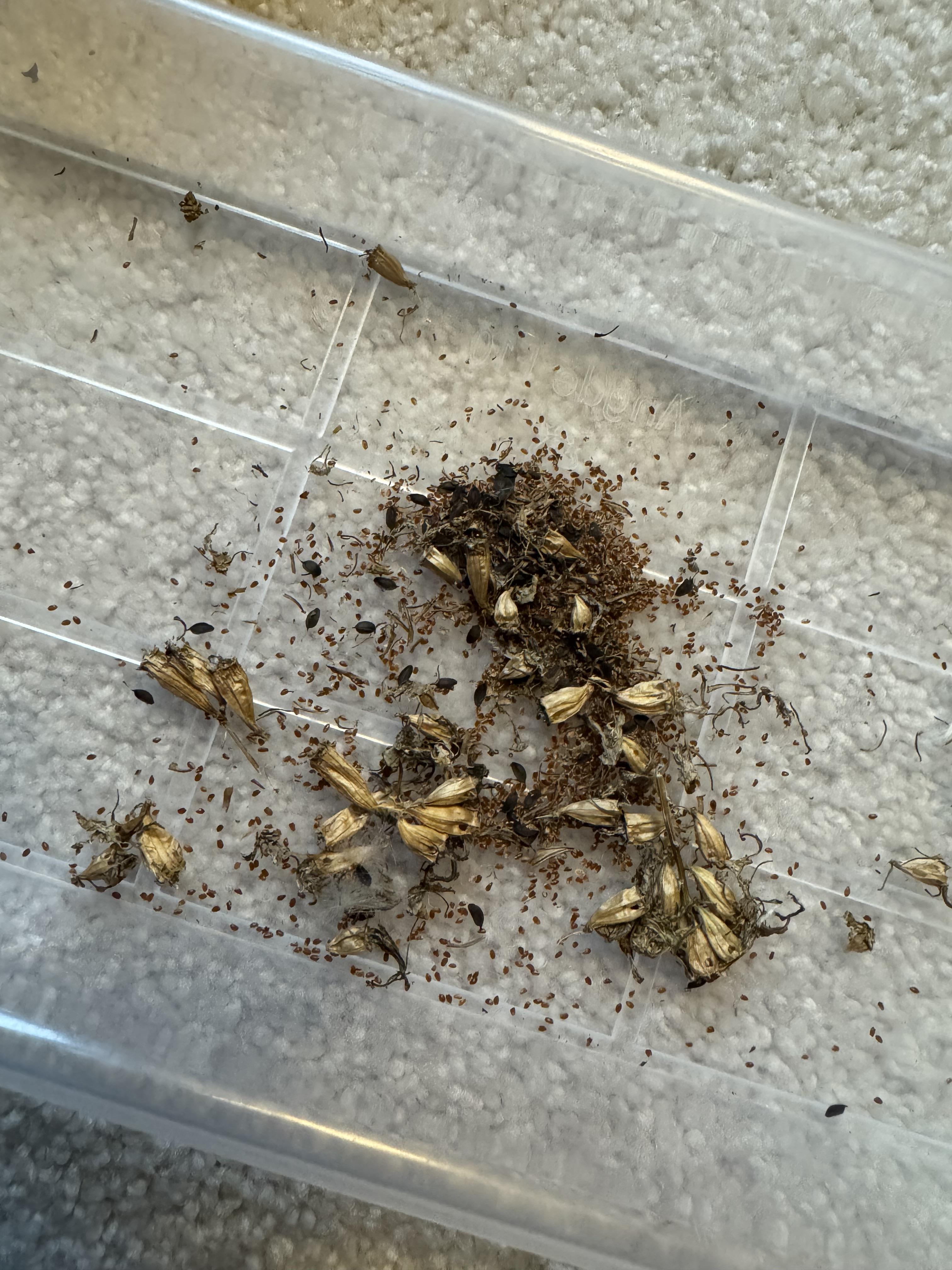
Hello, I collected these seeds a while ago and decided to not only mix them together but also NOT LABEL THEM!!! This has created a lovely problem where I don't know what either are. They were collected in Chicago, IL. I think one of them is a lobelia species I just don't know which one, and I'm lost on the black ones. Also I know its stupid to do this over carpet but its too late to back down now
I’m thinking of planting a lot of black cherry and choke cherry so the fruit can support birds and other wildlife. Prunus serotina and prunus Virginiana are disrespected on many websites. They spread by suckers, the fruit stains concrete, they’re structurally unattractive etc etc. None of these is an issue for my property. Has anyone had good luck doing these trees in quantity? Are tree tubes an option or would cages be better? Thanks in advance.
Hi All -- Can you help me decide if we should get swamp rose or carolina rose to include in a perennial border to get the effect of an english cottage garden? We have medium moisture soil and somewhere in between full sun and partial shade. I want something that will have bushy structure, and I am willing to prune. Any advice is greatly appreciated!
Interestingly, the tallest native herbaceous plant I’ve seen around me was a single wood lettuce growing on the edge of a stream bank. I got a ladder and a tape measure out and it was over 14’ tall. Quite unusual for that species AFAIK. I’ve also gotten a Joe pye weed over 8’
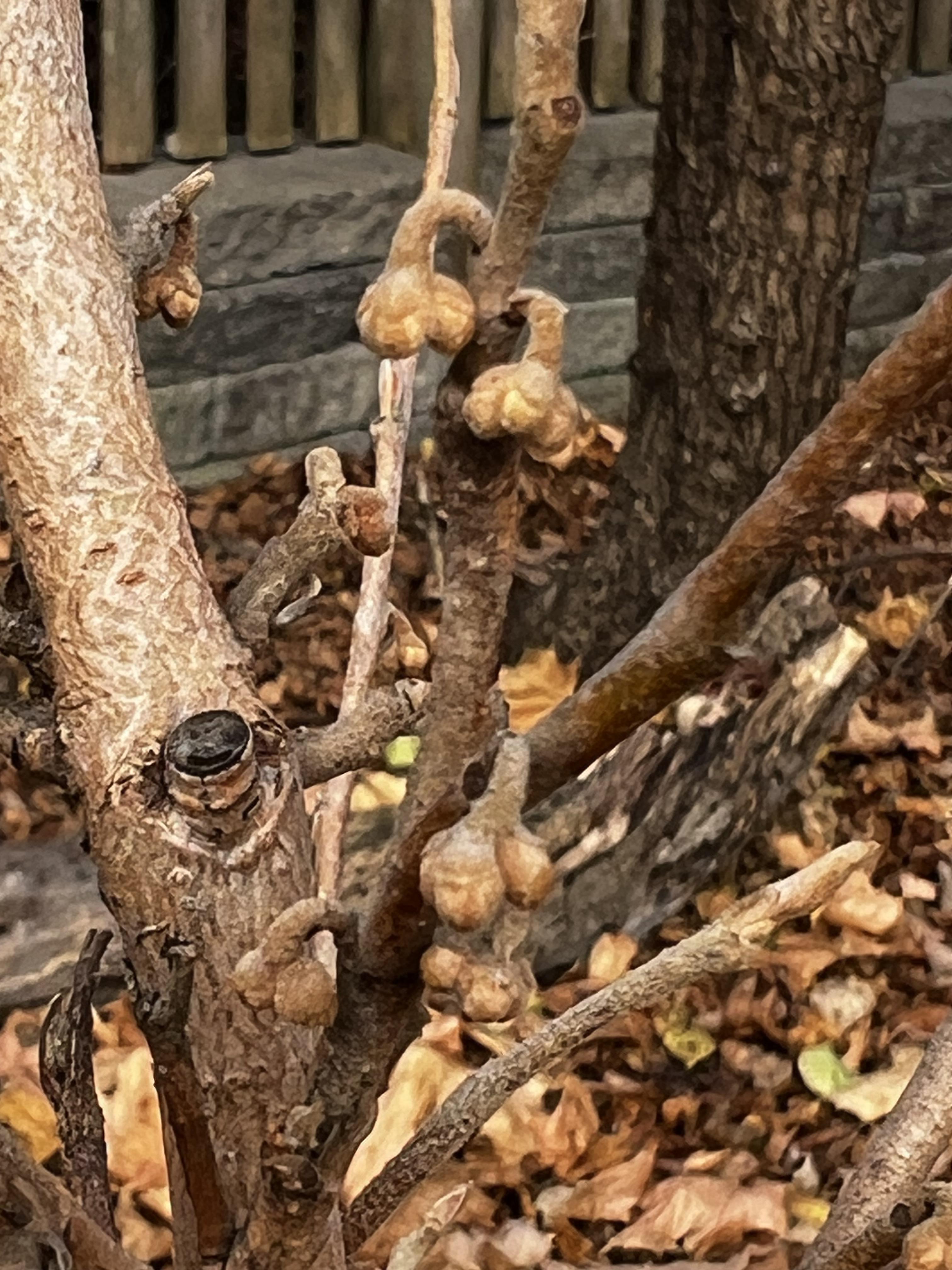
I know this may end up getting me dragged on the circle jerk, but: is it normal for Hamamelis virginiana to have still-unopened flower buds at the end of November? Canadian plant hardiness zone 5b (ish), Montreal, QC.
Everything I’ve read says they bloom in the fall, sometimes while the leaves are still on. I bought and planted this about a month ago; the buds were there at that time (leaves were too) and haven’t changed at all since. Is it transplant shock, or are they waiting for more frost (have had two frost mornings so far but no daytime below zero temps)? What is the mechanism that causes the plant to decide to bloom?
Or did it bloom before I bought it and these are actually seed pods?