r/ExploreLuxor • • Jun 26 '26

Luxor hidden basement elevator

0 Upvotes

I was curious if anyone reading this knows anything about the hidden elevator located in the Luxor bottom level hidden in an area. I know about this elevator from another technician. This was in 1993 when I worked there as a company electronics technician. This elevator went down to an underground area that was connected to something underneath the Luxor. I was l hired In October of 1993 8 weeks before opening and met many contractors. One of these people knew the contractor guys for the inclinatit’s. I was told the parking lot next to the Luxor and behind the Excalibur had an entrance behind some cement structure that had another hidden type of entrance. But wondering if anyone knows anything about this.


r/ExploreLuxor • • Dec 29 '24

Best Egyptian Souvenirs to Buy in Luxor

Thumbnail
exploreluxor.org
2 Upvotes

r/ExploreLuxor • • Mar 07 '26

Spin Music

Post image
0 Upvotes

On all platforms go stream for me “Spin Music” AMW Pierre Ft CGE Scottie Twan


r/ExploreLuxor • • Sep 01 '26

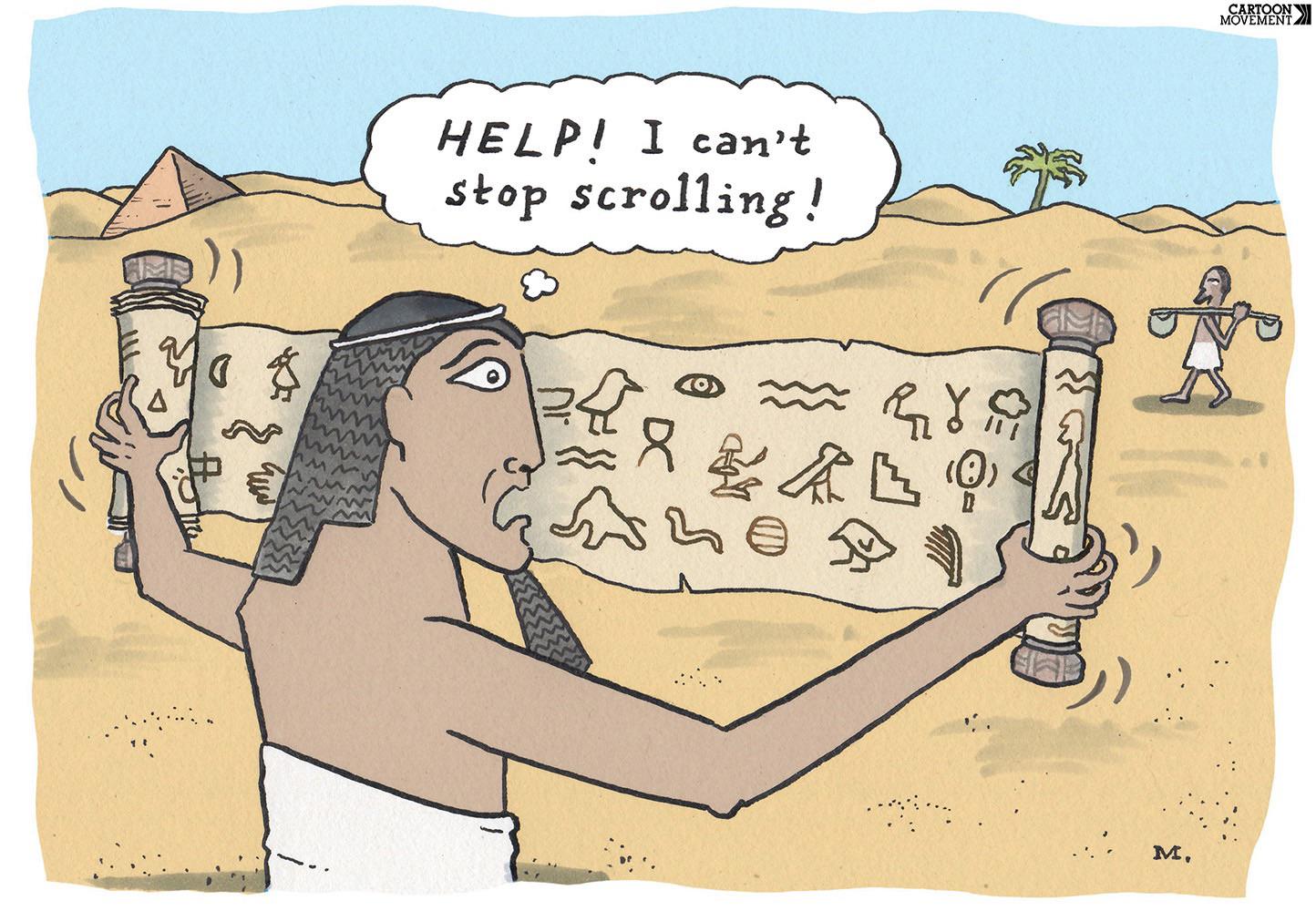
Political cartoon deriding infinite scrolling published 9/1/2026

Post image
6 Upvotes

r/ExploreLuxor • • Mar 01 '26

Happiness is free

1 Upvotes

happiness is free


r/ExploreLuxor • • 29d ago

Shabti, Nespaheran, Egyptian Priest (2), 1069 BCE-945 BCE, Findspot Egypt, Faience, Queensland Museum

Thumbnail gallery
2 Upvotes

Shabti, Nespaheran, Egyptian Priest (2)

Production date
1069 BCE-945 BCE

Country
Egypt

Description
Blue faience shabti of Nespaheran. Upright stance with wig, arms folded across the chest, and black inked headband, eyes, hoes and heighroglyphs on the front. Inscribed in black ink with "The Divine father of Amun, ouah-priest of Khonsu, and scribe of the temple of Amon"

Classification
ARCHAEOLOGY Egyptian figure

Production date
1069 BCE-945 BCE

Production place
Egypt

Measurements
L100mm x W35 x D32mm

Media/Materials description
Egyptian faience is a ceramic material with a siliceous body and brightly coloured glaze.
Faience (composed of quartz, alkaline salts [natron or plant ash], lime, and metallic mineral-based colorant)
Glaze (formed by alkali and lime reacting with silica to form the glaze)

Signature/Marks
ink

History and use
Shabtis are funerary figurines, usually mummiform in appearance, which developed during the Middle Kingdom. They were buried with a person, standing in place of the deceased and their servants. They were intended to free the deceased from the necessity of labour in the afterlife, which was required for the deceased to produce their own food.

Registration number
E40056.2

Title
Shabti, Nespaheran, Egyptian Priest (2), 1069 BCE-945 BCE, Findspot Egypt, Faience, Queensland Museum

https://collections.qm.qld.gov.au/objects/CH53203/shabti-nespaheran-egyptian-priest

Queensland Museum


r/ExploreLuxor • • Mar 09 '26

Ded beat

0 Upvotes

713 six eight one 946 four

ask for athen he works at brewings and refuses to take care of his two beautiful girls time and time again he’s supposed to show up for them and he always cancels and makes everything 1000 times worse and the little girls cry every time I can’t take it anymore he doesn’t pay child support. He owes over $20,000. I haven’t seen a dime from him in almost 6 months. If he’s not gonna take care of them he should be able to buy him self new shoes


r/ExploreLuxor • • Jun 17 '26

Limestone Relief of Akhenaten, Nefertiti and Two Princesses Worshipping the Aten, New Kingdom, Amenhotep IV/Akhenaten (ca. 1353-1336 BC), discovered at the Royal Tomb at el-Amarna, currently at the Egyptian Museum in Cairo.

Post image
3 Upvotes

Limestone Relief of Akhenaten, Nefertiti and Two Princesses Worshipping the Aten

Gallery number: 3 – Ground Floor
Period: New Kingdom, Amenhotep IV/Akhenaten (ca. 1353-1336 BC)
Dynasty: 18th Dynasty
Place of discovery: Royal Tomb el-Amarna (Akhetaten) Middle Egypt
Size: H 52.00 cm W 48.00 cm D/L 8.00 cm
Material: Limestone 

The Egyptian Museum

https://egyptianmuseumcairo.eg/artefacts/limestone-relief-of-akhenaten/

Limestone Relief of Akhenaten, Nefertiti and Two Princesses Worshipping the Aten, New Kingdom, Amenhotep IV/Akhenaten (ca. 1353-1336 BC), discovered at the Royal Tomb at el-Amarna, currently at the Egyptian Museum in
Cairo.


r/ExploreLuxor • • Jul 10 '26

Dummy Jar Inscribed for Sennefer and Senetnay, Dynasty 18 New Kingdom, Limestone,The Metropolitan Museum of Art

Thumbnail gallery
4 Upvotes

Dummy Jar Inscribed for Sennefer and Senetnay
New Kingdom
ca. 1427–1400 B.C.

On view at The Met Fifth Avenue in Gallery 117
This jar is a model made of solid stone that was intended as a piece of burial equipment. The inscription names the Royal Nurse Senetnay who lived into the reign of her nursling, Amenhotep II. As wet-nurse of a king, she was granted burial in the royal cemetery now called the Valley of the Kings. The tomb originally intended for Senetnay is unknown, but some of her funerary equipment, including this jar and several others in the collection, was discovered in an unused royal tomb, KV 42, in 1900. Burial equipment inscribed for other non-royal individuals was also found in KV 42 and it is likely that the contents of a number of robbed tombs had been reburied here for safe-keeping in ancient times.

For more information on the contents of KV 42, see the Curatorial Interpretation below.

Overview
Title: Dummy Jar Inscribed for Sennefer and Senetnay

Period: New Kingdom

Dynasty: Dynasty 18

Reign: reign of Amenhotep II

Date: ca. 1427–1400 B.C.

Geography: From Egypt, Upper Egypt, Thebes, Valley of the Kings, Tomb of Queen Hatshepsut-Merytre, KV 42, re-burial of Senetnay, wife of Sennefer, Macarios/Andraos excavations, 1900

Medium: Limestone

Dimensions: H. 14 cm (5 1/2 in.)

Credit Line: Rogers Fund, 1932

Object Number: 32.2.5

Curatorial Department: Egyptian Art

Curatorial Interpretation
Objects in the Metropolitan Museum Associated with Tomb 42 in the Valley of the Kings

Late in the year of 1900, two residents of Luxor, Chinouda Macarios and Boutros Andraos, were granted a concession to excavate a tomb in the Valley of the Kings. This tomb was eventually given the number 42 and today is often referred to as KV 42. Work in the tomb was overseen and reported on by Howard Carter, the recently appointed Chief Inspector of Antiquities for Upper Egypt. The tomb had been robbed in ancient times, but it contained burial equipment inscribed with the names of three non-royal individuals. The majority of these, including four canopic jars and numerous model vessels made of solid stone, were inscribed for the Royal Nurse Senetnay, wife of the Mayor of Thebes Sennefer whose tomb in the cemetery of officials on Sheikh Abd el-Qurna hill (TT 96) was already famous for its lavishly decorated burial chamber. Because the name of Sennefer was inscribed along with that of Senetnay on many of the model vessels, Carter decided that both Sennefer and his wife had been buried in KV 42 and identified it as another tomb of Sennefer in his report (see the reference below).

In spite of the presence of Sennefer’s name on some of the model vessels found in KV 42, it is most likely that the vessels all belonged to the burial of Senetnay. In the tomb of the Vizier Amenemopet (TT 29), she is shown with her husband in a banquet scene where she is given the title "one who nurtured the body of the god." This title indicates that she was not merely wet-nurse to one of the royal children, but that she lived into the reign of her nursling, Amenhotep II. Two generations earlier, Amenhotep’s great-aunt, the female pharaoh Hatshepsut, had granted her wet-nurse the special privilege of burial in the royal cemetery, and it appears that Amenhotep did the same for Senetnay. Sennefer, by having his name inscribed on some of his wife’s model vessels, would have shared in this privilege. However, it seems likely that he outlived Senetnay and was buried in his own tomb along with a second wife, whose name only appears in the burial chamber of TT 96.

After work was finished in KV 42, the excavators were given a share of the finds as part of their agreement with the Egyptian Antiquities Service. According to Howard Carter, a gold rosette found in the first passage near the tomb’s entrance (and noted in his report), was purchased from one of them by Theodore M. Davis. This was bequeathed to the Museum in his will. Other finds from the tomb were also sold and are now in the collections of museums in Europe and North America, including five model vessels which were purchased by the MET in 1932 from Sayed Molattam, a Luxor dealer. Four of these are on view in Egyptian gallery 117; the other went to the Oriental Institute Museum at the University of Chicago as part of an exchange in 1950.

While he was working with Lord Carnarvon in 1921, Howard Carter discovered foundation deposits around the entrance to KV 42. Inscriptions on model vessels from the deposits identified the tomb’s owner as Queen Hatshepsut-Merytre, the principal wife of Thutmose III whose tomb is entered from a crevice just above the cul-de-sac where KV 42 is located. Although Hatshepsut-Merytre appears to have been the intended occupant of KV 42, the decoration of the burial chamber was never completed and the stone sarcophagus found there was unused. It seems likely that the queen was buried elsewhere, perhaps in the tomb of her son, Amenhotep II. Three model vessels from these deposits were purchased by the Museum in 1932 from the same dealer who had Senetnay’s model vessels (see above). The foundation deposit vessels are also on view in Egyptian gallery 117.

So, why did burial equipment inscribed for Senetnay and two other non-royal individuals end up in an unused queen’s tomb? From ancient texts, we know of tomb robberies that took place near the end of Dynasty 20 (around 1100 B.C.), nearly four centuries after the Valley of the Kings was established as the royal cemetery of the New Kingdom. From dockets written on the wrappings of royal mummies and from graffiti found both inside and outside some of the Valley of the Kings tombs, we know that these mummies were moved for safe-keeping, often more than once, until most were finally cached in two tombs: TT 320, which lies just south of the royal temples at Deir el-Bahri on the Nile side of the desert cliffs; and KV 35, the tomb of Amenhotep II in the Valley of the Kings.

In view of the movement of mummies and burial equipment that took place in the Valley of the Kings at the end of its history as a royal cemetery, it is not surprising that some would have ended up in KV 42. There are several non-royal tombs nearby, including a small corridor tomb (KV 37) that lies across the cul-de-sac from KV 42. It is at least possible that this is the original tomb of Senetnay. But, wherever in the Valley of the Kings her original tomb was located, it appears that, after it was robbed, Senetnay’s mummy and what equipment could be salvaged were reburied in Hatshepsut-Merytre’s unused tomb along with the remains from at least two other non-royal tombs.

When KV 42 was opened in 1900, the condition of its contents suggested to Howard Carter that the tomb had been entered and robbed after the (re)burials had taken place. It is possible that any mummies present in the tomb, if they survived this robbery, were transferred to another cache, and they may be among the unidentified mummies found in KV 35 or TT 320.
Catharine H. Roehrig 2018

Further reading:
Carter, Howard, "Report upon the Tomb of Sen-nefer Found at Biban El-Molouk Near that of Thotmes III No. 34," Annales du Service des Antiquités de l’Égypte, vol. 2 (1901), pp. 196-200.

James, T. G. H. Howard Carter: The Path to Tutankhamun. Kegan Paul International: London and New York (1992).

Reeves, C. N. Valley of the Kings: The decline of a royal necropolis. Kegan Paul International: London and New York (1990).

Roehrig, Catharine H, "The Building Activities of Thutmose III in the Valley of the Kings," chapter 6 in Thutmose III: A New Biography, Eds. Eric H. Cline & David O’Connor, pp. 238-259. University of Michigan Press: Ann Arbor (2006).

Roehrig, Catharine H., "Some Thoughts on Queen’s Tombs in the Valley of the Kings," in Studies in Honour of Kent R. Weeks, edited by Z. Hawass and S. Ikram, pp. 181-195. Supplement aux Annales du Service des Antiquités de L’Égypte, Cahier no. 41, Cairo (2010).

Provenance
Purchased by the Museum from Sayed Molattam, Luxor, 1932.

References
Hayes, William C. 1959. Scepter of Egypt II: A Background for the Study of the Egyptian Antiquities in the Metropolitan Museum of Art: The Hyksos Period and the New Kingdom (1675-1080 B.C.). Cambridge, Mass.: Metropolitan Museum of Art, p. 146.

Graefe, Erhart 1981. Untersuchungen zur Verwaltung un Geschichte der Institution der Gottesgemahlin des Amun vom Beginn des Neuen Reiches bis zur Spatzeit, 2. Ägyptologische Abhandlungen, Wiesbaden: Harrassowitz, Otto, p. 145.

The Metropolitan Museum of Art

https://www.metmuseum.org/art/collection/search/557556

Dummy Jar Inscribed for Sennefer and Senetnay**,** Dynasty 18 New Kingdom, Limestone,The Metropolitan Museum of Art


r/ExploreLuxor • • Jun 09 '26

Stela

Post image
4 Upvotes

Stela of the Standard Bearer Smen

POSSIBLE ORIGIN Thebes, Egypt, Africa
CULTURE Egyptian
PERIOD New Kingdom, Dynasty 18, reign of Thutmose IV
DATE 1400-1390 BCE
MEDIUM Fine-grained limestone
CREDIT LINE Gift of the Georges Ricard Foundation
DIMENSIONS 25 9/16 x 17 5/16 x 2 3/4 in. (65 x 44 x 7 cm)
OBJECT NUMBER 2018.010.408

Label Text
Just as we do today, the ancient Egyptians named their boats. This round-topped stela belongs to a man named Smen, meaning “goose” in ancient Egyptian, who served on the royal state barge called Meryamun. He was promoted to standard bearer of the boat, “Menkheperure-destroys-Syria,” indicating he saw active military service during King Thutmose IV’s northern Syrian campaigns. In ancient Egypt, standard bearers could command troops and collect men for expeditions.

On the top register, Smen praises Osiris-Wennefer, enthroned before an offering table piled high with bread, meat, fruit, and onions. The table and two braziers below are topped with lotus flowers, symbolizing eternity. Above, two Anubis jackals and udjat eyes face an encircling shen-ring. Osiris-Wennefer, the mummiform deity of the underworld, wears an Atef-crown and holds a crook and flail, his standard insignia. His block throne rests on the hieroglyph for ma’at, relating to his role as the judge of the dead. Behind the throne, an ankh sign holds an ostrich feather sunshade aloft, symbolizing the god’s divine presence. Smen wears a wig, a bag tunic, and a kilt tied with a sash. The column of text behind Smen gives his lineage, “born of the mistress of the house, Tjenna, and the dignitary Shemsu.” On the register below, his wife, Hesetre, makes a bouquet and libation offering to her deceased parents, Nakht and Rui, who are seated on a couch. Before them is an offering table loaded with the same provisions as above; the only difference is two containers of wine wrapped with lotus buds below the table. Below the second register are four rows of text, “(1) An offering which the king gives to Osiris, ruler of eternity, the great god, lord of Abydos, so that he may give a voice offering of bread [sic], beer, ox, fowl, and cold water, wine [sic], and (2) milk, breathe the sweet north wind, drink from […],(3) the receipt of the offerings that come forth in the presence of the choicest things that are issued on their altar, that one may come forth to me bearing […] (from among the offerings of the lord of) eternity, for the ka of the serviceman (w’w) (of the boat) Mery-Amun, (S)men.” Another stela belonging to Smen in the Louvre, mentions his son Nai.

Exhibition History
Michael C. Carlos Museum, Veneralia 2019 Senuseret Collection Preview, May 18, 2019
Life and the Afterlife: Ancient Egyptian Art from the Senusret Collection, Michael C. Carlos Museum, February 4 - August 6, 2023

Published References
Melinda K. Hartwig, ed., Life and The Afterlife: Ancient Egyptian Art from the Senusret Collection (Atlanta: Michael C. Carlos Museum, 2023), catalogue entry 24.
TERMS reliefs (sculptures)stelae

PROVENANCE
Ex coll. Georges Ricard Foundation, Santa Barbara, California, possibly purchased from Jean-François Mignon, Aix-en Provence, France.

STATUS Not on view

COLLECTIONS Ancient Egyptian, Nubian, and Near Eastern Art

The Michael C. Carlos Museum at Emory University

https://collections.carlos.emory.edu/objects/37986/stela-of-the-standard-bearer-smen


r/ExploreLuxor • • May 23 '26

Stela

Thumbnail
gallery
5 Upvotes

Stela

Object Type
stela

Museum number
EA8468

Description
Sycomore fig wood stela of Neswy: this round-topped stela is divided into four separate sections. At the top under a curved sky-sign appears a winged sun-disk with winged uraei enclosing a scarab beetle. On each side is a recumbent jackal holding a sceptre. In the second register Neswy kneels on the right in adoration of the solar barque. A 'ba'-bird on the prow of the bark worships Ra, Atum, Khepri, Shu, Tefnut, and Geb who are seated and behind whom stands the helmsman. In the third register the deceased on the right stands in worship before an altar on which rests an offering cooled by a lotus-flower. Behind stand Osiris, Isis, Nephthys, Hornedjitef, Hathor, Anubis, and Wepwawet. The fourth register consists of five lines with a prayer to Ra-Horakhty and Khepri and names the deceased, Neswy, born of the lady Tʒ-kwr-hb. The stela rests on two stepped pedestals and there is a 'ba'-bird on its top. The stela is cracked down one side where a separate plank which helped to form this stela had broken away and been rejoined in modern times. The surface is cracked in several places and the colours are faded. The background of the stela is grey-white. The sky at the top is blue. The disk is red with a white rim. The tripartite wings are blue, yellow with black details, and green with black details, with yellow patches and a red upper and lower rim, and white between the divisions. The uraei have blue upper bodies, red and blue-striped wings, and blue-striped bodies on grey-white with red and blue-feathered green crowns respectively. They enclose on one side a blue beetle below which is blue and red decoration and on the other side blue šn-signs with red centres. The jackals are black with red sashes, blue flags, and blue and red sceptres. The texts are black between blue lines where indicated. There is a border consisting of blue, red, blue, green rectangles separated by one black and two white lines and edged on both sides by white borders between the first and second register. The deceased has a red body, black features, blue wig with green top, and blue-striped grey-white garment apart from the area under his arm which is striped black. The barque is blue at both ends and green in the middle with red and grey-white stripes between these divisions and red disks and lotus-centres at the top of the prow and stern. The 'ba'-bird has a red body and legs, blue back and wig, and green underbody and cone. His fan is blue with red diagonal lines on grey-white and his flag red and his feather blue. The seated gods have red bodies, blue-striped collars, blue wigs, and blue-black ankh-signs. Ra has a grey-white face with black details, a blue sceptre, and a red disk with black horns. Atum has a blue face and a red and grey-white crown. The next four deities have green faces. Khepri and Shu have blue head-dresses; Tefnut's is red, while that of Geb is red and blue. The deities rest on a platform made up of blue, grey-white, and red rectangles. The helmsman has a red body, blue collar and wig, and green and grey-white kilt. The boat rests on blue water. The texts here and in the following register are black with blue dividing lines. In the third register the deceased has a red body, blue wig and eyebrow, green cone, blue-green collar and underarm garment, and white garment with black details and a blue belt. The altar is blue with a red pot and blue lotus, Osiris has a red body with blue sceptres and streamers, green face, blue collar, and grey-white crown with blue feathers, black horns, and a red centre dot. The two goddesses have green bodies, red dresses, blue wigs, and blue and red head-dresses and carry blue-black 'ankhs'. Hornedjitef has a red body, grey-white face with black details, blue wig, blue striped and green kilt, and grey-white and red crown and carries a blue-black sceptre and black ankh. Hathor is similar to the other goddesses apart from her red disk with black horns, blue-black sceptre, and black 'ankh'. The two jackal-headed deities have black bodies, blue and red kilts with red tails and carry blue-black sceptres and black ankhs. The dividing lines between the names of Isis and Nephthys and the extreme right border are red rather than the normal blue. The border between the third and fourth register is composed of blue, white, and green squares, the white having a black dot in the centre. The text in the fourth register is black on alternate grey-white and yellow backgrounds between blue dividing lines. The sides and back are plastered white apart from the bottom edge. There is a red stripe in the centre of the sides. The pedestals are white with blue and red steps. The 'ba'-bird has a gold face, blue wig, and upper body with a grey-white red-feathered centre stripe. The underbody is grey-white with black, blue, and red details. The feet are red and rest on a base which has a grey-white upper surface and blue sides.

Cultures/periods
Ptolemaic

Findspot
Found/Acquired: Thebes (historic - Upper Egypt)

Materials
sycomore fig wood
plaster
gold

Technique
painted
plastered
gilded

Dimensions
Height: 53.50 centimetres
Width: 45.50 centimetres

Inscriptions
Inscription type: inscription
Inscription script: hieroglyphic
Inscription note: Prayer to Ra-Horakhty and Khepri painted in five rows of hieroglyphic text.

Inscription subject
funerary

Curator's comments

Bibliography:
The British Museum, 'A Guide to the Third and Fourth Egyptian Rooms' (London, 1904), p. 84 (no. 138);
E. A. Wallis Budge 'A Guide to the Fourth, Fifth and Sixth Egyptian Rooms, and the Coptic Room' (London, 1922), 138 (no. 2);
E. A. Wallis Budge, 'The Mummy: a Handbook of Egyptian Funerary Archaeology' (Cambridge 1925), 448-9 pl. xxiv,
B. Porter & R. Moss, 'Topographical Bibliography of Ancient Egyptian Hieroglyphic Texts, Reliefs and Paintings' I (Part 2) (Oxford, 1964), p. 809;
P. Munro, ‘Die spätägyptischen Totenstelen’ (Glückstadt, 1973), p. 236;
K. Myśliwiec, 'Mitteilungen der Deutschen Archäologischen Instituts Abteilung Kairo' 35 (Wiesbaden, 1979), p. 202 note 26;
S. Bosticco, 'Le stele egiziane di epoca tarda' (Rome, 1972), p. 44.
M. Minas-Nerpel, 'Der Gott Chepri : Untersuchungen zu Schriftzeugnissen und ikonographischen Quellen vom Alten Reich bis in griechisch-römische Zeit' (OLA 154, Leuven/Dudley, Mass.,2006), p. 338, note 943.

For a parallel, see Stadler, M.A. 2022. A New Version of the Beginning of the Book of Traversing Eternity: The Hieroglyphic-Demotic Funerary Stela of Pakhom, Son of Lykos, from Edfu (22 March 18 BCE [greg.]), in One Who Loves Knowledge. Studies in Honor of Richard Jasnow, Bryan B. et al. (eds), Columbus, p. 419-38.

Bibliographic references
Bierbrier 1987 / Hieroglyphic texts from Egyptian stelae, etc., in the British Museum, Part 11 (pl.82-83)

Location
On display (Room 62 - Egyptian Death and Afterlife: Mummies, Display Case 18)

Condition
fair

Subjects
ancient egyptian deity
ba

Associated names
Named in inscription: Takerheb (mother)
Representation of: Ra
Representation of: Atum
Named in inscription & portrayed: Khepri
Representation of: Shu
Representation of: Tefnet
Representation of: Geb
Representation of: Osiris
Representation of: Isis
Representation of: Nephthys
Representation of: Hornedjitef
Representation of: Hathor
Representation of: Anubis
Representation of: Wepwawet
Named in inscription: Ra-Horakhty

Acquisition name
Purchased from: Giovanni Anastasi

Acquisition date
1839

Department
Egypt and Sudan

BM/Big number
EA8468

Registration number
8468

Additional IDs
Miscellaneous number: BS.8468 (Birch Slip Number)

The British Museum

https://www.britishmuseum.org/collection/object/Y_EA8468


r/ExploreLuxor • • Jun 10 '26

Stele

Post image
6 Upvotes

Stela of a Man Making an Offering to Osiris

CULTURE Egyptian
PERIOD Third Intermediate Period
DATE 1076-723 BCE
MEDIUM Wood, paint
CREDIT LINE Mohamed Farid Khamis/Oriental Weavers Fund
DIMENSIONS 8 3/8 x 13 1/2 x 1 1/4 in. (21.3 x 34.3 x 3.2 cm)
OBJECT NUMBER 2005.015.003

Label Text
The Egyptians commemorated burials with stele as early as the 1st Dynasty (2950-2730 BC). In their earliest and most basic form, funerary stele bore only the name of the owner. This example, dating to the Third Intermediate Period (1076-723 BC), incorporates standard elements such as the individual performing an offering ritual before a deity underneath a winged solardisk. The deceased is depicted on the viewer's right wearing a long kilt and standing before an offering table. He offers incense and a bouquet of lotus blossoms to Osiris, god of the Underworld. The text below is an offering formula requesting donations on behalf of the deceased.

Exhibition History
From Pharaohs to Emperors: New Egyptian and Classical Antiquities at Emory, Michael C. Carlos Museum, January 14 - April 2, 2006
MCCM Permanent Collection Reinstallation, 2006 - December 10, 2025

Published References
Piasa, Archeologie (September 28 - 29, 2004), 62, lot 283.

TERMS stelaepainting (image-making)

PROVENANCE Purchased by MCCM from Piasa, Paris, September 28, 2004, lot 283.

STATUS Not on view

COLLECTIONS Ancient Egyptian, Nubian, and Near Eastern Art

The Michael C. Carlos Museum at Emory University

https://collections.carlos.emory.edu/objects/12782/stela-of-a-man-making-an-offering-to-osiris


r/ExploreLuxor • • Sep 23 '26

Goddess Isis with the Child Horus, Late period, 26th dynasty 7th/6th century BC, Findspot unknown Egypt, Copper alloy and gilding, Antikenmuseum Basel

Post image
6 Upvotes

Goddess Isis with the Child Horus

Object Number
BSAe III 00099

Cultural area
Egypt

Epoch
Late Period (Egypt)

Basic information
Copper alloy, remnants of gilding,
H. 20.6 cm, W. 7 cm, D. 6.8 cm

Late period, 26th dynasty, 7th/6th century BC.

Inv. BSAe III 00099

Provenance
Deposit Museum of Cultures Basel. Gift 1872 Wilhelm Vischer-Bilfinger (1808–1874).

Description
The statuette of a seated Isis was carved as a temple votive and depicts the goddess in her iconographically characteristic representation as a nursing mother (Isis lactans). Isis holds her son Horus on her left arm and extends her breast to him. She wears a fitted bodice and a three-part braided wig. As headwear, the Hathor emblem made of cow horns and a sun disk appears, which refers to the close connection between the two goddesses.

The Horus child is depicted naked and wears a snug cap with an uraeus serpent on the forehead. The juvenile curls falling down on the right ear identify it as a child.

The motif of the nursing Isis gained extraordinary widespread distribution during the Late Period and remained popular until the Greek-Roman era. In this period, Isis evolved due to her healing and magical powers into a universal goddess. According to the Osiris myth, she reassembles the murdered and fragmented Osiris by her brother Seth using her magic and posthumously receives her son Horus from him. To protect him from Seth's permanent persecutions, she hides with him in the papyrus thicket of Chemmis, located locally in the Nile Delta near Buto, and raises him there under great dangers.

The depictions of the nursing Isis embody the ideal of the caring mother. The act of nursing simultaneously symbolizes the life-giving and regenerative power of the goddess, thereby also being understood as a nurturing death goddess. The image motif was finally transferred in Christian times to the depiction of the lactans Maria.

Bibliography
J. J. Bernoulli, Museum in Basel. Catalog for the Antiquarian Department (Basel 1880) No. 205.

E. Hornung - Chr. Loeben - A. Wiese, Immortal Pharaoh. The Tomb of Thutmosis III (Madrid 2005) 84 f., No. 3.'

Title
Goddess Isis with the Child Horus, Late period, 26th dynasty 7th/6th century BC, Findspot unknown Egypt, Copper alloy and gilding, Antikenmuseum Basel

https://antikenmuseumbasel.zetcom.net/en/collection/item/74580/

Antikenmuseum Basel


r/ExploreLuxor • • Jul 03 '24

Amun-Ra Song

Thumbnail
youtu.be
7 Upvotes

r/ExploreLuxor • • Feb 04 '26

Statue

Thumbnail gallery
8 Upvotes

r/ExploreLuxor • • Mar 19 '26

Statuette

Post image
8 Upvotes

r/ExploreLuxor • • Mar 02 '26

Amulet

Thumbnail
gallery
9 Upvotes

Thoth Amulet

Late Period–Ptolemaic Period

664–30 B.C.

On view at The Met Fifth Avenue in Gallery 133

Amulets often represent deities in order to invoke their protection and specific powers. Such amulets were used by the living and often placed on mummies as well. The piece here depicts the god Thoth as a man with an ibis-head. Thoth was the god of knowledge and writing, and he was thought to have healing powers. Thoth amulets were popular mummy amulets, which possibly relates to his healing powers and to his role as recorder of the final judgment, in which it was determined if the deceased had lived a virtuous life.

Artwork Details

Title: Thoth Amulet

Period: Late Period–Ptolemaic Period

Date: 664–30 B.C.

Geography: From Egypt

Medium: Faience

Dimensions: H. 3.4 cm (1 5/16 in.); W. 0.8 cm (5/16 in.); D. 1.3 cm (1/2 in.)

Credit Line: Gift of Mrs. Joseph R. Skidmore, 1896

Object Number: 96.21.1

Curatorial Department: Egyptian Art

The Metropolitan Museum of Art

https://www.metmuseum.org/art/collection/search/552980


r/ExploreLuxor • • Dec 27 '25

Egypt Demands Return of Nefertiti Bust from Germany

Thumbnail
chosun.com
47 Upvotes

r/ExploreLuxor • • Feb 19 '26

Relief

Post image
10 Upvotes

r/ExploreLuxor • • Apr 24 '26

Ushabti

Post image
11 Upvotes

r/ExploreLuxor • • May 20 '26

Mask

Thumbnail
gallery
12 Upvotes

Gilded Cartonnage Mask
PLACE CREATEDEgypt, Africa
CULTURE Egyptian

PERIOD Ptolemaic Period
DATE3rd Century BCE

MEDIUM Cartonnage, paint, gilding

CREDIT LINE Gift of the Georges Ricard Foundation

DIMENSIONS17 15/16 x 11 7/8 x 9 3/16 in. (45.5x 30.2 x 23.3 cm)

OBJECT NUMBER2018.010.12

Label Text
This mask once covered the head and upper chest of the wrapped mummy. A polychrome wig frames a gilded face, with its lappets resting over an ornamented collar. Deities are painted on a dark yellow background, with details highlighted in pink, blue, and green. The wig lappets are divided into three registers with identical motifs of falcons, the mummy before the seated Osiris, and the four sons of Horus. To either side of the wig are rosettes, udjat eyes, and various geometric motifs. A pink headband encircles the wig, attached to a golden ring. At the top of the wig, a winged scarab stretches its wings over the band. At the back, the vulture goddess Nekhbet, wearing an Atef-crown, stretches out her wings over the top of the mask. On the back of the mask are the figures of Isis and Nephthys protecting the mummy.

Exhibition History
Life and the Afterlife: Ancient Egyptian Art from the Senusret Collection, Michael C. Carlos Museum, February 4 - August 6, 2023

Published References
Jacques Mercier, Jacques Velliet, and Daniel Thullier [Hotel des Ventes], Lille, Rare Ensemble d'Objets de Fouilles et d'Archeologie (29 Mai 1972), lot 9.

Rune Nyord, "The Good Burial," in Life and the Afterlife: Ancient Egyptian Art from the Senusret Collection, ed. Melinda K. Hartwig (Atlanta: Michael C. Carlos Museum, 2023), Figure 3.1.

Melinda K. Hartwig, ed., Life and The Afterlife: Ancient Egyptian Art from the Senusret Collection (Atlanta: Michael C. Carlos Museum, 2023), catalogue entry 72.

TERMS

PROVENANCE
Purchased by Georges Ricard (1921-2012) from Jacques Mercier, Jacques Velliet, and Daniel Thullier [Hotel des Ventes], Lille, France, May 29, 1972, lot 9. Ex coll. Musée de l'Égypte et le Monde Antique, Collection Sanousrit, Monaco, 1975-1982. Ex coll. Georges Ricard Foundation, Santa Barbara, California.

STATUS Not on view]

COLLECTIONS
Ancient Egyptian, Nubian, and Near Eastern Art

Museum, 2023), catalogue entry 72.

TERMS

PROVENANCE
Purchased by Georges Ricard (1921-2012) from Jacques Mercier, Jacques Velliet, and Daniel Thullier [Hotel des Ventes], Lille, France, May 29, 1972, lot 9. Ex coll. Musée de l'Égypte et le Monde Antique, Collection Sanousrit, Monaco, 1975-1982. Ex coll. Georges Ricard Foundation, Santa Barbara, California.

STATUS Not on view

COLLECTIONS
Ancient Egyptian, Nubian, and Near Eastern Art


r/ExploreLuxor • • Mar 12 '26

Stele

Post image
13 Upvotes

r/ExploreLuxor • • Feb 02 '26

Statue

Thumbnail gallery
15 Upvotes

r/ExploreLuxor • • Jan 30 '26

Amulet

Thumbnail gallery
15 Upvotes