Hello, me and my partner have been having trouble with this particular circuit that our professor has given us. Everything works fine expect the 7 segment. We’ve tried many things and we’ve gotten help from people who have finished this circuit but for some reason our 7 segment is still not lighting up.
I have done bachelor of engineering in Electrical this month. I have done final year Project in Arduino based water detection system. And also learning PLC codesys ladder logic. I have 2 years experience in related fields. I applied Many positions but every where I got rejected. Most of Firms preferred Local grads over international. Why we studying here if they don’t want us. Why Universities prefer international students. Worst job market for engineering grad I have ever see
Sorry if not allowed, please help point me in the right direction.
I'm looking to develop a product for the Logistics industry. I've been working in this industry for going on 10 years. I used to be a product manager at a medical device company so I've always kept an eye out for solutions-based products. I've found it and I think I hit the jackpot after asking Chat GPT some questions.
If you have any experience with high voltage systems, power systems, EVs, or hybrid systems I'd love to chat to see if we can join forces if we are a good fit.
I've been going to networking groups nearby the universities, but I've only met mainly software engineers.
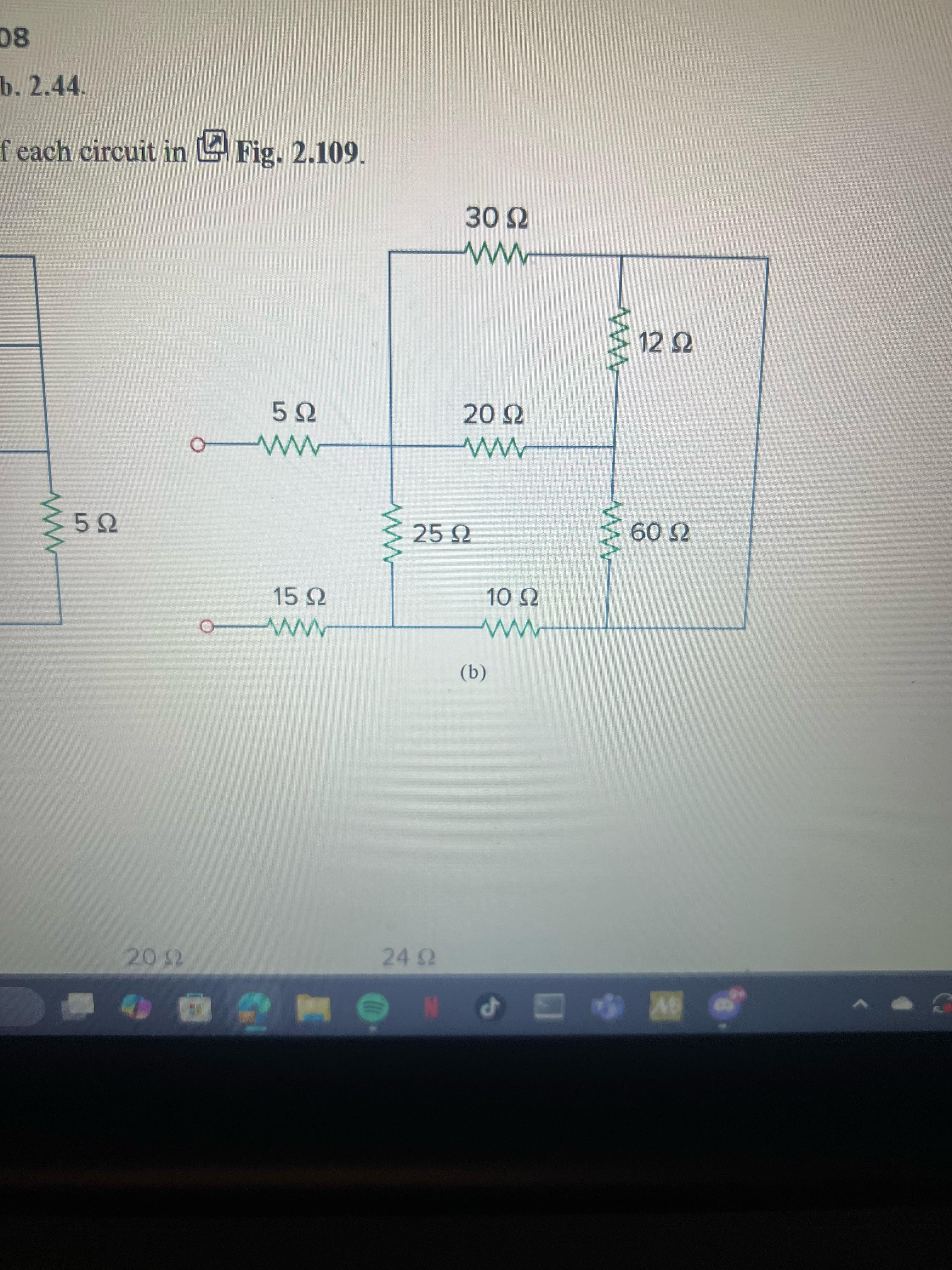
The correct answer is supposed to be 32.5 ohms. I got 30.5 ohms. Could someone tell me where I went wrong. I said the 12 ohms and 60 ohms are parallel giving 10 ohms. Which is in series with the 20 ohms giving 30 ohms. Which is in parallel with the 30 ohms giving 15 ohms. Then the 25 ohm and 10 ohms are in series giving 35 ohms. Which is in parallel with the combo of 15 ohms giving 10.5 ohms. The combo is in series with the 5 ohms and 15 ohms giving a total of 30.5 ohms
I am a 2nd year Electronics and Communication engineering student and we are told to make a project(simulation+model) solving a real world problem in a group of 4. So can you please help me with the ideas or problems you faced or seen people facing which can be solved. Badi meherbaani hogi🙏🏻🙏🏻 bhai samajh ke madat kardo
Today if the person is choosing the electrical branc so that it give the security in the future.the electrical is more suitable rather than cse it's true or not.
Im designing a binary function generator for one of my modules in electronics engineering. I’m trying to simplify these two equations to use as little different types of logic gates as possible. Someone in my class said they got there’s down to only nor gates but I can’t figure it out, any help would be much appreciated
Context: My friends struggled with EE technical interviews. After I talked to several students, I noticed that students and early-career engineers simply don't know what to expect on interviews, causing repeated failure.
Can this be some kind of asbestos wire? Trying to peel old cables from an old abandoned house and it causes shortness of breath and it spreads these shard like things everywhere?
Earthing and grounding are fundamental to electrical safety and system stability, especially in the Middle East where environmental and soil conditions create unique engineering challenges. As infrastructure across the region continues to expand—ranging from oil and gas facilities to high-rise buildings and data centers—the role of effective grounding has become increasingly critical.
In simple terms, earthing and grounding provide a controlled path for fault currents, lightning energy, and electrical surges to safely dissipate into the earth. However, in Middle East environments, this process is far from straightforward. Desert sands commonly found inland exhibit very high soil resistivity when dry, while coastal sabkha soils contain high levels of chlorides and sulfates that accelerate corrosion of grounding electrodes. Carbonate and limestone layers further restrict current dispersion, reducing the effectiveness of conventional grounding methods.
Because of these factors, poor earthing and grounding can result in dangerous step and touch voltages, ineffective lightning protection, and instability in surge protection systems. In critical facilities such as oil refineries, substations, airports, and commercial towers, grounding failure may lead to equipment damage, power quality issues, and unplanned downtime. These risks make grounding not just a compliance requirement, but a core element of infrastructure reliability.
Soil mineral composition also plays a major role in long-term grounding performance. Quartz-rich sands are electrically inert, sulfates accelerate metal corrosion, and chlorides weaken bonding joints. Seasonal temperature and humidity variations further alter soil resistivity, making grounding systems unpredictable if they are not engineered for local conditions.
Modern earthing and grounding solutions in the Middle East therefore require an engineered approach. This includes integrated grounding grids, corrosion-resistant electrodes, conductive backfills, engineered earthing compounds, and proper bonding across foundations and structural steel. Soil resistivity testing and chemical analysis are essential during the design stage to ensure consistent performance over the asset lifecycle.
As infrastructure becomes more complex and technology-driven, reliable earthing and grounding remain essential for safety, operational continuity, and regulatory compliance.
Manav’s Earth Enhancing Compounds (EEC)support this combined approach by delivering consistent conductivity in challenging soil conditions. Designed to perform reliably despite changes in moisture and mineral composition, these compounds help maintain low earth resistance, minimize corrosion, and improve the long-term stability of grounding systems. As climate patterns continue to evolve, such engineered solutions strengthen electrical safety and resilience across critical infrastructure.
For a detailed technical explanation of earthing and grounding design, soil behavior, corrosion control, and advanced grounding solutions in the Middle East,visit our website blog for more information.
My partner's company is actively hiring both Mechanical and Electrical Engineers. They hire on a referral basis only. They are looking for both BA's and MA's in Engineering. Relevant work experience is a plus but not required. Starting annual pay is $80-95k based on credentials plus benefits plus potential for overtime. It's a great company that values work/life balance.
Job Description:
Lead and support commissioning of mechanical systems for mission-critical data center infrastructure.
• Develop, execute, and maintain commissioning plans, test procedures, and verification checklists.
• Perform field inspections, functional performance testing, and integrated system testing.
• Review and evaluate design drawings, submittals, and equipment specifications.
• Collaborate closely with project engineers, contractors, and data center operators to resolve issues.
• Identify system deficiencies and recommend corrective actions to ensure performance and reliability.
• Document test results and prepare comprehensive commissioning and turnover reports.
• Provide operational training and technical support to data center operations teams.
• Ensure systems meet applicable codes, standards, and regulatory requirements.
• Contribute technical expertise during project meetings and design reviews.
If interested, message me with a brief description of your experience and include a resumé if you have one.
I am currently a college freshman pursuing EE and interested in shift work using my EE degree. I've heard about FIFO, but I am curious as to what other jobs EE's could do which could be similar? If anyone has any experience in these types of fields I would love to hear what you have to say!
Guys, I’m really confused about how to start my journey in electronics. I live in Mahendranagar, Sudurpashchim Province, Nepal, and I’m just a Grade 10 student. I can’t afford expensive electronic components, and buying them is another challenge because the local market here is terrible. Even online platforms aren’t very reliable and often charge too much.
I’m also confused about the best way to learn electronics. Should I take YouTube courses, learn through trial and error by building projects, read books and articles, or use platforms like Reddit and Facebook to gain informal knowledge about electronics?
I’d really appreciate any advice from people who have been in a similar situation.
Becoming an entrepreneur and building wealth has always been my long-term goal. I know having an engineering background can be very helpful for that, but I'm wondering if Electrical Engineering is the right path.
Hey all, I’m Brandon. EE by training, currently founding a software startup. I’ve been missing the grind of hardware, so I decided to start a series of teardown videos on iconic electronics from my childhood, starting with my old Bop-It that I found over the holidays. 🔌🔋⚡
Anyone else use this thing as their childhood punching bag? As expected, the electronics were built cheap and to take some serious abuse:
Single-sided PCB (boring)
All through-hole parts (was mildly surprised by this, but it probably makes it more durable? 🤔)
Cheap speaker and giant switches (engineers clearly got the memo that “kids will punch this repeatedly” 🤣)
The brain is an epoxy blob (I haven’t done anything with COB before, so I had to do some research, and it seems pretty freaking cool!)
If I were redesigning Bop-It today, I’d keep it simple and maybe just add an IMU for new actions like “wave it” or “flip it.” Curious what other folks would do instead?
PS: there’s a quick shoutout to my startup (Zenode) at the very end of the video (it’s aimed at YouTube Shorts) to justify spending time on this. Gotta keep the lights on so I can keep tearing into other old toys!! 💪🪛😂
I work for a company named Mercor, and they're currently looking for Electrical Engineering PhD holders. If you feel like you'll fit, do not hesitate !
Hello all I am gaining interest in the hardware specifically home automation and other diy stuff, I come from a software background working with .net, python and js and other stuff.
I wanna learn how to work with esps and other microcontrollers and explore this field also.
Hi Guys, I am developing as a side project an agentic platform to help engineers to make some of the basic task, it is more focused in doing de 0 to 1 work. Which are the main task or features that you would love to have?
Think like chatgpt with some extra tools for EE. Now I have divided in sub task like define the contract design, specifications, topology, components list, a basic netlist, a basic simulation, and report and documentation. It is though to create projects from 0 or iterate existing ones.
Many thanks for your help! Went I have it done I will publish here to try it if I'd be useful