r/ElectricalEngineers • u/anonymarxxx • Jul 29 '25
Please help 😓
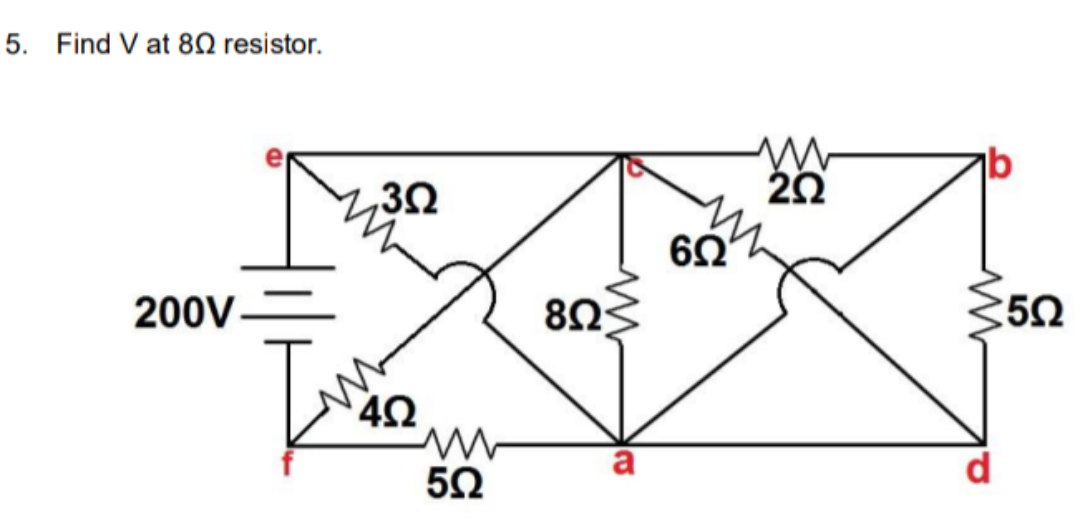
I'm currently studying circuit analysis and stumbled upon this question. Honestly, I have a few ideas on how to approach this myself but I feel like I'm on the wrong track every time. I also tried to browse the web but nothing came up so I'm shooting my shot in this subreddit. Can somebody help me out? 🙏🏼
1
u/anonymarxxx Jul 30 '25
Thank you, everyone, for all your responses! My friends and I tried to answer this altogether and managed to find different results through your suggestions until we finally solved it. I deeply appreciate your efforts and help. May all of you have great days ahead. Thank you!! :)
1
u/Money_Elk5657 Aug 01 '25 edited Aug 01 '25
Seems like a lot of comments are pointing to 30 volt answer. I will post the solution done by hand showing how to redraw the circuit and along with circuit simulation
Solution: https://ibb.co/qFk6zR31
Simulation: https://ibb.co/3y5qYDPW
2
u/anonymarxxx Aug 02 '25
Thank you so much for this! My friend also explained to me how to redraw it but yours made me truly understand it. I appreciate the effort! ^
2
u/Miserable-Win-6402 Jul 31 '25
The answer is 30.188V. The 5 Ohm to the right is shorted, and can be disregarded. The 4 Ohm is in parallel with the voltage source, can be disregarded. 2 Ohm, 3 Ohm, 6 Ohm, and 8 Ohm are in parallel, resulting in 0.8888 Ohm, which is in series with the 5 Ohm. 200V/5.8888 Ohm gives 33.962 Amps, which gives a voltage drop of 0.888 Ohms x 33.962 A = 30.188V
1
u/Adorable_Lie5810 Aug 02 '25
Approved. I like how this answer is focused on simple logic without using pen and paper for re-drawing and therefore losing time.
2
u/Dylan_Savage999 Jul 31 '25
After about 30 mins and consulting my boss (I teach 1st year electrical apprentices, he's the master instructor), I got 30V for the 8 ohms resistor. That is definitely a tricky one to redraw.
1
u/tayumly Jul 29 '25
You can look for the Thévenin équivalent Seen from point ac. For the Thévenin équivalent résistance you can use Kennelly's theorem.
1
Jul 29 '25
Try calling equivalent resistance in right the 5ohm comes in parallel for then we have 2ohm and 6 ohm in parallel that give s equivalent of 12/8 ohm in parallel with 8 ohm then do the same for left side eohm wil come in parallel with 12/8 ohm this give you simple circuit for analysis
1
u/nite_cxd Jul 30 '25
You can try this bad method, I learned that when I was in highschool.
First you have letters on the connections, write them down in the order from the positive side of the voltage to the negative side.
In your case it is: e c b d a f
The listing is not really important, the important thing is here to understand who is connected in series or parallel.
So now lets write down every connection for example Between e and c there is nothing Between c and b there is 2ohm Between b and d there is 5ohm Between d and a there is nothing Between a and f there is 5ohm
Now our list looks like this:
e-c-2-b-5-d-a-5-f
Now we have left with some resistors that are connected in a funnier way than the resistors we have already listed.
We need to add them up to our list.
So we need to add parallel branches for new ones.
For example we have a connection between e and a 3ohm.
So we have this new list. e|--------3--------|a e-c-2-b-5-d-a-5-f
So right now we can know that the 3ohm resistor is at least parallel to 2 and 5 ohms resistor at least for now, for sure you need to continue to this method until you placed every single resistor to your new list. This is kinda hard to implement and easy to make mistakes but it could save you time.
After you finish your new list, you will have a simpler version of your original design, then you can move on.
Or faster method is thevenin.
1
u/Electro-Robot Jul 30 '25
First you have to redraw the schema to be easly readbale then you can apply resistance law for series and parallels 😉
1
u/Money_Elk5657 Jul 30 '25
if 30.19 volt is the answer, i can help you.
1
u/NedSeegoon Aug 01 '25
The answer is 42.
2
u/Money_Elk5657 Aug 01 '25
I just simulated the circuit using circuit wizard and I am getting answer as 30.1 volt. Am I missing sth?
2
u/austix6e Aug 01 '25
the answer to the ultimate question of life, the universe and everything (Hitchhiker's Guide to the Galaxy)
1
u/KofFinland Jul 30 '25
Looking at the circuit, it becomes a rather simple resistive divider.
e-a, c-a,. c-b, c-d are in parallel. f-a is in series with that. d-b is short-circuited. c-f is in parallel of powersupply, irrelevant to question.
1/3 + 1/4 + 1/2 + 1/6 = 1/R -> R = 0.70588
V = R/(R+5) * 200V = 24.7V
As the resistors have just one significant number, answer with one sig. number: 20V.
1
u/Mohammed_N_ Jul 31 '25
Simplifing from far end of the v source First thing you see its 5ohm is shorted across Then left is 2 ohm is parallel with 6 ohm and 8 ohm Then you see e and c point are also shrted that mean 4ohm is parallel with v source and have same voltage That leaves the 3 ohm in parallel with 8&6&2 ohm So now we do voltage divider between two resistors 5ohm and R(eq)= 3&8&6&2 ohm I think its about right
1
u/FeveraQuickfist Jul 31 '25
Napkin math.... haven't done circuit analysis like think in years.
3&8 ohm are in parallel, which is then in series with the 5 ohm. All of which is in parallel with the 4ohm.
I THINK???
So do ya mathin' from there on?
1
1
1
u/aktentasche Aug 01 '25
Redraw and very likely transform triangle to star.
1
u/aktentasche Aug 01 '25
Also you can directly see that R between d and b falls away because it's parallel to a wire.
1
u/RelentlessPolygons Aug 01 '25
I though this was an EE sub and fucking elementary school do my homework sub.
1
u/Hot-Structure-2686 Aug 02 '25
You have 6 resisters and one voltage 200 v
Now apply the rest electricity laws you know.
1
1
1
u/twentyninejp Aug 20 '25
If you're doing this question just for the challenge, you might find that the method taught in this video makes it almost trivial. I highly recommend watching it.
Note that after you remove the 8ohm resistor, it becomes easy to draw as a 2 port circuit. Although even without removing it, you should still redraw it to remove the intersections. It's worth mentioning that you can't always do that, but this one in particular is planar (a circuit is called "planar" when it can be drawn without intersections). You can't even do mesh analysis as it's currently drawn.
2
u/Keefe1933 Jul 29 '25
First step would be to redraw it. It will become much more obvious when you do. The 5ohm resistor for example isn't even in the circuit, as it is shorted across.