r/CreationistStudents • u/stcordova • Jan 03 '19
Weekly 12-minute biochem lesson #1: What is biochemistry, and the major molecules of life
Astonishing as it may seem, it wasn't until after I got an MS degree in physics that I actually got a definition of what physics is! "Physics is a mathematical description of nature." That's about as good as a definition as I've read.
So what is biochemsitry? "Biochemistry is the molecular basis of life." That's about the best definition I heard so far.
There are 4 major classes of molecules in biochemistry, the molecular basis of life. There are plenty of molecules in life that don't fall into the 4 major classes, but the 4 major classes account for a lot of the molecules in life. Here they are below.
Carbohydrates: [from wiki] The term is most common in biochemistry, where it is a synonym of 'saccharide', a group that includes sugars, starch, and cellulose.
Examples of sugars are table sugar (sucrose), fructose (in soft drinks), glucose (in honey). Examples of starch is corn starch. An example of something with lots of cellulose is paper.
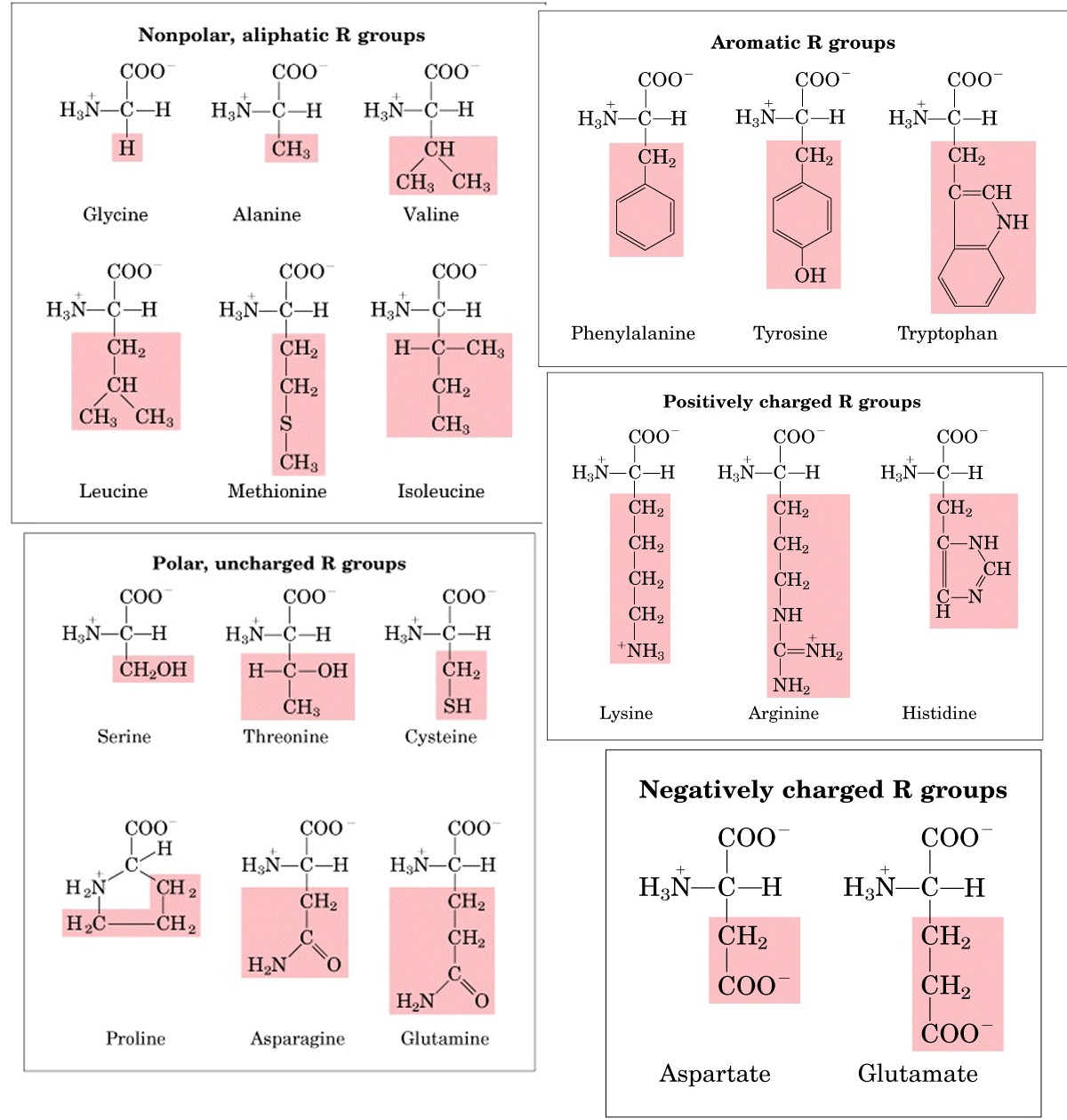
Amino Acids: Amino acids have many roles, not the least of which is that amino acids are the molecules that connect together to make proteins. An example of a food rich in proteins is meat or tofu.
Lipids: [from wiki] Although the term "lipid" is sometimes used as a synonym for fats, fats are a subgroup of lipids called triglycerides. Lipids also encompass molecules such as fatty acids and their derivatives (including tri-, di-, monoglycerides, and phospholipids), as well as other sterol-containing metabolites such as cholesterol.
Examples of foods rich in lipids are fats, cooking oil, butter. Cholesterol is a lipid.
Nucleic Acids and their components: [from McKee and McKee an Lehninger] There are two major nucleic acids DNA and RNA. DNA is what genes are made of. One of the roles of DNA is to serve as a template for RNA. One of the roles of RNA is that it is used as a template for things like proteins.
DNA and RNA are made up of nucleotides, nucleotides contain nucleosides, nucleosides contain nucleobases. Are you confused enough? :-) Unfortunately the meaning of these terms is only understood by learning more. However, here is a 15-second video of a little kid reciting the names of the nucleobases that found in DNA, and these are called the alphabet of DNA.
The little kid says:
A is for Adenine
C is for Cytosine
G is for Guanine
T is for Thymine
Now I know my ABCs, next time won't you sing with me.
Repeat this several times and you won't forget. Easy! Child's play.
A lot of biochemistry is memorizing names of things you don't understand right now, but which makes sense later!!!! Just memorize the names and how its connected in the big picture. DNA is made up of an alphabet, one of the uses of DNA is to make genes.
BONUS: There are 500 Quadrillion biochemical reactions in your body each second! One can only hope understand a few of those reactions! Just focus on a few reactions and wonder at what God has made from the little sample of things you do understand.
Here is a 4-minute video visual introduction to biochemistry that's just meant to convey a sample of how humans are "fearfully and wonderfully made" just as it says in the Psalms. The music is by Hans Zimmer. Beautiful.
NOTES:
I couldn't figure out all the scene in the video but, here are some things I think I identified in the video which I hope to cover in future lessons.
0:48 is RNA transcription, but that little machine that looks like a readhead is an RNA polymerase
0:51 The nuclear pore complex
0:54 a nucleosome
0:57 microfibrils
1:16 is clearly a lipid bilayer of some sort, and a transmembrane molecule and the molecules docking with it
1:30 a synapse
1:37 neurons. Shortly thereafter it looks like a signal travelling down an axon where there is depolarization because the voltage gated sodium channels open. Then there is re polarization
1:48 ATP synthase molecule
1:58 that looks like a kinesin protein walking down a microtubule carrying a vesicle
2:13 a top view of Gro-EL complexes of 6 chaperonins
2:30 is some sort of endocytocis
2:33 some sort of receptor
3:10 that looks like platelets
3:12 the hairs on the Organ of Corti in the ear