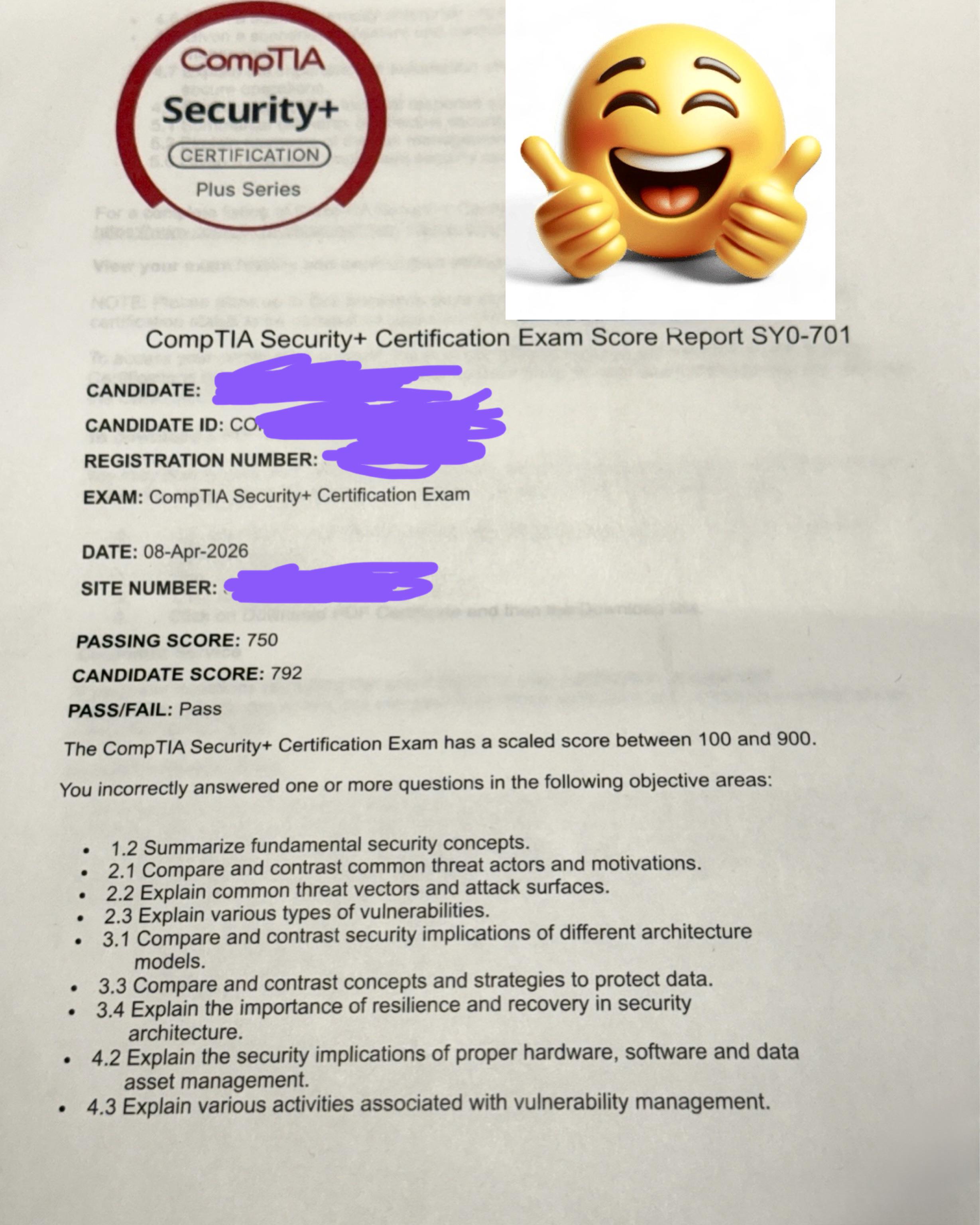
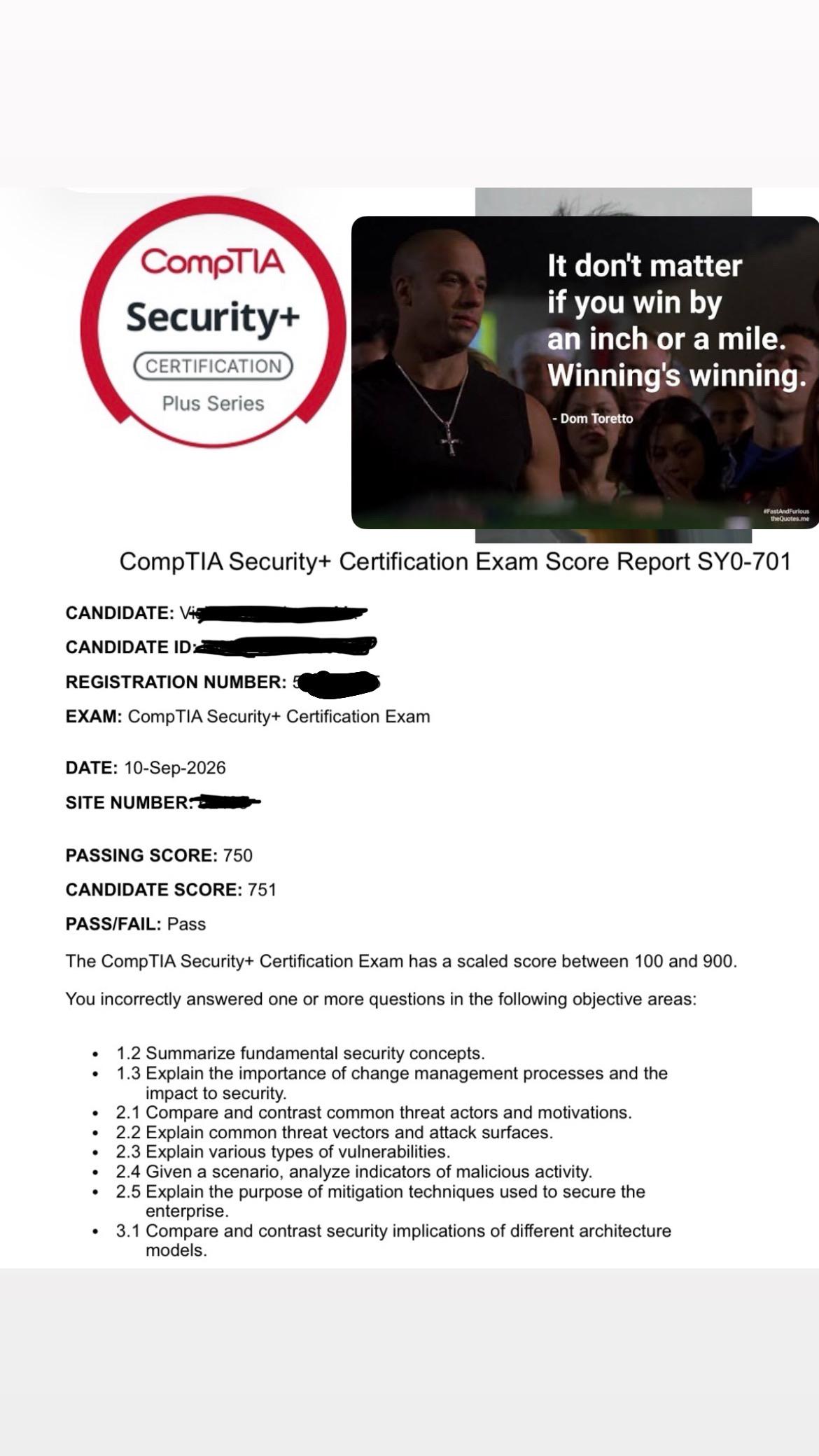
I recently passed Security+ and wanted to share my study cheat sheet in case it helps someone else! These are the notes I put together while preparing, shortened to fit here 😊 It’s not a complete guide to every exam objective, but hopefully it makes reviewing a little easier. Happy studying!
Vulnerabilities and threat information
CVSS — Common Vulnerability Scoring System. A severity score, usually 0–10. Score severity to help prioritize fixes; also consider exploitation and business impact.
CVE — Common Vulnerabilities and Exposures. The identifier for a publicly disclosed vulnerability. CVE names it; CVSS scores it.
SCAP — Security Content Automation Protocol. Standards for automating security checks, vulnerability management, and configuration assessment.
OSINT — Open Source Intelligence. Intelligence collected from publicly available sources. Think public websites and records.
Quick distinction: CVE = which vulnerability; CVSS = how severe; SCAP = automated assessment standards; OSINT = public information.
Risk and business continuity
BIA — Business Impact Analysis. What would a disruption do to the business? Identify critical processes and recovery priorities.
RPO — Recovery Point Objective. How much data loss is acceptable, measured in time? A 1-hour RPO means losing at most 1 hour of data.
MTTR — Mean Time to Repair or Recover. Average time needed to repair a failure or restore service. The exact expansion depends on context.
ARO — Annualized Rate of Occurrence. Expected incidents per year. Once every 5 years = 0.2.
EF — Exposure Factor. Fraction or percentage of asset value lost in one incident. 25% = 0.25.
SLE — Single Loss Expectancy. Expected money lost in ONE incident. Asset value × exposure factor.
ALE — Annualized Loss Expectancy. Expected money lost per YEAR. SLE × ARO.
ROI — Return on Investment. Benefit compared with cost. Common formula: (benefit − cost) ÷ cost × 100%.
Example: An asset worth $100,000 has an EF of 25%. SLE = $25,000.
Certificates and cryptography
CA — Certificate Authority. Trusted entity that issues and signs digital certificates.
PKI — Public Key Infrastructure. The overall system of certificates, keys, authorities, and processes. CA is part of PKI.
CSR — Certificate Signing Request. Request sent to a CA to obtain a certificate; contains the public key and identity information, not the private key.
CRL — Certificate Revocation List. Published list of revoked certificates. Revoked means canceled before normal expiration.
OCSP — Online Certificate Status Protocol. Ask an online responder about a particular certificate’s revocation status.
SSL — Secure Sockets Layer. Legacy protocol name still used in “SSL certificate.” Modern secure connections use TLS (Transport Layer Security).
TPM — Trusted Platform Module. Security hardware tied to a device; protects keys and supports platform integrity.
HSM — Hardware Security Module. Dedicated protected hardware for generating, storing, and using cryptographic keys.
TLS — Transport Layer Security. Encrypts data in transit and authenticates the server using a certificate; client authentication is optional. Think secure connection.
Important correction: CRLs list revoked certificates, not simply expired certificates. Expiration is checked using the certificate’s validity dates.
Identity and network security
AAA — Authentication Authorization and Accounting. Who are you? What may you do? What did you do? Identity, permissions, and activity records.
RADIUS — Remote Authentication Dial In User Service. Centralized AAA for network access. Think network login decisions and accounting.
IPsec — Internet Protocol Security. Protects IP traffic; commonly used for VPNs. IPsec secures traffic while RADIUS can handle AAA.
RDP — Remote Desktop Protocol. Interact with a remote computer’s desktop.
LDAPS — Lightweight Directory Access Protocol over SSL or TLS. Encrypted access to a directory of users, groups, and other objects.
802.1X — Port based network access control standard. Authenticate before getting normal wired or wireless network access.
VPN — Virtual Private Network. Protected tunnel over another network.
ACL — Access Control List. Rules that permit or deny access or network traffic.
GPO — Group Policy Object. Centrally apply Windows settings to many users or computers.
IPS — Intrusion Prevention System. Detect and block suspicious or malicious activity.
NGFW — Next Generation Firewall. Firewall with application awareness and additional inspection and security features.
WAF — Web Application Firewall. Filters web application requests, including common attack patterns.
ZTA — Zero Trust Architecture. Verify each access request, apply least privilege, and assume breach.
Network and device terminology
DNS — Domain Name System. Translates domain names into IP addresses. Names to numbers.
URL — Uniform Resource Locator. The address of a resource, such as a web page.
IP — Internet Protocol. Network addressing and packet delivery. In legal or business contexts, IP can mean intellectual property.
ARP — Address Resolution Protocol. Maps an IPv4 address to a local hardware MAC (Media Access Control) address. ARP poisoning supplies false mappings.
SDN — Software Defined Networking. Software centrally controls network behavior; control and forwarding are separated.
IoT — Internet of Things. Connected physical devices such as cameras, sensors, and appliances.
SCADA — Supervisory Control and Data Acquisition. Monitors and controls industrial processes. Think utilities and factories.
SMB — Server Message Block. Network file and printer sharing. SMBv1 is an obsolete and insecure version.
SFTP — SSH File Transfer Protocol. Secure file transfers over SSH (Secure Shell). FTPS means FTP over TLS, a different protocol.
DLP — Data Loss Prevention. Detects or prevents sensitive data leaving approved boundaries.
SPF — Sender Policy Framework. DNS record identifies servers authorized to send email for a domain.
RFID — Radio Frequency Identification. Uses radio signals to identify tags, such as access badges.
IT — Information Technology. Computers, networks, software, and related services.
WPA2 — Wi-Fi Protected Access 2. Protects the wireless connection between a device and its Wi-Fi network. It does not protect the entire path to a cloud server.
IP geolocation estimates an IP address’s geographic location; filtering can use that estimate to restrict traffic.
Agreements and leadership
NDA — Non Disclosure Agreement. Keep confidential information private. Think “do not disclose.”
MSA — Master Service Agreement. Umbrella terms for an ongoing service relationship; avoids renegotiating general terms for each job.
SLA — Service Level Agreement. Measurable service commitments such as uptime and response time. Think service targets.
SOW — Statement of Work. Specific work, scope, deliverables, and schedule. Think what gets done.
MOU — Memorandum of Understanding. Records shared intentions and understanding; legal effect depends on wording and jurisdiction.
MOA — Memorandum of Agreement. Documents agreed responsibilities and collaboration terms; may cover confidentiality and intellectual property.
AUP — Acceptable Use Policy. Rules for permitted and prohibited use of organizational technology.
CISO — Chief Information Security Officer. Executive responsible for the information security program.
CSO — Chief Security Officer. Executive security leadership; scope varies and may include physical and information security.
CEO — Chief Executive Officer. Top executive responsible for overall company leadership.
A right-to-audit clause grants contractual rights to inspect a vendor’s controls and compliance. Supply chain analysis examines risks from suppliers and dependencies.
Mobile ownership and incident preparation
BYOD — Bring Your Own Device. Employee brings a personally owned device. YOUR device.
CYOD — Choose Your Own Device. Employee chooses from an approved list. Ownership and payment depend on company policy.
COPE — Corporate Owned Personally Enabled. Company owns it and permits personal use. COMPANY device, PERSONAL use allowed.
COBO — Corporate Owned Business Only. Company owns it and restricts use to business. BUSINESS only.
IRP — Incident Response Plan. Documented responsibilities and steps for handling security incidents.
Preparation and awareness
Tabletop exercise: A discussion of a simulated incident to test plans, roles, decisions, and gaps. Findings help improve the IRP.
Situational awareness: Notice security issues around you, such as missing badges and unauthorized people at entrances.
Tailgating: Following an authorized person through a controlled entrance without separately authenticating.
Social engineering training: Teach employees to recognize manipulation and verify unusual requests.
Simulated phishing campaign: A controlled phishing test used to assess behavior and guide training.
Insider threat awareness: Recognize and report risks involving people with trusted access.
Fail open: If the control fails, traffic or access is allowed. Prioritizes availability, but can expose systems.
CIA = Confidentiality, Integrity, Availability. Confidentiality keeps secrets; integrity protects against unauthorized changes; availability keeps services accessible.
Attacks and social engineering
Smishing — SMS phishing. Phishing through text messages. SMS = Short Message Service.
Vishing — Voice phishing. Phishing through phone or voice calls.
Phishing — Deceptive messages. Trick someone into revealing information or taking an unsafe action.
Pretexting — Invented story or scenario. A believable excuse used to manipulate someone.
Impersonation — Pretending to be another person. For example, claiming to be the CEO. Can occur within vishing or smishing.
Typosquatting — Lookalike or mistyped domain. A small spelling change takes you to an attacker’s site.
XSS — Cross Site Scripting. Malicious script runs in a victim’s browser through a vulnerable website.
On path attack — Attacker between communicating parties. Intercepts or alters communications.
Rootkit — Malware that hides privileged access. Can conceal attacker control; an embedded rootkit may reside in firmware.
Keylogger — Records keystrokes. Can capture passwords and other typed data.
Buffer overflow — Data exceeds a memory buffer. Can crash a program or enable unintended code execution.
Sideloading — Install outside an approved app channel. Can introduce malicious software; not automatically malicious.
Other terms: Hacktivism = attacks motivated by political or social causes. Blackmail = coercion through threatened disclosure or harm.
Protecting data and applications
Hashing — One way fingerprint of data. Compare with a trusted expected hash to detect changes. Does not conceal the original data.
Encryption — Scramble data using a key. Authorized decryption recovers the original. Think confidentiality.
Tokenization — Replace sensitive data with a token. Authorized detokenization can retrieve the original through a protected mapping or process.
Masking — Hide all or part of a displayed value. For example, show only the last four digits of an account number.
Obfuscation — Make code or data harder to understand. Slows analysis or reverse engineering; does not guarantee secrecy.
Steganography — Hide the existence of a message. For example, conceal a message inside an image.
Code signing — Digitally sign software. Helps verify publisher and detect changes after signing; does not hide code.
Blockchain — Distributed linked ledger. Records are linked and difficult to alter undetected; not a general secrecy control.
SQL — Structured Query Language. Language for working with relational databases. SQL injection treats unsafe input as part of a query.
Input validation — Check incoming data. Reject values outside allowed types, lengths, ranges, or formats.
Authentication — Verify identity. Establish who a user or system is.
Secure cookies — Protect browser cookies.
Static code analysis examines code without executing it.
Securing data in transit
Data in transit means data moving between systems. Data at rest means stored data.
TLS certificates help authenticate a server and support establishing a TLS connection. TLS provides the connection encryption; a certificate alone does not encrypt files.
VPN = Virtual Private Network. It protects traffic traveling through its tunnel.
Practice question note: The supplied answer key selects TLS certificates and VPN.
Encryption key management covers creating, storing, rotating, and retiring keys.
Finding application vulnerabilities
SAST = Static Application Security Testing. Examines source code, bytecode, or binaries without running the application.
DAST = Dynamic Application Security Testing. Tests a running application by sending inputs and observing its responses.
Penetration testing attempts authorized exploitation to demonstrate impact.
Bug bounty = a program that rewards eligible vulnerability reports under defined rules. Researchers may demonstrate exploitation when the rules permit it.
Virtualization and isolation
VM = Virtual Machine. A software-based computer running its own operating system.
Hypervisor = the software layer that creates, runs, and isolates virtual machines.
VM escape = an attacker breaks out of a guest VM’s isolation to access the host or hypervisor.
Race condition = a flaw where security or correctness depends on the timing or order of operations.
TOCTOU = Time of Check to Time of Use. A type of race condition: a resource changes after it is checked but before it is used.
Qualitative and quantitative risk analysis
Qualitative analysis uses descriptive categories such as high, medium, or low to rate likelihood and impact.
Quantitative analysis uses numerical estimates such as money lost, failure rates, or recovery time.
MTBF = Mean Time Between Failures. Average operating time between failures of a repairable system.
Compare MTTR = Mean Time to Repair or Recover: how long it takes to restore service. Higher MTBF and lower MTTR generally indicate better reliability and recovery.
Risk register = a record of identified risks, ratings, owners, responses, and status.
Network isolation
Air gap = physical isolation from other networks, including the internet. Best choice when a secure network does not need external communication.
An air gap reduces network-based data leakage, but does not guarantee that data can never leave.
Containerization isolates applications in containers that typically share the host operating system kernel.
Decentralization distributes control or resources across multiple systems. It does not by itself prevent external communication or data leakage.
Security zones group systems with similar security needs into separate network segments. Enforce access rules between zones using firewalls or ACLs.
Network segmentation divides a network into smaller sections with controlled communication.
Load balancers distribute traffic across servers. Proxy servers act as intermediaries for requests.
Cloud services and resilience
IaaS = Infrastructure as a Service. Rent computing infrastructure such as virtual machines, storage, and networking.
SaaS = Software as a Service. Use a provider-managed application.
Multicloud architecture uses services from more than one cloud provider. Hosting critical VMs with different IaaS providers can reduce dependence on a single provider.
Resilience means the ability to withstand disruption and recover.
Compare: On-premises means infrastructure hosted in facilities managed by the organization. Load balancing distributes requests across servers.
Acquisition and supply chain security
Acquisition process = how the organization selects suppliers, purchases equipment, and accepts deliveries.
Sanitization removes or renders stored data unrecoverable, commonly before reuse or disposal. It does not establish that newly purchased hardware is trustworthy.
Change management reviews, approves, tests, and documents changes. Asset tracking records equipment identity, location, ownership, and status.
Risk limits and decisions
Risk tolerance = the acceptable limits or thresholds of risk for an activity or objective.
Risk appetite = the broad amount and type of risk an organization is willing to pursue or retain to achieve its objectives.
Risk acceptance = an informed decision to retain a particular risk.
Risk assessment identifies and evaluates risks, including likelihood and impact. A risk register records and tracks them.
Security monitoring and log correlation
SIEM = Security Information and Event Management. Collects and correlates security logs to support detection and investigation.
Correlation links related events across sources.
DDoS = Distributed Denial of Service. Many distributed sources overwhelm a service or exhaust its resources, reducing availability.
A SIEM can also help investigate password resets, DDoS activity, and breaches when relevant logs are available.
Availability and recovery choices
Load balancing distributes traffic across multiple servers.
State preservation needs more than a load balancer: session or application state must be replicated or stored in a shared service.
Cold site = an alternate recovery facility with basic space and utilities, but without a ready-to-run production environment.
Full backup = a copy of all selected data at a point in time.
Hybrid cloud combines distinct cloud environments, such as private and public clouds, connected to support data or application portability.
Secure access for remote workers
SASE = Secure Access Service Edge.
SOAR = Security Orchestration, Automation, and Response. Connects security tools and automates incident response workflows and playbooks.
NAT = Network Address Translation. Translates IP addresses between networks, commonly private internal addresses to public addresses.
Alert fatigue and detection quality
Alert fatigue = analysts become overwhelmed or desensitized by too many alerts, especially repetitive, irrelevant, or false-positive alerts.
Rule tuning adjusts detection logic, thresholds, exceptions, and priorities to improve useful detection and reduce unnecessary alerts.
False positive = an alert flags benign activity as suspicious. False negative = malicious activity occurs but is not detected.
Log aggregation collects logs from multiple sources into one place. Correlation connects related events across those sources.
Compensating control = an alternative safeguard used when a primary control cannot be implemented, to provide comparable protection.
Data location and sovereignty
Data sovereignty = data is subject to applicable laws and jurisdiction, often connected to where it is stored or processed. ata at rest outside a country’s borders.
Data residency = the geographic location where data is stored. Data localization = a requirement to keep certain data within a specified geographic boundary.
Data at rest is stored data, such as files on a disk or records in a database. Data in transit is moving between systems.
PII = Personally Identifiable Information. Information that can identify a person, directly or in combination with other information.
Physical security barriers
Bollards = sturdy posts spaced to block vehicles while allowing pedestrians between them.
Video surveillance monitors and records activity; it does not physically stop a vehicle.
Network authentication and VLAN access
VLAN = Virtual Local Area Network. Logically separates a switched network into distinct broadcast domains.
802.1X = port-based network access control standard for wired and wireless networks.
ACL = Access Control List. Rules that permit or deny traffic or access.
Captive portal = a web page that users encounter before network access, often for guest login or accepting terms.
DNSSEC = Domain Name System Security Extensions. Uses digital signatures to validate DNS data authenticity and integrity.
Recognizing SQL injection
SQL injection = attacker-controlled input is interpreted as SQL code and changes the intended database query. , injection. SQL = Structured Query Language.
Recognition clues: 1=1 is an always-true condition that can alter query logic; -- can comment out the rest of a SQL statement; a conditional database sleep can reveal information through response delays.
Brute-force attacks repeatedly guess passwords or other secrets. Replay attacks reuse captured messages or authentication data.
Hardening end user devices
FDE = Full Disk Encryption. Protects data at rest on a device, especially if it is lost or stolen.
Endpoint protection = security tools on devices such as laptops and desktops that prevent, detect, and respond to threats.
Hardening reduces a device’s attack surface through secure configuration, updates, removal of unnecessary software or services, and appropriate security controls.
Conditional access and device trust
Conditional access policies evaluate signals such as user identity, device management or compliance, location, and sign-in risk before allowing access.
MFA = Multifactor Authentication. Requires evidence from at least two different factor categories, such as something you know, have, or are.
CASB = Cloud Access Security Broker. Applies security policies and visibility controls to cloud service use.
DLP = Data Loss Prevention, already listed in the network terminology section. It helps detect or prevent sensitive information leaving approved boundaries.
Host intrusion prevention and control functions
HIPS = Host-based Intrusion Prevention System. Runs on an individual host to monitor for suspicious activity and block activity that matches its prevention rules.
Preventive controls try to stop an unwanted event. Detective controls identify and report activity or events.
Directive controls state required behavior, such as security policies. Corrective controls repair or restore after a problem.
Penetration testing knowledge levels
Unknown environment testing, also called black-box testing: testers receive little or no prior technical information about the target.
Known environment testing, also called white-box testing: testers receive extensive information, such as architecture, source code, or credentials.
Partially known environment testing, also called gray-box testing: testers receive some information or limited access.
SOC = Security Operations Center. The team or function that monitors security events, investigates alerts, and coordinates incident response.
Study clarification: An internal IT or SOC team being unaware of a test describes an unannounced exercise.
Checking exposure to a newly disclosed vulnerability
Vulnerability scanning checks systems for known weaknesses, vulnerable versions, and insecure configurations.
PoC = Proof of Concept. Code or a demonstration showing that a vulnerability can be exploited.
Packet captures record network traffic for analysis. Security dashboards summarize available security data.
Preventing sensitive data leakage
PHI = Protected Health Information. Individually identifiable health information protected under applicable health privacy requirements.
DLP = Data Loss Prevention. Detects or blocks unauthorized disclosure of sensitive information.
EDR = Endpoint Detection and Response. Monitors endpoint activity to detect threats, support investigation, and respond, for example by isolating a compromised device.
Secure protocols encrypt communication, but do not by themselves stop an authorized user from sending sensitive data to an unapproved destination.
Login policies and similar acronyms
AUP = Acceptable Use Policy. Rules for permitted and prohibited use of organizational systems.
EULA = End User License Agreement. Terms governing a user’s license to use software.
EAP = Extensible Authentication Protocol. A framework supporting authentication methods, commonly used with 802.1X.
MAC can mean Mandatory Access Control: access decisions enforced through centrally defined labels and clearances.
IoT purchasing and residual data
IoT = Internet of Things, already defined in the network terminology section.
Counterfeit products imitate genuine products or misrepresent their origin or authenticity.
Data remanence = data that remains on storage media after deletion or incomplete erasure. It matters when devices are reused, returned, or disposed of.
Device responsiveness concerns performance, which can affect availability in critical environments. Ease of deployment concerns setup.
Quarantine and mobile device management
Quarantine isolates a potentially infected system to limit communication and prevent spread while it is investigated.
MDM = Mobile Device Management. Centrally manages enrolled mobile devices, including security settings, configuration, locking, and remote wiping when supported.
Remote wipe erases device data; it is not quarantine and can destroy evidence. Disabling remote login alone leaves other communication paths.
Network access and device posture
NAC = Network Access Control. Enforces policies determining which users and devices may connect and what access they receive.
Posture assessment checks a device’s security condition, such as required patches, active anti-malware, firewall settings, and configuration compliance.
Compare: VPN provides a protected tunnel; WAF filters web application requests; IPS detects and blocks malicious activity.
Connecting company networks securely
Site-to-site VPN connects two networks through a protected tunnel, commonly using IPsec. It is the best match when two companies need secure network connectivity.
UTM = Unified Threat Management. Combines multiple security functions, such as firewalling, intrusion prevention, anti-malware, and content filtering, in one solution.
NGFW = Next Generation Firewall, It inspects and controls traffic with application awareness.
Privacy deletion requests
Right to be forgotten, also called the right to erasure, means an individual can request deletion of personal data under applicable privacy rules.
Data retention determines how long records are kept. Attestation and acknowledgment document a statement or confirmation.
Platform diversity
Platform diversity uses different technologies or platforms to reduce dependence on one and limit shared failure or vulnerability risks.
If the solutions use different cloud providers, this is also multicloud.
Compare: Load balancing distributes traffic; parallel processing performs work concurrently; clustering coordinates multiple systems as a group.
Industrial control systems
PLC = Programmable Logic Controller. An industrial computer that controls machinery or processes using sensor inputs and programmed logic.
SCADA = Supervisory Control and Data Acquisition, already defined in the network terminology section.
Compare: SDN = Software Defined Networking; IoT = Internet of Things; VPN = Virtual Private Network. The PLC clue most directly points to industrial control and SCADA.
Mobile operating system restrictions
Jailbreaking removes manufacturer-imposed operating system restrictions, commonly on Apple mobile devices, allowing privileged changes and unapproved software.
Sideloading installs applications outside the usual approved app store or distribution channel. It does not necessarily require jailbreaking or rooting.
Unauthorized startup or administrative changes may indicate operating-system compromise.
Password salting
Salting adds a unique random value to each password before hashing. Two users with the same password therefore have different stored hashes.
Logs for investigating SQL injection
Application logs are the best listed source for identifying the SQL injection command or payload submitted through an application, when request or query details are recorded.
System logs mainly record operating system events. NetFlow records connection details such as addresses, ports and traffic volume, rather than SQL payloads.
Cloud guardrails and secure baselines
Guardrails are policies and controls that keep cloud resources within approved security baselines.
CSPM = Cloud Security Posture Management. It discovers cloud misconfigurations and checks resources against security policies.
IAM = Identity and Access Management: controls identities, roles and permissions. CASB = Cloud Access Security Broker: applies security policies to cloud service use.
People policies and assurance
Social engineering and elicitation
The stranger in the coffee shop builds trust through conversation to obtain work and personal details.
Operational security
OPSEC protects sensitive information during everyday activities.
Insider awareness and behavior
For the layoff awareness question, B: train supervisors to recognize and manage signs of employee distress or disgruntlement.
Internal audits
Identify gaps in controls so the organization can remediate them.
Reviewing a SaaS vendor
Request a third-party audit report, such as a SOC 2 report, for independent assurance about security controls.
Change management
A formal process requests, reviews, approves, tests and documents changes to processes, assets and security controls. An acceptable use policy governs system use.
Legal investigation requests
E-discovery identifies, preserves, collects and reviews electronically stored information for legal requests. Root cause analysis investigates why an incident happened.
Threats and attack recognition
Watering hole attacks
Attackers compromise a website commonly visited by their intended target group, such as developers. Typosquatting uses look-alike domain names.
Worms and SMB
Heavy TCP port 445 traffic with widespread network disruption suggests a worm propagating through SMB. NTP amplification uses UDP 123.
SQL injection payloads
A condition such as UserId = 10 OR 1=1 adds an always-true expression to alter query logic. cat /etc/shadow is a shell command; ../ patterns indicate directory traversal.
Side channel attacks
Side channels exploit implementation leakage, such as execution time, power consumption or electromagnetic emissions. Weak cryptographic algorithms alone do not define a side-channel attack. Cue: Learn secrets from how the system behaves.
Buffer overflow wording caveat
A buffer overflow occurs when data exceeds allocated buffer capacity. An abnormally large number of incoming packets more directly describes flooding or denial of service; it does not by itself establish a buffer overflow. Cue: Too much data for a buffer = overflow; too much traffic = flood.
ARP poisoning and attacker type
Unskilled attacker is the only attacker category among the supplied options; readily available tools can enable ARP poisoning. Shadow IT means unauthorized technology, credential stuffing reuses stolen credentials, and DMARC concerns email authentication. ARP poisoning alone does not prove the attacker is unskilled.
Privilege escalation and passive reconnaissance
Moving from a guest account to administrator is vertical privilege escalation.Cue: More privilege = escalation; public research = passive recon.
Web protection and remote users
SASE for remote web protection
Secure Access Service Edge (SASE) combines network connectivity with cloud-delivered security.
Protection when the VPN fails
Install host-based content filtering so protection runs on the device even when the VPN cannot reach the on-premises proxy.
Blocking a newly identified domain
Update the proxy filters to enforce the existing restriction against the new suspicious domain.
DNS filtering and TLS inspection
DNS filtering blocks resolution of known malicious domains. A centralized TLS inspection proxy decrypts supported HTTPS traffic for inspection, then re-encrypts it.
Endpoint detection and response
EDR is the best listed choice for detecting and blocking a malicious file on a company computer.
EDR compared with SIEM
EDR collects and rapidly analyzes endpoint telemetry, including processes, files and network connections, and forwards it for correlation and reporting.
APIs and automation
An application programming interface (API) enables programs to exchange data and invoke functions. SOAR orchestrates security workflows, often through APIs.
Network visibility and isolation
Wireless site surveys and heat maps
A site survey assesses coverage and signal leakage into surrounding buildings. Use findings to adjust access-point location, antenna direction and transmit power.
NetFlow and packet capture
NetFlow records traffic metadata such as source, destination, ports and volume to help identify suspicious communication patterns.
Load balancer logs
Review these first for excessive traffic to front-end web servers: they show incoming requests, distribution to backends and, where recorded, response times and errors.
IPS configuration
Packet inspection enables an intrusion prevention system to analyze traffic against attack signatures or anomalies and block matches.
Air gaps
C in the physical-isolation question; D in the internet-access question. An air-gapped system has no network connection to external networks.
Detecting zero-day lateral movement
UBA can detect unusual account activity and access patterns even when an exploit has no known signature. DLP addresses sensitive-data leakage; NAC controls admission.
Federation and identity
Federation lets an organization trust another identity provider for authentication. OAuth delegates authorization; OpenID Connect adds authentication on top of OAuth 2.0.
Hardening vulnerabilities and resilience
Application allowlisting and bloatware
Allow only approved applications to reduce installation or execution of unwanted software.
Container image hardening
Remove unnecessary default applications and disable Telnet if present.
Zero-day vulnerability mitigation
For highly available production systems, monitor closely and implement compensating controls such as access restrictions, segmentation and exploit-prevention rules.
Vulnerability scanning and remediation
Daily endpoint vulnerability scans help track patch status and remaining exposure; they are not primarily threat hunting.
CVSS and CVE
Common Vulnerability Scoring System (CVSS) expresses vulnerability severity on a 0–10 scale. Common Vulnerabilities and Exposures (CVE) provides identifiers.
Bug bounty programs
Invite researchers to report vulnerabilities under defined rules, sometimes for rewards. Human investigation can uncover flaws automated tools miss.
Generator maintenance and MTBF
Mean Time Between Failures (MTBF) describes expected average operating time between failures of repairable equipment and informs maintenance planning.
Media disposal and quick distinctions
Shredding and destruction assurance
Proper shredding physically destroys storage media and provides the strongest assurance among the listed choices when performed to an appropriate destruction standard.
Certificates of destruction
Disposal certification provides a record that media destruction was performed, identifying the items and relevant method or details.
Self-signed certificates
A self-signed certificate is signed using the private key corresponding to its own public key. It is not automatically trusted by other systems.
Honeypots and honeynets
A honeynet is a network of decoy systems designed to attract and observe attackers, potentially exposing services such as SMB and RDP. A honeypot is an individual decoy.
Right to erasure review
The intended answer is to remove personal data in response to a valid right-to-erasure request. Applicable retention duties and legal exceptions can limit deletion.
Rapid review of control purposes
OPSEC protects everyday information handling. DLP restricts sensitive-data transfers.