r/weldinginspections • • Aug 17 '25

Submerged Arc Welding (SAW) Explained 🔥
Post image
4 Upvotes

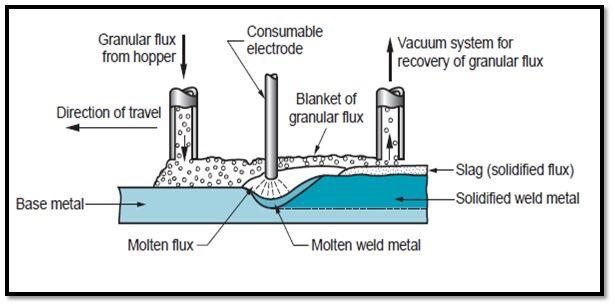
Here’s a clean diagram of Submerged Arc Welding (SAW) — a high-productivity process used heavily in pipelines, shipbuilding, pressure vessels, and structural fabrication.

Key points from the process: • A consumable electrode feeds into the joint. • A blanket of granular flux covers the arc, completely hiding it from view. • The flux melts, creating a protective slag layer and shielding the molten weld pool from air. • Excess granular flux can be recycled by a vacuum system for reuse. • As the weld solidifies, the slag peels away, leaving behind clean, high-quality weld metal.

⚡ Why it’s used: • Very high deposition rates (faster than SMAW or GMAW). • Deep penetration and excellent mechanical properties. • Minimal arc radiation exposure to the welder. • Ideal for long, straight welds in thick plate.

👎 Limitations: • Only works in flat or horizontal positions. • Requires automated or semi-automated setup. • Not great for thin materials or out-of-position welding.

Submerged arc welding isn’t as flashy as stick or MIG — you don’t even see the arc — but it’s a workhorse in heavy industry.

r/weldinginspections • • Sep 06 '25

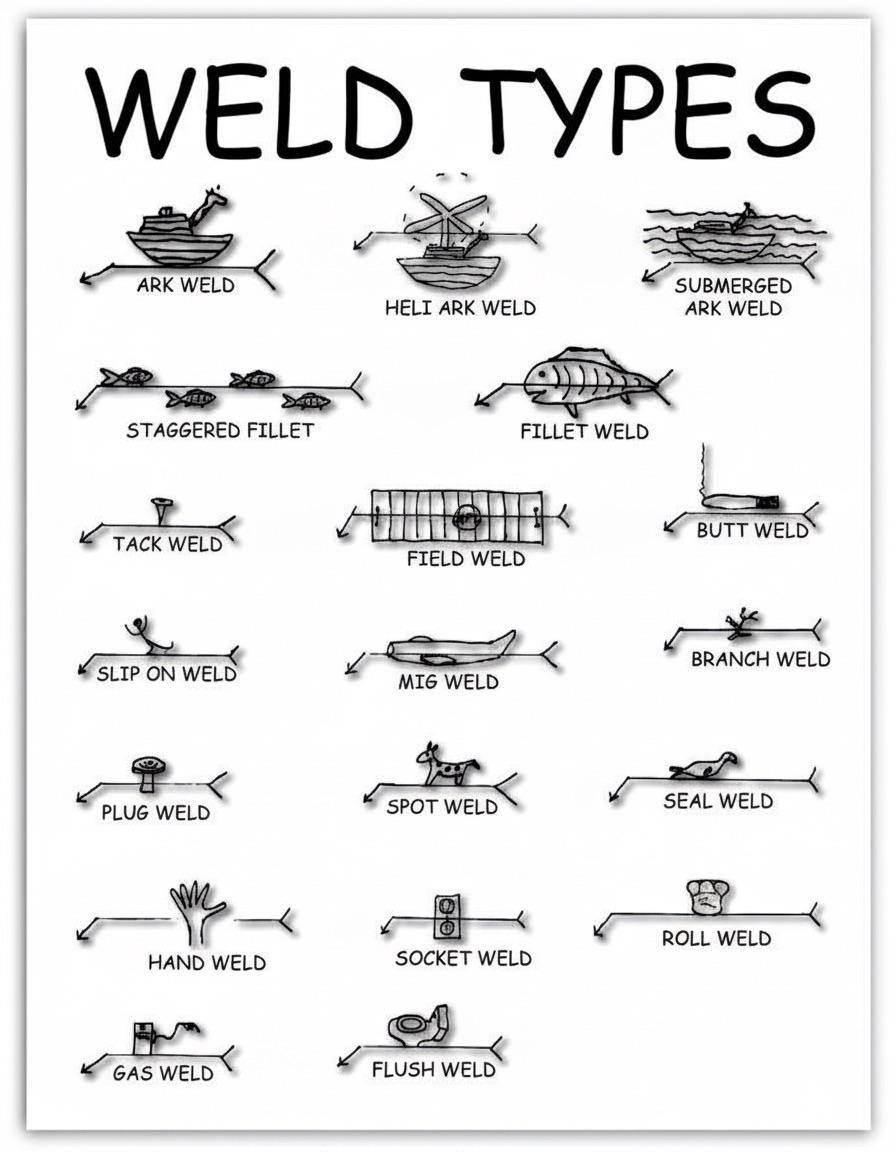
Weld Types

Post image
3 Upvotes

r/weldinginspections • • Aug 17 '25

Thermite Welding

3 Upvotes

r/weldinginspections • • Aug 17 '25

How Fatigue Cracks Grow — From Shear (Mode II) to Tension (Mode I) ⚙️

Post image
3 Upvotes

This schematic shows the evolution of a fatigue crack under cyclic loading, and the transition between different crack growth modes:

🔹 a → b → c: The crack initiates along slip bands at the microscopic level, growing in shear (Mode II). This is local, crystallographic crack growth — often invisible to the naked eye.

🔹 d: Eventually, the crack reorients and transitions into tensile opening (Mode I). At this stage, it propagates perpendicular to the applied stress, which is when cracks become more noticeable and dangerous.

Key takeaway: • Locally, cracks grow in shear. • Macroscopically, they appear to grow in tension.

This explains why components can look fine for most of their service life — until cracks suddenly become critical once the Mode I phase dominates. It’s also why fatigue inspections in aerospace, pipelines, and machinery focus on detecting early initiation before the Mode I stage.

👉 Engineers, inspectors, metallurgists: Have you encountered cases where a fatigue crack went unnoticed until catastrophic Mode I growth?


r/weldinginspections • • Aug 17 '25

HAZ

Post image
3 Upvotes

Most welders and engineers focus on the weld bead itself, but the real story often lies in the Heat-Affected Zone (HAZ). This narrow region doesn’t melt, but it experiences significant microstructural changes due to thermal cycles — and it’s often the first place where problems like cracking, toughness loss, or corrosion start.

📊 Here’s a clean diagram showing the different sub-zones: • Grain Growth Zone → Coarse grains, reduced toughness • Recrystallized Zone → New grain structures form • Partially Transformed Zone → Mixed microstructures, hardness mismatches • Tempered Zone → Softened regions with altered ductility • Base Material → Unaffected, retains original properties

Why it matters: The HAZ can make or break weld integrity. Controlling it through preheat, interpass temperature, post-weld heat treatment (PWHT), and proper welding parameters is critical for ensuring long-term performance in industries like oil & gas, power, and construction.

🔧 Inspectors, engineers, and welders: How do you manage HAZ issues in your projects? Do you rely more on PWHT, filler selection, or strict heat input control?


r/weldinginspections • • Aug 06 '26

JCOE forming heavy-duty steel pipes

2 Upvotes

r/weldinginspections • • Jul 03 '26

Boat train

2 Upvotes

r/weldinginspections • • May 09 '26

Induction pipe bender

2 Upvotes

r/weldinginspections • • Apr 23 '26

'The Big Wind', created by Hungarian Engineers using an old T-34 and two MiG-21 Jet Engines. It was abled to put out oil fire with a single blow. The photo was taken in Kuwait, 1991

Post image
2 Upvotes

r/weldinginspections • • Mar 05 '26

Pinsetter

2 Upvotes

r/weldinginspections • • Feb 14 '26

Welding Quartz credit to u/abeerforsasquatch

2 Upvotes

r/weldinginspections • • Feb 14 '26

Friction welding in action

2 Upvotes

r/weldinginspections • • Feb 11 '26

Welded into a Tiny Titan

2 Upvotes

r/weldinginspections • • Oct 27 '25

Paper thin veneer table top finish removing with laser

2 Upvotes

r/weldinginspections • • Oct 24 '25

Creating a truck

2 Upvotes

r/weldinginspections • • Oct 24 '25

Hand-cranked soft metal knurler

2 Upvotes

r/weldinginspections • • Oct 18 '25

Flash butt welding chain links

2 Upvotes

r/weldinginspections • • Oct 13 '25

Gears and offset cranks of a 1895 carousel

2 Upvotes

r/weldinginspections • • Oct 11 '25

Beerbot

2 Upvotes

r/weldinginspections • • Oct 11 '25

Gear mechanism inside a textile weaving machine

2 Upvotes

r/weldinginspections • • Aug 19 '25

Happens all the time

Post image
2 Upvotes

r/weldinginspections • • Aug 17 '25

Understanding Fillet Weld Geometry — Throat, Legs, and the Heat-Affected Zone ⚡️

Post image
2 Upvotes

Here’s a clean breakdown of the geometry of a fillet weld, one of the most common weld types used in structural steel, fabrication, and piping.

Key terms explained: • Leg: Distance from the weld toe to the root, measured along each joined member. • Face: Exposed surface of the weld. • Toe: Where the weld face meets the base material. • Root: Where the weld metal meets the joint’s base. • Heat-Affected Zone (HAZ): Base material area altered by welding heat, but not melted. • Throat: • Theoretical throat = geometric distance from root to hypotenuse of a perfect 45° triangle. • Effective throat = minimum throat dimension that ensures structural strength (code-based). • Actual throat = the real measured distance achieved by welding.

⚙️ Why it matters: The throat thickness determines the weld’s load-carrying capacity. Undersized fillet welds → risk of understrength joints. Oversized → wasted time, filler, and distortion.

Fillet welds may look simple, but geometry + inspection = integrity.

👉 Welders, inspectors, engineers: What’s the most common fillet weld defect you’ve seen in the field — undercut, lack of fusion, or undersized welds?


r/weldinginspections • • Aug 17 '25

API 571 — How Damage Mechanisms Are Grouped in Industry ⚙️

Post image
2 Upvotes

For those working in inspection, RBI (Risk-Based Inspection), or materials engineering, API 571 is a cornerstone document. It categorizes damage mechanisms (DMs) that can degrade equipment and lead to failures in refineries, petrochemicals, and other heavy industries.

Here’s a simplified breakdown of the groupings:

🔹 Group 1: Mechanical & Metallurgical Degradation • Failures are not corrosion-driven. • Root cause: mechanical or metallurgical weakening (e.g., fatigue, embrittlement, creep).

🔹 Group 2: Uniform / Localized Wall Thinning (<400°F) • True corrosion mechanisms, mostly oxidation-driven. • Appear below 400°F (204°C).

🔹 Group 3: High-Temperature Corrosion (>400°F) • At elevated temperatures, chemical attack + oxidation drive severe metal loss. • Note: creep is excluded (not corrosion).

🔹 Group 4: Environment-Assisted Cracking • Failures come from chemical attack + stress. • Examples: SCC (Stress Corrosion Cracking), HIC (Hydrogen-Induced Cracking).

🔹 Group 5: Aggressive Chemical Attack • Acidic or alkaline attack (caustic/amine). • Common in refineries & petrochem plants.

⚙️ Why it matters: By classifying mechanisms this way, API 571 makes it easier for inspectors, engineers, and RBI planners to identify threats, choose inspection methods, and prioritize risk mitigation.

👉 For those in inspection/asset integrity: Which API 571 group do you see most often in the field, and what’s the toughest to manage?