r/usmle • • Sep 04 '25

Having 4 hours of private tutoring experience with Michael Mehlman

409 Upvotes

Hi. I will share my own experience with you so you can have a better sense of what he looks like: I ordered 4 hours of tutoring for around $1600. Because of my difficult situation during that time , I thought Michael could guide me how to study and how to manage my times and recommend me personalized resources for the Step 1 exam. He showed up on the first session. I asked him if I can separate my 4 hours time to multiple 20mins or half-hour session so it can cover a longer period of time. He refused and said it can only be 1 hour. Then I asked I need it to be monthly so I can show you my progress during that time, then he said no, it should be weekly. I had 4 sessions with him. At first, I thought maybe his annoying and rude behavior is something for advertising and getting more attention, but i when he showed up he was all PISSED OFF and angry without no reason. When I asked questions, he used to answer with a short generic answer followed by a: any more questions? Which was meant: don’t ask any more questions. His answers regarding my studying, resources and timing was ALL GENERIC with zero personalization. I was like: “if I knew that, I would had just watched his youtube videos instead of paying this amount of money!” So the 1 hour just used to pass with 5mins me asking my questions, and 55mins he practices some questions with me (without any details!). Even when I asked if he can change the topic of the questions to something else (like biochemistry or cardio which I had more issues with) he refused and continued to practice Endocrinology which was useless. Then I realized that the reason was because he had just prepared the new Endocrinology pdf and wasn’t really fresh in other concepts. A few months after my 4 sessions with him, I messaged him and told him that I’ve just finished a full UW and would you recommend reviewing the UW again or taking the NBMEs, when he answered: “you have to book another ZOOM session for that AND switch to my own QBank and stop using UW anymore” which I refused and said since I am already on UW, I prefer to stick with it and use your QBank for step 2. He then laughed at me and said he can’t do anything for me and left. I will give him a 1 out of 10 for sure. Never pay him for a session because if you throw that money in a dumpster, you’d have a higher chance to get something useful back! I hope my review help you guys… good luck! ❤️😇🙏🏻


r/usmle • • Sep 03 '25

The day I learned UWorld wasn’t a textbook

386 Upvotes

Full transparency: I originally shared this on the Step 1 subreddit to help others avoid the same mistake I made.

I used to think scoring under 50% on UWorld was normal.

It’s not.

Under 50% usually means you’re reading UWorld wrong. Fix that, and everything changes.

Here is one mistake that might be keeping you there (and how to fix them)

Skipping the "why" and focus only on the "what."

- Memorize facts, not reasons

- Don't ask why a treatment works

- Miss how symptoms connect to treatment

An IMG reviews a UWorld explanation about beta blockers in acute myocardial infarction (MI). The notes end up as: “MI → give beta blocker.”

That’s it.

Then exam day hits with some version of this question:

“A 60-year-old man with acute MI is started on metoprolol. Which of the following best explains the mortality benefit?”

Options:

A) Decreased preload

B) Reduced arrhythmia risk

C) Increased contractility

D) Vasodilation

The connection isn’t clear.

Here’s the ‘why’ :

Acute MI

⬇

Beta blocker given

⬇

Blocks sympathetic stimulation (blocks beta-1 receptors)

⬇

↓ Heart rate

⬇

↓ Myocardial oxygen demand

⬇

↓ Risk of fatal arrhythmias (e.g., ventricular fibrillation)

⬇

⬆ Survival after MI

The main survival benefit comes from reducing arrhythmia risk, not just lowering blood pressure or heart rate.

If your mind only say “MI → beta blocker,” you’ll miss this crucial mechanism and likely miss the right answer on the exam.

Read each explanation with three questions:

  • What is happening?

  • Why is it happening?

  • How does this connect to what I already know?

Use explanations to build understanding, not just memorize answers.


r/usmle • • Feb 12 '26

Advice Studying for 8+ hours but Low scores on uworld ?

Post image
358 Upvotes

Over the past few days, I noticed my UWorld scores were lower than I wanted, so I decided to change my strategy:

•	Smaller blocks: I now do 20 questions per block instead of 40–50, and review immediately after finishing.

•	Prep before the block: I study the topic before starting, rather than going in vaguely.

•	Tracking improvement: This approach helped me go from 62 → 71.

•	Mindset: I decided not to lower my self-esteem even if I score in the 40s on some blocks.

It’s been a game-changer for me so far.

I’d love to hear from others ,what strategies worked for you?


r/usmle • • 21d ago

Exam Experience Climbing the ladder to the 270+ field

Post image
350 Upvotes

Late write-up. Real deal: 272. Sat in July.

Just posted my Step 1 experience which has contributed a lot to my Step 2 score. Also have beneficial AMAs on my profile.

OCT 2025 Step 1 passed

Dec 2025 started step 2 doing a block here and there (finished the month doing only 8 blocks)

(Looking and applying for electives in the meantime)

Jan 2026 started doing one block a day (Random)

Apr - 68% through Uworld 78-79% correct

NBME 11 - 259 (blocks completed on different days)

May - travelled for electives, barely studied for the full month, 72% through UW with some old CMS forms

June - chill rotation finish around 1 pm with some clinic days that go to 5 or 6 pm, hammered CMS forms and used AI to dissect examiners thinking

July - dedicated, NBME 10 263 > revise with AI, do some CMS, rinse and repeat > NBME 9 275 > 14 272 > 13 266 > 15 272 > 16 272.

Its all mind games. Understand the examiner and play his game. Doesn't necessarily have to be logic, but the more you solve the questions the examiner put, the more you will understand his mindset. Do as much CMS & NBMEs as you can, OLD & new. Use AI, the examiners explainations are rubbish.

Take UW slowly. Quality over quantity. 70% done with 95% understood will beat 100% done with 80% understood. Never put a random answer because a question was taking too long (during prep not the actual exam); take your time to think it through. If you have no idea start by eliminating the wrong ones. Left with 2 choices? Look for a keyword in the vignette that tips one over the other. Its definitely there, look closer. Any vignette includes more than one keyword that points towards a particular choice; don't be content with one even if you got the answer correct. Read the explanation well to know the others, you never know which one will be there on your exam. Same goes with the wrong options; there's probably more than one reason they are incorrect, know them all. You will never know all the answers on the exam, it's just not possible, medicine is huge > upping your elimination game is what will get you into the 270s.


r/usmle • • Apr 30 '26

Advice I’m still in shock

Post image
348 Upvotes

r/usmle • • Jul 22 '26 Mindblown

Exam Experience [NON-US IMG Step 2 CK] From 228 on UWSA1 to 268 on the real deal in 11 weeks

Post image
283 Upvotes

I decided to share my journey here because reading about about an experience similar to this would have helped me immensely.

My goal was 260+. I took Step 1 in August 2025 and started studying for Step 2 in September. I was studying about 6 hours a day while juggling work, US rotations (first the applications, then all the paperwork and logistics), conference abstract submissions, and training for a half marathon. Out of the 22 weeks of my first pass, there were 4 where I didn’t study (just kept up with Anki) because I had to prioritize other things. Toward the end of the first pass I couldn’t stand UWorld anymore, so I rushed through the rest of the qbank just to start my second pass sooner (do not recommend). I finished the bank at 66% correct.

I underestimated the second pass. I thought it would be smoother since I had already seen all the material, but it was much more challenging than I expected.

I was extremely distracted when I took UWSA1. For personal reasons, it was not a good day for a practice exam, but there was no slack left in my schedule. I scored 228, way below what I expected. Surprisingly, that didn’t rattle me; I knew it wasn’t my baseline. I analyzed my mistakes (as I had done ever since Step 1), and 14.4% of my misses were silly mistakes (my worst rate across all blocks and practice exams). Either way, I reviewed every single mistake in depth, including the careless ones, and started an error log.

An error log is simply documenting what you got wrong on each question and why. Sometimes it’s one simple piece of missing information; sometimes it’s poor test-taking strategy; and sometimes there’s a real knowledge gap that needs deeper study.

On my next practice exam (NBME 9), 12 days later, I scored 244. That was much closer to my real baseline. The problem was that no matter how much I studied, weeks went by and my score wouldn’t budge. I kept thinking that if my rotations weren’t already scheduled, I would have pushed the exam back to study with less time pressure.

The biggest turning point came when a friend told me, “it’s IMPOSSIBLE not to improve if you study your mistakes.” I took the advice and dedicated 4 full days exclusively to review: I read my error log from the start and redid my UWorld incorrects on topics that still weren’t solid. Finally, for the first time, my practice score broke 250. There were 4 weeks left until the exam and 7 practice tests to go.

I felt like my knowledge curve finally took off, which gave me confidence, but my biggest weakness was still silly mistakes. The strongest predictor of my practice scores was the percentage of questions I missed purely out of distraction (questions I knew the answer to but got wrong anyway).

In the final stretch, I started building a protocol for answering questions: a systematic, universal method to minimize careless errors. That deserves its own post, but basically it consisted of working through questions looking for deal breakers (pieces of information that RULE OUT an answer choice).

I also started practicing in 30-minute blocks. The new 30-minute block format took effect 2 days before my test date, so only studied in that format at the very end.

My silly mistakes kept dropping and my practice scores kept climbing. During exam week, I significantly reduced my study load. Just like tapering before a marathon to peak on race day, the same logic applies to Step 2, a 9-hour mental marathon.

Worth mentioning: the day before the exam, I was feeling anxious about not having been able to do much of what I had planned, especially the CMS forms, of which I only did 14 out of 50+. I decided to spend the day with my family and friends and not think much about studying (highly recommend).

When I woke up on test day, I felt confident and happy. Although I had a target score in mind, fixating on a specific number was making me neither calm nor confident, so my mindset was simply to do my best.

I found the exam exhausting, much more than Step 1. I took short breaks every 2 or 3 blocks and deep breaths between every single block to reset, which helped me stay focused. And drank a LOT of coffee 😅

It was only after 8 weeks, already on the first day of my second US clinical rotation, that my score came out. So much had happened in the meanwhile that I didn’t feel anxious anymore. Só h ere’s what I want you to take from this: it’s just a score. Your application depends on many other factors. Once you take the exam, don’t put your life on hold waiting for the result. Focus on giving your best, study your mistakes, and the results will inevitably come.

Finally, don’t let one bad practice exam or question block shake your confidence. Nobody would have told me it was possible to go up 40 points in 11 weeks. But here’s the thing: when you can identify your weaknesses and work on them intentionally, the unlikely becomes achievable.

Resources and timeline:

First pass: UWorld (~45% by system and 55% random). I don’t recommend random on your first pass unless you’re in a hurry to take the exam. I chose it thinking it would get me used to the real exam style, but I ended up with several knowledge gaps I had to chase down later. In my opinion, the best strategy is doing the first pass on tutormode, timed, and by system.

Second pass: I took EVERY available practice exam (list below). My original plan was to take one every two weeks, but since my first pass ran late, I had to condense it to 1 or 2 per week. After each one, I reviewed my incorrects first, then my corrects (highly recommend). Between practice exams, I did CMS forms (14 total, but recommend doing all of you have time), some UWorld incorrects, and some topic-specific AMBOSS questions.

•	**UWSA1** (79 days out): 64% (228)  
•	**NBME 9** (67d): 75% (244)  
•	**NBME 10** (58d): 76% (246)  
•	**NBME 11** (50d): 75% (244)  
•	**NBME 12** (41d): 72% (238)  
•	**NBME 13** (34d): 74.5% (245)  
•	**NBME 14** (27d): 77% (252)  
•	**AMBOSS SA** (23d): 74% (249) \*  
•	**UWSA3** (21d): 70% (243) \*  
•	**NBME 15** (17d): 84% (265)  
•	**NBME 16** (13d): 80% (259)  
•	**UWSA2** (9d): 77% (254)  
•	**Old Free120** (5d): 81.7% (\~261)  
•	**New Free120** (2d): 80.8% (\~260)  
•	**Step 2 CK: 268**

* AMBOSS SA and UWSA3 are harder than the NBMEs, so scores tend to run lower. That being said, they are absolutely worth doing.

I also have a video on Ig (@mdfrombrazil) and tt (@mdfrombrasil) sharing more about my test day experience. Hope this helps someone! ❤️


r/usmle • • Jun 19 '25

If you’re second-guessing UWorld answers, read this.

265 Upvotes

Most international medics read UWorld questions like textbooks.

Big mistake.

UWorld isn't testing memory, it's testing detective skills.

Every question has 3-6 hidden clues pointing to the answer. Miss them, you're guessing. Find them, you're diagnosing like an attending.

The problem? Med schools teach facts, not clue extraction. But facts without context are useless in clinical reasoning.

Here's what happens when you miss clues: You overthink, second-guess, and choose the "sounds right" answer instead of the clinically correct one.

Today, I'm sharing the 5-step method that boosted my UWorld from 45% to 78%.

Let's dive in:

1/ Read the last sentence first to prime diagnostic thinking.

Think like a clinician: start with chief complaint, gather supporting data. UWorld mirrors this.

• Question stem = patient presentation

• Last sentence = diagnostic target

• Middle content = your clues

• Connect dots, don't memorize facts

Reading backwards primes your brain to filter relevant info.

2/ Identify patient demographics and setting in opening lines.

Age, sex, setting aren't filler- they're diagnostic gold. A 65 year old male with chest pain has different probabilities than a 25 year old female. Demographics narrow your differential from hundreds to 5-10 options. International medics skip this because they focus on pathophysiology over clinical probability.

3/ Hunt for qualifying words that change everything.

"Sudden," "gradual," "intermittent," "constant", these aren't descriptive, they're diagnostic.

• Sudden = vascular events/rupture

• Gradual = inflammatory/neoplastic

• Intermittent = functional/mechanical

• These eliminate 2-3 wrong answers immediately

Temporal relationships and severity matter most.

4/ Map abnormal values to systems before reading choices.

Don't just note "sodium is low"- understand why it drops and what's affected. This prevents trap answers. Low sodium could mean heart failure, SIADH, or medication effects. Each has different stem findings. Recognize patterns before seeing choices.

5/ Use elimination based on clue mismatches.

Most international medics fail here. They seek the "most right" answer instead of eliminating "clearly wrong" ones.

• Cross out demographics mismatches

• Eliminate timeline conflicts
• Remove presentation inconsistencies

• Usually leaves two options-clues decide

UWorld rewards clinical thinking, not medical knowledge.

Master clue extraction, stop second-guessing on test day.


r/usmle • • Aug 19 '25

Famous pharm side effects everyone should know .

242 Upvotes

-Amiodarone → pulmonary fibrosis, thyroid and liver issues

-Doxorubicin → dilated cardiomyopathy (Dexrazoxane protects)

-Cisplatin → nephrotoxicity, ototoxicity (Amifostine helps)

-Cyclophosphamide → hemorrhagic cystitis (prevent with Mesna)

-Methotrexate → folate deficiency, hepatotoxicity

-Isoniazid → B6 deficiency → neuropathy, sideroblastic anemia

-Gentamicin (aminoglycosides) → ototoxicity + nephrotoxicity

-Tetracyclines → teeth discoloration, photosensitivity

-Chloramphenicol → aplastic anemia, gray baby syndrome

-Phenytoin → gingival hyperplasia, hirsutism, teratogenic (fetal hydantoin syndrome)

-Valproate → neural tube defects, hepatotoxicity

-Lithium → nephrogenic DI, hypothyroidism, Ebstein anomaly

-Clozapine → agranulocytosis (must monitor ANC)

-Halothane → hepatotoxicity (halothane hepatitis)

-Statins → rhabdomyolysis, hepatotoxicity

-Digoxin → yellow vision, arrhythmias, GI upset

-Fluoroquinolones → Achilles tendon rupture( don’t give to old pt with anurysm), QT prolongation

-Rifampin → orange red body fluids

-Ethambutol → optic neuropathy

-Chloroquine → retinopathy


r/usmle • • Oct 01 '25

Passed! From 57 to 70s on nbmes, while working 2 jobs with 2 kids

Post image
233 Upvotes

This is my miracle 🥹. I can’t believe this, I’m so relieved and want to give back as much as I can so ask all your questions. I’ll do a detailed write up soon. You can check my previous post and see how I was spiraling and convinced I was going to fail because I made very silly mistakes despite the exam not being as difficult as I expected.

Detailed write up coming soon and I will address all your questions in there too.

I’m so grateful to God and happy to put this behind me


r/usmle • • Feb 14 '26 Bravo

USMLE Resource Guide Compilation (2026 Edition)

224 Upvotes

I came up with a consolidated guide of the most current community recommendations into one definitive list. I’ve bolded the ones I consider to be essential.

Universal Resources (All Steps)

These are the most universal ones that apply whether you are pre-clinical or an intern.

  • Anki: Use the AnKing Deck. Spaced repetition tool. For Step 2 and 3, most people just unsuspend cards for their UWorld incorrects.

  • Dirty Medicine (YouTube): High-yield Biochemistry/Ethics/Biostats mnemonics and exam-day mindset videos.

  • Divine Intervention Podcast: Audio reviews integrating Step 1 basic science with Step 2/3 clinical management. Features high yield episodes on Risk Factors and Military medicine.

  • Case Based Learning.AI: Ethics cases are top notch. Other cases are a bit much just for step studying. 

  • USMLE Study Partner: Use this as a tool to find dedicated study partners

  • Randy Neil (YouTube): Short videos for Biostatistics logic and problem-solving across all three exams.

  • Predict My Step Score: Community standard score predictor. Plug in NBME and UWorld percentages to see your probability of passing.

  • Boards & Beyond: Mostly used for Step 1 and 2 but has Step 3 as well. Good adjunct resource to UWORLD .

Step 1: 

  • UWorld Step 1: The primary question bank. Standard use is 95%+ completion on Timed/Random.

  • Bootcamp: Video-based content review with built-in questions. Often used as an alternative to Boards & Beyond.

  • Pathoma: Essential pathology concepts. 

  • Sketchy (Micro/Pharm): Visual mnemonics for microbiology and pharmacology.

  • Pixorize: Visual mnemonics specifically favored for Biochemistry and Genetics.

  • Mehlman Medical (HY Arrows): PDF focused on physiological up/down arrows. Often utilized in the concluding phases of prep to break score plateaus.

  • First Aid (Step 1): Step 1 dictionary for fact-checking and annotating details from UWorld.

  • Physeo: Video resource using mnemonics and flowcharts for physiology and neuroanatomy. High-yield for CVS, Respiratory, and Neurology.

  • Step Genie: Question bank used to build foundational logic with question styles similar to UWorld.

  • Costanzo Physiology: Text-based resource for quickly mastering clinical physiology concepts.

  • Ninja Nerd (YouTube): Detailed lectures used selectively for foundational concepts in Embryology, Renal, Pulm, and Cardio.

Step 2 CK: 

  • UWorld Step 2: The gold standard

  • CMS Forms (Clinical Mastery Series): OBGYN, Peds, and Surgery seem to be the most useful though some do them all. Good for reinforcing NBME logic/style vs. UWorld logic/style.

  • AMBOSS: Specifically high-yield for Ethics and Quality Improvement (QI). These are the easy points people miss.

  • First Aid Clinical Algorithms: Maps out management flows to show you the exact steps to take when a patient has a problem.

  • U. Washington Heart Sounds: Audio practice for identifying murmurs and lung sounds.

  • Lecturio: All-in-one review site with videos, notes, and a question bank similar to NBME style.

  • Sketchy (IM/Differential Dx): Visual mnemonics and interactive cases for organizing diagnostic approaches. Most effective when paired with a comprehensive Anki deck.

  • Ajmonics (YouTube): Quick mnemonic reviews best for Cardio, GI, Ethics, and Screening guidelines.

Step 3:

  • UWorld Step 3: The primary qbank for the MCQ portion.

  • UWorld Medical Library: Integrated textbook within UWorld. Helpful for reviewing management algorithms for Day 2.

  • First Aid (Step 1): Reference used for Day 1 preparation, specifically for Pharmacology Mechanisms of Action (MOA) and Microbiology.

  • CCScases.com: This site mimics the real interface on the NBME and tells you exactly where you messed up.

  • Mehlman Risk Factors: High-yield PDF for Day 2 questions.

  • SmashTheBoards (STB): A favorite for residents/retakers. It automates Anki creation for your incorrects to increase efficiency during intern shifts.

  • Emma Holliday: High-yield clinical shelf review lectures accompanied by downloadable PDF slides.

  • Dr High Yield: Condensed, high-yield overviews designed for initial subject orientation or last-minute review of key concepts.

Would appreciate any feedback or things missed!


r/usmle • • Mar 09 '26

Residency Match 2 Yrs Ago: I was told I would NEVER MATCH cuz USMLE failure

218 Upvotes

Two years ago, on Monday March 11th, 2024 I MATCHED into a US Residency program.

I learned I was "Not SOAP Eligible" which means I did not need to scramble to apply to open residency spots across the country.

Since I had multiple "red flags" including: USMLE Step1 failure x2, a Leave of Absence (LOA), disabilities & health conditions necessitating USMLE accommodations, and a "professionalism" alert on my MSPE....I was told I had a low to ZERO chance of actually matching into a US Residency

Therefore, I dual applied to family Medicine & Psychiatry (something I recommend all who have USMLE failures)

To make it even more challenging, I only I applied to midwest programs since I needed to stay with my #1 support person, my husband, who was already a first year Neurology Resident in downtown Chicago.

On Monday I learned that I had matched, but NOT which specialty, I would have to wait until Friday.

That week, I was told to my face by my MedSchool Admin team: two attending doctors and the medical school councilor that I would “Never Match into Psychiatry.”

On Friday March 15th, I proceeded to match into Psychiatry, and in one of my top 3 programs!

Over the past 2 years, I have worked closely with dozens of medical students, residents, and IMGs who have been told similar statements when they struggle with USMLE failure, medschool academics, or their mental health.

It is NOT true! 

You CAN match into residency

You CAN become a resident doctor

You CAN accomplish your dreams!

Do not give up, because when you do, what they say becomes true.

Good luck to all 2026 applicants!

I promise it will all work out the way it is supposed to be! <3

****

Dear medical schools,

Stop telling medical students and residency applicants that they will “not match” if they failed USMLE or struggled in medical school

It is inappropriate, unhealthy, and unfounded.

♥️ Dr. Moss, Chief Psychiatry Resident


r/usmle • • Jul 20 '26

Advice Scored 284- What really made the difference

210 Upvotes

Hello everyone,

So Alhamdullah and thanks to god, I scored 284 a year ago and i wanted the share the resources that I used and some tips and tricks that I noticed after helping some of my friends and students that really made the difference.

my resources for step2 were quite simple:

1- U world: for me this was the most important source of knowledge and I solved it two times, The 1st time was to build up knowledge while the 2nd time was to reaffirm this knowledge while also marking really important topics that are repeated alot.

2- Amboss: I used it mainly for ethics, biostat, communication, and patient safety. Amboss is really goof in these topics so I solved them twice whilst focusing mainly on patient safety because I felt there was a defect there for me.

3- CMS: For me Cms forms are one of the most underestimated sources there is, but there importance for me is mainly to change your thinking process from Q bank type questions to exam questions while also making sure to mark really important topics and studying them thouroughly. I solved the Cms twice with then newer forms 7,8 almost 3 times.

4- NBME: Of course this is the highest yield source of them all, so I started with the old nbmes 6,7,8 and went one to solve the newer ones whilst studying them thouroughly in between and trying to identify my weaknesses. I solved each nbme at least twice. I will write my nbme scores down inshallah

5- UWSA: for me this source is the most useless one of them, it wasn't bad but I felt it was the most irrelevant ones compared to the exam. I solved them once whilst revising my errors but I don't feel that they made a difference.

Tips and tricks that really mattered: So, what really helped me make a difference in my nbme scores was not working on my defects because after solving the uworld twice and my mistakes twice, I had very little knowledge defects, No the 3 things that made the difference for me and for some of my friends and students were:

1- The most important one was always remembering that these cases aren't real, the examiner that wrote this question is trying to test you, he is trying to see if you can know the significnce of this clue or not, so for example if a patient is suspected to suffer from PE and at the start of the question, the question stem mentioned that she is 28 weeks pregnant, the examiner added this info to exclude the most common answer ct angiography and go for V/Q scan or in another question where a patient with classic symptoms of PE with a bp showing 80/56, if you didn't notice this very low bp , you would choose normal treatment as anticoagulation, but here he gave you a very low bp to alert you that this patient is going into obstructive shock and anticoagulation is n't gonna cut it.

2- the 2nd one is to always remember that ideas are repeated from the nbmes so unlike what some people suggest by memorizing the nbme questions for me the importnant task is to make sure that the repeated topics are safe in your mind, so for diagnosis of thyroid problems, what is the order, he will ask you about it but now the same step in the nbme for example he may say so we did tsh, what is the next step which will be US, in the real deal, he will tell you so we did tsh and US and the tsh was normal, what is the next step, So if you memorized the question above, you amy get this wrong but if you studied and the other steps and made sure what you understood them, this question is gonna be a piece of cake for you.

3- the 3rd one for is really really important and I think we all heard it once or twice before, If you hear hooves, think horse not zebra. I really noticed hat almost over 80% of my mistakes were due to me overthinking my answers and changing the answers to the wrong ones, that is why in the real exam I stuck to my original answers in the whole exams except once and it made a big difference. So the 1st answer you think about is usually the right one.

lastly here are my nbme scores and I will include the dates if that helps as I recorded the nbmes with them (I took the exam on 4th of May): OLD NBME: NBME 6: 169/184;91.84%;256 On Tuesday 26/11 NBME 7:163/182;89.56%;256 On Tuesday 3/12 NBME 8:151/164,92.07%,263 On Wednesday 26/12 New NBME: NBME 10:173/200,86.5%,269 on Thursday 9/1 NBME 12 : 168/200,84%,260 on Friday 31/1 NBME 9: 179/200,89.5%,276 on Friday 7/2 UWSA3:130/160,81.25%,261 On Friday 14/2 NBME 11:179/200,89.5%,270 On Saturday 22/2 Lecterio:132/160,82.5%,262,98%On Monday3/3 NBME 14: 178/200,89%,273 on Monday 31/3 UWSA1:147/160,91.9%,279 on Friday 11/4 UWSA2:147/160,91.9%,279 On Thursday 17/4 NBME 15:183/200,91.5%,280 On Monday 28/4 OLD old 120: 115/120,95.8% On Tuesday 29/4 OLD new 120:111/120,92.5%, On Tuesday 29/4 NBME 13:183/200,91.5%,280, Wednesday, 30/4 Free 120:109/120, 90.8%,on Thursday 01/05 IF any one has any questions, don't hesitate to ask them. I hope this helps and good luck to all of you guys


r/usmle • • Aug 27 '25

Confused

Post image
191 Upvotes

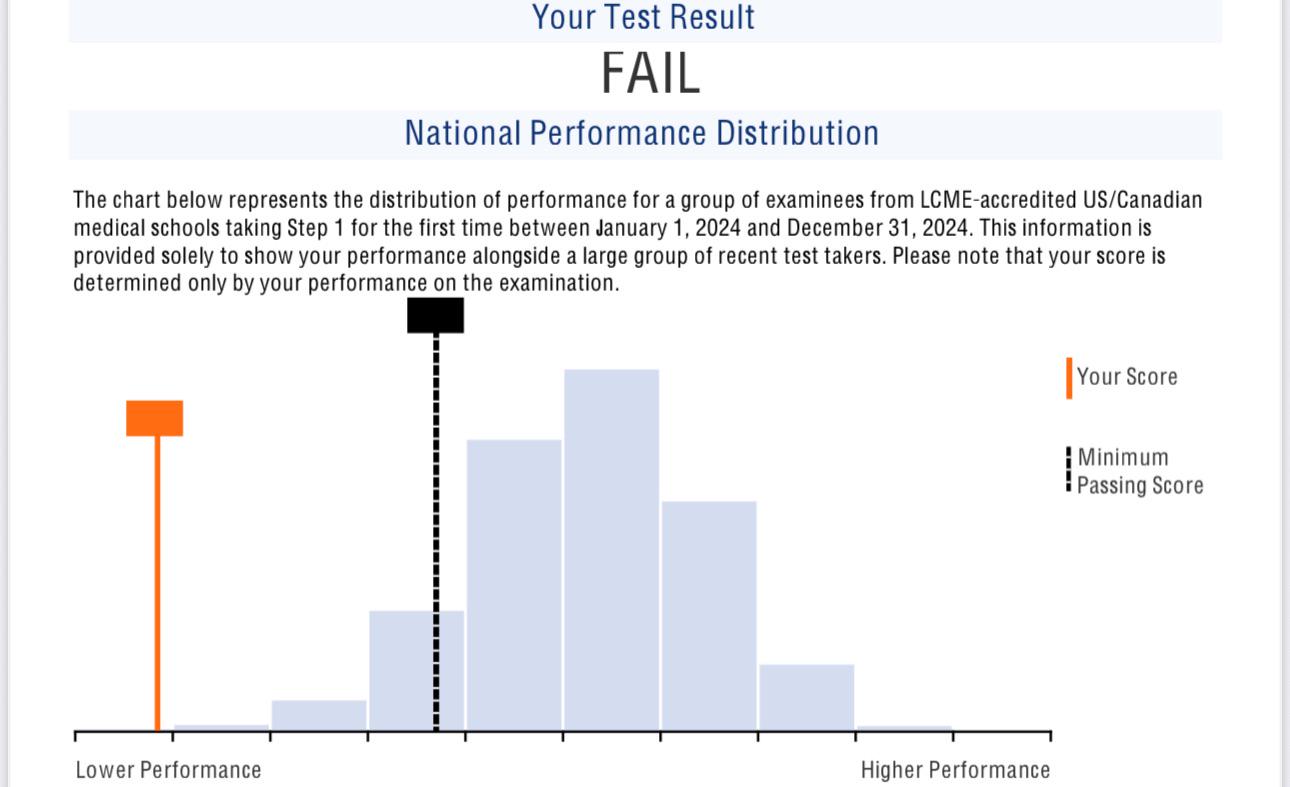
Hey everyone, I just got my Step 1 result back and unfortunately it says FAIL.

On my report, the orange marker is way over to the far left, almost like I got nothing correct. I know that’s not true I completed all 8 blocks and definitely got questions right but compared to some fail reports I’ve seen online, mine looks weird. Most people’s bars seem a little closer to the middle.

My questions are: • Is it normal for a fail report to show the marker all the way left like this? • Does the graph actually reflect how many questions you got correct, or is it just a broad placement below the passing line?


r/usmle • • Sep 27 '25

Step 1 Antidotes Hit List

188 Upvotes

🔺Acetaminophen ➡️N-acetylcysteine (replenish glutathione)

🔺Aspirin/salicylates ➡️ Sodium bicarb (alkalinize urine), supportive care

🔺Opioids ➡️ Naloxone or naltrexone

🔺Benzodiazepines ➡️ Flumazenil (watch for seizures!)

🔺Anticholinergics (e.g., atropine overdose) ➡️ Physostigmine

🔺Cholinesterase inhibitors/organophosphates ➡️ Atropine + pralidoxime

🔺Methanol or ethylene glycol ➡️ Fomepizole (1st line) or ethanol, plus dialysis

🔺Iron toxicity ➡️ Deferoxamine

🔺Heparin ➡️ Protamine sulfate

🔺Warfarin ➡️ Vitamin K (slow) + PCC/FFP (fast)

🔺β-blocker overdose ➡️ Glucagon

🔺Calcium-channel blocker overdose ➡️ IV calcium, glucagon, insulin/glucose

🔺TCAs ➡️ Sodium bicarb (for arrhythmias)

🔺Cyanide ➡️ Hydroxocobalamin or nitrites + thiosulfate

🔺CO poisoning ➡️ 100% O₂ or hyperbaric O₂

🔺Methemoglobinemia (nitrates, dapsone) ➡️ Methylene blue + vitamin C

🔺Lead ➡️ EDTA, Dimercaprol, Succimer

🔺Mercury / Arsenic ➡️ Dimercaprol, Succimer


r/usmle • • Aug 13 '25

The Tumor markers you should know by heart

185 Upvotes

AFP : HCC, yolk sac tumor

  • β-hCG : Choriocarcinoma, germ cell tumors, hydatidiform mole

  • CA-125 : Ovarian cancer

  • CA 19-9 : Pancreatic cancer

  • CEA : Colon, pancreatic (not specific though)

  • PSA : Prostate cancer

  • ALK : Lung adenocarcinoma, lymphoma

  • HER2/neu : Breast cancer

  • S-100 : Melanoma, neural crest tumors, Langerhans cell histiocytosis

  • Calcitonin : Medullary thyroid carcinoma


r/usmle • • Mar 01 '25

Before Match, I was told, to my face I would NEVER match

185 Upvotes

On Monday March 11th, 2024 I matched into a program.

After I received my match notification, I was told to my face by two attending doctors and the medical school councilor that I would “Never Match into Psychiatry.”

On Friday March 15th, I proceeded to match into Psychiatry in my top program!

I have now spoken with countless medical students who have been told similar statements when they struggle with academics, their mental health, or fail the board exam.

It is not true! 

You CAN match

You CAN become a doctor

You CAN accomplish your dreams!

Do not give up, because when you do, what they say becomes true.

Good luck to all 2025 applicants!

****

Dear medical schools,

Stop telling medical students and residency applicants that they will “not match” if they failed STEP/Comlex.

It is inappropriate, unhealthy, and unfounded.

♥️ Dr. Moss, A matched resident who failed STEP1 TWICE


r/usmle • • Oct 09 '26 Bravo

Advice AMA

Thumbnail
gallery
181 Upvotes

US MD PGY-1

Step 1 (2024): P on first try
Step 2 (2025): 263
Step 3 (2026): 247


r/usmle • • Sep 09 '25

Step 1 mixed Buzzwords You HAVE to Know

181 Upvotes

1-“Currant jelly sputum” → Klebsiella pneumoniae

2-“Slapped cheek rash” → Parvovirus B19

3-“Sheep erythrocyte agglutination” → EBV

4-“Bronze diabetes” → Hemochromatosis

5-“Bulls-eye rash” → Lyme disease

6-“Blueberry muffin baby” → Congenital rubella

7-“Eggshell calcifications of lymph nodes” → Silicosis

8-“Thunderclap headache” → SAH

9-“Worst headache of life + biconvex lens” → Epidural hematoma

10-“Temporal lobe lesion + seizures + olfactory hallucinations” → HSV encephalitis

11-“Cafe-au-lait spots + Lisch nodules” → NF1

12-“Port-wine stain V1 distribution” → Sturge-Weber

13-“Reed-Sternberg cells (owl eyes)” → Hodgkin lymphoma

14-“Starry sky appearance” → Burkitt lymphoma

15-“Nutmeg liver” → Chronic passive congestion

16-“Onion-skinning of renal arterioles” → Malignant hypertension

17-“Wire-loop glomeruli” → Lupus nephritis

18-“Sweet-smelling urine” → Maple Syrup Urine Disease

19-“Mousy odor” → PKU

20-“Cherry-red spot + no hepatosplenomegaly” → Tay-Sachs

21-“Cherry-red spot + hepatosplenomegaly” → Niemann-Pick

22-“Crumpled paper macrophages” → Gaucher disease

23-“Gray baby syndrome” → Chloramphenicol

24-“Red man syndrome” → Vancomycin

25-“Disulfiram-like reaction” → Metronidazole,

26-“Cyanide toxicity” → Nitroprusside


r/usmle • • Mar 20 '25

USMLE Exam Day Hacks

179 Upvotes

Hey everyone, I scored 260+ on Step 2 CK, and I’ve seen how small details on exam day can make a BIG difference. Here are some quick time-saving hacks to help you stay sharp and focused:

·         Before starting your USMILE exam, copy your CIN (Candidate Identification Number) the first time you enter it. When you return from breaks, simply paste it instead of typing it out every time!

·         If you bring a jacket or glasses to your USMLE exam, try to leave them at your desk before heading out for a break. This way, you can breeze through security checks when you return, without having to get them screened every time. Small time-savers can make a big difference on exam day!

·         Take the Free 120 tutorial before exam day so you can skip it during the actual test. The tutorial time comes out of your break time, so completing it in advance gives you more time to rest and recharge between blocks.

·         No watches or jewelry - Leave them at home to avoid delays.

·         Minimal pockets - The fewer, the better! Wear trousers with only two side pockets (and keep them turned inside out before security checks).

·         Round-neck, sleeveless/short-sleeve shirts - you’ll have to roll up/down your sleeves anyway for checks.

·         Avoid jeans with hidden pockets -even those tiny “pocket-watch” ones get checked!

·         Wear slippers to save time!

·         Always take a break after every block-even if you feel like you don't need one. Use the restroom, recharge, and reset. Skipping breaks can lead to burnout, and if the next block is tougher, you'll be tackling it with low energy.

I've been tutoring several Step 1 and Step 2 students, focusing on high-yield topics, scenario-based discussions, and test-taking strategies. If you're looking for guidance, feel free to reach out! I offer a free trial class and flexible payment plans, including the option to pay after attending a session.


r/usmle • • Aug 29 '26 Bravo

Exam Experience Allhumdullila passed

175 Upvotes

Hello guys! I just want share my personal experiences so far! I’ve recently completed 4th year and have begun with 5th year MBBS abroad in Belarus.

  1. Just believe in yourself , most importantly have faith in your creator plans if it’s meant for you and if it is in your favour, you’ll definitely achieve it !

  2. If you are following your mind map and if you’re in mid of your prep don’t get influenced and switch your strategy by seeing someone pass!!

  3. Just be consistent !! During preparation there will be times when you would want to give up but during that time it’s very important to continue and not stop!!!

  4. Resources to study which I personally followed are: sketchy for pharmacology and microbiology , Read once perfectly First Aid , and important topics from pathoma , atleast solve 20 questions if you’re a beginner and then you can increase solving questions over time. I did 60% u world with 60% pass. All NBMES from 25 to 33 I gave offline except free 120. And in all nbmes I scored 64,68, 69 % yet I passed !! Maximum time I got 68% 😂 Most importantly don’t panic believe in your NBME SCORES. If you have any queries about resources you can text me on Instagram @dr.zips_ or you can put comment here!

I wish luck to all your guys!! 🥹🤲🏻


r/usmle • • Jul 04 '25 Bless Up

The most powerful USMLE prep shift I ever made:

175 Upvotes

You might be using Uworld like a quiz bank, when it’s actually a diagnostic thinking tool.

Let’s fix the 5 big mistakes that turn UWorld into a memory test

Disclaimer: These strategies are best suited for IMGs who have 6+ months of prep time remaining because they take time to apply, so if you’re short on time, use the same approach with NBME questions instead of UWorld.

Let’s dive in -

Mistake 1: Treating UWorld like a quiz instead of a classroom.

• Doing 40 questions and rushing to check how many you got “right”

• Focusing on First Aid fact recall instead of asking “why this, not that?”

• Skipping the explanation once you see the correct answer

Instead: Turn every question into a mini clinical puzzle.

Example:

A 22 year old with severe headache and bilateral papilledema.

Options: Meningitis, IIH, Cavernous sinus thrombosis, Brain abscess.

Instead of just circling “IIH,” ask:

→ Why not abscess? Why no fever?

→ What’s the mechanism of papilledema in IIH?

→ Why is MRI better than CT here?

The goal isn’t right answers. It’s refined reasoning.

Mistake 2. Reviewing too much, too fast.

Many IMGs do 80 questions/day with minimal review. They forget 90% of what they did.

Try this:

– For each one, map a mini mechanism chart

Example:

A patient with ascites, ↓ albumin, and spider angiomas.

→ Portal HTN → Splanchnic vasodilation → RAAS activation → Na⁺/H₂O retention → Ascites

→ ↓ Estrogen metabolism → Spider angiomas + gynecomastia

Sketching this takes 2 minutes. But burns in 10x deeper.

Mistake 3. Ignoring wrong answer patterns.

Review shouldn’t just be “Oh okay, I picked B, it was C.”

It should sound more like: “I consistently fall for buzzwords without anchoring my diagnosis.”

Build a mistake log.

Example:

You confuse SIADH and CSWS because both cause hyponatremia.

→ Start tracking how you differentiate:

– Volume status?

– Urine sodium?

– Response to saline?

Within 2 weeks, you’ll see patterns in your errors, and stop repeating them.

Mistake 4:  Silent Guessing

If you can’t explain why each wrong choice is wrong, you’re guessing.

Practice speaking out loud. ( I know it's a weird advice, but trust me it works :) )

Example:

“This 60-year-old smoker with hematuria and no flank pain?

→ RCC is less likely, usually has flank mass + polycythemia

→ TCC fits better: painless hematuria, transitional cell risk (smoking)”

Teaching = Testing.

Mistake 5. Studying without a systems lens.

Most IMGs stay stuck in disease names. USMLE tests patterns.

Ask:

– Which system is dominant here?

– Can I link all wrong choices with a common feature?

 Example:

Question on acute pancreatitis, and wrong options include:

– AAA rupture

– Perforated ulcer

– Mesenteric ischemia

→ All present with sudden abdominal pain, but different positions ease pain.

→ Draw 1 comparison chart:

  • Pancreatitis: epigastric + radiates to back, better when leaning forward

  • AAA: tearing pain, hypotension, pulsatile mass

  • Ulcer: burning pain, worse with food

Once you map these systems, you stop guessing, you start diagnosing.

The difference between 220 and 250 isn’t knowledge, it’s how you use UWorld.

And remember:

UWorld isn’t a race. It’s a rehearsal for reasoning.


r/usmle • • Apr 22 '26

Advice How an "average" student hit 260+ after a shaky Step 1 (My Step 2 Write-up)

174 Upvotes

Look, I’m not one of those geniuses who "casually" gets a 270 while sleeping 8 hours. I’ve been an average test-taker my whole life—SATs, MCAT, you name it. I barely passed Step 1, so I knew I had to grind twice as hard for Step 2 just to stay competitive as an IMG.

The Rotation Struggle: I did most of my prep during clinical rotations. There were days I’d come home after a 12-hour surgery shift, smelling like the OR, and still force myself to do 40-50 questions. It sucked. If you’re struggling to balance wards and study, just know that even 20 focused questions are better than zero. Consistency > Intensity.

Why I Plateaued in the 240s: I was stuck for weeks. I realized I was just "recognizing" UWorld patterns instead of actually learning. I’d see a keyword and pick an answer without thinking. To fix this, I stopped doing 120q/day and spent literal DAYS reviewing one NBME.

The ChatGPT "Drill" (Game Changer): I started using ChatGPT to challenge my logic. I’d paste a concept I got wrong and tell it: "Act as an attending. Rewrite this scenario so that Option B is now the correct answer. What would have to change in the patient's vitals?" This forced me to understand the "why" behind every wrong choice. This is how you build that "gut feeling" everyone talks about.

My Resources:

  • UWorld: Essential, but don't let the percentage crush your soul. It’s a learning tool, not a predictor.

  • Amboss: Honestly? Their questions feel more like the actual NBME vagueness. Highly recommend for ethics and risk factors.

  • Anki: I’m terrible at keeping up with cards, so I only made cards for my "stupid" mistakes.

If you’re an average student like me, don’t lose hope. This test is a mental game as much as it is a knowledge one. I’m happy to answer anything about breaking the 240 plateau or surviving rotations while studying!


r/usmle • • Oct 02 '24

I quit USMLE after passing step 1

173 Upvotes

i don't think there is no better place than reddit to write this down. I'm a final year student from a third world country. last year i passed step 1. preparing for the exam was damn hard but at the same time somehow enjoyable. now i look back and miss those days. usmle taught me discipline and patience. tbh, i've always wanted persuade this path. i knew that i had enough time to clear step 2 and oet before my graduation. i knew i had potential. but i decided not to do. 'coz i can't take this much risk. just imagine studying over 8 hours every day, having no personal life, losing ur mental health, paying a great deal of money. dealing with visa issues, doing everything for not even 50% chance of getting matched. since i stopped, i'm spending more time with my family and friends, picked up new hobbies. people around me are telling me that i became more lively. now i'm planning to continue my career in an European country, where i can keep work and life balance.

some parts of me still can't accept this decision. there is constant battle in my mind between "Do not give up because you'll never know what will happen if you stay on" and "Sometimes giving up things are sucking the life out of you is the best choice" i think i will have to cope with it for a good amount of time.


r/usmle • • Nov 27 '23

How to get a research position as an IMG

165 Upvotes

I have been getting a lot of questions regarding this (after I responded to a post). I will try to explain as much as I can here.

As Match cycle is on in full swing, many potential research spots will open in after the match results. Most of the Principal investigators start looking for the potential candidate in these upcoming months. So you better start emailing people NOW!

Here's your roadmap to secure a research opportunity! 🎓

Step 1: University Selection: Pick one university and identify faculty members in your chosen specialty. Start with big names like Harvard, Yale, Stanford, Hopkins, Northwestern, Mayo Clinic, Columbia, etc.

2. Email Active Researchers: Focus on Associate and Assistant Professors who are actively involved in research projects like prospective studies/ clinical trials, etc. Full professors don’t take research fellows after certain time period due to other academic commitments. The biggies of every field are the busiest.

3. Gather Contacts/email IDs: Collect the names and email addresses of PIs whose research interests aligns with yours. For BIDMC, Harvard, MGH the email idss can be found on Harvard Catalyst. For the other places, find email id on the university website. If you can't find there also, then look at Google scholar. The PI will be listed as a corresponding author on some publication, get email ID from there.

4. Craft an Email: Compose an engaging email. Briefly introduce yourself, highlight your credentials, and express genuine interest in their research. It MUST NOT be generic. It must be personalized. Keep it short and to the point. Example : https://www.linkedin.com/posts/emmanueltsekleves_theres-a-proven-formula-to-write-emails-activity-7131665913023471616-TYRT?utm_source=share&utm_medium=member_android

5. Edit your CV and attach it to the email: Make sure it is free of errors. Look at examples of research CVs online.

6. Email timing matters: Send your emails around 8 am US time Tuesday to Friday when professors are more likely to check their inboxes.

Important : Acknowledge the competitiveness of the process and express your willingness to start as a remote collaborator or volunteer or if you have enough finances, prepare to work unpaid. Mostly paid positions have a lot of applicants and only the best ones get selected & sometimes PIs don’t have funding available.

Talk to seniors who have matched. Talk to friends of seniors. If you are attending conferences, talk to professors. Network your way through. Show that you're interested. Be teachable.

EDIT 1: The sooner you start, the better it is. Be prepared to be ghosted or to get a no. Keep trying. Keep emailing. If you're a med student, rejoice! Everyone loves a med student. Just be enthusiastic and show sincere interest.

EDIT 2 : Please don't DM me asking what your chances of getting a paid research spot are. I don't know. I didn't know my own chance of landing a research opportunity. I'm not a PI. I'm an IMG like you and I just wrote this post to highlight what worked for me and my peers.