r/thephysicstutor • • Mar 26 '26

A simple Colliding Blocks simulation

0 Upvotes

Colliding Blocks — Momentum & Energy

Two blocks on a frictionless track. Block 1 is attached to a wall by a spring. Block 2 slides freely. When they collide, momentum is exchanged. This is the classic demonstration of conservation of momentum.

Try it here https://8gwifi.org/physics/labs/collide-blocks.jsp

Collision Physics

During collision, the coefficient of restitution e determines energy transfer:

  • e = 1 (elastic): Total kinetic energy conserved. Velocities swap in equal-mass case

  • 0 < e < 1 (inelastic): Some kinetic energy lost to "deformation"

  • e = 0 (perfectly inelastic): Blocks stick together, maximum KE loss. Momentum still conserved!

Collision formula: v₁' = v_cm - e·(v₁ - v_cm) where v_cm = (m₁v₁ + m₂v₂)/(m₁+m₂)

Momentum is Always Conserved

Watch the momentum readout (top of canvas): Σp = m₁v₁ + m₂v₂ stays constant through every collision, even when e = 0. This is Newton's Third Law in action — the impulse on block 1 equals and opposite to the impulse on block 2.


r/thephysicstutor • • Apr 15 '26

AP Physics Free class*

Thumbnail thephysicstutor.net
0 Upvotes

I specialize in teaching:

AP Physics 1

AP Physics C (Mechanics & E&M)

IB, A-Level, MCAT Physics

With a strong foundation in advanced physics (JEE Advanced level), I help students simplify complex concepts and solve problems step-by-step.

🚀 What Makes This Different?

This is NOT traditional tutoring.

You will get:

✔ Clear concept explanation (no confusion)

✔ Step-by-step problem solving

✔ Real AP exam questions practice

✔ Strategy to score 4 or 5

✔ Personal attention (1:1 learning)

📈 Real Results You Can Expect

After a few sessions, students typically:

✅ Improve problem-solving speed

✅ Gain confidence in physics

✅ Reduce silly mistakes

✅ Understand concepts deeply

🎁 FREE Trial Class (Limited Slots)

Try before you pay.

In your FREE session, you will:

Solve real AP Physics problems

Understand your weak areas

Get a personalized improvement plan


r/thephysicstutor • • Feb 06 '26

Energy conservation in pure rolling

4 Upvotes

r/thephysicstutor • • Apr 26 '26

Revision class for AP Physics 2026

1 Upvotes

r/thephysicstutor • • Apr 12 '26

Cracking the Code of Perfect 5 in AP Physics 2026

2 Upvotes

5 Surprising Reasons Students Stumble in AP Physics and How to score a perfect 5​

For many high-achieving students, AP Physics represents the first time that "being good at math" fails to guarantee an A. The data from the College Board reveals a sobering reality: AP Physics 1 consistently posts one of the lowest "5" rates of any subject at approximately 8%. Even in the calculus-based AP Physics C: Mechanics, where the "5" rate sits at 26.4%, the mean scores on free-response questions tell a story of high-stakes struggle. In 2022, while students averaged a 7.25/15 on Newton’s Laws, the mean plummeted to a dismal 5.50/15 on complex topics like rotation.

To bridge the gap between a 3 and a 5, you must pivot your strategy from "solving for x" to "documenting the physics." As a senior academic strategist, I have identified five critical areas where even the best students leak points—and how you can plug those gaps.

Read More

--------------------------------------------------------------------------------


r/thephysicstutor • • Jan 31 '26

Kinematics FRQ #AP Physics 1

5 Upvotes

r/thephysicstutor • • Apr 16 '26 Popcorn

The antigravity board illusion Explanation

Thumbnail
gallery
10 Upvotes

r/thephysicstutor • • Apr 23 '26

AP-Physics1-Unit8-Fluids_Free-Notes (Part 2)

Thumbnail
gallery
48 Upvotes

r/thephysicstutor • • Jan 17 '26

Further Mechanics: Topple or slide

Post image
4 Upvotes

r/thephysicstutor • • Jan 16 '26

What is the magnitude of the friction force that the floor exerts on the ladder?

Post image
2 Upvotes

r/thephysicstutor • • Mar 20 '26

AP Physics 1_ Fluids _Viscosity

Thumbnail
gallery
21 Upvotes

r/thephysicstutor • • Nov 17 '25

Equilibrium of spring block system on inclined plane

Post image
2 Upvotes

r/thephysicstutor • • Apr 09 '26

New AP Physics series for upcoming exam (Free)

Post image
4 Upvotes

In this series, I will share 10 MCQ and 2 FRQ per unit for each of the four AP Physics courses.

Do share with your friends who take AP Physics classes.

Additionally, you can visit physicstutor.net for more information.


r/thephysicstutor • • Jan 22 '26

Work done by constant and variable force

Post image
6 Upvotes

r/thephysicstutor • • Mar 17 '26

Buoyancy force (AP Physics 1)

Thumbnail
gallery
8 Upvotes

r/thephysicstutor • • Jan 01 '26

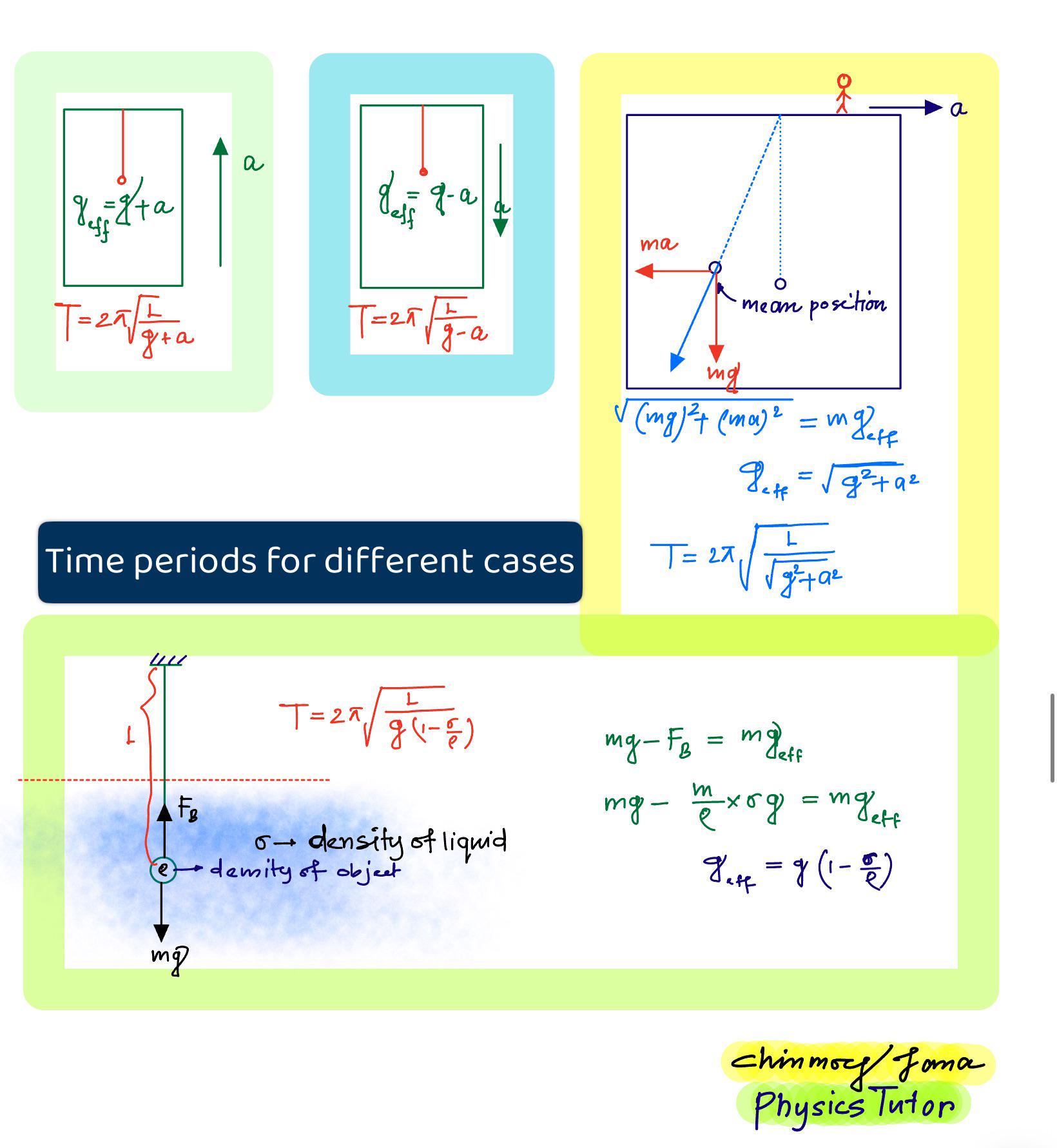
Time period for different SHM for simple pendulum

Post image
2 Upvotes

r/thephysicstutor • • Mar 29 '26

Resonance: Driven Damped Oscillator

4 Upvotes

Resonance

One, two, or three spring-mass systems hang from a shared driver that oscillates at frequency ω_d. Each has independent mass, stiffness, and damping — so each has a different natural frequency ω₀ = √(k/m). When ω_d matches one system's ω₀, that one resonates wildly while the others barely move. This is the core insight of resonance: same force, selective response.

https://8gwifi.org/physics/labs/resonance.jsp

Sample Learning Goals

  • Explain the conditions required for resonance.

  • Identify the variables that affect the natural frequency of a mass-spring system.

  • Explain the distinction between driving frequency and natural frequency.

  • Explain the distinction between transient and steady-state behavior.

  • Identify which variables affect the duration of transient behavior.

  • Recognize the phase relationship between driver and oscillator, especially how phase differs above and below resonance.

  • Give examples of real-world resonance and explain why understanding it matters.

Key Equations

  • ODE: m·x'' + b·x' + k·x = F₀·cos(ω_d·t)

  • Natural frequency: ω₀ = √(k/m)

  • Q factor: Q = √(km) / b — higher Q = sharper resonance peak

  • Steady-state amplitude: A(ω_d) = (F₀/m) / √((ω₀²−ω_d²)² + (2γω_d)²)

  • Phase lag: φ = −arctan(2γω_d / (ω₀²−ω_d²))

The Phase Flip

  • Below resonance (ω_d < ω₀): Mass moves nearly in phase with driver (φ ≈ 0°)

  • At resonance (ω_d = ω₀): Mass lags driver by exactly 90°

  • Above resonance (ω_d > ω₀): Mass is nearly anti-phase (φ ≈ −180°)

Try These Experiments

  1. Find resonance: With 1 spring, slowly drag ω_d near ω₀. Watch the amplitude grow.

  2. Two springs, one resonates: Switch to "2 springs". Give them different masses. Drive at one's ω₀ — it goes wild while the other barely moves. Same force, selective response.

  3. Radio Tuner (3 springs): Use the "Radio Tuner" preset. Three springs with ω₀ = 2, 3.16, and 5. Sweep the driver — each lights up in turn as ω_d passes through its resonance. This is exactly how a radio tunes stations.

  4. Same ω₀, Different Q: Use "Same ω₀, Different Q" preset. Three springs with identical natural frequency but different damping. At resonance, the sharp one (low damping) has huge amplitude while the damped one barely moves. This teaches why Q factor matters.

  5. Sweep mode: Click "Sweep" to auto-ramp ω_d. With 3 springs you'll see each peak up sequentially.

  6. Effect of damping: Compare "No Damping" (amplitude grows without bound!) vs "Heavy Damping" (barely resonates).

  7. Transient behavior: Change ω_d suddenly. The time graph shows messy transient → smooth steady-state. More damping = faster settling.

  8. Energy at resonance: Switch to Energy tab. The green total line shows energy accumulating at resonance until input = dissipation.


r/thephysicstutor • • Mar 19 '26

AP Physics 1_ Fluids _Equation of continuity and Bernoulli’s Equation

Thumbnail
gallery
50 Upvotes

r/thephysicstutor • • Jan 27 '26

Electrostatic force between two hanging charge

Post image
12 Upvotes

r/thephysicstutor • • Mar 26 '26

A Simple Cart + Pendulum simulator

7 Upvotes

Cart + Pendulum — Coupled Dynamics

A cart on a track (connected to a wall by a spring) with a pendulum hanging from it. The cart and pendulum are coupled: the swinging pendulum pushes the cart, and the cart's motion affects the pendulum. This is one of the most important systems in control theory.

try it here https://8gwifi.org/physics/labs/cart-pendulum.jsp

Equations of Motion

Derived from the Lagrangian with constraints:

v' = [mω²L·sinθ + mg·sinθ·cosθ - kx - dv + bω·cosθ/L] / (M + m·sin²θ)

ω' = [-mω²L·sinθ·cosθ + kx·cosθ - (M+m)g·sinθ + dv·cosθ - (M+m)bω/(mL)] / [L(M + m·sin²θ)]

The Coupling

  • Pendulum → Cart: The swinging bob exerts a centrifugal force mω²L·sinθ on the cart, pushing it sideways

  • Cart → Pendulum: The spring force kx·cosθ accelerates the cart, which changes the effective gravity for the pendulum

  • Effective mass: The denominator M + m·sin²θ shows the cart feels heavier when the pendulum is horizontal (sin²θ = 1)

Try These Experiments

  1. Watch energy transfer: Default preset — the pendulum swings and makes the cart oscillate. Energy flows between pendulum and cart-spring

  2. Heavy cart: Cart barely moves. Pendulum behaves almost like it's on a fixed pivot

  3. Heavy bob: Pendulum dominates — drags the cart along with each swing

  4. No spring: Cart slides freely. Total momentum is conserved (cart + bob). Watch cart drift

  5. Drag the cart: Pull the cart sideways and release — both the cart and pendulum oscillate in a complex coupled pattern

Phase Space

The Phase tab defaults to cart position (x) vs pendulum angle (θ) — this shows the coupled configuration space. The pattern reveals how the two degrees of freedom exchange energy.

Real-World Applications

  • Crane control: A crane payload is a pendulum on a moveable cart — operators must account for swing

  • Segway / self-balancing robots: Inverted cart-pendulum — the control problem is to keep the pendulum upright by moving the cart

  • Earthquake engineering: Buildings sway like pendulums on moving ground (the "cart" is the earth)

  • Rocket landing: SpaceX booster landing is essentially a 3D inverted pendulum on a moving cart


r/thephysicstutor • • Apr 22 '26

Electrostatic field and potential problem (non conducting charged sphere)

Post image
13 Upvotes

r/thephysicstutor • • Jun 02 '26

Parallel plate capacitor

Post image
18 Upvotes

r/thephysicstutor • • Jan 30 '26

Density and pressure of ideal liquid #AP Physics 1 #Fluids

Thumbnail
gallery
3 Upvotes

r/thephysicstutor • • Mar 15 '26

Pascal’s law for static fluids #AP Physics

Thumbnail
gallery
20 Upvotes

r/thephysicstutor • • Mar 29 '26

The Double Pendulum — Chaos in Action

2 Upvotes

The Double Pendulum — Chaos in Action

Two pendulums linked end-to-end — one of the simplest systems that exhibits chaotic behavior. Tiny differences in starting conditions lead to completely different trajectories over time.

Equations of Motion

Derived from the Lagrangian (T - V), the coupled ODEs are:

α₁ = [-g(2m₁+m₂)sinθ₁ - gm₂sin(θ₁-2θ₂) - 2m₂ω₂²L₂sin(θ₁-θ₂) - m₂ω₁²L₁sin(2(θ₁-θ₂))] / [L₁(2m₁+m₂-m₂cos(2(θ₁-θ₂)))]

α₂ = [2sin(θ₁-θ₂)((m₁+m₂)ω₁²L₁ + g(m₁+m₂)cosθ₁ + m₂ω₂²L₂cos(θ₁-θ₂))] / [L₂(2m₁+m₂-m₂cos(2(θ₁-θ₂)))]

These are nonlinear, coupled, and have no closed-form solution — they must be solved numerically (we use RK4).

Try it here https://8gwifi.org/physics/labs/double-pendulum.jsp

What Makes It Chaotic

  • Sensitive dependence: Change the starting angle by 0.001 rad → after a few seconds, the motion is completely different

  • Non-periodic: Unlike a single pendulum, the motion never exactly repeats

  • Energy is still conserved: Despite the wild motion, total energy (KE + PE) stays constant — switch to the Energy tab to verify

  • Deterministic chaos: The equations are perfectly predictable step-by-step, yet long-term prediction is impossible due to compounding errors

Phase Space

Switch to the Phase tab and watch θ₁ vs ω₁:

  • Small angles: Nearly periodic orbits (quasi-regular)

  • Large angles: Phase space fills erratically — the signature of chaos

  • Use the var-picker to view θ₂ vs ω₂, or θ₁ vs θ₂ (configuration space)

Try These Experiments

  1. Chaos sensitivity: Run "Default" for 10s. Reset. Change Start θ₁ by just 0.01 rad. Run again — the motion quickly diverges

  2. Small angle = nearly periodic: Try "Small Angle" preset — both pendulums oscillate smoothly, almost like two normal modes

  3. Full flip chaos: Try "Full Flip" — the pendulums wildly rotate over the top, pure chaos

  4. Heavy top vs heavy bottom: Compare the two presets — mass distribution dramatically changes the dynamics

  5. Energy conservation in chaos: Switch to Energy tab during wild motion — the green Total line stays flat despite the apparent randomness