r/ThedasLore • • Jun 01 '17

Theory A Comprehensive Timeline of Dragon Age Origins

143 Upvotes

So, the Origin timeline is kind of fucked.

I've been trying to put together a comprehensive timeline of my canon, spanning all three games. For reference purposes. And that meant starting with a more generic timeline. But even that is proving...fun. So here is my overly wordy but hopefully methodical working out of how the fuck you end a Blight in a year.

Many but not all of the travel time calculations have come from here.

(Dagna's comment re 2 week round trip between Orzammar and Kinloch Hold makes sense if you consider the following - she's sending missives with caravans which certainly could take a week to cover the distance.)

To start with we have Trian's Journal, which says that everything that happened during the Dwarf Noble Origin occurred after the 28th Ferventis/Justinian. No year given.

Now I'm assuming this codex entry has to be from 9:29 for a couple of reasons. If it had happened in 9:30 the timeline would be utterly dead (under six months to do everything in Origins). Putting it in 9:29 gives Gorim a reasonable amount of time to get to Denerim, get married and start selling fine dwarven crafts direct from Orzammar. Since the Dwarf Commoner origin happens before the Dwarf Noble Origin, that puts both of them in 9:29. Which fits with the fact that by the time the Warden turns back up in Orzammar, Bhelen has a kid with Rica. Assuming the kid was conceived around the time of Trian's Journal entries, he would have been born sometime in Guardian/Drakonis 9:30. Fitting neatly even if you decide to do Orzammar first.

The Battle of Ostagar needs to take place sometime early in 9:30 for the timeline to even have a chance. Giving the Warden almost a year to off the Archdemon.

Which means the Mage Origin needs to also take place in 9:29. Because Jowan needs time to escape, to be caught near Redcliffe by Irminric (roughly 20 days after escaping) and taken off him by Loghain's men six days later(who were, presumably some sort of scouting party or possibly travelling to Ostagar), have Irminric sent to Denerim, send Jowan to Redcliffe (a week total) and give him time to poison Arl Eamon before the Battle of Ostagar and for Isolde to start sending knights to look for the Sacred Ashes (which doesn't seem like the immediate thing to do when your husband is poisoned). What a Mage Warden recruit is doing in the interim, I don't know.

The Human Noble Origin needs to happen about two and half weeks before Ostagar. Assuming they planned to march straight through the Bannorn rather than going via the roads, the forces that Bryce and Fergus were planning to take to Ostagar would take 17.3 days to march there. Since Howe's forces were joining up with the Cousland's forces, I would assume that the march through the Bannorn would have entailed picking up other people's forces as well.

City Elf and Dalish Elf are the two origins which probably happened closest to the actual battle of Ostagar (8 days riding from Denerim to Ostagar, 6 days riding from the Dalish Camp to Ostagar)

After arriving in Ostagar the trip into the Korcari Wilds takes about ten days. That's allowing for marshy or boggy ground slowing their walking speed, not knowing really where they're going, potentially having one member of the group completely unused to the wilderness and having to find darkspawn (not to mention side quests) plus a trip to Flemeth's hut.

We hit a snag then in terms of DAII timeline. Because the earlier I make Ostagar, to give the Warden a reasonable amount of time to do everything, the earlier the Hawke family gets to Kirkwall and the earlier in 9:31 they finish their indenture and the earlier Anders needs to be in Kirkwall. Which is awkward since Awakening begins just before the 17th of Ferventis/Justinian 9:31 according to Seneschal Varel's comment when you deal with Nathaniel. But that's somewhat easier to fudge.

So I'm going to put Ostagar in the exact middle of Guardian 9:30 for convenience. Then give the Warden and Alistair say a week from Ostagar to wake up and get from Flemeth's hut to Lothering on foot still ahead of the darkspawn horde. They're still moving faster than Carver, who I think deserted so would be moving by himself and avoiding darkspawn and scouting parties alike.

They're not in Lothering very long, a total of three days. Picking up Leliana and Sten, supplies, making a bit of money with the sidequests etc.

I'd give it a couple of days after they leave Lothing that it's attacked by darkspawn and the Hawke family flee and are found by Flemeth. This is where I can start fudging things to make the DAII timeline fit. Although Flemeth rescues them, I don't think she flew them to Gwaren because that's just kind of ridiculous and would completely fuck my timeline. I think she protected them with something similar to whatever was on her hut, so darkspawn just wouldn't notice them and then left them to walk to Gwaren. Going through the Southron Hills and the Brecilian Forest to get there would take just over 24 days - that sounds like a lot but they don't have much food, I doubt Leandra's in fantastic physical condition, nobody's in particularly great mental condition and Lothering to Gwaren cross-country means hills and a forest. Plus another 14 days on the ship. Add in some time in Gwaren trying to organise passage and I've managed to put their arrival in Kirkwall back a good ways. That also makes the number of refugees in Kirkwall make more sense.

Back to the Warden who has spent 10 days on foot travelling so when they get to Kinloch Hold a reasonable amount of time has elapsed for the mages who were at Ostagar to return to their tower, tensions to rise, to have their meeting, Uldred to take over the tower, the Templars to retreat and have sent for the Right of Annulment but not quite so long that the Right has arrived or so long that Uldred waiting seems farcical.

The actual Broken Circle quest would take less than a day, I'd say. Or at least, I don't think anybody would want to sleep inside Kinloch Hold until everything was done.

Leaving Kinloch Hold and heading to Redcliffe down the western side of Lake Calenhad let them encounter Zevran, the guy selling fake documents and the Sulcher's Pass guy while avoiding Darkspawn. That would take approximately 20 days walking.

Redcliffe village takes a day of preparation and a night of fighting. Or you can abandon it and spend that day and night outside Redcliffe, only finding Teagan the morning after. Then Isolde arrives and Teagan heads off to the castle. Let's say it takes the better part of that day to get from the windmill into the castle and fight through it to the point where you're deciding what to do with Connor.

Killing him or killing Isolde to do the ritual can be done immediately. Going to get lyrium requires the introduction of sailing. Now, I reckon from Redcliffe to Kinloch Hold on Lake Calenhad is about 125 miles. With a boat capable of sailing and being rowed, you could get there and back in <24 hours depending on wind condition.

With Connor sorted, a quick trip to Honnleath to pick up the golem they were promised is certainly possible. At this point I'm pretty sure Master Dennet was working for Arl Eamon so the Warden and party can pick up horses. Just over three days to get from Redcliffe to Honnleath on horseback, probably the rest of the third day killing the darkspawn and dealing with Kitty and Amalia. Another three days to get back to Redcliffe. A week total round trip for a golem, not a bad trade.

Riding from Redcliffe to the Brecilian Forest Dalish Camp would take 11 days although I'm willing to give a leeway of an extra day given that they encounter at least one pitched battle on the way, taking it up to 12 days.

Nature of the Beast is fiddly. Taking horses into a forest filled with werewolves seems really stupid idea so everyone is back on foot and it's pretty dense forest so people are moving quite slowly. It takes three and a half days to get from the Dalish camp to the Western Brecilian Forest map marker. Add a day for exploring until you find Deygan (and the Ironbark). Now you can kill him and add no time to your journey or you can take him back to the Dalish camp - which is another 5 days to get back there (transporting a seriously injured man means moving slower) and 3.5 days to get back to the Western Brecilian Forest, adding a total of eight days extra time.

Heading from the West Brecilian Forest to the East Brecilian Forest takes 6 days. Here you meet Danyla and the Mad Hermit. No matter what happens with the Mad Hermit, you need to go back to the West Brecilian Forest either to kill the Grand Oak or return the acorn. If, at this point, you choose to return to the Dalish camp to return Danyla's scarf, that's an extra 7 days to get there and back. Either way, you have to head back to the East Brecilian Forest to cross the barrier itself.

After crossing the barrier it's a solid ten days of walking to get to the ruins, providing nobody gets lost. Let's say three days for exploring the ruins and getting to the Lady. Straight up killing the werewolves or agreeing to bring Zathrian (who has conveniently been following you) and ending the curse that way takes another day and then walking back to the Dalish camp takes 19.5 days.

Leaving the Dalish and going by the main roads, it's 6 days riding to Denerim. Although the major quests are unavailable at this point, it's a good time to clear up some of the other ones, like meeting Alistair's sister, finding Brother Genetivi's house and doing some of the little misc quests. We'll say a week in Denerim before heading out for Orzammar via Soldier's Peak.

4 days of riding gets you to Soldier's Peak. Let's say a day of fighting through the castle and another of resting once Sophia and Avernus are dealt with in whatever manner you see fit in time for Mikhael Dryden to appear and forge your starmetal sword. It's another day of riding to get back to the Imperial Highway

From there riding into the Bannorn is a day of clear riding and then they hit the first of the two battlefields about a quarter of the way into the second day. That's the pattern again between the first and second battlefield. One full day of travel, hitting trouble early on in the second day. They can deal with the second Civil War issue and proceed back to the Imperial Highway via Bann Loren's lands to pick up the information re Return to Ostagar over the course of two days. From there it's just over three days ride to the gates of Orzammar.

A total of seventeen days riding to get from Denerim to Orzammar .

Then we hit another stretch of fiddly with Orzammar. Partially because I'm using this interpretation on the size of the deep roads, which is very well reasoned and makes a lot of sense but also hugely increases travel time (so I guess the Deep Roads weren't only a slog for gamers)

Harrowmont's first task is dealing with the Proving, which can't take more than a day, but Bhelen's first task involves delivering documents to various people - the Dace document meaning you have to get to the Aeducan Thaig and back. Two days walking to get there, plus fighting alongside Lord Dace and two days walk back, makes five days.

Next up is Jarvia. I can't see that particular Carta hideout (because let's face it, there have to be others) being that big. So if we say a couple of days for getting the information out of people and one day of almost nonstop fighting through the Carta hideout until Jarvia is dead.

Now comes the fun one. The Anvil of the Void. Orzammar to the Anvil via the Aeducan Thaig and the Ortan Thaig is 645 miles one way because you're pretty much walking diagonally across Ferelden. Uninterrupted, moving exceptionally quickly and not getting lost, that's over 32 days walking one way. Once you add in the fighting, side quests, the Dead Trenches, getting through the traps outside the Anvil and dealing with the Anvil itself, we're talking over two months at minimum. The upside of the Deep Roads is that there's no weather to worry about and the paths appear to be mostly flat.

So 70 days later the Warden rocks back up in Orzammar with whatever they gained from the Anvil. Let's say 4 days of rest, recuperation, pomp and circumstance as the new ruler is crowned before their treaty is properly acknowledged and they leave Orzammar.

There's a 5 day optional ride from Orzammar to Kinloch Hold and back to deliver the smuggled lyrium and get Dagna her position in the Circle.

Heading back down the western side of Lake Calenhad again takes 6.5 days of riding on the Imperial Highway before they get to the turn off to Haven and a further 2.5 days to get from the Highway to Haven, making 9 days before they hit the village. Please note here that I am going with the location of Haven as indicated in Origins and on this map rather than the higher location indicated elsewhere.
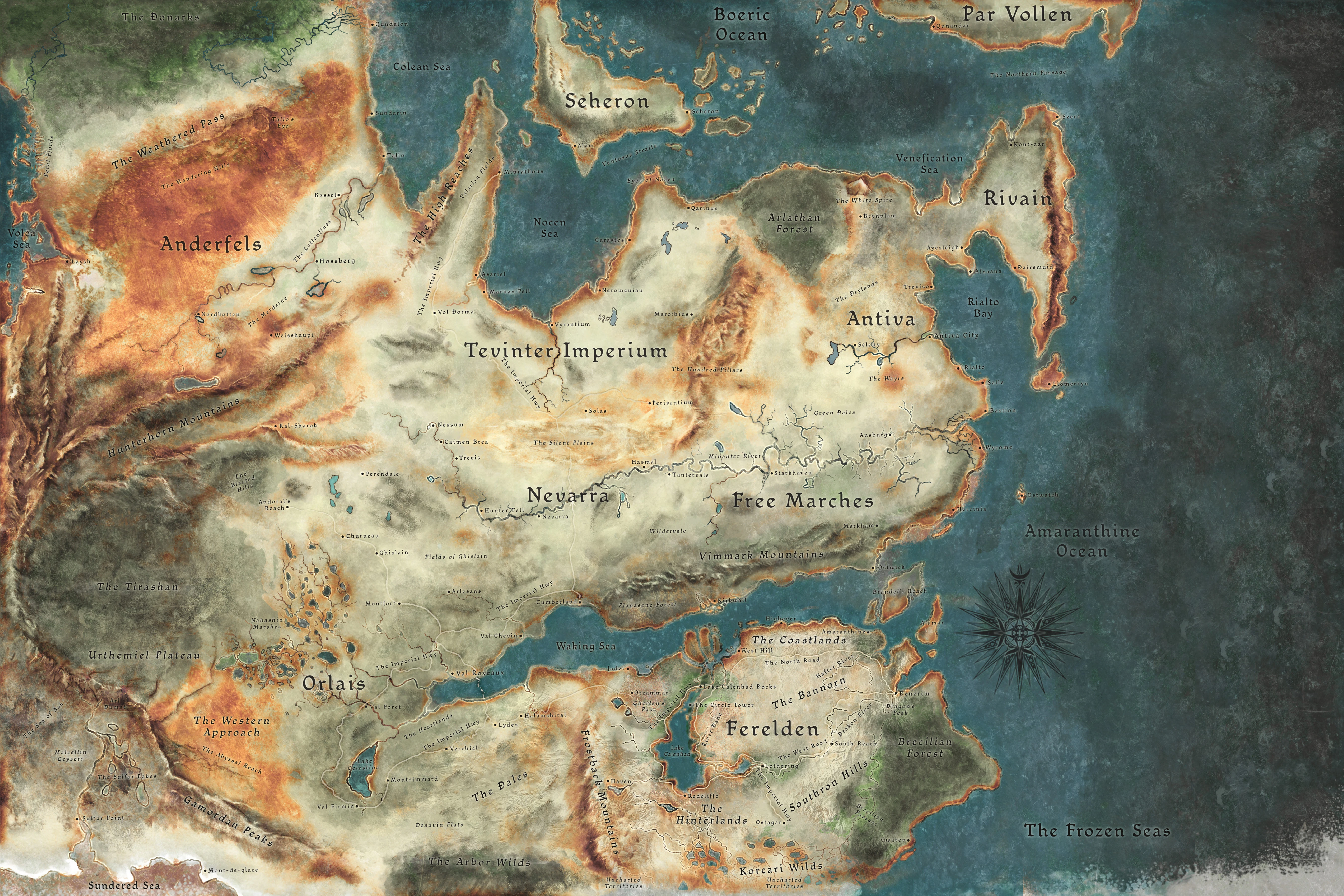
The events of Haven village need to happen in one day, because I think the party would have been murdered in their sleep if they'd camped in Haven. So you fight with Sten, slaughter a village and find Genetivi in one day. Resting then would seem like a good idea, heading up to the ruined temple the next day.

The temple itself can't be particularly far from Haven, since it's reasonably easily accessible during Inquisition. I reckon getting to it and exploring it (initially mistyped as 'exploding it', humorously enough) until you get to the caverns would take the rest of the next day. Another day after that to fight through the caverns to Kolgrim. You rest there, either in the company of Kolgrim's cultists if you agreed to help them or surrounded by corpses after you've killed them. A third day to get from Kolgrim's location out on to the mountain top where Andraste is. Whether you kill her then or on the return from the Gauntlet, that adds a day total for both fighting the dragon and recovering from fighting the dragon. Plus another day to get from Andraste's mountaintop to the start of the gauntlet

The Gauntlet itself is quite long, handily putting the Ashes and the huge lyrium deposit underneath (possibly a Titan) rather near the Frostback Basin where Ameridan and Hakkon Wintersbreath are frozen in time together. It's also on very much the same latitude and not far from where the Anvil of the Void and Caridin having been hanging out since -248 Ancient. That's a trifecta of weird old shit.

I'm going to say three days to get through the Gauntlet to the Ashes of Andraste. Riddles and the vision of your loved one of choice on day 1. Fighting yourselves is day 2. The bridge puzzle and the wall of fire is day 3. If you don't defile the ashes it only takes one day to get back to the entrance to the Gauntlet. If you do, then the fight with the Guardian/Wynne/Leliana adds another day.

Three days (or four if you fight Andraste or Kolgrim on the way back to Haven) to get back to Haven village. From Haven it's a four day ride to Redcliffe with the Ashes to wake Arl Eamon up. The Warden leaves before Eamon does but they'll meet up in Denerim to call the Landsmeet. Eamon's direct journey from Redcliffe to Denerim takes minimum 8.5 days, although possibly longer given that Eamon's recovering from a lengthy illness. The Warden rides for 2.5 days until the turnoff for Ostagar and then another two days down to Ostagar. Return to Ostagar probably takes two days to fight everything there and put Cailan on a pyre (don't ask me how he's preserved, I'm not even dealing with that).

Two days walking from Ostagar to Flemeth's Hut to deal with her. If you let her live, you can immediately turn around and head back, making a four day round-trip from Ostagar. If you fight and kill her, that adds another day to your journey because dragon, so five day round trip. Two days riding back up to Lothering and six days from Lothering to Denerim. Making their journey total twenty days.

Now both Denerim main quests are available, as well as other ones. The initial part of rescue the Queen would, I guess, take place over two days. Erlina arriving towards the evening of the first and telling the Warden about Anora's capture. Breaking in to the Arl of Denerim's estate happens in the early morning of the second day, and most of that day is working your way through that estate until you kill Howe. Which gives Ser Cauthrien enough time to arrive and attack you. Winning the fight means not losing time being captured.

Losing the fight means being captured. Your companions and Anora return to Eamon's estate and mount a rescue that very evening, leading to you returning in the early morning of a third day. Escaping yourself takes a bit longer, (I assume an inspection would take place in the morning) but you're still back by lunchtime on the third day. The rest of that day can be used to follow up on the people you freed from Howe's dungeons, grab the goodies from the Grey Warden Vault and talk to Anora about who's going to rule Ferelden now.

Unrest in the Alienage takes two days. One to gather information and one, albeit a long one, to deal with the slavers in whatever manner you see fit. The Warden can also leave and return the next day to deal with the demon-haunted orphanage.

After that's done I'll toss in a week for miscellaneous quests in Denerim (Leliana's Past, Gaxkang, Taliesen, Crime Wave etc etc).

The Landsmeet itself takes a day. For all that it's one of the most important quests of the game, it's really just a load of people in a room arguing.

Then comes the bit that drove me to distraction. The beginning bit of the Battle of Denerim. Which somehow involved getting to Redcliffe and back in record time. On the Imperial Highway that's 335 miles to cover. And then getting back with Redcliffe's forces.

I could get the Warden's best riders there in 4.5 days via horse relay (and quite possibly literally riding the horses to death) but getting the forces back was a more difficult proposition. A forced march can cover roughly 30 miles a day providing they have little baggage and you're willing for them to arrive half dead. That's still eleven days. And then part of your human force is in no fit shape for fighting. On the other hand, darkspawn are a pretty good motivator. But, short of mass teleportation, that was pretty much the only way to get them there.

And Redcliffe can't be the only place providing human soldiers, especially since the Blight would mean people were more concentrated in the northern third of the country rather than hanging around what might be the Darkspawn's next target. Also there's been a civil war fought while the Warden and co were running around trying to save the world, so there must be a reasonable amount of soldiers in the Bannorn.

The Battle of Denerim itself has to take about a day, until the Archdemon gets stabbed and explodes. Which is where I stop counting.

Since keeping a running tally of how long that took in your head is kind of a nightmare, I have this handy dandy colour coded timeline encompassing 9:29-9:31.

And that is how you defeat a Blight in under a year. And all it took was 3500 words


r/ThedasLore • • Dec 12 '20

Theory What's up with morrigan (theory about the Well of Sorrows and the Old Gods)

118 Upvotes

I've been advised to post this here too so have at it:

The next DA game is likely going to answer this question but I've been wondering about the consequences of Morrigan drinking from the Well. Two important things come from this:

She can turn into a high dragon, something she wasn't capable of doing before. Shapeshifting is a type of magic that isn't well-known by mages in the Circle. Morrigan in DAO tells you it's obscure magic that Flemeth taught her and your Warden can reply "I’ve never heard of magic like that before" unless, and this is important, you are a Dalish Warden, at which point Morrigan mentions that "There have been Dalish keepers that use similar magic". Aside from Morrigan and Flemeth, we've only seen Dalish mages using shapeshifting before, notably in the recent short story "Ruins of Reality". I'm pretty sure it's ancient elven magic. See also the codex entry Ancient Elven Writing:

"This elven writing found in the Arbor Wilds is so old there seems to be no way to learn what it means.

There are whispers from the Well of Sorrows. It's impossible to understand the entire text, but certain parts suddenly reveal a shadow of their original meaning.

"His crime is high treason. He took on a form reserved for the gods and their chosen, and dared to fly in the shape of the divine. The sinner belongs to Dirthamen; he claims he took wings at the urging of Ghilan'nain, and begs protection from Mythal. She does not show him favor, and will let Elgar'nan judge him."

For one moment there is an image of a shifting, shadowy mass with blazing eyes, whose form may be one or many. Then it fades."

This will be important later but let's move on to the second important point which is that she refers to herself as a High Priest. I believe drinking from the Well not only gives Morrigan knowledge but it is required so she can become Mythal's new host. Mythal's spirit will merge with her High Priest, i.e. her "chosen" the above codex entry talks about, in order to start the cycle again, thus achieving effective immortality. And if you don't believe me, look at the Canticle of Andraste:

"Here lies the abyss, the well of all souls.

From these emerald waters doth life begin anew.

Come to me, child, and I shall embrace you.

In my arms lies eternity."

Canticle of Andraste 14:11

(Shout-out to mythal-and-the-titans for first noticing that the Well of Sorrows shows up in the Canticle of Andraste!)

I 100% believe this verse describes Mythal's rebirths throughout the ages. The codex entry also goes on to speculate that "It is possible—even likely—that the "emerald waters" Andraste refers to are the substance of the Fade, which began as an "ocean of dreams" (Threnodies 1:1) and was reduced to a well". In the codex entry Walking the Fade: Frozen Moments, Magister Callistus talks about how he was "shown vast oceans, containing not water, but memories, drawn from the minds of dreamers" in the Fade.

I think it's possible that the Well of Sorrows contains the memories of past High Priests who then whisper to the person who most recently drank from the well.

I also believe the female line of witches, the Witches of the Wilds, are all brought up as potential vessels for Mythal. She teaches them magic that isn't known to most mages (e.g. the Dark Ritual to capture and purify the soul of an Old God, as well as transforming into animals and eventually dragons). Not all of the Witches are likely candidates, of course. Yavana seems particularly disdainful of the fact that Morrigan isn't receptive of the "gift" she was meant for. That's because Morrigan values her free will even though she was the chosen one of Flemeth's daughters to become the High Priest as I believe Morrighan'nan was before her (see also why I think Morrigan's name is derived from the elven language and why it literally means "high priest"). Considering Mythal's consciousness seems to merge with her host's (Flemeth: "She is a part of me. No more separate than your heart from your chest."), I can see why Morrigan wants nothing to do with it.

The "dragon + High Priest + godhood" thing also reminds me of Corypheus and his dragon. It was a symbol meant to signify him achieving godhood, a sort of apotheosis, but it clearly didn't work. The Architect also talks about being the High Priest of Urthemiel i.e. a real Old God dragon that he considered a god in and of itself.

I think there is an intentional pattern here, a god-and-its-high-priest relationship that Tevinter was trying to emulate without success. Since so much of Tevinter culture is about copying ancient elves, I bet the Evanuris, i.e. the elven gods all had High Priests and those High Priests were none other than the Old Gods - ancient elves shapeshifted into dragon form.

And that is exactly what Morrigan is becoming if you let her drink from the Well (ah, minus the elf part unless her father was an elf all along). She calls herself a High Priest, she turns into a dragon, and she literally can't disobey Flemythal, essentially becoming her servant. She cannot refuse becoming Mythal's vessel now that Flemeth is dead - and I bet that wisp Flemeth sends through the Eluvian is none other than Mythal herself.

This is also why I'm wary of Flemeth saying "a soul is not forced upon the unwilling": the Robes of Possession she meant for Morrigan to wear in Origins has a stat of -1 Willpower. Coupled with the fact that Morrigan can drink from the Well without knowing what it would mean for her later, I don't think Flemythal is concerned with this whole "informed consent" thing even if she fully believes she isn't actually forcing Morrigan. It may even turn out well in the end but she's still the one making decisions for Morrigan because she's certain she knows better.

P.S.: The way the Archdemons (tainted Old Gods) and Corypheus can hop bodies into anyone who is tainted (drinking tainted blood vs drinking from the Well?) is very Flemeth-like so I wouldn't be surprised if there's a connection there too.

TL;DR: The Old Gods were the High Priests of the Evanuris shapeshifted into dragon form.

ETA: I want to add that the fake "reincarnated Andraste dragon" we see in the Temple of Sacred Ashes in Origins is another misunderstanding of this rebirth process. You can find a bunch of codex entries about the Old Gods in the Temple. The cultists probably misunderstood something at some point and started worshipping the wrong kind of dragon. This also points to theories about the connection between Andraste and Mythal being correct.


r/ThedasLore • • Apr 07 '20

Question Is Solas really Fen'haral?

95 Upvotes

Solas says he took on the name as a badge of honor, and at the end of trespasser he says "I was Solas first, Fen'haral came later." With his sneaky half truth way of stating things, these don't really prove he is THE Fen'haral. Even the way Flemeth calls him Dread Wolf in the DA:I end credit scene sounds a bit insincere.

Could the Dread Wolf have been sort of a boogyman to the ancient Elvhen? Thus fitting Solas' purpose when they started calling him that, which is exactly what he says happened.

From what I understand with the new books(that I haven't read yet but don't really care about spoilers) Fen'haral is stalking the void while Solas is currently walking the mundane. He says the name Fen'haral inspired hope in his friends and fear in his enemies. If we take Solas into the fade he tells us that it is people's thoughts that shape the fade and attract spirits.

Could the shadowy, fiery eyed Dread Wolf stalking the fade actually be a manifestation of people's fears? A giant powerful fear spirit like the one the Wardens almost summoned? I think Solas and Fen'haral actually being separate entities would explain why we see, what appears to be, both of them in the mural depicted in the DA:4 trailer.

A courageous figure standing amidst the flames and chaos on the left, Solas, hope. And a great frightening beast rising from the fade on the right, Fen'haral, fear. I've seen people theorize that the images represent the duality of Solas but I wonder if, while still symbolic, it might not be a more literal representation of things to come.


r/ThedasLore • • Jan 19 '17

Andraste, Dumat, and Flemeth: putting it together

93 Upvotes

x-posting from r/dragonage to do my part to keep this sub alive until DA4

I recently posted a comment in a thread on a different topic about the theory that Andraste was an Old God Baby, taking the soul of Dumat, and that Andraste has some kind of connection to Mythal/Flemeth. It seemed worth expanding into a post of its own, since it's been a while since we last had a thread about this and I figured people new to the series might find the theory interesting.

None of this is conclusive and it is just as likely that all of us who have speculated about this bizarre theory are wrong. But what is clear is that something very weird is going on with Andraste's origins, much weirder than the modern Chantry admits. Here are the main pieces of evidence for that weirdness, and why I think they provide at least a little reason to think that Andraste was Dumat (and that Flemeth had a hand in making that happen).

The timing of Andraste's birth. According to The World of Thedas (TWOT) vol. 1, Dumat was slain in the year -203 Ancient. Also According to TWOT, Andraste was born in this same year. TWOT notes that "the exact year of her birth is hotly contested by scholars," but this is to be expected. (One problem with this piece of evidence is the geography of Andraste's birth -- it's a long way from the battlefield where Dumat was slain to northern Ferelden where Andraste was born. But perhaps nine months is enough time for the journey.) At any rate, even the suggestion of the conjunction of these two events is hard to ignore.

The obscurity of Dumat's death. This isn't evidence for anything exactly, but it is striking that no one has ever been able to pin down which Grey Warden made the "ultimate sacrifice" to slay Dumat. All we know is that, after many failed attempts to get Dumat to stay dead, Warden research paid off. But there is no story passed down about which Warden died or how the secret of destroying an Archdemon's soul was learned. This leaves open the possibility not only that no Warden died in the event, but also that Warden research uncovered more than how to destroy an Archdemon soul -- they may also have learned how to bind an Archdemon soul (in a Ritual quite Dark, no doubt). After all, Flemeth was alive at the time of the First Blight, and though we have no clue as to what she was doing, if during this time she was anything like the Flemeth we have met, she was doing something to both fight the Blight and take advantage of it. It's not hard to imagine Flemeth pulling a Morrigan with some Grey Warden commander of the Ancient Age.

The family Andraste grew up with. Her father had another daughter with someone who wasn't his wife, but instead was "an unnamed adviser on matters of alchemy." (Sounds like a witch to me -- and recall that Flemeth was also Alamarri.) Andraste herself recalled that this woman "whispered of the Old Gods" (TWOT II, p. 12). Someone who cared about the Tevinter Old Gods -- not the Alamarri tribal deities -- somehow and for some reason became quite close with Andraste's father. This is too inconclusive to be evidence for anything, but it is very suggestive.

The timing of Andraste's visions. It's hard to pin down the exact date that these started, but we know they began when she was a child. With this in mind, it's striking that Corypheus, the priest of Dumat, was imprisoned in -191 Ancient, when Andraste would have been 12 years old. It's not implausible that his priest's efforts to contact or retether himself to Dumat could have dampened the vividness of Dumat's presence in his new body (if this is even the right way to describe what it's like to be an Old God Baby), and that the sudden cessation of those efforts could have kickstarted Andraste's awareness of an "other" in contact with or inside herself. (There is another, weirder possibility: that Andraste's sister was the Dumat-OGB (you know, the one whose mother could have been Flemeth, according to the previous point), and that her sister's death under extremely mysterious circumstances corresponded with the date of Corypheus' imprisonment, an event which (due to whatever dark magic Cory had attempted in order to find Dumat again after he had "disappeared") caused Dumat to violently separate from Andraste's sister, after which he was drawn to the nearest available person -- Andraste herself. But you have to put on your Masterwork Superior Tinfoil Hat for that one.)

The culture Andraste grew up in. We don't know very much about the Alamarri clan in which Andraste grew up, but we do know a bit about the Avvars, who are said to have changed very little from their ancient Alamarri ancestors. Strikingly, the Avvar have a strong tradition of believing that ancient spirits are reborn to guide their people, and that even gods can die and be reborn.

The core of the concept is thus: the souls of a few Avvar "favored" by fate "migrate" on death to inhabit a new body destined for them, so they may return and perform great deeds for the good of their hold. These resurrected souls are not expected to remember their past selves consciously, but instead are assumed to be subtly "guided" by their previous experiences, especially through visions and portents. (Codex entry: A tradition of rebirth)

Even more striking is this codex:

I argued with the Avvar mage long into the night. If we'd had no truce with these barbarians to fight the darkspawn, it would have come to blows. Their conception of the Maker is as a child's! They assume He is a "spirit," and that we have displeased Him because He "answers none of your prayers." When I attempted to explain the doctrine of the Chant, the mage kept asking nonsense such as "Did Andraste have no gods of her own?" or "Why haven't you sung up another Maker?" I asked what in the good grace of Thedas she was on about, and the answers chilled me.

The Avvar confuse spirits for "gods," treating them as patrons to be lulled and wooed. The mage described, to my growing horror, how the Avvar deliberately invoke spirits for "strength in battle" or solicit them for advice. The mage claimed some of the spirits around her village had "lived" with her hold for a dozen generations, and sometimes took the form of an animal or departed relatives "when they pass on their wisdom."

Strangest of all, in the event a "god" is destroyed, the Avvar begin a year-long time of offerings and prayers and rituals I have no interest in knowing about further. At the end of this period, a new spirit takes on the name and role of the old one. I attempted to explain that this was not a "god," merely a spirit drawn in by their desires. The Avvar mage declared, with a ridiculous air of superiority, that that was the point.

Against this background, it is highly significant that we are told (TWOT II, p. 12) that Andraste "had always held the traditions of her people close to her heart, and in the years following the death of [her sister], that became the source of her strength." After her sister died, we are told (same reference) that Andraste became physically ill for some time and spoke of hearing and seeing things that weren't there.

So to sum up: when she was young Andraste believed that spirits, even the greatest ones, could die and be reborn, sometimes even as humans, though in such cases they do not remember their past lives, but are instead guided by their past lives through visions and such -- and in a time of great emotional and physical vulnerability, she turned to this belief as "the source of her strength." (If you've played DAI with a world state where Kieran exists as an OGB, this should remind you strongly of the way Kieran talks of his own experiences.)

The content of Andraste's visions. Despite finding strength in this belief, Andraste's visions and experiences unsettled her. The voice she heard was deeply sad, and spoke to her of an empty, black city. The only thing that comforted the spirit was when Andraste started to sing to it. Supposedly her song is what made the Maker choose Andraste as his bride, but we also know other ancient beings to whom a song is very important.

What's more, the Chantry's official line on what "the Maker" first said to Andraste after she began singing to him takes on a much less holy tinge when viewed against this background:

The Maker spoke. He showed her all the works of His hands: the Fade, the world, and all the creatures therein. He showed her how men had forgotten Him, lavishing devotion upon mute idols and demons, and how He had left them to their fate. But her voice had reached Him, and so captivated Him that He offered her a place at His side, that she might rule all of creation.

(Super tinfoil time: Old Gods have a strong song of their own, and the one OGB we have officially met -- Kieran -- spoke of hearing a song (presumably Urthemiel's) and not of being the singer. Why would it have been different in Andraste's case? There are two possiblities: (1) Andraste was so powerful (in a way I don't know how to describe) that she was able to make her song "outsing" Dumat's song, so much so that Dumat heard her song and not the other way around. I don't even know what this would mean, but it makes Andraste seem pretty awesome. (2) Dumat was in some way fragmented or separated from himself (recall the Alamarri belief that when dead gods are reborn, they do not remember their former lives), and when Andraste sang to him, she was remembering or recovering the song that was once Dumat's. I suppose there is also room for a combination of both (1) and (2), according to which Dumat had forgotten his song and so Andraste gave him a new one.)

The location of Andraste's final resting place. The Temple of Sacred Ashes was an important Elven site. DAO led some people to suspect this, as there are carvings and statues in the Temple that are also found in the Brecilian Forest ruins and in the Dalish origin. The Temple's Elven association is confirmed in the final battle with Corypheus, when the architecture crumbles away to reveal an enormous symbol of Mythal in the Temple. This symbol is plainly part of the larger mosaic of Mythal found in the Temple of Mythal. As we learn from the war table, the temple was already there when the Disciples brought Andraste's ashes to it: "It’s incredible how many passages remained undiscovered even after the Chantry’s arrival, and they scoured every inch of these mountains for years in search of anything related to the Sacred Ashes. The cult didn’t build all of this; it was here long before".

How did the group of Andraste loyalists who fled from Tevinter with her ashes know how to find this ancient, deeply hidden Elven site? Perhaps the Elves allied with Andraste knew of it, but this seems unlikely, given how far removed from ancient Elven culture the Elves of Andraste's day would have been. Perhaps Mythal herself, in the form of an old Alamarri woman we now know as Flemeth, guided them there. Why? Because the temple was the perfect place to preserve the soul that she had worked so hard to save from the Blight's corruption and the Wardens' blades. As to why she cared about that soul in the first place, I could only guess -- Mythal keeps counsel with no one.


r/ThedasLore • • May 15 '19

Theory Tinfoil Theory: The Real Identity of Fen'Harel, and the Ultimate Villain of Dragon Age...

81 Upvotes

Okay, here's my ultimate theory that would shake the foundations of Dragon Age, if it were so:

  • Fen'harel is actually Elgar'nan, the Elvish God of Vengeance.

Consider what we actually know about each of them. Elgar'nan is only vaguely depicted. His personality is known to be quite vengeful. Quoting the wiki,

"Ancient elves would not call on Elgar'nan to deliver justice, for his fury would destroy all it touched."

(Fen'harel's justice, I would remind you, led to the destruction of Arlathan. His plan to save the Elves in the modern day is essentially genocide against humanity.) Striking similarities, aren't there?

We also know that Fen'harel was not his name for most of Arlathan's history.

I was Solas first. Fen'harel came later, an insult I took as a badge of pride.

(Admittedly, he is saying his name was Solas. But there is no "Solas" in Elven mythology. It is possible that "Elgar'nan" was a name he took while posing as a god.)

It is also notable that Elgar'nan didn't take any vengeance against the Evanuris for Mythal's death, which would be expected of her husband. (Especially the "God of Vengeance"!) This means that either he helped kill her, or he did avenge her, under another name.

I should also note that Fen'harel and Mythal were awfully close, while her husband seems to not be in the picture. He's in front of her temple, but her husband is nowhere to be seen. In Trespasser, we learn from a journal:

Many of them [Elven Statues] are for Mythal, though. And Fen'Harel. Not in a spot of honor, but guarding, attending.

Protector and All-Mother, why are you honored here, so far from the light of the sun? And why was the Dread Wolf at your side? (Codex entry: Torn Notebook in the Deep Roads, Section 1)

As a side note, who does Fen'harel fall in love with? An elvish woman, who takes control during a period of immense upheaval. This woman becomes seen as a divine figure (The Herald of Andraste). Sound familiar? (The idea that you are similar to the Evanuris is hardly a secret.)

  • Mythal was actually not that different from the other Evanuris. Elgar'nan was just too in love with her to notice her tyranny.

Solas (Fen'harel) talks up Mythal like she was a benevolent queen. According to him, things were fine in ancient Arlathan, until the evil Evanuris killed her. But methinks the gentleman protests too much. The dialogue and evidence say she was no different from the others. Particularly speaking, the matter of slavery. The Well of Sorrows in the Temple of Mythal binds the drinker to Mythal. Fen'harel himself says:

You are Mythal's creature now...You have given up a part of yourself.

That implies some sort of slave bond. Not to mention the issue of the Vallaslin. According to Fen'harel himself:

They [the vallaslin] are slave markings. Or, at least they were in the time of Ancient Arlathan.

But if you look at Abelas, or the Sentinel Elves, look at their faces. They're wearing Vallaslin! So that makes Mythal a slave owner! So how was she that different from the others, again?

  • Mythal actually faked her death. Her plan is to let Elgar'nan destroy the world. Then, while he takes the blame, she will emerge, and take power in the chaos.

This has parallels with Inquisition. Fen'harel's plan was to let Corypheus destroy himself with the Elven artifact. Then he would take power in the confusion. Mythal was just doing this on a larger scale. Note that she took the essence of Urthemiel from Kieran. This was so she could convince Elgar'nan that he was alone, and would make him more desperate.

It's also notable that there is already evidence that Mythal may not be so dead...

  • The ultimate villain of Dragon Age was Flemeth all along!


r/ThedasLore • • Jan 16 '19

Why Minrathous will almost certainly fall to the Qun

62 Upvotes

Hello fellow Thedasians! As a Turkish DragonAge fan I've been a long time lurker here, but only recently found the courage to post. Before I start I want to stress that I may not be saying anything new, so you have been warned :)

It is fairly accepted that the Tevinter Imperium(TI) is an Analogy to Byzantine Imperium. The parallels are open, TI is the inheritor of the old Imperium that built highways and ruled almost the entire known world (except some barbarians in Ferelden) and she has a religious schism with the other Thedosian nations. While the southern nations follow the White Divine, TI follows the Black Divine.

Similarly, the Byzantine Emprie is the eastern heir to the Roman Empire that ruled huge parts of the known world. It also follows the Orthodox Christianity, led by the Ecumenical Partiarch instead of Roman Pope. Even to this day, the Ecumenical Patriarch resides in modern Istanbul.

The power of both empires steadily declined because of a foreign threat, the Qun is gaining terrirtory on TI (Seheron being the IT's latest loss) and the Byzantine territory was slowly conquered by the Turks.

The capital of the TI, Minrathous was besieged four times in the history of the Impreium, and all of them failed. It was first besieged by Andraste and her followers, second, by the Darkspawn, third by an Exalted March declared by the Divine and last by the Qunari.

Before it's conquest in 1453 by the Ottoman Empire, Istanbul was also beseiged many times and was only captured only once in 1203, however not by the Muslims but the western crusaders. One can draw a parallel between this and the Exalted March declared by the Divine. Other than that, Umayyad Caliphate and the Ottoman Empire failed multiple times and could not conquer the city. Even the prophet Mohammed said: ‘Verily you shall conquer Constantinople. What a wonderful leader will her leader be, and what a wonderful army will that army be! This hadith by the prophet was an important motivator to Turkish armies and rulers. Eventually, the city fell in 1453 and the Empreror Mehmed 2 built one of the largest cannons ever built to destroy the walls of the city. (One of these cannons that was built in 1400s actually managed to sink a British ship in 1807)

Similar to the Turks, the Qunari have a superior gunpowder technology whicht they utilize in combat. One can also draw similarities between the Qun and Islam, as both religions(?) stress how important it is to master one's self for the greater good. Also, both religions have strict rules which are perceived as authoritarian by other religious communities.

Because of this histroical parallels, I think that the Qunari will destroy the walls of Minrathous with the Gaatlok and the city will fall to the Qun. Minrathous not falling even once can be intrepreted as a Chekov's Gun it the lore, the city did not fall multiple times because it will eventually fall spectecularly.

TLDR: Qunari will conquer Minrathous with Gaatlok as Turks conquered İstanbul with the gunpowder.


r/ThedasLore • • Nov 11 '17

Speculation Translation for "Evanuris" = Honored Ones

59 Upvotes

This word, Evanuris, was introduced in DA:I. We are given another word with a translation that is very similar.

Evanura is a sword picked up the Emerald Graves. The wiki for this weapon is missing an important link to the codex entry Vallasdahlen.

  • The Dalish believe Mathalin was the first of the Emerald Knights, and the first to hold Evanura, the blade of honor, forged in Halamshiral for his hand.

Evanura is the blade of honor, and I'd argue that it could even have been named, literally, Honor. The Evanuris were, as Solas tells us, first generals, then respected (honored) elders, then kings.

I think this tells us that this root evanur/a is a word in Elven meaning honor.

The word evanura has been a bit of a mystery in two other phrases appearing in the games when you get the Red Hart.

"Emmasalin var suledin evanura" is in a codex written to an elven Inquisitor who receives the Red Hart. I'm translating this roughly as '[When you are seen coming may] our honor endure.'

"Mas enasalin lasa revas evanura" is in a codex written to a non-elven Inquisitor who receives the Red Hart. My literal pull from this is, '[May] victory give freedom honor.' which could be 'May your victories grant honorable freedom.' or something like it. (I could follow-up with a lexicon breakdown if anyone's interested.)

In short: Evanur/a = Honor, Evanuris = Honored Ones


r/ThedasLore • • Jun 29 '20

Alistair power nexus. Spoiler

56 Upvotes

One of the things that we have seen is that there are multiple paths to power within Thedas. whether it is reavers using dragon's blood, or templars using lyrium, or grey wardens using the blight, there is more than one way to attain power ups in dragon age.

I just noticed that Alistair is a sort of nexus for a lot of these paths to power: He is a Theirin(Dragon's blood), he is half-elf(elven blood?), a former templar who has taken lyrium, a grey warden (Blight).

Not sure if there is any lore significance to this, but it just struck me as odd that he is such a confluence.

Thoughts?


r/ThedasLore • • Jul 16 '18

Theory Mythal, Dumat, and the Blight: Some Tin-Foil Speculation (x-post from /r/dragonage) Spoiler

56 Upvotes

So I'm fresh off a new playthrough of DA:I, and just recently read through the two World of Thedas books as well. I've been poring over theories and speculation about absolutely everything to satiate my renewed interest in Bioware's world, and trying to see what conclusions the community has been able to draw about its lore in the three years post-Trespasser. I had a couple of ideas strike me concerning Mythal's self-stated impact on history, especially in regards to the nature of the Blight, and, though this has probably all been said before numerous times by cleverer people, I thought I'd post it here to see what everyone makes of it. Apologies in advance for the length.

Basically, I have a hypothesis that Mythal, through various avatars the likes of Flemeth, is the catalyst of the 5 Blights that have torn Thedas apart over its history. I've developed this hypothesis for a couple of key reasons, namely these:

  1. There is a popular theory floating around right now that Andraste, the prophet who created the cult of the Maker that would become the Chantry and unify the nations of Thedas under its influence, was either one of Mythal's previous avatars, or an Old God Baby, or both. I won't delve into the details of it too deeply here seeing as its all been touted so many times before, but this theory, which I believe to be correct (specifically in the "Mythal" part, possibly in the "both" part) is facilitated by various similarities in the stories of Mythal, Andraste, and Mythal's known avatar Flemeth, the "Witch of the Wilds." In particular, World of Thedas 2, our most recent DA lore dump and thus probably our best indicator for where the series will be going lore-wise, is almost goes out of its way to make connections between the two in its opening chapter, specifically pointing out that Andraste is depicted both as a "warm and maternal" figure, and also as a "noble warrior" - almost directly mirroring Solas' description of Mythal, "the mother," in DA:I, as well as drawing a connection between Andraste's parentage and an "unnamed Advisor on matters of alchemy" who "whispered of the Old Gods". Both Flemeth and Andraste are known to have given birth to only daughters, and daughters who bear only daughters (with the exception of Morrigan, possibly the first of the whole line, and certainly the first of Flemeth's line, NOT to be an vessel for Mythal's spirit). Flemeth's experiences with betrayal at the hands of her husband were stated in DA:I to be the reason Mythal's spirit approached her, and her betrayal is reminiscent Andraste's own.

  2. During the Well of Sorrows sequence in DA:I, if the Inquistor chooses to drink from the Well instead of Morrigan and be bound to the will of Mythal, the Inquistor can hear several whispered voices emanating from the well in the scene that follows. These voices, when reversed say pretty clearly "Mythal speaks the calling." Here's a video for proof. (Thanks user Geek Remix.)

Now, obviously the voices from the Well are scattered and cacophonous, and honestly interpreting "Mythal speaks," and "The Calling" as two distinct whispers is perfectly reasonable. But if the two parts do in fact constitute one complete, whispered sentence, that leaves us with enormous implications for the nature of the Blight. "The Calling," is, of course, the song of the Old Gods as heard by the Grey Wardens when they begin to succumb to the Darkspawn taint, and it's the Darkspawn's pursuit of the song of the Old Gods, transmitted via that same Taint, that eventually leads to the creation of an Archdemon and the start of a Blight. If this is all so, it casts responsibility for the Blight pretty much squarely on Mythal's shoulders. Morrigan does say at the end of the Witch Hunt DLC that Flemeth is more connected to the Blight than anyone guessed. Furthermore, Kieran, if born with the soul of an Old God, will also state that he heard Flemeth/Mythal "calling" to him. How can this be, seeing as the song is said in various sources throughout the games to seemingly emanate from the Old Gods themselves? I'd wager that there's a connection between the Evanuris, of which Mythal was one, and the Old Gods. More on that below.

3. Mythal/Flemeth states in DA:I that, “I nudge history, when it's required. Other times, a shove is needed.“ This is stated in reference to Flemeth's involvement with bringing to bear numerous important events in the history of Ferelden, such as setting the Hero of Ferelden out on their journey in DA:O. The way Flemeth words her response seems to indicate that these occasions are her "nudging," history, which leaves one to wonder what a "shove" constitutes. I can think of no greater "shove" than a Blight. Each Blight was either preceded by or followed by a major shift in Thedosian history and the balance of power among its nations. The codex entries from the games and the World of Thedas books make it clear that the First Blight drastically weakened the Tevinter Imperium's might and its faith in the Old Gods, facilitating the rise of Andraste's Cult of the Maker and creating an opportunity for her slave rebellion that liberated much of southern Thedas. Some time later, the various and differing Maker cults were unified into the Chantry by Kordiullus Drakon, who also united a good deal of Cirianne and Alamari land holdings into the Orlesian Empire. World of Thedas 2 states that the growth of both the Chantry and Orlais were stunted for a time - that is, until the Second Blight, when Drakon's conquest of the Darkspawn was able to expand the influence of both immeasurably. The book also states, interestingly, that Drakon united Orlais and created the Chantry at the urging of Andraste in dreams. The Third Blight essentially led to the consolidation of the various city-states that would become the Free Marches into their current forms, and the Fifth Blight in DA:O was accompanied by major political upheaval in Ferelden based on the player's choices. Admittedly, I cannot find much information on political goings-on regarding the Fourth Blight, but that isn't to say none occured. The point about the Free Marches is a bit weaker considering they existed beforehand and that immediately after the Third Blight parts of them were conquered by either Orlais or Tevinter, but that doesn't take away from the fact that, from what I can remember from World of Thedas 1, the Third Blight was the first real hint at the power the Free Marches were able to muster of their own accord. There's a common theme here of the world essentially re-ordering itself after each Blight and power consolidating and re-consolidating, first under the Cult of the Maker, then under the Chantry, then Chantry-guided nations, and so on.

Now, provided all of the above works out to be correct, where does that leave us? Mythal, through her avatars, is clearly guiding history, but to what end? It would almost certainly have to do with her proposed "reckoning to shake the very heavens" mentioned in DA:I. Why create the Chantry at all? Perhaps it truly was to re-unite the world with its Maker? Perhaps she's unifying Thedas under the influence of the Chantry to ensure that its disparate nations will have have reason to be unified, possibly for unification's own sake or even to stand against the Evanuris should they return, as many think they will if Solas succeeds in his plan to bring down the Veil? None of these propositions make total sense alone, nor do they quite match up with the political fallout of the Blights one to one, so I can only speculate as to her intentions.

But what about that little tidbit about Andraste possibly being an OGB I mentioned earlier? Another popular fan theory is that Andraste was actually the OGB vessel of Dumat after his "death" at the First Blight's conclusion, seeing as his death and her birth are given as being in the same year by the first World of Thedas book, though the timing of her birth is said in that same book to be "hotly contested by scholars." The talk of Andraste's father, Elderath, consorting with someone who "speaks of the Old Gods" reinforces this theory somewhat. So how could this also be true, in light of the connection drawn between Andraste and Mythal? I don't believe the two theories are necessarily mutually-exclusive, particularly if there is a connection between the Old Gods and the Evanuris as I mentioned in point 2 above. This leads me to the second part of my hypothesis, again definitely not new to Dragon Age speculation but interesting nonetheless. This is also where things start to get particularly tin-foil.

I hypothesize that Dumat and Mythal are potentially one and the same, or related to one another somehow. My reasons for this are:

  1. There's a strong possibility that the Old Gods are connected to the Evanuris, perhaps even being the physical forms of the Evanuris themselves or at least vessels that fragments of their souls inhabit. This is another oft-touted theory: the fact that there were seven Old Gods as well as seven remaining Evanuris after Mythal's murder and Solas' betryal might imply a connection. Couple this with the references in the World of Thedas books to the Evanuris being trapped by Solas in the "eternal city at the heart of the fade," - i.e The Golden/Black City in which the Old Gods claimed to dwell, and the mention in Drakon's prophecy in the Canticle of Exaltations as having "seven gates," and so forth all reinforce a connection to the Old Gods and the Evanuris via the Black City. Solas' comments about the nature of Corypheus' faux archdemon are also telling:

  • Cassandra: Solas, the dragon Corypheus commands - could it truly be an Archdemon?

  • Solas: One assumes that if it were, we would be facing a Blight.

  • Cassandra: So what is it, then? A corrupted dragon, simply another darkspawn?

  • Solas: It is connected to Corypheus. Such a relation goes beyond mere control - it is a bond.

  • Cassandra: It makes you wonder if that's all the Archdemons themselves are: pets to beings who no longer exist.

  • Solas: I would not go as far as that. This dragon is a replica, spawned from a creature who aspires to greatness. No more.

This "pet" is the same creature in which Corypheus has bound a part of his power, facilitating his own effective immortality, - the ability to transfer his soul into other beings, much like an Archdemon. And much like Mythal. Mythal is also portrayed as a Dragon, or with Dragon wings, several times in DA:I, and the Well of Mythal grants the Inquisitor a Dragon ally one way or another. Flemeth can also literally turn into a dragon. The ancient Tevinter lifted so much else of the rest of their culture from the Elves, why not their gods too?

2. Dumat and Mythal are linked in some lore, especially this codex entry found on a DA:I Astrarium for Constellation: Silentir.

"Referred to as "Silence" in the common parlance, the constellation Silentir is historically attributed to Dumat, the Old God of Silence and leader of the ancient Tevinter pantheon. The depiction of the constellation, however, is often debated. Some depict a dragon in flight, while others (also the most common modern depictions) show a man carrying a horn and a wand. Some scholars believe these represented scales, which would point to this constellation being a supplantation of the elven Mythal, but nothing indicates this to be more than speculation.

—From A Study of Thedosian Astronomy by Sister Oran Petrarchius"

3. Solas, when brought to the Temple of Mythal in DA:I, will say that, "Silence has reigned here for time beyond memory." Dumat was the Old God of Silence. Just a turn of phrase? Probably. But Solas has a habit for phrasing things so as to have layered meaning. Video proof at 30:25. (Thanks user Denny Ayard.)

4. According to World of Thedas 1, Dumat is "said in some ancient lore" to have created the Darkspawn, rather than the other way around. In Trespasser it is revealed that Mythal killed a Titan in the days of Arlathan, after which the Evanuris began to mine its corpse for lyrium and "something else." That same "something else," most likely the Blight or Red Lyrium, was locked in the Deep Roads by the ancient elves for fear that it would destroy everything, sparking rebellion against the Evanuris for their greed. Solas claims that the Evanuris, if left to their devices, would have "destroyed the world." Because of this information, the Blight is now largely theorized to be 1)An anti-Titan bioweapon employed by Mythal, 2)Corrupted Titan Blood, spread via Red Lyrium, 3) An abomination of "the Void," guarded against by the Titans and released upon the Titan's death, 4) a creation of the Forgotten Ones - the opposite "evil" half of the Elven Pantheon with whom the Evanuris warred- or any combination of the four. Regardless, if the Mythal killing a Titan directly facilitated the original outbreak of the Blight and the creation of the Darkspawn, and Mythal is Dumat, World of Thedas' statement rings true still.

It's possible, then, that Dumat is either Mythal herself, and the current Mythal as we know her became active in history only after being liberated from Dragon form by being placed in Andraste, though I think this unlikely considering that if the other Old Gods are in fact the Evanuris, Mythal was murdered at their hands some time before their imprisonment. More likely, I think, is that Dumat was merely a fragment of Mythal, trapped in dragon form after her murder at the hands of the Evanuris, and reunited with another fragment possessing Andraste. We know that Mythal can be in more places than one, according to Flemeth, as proven by her ability to keep a part of her soul locked away in DA:2. World of Thedas 2 also suggests that there are several Flemeth-esque "Witches of the Wilds," active in other nations apart from Ferelden. This implies Mythal's soul has been fragmented several times over.

As an aside: As per World of Thedas 2, the connection of Andraste to Dumat is muddled by the fact that Elderath's relations with his "alchemy adviser" are said to have given birth to Andraste's sister, Halliserre, whereas Andraste was said to be the daughter of a woman named Brona, whom Elderath wed for political reasons. Halliserre died young after a strange event in a forest to which Andraste witnessed and was said to have no memory, and it was only later that Andraste began suppressing information about Halliserre as heretical with the help of some of her followers. Regardless, the book paints all of this is particularly sketchy terms, and doesn't preclude that Andraste's true parentage, and possibly the real circumstances regarding Halliserre's "death", were covered up. It may actually imply it. I'd like to refer anyone interested to this thread for a more in depth discussion.

I'd also posit as an alternative that Dumat was some sort of corruption of or antithesis to Mythal, perhaps a malignant spirit or soul fragment, or even one of the Forgotten Ones, said by David Gaider himself to be much more likely to have been the basis of the Old Gods from a Tevinter perspective. Maybe the Forgotten Ones co-opted the iconography of their former enemies as mockery. Regardless, the possible connection between the two remains, if indirectly. If Dumat was a Forgotten One, then the possibility that Mythal creates the Calling and therefore the Blights as well still remains, seeing as both would have been Elven "deities" of a kind, and therefore most likely have had similar abilities.

Finally, I most definitely realize a good bit of this is kind of far fetched. Do I think that this any of this is actually the case? That depends, to tell the truth. Personally I'm convinced of the Mythal/Andraste connection at least, but past that I'm not so sure, hence why I make use of the phrase "hypothesis" so liberally. Flemeth referred to the Blight as "evil" in DA:O, and I'm more inclined to think that from what we've seen play out in the games that Flemeth/Mythal is, while vengeful and dangerous, not necessarily out-and-out evil, nor the kind to employ out-and-out evil methodology to orchestrate her grand plan. I think this particularly in light of her pretty positive portrayal in DA:I - but then again, she could be deceiving us. Regardless, I think in actuality it's far more likely that Mythal was guiding history in reaction to or in outright opposition of the Blights, rather than facilitating them. The connection between Dumat and Mythal drawn from the Astrarium codex entry could just be indicative of the ancient Tevinters co-opting Elven culture, as they've been known to do. The theory that the Old Gods are actually the Evanuris is muddied by the existence of the Forgotten Ones,who were said to be locked in the Abyss by Fen'Harel as the Evanuris were locked in the Beyond - a description that fits the Old Gods rather well. All of that aside, Mythal and the Blight are connected beyond the shadow of a doubt, and I think we'd be remiss not to consider every possibility as to the nature of that connection.

So why do I bother to speculate on these things at all if I don't actually think they'll turn out to be accurate? Why am I so eager to contradict myself now? Because I think that the more we speculate, the more likely we are to touch on a thread of story-telling we may not have picked up on before and discover something that is. That, and it'll make waiting for DA:4 maybe a little easier.

tl;dr: Mythal may also have been Andraste and Dumat, and the creator of the Blight/Taint and catalyst of the 5 historical Blights. Or not.


r/ThedasLore • • Sep 30 '19

Speculation Nevarra is Thedas's analogue of the Low Countries/Kingdom of Lotharingia

55 Upvotes

So, I'm a major history buff and fan of historical grand strategy games in addition to a fan of Dragon Age, and after doing some research, I'm pretty sure I've figured out the historical European nation that BioWare was referencing when they wrote Nevarra. My guess is that Nevarra is based upon the historical Kingdom of Lotharingia that existed in the century after Charlemagne and the Duchy of Burgundy under the House of Valois. Now, some historical context: After the death of Charlemagne's son, his empire was partitioned into three kingdoms by his three sons: Charles the Bald received West Francia, which eventually became France, Louis the German received East Francia, which became Germany, and Lothair received Middle Francia, which was nestled between the two and stretched from what is now the Netherlands and Belgium to Provence. While the first two kingdoms would live on for centuries, Lotharingia would collapse and be divided between the two Francias only a century after its foundation. This entire scenario is likely referenced in Dragon Age with the division of Maferath's barbarian empire between his three sons, with one getting the future Orlais (France analogue), the other getting the future Free Marches (Germany analogue), and one getting the future Nevarra in the middle, and whose rule would soon collapse after the partition.

Now, this isn't the only reference to Lotharingia that the BioWare team put in - in real life, the former parts of Lotharingia in the Low Countries were one of the most developed and urbanized regions in medieval Europe, with cities in Flanders sometimes boasting over 200,000 inhabitants (approximately the same population as Dragon Age's Cumberland). In addition, the Low Countries, which were initially part of the Holy Roman Empire, and the more southern regions of former Lotharingia were reunited in the 15th century as the Duchy of Burgundy, a rebellious French vassal that, under the House of Valois, became not just a major military power that could hold off both France and the Empire, but a major center of art and other cultural products due to the wealth of the Low Countries. This all parallels Nevarra's military might, wars against Orlais and the Marches, and great artistic output. The Duchy of Cumberland in particular seems to be a parallel to the Low Countries. Plus, Nevarra's history of starting off as a member of the Free Marches before growing into a nation of its own parallels the reunification of Lotharingia as Burgundy. Finally, the linguistic associations of Nevarra add extra evidence - Nevarra uses both Latin-sounding and Germanic-sounding names, mirroring Burgundy's Franco-German cultural union, and its currency is called the "guilder," which was also the name of currencies used in the Low Countries. All in all, there's a pretty strong case that can be made for this association. Just a thought from a long time fan.


r/ThedasLore • • May 18 '19

[Spoilers All] Qunari origins, Dragons and Tevinter. Spoiler

52 Upvotes

The Qunaris gained much attention after inquisition and trespasser. And most likely they will have a very large focus on dragon age 4. But one mystery that still permeates is its origin. Where did they come from? I think I have a vague idea of ​​that.

First let us pay attention to what Corypheus speaks to an inquisitor qunari.

What do they call you? Qunari? Your race is not a race, it's a mistake!

This statement implies that the Qunaris are not a race that came out of nowhere. I believe they are labor error. An experiment that went wrong (or an unusual result). And I believe this experiment is connected to tevinter.

I also discovered that both Aeonar and Ostagar were Tevinter's fortresses dedicated to magical experimentation.

When the Imperium occupied the area that is present-day Ferelden, they had two sites dedicated to magical experimentation at the extreme ends of the Imperial Highway. The southern one was the fortress of Ostagar, which looked out over the Korcari Wilds. The northern one was Aeonar, although the exact location is now a secret known only to a handful of Templars.

The Aeonar

Ostagar is close to Korcari Wilds. The first appearance of the Kossith \ Qunari group that is known was in Korcari Wilds around -410 of the ancient age.

Before their arrival in Thedas, the white-haired race was once part of kossith. The earliest known kossith contact with Thedas was when a colony of them had settled in the southern Korcari Wilds in -410 Ancient. It was overrun by darkspawn during the First Blight, and it is presumably this colony which led to the darkspawn developing ogres

Dragon age: The World of Thedas. Vol.1, p.26.

Apparently the tevinter mages, more precisely the Magisters, have a certain liking for magical experiments. Fenris is an example of this since he was Danarius guinea pig (independent of Fenris having asked to do that or not).

Besides the Elves, only the Qunaris have pointed ears. And the Qunaris (vittars) paintings look like versions of the elfin vallaslins.

The Qunaris seem to venerate dragons (according to Iron Bull). Plus their horns are more to dragons than to something else.

Cole: I like your horns, The Iron Bull.
Cole: But they're dragon horns, not bull horns. You could have named yourself The Iron Dragon.
Iron Bull: Oh, shit. That would have been better.

Dialogue between Cole and Iron Bull.

If the inquisitor is a Qunari, Kieran will speak that his blood does not belong to him. He still says he regrets what happened to the people.

PS: When he mentions `` the people'' I strongly believe that he is referring to the elven people, after all the games refer to the elves several times as `` the people''

We also know that humans lived in Par Vollen, and apparently worshiped tall, horned creatures (dragons ?). When the Qunaris arrived there was not much resistance. Apparently the Qunaris found something familiar to them.

We know more of the pyramids than we do of the humans who built them. The Qunari came to Par Vollen as conquerors, but there is no history and little sign of battles fought on the island's shores. A civilization that could build such vast cities would surely have defenses, armies, perhaps weapons alien even to the Qunari. So why is there so little proof of resistance?
One answer may lie in what remains of their temples. Beneath the leaves and vines covering the walls, you can still make out the stylized carvings that adorn them. The paint has long since flaked away, but the silhouettes are clear: intricate sea creatures, shipwrights, musicians, archers, and kings. Here and there, odd figures are depicted, tall, horned, always in a position of authority and respect.
What were these horned figures to the ancients of Par Vollen? Priests, ritualistically crowned? Heroes? Gods, perhaps? We may never know the truth. But when the Qunari arrived from the sea, horned and carrying the word of the Qun, perhaps instead of conquerors, the people of Par Vollen saw an old legend returning to them.

The Pyramids of Par Vollen

Conclusion:

I believe that in ancient age, the tevinter mages (more precisely some magisters) did experiments on elves. They tried to combine dragon blood with the Elven blood to form formidable and obedient warriors (Fenris type). The location of these experiments was in Ostagar, near Korcari Wilds. But something went wrong. The guinea pig elves mutated and eventually became larger creatures, stronger (both in strength and magic) and acquired horns. That must be why the Qunaris hate magic, it was the magic (coming from Tevinter's mages) that fostered torture and experiments in their ancient lives. There was probably a battle, a lot of people died, the Tevinter mages died almost all (there must be 1 or 2 left to tell the stories). The mutant elves, now kossith \ qunari fled and eventually settled into the Korcari Wilds. However, this colony was decimated in the first Blight, the Qunaris females were kidnapped to become broodmothers (I do not know if they were all or most) and so the first ogres were born. Those who survived fled Thedas. They must have risked across the seas to Par Vollen. Or else they went to another land beyond the Amaranthine Ocean and from there they went to Par Vollen. Upon arriving at Par Vollen they spotted humans who worship tall creatures with horns (dragons?). Humans offered little resistance because they probably thought that the Qunaris were sent or emissaries of dragons (their deities) or even dragons' children.


r/ThedasLore • • Dec 21 '17

Character An Analysis of the Solasmance (x-post r/dragonage)

52 Upvotes

The most common observations I’ve heard from people regarding the infamous Solasmance have been that it was short, heartbreaking, and was kind of left hanging at the end of Trespasser. While I don’t entirely disagree with these sentiments, I thought I’d share some of my own thoughts on the matter, and how I think romancing Solas can radically change the payoff from a character’s perspective in the final moments of the game.

After every indication that your relationship is going just fine – indeed, mere moments before the dreaded Vallaslin scene, you can even tease Solas about him being grim and fatalistic in the hopes of getting you in bed – your beloved egg drags you all the way out to Crestwood, throws some revelations about your revered cultural traditions (quite literally) in your face, and then straight-up dumps you. And you’re left standing there, wondering why in the hell he went to all that trouble if he was just going to break up with you all along.

Now, I know it’s generally recognized that Solas was originally going to tell Lavellan the real truth about who he is in that scene, but changed his mind at the last minute and went with the Vallaslin tack instead. I am however of the mind that telling the Inquisitor of the slave markings wasn’t entirely the cop-out answer it seems to be. In fact, I think Solas deliberately told her part of the truth, in the hopes that she would figure the rest out on her own.

Think about it: after learning of the Vallaslin, the only piece really needed for the Inquisitor to complete the picture is the knowledge that Fen’Harel used the same spell on the elves he freed way back when. Sure, it wouldn’t be irrefutable evidence, but it would likely be enough to take her down that train of thought. So either Solas gambled on her not knowing this in order to preserve his identity, or, as I believe is more likely the case, he told her about the Vallaslin hoping it would provoke some more thought into the origin of her culture, and perhaps even prompt her to go in search of the missing information herself.

But if that’s the case, why, after seemingly pulling back from the relationship altogether, would Solas leave this massive clue?

Solas, it seems, is a bit of a coward. He tends to let other people do the work for him, and only steps in himself when he’s sure he’ll have the upper hand. Telling Lavellan the full truth right there would have left him at her mercy. And Solas absolutely does not like being at someone else’s mercy. So he steps back, not wanting to openly betray everything he’s been working towards, while at the same time secretly hoping the Inquisitor will work out who he really is. That way, if she did happen to figure it out, and all he did was happen to give her a hint, when the time came he could still plausibly deny actually telling her anything. In this situation, he would have the upper hand.

But, tragically, this never comes to pass. You’re never really given a chance to dwell on the Vallaslin incident before Corypheus mounts his final attack, and Solas leaves your company indefinitely. And it’s never really brought up again, and doesn’t really seem all that important in retrospect…

…Until you’re standing in an ancient Elven temple, in front of a mosaic depicting the Dread Wolf removing Vallaslin from Elven slaves, something you’ve never heard of being done before, save for on one very memorable occasion…

And in that moment, I believe Lavellan would have understood exactly what Solas had offered her back then, and exactly what that seemingly bizarre, out-of-the-blue gesture would have meant to him. And that, for me, is the crux of the beauty and tragedy of the Solas romance: the revelation in the end of just how close you were back then to knowing the truth without even realizing it.

In the end, this is mostly just speculation and inference on my part. And even though you still need to collect the requisite four codex entries regardless of whether you romanced him or not, I like to think that a character who has romanced Solas is able to draw their conclusions about his identity long before any other character would be able to. For me, that more than makes up for the brevity of the initial romance.


r/ThedasLore • • Feb 08 '21

Question Regarding the setting of the fight against Corypheus and Kieran's trip into the Fade

51 Upvotes

Two questions in one.

First, when we finally fight Corypheus in the Valley of Sacred Ashes and he starts pulling the earth to towards the Breach (and we get a very Black City-esque image), beneath the mountain it's full of Fade buildings just like the ones in Here Lies the Abyss. Anyone have any guesses as to why?

Second, when Kieran directs the Eluvian into the fade to go meet his grandma, no matter where you look, you can't see the Black City. Couple that with the pretty disturbing imagery and statues and the constant whispering, is it possible we actually entered the Black City?


r/ThedasLore • • May 24 '18

Theory Theory on Sylaise and her true nature and role in the ancient elven pantheon. Spoiler

51 Upvotes

I admit I could be utterly wrong on all of this so feel free to correct any mistakes.

Now I'm a huge fan of Sylaise given that there seems to be no info on her during the time of the ancient elves, and whats more she seems, even in the context of the elven gods being corrupt powerful mages, kinda rather decent or at least not terrible. I don't recall Solas so much as saying anything about her, which sorta gives me the impression that at the very worst she wasn't as terrible as the rest could be (assuming of course Solas' account of them is not biased and he isn't demonizing them which after everything I am not entirely inclined to agree on.)

Anyway, going into this, I noticed that Syalise seemed to share many similarites with the greek goddess hestia, who was "a virgin goddess of the hearth, architecture, and the right ordering of domesticity, the family, the home, and the state." according to wikipedia.

Other sources also say Hestia was quite popular and depicted as kind and disinterested in the affairs and drama of the other gods beyond comforting them and trying to act as peacemaker, going so far as to give up her seat on Olympus to Dionysus just to keep peace.

Whats more, offerings to her were important enough to be quite common and in essence she was seen as the goddess of community itself.

Being that Sylaise shares many similarities with this, I have a theory. Sylaise wasn't just the Elven goddess of the hearth, she was the ancient elven goddess of community,the state of Elvhenan in all senses of the word, and maybe even their very civilization itself, or perhaps the proper functioning of.

Minor spoilers!

According to Codex entry: Song of Sylaise Sylaise, whose heat rivals Elgar'nan's light. Sylaise, whose temples rival Mythal's cities. Sylaise, whose breath rivals Andruil's spear. Sylaise, whose skill rivals June's craft. Sylaise, whose fire cannot be quenched.

We give ourselves gladly to your service.

—Song to Sylaise, found in the Temple of Mythal, author unknown

"Sylaise, whose heat rivals Elgar'nan's light."

Basically as the goddess of fire, and the hearth, not just for families, but also communities and even the elven state/nation itself, she would have a massive number of shrines dedicated to her to the point of equaling and possibly exceeding Elgar'nan.

Sylaise, whose temples rival Mythal's cities.

Similar to Hestia's flames being seen as important to the proper ordering of various communities and even governments, one could argue that temples to Sylaise were also cities themselves to the point that the two were one in the same.

Sylaise, whose breath rivals Andruil's spear.

Not sure what to inturpate this as I admit.

Sylaise, whose skill rivals June's craft.

When your skill is geared towards the very ordering of an entire civilization and maybe even it's whole existence, the singular crafts of another might seem paltry in comparison

Sylaise, whose fire cannot be quenched.

Her fire is everywhere, and all places, of course it could never be quenched.

In essence, I propose that Syalise at the height of the ancient elven civilization would have had a massive following on par with several of the other gods combined. weither or not this would have made her as strong as the rest combined or merely stronger on a individual basis I have no clue but I wouldn't put it past her for both to be possible.

As for Character, I think that despite all her power, much like Hestia, she was more or less indifferent to the power plays and drama of her fellow gods and kept out of their great game, more interested in keeping elven society functioning. I would even see her as something akin to a pacifist, insofar as she simply didn't care for anything beyond statecraft and her interests and prefered to be left to her own devices and in peace.

I even think she would have been quite kind and saw her power and the idea of godhood as a way to help her people and make them prosper at first and perhaps a chance to put her ideas of making a great civilization to test in ways that she could never before until whatever force corrupted them got to her as well and she became more interested in preserving the peace and order of things even when those things were grossly corrupt and broken

I could even imagine her as being somewhat like Elder Scrolls Sotha sil, a powerful god like figure with a deep apreciation for the more scientific aspects of existence albeit geared more so towards politics, diplomacy, and statecraft than the arcane and metaphysical.

Ultimately however, I admit this is all purely conjecture on my part, and I could be grasping at straws or seeing things that are honestly just not there. And plus I am somewhat a fan of the goddess lore wise so I am probably biased to an extent that it's affecting my views.

Anyway, what do you guys think? Has some merit? total BS? have some ideas of your own to toss out there? I'd love to hear from you.


r/ThedasLore • • Aug 12 '16

Theory [Spoilers All] How I think the elven gods screwed over everyone. (x-post from r/DragonAge)

51 Upvotes

Very long, I know. Conclusions below. Someone in r/DragonAge recommended that I post here.

edit:

Part II: Black City and the Abyss

Part III: Behind darkspawn and Blights

Part IV: who whispered to the seven magisters

Part V: balance and the song of creation

Summary of all the links above


Long ago, when time itself was young, the only things in existence were the sun and the land. The sun, curious about the land, bowed his head close to her body, and Elgar'nan was born in the place where they touched.

Codex entry: Elgar'nan: God of Vengeance

"In this place we prepare to hunt the pillars of the earth. Their workers scurry, witless, soulless. This death will be a mercy. We will make the earth blossom with their passing." For one moment there is a vivid image of two overlapping spheres; unknown flowers bloom inside their centers. Then it fades.

Codex entry: Old Elven Writing


One of Solas’ frescos from Trespasser featuring curious spheres.


Something caused the Titans to fall, and the fate of my people fell with them. The Titan wants me to know. No, more than that. It wants me to understand. There is a loneliness to its song.

Codex entry: Titans

As a gift to Elgar'nan, the land brought forth great birds and beasts of sky and forest, and all manner of wonderful green things. Elgar'nan loved his mother's gifts and praised them highly and walked amongst them often.

Codex entry: Elgar'nan: God of Vengeance

But I heard her the loudest. The Stone. When they left me in the quiet dark, she remained. Her soft lullaby told me of a way I could return: a song of my own. Filled with Mother's love, I gathered singing stone by hand. They said it would poison me, but Mother would never do that. Not to her son. Within the melody are secrets meant only for me.

Codex entry: Kolg’s Journal

I can't explain the sound—the song—but I knew. It's a poison that grows in the mind, then consumes the body.

Codex: Warden Alisa’s Diary

It's a given that the Chantry's beliefs about the darkspawn's origins are nonsense. They were not cast down from a fabled city—they crawled up from the deep recesses of the earth. We know that darkspawn come from broodmothers. Perhaps at the very heart of our world sits a queen—the first mother. Instead of focusing on her children, we should target broodmothers and ensure that future reinforcements will never be born.

Codex entry: The Eternal Battle: Darkspawn

"From the Stone, have no fear of anything, but the stone-less sky betrays with wings of flame. If the surface must be breached, if there is no other way, bring weapons against the urtok, and heed their screams." "Urtok" means "dragon." Why was it part of an ancient crest? Why were these dwarves so worried about a monster they'd never see that they worked it into their weapons?

Codex entry: A Journal on Dwarven Ruins

Elgar'nan, Wrath and Thunder, Give us glory. Give us victory, over the Earth that shakes our cities. Strike the usurpers with your lightning. Burn the ground under your gaze. Bring Winged Death against those who throw down our work. Elgar'nan, help us tame the land.

Codex entry: Song to Elgar’nan

"Hail Mythal, adjudicator and savior! She has struck down the pillars of the earth and rendered their demesne unto the People! Praise her name forever!" For a moment, the scent of blood fills the air, and there is a vivid image of green vines growing and enveloping a sphere of fire. What the Evanuris in their greed could unleash would end us all.

Codex entry: Veilfire Runes in the Deep Roads

am empty, filled with nothing(?), Mythal gives you dreams. It fills you, within you(?), Making our leaders proud. My little stones, Never yours the sun. Forever, forever.

Hahren said we had lost some of the old words. What if they have changed? Durgen'lin from durgen'len? Little dwarves, never yours the sun? What did Mythal do here?

Codex entry: Torn Notebook in the Deep Roads, Section 3

Now, with their Father's eye elsewhere, the firstborn At last created something new: Envy. They looked upon the living world and the favored Sons and daughters there, covetous of all they were. Within their hearts grew An intolerable hunger. Until, at last, some of the firstborn said: "Our Father has abandoned us for these lesser things. We have power over heaven. Let us rule over earth as well And become greater gods than our Father."

Canticle of Threnodies


His crime is high treason. He took on a form reserved for the gods and their chosen, and dared to fly in the shape of the divine.

Codex entry: Ancient Elven Writing


They made bodies from the earth. And the earth was afraid. It fought back. But they made it forget.

-Quote from Cole in Trespasser


From the comics:

Dragons ruled the skies before the Veil.

Your heart beats with the old blood, as well. Where do you think it comes from? It sings of a time when dragons ruled the skies. A time before the Veil, before the mysteries were forgotten. Can you hear it?

The blood of dragons is the blood of the world.

In destroying what it does not understand, mankind would destroy itself.

-Quotes from Yavana, a daughter of Flemeth in the Silent Grove comic


He carries a piece of what once was, snatched from the jaws of darkness. You know this.

-Flemeth to Morrigan during the Final Piece regarding a Kieran who carries the Old God Urthemiel


Eventually Elgar'nan threw the sun down from the sky and buried him in a deep abyss created by the land's sorrow. With the sun gone, the world was covered in shadow, and all that remained in the sky were the reminders of Elgar'nan's battle with his father—drops of the sun's lifeblood, which twinkled and shimmered in the darkness.

Codex entry: Elgar'nan: God of Vengeance

That last part may refer to all the Old God constellations.


the Old Gods were like unto dragons, as the first human kings were like unto ordinary men

-from the Tome of Koslun, the sacred Qunari text

The first human kings were Dreamers, and the Old Gods were probably not just High Dragons.


Aurelian Titus in the comics only has the power of a Dreamer because of dragon blood.


It was the most beautiful thing she’d ever heard. Aching and ethereal, it seemed to pull her toward a memory of nostalgic bliss that she had somehow lost — but that she would do anything to recover. Anything at all.

-Dragon Age, The Last Flight (ch. 3) regarding the call of the Old Gods


Bregan describes the call of the Old Gods as a sound of "terrible beauty" and "awful yearning", while the Architect considers darkspawn pursuit for the ancient dragons as a never-ending aspiration towards a perfection they can never have, as it is corrupted in the instant they touch it.[28] Cole hears the call in the Western Approach and feels that it has "an urgency that sped his heart"[29] and is different from the song of lyrium.

Source


There is a taint that is within the darkspawn. A darkness that pervades us, compels us, drives us to rail against the light.

-the Architect in the Awakening DLC


of darkness both spiritual and physical

During the Fourth Blight, Isseya witnessed Archdemon Andoral breath out a vortex "of darkness both spiritual and physical" that is described as unquestionably magic but having no connection to the Fade.

Source


Dragons are unusually resistant to the taint and can stem its spread within their own bodies by growing cysts around blighted flesh. They cannot do this indefinitely, though.

Source


Members of a dragon cult live in the same lair as a high dragon, nurturing and protecting its defenseless young. In exchange, the high dragon seem to permit those cultists to kill a small number of those young in order to feast on draconic blood. That blood is said to have a number of strange long-term effects, including bestowing greater strength and endurance, as well as an increased desire to kill. It may breed insanity as well.

Codex entry: Dragon Cults


There are Void places, gaps between dreams.

-Aurelian Titus in the comics

The pages of this book—memory?—are instructions on how to reach the deepest parts of the Fade, realms so far removed they're unmarked by Dreamers:

Codex entry: Vir Dirthara: The Deepest Fade


So, there are a lot of parallels between ancient dragons and Titans.

Conclusions:

Dragons ruled the skies before the Veil, according to the comics. The Sun and Earth are the primordial deities in Dalish mythology. We also know that Titans are consistently referred to as “earth” and “land” in lore. Old Gods seem to be ancient dragons referred to as “the sun.”

Obviously, Titans are important. Dragons seem to be very important as well, considering how they’re referred to as “the blood of the world” by Yavana, and the Old Gods are possibly the “drops of the sun’s lifeblood” in the Elgar’nan myth. They’re balancing forces.

Titans sing, and Old Gods sing, but their songs are different.

We know that the Evanuris mined Titans for lyrium, which is their blood. If dragons ruled the skies before the Veil, did they just co-exist peacefully with them? I don’t think so. The Titans caused earthquakes, and dragons are known to rampage.

I think they eventually conquered the surface world before looking to the earth. I think they drank and utilized dragon blood for power, and they invested part of their essence into some of these dragons (Old Gods).

The first darkspawn seem to have been dwarves, meaning that the first tainted Titan was the first Broodmother. Old Gods seem vital to the Fade, and the elves are intrinsically tied to the Fade. I think the darkspawn are drawn to the Old Gods’ song as a protection mechanism against the elves who collapsed dwarven civilization.

The Evanuris drank the blood of Titans (lyrium), and I think they drank the blood of ancient dragons as well. Aurelian Titus in the comics only has the powers of a Dreamer because of the blood of Great Dragons.

As for why the magisters became tainted when the entered the Golden City, I think the Golden City is where the “two spheres overlap” in the codex entry above. This is where heaven and earth meet. It would explain why the taint seems to have originated both in the Fade and the Deep Roads.

TL;DR: the ancient elves fucked over both the Titans and Old Gods. Basically fucking over everyone in the process.


r/ThedasLore • • Aug 03 '19

Discussion Update on a question

50 Upvotes

Awhile back I posted this question and I decided I’d ask Patrick Weekes for his thoughts and he responded! Thought I’d share his answer which is hypothetical and not canon.


r/ThedasLore • • Sep 22 '16

Theory [Theory] Solas may have Leviathans up his Sleeve.

50 Upvotes

This theory begins with The Ascension of Ghilan'nain.

Ghilan'nain was a bit of a problem for the Evanuris. She was one of the People, meaning not of the Evanuris, and an exceptionally powerful mage who got her kicks from creating extremely dangerous monsters with magic. Evidently her beast were getting way out of hand so the Evanuris offered to raise her to god-hood if she would vow to exterminate her monstrosities. She took the deal, with a few exceptions. She spared some and gave dominion of them to Andruil. She spared the Halla. And fucking Solas convinced her not to kill off what might have been her most dangerous creation; Sea Dragons.

Now the codex entry says, "On the second day she drowned the giants of the sea, except those in deep waters, for they were too well-wrought, and Pride stopped her hand.". Not pride as in proud of her work, but [P]ride as in Solas. Sneaky bastards. The capitalization of pride implies it's used as an actual name of a person, and Solas means Pride in the elven language.

This even fits Solas' M.O of rebellion and deceit. The Evanuris wanted things done their way and Solas came around to Ghilinan'nain and convinced her not to destroy the Cetus, to what end, I don't know, but it's fishy. It's possible the Evanuris believed she destroyed the sea dragons, after all they are cited as dwellers of the deep oceans, and they would be far from prying eyes.

I don't for sure if Solas will attempt to use them in the near future, but I think it's entirely possible that these Sea Dragons will make an appearance in the next game. If Solas won't I have a feeling Ghilan'nain will if she is ever freed(which also seems likely given the direction the series is heading in).


r/ThedasLore • • Apr 10 '22

Speculation Some thoughts about Seheron and a potential real life influence: Cyprus.

48 Upvotes

As a Cypriot fan of Dragon Age, I’m particularly a fan of how Inquisition set up links between the Qun and the Ottomans, through both clothing style and things like advanced technology. At the same time, Tevinter has always had strong Greco-Roman imagery, especially if one considers Ancient Tevinter as a Thedasian version of the Byzantine Empire.

Which brings me to Seheron.

The island is in a state of constant war, caught between the Qunari and Tevinter, with locals being caught in the middle. Some locals support one side or the other, others are against both.

This is extremely similar to modern-day Cyprus, which has been subject to the Greco-Turkish conflicts across history, along with occupations from other states such as the British Empire. To this day, the island is divided in two due to a failed fascist Greek coup and Turkey’s invasion in response. This mirrors the constant back and forth between who owns the island. Not only that, but the two communities on the island have historically committed atrocities against one another, in large part due to external colonisation and violence. This matches both Fenris’ and the Iron Bull’s accounts.

While I know it’s not necessarily a likely comparison to make, I think it’s definitely something to keep an eye on if we get a chance to see Seheron, and see if there are any parallels to be made.


r/ThedasLore • • Dec 25 '23

Theory [Spoilers All] On Dwarves, Scaled Ones, the Great Betrayal, and the Blight

46 Upvotes

Apologies for any formatting or general issues with connecting my thoughts, this was written on my phone in a sleep deprived haze.

David Gaider spoke once of the Fex, and if I remember correctly they're mentioned briefly in World of Thedas. A few others have theorized a connection between the Fex and the Scaled Ones – I agree, but maybe in a different way.

If the Fex and the Scaled Ones are one in the same, that would raise the question of why and how the fex, native to an island to the North of Thedas, are in the deep roads suckling down Dwarven blood in the Deepest of the Deep Roads (and what the ritual did to/for them).

Excerpts from Chronicles of a Forgotten War, Author Unknown

Commander Othon told us to move out. He didn't give details, only that there'd been attacks north of Cad'halash and the Crown was sending reinforcements.

In the flame's light, we saw a man's body like those of the Imperium humans, but covered in scales. It wore armor and even had a dagger hanging from its hip. Its jaws wrapped around Drohg's face and twisted.

I guessed there was a score of them, all wearing armor and carrying weapons as sharp as their teeth and talons. The one that killed Drohg barked orders I didn't understand.

The Scaled Ones had set up a camp at an intersection in the Deep Roads. In the center there was a golden altar fashioned in the shape of fire. A chill swept through me. On the tip of each flame hung the corpses of those we'd lost—including Father and Drohg. They'd been drained of blood, leaving only bone wrapped in grey skin. A robed Scaled One stood before the altar. Its voice was different from the others: softer, almost feminine. It chanted and raised a basin of blood towards the altar. The other Scaled Ones bowed low. The robed Scaled One produced fire from its palm and mouth and ignited the blood.

The memory of Father's sagging, emptied face kept me awake. The hour passed slowly, but it did pass. Othon led us down the path to the overlook. I readied my axe for blood and steeled myself for the sight of the altar. But it wasn't there. The camp, Father and Drohg, the Scaled Ones... all gone. Only the basin remained, charred around the edges.

The Forgotten War (between -1195 Ancient and -975 Ancient) being between the dwarves and the fex might imply Deep Roads entrances beneath the Par Vollen pyramids and ruins, but we still don't have any indication of what the war was waged over. Dwarven blood? Maybe, maybe more than that alone.

The ruins and pyramids on Par Vollen depicted revered beings that mirror those of the Evanuris – the Old Gods? – similarly sharing features likened to dragons.

Here and there, odd figures are depicted, tall, horned, always in a position of authority and respect.

The Old Gods were the ones that whispered to the first human dreamers fifty years after the Neromenian tribe landed on the shores of Thedas and taught humanity magic, blood magic, encouraged Tevinter to raze Arlathan and wage a conquest against the Elvhenan, the ones that urged the Magisters to enter the Golden/Black City and ultimately unleash the Blight, and the ones that lead the Blights as Archdemon.

The Kossith arrived in Southern Thedas ~500 to 700 years later in -410, and still worshipped animist gods (which can be anything from persons, animals, plants, spirits, environment, and technology – perhaps fire and blood was one of those deities?)

According to these notes they were going after Cad'halash specifically, as far as we know, and Cad'halash harbored elven refugees from Arlathan.

In we learn that Mythal and Fen'Harel had statues guarding, protecting the old Thaigs, given places of honor, ever vigilant in the deep dark.

These statues are old. Better shape than anything I've seen on the surface. Many of them are for Mythal, though. And Fen'Harel. Not in a spot of honor, but guarding, attending.

Protector and All-Mother, why are you honored here, so far from the light of the sun? And why was the Dread Wolf at your side?

Mythal sealed away the Titan and the Wellspring from the Evanuris, depriving them of its power and shielding the Children of the Stone from their hunger.

"Hail Mythal, adjudicator and savior! She has struck down the pillars of the earth and rendered their demesne unto the People! Praise her name forever!"

For a moment, the scent of blood fills the air, and there is a vivid image of green vines growing and enveloping a sphere of fire.

The vision grows dark. An aeon seems to pass. Then the runes crackle, as if filled with an angry energy.

A new vision appears: elves collapsing caverns, sealing the Deep Roads with stone and magic.

Terror, heart-pounding, ice-cold, as the last of the spells is cast.

A voice whispers:

"What the Evanuris in their greed could unleash would end us all. Let this place be forgotten. Let no one wake its anger. The People must rise before their false gods destroy them all."

We learn from Abelas that Mythal was murdered, not banished to the Beyond. It was the Evanuris who executed her for protecting the dwarves as she did the Elvhenan, and for putting an end to the injustices committed in the darkness of the Deep Roads. But it is Fen'Harel that is credited with the rebellion – a blessing, or a curse?

These statues are older than anything I saw in my days with the clan. The area's dwarven, though. What were the ancient elves doing down here? Mining? Where were the dwarves? Easier to have them mine it. Not a trading post. You don't go into a friend's home, knock over their gods, and put up your own.

War? I don't remember any legends about our people fighting the dwarves. Though I remember my Keeper telling a story about how the dwarves fear the sun because of Elgar'nan's fire. A metaphor for the elves of Arlathan driving the dwarves underground?

The Evanuris were corrupted by their hunger and thirst for power, and created something horrible with it.

"They made bodies from the earth, and the earth was afraid. It fought back, but they made it forget."

Cole, Descent

The Evanuris became the Old Gods,† their greed and gluttony as they abused the Titan.

There are whispers from the Well of Sorrows. It's impossible to understand the entire text, but certain parts suddenly reveal a shadow of their original meaning.

"In this place we prepare to hunt the pillars of the earth. Their workers scurry, witless, soulless. This death will be a mercy. We will make the earth blossom with their passing."

For one moment there is a vivid image of two overlapping spheres; unknown flowers bloom inside their centers. Then it fades.

The workers the Well whispers of are those subjects that the Evanuris enthralled and forced to mine the Lyrium. The Pillars of the Earth that Mythal struck down were not the Titan, but the product of her kin – either the Evanuris themselves (most likely: here they prepared to create the veil and banish the Evanuris to the beyond) ,or their infrastructure – the mines, the passages, and the Eluvian that they used to reap the lyrium they pillaged and plundered from the Stone.

"The runes say the Evanuris fought the Titans. They mined their bodies for lyrium and... something else. It's not clear." – Inquisitor, The Well of Sorrow

The Titans are the Forgotten Ones — forgotten by their children, erased from the Shaperate, sealed away in the depths beneath the Deep Roads. The last traces of their memories lie in the crumbling Thaigs, long emptied, ruined and lost.

"They made bodies from the earth, and the earth was afraid. It fought back, but they made it forget."

—Cole, on the Titans

Fen'Harel is said to have sealed away in the Abyss, but I posit instead that the Great Betrayal belonged to Mythal. Sealing the Titan and the Wellspring was an act of justice and mercy, not conquest nor subjection – it was a punishment for the Evanuris, for their unjust cruelty. Mythal did not enslave the Titans, she sought to save them.

Mythal, all-mother, protector of the People, watch over us, for the path we tread is perilous. Save us from the darkness, as you did before, and we will sing your name to the heavens.

Let fly your voice to Mythal. Deliverer of justice. Protector of sun and earth alike. Pray to Mythal and she would smite your enemies, leaving them in agony.

The People are not just the Elvhenan, but the Children of the Stone that she freed and embraced as her own. In another entry we see that Mythal gave the ability to dream, gave magic to dwarves, which has been all but lost (Enchantment!) and erased from the Memories.

Many of these pages are filled with sketches of elven statues matching the ones found in the area, along with notes and what look like attempts to practice Qunlat:

Trying to remember that old bedtime song about Mythal. My mother sang it the night before the darkspawn came for my clan. It's the last time I ever heard her voice.

Ir sa tel'nal, Mythal las ma theneras. Ir san'a emma. Him solas evanuris. Da'durgen'lin, Banal malas elgara. Bellanaris, bellanaris.

Written beside each elven line is a corresponding phrase, likely a translation:

I am empty, filled with nothing(?), Mythal gives you dreams. It fills you, within you(?), Making our leaders proud. My little stones, Never yours the sun. Forever, forever.

Hahren said we had lost some of the old words. What if they have changed? Durgen'lin from durgen'len? Little dwarves, never yours the sun? What did Mythal do here?

Something's wrong. The lights in the walls are fading. Going to find help. It's not safe. Without light…

Itwa-ost: You all fall Itwa-adim: They all fall Itwasaam: We all fall

If the Fex were humanoids and consuming the blood of both dwarves (earth) and elves (sun), and with them the old magic of the Elvhenan and the Children of the Stone? Between the consumption and the blood magic of their rituals, I imagine they could reap some very powerful results.

If drinking the blood of dragons and wyverns can create Reavers, and overindulging might cause physical... abnormalities, what would happen if an army set out to consume the potent blood of various races, still close to their deities, over years en masse?

The other Thaigs weren't abandoned to Darkspawn, but to flee from the Scaled Ones, who used the blood from their slaughter in rituals of both consumption and magic and worshipped fire — fire, like that which a dragon may breathe?

Further considerations in the Journal on Dwarven Ruins, Hissing Wastes

The inscriptions on the ruins are all in the old tongue. (Thank you, Grandmother, for teaching this ungrateful brat Old Dwarven.) The writing talks about "the sad parting from the Stone." Hundreds of years ago, several houses left their thaigs to settle here under one leader. They were running from a war, or running so there wouldn't be a war? I read and re-read the pillars until the light faded, but I know I'm missing something.

It's a Paragon. The man who lead the people here, who built this city, was master smith Paragon Fairel.

Legend says he died in the Deep Roads during a war between two thaigs who used his runework to build fantastic weapons of destruction.

I was tracing heraldry etched on a wall when I noticed pictures of weapons with winged lizards worked into the decoration. I spent the rest of the day translating the inscriptions. This verse was apparently passed down through Fairel's house, through his father to his father's father and so on for hundred of generations:

From the Stone, have no fear of anything, but the stone-less sky betrays with wings of flame. If the surface must be breached, if there is no other way, bring weapons against the urtok, and heed their screams.

"Urtok" means "dragon." Why was it part of an ancient crest? Why were these dwarves so worried about a monster they'd never see that they worked it into their weapons?

What would happen to a being — Fex, Human, or otherwise — that consumed the blood of Elvhenan, the old Stone, and dragons, perhaps more races and creatures?

Would their blood be considered engorged with decay, their race not a race, but a mistake? Is their blood not their own?

Titans

"It's singing. A they that's an it that's asleep, but still making music."

"Their ancient shapers were mountains drawn of all their wills, walking their memories into valleys of the world."

"They made bodies from the earth, and the earth was afraid. It fought back, but they made it forget."

—Cole on the Titans

"It’s where Andraste goes to speak to the Maker for the first time. It’s where she convinces him to forgive mankind. It was supposed to be this beautiful temple deep under the earth surrounded by emerald waters."

—Maric Theirin, Dragon Age: The Calling

Some supporting texts

Mythal

Walking the Fade: Frozen Moments

I once studied the Fade as a scholar, dissecting it, as a child might a rat or a frog. I was young and craved the power conquering the Fade could bring. I tried in vain to chart its paths, and when that failed, I attempted to secure them. In my arrogance, I struggled against the Fade's very nature. How does one pin down a dream? How can one control a thought so that it might travel always the same course from conception to completion?

Only when I let go of my desires and humbled myself was the Fade opened to me. The spirits came and took it upon themselves to be my guides, my lanterns in the darkness. At their command, the paths grew still, and I could walk them again and again. I was shown vast oceans, containing not water, but memories, drawn from the minds of dreamers. I drifted through frozen moments, like paintings, perfect in each detail. As I explored this impossible realm, the spirits kept darker things at bay. I came to trust them, even love them, and I saw my own love reflected in them.

To know the Fade, one cannot seek to master it. The Fade is the master, the teacher. We are merely apprentices.

—Writings of Magister Callistus of Taraevyn, known to some as "Callistus the Fade-Touched"*

Here Lies The Abyss

Chantry sisters have long debated this section of the Chant of Light. It is tempting to assume that the "well of all souls" is a literal well, but such imagery appears nowhere in Andraste's other works. An examination from Threnodies 1:4 yields clues:

From the waters of the Fade you made the world. As the Fade had been fluid, so was the world fixed.

It is possible—even likely—that the "emerald waters" Andraste refers to are the substance of the Fade, which began as an "ocean of dreams" (Threnodies 1:1) and was reduced to a well—bottomless but limited in scope—by the Maker's creation of our world.

Is Andraste urging the listener to come to the Fade? Should we take "From these emerald waters doth life begin anew," as literal evidence of reincarnation—or even of life after death, as the Cult of Spirits suggests—or as a figurative benediction indicating that the Maker is the source of all life, and in finding His embrace for Eternity, we will only be returning our souls from whence they came?

—An excerpt from Reflections on Divinity, by Revered Mother Juliette

Here lies the abyss, the well of all souls. From these emerald waters doth life begin anew. Come to me, child, and I shall embrace you. In my arms lies Eternity.

—Canticle of Andraste, 14:11

Ancient Elven Writing

There are whispers from the Well of Sorrows. It's impossible to understand the entire text, but certain parts suddenly reveal a shadow of their original meaning.

"His crime is high treason. He took on a form reserved for the gods and their chosen, and dared to fly in the shape of the divine. The sinner belongs to Dirthamen; he claims he took wings at the urging of Ghilan'nain, and begs protection from Mythal. She does not show him favor, and will let Elgar'nan judge him."

For one moment there is an image of a shifting, shadowy mass with blazing eyes, whose form may be one or many. Then it fades.

Unreadable Elven Writing

There are whispers from the Well of Sorrows. It's impossible to understand the entire text, but certain parts suddenly reveal a shadow of their original meaning.

"She shook the radiance of the stars, divided them into grains of light, then stored them in a shaft of gold. Andruil, blood and force, save us from the time this weapon is thrown. Your people pray to You. Spare us the moment we become Your sacrifice."

There is a brief image of an elaborate golden spear, glowing with unbearable heat. Then it fades.

Untranslatable Elven Writing

There are whispers from the Well of Sorrows. It's impossible to understand the entire text, but certain parts suddenly reveal a shadow of their original meaning.

"We are trapped. The ones born here do not understand the keenness of what we have lost, or why so many of their elders weep as they enter uthenera. The new ones are faithful to Mythal, but do not understand what she was in her fullness. Without the wise to lead them, they will lose what they should have been.

I will teach them. They must serve. We must prepare for those who cast Mythal down. I shed my name the day I began her service. I shed my new one again, now that she rests. I will only be known by the sorrow that cuts my heart."

For a moment, there is a feeling of wrenching loss. Then it fades.

Mentions of the Qunari if the Inquisitor is Tal-Vashoth

"A few of the Ben-Hassrath have this crazy old theory. See, the Tamassrans control who we mate with. (...) What if they mixed in some dragon a long time ago? Maybe drinking the blood, maybe magic, I don't know."

"I noticed your blood. It doesn't belong to your people."
"I just feel bad about what happened to your people."

"What do they call you? A 'Qunari'? Your blood is engorged with decay. Your race is not a race, it is a mistake."

"You are not what I expected. Qunari are savage creatures, their ferocity held in check only by the rigid teachings of the Qun."

Some mosaic notes

"There's skulls all over, and two big and horned. That brings to mind your Qunari, and fair enough, right? (...) Because this is probably that business of readying to invade the Fade, and giants with horns are a good motivator to sodding hurry up."

Deep in the jungle ruins of the Pyramids of Par Vollen, where Fex (and, perhaps, humans) originated

Beneath the leaves and vines covering the walls, you can still make out the stylized carvings that adorn them. The paint has long since flaked away, but the silhouettes are clear: intricate sea creatures, shipwrights, musicians, archers, and kings. Here and there, odd figures are depicted, tall, horned, always in a position of authority and respect.

† The Evanuris and the Old Gods

Mythal: The Great Protector

Elgar'nan threw the sun out of the sky in vengeance for burning the earth to ashes, Mythal calmed him and helped him see how his anger had betrayed him. Elgar'nan was convinced to free the sun.

Fulmenos

Commonly known as "the Thunderbolt." Fulmenos depicts a bolt of lightning thrown by a wrathful god, though there is significant debate over which god it's supposed to be.

Gaider: On Qunari and Kossith and Never the Twain Shall Meet


r/ThedasLore • • Dec 24 '16

Since lyrium that comes into contact with the blight turns into red lyrium...

44 Upvotes

Does that mean that it is possible for red titans to exist?


r/ThedasLore • • Sep 03 '20

Question The Mortalitasi (A question concerning Tevinter Nights)

43 Upvotes

I just recently managed to get myself Tevinter Nights and have only read the first two stories, ‘Three Trees to Midnight’ and ‘Down Among the Dead Men’ (DAtDM).

DAtDM is set in Nevarra, and more specifically, The Grand Necropolis. Without going into detail about the story itself I had a question regarding a statement made near the beginning concerning the Mortalitasi, which is:

‘Every mage in the kingdom of Nevarra was part of the Mortalitasi...’ (Tevinter Nights, Down Among the Dead Men, pg.53)

Until reading this passage I had been under the impression that the Mortalitasi were a ‘faction’ or ‘group’ of mages that existed and operated within in Nevarra, not the all encompassing title that DAtDM would seem to imply.

In ‘The World of Thedas Volume 1’ the Mortalitasi are described as:

‘Mortalitasi. An order of Nevarran mages that studies and works with the dead.’ (TWoT V1, pg.180).

Am I simply making a mistake with my understanding of the description from The World of Thedas, or is there actually a discrepancy between the two?

Given how that there are subgroups within the Mortalitasi, The Mourn Watch being one, is Mortalitasi more of a name given to a mage from Nevarra similar to, but with obvious differences, how a mage from Tevinter is often wrongly called a Magister by those not from Tevinter?

Update: Author Replied

I asked the author, Sylvia Feketekuty, if she might be able to clear up my confusion and this was her response:

‘“World of Thedas Vol. 1” was written before we really explored more on necromancy, which is why the implied details there seem to conflict. It’s accurate to say all Nevarran mages are Mortalitasi, but they have subgroups and specialities (1/3)

So while Emmrich and Myrna from the short story are both Mourn Watchers, they’re also a subgroup of the Mortalitasi. Every mage in Nevarra gets taught basic necromancy. Some might go on to specialize in something else, especially if they have gifts like (2/3)

healing magic or just really like fire, or etc. But death magic’s probably the most popular in Nevarra.’ (3/3).


r/ThedasLore • • Dec 29 '19

Theory Are spirits/demons ancient elves? [Spoilers] Spoiler

42 Upvotes

I don't know if this has been discussed already, but a quick search didn't bring up anything for me.

So I recently watched a video where it was was mentioned that elvhen names often translate to emotions or traits(E.g. Abelas meaning sorrow and Solas being pride). Then I played the quest where you have to help Solas' spirit friend and after turning back to their regular form it was clearly elvhen in appearance. So with the whole story of Solas raising the veil, it got me thinking if those spirits are actually the souls of all the ancient elves that lost their immortality.(Were their souls or something actually what held their immortality and they got disconnected from them because souls resided in the fade?) Any thoughts on it?

Also, sorry if I couldn't express everything clearly enough, sadly English is not my main language. But I will try to clarify everything that's not clear.


r/ThedasLore • • Sep 14 '16

Theory Ashes, Andraste, Mythal

42 Upvotes

"When the time is right, She will descend upon the nations in fiery splendor, and all will know her." - Father Kolgrim

I recently took a Warden through the Temple of Sacred Ashes, and have been thinking about the strangeness we find there. Among all the places we visit in our heroes' travels, it is one of the most mysterious: it is truly ancient, houses a relic that can restore the dead and cure the sick, and sustained a venerable counter-tradition to the Chantry. Yet the Temple itself is no more mysterious than the one whose ashes supposedly were brought there: though Andraste was a definite historical person, most of what we know about her is based on what was said and written about her long after her death. Since u/eravas has been posting such great stuff about Andraste lately, it seems good to post my thoughts, as both support and counterpoint.

  • Andraste's execution was likely a ritual to preserve her soul. In the Temple we find a Holy Brazier, which yields a codex entry about a strange ritual performed by the Andrastian cult inhabiting the temple. "The chosen disciple would fast and pray for weeks, taking into his body nothing but a sip of water a day. When the disciple was finally ready, he would place in his mouth a flawless black pearl, and step into the flames. In ancient Tevinter, black pearls were thought to be magical, able to stop the soul from passing through the Veil when held in the mouth at the moment of death. Thus, Andraste's disciples consigned themselves to the eternal flame; they became dust and ashes, and rose again and again to protect the most Beloved of the Maker." Andraste was famously silent during her immolation -- a great feat, no doubt, but also quite possibly due her having a black pearl in her mouth.

  • The original Disciples of Andraste were probably in on it. A group of Andraste's followers known as the Disciples of Andraste later performed this ritual at the Temple of Sacred Ashes. But why did her Disciples take her ashes there? What was their goal? The fact that they knew about the ritual, or at least figured out how to replicate it, strongly suggests they were up to something beyond merely placing her ashes in a place of honor. (It's true that the original Disciple we meet, the Guardian, gives no hint of regarding the Ashes as anything more than a holy relic. It may be that the Guardian is not exactly himself anymore -- like the appearance of Jowan/Shianni/Tamlen/etc. in the Gauntlet, he is a part of the Gauntlet itself -- but as the last point below suggests, there may be more to his story.) What's more, one of her most important Disciples -- Havard -- seems to have survived death already: having been struck down trying to safe Andraste, he miraculously survived, and had a strange vision when he reached Andraste's pyre: "Havard lived and made his way, gravely wounded, to the gates of Minrathous to stop the execution. Too late. He found only the ashes of the prophet, left to the wind and rain. When his fingers touched the ash, his ears filled with song, and he saw a vision of Andraste dressed in cloth of starlight. She knelt at his side, saying, 'Rise, Aegis of the Faith, the Maker shall never forget you so long as I remember.'" Rebirth and survival beyond death seems to have been a central feature of this earliest Andrastian movement.

  • The Temple of Sacred Ashes was an important Elven site. DAO led some people to suspect this, as there are carvings and statues in the Temple that are also found in the Brecilian Forest ruins and in the Dalish origin. The Temple's Elven association is confirmed in the final battle with Corypheus, when the architecture crumbles away to reveal an enormous symbol of Mythal in the Temple. This symbol is plainly part of the larger mosaic of Mythal found in the Temple of Mythal. As we learn from the war table, the temple was already there when the Disciples brought Andraste's ashes to it: "It’s incredible how many passages remained undiscovered even after the Chantry’s arrival, and they scoured every inch of these mountains for years in search of anything related to the Sacred Ashes. The cult didn’t build all of this; it was here long before".

  • The Temple of Sacred Ashes has unusual concentrations of unusually pure lyrium. This is according to Oghren, whose word I usually take with a grain of salt, but I trust him on this one. (Besides, we see plenty of it corrupted to red in DAI.) This fact alone is enough to raise Leliana from the dead if the Warden slays her there -- or at least, it is enough to give a spirit Leliana's form until it feels its purpose is fulfilled. I am not sure exactly what the Disciples knew about the Temple before taking Andraste's ashes there, but I cannot believe that they wound up in a secluded ancient Elven temple with lyrium deposits powerful enough to sustain such powerful spiritual energies by coincidence.

  • Andraste's movement was closely allied with the Elves. Everyone knows about Shartan and the elven uprising that Andraste incorporated into her movement. But what if her elven alliance was based on more than strategic considerations? Andraste seems to have regarded Shartan's contribution to her movement as more than military, as Shartan contributed a Canticle to the Chant of Light (the Chantry struck it from the Chant when they marched on the Dales). It is very likely that the Disciples, being early followers of Andraste, knew of Andraste's regard for the Elves -- and perhaps knew why she regarded them so highly. Perhaps they deliberately sought out an Elven site like the Temple.

  • The spirit Andraste heard was unusual. It apparently had some fairly specific things to say: it didn't speak to her of virtues/vices, emotions, and character traits, the things spirits we have met tend to be obsessed with. Instead it gave her visions of an empty, Black city. In this regard I find the timing of her visions highly suspicious. As r/thedaslore discussed a while back, the timing of Dumat's death and Andraste's birth is suspiciously close, and though there is some debate about when exactly these dates are, there are other correspondences between Andraste and Dumat. For instance, Corypheus was first imprisoned when Andraste was 12, around the time she first began to have her...experiences. The imprisonment of Dumat's ancient magister at the time of Andraste's spiritual awakening would be a stupendous coincidence indeed. These points make me doubt that the spirit who spoke to, befriended, cried out to, or even possessed Andraste was a spirit who had previously possessed Halliserre, as u/eravas suggests -- unless, as eravas has also tentatively suggested, Halliserre was Dumat. Given the obsession with rebirth that Andraste's Disciples apparently had, it would stand to reason that Andraste herself shared this concern -- perhaps because she had begun to believe the she herself was some ancient being reborn.

  • Andraste's visions drove her to seek something under the earth. One of the most obscure passages of the Chant contains these lines: "Here lies the abyss, the well of all souls. / From these emerald waters doth life begin anew. / Come to me, child, and I shall embrace you. / In my arms lies Eternity." Maric's commentary on these verses (when, in The Calling, he and Fiona encounter literal emerald waters in an abyss) is intriguing: "It’s where Andraste goes to speak to the Maker for the first time. It’s where she convinces him to forgive mankind. It was supposed to be this beautiful temple deep under the earth surrounded by emerald waters." Why did Andraste go "deep under the earth" to commune with the spirit speaking to her? If she does indeed have a connection to the Old Gods, this leads to disquieting possibilities -- might she have been seeking an imprisoned Old God? If so, we cannot ignore the fact that the experience she had underground was of a being of benevolence and goodness. The calling she heard seems to have convinced her that "the Maker" had been convinced to give humanity another chance, an experience that would eventually become the crux of her religious movement. What happened down there?

  • The later Disciples of Andraste may have been right after all. The Haven cult is dismissed as a collection of inbred fanatics who begin to worship a dragon out of desperation. In light of the above, I find this far too simplistic. A cult doesn't come to believe that the object of their veneration has returned in strange form unless they already have the concept that she might return. Everything we've just seen explains why they would have expected this -- I'm mostly convinced that they brought the ashes to the Temple so that Andraste might be reincarnated. They spent a lot of time in those ruins. Might they have discovered something of the Temple's association with Mythal? Mythal who is often depicted as a dragon? They wouldn't have been crazy to interpret these depictions as ancient prophecies of their Lady's return in new shape. And what's so crazy about thinking she did? Her spirit was brought to a powerful, ancient place with strong memories of its former masters. It's likely the High Dragon was drawn there not only for the seclusion of the place, but for the Temple's ancient association with Mythal, who is known to have dragons loyal to her. Her Disciples' spirits took shape in bodies of ash, but that would have been beneath her. What form could possibly welcome her with the dignity she deserves? If Andraste's spirit was reborn at the Temple into another body, it may well have been as a dragon.

  • The Disciples' secrets remain undiscovered. Oddly, the runes the Inquisition finds at the Temple are neither Tevinter nor Elven, but Alamarri. They direct the Inquisition to a large island off the northern coast of Ferelden that, according to the runes, has "some connection to the original disciples of Andraste and the “Guardian” of the Sacred Ashes". After discovering this, the Inquisition gets busy because OHNOCORYPHEUS and neglects to follow up. I will eat my hat if we don't go there in DA4. What will we find there? Let's just say I won't be surprised if there are more Mythal mosaics.

I conclude that the Hero of Ferelden probably killed Andraste, but that she may well live on. We haven't seen the last of her Disciples, and maybe Kolgrim was right: she may yet return in fiery splendor.

(edit: added the abyss section, expanded the material on Elven connections, and fixed spelling)


r/ThedasLore • • Aug 31 '20

Discussion Why are Flemeth and Morrigan human and not elves?

41 Upvotes

Bioware's penchant for retconning aside, the more the story of elves and the Elvehan develops the less sense it makes for Flemeth (and by extension Morrigan) to be human (imo.)

Flemeth is the embodiment of Mythal, yes I know the story of Mythal basically possessing the human Flemeth many years ago. However, in DA:O the whole quest involving Flemeth's grimore and Morrigan asking you to kill Flemeth because of the plan to possess Morrigan makes me wonder why she (Mythal?) kept choosing human vessels.

Morrigan is not certain of any blood relation to Flemeth and got her from somewhere. The reverence that Merrill's Dalish clan has for Flemeth also makes me question why an elven mage child could not be given to Flemeth. I know mages are considered rare in Dalish clans and that is why there is just the Keeper and the Keeper's apprentice. The Dalish believe in the old Elven gods and since she was literally Mythal I am sure it would be a great honor to become one of "Flemeth's daughters."

Do you think there is a reason or just the story progressed in a way that they did not think so far ahead and had already made most of the later "important" characters human? Or maybe there was some great lore piece I am missing?