r/tarotarcana • • Nov 17 '25

Resources Understanding the system of the Tarot and the cycle of the Suits

1 Upvotes

Understanding the system of the Tarot and the cycle of the Suits can be of great benefit for introspection and diagnosis.

At the heart of the Tarot lies a finely honed philosophy, which is primarily divided into the four Suits of the Minor Arcana.

Cups — Emotions.

Impulses and reflection, rises and falls — but all on the emotional plane. Cups represent our reactions to the world, the reflection of reality within us, and the signals that the outer world sends into our inner being. They embody what we want to be, compared with what, by nature’s design, we must become - yes, world think we must. It is about feeling and vision — and it is no coincidence that the suit bears this name. Cups are reaction to Pentacles.

Swords — Thoughts.

Hierarchy, systems, choice, authority, the division and distinction between the essential and the nonessential — the creation of order out of feelings, and yet also their destruction. For Swords represent intention. Ethologists say that thought is a considered emotion — yet there could be no thought without emotion.

Wands — Will.

It is the Wands that transform, forgive the phrase, the idea of sitting on a chair into the creation of a real chair. Wands seem to create something that has never existed before — from a tiny, insignificant acorn can grow a mighty oak. The Wands are the “space” in which something unreal becomes real, where the act of manifestation occurs.

Pentacles — The Material World.

The tangible result — and at the same time, the cause for the next reflection of the Cups. The field upon which the game unfolds: the here and now. The system that can be truly felt, though it remains ever-changing and chaotic in its motion. Pentacles are reasons for Cups.


r/tarotarcana • • Dec 31 '25

HIGH DEMONS IN TAROT CARDS? WHAT CARDS WOULD THEY BE? QLIPPOTHIC TAROT

Thumbnail reddit.com
1 Upvotes

r/tarotarcana • • Nov 18 '25

Interpretation VI OF WANDS - LORD OF TRIUMPH

2 Upvotes

VI OF WANDS - LORD OF TRIUMPH

This card is like a congratulatory postcard.

It promises triumph of will, success, a wave of good luck, a victorious conclusion, and seeing matters through to a successful end.

It is a card of hopes fulfilled and wishes coming true.

Bright prospects, life success, progress, and efforts bringing reward. The card serves as a link between the struggle-filled Five of Wands and the Seven of Wands — the card of “defending one’s territory.” But that is before and after; right now is the moment of celebration and triumph. If other cards of success symbolize luck but still speak of struggle and effort, the Six says the efforts have already been made, and the result will be achieved.

As a final card in a spread, it signifies that a series of trials — even difficult ones — will lead to success.

It is not so much a romantic or intimate card, but rather a “ceremonial,” open, joyful, and pompous one, unashamed to show itself proudly.

In personality analysis, it represents a “victorious hero,” the one about whom minstrels sing and whose tales are told to children. An audience and admirers are an essential attribute of this card. Willingly or not, people are drawn to the secret of this success and are inspired to feats of their own. This is a person who gives hope — or sparks envy. Rightfully so — a favorite of fortune in a dazzling outfit!

Often, the card resembles the Page — someone bearing good news and sharing it with the world.

Interestingly, this Hero’s Mask in its most positive form often symbolizes a leader chosen through the friction and competition of the Five of Wands. Now the structure is no longer chaotic — a “first among equals” has been found — and with triumph also comes a proudly accepted Burden of Responsibility. The envy with which others blame the Six of Wands for their own failures (“There aren’t enough winner’s places for everyone, and since he exists, he’s taken one!”) is well reflected in its triumphant grandeur — “Yes, I am like this!” And despite its pride, the Six is entirely good-natured, unlike the Swords cards that symbolize victory through conflict.

This is a celebration — “everyone dances!” Sometimes it is good to rest on one’s laurels, but doing so together is even better, and this joy draws others in and fills them with happiness. Why topple the hero from the pedestal when you can join the strong and share in the triumph? That is why the card is often favorable even when drawn not for you, but for someone around you.

In financial spreads, this is a very positive card, often indicating promotions, bonuses, increased prosperity, and moving to a higher level of well-being.

In love and personal life, the card is surprisingly favorable as well. Often it signifies winning the heart of the one you love. Despite its celebratory nature, it does not symbolize revelry, parties, or superficial ease — on the contrary, it represents depth, warmth, tenderness, a qualitative improvement in relationships, and moving to a new stage. Strangely enough, this card is connected with home, comfort, and family — though it is a Wands card, and a triumphant one at that, not Cups or Pentacles.

In old interpretations, this card directly meant marriage.

It also signifies healing after illness and the restoration of good health.

Wishing you a positive, festive mood and for everything to come easily and smoothly!


r/tarotarcana • • Dec 25 '25

Thoughts about reading cards.

2 Upvotes

Many people seem to misunderstand what card readings are when they approach it from the standpoint of causal thinking. If they believe the reading was some kind of magical act and if the right cards were creating the future, then the fortune-teller would be a magician whose cards manage to bring about future events.

But card reading doesn't produce the future. It is a reading of patterns. The future is not something mechanical, it unfolds out of the present situation and decisions we make. The cards might be seen as an image of the unconscious, similar to a dream. The person who lays out the cards is an interpreter of symbols.

The error happens when a person externalises the numinous experience a reading can create. The fortune-teller then appears to have magical powers, when in truth the archetypal energy originates in the collective unconscious and speaks through the symbols laid out on the table. The fortune-teller is a mediator, subordinate to the symbol. The symbol shows something, but it compels nothing.

When the fortune-teller is seen as a magician, sitters hand over the responsibility for their own life over to an external figure. Doing so is dangerous because it prevents engaging with one’s own inner development.

Rather than a magical act that fabricates the desired outcome at some point in the future, a card reading is a reflection of what is already inherent in a person, a conversation with the unconscious.


r/tarotarcana • • Sep 18 '16

Brief Tarot Origin History

Thumbnail
youtube.com
2 Upvotes

r/tarotarcana • • Dec 27 '24

The Magician - what does this card mean for you?

Post image
2 Upvotes

r/tarotarcana • • Mar 12 '18

The tarot trump, The World, used to have a much more malefic meaning, as opposed to the love, light, and good luck definition it enjoys today.

Thumbnail
gnome.school
0 Upvotes

r/tarotarcana • • Nov 15 '25

THE KINGS OF TAROT

Thumbnail
gallery
3 Upvotes

King of Pentacles
Truly, the happiest and most balanced of all Kings. Why so? The King of Pentacles is very positive in readings because even when surrounded by the most negative cards, he is either favorably disposed toward the querent or neutral - but never hostile. Definitely, Solidity is his second name. Yes, monumentality is inherent to all Kings, but the King of Pentacles embodies its kind-hearted aspect. He does not inspire fear. Working with him is a privilege - not only because he values his own time, but because he values others’ time as well. He loves well-balanced systems, where mutual benefit is the highest reward. How few such rulers there are in the real world! He is a master of all trades. “The more you know and can do - the more you’re worth” - that is his credo. He achieved his position by himself, not merely “inherited” it, and therefore he respects all professions, although, of course, he now holds exclusively leadership roles. For who else but he knows that the world is turned not by Heaven or Hell, but by the Golden Threads.
He is always working and enjoying it, because stagnation bores him - as if a CEO spent his weekend building a railroad in the yard for his children. Feelings are truly important to him - don’t misunderstand. He greatly values Beauty, especially when Beauty is faithful to him, and is capable of sensual and romantic gestures... because he knows their worth. And if love is not easily won - he will buy it without hesitation. Everything has a price. The game takes place here and now.

King of Swords
Wait - it’s not only about his cruelty. In conflict situations, he represents a certain Third Force. But not a physical one - the Page and the Knight (and what about the Ten?) handle that perfectly well - but an intellectual one. Why the Third Force? Because he always symbolizes a cruel choice, like a Judge looking from above. To separate the important from the trivial, even when it’s difficult. Choice is a crucial aspect of existence. You cannot swallow a whole cake unless you are a Kraken. You will have to cut it - and chew it. Dividing an enormous problem into tiny components - that is the role of the King of Swords. He knows how to do it. You may disagree - and you will choke.
The King of Swords places principles and rules, the Idea, hierarchy, and order above the material frailty of thousands of beings and worlds. He is like Occam’s Razor, which does not multiply entities but reduces them to order. Yes, it’s merciless, but the world isn’t made of rubber, you know.
The King of Swords reduces fears and anxieties to nothing. There are no illusions under this Arcana. A choice must be made, “or else everyone here will drown in the swamp.”
In relationships, he has a special passion - he must be interested. He does not tolerate lies and always sees through them. But he loves intellectual games, puzzles, and sincerely rejoices “for the amusement of the mind.” In terms of health, he is the complete opposite of the King of Pentacles - the first promises longevity, while this King says, “nothing lasts forever,” and despises anything that clings to life - though he doesn’t foretell recklessness or negativity, only a philosophical idea. In short, there is only Truth.

King of Cups
Perhaps the most strikingly dressed King of all. The thing is, like the King of Pentacles, he has reached his state because he has gone through a lot. But the pain in his heart made him dual. He came to people to tell them a story about darkness and the depths of the ocean. And at the same time, he has withdrawn from the world. Probably, no one would really want to have such a friend as the King of Cups. Invite him to a party - he’ll show up barefoot - flood everything with water, and you won’t know if it’s tears of joy or mermaids stuck in the pipes and the plumbing burst, and now you must explain yourself to the landlord.
“We don’t befriend the unconscious - we trust it, for who else can we trust?”
The King of Cups has certainly passed that stage of madness when everything seems either controllable or lost. “How is he still afloat?” - wonders the King of Swords. No wonder - both see through the minds and hearts of people, but the Swords judge, while the King of Cups invites you to swim in the Tornado, to reach its center and feel with your own skin what levitation is, what it means to have fear and lose it, what it means to fall - yet rise. The Queen of Cups is merciful and gently cleanses the burdens of the world. The King of Cups says - the World is the World, whether the burdens are for you or not. Yes, the world is cruel. But, strangely enough, everything around is still a fairy tale.
Most astonishingly - he is so charming and wondrous that you simply cannot stop. Until the very end, you will follow his path, gaining unthinkable wisdom, and he will keep calling you. And when you become food for giant prehistoric beasts somewhere at the bottom of the Ocean, drowned in a Karst Abyss - he will sing you a funeral song.

King of Wands
Perhaps the most mysterious King. And do you know why? Because these are Wands. We have the Page of Wands, rushing with his “intimate feelings” at everything that moves; the Knight and the Queen, who blow everything up like a battering ram smashing gates. It would seem - what next? The King should be just a Comet promising apocalypse. However - not at all. It seems he has already gone through it. More than once.
The thing is, the King of Wands does not possess the typical masculine traits that are usually considered pride. You know - like a baboon’s bright butts. Well, actually, he does possess them, and how! But his main feature is that he once lost his position - unlike the other Kings. He lost his Queen, his Kingdom, his glory, his health, and even… his life. And he came back. And won it all back.
The defining trait of the King of Wands is to give a spark even in a place extinguished and devoid of life - and he uses this freely. The King of Wands seems to defy the laws of school geometry and mock the concept of time itself. And indeed, without a shadow of doubt, he makes crowds follow him, makes factories blaze with fire. Again and again, he returns - because life is just too... delicious.
The King of Wands card is always very positive for health - what could be better than the Unkillable King? In finances, it signals an unexpected rise and success. The King of Wands burns all previous failures to ash. And the mighty oaks from the seeds of his wand keep growing. With every year, they become greater - and more strange.


r/tarotarcana • • Dec 14 '25

REVERSED PAGE OF CUPS

3 Upvotes

Pages are generally difficult to interpret because of their role as Heralds of their suit, even though they tend to give very precise answers to clearly formulated questions. That’s why their meanings can vary greatly depending on the inquiry.

Let’s go through the essentials:
Overall, this card signifies a discrepancy between expectations and reality, particularly on the emotional level. The card doesn’t determine the strength of these emotions - only their untimeliness or futility.

It may speak of a small soap bubble carried away by the wind, or of powerful, turbulent passions; but whatever the case, there is only one answer: no, regardless of what the question is. Things will either pass and change, or they will lead to trouble.

In deeper psychological readings, this card represents a person who is, on one hand, childish and immature (as all Pages are), and on the other, a sensitive and emotional nature, often harmful both to themselves and to others. This card often appears in descriptions of those who are detached from the world or cast out by it - people full of imagination and passion.

If the Page of Swords fights desperately for rank and recognition among the ruthless sharks, dreaming of becoming just as sharp and dangerous, then the reversed Page of Cups is rather a romantic hero, tragically wringing their hands while rejecting the gifts of fate. Ironically, it is the reversed Page of Cups that symbolizes loss of innocence in older interpretations.

Although not always, it may refer to gaining experience through someone’s cruelty or deceit. The card says: “Your soul has been stepped on.”
In any case, the key message of this card is loss of trust. It can also be associated with lies, flattery, or emotional manipulation. At times, it represents a Closed Road; a fear of opening up and becoming vulnerable.

It is often the significator of an Unloved or Unwanted Child, like Mordred from the Arthurian Cycle or Cain from the Hebrew legends, or a being abandoned by its parents or creator, like Frankenstein’s creature. It can also symbolize a forgotten or neglected creation, such as an abandoned manuscript that no one cares for anymore.

Still, the reversed Page of Cups is not without charm and charisma. Ancient interpretations attribute to this card grace, a morbid “fatal” refinement, and a good sense of taste.

Wishing you all the best!


r/tarotarcana • • Nov 15 '25

Interpretation THE QUEENS OF TAROT

Thumbnail
gallery
4 Upvotes

Queen of Swords

A sharp-tongued, confrontational, but "icy" lady who always hits not in the eyebrow, but in the eye. She sees through a situation and is keenly aware of emotions, intrigues, and any behind-the-scenes politics, but she completely disregards any empathy, childhood trauma, or other bullshit which is presented as an excuses.

The Queen of Swords often means a Bitter Truth: her presence means that clarity is coming, and with it - conflict.

In short - she’s the type who will rip up the floorboards of a house infected with cockroaches to pour poison in, and she doesn't care that the floorboards are from the 19th century, or that you’ll have to spend the night in a hotel while the place airs out.

Queen of Wands

The most ambitious of all the Queens - fierce, creative, and endlessly driven. The real “power woman” of the deck. She knows exactly what she wants and doesn’t waste time thinking - she’s already doing. If the King of Wands gives a project its first spark, it’s the Queen who keeps the fire roaring. In old interpretations, she represents the process that’s already taking form. She's known for her elbow mentality, always pushing. Also, she’s passionate, inspiring, and brimming with life’s fire.

Take notice, she’s not the one who will be plotting for month to revenge - more likely, she’ll just smash somebody's nose and move on. "The life is too short", you know.

Queen of Pentacles

A woman of stability and order, who likes things to be “the way they should be” - respectable, decent, and tidy. The kind who makes sure your ribbon isn’t crooked and the undershirt is tucked in properly.

She’s one of the most favorable cards, symbolizing prosperity, family, kids, social respect, and successful completion of projects. Leisurely, Slow and Steady, also loves to give gifts and support promising ideas.

If the Queen of Wands forces her way in any crack without any soap, the Queen of Pentacles doesn’t have to. The crowd parts for her, and someone’s already offering her a seat.

Queen of Cups

A deeply wise and harmonious soul - sensitive, intuitive, and capable of seeing right through to the heart. People often come to her for comfort, and when she appears in a reading, she washes away what’s been festering.

Where the Queen of Cups reigns, there’s no place for schemes, hidden traps, or bitterness. She brings joy and peace - though not necessarily worldly success. Her motto might well be: “The life is not for suffering.” Everyone needs her shoulder to cry on.

Intuition, imagination, and emotional balance matter more to her than the hustle of Wands, the pragmatism of Pentacles, or the sharp conflicts of Swords.


r/tarotarcana • • Aug 11 '16

Stephan A. Hoeller - Tarot: A Universal Mandala of Life [Lecture]

Thumbnail
youtube.com
4 Upvotes

r/tarotarcana • • Aug 21 '16

Tarot and the Cardinal Virtues

Thumbnail
m.tarot.com
5 Upvotes

r/tarotarcana • • Mar 02 '25

Sunday Funday You gotta take the good with the bad

Post image
9 Upvotes

r/tarotarcana • • Aug 10 '16

Qlickable Qabalah - Tarot and the Tree

Thumbnail
nofaithinthehumanrace.com
11 Upvotes

r/tarotarcana • • Mar 12 '26

ExploringTarot turns 10 ✨ Find your Tarot Buddy 💞

Thumbnail
reddit.com
2 Upvotes

r/tarotarcana • • Nov 16 '25

Interpretation THE THREE OF SWORDS - THE LORD OF SORROW

Post image
2 Upvotes

The Three of Swords
The Lord of Sorrow.
The broken, pierced heart symbolizes a choice that was made against one’s feelings. Whether this choice was bad, or on the contrary became a step forward - the other cards in the spread will tell.

It is commonly believed that Feelings cloud the Mind, pulling one into the mystery of pain and pleasure, away from the rational. The Three of Swords, however, does the opposite: it is not fooled by beautiful theatrics and brings to the forefront a painful and cynical, “Oh, really? And what now?”

Yes, the Three is a symbol of reason breaking through emotion. But why, then, is it considered so negative?
The point is that the Three of Swords is excessive in its opposition to the “circus of feelings.” Indeed, the Three of Swords is a good card for suppressing destructive impulses and addictions, but it kills not only passions, anxieties, and fears - it also kills even pure, warm, calm emotions. It may indicate cynicism and devaluation, and overall a cold, calculating cruelty. It may also speak of traumas received when encountering such a personality, and emotional suppression. Like a harsh teacher who cripples and wounds rather than teaches, giving lessons of distrust and self-reliance. Like a manipulator who pretends to be in love, yet in reality possesses only fragile ego and not a drop of true feeling.

Sometimes the Three of Swords symbolizes detachment, but in the context of cynical indifference (“I don’t give a damn,” “Couldn’t care less”). In spreads it may indicate the absence of something meaningful and valuable within reach. In old traditional interpretations, the card often meant Separation caused by a departure. This appears especially clearly in combination with the Eight of Cups and the Six of Swords. The card may also be a harbinger of approaching misfortune - a warning, so to speak - playing a role similar to the Page of Swords and directly connected to an unpleasant choice that must be made, “stepping on one’s own song.”

In Psychological Analysis, it often signifies a suffering person (“The Heart Aches”), or one who has grown used to causing suffering to others (“Heartbreaker”). Often such a person has drunk bitterness to the dregs; within them lives a theme of disgust and disappointment, perceived as vindictiveness, opposition, antipathy, and limitations both for themselves and others. And if they do have an ideal, it is unattainable - neither for themselves nor for anyone else.
In combination with positive cards, the Three speaks of a difficult trial that must be endured without leaving the intended path, and it may symbolize initiation and the gaining of useful - though negative - experience.

In matters of health, it can indicate cardiological problems and issues with blood circulation.
In matters of relationships, it symbolizes longing for what is lost - a “scar on the heart” that aches and prevents one from living peacefully. Sometimes it represents a “love triangle.”


r/tarotarcana • • Dec 28 '25

Resources cartomancy with ancestral work

2 Upvotes

Hi everyone! I’m very decently new to this, having just begun ancestral work and tarot reading. I tend to use tarot cards to communicate with my ancestors as well as cards for the traditional uses. I use RWS as that’s what’s most accessible, but I’ve noticed there are a lot of other card systems and styles. Is there any card system that would be more effective with ancestral work/mediumship/communicating with spirits? Or history of certain card systems being used for this? I know elder futharak runes have been used for this purpose, and I use those as well with RWS tarot! I’m more speaking of ettelia, lenormand, or any I haven’t heard of. Thank you in advance for any opinions and advice :)


r/tarotarcana • • Apr 12 '26

Games First Impressions 🛍

Post image
2 Upvotes

r/tarotarcana • • May 13 '23

Symbolism The Empress and Pomegranates

4 Upvotes

In the Rider-Waite-Smith system, pomegranates are seen on the fabric of the Empress' dress. They’re a symbol of the Greek myth with Demeter and Persephone.

In the myth, Persephone's fate was decided when she ate six pomegranate seeds in the Underworld with Hades. In short, she had to split her time between her mother (Demeter) and Hades (god of the Underworld).

She returned to Demeter and Earth for 6 months of the year and 6 months in the Underworld with Hades which brings about the seasonal changes on Earth. In this myth and the Rider–Waite card, pomegranates symbolize fertility, death, and rebirth.

The pomegranate appears on one other Rider–Waite Tarot card—The High Priestess.

Pomegranates aren’t on all Empress cards in every deck. They don’t make an appearance on the Light Seer’s or Shadowscapes tarot decks.

Are pomegranates on your deck’s Empress? (Share the deck too.)

/preview/pre/48s0yop20oza1.jpg?width=288&format=pjpg&auto=webp&v=enabled&s=48f19e148b9c0ec0259eda8f5542bc995cf828dc

Source: The Ultimate Guide to Tarot; Pg. 44


r/tarotarcana • • Nov 20 '25

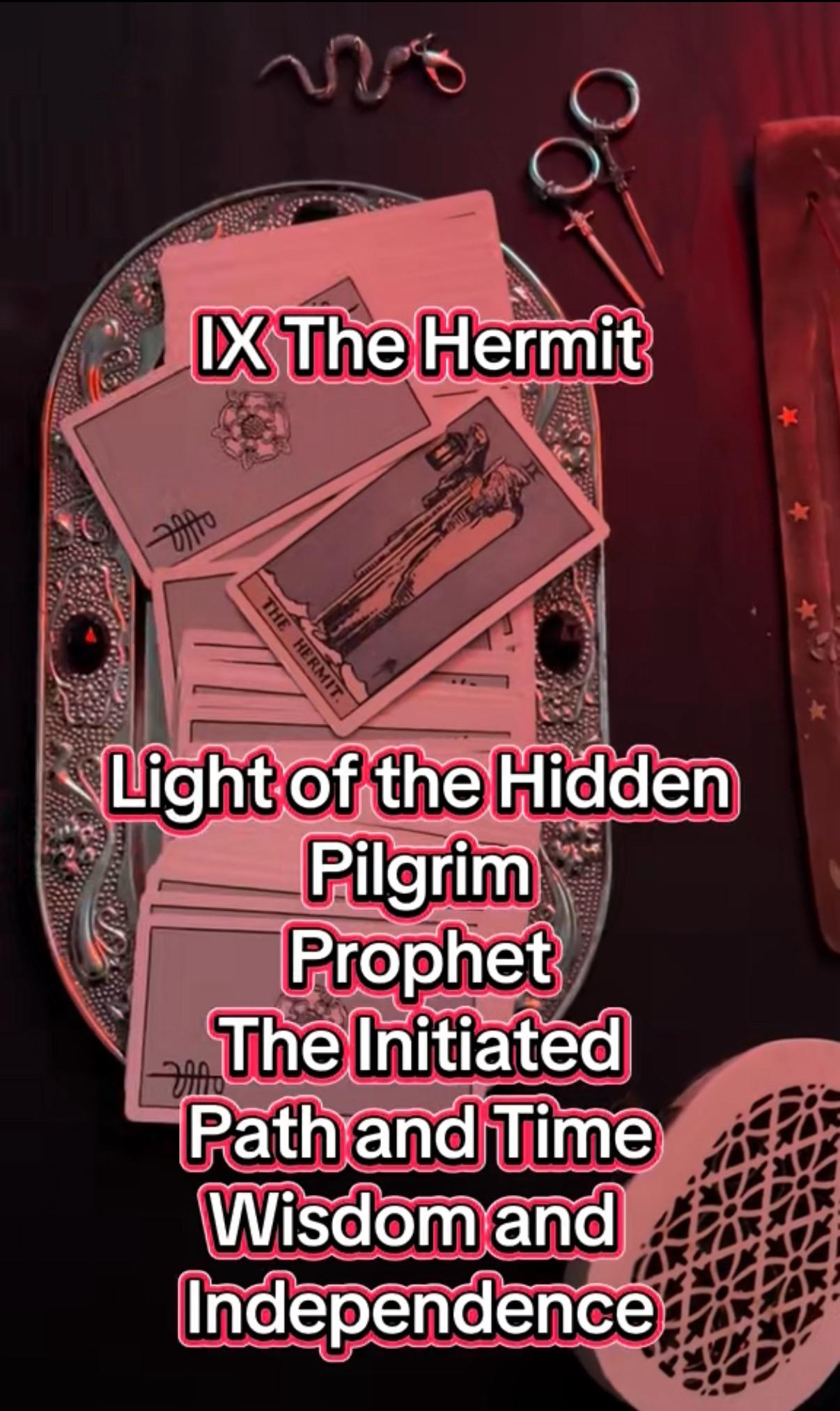
Interpretation IX: The Hermit (My interpretation)

Post image
3 Upvotes

Light of the Hidden Pilgrim // Prophet // The Initiated Path and Time

Wisdom and Independence The Hermit is one of the most interesting and profound Tarot cards. Its main contrast is self-sufficiency combined with a hungry search for truth.

People usually approach this card with caution or even negativity, which is rather amusing. In reality, it is a true treasure for deep analyses, but in simple questions it is often seen as negative or undesirable, and is simplistically interpreted as Loneliness. But that is far from the case. The Hermit is indeed very reserved and always responds very precisely to a question. However, the essence of the Hermit is not solitude, but Faithfulness to Oneself. This is what fundamentally distinguishes it from the Hierophant. The Hermit speaks not of “Concepts,” but of the inner core and intuition. Not of how things should be, but of what cannot be otherwise.

The Hermit is certainly a pioneer, walking a new and untraveled path, but there is no need to fear — it is also a card of Truth. If the Hermit appears in a reading on a difficult life decision, it points to the most reliable and fortunate path, even if it does not seem easy. It is like a master of keys and corridors, which makes it very close to the High Priestess. Both characters are introspective and deliberate, like in a Western — they wait patiently, strike once, but decisively.

Solitude is not the main component of this card, even though it seems inseparable from it. It is more about reflection and a hint that it is time to focus on oneself. In love readings, the Hermit does not necessarily mean you will be alone — it can indicate that upcoming relationships will contribute to your transformation into a stronger person, and much depends on the surrounding cards. The Hermit often advises following your own path, but this does not mean you need to dig a cabin in the forest — so don’t worry, extroverts. The Hermit may even herald the acquisition of a new, better circle of acquaintances — if you remember Snufkin from the Moomins, who is “always alone,” recall that in reality he had a whole family and many friends in Moominvalley who respected and valued him greatly.

For practitioners, esotericists, and those aiming for spiritual growth, this card signifies a Successful Path. Interestingly, the Devil, when describing the qualities of a Practitioner, depicts them with the Hermit card (not, for example, the Tower).

Generally, a person embarking on a new and engaging path, fully absorbed in it, possesses some Hermit-like qualities — a degree of detachment and the feeling of being somewhat apart from others, but this is more about being Ahead than On the Sidelines. This is why the Hermit shares similarities with the Eight of Pentacles — the Master card.

The fundamental paradox of the Hermit lies in the idea that no one truly belongs to themselves, and the individual struggles to reconcile the demands of the world, the demands of the self, and the concept of the person one considers oneself to be—and believes they possess. Yes, it sounds like depersonalization, but this leads us to the Hermit's essential meaning: “as below, so above”—what is inside is reflected outside, and vice versa. Every system around us and within us mirrors each other, yet none are truly absolute. Reflections within reflections, like optical fractals, generate multiplicity and disorder. The Hermit does not deny the importance of how and who is reflected in the mirror. However, his interest lies beyond the mirror, both external and internal. What hides behind the surface of physical reality, and is it as fundamental and basic as it seems? In this sense, he is like the monk in an ancient engraving who reached the edge of the Earth and peered beneath the Starry Fabric of the Heavens, discovering nightmarish, titanic gears turning the cosmos.

The Hermit's main characteristic is to retain only what is essential. He does not devalue worldly life; he merely withdraws from it. Even the possession of Truth does not entice him—he seeks neither power nor gain, only Knowledge. Interestingly, the Hermit—this enigmatic figure of gifted wisdom—is a highly sought-after archetype for many diagnosticians and, indeed, other Arcana. All of them know precisely how to use his knowledge, for “unfortunate is the sage whose wisdom brings him no benefit.” Yet finding the Hermit is no easy task—even approaching him requires a unique, unusual, and sometimes dangerous journey, not to mention the profound questions one might wish to ask.

Paradoxically, the Hermit is among the rarest cards one can encounter in readings, and interpreting him can be equally challenging.

The Hermit's primary tools are not so much his staff, which clearly possesses potent magical power, but his Lantern. The Lantern—or Lamp—is a fundamental esoteric symbol, representing inner flame, the soul, the idea, and Knowledge itself. Knowledge as a torch was brought to humanity by Prometheus; the Lantern is an essential attribute of the Goddess Hecate and the former Archangel Lucifer; the Torch belongs to the goddess Demeter. It is within the Lantern that the Djinn resides. The magical Lantern illuminates the secret corridors of Avalon, and among Druids, it symbolizes the Gift of Prophecy and Knowledge in general. In alchemy, the Inner Light was symbolized by the Lamp, and in 19th-century esoteric texts, it became a symbol of creative power and imagination.

The Hermit is extraordinarily powerful not only in prophecy and knowledge but primarily in his creative essence. He is the strongest card representing creation and building. The Hermit embodies relentless inspiration, and the potential of his ideas is truly limitless.

In deep psychological readings, the Hermit symbolizes the Companion effect — you see the Hermit and share your stories with him, and he shares his with you. In general, the attitude of people marked by the Hermit is often precisely this: “everyone is alone in their own way.” There is no sorrow or melancholy, no shell or closedness to new acquaintances, and no pride. Everyone has their own path. The Hermit truly seems otherworldly, very modest, somewhat eccentric, yet always leaves a charming impression of duality, much like characters played by Keanu Reeves. Look closely at this figure in the cloak — the Hermit handles Masks remarkably well, and the suit of Cups is extremely impressed by this.

The Hermit is always alien to disappointment, helplessness, and despair. He understands and perceives the self-sacrifice of the Sun and the Tower, the icy wisdom of the Swords, and the mercy of the Emperor, hidden beneath a fearsome mask, and is always piercingly accurate in his independent investigations, wandering through the gardens of dreams and nightmares of the Moon Arcana.

In professional and financial matters, the Hermit is highly favorable for careers related to movement, transport, and travel, as well as for investigators, psychologists, spiritual or scientific pursuits, and students. Meditation on the Ninth Arcana promises success in studies and clarity of mind.

He often symbolizes financial challenges — when asked, “Will I become wealthy?”, the Hermit replies: not in the usual way, and it’s time to revise your plans.

The Hermit gladly closes doors behind him, linking him to the Thirteenth Major Arcana — Death. Often very secretive, he appears in readings as a symbol of a valuable hidden truth.

Regarding health, the card is unfavorable. It symbolizes retreat — withdrawal into oneself.

I wish you good luck and abundant strength!


r/tarotarcana • • Nov 22 '25

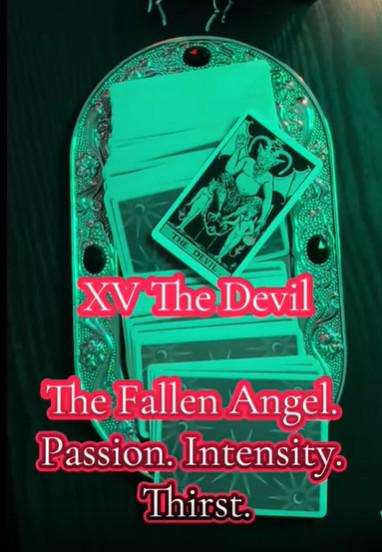
Interpretation XV: The Devil

Post image
3 Upvotes

The Fallen Angel. Passion. Intensity. Thirst.

This card is always interpreted in two ways, and it is one of the main significators of the traditions you work with.

In general, from a neutral perspective, this is the most highly energetic card. The next one - the Tower - is collapse, going beyond the limit, when the energy can no longer be contained and catastrophe occurs. The Devil, on the other hand, is energy accumulated to the brim: a greenhouse where unseen plants grow and countless mysterious beings thrive that cannot be found anywhere else. Fruits ripen in excess, in triple harvests; geysers and waterfalls surge; bonfires burn brightly. The Devil is the card of abundance, and therefore also of exhaustiveness, when there is simply too much of everything. For some, the Garden of Demons may seem baroque, excessive, even grotesque; for others - supreme magnificence, a treasury of mysteries, overflowing with different fruits - from sweet to poisonous or even both. “Too Much,” in every sense.

This is where the divergence begins. The Devil is traditionally the dark mirror of the Major Arcana Hierophant, the High Priest card. And, I think you already understood - this card is the significator of Dark Powers in practice. It usually appears as a signifier of higher ritual work, not minor rites, and often indicates the patronage of the Devil himself, as well as other high demons.

Of course, you see: if you take a militant stance against Darkness, this card will hardly be positive for you - even if a certain “positive” dark working is taking place (harmful actions would be indicated by other cards). Similarly, the Hanged Man often points to Light Practitioners, while Death is associated with the Grey (Necromancers).

Beyond this foundation, the card branches like horns. For Dark practitioners, it symbolizes strong progress, enlightenment, and certainly - established contact with Higher Powers. It may represent greedy satiety - physical pleasure and even hedonism, but also spiritual and intellectual: study, inspiration, breaking through creative blockages, overcoming crises. True passion. It often symbolizes trials of strength and mind, in which one can prevail.

However, stormy dark waters are a nightmare for others who are not aligned with darkness. You may be swept away by an overwhelming passion that pulls you into imbalance, mania, temptation, or pride. Here the Devil is interpreted in every possible negative way, showing nothing but all bad sides of our good old world - but let their gods be their judges.

In the professional sphere, it often signals connections with people of a strange or dubious reputation, from which benefit can still be gained, as well as success achieved through questionable, unusual, or unconventional means. It is always a very positive card in readings about finances, luxury, and pleasure - even for those who dislike this card.

Usually a positive card for relationships, associated with fiery, sharp physical passion; unlike the Page of Wands, it promises mutual attraction, attachment, and even dependence on one another. Often a symbol of karmic relationships - those that have lasted through past incarnations.

In terms of health, it points to various dependencies, perversions, and lack of control over them. Often it signifies a personality with strong inclinations - similar to fanaticism or obsession.

Tip for Dark Newbies - stop relaxing. Especially if the card persistently appears or is supported by the Hierophant, Magician, Priestess, and Wands cards, it means "stop slacking off, the bosses are requiring a report." For dark practitioners, this most often means it's time to engage in high rituals.

Feel free and stay safe!


r/tarotarcana • • Feb 22 '26

THE TOWER. XVI MAJOR ARCANA (SHORT EXPLANATION)

2 Upvotes

r/tarotarcana • • Dec 26 '25

MOD POST Welcome to r/tarotarcana 🍵

8 Upvotes

Hello there!
I'm u/Fortune_Box, the current moderator of r/tarotarcana.

This sub has been around for almost 10 years, but I'm not its founder. A year ago I just happen to come across this dormant sub. I liked the name and decided to adopt it. I've left the group description, tags and rules pretty much intact.

What to Post
I find physical diaries and bullet journals somewhat difficult to manage. I've successfully started a couple, but I seem to lose sight of them quickly. Which is why I will turn this sub into an online journal where I keep my notes and share observations that relate to the tarot.

If you like to do the same, you're welcome to share your thoughts and ideas. You may share readings here, especially if cards give you a hard time, but post about them like they were notes in your journal.

Community Vibe
I want this sub to be the library, a quiet corner in the tarot community where books collect dust and people jot down their thoughts. The idea of a library is a public bookshelf, so there's plenty of room for all sorts of books. You're welcome to read what's on display and if you feel called, add some contents of yours.

How to Get Started

  1. Introduce yourself in the comments below.

  2. Post something today.

  3. If you know someone who would enjoy this community, invite them to join.


r/tarotarcana • • Nov 29 '25

VIII OF SWORDS - THE LORD OF LIMITED POWER

Post image
2 Upvotes

EIGHT OF SWORDS
Lord of Restricted Power
Bondage. Imprisonment.

Traditionally considered one of the most unpleasant cards in the deck, the Eight of Swords signifies being caught in a highly difficult situation - both physically and mentally. It speaks of a lack of real choice, of circumstances working against you, of the impossibility of finding a favorable solution. Often it points to a dead end, a stalemate.
This card may represent the inability to change one’s circumstances and to steer life according to one’s will. Power is handed over to someone else. When combined with the Ten of Swords or Judgement, it can indicate literal loss of freedom: arrest, imprisonment, captivity, or coercion. It may also act as a signifier of blackmail.
In combination with positive cards, it suggests the restrictions are temporary.

On a psychological level, it often speaks of the prison of the mind: a person sets conditions for themselves that they cannot possibly fulfill. This is a time of creative crisis and stagnation caused by inner obstacles. Like an obsessive idea, the Eight excludes all options except impossible ones, paralyzing and constraining any process. These hindrances are internal, born of the mind itself - not external (which would be shown by other cards).

Life presses on you from all sides, forcing you to swallow your own slack and reject things that are dear and adorable to your heart. You can't even breathe, as they say. A hostage to circumstances - that's the character of this card. The card's energy is reminiscent of the agonizing sensation of being stuck in a traffic jam. Stuck, clogged, and with nowhere to go.

Often, this card can symbolize slander and accusations. This is the very situation where you have to "prove you're not a camel" - like you've done nothing, yet you've become the scapegoat. This interpretation is traditional because it's associated with "sacrifice on the altar," an unwilling victim, and is often a sign of bullying and harassment. This is the very situation where everyone knows perfectly well that the person isn't at fault and the case is fabricated from head to toe, taken to the point of unnecessary absurdity, but the game must be played to the end. It's better to blame someone than to find yourself in the same situation. This card is a powerful signal of collective cruelty, situations where the victim is ostracized. Not because of the victim's real guilt, but because of some principle that requires violence to defend itself. And those who sympathize - remain silent. The card is an accusation of heresy, an accusation against a worldview, but the most absurd thing is that the victim may be innocent, simply "asking" for an exemplary reprisal just too conveniently.

The Eight of Swords is a sorrowful reflection of the Hanged Man. Yet while the Hanged Man sacrifices willingly for the sake of future growth, the Eight depicts a humiliated, defeated figure at the pillory. Someone offered up as a sacrifice against their will.

In financial readings, this card points to a constrained situation. Often it symbolizes the “hungry diet” of trying to save or accumulate resources. It can also mean the inability to collect what is due, such as repayment of a debt or salary. Sometimes it represents the price paid for a risky venture or deception.
In relationships, the Eight of Swords is a heavy card. Connections may hang by a thread, yet neither resolve nor improve. It is like a Reversed Death card, but with an added shade of cruelty. Stubbornness, retreating into one’s own illusions of how a partner must behave, unwillingness to open one’s eyes. Traditions, limitations, “marriage is not a feast, but hard labor” - sometimes even abuse, psychological or physical, within the family.
For mental health, this card is ominous, often signifying serious psychological disorders.
For physical health, it points to minor injuries that, unlike the Four of Swords, do not confine one to bed for long. In fact, the ailments hinted at by the Eight of Swords may not occur at all if one is careful.
In magical contexts, this card is serious. It signals curses aimed at madness, quarrels, or roadblocks - “Closed Roads.”

Strengthening negative influences:
With the Tower and Ten of Swords, it can signify real physical loss of freedom. Not only conditional restrictions (like those on migrants), but actual arrest.
The Moon and Nine of Pentacles amplify its darker aspects.

Softening influences:
With the Three of Pentacles: wise economy, promising future benefit.
With the Two or Three of Wands: “focus before a great leap”. Here, the Eight points more to preparation for decisive action.
With the Chariot: inconveniences are temporary.
With the Magician or Hierophant: severe self-discipline and a stoic worldview.

Take care of yourself and your loved ones!