r/spaceporn
•
u/Busy_Yesterday9455
•
17h ago


Pro/Processed Perfect Moon Shot

6.9k
Upvotes
Credit: guzmanramoss
r/spaceporn
•
u/Busy_Yesterday9455
•
17h ago
Credit: guzmanramoss
r/spaceporn • u/Busy_Yesterday9455 • 1h ago

Link to the science release on ESA website
The European Space Agency’s Euclid space telescope has discovered the most distant quasar to date (small red dot near the centre): a rare 360 million-sun-mass galactic core seen just 630 million years after the Big Bang.
The discovery breaks Euclid’s own previous record, announced only a few months ago, by peering back in time an additional 40 million years. It also raises a compelling question: how could such an enormous black hole have formed and grown so rapidly after the Big Bang?
Credit: ESA/Euclid/Euclid Consortium/NASA, Wolf et al. 2026
r/spaceporn • u/Busy_Yesterday9455 • 13h ago

Link to the science release on ESA website
On 21 November, starting at 18:24 UTC, BepiColombo achieved Mercury orbit insertion (MOI), the second major milestone of its planetary arrival phase.
As soon as the signal from the spacecraft was re-established after a scheduled loss of contact, the Mission Control Team at the European Space Operations Centre (ESOC) in Darmstadt, Germany, saw that the spacecraft had entered safe mode.
Credit: ESA
r/spaceporn • u/ojosdelostigres • 3h ago

r/spaceporn • u/Grahamthicke • 8h ago

r/spaceporn • u/Exr1t • 8h ago

Taken Using 1:00 Video Stack (Seestar S50)
Edited In PS Express.
r/spaceporn • u/ojosdelostigres • 1d ago

r/spaceporn • u/4x6x8 • 16h ago

We found this stone on the beach and it lives rent free in our house as the Jupiter stone
r/spaceporn • u/Neaterntal • 19h ago

This Nov. 16 collage shows 49 drill holes captured by NASA’s Curiosity Mars rover as of November 2026. Each hole represents a sample collected from rocks on the Martian surface; Curiosity’s drill, located on the end of its robotic arm, drops pulverized rock samples into instruments in its belly that analyze their composition.
Each hole marks a location where the rover used its robotic arm to drill and collect powdered rock for analysis, building a remarkable record of the Martian surface.
.
Since landing in August 2012, Curiosity has investigated how Mars changed from a world that once supported lakes and streams into the cold, dry planet we see today. Its onboard laboratories analyze the mineral and chemical composition of collected samples, helping scientists reconstruct ancient environments and assess whether they could have supported microbial life. Together, these 49 drill holes represent more than a decade of scientific discovery, one carefully selected rock at a time.
.
https:// x. com/SETIInstitute/status/2124896144115302604
Image credit: NASA/JPL-Caltech/MSSS
https://www.nasa.gov/image-article/nasas-curiosity-mars-rover-collects-samples/
.
previous post
r/spaceporn
•
u/Busy_Yesterday9455
•
1d ago
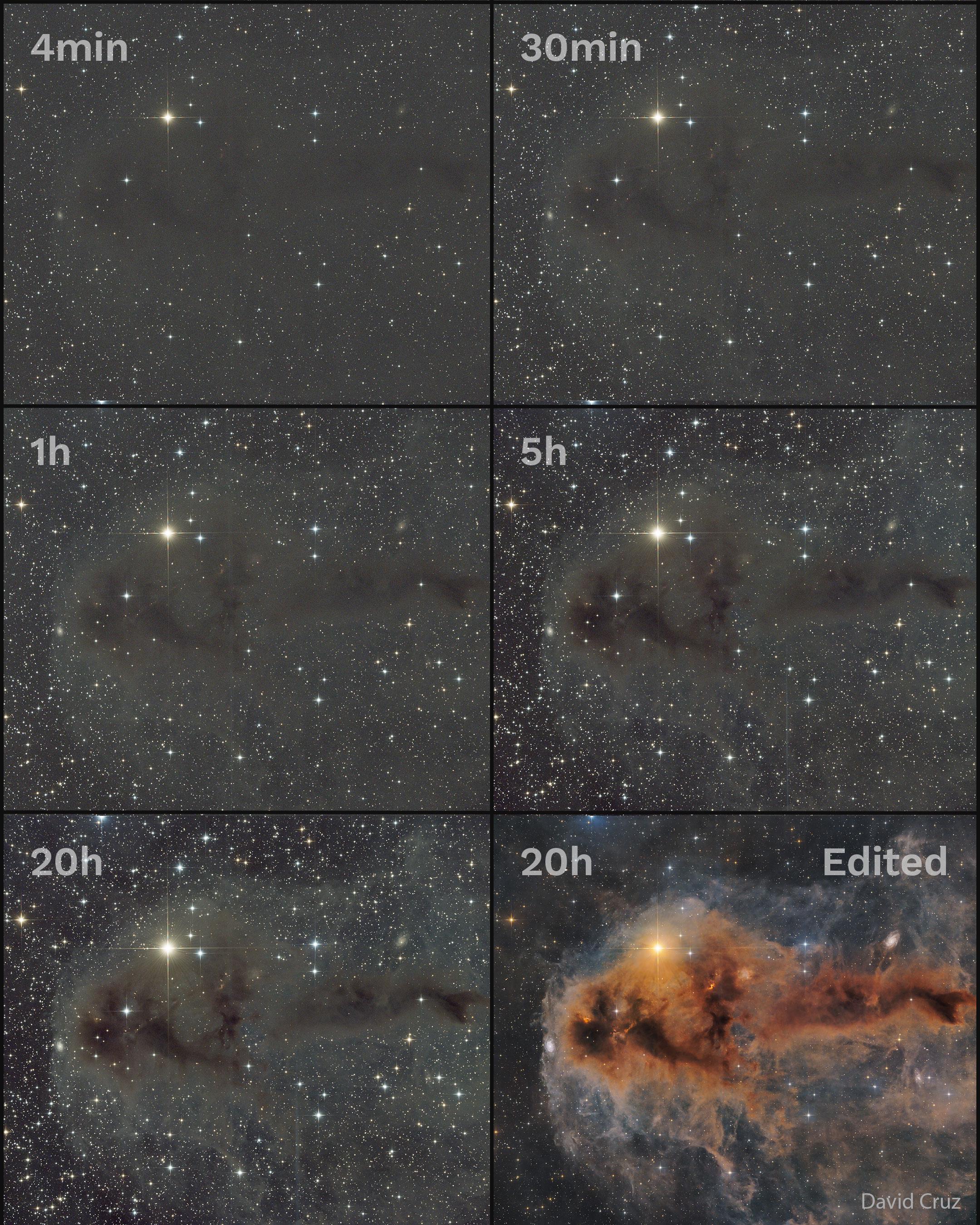
In the direction of the featured image, after only a few minutes, you would begin to notice some regions without stars. As your staring continued, the dark region would become better defined, and after a full 20 hours, you would notice a strange dark structure. To celebrate, you use digital processing to brighten the image and enhance the colors. At the end, you might have an excellent image of Lynds 1251 (LDN 1251), a star-forming region laced with opaque brown-appearing interstellar dust.
Also known as the Rotten Fish Nebula, LDN 1251 is home not only to young stars and dust, but also, your long staring indicates, energetic shock waves, fast stellar winds, and powerfully beamed jets.
Credit: David Cruz
r/spaceporn • u/Professor_Moraiarkar • 22h ago

The brightest star, left of the center, is blue Alnitak (the Girdle): a triple star system best known for being the easternmost star in Orion's Belt. The instantly recognizable shape of a dark horse's head at the center is the aptly named Horsehead Nebula. It is about five light-years tall and lies approximately 1,500 light-years away. It is made of dust and gas that obscure the red glow behind it, which is caused by hydrogen gas being ionized by the bright star Sigma Orionis at the top.
The orange nebula with dark filaments on the left is the Flame Nebula. Closer to the Horsehead, the blue reflection nebula NGC 2023 is actively forming stars.
The data for this "painting" were collected for almost six hours at the Utah Desert Remote Observatories, but the equipment was remotely controlled by the astrophotographer from his home, over 2,000 km away in Illinois.
r/spaceporn • u/Busy_Yesterday9455 • 1d ago

Credit: KAGAYA
r/spaceporn • u/Busy_Yesterday9455 • 22h ago
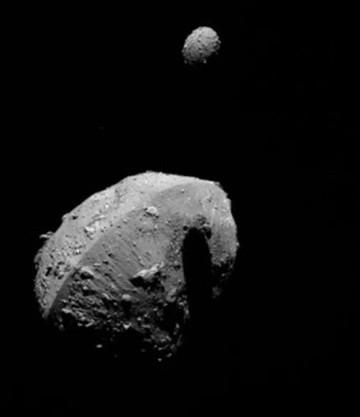
Shown in this early view of the Didymos binary asteroids from the European Space Agency’s Hera mission for planetary defence.
The smaller Dimorphos moonlet (top) is seen casting its shadow across part of its Didymos parent body (bottom), to blank out the Sun across the shaded stretch of rocky surface.
Credit: ESA
r/spaceporn
•
u/Neaterntal
•
1d ago

Credit: Wael Omar WO (not mine)
.
.
From his description:
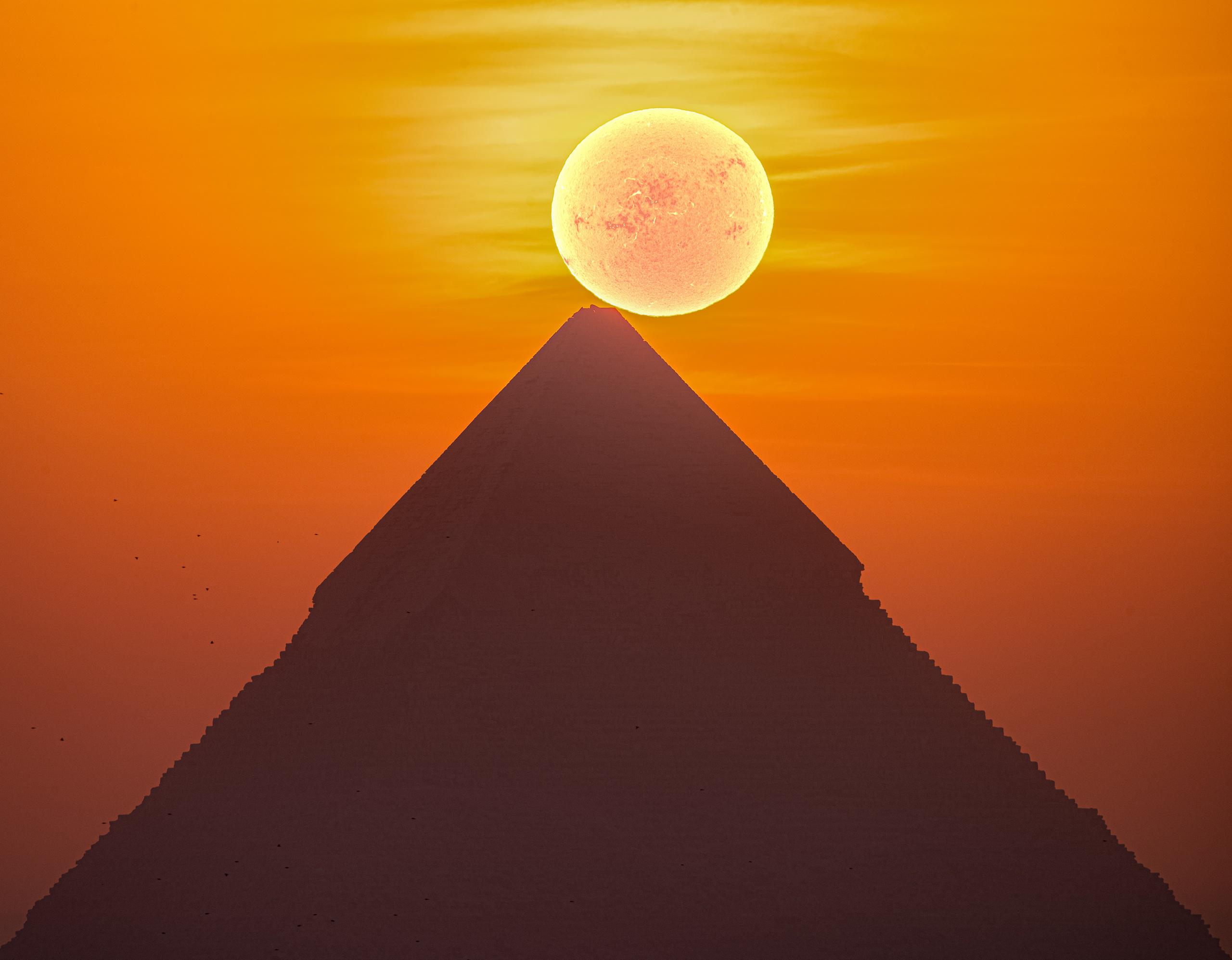
"The concept behind this photograph was to create a carefully aligned composition in which the rising Sun appears to emerge from behind the “ Khafrah “ Pyramid and move along its edges, creating the visual impression of the Sun rolling over the monument.
However, my objective was not limited to achieving a striking alignment. I also wanted to reveal the Sun in a way that differs from conventional solar photography by capturing details of its hydrogen emissions.
For this purpose, I used a specialized Hydrogen-Alpha imaging setup , the MLastro spectroheligraph to observe the solar chromosphere, the dynamic atmospheric layer above the photosphere. Imaging at the H-alpha wavelength of 656.28 nm reveals solar structures associated with magnetic activity, including filaments, active regions, and prominences.
.
This wavelength is particularly fascinating because hydrogen is the primary fuel in the Sun's nuclear fusion process. Approximately 600 million tons of hydrogen are converted into helium every second, releasing the energy that powers our solar system.
Achieving the intended composition required careful planning and precise calculations. I selected an elevated shooting position on top of a mosque minaret to obtain the appropriate viewing angle and alignment with the Great Pyramid.
The imaging session began shortly before sunrise continuing through sunrise and shortly afterward.
The resulting footage captured the Sun emerging from behind the Pyramid and appearing to travel along its edges, while simultaneously revealing details of its hydrogen-alpha structures.
.
Technical Details:
Several images 1/400 sec, iso 250, F9
Video 120Fbs , 2.2ms, Gain 124 by MLastro device."
.
Gif video
https://cdn.astrobin.com/ckeditor-files/83312/2026/5992972a-e5cf-4bc7-82ab-e0790b90970a.gif
.
.
Source
r/spaceporn • u/Neaterntal • 22h ago
Astronomers discover remarkable triple-star system just 28 light-years from Earth
.
Image
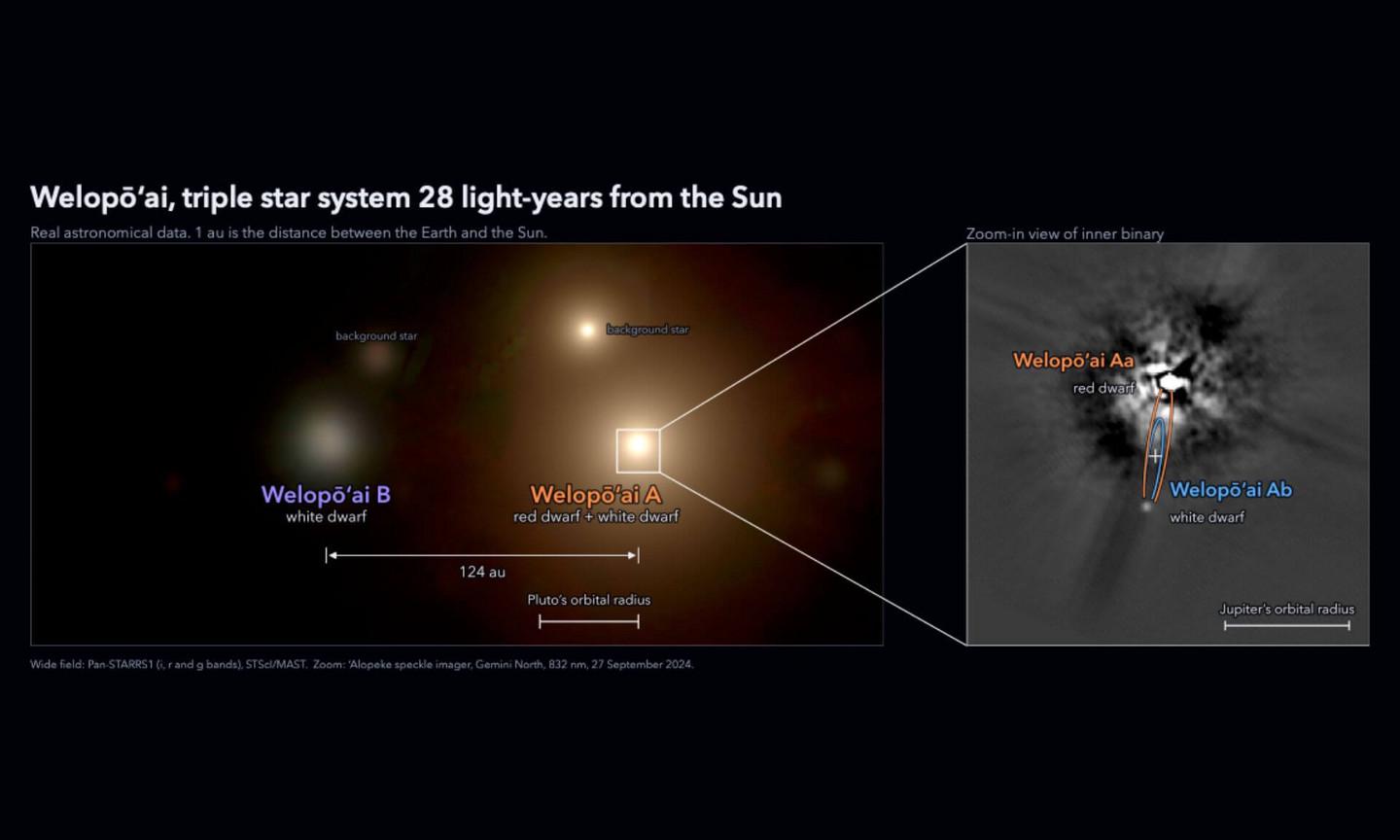
Observations of the Welopōʻai triple-star system, located 28 light-years from Earth. The image on the left shows the two components of the system: Welopōʻai A, a closely orbiting red dwarf and white dwarf pair, and Welopōʻai B, a second white dwarf located much farther away. The image on the right provides a close-up view of the inner pair, revealing the faint white dwarf companion (Ab) detected using the Gemini North telescope's ‘Alopeke instrument. The overlaid curves illustrate the stars' orbital paths.
Photo : Pan-STARRS1/STScI/MAST (left); International Gemini Observatory/NSF NOIRLab (right). Graphic compilation: Étienne Artigau and Heidi White (UdeM/IREx)
.
.
Astronomers have discovered an extraordinary stellar system just 28 light-years from Earth that challenges our understanding of how stars live, die and interact as they evolve.
Given the name Welopōʻai, this unusual triple-star system was discovered by an international team of scientists led by the Trottier Institute for Research on Exoplanets (IREx) at Université de Montréal.
They detail their discovery in a study published today in Astronomy & Astrophysics.
The system contains two white dwarfs, the extremely dense remnants of Sun-like stars that have exhausted their fuel, and a red dwarf, a star much dimmer than the Sun.
The scientists stumbled upon this remarkable configuration, unlike anything else known in the Sun’s neighbourhood, while searching for planets around the red dwarf.
“We were actually looking for planets,” explained IREx researcher Étienne Artigau, the study’s lead author. “Instead, we found something much more surprising.”
.
The discovery began with the SPectropolarimètre InfraROUge (SPIRou) instrument at the Canada-France-Hawaii Telescope on Maunakea, Hawaiʻi. SPIRou is designed to detect exoplanets by measuring the tiny changes in a star’s velocity caused by orbiting planets.
But one nearby red dwarf behaved differently: the scientists detected velocity variations of nearly 16 kilometres per second, more than a thousand times larger than expected. After several years of follow-up observations, the team established that the unseen companion had a mass greater than half that of the Sun.
“The unusual combination of high mass and very low brightness left only one plausible explanation: it was the remnant of a dead star,” explained Charles-Antoine Parent, an undergraduate student at Université Laval and co-author of the study.
“The most likely explanation was a white dwarf, although a neutron star or even a black hole couldn't be ruled out.”
The team turned to the Gemini North telescope, also on Maunakea.
Using high-resolution images from its ‘Alopeke instrument, they directly detected a faint companion: a white dwarf. A second, much more distant white dwarf was already known to be part of the system.
A red dwarf and a white dwarf therefore orbit close to one another, while the second white dwarf orbits the pair. No comparable system is known within 100 light-years of Earth.
.
.
More
Paper
https://www.aanda.org/articles/aa/full_html/2026/11/aa61214-26/aa61214-26.html
r/spaceporn • u/Big-Computer5628 • 1d ago

r/spaceporn • u/the_one_99_ • 21h ago

Link to website https://noirlab.edu/public/news/noirlab2629/?lang
Wispy blue ribbons of stellar matter float deep in the cosmos, appearing like the waving tails of betta fish. This stunning snapshot features the best, most detailed view of supernova remnant SNR G295.5+09.7 to date. It was captured by the U.S. Department of Energy-fabricated Dark Energy Camera, mounted on the U.S. National Science Foundation Víctor M. Blanco 4-meter Telescope at Cerro Tololo Inter-American Observatory in Chile.
r/spaceporn • u/Neaterntal • 21h ago

Image
Cassiopeia A (Spitzer and Webb image)
NASA’s retired Spitzer Space Telescope observed the supernova remnant Cassiopeia A (Cas A), helping identify key regions that the NASA/ESA/CSA James Webb Space Telescope later examined in greater detail. Webb’s higher resolution enabled astronomers to create a map of Cas A’s dust chemistry across the entire remnant. This map provides crucial insights into shell mergers, a process in which the layers of elements formed during a star’s life begin to mix before the star explodes. These findings also reveal details about the structure of Cas A’s original star and provide astronomers with a new way to infer the internal structure of exploded stars by studying the dust preserved in their supernova remnants.
Credit:
NASA, ESA, CSA, JPL-Caltech, T. Temim (Columbia University), R. Arendt (UMBC), D. Milisavljevic (Purdue University). Image Processing: A. Pagan (STScI).
.
.
The NASA/ESA/CSA James Webb Space Telescope captured the mid-infrared light of Cassiopeia A (Cas A), one of the most well-studied supernova remnants, to characterise its dust. Astronomers used Webb’s detailed observations to gain new insights into shell mergers, a process that is theorised to occur mere hours before a star’s supernova explosion, revealing new details about the structure of Cas A’s original star.
The James Webb Space Telescope paints a vibrant tapestry of the legendary supernova remnant Cassiopeia A (Cas A). Remnants like these are the clouds of gas and dust that remain following the explosion of a massive star and will eventually seed a new generation of stars and planets.
This high-resolution, mid-infrared observation reveals new details that are helping astronomers chronicle the structure and evolution of Cas A’s original star. The Webb data supports a scenario in which the interior of the star underwent a dramatic change, possibly just hours before its demise. These results were published today in The Astrophysical Journal Letters.
Stars begin their lives as large clouds of mostly hydrogen gas and cosmic dust called molecular clouds. Eventually, gravity causes these molecular clouds to collapse, the material heats up, and protostars stars — infant stars — form. Under the constant pressure of gravity, hydrogen within a protostar begins to fuse into helium, which marks the point where protostars evolve into full-fledged stars like our Sun.
.
More
https://esawebb.org/news/weic2624/
paper
r/spaceporn • u/Busy_Yesterday9455 • 1d ago

Credit:
Earth: G. CARABIN
Mars: NASA/JPL-Caltech/MSSS/Texas A&M Univ.
r/spaceporn • u/alch_emy2 • 1d ago

Tracked by ioptron skyguider pro and MSM rotator (before I got the SGP)
featuring flying bat nebula at the corner
r/spaceporn • u/Neaterntal • 1d ago

Image
Description from paper:
The mineralogy of track-rich hydrated IDPs. (A) A bright-field (BF) scanning teM (SteM) image of a microtome thin section of idP l2079c35 showing a compact,low-porosity texture. the small dark grains are mineral grains, mainly sulfides and carbonates. (B) A BF SteM image showing the textural varieties of clay minerals in hy-drated idPs with coarse clays (right of dashed yellow line) and fine-grained clays with sulfide inclusions (left). (C) A BF SteM image showing a region of fine-grained clayswith three clusters of sulfide inclusions indicated by the red dashed circles. (D) A high-resolution teM (hRteM) image of a saponite crystal showing the characteristic 1-nmbasal spacing. (E) A dark-field teM image of an enstatite crystal in idP l2079c35 showing a high density of SeP tracks (yellow arrows) with a density of ∼5 × 10 10 /cm 2 .(F) A BF SteM image showing a rhombohedral crystal of ferroan magnesite (red dashed outline) and a carbon nanoglobule (yellow arrow)
.
The Solar System is a soggy sort of place.
Although most of Earth's surface is covered in liquid water, it's a mere drop in the ocean compared to the entire volume contained in the Solar System – much of it locked away as ice in the moons of the giant planets.
The outer Solar System is icier still. Far from the warmth of the Sun, the estimated millions of icy objects that make up the Kuiper Belt beyond Neptune are thought to contain absolute scads of the stuff.
And now, scientists have found evidence that at least some of that distant water is of a kind singularly unlike the water we have here on Earth.
In a handful of dust grains that traveled to Earth from the Kuiper Belt, traces remain of long-lost water bearing the signature of primordial chemistry – suggesting that the water reservoir at the edge of the Solar System remained pristine, untouched by the changes unfolding closer to the Sun.
It is, according to a study led by planetary scientist Lindsay Keller of NASA's Johnson Space Center, "compelling evidence for the presence of a major heavy water reservoir beyond the orbits of the gas giant planets that was largely isolated from inner solar system materials."
.
The Kuiper Belt beyond Neptune's orbit at roughly 30 astronomical units from the Sun – 30 times the Earth-Sun distance – represents a somewhat challenging Solar System frontier.
Very few human-made craft have ventured into its cold, dark reaches.
It takes years to get there; landing a probe or collecting samples to send to Earth would be so astronomically difficult and expensive that – so far at least – it's out of the question entirely.
.
This is kind of a bummer, because the chunks of ice and rock hanging out in the Kuiper Belt are thought to be among the most unchanged remnants of the early Solar System since it all coalesced out of solar amniotic dust and gas some 4.5 billion years ago.
Luckily for us, though, not everything in the Kuiper Belt stays there.
We can't see it, but the Solar System is full of cosmic dust. An estimated 5,200 metric tons of the stuff rains down on Earth every year. And some of that dust has traveled a long, long way to get here.
.
r/spaceporn • u/Busy_Yesterday9455 • 2d ago

What creates the colors in Jupiter's clouds? No one is sure.
The thick atmosphere of Jupiter is mostly hydrogen and helium, elements which are colorless at the low temperatures of the Jovian cloud tops. Which trace molecules provide the colors remains a topic of research, although small amounts of ammonium hydrosulfide are one leading candidate. What is clear from the featured color-enhanced image -- and many similar images -- is that lighter clouds are typically higher up than darker ones.
Pictured, light clouds swirl around reddish regions toward the lower right, while they appear to cover over some darker domains on the upper right. The featured image was taken by the robotic Juno spacecraft in 2018 during its 14th low pass over Jupiter. Juno continues in its looping elliptical orbit, swooping near the huge planet every 33 days and exploring a slightly different sector each time around.
Credit: NASA, Juno, SwRI, MSSS
Processing & License: Matt Brealey, Seán Doran
r/spaceporn • u/8Bit_Cat • 1d ago

Saturn is visible as a star in the bottom right corner
r/spaceporn
•
u/Busy_Yesterday9455
•
2d ago

The video spans from Sep 7 to Nov 18, 2026
A stellar explosion in the spiral galaxy NGC 1433, approximately 50 million light-years from Earth, has given astronomers a rare opportunity to observe a supernova while it is still brightening. Designated SN 2026ahvu, the event is classified as a Type Ia supernova and was detected during an early stage of its development.
Unlike many supernova discoveries made after an explosion has begun fading, SN 2026ahvu was identified while its brightness was increasing.
Credit: Slooh
