r/solarenergycanada • • Apr 02 '25

Solar BC Tesla Loses BC Hydro Rebate Eligibility

267 Upvotes

Shots fired! Tesla products will no longer be eligible for BC Hydro's very popular $10,000 solar + battery rebate. This will likely have the largest effect on Powerwall purchases since Tesla solar roofs are not viable in Canada anyway. Will Ontario's extremely unpopular Home Renovation Savings Program follow suit? Are we headed for an all out Tesla ban in Canada?


r/solarenergycanada • • Feb 25 '26

Solar Alberta My friends laughed at our solar panels until they saw our bills

167 Upvotes

When we first got solar installed, a bunch of my friends were like, “Is that even worth it in Alberta?”

Fast forward a couple months, we had them over and somehow the conversation turned to utilities (because, honestly, when doesn’t it these days 🥲). We pulled up our last power bill… and their reactions were priceless.

One of them literally said, “Wait… that’s it?!”

Now two of them are already getting quotes.

I think a lot of people assume solar doesn’t work here just because we’re in Canada. But Calgary actually gets more sun than most realize. And seeing real numbers from someone you know? That really hits differently.

Not saying solar is for everyone, but if you’re already paying crazy electricity rates, it might be worth at least running the numbers.


r/solarenergycanada • • Aug 12 '24

Solar Ontario My solar review - 1 year. How much I didn't save.

143 Upvotes

I'll start off with my current system setup:

LONGI Solar panels (Lr4-60HPB 355W)
43 Modules, for a total of 15.3 kW array
P505 optimizers

Located in Ontario - Kitchener-Waterloo region

It was estimated I would produce between 15,000 – 15,500 kWh in my first year.

I had my system installed June 2023, but it wasn't activated till August 11, 2023. I have now had my system for a full year and this is how much I paid for hydro, my loan and how much I didn’t save.

Link to my original post:
https://www.reddit.com/r/solarenergycanada/comments/14vxq8j/153_kw_array_completed_details_in_comments/


System Cost:
It cost me $35,000 CAD out of pocket for everything. Panels, installation, activation, permits, etc.
I received a $5000 rebate from the government, so in total, my system cost me $30,000.

I also received a 0% finance loan through the government, with equal payments of $282/month.

With the rebate, I can look at this two ways:

  1. The rebate pays for the first 18 months of the loan or,

  2. The rebate, divided by 120 (12 months x 10 years) is $41.66, making the loan about $240/month (282 – 41.66)


Energy Usage, before the panels:
On average, we would use 45 kWh a day (That’s roughly 16,425 kWh a year). We have a Tesla Model Y with roughly a 72 kWh battery. Charging this averages out to use roughly 33% of our total electricity.

Our bills would average out to be about $240 a month. Some months were higher, some were lower.


Energy Production:

Our system was activated in August, as previous mentioned, which was a good time to produce energy while the sun was still shinning shining for about 14 hours a day, but slowly declining.

Our first month was only producing for 20 days, but we managed to generate 1.2 MWh, pretty impressive.

September – 1.58 MWh

October – 970 kWh

November – 679 kWh

December – 312 kWh

The fall and winter were not great. We didn’t bank enough credits to use over the winter, so our hydro bills remained high over the winter, into the spring.

January was by far the worst month, producing only:

January – 269 kWh

February – 924 kWh

March – 1.2 MWh

April – 1.54 MWh


Now that the sun is shining longer, our system started really producing, and even clipping most days. In April, we saw our electricity bill drop to $43, and in May, June, July, (still waiting on August) at $31.70.

Wait, we still pay something?

Yes. Since we don’t have battery storage, we still rely on the grid to import electricity overnight. While we offset this cost through credits, we are still tied to the grid (you cannot go off grid here), and in so, have a cost for this that cannot be offset by credits.


Here is what we produced over the summer:

May – 2.1 MWh

June – 1.9 MWh

July – 2.1 MWh


What happened in June? The days are longer, why did our system under perform here?

The answer, it was just so cloudy in June. We still produced power everyday, even though the clouds. Our lowest production day in June 2024 was 16 kWh.

Our best day ever was May 30, 2024, at 98.1 kWh. Our worst day was January 1, 2024 at 0.00 kWh (it snowed, a lot).


All together, we produced 15,550 kWh, right on the high end of our estimated target, from the installer.

I paid $3,102 (only paid 11 months so far) for the loan, and a total of $900.25 for hydro (I expect this to be $931.95 when my august bill comes in)

But wait, I paid over $4000 for the loan + hydro compared to less than $3000 if I didn’t install anything.

Yes, this is true. It actually cost me more than $1000 this year to have solar vs not having anything.

I didn’t generate enough credits over the winter in 2023-24 to offset that $900.

While the 2024-25 year will be better (estimated about $400-450 in hydro), I still expect to pay a premium having solar vs doing nothing.


Why? Why would anyone install solar then?

1)      Rates will go up. If the price per kWh goes up, so does the cost I export to the city. I won’t be subjective to this price increase, when it happens.

2)      At the ends of the 10 years, when my loan is paid off, I won’t have that additional cost per month. It’s a long-term investment.

3)      I drive my car for $0.00 a month.


My Final Thoughts.

My breakeven will be in the 11th or 12th year.


I’ve heard a lot of feedback over the last year, from curious people coming to our door, to skeptic people telling me I’ll never be able to sell my house. Skeptics will always be skeptic and I know I won’t change their mind about green initiatives. The majority of the feedback has been positive and overall, I feel it’s something everyone wants, but no one wants to make the investment.


The most common question I get from both skeptics and interest parties, “How much will it cost to replace your roof?”

My answer is simple. I can’t predict how much something will cost in 15-20 years.

While I know there will be an incurred cost to replace solar when my roof needs replacing (it’s a new house, new roof), I don’t worry about this cost now. I don’t know if I’ll even be living here in 10, 15, 20 years.
I get a similar question when it comes to my car. How much will a battery or motor replacement cost? It’s under warranty.


Overall, I am very happy with the system and I still check my SolarEdge app daily. I look forward to clear sky days, knowing I’ll be producing enough energy to offset my usage and bank some credits. We try as much as we can to charge our car during the day, when the sun is strongest, to use the solar directly rather than overnight charging.

Our future plans involve a battery to bank the excess solar. The math for a battery right now has a horrible ROI. The important part of that investment would be to have a backup in case of power outages or brown outs in the summer.

Would I do solar again? Yes. 100% Yes.

Edit: Added link to original post and my location.


r/solarenergycanada • • Apr 14 '23

Solar Installation 14.25kWdc installed last week, in Central Alberta! Post Energy Audit complete, inspection complete. Now I wait for a new meter and the Green Homes Loan / Grant...

Post image
136 Upvotes

r/solarenergycanada • • Sep 23 '26

Solar News, Investing and New Technology canada just dropped tariffs on chinese solar panels. here's what that actually means for your quote

130 Upvotes

something happened last week that i dont think most canadian homeowners have connected to their own situation yet.

on september 17th the canadian international trade tribunal quietly rescinded the anti-dumping and countervailing duties on chinese solar panels that have been in place since 2015. eleven years of trade protection, gone. the canada border services agency stopped collecting duties the same day.

the reason is actually more interesting than the outcome. domestic canadian solar manufacturers didnt lose the case. they walked away from it. they chose not to participate in the expiry review which under canadian trade law automatically triggers termination. that tells you something about the state of canadian solar manufacturing. whatever domestic production existed had either repositioned into other areas or concluded it couldnt compete on commodity panels regardless of tariff cover.

so what does this mean if youre thinking about solar for your home right now?

the honest answer is probably less than the headlines suggest, at least in the short term.

chinese production capacity in 2024 exceeded 200% of global demand according to the cbsa's own analysis. that oversupply has been sitting at the border looking for markets and canada just opened a door. but whether cheaper chinese panels translate into lower installed costs for homeowners depends on how much of that saving flows through distributors and installers versus gets absorbed along the way. that part usually takes a few months to show up in actual quotes.

what doesnt change at all is everything else. racking systems use aluminum extrusions and those duties were actually renewed just last october. permits, electrical inspections, and canadian electrical code requirements are unchanged. your installer still needs to be licensed. the HST exemption on solar panels still applies in ontario saving you $2,000 to $3,500 with no application required. the HRSP rebate of up to $10,000 for solar and battery is still active and still first come first served.

the contrast with the US is worth noting too. trump introduced an additional 15% tariff on polysilicon imports last month. canada and the US are now moving in completely opposite directions on chinese solar trade policy.

if youre getting quotes in the next few months its worth asking your installer specifically whether the duty removal is reflected in their panel pricing. its a reasonable question and any installer worth working with should be able to answer it.

happy to answer questions if anyone has them.


r/solarenergycanada • • May 21 '25

Solar Alberta I've started a non-profit for DIY solar in Canada (solar kits, install guides, etc). Looking for feedback from you amazing folks please.

121 Upvotes

Hey everyone, last summer I did my own DIY grid-tie install of 8.6 kW AC, 24 panels, 6 Hoymiles microinverters on my roof in the Calgary area.

Two things I learned from the install:
1.) I wish there had been a better source of information for DIY grid-tie installs in Canada. Would have likely saved me many hours of research.
2.) I wish there had been easier options for buying all my equipment (panels, inverters, racking). Wholesalers don't really want to deal with DIY folks and they seem to guard their pricing which is annoying.

So I decided to launch a non-profit cooperative to promote DIY solar in Canada and also provide easier wholesale access to anyone interested in doing it.

This sub-reddit helped me a lot in my research before my install - so thank you all.

The website is here: (Solar Circle Cooperative solarcircle.ca). I would appreciate if you could take some time to review it and provide feedback, suggestions, mistakes noticed, ideas/recommendations.

If anyone here wants to help run it, that would be pretty great too. Let me know, thank you!


r/solarenergycanada • • Feb 28 '25

Solar Alberta What would have been one of the largest urban solar parks, 'Gas City’ downsizes 325 MW solar project to 75 MW

Thumbnail
pv-magazine-usa.com
110 Upvotes

Contaminated land in a region with more sunny days than anywhere else in Canada is a spot that’s eyed for solar development.

However, a 325 MW project, originally owned by developer DP Energy, will soon downgrade to 75 MW after the city, which hosts a large gas power industry, took ownership of the project.

The city’s decision to request control of the Saamis Solar Project after its previous attempts to become involved with the solar project failed, Medicine Hat city officials said. “When it became clear that would not be an option, the City took efforts to purchase the site to attain the option to develop clean energy now or anytime into the future.”


r/solarenergycanada • • Aug 20 '25

Solar Ontario My Solar Review – How much I didn’t save, year 2!

100 Upvotes

You can find my year 1 review here:

https://www.reddit.com/r/solarenergycanada/comments/1eqinrf/comment/n9geqi1/


It’s been another year with solar, so let me cover my experience since my previous post.

My Setup:

LONGI Solar panels (Lr4-60HPB 355W)
43 Modules, for a total of 15.3 kW array
P505 optimizers

Located in Ontario - Kitchener-Waterloo region

My system was originally designed to produce 15,000 kWh a year.

We drive a LR Tesla Model Y

Our pre-solar average daily energy usage was 45 kWh


The Second Year

In my second year of ownership, my panels generated 15.67 MWh (170 kWh over my first year). Our worst month by far was February, where we had over 18 inches of snow across all of our panels. We had 13 days in February where we did not generate any electricity at all.

Our best month, was July 2025. We generated 2.30 MWh, the most of any month so far!


Energy Production:

Our system was activated August 11, 2023. Our first year wasn’t able to generate enough credits over the summer to carry us through the winter months. Now in our second year, we have gone through an entire peak season to generate enough credits, let’s see how we did.

August (2024):

Generated: 1.81 MWh
Credits Earned: $179.67
Energy Bill: $31.67

September:

Generated: 1.62 MWh
Credits Earned: $182.20
Energy Bill: $31.67

October

Generated: 1.27 MWh
Credits Earned: $179.91
Energy Bill: $31.66

November

Generated: 592 kWh
Credits Earned: $108.06
Energy Bill: $31.66

December:

Generated: 304 kWh
Credits Earned: $33.58
Energy Bill: $33.75

January (2025):

Generated: 263 kWh
Credits Earned: $11.71
Energy Bill: $33.75

February:

Generated: 180 kWh
Credits Earned: $6.43
Energy Bill: $34.87

March:

Generated: 1.39 MWh
Credits Earned: $5.79
Energy Bill: $33.88

April:

Generated: 1.77 MWh
Credits Earned: $71.73
Energy Bill: $258.91

May:

Generated: 1.80 MWh
Credits Earned: $134.90
Energy Bill: $129.16

June:

Generated: 2.10 MWh
Credits Earned: $157.38
Energy Bill: $34.87

July:

Generated: 2.30 MWh
Credits Earned: $158.71
Energy Bill: $34.87


Total energy costs: $720.72 (down from $900.25)

Total solar loan costs: $3,514.32

Total Yearly Cost: $4,235.04

Estimated Energy Cost Without Solar: $2,880

Our best production day was May 11 – 95.17 kWh

Our worst production day (there were a lot in February): 0 kWh.

The winter months were looking great, with the sun shining in March, I was sure we would never see a bill above $40 again. So, what happened? February storms happened. We didn’t generate any power for almost three weeks. With the one-month delay in billing, that caught up to us.

We also completed a basement renovation over the last year, with my mother taking over the basement. There is that increase in electrical usage. Going forward, I think adjusting the ToU energy rate will help us carrying through into the spring.

We almost made it through the entire winter off of our credits in the summer.


What Will be Different?

Thanks to your feedback from last years post, I contacted my energy company and switched to a Time of Use energy plan. We are now generating at $0.158 during the peak of the day, and paying $0.076 in the off peak. This will help us generate more credits during the weekday, and allow us to charge our car during the off-peak, overnight.

We are switching from Tiered rate to Time of Us between May 1 and October 31. I am hoping this change will carry our credits through till Spring.

We will be adding a second EV to our house at the end of this year, which will add to our energy usage.


My Final Thoughts:

We still expect our breakeven to be between the 11th and 12th year.

Our second year was excellent! We honestly expected our panels to produce a little less each year, but we managed to generate 170 kWh over the previous year. I do believe this was because of the forest fires. On the hazy days our panels are not producing at peak efficiency. During our most recent smokey day, our panels were producing around 9-9.5 kW, vs a perfectly sunny day, we are clipping at 10 kW.

We still get the random person asking about our solar panels. I have personally noticed the skeptics have faded away, and it is now more genuine interest in the panels. The focus of the questions has shifted from “how much did it [the total system] cost?”, and “how much will it cost to repair your roof”, to “how much are your monthly bills?”

Do we have any regrets about solar?

Nope. I would do solar again, 100%! We still check our SolarEdge app every day. We even made a game out of guessing how much we made per day.


r/solarenergycanada • • Feb 08 '24

Solar Alberta Snow is having a bigger impact that I expected

90 Upvotes

First winter with panels, located near Edmonton. One of reservations we had about installing a system was the impact snow had. Doing the research and reading what other people had to say ahead of time, the general condenses seemed to be that deep snow had an obvious impact, but that light would pernitrate a small dusting of snow and that snow would melt off panels more quickly. I totally get that most days are cloudy and the sun isn't out for many hours anyway; but all the same, I want to maximize every hour.

My observations so far are:
- Any snow (or even a thick frost) pretty much renders my panels useless

- The snow doesn't melt off them any faster, in fact early in the season when we had a few snow/melt cycles, the snow melted everywhere on the roof but the panels

- The snow does slide off them if you can rake off the bottom quarter or so

I have a long roof rake and can get a bit off from standing on the ground. But it's definitely a little frustrating.


r/solarenergycanada • • Apr 20 '24

Solar Alberta 12.96kw system in Edmonton

Thumbnail
gallery
88 Upvotes

My system is installed!! Inspection passed on Monday and the system turned that afternoon. It’s been very sunny the last few days so I’ve been generating like crazy.


r/solarenergycanada • • Sep 10 '22

Solar Installation I have seen a lot of posts lately from Redditors looking to install solar. Here are some helpful tips:

86 Upvotes

For anyone interested in installing solar panels on their home or business, the biggest thing to watch out for right now is high pressure sales, price gouging and fly by night installers. The only real way to ensure you are getting a competitive price from a good installer is to get and compare multiple solar quotes. Ensure that they are local, have at least a few years of experience and do not subcontract the work. Some people choose to use a broker that will help you get and compare multiple quotes while providing some unbiased advice.

Are you approved, licensed and insured to operate in my province/county/city?

Ask for their license and policy number and verify that it’s in good standing with the appropriate licensing board and insurance providers. In Canada, CSA NOC 7241 certification is required for any electrician installing solar.

Is my roof a good fit for a solar PV array?

Solar panels can be arranged on your roof or ground to capture sunlight as efficiently as possible. s. In the end, some homes will have better solar coverage of their roof over others. Using a tool like NRCAN’s solar photovoltaic potential map can help you assess on your own and without a salesperson. If your roof is covered in shade by large trees or a nearby building, north facing, or in poor condition, it may not be suitable for solar installation. Installing a new roof and solar system at the same time can be a cost-effective way to combat climate change and lower your carbon footprint.

Different solar installations will produce a different amount of electricity based on shading, roof orientation and other factors. You should look for solar quotes that conservatively estimate the amount of electricity that the solar installation will produce. Please be aware that these are just estimates and be cautious of installers that can overestimate solar production strategically. Just because a solar quote promises more electricity production than another, it doesn't mean it will actually happen.

What happens if I want to sell my property or move out?

Look for specifics in your contract and ask for them to be explicitly noted. If there are any penalties or fees, you’ll see them here. Another important point is the ability to move out of the property and rent it to tenants. In this case, the options should be stated as applicable. Perhaps you wish to have your tenant pay the electric bill, but you wish to continue with the financing payments for the PV system. Learn all of these details up front and from the contract’s top to bottom.

Do you use subcontractors to install the equipment?

Using a third party contractor can bring opportunities for uncertified or unlicensed/uninsured workers on your property. Always ask your installer whether they use in house electricians or not. If they are going to subcontract the work, be sure to ask how long that subcontractor has been working for them and who will own the installation warranty moving forward. Remember, there are plenty of companies out there who will not subcontract your installation so never feel like you need to use an installer that subcontracts.

What type of warranty does the system and install come with?

Warranties and guarantees can vary greatly. They can exclude certain components and not provide a point of contact should something go wrong. Get as many details in writing as possible before signing a contract. The industry standard warranties are as follows:

Solar panel performance warranty - protects you if your panels degrade faster than they should (0.5% per year). Most performance warranties guarantee that your panels will produce at least 80% of their rated output after 25 years.

Solar panel product warranty - protects you if your solar panels malfunction due to material or workmanship defects. The coverage period varies depending on the brand, but the standard is 10-25 years.

Inverter warranty - 10 to 12 year warranties are typical for inverters and some can be extended up to 25 years for an additional cost.

Solar installer workmanship warranty - This provides you with coverage against workmanship or installation errors. The length varies between companies quite a bit but 2-5 years is standard.

What is your estimated timeline for project completion?

Timelines can vary greatly and can influence total cost. Watch out for the estimated timeline and that it works with your schedule. Solar contractors who are not experiencing labour or supply shortages will freely give you project milestone dates that you can hold them to. You can even request penalties should the system not be installed or grid interconnected with permission to operate should the date not be met. This will often come to the ire of the solar contractor, but even if the dates are months out, at least there will be no surprises for you.

Can you provide the total cost of the system to me in digital or paper format to compare against other quotes?

If you are looking to finance or lease your system, ask about any required down payment and how many monthly payments will be. Any federal/provincial tax credits/benefits should also be detailed here or passed along in further discussions to know the full cost. When comparing prices it is best to use cost/Watt (unit cost) since it is the best metric for comparing prices apples-to-apples independent of system size. Cost/Watt is calculated by dividing the total turn-key installed system cost before any incentives and taxes by the total system size in Watts. For batteries cost/kWh can be used if you are looking at energy storage options.

The electricity production estimate affects the financial metrics directly. If a quote overestimates electricity production, the financial metrics will look better than the reality. Additionally, many assumptions go into financial metrics like payback period and return on investment, so we caution you against comparing financial metrics between installers.

Solar quotes should include a layout image clearly showing how the solar panels will look on your roof using satellite imagery. Although the layout can always change, you should look for the following noticeable mistakes to help you compare quotes:

Solar panels are covering roof penetrations like chimneys and vent stacks. Solar panels are arranged unevenly and/or crooked on the roof. Solar panels hang over the edge of your roof.

What about payment schedules?

The Greener Homes loan disbursement rarely aligns with the installer payment schedules. We recommend that you ask each installer about their deposit schedule in advance so there are no surprises. You should expect to carry at least a portion of the installation cost for some time or use short-term bridge financing like a line of credit.

Always get multiple quotes.

While the Greener Homes Loan does not require that homeowners get multiple solar quotes, we highly recommend it. The solar "gold rush" created by incentive programs has led to many unethical companies employing high pressure sales tactics, lying about how these incentive programs work for their benefit and price gouging homeowners. If you plan to take advantage of the greener homes loan and install solar panels on your home, please be sure to get multiple quotes from reputable local companies. This is the only way to ensure you are getting a quality solar panel installation at a fair price. You may also choose to use a broker, like Glean, to solicit multiple quotes on your behalf from vetted installers and provide unbiased advice so you can be sure you are making the right decision.

https://goglean.ca/free-solar-quote/


r/solarenergycanada • • Sep 14 '25

Solar Alberta Everyone keeps saying solar pays for itself in 10 years, but I'm not seeing it. What am I doing wrong?

75 Upvotes

Update: Thank you so much for all your input! I was not expecting so much help so fast! You've given us a lot to think about and many new questions for our solar company. We will most likely table solar until a good grant comes around again. We're going to focus our time and money on making our heating and insulation more energy efficient and explore some other options for emergency power/heat. Thanks a bunch, everyone!

I'm in central Alberta, small city in Fortis territory. We've gotten solar breakdowns from 2 companies in the past year and a half because I really love solar, but it's not as financially feasible for us as we expected, even with the loan. The companies completely ignored additional fees on our bills and made it seem like we would be saving so much money. Maybe I'm not understanding correctly, so I'll share what I've figured and hope someone here can help me. (TL;DR, start at "To sum up" below.)

  • We use an average of 320 kWh per month (280-320 most months but a cold winter has popped us over 400 kWh in the past).

  • We are approved at 114% with 8 panels which is a total of 3.57 kW.

  • Based on the data provided by the companies and our own electricity bills, we will have about equal production and usage for 3 months, much higher production for 5 months, and much lower production for 4 months.

  • We would use a solar club and have the higher production months at the higher cost.

So far, this looks great. On my paper, that's a net of 5 kWh of usage all year. But then things go sideways when you look at our bill...

We pay an average of $100 a month.

  • $18/month for admin, line, and city fees.

  • $30/month for daily distribution fee.

  • About $25/month for usage based distribution and transmission fees (these go down with solar, but as long as we use grid at night, we have to pay something. My best guess is $20 in winter and $5 in summer, averaging to $12/month)

  • And the rest is electricity, so about $27/month now and actually an $18 credit per month with selling back to the grid.

To sum up: Presolar: $100/month Postsolar: $42/month (not including insurance)

Our system is $16000 at its most basic, but we want to generate during an outage, so that's $24000. To pay off in 10 years would require $2400 per year or $200 per month in savings. We are saving $58 per month, no where near enough to cover the cost. Even for the basic system it's not enough (would need $130 per month in savings, so 20 years to pay off even the basic system).

The interest free loan is 10 years, so $2400 per year. With just $58 savings per month, we're short $1700 each year. Is it worth it for some electricity during an outage and reducing our footprint. Maybe. We can't run our boiler on it and it doesn't work at night or most of the winter, so we're still hooped during a winter outage. I'm really torn on this. Any insight people have is welcome. I'll also be talking with our most recent company again soon to ask some questions.

Thanks so much for reading all of this!


r/solarenergycanada • • Feb 15 '24

Solar Alberta Why are people not going solar?

72 Upvotes

Currently I’m in the process of getting quotes for solar power. I’m looking to supplement my power to help keep my bills lower. With the government’s grant money included some of my quotes are less than $10,000 with interest free loans payments are ~$70-80 per month and essentially on average over the year will cut my current monthly electricity payments by half if not more if I join a solar club. Yet I see almost nobody in my neighborhood doing this. I guess my question is why are people not getting solar installed?


r/solarenergycanada • • Oct 26 '26

Solar News, Investing and New Technology ontario is literally buying 600 megawatts of american electricity this winter. months after ford threatened to cut power to the US. the irony is hard to ignore.

70 Upvotes

this one stopped me when i read it.

a few months ago doug ford was threatening to cut electricity exports to the united states as leverage in the tariff dispute. it made headlines. it was a whole thing.

now the IESO, ontario’s grid operator, has signed a deal to import 600 MW of american electricity this winter because ontario doesn’t have enough supply. the winter capacity auction also came up 75 MW short of its 1,200 MW target. and the price hit $725 per megawatt per business day, the highest capacity price ever recorded in ontario’s market. that’s from money.ca reporting this week.

so to be clear: ontario threatened to cut american power, then turned around and bought it because we need it.

this is the supply crunch i’ve been talking about for a while. pickering going offline for refurbishment, bruce units cycling through maintenance, demand growing from EVs and data centres faster than new supply is coming online. the grid is tighter than most people realize heading into this winter.

what this means practically is a few things.

the OEB sets prices based on a 12 month cost forecast. if actual winter costs run higher than what was forecast, the difference surfaces in future rates. so even though the november 1st rate numbers are set, the pressure on the system this winter could influence what the OEB does at the next adjustment.

the winter disconnection ban starts november 15th which means no residential disconnections for non-payment until april 30th. that’s worth knowing if you’re tight on bills.

and the OER dropped from 23.5% to 15.7% on november 1st. the CBC confirmed that for a typical 700 kWh household the rebate was worth $36 per month last year and is now worth $23 per month. that $13 difference is real and it’s going straight back onto bills even though the headline rates went down slightly.

the compounding picture here is that ontario is importing american power at record prices, the rebate cushion got cut, and winter demand is about to spike. for homeowners who have been sitting on the fence about solar or a heat pump this is probably the winter that makes the math undeniable.

genuinely curious what people are planning to do about their heating bills this winter. anyone switching plans, making upgrades, or just hoping for a mild december?


r/solarenergycanada • • Aug 28 '25

Solar Alberta He paid triple the going rate for solar panels. Now he warns people to research door-to-door contracts

Thumbnail
cbc.ca
69 Upvotes

r/solarenergycanada • • Nov 18 '20

Solar for Beginners Solar for Beginners: Off-Grid (Non-Grid Tie) vs. On-Grid (Grid Tie)

Post image
68 Upvotes

r/solarenergycanada • • Sep 12 '26

Solar Ontario My Solar Review – How much I didn’t save, year 3...

60 Upvotes

View my year 2 review here

It has been another year with my solar install!

Let me give you a brief summary of setup:

My Setup:

  • LONGI Solar panels (Lr4-60HPB 355W)

  • 43 Modules, for a total of 15.3 kW array

  • P505 optimizers

  • Located in Ontario - Kitchener-Waterloo region

  • My system was originally designed to produce 15,000 kWh a year.

  • We drive two LR Tesla Model Y

  • Our pre-solar average daily energy usage was 45 kWh.

Year Three

Not a great year. This was the first full year of having my mother live in our now finished basement. We also got a second Model Y for my wife to drive for work back in October 2025.

This is one of the worst winters we have had in a long time. At one point we had over 18" of snow across our panels and generated nothing for days at a time. Looking back at our November - February photos, there was just so much snow on the ground.

Based on the comments from the previous year, we switched to Time-of-Use (TOU), where we generate more money on-peak and charge our car exclusively during overnight off-peak, buying back our energy for 9.8c/kWh, where we sold our on-peak for 20.3c/kWh and 15.7c/kWh during mid-peak. Thank you for the suggestion!

Let's get into the numbers! Note: the bill cost is the month I received the bill in, so it would be from the previous month:

MonthkWhBill Cost
August2010$34.87
September1710$34.87
October1170$34.87
November500$34.87
December190$199.78
January150$360.52
February480$348.50
March1220$255.84
April1460$148.62
May2080$53.95
June2140$32.29
July2130$32.29
August (2026)1820$32.29
Total17060$1,603.02

Our loan amount is still $292.86 ($3,514.32 for the year). Adding that to our energy bills, we paid $5,117.34.

My average bill pre-solar would be around $260~, or roughly $3120/year. However, we have added a car over the last year and added a person to the basement apartment. If we use the rough estimate pre-solar (2021), I paid over $2000 in a premium over the last 12 months. On a positive note, we paid $0.00 for gasoline in 2025 and 2026.

We currently do not have a backup battery, and frankly never will, unless Ontario gets rid of Net Metering. We get a 1:1 credit on the grid, and this is the best storage device for your generated power in Ontario.

Undecided with Matt Ferrell just did a video on exactly this. There is almost no ROI on a battery for us. We also had no blackouts over the last year.

Summary

This was a rough year for our solar install. The winter low gave me second thoughts after getting back-to-back $300+ bills, with a loan on top of it. If we're getting $300+ bills, maybe our loss isn't as bad as I think. I said pre-solar our bills were on average $260~/m. Our average for January/February (when our credits ran out) was $350~/m (or $4,200/y). Having a $1000/y premium for solar, where I don't pay for gasoline, driving for free, isn't so bad. There is also the $5000 rebate we got from the government for installing solar as well. We are still ahead overall!

So why aren't my numbers more accurate? It is difficult, let me explain. We do not have CTs on our exports; the only way to gather what we sold to the grid is to email GrandBridge Energy, who can provide me with a monthly breakdown only. We also do not have a smart panel to let us know what is consuming from the grid/solar. If we're generating solar at say 10 kWh, but charging our car and using 7 kWh, we are selling 3 kWh to the grid. I am still estimating our ROI on solar will be around year 12.

Overall, still very happy with solar. I continue to research batteries to see what is new on the market and if we can install something that will have a faster ROI. We previously got quoted at over $20,000 for a Powerwall 3.

Edit:
Based on some comments, I will look into gathering monthly bill usage and how much that costs. Some feedback wants to see what we sold at, and what we bought back at. My energy company doesn't provide those details to me. I can see breakdown of pulling from the grid, but completely blind at what we exported to them in their portal.

My Tesla app suggested we saved $1,909 in gas in the last 12 months.


r/solarenergycanada • • 24d ago

Solar Alberta WOW!!

Post image
56 Upvotes

This is awesome!!!


r/solarenergycanada • • Jul 15 '24

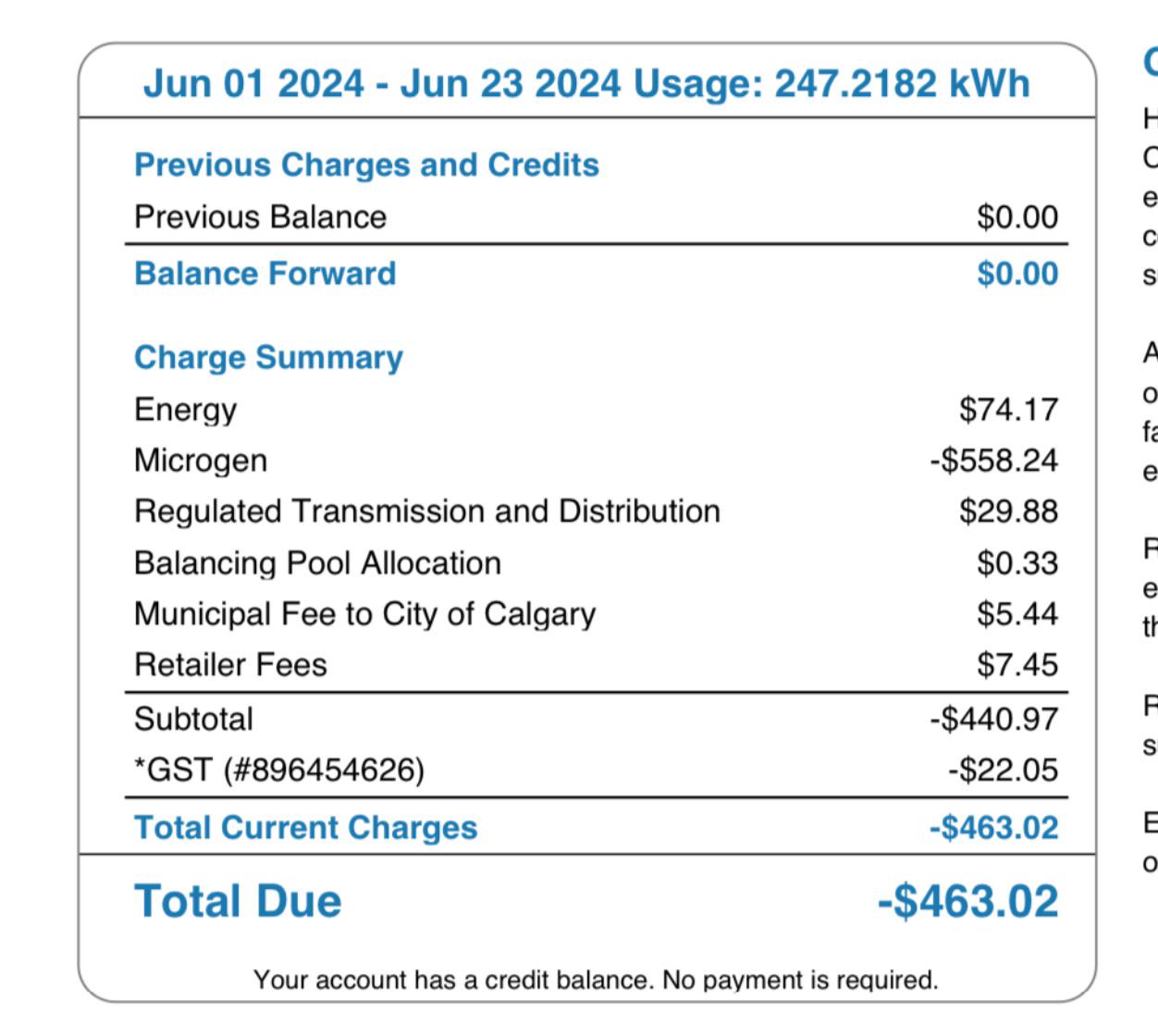
Solar Alberta 2nd Bill after solar

Post image
54 Upvotes

r/solarenergycanada • • Dec 03 '20

Solar News First Nation completes largest solar panel project of its kind in Metro Vancouver

Thumbnail
dailyhive.com
52 Upvotes

r/solarenergycanada • • Aug 29 '24

Solar News Rules discourage Canadians from generating more solar power than they use

Thumbnail
cbc.ca
51 Upvotes

r/solarenergycanada • • Feb 02 '26

Solar Alberta Is solar actually worth it in Alberta? Our real numbers after installing

49 Upvotes

We installed solar last year in Alberta and I was honestly pretty skeptical going in.

Before solar, our power bills were usually around $160–$180/month. Now they’re mostly under $40, sometimes just the admin fee.

Winter obviously produces less, but it’s not zero like I thought. Cold temps actually helps the panels, and snow slides off quicker than I expected. Summer production more than makes up for it with net metering credits.

For us, the payback worked out to about 6–9 years depending on usage and rates. Especially with electricity prices doing what they’re doing, I am not surprised that timeline keeps shrinking.

Not saying solar is for everyone, but if you’re planning to stay in your house long term, it’s been 100% worth it for us. Happy to answer questions from a homeowner perspective!


r/solarenergycanada • • Jul 15 '25

Solar Quebec 11.8 KW Finally online

Post image
47 Upvotes

Net metering activated. String inverter with 14Kw battery. If anyone in quebec province have questions ping me. 3 different orientations. I’m surprised by the production of the north west section so far.


r/solarenergycanada • • Oct 20 '26

Solar Ontario ontario just changed your electricity bill on november 1st and the part nobody is talking about is the rebate drop

46 Upvotes

ok so the OEB dropped their november 1st rate announcement last thursday and i keep seeing people focus on the rate numbers and completely miss the thing that’s actually going to hit their bill harder.

yes the rates shifted. here’s what’s actually changing november 1st confirmed directly from oeb.ca:

TOU on-peak goes to 18.9 cents. mid-peak 14.6 cents. off-peak 9.1 cents. ULO overnight drops to 3.7 cents which is genuinely wild, and ULO on-peak is 37.7 cents. tiered tier 1 is 11.2 cents, tier 2 is 13.2 cents.

but here’s the thing people are missing.

the ontario electricity rebate is dropping from 23.5% to 15.7% on november 1st.

that rebate shows up as a pre-tax credit at the bottom of your bill. the OEB says at the new 15.7% rate it’s worth about $23 per month for a typical 700 kWh household. at 23.5% it was worth more than that. the direction is down and whatever that gap is goes straight back onto your bill.

the reason this matters is context. the OER was bumped up to 23.5% last november specifically to cushion the blow from that 30% rate hike. now it’s being quietly deflated. the “overall rate increase will remain consistent with previous years” language in the announcement is technically accurate but it kind of buries what’s actually happening to people’s real bills.

what this means practically for ontario homeowners:

every kwh you generate yourself from solar or save through a heat pump is one you’re not buying at these rates without the same rebate cushion you had before. the HRSP solar rebate is still active, up to $10,000 for solar and battery combined, and expected to close before end of 2026. the new federal heat pump rebate announced october 8th is retroactive to this fall with the portal opening early 2027.

the math on both of those got a little more compelling on november 1st. and it’ll get more compelling again every time the OER gets adjusted down in future years which is the direction it’s going.

i built solenery.com specifically so ontario homeowners can see what their actual out of pocket looks like after stacking all the programs that apply to their specific address before talking to any installer. worth checking given how much these numbers just shifted.

what’s your current rate plan and have you noticed your bill changing since november 1st?


r/solarenergycanada • • Oct 11 '24

The high price of Alberta's solar door knockers

46 Upvotes

I work for a Canadian broker of solar panel quotes. Over the last 2 years we have amassed a significant database of over 1,250 solar panel quotes from Alberta alone. We only broker quotes from companies that do not use door-to-door sales but homeowners come to us with door knocker quotes very often to ask for our opinion. We have gathered over 200 door knocker quotes this way.

Many news articles have been surfacing lately about door knockers using high pressure sales tactics and lies to persuade homeowners into solar panel quotes that are well above industry standard. So, I decided to analyze our data to compare prices from door knockers vs non-door knocking companies.

As someone who cares about this industry deeply, the results are really sad.

On average, the prices provided by an installer that uses door-to-door solar sales exceeded non door-to-door quotes by 24.7% on average. Our database even includes 25 quotes from one particular door-to-door solar company that exceeds non door-to-door quotes by 80% on average. In some cases, that company provided quotes that were double or even triple the industry standard!

There is no reason for this price increase other than greed. Equipment types and installation quality were consistent between the quotes regardless of whether it was from a door knocker or not.

Since we do work Canada wide, I will also mention that this issue tends to be most present in Alberta. This type of price gouging and high pressure sales from door knockers hasn't become as much of an issue in other provinces.

I understand that our database is not perfect and that not all door knockers are unethical nor do they all price gouge. But commission based door-to-door solar panel sales seems to breed high priced quotes and high pressure sales tactics.

Yet another reason to make sure you get multiple solar quotes before choosing an installer!

Here is a link to the original article and more details about the data.