r/signalprocessing • u/stalin1891 • Jan 15 '26
ICASSP 2026 Decisions!
29
Upvotes
ICASSP 2026 decisions will be out in a day, official date is 16 January. Creating this post to discuss any aspects of decisions and reviews.
r/signalprocessing • u/Less_Bar1994 • May 13 '23

r/signalprocessing • u/Advanced-Dealer-1161 • Dec 07 '25
r/signalprocessing • u/Dreamhopperss • Aug 26 '26
Hello there. In the ICASSP 2027 website, the submission deadline is noted as 16-09-2026. But I don't see any link to submit my research paper. How can I submit my research paper? Is the submission portal open in the first place?
I have never submitted a research paper before and I would really appreciate any guidance you could provide with this. Thank you!
r/signalprocessing • u/Typical_South1480 • Jun 24 '26

The idea of this wavelet kernel is based on the use of a lognormal distribution as the wavelet spectrum, the point of this idea is that the band on the logarithmic scale axis of the wavelet scalogram should be Gaussian.
Unfortunately, this wavelet does not currently have an explicit analytical expression due to the peculiarity of the spectrum. The application of the wavelet kernel is convenient numerically, which avoids analytical expression.
However, despite this, it can be expressed through the Fourier transform of the spectrum, as well as through a special differential equation.
Below are images showing an example of what a wavelet looks like, its uses (scalogram), the expression of a wavelet through a Fourier spectrum, through a differential equation of compression, and also proof that wavelet oscillations reach an infinite number.
I would be glad if you are interested, as well as any assessment and criticism 😄
r/signalprocessing • u/ClipboardClan • Jul 29 '26

I've been staring at this repeatedly and it took me a while to realize what the author was actually saying.
Like this line: i.e. "at regular periods of ts seconds where ts = 1/fs".
Couldn't they simply say in plain English words: "i.e. how many seconds does it take to take one sample"?
And then they assign that (1/fs) to a variable ts, and then use it in the equations below for 0th sample, 1st, 2nd sample. Wouldn't it be simpler to just leave it in that form itself (1/fs) in the equation???? By substituting it with a variable name, you're just making your work more cryptic and the reader has to trace back and find out what exactly is ts.
Book: Undestanding Digital Signal Processing by Richard G Lyons
r/signalprocessing • u/Hussainsmg • Jul 14 '25
There is only alpha version 2013 and nothing since. Did the authors said anything?
r/signalprocessing • u/Itchy_Possible • Dec 22 '23
How would I use chi square (or any analytical technique) to compare the correlation between two signals in a single period? I am doing this for a project analyzing the inverse discrete fourier transform by comparing the original signal of an instrument at frequency C4 to different levels of reconstructed signals using the frequency vs amplitude spectral diagram.
r/signalprocessing • u/SnooDoggos3844 • Mar 15 '21
Variational Mode Decomposition is one of the latest signal processing algorithm. Even though it is recognized well in the research community, very few people are aware of it. It has a huge potential and also been combined with machine learning and deep learning methods. Here is the first blog on Variation Mode Decomposition. This is going to be a series of blogs and also going to make a YouTube video on this.
https://vamsivk1995.medium.com/introduction-to-variational-mode-decomposition-vmd-d7100210a56a
Always open to changes or suggestions.
Thank you
r/signalprocessing • u/HqppyFeet • Sep 08 '25
TLDR {
B_min ≤ R_s / 2. I can’t comprehend this shit.
}
I’m looking for an “aha!” moment, but I’m left with a sobbing, painful, “AAAA I DONT GET IT” moment.
It could be my brain, which is why I plan to get some sleep after posting this.
I need help.
An exercise asks: “What’s the relationship between the symbol rate and the required bandwidth (in the frequency domain) for digital baseband signals?”
Bandwidth (from what I know) is a spectrum of frequencies that the digital baseband signal occupies.
Symbol rate is the number of symbols carried per second.
What I DONT understand is the relationship between the two. I asked Chatgpt (ᐛ) for help, and so I acquire the following info:
Let symbol rate be R_{s} and let required bandwidth be B for digital baseband signal. “The theoretical minimum bandwidth needed to detect R_{s} symbols is R_{s}/2”. And so I end up with “B_min = R_s / 2”, but if I turn it into 2B_min = R_s, it appears to look similar to that Nyquist’s sampling theorem saying 2*f_sampling ≥ f_signal to be able to reconstruct a continuous signal.
I understand Nyquist’s sampling theorem.
But I don’t understand THAT 👉 B_min ≤ R_s / 2. I can’t comprehend it. When I try to understand it the same way I understood sampling theorem, logic shuts off. Perhaps I shouldn’t associate this with sampling theorem because they have different meanings.
The minimum bandwidth must be equal to or less than half the symbol rate… does this make sense? If so, please do give an insight 🙏
I’ll be responding in 8 hours.
r/signalprocessing • u/C2H5COOH • Nov 18 '24
Im trying to implement a FFT function for my hobby project. (It's also meant to be educational so I dont want to use libraries). Eventually it's supposed to be a split radix FFT implementation for power of two sized arrays. And I noticed something odd while doing doing the 4-point DFT by hand and comparing it to the 4-point FFT.
When i do the 4-point DFT with the Matrix the result is:
| X[0] | 1 | 1 | 1 | 1 | x[0] | X[0]=x[0]+x[2]+x[1]+x[3] |
| X[1] | 1 | -i | -1 | i | x[1] | X[1]=(x[0]-x[1])-i(x[1]-x[3]) |
| X[2] | 1 | -1 | 1 | -1 | x[2] | X[2]=(x[0]+x[2])-(x[1]+x[3]) |
| X[3] | 1 | i | -1 | -i | x[3] | X[3]=(x[0]-x[1])+i(x[1]-x[3]) |
When i apply the FFT algorithm like demonstrated in this video I get:
FFT(x[4]) =>
ye[2] = FFT({ x[0], x[2] }) => { x[0] + x[2], x[0] - x[2] }
yo[2] = FFT({ x[1], x[3] }) => { x[1] + x[3], x[1] - x[3] }
X[0] = x[0] + x[2] + x[1] + [3]
X[2] = (x[0] + x[2]) - (x[1] + x[3])
X[1] = (x[0] - x[2])  + i(x[1] - x[3])
X[3] = (x[0] - x[2]) - i(x[1]-x[3])
The second and the last result seem to be swapped. So whats going on?
r/signalprocessing • u/sk8137 • Sep 26 '24
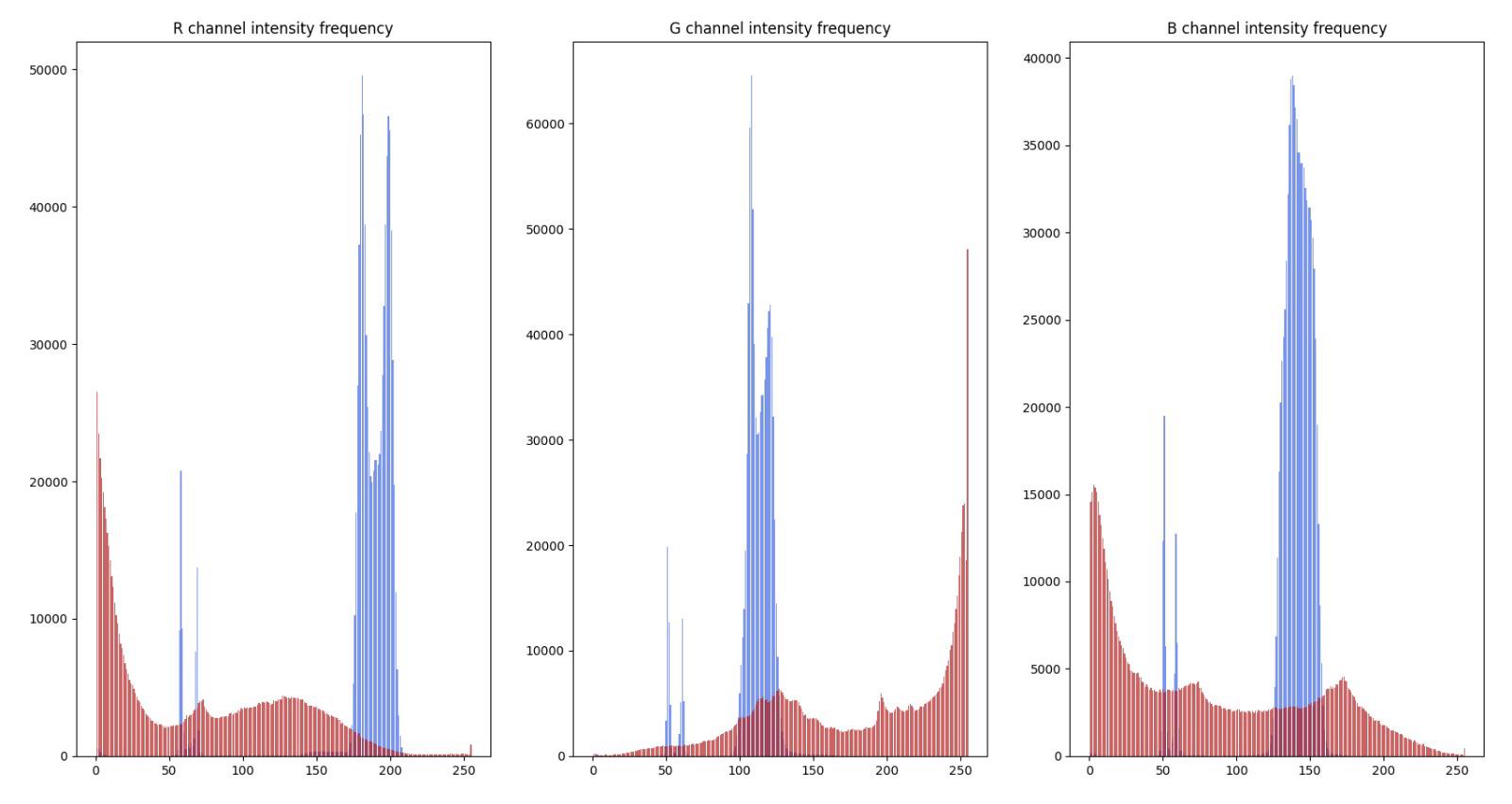
i am trying to reverse engineer the signal processing technique that transforms the blue distribution into the red distribution. a few observation,
it looks always result in a skewed distribution
it seems like will make the lowest mean channel right skewed and the rest left skewed
the original (blue) distribution is non continuous (doesnt take up all values between 0 - 255) but the transformed (red) distribution will have all values between 0 - -255 would really appreciate for any pointers/answers!
r/signalprocessing • u/Legitimate_Manner175 • Jul 18 '26
This subject is my biggest weakness. I failed the course the first time because I simply didn’t understand it. I passed it on my second attempt during retaking the subject, but it always felt like the more I studied, the more I realized how little I actually understood.
Now I failed this part of my state exam, so I’m preparing for my second attempt. I have just over a month to study (along with several other subjects), and the textbook (only signal and image processing) is around 500 pages long .
How would you approach learning this subject so you actually understand it instead of just memorizing formulas? Any advice, resources, or study methods would be greatly appreciated. I really want to get it this time.
r/signalprocessing • u/Annual-Till1262 • Jul 20 '25
I'm a professional in the field but am looking to solidify my theoretical knowledge which has fallen out of my head over the years.
What's the best online course to cover this? I would love something with a testing component since I feel like you only know something properly once you're put on the spot.
r/signalprocessing • u/Necessary-Gold-9787 • Dec 11 '24
r/signalprocessing • u/anxiousbutterfly707 • Oct 15 '24
Hey everyone, I am a first year EE master's student. I have recently been trying to narrow down on a particular research area that can help me form the base of my research problem for further studies (I plan to do a PhD).
I have been incredibly interested in Computational Neuroscience for a while now, however the more I read about the different techniques and research that goes on in the field, the more confused I get, because even the imaging techniques (PET/fMRI studies) and EEG signals seem highly context dependent and very theoretical....the noisy nature of the data fails to translate to practical applications that can help understand the human brain better (recently read an article that linked very few brain synapses to autistic behaviour, hence debunking the reliability on brain imaging methods).
I am trying to find a more practical and active research area that approaches solving brain health problems through a signal processing perspective(somewhere I can leverage my electrical engineering knowledge).Additionally I am also interested in research at the intersection of Signal Processing and Machine learning, and want to know what are the hot topics/active research fields that has plenty of problems that needs to be focused on.
r/signalprocessing • u/Lazy_Log2004 • Jun 17 '24
Good afternoon,
I am dealing with some electrically evoked auditory cortical responses signals. I was trying to detect and quantify the chances of a response to a stimulus in a given time interval being there in terms of a P-Value. For example, in the range of 60-180 ms, what is the P-Value of the processed signal that will let me know the chances of a real signal response being there? So far, I am not aware of any developed toolbox with this feature but maybe you could enlighten me into the right direction. The closest processing pipeline that I have come across is this one:
https://www.thieme-connect.com/products/ejournals/abstract/10.3766/jaaa.26.4.5

I am using Matlab as my coding language but I wouldn't mind to explore other if there is an already implemented function or toolbox with this kind of analysis.
Thanks in advance
r/signalprocessing • u/tg4267 • Jun 15 '24
I know convolution represents FIR filter at LTI system. But if not LTI system, they are still same? I think it's not, but I cant explain exactly why...
r/signalprocessing • u/ApplicationFalse4903 • Jun 09 '22
I have recently studied and analysed in the research papers (IEEE journal, transaction and conference papers) published by many researchers that, both Wavelet transform and Hilbert transform are best suited for fault detection and fault classification in electrical power system, as compared to classical Fourier transforms and short time fourier transforms. It is because both wavelet transforms as well as hilbert transforms can detect what are the frequency components present in the waveform of fault currents at a particular instant of time (wavelet and hilbert transforms are used to identify the transient behaviour of the fault current waveform). Then what is the difference between the two ? If wavelet transforms is used for fault detection and fault classification in electrical power system as compared to classical fourier transforms and short time fourier transforms, then why ? If hilbert's transform is used for fault detection and fault classification in electrical power system as compared to classical fourier transforms and short time fourier transforms, then why ? If both the transforms methods are best for fault detection and fault classification in electrical power system as compared to classical fourier transforms and short time fourier transforms , then why both transform has been developed, only one of the two transforms would be sufficient for fault detection and fault classification in electrical power system as compared to classical Fourier transforms and short time fourier transforms ? There must be some advantage and disadvantage, one might pose over other, therefore these two transforms method exists in the research papers.
I just want only suggestion. I am not asking for an exact answer.
r/signalprocessing • u/SnooDoggos3844 • Mar 25 '21
Here is part-2 of the blog series on Variational Mode Decomposition(VMD). The mathematics of VMD is discussed and also explained all the parameters & variables related to it.
https://vamsivk1995.medium.com/variational-mode-decomposition-part-2-the-maths-4a81a8e05076
To get better context please check out the Introduction blog.
https://vamsivk1995.medium.com/introduction-to-variational-mode-decomposition-vmd-d7100210a56a
Always open to changes or suggestions
Thank you
r/signalprocessing • u/major_fox_pass • Sep 01 '20
r/signalprocessing • u/Shagggggeeee • Oct 03 '18
is too many people doing AI
Would signal processing be a better career path.
I actually love mathematics and both seem really good paths to take.
AI and ML seem to have cooler applications, but way too many ppl trying to get in the field
Signal Processing is enriching too (mathematically). It's interesting to research but I don't like there's much enevelope to push as AI, plus the applications don't sound as cool tbh
r/signalprocessing • u/LeadingEar8495 • Aug 04 '26
Opening this thread to discuss Spoken Language technology 2026 reviews when the rebuttal period begins
r/signalprocessing • u/Typical_South1480 • Jul 12 '26

I generated a wavelet similar to an ECG rhythm based on a Weierstrass-type aperiodic function (golden ratio coefficient) and a Gaussian.
Possible application for ECG analysis.
The last image is a wavelet scalogram of this wavelet with itself.
Would be happy if this idea is useful and you appreciate it)
r/signalprocessing • u/Outside_Argument_600 • May 28 '26
https://matlabonsteroids.online
I love MATLAB. I use it a lot for signal processing work, especially with physiological signals like PPG data.
But while working on projects, I kept running into the same issue: handling multiple recordings, testing different DSP pipelines, and iterating quickly became slow and repetitive. I wanted something faster, more visual, and easier to experiment with.
So I started building “Matlab on Steroids.”
It’s a browser based signal processing platform where you can:
• Build DSP pipelines visually using drag and drop blocks
• Process multiple recordings in parallel
• Extract features directly from the workflow
• Train ML models on processed signals
• Use AI to analyze signals and suggest a processing chain automatically
The goal is not to replace MATLAB, but to make experimentation and workflow building much faster and more accessible.
I’m still actively developing it and would genuinely love feedback from people working in DSP, biomedical signals, embedded systems, audio processing, etc.
Would this actually be useful to you? What features would you want in something like this?