Prints?
47
Upvotes
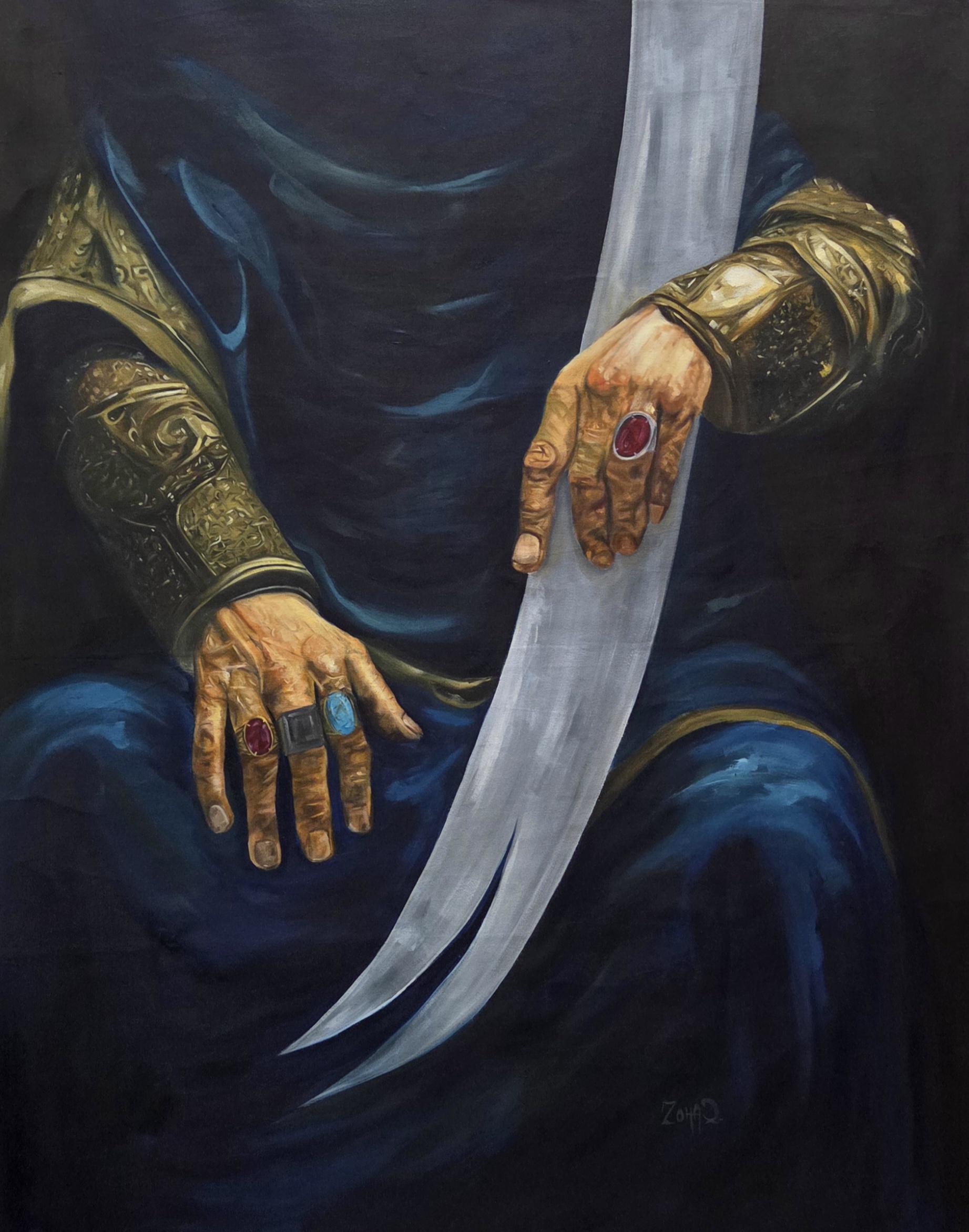
I was thinking of making prints of these. If anyones interested let me know!
r/shia • u/paint-it-blackk • 1h ago
Mentioned Ahmad ibn Hanbal in the title because the speaker specifically talked about him. In reality, many sunni compilers of ahadith have censored ahadith throughout history. My second last post is about Bukhari doing the same.
Speaker: Sheikh Hassan Farhan al-Maliki (sunni scholar)
r/shia • u/AppropriateAside790 • 7h ago

[باللغة العربية]
الزيارة الجامعة الكبيرة من أعظم الزيارات المأثورة عن الإمام علي الهادي (عليه السلام)، وفيها يعلن الزائر عقيدته بالرجعة وانتظار دولة أهل البيت (عليهم السلام)، ويُعدّ نفسه وقلبه ونصرته لهم حتى يُظهرهم الله لعدله ويمكّنهم في أرضه.
من الزيارة الجامعة الكبيرة المروية عن الإمام الهادي (عليه السلام):
«مُؤْمِنٌ بِإِيَابِكُمْ، مُصَدِّقٌ بِرَجْعَتِكُمْ، مُنْتَظِرٌ لِأَمْرِكُمْ، مُرْتَقِبٌ لِدَوْلَتِكُمْ ... وَقَلْبِي لَكُمْ مُسَلِّمٌ، وَرَأْيِي لَكُمْ تَبَعٌ، وَنُصْرَتِي لَكُمْ مُعَدَّةٌ، حَتَّى يُحْيِيَ اللَّهُ تَعَالَى دِينَهُ بِكُمْ، وَيَرُدَّكُمْ فِي أَيَّامِهِ، وَيُظْهِرَكُمْ لِعَدْلِهِ، وَيُمَكِّنَكُمْ فِي أَرْضِهِ»
المصدر: من لا يحضره الفقيه للشيخ الصدوق، ج٢ / تهذيب الأحكام للشيخ الطوسي، ج٦ / مفاتيح الجنان، الزيارة الجامعة الكبيرة
[English Translation]
Al-Ziyarah Al-Jami'ah Al-Kabirah is among the greatest visitations transmitted from Imam Ali Al-Hadi (as). In it, the visitor declares his belief in the Return (Raj'ah) and his anticipation of the state of the Ahl al-Bayt (as), and prepares his heart and his support for them until Allah manifests them for His justice and establishes them in His earth.
From Al-Ziyarah Al-Jami'ah Al-Kabirah, narrated from Imam Al-Hadi (as):
"I believe in your homecoming, I affirm your return, I await your command, and I anticipate your state ... My heart is submitted to you, my opinion follows yours, and my support for you is prepared, until Allah the Exalted revives His religion through you, returns you in His days, manifests you for His justice, and establishes you in His earth."
Source: Man La Yahduruhu Al-Faqih by Sheikh Al-Saduq, Vol. 2 / Tahdhib Al-Ahkam by Sheikh Al-Tusi, Vol. 6 / Mafatih Al-Jinan, Al-Ziyarah Al-Jami'ah Al-Kabirah
Note: Translation assisted by AI and verified by the poster. Please gently correct me if there are any unintended errors.
r/shia • u/EthicsOnReddit • 35m ago

The attestations of reliability (*tawthiqat*) provided by Sheikh al-Tusi and al-Najashi are—for the most part, if not entirely—based on direct knowledge (*hissiyyah*). This is evidenced by their statements in their respective works—for instance, noting that the [Shia] community distinguished between reliable narrators and others, and similar remarks.
These attestations are “unlinked” (*mursalah*)—for example, we do not know the specific chain of transmission (*tariq*) through which Sheikh al-Tusi arrived at his assessment of the reliability of Muhammad ibn Muslim. How, then, can we rely upon their validity?
Since our attestations of reliability are “unlinked,” how can they serve as valid proof (*hujjah*)?
In the book *Introductory Lessons in the Principles of Rijal* (the study of narrators), authored by Sheikh Muhammad Baqir al-Irawani (may God protect him), the following point is raised:
To continue to read the answer to this doubt: https://realshiabeliefs.wordpress.com/2026/11/27/can-we-take-the-testimony-of-shaykh-tusi-najashi-regarding-narrators-they-deemed-reliable/
r/shia
•
u/EthicsOnReddit
•
13h ago

Sometimes you may come across something you cannot comprehend, do not immediately reject it or fall pray for the anti-shia framing. When you find yourself agreeing with the wahabis and salafi for example, reexamine your position...
Below taken and shared from: https://lib.eshia.ir/72071/1/136
Among these accounts is one recorded by al-Nu’mani in *al-Ghaybah*, with his chain of narration reaching back to the Commander of the Faithful (peace be upon him), who said to Hudhayfah ibn al-Yaman:
يا حذيفة لا تحدّث الناس بما لا يعلمون فيطغوا ويكفروا. إنّ من العلم صعباً شديداً محملة لو حملته الجبال عجزت عن حمله إنّ علمنا أهل البيت يستنكر ويبطل وتقتل رواته ويساء إلى من يتلوه بغياً وحسداً لما فضّل اللَّه به عترة الوصي وصيّ النبي صلى الله عليه و آله و سلم [3].
"O Hudhayfah, do not speak to people about matters they do not comprehend, lest they transgress and fall into disbelief. There are aspects of knowledge so arduous and heavy that, were the mountains to bear them, they would surely fail. Indeed, our knowledge—the knowledge of the Ahl al-Bayt—is often rejected and dismissed; those who narrate it are killed, and those who recite it are mistreated—all out of malice and envy regarding the virtues with which God has favored the progeny of the Successor—the successor to the Prophet (may God bless him and his family)."
Al-Fayd writes in *al-Usul al-Asilah*:
Regarding a tradition from al-Sadiq (peace be upon him):
خالطوا الناس بما يعرفون ودعوهم مما ينكرون ولا تحملوا على أنفسكم وعلينا أنّ أمرنا صعب مستصعب لا يحتمله إلّاملك مقرب أو نبي مرسل أو عبد مؤمن امتحن اللَّه قلبه للإيمان.
"Interact with people based on what they understand, and refrain from sharing what they might reject. Do not impose a burden upon yourselves—or upon us—for our affair is exceptionally difficult and demanding; it can only be borne by an angel brought near, a prophet sent forth, or a believing servant whose heart God has tested and prepared for faith."
In explanation of this *hadith*, Al Fayd says:
"This is because the inner realities of knowledge, in their true form, do not always align with the exoteric interpretations of the religious law as understood by the general public. Thus, a person must fall into one of two categories: either a seeker of truth who possesses spiritual insight (*kashf*) and certainty, or a follower who accepts and submits [to the teachings]. As for a third type—those who mix truth with falsehood, interpreting the Book and the Sunnah according to their own personal opinions and flawed reasoning—they are doomed to ruin; a point addressed in numerous traditions."
The conclusion to be drawn from this set of narrations is that certain teachings of the Ahl al-Bayt (peace be upon them) exceed the capacity and endurance of some individuals.
For this reason, the Ahl al-Bayt commanded that these teachings be concealed from those not suited to receive them, and that they be denied if they happen to become widely known. This is because such traditions and insights are difficult to bear for anyone who is not entirely devoted to them; encountering them might lead such individuals to reject them, or to disparage both the content and the narrator.
From this, it becomes evident that much of the criticism, disparagement, and labeling of narrators as "weak" (taḍʿīf) stems from this very cause—as the Almighty says:
"Rather, they have denied that which they could not encompass in knowledge, and whose interpretation has not yet come to them."
-- below commentary from the author of this book continues regarding past Shia rijal scholars who were so "strict" in their Rijal approach regarding certain narrators of our hadith it is a bit high level rijal discussion so its okay if you dont understand it
Thus, a researcher should not be surprised by the frequent criticisms leveled by scholars of *rijāl* (biographical evaluation)—such as Ibn al-Ghaḍāʾirī, al-Najāshī, al-Kashshī, and others—against narrators who transmitted profound teachings or complex subjects that these scholars had not explored themselves, or lacked the capacity to investigate.
Consequently, their stance toward such narrators was inevitably one of strong disapproval, disparagement, and prejudice. Furthermore, these scholars were also influenced by the criticisms leveled against these narrators by the "general public" (i.e., the non-Shia mainstream)—criticisms they accepted as established facts, to the point where a researcher in the field of *rijāl* might fear even questioning them or pausing to verify their validity.
r/shia • u/Strange-Jacket-1253 • 14h ago
Sorry if it sounds like i am being stupid. I need some sort of nudge that Islam is the true religion, shia is the true sect, and God really does exist.
r/shia • u/GarbageLeast667 • 1d ago

Inallilahi wa inna illahi rajiun
Salam everyone, my heart is heavy as we mourn the passing of this dear brother who stood up and defended the House of Prophet Muhammad (peace be upon him and his family) with such dedication, please keep him in your sincere prayers and ask Allah (SWT) to forgive his shortcomings, shower him with endless mercy, and grant him a place alongside the Ahlul Bayt in the highest ranks of Jannah.
He was quite relevant in the Shia apologetic community online, his Arabic debates used to silence the opposition. Another great loss for the shii community this year
Brother Athar Allah
r/shia • u/infinitone • 20h ago

A new project covering the seerah of the prophet (pbuh)
r/shia • u/Organic_Sound1408 • 1d ago
I recently lost a job that I genuinely loved and enjoyed, and this has been so devastating for me. I am young so have never experienced this kind of loss of hope, effort, and certainty before. I am desperate for Divine help through your Duas.
I even found myself speaking to our Imam (ajtfs) telling him of the good deeds I have tried to do and asking him to grant me some reward for them. I feel guilty doing this because I know how immeasurable and abundant the rewards of the akhirah are, but I am so in need for help in worldly matters right now.
Please if anyone visiting the shrines, take my Duas with you and remember me in your prayers to ease my difficulties and open doors for me.
r/shia • u/Present-Fortune4448 • 14h ago
Salaam alaikum everyone,
I hope you are all well, insha’Allah. I have an important hajat that I have been praying to Allah (swt) for, and I am hoping to incorporate an amal into my routine while placing my trust in Him.
I have been considering reciting Ziyarat Ashura for 40 consecutive days (but the salaam and la'an part just once followed by: اللَّهُمَّ الْعَنْهُمْ جَمِيعاً تِسْعاً وَتِسْعِينَ مَرَّةً and السَّلامُ عَلَيْكَ يَا أَبَا عَبْدِاللَّهِ وَعَلَى الأَرْوَاحِ الَّتِي حَلَّتْ بِفِنَائِكَ تِسْعاً وَتِسْعِينَ مَرَّةً), or performing Namaz-e-Ja‘far al-Tayyar.
I have also heard of a four-rakat prayer for hajaat involving recitations of Surah Ikhlas 11, 21, 31 and 41 times in each rakat
As well as reciting istighfar 100 times after Isha prayer.
For those familiar with these practices, is there one you would particularly recommend for a hajat? I would be grateful if anyone could also share reliable sources or narrations regarding them, especially the Ziyarat Ashura and Namaz-e-Ja‘far
If anyone feels comfortable sharing, I would love to hear about your personal experiences with any of these amaals and how you incorporated them into your routine.
May Allah (swt), through the wasila of the Ahlul Bayt (as), accept all of our duas and grant everyone their lawful hajaat. Ameen.
JazakAllah khair for your guidance.
r/shia • u/Medical-Highlight244 • 1d ago
Evidently I just never deleted reddit so here you go:
https://youtu.be/zsG66Mm7bDg?si=1eEPb7BtcDpOa4Zh
Also increase your salawat since it’s the night before jum3ah!!
r/shia • u/genvonsteuben • 1d ago
Before I present my question, I want to clarify that I'm not trying to challenge, provoke, or criticize Shia beliefs. I am asking out of genuine curiosity and a sincere desire to understand the theological foundations of Twelver Shia Islam.
I am a non-denominational Muslim who was born and raised in a Sunni family and in a country with a predominantly Sunni population. However, I have never been able to fully reconcile myself with the Sunni belief that all the companions were just and that the events following the Prophet’s (s.a.a.) death were merely the result of differences in ijtihad. I have always felt more drawn to the Shia understanding of early Islamic history, and at this point in my religious journey, I am seriously considering embracing Twelver Shia Islam.
Because I am approaching this possibility seriously, I want to understand certain theological questions rather than accept doctrines without examining their foundations.
As I understand it, in Twelver Shia theology, the Imamate is regarded as a divinely appointed spiritual rank higher than prophethood and messengership. Shia literature also widely holds that the Twelve Imams (a.s.) are superior to all prophets (a.s.) except Prophet Muhammad (s.a.a.). Shia scholars differ on whether this includes the Ulul Azm prophets (a.s.). The Imams (a.s.) are never considered superior to Prophet Muhammad (s.a.a.), who is believed to have combined all three ranks: prophethood, messengership, and Imamate.
This raises two fundamental question for me:
Was Prophet Muhammad Himself an Imam?
What is the explicit Quranic or authentic hadith evidence that Prophet Muhammad (s.a.a.) himself possessed the distinct rank of Imamate? Is there a clear revelation identifying him as an Imam in this specific theological sense, rather than merely as a prophet, messenger, leader, or prayer leader? If Imamate is considered a higher rank than prophethood, how exactly do Shia scholars establish that Prophet Muhammad (s.a.a.) possessed this rank as well? Is this based on explicit textual evidence, or is it primarily a theological inference?
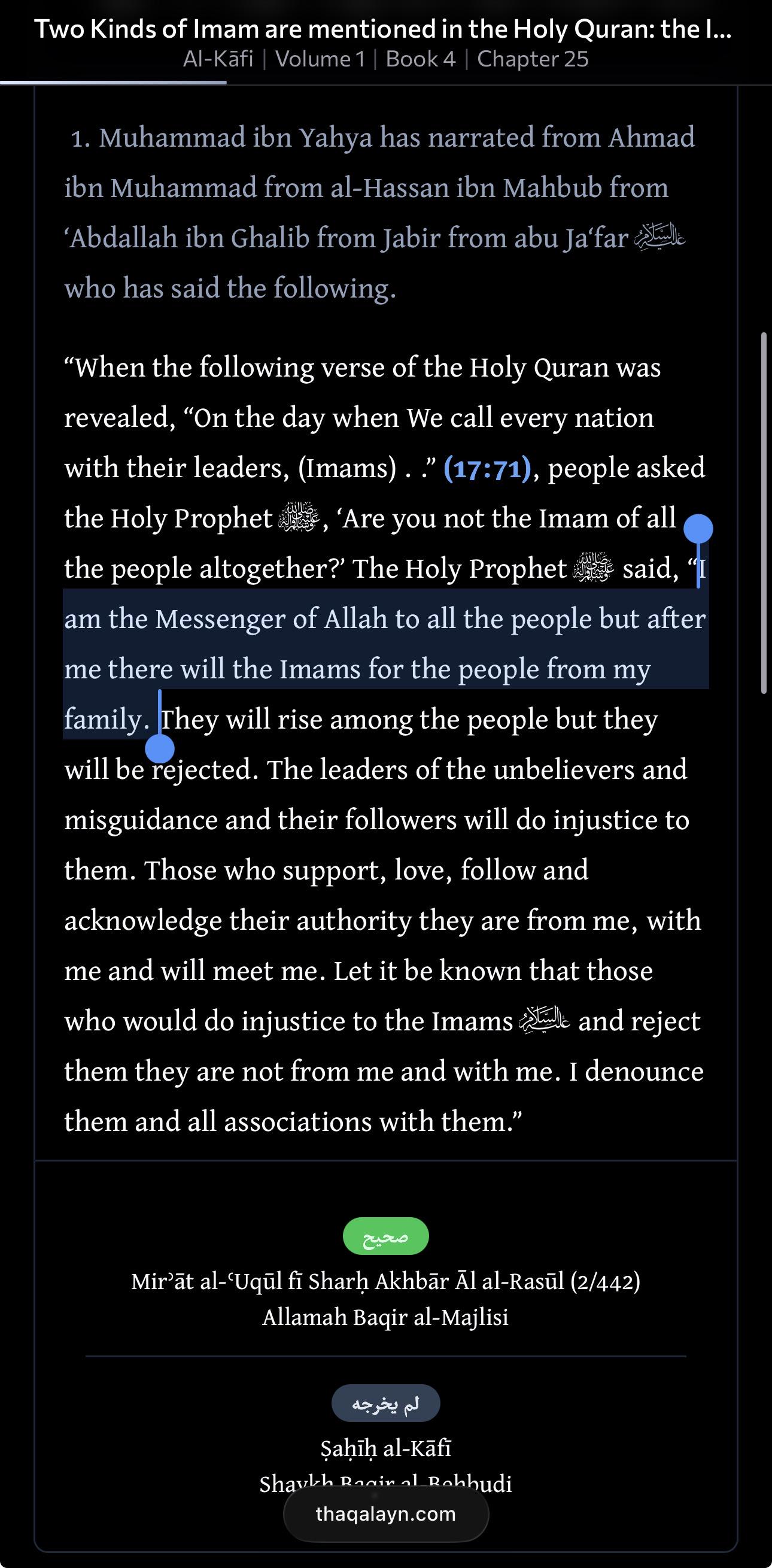
Furthermore, I came across an interesting narration in Al-Kāfī (Vol. 1, Book 4, Chapter 25, Hadith 1), narrated from Imam Muhammad al-Baqir (a.s.). According to this narration, when the verse “On the day when We call every nation with their Imam” (Quran 17:71) was revealed, people asked Prophet Muhammad (s.a.a.): “Are you not the Imam of all people?” He reportedly replied: “I am the Messenger of Allah to all people, but after me there will be Imams from my family, appointed by Allah.”
If Prophet Muhammad (s.a.a.) himself possessed the distinct rank of Imamate, why does he appear to distinguish his role as the Messenger of Allah from the Imams who would come after him, rather than explicitly affirming that he was also an Imam? How do Shia scholars interpret this narration in light of the doctrine that the Prophet (s.a.a.) himself held the rank of Imamate?
Question About the Hierarchy of Imams and Prophets.
If Prophet Muhammad (s.a.a.) is considered the highest of all creation because he combined prophethood, messengership, and Imamate, how can the Twelve Imams (a.s.), who possess the rank of Imamate but are neither prophets nor messengers, be considered superior to Prophet Abraham (a.s.), for example, who was both a prophet and an Imam? What theological principle or textual evidence explains how an Imam who is not a prophet can hold a higher spiritual rank than a prophet who was also appointed as an Imam?
r/shia • u/AppropriateAside790 • 1d ago

[باللغة العربية]
يُصوّر أهل البيت (عليهم السلام) جانباً مبهراً من دقة الإدارة والحكم الرشيد في دولة الإمام المهدي (عجل الله فرجه الشريف)، حيث يبعث ولاته إلى أقاليم الأرض، ويجعل لهم في أكفّهم عهداً يرشدهم في القضايا التي تُشكل عليهم، ويؤيد جنده بالكرامات حتى تُفتح لهم المدن.
عن الإمام أبي جعفر محمد بن علي الباقر (عليه السلام) أنه قال:
«إِذَا قَامَ الْقَائِمُ بَعَثَ فِي أَقَالِيمِ الْأَرْضِ، فِي كُلِّ إِقْلِيمٍ رَجُلاً، يَقُولُ: عَهْدُكَ فِي كَفِّكَ، فَإِذَا وَرَدَ عَلَيْكَ أَمْرٌ لَا تَفْهَمُهُ وَلَا تَعْرِفُ الْقَضَاءَ فِيهِ فَانْظُرْ إِلَى كَفِّكَ، وَاعْمَلْ بِمَا فِيهَا.
قَالَ: وَيَبْعَثُ جُنْداً إِلَى الْقُسْطَنْطِينِيَّةِ، فَإِذَا بَلَغُوا الْخَلِيجَ كَتَبُوا عَلَى أَقْدَامِهِمْ شَيْئاً وَمَشَوْا عَلَى الْمَاءِ، فَإِذَا نَظَرَ إِلَيْهِمُ الرُّومُ يَمْشُونَ عَلَى الْمَاءِ،
قَالُوا: هَؤُلَاءِ أَصْحَابُهُ يَمْشُونَ عَلَى الْمَاءِ، فَكَيْفَ هُوَ؟ فَعِنْدَ ذَلِكَ يَفْتَحُونَ لَهُمْ أَبْوَابَ الْمَدِينَةِ، فَيَدْخُلُونَهَا، فَيَحْكُمُونَ فِيهَا مَا يَشَاؤُونَ»
المصدر: الغيبة للشيخ النعماني، ص٣٣٤، باب ٢١، ح٨ / بحار الأنوار، ج٥٢، ص٣٦٥، باب ٢٧، ح١٤٤
[English Translation]
The Ahl al-Bayt (as) depict a remarkable aspect of administrative precision and wise governance in the state of Imam Al-Mahdi (may Allah hasten his reappearance), as he dispatches his governors to the regions of the earth, places in their palms a covenant that guides them in the matters that confound them, and supports his soldiers with miracles until cities open their gates to them.
From Imam Abu Ja'far Muhammad ibn Ali Al-Baqir (as), who said:
"When Al-Qa'im rises, he will dispatch a man to every region of the earth, saying: 'Your covenant is in your palm; so whenever a matter comes before you that you do not understand and do not know how to judge, look at your palm and act according to what is in it.'
He said: And he will send an army to Constantinople. When they reach the gulf, they will write something on their feet and walk upon the water. When the Romans see them walking on the water,
they will say: 'If these are his companions walking upon the water, then what of him?' At that, they will open the gates of the city to them, and they will enter it and rule in it as they wish."
Source: Al-Ghayba by Sheikh Al-Nu'mani, p. 334, Chapter 21, Hadith 8 / Bihar Al-Anwar, Vol. 52, p. 365, Chapter 27, Hadith 144
Note: Translation assisted by AI and verified by the poster. Please gently correct me if there are any unintended errors.
r/shia • u/_TotallyOriginalName • 1d ago
If I am living until then, even at the age of 135, I will run towards you. If I could not run, then I would walk. If I had no legs, then I would crawl. If I had no arms too, then I would use my face, teeth and tongue to crawl to you. If I could not do that, then I would beg someone to take me to you. If I could not do that with my mouth, I would use my eyes to beg them to take me to you. If I could not do that, then I shall ask forgiveness from you and your Lord, because the master does not come to visit the slave. The slave goes to visit the master. This is my belief ya Hujjah. You are the generous slave of the generous Lord. You are the master, but you will still come. Generosity is known through your Lord, you, and your family.
Ya Allah hasten his reappearance. Hasten it, hasten it, hasten it. And keep us on the straight path.
r/shia • u/Shot-Limit5794 • 1d ago
r/shia • u/DeliciousAd8621 • 1d ago
r/shia • u/abcabc119 • 21h ago
As a follower of Sistani, has anyone got any info on house deposit money being liable for Khums?
I am aware it says any money being saved towards a house by end of khums year is liable, but what if a house has been purchased and deeds signed pending completion, so money spent as a justifiable expense, but the vendor has ended up in a chain so if it completes within 7 weeks it'll be spent but if it takes 8 weeks my khums year surpasses? What do I do in that case?
Also does having sent it to the solicitor count as it being my savings still as I am aware they take the money prior to hold till exchange?
Thanks
r/shia • u/Shot-Limit5794 • 1d ago
r/shia • u/barar2nd • 1d ago
r/shia • u/ExpressionOk9400 • 1d ago

In many of our communities, mental health is often ignored or misunderstood, leaving those who struggle to do so on their own. When we look at the Quran and Hadith literature, it becomes clear that mental and emotional hardship is not a modern problem; our Prophets and Imams (pbut) faced intense challenges of their own. What are some lessons from Islamic tradition that destigmatize mental health struggles?
It is normal to be impacted by loss and grief.
Struggling doesn’t make you weak—it makes you human.
Islam acknowledges the complexities of the human experience, including emotional and psychological struggles. The Quran recounts the story of Prophet Yaqub (p), who was overcome with grief upon the disappearance of his son, Prophet Yusuf (p). God describes his sorrow during this long period of separation: “And he turned away from them and said, ‘Oh my sorrow over Yusuf,’ and his eyes became white from grief, for he was [of that] a suppressor” (12:84).
Prophet Yaqub’s (p) reaction reflects that even the most pious individuals can feel profound emotional pain. This acknowledgment in the Quran validates the struggles of those who endure profound losses.
The community and society can ease your burden or compound your struggles.
In the tenth year of his prophethood, the Prophet Muhammad (pbuh&hp) experienced immense loss when both Lady Khadija (p) and his uncle and protector Abu Talib (p) passed away. Compounding this grief, the Prophet (pbuh&hp) and his followers faced immense economic and social pressure, ridicule, and mistreatment at the hands of the people of Makkah, who continued to reject his message. And so, the Prophet Muhammad (pbuh&hp) himself endured what he called ‘Ām al-Ḥuzn‘ or the ‘Year of Sorrow.’
The people around you can lift you—or break you. Choose companions who bring you closer to God.
But the Prophet (pbuh) was comforted by both his trust in God as well as his faithful companions. Similarly, Imam Hussain (p), whose story we retell every Muharram, was surrounded by fiercely loyal companions.
On the night of Ashura, the Imam (as) allowed him to leave, saying, “Beware! I strongly predict that the day of our confrontation with them will be tomorrow. Beware! I have given you permission to leave. You are all free to go. I do not and will not reproach anyone of you for doing so. This is a night whose darkness has covered you like a mounted camel. Therefore, take advantage of it and make your escapes” (Muqarram, Maqtal al-Husayn, p. 212).
Not a single one of them left. And though small in number, they faced an army of thousands with bravery and one by one were martyred on the plains of Karbala in the way of God.
Imam Hasan (p), on the other hand, had an army of anywhere between 12,000 to 100,000 men. But few had the same pure intentions and higher purpose as Imam Hussain’s companions. Many turned on him. As a result, Imam Hasan (p) did not prolong his war with Muawiayh, and instead forged a treaty to maintain unity and peace in the Ummah. Rather than relieve his burden, the community around Imam Hasan (p) limited him greatly, for there were not enough loyal companions to empower and support him in seeking justice.
There is a profound lesson to be learned here: To the best of your ability, seek out the company of the people who bring you closer to God, for they will affirm, comfort, and uplift you in times of need.
Life is full of ups and downs.
Life comes in waves. Faith isn’t about always feeling strong—it’s about trusting through the highs and lows.
It was Imam Ali (p) who wrote, “Remember that this life consists of two days – a day for you and a day against you, and that the world is a house (changing) authorities. Whatever in it is for you will come to you despite your weakness; and whatever in it turns against you cannot be brought back despite your strength” (Letter 72 to `Abdullah ibn al-`Abbas).
Your mental, emotional, and even spiritual state will fluctuate; that is normal. Imam Ali (p) teaches us here that the best way to deal with constant changes in our circumstances is to know and trust in God’s power and His plan. There are things beyond our control, and if we continue to overexert ourselves without asking for God’s help or being satisfied with His will, we risk burning out. We must be satisfied with doing the best we can and leaving the rest in God’s hands.
What are some practical ways to destigmatize mental health in our own communities?
Pray for each other’s well-being. Making sincere dua for someone can go a long way. Pray that God eases the burden of those around you, and gives them strength, patience, and the tools they need to find peace and contentment.
Curate safe spaces for sharing about mental health struggles. Designate time to check in on one another as a community, especially during times of collective crisis. Set norms that encourage vulnerability and confidentiality.
Know where you can get help. Be proactive; know the resources that are available to you and your community if you ever need professional help. Make these resources accessible by posting them on social media, and in community spaces such as your local Islamic centers and Islamic schools.
If you are passionate, pursue a career in mental health. Our communities are in dire need of psychologists, therapists, psychiatrists, etc., who have an intimate understanding of the linguistic, cultural, and spiritual backgrounds of their patients.
By normalizing conversations about mental health and offering support, we can create a community that uplifts and empowers one another. Let us draw inspiration from Islamic history to destigmatize mental health and foster an environment of healing and hope.
r/shia • u/ExpressionOk9400 • 1d ago
With the uptick of posts regarding mental health concerns I've decided to compile the posts dealing with this topic as a way to help those out.
It doesn't feel good removing these posts as to many desire a place to speak and for many this is their life line but it's simply hard as this sub has a lot of "Security issues" and we feel a sort of responsibility to watch out for our community.
We shia are a heavily scrutinized people, and online you have no idea who you're speaking with. there have been many cases of people being used in such a volatile state and it gets worse, there have been incidents of people claiming to be women/shia and building relationships and sharing nudes, let's not put ourselves out there and in bad positions.
Also, a majority of us are under 20 lol, do you really want a teenager to help you navigate complex life issues like divorce lol
Feeling Mentally Overwhelmed As A Muslim? You Are Not Alone
Prioritize your emotional and intellectual energy appropriately.
- Clarifying Above Post on Seeking Critical Life Advice
You're allowed to ask questions, you're not allowed to air out your dirty laundry with Islam
The use of generative "AI" in religious applications
Comment Sections where your brothers/sisters have struggled.
This community is my last resort (maybe NSFW?)
Please pray for me. I think I ruined my life.
If you have an ideas or disagree please comment
r/shia • u/Normal_Inspector4038 • 1d ago
Salam everyone,
It’s not me personally, a close friend of mine has reverted to Islam recently Alhamdulilah, but is conflicted on how to choose a marja. Mainly leaning towards Ayatollah Sayed Ali Al-Sistani, but just wants to be familiar with other marjas, namely Sayed Kamal Al Haydari.
I have advised my friend of Ayatollah Sistani’s website which he has his rulings, however I can’t seem to find an equivalent for Sayed Kamal Al-Haydari.
Originally they asked to follow Ayatollah Sayed Muhammad Hussein Fadlallah, but the whole idea of following a marja who is deceased, and they didn’t want to do anything which is not permissible.
Any advice on this situation? Would very much appreciate it.
Thank you for your time reading and May Allah (swt) bless you all
r/shia • u/robloxhyena • 1d ago
Salam alaikum.
Those who use chapsticks for dry lips, do you find that it creates a barrier to wudhu? If it does and there are alternatives, could you recommend one that can be washed off easily for wudhu? Any specific names? Any specific ingredients to avoid?
Thank you.