r/sciencefiction • u/nikulmmadhu • 23h ago
since we're nearing the end of 2026 what are the best sci fi TV shows of the year across all languages?

170
Upvotes
r/sciencefiction • u/nikulmmadhu • 23h ago
r/sciencefiction • u/JohnBarcode • 1d ago

I've seen it repeatedly in different media appearing in different styles but why is it so common, what is it's origin and why is it used so much?
r/sciencefiction • u/Southern-Dragonfly49 • 1d ago
What would the mentality of an immortal that cannot die be? Lived from the start of humanity all the way to today, his body adapted to various harsh conditions without changing his appearance into something inhumane and doesn't have most needs because of it. What would such a person think of himself and view the world?
r/sciencefiction • u/RookCrossAuthor • 1d ago
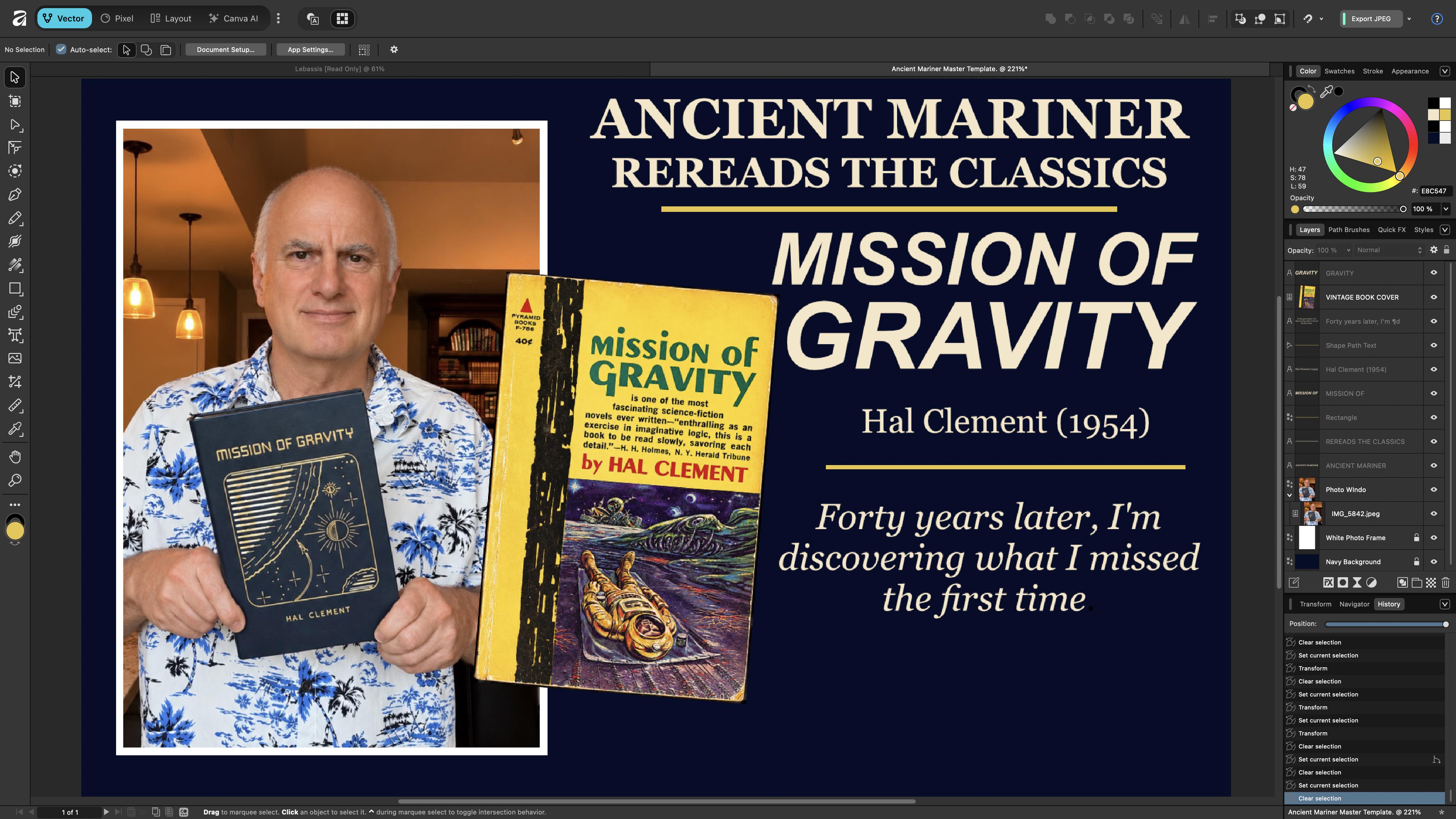
Mission of Gravity*
Hal Clement (1954)
Admin/moderators: The photo shows my iMac running Canva Affinity. This graphic was assembled using conventional design tools, not generative AI.
Clement put a hell of a lot of thought into the physics of this book, especially considering it was written in 1954. Some of his calculations turned out to be wrong, but that don’t take much away from what he accomplished. He built an alien planet where gravity effects just about everything, including how the inhabitants live and get around.
But I think Barlennan might be the smartest character in the whole damn book.
The humans have spacecraft, scientific instruments, and technology Barlennan couldn’t begin to build. He’s got a sailing ship and a crew. That’s about it.
But Barlennan figures out something the humans don’t seem to appreciate. They’ve got knowledge that could change the future of his entire species. And he’s not particularly interested in getting his hands on their equipment. He wants to know how to build it himself.
I spent a good part of my life in the Navy, and one thing I learned is that having the best equipment don’t necessarily mean you’ve got the smartest man in charge.
Barlennan knows what he’s doing. He understands what the humans need, what he’s got to offer, and how much he can get in return. He doesn’t have to outsmart their scientists when it comes to science. He just has to be a better negotiator.
You could take a successful merchant from just about any period in history, put him in Barlennan’s place, and he’d probably do the same thing. Find out what the other fellow needs and make yourself a good deal.
That’s what I like about Clement’s aliens. They look different, live under conditions that would kill us, and have a completely different way of getting around. But when it comes to looking after their own interests, they’re not so different from us.
Most people remember Mission of Gravity for the science, and there’s plenty of good reasons for that. But I think Clement deserves just as much credit for creating Barlennan.
When I first read this book about forty years ago, I was fascinated by the planet and its incredible gravity. Reading it again, I’m more impressed by the captain.
And I suspect Clement would’ve been pleased with that.
⸻
Spoiler-free synopsis:
On Mesklin, a rapidly spinning planet where gravity varies enormously depending on where you are, an alien sea captain agrees to help human explorers recover a stranded scientific probe. Getting there means taking his ship and crew through some of the most dangerous territory imaginable. It’s a story about exploration, survival, and two very different species learning how to deal with each other.
r/sciencefiction • u/alessandrodizziart • 1d ago
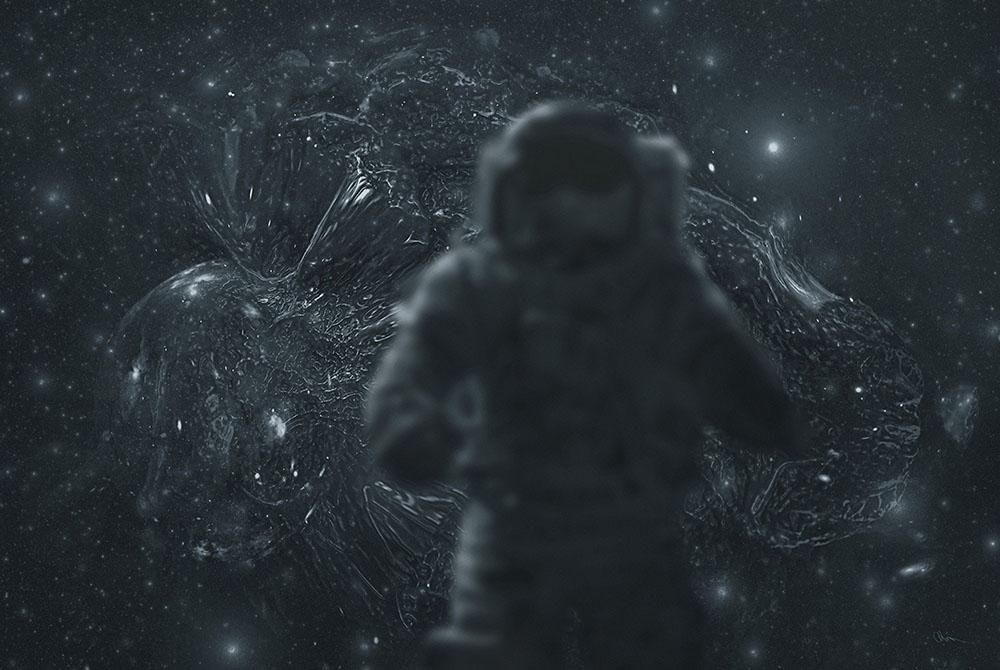
"The Anomaly" is the first part of my art series "BLΛCK", based on the Lense-Thirring effect, a physical phenomenon predicted in 1918 by Josef Lense and Hans Thirring. In simplified terms, this can be visualized as a rotating mass pulling the space around it along like a viscous fluid, twisting spacetime.
The year is 2174. The research station E.W.A. discovers an extremely high-energy anomaly deep within the Eagle Nebula (Messier 16) and sends a small crew of astronauts and scientists to investigate. Upon arrival, they encounter an eerie surprise that completely challenges our laws of physics...
100% Human Art - NO AI!
r/sciencefiction • u/seeryang • 1d ago
Suppose you could play a piece of music for an alien that experiences an entire minute at once. Halfway through, the pianist holds a note a little longer than you expect. For me, that tiny delay might be the best part of the piece. I wonder what the alien would hear. Could a note feel late to someone for whom it had already arrived?
What got me thinking about this was an old Chinese diagram associated with Shao Yong. It arranges the same sixty-four hexagrams in a square and in a circle. I can look at the whole square, or put my finger on the circle and trace it one sign at a time. Nothing on the page changes. But when I follow it with my finger, there’s always a sign I haven’t reached yet.
My instinct is that having to wait gives the listener something. Then I think of a song I’ve played a hundred times. I know exactly when the singer will come back in, and that pause still gets me every time. So perhaps surprise has very little to do with it. Perhaps what matters is that, however well I know the song, my body still has to live through the pause.
Ted Chiang’s Story of Your Life comes to mind here. I’d love to hear about other stories that let you spend time inside a mind like this. Was there a particular scene where you felt what an ordinary pleasure was like for it?
r/sciencefiction • u/Character-Witness-27 • 2d ago

Voyage to the End of the Universe (1963), originally titled Ikarie XB-1, is a Czechoslovak science-fiction film set in the year 2163, following a crew aboard a spacecraft traveling to the distant planet of Alpha Centauri. During their journey, the astronauts encounter mysterious dangers, psychological tensions, and the unsettling discovery of an abandoned spacecraft carrying the remains of a long-dead civilization. A thoughtful and atmospheric example of early European science fiction, the film explores humanity's future, the dangers of space exploration, and the psychological effects of prolonged isolation.
r/sciencefiction • u/BunyipPouch • 3d ago

I organized an AMA/Q&A with the VFX team of Project Hail Mary.
The AMA post is live here now in r/movies for anyone interested in asking a question:
https://www.reddit.com/r/movies/comments/1y57jz5/amaze_amaze_amaze_question_hi_rmovies_we_are_the/
They will be back between 2 PM ET and 6 PM ET today to answer questions. I recommend asking in advance. Please ask there, not here. All questions are much appreciated!
The guests are:
Paul Lambert – Production Side Co-VFX Supervisor - Other Credits: 4x Oscar Winner - Blade Runner 2049, First Man, Dune: Part One, Dune: Part Two
Mag Sarnowska – Production Side Co-VFX Supervisor - Other Credits: Kraven the Hunter, Dune: Part One, The Stand
Stuart Penn – Framestore VFX Supervisor (London) - Other Credits: Mickey 17, Alien: Covenant, Gravity
Bob Winter – Framestore VFX Supervisor (Montreal) - Other Credits: Spider-Man: Brand New Day, Army of the Dead, Starship Troopers
Arslan Elver – Senior Animation Supervisor - Other Credits: Guardians of the Galaxy, Paddington 2, Star Wars Episode VII - The Force Awakens
Trailer:
https://youtu.be/Q2UjkMU_ZWQ?si=AfiDyQPlTI-j7exb
Project Hail Mary follows Ryland Grace (Ryan Gosling), a middle-school science teacher who wakes up from a coma on a spaceship light-years from home with no memory of who he is or how he got there, only to discover he’s humanity’s last hope to save Earth's dying sun, with help from an unexpected alien engineer.
Thank you :)
r/sciencefiction • u/ImAlwaysRightAlways- • 3d ago
OK, this seems too obvious, but I don’t think I’ve seen this - what are you guys favorite sci fi humor books/movies, etc?
I would think the obvious would be Hitchhikers’ Guide and Galaxy Quest. Love to hear your answers!!
r/sciencefiction • u/wholeein • 4d ago

As a young lad Ray Bradbury was easily one of the most influential writers to me. Followed closely by Philip K Dick, Isaac Asimov and Arthur C Clarke. Bradbury's short stories have always just spoken to me in a way that works wonderfully with my brain and there's never been any shortage of wonderful imagery or amazing concepts to dig into and process. The first book of his I ever read was the Martian Chronicles and while I would happily recommend it to anyone that enjoys science fiction there is just something about short stories that I have always preferred at the end of the day. And for me Bradbury strikes an incredible balance between world building, dialogue and letting your brain fill in the blanks just enough for each story to feel fresh upon rereading.
I grabbed this copy of the book at an antique mall for $5 after losing my original one in a move and I'm very happy to have it back.
r/sciencefiction • u/Somatic_Archivist • 4d ago
Hey everyone! I’m currently in the early stages of developing a new hard-science/post-cataclysm sci-fi IP. My goal is to build a cohesive setting that I can then use for short stories, tabletop gaming and much more.
Here is a unit profile for one of the factions in the setting. Since this is part of the bedrock lore, I’d really appreciate some fresh eyes and constructive feedback before I lock it in completely.
If you would like to see the other writings from my setting, please have a look at my profile.
-----
Moeder en Kind (“mother and child” in the native language of the area where it was first encountered in the Cape Peninsula, South Africa) is easily one of The Transcendent’s most horrific creations. Where some factions treat the Somatic Flux as a force to live alongside, The Transcendent treat biology and Flux-driven mutation as raw fuel to be used, abused, and recycled.
The Moeder is a lanky humanoid roughly half a metre taller than the average man, presenting universally female with long, oily hair, sagging breasts, and a horribly distended stomach. Despite their stretched, gaunt proportions, they possess abnormally dense, cancerous muscle tissue that makes them far faster and stronger than they look. Their hands and fingers are elongated, each digit roughly 30 cm long, with the terminal bone piercing through the skin to form a jagged bone claw. A compulsive urge toward dermatophagia drives them to continually strip and gnaw away tissue around the bone, keeping the claws exposed and honed.
Driven by zero self-preservation instinct, the Moeder charges straight into enemy lines to shred targets at close quarters. Unconfirmed field reports suggest a chilling bias: Moeders have been seen bypassing injured or unarmed male soldiers to hunt down female combatants, with darker rumours claiming they specifically single out mothers.
Gunned down in a melee charge, the Moeder triggers the birth of the Kind… not a true child, but hyper-accelerated cancerous proliferation pushed to an extreme. Bursting from the ruptured abdomen as a formless mass of tumorous tissue, the Kind immediately engulfs and consumes the Moeder’s remains through a process similar to phagocytosis. Once anchored, it lashes out with pseudopod tentacles to snag, haul in, and digest nearby organic matter. Because the Moeder sprints straight into the thick of the enemy, there are likely many soldiers within range.
How much true sentience, if any, the Kind possesses remains unknown, and most researchers show very little desire to find out. Once surrounding biomatter is depleted, the Kind triggers rapid onset programmed cell death, collapsing into a dense, concentrated reserve of biomass ready to be collected and reused by The Transcendent.
r/sciencefiction • u/Character-Witness-27 • 4d ago

The Day the Earth Caught Fire is a British science-fiction disaster film directed by Val Guest, depicting a world thrown into chaos after simultaneous nuclear tests by the United States and Soviet Union knock Earth off its axis, sending the planet on a catastrophic collision course with the Sun. Told largely through the eyes of journalists at a London newspaper, the film combines apocalyptic suspense with political commentary, journalistic drama, and a chilling sense of realism.
r/sciencefiction • u/Hopeful-Guard9294 • 5d ago
I am sick to death of the depressing cyberpunk corporate capitalist storytelling of the future that currently dominates science-fiction, i’ve written my first hope punk story and I’m wondering where to find a community of positive solar punk, readers or writers, where I can gently dip my toe in the water and see if my work resonates and uplifts readers at all
r/sciencefiction • u/Ornery_Aardvark_ • 4d ago
Have you ever been inspired by the modern hobby of cyberdeck building? I feel like r/Cyberdecks is a good source of inspiration but I am not a SciFi writer myself. Anyways, just curious on your thoughts.
r/sciencefiction • u/reluctantreddit • 5d ago
Horror movies that have scifi settings can be very good, and really depressing films also have their place. It's just that the wife and I have seen enough of those for now and are looking for something else for a while. Doesn't have to be comedy or fluff or uplifting or even have a happy ending. Just no horror/gore, and not humans-trying-to-survive-post-apocalyptic/climate collapse/alien invasion-hellscape. Thanks!
r/sciencefiction • u/brainshades • 5d ago
The announcement that AI has solved the Riemann Hypothesis, reminds me of the Charles Stross story - Antibodies…
r/sciencefiction • u/Apprehensive_Use_557 • 6d ago
Hello! Years ago I read a short story that involved a time traveler who was looking for, and found, the greatest medieval minstrel of all time. The minstrel observed some "science-fictional stuff" (I keep thinking this was a Fred Saberhagen berserker story) and was inspired by it to create a new song, which he played in a royal court and determined was his masterwork.
The time traveler was so enchanted by the performance that he forgot to record or document the song in any way. At the end of the story, the time traveler says something like "I can't remember exactly what you played, but I've got the basics of the tune and could probably improvise something based on that," and the minstrel replies something like "Well, that's the musician's art, isn't it?"
I'm currently wrapping up my Intellectual Property survey course and would LOVE to refer to this in my final discussion post of the semester (and hey- I'd love to re-read this one and share it with my kids as well). Can anyone help me track this down?
r/sciencefiction • u/Z_Neon • 6d ago
Many foundational cyberpunk works, such as Blade Runner and Neuromancer, are slow-burning. I'd be curious to see if the TV adaptation of Neuromancer will retain the same feel. Some more recent works, such as Cyberpunk Edgerunners, are fast-paced but still manage to capture the core of cyberpunk. I cried when watching Season 1, and I don't cry often at all. Do you prefer slow-burning, atmospheric cyberpunk or fast-paced, action-heavy cyberpunk? Or do you think the best works strike a balance between the two?
r/sciencefiction • u/ImAlwaysRightAlways- • 7d ago
2001 was pretty good. But…
“Contact Starfleet!”
“aye Captain Kirk - response expected in 87 years.”
“And when do we get to Omega Glory?”
“2.75 million years, sir.”
r/sciencefiction • u/oxegeniscool • 6d ago
Alien life exists throughout the universe. Different planets develop their own biological foundations, ecosystems and potentially intelligent civilizations.
Earth is not the only inhabited planet. Every planet in this universe has life.
A life base is the primary chemical foundation upon which an organism's biology is built.
Earth's life base is Carbon (C).
A life base must be a non-metallic element, a metalloid or a chemical compound.
It should usually constitute at least 0.025% of the planet's crust and/or atmosphere.
The abundance requirement is a guideline, not an absolute rule.
The chemical foundation must be capable of supporting the proposed biology.
Each planet has exactly ONE primary life base.
Other chemicals can exist within organisms and their environments, but only one substance is designated as the primary life base.
Carbon (C)
Silicon (Si)
Nitrogen (N)
Oxygen (O)
Phosphorus (P)
Sulfur (S)
Ammonia (NH₃)
Water (H₂O)
Methane (CH₄)
Hydrogen (H₂)
Approximately 90% of life throughout the universe uses common non-metallic elements and chemical compounds. The remaining 10% may use rarer or more unusual chemical foundations.
Every planet has life, but planetary environments determine what types of organisms can develop.
Rocky planets can support:
Land-dwelling organisms.
Aquatic organisms.
Underground organisms.
Flying organisms.
Potentially human-like intelligent civilizations.
Gas giants can also support conscious and intelligent life.
However, their organisms are restricted to flight-based existence.
Gas giant organisms:
Live within atmospheric layers.
Fly, float, glide or remain suspended.
Can develop intelligence and consciousness.
Can communicate and form societies.
Can develop cultures, technologies and civilizations.
Gas giants do not have conventional surface-dwelling ecosystems.
The Civilization Zone replaces the traditional concept of the Habitable Zone.
Definition: The Civilization Zone is the orbital region around a star where conditions are favorable for human-like intelligent civilizations to emerge, develop and thrive.
Important distinctions:
Life can exist outside the Civilization Zone.
Being inside the Civilization Zone does not guarantee civilization.
Planets outside the zone can still have complex ecosystems and intelligent organisms.
Gas giants are not excluded from developing civilizations.
The Civilization Zone concerns the potential for human-like civilization, not simply the presence of life.
Host star: Sol (the Sun)
| Planet | Life base |
|---|---|
| Mercury | Silicon (Si) |
| Venus | Silicon (Si) |
| Earth | Carbon (C) |
| Mars | Silicon (Si) |
| Planet | Life base | Life type |
|---|---|---|
| Jupiter | Hydrogen (H₂) | Atmospheric flight-based life |
| Saturn | Ammonia (NH₃) | Atmospheric flight-based life |
| Uranus | Methane (CH₄) | Atmospheric flight-based life |
| Neptune | Methane (CH₄) | Atmospheric flight-based life |
Gas giant life can be conscious, intelligent and capable of forming civilizations, but must remain flight-based.
Ceres
Orcus
Pluto
Haumea
Quaoar
Makemake
Gonggong
Eris
Sedna
These are included in the planetary census. Their life foundations have not yet been assigned.
Host stars:
Rigil A (Alpha Centauri A)
Rigil B (Alpha Centauri B)
No confirmed planets have been added to the Rigil A or Rigil B planetary census.
Host star: Proxima Rigil (Proxima Centauri)
| Planet | Official designation | Distance from star | Life base |
|---|---|---|---|
| Vulcan | Proxima Centauri d | 0.029 AU | Ammonia (NH₃) |
| Cacus | Proxima Centauri b | 0.049 AU | Silicon (Si) |
Vulcan supports unusual ammonia-based life, including aquatic or fish-like organisms.
Cacus supports silicon-based life with more familiar biological characteristics.
Host star: Barnard's Star
| Fictional name | Official designation | Life base |
|---|---|---|
| Erebus | Barnard b | Silicon (Si) |
| Atlas | Barnard c | Sulfur (S) |
| Aether | Barnard d | Silicon (Si) |
| Moros | Barnard e | Carbon (C) |
All four planets have assigned biological foundations.
Their proposed ecosystems and chemical compositions remain fictional.
Host star: Wolf 359
Star type: Red dwarf.
Distance from Sol: Approximately 7.86 light-years.
Confirmed planets: None currently included in the census.
The Canine System is the next system being explored.
Host star: Ran (Epsilon Eridani)
| Planet | Official designation | Life base |
|---|---|---|
| Ægir | Epsilon Eridani b | Carbon (C) |
Ægir is a gas giant with atmospheric, flight-based life.
Its organisms can potentially develop consciousness, intelligence and civilizations.
| Foundation | Planets |
|---|---|
| Carbon (C) | Earth, Moros, Ægir |
| Silicon (Si) | Mercury, Venus, Mars, Cacus, Erebus, Aether |
| Sulfur (S) | Atlas |
| Ammonia (NH₃) | Vulcan, Saturn |
| Hydrogen (H₂) | Jupiter |
| Methane (CH₄) | Uranus, Neptune |
Every planet has life.
Every planet has exactly one primary life base.
Life bases consist of non-metals, metalloids or chemical compounds.
Life bases usually represent at least 0.025% of the planetary crust and/or atmosphere.
Approximately 90% of extraterrestrial life uses common chemical foundations.
Rocky planets can support diverse forms of life.
Gas giants can support conscious and intelligent life, but only flight-based organisms.
Intelligent life is not restricted to the Civilization Zone.
The Civilization Zone describes where human-like civilizations can emerge and thrive.
Different planetary environments produce different evolutionary paths.
End of Current Lore Document
This document represents the current established rules and planetary assignments. Future star systems, planets, biological foundations and civilizations can be added as the universe expands.
r/sciencefiction • u/Def-C • 7d ago
I’m looking for Spy/Espionage thrills that employ conventions of Science fiction, whether it’s integrated through futuristic gadgets, space exploration, dystopian worlds, etc.
I think of 007/James Bond (Moonraker, You Only Live Twice, The Spy Who Loved Me, etc.), New Rose Hotel, Demonlover, Cypher, Eidos’ Deus Ex, Metal Gear Solid, No One Lives Forever, The Venture Bros., etc.
r/sciencefiction • u/irvojaros • 8d ago
I was away from reddit for a few days (a lot of business-tripping), so I missed that big self-promo poll we had here. Still I felt like sharing a few thoughts.
I am quite torn on this topic. Without indie or self-publishing, we would have never discovered Project Hail Mary or Bobiverse or Dungeoncrawler Carl or Sword of Kaigen. Then there are the megatons of AI slop and low-effort works that tend to drown all the unique voices in overwhelming noise.
As an independent author myself I, of course, want to talk about my story or recommend my book. But I also cherish these nerd subs for what they are: fora for debating strange ideas, getting cool recommendations, etc. I play by the rules and do self-promo when allowed, be it dedicated days or megathreads - only to see my posts instantly downvoted out of principle. On one hand, it is extremely frustrating to see that happen to me after years of writing and thousands of dollars invested into design and editing. On the other hand, I do kind of get it. People hate slop and at some point stop trying to hope there is a diamond in the rough somewhere there (not to suggest my stories are said mineral).
So yeah. I appreciate a controlled environment to talk about my work and I thank those who give it a look if interested or just skip ahead without the urge to insta-downvote if not.
Anyway, SF rocks!
r/sciencefiction
•
u/Scott_A_R
•
8d ago

I started reading Harry Harrison's Deathworld, a series that I'd long overlooked. It's set in the distant future, when humans have colonized multiple star systems, and interstellar travel is (it seems) simple and practical--there was reference to a "jump" to indicate some method of movement between solar systems in relatively short periods of time, but there's no further info.
There are little references to various technologies that are vague enough not to stand out, but then the MC goes to a library for information and it's described like this: “Operation of the library was completely automatic. A projected index gave the call number for any text that had to be consulted. The tape was delivered to the charge desk thirty seconds after the number had been punched. Returned tapes were dropped through a hopper and refiled automatically. The mechanism worked smoothly.”
And in a later scene, it was casually noted that, in this distant future, paper was regularly being used to store books and records.
I started reading sci-fi before dialup was widespread, but even still this was pretty jarring; the series was written in the 1960s, and I don't know what I should reasonably have expected the author to envision for the space age. But Ringworld came out in 1970 and Niven seemed to have a much more creative vision for the future.
Has anyone else read older sci-fi and been amused at how seemingly low tech it was?