Please stop telling people to go to r/mescaline with any questions about San Pedro use. These questions are totally appropriate here. r/mescaline is fine for some things but that sub tends to be more focused on mescaline molecule and usually into extractions. Huachuma/San Pedro cactus is much much much more than just the mescaline. Sending people asking about ceremonial use of San Pedro to a sub that’s about just one molecule in the cactus and more focused on extractions is not the go.
I know the rules can be a bit confusing but it is not against the rules for people to post about or ask about San Pedro experiences here, especially for educational and harm reduction reasons.
Howdy fellow cactaphiles. This post will be stickied as a reference to help people identify the common San Pedro Lookalikes. The following plants are columnar cacti that are easily confused for the Trichocereus species. You can use this guide to compare your mystery cactus to these photos and descriptions.
#1 - Cereus species -
The infamous "Peruvian Apple Cactus." This is most commonly mistaken for San Pedro because it's size, profile, color, and flowers look very similar to Trichocereus.
There are several species of Cereus that look almost identical. They usually get lumped into the description of Cereus peruvianus, which is not an accepted species.(https://cactiguide.com/article/?article=article3.php). These include C.repandus, C. jamacaru, C. forbesii, C. hexagonus and C. stenogonus. Other Cereus species are easier to distinguish from Trichocereus.
The main features that distinguish a Cereus from a Trichocereus are the flat skinny ribs, hairless flower tubes, and the branching tree-like structure of mature plants.
#2 - Myrtillocactus geometrizans -
This cactus goes by many names including the blue candle, whortleberry, bilberry, blue myrtle...
This plant often has a deep blue farina, but larger plants usually look light green. Young plants are columnar and usually have 5-6 angular ribs. The ribs are often thicker than a Cereus and narrower than Trichocereus. Mature plants can get large, but are more shrub-like than tree-like.
The best way to distinguish these plants from Trichocereus is to look at the spines. Myrtillos have a few short spines per areole. The spines on short plants are usually dark colored and pyramidal (instead of round, needle-like spines.) Spine length increases as the plants age, but the spines stay angular.
#3 - Stetsonia coryne -
This is the toothpick cactus. It looks very similar to Trichocereus species like T. peruvianus, T. knuthianus, etc. However, there are a few subtle ways to distinguish a Toothpick cactus from a Trichocereus.
The dermis of a Stetsonia will be a darker green in healthy plants. The aeroles are large, white, woolen and not perfectly circular.
The easiest way to distinguish a Toothpick cactus is of course, by the spines. Stetsonias will have one long spine per areole that resembles a toothpick. The coloration of new spines will usually be yellow, black, and brown. They lose their color and turn grey to white rather quickly. Usually only the top few areoles will have the colorful spines.
#4 - Pilosocereus species -
There are many species in the Pilosocereus genus, but just a few closely resemble San Pedros. Most Pilosocereus will be very blue, with needle-like spines that are yellow to grey. The most common, and most commonly mistaken for San Pedro is P. pachyclaudus. Other Pilos are much more uncommon, or have features like long hairs that make them easy to distinguish from a San Pedro.
Young P. Pachyclaudus will usually have a vibrant blue skin with bright yellow spines. This should make them easy to pick out of a lineup. Unhealthy plants will have lost their blue farina. For these plants look at the areoles and spines for ID. There should be about 10 yellow, spines that are evenly fanned out within the areole. The spines are also very fine, much thinner than most Trichocereus species.
#5 - Lophocereus / Pachycereus species
Pachycereus got merged into the Lophocereus genus this year!? Wacky, but they still get confused with San Pedros so here are the common ones.
L. Marginatus is the Mexican Fence Post cactus. The size and profile are very similar to San Pedro. The easiest way to distinguish a fence post is by their unique vertical stripes. I stead of separate areoles, you will notice white stripes that run the length of the plant. Unhealthy plants will lose the white wool, but upon a close inspection, you can see the line of spines. The flowers are also small and more similar to Pilosocereus flowers.
L. Schottii is another common columnar. Especially in the Phoenix metro area, you will drive past hundreds of the monstrose form. The totem pole cactus slightly resembles a monstrose Trichocereus. The exaggerated lumpiness and absence of descernable ribs or areoles makes a totem pole pretty easy to spot.
The non-monstrose form of L. schottii is actually less common. Adults look similar to an extra spiny Cereus or L. marginatus. Juveniles look more like the juvenile Polaskia and Stenocereus species.
#6 - Stenocereus and Polaskia species
Polaskia chichipe can look very similar to San Pedros. The best way to discern a polaskia is by the ribs and spines. The ribs will be thinner and more acute than Trichocereus, but wider than Cereus. They usually have 6-8 evenly spaced radial spines, and one long central spine. Although the spination is similar to T. peruvianus, the central spine of a Polaskia will be more oval shaped instead of needle-like. Adult plants usually branch freely from higher up. Juvenile plants often have a grey, striped farina that disappears with age. This makes them hard to discern between Stenocereus and Lophocereus juveniles, but it is easy to tell it apart from a Trichocereus.
Polaskia chende - Is this a recognized species? Who knows, but if it is, the discerning characteristics are the same as P. chichipe, except the central spine is less noticeable.
Stenocereus - There are a few Stenocereus species that can be easily confused for San Pedros. Juvenile plants look very similar to Polaskia. Stenocereus varieties such as S. aragonii, S. eichlamii, S. griseus, etc get a grey farina that usually forms Chevron patterns. S. beneckei gets a silvery white coating too.
Mature plants will look very similar to San Pedros. The identifying traits to look for are the acute rib angles, spination and silvery farina that often appears in narrow chevron patterns. The flowers are also more similar to Lophocereus spp.
#7 - Browningia hertlingiana
Brownies are beautiful blue plants that can look similar to Trichocereus peruvianus or cuzcoensis. The ribs are the defining traits to look at here. The ribs of a Browningia are wavy instead of straight. Mature plants will often have more than 8 ribs, which would be uncommon for most Trichocereus species.
#8 - Echinopsis?
Is a Trichocereus an Echinopsis? Yes. Is an Echinopsis a San Pedro? Sometimes. Most folks consider the San Pedro group (along with a few other species) too different from other Echinopsis and Lobivia species to lump them together into the same genus. Just because they have hairy flowers and can fertilize each other, should they be in the same genus?
Echinopsis species are usually shorter, pup from the base, and have more ribs. There are many different clones and hybrids that are prized for their colored flowers. Where most Trichocereus have white flowers instead.
Echinopsis x Trichocereus hybrids do exist, and they are getting more popular. Should they be treated as the same genus? Who cares if they are awesome plants.
If your plant doesn't match any of these, feel free to post an image (or a poll) and see what the community can come up with.
This fasciated guy I got from a gentleman in St. Pete, FL. He said it was a personally grown cultivar he dubbed “Best Crest.” It took a while, but it’s finally putting out some nice growth!
A vigorous beast, officially my 50th harvest from these mother plants , over 5,000 feet of cacti harvested from these. They are now growing in all fifty states , and many foreign counties. A beautiful blue clone and fine example of how productive a mother plant can be when properly maintained. Started from a few cuttings planted in 1970 by a Mr Salvador Alvarez , whom I met at the age of 99 and has since passed.. I found these plants around six years ago with my friend Josh in an area we had been a thousand times growing up and never noticed. Lucky to be able to maintain the legacy.
I’m putting things inside for the winter, realized I’m not sure if I need to put the sun goddess in or if it can stay outside or even get planted in the ground. I’m in zone 8b near seattle.
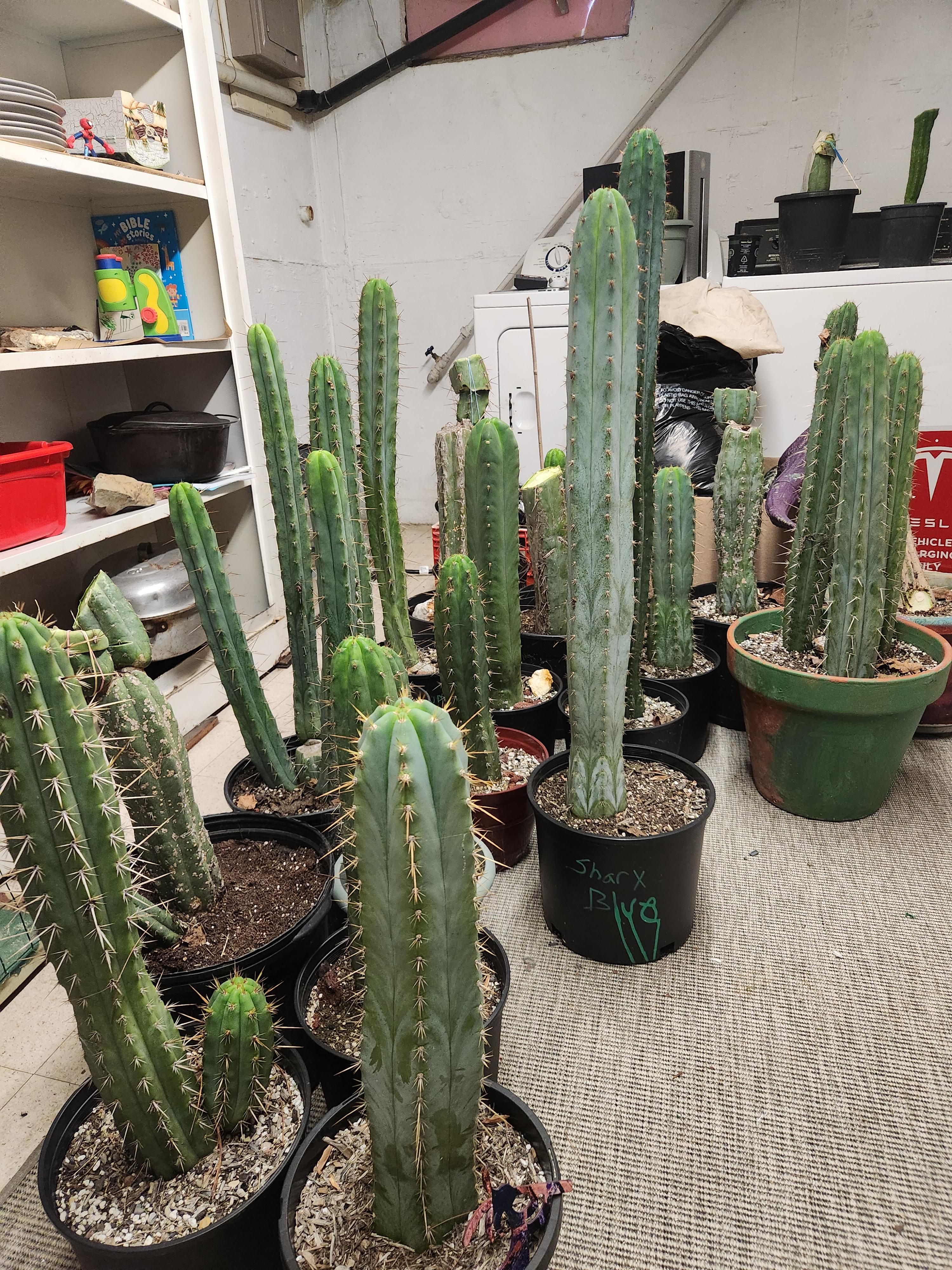
Will my friends be ok. I have put them all in the basement this year for winter. It is cool and dry down there. Last year I left them in my enclosed porch and saw some signs of frost damage this summer. Im in Indiana
People are always posting pics of cactus like oh yeah this is Franklin x jazzyjeff, or jr1093 x scoptopdroptop. Other than having an encyclopedic mind for cactus varieties, how are you supposed to organize this thinking? Like do people actually read those names and go "ah yes Blue Buffalo, that is a find cactus genetic line, with thicc ribs and long spines".
I find it overwhelming and am always like "damn that's a nice cactus" but it might as well be a foreign language. I'm still struggling to keep the scientific names straight amongst all the closely related/cultivated species.