r/regulatoryaffairs • • Feb 07 '26

General Discussion Why "Sufficient" is the most dangerous word in a Technical File.

3 Upvotes

I’ve been obsessed lately with why so many internal audits—which look perfect on paper—end up getting shredded during an actual FDA inspection or Notified Body review.

After looking at dozens of Risk Files and Design Inputs, I have a theory: We treat compliance like a creative writing exercise when it should be a math problem.

The biggest culprit? "Weasel Words."

I’m talking about subjective terms like Sufficient, Adequate, Appropriate, or As needed. We use them to bridge the gap between what we think we’ve done and what we can actually prove.

The Human "Skimming" Trap

As engineers, we are brilliant at critical thinking, but we are biologically wired to fail at repetitive logic checking. By the time a human reviewer hits page 40 of a technical specification, the brain starts "filling in the blanks."

We see the word "Adequate," and because we know the product works, our brain accepts it as a "Pass." But an FDA auditor doesn't care if the product works; they care if the evidence mapping is literal.

The "Negative Filter" Approach

I’ve stopped trying to use AI to "generate" compliance (which just creates more fluff). Instead, I’ve been experimenting with using it as a Negative Filter. Instead of asking "Is this compliant?", I ask: "Identify every claim in this document that lacks a literal, quoted reference to a test report or requirement."

If you have 11 requirements and 9 have direct evidence mapping, but 2 rely on "Sufficient" as a justification, you don't have a 90% success rate—you have a 100% chance of a GAP finding.

My question to this group: How do you handle the "Subjectivity Creep" in your documentation? Do you have a formal process for hunting down these weasel words before an audit, or is it just a "hope the reviewer is tired" strategy?


r/regulatoryaffairs • • Jan 05 '26

General Discussion Cybersecurity sections in FDA submissions are slowing down everything

0 Upvotes

We’re mid-process on a Class II device and have hit more delays on the cybersecurity side than we anticipated. The core 510(k) content is clean - predicate device, testing, labeling, all good, but the FDA’s expectations for cybersecurity documentation have added a whole new layer of complexity.

What’s surprising is how much of it isn’t just security-by-design, but how you demonstrate it in submission language. Threat models, SBOMs, postmarket monitoring strategies… all of it needs to be not just technically sound, but packaged to fit FDA language and structure.

We brought in Blue Goat Cyber to take over the cybersecurity documentation and risk analysis side, they’re pretty focused on this specific niche and have helped keep things aligned with the guidance. Still, I wonder if anyone’s found a more efficient internal workflow for integrating cybersecurity into the regulatory pipeline without constantly reworking things as guidance shifts.

It’s starting to feel like unless cybersecurity is embedded into the regulatory strategy from day one, you’ll be stuck in reactive mode for most of the submission.


r/regulatoryaffairs • • May 26 '26

What Would You Do?

1 Upvotes

23F and honestly having a full blown career crisis. I graduated in May 2025 with a health science degree. 3.5 GPA. My original plan was optometry school, which is why I chose the degree in the first place, but the schooling honestly scared me away. I struggled enough with prereqs in undergrad (organic chemistry and anatomy especially humbled me badly lol) and the idea of 4 more intense years plus hundreds of thousands in debt for a salary that honestly isn’t THAT high compared to the debt made me start questioning everything.

I actually never completed organic chemistry or anatomy. I withdrew from both because I was failing them pretty badly and realized I genuinely might not be cut out for certain heavy science paths. I still graduated with my degree without those classes, but now if I wanted to apply to certain science-based programs like radiology or other healthcare fields, I’d probably have to go back to school for at least a semester just to finish prereqs first, which makes everything feel even more overwhelming.

I worked as an optometry tech from October 2023 to January 2025.

Since then, I’ve been doing social media/TikTok full time and thankfully made a pretty good amount of money from it, so financially I’m okay right now. But social media obviously is unstable long term and now I feel completely stuck trying to figure out what actual career path makes sense for me.

For years I also considered law school because I’ve always liked reading/writing more than science, but now I’m questioning if I’m cut out for the stress and lifestyle of law too. I know deep down I’m not. I value low stress and law is very much not that (my dad’s an attorney, so I’ve witnessed firsthand lol.) I’ve also looked into radiology tech, a master’s in health administration, regulatory affairs masters, occupational therapy, nursing, etc.

Every option sounds okay until I start thinking about debt, burnout, stress, failing, years of schooling, whether I’m even passionate enough, etc.

Last fall my plan was actually to work in healthcare administration while getting my MHA part time. I applied to probably 100+ entry level admin/coordinator jobs, got a couple interviews, and then never actually landed a job. That honestly destroyed my confidence for a while because I thought healthcare admin would be my “safe” option after graduating.

Another thing is I honestly don’t currently plan on working much once I have kids someday if I’m fortunate enough not to have to. So part of me struggles with the idea of taking on massive debt and years of stress for a career I may not even stay in forever. But at the same time, I still want something respectable, stable, and meaningful because I hate feeling directionless.

Meanwhile everyone around me seems to have their lives figured out already. Any advice, recommendations, or suggestions are welcome. Thank you so much for reading/helping!


r/regulatoryaffairs • • Apr 11 '26

General Discussion How is your RAQA team actually using AI?

0 Upvotes

Obviously lots of hype around AI workflows/agents, but it does seem that the companies that adopt it safely will obviously have a significant advantage. The FDA themselves are claiming to be bringing in many new AI assisted workflows.

Wondering what teams are actually doing? And how you're dealing with the challenges of passing tool validation? Assuming it's just always keeping human in the loop at crucial steps?


r/regulatoryaffairs • • Mar 30 '26

Getting into Regulatory Affairs

0 Upvotes

Hello everyone,

I am exploring regulatory affairs, and I am curious about how the process works. My understanding is that RA officers are tasked to translating compliance requirements into actionable KPIs.

How does an RA start their job and where does it end? Are they given a list of chemical compounds and then they have to figure out what regulations they need to follow?


r/regulatoryaffairs • • Feb 10 '26

AI for Reg Strategy

0 Upvotes

Anyone here know of AI that people at their company are using for regulatory work. Primarily for help with HA interactions and responses and work related to that. If so how do you use it? How does it work? Did your company validate the AI software? Thanks all just curious! Veeva should have AI but maybe there is something better or already out.


r/regulatoryaffairs • • Sep 10 '25

General Discussion What are some latest use cases of AI in RA? Especially in submission/publishing

0 Upvotes

r/regulatoryaffairs • • Mar 18 '26

Career Advice Seeking Regulatory Affairs Roles (Medical Devices),1-2 Year Experience, Immediate Joiner

0 Upvotes

Hey folks,

I’m currently exploring opportunities in Regulatory Affairs (Medical Devices) with 1-2 year of experience.

Worked on:

•Regulatory documentation and submission support •Technical file / dossier preparation •Exposure to US FDA (510(k)) and EU MDR requirements •Labeling review and compliance checks •Coordination with cross-functional teams (QA/R&D)

I’m looking for roles in Hyderabad / Bangalore / Pune and can join immediately.

If your company is hiring or if you can refer me, I’d really appreciate it 🙌

Happy to share my resume in DMs. Thanks!


r/regulatoryaffairs • • Apr 16 '26

How does starting out as a Regulatory Affairs Manager in the homeopathic and herbal medicine sector impact one’s future career path?

0 Upvotes

Hello, I don’t have any experience in regulatory affairs yet, but I’d like to get into the field—preferably at a reputable pharmaceutical company, of course. However, I’m aware that this can be very difficult at first, or rather, that it’s generally hard to break into the field. There are two companies in my area that specialize in homeopathy and phytopharmaceuticals, and they likely hire entry-level candidates.

I have a master’s degree in chemistry and have been working as a CTA in a laboratory (clinical chemistry) for the past 1.5 years to gain practical experience.

Does anyone have experience with this and can tell me whether the skills I’m learning in this field are transferable to the broader pharmaceutical industry? How will working in homeopathy affect my reputation in the pharmaceutical market? Could it hurt my chances, or should I take this opportunity to gain a foothold in the industry?

Thanks in advance for your help!!

And if it’s important, I live in Germany


r/regulatoryaffairs • • Jun 16 '25

Career Advice Recommend RA to someone just starting?

1 Upvotes

Hi, I have no education or experience in RA. and I’m deeply (😅)researching about the possible further career paths. RA is one of them that I’m considering.

For me, fast-paced and stressful environments are not places I can do very well in. And by fast paced and stressful, I mean: Having to do multiple tasks real time and getting them done so quickly now or within a few hours. An example of that environment would be working in a kitchen in a restaurant or a bakery. Not good for me. Not good…lol

So, my questions about RA are:

  1. Do you think the nature of RA is stressful and fast paced in the above definition?

  2. If it gets fast, how often it is like that? And how deadlines are like in those stressful situations?

  3. RA in food, pharmaceutical and etc.. has huge difference in terms of responsibilities and roles?

  4. What are the challenges in your opinion?

  5. And what traits are required to do well in RA?

Thank you all for your time!


r/regulatoryaffairs • • Oct 26 '26

Is this the right career path for me?

0 Upvotes

Hi, I just started 9th grade and I’ve been thinking about my career path and planning in the next few years. I know a lot of people would say it’s too early to think about things like this, but I want to be prepared as we all know how the job market is and there’s no telling how it’ll be by the time I graduate college. To put things in perspective, right now I’m taking a dual enrollment college class for principles of business, biology honors, World History AP, Algebra 1 Honors, and ELA Honors. There aren’t a lot of options available at my particular high school for freshman to take more AP courses or dual enrollment, so I took all the ones available. As for my interests, I really like History, it’s my favorite subject actually, but there isn’t a strong career path for that. I think I’m very good at ELA with writing and I enjoy it, especially informative writing and even essays (I found a 15 page essay easier than an interview assignment) I hate creative writing though. I like science decently, I get good grades in it and am literally the only one participating sometimes. However, I genuinely hate math, like even when I understand it, I just hate doing it, especially algebra. The numbers get jumbled up in my head and I don‘t understand the equations, I’m fine in geometry or statistics though with what I’ve done so far.

I did some research and I’ve found regulatory affairs as a good career choice for me depending on my skills. I was thinking going into pharmaceuticals regulatory affairs or such, but I’m not entirely sure. I was hoping if anyone could give their perspective on the job, a day in their life, or if what they do matches my interests, or what they took in high school/college.

I want to also note that I’m a terrible public speaker, I can talk to people and will talk to people if I have to, Im not completely silent but I find that I can be sometimes socially awkward. Is presenting or such a part of the job? As I will probably fry myself doing so, I can’t speak during a presentation without saying ”like” 70 times. I need to work on that.

I appreciate any advice and thank you for taking time to reply. I don’t really know anyone in this sector, but this seems like something in STEM that will still have a good job market in the future.


r/regulatoryaffairs • • Jan 20 '25

Career Advice Job in US after gaining work experience from India in RA after B.Pharm

0 Upvotes

I’m a 22 year old B.Pharm graduate from India and currently working as a regulatory affairs officer at a generic pharmaceutical company. What chances do I have to land a job after MS from US that i will be able to land a job afterwards? Will my 1.5 -2 years experience from India be considered in US?


r/regulatoryaffairs • • Dec 23 '25

Looking to work as a freelancer in Regulatory affairs

0 Upvotes

Hey there! I am looking to work as a freelancer based in toronto for entry-level regulatory affairs role where I can gain valuable experience!


r/regulatoryaffairs • • Oct 21 '24

Career Advice Biotech graduate want to get into regulatory affairs

0 Upvotes

Hi I am a biotech graduate.. have worked as a pharmacovigilance safety scientist for 4 months ..want to get into regulatory affairs .. confused whether i should do a certificate course from RAPS (12 months) or a certificate course from Northeastern which I can use to compelte my MS in regulatory sciences … RAPS certificate course online is cheaper around $4000.00 compared to other programs.. goal is to get an entry level position.. thanks for reading and your advice..


r/regulatoryaffairs • • Jul 06 '24

Suggestions/advice for regulatory affairs

0 Upvotes

Hey, I'm from India and I have completed my bachelors in biotechnology engineering. I have one year of experience as a research analyst intern. I have an admit in Northeastern University, Boston for Masters in Regulatory Affairs of drugs, biologics, and medical devices. I have no experience in the regulatory field as such. I'm thinking to take an educational loan of 50 lakhs. Is it feasible to go to the States in the current economy and find a coop/full time position with a company offering to sponsor a H1B visa? Any advice is greatly appreciated.


r/regulatoryaffairs • • Sep 28 '25

General Discussion 510(k) submission after development of class II device

0 Upvotes

So I'm RA in medical device startup and we manufacture class II devices with predicate devices. We are based outside US and didn't plan 510(k) from product initiation. Currently we are ISO 13485 compliant and meet the regulatory requirements of current market. We are exploring for 510(k) of our device and I need to lead the process. Since I have never done the FDA documents before, I have read fair bit of guidance docs and other content online. But find it too overwhelming and lots of information to process. What I want is a simple list of documents needed for submission and their tample or example document so that I can prepare these documents for our device? Any advice for me or am I thinking in the write direction and if yes where can I get the exact structured information?


r/regulatoryaffairs • • Aug 01 '26

Career Advice Breaking into Regulatory Writing & Affairs

0 Upvotes

Currently a freelance medical writer with DVM, PhD (US). Therapeutic area: Oncology and rare diseases. I want to get into regulatory work- writing/ affairs / compliance, specifically for EU market. Did you find any courses or certifications that helped? Currently Considering 1. RAPS -RAC exam, is it worth it? 2. EMWA professional development programs. Any companies that offer internships / programs to get into regulatory affairs? Thanks!


r/regulatoryaffairs • • Nov 06 '25

Starting a career in regulatory affairs

0 Upvotes

I finished pharmacy in other country and can’t get a license here so I am thinking to start a career in RA I have an excellent gpa and planning to get RA certification after that I will start looking for internships positions, I don’t need sponsorship or anything.

How bright is the feature for RA is it worth it? How competitive is the market and how hard is it to start a job ? Do you advise me to start a career in that?


r/regulatoryaffairs • • Aug 14 '26

Hi can anyone guide how to score a Health Canada or Canadian Pharma Company entry level job ?

0 Upvotes

Hi, any guidance would be helpful. I did a semester in Seneca RAQC , but realized they weren't worth it, no co-ops , no in pharma jobs, and no networking help either. So, reaching out on the platforms that understands. Any guidance (other than enrolling into a program) is great!


r/regulatoryaffairs • • Jul 14 '26

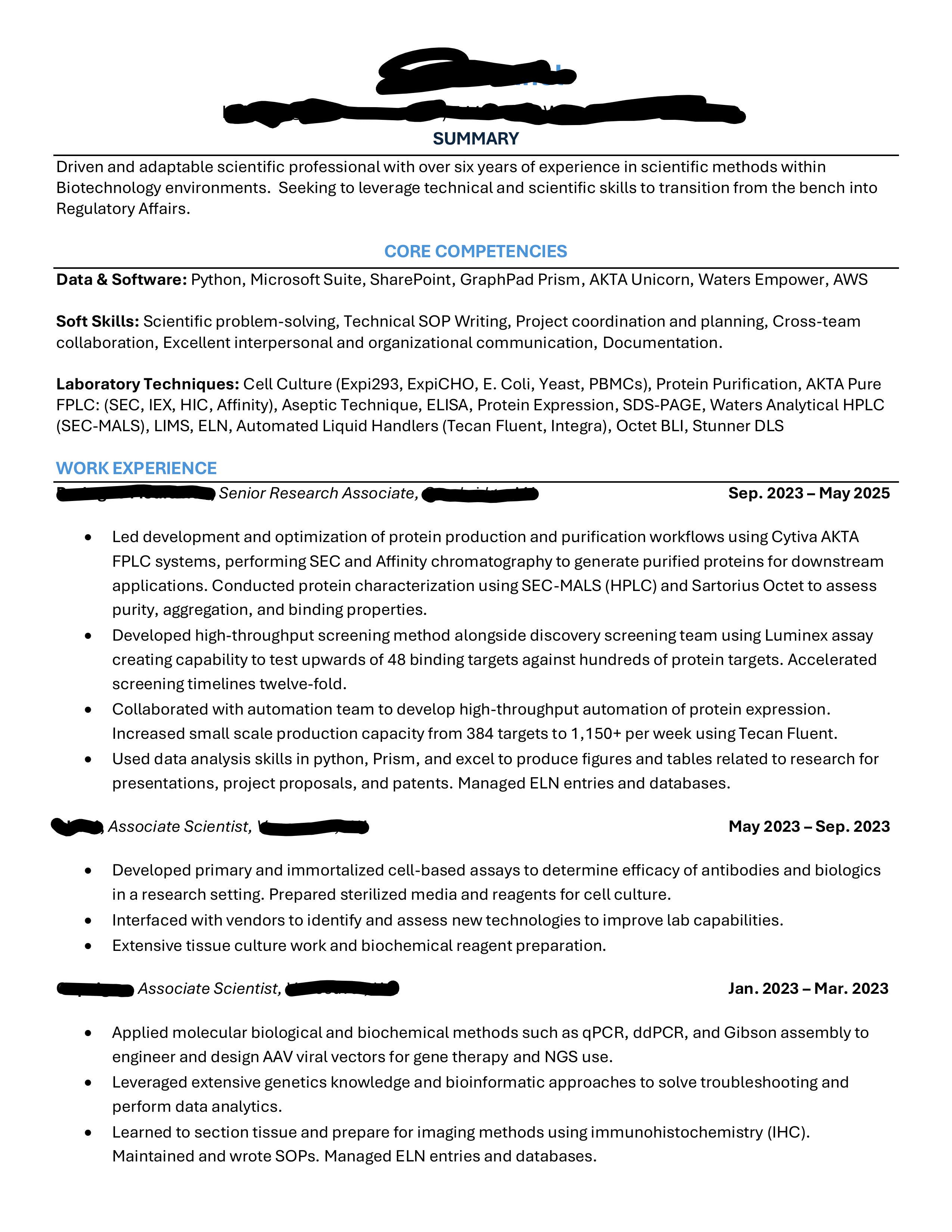
Career Advice Masters in Biotech, 7 years of lab experience, how can I restructure my resume for Regulatory Affairs career switch?

Post image
3 Upvotes

Sorry I could only upload the first page of my resume as the uploader was giving me an error, but I think it still should be fine, the second page is just more work experience and my degrees.

I'm looking to make a career switch. I was laid off from an interim role running microbiology QC and managing fermentations at a large brewery in January. I was looking to get back into Biotechnology, but the market for R&D and lab work has completely collapsed as many of you might know, and it seems like I won't be able to get back into the lab. I have always been interested in Regulatory Affairs, especially since I didn't really want to stay in the lab long term, and I know many folks make this transition.

How can I rewrite my resume to give myself a better chance at getting an entry level RA role in Biotech or biopharma? What terminology should I use and what skills should I highlight? Would it make sense to pursue a certification in RA? I have ample technical writing experience, I have written many SOPs and descriptions for Patent submissions. Any help would be appreciated.

EDIT: commenter pointed out my area of expertise might help lol. Most of my work has been in Biologics and Small molecule/large molecule drug discovery and development. So I would like to focus in these sectors.


r/regulatoryaffairs • • Aug 15 '26

Why are we still burning thousands of engineering hours tracking bound monomers in completely safe polymers?

3 Upvotes

I’ve been in the chemistry/coatings industry for a while now, and the sheer amount of wasted human potential in global chemical compliance is starting to drive me insane.

Under EU-REACH (and now all the global clones popping up), polymers are supposed to be "exempt." But as anyone managing product stewardship knows, the monomer tracking rules (Article 6(3) w/w limits) mean you’re still forced to run endless stoichiometric calculations on inert, fully reacted, non-hazardous resins.

From a basic toxicological standpoint, a high-molecular-weight, crosslinked polymer or dry acrylic bead is inherently safe. It has zero bioavailability. It’s physically impossible for it to cross biological membranes.

Yet, we spend tens of thousands of dollars and endless technical hours tracking bound monomer fractions down to the metric ton, buried in fragile legacy spreadsheets passed down like sacred family heirlooms by internal gatekeepers.

We’ve completely decoupled chemical safety from administrative paperwork:

1 The Paranoia: Regulators treat inert architectural resins that last 30 years with the same procedural friction as volatile free monomers because they’re terrified of "loopholes."

2 The Global Spread: Now we watch markets like Turkey (KKDIK) try to copy-paste this massive, expensive EU administrative machine into price-sensitive supply chains, leading to endless extensions because nobody can afford the Letters of Access or the tracking overhead.

3 The Revenue Model: It feels like REACH has evolved into a regulatory cost center bankrolled by high-volume safe polymers to subsidize the database, rather than a targeted tool to stop actual toxic hazards.
If you’re a formulator or plant engineer, how much of your life is consumed by running monomer calculations on stuff you know is toxicologically harmless?

Are your sites actually transitioning to automated global OR tracking, or are you all still secretly running multi-million dollar product lines off 6-year-old macro-enabled Excel sheets that one guy who retired in 2018 created?

Curious to hear how bad it is at other sites.


r/regulatoryaffairs • • Nov 16 '23

2024 is coming fast - Career Consultations

2 Upvotes

Hello again - many of you have seen my posts here before.

The level of engagement has been truly heartwarming, and the level of subsequent productive networking equally rewarding.

I began posting on this subreddit to introduce myself to this close-knit community of whose industry I live and breathe its talent acquisition.

Most people I have spoken with were previously unaware of how recruitment/headhunting/talent agency works in Pharmaceutical/Medical Device Regulatory Affairs.

Essentially, companies (the biggest and most well known like Takeda, BMS, Moderna etc. through to small biotechs) retain my services when they need to find a specifically experienced Regulatory professional. These specific experience variations come down to therapeutic area expertise, Regulatory vertical (CMC/Clinical/AdPromo), and leadership.

The reasons companies pay top dollar (25% of a candidate's first year base salary) for me to fill these positions is because a candidate can only have had such experience if they have previously gained it, i.e., you cannot grow Regulatory professionals on trees or gain that experience through schooling or coursework - you have to have been in the trenches doing that hands on work. This plays into the reason that Regulatory is such a sought-after career, because once you're in, you have a well-paying, dynamic, and secure job for life. Moreover, you in turn are always sought after by companies/hiring managers.

Niche talent agency recruitment is a toughhhhhhh field, and one of the main reasons is that we get paid $0.00 until 30 days after a candidate starts in a position that we placed them into. This includes sourcing (finding the candidate and making initial contact), process management (interview scheduling, preparation, feedback, which can take months), and acceptance (handling compensation, relocation, family circumstances, equity buyout, incentives, specific circumstances) and onboarding.

I find what I do very rewarding because the challenging, high-risk nature of the game is ameliorated through the triply symbiotic beneficial outcome of placing someone into a job - you help someone obtain their dream job (and a better life for them and their family), you help your client attain a key resource (which often times, has an exponentially altruistic effect in getting a drug approved), all the while having virtually no ceiling on earning potential (what you put in is what you get out, directly correlated).

As I met more and more Regulatory professionals from this forum, I realized that there was a notable gap in information between what I as a Regulatory Talent Agent have come to learn from reviewing ~10k resumes (and in turn, studying the career trajectories of RA professionals) in my five years of doing this and what aspiring and/or current Regulatory professionals know about the industry as a whole.

The next question I asked myself was: how can I help? Well - I have taken plenty of phone calls in the past where I have helped RA professionals with:

- Career advice specific to them and their objectives (what companies/roles to apply to) and which trajectories are available to them

- Introductions to hiring managers that I know (personal is always best, avoid the resume submission black hole)

- Resume creation and editing (how to make yourself stand out in a 30 second read of your resume by a Regulatory hiring manager...very specific!)

- Interview preparation (I have proudly helped candidates who would not otherwise have obtained a role obtain that dream job through VERY DETAILED INTERVIEW PREPARATION). this cannot be understated, an interview is a microcosm of who you are as a professional, and you need to make sure to showcase the best and most relevant parts of you

- offer negotiation and close: how to maximize the offering a company can give you.

The next question I asked myself was: how can I help RA professionals with the above while still making sure my time is held valuable?

Simple: I created a consultation service where I only charge $50 for each half-hour time block we spend together and cover the above topics in a *personally tailored plan* just for you focused on your career objectives worked backwards.

Lets connect! DM me and we can connect on LinkedIn and take it from there :)

r/regulatoryaffairs • • Dec 13 '25

regulatory affairs

Thumbnail reddit.com
0 Upvotes

r/regulatoryaffairs • • Jun 19 '26 Heartwarming

Built a marketplace for freelance pharma/biotech consultants curious if this solves a real problem for medical writers

3 Upvotes

I've spent 15 years in biotech clinical operations and I am currently a head of clinops at a Biotech. I would really like communities like this to provide feedback on my new venture that I have spent the last two years working on.

It's called FindPharmaPros (findpharmapros.com). We are a direct marketplace where biotech and pharma companies find freelance consultants and contact them directly. No middleman. No agency. Flat 9.5% platform fee on transactions that's the only cut taken.

Details:

  • You set your own rate

  • Companies find you and reach out directly

  • You keep 90.5 cents of every dollar billed

  • Your profile can be anonymous until you choose to engage so if you're currently employed and just exploring, nobody at your day job is going to find out

We just launched. It's free to create a profile and takes about 5 minutes.

Happy to answer any questions about how the platform works.


r/regulatoryaffairs • • Apr 12 '26

what part of a report is hardest to defend when it gets challenged?

0 Upvotes

working on some verification workflows for technical reports and regulatory submissions.

when a report gets challenged - peer review, audit, opposing counsel - what part tends to get scrutinized first? the citations, the methodology, or whether you can prove how you actually reviewed it?

we keep hearing "we reviewed it" but nobody can really prove how they reviewed it. email threads, annotated drafts, sometimes just memory. wondering what usually triggers the search for something stronger - a bad near-miss, a reviewer objection, an audit finding?