r/regolo_ai • • Aug 13 '26

Self-hosted web search for AI agents: cut Tavily-style costs by 80% and keep every token private

Post image
5 Upvotes

If you’re building autonomous research agents (LangGraph, CrewAI, custom loops, etc.), you’ve probably felt two pains at scale:

  • Search API costs quietly exploding once you move beyond the notebook

  • Compliance / infosec freaking out because prompts + context are sprayed across US-based proprietary APIs

We’ve published a deep-dive on a fully self-hosted web research stack that replaces commercial search APIs with:

  • SearXNG running in your own infra

  • A concurrent fleet of 6 specialized subagents (discovery, specs, compliance, market, research papers, security)

  • Spatial chunking + factual density scoring to keep only the highest-signal parts of pages

  • Optional synthesis + sentiment analysis via Regolo’s brick-v1-beta (EU-native, zero data retention)

Benchmarks:

  • 81–88% cost reduction vs closed search APIs (per 1,000 queries)

  • P99 latency cut from ~1,420 ms to ~310 ms

  • 100% data sovereignty: no prompts or vectors leaving your VPC

The tutorial ships with:

  • Dockerized SearXNG setup

  • FastAPI /v1/research endpoint usable as a LangChain / agent tool

  • A TUI setup.sh that bootstraps everything and runs demo/interactive queries

Link:
https://regolo.ai/self-hosted-web-search-for-ai-agents-replace-tavily-cut-costs-80-and-keep-every-token-private/

Youtube: https://www.youtube.com/watch?v=p6Tvh75DO_A


r/regolo_ai • • Oct 02 '26

Bonsai 2 vs its Qwen3.8-27B parent: similar coding scores, different OCR results—and why utilization changes the cost comparison

Thumbnail
gallery
3 Upvotes

Whenever a new model comes out, I try to answer the same question: does it solve my actual tasks reliably enough to justify using it?

That becomes especially interesting with Ternary Bonsai 2, which is derived from Qwen3.8-27B. Instead of asking which model wins overall, I wanted to understand where compression changes the results—and what that means for cost per successful task.

Cost per successful task: Bonsai 2 vs Qwen3.8-27B

Which model is cheaper per accepted result? In these scenarios, the answer changes with subscription utilization.

WorkloadRegolo plan utilizationBonsai 2Qwen3.8-27BPrice delta¹Lower-cost option
Batch extraction100%€0.000277€0.000179−€0.000098Qwen3.8-27B
Code-review assistance100%€0.005809€0.004306−€0.001502Qwen3.8-27B
Long-document analysis100%€0.013830€0.008938−€0.004892Qwen3.8-27B
Batch extraction50%€0.000277€0.000358+€0.000081Bonsai 2
Code-review assistance50%€0.005809€0.008613+€0.002804Bonsai 2
Long-document analysis50%€0.013830€0.017875+€0.004045Bonsai 2

¹ Delta = Qwen3.8-27B cost − Bonsai 2 cost, calculated before rounding. Negative values favor Qwen; positive values favor Bonsai.

Under these assumptions, Qwen3.8-27B costs less at full utilization; Bonsai 2 costs less at half utilization.

👉 Full tutorial and benchmarks: https://regolo.ai/bonsai-2-vs-qwen3-8-27b-benchmarks/


r/regolo_ai • • Aug 14 '26

[Benchmark] Kimi K3 vs Qwen 3.8-Max — 7 head-to-head benchmarks across coding, agentic and multimodal, plus cost-per-task analysis

3 Upvotes

We put 2026's two largest open-weight models head-to-head, below the table that shows quick results:

BenchmarkQwen 3.8-MaxKimi K3Δ
FrontierSWE73.581.2+7.7 Kimi
Terminal-Bench 2.186.688.3+1.7 Kimi
SWE-bench Pro67.763.2+4.5 Qwen
DeepSWE 1.156.667.5+10.9 Kimi
PerceptionBench63.558.5+5.0 Qwen
OSWorld-Verified86.181.2+4.9 Qwen
CharXiv (RQ, w/ Python)93.591.3+2.2 Qwen

Useful if you're choosing a model for agentic coding workloads: benchmark winner ≠ cost winner.

Full article with charts and sources: https://regolo.ai/qwen3-8-max-vs-kimi-k3-when-to-use-each-model/


r/regolo_ai • • Feb 12 '26

Private AI Coding: Deploy Without Giving Away Your Code

Thumbnail
regolo.ai
3 Upvotes

r/regolo_ai • • Sep 18 '26

Benchmarked DeepSeek V4.1 Flash vs V4 Flash across 6 use cases: agentic jump holds up, generation speed is a tie, and the TB 4.0 headline needs context

2 Upvotes

Since most coverage is just restating the vendor table, here's what survives scrutiny and what doesn't.

BenchmarkV4.1 FlashV4 Flash 0731
DeepSWE v1.174.254.4
Terminal-Bench 2.190.682.7
Terminal-Bench 4.031.27.0
AutomationBench54.837.7
CyberGym88.176.7
Codeforces3,4713,289

About that Terminal-Bench 4.0 jump (7.0 → 31.2):

  • It's on the public leaderboard (llm-stats): 31.2 puts V4.1 Flash at #8 overall, #1 among open-weight models

  • But the benchmark is savage: the current leader scores 60.9, Claude Opus 5.0 is at 51.8, GPT-5.6 Sol at 39.9. At 31.2 you still fail ~7 out of 10 tasks. V4 Flash's 7.0 meant failing 9 out of 10

  • Artificial Analysis independently measures ~27%, not 31.2% — same direction, lower ceiling. Harness and eval settings matter, as always

Full writeup with the six-dimension scorecard (capabilities, pricing efficiency, context, output capacity, recency, composite) and per-use-case recommendations if useful: https://regolo.ai/deepseek-v4-1-flash-vs-v4-flash-which-open-weight-model-should-your-company-run/


r/regolo_ai • • Sep 02 '26

Why Chunk RAG Fails for Coding Agents: Building Long-Term Memory with Cognee Knowledge Graphs, Dynamic Routing, and Live Pytest Loops

2 Upvotes

Over the past few months, our engineering team has been experimenting with autonomous coding agents (Claude Code, Cursor agent mode, custom CLI loops) across enterprise multi-tenant repositories.

We ran straight into what we call the Context Amnesia Trap: an agent fixes a security bug or refactors a query in Session 1, but when invoked in Session 2 two weeks later, it introduces the exact same bug.

Why Standard Vector RAG Breaks Down on Codebases

When teams add memory to coding agents, the default approach is standard vector chunking (512-token text splits + cosine similarity).

On enterprise code, this fails systematically:

  1. Lack of Causality: vector search retrieves lexical matches, not causal relationships. If an outdated helper function from 6 months ago matches the query keywords, the agent retrieves it and ignores newer Architectural Decision Records (ADRs).

  2. Missing Precedent: it cannot traverse the relationship between an incident, the pull request that fixed it, and the policy written to prevent it (`CI-FAIL-89` ➔ `PR-142` ➔ `ADR-003`).

  3. No Closed-Loop Verification: traditional RAG generates code in a single forward pass without executing test suites.

The cognitive graph architecture

We built an open-source framework combining Cognee (Knowledge Graph + pgvector) and Regolo (EU sovereign inference with Zero Data Retention):

- Entity Model: rather than raw text chunks, the graph indexes ADRs, PRs, CI failures, Coding Conventions, and resolved CVEs as typed nodes.

- Typed Causal Edges: nodes are connected via `TRIGGERED_BY`, `FIXES_CI_FAILURE`, `IMPLEMENTS_DECISION`, and `ENFORCES_CONVENTION`.

- Multi-Hop Traversal: when an agent receives a task touching search, it walks the graph: `Search Task` ➔ `ADR-001 (Tenant Isolation)` ➔ `ADR-003 (Parameterized SQL)` ➔ `PR-142 (Verified Patch)`.

- Dynamic Semantic Router (`brick-complexity-pro`): evaluates task complexity on a 1.0–10.0 scale and routes dynamically to `gpt-oss-20b` (fast extraction, ~0.28s), `qwen3-coder-next` (syntax/code), or `qwen3.5-122b` (deep reasoning with `max_tokens >= 800`), avoiding hardcoded models in `.env`.

5-Stage ReAct Loop:

Recall ➔ Code Inspection ➔ Patch Synthesis ➔ Subprocess `pytest` ➔ Memory Codification.

If `pytest` fails, the error trace feeds back into the loop for self-healing before writing to disk.

Benchmark Results (50 Simulated Feature Tasks)

We ran an A/B benchmark against an enterprise FastAPI SaaS target:

MetricNaive Chunk RAGCognee Graph Memory
ADR Policy Compliance0%100%
Security Audit Score25 / 100100 / 100
Repeat Vulnerability Rate78%0%
Prompt Token Overhead~40,000 tokens~1,200 tokens (-73%)
First-Pass CI Pass Rate22%94%

Download the repository from Github and follow the instruction in the readme. It includes both an interactive Rich TUI and headless CLI flags:

Github Codes: https://github.com/regolo-ai/tutorials/tree/main/AI-agent-cognee-closed-loop-memory

Youtube: https://www.youtube.com/watch?v=-4c7MPgnBk0


r/regolo_ai • • Aug 21 '26

Building a Self-Improving Secure Coding Loop with Open SWE, Deepsec, Cognee, and Regolo AI [Open Source]

2 Upvotes

Hey everyone,

one of the biggest issues with existing AI coding assistants (and SWE agents in general) is stateless blindness: they don’t remember past architectural constraints, leading to recurring vulnerabilities across PRs.

Additionally, passive security scanner logs often cause alert fatigue without actual remediation.

To address this, we built and open-sourced an autonomous Self-Improving Secure Coding Loop that automates vulnerability remediation with independent zero-trust verification and persistent knowledge graph memory.

The stack is: Open SWE, Deepsec and Cognee

The loop explained is below:

    ┌──────────────────────────────────────┐
    │     TARGET REPOSITORY / ISSUE        │
    └──────────────────┬───────────────────┘
                       │
                       ▼
    ┌──────────────────────────────────────┐
    │  1. DEEPSEC AUDIT (SAST/AST Scan)    │
    └──────────────────┬───────────────────┘
                       │
                       ▼
    ┌──────────────────────────────────────┐
    │  2. COGNEE MEMORY (Knowledge Graph)  │◄──┐ (Learns)
    └──────────────────┬───────────────────┘   │
                       │                       │
                       ▼                       │
    ┌──────────────────────────────────────┐   │
    │  3. OPEN SWE PLAN (Regolo AI)        │   │
    └──────────────────┬───────────────────┘   │
                       │                       │
                       ▼                       │
    ┌──────────────────────────────────────┐   │
    │  4. HUMAN-IN-THE-LOOP APPROVAL       │   │
    └──────────────────┬───────────────────┘   │
                       │                       │
                       ▼                       │
    ┌──────────────────────────────────────┐   │
    │  5. SANDBOX PATCH + PYTEST SUITE     │   │
    └──────────────────┬───────────────────┘   │
                       │                       │
                       ▼                       │
    ┌──────────────────────────────────────┐   │
    │  6. DEEPSEC ZERO-TRUST REVALIDATION  │   │
    └──────────────────┬───────────────────┘   │
                       │                       │
                       ▼                       │
    ┌──────────────────────────────────────┐   │
    │  7. MEMORY UPDATE & KNOWLEDGE GRAPH  ├───┘
    └──────────────────┬───────────────────┘
                       │
                       ▼
    ┌──────────────────────────────────────┐
    │  8. VERIFIED PR & TELEMETRY REPORT   │
    └──────────────────────────────────────┘

Benchmark / Cost Savings:

By routing pipeline stages through GLM-5.2 on Regolo (~$0.60 / $1.80 per 1M tokens), the full remediation loop costs ~$0.0059 per issue compared to ~$0.0410 on proprietary frontier baselines (~85.6% cost reduction).

Check out the repo here: https://github.com/regolo-ai/self-improving-secure-loop

Youtube tutorial: https://youtu.be/ddCECOq1EnQ

Feedback and PRs are welcome!


r/regolo_ai • • Aug 17 '26

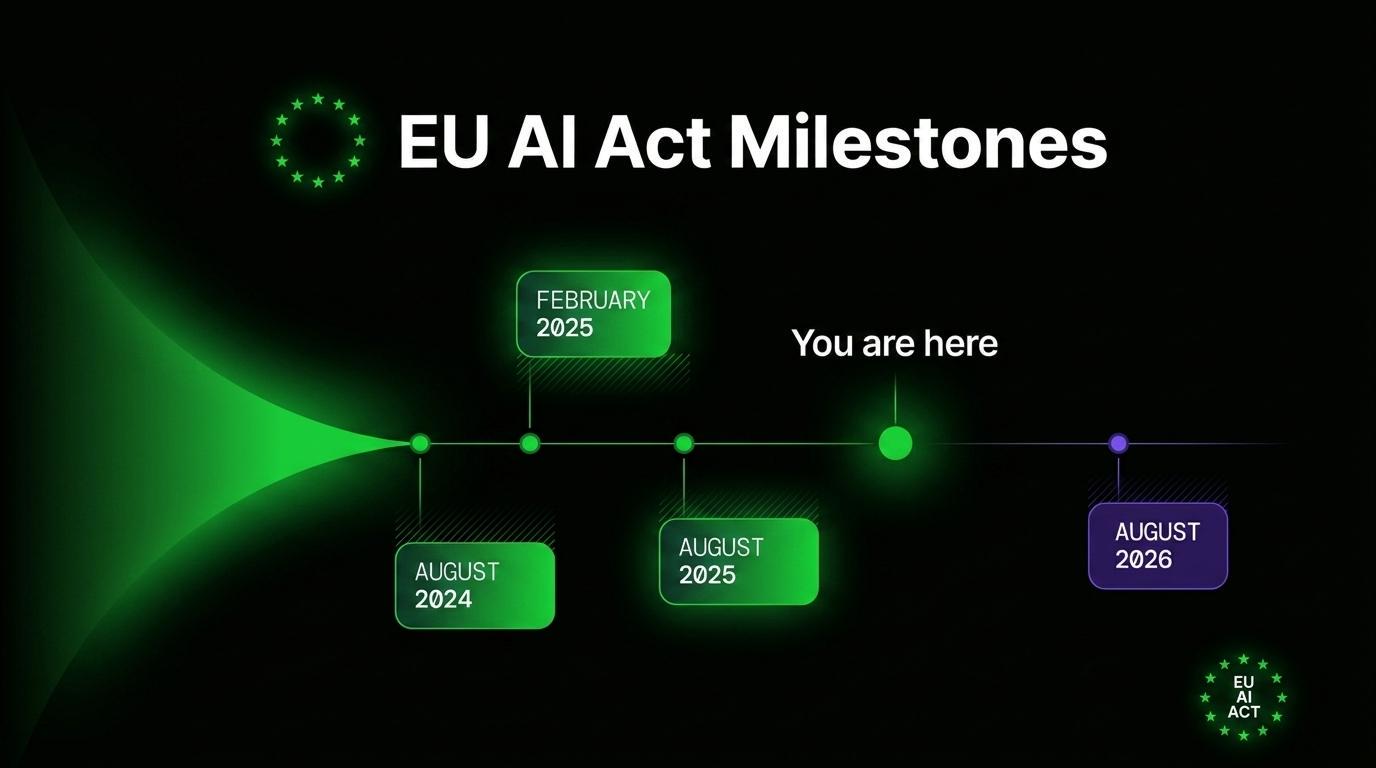
Is anyone else's legal team misreading the EU AI Act 'delay'? High-risk moved to Dec 2027, but enforcement powers are live NOW — breakdown inside

Post image
2 Upvotes

The trap most engineering teams haven't mapped: if you fine-tune a third-party model on your own data, or white-label an AI system under your own brand, the Act can requalify you from deployer (light duties) to provider (full regime: conformity assessment, technical documentation, EU database registration).

This happens quietly — a bank fine-tuning a commercial model, a SaaS company embedding a model under its own brand.

Why infrastructure teams specifically should care:

  • for systemic-risk GPAI models (10²⁵ FLOPs+), cybersecurity of the model and its physical infrastructure is a statutory obligation — datacenter security and model-weight protection are literally named in Article 55.

  • logging/traceability requirements for high-risk systems land directly on your observability stack.

  • vendor selection is now a compliance surface: if a regulator pulls a non-compliant model from the EU market, everything you built on it inherits the disruption.

We published a longer breakdown with a 6-step CTO action plan here: https://regolo.ai/what-is-eu-ai-act-compliance-for-ai-infrastructure-a-ctos-guide/

Posting this because I keep seeing the "it was all delayed" take and it's going to burn people. Happy to answer questions in the comments.

ObligationStatus
Prohibited practices + AI literacySince Feb 2025
GPAI model obligationsSince Aug 2025
Enforcement powers (AI Office + national authorities), penalty frameworkLive since Aug 2, 2026
Art. 50 transparency (chatbot disclosure, deepfake labels, AI-content marking)Enforceable now
Watermarking grace period (pre-existing systems)Ends Dec 2, 2026
High-risk Annex IIIDec 2, 2027

r/regolo_ai • • Aug 13 '26

Self-hosted web search for AI agents: cut Tavily-style costs by 80% and keep every token private

Post image
2 Upvotes

If you’re building autonomous research agents (LangGraph, CrewAI, custom loops, etc.), you’ve probably felt two pains at scale:

  • Search API costs quietly exploding once you move beyond the notebook

  • Compliance / infosec freaking out because prompts + context are sprayed across US-based proprietary APIs

We’ve published a deep-dive on a fully self-hosted web research stack that replaces commercial search APIs with:

  • SearXNG running in your own infra

  • A concurrent fleet of 6 specialized subagents (discovery, specs, compliance, market, research papers, security)

  • Spatial chunking + factual density scoring to keep only the highest-signal parts of pages

  • Optional synthesis + sentiment analysis via Regolo’s brick-v1-beta (EU-native, zero data retention)

Benchmarks:

  • 81–88% cost reduction vs closed search APIs (per 1,000 queries)

  • P99 latency cut from ~1,420 ms to ~310 ms

  • 100% data sovereignty: no prompts or vectors leaving your VPC

The tutorial ships with:

  • Dockerized SearXNG setup

  • FastAPI /v1/research endpoint usable as a LangChain / agent tool

  • A TUI setup.sh that bootstraps everything and runs demo/interactive queries

Link:
https://regolo.ai/self-hosted-web-search-for-ai-agents-replace-tavily-cut-costs-80-and-keep-every-token-private/

Youtube: https://www.youtube.com/watch?v=p6Tvh75DO_A


r/regolo_ai • • Jul 31 '26

GLM-5.2 (753B) vs Kimi K3 (2.8T): A 753B model beats a 2.8T model on average benchmark score, but loses 4/6 categories

Thumbnail
gallery
2 Upvotes

Is a 2.8 Trillion parameter model worth 5x the token cost for coding agents?

To be clear: this isn't a benchmark comparing models of equal weight, but an out-of-class operational comparison pitting a lightweight production workhorse against a heavyweight frontier agent.

The arithmetic average shows GLM-5.2 winning (69.3 vs 67.3), yet Kimi K3 wins 4 out of 6 individual dimensions:

  • Short-horizon parity

  • Long-horizon divergence

  • Economics & Latency

We put together a full guide covering all 6 evaluation axes, visual telemetry charts, real-world agency scenarios, and self-hosting requirements.

Full breakdown: https://regolo.ai/glm-5-2-vs-kimi-k3-the-pragmatic-engineering-guide-for-ctos-and-leads/


r/regolo_ai • • Jul 27 '26

Common Pitfalls in Agent Harness Design and How to Avoid Them

2 Upvotes

An agent harness is the layer around a model that manages context, tools, permissions, memory, execution flow, and monitoring. Many teams blame the model when results are weak, but the real problems usually come from the harness design: too much context, weak tool definitions, poor evaluation, or unsafe execution paths.

This guide focuses on practical mistakes that appear in real projects and explains how to avoid them. It does not include code. Instead, it gives operational advice and ready-to-use diagrams you can adapt for documentation, workshops, or design reviews.

👉 Read the full guide: https://regolo.ai/common-pitfalls-in-agent-harness-design-and-how-to-avoid-them/


r/regolo_ai • • Jul 25 '26

Opencode + Brick for Multi Agent Coding and optimize costs up to 80%

2 Upvotes

Most AI coding assistants lock you into a single model. You pick one at the start, and That is it—whether you’re debugging a regex or architecting a distributed system, the same model handles both.

The author recently reconfigured opencode to use Brick-V1-Beta as its primary orchestrator, with six specialized subagents routed through Regolo’s API. The result: a coding assistant that automatically picks the best model for each task—cheap models for simple lookups, heavy models for architecture decisions—without me thinking about it.

Here’s exactly how I set it up, the tradeoffs I hit, and why this architecture works better than the single-model default.

Video tutorial: https://www.youtube.com/watch?v=Y29_Swmxxig

Full Guide + Codes: https://regolo.ai/opencode-brick-for-multi-agent-coding-and-optimize-costs-up-to-80/


r/regolo_ai • • Jul 22 '26

Give your AI agents persistent, GPDR compliance and memory

Thumbnail
regolo.ai
2 Upvotes

A step-by-step guide to installing agentmemory with OpenCode and Regolo — keeping all session data on-premise, fully GDPR-compliant.

Every AI coding agent forgets everything when the session ends, you waste the first 5 minutes of every session re-explaining your stack, your conventions, and your last decision, agentmemory fixes this permanently.

It runs as a local MCP server in the background. Hooks silently capture every tool call, file touched, and decision made. When the next session starts, the agent already knows your architecture — no re-explaining, no copy-pasting context.


r/regolo_ai • • Jul 02 '26

AI Act deadline: what EU CTOs actually need to implement before August 2, 2026

Post image
2 Upvotes

The EU AI Act’s general application phase starts on August 2, 2026, and a lot of teams still treat it as “future legal noise” instead of an engineering problem.

In this article we break down what high‑risk and agentic AI systems actually need in practice: end‑to‑end tracing, continuous evaluation on live traffic, human‑in‑the‑loop controls and a migration path away from non‑sovereign inference stacks.

If you’re a CTO or lead engineer in the EU, the goal is to give you a concrete roadmap: what has to exist in your architecture before August 2, what can wait, and where sovereign EU inference providers fit into compliance with GDPR and the AI Act.

Here the article: https://regolo.ai/ai-act-august-2-2026-what-ctos-must-actually-do/

Curious how other teams are approaching this?

Would love to hear how you’re planning risk management, logging, and human oversight in your agent pipelines.


r/regolo_ai • • Jun 07 '26

How does this different from other AI APIs?

2 Upvotes

Came across this due to a Reddit ad and was curious, I saw it said costs were less on a per token basis but curious how it differs from other AI APIs like Qwen, Claude, Gemini, DeepSeek, etc.?

What are optimal uses of the models included and does it allow for live web based search?


r/regolo_ai • • Jun 05 '26

Train and run DFlash speculative decoding with vLLM

Thumbnail
regolo.ai
2 Upvotes

r/regolo_ai • • May 30 '26

A developer's guide to Multimodal AI: Practical use cases and API integration

2 Upvotes

Multimodal AI models—which integrate visual, text, and sometimes audio inputs into a single model architecture—have become widely accessible. Rather than stringing together separate OCR and text-processing pipelines, a single vision-language model (VLM) can often handle both jobs.

We recently published a primer explaining what multimodal models are, when it makes sense to use them, and how to integrate them into your apps: Understanding Multimodal AI Models.

Key Takeaways:

  1. When to use them: Multimodality is highly effective for tasks where context depends on more than just text—such as parsing unstructured scanned invoices, analyzing screenshots for customer support, or digitizing whiteboard notes

  2. Cost vs. Capability: For pure text or language tasks, text-only models remain faster and more cost-effective. Multimodal models should be reserved for mixed-input workflows.

  3. No Special Endpoints Required: Modern inference APIs (like Regolo) allow you to use the standard chat completions endpoint, passing both text and image_url types directly in the messages payload.

Quick Python Example:

Here is a straightforward example of how to structure a multimodal request using a VLM (like qwen3-vl-32b or qwen3.5-122b):

import requests

API_KEY = "YOUR_REGOLO_API_KEY"
BASE_URL = "https://api.regolo.ai/v1/chat/completions"

payload = {
    "model": "qwen3.5-122b",
    "messages": [
        {
            "role": "user",
            "content": [
                {
                    "type": "text",
                    "text": "Look at this invoice image and describe the photo details and the subject."
                },
                {
                    "type": "image_url",
                    "image_url": {
                        "url": "https://example.com/invoice.jpg"
                    }
                }
            ]
        }
    ],
    "reasoning_effort": "low"
}

response = requests.post(
    BASE_URL,
    headers={
        "Authorization": f"Bearer {API_KEY}",
        "Content-Type": "application/json"
    },
    json=payload,
    timeout=60
)

print(response.json())

r/regolo_ai • • May 27 '26

Auditing Open-Source LLMs: A walkthrough using Petri and Regolo

2 Upvotes

Evaluating and auditing open-source Large Language Models (LLMs) is a critical step for teams looking to deploy these models into production. Ensuring output quality, safety, and formatting consistency requires a structured approach to testing.

We recently published a technical guide on how to utilize Petri—an evaluation and auditing tool—alongside Regolo’s inference infrastructure to run systematic audits on open-source models.

What is Petri?

Petri is a framework designed to help developers run automated audits on LLM outputs. It allows you to define specific evaluation criteria, test assertions, and edge cases to verify how a model behaves across various prompts.

Why pair it with Regolo?

Running comprehensive evaluations can be resource-intensive. Regolo provides hosted, high-throughput API access to open-source models (such as Llama and Mistral), allowing developers to run large-scale test suites without the overhead of managing local hardware or complex infrastructure deployments.

The Audit Workflow:

  1. Define Evaluation Criteria: Establish the rules and assertions (e.g., checking for specific structures, safety guardrails, or factual consistency).

  2. Configure Endpoints: Point the Petri framework to the Regolo-hosted model endpoints.

  3. Execute the Suite: Run the prompts through the target models to collect and evaluate the responses.

  4. Analyze Results: Identify potential failure points, latency issues, or behavioral deviations.

For those interested in the implementation details, configuration steps, and code examples, you can read the full walkthrough here: Using Petri to Audit Open-Source LLMs with Regolo.


r/regolo_ai • • May 26 '26

ZAYA1-8B vs DeepSeek-R1-0528: which open model enterprises should use, and how to run it with Regolo

Thumbnail
regolo.ai
2 Upvotes

r/regolo_ai • • Mar 04 '26

I did a PR to a KDE tool generated by Regolo's Qwen3-coder-next

Thumbnail
invent.kde.org
2 Upvotes

I am using it also in other OSS projects (but I review the code) :-)


r/regolo_ai • • Jan 24 '26

Fast Whisper: The Best Open-Source Speech-to-Text Solution - regolo.ai

Thumbnail
regolo.ai
2 Upvotes

r/regolo_ai • • Jan 23 '26

Production RAG Pipeline: 87% Accuracy, 420ms Latency, Open Models Only (Code + Docker)

2 Upvotes

Naive RAG tutorials work on toy datasets but crumble in production:

  • Fixed chunking breaks mid-sentence → lost context

  • Weak embeddings → poor recall

  • No reranking → irrelevant chunks to LLM → 40% hallucinations

  • No caching → 2 QPS max, not 10k+

We built a complete production RAG system using **open models only**:

Key improvements:

  1. Semantic chunking preserves document structure

  2. gte-Qwen2-7B embeddings (#1 MTEB open, beats OpenAI)

  3. Hybrid retrieval (ChromaDB cosine + BM25 lexical, +20% recall)

  4. Cross-encoder reranking (87% precision@5 vs 65%)

  5. Llama-3.3-70B generation with strict grounding prompts

  6. Redis caching + async batching → 50 QPS, scales to 1M docs

  7. Evaluation metrics (precision, recall, F1, hallucination rate)

Benchmarks

MetricNaiveThis PipelineWin
Precision@565%87%+34%
Latency p952.1s420ms-80%
Hallucinations42%8%-81%
Cost/1k q$0.45$0.12-73%

Hosted on Regolo.ai (EU infra, OpenAI-compatible API).

Guide here:

https://regolo.ai/production-ready-rag-on-open-models-chunking-retrieval-reranking-evaluation/

Codes on Github:

https://github.com/regolo-ai/tutorials/tree/main/production-ready-RAG-on-open-models