r/radioastronomy • • Oct 23 '25

Community I'm excited to share the Titan Astronomical Observatory!

160 Upvotes

A couple of weeks ago I posted here, jokingly asking who wanted to pitch in to buy this $70k telescope off Facebook Marketplace. The amount of genuine support I got—both in the comments and in DMs—along with how awesome it would be to run this thing, made me seriously research whether it was possible to turn this into a telescope anyone could use. Well, it’s time to find out!

The Titan Astronomical Observatory is a nonprofit based in Lakeland, Florida, with the goal of purchasing, relocating, and modernizing this telescope; creating a web interface that allows students, amateur astronomers, and citizen scientists to reserve observing time; and designing a pipeline to automatically deliver calibrated data. We’re an officially incorporated nonprofit (501(c)(3) pending) with a four-member board, a potential site secured, an option contract granting us the exclusive right to buy the telescope, and a core team planning for the future.

If you’re interested in supporting the project by volunteering time or expertise—or you simply want to follow along—join our community on Discord! https://discord.gg/T5F6AG26tE

We’re currently accepting donations via PayPal, and a full GoFundMe campaign is on the horizon!


r/radioastronomy • • 1d ago

General I made a very basic spectrogram viewer for Breakthrough Listen GBT filterbank files

3 Upvotes

Hi, I just wanted to share my incredibly basic project that resulted from going down a rabbit hole after finding this subreddit. I'm somewhat familiar with Breakthrough Listen and SETI, but I had no idea there was publicly available data from real radio telescope observations until I saw people mention it here. Anyway, I thought that was really cool so I spent a few hours looking into it and making this.

I had a lot of fun making this, so I'd really like to turn this into something more interesting (and to learn more about the details of radio astronomy, in general).


r/radioastronomy • • 2d ago

Using VLBI to untangle a binary star system

Thumbnail astron.nl
11 Upvotes

Using the VLBA and GBT radio telescopes, we observed a young m-dwarf binary at X-band (8.4 GHz), and were able to detect both members. With our observations spanning 18 years, we were able to create a very precise orbital model of the system.


r/radioastronomy • • 13d ago

News and Articles Researchers discover rare star system that emits radio signals every eight minutes

Thumbnail
curtin.edu.au
21 Upvotes

r/radioastronomy • • 14d ago

Equipment Question trying to build a telescope and i'm stuck pease help

3 Upvotes

hey guys, i'm aware this might be too low-effort or too dumb or not enough information for this sub. i'm trying to build a radio telescope out of easily available parts and i've gotten a bit stuck.

i have three parts: a satellite dish, a pc, and a radio. my thought is that a radio is able to pick up radio signals, so it should be helpful.

my main problem is that i don't know how to put these things together. how do i connect the sattelite dish to either the radio or the computer? it didn't come with a receiver, can i make one? what kind of software would i need to actually do anything with the signal?

i'm well aware that if it works at all it's not going to be very powerful. my goal at this point is to detect the sun.


r/radioastronomy • • 15d ago

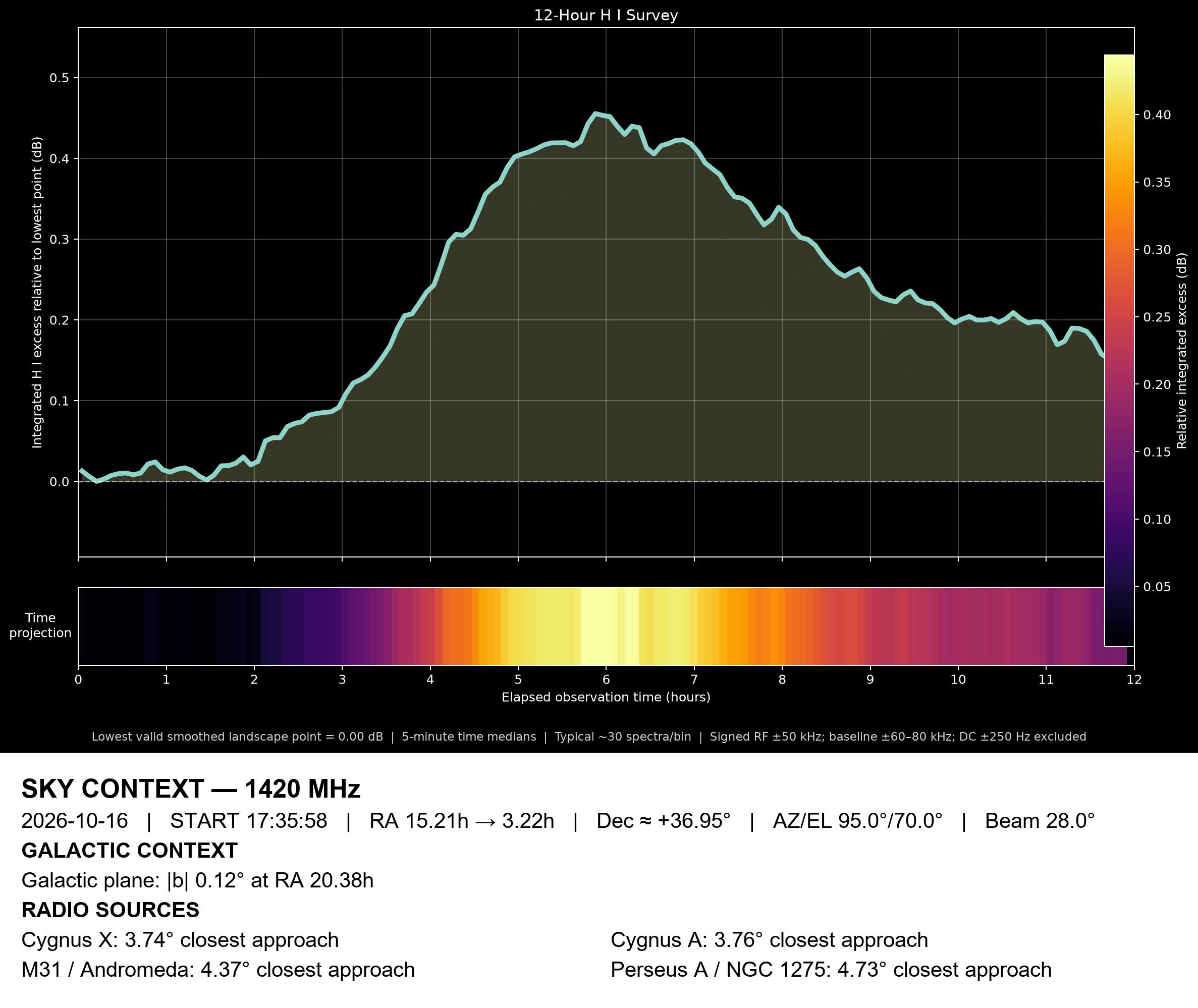
Observations 24 Hours of Galactic Hydrogen using the Disc Yagi and an 8 bit RTL

Post image
13 Upvotes

r/radioastronomy • • 16d ago

News and Articles A little different approach to radio astronomy outreach – a film about MeerKAT

17 Upvotes

Hi everyone! I'm a professional radio astronomer working out in South Africa.

Not at all intended to be self-promotion here, but I recently made a short film following a motorbike journey from Cape Town to MeerKAT in the Karoo desert.

I'm experimenting with combining the travel/adventure with astronomy and engineering outreach - essentially, making a journey to some of the world's most extraordinary telescopes and trying to focus more on the telescopes than the resulting science. (Think Top Gear meets Brian Cox).

I'd love some honest feedback from people who are into radio astronomy. It's quite a niche idea as far as documentaries go so I'm still getting a handle on what people like and dislike about the format, especially in terms of striking a balance between travel/science and what depth to go into from a technical perspective.

The longer-term ambition is to develop this into a series visiting telescopes around the world, so I'm keen to get as much constructive criticism as possible!

If anyone has the time to take a look and let me know what you think, I'd be incredibly appreciative!

Here's the film: https://youtu.be/f_40FOahezo

Cheers


r/radioastronomy • • 17d ago

Equipment Showcase Rotator for a 1.5 meters dish

69 Upvotes

r/radioastronomy • • 17d ago

Equipment Question amature Hydrogen line setup amazon shopping kit

3 Upvotes

Will these 6 items actually work together for hydrogen line and satellite hunting?

​Hey everyone. Total beginner here. I understand the general capabilities of what these parts do, but I need to be sure from people who actually know this stuff.

​Are these 6 items useful, will they actually work together for my setup, and did I miss anything obvious?

​Here is what's in my cart:

​1. Nooelec RTL-SDR v5

​2. Nooelec Lana Wideband LNA

​3. Nooelec SAWbird+ H1

​4. Nooelec SAWbird+ iO

​5. Nooelec Satellite Mesh Antenna Bundle (the 20dBi L-band mesh dish)

​6. 50ft LMR-240 Coaxial Cable

​What I'm trying to do:

I want a cheap, fun entry point to look for satellites and the hydrogen line. I'm grabbing the Lana and both SAWbirds specifically to swap and experiment with the modules.

​Do these items all hook up and work together without issues?

​Is the setup enough to handle the loss over a 50ft cable run, or would an extra LNA help? Can I do that?

​Any recommendations on what else I might need?

​Thanks!


r/radioastronomy • • 20d ago

General Question from a writer: What exactly does work at a radio astronomy station entail?

24 Upvotes

As said in the title, I'm a creative writer and one of my projects at the moment takes place in a remote radio astronomy institute in northern Alaska in 1990-1995. I know the basic jist of the process, but I feel like I know very little about what specific tasks look like and similarly haven't been able to find an easy way to actually find this information?

I've just been handwaving exact tasks in everything I've written so far, but I do want to be accurate and would love to provide complex infodumps about the process my characters are actually performing.

As an example, they recieve a signal, how exactly do they aim the dishes at the object they want to observe? How long does this usually take? Is it saved to a databank somewhere? How do they convert it from a signal to an image? Is this done with their computers or do they have to do it by hand? What do their computers look like? Etc

In lieu of an essay of a response I'd also really appreciate if anyone could point me in the direction of finding all of this stuff out. Ideally i'd be able to simply work in a radio astronomy site myself but i doubt they'd take me without any credentials or experience.


r/radioastronomy • • 21d ago

News and Articles Astronomers capture the sharpest, most sensitive image yet of the low-frequency radio sky, revealing nearly 63,000 sources

Thumbnail
astronomie.nl
5 Upvotes

r/radioastronomy • • 25d ago

Observations I built a disc Yagi, 17dB at 20 deg beam width as best calculated and then compared to imperial data from the 4.5m dish and the 15.7 dB Yagi uda. The baseline held stable enough for a 24 hour continuum mode survey. Comparing here to the same sky pointing against the 4.5m dish

Post image
54 Upvotes

Empirical data not imperial :)


r/radioastronomy • • Oct 28 '26

Other TNA-1500 radio telescope kalyazin, russia

Post image
77 Upvotes

r/radioastronomy • • Oct 24 '26

News and Articles Gotchas when working with public CHIME/FRB baseband and Breakthrough Listen raw data (plus a small ML detector)

3 Upvotes

While training burst detectors on the public CHIME/FRB baseband release (DOI 10.11570/23.0029) and Breakthrough Listen's Parkes Vela data, I hit two data issues worth sharing:

  1. CHIME channels are reversed relative to the textbook dispersion formula. Dedispersing with both signs and correlating with the archive's tiedbeam_power gave 0.988 for one sign and 0.06 for the other. The textbook sign is wrong for this data. I suspect second-Nyquist-zone sampling but found it empirically; happy to hear the definitive reason.

  2. The BL Parkes Vela files have an inverted band despite a positive OBSBW. Header order folds to S/N ≈ 1, reversed order to about 2,400. Only the beam-3 files contain Vela.

The detector: 16 fixed coherent-dedispersion filters plus a small CNN on the DM–time map. It detects 93–98% of injected bursts in real CHIME noise at a 1% false-alarm rate, against about 70% for 300k-parameter generic CNNs. On 10 real bursts, though, it localises 5–6, which is the same as dedispersion at the catalogue DM, so the synthetic advantage isn't proven on real data yet.

Write-up: https://phasefield.ai/blog_entry_4.html ·

My own work; suggestions for a more sensitive real-burst test are very welcome.


r/radioastronomy • • Oct 22 '26

General Questions about observing Milky Way edge/arm edges

6 Upvotes

Hello, I am an amateur astronomer who has recently built a radio telescope to observe hydrogen, with the recent goal: attempt observing the outer parts of the Milky Way/Milky Way arms at the edge of the galaxy. I know absolutely nothing about observing these, and I can’t seem to find maps of the galaxy online(which makes sense) but I have seen galactic longitude and don’t know what it means. Going into this project, I thought the actual dish itself would be the hard part, but who would have known navigating the galaxy is hard. If anyone knows how to do this or any sources I would be happy to hear them, best regards


r/radioastronomy • • Oct 21 '26

Observations Exploring how small and simple an effective radio telescope can be. Here’s my 4.5 m dish vs my 15.7db Yagi, both observing the same galactic hydrogen, the same evening at 1420 MHz using different recording modes, both in DeepSpace1420 software. Exploring how much we can do with modest equipment.

Post image
18 Upvotes

r/radioastronomy • • Oct 20 '26

Other Looking for survey participants

4 Upvotes

Hi all!

I’m a student at West Virginia University performing a very basic study about the effects and implications of radio frequency interference (RFI) from satellite constellations on radio astronomy. I put together a short survey about this topic, and I’m looking for respondents who have experience in radio astronomy or with RFI. All questions are optional, and it’s not a very difficult or long survey.

Any feedback would be greatly appreciated and would significantly help my study. The survey is linked below.

https://docs.google.com/forms/d/e/1FAIpQLSc75-NtoZ7kE9sJBdDUOxav5-CKR4gN1BCPjIWux44iJgR-Hg/viewform?usp=header


r/radioastronomy • • Oct 20 '26

Observations A simple radio telescope for Ku band analysis

9 Upvotes

Salutations!

I'm recently getting interested in radio astronomy, and I'm currently working on a small, microcontroller-based radio telescope with a 1-meter dish to analyze solar and lunar transits in the Ku band. So far, I've collected some drift-scan graphs of the solar transit, as shown below.

The measurements are plotted as voltage (V) versus time (s), as shown in the graph.

The circuit is bassicaly an LNB conecteto to an analog satellite finder as a radiometer to measure the signal intensity, an ADS1115 Module to read the Sata Finder's Voltage level with a microcontroller acting as an interface between the satellite finder and my PC.

The main point is that I'm not entirely sure how to interpret the rise in the reference level (the sky voltage), which is set to 0.045 V, or approximately 2.1 dB on the satellite finder's scale. The variation of the reference level isnt big enough to afect the solar transit detection, but afects directly on drift scans of bodies with a small curve of detection like the moon, so im stucked at this.


r/radioastronomy • • Oct 19 '26

Community Graphics update in radio observatory simulator

Thumbnail
gallery
64 Upvotes

Made graphics better and added oscilloscope for my game


r/radioastronomy • • Oct 17 '26

Observations 15.7db Yagi Hydrogen line drift scan results, using my software in Spectral FFT mode and with only a Noolect v5 Raw I/Q, which helped the baseline and 8 bit resolution tremendously. I recorded early to show the baseline. More to come.

Post image
13 Upvotes

r/radioastronomy • • Oct 17 '26

News and Articles The Ukrainian T-shaped Radio Telescope is getting a glow-up after getting caught in a war zone

Thumbnail astrobites.org
15 Upvotes

r/radioastronomy • • Oct 13 '26

Observations Airspy mini SDR performed very well on a 24 hour continuum drift scan with the 4.5m dish

Post image
14 Upvotes

r/radioastronomy • • Oct 12 '26

General I'm offering to do free data entry work

9 Upvotes

I'm fresh out of the training course in data entry and looking to do some work even free volunteer work to build up my resume. I'm a big fan of astronomy but never got to have the tools for the hobby so I decided to post here. Hit me up if you want a tidy excel record of your findings with formulas