r/qlik_sense • • Apr 14 '26

8 years in Qlik - is this niche getting smaller, or is it just me?

14 Upvotes

I've been working as a Qlik developer for about 8 years now. Over time the role evolved well beyond building dashboards — I ended up doing full-stack work around it: custom mashups with React and TypeScript, Node.js backends, JWT auth integrations, REST APIs, Python scripting. Basically wherever Qlik needed glue code, I wrote it.

Lately I've been noticing fewer job postings that match this profile. The pure "Qlik developer" title feels increasingly rare, and the hybrid roles that actually reflect what I do day-to-day don't seem to have a consistent name or demand yet.

Curious whether others in the BI/analytics space are seeing the same thing:

  • Is Qlik losing ground to Power BI / Tableau / Looker in your org or market?

  • For those in a similar niche role — did you stay and double down, or pivot toward a broader data engineering / frontend path?

  • How are you packaging a profile like this when the job market doesn't have a clean bucket for it?

Not looking to rant, genuinely trying to understand where people in this space are heading.


r/qlik_sense • • Apr 28 '25

Qlik Set Analysis.... without the syntax? Yes, really!

11 Upvotes

Qlik just made it possible to apply filters directly on objects via the UI, no more {<Year={2025}>} headaches. Clean, fast, and accessible for everyone.

Read more here


r/qlik_sense • • Jul 11 '24

Qlik Cheat Sheet for New Users

Thumbnail
bitmetric.nl
11 Upvotes

r/qlik_sense • • Aug 20 '26

We wrote a practical guide to migrating from Qlik Sense Enterprise or QlikView to Qlik Cloud

Thumbnail
bitmetric.nl
10 Upvotes

We’ve been involved in quite a few conversations and projects around moving Qlik environments to Qlik Cloud, and noticed that most of the discussion tends to focus on moving the apps.

In practice, that’s usually not the difficult part.

The things that tend to require more thought are security rules vs. spaces and roles, Section Access, task chains, gateways, NPrinting/reporting, licensing, extensions, and what you actually want to clean up rather than migrate.

So we tried to put the whole process into one practical guide:

https://www.bitmetric.nl/blog/qlik-cloud-migration-complete-guide/

It covers QAMT, what does and doesn’t migrate, QlikView vs. Qlik Sense migrations, governance, licensing, gateways, common mistakes, and the first 90 days after go-live.

We’re particularly interested in experiences from people who have already done a migration. Anything you think we’ve missed, got wrong, or underestimated?


r/qlik_sense • • Jan 07 '25

Visualizing Dimensional Relationships

Thumbnail
qlikdork.com
10 Upvotes

r/qlik_sense • • Sep 01 '26

Qlik Answers Review: Real-World Testing and Lessons

Thumbnail
bitmetric.nl
9 Upvotes

We’ve been testing Qlik Answers on a real production app, and the biggest takeaway was simple: context matters more than the AI itself.

Good master measures, descriptions, field selection, and business definitions made a huge difference to the quality of the answers.

We also compared it with Claude connected to Qlik through MCP.

Full write-up here:
https://www.bitmetric.nl/blog/qlik-answers-review/

Curious to hear how others are finding Qlik Answers in real-world apps.


r/qlik_sense • • Apr 16 '26

Your 10 MB Qlik app won't become 10 GB at 1000× the data — I reverse-engineered the memory model to prove it

9 Upvotes

Most people assume Qlik memory scales linearly with rows. It doesn't. Not even close.

Here's why:

  • Region has 5 unique values at 10K rows. At 10 million rows? Still 5. Field size: unchanged.

  • Status, Category, Country — all the same. They don't grow with rows. Memory cost is flat.

  • SalesAmount has 9,000 unique values at 10K rows. At 10M rows? Maybe 900K — not 10 million. Sublinear growth.

  • Only fields like TransactionID grow 1:1 with rows.

So that 10 MB app at 1000× data? Probably ~300 MB, not 10 GB.

But "probably" isn't good enough for capacity planning. We wanted the exact number. So I reverse-engineered Qlik's memory model at the byte level.

What I found:

Every field in Qlik has two storage components:

Symbol Table — stores each unique value once:

  • Numeric fields: exactly 8 bytes per unique value

  • String fields: avg_string_length + 6 bytes per unique value

  • AutoNumber() / RowNo(): 0 bytes — but only when Qlik generates the sequence. The same 1-to-N loaded from a database costs 8 bytes per unique value

Pointer Array — maps each row to its symbol:

  • Size = rows × ceil(log₂(cardinality)) / 8 bytes

  • This is a bit-stuffed array. A field with 1,000 unique values uses 10 bits per row (ceil(log₂(1000)) = 10). At 10M rows: 10M × 10 / 8 = 12.5 MB

So: field_size = (cardinality × avg_symbol_bytes) + (rows × ceil(log₂(cardinality)) / 8)

On test data: 99.99% accuracy. On production: ~95% — the remaining ~5% is engine overhead from hash tables and internal structures, handled by a multiplicative calibration factor (~1.05×).

What drives app size:

The key insight is that app size is driven by cardinality growth per field, not raw row count.

When rows go from 1M to 10M:

  • Low-cardinality fields (flags, statuses): cardinality stays flat → symbol table unchanged, only pointer array grows

  • Medium-cardinality (codes, categories): cardinality grows sublinearly (√ or log) → moderate growth

  • High-cardinality (keys, IDs): cardinality grows ~linearly → expensive

Each field has its own growth rate (elasticity). A field with elasticity 0.3 means: if rows 10×, cardinality only 2×. You measure this from two snapshots using log-log regression.

The predictor:

I built this into a Qlik load script that:

  1. Captures metadata snapshots over time (using the Engine API / document analyzer)

  2. Back-solves avg_symbol_bytes per field from observed field sizes

  3. Fits 4 regression models per field (linear, power-law, logarithmic, square-root) to predict cardinality growth

  4. Auto-calibrates against actual Engine API metrics (~1.05× multiplicative factor)

  5. Projects app size at any target row count

  6. Gives interactive what-if analysis via front-end variables — no reload needed

It runs as a native Qlik app — load your metadata exports and it does the rest.

Some findings that surprised me:

  • AutoNumber() fields cost literally 0 bytes for the symbol table. But load the same sequence from your database and it costs 8 bytes per value. Qlik's internal sequence generator gets special treatment.

  • String storage is UTF-16 — every character costs 2 bytes, plus 6 bytes overhead (4-byte offset + 2-byte length prefix). A 10-character string costs 26 bytes per unique value, not 10.

  • The pointer array uses exactly ceil(log₂(cardinality)) bits per row. A field with cardinality 1,024 uses exactly 10 bits/row. At 1,025 it jumps to 11 bits/row. These thresholds matter at scale.

  • The ~5% calibration factor is consistent across apps. It accounts for hash tables inside symbol tables, row-level indexing structures, and memory alignment.

Validated against production:

  • Test data (controlled experiments): 99.99% accuracy

  • Production models (multiple apps, largest ~500 MB): ~95% accuracy before calibration, ~99% after

If you 10× your data tomorrow, do you know your actual memory multiplier? Curious what others are seeing on their production apps.

Happy to share methodology details or the approach for building the predictor if anyone wants to try it on their own apps.


r/qlik_sense • • Aug 26 '26

Qlik had semantics all along. AI is making them more important again.

8 Upvotes

One thing I find interesting about the current AI wave is that it is bringing an old BI problem back into focus.

In Qlik, business meaning has always existed in the model, but in practice it often ended up spread across the data model, script, variables, set analysis, master measures and object expressions.

That worked fine when experienced developers knew where everything lived.

AI agents change the equation.

Giving an LLM access to data is relatively easy. Getting it to understand what your business actually means by “revenue”, “margin” or “active customer” is much harder.

That is why I think semantic layers and governed business context are becoming more important again. Qlik’s own direction with MCP and agentic analytics fits that trend quite well.

I wrote up some thoughts on the broader history, from BusinessObjects Universes to self-service BI to AI:

https://www.bitmetric.nl/blog/semantic-layer-ai/

Curious how others see this in Qlik environments: how much of your business logic is truly centralized, and how much still lives in individual apps?


r/qlik_sense • • Sep 02 '25

Qlik vs. Power BI. What's it really like to work with both, side by side?

Thumbnail
bitmetric.nl
8 Upvotes

r/qlik_sense • • Oct 31 '24

New AI & Visualization Features for Data Analysis in Qlik Sense

Thumbnail
qlik.anychart.com
8 Upvotes

r/qlik_sense • • Sep 18 '25

𝗣𝗮𝗿𝘁 4 𝗼𝗳 𝗼𝘂𝗿 𝗤𝗹𝗶𝗸 𝘃𝘀 𝗣𝗼𝘄𝗲𝗿 𝗕𝗜 𝘀𝗲𝗿𝗶𝗲𝘀 𝗶𝘀 𝗹𝗶𝘃𝗲!

Thumbnail
bitmetric.nl
7 Upvotes

r/qlik_sense • • Sep 04 '25

Qlik vs Power BI Part 2: Back End & Data Modeling

Thumbnail
bitmetric.nl
7 Upvotes

r/qlik_sense • • Nov 28 '24

November 26, 2024: What’s New in Qlik Cloud?

Thumbnail
bitmetric.nl
7 Upvotes

r/qlik_sense • • Aug 13 '24

Qlik Answers is here!

7 Upvotes

The recently released Qlik Answers allows you to:

* 𝗖𝗿𝗲𝗮𝘁𝗲 𝗞𝗻𝗼𝘄𝗹𝗲𝗱𝗴𝗲 𝗕𝗮𝘀𝗲𝘀: Build comprehensive knowledge bases effortlessly

* 𝗗𝗲𝗽𝗹𝗼𝘆 𝗔𝘀𝘀𝗶𝘀𝘁𝗮𝗻𝗰𝗲: Implement hashtag#AI-driven assistance to answer data-driven questions

* 𝗜𝗻𝘁𝗲𝗴𝗿𝗮𝘁𝗲 𝗦𝗲𝗮𝗺𝗹𝗲𝘀𝘀𝗹𝘆: Access insights from unstructured data

𝗥𝗲𝗮𝗱 𝗺𝗼𝗿𝗲 𝗵𝗲𝗿𝗲: https://www.bitmetric.nl/news/qlik-answers-is-now-available/


r/qlik_sense • • Feb 19 '26

Qlik named a Leader in the 2026 Gartner Magic Quadrant for Augmented Data Quality Solutions

Post image
6 Upvotes

Good reminder that AI is only as smart as your data.

𝗥𝗲𝗮𝗱 𝗺𝗼𝗿𝗲 𝗵𝗲𝗿𝗲


r/qlik_sense • • Jun 03 '25

Qlik Sense : Export In-Memory Loaded tables without data source

6 Upvotes

Hey Guys, had a question. I have a qvf file which contains a set of visualizations in the sheets. I dont have the data source for this qvf file with me, and I want to somehow export the in-memory tables out. I tried adding a section to my qvf file data load editor section

TRACE Number of tables: $(NoOfTables());
FOR i = 0 to NoOfTables() - 1
     LET tName = TableName($(i));
     STORE [$(tName)] INTO [lib://SOME_EXTERNAL_DATA_CONNECTOR/$(tName).qvd](qvd);
NEXT i;

For running this i had commented out the LOAD sections in my data load editor and run this, it ran without any error after that, but the NoOfTables trace is empty. Any ideas how to achieve this?

EDIT: Have figured it out, posting a sample code for the same

  • Create a new app

  • In data load editor of the new app, run this


BINARY [FROZEN_APP_ID];

TRACE Number of Tables: $(NoOfTables());
FOR i = 0 TO NoOfTables() - 1
    LET vTable = TableName($(i));
    STORE [$(vTable)]
      INTO [lib://EXTERNAL_DATA_SOURCE_CONN/$(vTable).csv](txt);
NEXT i;

r/qlik_sense • • Dec 04 '24

New critical security patches for Qlik Sense Enterprise for Windows - Bitmetric

Thumbnail
bitmetric.nl
6 Upvotes

r/qlik_sense • • Nov 18 '24

Any Qlik people on Blue Sky?

Thumbnail
bsky.app
6 Upvotes

r/qlik_sense • • Sep 10 '24

Qlik Cloud icons in SVG format for use in diagrams and documentation

Thumbnail
bitmetric.nl
6 Upvotes

r/qlik_sense • • Dec 22 '23

Feedback on personal/side projects (Qlik Sense)

6 Upvotes

Hi all,

For some time I've been working on some Qlik Sense related side projects. Naturally I find them quite useful 😀 But I will be more than happy if someone can provide some feedback.

I'll keep working on them anyway until im happy with the result even if they are not used. The whole process of writing a big piece of software, managing it, deploying it, testing it, documenting it ... etc is quite useful in a personal plan.

Both are TypeScript based and can be installed via npm and ran from the terminal. At some point both will be able to be downloaded as (signed) executable as well.

  • Automatiqal - I've started this before SaaS Application Automation but the concept is similar (although the initial target of this project was/is Qlik on-prem). The idea behind it is to have a yaml/json file (schema is available) where set ot actions can be specified and executed against Qlik. Essentially this is a way to achieve automated deployment/configuration/management of Qlik instances. SaaS support is also being added.

  • Test-O-Matiq - Automatiqal is more mature than this one but think that this one might have more potential. The idea is to specify a set of data tests in yaml/json (schema is available) and execute them against the Qlik app. Since this project is using the Engine API, it will be easier to run it against on-prem and SaaS. At the moment very basic tests can be specified - compare expression with multiple expected results. Have slightly bigger plans for this one.

The usual "how to deploy a new version of an app to prod environment" scenario can be used to give you an idea how both can be used in practice:

Automatiqal can be used to import the app, create a reload task and run it to bring the latest data. Once the task is completed (without errors) another task can trigger the Test-O-Matiq data tests and only when they all are passed Automatiqal will continue and publish/overwrite the imported app into the dedicated stream. (Additionally the temp tasks can also be automatically cleared after the whole process is complete)

This whole process can be scripted in a single yaml file (+ another one for the data tests ofc). On top of that both projects support different ways to provide variables so one yaml file can be ran with different parameters (for example provide the "live" app name/id and stream name)

Thank you and Merry Christmas!!!

Stefan


r/qlik_sense • • 20d ago

Qlik Cloud October 2026: Semantic Models, Qlik Code, and a few things worth discussing

Thumbnail
bitmetric.nl
5 Upvotes

We went through the October Qlik Cloud updates with six of our consultants to figure out what's actually interesting for developers and administrators.

A few things stood out:

  • Semantic Models in Data Products look promising. Centrally managed measures, dimensions, and relationships could help solve some long-standing consistency issues across applications. I'm particularly interested in how this will work with existing development and deployment processes.

  • Agentic Semantic Modeling is an interesting direction, but AI still needs someone to explain what the data actually means. Governance becomes even more important when agents can modify shared definitions.

  • Qlik Code for VS Code is a welcome addition. However, it currently covers load scripts rather than entire applications. That's worth considering if you already have version control and deployment processes in place.

  • Direct Access gateway 1.8.1 includes a fix for a rare issue that could cause silent data loss during overlapping reload requests. Definitely worth checking your gateway versions.

We also looked at the smaller improvements to Data Flow and Table Recipe.

I wrote up our findings, including some practical considerations and limitations:

https://www.bitmetric.nl/blog/qlik-cloud-update-october-2026/

Curious what others think about Semantic Models in particular. Is this something you see yourselves adopting, or are you sticking with your existing approach to managing shared definitions?


r/qlik_sense • • Sep 03 '26

We built a Qlik Cloud health checker after seeing the same issues over and over

Thumbnail
bitmetric.nl
5 Upvotes

The idea came from a pretty simple observation: a lot of Qlik Cloud incidents don’t really come out of nowhere.

API keys have expiry dates. Capacity tends to creep towards its limits. Reloads may start failing more frequently before someone notices. Automations can slowly become unreliable. Permissions and tenant configuration can drift away from the way you originally intended to manage them.

So we started automating checks for those kinds of things.

CloudScan now runs 50+ checks across areas such as licenses and capacity, users and permissions, reload tasks, automations, API keys, gateways, spaces and tenant configuration.

It doesn’t produce a generic “health score”. It reports the individual findings, their severity and the underlying details so you can actually investigate them.

We initially built this for customers under support, but we think it’s useful for teams managing Qlik Cloud themselves as well, so we’ve made it available separately.

We’re also offering a free one-time scan of a single Qlik Cloud tenant, including the full report. No requirement to continue afterwards.

More details and some screenshots here:
https://www.bitmetric.nl/services/support/qlik-support/cloudscan-for-qlik/

Would also be interested to hear what other things people here routinely check in their Qlik Cloud tenants. We’re continuously adding checks based on things we encounter in real environments.


r/qlik_sense • • Jun 11 '26

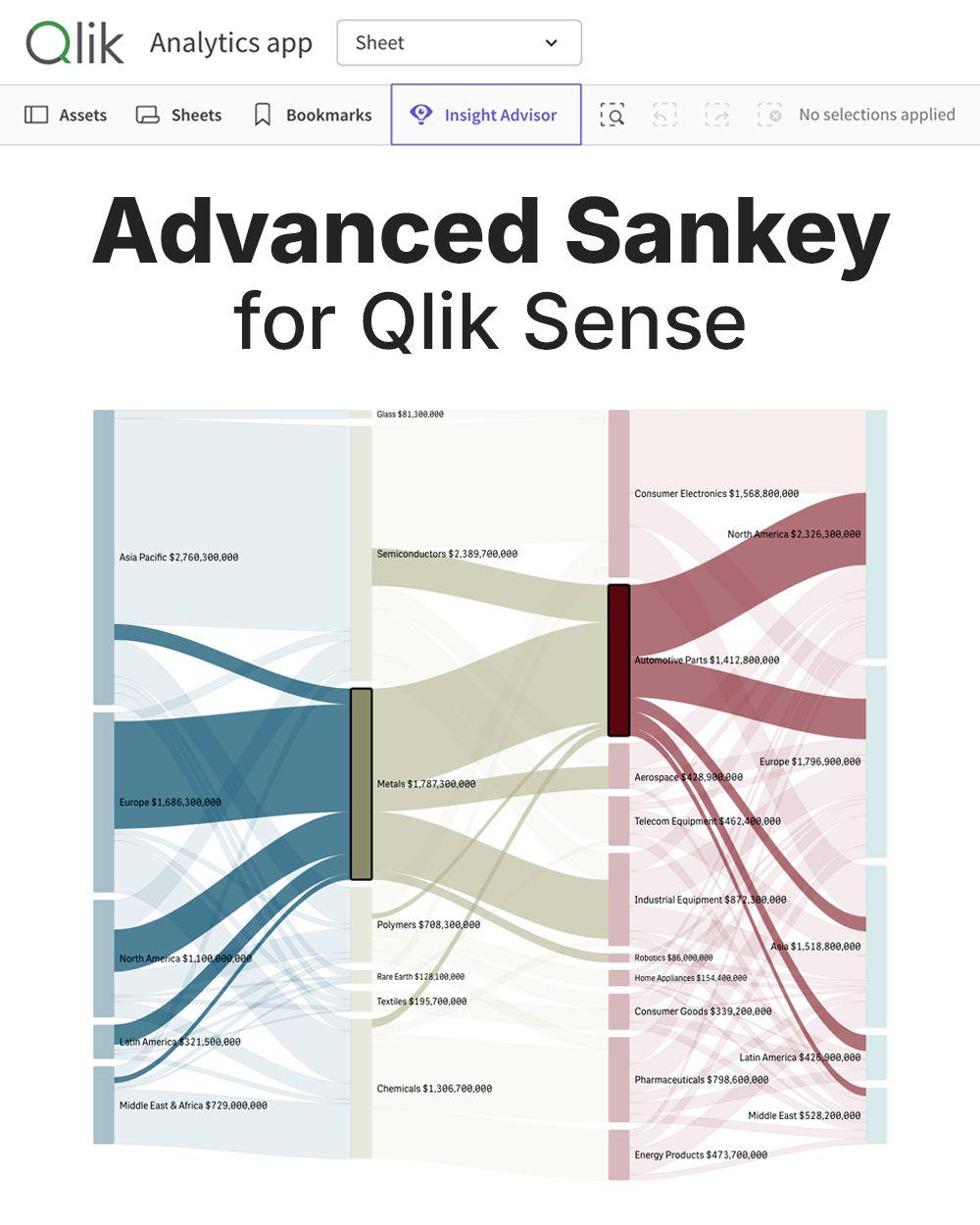
Advanced Sankey Chart Now in Qlik Sense

Post image
5 Upvotes

A new Sankey Chart extension for Qlik Sense is available, built for multi-stage flow analysis when the native chart runs out of room. Released by AnyChart, a Qlik Technology Partner, it enables up to 10 dimensions (instead of 5), full dual-end flow selection (not only source), and richer visual context. Useful for analyzing how value moves through stages: budget allocation, supply chains, customer journeys, energy flows, website traffic, conversion funnels. Announcement here →


r/qlik_sense • • Jun 02 '26

Introducing Circular Dendrogram for Qlik Sense

Post image
5 Upvotes

AnyChart released the Circular Dendrogram extension for Qlik Sense. It draws hierarchies as a radial node-link tree, supporting 2 to 10 dimensions. Useful for org charts, product/service taxonomies, account hierarchies, file structures, and any nested-category data.
Announcement here →


r/qlik_sense • • Oct 30 '25

Provisioning 100+ Qlik Cloud tenants on an OEM subscription - Bitmetric

Thumbnail
bitmetric.nl
5 Upvotes

Automating the provisioning of 100+ Qlik Cloud tenants using Qlik CLI and an OEM subscription. Lessons learned, practical tips, and reflections from the Masters Summit for Qlik.