Kia Ora my fellow Tamariki o te rā!
Long time lurker, first time poster - Apologies if this is a bit long winded, but I have loved reading about all things solar going on in Aotearoa over the past year and feel compelled to share some of my experience in the hope that it helps someone else make the move towards better energy.
This is a new account as I don't fancy doxing my main with some detail that I'll be posting here - I'm not just some shill for big solar (Although would consider a kidney swap for a 20kwh battery if anyones got a deal?)
Quick history
About 12 months ago I was going over the family budget with the vision of undertaking some long-term planning about our household and how to better manage current and future expenditure with a degree of 'self-reliance' or 'independence' from outside inflationary pressures.
Naturally this involved a bit of internet deep diving, and the good ole algorithm pointed me to /nzsolar for a crash-course in everything photo-voltaic.
So mid-summer, after much reading, watching and fact-checking, I started looking into if my property, roof, household and budget would be at all suitable for harnessing all that beautiful ultra-violet brilliance - and turns out, we were pretty much the perfect fit.
Location
We're lucky enough to be located in Waikanae, on the beautiful Kapiti Coast, which according to a quick google search is good for a modest 2040hrs of sunshine a year. And on paper this sounds low, because as any self-respecting coaster will tell you, it is in fact always sunny on the coast.
But in all seriousness, Kapiti does tend to get more settled weather than Wellington, with less wind and warmer temperatures year round - So overall, not a terrible place to be to gather some sweet rays.
Being just out of the city, we also have access to many different installers which I hope drives some competition with regards to pricing and workmanship.
Roof
Roof type, orientation, pitch and accessibility all play massive parts in not only specifying and choosing the right system, but also the overall cost.
Roof with Multiple planes and steep angles, maybe even some flash architectural number with some awesome hectic 3-level thatched-gable-dormer? You're going deep in those pockets for scaffolding and specialty mounting hardware.
Single-level, mono-pitch, majority north-facing with relatively new corrugated iron with minimal shading? Perfect for your chosen installer and budget.
Luckily I fit perfectly into the second camp - A relatively new (2019) single storey home, trapezoidal profile, metal sheet roof, with 3 Mono-pitch planes of a very modest pitch.
The first plane on the north-eastern corner of the house with a 026° azimuth and 6° pitch, measuring in at about 11m (E/W) x 7.5m (N/S) became an obvious choice for a good portion of my panels. This roof is exposed to fantastic early sun, whilst also carrying a good load through the middle of the day with zero shading apart from a lousy chimney spewing steam and carbon-monoxide from my gas boiler (I know, I know - ew. It will be going soon).
The second plane on the southern side of the house, measuring in at 2.5m (N/S) x 6.5m (E/W) wasn't really suitable as it backs on to the NE plane and doesn't cop much if any sun, particularly throughout the winter months.
The final plane on the West-North-West side of the house, with an 8° Degree pitch and an azimuth of 290° is by far the biggest roof surface with nearly 110 square meters of sun-soaked real estate to capture that lazy afternoon sun Waikanae is renowned for.
The hardest part about our roof was deciding how many panels and where they would be located on the roof - This is where understanding your house-hold demand comes in to play.
House Hold
As we are all aware, Its not just how much power your household uses a year that matters when it comes to maximising your solar benefit - Its how much of that use you can move into that God-given solar window.
It took a little while to really plan and manage how we were going to best make the most of the load-shifting to make solar worthwhile and it will definitely be something we continue to improve on.
We are a 4-person household (2 adults, 2 kids under 5) with schedules that vary day-to-day, week-to-week.
Annually, according to our latest power bill, we are consuming 8,241 kWh - So not massive, but not insignificant either. However We are also currently still using piped-gas for hot water and cooking which further stifles our benefits from solar and brings that electricity consumption right down.
We are actively in the process of getting our Baxi boiler removed and replaced with a heatpump HWC, along with our terribly overrated Falcon gas range - so our electrical consumption will definitely increase.
Like many households, the lions share of our usage does occur in the dreaded peak hours between 7am-9am, and 4pm-9pm - which during winter are incredibly difficult to manage with solar alone. Planning for and managing use through these times will be an on-going process - particularly as we DID NOT opt for battery for a couple of reasons - the biggest being Budget.
Budget
After being deep in the solar rabbit hole for a few months, trawling the /nzsolar forum, along with a few of the Aussie equivalents, I wanted 300 panels, 20 batteries and an inverter that could rival a nuclear air-craft carriers power-plant - Unfortunately that wasn't realistic for what we could afford, so I had to slightly temper my expectations.
In all honesty, I didn't really know what to expect when it came to pricing my system - I just knew I wanted to get a RoI in less than 8 years. Of course I had read plenty of posts on here asking for quote comparisons and estimates, but its not until you get some local experts in to have a gander and a yarn about what you've got do you really get an idea of the local market, and of course their advice on what might suit your needs - So until I had a few quotes under my belt, I didn't make any hard and fast budgets.
Quotes
I approached three different companies for quotations - Two being smaller, local crowds, and one big-box brand.
All three companies responded in a timely manner and had their team members around within a week to have a look and provide some advice along with their sales pitch.
Thankfully they focused more on the advice, and less on the sales pitch which was much appreciated, as by this point I had a fair idea of what I wanted and what products were in the market so I wasn't overly interested in anyone up-selling the latest and great doo-hickey or whatsamajiggit.
I was really happy with every company I had around - Staff were friendly, knowledgeable and were happy to answer plenty of questions.
My initial plan was to include a battery, so got a couple of quotes that captured arrays from 18-24 panels and a 10kwh-13kwh battery (depending on supplier - e.g. tesla power-wall). These prices varied from 29k-34k installed depending on exact system details across two of the installers.
Before quoting me the battery - the third crowd seriously recommended I consider NOT having the battery unless I really valued grid resilience, as adding the cost of the battery would severely blow out the RoI timeline I had worked out - This recommendation did in fact lead me to reassess our plan!
So at this point I had a really good baseline of what the systems looked like with the battery and without and as noted above, decided on the system without the battery which provided a significant cost saving of around 10-13k across the quotations.
I decided instead to maximise my array and inverter size to fit comfortably under $25,000, and tightening the RoI timeline to under 7 years (Projected based on current power prices).
I then asked all three providers to quote me on this brief - 28 Panels (460w-500w depending on brand etc) with a 10kw Inverter.
This returned 3 quite different quotes from the suppliers ranging from 21k - 28k.
Company 1 and 3 provided the same inverter (Fronius Gen24 10kw), but one supplier said they could install 28 panels for around 28k, whilst the other firmly stated the maximum for this inverter was 24 (but using higher wattage panels to get the overall array size up) for 21k. I'm not technically knowledgeable enough to know who was right or who was wrong, with Uncle ChatGPT telling me 28 was plausible, but 24 MIGHT be the maximum - So this might have been an interesting path to follow, but ultimately I chose not to proceed with either of these options.
Company 3 quoted me the requested 28 panels (Sunpower P7 460w) for a total array size of 12.88kw, paired with the SigenStor 10Kw energy controller/Hyrid inverter for a smidge under 23k Installed. After a bit of internet perusing, and a few hours spent youtubing, I decided that this might be my best bet.
This option gave me the large array size I wanted, along with the ability to upgrade to a battery down the track if/when budget allows, or the price of batteries reduces in a significant way to improve the RoI maths.
RoI Maths and power projections
I see a lot of people asking how to size their systems and what their return on investment time might be. This is a really hard one for any internet stranger to accurately estimate without knowing plenty of details about your home and personal circumstances, so the person posing the question is generally in the best seat to work this one out for themselves.
With so many resources available online, anyone with a couple of braincells to rub together can get some relatively good ideas of what solar might deliver for their location based on some relatively simple internet searches. "How is this internet stranger qualified to make that statement?", you might be asking yourself. Well I am a lowly construction worker, boasting around 3 braincells, achieveing no formal education outside of High-school and prior to finally committing to this, I took a few hours of my time to gather my quotations, recent electricity bills (Which included half-hourly usage data from my provider), visit a few solar websites such as NIWA Solar view and dumped all of that information into my AI engine of choice, demanding it provide me with Photovoltaic production predictions for my particular predicament. And Voila - Surprisingly simple and based on gathered data to-date - very bloody accurate!
For my property and setup, mid range-estimates suggested around 15,000kWh of energry per annum. Could be more, could be less. Basing this along-side my current energy prices (import and export) I could expect a RoI of around 6.8 years, give or take. Not bad.
Install day
Very bloody exciting to say the least.
Initially I had been told that install would take place about 12 weeks following acceptance of quotation and payment of deposit. That lead time sounded terrible. However, this was communicated early and was down to the installer being very busy. A busy installer generally means they have plenty of work on and In my line of work, shit tradies generally don't have much on, so this had to be a good sign.
I made it clear to the installer I would be ready for install with 2 days notice, so if they had openings prior to that timeline I would be ready to go. Low and behold, at about the 8 week mark I got the green light to get things ready - So into the ceiling cavity I dove to make sure all of our excess junk was pushed aside and a nice clear access way was provided for the required roof-space cable runs - Do everything in your power to make your installers life easier - It will be massively appreciated and the poor bugger who has to climb through there will have a much nicer time and hopefully reward you with a really quality job.
I was told installation would be over and done with within a day (which I was very sceptical of given the size of the job). Come the morning of the installation, a crew of four turned up bright and early and dove straight into their work - two on the roof, one at the switchboard, and one helping hand doing the leg-work. The staff who undertook the install were friendly, enthusiastic, happy to answer questions and had a bit of a laugh and banter with me throughout the day, clearly knowing and enjoying what they were doing. The installation went perfectly with no dramas or hiccups popping up. My previous skepticism around install time also proved unfounded - The boys smashed it out the park and were finished and on their way to an early beer at 4.30pm that afternoon.
Install Quality and Final Layout
As noted above, prior to installation I had done my research on solar production for my location and spent plenty of time sitting outside noting the sun pattern for my property. I had in my mind exactly what I wanted - 10 panels (1 x 10 panel string) on my North-North East roof to catch some early morning radiation, carrying us through our morning routine. And 18 ( 2 x 9 panel strings) panels on the NNW roof to pick-up from late morning and carry us into the late afternoon - Particularly through summer where that roof space sees sun until after 8pm.
On the day of installation, the team did a quick survey of the roof and suggested I should have the roofs swapped to 18 on the NNE and 10 on the NNW, noting "The NNE is a better roof". I politely thanked them for their suggestion, acknowledging they were the professionals, but confirmed that I wanted the layout I had selected based on my data and notes, letting them know I wanted to maximise the afternoon exposure. They accepted and installed the panels as requested.
Install was of a very high standard, with all exposed conduit work tidy, level, and plumb. External penetrations were correctly sealed and installed as high up under eaves as possible to minimise the chance of water ingress into the house. The all-black panels and hardware look fantastic on our dark roof and I definitely fizz a fair bit when I walk down the street and catch a look.
Production and Data to-date
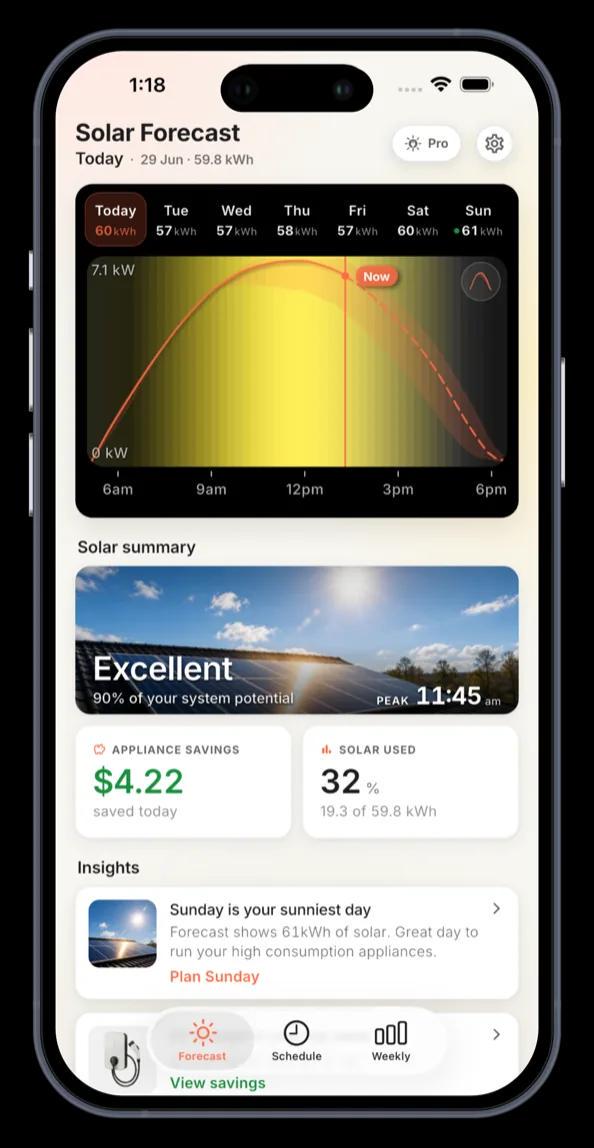
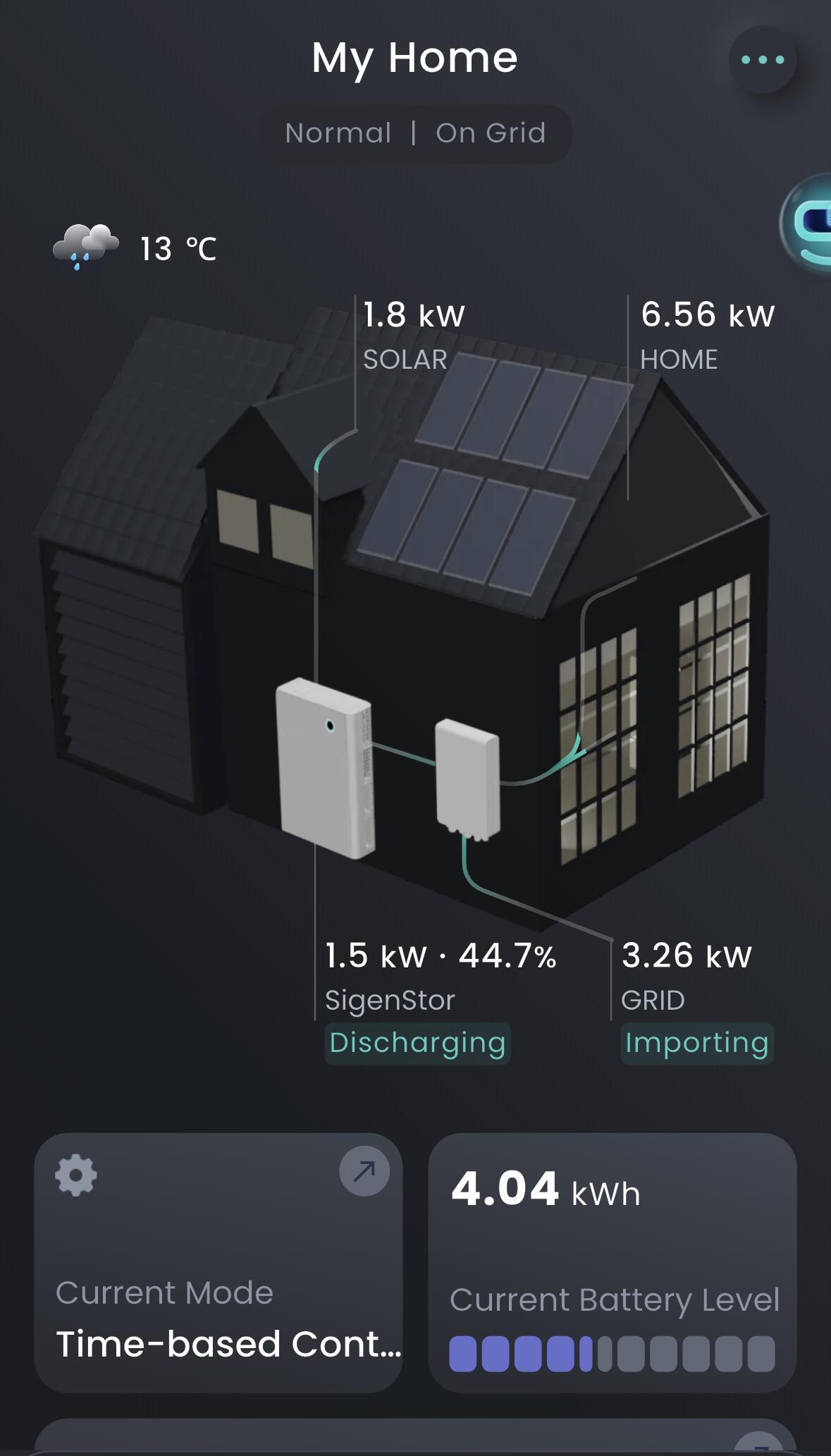
The system has been in operation for about 3 weeks as of writing this up. Initially I was just tracking the data through the 'MySigen' app, which is the official companion app for Sigen products. The app is user-friendly with a really easy to read and navigate UI, providing some awesome graphs which make your consumption and export data really easy to track and follow. They only downside was it didn't hold the all the finer system detail in memory, or readily available for export for deeper analysis - which is fine for the every day solar fan - However I love a bit of the nitty-gritty and wanted to track as much data as often as I could, so I rattled my 3 brain cells together and setup a home assistant server that captures data direct from the Inverter via the Sigen energy controllers Modbus TCP. "WTF is a Modbus TCP?" I hear you wondering. Well I suggest you google it like I did, because I'd need a couple more brain cells to explain it properly - But long-story-short (As this could be a whole other post on its own) this lets me capture, log and store all the data I want at 5-second intervals which provides incredibly granular feedback for analysis and trouble shooting if required.
With this data in hand, I will be able to start building a really accurate picture of what my system will deliver and how it will perform in a good variety of weather conditions, all the while updating my yearly forecast against pre-install estimates. Currently I am tracking well above the 15,000kWh mid-range prediction, looking in excess of 16,000kWh - Obviously with a huge Asterix due to the very small dataset so far.
To date, the collected data also supports my decision of splitting the panels over the two roof spaces in the 18 NNW - 10 NNE split, with each face performing exactly as intended.
Final thoughts
I am incredibly happy with my system and the decisions I made along the way. We got a variety of quotations from a few reputable suppliers, choosing based on both price and perceived quality (perceived because you never really know until its all said and done). We're on track for a yearly power-bill of around $200 and I couldn't be happier about that. One negative side-effect is how addicted you will become to checking the app, seeing how much power you're producing, consuming and exporting, and politely reminding the better-half that now might not be the best time do another load of washing, just as the sun goes down.
Words of wisdom - Take your time doing a bit of homework and don't be afraid to ask questions at every step of the way - No single person, installer, online resource, forum, website or pamphlet will have all the answers for you.
Happy to answer any questions if there is something I missed - publicly or privately just let me know!
Up the Wahs.