r/nzsolar • u/Lanky33 • Dec 03 '25
Me, ever since I got solar installed

394
Upvotes
r/nzsolar • u/Mountain_Tui_Reload • Oct 19 '26
Key facts
Nothing to pay upfront with two new Government-backed, long-term, low-interest finance options repaid from savings on your power bill
No lock-in: Repay the loan early at any time
Kickstart subsidy of up to $3,000 for low- and middle-income homeowners and renters
Plug-in solar panels for renters saving up-to $400 a year and paying for themselves in four to five years
Fair pay for power you share: Fair time of use rates when you export power to the grid.
$30 million community battery fund so neighbourhoods share the benefits, with or without panels on their roof
EECA provides free, independent advice as a one-stop shop to help households with system selection, installer quotes and finance matching
$160 million fully-funded over four years by repurposing the Government's Gas Security fund
Here's the SOLAR PLAN PAGE on their website
I saw a Green Party solar video on r/nzpolitics and it occurred to me I should look up Labour's. Was apparently released in May but I never really saw any news on it so sharing here in case of interest.
r/nzsolar • u/RobDickinson • Jul 20 '26

r/nzsolar • u/devl_ish • Apr 20 '26
Yet my 9.68kW of panels has been fluctuating between 0.5 and 2kW all morning which is enough to power 2 heat pumps maintaining 20 degrees, laptop, screen and router, backfeeding the battery with excess and drawing from it on drops.
Thought I should mention having heard approximately 10,000 "But the sun doesn't shine all the time!!" arguments leading up to install. Its still earning its keep.
Also, my fiancée's whole "fuel" requirement for the entire week fell off the roof yesterday during the half sunny hours. When I take a another break and run errands it'll be on Saturday's sunshine.
Smug? No. Very angry. We personally could have been living like this years ago. People are right this minute out of their minds with stress about how they're going to pay to get to work and layering up their kids who are still breathing in cold damp air all night. This isn't even remotely our first economic or fuel crisis and we're still going softy-softly on one of the biggest parasitic drags on our lives - imported energy.
Rant over, back to work...
r/nzsolar • u/feel-the-avocado • Mar 26 '26

I dont know why we are not doing this and more here
- All new SDU and Duplex homes over 60m2 need a 2kw+ solar array
- All new subdivisions should be laid out so houses can have a north facing roof
- All new houses should have an outlet in any attached or detached garage for a 4.6kw+ car charger
- All new houses should have an outdoor outlet capable of handling a 4.6kw+ car charger closest to the driveway if there is not already one in the garage. If there is already one in the garage then the outdoor outlet can be a standard 10 amp 2.3kw GPO or better.
- Central government needs to mandate city councils implement a policy to allow car charging outside one's property if there is a roadside berm avaliable, using pre-approved models of footpath-embedded cable channel (similar to manchester city council in the UK) and models of bollard for slack storage and outlet mounting.
- Central government needs to mandate that apartment building owners and body corps allow car charging to existing allocated or occupant owned carparks at the carpark owner's expense from a shared power supply with a submeter on a cost recovery basis, or implement a plan for a shared, load managed charging system to be installed, without requiring owners or tenants to use dedicated charging carparks.
- All new houses north of some suitable point in the south island have a heat pump and cabling in place to suit electric cooking, heating and hot water, even if the house is to be using gas initially.
r/nzsolar • u/RyanBurnettNZ • 29d ago

Hey All,
Spent most of this year going down the solar rabbit hole (eleven quotes, way too many spreadsheets, one very patient wife) and the system went live at the start of October. There wasn’t much on here about bigger residential systems in Chch, flat membrane roofs, or batteries above the usual 10 to 13kWh, so here’s ours in case it helps someone.
The house
2018 build on the Port Hills, four stories, flat Butynol roof, single-phase. Family of four, I work from home, e-Golf, heat pump hot water, induction. We were using about 14,000 kWh a year, with winter months hitting 2,000 kWh and summer under 700.
What went in
40 x Trina Vertex S+ N-type dual glass panels, 18.97kW, across two roof levels on 10 degree tilt frames
2 x Deye 8kW hybrid inverters, one above each battery
2 x Deye RW-F16 batteries, 32kWh
Orion approved us for 10kW export, with a meter enforcing it
Roof penetrations on stainless hanger bolts through the membrane, each one collared with a bonded Butynol patch by a proper membrane roofer with over 40 years experience working on the roof type.
Who did it
Brendon at Veinte Electrical, out of Tai Tapu. Small outfit, which is why the pricing was what it was. He redesigned the inverter setup twice when we worked out the 10kW export cap made the original 16kW hybrid pointless, and his final bill came in under his own quote from June. He is also actively (post install) working on automations through Home Assistant/Deye/Shelly on creating, essentially, a suite that runs the home the right way on any given day! Very happy with his service!
Cost
Just under $44k inc GST for the solar and battery, about $2,300 per kW installed. The other quotes for comparable arrays were $46k to $52k with 9 to 16kWh of battery, so we ended up with the biggest system and the biggest battery of anything quoted at the lowest price per kW.
Early results (first three weeks of October)
Best day so far: 94 kWh. Clear days are running 80 to 94, which is about 15% above what the modelling said for October.
Daily power bill is now basically the daily charge, around $2 to $3, before any export credits.
We’re already pushing 20 to 60 kWh a day back to the grid. The export meter has just been switched on to take solar and we are moving to time-of-use plans with Ecotricity that should see us well in credit.
Things I’d tell past me
Get your half-hourly meter data from your retailer before you talk to anyone. Every installer’s estimate was out by 20% or more until I gave them the actual CSV.
On single phase in Orion’s area you’re capped at 10kW export. Don’t pay for inverter capacity above that.
A flat membrane roof is fine for solar, but get a membrane roofer to do the penetrations, not the sparky.
Battery size matters more than panel brand once you’re on a time-of-export plan. The battery is what turns 10c exports into 23c exports.
Happy to answer questions on any of it.
r/nzsolar • u/punIn10ded • Jul 07 '26

r/nzsolar • u/lcmortensen • Jul 14 '26

r/nzsolar • u/Living_Register145 • May 29 '26

Pretty happy, hoping we can get some more clear days!
r/nzsolar • u/Mountain_Tui_Reload • Oct 23 '26

r/nzsolar • u/Living_Register145 • May 23 '26

Monday and we are all go!!
Along with a 12 kW Sigenergy inverter.
Batteries after a full calender year .
r/nzsolar • u/That_Zookeepergame17 • Nov 13 '25

Not a flex but just wanted to say that I am so glad that I looked into solar and this community. Moved to solar yesterday and loving the savings, seeing power generation and consumption stats, not worrying about gas, etc.
Based in Porirua Wellington and I went with following setup: $20K: 10kW - 20 x Trina Vertex S+ 500 Watt panels and 10kW of Sigenergy hybrid inverter with no battery. $7k: 300l Carrier hot water heat pump. $2.5k: Bosch induction cooktop.
Early days but since the last day and a half the stats look really good for a decent ROI. Have had one sunny day and one rainy day. Mostly also because our consumption went down by ditching gas and moving most of the chores to daytime.
r/nzsolar • u/Willuknight • Jul 12 '26
Last Christmas, we took the plunge and had solar installed. Now that we've had about six months of living with it, I thought it was a good time to share how it's actually going. https://imgur.com/a/jCGiRIT
Our household isn't exactly a light power user. There are 4-5 adults living here, we have electric vehicles, electric hot water, and I work from home full time. We use a lot of electricity. In fact, our June power bill was around $650, up from about $450 the month before.
Despite it being the middle of winter, on a clear sunny day we're still generated around 21 kWh yesterday, or $6 of power. Since the system was installed, we've generated 8.9 MWh of electricity, and we've been able to use 6.21 MWh of that ourselves rather than buying it from the grid.
So far, the system has saved us approximately $2,144. Based on our current modelling, we're on track for the system to pay for itself around November 2031, AKA 5 years, a total of 6 years, which is far faster than my predictions.
For me, installing solar wasn't just about lowering the next power bill.
It was about investing in something I know I'll continue to need for decades. Every year, electricity gets a little more expensive, but sunshine is still free. Solar lets me lock in part of my future energy costs today, reduce my carbon footprint, and become a little more self-sufficient. It also means more of my money stays in the local economy by supporting New Zealand businesses instead of being entirely tied to future energy price increases and energy shocks around the world.
One thing I didn't expect was just how much there was to learn. Panel sizes, inverter limits, export caps, retailers, buy-back rates, batteries, payback calculations... there are a lot of moving parts, and it took me quite a while to feel confident that it was the right investment for our family.
I'm really glad I put in that effort.
I hope this success story helps another family decide whether solar makes sense for them.
Some quick stats:
Total system cost: $21,400
Size: 14kw
Inverter 10kw
Retailer: Genesis
Installer: Smart Solar
r/nzsolar • u/Aggressive_Effort241 • Sep 21 '26
***I have edited this post to update it for September actual figures and fix a couple of errors in previous calculations and will continue to edit this post monthly with updated figures***
I’ve had my system running for just over a month now and I’m really pleased with how it’s performing.
11.9 kWp PV
10 kW Sigenergy three‑phase hybrid inverter
Array 1: 10 × 475 W (4.75 kW), facing 124° ESE
Array 2: 11 × 650 W (7.15 kW), facing 304° WNW
Roof pitch: 22.5°
Location: Whanganui, NZ
No battery - maybe in future
I’m not seeing any clipping so far, though I’ve hit 9.8 kW peak production. I expect some clipping over summer. The east/west split spreads production nicely across the day.
Went live just after midday on 20 August.
For the 30 days of September - Total generation: 1.12 MWh.
Average: ~37.33 kWh/day
Best day: 61.13 kWh
Worst day: 6.81 kWh
Given we’re just coming out of winter, I’m pretty happy with these numbers and am interested to see how it goes over summer.
I decided not to add a battery at this stage. My export rate is locked in at $0.20/kWh for two years, and I just couldn’t justify the cost of storage while I’m getting paid that much for excess generation.
Between that and our daytime usage patterns, a battery wouldn’t be doing enough heavy lifting to make the ROI stack up right now. I’ll revisit it once the export contract ends or if prices shift. We have no issue with power cuts here either.
One thing I’ve learned already: using as much of your own solar as you think you will is harder than expected. We’re still figuring out the routine of doing everything in daylight which is going well enough but not always possible. We have 4 kids and 3 adults in the house.
The good news is that my wife is home most days, and I work some evenings, so between us we can usually make use of solar as it’s generated. We’re getting better at charging the Leaf during the day too.
But yeah … still work to do here without resorting to timers.
Picked up an older Nissan Leaf for $3,300 in early June. Only ~100 km range, but perfect for the dozens of 2–3 km trips we do each week. We still have our V6 carnival for longer trips but it was hungry.
Fuel savings so far: **~**$400 per month compared to pre‑Leaf life but that doesn’t include other costs of leaf, but I suspect that will be offset by less maintenance required on the V6.
I’m not electrically minded, so this whole project was a real learning curve. I have switched out an old face plate for a new one was about the extent of my electrical experience. Cost of living was a big factor in motivating me.
I had two old gas infinities and a gas hob. I replaced them with a 340L Rinnai Hydraheat hot water heat pump and an electric hob earlier this year which instantly killed my ~$200/month (And increasing) gas bill and made solar more worthwhile. The hydra heat has a built in timer so I only have it heating during the day now I have the solar set up. I have it set to operate between 8 a.m. and 9 p.m. at present but may shorter than up as so far haven’t run out of hot water due to this.
My west roof could fit ~40 × 475 W panels, but budget said otherwise. The east roof is chopped into awkward sections, so layout took some planning and trying to work out what I could fit
optimally on that face and that would marry up to my nail lines.
I estimated our usage at ~12,500 kWh/year (including EV + hot water changes). This was based on past usage plus estimates moving forward so was a bit of a guess as I didn't know charging the EV would go, nor how much power the hot water would use.
The guys that came and quoted all said the inverted can go outside. But I wasn’t that keen on that idea and so the best spot was a covered carport at rear of the property but it was ~40 metres from the main switchboard with no real alternative options in my mind.
Roof space wasn’t accessible for the first 12 m, and concrete foundations blocked easy cable runs underneath. Exterior wall mounting was the only real option so I decided to use air conditioning ducting under the eave which was the best solution I could come up with. It doesn’t look to bad in my opinion and it is in the least accessible/visible part of my property so you don’t really have to see it which helps. My house colour scheme helped as well I think.
After lots of reading and research, I settled on a 10 kW inverter. I considered going bigger (particularly the 12kW inverter), but didn’t want to lose the better buy‑back rates above 10 kW. A big consideration obviously was the three phase limitations. The sig inverter allows unbalanced phases of up to 10% so I figured 3.6 on one phase was my limit. I drew the conclusion this should be sufficient having looked at my half hour usage for the past year but I’m not overly confident in this area so I could be wrong.
I bought the Sigenergy hybrid inverter + gateway through J.A. Russell (via my brother’s trade account) prior to the price increase in May. Interestingly I saw the new price when I picked it up and
it had gone up significantly.
Panels + mounting gear from Micromall:
21 × LONGI Hi-Mo X10 panels consisting of
10 × 475 W ($178 each) (East array)
11 × 650 W ($243 each) (West array)
All rails and mounting gear/shipping was another $1700ish
Total for panels + inverter + gateway +mounting: $12,023. No issues with either supplier but I made a few mistakes on some of the components needed as was not entirely clear on exactly what I needed to mount the panels and so on so had to do a small order of some extra components later.
I had ordered this with out speaking to a solar electrician and that was a big unknown – who was I going to get to complete the work once I had done the DIY. I just wanted to beat the coming price increases I was reading about online so pulled the trigger at that point.
Conduit, cabling, earth cable
Solar AC cable
CAT6/data cabling + network switch and conduit for this
Trunking
Extra components from micromall
Paying my brother (sparky) for panel installation help
I installed all the mounting rails myself and worked out the layout. Installing the 21 panels + running cables took ~7.5 hours. The 11 × 650 W panels took 1.5 hours; the 10 × 475 W panels took 6 hours due to panel orientation.
My brother handled roof penetrations and cable termination at the isolator switch thing next to the inverter.
Running trunking + cables to the meter board took another full day. Though that was spread out over a coupe of weeks as I had to negotiate some trickery and it involved removing roof iron to
access otherwise inaccessible space to try and keep things tidy which I was comfortable doing myself.
I ran the solar cable back to the mains and up to the meter inside the wall.
So essentially I needed a solar electrician to come around and fit off each end - the inverter and then the mains. Everything else was done.
Paid $2,050 for fit‑off, inspection, certification, tidying up the mains, and adding an
outdoor 15 A socket for the EV charger. This was easy to organize though I still had a lot of questions along the way which fed back into my cable runs and set up etc.
$17,260 all up which includes all miscellaneous costs I incurred.
For comparison sake the closest quote I received - $20,500:
8.8 kWp
6 kW three‑phase inverter (Though the quote said singe phase inverter so unsure if price was reflected or not)
Gateway included
I received other quotes anywhere in the range of $18,000 all the way up to $40,000 (Different sized systems etc)
That quote did not mention any edge protection or scaffolding and I don’t believe it included factoring in the long run between where I actually wanted the inverter and my meter which I suspect may have resulted in a bump in price. My house is an old villa with a 3.3m stud and so I think a few thousand extra for that would be likely. As it was … my brother and I did it without this cost. I’m not going to lie. I do not recommend that.
Some will scoff at the recklessness of it. Despite having been on roofs plenty before, I was a little uncomfortable at times when working near the edge when fitting off some of the panels and holding them awkwardly while my brother fitted off wiring etc.
I got a quote for some edge protection at mates rates ($500 for a couple of days) but my brother said not to worry about it and I listened to him. I do own a mobile scaffold tower for painting my house so I did utilize that which helped but it is not really a substitute for proper edge protection as while its plenty high its only 1.8m wide and we weren't getting down and moving it along with us all of the time.
Nor did that quote include the cost of tidying up the wiring on my meter or running the extra breaker and cabling and exterior power point for my granny charger (which was about 45m of cable).
I ended up with 35% more PV and a larger inverter for significantly less money but only because I did a lot of the work myself and spent many many hours thinking and researching and had a sparky in the family I could call on at times. I watched loads of youtube videos and read loads of reddit posts trying to decipher and learn what I could.
Would I recommend DIY solar to others? Ehhhhhh… maybe if you are confident.
From a pure cost saving I definitely saved myself money for sure and it is not an insignificant amount. But there was a chance I fell off the roof and broke something and that have a hmmmm moment from the ACC ad’s definitely applies. I got lucky in some respects and more or less got the rights parts without any major mistakes.
I could have returned the gateway as I didn’t end up installing it which would have reduced my cost a further $1100 or so. I’ve kept it and plan to install it in due course which will obviously have a cost associated to that.
I went into this thinking, “How hard can it be? Panels go on roof, cables go in inverter, job done.” Yeah… no. It was way more complicated than that and while the larger west array was straight forward the east array was like the boss level of a game I didn’t realise I’d started playing. Without my brother (the sparky) I would’ve been absolutely cooked at that point.
There’s also the whole “electrical compliance” thing. Unless you’re genuinely good with electrical stuff, there’s a very real chance you’ll create a system that looks fine but is secretly plotting to burn your house down.
And of course, any maintenance or warranty issues are now my problem - though the
solar electrician I used was great, and I’m sure he’d help if something went wrong (paid help, obviously). Obviously he jumped up on the roof and checked out our work and so on as well before getting the inspector around to sign things off.
You'll note I am still importing more power than I am actually utilizing which surprised me. I still have work to do to make better use of what we are producing and this is perhaps limited by my three phases in terms of what is capable of being drawn down each phase. I have to do some work to check how my phases are balanced to get the best out of my system and haven’t looked at this yet and the net metering for three phases thing complicates this. I only moved hot water heating recently to timer so haven’t fully realized any savings there yet either.
So using my current power rates I roughly saved $276 on my bill for September. The export credit is a significant factor obviously. Also trying to utilize power during the day better is going to help in the long run. Long live export credits… It is also worth nothing I could get slightly better rates I believe on a non solar plan so this figure is likely overstated compared to no solar.
So payback period? To early to really say confidently, but if I can average $275 per month (Remains to be seen) that would suggest slightly over 5 years. This does not factor in saved petrol via the leaf, or the elimination of my gas bill (Those all came with associated costs of course).
Overall... really happy and excited to see how it goes over summer and then winter etc. I have a spare mppt and a space I could throw up another 3kW of panels north facing at 60 degrees to help in winter if required. Will wait and see how summer goes first.
For September
1120 kWh produced (Daily average - 37.33)
61.13 kWh - Best day
829.85 kWh exported = $165.97 export credit
600.08 kWh imported = ~$228.03 power bill
290.15 kWh utilized = ~$110 saved power cost.
Power bill for the month = $139 (Includes daily line charge)
For October
1662 kWh produced (Daily average - 53.62)
77.79 kWh - Best day
1211 kWh exported = $242.32 export credit
434 kWh imported = ~$162.34 power bill
450.54 kWh utilized = ~$168.39 saved power cost.
Power bill for the month = $8.79 (Includes daily line charge)
r/nzsolar • u/Dat756 • Oct 14 '26

r/nzsolar • u/RobDickinson • May 07 '26

r/nzsolar • u/CrazyPlantLady95 • Oct 20 '26
Hey everyone,
I’m posting this as both a warning and a place for affected customers to gather information. Like many others, I’ve been hit directly by the sudden collapse of Solar Hub NZ Limited—I’ve personally lost around $12,000 to them for panel that was never installed in July.
The Liquidators’ First report(Ecovis KGA) was recently released, and the details are pretty grim. Here is a breakdown of the key facts from the report:
Liquidation Date: Solar Hub NZ Limited was placed into liquidation on October 13, 2026. Gareth Hoole and Chiragkumar Patel of Ecovis KGA are the appointed liquidators.
Missing/Unfulfilled Customer Deposits: The company’s records list $648,894 in customer deposits. A massive number of customers paid deposits or full upfront costs for solar setups that were either left half-finished or never started at all.
Investigation into Misuse of Funds: The liquidators noted this is a serious issue and are conducting a formal investigation into potential misuse of deposit funds and malfeasance.
Financial Position:
Total liabilities stand at ~$5.14 million.
They owe $1.265 million to Inland Revenue (IRD) in preferential tax claims and ~$494k to secured lenders.
Cash on hand when liquidators took over: literally $7.
What You Should Do Immediately If You’re Affected:
Submit a Creditors Claim Form:
You need to file a formal claim with the liquidators by November 11, 2026. PDF
Email your claim form and proof of payment/invoices to: [email protected]. PDF
Request a Bank Chargeback ASAP:
If you paid any portion of your deposit or invoice via Credit Card or Debit Card, contact your bank immediately to request a dispute / chargeback. Depending on your bank's timeframes, this might be your best chance at recovering your money.
Notify SEANZ:
If you have an incomplete or unserviced installation, consider reaching out or logging details with SEANZ (Sustainable Energy Association New Zealand) so the wider industry has visibility over affected households.
r/nzsolar • u/Mountain_Tui_Reload • May 07 '26

r/nzsolar • u/Mountain_Tui_Reload • May 04 '26

New Zealand has passed the "tipping point" where most people buying solar panels will save more money than they spend on them, researchers say, but more could be done to unlock households' ability to make use of solar power.
Josh Ellison, research lead for Rewiring Aotearoa, said the country was one of the first where the electrification of homes and vehicles could deliver cost-of-living savings and reductions in emissions at the same time.
He said the tipping point was probably passed about three years ago but has now been crossed for battery storage systems, too.
It was helped by solar installation costs reducing and power prices increasing.
"It does depend on how much electricity the household consumers.
r/nzsolar • u/helpfultroll • Feb 16 '26
Firstly, this is not intended to show off. I feel deeply sorry for all of those affected by this severe weather, and I am incredibly thankful to all of those involved restoring our vital infrastructure.
Our solar/battery system took over yesterday when various trees fell onto the power lines. We continued life normally. Oven on, TV on, internet up and running.
This morning I made coffees and breakfast for the family, and then worked from home. By early afternoon, the house batteries were fully charged, and water tank full of hot water.
I've just had a shower, and I'm about to cook food. The washing machine, tumble dryer and dishwasher are all running. We'll have ample power to last through the night, and the batteries will fully charge tomorrow.
Environment aside, solar and batteries just makes sense. They provide the ability to run appliances during the day when most convenient, and provide peace of mind with backup capabilities during a power cut. The fact that these systems also pay for themselves over time is just icing on the cake.
If you're on the fence about solar+batteries, do consider backup capabilities. It's pretty magic.
Would love to hear similar stories from those using solar/batteries, and even V2L!
Hope you're all staying safe.
r/nzsolar • u/Mountain_Tui_Reload • Oct 21 '25

New power projects already in advanced planning stages would collectively boost New Zealand’s electric supply by a quarter, according to new data
A new dashboard released by the Electricity Authority shows developers are planning 45 gigawatts of new power capacity across 292 projects – five times the country’s full electric grid in 2023.
While the vast majority of the projects are still in early or even hypothetical stages (they include eight gigawatts of offshore wind, even though there is no legal framework for offshore turbines), those in advanced planning stages or actively committed to by developers would still boost New Zealand’s electric capacity by 27 percent.
Less than a quarter of the planned new generation would come from the big gentailers. Instead, independent New Zealand firms and international investors are behind 35 gigawatts of the pipeline. More than 100 developers responded to the information request.
Full link above
r/nzsolar • u/SheepShaggerNZ • Apr 29 '26

It's a foggy morning in Autumn and it's still putting out 2.3kW. I've got 14.7kW of panels on 3 sides of my house and the morning sides maximum would not be more than 4kW.
r/nzsolar • u/lcmortensen • Oct 25 '26

Long weekend in spring
Fine weather but with a strong nor'wester
Geothermal providing baseload
No fossil fuel generation (bar industrial cogeneration)
Hydro at minimum generation (to maintain minimum flows and provide grid support)
Batteries fully charged
Wholesale prices at $0.02 per MWh...
Something had to give... and now we have Turitea and Kaiwera Downs wind farms being curtailed during peak solar generation.
r/nzsolar • u/InertiaCreeping • Mar 05 '26
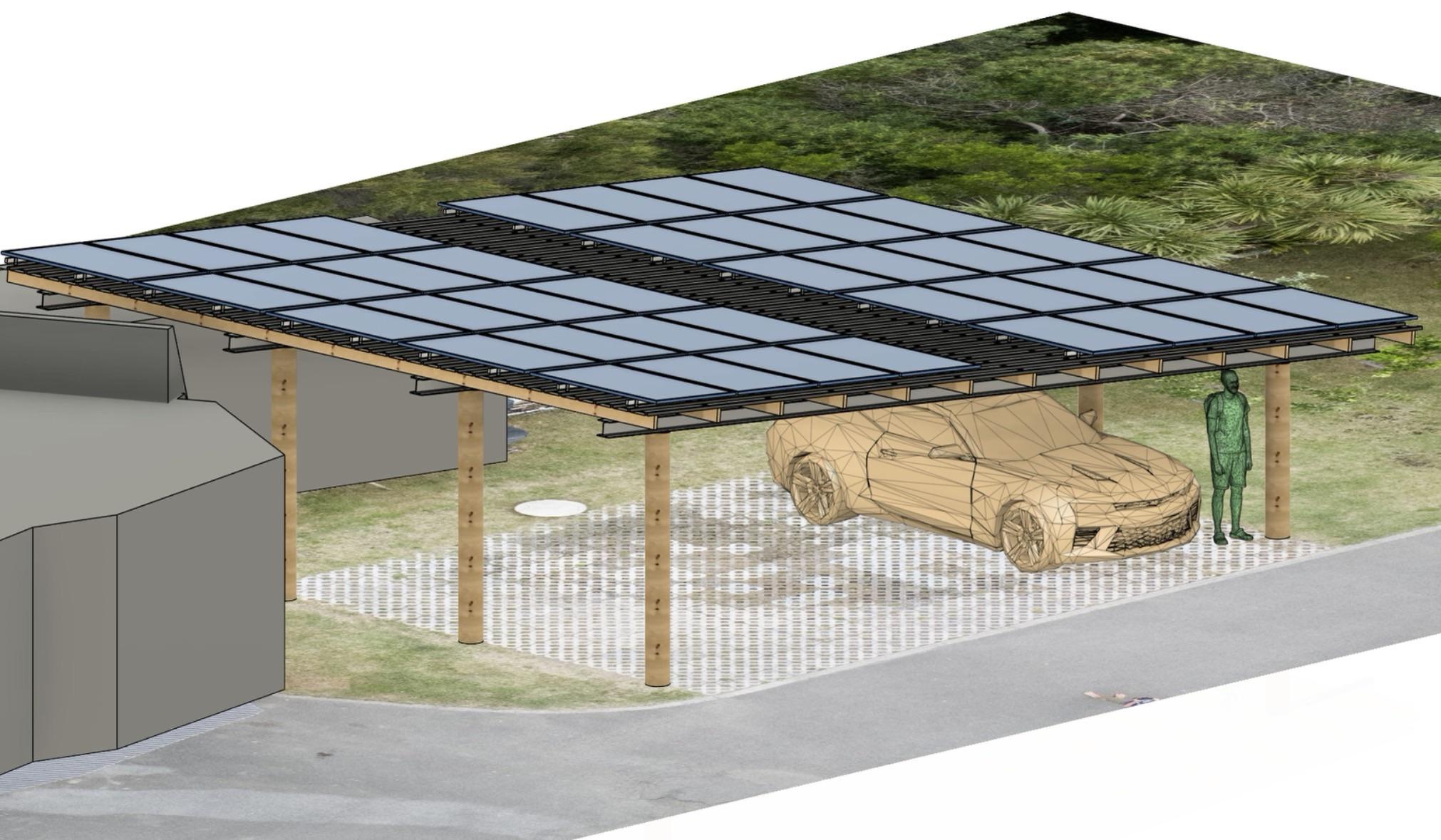
Basically, I’m off grid with a bloody octagonal shaped house which means I don’t have long stretches of roof space.
I basically need to add 40 panels to my system to keep us going through the winter - and a perfect three car parking spot to put said panels (I wanted to cover the cars anyway).
Besides a nice north facing paddock about 150 m away, this is the only available space I have for these panels.
The problem is, we are on top of a hill in the windiest zone (extra/very high), so all of the commercially available residential solar carport kits are not suitable.
I asked a shed builder/designer outfit if they would sell me a shed without any walls or roofing so I could just bolt solar rails to the top and use the panels as a roof, they basically ghosted me. Heh. (I thought maybe a consent free shed might be an easy option)
Realising that I probably can’t get away with not getting consent, etc I spoke to a builder who said that he has a draftsman mate who can do the designs for what I want, and he could build it (and most importantly deal with the paperwork ) I’ll work with a Sparky during the planning stage of the solar panels and rails, as they will have to sign off on it.
Fast forward to today I finished the CAD drawings based on putting my span distance and wind requirements etc into GPT and following what it vomited out… (JUST to get in the ballpark, NOT trusting a chatbot!!!)
250mm dia upright pine. 310UB steel beams spanning almost 11m(!!!), 140x40 purlins across, yada yada.
My question is - am I going about this right way? Is there an option I have missed?
—
Existing system is a 15 kW victron inverter, with 5x MPPTs, six strings, about 30x 500w panels, 114 kWh DIY LFP battery bank with Victron BMS