r/morsecode
•
u/Df7x
•
14d ago

Is this Morse code?
4.3k
Upvotes
Saw this weird light flashing out of a condo window. Looks to be repeating. Does it say anything?
r/morsecode
•
u/Df7x
•
14d ago
Saw this weird light flashing out of a condo window. Looks to be repeating. Does it say anything?
r/morsecode • u/BUBBA_KUSH_WATSON • Dec 16 '25
Can someone verify whether or not the guy on the right of this video is sending a secret message? The blinks seem irregular to me but I am unfamiliar with Morse code.
r/morsecode • u/demetresjames • Feb 13 '26

In our English class we were able to make love notes or stuff like that for our freinds or lovers and I gave my friend one and drew him his fav gun from arc raiders ventor btw. But besides that at the end of school he came running to me giving me this and I laughed my ass off over this bc it’s in Morse code so I try decoding it and decided to resort to Reddit. Btw that gun is the bobcat from arc raiders
r/morsecode • u/Von_Rootin_Tootin • Feb 22 '26

I was told by a friend that these panels are Morse code, but I cant figure it out. I’d appreciate the help
r/morsecode • u/brenee1993 • Jan 26 '22

r/morsecode • u/UnluckyHall1935 • Oct 21 '25

Our dad passed last Saturday after a long fight with Cancer, and left a bracelet to my brother. We suspect it’s Morse code, but there’s no spaces in between the dots and dashes. Any help to decipher it would be greatly appreciated!
Here’s the code. We also don’t know which is the front so it could also be backwards
-.....-..-.--......-...-.--.
r/morsecode
•
u/AudraKlair
•
Apr 27 '25


My grandpa passed away early this morning at the age of 94. He was drafted in the Korean War and, as he did not want to see combat, opted to become a high frequency radio operator. I learned in recent years that he still remembered morse code. He rarely said "I love you" to anyone except my grandma, but after I expressed interest in his knowledge of morse code he started to say it to me. Last month I asked if I could record him and I am so grateful I did because this was our last visit where he could still speak.
He was a strong, brilliant, cranky man and I'll miss him immensely.
Di-di | di-dah-di-di dah-dah-dah di-di-di-dah di | dah-di-dah-dah dah-dah-dah di-di-dah, Poppy.
r/morsecode • u/Lasivian • May 28 '21

r/morsecode • u/uhwhatisjalapenos • Sep 25 '20

r/morsecode • u/WitherCro2 • Feb 14 '26

r/morsecode • u/flamingoeyes • 16d ago
For the past year I've been developing a gadget using the elegance of Morse code to power a two button messaging device. It's called Dot Dash ;) The idea was born out of the urge to create something for my pre-phone kids to communicate directly with their friends, but after starting an Instagram account a few months ago, I realized that people in the Morse community are really into as well!
When you register a device, it gets a unique call sign. When devices add each other, they are able to send short messages back and forth, as long as they both are connected to WiFi. Your device can be linked to up to 20 contacts (not just other Dot Dashes, also now works with anyone who has a phone number!)
There's also a training mode where the device helps you learn Morse code. I've also etched the morse key into the back of the 3D printed case.
It's high time I told you all about it! There are lots of videos on Instagram showing how it works. I'd love comments and feedback!
r/morsecode • u/Shadow_Avis • Dec 14 '25

r/morsecode • u/Due-Explanation8155 • Mar 31 '26
r/morsecode • u/[deleted] • Mar 11 '21
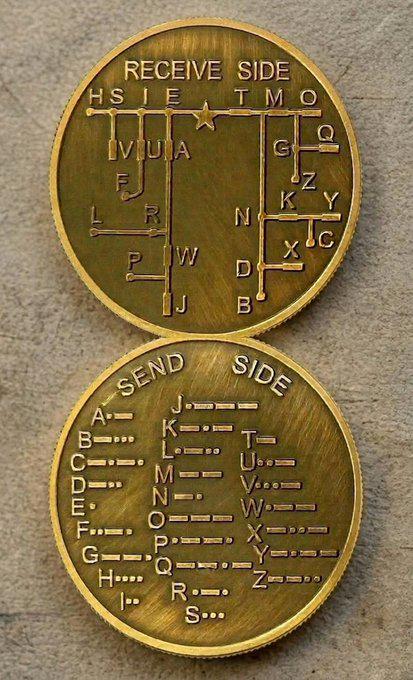
I was listening to Structure by Odd Sweetheart and in the beginning you can hear what I believe is morse code (if you turn up the volume) I have no idea what it says I don't much experience with decoding- could I perhaps get help?Structure - Odd Sweetheart
r/morsecode
•
u/CalcetinDeLefa123
•
Aug 31 '26

Probably nobody will notice details that small, but one day I was waiting for someone to answer me and saw this while looking carefully at the app's wallpaper. I'm pretty sure most of the people here know what it says but, for beginners here, it says "enigma".
(Sorry if I wrote something strange, I'm not a native speaker)
r/morsecode • u/Manlypineapple1 • Apr 21 '21

r/morsecode • u/YT_Usul • Feb 04 '24
This post was originally taken from a comment in another thread. I've expanded it and will do my best to keep this post updated as time goes on. Please feel free to reference this post going forward. Last updated: 12 FEB 2024
MORSE CODE PROFICIENCY
This guide documents a proven method for gaining proficiency in communicating with Morse Code using the free website lcwo.net. LCWO is developed by Fabian Kurz (DJ5CW), a ham radio operator in Germany. He has developed the site as a completely free resource to help those interested in learning Morse Code. It is ad-free, and Fabian does not ask for donations or money of any kind.
Morse Code proficiency means understanding Morse as a language, not just a series of beeps or ASCII text characters. The focus is on hearing Morse as a sound and instantly recognizing its meaning, just like someone might do with a spoken language. This allows for the free and easy exchange of information using only the sound of Morse itself. It can be incredibly challenging and rewarding to communicate using the musical rhythm of "The Code."
Getting on the air as a licensed amateur radio operator and making CW (continuous wave) contacts is the most common reason to learn Morse. There are approximately 250,000 people world-wide that are using Morse to communicate. It is by far the most wide-spread modern use of Morse code. Surprisingly, the number of people involved is actually growing over time despite an aging demographic. There is something thrilling about making a direct person-to-person contact with someone thousands of miles away using a radio that fits in your pocket, no internet or smartphones required. Morse code operators often talk of the "mind-meld" that seems to take place between operators, with thoughts streaming into your head as the code arrives. People of all ages and backgrounds have discovered the thrill of Morse sent via radio.
LEARNING MORSE
Morse Code has been taught for over 150 years. Out of all the techniques and possible permutations of training from the military, Western Union telegraphers, railroaders, maritime radio officers, amateurs and more... There is one method that has risen above them all: Koch-Farnsworth.
Those serious about gaining Morse Code proficiency should put considerable effort into using the Koch-Farnsworth "no counting" method prior to trying other approaches. This method will help develop skills without bad habits that have tripped up many other students over the years. The secret is to find a method that makes it fun to learn.
USING LCWO.net
The following K/F method using LCWO.net has been proven to work well:
Set up a free account and log in.
Select "Change CW settings" in the left nav-bar.
Click the "link" button/icon just to the right of the character & effective speed options.
Set character speed to 28 wpm (or faster, you may have to adjust later).
Set the effective speed to 5 wpm (or slower, adjusted later).
Keep extra word spacing at 0.
Set the tone you prefer in Hertz. 500-750 is recommended. 700 is a popular one.
Use the recommended CW player unless your browser has issues.
Keep the transmission suffix off (unchecked).
Set the start delay to your preference. Most keep it at zero.
Set group length to "2-7 random."
Go through all the "Koch Method CW Course" lessons, one by one. Do NOT skip ahead. Do not go to the next lesson until you get to >98% accuracy with 5 minutes of code. You want high accuracy at this stage.
By clicking the character in "Letters in this lesson" you can hear each one. As you progress into the later lessons, use this feature to hear the difference between characters you might find difficult. Listen to these over and over before trying the lesson.
When first starting out, 5 minutes may be a little long. Set the lesson duration to 3 minutes, then work up to 5 minutes as you gain skill. By lesson 20 you should be listening to 5 minute lessons.
Note: The goal is to get to a point where each lesson is almost effortless. The website indicates you should proceed at >90% accuracy, but try for 98%. If you really strain to get that 98%, do it again until you can consistently hit 98%. Some lessons will be quick, others may take several tries. Keep trying!
Bad habits to avoid:
DO NOT COUNT THE INDIVIDUAL DITS-DAHS!!!! You want to have the character speed set fast enough that you cannot possibly count the individual dits and dahs. You want to hear the character as ONE COMPLETE SOUND. Nothing will unravel a student's training faster than this bad habit. It is critical to not develop it. You may need to adjust the speed up to 32 wpm if needed to get speeds fast enough your brain will not try to count dits/dahs. You can slow down the effective speed as needed to allow more time to process each character.
Do not learn to hit the corresponding key on the keyboard thoughtlessly. Say the letter in your head as you copy it. If you type it instantly, you will be forced to type or write everything you hear. This is because you are training your fingers to respond rather than your brain to understand.
Try "copying behind" just a little. Meaning, listen to a few characters before typing them. The goal is to teach the brain to track several characters at once and improve mental capacity. This will help immensely later on as you move to word training. If possible, remember an entire group before typing it.
Once you get to the last lesson (#40) and can get better than 95% accuracy (now the fun part):
Lower the character speed by 2-3 wpm.
Increase the effective speed by 2-3 wpm.
Do lesson #40 again (don't start over). Keep at it until you can get better than 95% accuracy, then adjust speeds closer again.
Be patient. This process can take weeks for some people and months for others. Avoid comparing yourself to others. This is your journey, not theirs. Enjoy the process and treat it as a personal challenge. Keep the stress low and focus on hearing the letters as complete sounds.
Once the character speed and effective speed finally match you should be somewhere between 15-20wpm full speed code. From here you have freedom to increase the speed in lockstep.
Congratulations! You completed the LCWO.net course! Successfully completing the lessons is the start of a journey, not the end of one. Use the rest of this guide for additional tips.
Practice, listen, listen, practice. Start listening to lots of real code on the air, plain language code, contests, whatever you are in to. Get a training app for your phone, whatever you like. It can take years before Morse Code is like a second language.
Start practicing "head copy" at this stage. Don't write anything down. Just listen and try to keep it straight in your head. This is the stage that takes the longest.
Example schedule (character speed / effective speed);
28/5 (lessons 1-39 to 98% accuracy, then lesson 40 to 95% accuracy)
25/8 (lesson 40 to 95% accuracy)
22/11 (lesson 40 to 95% accuracy)
19/14 (lesson 40 to 95% accuracy)
16 wpm full speed (lesson 40 to 95% accuracy)
19, 22, 25.... however fast you want to train.
Head copy real code. Words, phrases, on-air procedure, etc.
DRILL WITH THE MORSEMACHINE
If you have tried more than 5 times on a lesson, but still can't get better than 98% accuracy, use the MorseMachine to practice until trying again. You can find it under "Lessons" in the left nav bar. Here are some MorseMachine tips.
You may be stuck differentiating similar characters such as I, H, 5, S, V, U, and so on. This is quite common. Do not be concerned. The MorseMachine is the perfect tool to work on it.
By default the MorseMachine will use all letters from the current Koch lesson.
You may configure custom characters in the user settings, then select them in the MorseMachine (Character Set drop down menu). Use this to zero in on problematic characters only, if you prefer.
Set a timer for 5 minutes. Work the MorseMachine for 5 minutes. Then take a break. Try to do this several times a day until errors get noticeably less frequent. Then try the lesson again.
Focus on accuracy, not speed. Take the time to recognize the sound. It may seem almost impossible at first, but the more you try, you will find the brain will "click" and start hearing the difference, perhaps almost subconsciously.
In the MorseMachine, click the gray/green bar above a character near to the top to reset just that character. Do this for any problematic charters, and the MorseMachine will play those more frequently. You can also reset all statistics with the "RESET" button, but generally this isn't recommended.
Reduce speed temporarily if needed, but do not proceed with lessons until you can get the speed back up to the speed you are targeting.
SENDING PRACTICE
Okay, you can hear and decode Morse just fine... But how do you send it? LCWO.net does not have tools for sending practice, though there is an experimental option, here: https://lcwo.net/transmit
There are two schools of thought when it comes to sending practice. One involves using a straight key (old fashioned style) & practice oscillator. Then, learning the finer points of spacing and wrist control right off the bat by using that to send Morse. The other (and more popular) choice involves the use of "Iambic Keying." This uses two paddled Morse Code keys, and an electronic device called a "keyer." The keyer controls the length of the dits and dahs and sends the corresponding sound based on which paddle is pressed. A dial on the keyer sets the overall speed or length of the dits and dahs (and the spaces).
The trouble with the second option is that computerized keyers and iambic paddle keys can be on the pricey side. It might cost several hundred dollars. It can also lead to frustration and bad habits if a student goes too cheap and doesn't get quality devices. You will have to decide what works best for your budget. Check with the r/morsecode subreddit for budget friendly options. Look at KENT Morse Keys iambic paddles for a good value starter iambic paddle set. The Morserino-32 is a popular keyer that also works as a trainer.
Once you have your key, keyer, and/or practice oscillator, find a way to feed the audio from the device into a computer. A built-in microphone on a laptop should work find (as long as it is in a quiet area). Download and install the free program "FLDigi." Setup FLDigi to decode the noise it hears as Morse Code. FLDigi is really bad at decoding Morse (really, really bad)... And that's actually a good thing! FLDigi will only decode if the Morse sent is near perfect. Write down a message and transmit it. Compare it to what FLDigi decoded. Keep this up until you can get FLDigi to decode your message with 100% precision (remember, spaces count). If FLDigi can decode it, any other Morse Code operator can easily do the same!
NOW WHAT?
If you have completed the course, gained proficiency with the characters, you are ready to communicate... Right? Learning the characters is only part of the challenge. Morse code is sent in a form involving procedures and guidelines to improve efficiency and ensure understanding. Abbreviations and shortcuts are used extensively. The procedures used are historical in nature, with many being developed over a hundred years ago with the expansion of the land-based telegraph.
The best option is to get on the air and listen, listen, listen! With the rise of Software Defined Radios (SDR) this has never been easier. Many of these radios are available on the web, and can be used by anyone (you do not have to be a ham radio operator) for free. Check out a list, here: http://websdr.org/
LCWO.net also gives you additional training tools via its other modules such as "Callsign Training," "Word Training," and more. Check the RESOURCES section for more options.
Check out CW contests, Summits on the Air (SOTA), Parks on the Air (POTA), DXpeditions, and more. These combine outdoor adventure activities with CW and make an already challenging form of communication even more so. Taking a tiny radio to the top of a mountain, getting "chased" by other stations who are desperate to contact you, working a "pile-up" of dozens of CW operators all wanting to hear your signal... The feeling is hard to describe. Operators have told of the overwhelming joy they feel making a special long-distance contact, or being heard using a tiny low-powered radio that fits in the palm of the hand. It is thrilling!
If you do not know where to go next, please ask. Post to r/morsecode or r/amateurradio. Join a local ham club. Check out other social media resources. Look at YouTube.
GENERAL TIPS AND TRICKS
Some people need the character speed set very fast to avoid the temptation to count dits-dahs. Try 44wpm or faster with lots of Farnsworth spacing (3-5wpm).
You may notice that some lessons are easy and can be done in minutes. Others might take quite a bit of practice. For example, hearing the difference between "U" and "V" sent at high speed may take extra effort. That's expected, and okay.
Don't forget to mix up training to keep it interesting and enjoyable.
Learning the characters is the easy part. Don't be discouraged when learning the procedures, abbreviations, and odd short-cuts seem even more daunting than learning the code itself. All of it will get easier with time.
If at all possible, get your ham radio license in whichever country you live. CW-only radios are quite affordable compared to other larger radios. Use it to get on the air and start communicating as soon as you feel comfortable.
It is easy to feel intimidated. Making mistakes is normal for any beginner. It is okay, really! Just try again. We've all been there, and the CW community is very forgiving and understanding. Trust that everyone knows how difficult it is to learn Morse and will be there to support you.
GOING FURTHER... AND FASTER
If you already know Morse or want to go faster, here are character and effective splits to land at 30wpm full speed. You can start over if you wish, or jump right to lesson 40. After 30wpm, you might try 35, 40, or even faster. Gaining elite levels of skill can actually make you a valuable operator to large contest groups and DXpeditions.
44/6 - Lessons 1-40
42/10
40/14
38/18
36/22
34/26
32/30
30
It is critical that accuracy targets be hit, or it will be very difficult to proceed as speeds increase. This should be done with a mixed training program, such as on-air listening and other Morse training tools (see RESOURCES below).
RESOURCES
CWOps is an all volunteer run ham radio club that runs contests. They also teach classes for any licensed amateur radio operator called "CW Academy." It is totally free, though they do ask you to be dedicated and commit the required time. These classes are an excellent way to go from zero understanding of code, to getting on the air and making contacts. Thousands of hams have completed the course. More info: https://cwops.org/cw-academy/
CW Academy uses this trainer for their classes. It is an alternative to LCWO.net, though it really works best when using it with CW Academy: https://morsecode.world/international/trainer/trainer.html
The First Class CW Operators Club promotes excellence in Morse Code operations by amateur radio operators. They maintain a list of highly useful resources, here: https://www.g4foc.org/Improving-Your-CW
The Straight Key Century Club (SKCC) promotes the use of manually controlled spacing of dits and dahs using old-style straight-keys, bugs, and "cooties." They hold regular contests and have an extensive awards program. It is free to join. https://www.skccgroup.com/
The North American QRP CW Club promotes the use of Morse using low-powered radios. They hold regular contests and have awards. It is free to join. http://naqcc.info/
Summits on the Air (SOTA) started in the UK, but is now a world-wide sensation! This very popular activity involves setting up a ham radio shack on the tops of mountains. Using Morse is one of the most popular modes used in SOTA. https://www.sota.org.uk/
The free program Morse Runner simulates realistic conditions during a CW contest using a Windows Desktop application. It allows you to operate just like running a real radio and the N1MM logger (for auto-sending Morse during a contest). It simulates fading, interference, noise, pile-ups, and more. Highly recommended as a training tool for those interested in contests. https://www.dxatlas.com/MorseRunner/
The ARRL also has a series of resources for hams learning CW. They also award certificates for being able to copy CW correctly during scheduled broadcasts. https://www.arrl.org/learning-morse-code
The WA7BNM Contest Calendar is a great resource to find out when Morse Code contests will occur. Some of these contests involve thousands of people sending Morse simultaneously, and can be a great time to listen. https://www.contestcalendar.com/contestcal_cw.html
"Chasing DX" can be a very challenging and thrilling hobby. Ham radio operators travel to remote undeveloped locations, set up a full ham station, and make as many radio calls as possible while they are there. These "DXpeditions" can be expensive, involving chartered aircraft or ships. They tend to recruit top-talent and select the best equipment. CW is a popular mode due to its efficiency and readability over long distances. Collecting QSL cards from these groups is seen as a hobby unto itself. A list of planned DXpeditions is available here: https://www.ng3k.com/misc/adxo.html
Have more? Share them below.
MORSE CODE HISTORY
This section offers a few historical highlights some may find interesting.
International Morse
The type of code in most wide-spread use is International Morse Code. There are various ways to encode characters and numbers using Morse. The first encoding was actually created by Alfred Vail, who worked for Samuel Morse and did most of the actual engineering. Enthusiasts may occasionally refer to Morse code as "Vail's Code" to pay homage to the fact that it was Alfred Vail who actually came up with the original encoding mechanism.
The rise of land-based telegraphy was eventually dominated by the company Western Union. They gained an effective monopoly over all land based telegraphy. With that monopoly came a standardization of Morse using an encoding called American Morse, or "Railroad Morse." So called due to the right-of-way agreements telegraphers shared with the railroad. Many rail stations also became Western Union telegraphy stations. Most of the procedure and abbreviations used today were developed by the Western Union land-based telegraphers.
With the development of the transcontinental telegraph by Western Union, new forms of encoding were required to handle the additional characters of languages found across Europe. As the Marconi Wireless Telegraph Company began to overtake Western Union's dominance, there was an even greater demand for standardization.
In 1865 the International Telecommunications Union (ITU) was formed. This body was made up of a number of companies and specialists in the telecom industry. The ITU Congress officially sanctioned the encoding of International Morse Code in that same year. This encoding has become the world-wide standard for all Morse Code since. The ITU is now officially part of the United Nations, and still maintains the official definition of International Morse Code.
Though rare, occasionally you may hear other encodings such as American Morse, or Japanese Wabun Code. Historically, Morse Code operators liked to come up with their own encodings, and there are a variety of regional quirks not heard elsewhere.
Koch-Farnsworth
The terms Koch, Farnsworth, and Koch-Farnsworth all refer to methods of learning Morse Code. These are the most popular approaches to learning Morse, specifically it is the combination of these two methods that is popular. Other methods of teaching have been proven, over many years, to introduce bad habits or roadblocks to proficiency. It is highly recommended those new to Morse avoid all other learning programs but Koch-Farnsworth. These include: Visual learning methods (such as associating each letter with a shape or object), sending at very slow speeds, manually looking up codes, counting dits & dahs, and so forth.
Koch refers to a system of teaching Morse by Ludwig Koch in the 1930s. Koch was a German psychologist who believed you should learn characters sent at full speed, then train your reflexes to respond to the full speed code. The Koch method involves learning characters in a carefully selected order. This order introduces similar sounding characters at strategic points, when the brain is well-familiar with the previous characters. Lessons are meant to be kept short, at 5 minutes. You listen to the new character over and over again until you become comfortable with it, then listen to all previously introduced characters with the new one introduced for 5 minutes. Once the student can copy all characters above 90% accuracy, the next letter is introduced. The trick is to spread out the training over several sessions, daily, rather than hours-long study sessions grinding away trying to understand it.
Donald R. Farnsworth, an American ham radio operator, introduced a slight variation to the Koch method in the 1950s. This kept the fast speeds of Koch, but added additional spacing between each character. This gave the brain time to recognize the character before hearing the next. Once the student learns all the characters, the spacing is slowly removed until the student is copying full-speed Morse. This method allowed students to train for copying Morse at very high speeds. The space between characters is often called its "Farnsworth Spacing."
The combination of these two methods has proven to be a powerful way to learn Morse. Tens of thousands of students have gained proficiency, with a minimization of bad habits that can often trip people up. It is for this reason it is so widely recommended and used.