r/marketsbyzerodha • u/meher_smaran • 1d ago
Resource Food prices rose every month this year to 8.9% in October, led by sugar and fruit, while staples like cereals and milk held steady near 6%

13
Upvotes
r/marketsbyzerodha • u/meher_smaran • 1d ago
r/marketsbyzerodha • u/meher_smaran • 2d ago

Wasn't the world supposed to be running out of copper? Yet, copper prices have fallen nearly 20% from their September record highs. Two fascinating developments explain why. First, investors increasingly started treating copper as an AI bet, given the enormous electricity requirements of data centres. As AI stocks crashed, copper got caught in the same sell-off. Second, anticipating US import tariffs, traders shipped enormous quantities of copper to America. The US now holds roughly 2 million tonnes of refined copper and accounts for 94% of copper inventories in LME and Comex warehouses, up from just 20% two years ago. With traders increasingly doubting whether the refined copper tariff will materialise, these stockpiles are starting to flow back into global markets. Meanwhile, the structural supply challenges remain unchanged: a new copper mine still takes around 18 years to become operational. The world hasn't solved its copper shortage; the bets that drove prices higher are simply unwinding.
r/marketsbyzerodha • u/meher_smaran • 4d ago

India has budgeted ₹1.91 lakh crore to boost domestic manufacturing through its PLI scheme. But is it actually making India more self-reliant? So far, just ₹35,400 crore has been disbursed, with electronics receiving more than half. Smartphone exports have surged from ₹22,868 crore in FY21 to nearly ₹2 lakh crore in FY25. Yet, domestic value addition in electronics remains around 23%, meaning much of the value still comes from imported components.
Interestingly, air conditioners tell a different story. By incentivising component manufacturing rather than final assembly, domestic value addition in white goods jumped from 20% to 55%. Meanwhile, battery and solar PLI schemes haven't disbursed any incentives, despite accounting for over a fifth of the total budget. The bigger lesson? Subsidies can bring factories to India, but building a genuine manufacturing ecosystem requires technology, expertise and local supply chains, not just assembly lines.
r/marketsbyzerodha • u/Aggravating-Time-410 • 4d ago
A QUESTION EVERY INDIAN SHOULD BE ASKING 🇮🇳
Why is 1 Kuwaiti Dinar (KWD) worth nearly ₹300? Why is 1 Bahraini Dinar worth around ₹230–240? Why is 1 Omani Rial worth around ₹230? Why is 1 British Pound worth over ₹100? Why is 1 Swiss Franc worth over ₹100? Why is 1 US Dollar worth so much more than the Indian Rupee? And why do currencies like the Euro and Singapore Dollar also command significantly higher exchange rates?
More importantly, what are these countries doing differently, and where are we falling short?
India is one of the world's largest economies, has an enormous workforce, a rapidly growing technology sector, a massive domestic market and immense human potential. Yet, when it comes to the international value of our currency, the Rupee continues to face significant challenges.
Are we lacking in manufacturing? Export competitiveness? Productivity? Technological innovation? Economic policies? Financial stability? Or is it a combination of these factors?
Why haven't we been able to build an economy where the Indian Rupee commands greater international confidence and strength?
The question isn't simply why the Rupee is weaker. The real question is: What structural changes must India make to become an economically stronger, more productive and globally competitive nation?
We have the population, the talent, the resources and the ambition.
So, what exactly are we missing? And what needs to change?
Let's have an honest discussion. 🇮🇳
r/marketsbyzerodha • u/meher_smaran • 7d ago

GTA VI is finally here, and it could become the biggest video game launch of all time. But behind the excitement, the gaming industry is facing a serious crisis. Since 2021, global spending on video games has fallen 14% in real terms, even as development costs have skyrocketed. GTA VI alone is estimated to have cost at least $1 billion, compared to the $5–20 million typically spent developing a major game two decades ago. The bigger problem? Players aren't spending much time on new games. In 2025, 54% of gaming time went to games more than six years old, while new releases accounted for just 13%. Meanwhile, smaller studios are finding success with inexpensive games built by tiny teams. One indie title, Clair Obscur, was developed for under $10 million and sold over five million copies. GTA VI might be a blockbuster, but its success could mask an uncomfortable reality: the economics of making blockbuster games are becoming increasingly unsustainable.
r/marketsbyzerodha • u/bhrat_mata_ki_jay • 7d ago
Most of us are familiar with the fact that Bangladesh this year will temporarily outpace the India in terms of dollar denominated nominal percapita on paper, which is often being touted as the headlines.But what we are actually missing is that the nominal surge in case of Bangladesh is simply as a result of statistical artifact than true economic growth performance. Actual real gdp growth is estimated to be around 3-3.5% which is way below than the rest south asian peers and even below the half of what India is experiencing, secondly "real" not nominal percapita surge as per World Bank is estimated at 2.15% for fy27 year making it the worst economic performance where poverty is estimated to have increased by 2.1 million population in previous financial year alone , purchasing power is squeezing as inflation is nearly 3 times larger than real gdp growth indicating persistent erosion in household gross savings and inflation adjusted real wage growth and excluding the inflationary and exchange rate actual percapita in PPP terms turns out be 10,884$ compared to India's 12,998$ which is 19.4% below than India as per Fy27 projection provided by Imf .The actual phenomena of 9.5-10% surge in Bangladesh's dollar denominated nominal value of percapita is largely driven 9-10% inflation surge coupled with artificially stabilized Bangladeshi currency through extreme high intrest rate, heavy monetary tighting and external liquidity support like that of IMF loans rather than purely organic market balance. In macro economic terms surge in nominal percapita driven by domestic inflation and managed exchange rate is called nominal illusion or statistical artifact.
r/marketsbyzerodha • u/meher_smaran • 8d ago

r/marketsbyzerodha • u/meher_smaran • 8d ago

For decades, the world's spending on energy research closely followed oil prices. When oil became expensive, governments poured money into finding alternatives. When prices fell, research budgets shrank. Between 1974 and 1998, the correlation between oil prices and government energy R&D spending was an astonishing 0.89.
But that relationship eventually broke. Climate change and energy security became bigger priorities, keeping research spending elevated even when oil prices fell.
And something else changed. Fear might kick-start energy innovation, but factories are what sustain it. China's dependence on imported oil initially pushed it to invest in electric vehicles and batteries. Years of subsidies, research and manufacturing eventually created companies like BYD, which now spends €6.7 billion annually on R&D, more than five global oil giants combined.
The lesson? Governments invest when energy becomes a threat. But lasting innovation comes when companies can turn that research into profitable products.
r/marketsbyzerodha • u/meher_smaran • 9d ago
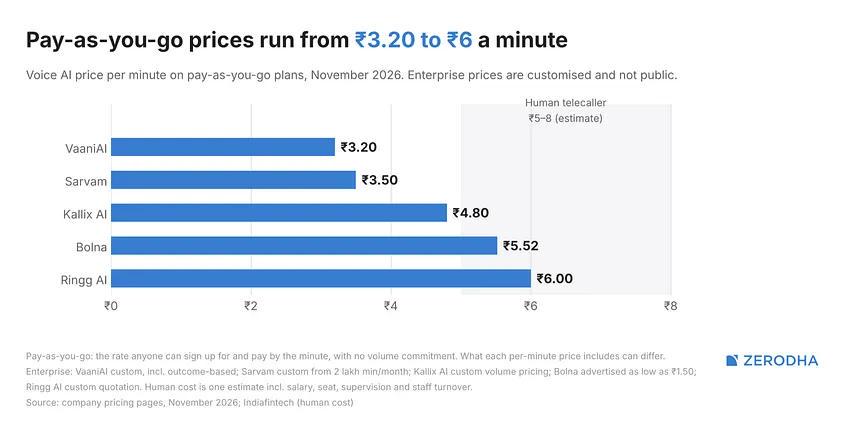
The next time your bank calls about a loan or EMI, you might be talking to AI without even realising it. India's biggest lenders are rapidly adopting voice bots that can speak Hindi, Tamil and other Indian languages, often at roughly one-third the cost of human telecallers. At Bajaj Finance, voice bots generated leads that resulted in ₹2,104 crore in loan disbursals in just one quarter, while Axis Bank's bots handled 60% of its collection calls. But there's a catch. India's voice AI startups are already facing price wars, with basic calling becoming increasingly commoditised. And while startups build the technology, banks retain something far more valuable: millions of customer call recordings that help train and improve these systems. Bajaj Finance alone analysed 56 million customer voice interactions in one quarter. The irony? Voice AI startups are racing to automate India's banking calls, but the banks themselves may hold the biggest competitive advantage.
r/marketsbyzerodha • u/meher_smaran • 10d ago

Indian hotels are having one of their best years, even though foreign tourism remains weak and airfares are soaring. The secret? They're making more money from existing rooms rather than simply filling more of them. Industry room rates rose 8–10%, while occupancy increased just 1–3%. At The Leela, occupancy remained around 69%, but room rates jumped 30%. A major reason is the growing demand from international summits, corporate events and lavish Indian weddings, which temporarily fill up rooms in already crowded cities. Hotels are also replacing fixed corporate rates with dynamic pricing, much like surge pricing on cab apps. The Leela has shifted 60–70% of its corporate contracts to this model. And here's the catch: While hotel chains are expanding rapidly, new rooms are mostly coming up in smaller cities, not prime locations like Mumbai's BKC or Central Delhi, where land is scarce. That shortage could keep hotel prices elevated for years.
r/marketsbyzerodha • u/meher_smaran • 10d ago

r/marketsbyzerodha • u/kkin1995 • 10d ago

LLMs are coming for the jobs of Machine Learning Engineers
r/marketsbyzerodha • u/meher_smaran • 11d ago

India's largest cement maker is entering the ₹1.1 lakh crore wires and cables market, and established players could face serious competition. UltraTech Cement has launched Ultravolt, investing ₹1,800 crore in a business dominated by Polycab, KEI, Havells and RR Kabel. Its new Gujarat plant can manufacture 11 lakh kilometres of wire annually, making it India's second-largest wire maker by capacity, according to the company. The advantage? UltraTech already sells cement to developers four to six months before they need electrical wires, giving it a head start in reaching customers. Crompton, another established consumer brand, has also entered the market. Interestingly, wires account for just 25% of Polycab's wires and cables sales, but 73% of RR Kabel's and 60–70% of Havells', making the latter two more exposed. The bigger question is whether UltraTech can turn its cement distribution network into a competitive advantage in an entirely different industry.
r/marketsbyzerodha • u/meher_smaran • 11d ago

One company produces more than 20% of India's thermal coal and earns over ₹10,000 crore in annual profits. Now, it's heading for an IPO. Mahanadi Coalfields (MCL), Coal India's largest subsidiary, reported ₹30,550 crore in revenue and ₹10,698 crore in profit in FY26. Its mines are among India's cheapest to operate, producing 2.4 times more coal per worker-shift than Coal India's average. It also distributed ₹8,400 crore in dividends last year. But there's a catch. Coal India controls most of MCL's selling prices, dividends and management, and will retain roughly 90% ownership after the IPO. Meanwhile, an unresolved tax dispute with Odisha once threatened a liability exceeding ₹31,000 crore, nearly three times its annual profit. A recent legal amendment could eliminate that risk, but challenges remain. Investors are getting a highly profitable coal business whose future depends heavily on government decisions, power demand and the courts.
r/marketsbyzerodha • u/meher_smaran • 14d ago

India's food inflation jumped to 7.7% in September, but the real price shock began months earlier. Between April and September, prices of vegetables, tubers and pulses surged 24%, even as annual inflation figures initially appeared subdued. Onion prices alone jumped 36% in September, while cooking oil rose 15% and sugar nearly 30% year-on-year. The bigger concern? India's monsoon ended 13% below normal, leaving reservoirs with 27% less water than last year, threatening the upcoming winter crop. Meanwhile, a strong El Niño could disrupt harvests in countries India imports food from, making imports more expensive. The West Asia conflict has also pushed up fertiliser costs, adding pressure on farmers. And here's the catch: Even if vegetable prices ease with the winter harvest, shortages of water, expensive fertilisers and rising global food prices could keep grocery bills elevated for longer.
r/marketsbyzerodha • u/meher_smaran • 14d ago

r/marketsbyzerodha • u/meher_smaran • 15d ago

Western banks and governments are increasingly borrowing in Chinese yuan instead of dollars. But it's not necessarily about replacing the dollar. It's about cheaper money. China's 10-year bond yield is around 1.6%, compared to over 5% in the US. Major foreign banks can borrow in yuan at roughly 1.7–2.2%, versus 4.5–5.5% in dollars. In just eight months of 2026, foreign borrowers raised over 210 billion yuan through panda bonds, surpassing the entire previous year's issuance. Interestingly, much of this lending is ultimately funded by Chinese households earning less than 1% on bank deposits, with limited access to higher-return investments. The irony? China's strict capital controls help keep borrowing costs low by trapping domestic savings, but those same restrictions prevent the yuan from becoming a truly global currency. Despite the boom, the yuan accounts for just 2.1% of global foreign exchange reserves, compared to the dollar's 56.7%.
r/marketsbyzerodha • u/meher_smaran • 16d ago

NSE dominates India's stock market, handling 92% of cash trading and practically all futures. Yet its biggest revenue source is also where BSE is challenging it. Weekly Nifty options alone contribute 42% of NSE's revenue. Meanwhile, BSE has captured nearly 36% of index options trading by premium, with its options premium turnover growing 50% year-on-year. Interestingly, 77% of BSE's options volume comes from contracts expiring the same day or the next, making it heavily dependent on expiry-day trading. Despite handling nearly as much index options trading as NSE by contract value, BSE earns far less because these short-dated options carry smaller premiums. And here's the twist: BSE paid ₹166 crore in regulatory fees last quarter, almost matching NSE's ₹171 crore, despite earning roughly one-third its revenue. NSE may dominate India's markets, but BSE is proving that even a near-monopoly can face serious competition where it makes the most money.
r/marketsbyzerodha • u/kkin1995 • 17d ago

r/marketsbyzerodha • u/meher_smaran • 18d ago

Netflix is making more money than ever, but its subscribers are spending less time watching. Revenue grew 12% to $12.9 billion last quarter, while operating profit jumped 37%. Yet reports suggest average viewing time per account is declining, even as total viewing grows. The bigger challenge? YouTube now accounts for nearly 16% of US television viewing, more than double Netflix's share. YouTube also generated $11.2 billion in advertising revenue last quarter, more than Netflix expects from ads in an entire year. Unlike Netflix, which spends billions producing and licensing shows, YouTube relies largely on creators to supply content. Meanwhile, Netflix is investing in live sports and reality shows to keep viewers returning. The irony? Streaming platforms are spending billions to capture our attention, while YouTube is winning more of it without bearing most of the costs of producing entertainment.
r/marketsbyzerodha • u/meher_smaran • 21d ago

Reliance wants its future to be about technology, retail and clean energy. But its biggest profits still come from oil. The company reported a record quarter, with revenue rising 28% to ₹3.6 lakh crore and EBITDA growing 24% to ₹62,409 crore. Nearly 80% of the EBITDA increase came from its oil-to-chemicals business, benefiting from soaring refining margins amid the West Asia conflict. O2C EBITDA jumped 68% to ₹25,203 crore, covering roughly two-thirds of Reliance's capital expenditure. While other Asian refineries cut production by 15–20%, Reliance's Jamnagar refinery kept running, thanks to its ability to process different crude types and switch suppliers. Meanwhile, retail margins declined, and clean energy projects faced delays. The irony? Reliance's ambitions to move beyond oil are being financed by the very business it wants to become less dependent on. But with refining profits boosted by a geopolitical crisis, how long can this windfall sustain its transformation?
r/marketsbyzerodha • u/meher_smaran • 21d ago

r/marketsbyzerodha • u/meher_smaran • 22d ago

India's solar factories are getting built from the top down: panels are mostly done, but the polysilicon and wafer plants that come first are still waiting.
r/marketsbyzerodha • u/meher_smaran • 23d ago

