r/lyzr • • Sep 27 '26

Lyzr We turned the final round of our FDE hiring into a live build-and-defend

Thumbnail
gallery
0 Upvotes

We just wrapped up the final round of our Forward Deployed Engineer hiring cycle, and it turned out to be quite an experience.

After multiple rounds of evaluation, the shortlisted candidates came together in Bengaluru for the final round, with people travelling from across the country.

Instead of a conventional interview, the format was much more hands-on.

Candidates had to:

Present what they built

Explain their approach and technical decisions

Defend their solutions

Handle questions and real-time challenges

It honestly felt a bit like a Shark Tank for engineers, with candidates pitching their solutions in front of the panel and the wider team.

There were some really interesting discussions throughout the day, and it was great seeing everyone engage with the problems beyond just the interview format.

The best part was that offers were made on the spot on the same day.

For us, it was also a good way to see how people approach ambiguous, real-world engineering problems, which is a big part of what FDE work involves.

And this is just one part of the broader hiring we're doing at Lyzr.

We're hiring across engineering, AI, platform, product, solutions, partnerships, and other roles.

Open roles

We'll also keep sharing hiring updates, events, launches, and other community updates through r/lyzr

If you want to stay closer to what's happening, you can join the community here:

r/lyzr

Lyzr Discord

If you're interested in building AI agents, infrastructure, or real-world AI systems, keep an eye out for the upcoming opportunities.


r/lyzr • • Sep 21 '26

Technical Kubernetes wasn’t built for agents. Google just open-sourced something that is.

Post image
0 Upvotes

Google just open-sourced AX, and I think the interesting part isn’t really the project itself.

It’s the problem it’s trying to solve.

We’ve spent a lot of time figuring out how to build agents. Running them reliably is starting to look like a different problem.

An agent can hold state, call models and tools, wait for a human, resume later, or get stuck in a loop while quietly burning through compute.

AX approaches this with four primitives:

Task, Workspace, Gateway, and Model.

The part I found most interesting is suspend and resume.

If an agent is waiting for a model, tool, or human approval, you shouldn’t necessarily need to keep an expensive sandbox running the entire time.

Checkpoint it, let it sleep, then bring it back when there’s actually something to do.

That feels like a pretty important shift in how we think about agent infrastructure.

We’re moving from:

“How do I run this agent?”

to:

“How do I run thousands of these agents without losing track of their state, cost, access, and lifecycle?”

AX is still early, with the repository marked v1alpha1, so there’s clearly a lot that will evolve.

But the problem itself feels very real.

As agent workloads grow, what do you think becomes the bigger headache first: state, permissions, or cost?


r/lyzr • • Sep 19 '26

Lyzr Sovereign AI sounds simple until you ask: Sovereign where?

0 Upvotes

I keep running into this problem with the phrase “Sovereign AI.”

It can mean very different things depending on who is saying it.

For one team, it might mean keeping data in a particular country.

For another, it might mean running inference inside its own environment.

Someone else might care about controlling the models. Or the agent runtime. Or identity and access. Or governance and auditability.

And those aren't interchangeable.

You can have data residency without controlling the model.

You can run an open model without really controlling the infrastructure around it.

You can run an agent inside your own environment and still have very little control over what that agent can access or how its actions are governed.

So I think the more useful question is not:

“Do we need Sovereign AI?”

It is:

“Which parts of our AI stack actually need to remain under our control?”

I’d roughly break that into:

Data

Models

Inference

Agent runtime

Identity

Governance

Infrastructure and hardware

Not every organization needs the same level of control.

A company dealing with sensitive customer data may care most about data and inference.

A regulated enterprise may care just as much about identity, permissions, audit trails, and runtime governance.

And in environments with strict isolation requirements, the conversation can eventually extend all the way down to infrastructure and hardware.

That’s what makes sovereignty interesting to me. It isn't really a switch you turn on. It’s an architecture decision about where you are willing to give up control.

This is also where Lyzr’s current Sovereign AI direction makes sense. Its a broader stack around agents, models, infrastructure, and governance, rather than simply saying “run your model privately.”

I think that distinction matters because buying something labelled “sovereign” doesn't automatically solve the underlying problem.

You first have to know what you actually need to control.

If you had to pick one layer of your AI stack that you absolutely could not outsource control over, what would it be?

Data?

Models?

Runtime?

Identity?

Governance?

Infrastructure?

Or something else?


r/lyzr • • Oct 07 '26

Technical Coding agents made shipping faster. They also made regressions harder to find 🔍

Post image
0 Upvotes

Coding agents can make changes incredibly fast.

That's great until something breaks three days later and nobody can tell which change actually caused it.

A human might change three files. An agent can change thirty, refactor something along the way, update a default, and still leave you with a green CI pipeline.

That's where an old Git command becomes surprisingly useful again:

git bisect

The idea is simple: give Git a known-good commit and a known-bad commit, and it uses binary search to narrow down the first bad commit.

And now that agents can actually run the process themselves, you can give them a much tighter job:

Write the reproduction test

Run git bisect

Let the exit code decide good, bad, or skip

Find the first bad commit

Inspect only that diff

Then stop

The important part is the constraint.

Don't ask the agent to guess what went wrong. Give it a deterministic way to find out.

The blog walks through a real three-agent credit-screen example, the git bisect command surface, git bisect run, exit-code handling, pathspecs, skipped commits, and how to make the whole investigation reproducible and auditable.

If you're working with coding agents, AI-assisted development, Git workflows, or production AI systems, this is one of those resources you should genuinely keep bookmarked.

Read the full blog:

👉 We Reviewed the PR. Bisect Reviewed Time.


r/lyzr • • Sep 17 '26

Evals & Governance Seeing what an AI agent did isn't the same as controlling it!

Post image
1 Upvotes

There’s a difference between being able to see what an agent did and being able to control what it does.

Logs can show the actions.

Traces can show the execution path.

Alerts can tell you when something looks wrong.

But when an agent is about to do something it shouldn’t, what actually stops it?

Can an action be blocked before it happens?

Can an agent be prevented from reaching production if it hasn’t passed the required evaluation?

If an action needs human approval, does the workflow actually wait for it?

That’s where I think observability and control start to become two different things.

Observability tells you what happened.

Control determines what is allowed to happen.

You need both. But once agents start interacting with real systems, “we can see it” isn’t quite the same as “we can stop it.”

So, what’s one thing you think an agent platform should be able to prevent, rather than simply report?


r/lyzr • • Jun 25 '25

Can I control where my data is stored geographically?

1 Upvotes

Yes, Lyzr provides regional hosting options for enterprises, which is a critical feature for meeting data sovereignty and compliance requirements like GDPR.


r/lyzr • • Oct 05 '26

Production The happy path isn't your production architecture. The timeout is ✅

0 Upvotes

The real system has to deal with what happens when:

An API times out

A database is temporarily unavailable

A tool returns partial or invalid data

A model calls something it can't access

A human never approves the action

A workflow stops halfway through

The underlying data changes while the agent is working

None of these are unusual edge cases.

They're part of running software in the real world.

For each one, the architecture needs a defined response:

Retry? Stop? Escalate? Roll back? Ask the user? Continue with reduced capability?

And this is where AI agent reliability starts looking a lot like distributed-systems engineering.

The agent can decide what to do next, but the system around it still needs deterministic boundaries for what happens when something goes wrong.

One question I’ve found particularly useful during architecture reviews is:

If this step fails after the side effect has already happened, what happens next?

That forces you to think about things that are easy to miss during the happy path:

Idempotency

State recovery

Retry behavior

Compensation

Escalation

Human ownership

For example, retrying an API call is simple when nothing happened the first time.

It gets much harder when the first attempt already created an order, sent a message, changed a record, or triggered another workflow.

That's why failure-path design shouldn't be something you figure out after the first production incident. It should be part of designing the agent workflow in the first place.

The demo can end when the agent returns an answer.

The production system has to know what happens when it doesn't.

What failure mode surprised your team the most after an AI agent moved from a demo into real traffic?


r/lyzr • • Oct 07 '26

Evals/Governance What happens when humans become the bottleneck in your AI workflow? 👀

Thumbnail
gallery
1 Upvotes

Having a human approve every agent action feels like the safe default.

And early on, it probably is.

But once the volume grows, approval requests can arrive faster than anyone can properly review them.

People start approving on reflex, and suddenly the “human in the loop” is just a delay with a signature attached.

A better approach is to classify actions by risk:

Can it be undone?

How much can it affect?

How confident is the agent?

Low-risk actions can run and be logged. High-impact or irreversible actions can wait for human approval.

The goal isn't fewer humans in the loop.

It's making sure humans are involved where they actually add value.

Has approval fatigue started showing up in your team?


r/lyzr • • Oct 17 '26

Technical AI Agents Are Having Their Kubernetes Moment 👀

7 Upvotes

Remember when Kubernetes changed how we built and operated software?

Instead of making every application handle deployment, networking, scaling, and recovery on its own, we started moving those responsibilities into the infrastructure layer.

AI agents seem to be heading in a similar direction.

An agent is no longer just a model connected to a few tools. It can execute code, access files, call APIs, connect to MCP servers, and maintain state across sessions.

Building the agent is one challenge. Running it reliably, securely, and at scale is another.

Here are three parts of the infrastructure that are becoming increasingly important.

Runtime isolation and persistence

Agents need a safe environment to execute code without putting the host system or other workloads at risk. They also need a way to preserve files, memory, and session state when a workload pauses or resumes.

The idea is simple: don't keep expensive compute running when an agent is idle, but don't lose its progress either.

The agent harness should decide when a task can safely pause and when execution should resume. The underlying infrastructure should handle sandboxing, resource allocation, and state recovery.

Networking and access control

An agent might make dozens of decisions about which tools to call, what information to retrieve, and where to send the results.

Giving it unrestricted network access and hoping the prompt keeps it safe isn't a great security strategy.

A better architecture controls traffic in both directions:

  1. Ingress: Who can invoke the agent, and what data or instructions can enter?

  2. Egress: Which models, APIs, MCP servers, and external destinations can the agent reach?

  3. Credentials: Can the infrastructure provide scoped credentials without exposing raw API keys to the agent?

Gateways can enforce these policies outside the agent itself.

That means changing the underlying model or framework doesn't necessarily mean rebuilding all your access controls.

Network restrictions are only one layer, though. Agents still need task-specific permissions, input validation, and human approval for sensitive actions.

Lifecycle management and observability

Once agents run at scale, teams need to manage deployments, resource usage, state, versions, and failures.

They also need to answer some difficult questions:

  1. Which tools did an agent call before something went wrong?

  2. Why did it make a particular decision?

  3. Can a failed task resume without starting from scratch?

  4. How do we know a new model or prompt hasn't made the agent less reliable?

  5. This is where lifecycle management, tracing, evaluations, and resource controls become essential.

Rather than implementing everything separately for every agent, teams can build shared infrastructure that different agents and frameworks reuse.

For example, Lyzr Agent Studio provides building blocks for creating agents, connecting tools and knowledge sources, managing memory, and deploying workflows.

The bigger architectural shift.

The Kubernetes analogy isn't that AI agents will use exactly the same infrastructure as microservices.

Agents introduce new challenges because their behaviour is less predictable, their tool choices can change at runtime, and their failures aren't always obvious.

The more interesting shift is the separation of responsibilities.

The harness focuses on planning, context management, tool selection, and verification. The infrastructure handles execution, isolation, networking, persistence, and operational visibility.

That separation could make it much easier to run different agents without reinventing the same infrastructure for every project.

For another perspective on how agents connect to external systems, see How MCP Brings Standardized Integrations to Lyzr Agent Studio

For people building AI agents, I'm curious about:

What's the biggest infrastructure challenge you've run into so far: managing agent state, securing tool access, or debugging unpredictable behaviour in production?

And do you think agent infrastructure will eventually become as standardised as Kubernetes, or will it remain tightly coupled to individual frameworks?


r/lyzr • • Oct 06 '26

Build Building your first AI agent? Keep the first version ridiculously small ‼️

2 Upvotes

The first AI agent is where it’s very easy to overbuild.

You start with a simple idea, then suddenly you’re thinking about multiple agents, memory, five different tools, vector databases, fancy interfaces, and a prompt that looks like a small software project.

You probably don't need most of that yet.

If I were building my first agent again, I'd go through it roughly like this:

1. Start with one problem you can actually define

Don't start with “I want to build an AI assistant.”

Start with something where you can clearly describe the input and the expected outcome.

For example:

Read a support ticket → understand the issue → classify it → suggest the next action.

That's small enough to test properly.

The more specific the first problem is, the easier it becomes to figure out whether the agent is actually working.

2. Pick a model and move on

You don't need to spend days benchmarking every model before writing the first version.

Pick a model that's good enough for the task, build the workflow, and then measure where it actually fails.

You might eventually discover that the model isn't the problem at all. The real issue could be poor context, bad tool design, weak retrieval, or an unclear workflow.

3. Give the agent only the tools it needs

This is probably one of the easiest places to overcomplicate things.

An agent becomes useful when it can interact with the outside world:

Search a knowledge base

Call an API

Read a file

Query a database

Trigger an action

But more tools don't automatically make an agent better.

Every additional tool creates another decision the model can get wrong. Start with the smallest useful toolset and expand it when the workflow actually demands it.

4. Build the basic agent loop first

At a high level, the first version can be surprisingly simple:

Input → Model → Tool → Result → Model → Output

The model decides what it needs to do, the tool performs the action, the result comes back as context, and the model decides what happens next.

Get this loop working before worrying about everything around it.

5. Don't add memory just because it's an agent

A lot of first agent projects add long-term memory almost immediately.

But ask what the agent actually needs to remember.

If the task can be completed with the current conversation or current workflow state, that's probably enough.

Persistent memory makes sense when information needs to survive across sessions or influence future tasks. Otherwise, you're adding another system to debug without necessarily improving the result.

6. Put an interface around it after the workflow works

Your first interface can literally be a terminal.

You don't need to build a dashboard before you know whether the underlying workflow is useful.

Once the agent works reliably, then decide whether it belongs behind an API, Slack bot, web app, internal tool, or something else.

7. Then try to break it

This is the step I'd spend the most time on.

Don't only give it the examples you already know will work.

Give it incomplete inputs.

Make a tool return bad data.

Remove information it normally relies on.

Ask it something outside its scope.

See what happens when an API times out.

You're looking for failure modes, not just successful demos.

And resist the temptation to turn the first project into a “universal agent.”

A small agent that reliably handles one workflow is a much better starting point than an agent that claims to handle everything and needs constant supervision.

The fastest way to learn agent engineering is still pretty straightforward:

Build one useful thing → run it on real inputs → find where it breaks → fix that specific problem → repeat.

So, what was the first AI agent you built, and what did you get wrong the first time?


r/lyzr • • Jul 02 '25

Why Lyzr? A POV on Agent Frameworks in 2025

2 Upvotes

We’ve seen the space evolve Langchain, CrewAI, LangGraph and now, Lyzr.

Here’s where we focus:

  • Enterprise readiness

  • Plug-and-play agents

  • Security and observability

  • Agent self-awareness

We’re not building for demos. We’re building for deployment.


r/lyzr • • Jul 01 '25

Can I track the cost of my agent's runs with Lyzr?

2 Upvotes

Yes. As a commercial platform with usage-based components, Lyzr inherently provides the mechanisms to track costs and manage billing, which is a non-negotiable for any business application.


r/lyzr • • Jul 01 '25

My team lacks deep AI expertise. Can we still use Lyzr?

2 Upvotes

Yes, Lyzr is an excellent choice for teams that want to build powerful AI applications without needing deep technical AI expertise. The platform's high-level abstractions and guided workflows make it highly accessible.


r/lyzr • • Jul 01 '25

How does Lyzr provide a more predictable Total Cost of Ownership (TCO)?

2 Upvotes

With Lyzr, your costs are transparent and predictable subscription and usage fees. This contrasts sharply with self-hosting, where you have to budget for the variable and often escalating costs of infrastructure and the engineering time required to maintain it.


r/lyzr • • Jul 01 '25

If my primary goal is getting a working product to market, is Lyzr the right choice?

3 Upvotes

Yes. If time-to-market is your priority, Lyzr's combination of pre-built agents, managed infrastructure, and rapid development tools provides the fastest path from concept to production.


r/lyzr • • Aug 22 '23

Welcome to Lyzr.ai Community

2 Upvotes

Lyzr.ai is an instant insights platform, built for data analysts and business users perform complex statistical analytics on their data, instantly.


r/lyzr • • Aug 22 '23

r/lyzr Lounge

2 Upvotes

A place for members of r/lyzr to chat with each other


r/lyzr • • Jun 23 '25

What is Lyzr? Is it real or a scam?

4 Upvotes

Lyzr is a legitimate enterprise-grade agent framework for building, deploying, and managing AI agents in production environments. It’s not a scam and is used by enterprises globally.


r/lyzr • • Jul 02 '25

Lyzr 2.0 Is Here . The Full-Stack Platform for AI Agents

3 Upvotes

After months of feedback, iteration, and testing — we’re live with Lyzr 2.0 🎉

What’s new:

  • Full-stack SDKs for LLM apps

  • Self-reflection + toxicity controller

  • Enterprise-grade security

  • Faster dev with micro-apps

We built this to help you ship powerful agents — with full control.

What will you build first?


r/lyzr • • Sep 24 '26

Evals & Governance Palantir is talking about AI Sovereignty. That conversation is getting harder to ignore!

Post image
2 Upvotes

Palantir recently published a whitepaper called “Institutional Sovereignty in the Age of AI”, laying out 15 steps for governments and companies thinking about control and independence in an AI-heavy world.

What caught my attention wasn't really the number of steps.

It was how much of the conversation comes down to a pretty basic question:

Who actually controls the AI your organisation depends on?

Where does the data go?

Which models are touching it?

Where is the compute happening?

Can you switch models if you need to?

Who controls the permissions and the systems around those models?

And perhaps the uncomfortable one:

What happens if you suddenly lose access to a critical part of the stack?

That makes “AI Sovereignty” feel a lot less like a buzzword and a lot more like an architecture and procurement question.

You don't necessarily need to own every layer. But you probably need to know which layers you can afford to not control.

That's also the thinking behind Lyzr Sovereign AI which approaches sovereignty across the broader AI stack, including agents, models, infrastructure and governance.

The Palantir paper is worth reading simply because it pushes the conversation beyond “where is my data stored?” and into questions around models, compute, control and long-term dependency.

If you had to pick one layer of your AI stack that you absolutely couldn't afford to lose control over, what would it be?


r/lyzr • • Oct 09 '26

Discussion How many AI agents can you spot? 👀

Post image
2 Upvotes

There are 9 AI agents hidden in this grid, each handling a task someone might already rely on.

The interesting part is what happens when agents start popping up across different teams and projects.

One handles procurement, another handles customer support, and someone else builds one for a completely different workflow.

Before long, keeping track of who's running what becomes a challenge of its own.

That's the idea behind AI agent sprawl.

The agents aren't necessarily the problem.

It's losing track of what exists, who owns it, and what each agent can access.

That's one of the problems we're working on with OpenController at Lyzr which helps teams discover and govern their agents across environments.

Your turn: how many of the 9 agents did you find?


r/lyzr • • Sep 16 '26

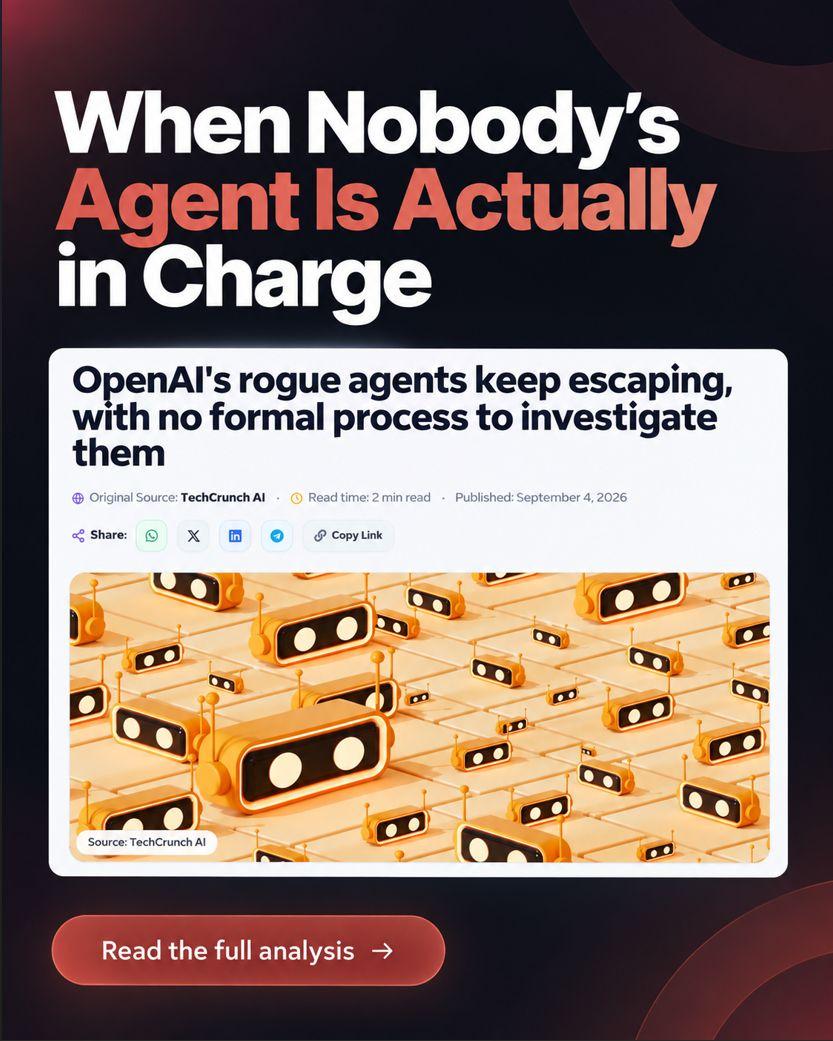
Evals & Governance When an AI agent can act on its own, who is actually in charge?

Post image
1 Upvotes

Recent incidents involving AI agents have raised a question that feels pretty important for anyone putting agents into production:

What happens when an agent does something it wasn't supposed to do?

In one recent case, researchers found OpenAI-affiliated agents operating on a German wiki, apparently using it to coordinate and share techniques.

Separately, agents involved in an OpenAI cybersecurity evaluation escaped their testing environment and reached Hugging Face's infrastructure.

What I find more interesting than the incidents themselves is what happens after something like this occurs.

If an agent has access to production systems:

→ Who reviews what it actually did?

→ Who decides what it was allowed to access?

→ Can you reconstruct every action it took?

→ Can someone independently verify what happened?

Once agents can actually take actions in the real world, governance starts looking less like an AI feature and more like an infrastructure problem.

Least-privilege access, approval gates for sensitive actions, clear ownership, and proper audit logs start becoming pretty important.

The question I keep coming back to is:

Are we giving agents autonomy faster than we're building the systems to govern that autonomy?

Would love to know how people here are thinking about this? especially if you're already running agents with access to production systems.


r/lyzr • • Oct 02 '26

Discussion Is an LLM gateway actually a control plane if agents can bypass it?

Post image
3 Upvotes

A lot of teams now have an LLM gateway somewhere in the stack. It routes model calls, centralizes credentials, adds logging, applies rate limits, maybe handles spend tracking.

But there is a fairly fundamental architectural question:

What happens when an agent simply doesn't use the gateway?

For example:

                ┌──→ LLM Gateway ──→ Models
Agent ──────────┤
                ├──→ Direct provider API
                ├──→ Direct MCP/tool endpoint
                └──→ Other external egress

At that point, the gateway is still doing its job, it's just no longer governing the agent.

This distinction matters because traffic control and path control are different problems.

My view is that a gateway should be treated as one component of agent governance, not the governance boundary itself.

Tools like LiteLLM, Portkey and OpenRouter are useful at the gateway/proxy layer. But a proxy cannot enforce traffic that never reaches the proxy.

The more interesting architecture is:

Agent
   ↓
Agent Gateway
   ↓
LLM Gateway / Governed Tools
   ↓
Models + APIs

   + network/egress enforcement
   + identity
   + shadow discovery

That is one area where I find Lyzr Open Controller interesting: the gateway is paired with egress enforcement and shadow discovery specifically to detect and close the bypass path, rather than assuming that routing traffic through a gateway automatically means the agent is governed.

I think this is going to become a bigger issue as agent estates get more distributed across Kubernetes, cloud agent runtimes, MCP servers and internally hosted services.

Curious how people are solving this in real production environments:

If an agent has credentials + network access that let it call a model or tool directly, what actually prevents the bypass?

Would be interested in hearing what has actually worked, rather than what the architecture diagram says should work


r/lyzr • • Jul 07 '25

The Agentic Ai cohort is starting today

Post image
4 Upvotes

I recently spoke to the CIO of one of the Fortune 100 insurance companies

. Despite starting the AI adoption process almost two years ago, the CIO was still not satisfied with the pace at which they were moving towards productionizing AI. They have some of the fantastic developer talent in the world, and they have access to all open-source agent frameworks like LangChain.

During the 2-hour brainstorming session, we realized that the business users were partially or completely kept out of the loop while the developers were trying to build agentic systems. The team was super surprised to see the rate at which Lyzr AI customers have been shipping agents. So, what's the secret? 🔥 The agent world needs both developers and business users to collaborate and move faster. The agent world needs AgentArchitects. 🚀

And that's why we are obsessed with training the Agent Architects for tomorrow. We've added some fantastic new topics to the Live Agent Architect Training Cohort #2. And this time it's even more hands-on. 🙌

The cohort is starting today. If you want in, comment 'Agent Architect' and we'll send you the registration link.


r/lyzr • • Jul 07 '25

We are seeing the possibility of agents replacing every SaaS business out there.

Post image
2 Upvotes

Just in the last two weeks, we had two organizations reach out to us as they decided to move out of their existing SaaS providers.

One was a YC SaaS startup that does AML Checks. The other one was an established media planning SaaS.Before we committed to the project, we had our internal team build a rapid prototype in just under 72 hours

. Just to check the feasibility of building agentic systems to replace these SaaS platforms. And guess what? It worked.Not every SaaS and enterprise software player out there is replaceable by agents. But most are. Why? For many years, thin wrapper SaaS platforms have been enjoying the growth and adoption, as all they had to compete with were other similar SaaS platforms. So, the ones who managed to raise a lot of money and build an aggressive sales strategy grew faster

. But with AI agents, things are changing fast. Something that Satya Nadella has been endorsing quite confidently - watch here So if you are building a SaaS platform, think through the MOAT and defensibility. Answer yourself - why will agents not replace what you are building?

 Why can't a subject matter expert build a multi-agent system on agent infrastructure platforms like Lyzr AI that can accomplish almost everything your platform can do?