r/leetcode • u/sooooooooooowsup • Jan 15 '24
Question Why is there an IndexError?
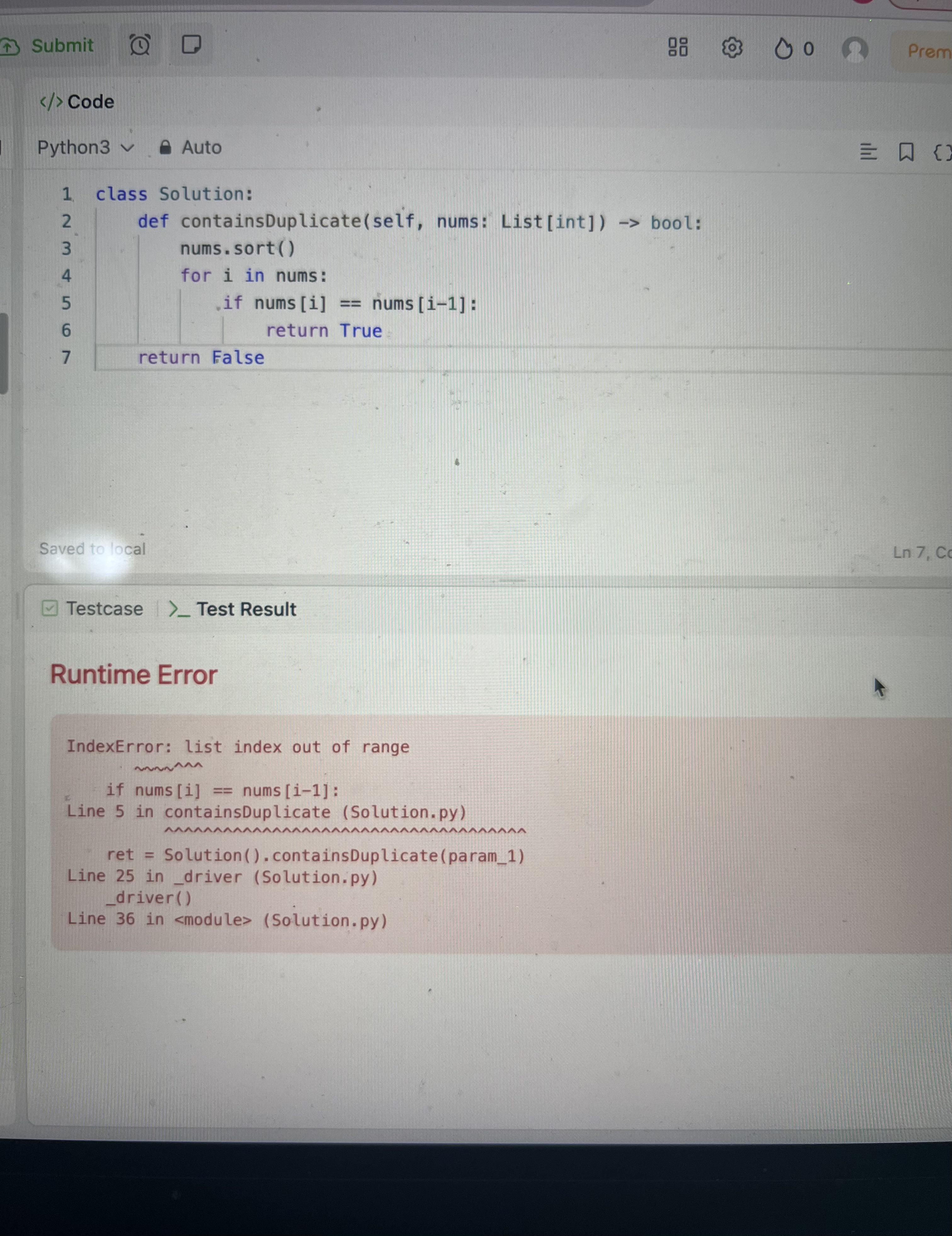
I saw a solution to the Contains Duplicate problem and I was just trying to fully understand it.
They had exactly what I typed above, except they included
n = len(nums) for i in range(1,n) #instead of for i in nums
I don’t understand why this produces an Index Error. Wouldn’t the first “i - 1” just be equal to “-1” and isn’t -1 always a valid index?
I understand why their solution is correct but I don’t understand why this one isn’t correct too.
5
28
u/Empty_Stacktrace Jan 15 '24
Two problems:
“for i in nums” in Python will actually substitute i for the number. Then you’re trying to use the actual number to index. What you’re looking for is for i in range(len(nums))
Even if you had the above syntax, it would still be buggy because i starts at 0, so the first comparison would look at index i-1 == -1. You need to start at 1.
These types of bugs will go away as you do more problems. I was there before!!
6
u/FaultHaunting3434 Jan 15 '24 edited Jan 15 '24
i is the value of the element, not the index. Quick question what's the cost of the .sort() method?
6
1
1
1
1
u/-CJF- Jan 15 '24
Why would -1 be a valid index? Arrays are 0 indexed in every language I've ever used, but I don't really know Python.
10
u/sooooooooooowsup Jan 15 '24
Oh idk I thought index of -1 referred to the last element, but maybe not
1
u/-CJF- Jan 15 '24
You might be right about that. Like I said, I don't know Python. I did find this on StackOverflow:
One of the neat features of Python lists is that you can index from the end of the list. You can do this by passing a negative number to []. It essentially treats len(array) as the 0th index. So, if you wanted the last element in array, you would call array[-1].
Source: https://stackoverflow.com/questions/52395099/meaning-of-list-1-in-python
Why they would do that I don't know. Seems like an opportunity for terrible logic errors to occur.
4
Jan 15 '24
Seems like an opportunity for terrible logic errors to occur
Negative indexing allows you to iterate in reverse, which is a useful property.
Additionally, when combined with slice notation, it can extract arbitrary sequences:
nums[::-1] # returns a copy of nums reversed in order
nums[0:2::-1] # returns the first two elements, order reversed
Truthfully, it could be a source of logic errors, but not really - it's easy to constrain
iinto the rangemod len(n).
2
u/RawAssholeProtein Jan 15 '24
Folks here have mentioned what the error is. Since you're doing i-1, what you're looking for is
for i in range(1, len(arr)):
This way, you'll be guaranteed that when you do i-1, you're always within bounds.
2
1
u/howzlife17 Jan 15 '24
I think for i in nums gives you the nums in the list, not the index.
So [5,6,7] first value is nums[5], not nums[0]
1
1
1
u/iibeanus1 Jan 16 '24
i is not the index. i is the actual elements in nums. Nums will have int values that will be used as indexes in this case
1
1
Jan 16 '24
You should really take some time to learn the language before actually doing leetcode. No offence
1
u/dhruv892 Jan 16 '24
here i is not index it’s element itself now if you want index in there either you can use like they told you or you can use enumerate function
1
1
1
u/kaz4510 Jan 16 '24
The for loop is calling the item instead of the index. Assume the array is [10,11,12] While in the first iteration of the loop, i=10 num[i] is calling for 10th element, even when the length of array is 3
1
0
u/Empero6 Jan 15 '24 edited Jan 15 '24
Can’t have a -1 index.
Try this it here before submitting it:
1
Jan 16 '24
This is incorrect. Yes, in Python, you can have a -1 index. :)
1
u/Empero6 Jan 16 '24
I should have clarified. You can’t have an index before the first element. n[-1] just gives you the last element of the array.
1
Jan 16 '24
But that doesn't change the solution's correctness. The list is sorted, so comparing first to last element will never result in a false positive. It's an unnecessary check, but OP's solution is sound as long as they fix the fact they're iterating over the elements rather than the indexes as intended.
1
0
u/BusyNegotiation4963 Jan 16 '24 edited Jan 16 '24
Disregard this — It’s simple.. when you first start moving thru the list, when i == 0, the other pointer(i - 1)will point to -1 and hence the out of index error.
Because negative indices are valid indices in python.
2
0
1
Jan 16 '24
[removed] — view removed comment
1
u/haikusbot Jan 16 '24
Seriously you
Could have just asked chatgpt. It's
Obvious as hell
- Quantumfusionsg
I detect haikus. And sometimes, successfully. Learn more about me.
Opt out of replies: "haikusbot opt out" | Delete my comment: "haikusbot delete"
114
u/[deleted] Jan 15 '24
for i in numsiterates through the elements of num, it doesn't give you the indexes.In other words,
for i in [5, 4, 3]will give you 5, 4, 3 as values of i, not 0, 1, 2 as you're expecting.You can either use
enumerate()builtin to retrieve both index and element or usefor i in range(len(nums))to iterate through indexes.