Im graduating next semester and looking to go into industrial hygiene with my bachelors degree in public health no experience. How can i pivot here i know there are masters programs out there but any way i can break into safety /industrial hygiene / EHS with certificates or any type of entry level jobs
I’m trying to understand a specific asbestos/HEPA-filter scenario and would appreciate input from people familiar with filtration or asbestos exposure. I used a Levoit Core 400S for roughly two months after it had previously been used in an renovation environment where asbestos-containing material have been disturbed. (didn't know at that moment about content)
My concern is that if asbestos fibers were captured by the filter, could some of those fibers later detach or become re-entrained during normal operation, changes in airflow, low-level vibration, or handling of the purifier? I’ve come across studies reporting re-entrainment from loaded HEPA filters, but the experimental conditions seem to vary considerably.
I’m particularly interested in whether those studies are realistically applicable to a household HEPA purifier operating under normal conditions, and whether fibers that were previously trapped in the filter could realistically produce a meaningful airborne concentration in the room, and if so, what levels could be?
I paid to get a professional air test done in my apartment. These are the results that my apartment management said that there is no problem and that maintenance said they couldn't see any mold.
The Sorrow of Ghosts Abstract Labor produces the worker. Labor obviously produces the product and labor must also produce itself, as more labor but labor also produces the worker, including the body of the worker. The worker can never own the commodity that their labor produces. The worker must always own their body that their labor has produced. Occupational medicine teaches that the worker's labor puts its imprint on the worker's body. When it does, for what? For something the worker can never own. Rich explores the relation of alienation between the production (labor), the product (commodities) and the producer (the worker) in a narrative of his career as an OSHA chemist for the US government. Rich worked outside of the official constrictures of the laboratory and discovered that OSHA was throwing a third of the lead in the workers breathing air samples in the trash, and had been doing so for thirty years. OSHA changed the lab procedure to fix the problem. The workers' right to know the hazards of their workplace is derived. Rich loudly insisted to the lab management that the workers who were misinformed, needed to be told of their lead exposure. Rich is then arrested for assault. Other than death itself, forced incarceration is the most extreme alienation. There is a veiled, understated thesis, that alienation in extremis (separation from the labor, separation from the others, separation from the product, and separation from the self), that this alienation can be cause for a realization of the absurd and an existential reckoning. The missing lead did not go away, it is sleeping in the bones of those millions exposed and not told. The lead will reawaken and cause a final insult, the neurotoxin will alienate the aging worker from their very memories. Rich wants the reader to understand that when he describes his interaction with hundreds of workers, in the language of intentionality, it represents millions of workers in a social relation. When he describes the actual concrete events such as sudden death or dismemberment or poisoning as the philosophical embodiment of the estrangement by the labor to the worker, this is understood at the same time as a social condition. No doubt, it's both.
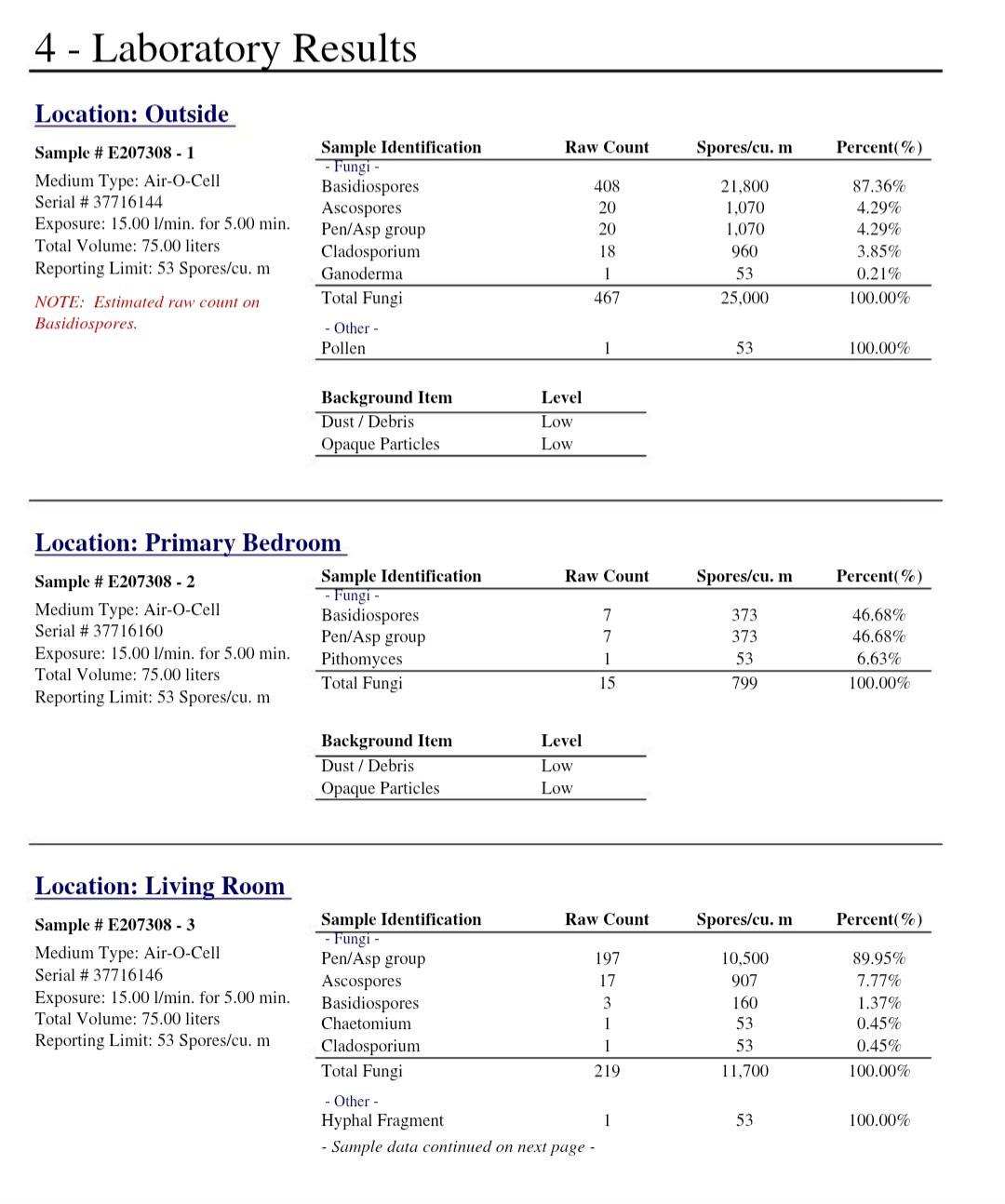
A family friend is buying a house and wanted to get a mold inspection/air test due to some current health issues. They don't have reddit, so l'm posting on their behalf.
The house is only three years old and has been vacant for several months. They’re concerned by the high level of basidiospores. There was one room that had water intrusion and damaged floors by the back door/sunroom. Curious as to why the rooms closest to the exterior doors have lower levels of basidiospores than other interior rooms.
Does anyone know how to interpret the results? Any help is appreciated!!
Hi all, first time posting here! I own an environmental consulting firm and just brought on a new partner with 15 years of industrial hygiene experience. Let’s call him Bob. At Bob’s former firm, he managed a large client with nearly daily industrial hygiene needs. He is at a point where our current CIH is more likely to ask him a technical question about industrial hygiene than to make a “true edit” on his reports. Point is, Bob is a CIH in all but title, but Bob has no degree, just a ton of experience. Is there any shot he can qualify for the CIH without a degree or do I need to put Bob through a bachelor’s degree program? If there is a way, does anyone have any experience or guidance on how to go about this?
I’m Doina Elena Anton, developer of the ASP Exam Prep app. I have 5 complimentary access codes for people preparing for the ASP exam who would like to try the app and share feedback.
Important: The app and access codes work on Android devices through Google Play only.
They will not work on Apple devices, including iPhones and iPads!
If you’re interested, send me a private message and I’ll send you a code.
Any idea what may absorb and retain industrial chemicals like these, which could be tested 7 months later? List of my ideas at the bottom if you want to skip to it. Maybe if there are some candidates I might get more responses from places I reach out to. Plus, I can go home and check up on things that might be usable if I know what to look for. Everything I own and my home was exposed, should be a lot to choose from.
I could do a separate post just on observed chemical properties, acute physical and neurological effects and what not if that might narrow down some candidates?
Tenant who did this lived on the first floor. My condo is the 2nd and 3rd with attic above. I know having been a long time since November makes things harder. But, explaining the delay does not add any benefit to the situation so not going to get into it.
Criminal lived (since evicted) downstairs and we had issues. They sprayed an industrial chemical into my home Sept. 1st that caused my ears to ring for a month and a half. And when I left a glass of water on my coffee table, within an hour it would taste chemically tainted over the next 2 months. Was later sprayed in November at least once a day into my home for 6 days straight and at least twice into my car. Through the gaps between framework of home and firewall. Builders sealed nothing so something that expands like a thousand times when sprayed easily expands into home. Also more than once through front window.
November he sprayed it late night on the 6th. He knew I would open my windows like I always due (from pot smoke and spraying chemical). He or one of his associates then sprayed a different chemical through the screen door in my kitchen. Which was much more nasty. Only sprayed that one one time. Kept spraying the other one.
I suspect good candidates for these chemicals would be those available to an auto/paint shop as his criminal activity involved vehicles and had referred to "the shop" before. For all I know, they could be pesticides. But, automotive paint shop has a lot of good candidates. Like the nasty one had chemical properties observed, physical effects, and cognitive effects that are consistent with isocyanates when searching/filtering candidates with google AI. Not considered reliable, just convenient. Does give an idea the kind of people I am dealing with though. Did attempt to clean most of that nasty chemical. In the morning sunlight coming through the window. Could see a shiny clear coating on my linoleum floor. I sprayed it with white vinegar and let it sit for a few hours. Then mopped up with ammonia based floor cleaner. Didn't go through stuff to the side that might have been hit. That was the 7th. Could still smell it on the 13th before I left the state. Other people could not. But the ordeal had induced hypersensitive smell (hyperosmia) regarding chemicals so I still could. It went away but I seem to have permanent Multiple Chemical Sensitivity (MCT) so it can be retriggered.
Had bought a home air quality tester on Amazon. I know nothing about these so have no idea how calibrated and if it should pick up these kind of chemicals or not. I did not indicate any issues. Had seen people say these kind of things are practically useless. No idea if they are right. Maybe this thing is junk or not calibrated for these kind of chemicals. Or maybe they weren't VOCs? https://www.amazon.com/dp/B0FBM8ZL9B?ref_=ppx_hzsearch_conn_dt_b_fed_asin_title_2
Been contacting different organizations including places with Industrial Hygienists that do residential work. Assuming off gassing not likely to work at this point for collection and testing. I need to figure out other things I can test potentially.
Some ideas of my own? --The Activated Carbon / P100 cartridges I had on my respirator? Were also used a few times to filter out pot smoke blown into my home. They were still highly exposed to the 2 chemicals though. --Can leave glasses of distilled water in kitchen and other rooms and see if they taste tainted after a few hours. If so, then one or both are still off gassing. Then could water be tested?
For the one sprayed multiple times: --Chrome around my car's windows outside and hinge between front seats inside. Reacted with chrome to make the surface have a lite rainbow effect. Can probably scrape off a sample. May narrow chemicals that can react based on sample result? --Irish Spring bath soap bar still in paperboard package. When I took one out, the outer portion was softened by the repeatedly sprayed chemical that also penetrated the packaging. If another bar was still softened, could it be tested to find out what caused it? --3 or 4 weeks after leaving the state. Put a few boxes I had supplements in from home into my bedroom I am staying in. Woke up a few hour later with skin and throat reacting to off gassing. Cardboard boxes may be something that soaks up fumes? --Had a new leather wallet that was sprayed in my car. A month or so later wiped it with rubbing alcohol and left it on a tall dresser. Everytime I walked by it for a week or so, it irritated me. From what I read it can cause VOCs to come out of what they are absorbed into. Rubbing alcohol alone doesn't have the effect. Maybe leather might absorb and retain chemicals? --Left fish oil gelcaps at home. looked like the bottle was penetrated and made the gelcaps leak. But have to double check it wasn't just due to blurry eyes playing tricks on me. If did leak, testable for chemicals?
--Had picked up my Adderall prescription which was in the car when sprayed. Then in my contaminated coat pocket. The brown prescription bottle bothered my hand every time I picked it up afterward. I threw out the bottle and put the Adderall into a plastic bag. Last month I tried it due to constant shortages. After a couple days my ears started ringing again so assume they are tainted. The exact ingredients are available online. If that makes any difference regarding something that seems to have absorbed it that may give an idea for something else based on it that might absorb and retain? Think mentioning Adderall scares people off right away. FD&C BLUE NO. 1, LACTOSE MONOHYDRATE, MAGNESIUM STEARATE, CORN STARCH Amphetamine or D-amphetamine salts in Sulfate, saccharate, or aspartate monohydrate forms.
[ Edit -
This fly was on my kitchen floor when i walked in and was still alive fluttering along. You can see the brown trail they left along the floor. I took out my camera, bent over, took this picture, Was going to take another but my feet started to feel like they were burning through my sox. You can see the obvious droplet above and to the right of the fly. And zoom in and look closely you can see a bunch of small ones toward the bottom right of area of the picture. In the morning with door open and sun shining directly onto it, whole floor in front of door was shiny with a clear substance on it, and thinned out as you went away from the door.
Fumes also caused the skin on my neck and back of my hands to become irritated like a mild sunburn feeling. I was already wearing my half face respirator. It only took about 3 breaths in my living room before i started to feel nauseous which went away when I put the mask back on. Same thing happened later after I thought it might have aired out more. My throat was horse, had neurological effects. Made my medications for ADHD/SCT/Narcolepsy (stimulant and non-stimulant) not work right. Was shaky, weak, and off balance. Harder to think straight. BP, pulse, and respiration were all up. Medics also noted this and could see the redness on my skin and noted the hoarseness of my voice. Next 3 days my meds would not work well. Also had clinical depression for 3 days so probably had an irreversible serotonin inhibition effect. And no, wasn't depressed due to the situation. It was an induced effect of the chemical. a month or 2 later my cutaneous t-cell lymphoma that had been slowed to a crawl kicked off and advanced many times more in 3 months than it did in 3 years, before it was back to a slow crawl again.
7 months later and if exposed to certain chemicals, I am permanently sensitized. Bought some fragrance free sensitive skin hand and face wipes for cheetos fingers. If I put it in the trash or leave it on the table. It builds up and becomes intolerable. Which triggers the hyper smell and even the Cetaphil unscented moisturizing cream I've been using for a couple decades smells strong and is annoying when triggered. Bought a couple solid ant bates and put 2 down against the wall. Not supposed to notice them. It builds up and becomes intolerable. Had to throw them out. Had those in my home for years as the ants go marching every spring. Father sprayed something outside along the base of the foundation. Forget exactly what. He can't smell it outside while spraying it. Inside, I could. You're not supposed to be able to smell it.
] [Edit 2. People calling me paranoid etc. I didn't believe what was going on at first either. It was too fantastical. Figured things that keep happening can't be what they seem. Not going through that whole explanation. But, at some point it could not be denied or explained away. --The pic above with the fly. Do you think flies just drop out of the sky and start dissolving on floors? Can see the droplet I already mentioned to the upper right of fly and zoom in bottom right for small droplets. In the sun the whole floor had a shiny coating. Would have taken a picture if I knew what was coming for the next 6 days or so. Kitchen is on second floor of building. Porch is about 4 feet deep and 10 feet above ground. Coated 3 foot wide area about 8 feet deep to counter opposite door. So, 10 feet vertical + door above porch and bottom of door so about 12 feet vertical minimum, through screen on storm door with total horizontal distance of 4 + 8 = 12 feet plus 1/2 foot for doorway through wall. 12.5 feet. Coating indoors 3 X 8 = 24 square feet. --Am I imagining my floor sinking? If I'm imagining everything, you can't cherry pick for convenience sake. --Can you spot a fake temp. plate? The background seal is not centered. The VIN is misaligned and if you check how to decode the VIN, it is invalid. State seal bottom right should be gold. It is a manipulated photo copy and fake. I think I took that picture in October 2025. It expired in Georgia in July according to the plate. He has been living there since Aug 2024. Car started showing up late winter. Not proof, but does throw some suspicion onto my neighbor. If some people are just going to question everything and ignore what the post is actually about. Then why would someone who moved from Brooklyn to Jersey City, NJ in Aug 2024 abandon a black range rover sport with blacked out windows after it was towed by the cops Dec. 2024 (Maybe January '25) for suspicion of being used in a crime. After returned, never driven again and towed by HOA in I think October 10 months later. Did manage to show up in another black with blacked out windows (including windshield also) range rover with no plates in January. Just has them lying around I guess. Should have taken pic of them together. Switched to chrysler and only showed up with other range rover on occasion. --Do you think the redness and dryness and affected skin is more likely from chemical exposure over at that point 5 days, or imagined? --How about my face? Imagining the skin irritation on my face, ear, and neck that was exposed to vapors? --Chrome trim on car Nov. 12 after being sprayed. Happens to be on both sides, and back, and hinge between front seats inside. --Last pic, Chrome trim can be seen with no rainbow effect on Sept. 29. 1.5 months earlier. Mental health does not have magic properties that can create rainbows.
Just moved into a new house a little over a month ago. Ranch style house, with no visible water damage. Wife kept smelling a musty smell in my son's room, as well as the laundry room, which is attached to the garage. Had initial air samples done, which warranted no results that were out of range. Got 3 cavity samples done, and that got the results above. Confused about next steps because the tester responded by saying "Given the findings, at least some mold activity at some point has occurred within the cavities, though I would not characterize the counts as especially concerning". Based on these results, should I get remediation done asap?
I have been applying a 2-3% bleach spray regularly to a stainless steel refrigerator door for disinfection every 1-2 days for the last 2-3 months and have noticed that there are areas of corrosion forming on the refrigerator door (I was not aware that you are not recommended to apply bleach to stainless steel, so please forgive my ignorance). I recently also noticed there is a powder forming below the refrigerator door from the bleach spray runoff, and that the powder has a slight yellowish tint.
I just learned that stainless steel contains the metal chromium, and that while the chemical form of chromium in stainless steel is harmless, there also exists a form called hexavalent chromium, which is carcinogenic. According to a webpage from the British Stainless Steel Association stating "There is one very specific example where corrosion [of stainless steel] may produce very small quantities of hexavalent chromium at ambient temperature. This is where some strong oxidisers with a pH of 10-14 are in prolonged contact with stainless steel and cause corrosion over time."
Given that bleach is an oxidizer, I am worried about whether these repeated bleach applications could have oxidized the stainless steel door enough to produce a significant amount of hexavalent chromium (which can be yellow, such as in the compound sodium chromate). In a situation like this, how likely is it that there is a harmful amount of hexavalent chromium produced from multiple dilute bleach applications to stainless steel?
Posting here because I haven’t been able to get any answers from poison control or Poland Spring. Sunday midday, I started drinking from an aluminum Poland Spring water bottle. I did not realize until halfway through the bottle that there was a strong pine needle chemical smell coming from inside the rim of the can. Upon further inspection, there’s normally a blue liner in the cap and this bottle’s liner was just white. I did have some numbness in my mouth (lips and tongue), which quickly went away and a mild headache that lasted for 4 hours. The overall exposure lasted periodically over an hour (anytime I took a sip of water).
Just hoping for any information at this point. I poured the water into a glass and the water looked normal, had no chemical smell, or taste from what I could tell. I’ve tried getting in-contact with Poland Spring, but they are “opening a quality case” and haven’t reached back out for any information. Based on the general information I can find online it’s either epoxy or VOC. Does anyone have any insight into this? And know any of the risk of exposing myself to it when pregnant?
Wanted to know if anyone has input on how to accurately measure the VOC levels in my brand new Lexus IS350. I understand I would need a professional to test and identify the compounds, but I would like to see if it's worth monitoring the total levels while attempting to off-gas the cabin over a period of time.
I know there is a debate as to whether these chemicals cause significant harm, but I stand firm in saying I know my health has deteriorated because of the exposure. I realize it is in my best interest to obtain a new vehicle, but I would be losing an insane amount of money. I'm willing to spend 2k between testing and treatment methods if I can deem the car safe.
Update: Thought I'd let anyone interested know (or who doubted me) I was 100% right about the high VOCs in my car. Had it tested a couple months after I posted, and it was the most toxic vehicle the industrial hygienist had ever sampled in his 30 years in the field.
msqPCR analyses of mold DNA in settled dust samples report spore-equivalents/mg (SE/MG). If I understand this correctly, this is compared to the geometric mean of spore-equivalent/mg (GM SE/mg) of that mold in EPA's reference sample of non-water-damaged homes, mostly on the east coast.
What are the most useful and informative ways to present how elevated a specific mold is, and what the to help homeowners, healthcare providers and/or landlords make decisions, especially when there are elevations of some known toxigenic molds (from A. versicolor, P. chrysogenum etc), the need for (further) investigations, contents remediation, etc.
(I assume each stakeholder understands what msQPCR measures, and how that compares with other techniques like still air sampling, aggressive air sampling, mold enzyme testing, and the strengths and limitations of each.)
I feel like the EHS/ CUSP/ Safety world in general asks us to be experts in so many areas that it's impossible to be great at everything. I once heard Safety Pros are good at everything but great at nothing and it hit me differently. We have to know OSHA, environmental, ergonomics, and so much more that we can't be experts in it all. For me, I struggle with soft tissue injury prevention. What are y'all's solutions? Do you outsource it to contractors/ and injury prevention specialist? If you have, who do y'all use? How did you get management to buy in? How do they do driving engagement? If you don't use one, why not?
About Me – Attorney and mechanical engineer asisting others find solutions to this new environmental and public health challenge. We have a library of information to share with you. We will tutor you and are networked with attorneys, acoustical consultants, etc.
About You - Interest in part time remote work. Prepare brief written reports that will dovetail with the written reports of Acoustical Engineers (they do the on-site visit, they do the decibels, pitch, impulsiveness.) You do the physiological and psychological health impacts. Mostly written reports based on the science. Occasional diagnosis of individual health records. Some zoom work presenting to city councils, HOA Boards, etc. Some court room testimony in nuisance lawsuits if you are interested and demonstrate your expertise.
Why we need You - There is a nationwide problem of tennis courts being converted into pickleball courts. The acoustical engineers need help in communicating the seriousness of the chronic, repetitive, persistent noise exposure. Often 10-12-15 hours a day, 365 days a year, within 125 of people's homes.
Compensation - retired volunteer welcome or compensation structured by you commensurate with your credentials and the market.
Need Industrial Hygienist Perspective: Potential Asbestos Exposure While Painting 100-Year-Old Shed While helping my dad paint his old shed, I encountered a red-back spider on the roof soffits and killed it. When I struck the boards, a visible cloud of dust erupted into the air—I could actually see fibers floating before they dispersed. Here’s what concerns me: My uncle (an asbestos lawyer) later tested the boards out of curiosity and found they’re 85% friable amosite underneath the paint. We spent about an hour painting these boards and another hour working underneath them. The dust plume I saw was substantial and hung in the air for roughly 10 seconds—but that was the only major dust event. Everything else was much more minimal disturbance. Both my dad and I have sore throats as I write this. My questions: Given this scenario—one significant dust release plus 2 hours of light contact with friable asbestos—how far above the 0.1 f/cc exposure limit might we have gone? What would realistic exposure concentrations look like in this situation? Also, for context: When you’re monitoring workers actively breaking, cutting, or ripping out asbestos insulation boards in the field, what fiber concentrations do you typically measure? Are we talking 1 f/cc? 10 f/cc? Higher? I’m trying to understand what “heavy disturbance” actually translates to versus what we likely experienced. The building is 100 years old, and we had no respiratory protection. Looking for professional insight on the actual risk level here.
I’m looking for some advice concerning an area designated as a welding station. I typically do annual tests on snorkels with an anemometer to ensure LEV is meeting the 100 fpm minimum. I know that this setup is not considered LEV. I’m really concerned with worker exposure to fumes. This is a newly construction building, and is located in the makerspace area. There are other exhaust nightmares within the space for lasers and other equipment. So this has not even been used. Is using the anemometer for this setup a waste of time? Should I have the worker weld and do exposure monitoring? The duration of welding is typically very short. Has anyone seen a setup that is similar?
Hi everyone! I am preparing to sit for the CIH exam. I have most of the recommended print book resources, but wondering if anyone has any other reference materials they found helpful and would be willing to share (pdf etc.). Thanks!
Hi Reddit! I am under contract to purchase a house and recently learned that the previous owner did some welding as a hobby in her garage. She had some kind of vent fan/system installed but it doesn’t appear that it vented all the way outside. Instead it likely vented somewhere in the attic.
I have two questions:
how concerned should I be about this? and
what testing or remediation might be necessary? For context, I am already planning to seal the garage where the exhaust system was with drywall.