r/homebrewcomputer • • 5d ago

beginner here, wanting to make a 2 Bits CPU and 1 byte of ram

14 Upvotes

i am ABSOLUTELY new to the world of self made tech, i barely know how to use logisim and i do NOT even know how to build something irl out of breadboards.

however, i would like to start learning all of this just for one project, making a computer with a 2 Bits CPU (risc core i think?) with one byte of ram.

and i just want it to display random text written in katakana

how hard will this be?, and how much time will it take?, as i said. i'm starting from 0.


r/homebrewcomputer • • 5d ago

65C916 - Progress Report

Post image
93 Upvotes

r/homebrewcomputer • • 9d ago

New 6502 + others computer

Thumbnail
reddit.com
1 Upvotes

r/homebrewcomputer • • 9d ago

The UnGPU: A TTL text-based GPU

Thumbnail
github.com
4 Upvotes

r/homebrewcomputer • • 9d ago

question about the clock

Post image
48 Upvotes

hello there, so far for my z80 computer i made a corcuit that and have a question, i want to use a separate clock for my modules and i will be using a 10Mhz cmos z80 with at28c256 eeprom and as6c62256a ram and the eeproms access time is 150ns. So my question is what type frequency clock should i use? i have 4 mhz crystal and 5-6 mhz oscillator


r/homebrewcomputer • • 16d ago

Pugputer 6309 is turning out nicely

Thumbnail
gallery
159 Upvotes

Hi Everybody. For the last few years, I've been working on a computer based on a Hitachi HD6309, a 1980's CMOS update of the Motorola MC6809. I've had several revs of hardware that I designed, built and tested, but software and emulation had always been slow-going and kept getting put off... until recently. Anyways, here's the

NEWS!

  • Just added a C compiler that runs on the machine!

  • Decent subset of C libs (stdio, math, stdlib)

  • Inline assembly

  • Has libraries for game dev

    • tile-maps, sprites, drawing bitmap graphics (works with built-in tilemap editor)

    • music and sound effects player (works with built-in music editor)

    • keyboard, gamepad, mouse

    • RAM banking for code and data

    • Demo C file showing off these features

SPECS

  • CPU Card: HD63C09P at 3.58 MHz, 1MB SRAM, 32K Flash, UART @ max 19200bps

    • Can run standalone with serial terminal, S-Record upload, via 4K BIOS

  • Old Video/Sound Card: Yamaha V9958 (video chip used in MSX 2+), YMF-262 OPL3 (Same synth was used in Sound Blaster 16)

    • Graphics and music demos

  • New Video/Sound Card: RP2350B DVI/HDMI, 8MB SRAM, 16MB Flash, Same OPL3 chip, SD Card.

    • Three tile-map layers, each at 320x240 or 640x480

    • 16 or 256 colors per tile, 8x8 or 16x16 sizes

    • 128 sprites in all modes, with 32 per horizontal line

    • Bitmap gfx modes

    • Text mode at 80x30 and 80x60 with reprogrammable font, treated as a tilemap layer.

    • USB Host for Keyboard, Mouse, and gamepad.

    • BASIC extended to support these features, with examples

    • Yes, it feels like cheating to use the modern chip, but it's working really well.

  • VIA/SD: WD65C22S VIA, ATMEGA328P, SD card

    • This card superseded by the new video card, but this one is more retro

Schematics, pictures:

https://github.com/caiannello/Pugputer6309

SOFTWARE

  • DOS-Like shell, FAT16 filesystem on SD card

  • Fullscreen text editor via UART (if no video card attached) or video console

  • 6309/6809 Assembler and linker running on the machine

  • MS Extended BASIC with additions for good graphics, sprites, file operations

  • VGM music player for OPL3 sounds

  • Tilemap editor with mouse/keyboard support (I want to add a scripting language for making Pugputer games directly. For now, assembly language examples included.)

  • Tracker-style Music player/editor for OPL3 with a couple hundred 2-op and 4-op general midi instruments

  • Parallax-scrolling and music demo, with all assets editable using the above tools.

  • 6309 assembly source for all software (BASIC, DOS, assembler, tilekit, songkit, editor, demos, etc.) is available on the SD card for customizing the system directly on the system

VIBE-CODED EMULATOR:

  • Simulates CPU Card, Video/Music Card

  • Has an SD card image with the above software

  • Pretty good parity with the real thing

    • so you can try it for yourself without building anything

  • Windows/Linux x86_64 builds available in releases

    • Build instructions for other systems

https://github.com/caiannello/Pugputer6309_Emulator


r/homebrewcomputer • • 17d ago

feel like I'm getting somewhere 68000 emulator and micro bios

Thumbnail
reddit.com
4 Upvotes

yes its virtual... but it need not be.....


r/homebrewcomputer • • 18d ago

A 16-bit computer made from ~900k NAND gates that runs its own OS with a file system, text editor and assembler

236 Upvotes

This is a computer built entirely from NAND gates in Gate Singular, a logic simulator game. In the video it assembles a Hello World on the machine itself, and then runs it.

Specs:

- 16-bit CPU with 24-bit instructions (8-bit opcode + 16-bit data)

- 30 instructions (206 if you count the variants of where operands come from and where the result goes)

- 1 KB of RAM and 24 KB of ROM in a shared address space, 2 registers, a 16-level stack, an 8-entry keyboard event queue, and a 64x64 screen with write-only VRAM

- Every instruction, including multiplication and division, runs in one clock

- Everything is made from 909191 NANDs. On top of that there are only buttons/toggles/LEDs and clock sources for temporal completeness. Nothing else is used.

The OS lives in the 24 KB ROM. It has a file system (in RAM), a text editor, memory management, an assembler to build new programs, and an OS API that those programs can use: text printing, memory allocation, file system access, keyboard input, etc.

By the way, I made the simulator game too (link in the comments).

I made it because I wanted one without the "1-tick delay per gate", and with full support for feedback between gates (e.g. so you can build proper D-latches from NANDs).

I'm happy to answer any questions about the CPU or the simulator.


r/homebrewcomputer • • 18d ago

I’m building a Raspberry Pi based Hayes WiFi modem to bring the BBS experience back

Thumbnail gallery
28 Upvotes

r/homebrewcomputer • • 18d ago

Mandelbrot Fractal set for Homebrew Z80 with DEC VT510 Terminal

Thumbnail gallery
48 Upvotes

r/homebrewcomputer • • 19d ago

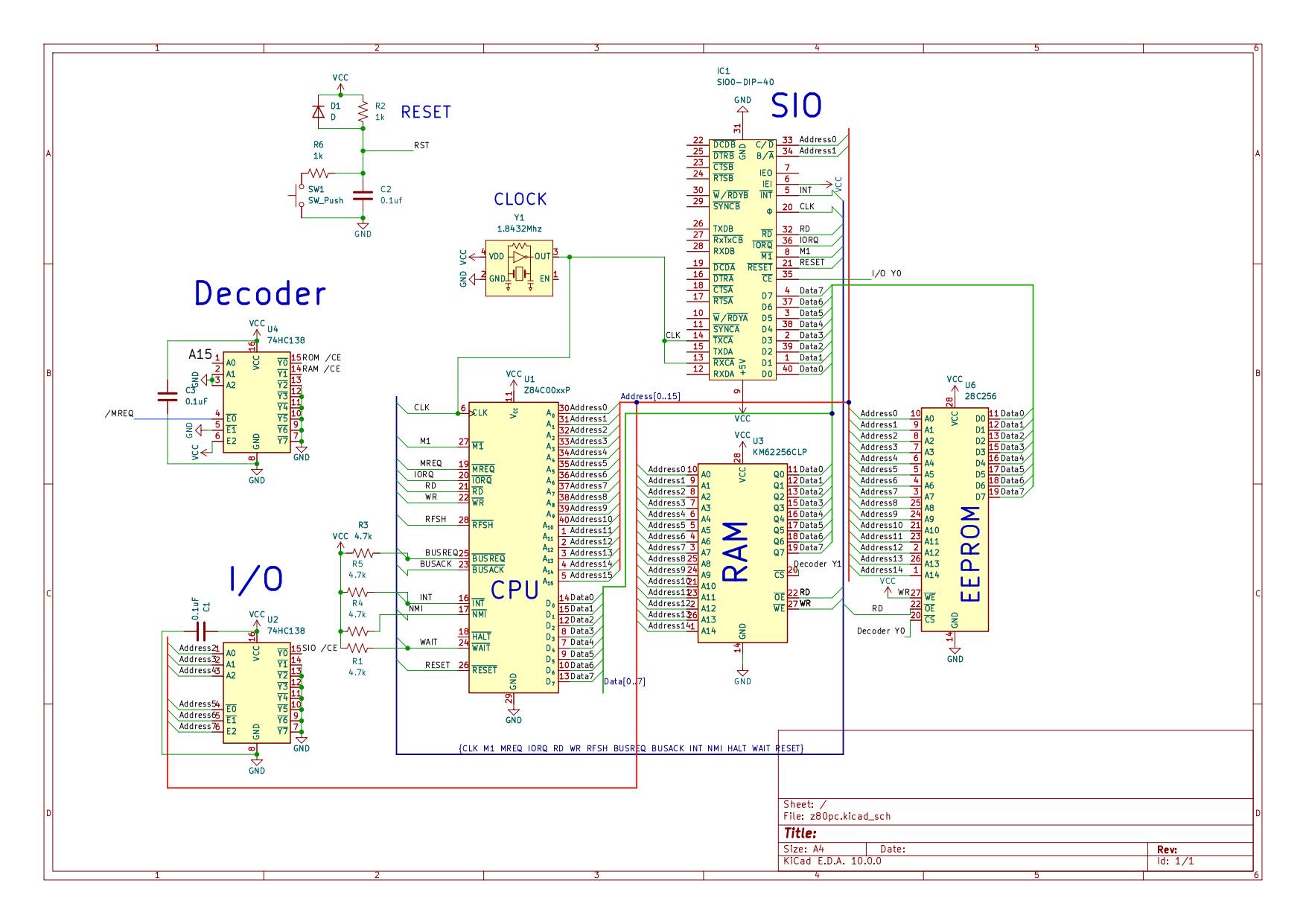
could this circuit work? im trying to get bare minimum to work

Post image
21 Upvotes

this design is based on doctor volt on youtube


r/homebrewcomputer • • 19d ago

Been testing my 8-bit binary architecture with FPGA tools. Looking for some technical feedback.

Post image
1 Upvotes

r/homebrewcomputer • • 20d ago

Help finding GreenArrays GA144 DevBoard

Thumbnail reddit.com
2 Upvotes

r/homebrewcomputer • • 20d ago

Turning a I-400 controller into a computer

Thumbnail
gallery
29 Upvotes

I recently took this apart to create a functional schematic of it as of to my knowledge none currently exist. I also plan to eventually use a separate Z80 that way I can make the Z8 on it can easily communicate. My goal is to try to make a CP/M computer using the shell and hardware of this + some stuff of my own
Here are some pictures of the 4 main boards

If this project goes well I might release the schematics I make online, though I’m trying to be as nondestructive as possible to its going to be hard in some areas


r/homebrewcomputer • • 25d ago

Any Suggestions For What to Fill Remaining Registers With?

4 Upvotes

I'm currently working on a PCB Design 8-Bit computer based partly on the design of Mattbatwings' Minecraft CPU design, and making a few changes that better fit the physical CMOS chips, such as making the register file memory mapped with special functions, the specs are as follows:

  • Powered by USB-C

  • 65kHz Clock (Intended to allow a Timer division in seconds)

  • 65536x16-Bit Single Cycle Instruction Memory

  • On-Board and External Memory Writing

  • 65536 Bytes of RAM, excessable in 256x256 Byte Memory Banks

  • ALU with Logical Addition and Subtraction

  • Bitwise NOR, AND, XOR, and Right Shift

  • Immidiate Add and Load Instructions

  • Indirect Instruction Jumps, and Conditional Branching

  • Conditional Flags for Carry Detection and Zero Detection

  • 4 Layer Callable Subrutines with a 4-Layer Hardware Stack

  • 16 Register Register File with:

  • (0-3) General Operation Registers (Readable, Writable)

  • (4) Parallel Input Register with 4 Output JST connectors (Readable)

  • (5) Serial Input Register with Output Clock and Latch Signal (Readable)

  • (6) 16-Bit Timer Lower Byte (Readable)

  • (7) 16-Bit Timer Upper Byte (Readable)

  • (8a) Indicator Flags CNVZP (Readable, Writable*) (7-3)

  • (8b) LCD Control Signals E, RW, RS (2-0) (Readable, Writable)

  • (9) ST7920 128x64 LCD Display Data Bus Register (Writable)

  • (10) Variable Clock frequency Generator (Intended for Audio)

  • (11) Unassigned as of now

  • (12) Serial Output with External Latching and Clock Support (Writable)

  • (13) Parallel Output Register With 3 JST Connectors (Writable)

  • (14) Memory Address Register to Determine which of the 256 RAM Banks is read (Writable)

  • (15) PRNG Generator Register (Readable)

I'm approaching the final design and was wondering what I should put into the final register space? I though about adding a SPI dedicated register but I'm unsure how to incorporate such a thing in a single cycle.


r/homebrewcomputer • • 25d ago

retro computer on a Pico W with a 20x4 LCD: its own BASIC

Thumbnail gallery
129 Upvotes

r/homebrewcomputer • • 26d ago

70's NMOS IC design game

Thumbnail
ikeralir.itch.io
15 Upvotes

I've been working on a game where you take the role as a VLSI design engineer in the year 1975 and have finally published the alpha version. Layout, pass DRC, Extract and simulate to meet the design criteria before the deadline for each circuit to advance.

The game throws you in at the deep end with very little support but you can start the game as an intern in sandbox mode and get some help.

The wrapper to make it work in a browser with graphics and music is AI generated but the main game was created with little AI support.

Check it out and play for free in a browser.


r/homebrewcomputer • • 26d ago

I built an Apple II+ from 21,180 transistors in a browser simulator — it boots DOS 3.3 and runs VisiCalc

348 Upvotes

Not a physical build, so I hope it's okay here but everything is wired by hand, starting from single transistors.

Two transistors make a NOT gate. From there I built the gates, latches, adders, the ALU, and finally a full NMOS 6502 (20,524 transistors). The gate-level CPU passes the Harte 6502 test suite (about 1.5 million tests). Around it I wired the rest of the Apple II+: address decoding, RAM, ROM, soft switches and video.

It runs Applesoft BASIC and, in general, Apple II programs anything you can load into memory as a binary (.obj) file. VisiCalc is in the video. The video is 4 days of building, sped up, with no voiceover.

A few honest notes:

– Simulating 21k transistors at switch level is slow, so to run software at full speed the simulator swaps the CPU for an interpreter that is checked against the gate-level one. Everything else stays the same circuit.

– The ROM and program files are the original Apple ones, loaded by me — they don't ship with the simulator.

– There's no disk drive in this video. I built a Disk II controller separately — that's another story.

The simulator is free and runs in the browser, no sign-up: https://cs.khanin.info

Happy to answer questions about how any part of it works.


r/homebrewcomputer • • 29d ago

Documenting my PIC32MZ and FPGA based homebrew computer project

Thumbnail
drewsrobots.blogspot.com
27 Upvotes

This started out as an attempt to see if I could generate HDMI video output with a relatively low end FPGA, and turned into a complete boot-to-basic retro-esque computer system built with modern components. PIC32MZ CPU, Efinix T20F256C3 FPGA for video and sound. It has a fast BASIC interpreter that I wrote from scratch, a rudimentary disk operating system, 320x240 graphics output with multiple tile and sprite layers, 16 channel wavetable synthesis sound output.

Not sure what to do with the project now, but it's been a fun learning experience.


r/homebrewcomputer • • 29d ago

Breadboard simulator feature a drop-on 6502 CPU chip

Thumbnail gallery
100 Upvotes

r/homebrewcomputer • • 29d ago

Monochrome vga output with a pseudo-desktop pc enviornment (kinda) entirely on a avr64da28.

Post image
16 Upvotes

The next thing is probably figuring out a text editor nd a 2MB eeprom


r/homebrewcomputer • • Oct 27 '26

Tester for MOS 6510 CPU

89 Upvotes

r/homebrewcomputer • • Oct 25 '26

Can a computer built from relays solve a system of linear equations?

Thumbnail
youtu.be
9 Upvotes

In this video, our 16-bit relay computer solves two linear equations with two unknowns and calculates the values of X and Y with an accuracy of one decimal place.

You can learn more about the relay computer here: https://relaiscomputer.at/

Try the simulator: https://clack-studio.relaiscomputer.at/

Try the BASIC compiler: https://clack-basic.relaiscomputer.at/

Try the FPGA System: https://clack-fpga.relaiscomputer.at/

best regards...