r/epistemology • • May 04 '25

discussion Why do so many “rational” people have zero epistemic hygiene?

263 Upvotes

You believe studies you haven’t read, quote scientists you don’t understand, and confuse intuition with insight.
How do you actually know what's true—especially when it can't be verified?


r/epistemology • • Jan 28 '22

What fallacy is this?

Post image
188 Upvotes

r/epistemology • • Jun 07 '21

Whether it be intuition or deductive reasoning, always verify the drawn conclusion.

Post image
112 Upvotes

r/epistemology • • Mar 31 '25

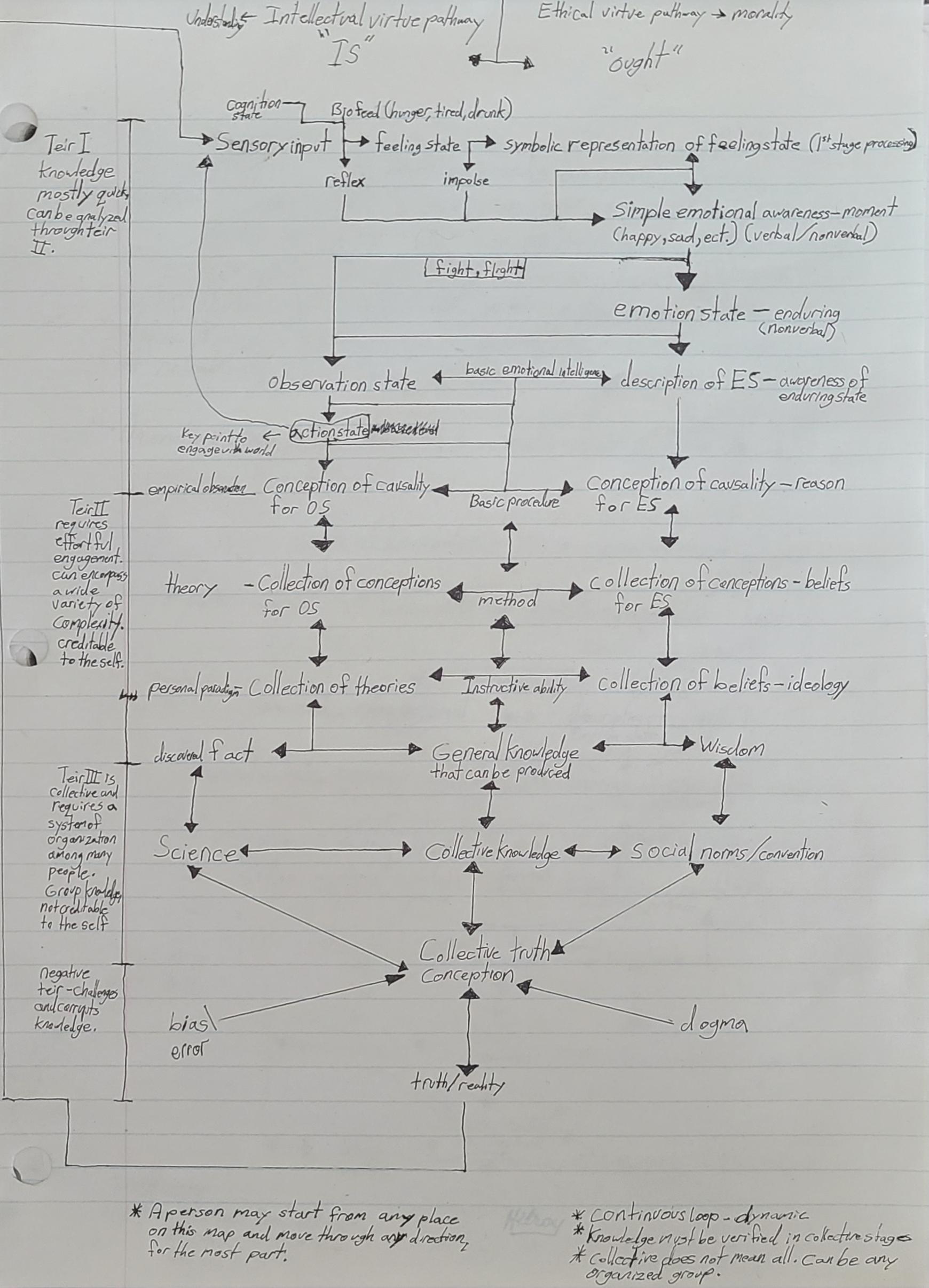
discussion Epistemological diagram of knowledge

Post image
97 Upvotes

I've created this diagram of knowledge and would like to ask for feedback and constructive criticism.

  1. Does it make sense

  2. Is it accurate

  3. Is it missing anything major (or minor) Etc


r/epistemology • • Apr 19 '21

On critical thinking vs critical pedagogy

90 Upvotes

https://symposium.substack.com/p/we-need-liberal-social-justice-not?r=17uk7&utm_campaign=post&utm_medium=email&utm_source=twitter&fbclid=IwAR2K7m7NFOJqMjypZkJZmELAtL_zgTkpNUusvguJMRKmUkPZyXAiwEsiKFg

Curious what people think of this from an epistemological pov. On critical thinking vs critical pedagogy:

"The critical-thinking tradition is concerned primarily with epistemic adequacy.... To be critical is to show good judgment in recognizing when arguments are faulty, assertions lack evidence, truth claims appeal to unreliable sources, or concepts are sloppily crafted and applied.... Critical pedagogy regards the claims that students make in response to social-justice issues not as propositions to be assessed for their truth value, but as expressions of power that function to re-inscribe and perpetuate social inequalities [emphasis mine].”


r/epistemology • • Apr 11 '23

discussion The Inherently Indescribable Nature of the Universe

Post image
81 Upvotes

r/epistemology • • Oct 05 '25

discussion As a black American, I'm beginning to think threads of anti-intellectualism are woven into various elements of our community. How does one untangle these threads without evoking fears that the whole thing will come apart?

78 Upvotes

My hope is to discuss this in a rational and objective way. I recently made a post on a Black people sub wherein I used John Steinbeck's novel THE GRAPES OF WRATH as a kind of metaphor. The gist was that if you're steeped in hopelessness and desolation, it can be hard to believe in--let alone work toward--anything else. Suffering isn't unique to black people, nor is it the only story we have to tell. The underlying question was: why are negative things the ones even we grant the most attention and significance to?

The top comment on the post was a montage of oft-repeated information crowned with the certainty that I must not be black.

The main thing I took from all that was that you need a varied approach to knowledge and learning to appreciate views markedly different from your own. This exploration of intellectual variety--styles of thought, the perfecting of critical thinking and related skills, Etc.,--doesn't seem like something black American culture encourages and I would like to understand--from a strictly academic position--why that might be.


r/epistemology • • Dec 26 '25

discussion Carl Sagan and the Uncomfortable Challenge of Skepticism

77 Upvotes

You can always tell a fake skeptic from a real one— fake skeptics don’t like it when you challenge their skepticism.

These criteria by Carl Sagan are hated, even by those who call themselves skeptics. Why? Because they’re entirely objective, they’re set up to challenge and crush emotive claims of authority, by demanding that those claims meet an evidential and rational burden of justification.

“1. Wherever possible there must be independent confirmation of the “facts.”

“2. Encourage substantive debate on the evidence by knowledgeable proponents of all points of view.

“3. Arguments from authority carry little weight — “authorities” have made mistakes in the past. They will do so again in the future. Perhaps a better way to say it is that in science there are no authorities; at most, there are experts.

“4. Spin more than one hypothesis. If there’s something to be explained, think of all the different ways in which it could be explained. Then think of tests by which you might systematically disprove each of the alternatives. What survives, the hypothesis that resists disproof in this Darwinian selection among “multiple working hypotheses,” has a much better chance of being the right answer than if you had simply run with the first idea that caught your fancy.

“5. Try not to get overly attached to a hypothesis just because it’s yours. It’s only a way station in the pursuit of knowledge. Ask yourself why you like the idea. Compare it fairly with the alternatives. See if you can find reasons for rejecting it. If you don’t, others will.

“6. Quantify. If whatever it is you’re explaining has some measure, some numerical quantity attached to it, you’ll be much better able to discriminate among competing hypotheses. What is vague and qualitative is open to many explanations. Of course there are truths to be sought in the many qualitative issues we are obliged to confront, but finding them is more challenging.

“7. If there’s a chain of argument, every link in the chain must work (including the premise) — not just most of them.

“8. Occam’s Razor. This convenient rule-of-thumb urges us when faced with two hypotheses that explain the data equally well to choose the simpler.

“9. Always ask whether the hypothesis can be, at least in principle, falsified. Propositions that are untestable, unfalsifiable are not worth much. Consider the grand idea that our Universe and everything in it is just an elementary particle — an electron, say — in a much bigger Cosmos. But if we can never acquire information from outside our Universe, is not the idea incapable of disproof? You must be able to check assertions out. Inveterate skeptics must be given the chance to follow your reasoning, to duplicate your experiments and see if they get the same result.”

Source: The Demon Haunted World, Carl Sagan p.210-211, Random House 1995


r/epistemology • • Dec 10 '25

discussion Why the heck does science work?

75 Upvotes

Seriously, I need answers.

Einstien once said: "The most incomprehensible thing about the world is that it is comprehensible".

Why is it, that you're capable of testing things within nature, and nature is oblidged to give you a set result.

Why is it that the universe's constants remain constant, it's not nessecary for light to always move at the same speed, reality could easily "be" if it didn't.

Perhaps I'm asking too many questions, but the idea that science is possible has got to be perplexing.

It's as though the universe is a gumball machine, if you give it certain inputs (coins/experiments) it'll give you a certain result (gumballs/laws)

Why is the universe oblidged to operate this way? and why can we observe it?


r/epistemology • • May 31 '26

discussion The Physics community has a string theory cult problem.

72 Upvotes

Has anyone else noticed this? If you question the epistemology of string theory and how it hasn't produced a single falsifiable result in over 40 years, they tend to shut you out instead of discussing the implications of a billion-dollar industry that has failed to produce much of anything.

This has been a fairly consistent response from that camp. To be honest, I think they need a serious reminder of what real epistemology looks like.


r/epistemology • • Jan 07 '26

discussion Is a single water molecule wet?

70 Upvotes

I’m curious about your views?

Maybe a more precise question is can a single water molecule deploy/create wetness?

Edit:

‘Wetness’ probably emerges sort of like friction

I’m asking how many (roughly maybe) water molecules does it take for the body of water to be able to create this quality we call wetness?

If one liter qualifies but a single water molecule doesn’t, then when would *you* qualify it? Do u draw a line, or is it a spectrum? Maybe a binary but with a fuzzy area around x molecules?

I’m just curios of others' position.


r/epistemology • • Sep 26 '25

discussion Why epistemology so understudied/undervalued in the education system?

68 Upvotes

I understand the purpose of State education is turn us into obedient workers. But why is epistemology not studied more widely? With the exception of philosophy and perhaps law, no other field teaches epistemology. Not even engineering or science. This also applies to philosophy of science I think.


r/epistemology • • Dec 29 '25

discussion Is there a theoretical limit to the amount of knowledge in the universe?

66 Upvotes

Say millennia and millennia pass and humans and society not only have survived but have progressed technologically and mentally at an incredible exponential rate during that entire time, is there theoretically an amount of knowledge that could be discovered by the human race about the universe where it finally hits its limit?

A point in which the exponential progress of humans and society has to slow to a metaphorical halt because the lack of new information available for progress to take place?


r/epistemology • • Nov 23 '25

discussion Why is epistemology an interest for few?

62 Upvotes

I am 19 years old and I am not yet an expert in philosophical circles, but I have noticed that most people are not interested or take it for granted by studying authors who deal with it transversally. But I have also noticed in my daily life that it is already rare to find philosophy enthusiasts, and it is even more difficult to find people who are interested and live the limits of knowledge in all its nuances. Yet I find that together with analytical philosophy and other borderline branches they are so important... What do you think? Should it be more "pop" or only for philosophy workers? Why is the border so uninteresting?


r/epistemology • • Apr 10 '22

How would you explain epistemology in a few paragraphs to somebody that’s never been exposed to philosophy, let alone epistemology?

51 Upvotes

Imagine your audience is top 10% high school graduates that never read any philosophy.

I already know what I would say. Wondering what others would say. I’ll be giving my answer too.


r/epistemology • • Nov 26 '22

discussion Are human inventions considered nature?

49 Upvotes

My whole life I have held the very unpopular idea in my head that what humans do and create does not exist outside the boundaries of the universe and therefore is inseparable from what we would describe as nature. Everything from mass extinction events to nuclear fallout created by thermonuclear explosions; all these things arose from the same laws of physics that have created anything else. When I bring this up it makes people very uncomfortable, bur my question is, has this topic been explored in other spaces before? I would love to read other people's interpretations of the "natural vs not natural" paradox

Edit: I'm not trying to make a moral argument about the behavior of humans. In respect to our existence and the existence of the earth and everything on it, destroying it is bad and we should definitely not do that. My argument more follows the logic that we follow all the same rules as everything else in the universe, and so does everything we have ever made or done. We don't "bend nature to our will", we simply are one of the iterations of nature and so is everything else that ever was or will be


r/epistemology • • Jan 08 '26

discussion Are there other types of knowledge besides scientific knowledge?

48 Upvotes

Isaac Arthur, a futurist physicist and popular YouTuber believes that science may have a limit and we can run out of science to discover

However, he also said that there is knowledge that is not scientific in nature and he didn’t give any examples and I can’t think of any myself.

Is there such thing as non-scientific knowledge and what is an example of such?


r/epistemology • • Nov 27 '25

discussion The Absurdist Epistemology

48 Upvotes

My entire philosophical stance rests on the idea that to be honest about my cognitive state, I must embrace the absurd: that all human apprehension is belief (Doxa-Assent), and the very act of claiming this truth is the highest form of that belief.

I. The New Epistemological Lexicon

I must define the terms of my own ignorance. The traditional Knowledge versus Belief dichotomy is useless because it assumes Knowledge is reachable. I use new terms to reflect the true, contradictory nature of my experience.

TermDefinitionAbsurdist Rationale
Certitude (C)Objective Truth as it exists independent of my mind. This state is fundamentally inaccessible to me.I define the ideal only to confirm I can't reach it.
Doxa-Assent (D)The entire spectrum of my human cognitive affirmation—from immediate sensation to blind faith. It is the only state I possess.Every human thought, even perception, is a form of belief.
The Epistemic VoidThe unbridgeable gulf between my Doxa-Assent (my best guess) and Certitude (True Reality).This formalizes the necessary and eternal gap that defines my existence.
Phenomenal Doxa (DP)Doxa-Assent based on immediate sensory input.I use this to categorize "seeing" as a belief, not knowing.
Inferred Doxa (DI)Doxa-Assent based on theory, induction, or faith.This is the realm of my assumptions about unseen things.

II. The Absurdity of the Definitions

The Foundational Contradiction: My entire system is built upon the Inferred Doxa (DI)—the belief that Certitude (C) is unattainable. To assert that C is unattainable is, paradoxically, to assert absolute knowledge (C) about the limits of my knowledge.

The Absurdist Embrace: I don't see this as a flaw. This self-refuting loop perfectly captures the human condition: a mechanism designed to seek truth that is perpetually trapped in a state of self-referential uncertainty. My system is honest because it admits its own failure.

III. Applying the Absurd to the Doxa-Spectrum

The difference between a scientist and a devotee is not truth; it's merely the degree of justification for their Doxa-Assent.

Doxa TypeAbsurdist StatusThe Internal Contradiction
Phenomenal Doxa (DP)Low Absurdity. Minimal Gap.I see this table (DP), but I cannot know if my brain is accurately translating the external C of the table. The immediate belief is necessary, but the certainty is false.
Inferred Doxa (DI - Science)Medium Absurdity.I believe in the laws of nature (DI). I use my current best theory to know the universe is predictable (C claim), even though I know all previous theories were wrong (not C). I am betting my life on a model I know to be incomplete.
Inferred Doxa (DI - Faith)Highest Absurdity. Maximal Gap.I believe in an omniscient being (DI). I claim to know the highest truth (C claim) based on the least amount of DP. This is the ultimate "I don't know, but I know," made sacred.

IV. The Conclusion: Life is an Act of DI

The result of this system is that all human experience, from the mundane to the metaphysical, is defined by the Absurd:

To Live is to make an act of Inferred Doxa (DI). I believe in my memories, I believe in my future, and I believe that the next second will arrivve. This is the necessary fiction that allows me to function.

To Define is to use an inherently flawed Linguistic Doxa (D) to try and capture an uncapturable Certitude (C). I am aware that the words I use to build this philosophy are also incomplete, but they are the only tools I have.

The Absurdist Solution: The only authentic human response is not to try and solve the contradiction (the failure of past philosophy), but to live in conscious rebellion against it. I embrace the necessary belief, but I always acknowledge that it is, and can only ever be, a necessary lie. To accept the contradiction is the only way I can truely be honest with myself.


r/epistemology • • Jan 11 '26

discussion Are we born with knowledge

45 Upvotes

It makes sense to say we are born a blank slate, but for some reason that feels incomplete. Can our instincts and natural behaviours count as knowledge?


r/epistemology • • Oct 22 '24

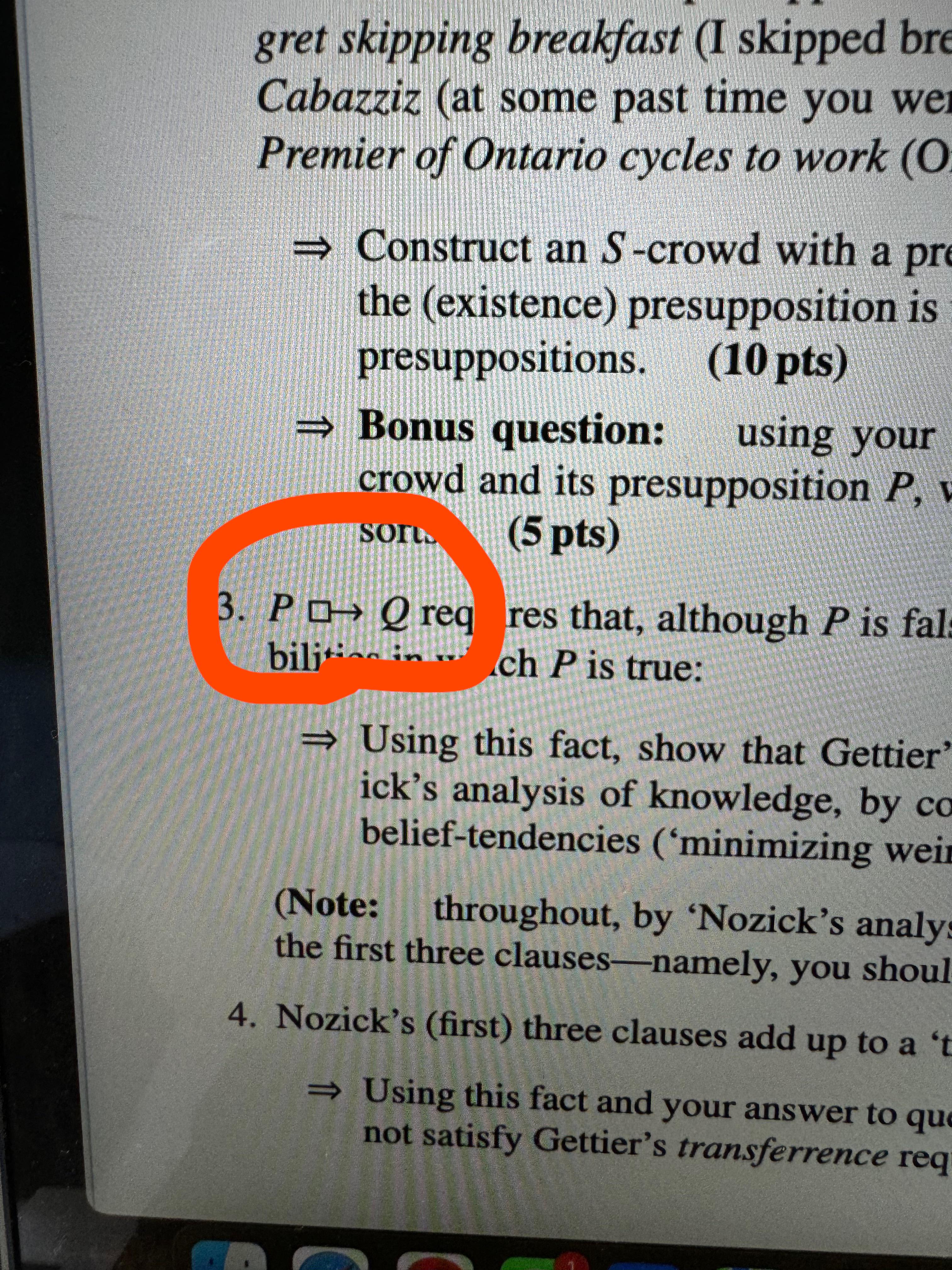
discussion What does this symbol mean?

Post image
45 Upvotes

My professor never taught us what it means, and I cannot find a universal answer online. I was wondering if any of you know what it means. If you do, it would literally save my life


r/epistemology • • May 19 '21

/r/epistemology hit 5k subscribers yesterday

Thumbnail
frontpagemetrics.com
44 Upvotes

r/epistemology • • Dec 19 '25

discussion Does science and technology have an endpoint?

43 Upvotes

I sometimes wonder if scientific and technological progression has a natural stopping point and we will one day just hit a ceiling that we can never breach. Some things we want are just not possible.

Yet I do believe the universe is infinite-and if something is infinite; shouldn't there be infinite possibilities?

A lot of people argue that we have stalled already as we haven't really made any discoveries or developed technologies that are fundamentally novel since the 70's. Sure, tons of innovation but most of it is just building on what we already have and/or improving things.

Smartphone technology was "invented" in 2007, but we really had the working tech as far back as 1984-it just wasn't available to the consumer public. I would not even remotely be surprised if certain advanced technologies are kept totally secret

There is so many conflicting views in favor of one or the other, but is there any "semi-concrete" evidence that might point towards it ending, has already ended or is endless?


r/epistemology • • Apr 01 '24

discussion My personal conception of virtue epistemology- mind map

Post image
41 Upvotes

I tried to create a mind map of my general conception of virtue epistemology after a semester of class. It's imperfect, and this isn't to turn in, I just thought I'd post this and see what sort of feedback I receive. I apologize in advance for what may not be legible. I will try to provide clarity for any confusion people may have.


r/epistemology • • Jun 01 '21

Research Less Likely to Be True is Cited More

Thumbnail
labroots.com
40 Upvotes

r/epistemology • • Jul 12 '25

discussion How to Arrive at Truth

38 Upvotes

We each inhabit the same reality and yet we arrive at different interpretations of that reality. The divergence then is not in reality but in the order in which we conduct our thoughts to arrive at truth.

It is as if each of us always begins at the same trail head and yet somewhere along the path we diverge and find ourselves in different positions and can never reconcile our differences.

The method to find agreement is to make ourselves aware that we always begin at the same place and to communicate to each other the series of steps to take to arrive at truth.