r/compmathneuro • • Jul 24 '26

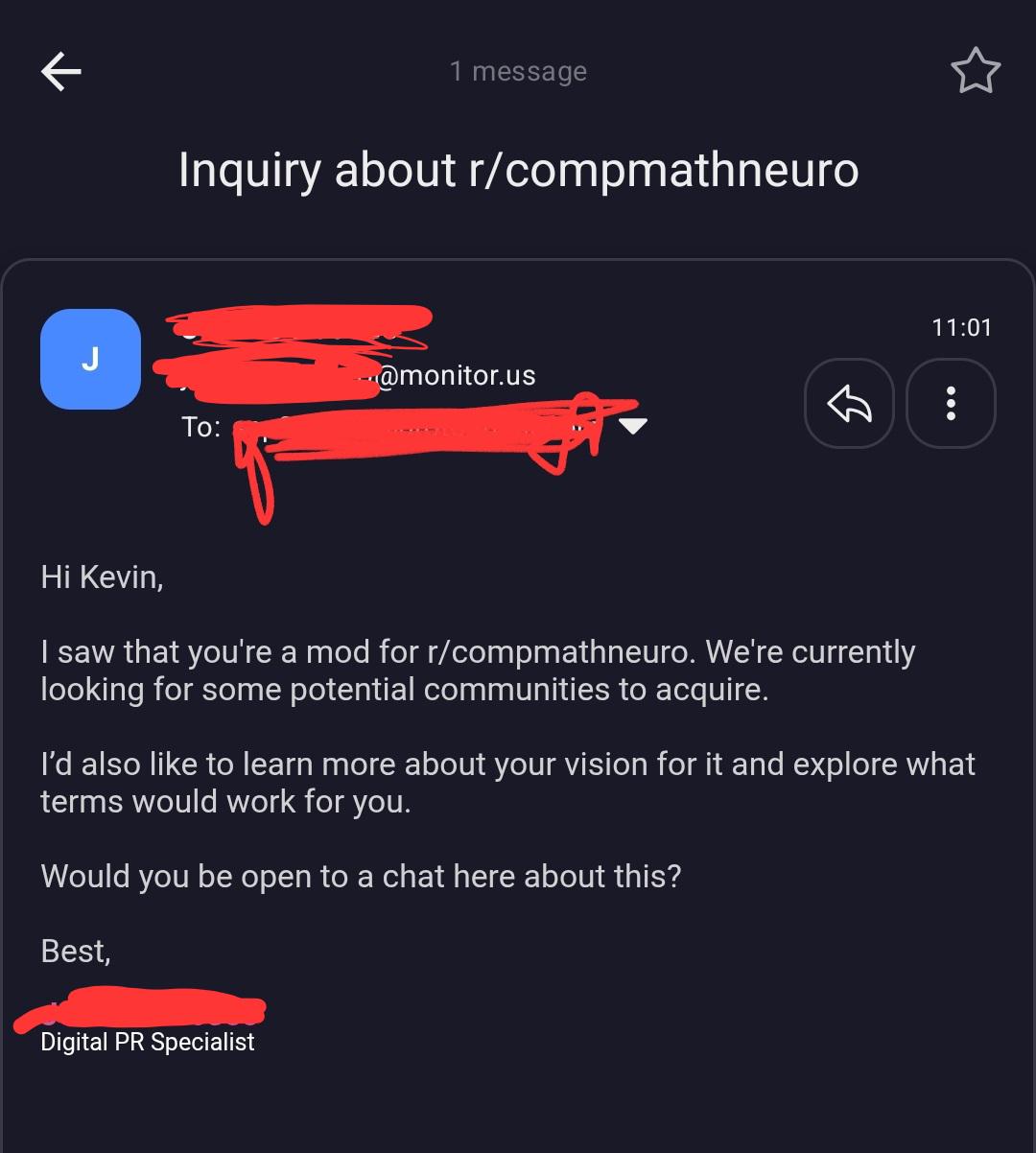
PSA: this subreddit is being targeted for acquisition.

Post image
365 Upvotes

This email was sent to an ancient address of mine. Not sure whether it's real, but I figured I'd post this here to flag the fact that someone out there seems to be trying to buy subreddits. If you see this post be unpinned at any point, let that be your sign that an external party with a presumably commercial interest has gained control over the subreddit one way or another.


r/compmathneuro • • May 11 '26

Discussion Interactive online demo of brain information flow

157 Upvotes

Link for online interactive demo:
https://pixedar.github.io/ai/mindvisualizer/

Main GitHub repo:
https://github.com/Pixedar/MindVisualizer

This is a follow-up to my open-source brain information flow exploration repo from this post:

https://www.reddit.com/r/compmathneuro/comments/1sy150g/open_source_brain_information_flow_exploration

I decided to make a small online demo of the repo to make the idea more accessible to a broader group of people, and to give people an easier way to first interact with the visualization.

I see the web demo mostly as an entry point into the broader effort and repo. More broadly, I see this as part of a larger effort to build better intuition and mental models for large-scale brain dynamics. I know the current technology and methods may not be fully there yet, but I think this kind of exploratory / collaborative tooling is emerging and worth trying

However, a few caveats:

  • The current flow data is not peer-reviewed. It is based on real brain data from my preprint / Zenodo record: https://zenodo.org/records/18200415 In the future, it would be nice to turn this into a more rigorous version, possibly with higher-quality data, better-validated flow models, or collaboration with people who work more directly on this kind of problem.

  • Please remember that the online demo is only a limited demo. It currently shows only one of the three modes from the full repo. The other modes in the repo may actually be more important / relevant than the one currently shown in the browser demo, especially for the broader brain-manifold and information-propagation idea. For the full functionality, please check the actual GitHub repo: https://github.com/Pixedar/MindVisualizer

  • The real repo is the main project, not the web demo. It contains the three modes, the broader brain-manifold / information-propagation idea, the LLM/RAG interpretation part, and the informal observations file: https://github.com/Pixedar/MindVisualizer/blob/master/OBSERVATIONS.md The observations file is there so people can add interesting flow paths, perturbation effects, or intuitions about resting-state organization. The hope is to slowly build a shared record of patterns that might help us think about how the brain works internally.

  • The site is intended for demo / accessibility purposes only. The web version was made more quickly just to make the idea easier to try in the browser. The GitHub repo is the more complete version of the project, with more functionality and better code structure. For anything beyond just trying the browser demo, please look at the repo.

  • I do not expect a huge amount of traffic, but since the LLM analysis costs tokens, I included only a small amount of my own credits, so it may run out over time if people use it.

The original repo post was basically about combining brain information flow derived from real fMRI and tractography data with an LLM, including RAG-based interpretation of this flow and propagation of information in the brain.

It is still not peer-review quality and should rather be treated as a tool for building intuition about the brain and building a mental model of brain dynamics.

Feedback is very welcome, especially from people who know the field better or have ideas about validation, better data, better flow models, or how to make the observation/collaboration part more useful


r/compmathneuro • • May 21 '19

Poster Computational Neuroscience Textbook Guide -- looking for suggestions and critique.

Post image
151 Upvotes

r/compmathneuro • • Apr 28 '26

Open Source brain information flow exploration tool

118 Upvotes

I made a open source repo that combines brain information flow derived from real fMRI data with an LLM, with access to RAG-based interpretation of this flow, as well as propagation of information in the brain here: https://github.com/Pixedar/MindVisualizer

It is not peer review quality and should rather be treated as a tool for building intuition about the brain and building a mental model of brain dynamics .It is more of an exploratory visualization / intuition-building tool, and I would be happy to hear feedback from people who know the field better

I also added an https://github.com/Pixedar/MindVisualizer/blob/master/OBSERVATIONS.md for informal notes: if anyone notices an interesting flow path, surprising perturbation effect, or intuition about resting-state organization, feel free to add it there. The idea is to build a shared record of observations that may help refine mental models over time


r/compmathneuro • • Jun 25 '26

CALHippo - Mapping neurons and glial cells in the human brain hippocampus in 3D with SOTA segmentation and density estimation models

102 Upvotes

Hello everyone!

I'm posting our research work as you might be interested in how we used ML to map part of the brain cells of the human hippocampus :)

We used various human brain slices at high resolution (1 micrometer per pixel) and developed a custom segmentation pipeline that uses SoTA whole slice cell segmentation networks, like CellPoseSAM with good zero shot performances. We then refined semi-automatically those annotations and ensembled more finetuned models within the pipeline, adding a merging algorithm and a cell classification for 3 classes (excitatory and inhibitory neurons, and glial cells).

But the high-res slices covered only a few parts of the hippocampus with respect to other slices scanned at 20x less the resolution where the cell nuclei are only 1 pixel wide. So we tried to map the high-res annotations we obtained to the low-res corresponding slices, and used a small UNet to supervise a density estimation task for 3 classes. We obtained a network that outputs a density map that can be sampled to obtain a probabilistic map of the cellular positions.

Finally, to reconstruct the volume, we stacked together all the low-resolution density maps from all the slices that covered the hippocampus and obtained a point cloud, which you can see in the GIF along the corresponding anatomical CA (Cornus Ammonis) areas.

The performances are still limited by the quantity of data and low-resolution slices, but we showed that the results were biologically plausible given previous estimates by other researchers.

The paper was accepted at MICCAI 2026 a few weeks ago!

Feedback is very welcome, especially on the density-estimation formulation and possible uses of the generated point cloud.

Paper (pre-print): https://federicobolelli.it/media/publications/pdfs/Paper-0727.pdf
Code: https://github.com/AImageLab-zip/CALHippo-Framework
Dataset: coming soon!


r/compmathneuro • • Nov 26 '24

Is Computational Neuroscience worth it??

77 Upvotes

I'm obsessed with learning about the brain to the point that I want to do this my whole life. I really want to go into computational neuroscience but I don't know what to study ad a foundation. I'm thinking of pursuing CS in my bachelors since none of the colleges in my country offer a bachelors in neuro. What should I do?


r/compmathneuro • • Mar 10 '26

Question How do scientists actually simulate an entire brain like the fruit fly connectome?

Thumbnail
amp.elperiodico.com
73 Upvotes

I recently saw a video about a company simulating the brain of a fruit fly and placing it inside a virtual body in a simulated environment.

What I don’t understand is how this is technically done.

Do scientists literally recreate each neuron in code and simulate how it fires and connects to other neurons? Or do they use some kind of neural network or specialized software to replicate the connectome?

Also, if the neural wiring is replicated accurately, does the simulated brain behave the same way as the biological one? Or is it still more like a simplified model?

Basically I’m trying to understand what the actual computational process looks like when people say they “simulate a brain.”


r/compmathneuro • • Jun 12 '26 Bravo

Question How to start in computational neuroscience research?

62 Upvotes

Hey everyone,

I’m getting into computational neuroscience and wanted some guidance on where to start:

  1. How do beginners break into research in this field?

  2. What are the must-read papers/books or resources?

  3. What math + programming skills are essential (and to what level)?

  4. Which universities/labs are leading right now?

  5. What are the most in-demand / high-paying career paths in this space?

Would really appreciate advice from people already in the field.

Also if you were to start all over again what things would u do differently.

Thanks!


r/compmathneuro • • May 21 '19

Administrative Post r/compmathneuro's guide to finding paper and textbook PDFs

60 Upvotes

When it comes to papers, there are several sources that provide access to paywalled papers.

  1. Sci-Hub
    This is the most reliable site currently available – it requires the paper’s DOI or URL, and uses shared user credentials to provide a scientific article PDF. It is fast, and offers access to all the most important journals, as well as to most less prestigious ones. In case Sci-Hub is unable to find the paper you’re looking for, the site will attempt to obtain it through a list of additional sources. If you’re unlucky, and the paper is still unavailable, try again a few weeks later. Visual guide.

  2. LibGen Scientific Articles Archive
    LibGen (Library Genesis) attempts to archive every paper retrieved through Sci-Hub. Its SciMag archive, with about 75 million files and a total size of over 60 TBs, is probably the largest scientific archives available on the world wide web. It is continuously updated, with hundreds of thousands of paper added every month. In case your Sci-Hub search failed, check whether LibGen has the paper you’re looking for. Keep in mind that LibGen does not accept URLs, but you can search through a paper’s DOI, PMID or title. Visual guide.

  3. /r/Scholar Community
    A subreddit dedicated to sharing scientific papers. Worth trying if the first two links fail you. All you need to do is post some details, and someone with access to the particular journal your paper was published in will generally upload a copy for you within a day or two.

  4. ArXiv e-Print archive, bioRxiv e-Print archive
    It is possible that the paper you’re looking for was posted as a preprint (a non-peer reviewed, non-typeset version) on an online archive. ArXiv (Physics, CS, Mathematics, Quantitative Biology and more) and bioRxiv (Biology) are two of the most popular ones. Search the title of your paper: if you’re lucky enough, you should now have a preprint copy freely available to you.

If you're having trouble finding specific identifying strings for a paper (which you really shouldn't given that most of the posts in this subreddit link directly to the journal source), use CrossRef for metadata searches or Doi.org to resolve a DOI name.

Contact the moderators if you need any help beyond that.


When it comes to textbooks, you may want to check out several possible sources.

  1. LibGen Sci-Tech archive
    Library Genesis doesn't just archive scientific articles, it also provides access to what is perhaps the richest book and textbook archive on the internet. Over two million titles, for a total size of over 30 TBs of books. It is recommended, when searching, to provide both the book's author and title. Visual guide.

  2. Mobilism forum
    The Library Genesis archive comprises most textbooks. In the unfortunate case it doesn’t have the textbook you’re looking for, the Mobilism forum is worth checking out. Registration is required, but once you are signed up you can simply search the site using the top right search bar.

  3. r/Piracy custom search engine
    The Piracy subreddit has put together a custom search engine dedicated to ebooks. In the extremely rare case both LibGen and Mobilism lack the book you’re looking for, this is an additional source to check out. It searches many smaller websites, as well as torrent indexes. When searching, the book’s title is usually enough.

  4. r/Scholar
    The r/Scholar Reddit community doesn’t just provide help with papers, but with scientific books too. The concept is the same; posting the book’s title, author, and ISBN will (hopefully) allow some user to send it to you. Consider this your last resort.

If you’re having trouble finding a book’s ISBN, consider checking out its Amazon page. Again, contact the moderators if you need any help beyond that.


r/compmathneuro • • Apr 28 '21

Online self-paced course "Python for neuroscience"

56 Upvotes

Heya

I have been working recently on the online course on basics of Python for data analysis. Now I feel that it's done and I would like to get a feedback from learners to get the direction of perspective topics or the way to improve existing ones.

Even though this course has a fancy name, it is not much different from any introduction Python course you can find online. The main difference is that I tried to connect exercises to neuroscience related problems.

Course is designed for people with little or no programming experience and it covers such topics as basic programming skills (data types, for loops, writing functions, etc); working with data in different formats (CSV, MAT, JSON, etc); making custom plots and working with packages for statistical analysis.

Link: https://pyforneuro.com/

And a big spoiler alert: this course will not make you a computational neuroscientist, but it can give you the programming skills to become one :)


r/compmathneuro • • 10d ago

Question What should a new PhD student work on that won't be outdated in 5 years?

55 Upvotes

I'm in my first year of a comp neuro PhD at a smaller, less-known university in Canada. I'm feeling nervous at how fast things are moving and feel a certain sense of nihilism about my work. I don't think anything matters anymore since LLMs+the bitter lesson can do everything now, from robotics to drug discovery to game development etc. I'm wondering what I should work on in order to maximize my chances of not ending up in some kind of permanent underclass in the future?


r/compmathneuro • • Jul 24 '25

Discussion Building a Collaborative Computational Neuroscience Community

52 Upvotes

Hey everyone,

I’ve noticed something odd across many neuroscience and neurotech-related subreddits: some of them have tens of thousands of members, but very little actual discussion. Most posts are either academic/career questions or go unanswered entirely.

Where’s the space for people who are building things? Who want to collaborate on competitions, build new EEG tools, or open-source brain-computer interfaces? I’m talking to the hackers, engineers, students, and researchers who are actually doing the work and want to share tools, pipelines, problems, and ideas.

If there’s already a good place for this, please let me know. But if not, maybe it’s time we make one.

Would anyone else be interested in helping create a small but active space for real collaboration? Think: open-source tooling, show-and-tell posts, modeling tips, and sharing experimental rigs.

Would be happy to get your thoughts!


r/compmathneuro • • Apr 21 '25

Upcoming conference on Neuroscience and AI

Post image
52 Upvotes

r/compmathneuro • • Apr 21 '20

July 2020: massive interactive online computational neuroscience summer school

52 Upvotes

UPDATE 4/22 9:30am PDT: join our AMA on crowdcast today at 12pm Pacific 3pm Eastern to ask your questions!

https://www.crowdcast.io/e/neuromatch-academy-ama/register

------------------

Hi friends, I'm part of the organizing committee of Neuromatch Academy, a massive interactive online summer school aiming to provide hands-on live-coding experience, tutorials, TA-led small group support in 8:1 student:TA ratio, professional development + matchmaking, and more! Our organizing team consists of 30+ faculty from around the globe who have organized smaller in-person summer schools through the years, and we are banding together to bring you a fantastic experience this summer when the in-person stuff just isn't possible. 3 weeks of exciting, intensive curriculum! Groups are formed by algorithmic matchmaking ensuring you get clumped with people who have similar interests and in a similar-enough timezone that you can all interact in real time.

Website is sparse as of now, but shows a draft curriculum covering all sorts of exciting stuff. Prerequisites are essentially "know some Python" and "have enough math to keep up" plus a keen interest and background in advanced undergraduate or MS/Phd-level neuroscience topics. The school will be free or available for a small (~$100) donation. TAs will be provided a reasonable stipend (exact amount pending funding -- we're fighting for that right now).

Specific features of The Neuromatch Academy include:

  • An integrated, scientific inquiry-based curriculum with instruction in core topics of neural data science and computational neuroscience such as dimensionality reduction, neuron models, network science, Bayesian modeling, and deep learning

  • Interactive lectures with hands-on coding, offered by world-renowned scientific leaders

  • Dedicated teaching assistants with a target student to TA ratio of 8 to 1

  • Lectures and TA sessions accessible in every time zone and with TAs who speak multiple languages

  • Mentored projects with a concluding online “poster” symposium; some will be invited to participate in a special issue of the NBDT journal

  • Professional development workshops on topics like paper writing and reviewing, grantsmanship, public engagement, and career development

  • Community building events to foster relationships within TA-groups and across the worldwide student cohort

  • Job forums for students and postdocs with algorithmic matching

  • An online repository of all content created during the school including tutorials, recorded lectures and workshops made freely available to the entire neuroscience community

  • A social component driven by algorithmic matchmaking to link participants with senior researchers for feedback and advice on their project and careers

Round 1 of applications, for both TAs and students, is now open!

Students: https://forms.gle/NaxSk6ZoirS7Ukj88

TAs: https://forms.gle/VbvV2gBvFA3dr1mG6

Come join us!


r/compmathneuro • • Apr 23 '25

I spent a year writing a book on neuroAI. Here's my story.

51 Upvotes

This past January I self-published a 45-page journalist book project on neuroAI research, which I feel that some members of this subreddit might find of interest. It's free and available to anyone. It was based on around a year of extensive reporting, writing, and research, including interviews with 30+ neuroscientists.

My goal was to explore the emerging evidence for seeing deep neural networks—the basic architecture of modern AI programs—as a surprisingly suitable basis for making realistic models and simulations of brain regions, like the visual cortex and the so-called language network. Moreover, my goal was to lay out the evidence in such a way so that anyone from the public could understand it—and not only that, but actually enjoy the learning process.

I came to feel that these goals were very important. Because it seemed to me that if this reading of the evidence was correct—and there was a strong suggestion that it was, based on the way the science was moving forward—then what it implied was that we as a society were now entering the age of building a very serious, but incomplete braintech. This would have major implications for society, in terms of the technology's potential benefits, limitations, and harms. We'd never been able to create anything like brains (or brain regions) in the past. And yet, most of society was (and still is) totally unaware that such a massive paradigm shift was taking place.

In any case, after working in private for around a year, trying to sell the project to a literary agent without success, I decided to just throw it up online, (initially) on a Kickstarter. I hoped to gain funding to do much more work on it. I tried to get the word out, mainly on Reddit, but also on posts on Bluesky, Twitter, and LinkedIn (shudders).

Unfortunately, I have to admit—nobody really seemed to care, and nobody (that I know of) actually read the whole project.

In hindsight, I suppose this was to be expected, as I didn't invest hardly any time into marketing the project or promoting it. I suppose I didn't realize the extent to which a journalism project only succeeds based on the popularity of the project, or the author, and not on its intrinsic merits. What can I say? I was never the type of journalist to chase plaudits—I was just trying to do good work, but I guess that wasn't quite enough, in and of itself.

Regardless, I still feel that the project was both a pretty important personal achievement, proving to myself I could write something really long form—that still met my own personal quality standards—as well as something that could be of great public benefit. I'd be delighted to hear if anyone gets anything out of it.

Anyways, main reason I'm really posting here is that I'm currently looking for work, and would appreciate any tips or leads that anyone might have. I'm experienced as a technical writer, science journalist, and physicist. Career opportunities in science journalism are pretty negligible, which has mainly led me to look to ending my adventure in science journalism, which I've undertaken in the last 5 years, and try to find another role back in technical writing.

In the course of working on the project, I also became very interested in (and familiar with) neuroAI research, which led me to also think about pivoting back to science. However, I didn't manage to find any leads on potential research assistantships.

What to conclude from all this? To some extent, I do somewhat feel like a black sheep with regards to the project. It seemed to be unappreciated by the public, doubted by the computer scientists, and ignored by the neuroscientists. I hoped it would have been much more appreciated.

But what can you do, I guess it's all just a learning experience.

-Written by the human Mordechai Rorvig on this day, Wednesday, April 23, 2025


r/compmathneuro • • Mar 16 '25

Those with Computational Neuroscience PhDs working in industry…

51 Upvotes

Could you describe your current position and responsibilities? What type of fields did you consider to translate into and why did you choose the one you are currently in?

Thank you!


r/compmathneuro • • Oct 03 '25

Simulation of a rat brain on a track

50 Upvotes

r/compmathneuro • • Jun 19 '25

Simulation study of simple retina, thalamus, cortex, & hippocampus models working together

47 Upvotes

After the winter trip to Mexico, we visited Greece and discovered that Tiki-bar cocktails are popular there. Ah, to sip a Zombie cocktail while admiring the Aegean Sea. Even though I haven't been active here lately, I have in fact been chipping away at my brain program. Here's my attempt to assemble some of the pieces. The mammalian brain architecture takes in stimulus from sensory organs through the thalamus, does preliminary processing in the primary & secondary sensory regions for each modality, mixes the results up in the association-cortex (AC) regions, and hands off the results to the hippocampus. I have models for these at some level of detail, and here is an attempt to pull them all together into a single simulation.

Some details of the cell & synapse model

My model of the primary visual pathway as it currently stands

More about the thalamocortical loop

Hippocampus model

Some details of my cortical microcircuit model

Another thought on the canonical cortical microcircuit

Excitatory/inhibitory balance in the cortex, and wave dynamics

Superior colliculus performing gaze control

There can never be enough detail in the model to satisfy the discerning neuroscientist, and I'd certainly like to add more. But these were my building blocks at the moment and are enough to assemble an end-to-end data path. There are two binocular visual pathways, each with its own world-view and superior colliculus (SC1 and SC2). Each retinal ganglion cell array (RGC1a, RGC1b) and (RGC2a, RGC2b) signals one of the four lateral geniculate nucleus (LGN) arrays. These drive corticothalamic loops, placing attention halos around line segments in one of four possible orientations: \ / | _. By the way, two visual pathways because I don't have an auditory pathway model and the thalamus needs at least a few channels to do its thing.

The signals from each pair of eye channels combine in the corresponding V2 stellate (V2s) and pyramidal (V2p) cell arrays. These drive AC region o arrays, creating various combinations of \ / | _. The next association cortex region 2 is built with wave dynamics, only because I've read many times that this occurs. And it makes for interesting viewing. But I don't know how it is useful.

Finally, the association cortex drives hippocampus CA3. CA3 and CA1 trade off with each other based on a 10Hz control signal that presumably would come from the medial septum. But here I simply made the signal directly. CA1 tries to create a sequence of place-cell activations. Since it has not been trained in this case, these are short random paths.

The whole system doesn't do anything useful beyond tracking visual features it finds interesting and stimulating its hippocampus to produce trajectories. My plan for it is to be a platform for looking into hippocampus/cortex interactions, and development of a more complete cortical microcircuit model. Rather than simply using hippocampal stimulus of samples from a random Poisson distribution as is commonly done, I can drive it with a structured signal actually derived from sensory stimulus.

That's the hope, anyway. One way or another, it's been a very interesting project. It's as much an exploration of how big a system I can build as anything else. Please let me know if you notice anything egregiously wrong, or something you'd like to see added or enhanced. Cheers!/jd


r/compmathneuro • • Apr 10 '26

Prototype: real-time dynamical state-space representation of EEG signals

44 Upvotes

I’ve been developing a real-time system for representing EEG activity as a continuous dynamical state space, and I’m interested in feedback from people working in computational neuroscience and BCI.

The goal is to move beyond static features or trial-averaged analysis and instead model state trajectories, transition dynamics, stability and instability, and early indicators of regime shifts.

The system is constructed from band-power features (α, β, θ, γ), common ratios (e.g. β/α, θ/β, γ/θ), and low-dimensional projections (valence, arousal, and engagement from DEAP). From these, I derive time-varying properties including temporal variance, first-order derivatives (rate of change), persistence (as a proxy for stability), and inter-channel coherence or dispersion.

Rather than classification, the focus is on identifying state regimes, detecting transitions between defined regimes, and characterizing pre-instability dynamics such as rising variance.

The current prototype uses a particle-based field in which density reflects coherence, dispersion reflects feature divergence, and motion reflects temporal derivatives. Color is used as a compressed projection of multiple state variables, combining both derived features and low-dimensional projections (e.g. valence/arousal) to encode overall system state.

This is an early prototype, and the current metrics are still being refined. Longer term, I’m interested in connecting these dynamics to more formal dynamical systems frameworks and underlying circuit-level mechanisms.

I’d be very interested in how people here would approach formalizing or extending something like this—i.e. alternative representations of the state space, or ways of integrating this kind of real-time structure into existing analysis pipelines.

I’m also interested in whether this framing aligns with existing work in neural state-space or dynamical systems modeling, approaches for formalizing state, stability, and transition detection in this context, and any related work on real-time implementations of similar representations.


r/compmathneuro • • Jan 09 '26

Self-study roadmap for Computational Neuro / Brain-Inspired Computing?

43 Upvotes

I recently resigned from my job to prepare for a competitive master’s entrance exam. While exam prep is my main focus this year, I also want to use this time to build deeper foundations for research.

I’m particularly interested in computational neuroscience, brain-inspired and neuromorphic computing, and in-memory computing. My aim isn’t to rush into publishing, but to become research-ready over time by understanding core concepts, reading papers, and working on small projects.

I’d really appreciate suggestions on how to structure self-study, good books or lecture series to start with, how to balance biology, math, and CS, and how to study this in parallel with exam prep without burning out. Advice from people who’ve walked this path would mean a lot.

Thanks in advance!


r/compmathneuro • • Mar 22 '25

Question Did anyone get their hands on this? The first commercial biological computer!

Post image
43 Upvotes

Did anyone get their hands on this? Ever since I had read their paper in neuron, it seemed deeply intriguing and fascinating. How effective is this? I have talked to a few ‘experts’ who believe this is gimmicky stuff.


r/compmathneuro • • Jun 29 '26

From Medicine to Computational Neuroscience

40 Upvotes

Hey y'all,

I'm a med student (in Iraq), just finished my second year. I’m not really into the clinical side of medicine, especially the disease focused part. What really interests me is biology as a system, how living systems are built from basic physical components, how they interact with their environment, and how something like intelligence can emerge from "dumb" atoms following some rules. So because of that I decided to aim toward computational neuroscience.

I started seriously around 7 months ago with Gilbert Strang’s linear algebra textbook. I've finished 5 and a half chapters (now I'm at eigenvalues/vectors). Also finished about a chapter and a half from Boyce & DiPrima’s differential equations book.

During this time I’ve also been filling gaps in calculus beyond what I learned in school. So my next plan for the next 2-3 years is roughly like this:

  1. Finish core linear algebra, especially eigenvalues/eigenvectors, diagonalization, symmetric matrices, positive definite matrices, and eventually SVD/PCA.

  2. Move deeper into ODEs and dynamical systems: phase spaces, equilibria, stability, numerical solving.

  3. Study vector calculus and fields: gradient, divergence, curl, flux, diffusion intuition.

  4. Then numerical methods, probability/statistics, stochastic processes, PDEs, and finally neural modeling more directly.

I’m posting here because I want feedback from people who are already in or near this field.
What do u think?
Does this path make sense?
Am I overemphasizing any topic too early?

and when should I start reading actual compneuro papers or books, even if I don’t understand everything yet?
Also, what would be a realistic first project for someone at my current level?

my final goal is to become strong enough to apply for a funded master's program in compneuro somewhere with a serious research environment (definitely not Iraq)

n thanks. I’d really appreciate serious criticism.


r/compmathneuro • • May 15 '26

Question How to Start Learning Computational Neuroscience?

40 Upvotes

I’m a first-year CS student, and I’ve recently gotten really interested in computational neuroscience, neuromorphic engineering, and the science of consciousness. I love the idea of figuring out how the brain works and how we might build tech that’s inspired by it, but I have no background in neuroscience at all.

What would you suggest for someone just starting out? Are there beginner-friendly resources, videos, or courses you liked? Do I need to worry about having strong math skills right away, or can I just dive in and pick things up as I go?

If anyone else started from scratch in these topics, I’d really love to hear how you approached it or what you wish you knew at the beginning


r/compmathneuro • • Feb 26 '24

Question How good is our understanding of synaptic plasticity?

39 Upvotes

Basically just the title. I'm wondering how good our models of synaptic plasticity are currently. More specifically, can you recommend any good models? I'm a highschool student who has a bit of experience in machine learning and more recently became more interested in SNNs and the field of computational neuroscience. I've done some basic research and learned about some models for neuron activation ranging from LIF to Izhikevich. I've written some implementations for these models and now I'd like to actually get my clump of neurons to learn. My understanding is that in order to implement some level of learning I need to get my reservoir of neurons to self-organize and for that I'd need some sort of set of learning rules or model of synaptic plasticity. I've tried STDP on its own but it doesn't seem to work that well.