Big improvements to Codex Cryptica's complex generators
I've spent a fair bit of time reworking the more ambitious generators in Codex Cryptica.
The old results could be imaginative, but there was a recurring problem: a good read isn't always a playable adventure. An NPC might turn up in two places at once, a route might require a key you couldn't get, or an ending might contradict the setup.
I wanted to fix the underlying problem, rather than just make the AI write prettier prose.
What's changed?
The bigger generators now work in stages. Instead of asking the AI to invent everything in one enormous response, they establish the important facts first, build on those facts, and finish with consistency checks. Later stages aren't supposed to quietly change what earlier stages established.
Where it makes sense, code handles the structure and rules, while AI handles the creative detail. That means fewer opportunities for the map, clock, voting maths, or victory conditions to contradict the narrative.
Here's what that looks like across the generators:
One-Shot Adventures: Scenes now follow one another with better continuity for NPCs and important objects. Clues, countdowns, alternative routes and endings get checked for playability.
Point Crawls: The route network is built and checked as a graph, including travel times, gates, requirements and alternate paths. The AI fleshes out the locations without being allowed to casually rewrite the connections.
Dungeon & Delve: The dungeon's layout comes first. Factions, hazards and treasures are then tied to actual sectors, with checks for whether factions can reach the territory they're supposed to control.
Adventure Ideas: Objectives, locations and characters are established before complications and outcomes. A final pass checks things like causality, deadlines and whether the players can actually achieve the proposed resolutions.
Council Votes: Coalition paths are intended to be genuinely different strategies, not cosmetic variations. The vote threshold, dependencies and proposal constraints are checked.
Heists: The prize, layered security, alarm escalation and getaway are developed together. Extra checks look for inconsistent prize locations, impossible escape timing and outcomes that promise more than the plan can deliver.
Tomes & Forbidden Books: The book's origin, claims and underlying truth are established before its revelations, powers, research risks and adventure hooks, so the lore is less likely to contradict itself.
The generation process also has more targeted repair and clearer progress feedback. If a stage can't produce something usable, there are fallbacks rather than simply publishing a half-finished result.
The trade-off
A complex generator can take longer now because it does more than one AI pass. And no, it doesn't make AI infallible. But I'd rather spend a little longer producing something a GM can actually run than generate three pages of impressive-sounding contradictions in seconds.
If you try one, I'd be particularly interested in the parts that break at the table: unreachable locations, impossible timelines, contradictory motivations, dead-end clues, or choices that aren't really choices.
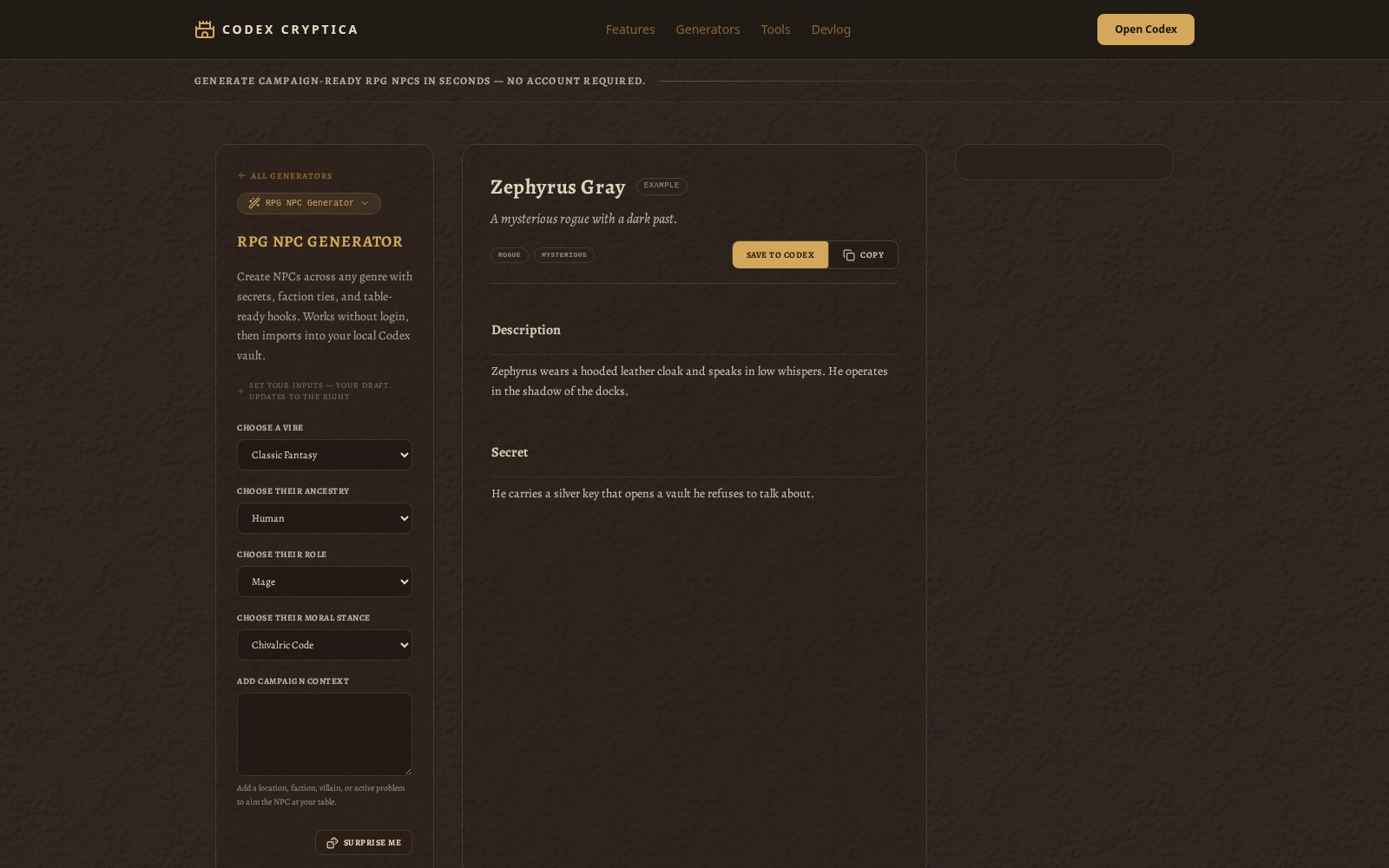
You can find the generators here: https://codexcryptica.com/generators
Which of these would you like me to focus on improving next?