r/casualconlang • u/LuziaCitlalcuicatl • 1h ago
Resource Conlanging Beyond the Basics: An in-depth naturalistic conlanging tutorial (Chapters 0 & 1 out now!)
reddit.com
1
Upvotes
r/casualconlang • u/ReasonableChef2816 • 2h ago

It has its own symbols but I just used Katakana instead
r/casualconlang • u/The_Void_Thaumaturge • 3h ago
r/casualconlang • u/Warm-Cranberry7557 • 5h ago

I am new lol
r/casualconlang • u/Adept_Situation3090 • 8h ago

Side note about pronunciation: When a ৎ (~t final) precedes another syllable starting with a consonant, the ~t can optionally be dropped, causing the following consonant to geminate. For instance, Kîtlim (কীৎলিম/吉林) and itjang (ইৎজং/日常) could be pronounced and/or written as Kîllim (কীল্লিম) and ijjang (ইজ্জং).
r/casualconlang • u/Andrieeo • 8h ago
I am interested in the question of whether it is normal to use artificial intelligence for artificial language purposes.For example, I use artificial intelligence to create pictures and I put my words in there, but if it's normal to create grammar, a dictionary or something else
r/casualconlang • u/FroyoPsychological61 • 9h ago

Hi everyone, this is a quote translated in my conlang.
I have been in love with no one, and never shall – she whispered – unless it should be with you.
Hadét agethem nunn, et nuch quenn žalam – lae sazadan – unn ga dat sit dha.
/ˌhaːˈdet ˌaːˈɡɛː.θem ˈnuɴ | ˈet ˌnuq ˈqʷeɴ ˈʒaː.lam | ˈlæ ˌsaːˈzaː.dan | ˌuŋ ɡaː ˈdat ˈsɪt ða/
```
Hadét ageth-e-m nunn ,
PFT.PST love-IND.PRS-1SG NIND ,
et nuch=quenn žal-a-m –
CONJ NEG=TEMP intend.to-IND.PRS-1SG –
lae saz-ada-n –
3SG whisper-IND.PST-3SG –
unn=ga=dat sit dha .
EXC=REL=DEM.3SG.F COP.SBJC.PRS.3SG 2SG.F.ACC .
```
The literal translation is: I have loved no one, and I never intend to – she whispered – unless that one is you.
What do you think about it? It makes sense?
r/casualconlang • u/AlienDayDreamer • 9h ago
I’m making a sort of speedlang challenge for myself, and I’d like to make it with the input of fellow conlangers! If you are interested, please feel free to fill out this survey and I’ll use the results to shape the conlang!
r/casualconlang • u/CuriousFox3927 • 13h ago
Dakkunnon skri e paël weldded id. Tulon nemmom shiridza u tuyom dakkunnam hanaia. Tijit, dakkunnom paël shomattin kiriztïna. Tuyom kadraon lees e tolsikkin ish yam niyen tsamishda. Me, dakkunnom paëlled skrib e welddam tsukiztïna. Dakkunnom dakkunnon shokiam e tuyam shukaoïn tasuiztïna. Shukaom tsukiztïna e dakkunnon shukaom shokiam id.
Translation
Legend of the World and Us
A god with a pen a paper exists within this realm his name is unknown but we call him dakkun. One day he cut paper in small pieces. These pieces became the laws of nature and wisdom that us men will gather in the future. Then he wrote in paper with his pen and created our world. He took part of his life and gave it to us. We were created and we are part of him.
r/casualconlang • u/KS11TH • 19h ago
A /a/
B /b/
Ç /t͡ʃ/
D /d/
 /æ/
Ê /ɝ/
E /e/
F /f/
G /g/, /k/
H /h/
Î /ɨ/
I /i/, /ɪ/
J /d͡ʒ/
K /kʰ/
L /l/
M /m/
M̩ /m̩/
N /n/
Ŋ /ŋ/
Ɲ /ɲ/
Ô /ɔ/
O /o/
P /p/
B̂ [Not confirmed because I couldn't find the exact IPA, but I know how to pronounce it]
P̂ /pʰ/
R /ɾ/, /r/
S /s/
Ŝ /ʃ/
T /θ/
T̂ /tʰ/
Û /y/
U /u/
V /w/
Y /j/
Z /z/
Ẑ /ʒ/
' /ʔ/
r/casualconlang • u/GlottoNaut • 21h ago
In my case, it’s my passion for linguistic typology. That’s why my conlangs revolve around syntax, while I largely neglect the aesthetics of an alphabet or the phonology. In your case, what trait gives you away as the author of your conlangs? What kind of breadcrumb trail do you leave behind?
r/casualconlang • u/T1mbuk1 • 1d ago
My (considered) final list of sound and grammar changes, whatever revisions need to be made:
S1. Vowel loss between voiceless stops in unstressed syllables, except at the start of words beginning with glottal stops. (May prohibit word-initial and word-internal consonant clusters, or insert an epenthetic vowel later.)
S2. The glottal stop and [h] are lost.
G1. New copula forms and later pro-dropping(after sound change 2).
S3. Stops are voiced between vowels and when following liquids, with stops following nasals also becoming prenasalized.
S4. Coda stops are dropped. (This causes distribution overlap between voiced and voiceless stops.)
S5. Coda nasals preceding obstruents are dropped, leading to voiced prenasalized stops becoming phonemic.
S6. Vowel loss between [t] and [r], and between [t] and pharyngeals in unstressed syllables.
S7. L-vocalization, depending on the adjacent vowel.
G2. New tenses arise.
S8. Clusters between dental and alveolar obstruents with [r] become post-trilled editions of those obstruents.
S9. [u] merges with [o].
G3. Conjugation classes A, E, I, O, and X arise.
G4. The dual and trial number arise.
S10. [r] merges with [l].
G5. Noun cases arise.
S11. Clusters between dental and alveolar obstruents with pharyngeals become pharyngealized editions of those obstruents.
G6. The new aspectual distinctions arise.
S12. Rhotacism of [s] to [r] between vowels.
G7. The inverse number shows up.
S13. Plain velar and pharyngeal fricatives weaken to [h] in some environments.
S14. A sound change leading to an overlapping distribution between [s] and [r].
G8. Evidentiality arises.
S15. A sound change leading to an overlapping distinction between those fricatives and [h].
r/casualconlang • u/Willing_Squirrel_741 • 1d ago
Funveli ulmalam arlatolis,
Tūnvalam sūvu sekųn.
Funve plęustalam sestun,
Toukalam oletųm.
Memalam posh ikumbās,
Tuxekish maru ulmam henkk.
I gulnēm rulkē hal sūn,
Fe kuntēlemm tejtet timijē.
Ulmalam kēsken fe selmus,
Bek ansō ulmalas gedēs.
Ętālam hal sūn pimų,
Ho hal mūn sų kobelēs!
Fe arsilelem Scar,
Ulmas mūn vajār!
I gilnēs rulkē tesso,
I arsilem sun miazhū.
Bek tulttam vūl ilsafi,
Fe jevelem munin ojjigun!
Sedalam vevet zer mūn harsū,
Posh potēti shavalam.
Bek Mufasa mų memalas Scar,
Fe rhekō,ri henkkaram!
Fe arsilelem Scar,
Ulmas mūn vajār!
Mūn jasako rųva
Ulmalas epu unlekų.
Ho mijkuko ulmalas klogesh,
Mufasa mouteles ilttomų!
Bek galpalas Simba,
Fe uhveles mūn henkka,
Ogārass lizante,
Sobu glotē dojdalam!
Fe arsilelem Scar,
Ulmas mūn vajār!
O-ho fe arsilelem Scar...
Vūl mųnē ri kelpettān!
**IPA**
funveli ulmalam arlatɔlis
tuːnvalam suːvu sekyn
funve plɛustalam sestun
tɔukalam oletym
memalam poɕ ikumbaːs
tuk͡sekiɕ maru ulmam henkː
i ɡulneːm rulkeː hal suːn
fe kutnelemː tejtet timijeː
ulmalam keːsken fe selmus
bek ansɔː ulmalas ɡedeːs
ɛtaːlam hal suːn pimy
hɔ hal muːn sy kobeleːs
fe arsilelem skar
ulmas muːn vajaːr
i ɡilneːs rulkeː tesːɔ
i arsilem suːn miaʑuː
bek tultːam vuːl ilsafi
fe jevelem munin oʝiɡun
sedalam vevet zer muːn harsuː
poɕ poteːti ɕavalam
bek mufasa my memalas skar
fe ʁako ri henkːaram
fe arsilelem skar
ulmas muːn vajaːr
muːn jasakɔ ryva
ulmalas epu unlety
hɔ mijkukɔ ulmalas klɔɡeɕ
mufasa mɔuteles iltːɔmy
bek ɡalpalas simba
fe uhveles muːn henkːa
oɡaːrasː lizante
sɔbu ɡlɔteː dɔjdalam
fe arsilelem skar
ulmas muːn vajaːr
ɔ-hɔ fe arsilelem skar
vuːl myneː ri kelpetːan
r/casualconlang • u/GlottoNaut • 1d ago
r/casualconlang • u/BrightAnalysis7742 • 1d ago
I’ve been wondering lately: what makes a conlang better—being rigid and straight-lined, or curved and winding? Yes, I decided to go with a geometric metaphor here, because even naming these two types of languages feels better when you don't put it too bluntly. Anyway, after creating my own conlang, this question started nagging at me, so let’s try to unpack it together…
We all know Ithkuil, Lojban, Esperanto, and other logical languages. They were built either for maximally unambiguous information transfer or for maximally convenient communication. Well, you know who I’m talking about—Ithkuil was definitely not built for convenient small talk, heh. Broadly speaking, these languages are designed to make life easier in one sphere or another. Then there are other languages that aren't trying to simplify anything for us at all; they operate purely out of their own artistic convictions—conveying a culture, a worldview, or the philosophy of a language. Toki Pona, Klingon, and others fall into this camp. I like to include my own language, Yonmyon (Ёнмён), here too—why not, if it’s true? So, some languages are governed by strict, predictable rules, while others are chaotic and full of surprises. Which one is better for us: aesthetics or efficiency?
Personally, I love all conlangs and genuinely appreciate each one for whatever unique feature it brings to the table, yet I definitely lean toward one side. I genuinely enjoy crafting rules, yet I also absolutely love building exceptions into those rules. I prefer more unusual languages with quirks and "weird anomalies." As we say in Russian, "an exception piled on an exception, driven by yet another exception." Simply memorizing neat rules is undeniably easier, sure—but it gets boring. It’s way more fun to stumble over illogicalities, try to figure out why something works the way it does, and maybe even discover something new through that friction. Of course, learning a completely regular rule that doesn't exist in natural languages can be mind-blowing too.
We build sleek, artificial languages because we want to escape the unpredictability of natural tongues and simplify communication. Nobody really wants to learn a new language from scratch where every second word has root alternations instead of a neat, predictable case ending. To be honest, I’d gladly learn a super-logical language myself if a lot of people spoke it—that would be awesome. At the same time, I’d want to be a native speaker of a "curved," winding language, because to me personally, that’s just way more fun!
I’m not trying to say one category is objectively better or worse—I just personally wish I could speak an ultra-complex, illogical native language while learning a relatively easy second one (which, incidentally, is pretty much my exact situation as a native Russian speaker 😁). Yeah, I’m a bit of a hypocrite like that, hehe. Non-linear conlangs are often created for the sake of art. It makes complete sense that if you’re trying to capture the culture of a fictional people, you’ll craft a living, breathing language—you probably wouldn't invent such an erratic system out of nowhere, otherwise your exceptions and quirks wouldn't have any grounding. For linear languages, you don't need an entire lore universe where "such-and-such tribe established this grammar rule because they loved riding pigs"—no, you just lay down the rules, build the lexicon, and you’re good to go! That’s a huge plus because they’re simpler in that regard (well, not always—looking at you, Lojban and Ithkuil).
Overall, I’d really love to hear the community’s thoughts on this, since it’s a pretty philosophical question with no definitive answer. Let me know in the comments what you think matters more: aesthetics or efficiency? I’ll be reading and chatting with you all!
r/casualconlang • u/KS11TH • 1d ago

Almost 7 years until I share it to you. What do you think about it?
r/casualconlang • u/AlmonteseMoI • 1d ago
Zun!
I've been off and on with my conlang, Almarin, for quite a while. I started it last year and I would go from time spent developing it to time spent speaking and using it to brief breaks in between. What I have learned is I often now struggle to relearn my own language because it's a bit scattered and I usually get frustrated trying to find words I know exist. The problem I am at is the file I have used to store the information about Almarin can no longer store it in such a way it is easy to find words or refer back to rules.
So my question for this subreddit is, how do you organize your conlang? What do you use if you use software. And as a bonus, how do you write definitions for conlang words? What do your entries look like? Mine are very descriptive definitions but I think that inevitably harms my ability to use Almarin because if I'm looking for a word that I know means "do", I can't just search for the word "do" in my document, I have to type what I think the word "do" means and I usually type the wrong thing so I am left to manually search through my list of words. In some ways this is good, it forces me to not think what would be one-to-one English to Almarin, and it allows me to think in Almarin, but I have found it annoying in the past and I was interested if anyone else had a different way of writing definitions.
Zeja rel,
Pananalmar Tanneravet Tanner.
r/casualconlang • u/Warm-Cranberry7557 • 2d ago

my first alphabet
r/casualconlang • u/AmbitionExotic3586 • 2d ago
so my conlang dzƕėma uses an avalent subject and heres why you should too
an avalent subject is where how english says it's raining instead of "raining", it acts as an avalent subject, so it is basically just a marker to make it grammatically correct. if you dislike this before or from this post, i suggest making a placeholder, to make sure you dont get it complex like "its raining" or make it ambiguous like an answer "raining" to intransitive "raining". if you want you could telephone game my avalent subject bėėt' быыҭ /bɜːt'/ its caseless
r/casualconlang • u/GalacticMaraja • 2d ago
Hi everyone!!
Here is my little translation excercise: I used the original Koine Greek as a source to translate the Lord's Prayer into Neo-Etruscan.
For those who don't know, Neo-Etruscan is my attempt to revitalise the Old Etruscan language, which was a pre-Indo-European language spoken in the Centre-North of Italy during the Roman period. Unfortunately, we have very little evidence on how Etruscan worked, since it hasn't been spoken for the last two millennia and it was rarely written down. Because of this, in trying to revitalise Etruscan I had to make a lot of conjectures and speculations, or even out right invent some vocabulary and some features.
Let me know if you're interested in knowing more about this project and what you think of this translation.
For now, enjoy!


r/casualconlang • u/Gloomy-Ball1789 • 2d ago
I have completed the 19th and 20th languages in my constructed language family. These are the final two additions to the project.
Both languages draw inspiration from Southeast Asian writing traditions, which I have a particular interest in exploring through constructed language development.
19. Jangala — ꤺꤲꤾ
Writing system: Lepiak Jang
Jangala uses the Lepiak Jang writing tradition, originating in Sumatra, Indonesia. The script belongs to the Brahmic family and is an abugida.
I selected characters that correspond to Jangala's phonological inventory while retaining the script's recognizable character forms.
Consonants
ꤰ = k, ꤱ = g, ꤲ = ng, ꤳ = t, ꤴ = d, ꤵ = n, ꤺ = j, ꤹ = c, ꤽ = r, ꤾ = l, ꤶ = p, ꤷ = b
Vowels
ꥆ = a, ꥇ = i, ꥈ = u, ꥉ = e, ꥋ = o
Jangala uses a basic five-vowel system.
Inherent vowel removal
꥓ = virama
Example:
ꤰ = ka
ꤰ꥓ = k
20. Amihala — ᝀᝋᝒᝑᝎ
Writing system: Buhid
Amihala uses Buhid, an indigenous Philippine writing system traditionally used by the Buhid Mangyan people. It belongs to the Brahmic family and is an abugida.
I chose this script because of my appreciation for Philippine writing traditions and their linguistic heritage.
Consonants
ᝃ = k, ᝄ = g, ᝅ = ng, ᝆ = t, ᝇ = d, ᝈ = n, ᝉ = p, ᝊ = b, ᝋ = m, ᝌ = y, ᝍ = r, ᝎ = l, ᝏ = w, ᝐ = s, ᝑ = h
Independent vowels
ᝀ = a, ᝁ = i, ᝂ = u
Vowel signs
ᝒ = i, ᝓ = u
The vowel assignments shown here are specific to Amihala's orthography.
About the project
Both languages have their own phonological identities and orthographic systems. Their character selections reflect the sounds needed by each language rather than an attempt to reproduce every character in the historical scripts.
I approach these writing traditions with appreciation for their histories and the communities connected to them.
With Jangala and Amihala, my constructed language family has reached its planned total of 20 languages.
The larger project explores linguistic diversity through constructed languages, writing systems, and music. My intention is to give each language an identity that extends beyond vocabulary and grammar.
r/casualconlang • u/Saadlandbutwhy • 2d ago
Besides the Script, theres:
SOV word order
thats it bye
r/casualconlang • u/ElevatorSevere7651 • 3d ago
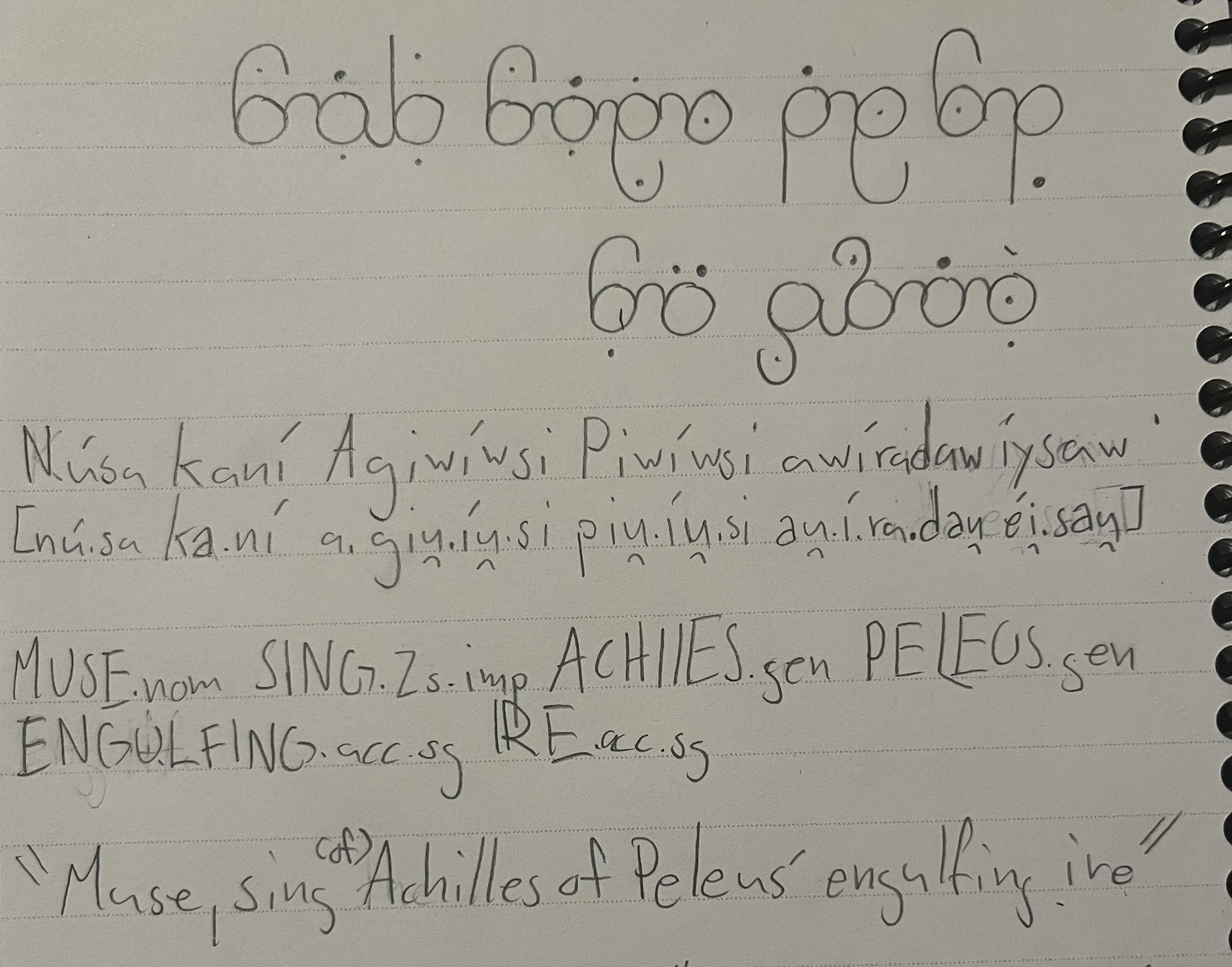
The first line of the Iliad in Káduw using dactyl hexameter, written in the Káduw and Latin script
Latin script for clear read:
”Núsa kaní Agiwíwsi Piwíwsi awíradaw íysaw”
[nú.sa ka.ní a.ɡiu̯.íu̯.si piu̯.íu.si au.í.ra.dau̯ éi.sau̯]
MUSE.nom SING.2s.imp ACHILLES.gen PELEUS.gen ENGULFING.acc.sg.fem IRE.acc.sg.fem
”Muse, sing of Achilles of Peleus’ engulfing ire”
Etymologies:
núsa – borrowed from Ancient Greek (AG) Μοῦσα
kaní – from Proto-Indo-European (PIE) *keh₂n-
Agiwíwsi – borrowed from AG Ἀχιλλεύς
Piwíwsi – borrowed from AG Πηλεύς
awíradaw – from PIE *h₂wer-
íysaw – from PIE *h₁eys-