r/beneater • u/Ok_Philosopher564 • Jul 04 '25
Why does ben eater use mac? I would assume for his work case windows/linux would be preferable
1
Upvotes
r/beneater • u/Effective_Fish_857 • Aug 29 '25
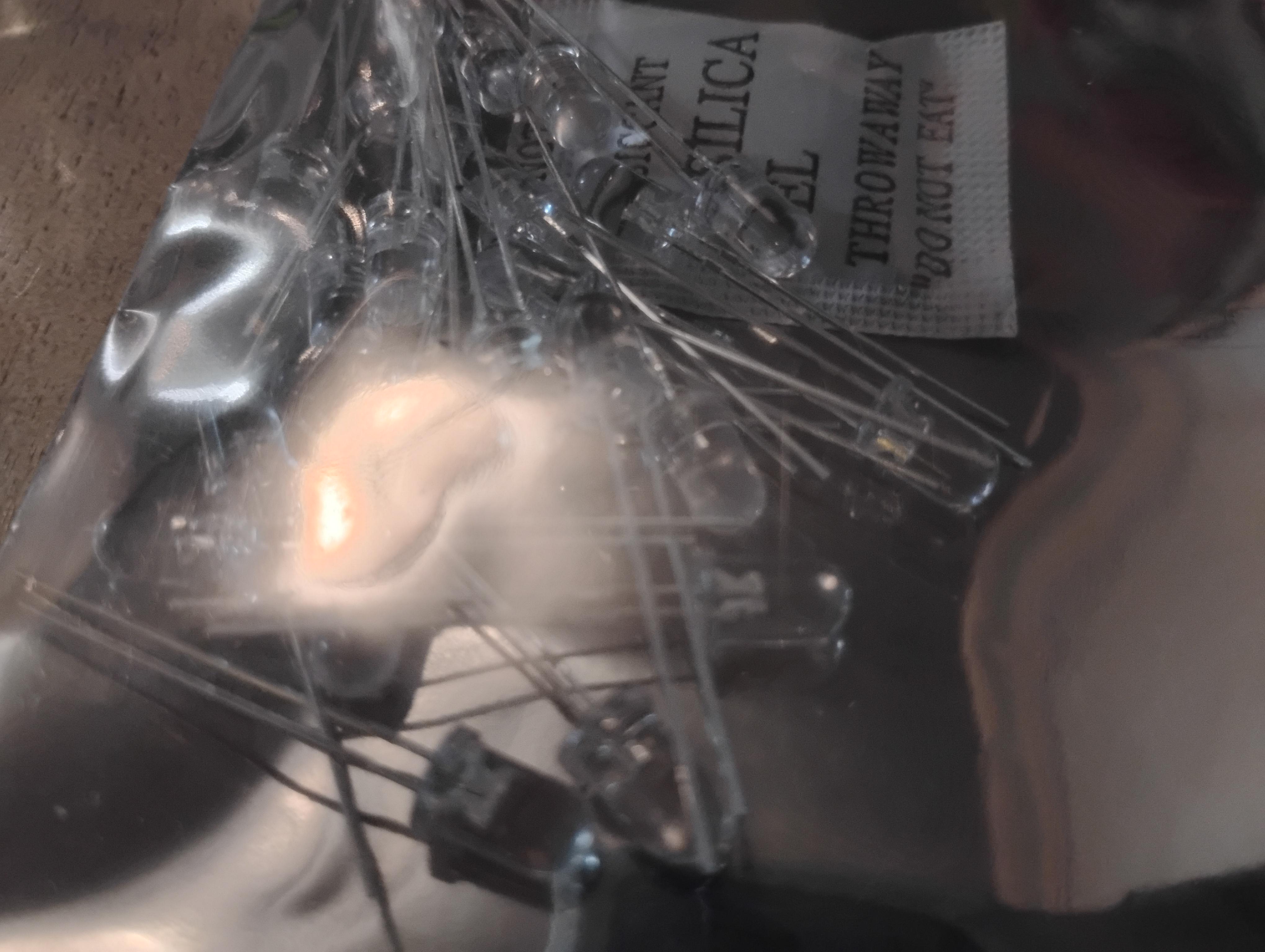
My "blue" LEDs from SparkFun electronics arrived today.
Seriously, y'all, there doesn't seem to be any 5mm through hole blue LEDs with blue lenses, that have internal resistors, in existence. I found the Kingbright versions of those for the other three essential colors, that is yellow, red, and green.
The search for LEDs with internal resistors that fit with Ben style projects has been a big headache.
Where on Earth did Ben find them for his own projects??
If anyone has any additional information on this topic let's start a conversation here. Thanks!
r/beneater • u/ebadger1973 • Oct 09 '26

My Ben Eater 6502 build
r/beneater • u/[deleted] • Dec 14 '25
I wanted to make a ben eater inspired video card as my class project. But my teacher ask me to show parallel processing which I said is not possible in this. He asked me to add this or drop my project. What should I do and can I achieve that in eaters video card!?
r/beneater • u/Zestyclose-Produce17 • Feb 17 '25
r/beneater • u/Mediocre_Insurance91 • May 07 '26
Hi guys i want to build a homebrew gpu using a cpu (zilog z80) but i have like almost no experience of how the cpu works because i only work with logic gates and if someones willing to help it would be great! ty
r/beneater • u/computerwizard2468 • Jun 13 '22

r/beneater • u/brianswedehanson • Jun 19 '25
I am starting the 8-bit build. Did the 6502 last year.
I watched all the 8-bit videos a few years ago.
I'm only posting this on the (very) remote chance Ben might see it.
I am getting ads (fairly long ones) every 3 minutes or so. It's
driving me crazy, and going through all 64 videos is going to be
a challenge because of this. As though the project itself is not challenging enough. Is anyone else experiencing this?
r/beneater • u/francyhacker345 • Apr 15 '22
HI, can someone explain why Ben Eater hasn't posted any video for 5 months? Thanks :)
r/beneater • u/Negan6699 • Dec 12 '23
I'm cooking up a CPU and wanted to make it on a fpga to be smaller and faster but the prices seem high and can't really find useful info. So I thought to make it out of logic chips, what are the fastest families ? I would like at least a few hundred MHz but idk witch of them support that speed. Also if anyone knows some good inexpensive FPGAs pls tell. Thanks to everyone, I'll do more research but this will speed up the process tremendously.
r/beneater • u/KushagrJ • Oct 20 '23

r/beneater • u/mon0506 • Jun 20 '21

r/beneater • u/literallair • Feb 24 '22
Software: Neuton TinyML ; Hardware: Arduino Nicla Sense ME
Less than half a year ago, a new Arduino’s board, Nicla Sense ME (Motion & Environment), hit the market. And, needless to say, I couldn't wait for a chance to try this brand new device and explore its capabilities.

Nicla Sense ME is currently the smallest board across the entire Arduino PRO family of boards for industrial applications. It comes with a range of Bosch Sensortec smart motion and environmental sensors, and I’m quite sure that this device will be widely applicable in industrial IoT, as it’s great for various research projects and commercial use.
Just have a look at its unique characteristics:

I’m really excited about the pace of development of the TinyML field because such small devices coupled with tiny machine learning capabilities indeed demonstrate enormous potential for many industries and domains.
Now, let me share my findings after an experiment with Nicla Sense ME.
Procedure:
In my experiment, I decided to play with in-air handwriting using an accelerometer-based pen device for handwriting recognition applications in order to test the ability of Nicla Sense ME to identify and process data about handwritten numbers on the edge. Compared to handwriting based on touch devices, this task is much more complex and challenging.
The device on which the experiment was carried out consisted of a triaxial accelerometer and Nicla Sense ME. The accelerations generated by hand motions were processed on MCU for further inference using the Neuton TinyML model.
Step 1: Model Training
For model training, I created my own dataset by capturing data containing 200 samples for each handwritten digit (from 0 to 9). Each sample was recorded for 2 seconds with a frequency of 100 Hz. It's easy to calculate how many times I had to move my hands in the air to collect this data, and it's even easier to imagine what my family members were thinking about me :)
Training Dataset
I merge captured samples to a single CSV file and add a target variable using Python script. The resultant dataset consisted of three features (accelerometer axes) and 400000 rows (200 samples by 200 rows for each digit).
I uploaded the dataset in a CSV format to the Neuton TinyML platform, selected the target variable (Digit), target metric (Accuracy). And then I enabled the TinyML option, selected 8-bit calculations without float support. For this case, I activated the Digital Signal Processing option for automatic data preprocessing and feature extraction. The model was trained automatically, and nothing needed to be compressed.


The platform allows us to see a preprocessed dataset. It merged 200 samples in one row and added some statistical features (min, max, mean, etc.)

I chose Neuton for this experiment since the platform automatically builds models that are optimal in size and accuracy. I also tried to train the same model with TensorFlow. Сheck out the comparison of the resultant metrics:

Just have a look at the dramatic difference in the number of coefficients, Neuton's model has 42 times fewer coefficients than a TensorFlow one!
Step 2: Embedding into a Microcontroller
After the training was completed, I downloaded the archive containing all the necessary files for the embedding to the microcontrollers firmware project.

I uploaded all the components to GitHub so that you can easily replicate my experiment for yourself: https://github.com/Neuton-tinyML/nicla_digits
Step 3: Running On-device Inferences
I connected my device to a PC via USB to display inference results. Check out the outcomes of my experiment on the video below:
As you can see, the sensor accuracy is really high so it managed to identify all the numbers with great probability. The model operates right on the device and weighs about 1 KB. That’s what I call real TinyML!
Conclusion:
I believe that the future belongs to such incredibly tiny machine learning solutions. The ability to sense and accurately process various types of data in real-time, at low energy consumption but with high computing power opens up new opportunities in many fields. The implementation of such solutions can, for instance, streamline robotic science, ease the detection of seismic activities and dangerous gases in the air, advance IoT devices that we use on a daily basis, and a lot more — the scenarios are infinite! Isn’t that inspiring?
Please write in the comments below what other experiments you want me to do with Nicla Sense ME!
r/beneater • u/NK_Seven • Jun 09 '23
What I do not know is the length to cut all the wires precisely so that the project does not look like a C-3PO or R2D2 mishap. There should be better information on how to do this ahead of building the project. I would like to be able to build the 8-bit breadboard computer in one-shot.
r/beneater • u/Sillycrazyllama • Apr 24 '24
Hi everyone. I have a 32k EEPROM, but why do I need to fill it up with rubbish. My code maybe takes up 20 bytes out of the many bytes a 32k EEPROM has. It feels like a waist.
r/beneater • u/ukpauchechi • May 18 '23
I was using Crumb before on my iPhone but it had a lot of issues, wanted to switch to the desktop version but Steam took my money and I didn't get the software.
Also tried logisim, but it is no longer actively developed. but recently found logisim evolution(saw someone built a 32-bit computer on it ) think this one is more advanced and supported.
r/beneater • u/daniilkhanin • Sep 07 '26

Hi everyone,
I wanted to share a project I've been working on. It all started after reading Charles Petzold’s "Code". Instead of buying real wires and breadboards, I decided to build my own circuit simulator in JavaScript and try to build a CPU from individual transistors.
My goal was to create something close to the MOS 6502 (used in Apple II and NES).
I made a huge mistake during early design. The original 6502 has around 3,500 transistors. My implementation ended up with 22,544 transistors. I didn't optimize the gates properly, making my version much larger and about 100x slower than the real chip.
Simulating 22k transistors with real-time current calculation (I call it "Real" mode in my app) completely destroys CPU performance in a browser. To fix this, I added two optimization layers:
Fast Mode: The simulator groups transistors into logic gates (AND, OR, XOR) and processes them using lookup truth tables instead of raw physics. This gives about 0.1 MHz speed.
Turbo Mode: A pure JS emulation layer that skips transistor logic entirely to run software smoothly.
A computer is useless without software. I had no assembler or text editor for my custom architecture. So I fed my CPU circuit schematics to Claude LLM.
Surprisingly, the AI figured out the architecture. It wrote a WOZ-like monitor, an assembler, and then wrote a functioning BASIC interpreter using that custom assembly.
Right now, the virtual machine can run BASIC, a text editor, a Telnet terminal, and a Snake game.
You can test the demo and look at the circuit here: cs.khanin.info
I also made a quick video showing the boot process and BASIC here (on russian): https://www.youtube.com/watch?v=rG6MOULxGwM
Would love to hear your thoughts on the architecture and how I can better optimize the gate layout to bring the transistor count down closer to the original 6502.
PS
text translated from my russian and cheap english to english by LLM translator.
r/beneater • u/Smartengineer0 • Oct 11 '22
It's been more than a year since I saw his activity on any social media , is he okay ?? Kinda worried
r/beneater • u/GalacticJunk23 • Jan 30 '23
i am thinking about trying to make a gameboy with a custom printed pcb
r/beneater • u/Mediocre_Insurance91 • Apr 26 '26
What if you can cascade 2 microprocessors or microcontrollers to make a better microprocessor or microcontroller??? can someone explain if it works or not


