By wild here I mean undomesticated, not just feral domesticated horses. Given the widespread domestication of the horse the wild horse must have been quite widespread and populous before humans, and would domestication not make domesticated horses less able to compete and survive in the wild than wild horses? If so, why are almost all wild horses extinct?
I've been seeing this term being used for describing the power of certain things over the years, latest being the pistol shrimps' way of hunting. Yet what I don't understand is, if that exact point of energy release is almost as hot as the Sun's surface, why doesn't everything around that point just burn and/or evaporate?
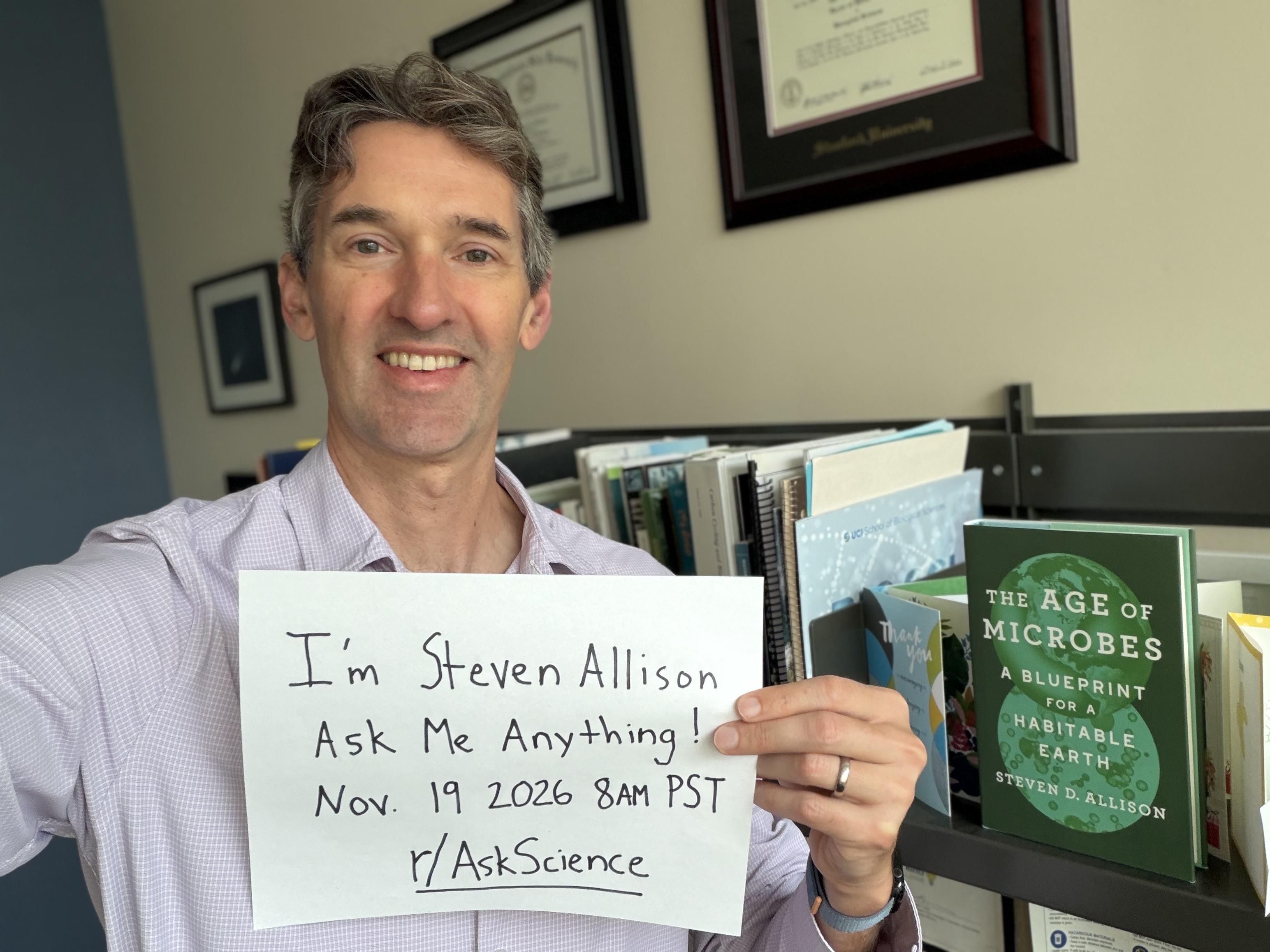
Hi Reddit, I'm Steven D. Allison, a professor of ecology at the University of California, Irvine. For over twenty years, I’ve explored the often-unseen roles microbes play in the world around us, including how they influence soil carbon cycling and ecosystem resilience.
From scorching temperatures and deadly fires to flooding and food shortages, the signs of a changing climate are everywhere. Microbes offer one hopeful answer: they have evolved through billions of years of environmental change; they’re remarkably diverse, easy to study, and unleashing their potential could help reduce greenhouse gas emissions and strengthen the climate resilience of human and natural communities.
In The Age of Microbes: A Blueprint for a Habitable Earth, I explore how these adaptable organisms might contribute to climate solutions—from supporting crops and restoring ecosystems to reducing carbon emissions.
Today, scientists are learning to discover, evolve, and engineer microbes that can, for example, remove pollutants from drinking water. By bringing together experts from different walks of life—like farmers, scientists, land stewards—there is renewed hope for harnessing microbes in ethical, sustainable ways to build a more resilient future.
I’m here to answer your questions about microbiomes, soil, climate change, carbon cycling, agriculture, ecosystem restoration, and the promise and challenges of microbial climate solutions. I'll see you at 8am-11am Pacific time (11am-2pm ET, 16-19 UT), ask me anything!
Psst: Redditors can take 30% off my book with code AGE30. If you want to learn more about my research, here’s a link to my lab’s website.
Not counting Endogenous Retro Viruses or gut biomes because everyone has them. Is there any parasite, virus, fungus or something that could live inside a body and benefit people?
A big example of one is people who contracted Hepatitis G/GB virus have resistance to HIV's progression for life. So don't say they arnt real.
For example insects. They only live for days/weeks. Does this make them evolve faster since they go through more generations quicker? Or does it get a bit evened out by the fact they live so short they might not have time to experience enough to notice the positives/negatives of any mutations they might have. (Including rats and mice and other animals with short lifespans not just insects)
I have a lot of bunnies that live and burrow in my yard. I’m just curious about what they do when it rains a lot. We get flood warnings and I just wonder where they are at. Have they built something to specifically handle this situation?
Hello Reddit! We’re hosting an AMA in honor of the PBS Nature documentary “HumanLike: The Chimps of Fongoli.” The documentary follows our 25-year-study of the chimpanzees of Fongoli, Senegal, who live at the very limits where chimps can survive, having adapted to the extreme heat and dryness of the savanna woodlands. Our studies allowed us to get close to this troop and discover unique behavior, including hunting with spears, sheltering in caves, digging wells, and reading fire. You can read more about the project here.
Answering your questions today:
Dondo “Johnny” Kante was part of the original team when the Fongoli Savanna Chimpanzee Project started in 2001, making him one of the first Senegalese individuals to study chimpanzees. He spent thousands of days over the first decade of the project as a field assistant, out in the Senegalese bush following the troop. His pioneering work and the unique behaviors he observed led to him to co-author several papers with Jill, documenting their discoveries. In 2012, Johnny stepped back from his field duties and took on the role of Project Manager. This allowed him more time to help care for the Orphan Toto. Since Toto’s move to Guinea in 2016, he’s continued to work as the project’s manager, helping researchers, students and film crews with their work.
Jill Pruetz, a biological anthropologist and primatologist, currently serving as a professor in the Department of Anthropology at Texas State University. She is the Director of both the Fongoli Savanna Chimpanzee Project and Neighbor Ape, a non-profit organization dedicated to conserving chimpanzees in Senegal and providing for the well-being of the local people living alongside them. She began the Fongoli Project in 2001, and since then her research has been widely recognized – with 179 published articles in books and esteemed journals. These discoveries have led to some of the largest breakthroughs in chimpanzee primatology and aided our understanding of early human ancestors, how they behaved and how they might have evolved.
In the US, you can watch “HumanLike: The Chimps of Fongoli” on PBS.org,YouTube, or on the PBS App.