r/askcriminaljustice • • Mar 10 '26

What should I do with my criminal justice degree?

12 Upvotes

I’m currently a junior working towards my criminal justice bachelors degree, and ive been planning to go to law school, but im seriously burnt out. I don’t want to go to school anymore, im gonna finish my degree, but like… lowkey what can I do? I don’t want to become a cop. Idk if this is the subreddit to ask this but like, whatever.


r/askcriminaljustice • • Jul 30 '26

Psychology + Criminal Justice student looking for a career path in missing persons and child protection investigations

9 Upvotes

I am a sophomore in college pursuing degrees in psychology and criminal justice. I am interested in a career focused on protecting children, investigating missing persons cases, and helping combat crimes against children.

I am especially interested in work involving investigations, victim identification, intelligence analysis, and supporting law enforcement efforts.

I also want to build a stable career that allows me to support myself financially. I have looked into different paths but haven't found one that combines my interests in psychology, criminal justice, investigations, and child protection.

What careers, agencies, or specializations should I consider? Are there people working in this field who could share how they got there?


r/askcriminaljustice • • Jan 16 '25

Bachelor in Criminal Justice

9 Upvotes

Hey y’all! I graduate in May with my bachelors in criminal justice. Could y’all point me in the right direction of the types of jobs I can research if I want to work in the field—prosecutions side/research! I know that I want to investigate—forensic/mind things like that. But everything I’m looking at when researching is corrections/probation. So I was wondering if y’all could just help me navigate! I’m too of my class, I haven’t found a class I didn’t like beside my economics class🙈 Thanks y’all! 🫶🏽


r/askcriminaljustice • • May 30 '26

What Makes a Criminal Defense Lawyer Actually Effective in Court? (Indianapolis, IN)

8 Upvotes

Hi everyone

I am in Indianapolis IN and trying to understand what really makes a criminal defense lawyer effective in court

From a criminal justice perspective what matters most experience case strategy negotiation skills or something else?

Any insights would be appreciated


r/askcriminaljustice • • May 20 '26

Lost

8 Upvotes

I just graduated with a degree in criminology and justice studies at 22 Now I don't know, I am so lost. I originally joined criminology because of a tv show called Criminal Minds and wanted to be exactly like them. Over time, I was like, maybe no. It just seems too much and part of me doesn't want to hold a gun.

I thought maybe I could be a crime scene investigator. Those people at the crime scenes but for this you need some sort of forensic degree and I was already too deep into criminology so I just stayed with it.

I thought about maybe grad school but what would I do it in. My university doesn't have a master program for Criminology and I think I might have missed the deadline for grad school.

So if someone could help me out it would be great.


r/askcriminaljustice • • Nov 12 '25

criminal and social justice diploma!

8 Upvotes

hi! i am currently in school for a criminal and social justice diploma, and am on my last year. I have started to look at job openings relevant to me but i have been incredibly unsuccessful. i am wondering what kind of jobs i can get with just a diploma, not a degree. most of the job openings (even entry level positions) require 2-3 years experience but i dont know how to get experience if no one will hire me. volunteering isnt an option for me as i am a full time student & full time employee so i dont have the time for volunteering unfortunately😭


r/askcriminaljustice • • Oct 20 '25

Is a DWI as bad as a felony?

8 Upvotes

Hey all, I recognize and own up to my mistakes I've made in the past. I was arrested in my earlier 20s for driving while impaired. I'm not here to justify my actions or seek empathy but I couldn't help but notice even trying to better myself by going to college, I am grilled, questioned and may not even be considered because of a slip up.

Is this going to be for the entirety of my life? Ironically enough the major I'd like to choose is criminal justice, but if I even get into the school I'm applying for should I just change majors?

I'm in NC if that makes sense and while a DWI doesn't immediately disqualify you from ever becoming a public servant I can only imagine finding a job will be next to impossible. I'm a former Marine too.

It seems like most misdemeanors go overlooked but DWI and I understand why in some cases and can't in others.


r/askcriminaljustice • • Sep 13 '25

What can a PI find out? And how do they keep it a secret?

8 Upvotes

I have reason to believe my mom is married to a con artist. I want to hire a PI to look into his finances, but a) what can a PI really find out? Can they find out if you inherited money or if you lost a lot of money gambling or in the stock market? And b) how do they keep it a secret? I would imagine financial institutions alert you if someone is asking for records, etc. him finding out I’m looking into him will only make things worse. HELP!


r/askcriminaljustice • • Jul 16 '25

is a a bacholer in criminlongy and criminal justice just a regular criminal justice degree?

8 Upvotes

I cant tell the differnce btween regualr criminal justice and criminlongy and criminal justice is it just the title they put on the degree when they earn it?

im studying criminal justice at the comminity college thing about getting my bacholoers when im done


r/askcriminaljustice • • 29d ago

Job recommendations? Just got laid off.

Post image
7 Upvotes

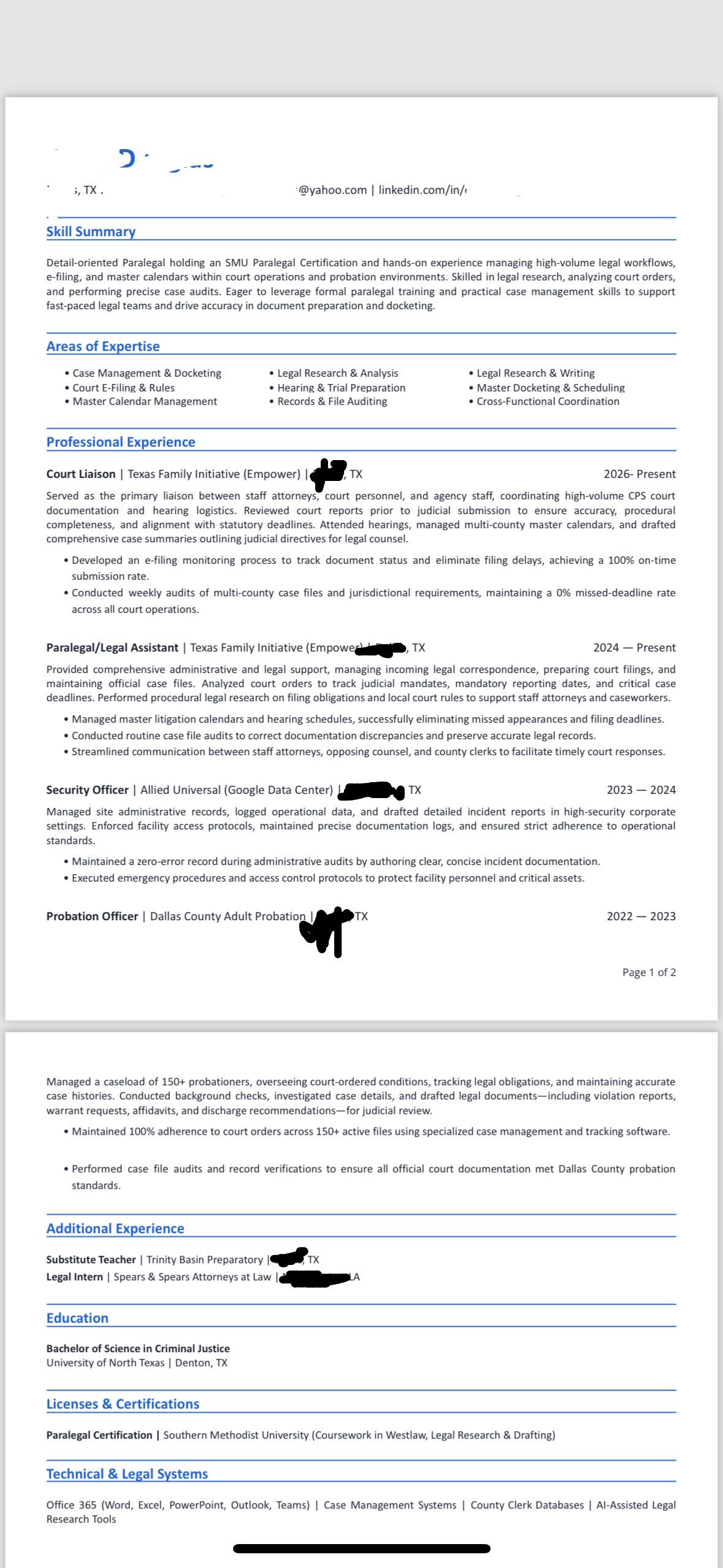
I got laid off and only have had a month to find new employment. I am on probation for a small marijuana charge for the next 5 months from a small Texas county (I know, I take full responsibility but I still need employment) which takes away many government positions. Any recommendations? (No I don’t smoke anymore)


r/askcriminaljustice • • Sep 02 '26

Sophomore Criminology Major trying to decide between Probation/parole, Analysis, and Legal Work - How did you find your path?

7 Upvotes

Hi everyone,
I’m currently a Sophomore majoring in Criminology at a community college in the California. Full disclosure, I don’t really use Reddit much, but I wanted to post here because I’m feeling a bit lost about what direction to take with my degree. I honestly have no idea what specific career path I want to pursue - whether that’s law enforcement, data/crime analysis, legal work, so on so forth.
Since I’m a sophomore, I’d like to start building my resume/skills instead of just waiting until the last minute. I’d love to get your perspective on a couple things.

  1. Skills: What skills am I going to need for the future? 2) Internships: What types of internships should a sophomore look for when they aren’t 1000% sure what field they want to land in?

  2. Career options: For those who graduated with a Crim degree, what entry-level jobs did you start with, and how did you narrow down what you liked?
    Any advice, personal experiences, or tips on what you wished you did during your sophomore year (or any in general) would be greatly appreciated! Thanks in advance!


r/askcriminaljustice • • Aug 29 '26

Would this ICAOS reform improve interstate probation decisions, or just create more bureaucracy?

7 Upvotes

I’m developing a proposed amendment to the Interstate Compact for Adult Offender Supervision (ICAOS) and would appreciate criticism from people who work in probation, corrections, criminal justice administration, prosecution/defense, or who otherwise understand interstate supervision.

I’m not asking for legal advice or asking anyone to determine whether a particular transfer should have been approved. I’m trying to determine whether the policy mechanism itself makes sense in actual criminal-justice practice.

The issue I’m trying to address is fairly simple:

Sometimes a person is already physically living in the proposed receiving state before the interstate transfer of supervision is finally resolved. In some circumstances, that presence can begin lawfully before sentencing.

As time passes, the practical question can shift from:

“Should this person relocate to State B?”

to:

“They’ve already been living in State B for months. Why make them return now?”

There may be perfectly legitimate reasons to consider existing residence and the disruption caused by return.

My concern is whether elapsed presence can gradually acquire weight as though it were evidence of supervision stability, even when the underlying circumstances have not actually stabilized.

For example:

Person A spends three months in State B and during that period obtains stable housing, employment or another reliable means of support, treatment, transportation, and meaningful support relationships.

Person B spends the same three months in State B, but housing remains uncertain, employment remains unresolved, treatment access is unsettled, transportation remains problematic, and the proposed support structure has not materialized.

Both people have been there for three months.

But have those three months demonstrated the same thing?

The principle behind my proposal is:

“Time should be permitted to produce evidence; time should not itself substitute for evidence.”

The proposal has three main parts

  1. A Supervision Stability and Transition Summary

A transfer request would contain a standardized factual snapshot, to the extent known and reasonably verifiable, of relevant supervision circumstances in both the sending state and proposed receiving state.

It could include:

residence and verification status;

employment or other means of support;

treatment/services relevant to supervision;

transportation needed for supervision, work, or treatment;

material family, recovery, or community supports;

whether receiving-state arrangements are verified, prospective, unresolved, unknown, or not applicable;

circumstances expected to continue, change, end, or remain unresolved if the transfer occurs;

and the supervised person’s own reasons for seeking transfer and opportunity to correct factual inaccuracies.

This is not intended to determine which state is “better.” It is intended to put the actual transition facts in one place.

2. A Material Supervision Concern Notice

If the receiving state investigates an otherwise valid supervision plan but discovers a specific, objectively verifiable concern, it could notify the sending state without rejecting the transfer.

Examples could include discovering that a proposed residence is no longer available, employment represented as established is actually only prospective, required treatment is unavailable, or an important claimed support arrangement cannot be verified.

The receiving state would not gain authority to reject a mandatory transfer.

The sending state could:

supplement or modify the plan;

withdraw the request;

or proceed after documenting that it considered the concern.

3. A rule addressing pre-existing receiving-state presence

Positive and negative developments occurring while someone is already in the receiving state could both be considered.

But:

Physical presence or elapsed time, standing alone, would not constitute independent evidence that the receiving-state placement is stable.

The proposal would also expressly prohibit treating lawful pre-sentencing relocation itself as something negative.

Why I started looking at this

The proposal was prompted by an actual case, although I’m deliberately keeping the public details generalized.

The individual lawfully relocated to the eventual receiving state before sentencing and remained there for several months while the criminal proceedings were continued.

During that period, concerns were raised contemporaneously about changing housing circumstances, unresolved employment, transportation, treatment continuity, and differences in available support.

By the time interstate supervision was addressed, however, the fact that the individual was already living there had itself become part of the practical reasoning for allowing the arrangement to continue.

The transfer ultimately qualified and was completed under the existing ICAOS rules.

I am not claiming that means the transfer was unlawful or that a different result necessarily should have occurred.

What interested me was the process question:

Should several months of being somewhere and several months of demonstrating stability somewhere be treated as the same thing?

Where I particularly want criticism

I can already see several potential problems with my own proposal:

Would the Material Supervision Concern Notice become a de facto soft veto even though the receiving state legally cannot reject the transfer?

Could documenting housing, employment, transportation, and support unintentionally discriminate against people who are poor or have unconventional living arrangements?

Is “material supervision concern” still too subjective?

How much of this information do probation officers already collect, making another summary redundant?

Would this create enough additional paperwork that officers hate it regardless of whether the concept is useful?

What due-process opportunity should the supervised individual have to review and correct adverse information?

Should this apply to every ICAOS transfer, or only cases involving pre-existing receiving-state presence or significant changed circumstances?

Is disruption from requiring somebody to leave a state where they have already been living itself a legitimate factor that should have weight independent of traditional stability measures?

I’m not looking for people to agree with me. I’d actually prefer people who work inside the system to tell me where this would fail in practice.

If you’re a probation officer, Compact staff member, corrections professional, prosecutor, defense attorney, or have direct experience with ICAOS transfers, would a framework like this improve the quality of transfer decisions—or would it mostly create another administrative hurdle?

And at the most basic level:

Is the distinction between elapsed presence and demonstrated stability a sound one?

r/askcriminaljustice • • Aug 21 '26

Is there a way to become a detective or investigator with the police without first being a regular police officer?

7 Upvotes

I want to interview suspects, view crime scenes, etc. but I'm a female and dont want to be a female cop. I'm willing to go back to school and whatever else. If i do have to be a cop first, usually how long until you could switch/get promoted?
I also dont want to do PI or white collar crime stuff.


r/askcriminaljustice • • Aug 09 '26

Why doesn't a sentence of "life" mean life?

7 Upvotes

Why sentence someone to life if there's a chance they could be released later via parole? Why is there "life" and "life without the chance of parole"?

(I saw a similar question posted ~2 years ago but the single response failed to answer the question)


r/askcriminaljustice • • Aug 05 '26

Don’t know if I should go to court

7 Upvotes

So The DA gave me a plea and I told my lawyer I’m going to accept and to go ahead and set a plea date. Well the problem is I have court on Friday and I wouldn’t have to go if the plea date already set! But of course I can’t get a damn response from my lawyer! I get he’s busy but that’s why you have assistants for! I’m going to be so pissed if I miss an un-paid day of work and turns out I don’t have to go! I swear man he waits to the last possible moment to tel me anything smh


r/askcriminaljustice • • Aug 30 '25

Do crisis negotiations change out of their uniform into regular clothes so the criminal lets their guard down?

7 Upvotes

(negotiators**)

I’m writing a persuasive essay and one section is about how the way authority figures dress can impact trust.

In the OJ Simpson doc on Netflix, the crisis negotiator mentioned that he usually changes out of his police uniform into street clothes before negotiating. He didn’t explain why, but I assume it’s so the person feels less intimidated and lets their guard down.

Is this actually something you’re trained to do in crisis negotiation? Or is it more of a personal preference?


r/askcriminaljustice • • Dec 13 '24

Opposite of Deviant Behavior

7 Upvotes

I took a Criminal Justice class in college recently and learned about deviant behavior, which is like behavior that isn't illegal but society doesn't like. I was wondering if there was a name for the opposite of that, of behavior that is illegal but society doesn't press for punishment?

The first example I can think of is going faster than the posted speed, like on a freeway, to stay up with traffic. Sorry if this has been asked already, I was just curious.


r/askcriminaljustice • • Jun 21 '24

how often do first time murderers commit a second murder?

7 Upvotes

i wanted to know the statistics on how often first time murderers commit a second murder before they're caught. i've been watching documentaries about cold cases and they always say "the killer is still out there and could kill again" but it doesn't seem common. i actually had an uncle who was murdered and while his killer was already a know criminal and the cops never arrested him for my uncle's murder, he never killed again. not important to anything academic i was just wondering.

p.s. my uncle's killer was also murdered and im not saying i wish death on anyone but i certainly didn't cry.


r/askcriminaljustice • • Oct 14 '26

Need your questions

6 Upvotes

In the process of writing a guide to help people that are accused of crimes in the military and their family or other support group. People that are charged with criminal offenses in the military or their families often have many questions, such as:

  • Will I still be able to access the base?

  • Will he still be paid while he's under investigation?

  • How do I handle myself in the courtroom?

  • What kind of things can I do to support my loved one?

Other questions like these. I'm trying to generate questions that I've not already thought of to include in this guide. If you know of someone or have been involved in someone being investigated, arrested, charged, or court-martialed, I'd love to hear what your questions are so that I can make sure I get a well-rounded series of questions.


r/askcriminaljustice • • Sep 15 '26

College Project

6 Upvotes

Hello,

My professor assigned us to question any community forum about our future careers and how to get there, and I was wondering if you might assist me? My future job goal is to become a detective or a CSI detective. I know I have to become a cop first but after that i have no clue, and what would be common issues in that field? Thank you!


r/askcriminaljustice • • Sep 08 '26

If possible, I'd like to hear your stories.

Thumbnail reddit.com
6 Upvotes

r/askcriminaljustice • • Aug 25 '26

Digital information as evidence

6 Upvotes

I recently sat on the jury of a murder trial in Virginia and I don’t want to re-litigate the case.  However, we were presented with a lot of reports and saw the displayed information. These reports were the results of queries made to the flock camera system, other camera systems, cell tower data and cell phone data.

As background, I would like you to understand that I am a retired software engineer/architect with more than 40 years experience and related undergraduate and advanced degrees.

From a computer science perspective I was shocked because for each and every report, the witness attesting to the report could not explain, justify, or even recall the search criteria used to produce their report. The response when asked was, “ I don’t recall”.  This happened repeatedly - at least 5 times by a variety of law enforcement agencies.  This became more concerning when the witness spoke briefly about the necessity of filtering out various cameras, cell phone towers, and cell numbers.  

Seriously, I could use the data available in those databases to create a report that would put suspicion on anyone who was within a half mile of the location. Then I could present it at trial and just not be able to recall how I produced the report.

In addition, they spoke about how unless the relevant data was preserved at the source under the auspices of an investigation, the data would be purged after 21 days. The number of days isn’t particularly important and is specific to the state, except to note that it is relatively few in the course of an investigation. Consider that the defendant may not be charged until after that period had expired and therefore the defense counsel would not be able to reproduce the same report or reproduce a  salient report of data filtered out by the prosecution.

Why are defense attorneys letting this unsubstantiated evidence to be submitted?

Why is the situation set up so that only the prosecution can retrieve the information within such a tight timeframe?


r/askcriminaljustice • • Jul 23 '26

What's your opinion and/or experience with the criminal justice system in the US?

6 Upvotes

Hey all. I'm researching, why the American criminal justice system produces the outcomes it does. I would love to hear from people who actually know it firsthand rather than just pundits and policy papers.

No matter if you did time, worked as a CO, cop, prosecutor, defense attorney, judge, parole officer, studied it academically or you're close to someone who's been through it and watched what it did to them and to you.

I would like to hear the messy, contradictory version. If you're willing to share your take, or you know someone who'd be a good person to talk to, drop a comment or DM me. Happy to keep things anonymous if that's what makes you comfortable talking honestly.

Thanks


r/askcriminaljustice • • Jul 01 '26

Why does Canada and Russia have the same parole eligibility rule for first degree murder?

6 Upvotes

In both Canada and Russia, a person sentenced to life imprisonment can generally first become eligible for parole after 25 years

Canada: After 25 years, the offender is only eligible to apply for parole. Many offenders are denied and remain in prison for years or decades longer. The parole decision is made by the independent Parole Board of Canada, which considers factors such as the offender’s risk to the public, rehabilitation, and remorse.
Russia: A person serving life imprisonment can generally apply after 25 years if they have had no serious disciplinary violations in the previous three years. However, parole is granted very rarely, and many people serving life sentences remain imprisoned for life in practice.

So while Canada is generally considered more liberal than Russia in many areas—such as civil liberties, freedom of expression, and democratic institutions—that doesn’t necessarily translate into shorter sentences for crimes- regardless of mitigating factors.

I don’t understand how a country that is more friendly than Americans have laws that are almost identical to Russia.


r/askcriminaljustice • • May 02 '26

College Senior

6 Upvotes

I am majoring in Criminal Justice, and now that i am close to graduating I am unsure on what career path I want to take… If you graduated with a criminal justice degree what path did you choose?