r/amazonsdeprep • u/Common_Coach4437 • 28d ago
INDIA Amazon SDE1 Interview Experience [Hackon] | Selected
Hey everyone!
This community helped me throughout my preparation, so here's my recruitment timeline, interview questions, and a few lessons that might help future candidates.
Recruitment timeline
| Date | Event |
|---|---|
| June 15 | Amazon reached out based on my previous year's HackOn performance |
| June 26 | Received OA link |
| June 30 | Completed OA |
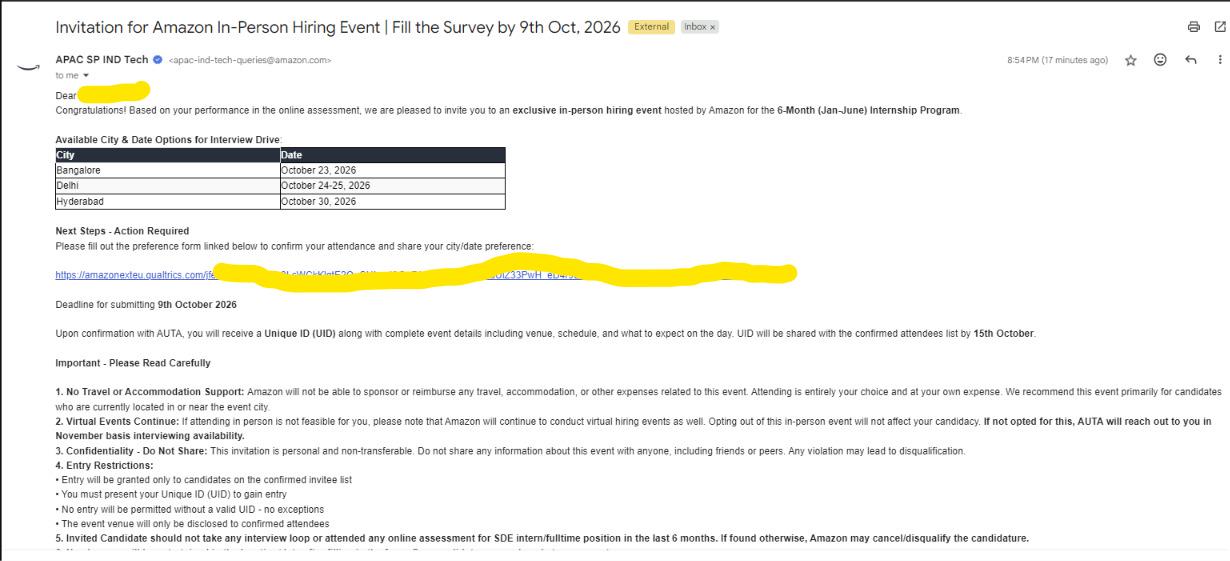
| July 15 | Cleared OA; received Hiring Interest Form |
| August 3 | Received an unexpected rejection email |
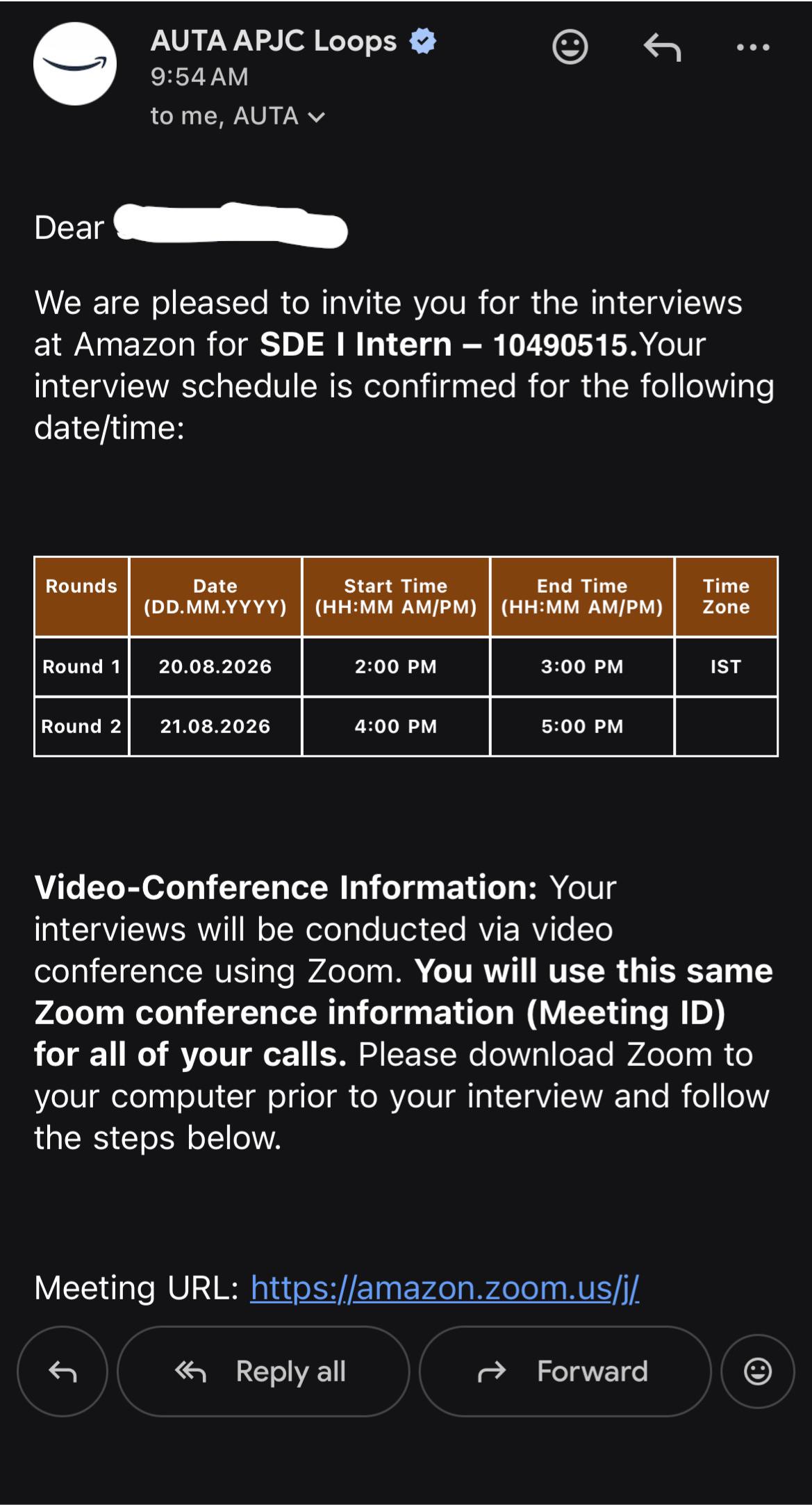
| August 18 | Received confirmation that I was moving to interviews |
| September 11 | Round 1 [ Technical ] |
| September 28 | Round 2 [ Technical ] |
| September 30 | Recruiter asked for preferred location and mapped me to that location. |
| October 1 | Round 3 [ Hiring Manager ] |
| October 3 (approx.) | Candidate portal started redirecting to Amazon A to Z |
| October 14 | Bar Raiser scheduled, later postponed |
| October 21 | Round 4 [ Bar Raiser ] |
| October 29 | Recruiter called and confirmed my selection! |
Note: The August rejection email and portal changes were confusing. I don't know the exact reason behind them, so don't treat application statuses or portal behaviour as reliable selection signals. My Bar Raiser postponement also taught me to stay patient.
Interview rounds
Round 1 | Technical | 45 minutes | 2 interviewers
Introduction and project/experience discussion in depth.
LP: Tell me about a time you delivered something under a strict deadline. What trade-offs did you make?
Coding: Rotting Oranges LeetCode 994 (BFS).
Round 2 | Technical | 1 hour 20 minutes | 1 interviewer
Coding 1: Minimum Window Substring LeetCode 76 (sliding window + frequency maps).
Coding 2: A varient of Top View of a Binary Tree (BFS + horizontal distance).
Conceptual: Explain BFS vs DFS and when to use each approach.
LP: Tell me about a time you implemented a design keeping customers in mind.
Round 3 | Hiring Manager | 1 hour
Coding:
Closest common manager of two employees (LCA variation, I had to interpret that it was LCA typa shi- from the problem he gave).
Rearrange a string so no two adjacent characters are equal (frequency counting + max heap).
I fully coded the first question. I explained my approach for the second, and when I started coding, the interviewer stopped me and moved the discussion to GenAI.
GenAI and system design:
How do you use prompts effectively with AI tools?
How do you review AI-generated code for correctness, readability, and efficiency?
What are LLM hallucinations, and how can you reduce them?
Design an email notification system in a day. How would you handle asynchronous processing, retries, and reliability?
How would you clarify requirements and deliver an MVP under 24 hour deadline?
What are you passionate about in technology?
Round 4 | Bar Raiser | Around 40 minutes | No coding
Behavioral and technical decision-making discussion.
Have you ever received negative feedback from a peer or senior? What was it, and what did you change?
Tell me about a challenging situation where you went out of your way to find an answer. How did you approach it?
Tell me about a time you already knew a technology and used it in a project.
Have you ever worked with a completely new technology?
There was also a technical discussion about data structures, storage choices, lookup performance, and evaluating alternatives from my experience/projects.
At the end, I asked the interviewer a question about advice for someone joining Amazon early in their career. We had a nice, casual conversation for around 10 minutes.
Lil insights:
1. Use a whiteboard if u have. Draw your approach on your screen while explaining it. It makes your reasoning easier to communicate, especially for graphs, trees, and sliding-window problems.
2. Prepare LP stories thoroughly. Use STAR, but be ready for multiple follow-up questions: Why this approach? What alternatives did you consider? What would you change?
3. Know your technical decisions. Understand your data structures, complexity, trade-offs, and how you measured performance. Be clear about what you actually implemented and what you would improve further.
4. Prepare questions for the interviewer. Have one or two thoughtful questions relevant to their role or team. Trust me the questions you choose to ask would leave a good impression, so be strategic.
5. Work on communication and confidence. Last year, I was rejected from Amazon-sde internship interview, and I felt my lack of confidence and difficulty explaining my approach had held me back. This time, I consciously worked on speaking up and explaining my thought process.
As an introvert, I know that feeling of thinking, "I could have got that opportunity if only I had explained myself better or felt less shy." Don't let that hold you back. You don't need to know everything; communicate what you know and work through the problem.
6. Take care of yourself. Sleep well, stay hydrated, and build a simple routine that helps you feel calm before interviews. [A psychological trick: Yawn intentionally about 15 minutes before your interview starts. Biologically, it cools down your brain, brings in extra oxygen, breaks nervous tension, and makes you feel instantly fresh and confident.]
Final thoughts
The process wasn't smooth: an unexpected rejection email, changing job IDs, a postponed Bar Raiser, and a long wait for the final decision.
But on October 29, I received the call confirming my selection for Amazon SDE-1 in my preferred location which I have chosen after my round 2!
Also that Amazon a to z portal shift after my Hiring manager round, I didn't knew if I could consider it as a positive sign back then.
Sharing this because I know how much interview experiences from this community can help someone preparing for the same opportunity.
This is just my experience, and the process may differ for others.
Your mind is your only limit. You've got this!