r/aicomicsguild • u/Altruistic_Leek_4183 • Oct 21 '26
True Spooky Story in the Woods.

0
Upvotes
r/aicomicsguild • u/Astra-Fang • 25d ago

Just sharing little moments from our married life, as well as modeling healthy relationships.
Would love feedback!
r/aicomicsguild • u/Astra-Fang • Sep 19 '26
Something I’ve been experimenting with lately is using a Word document as the actual character reference instead of trying to cram everything into one giant character-sheet image.
The difference in fidelity has been pretty dramatic.
A normal image sheet has limited real estate. You can fit a front view, side view, maybe a 3/4 view, expressions, and a few details before everything starts getting tiny or ambiguous. And if one part of the sheet is wrong, that mistake can effectively become part of the reference.
With a Word document, I can treat the character sheet more like a reference packet.
I can have separate, large images for:
Front / side / 3/4 / rear views
Face and hair details
Specific anatomy or proportions
Clothing and accessories
Alternate outfits
Expressions
Important details that models routinely screw up
Written rules explaining what is actually canon
Negative rules explaining what not to infer from the images
The big advantage is that you aren’t asking one image to communicate everything.
For example, if a character has a feature that keeps drifting, I can give that feature its own close-up reference and then explicitly describe its dimensions, orientation, placement, and what should remain consistent across different angles.
You can also distinguish between identity and wardrobe. Instead of accidentally teaching the model that the character always wears the outfit from their reference image, the document can explicitly say that the outfit is just one example and that their wardrobe should vary.
It also makes revisions much easier. If I change one canonical detail, I don’t necessarily need to regenerate an entire perfect reference sheet. I can replace the relevant image or update the written rule.
Basically, I’ve stopped thinking of a character sheet as an image of the character and started thinking of it as documentation for how to reconstruct the character.
One image is still useful as a quick visual reference, but a multi-page document can contain way more information without sacrificing resolution or forcing unrelated details into the same composition.
If you’re having problems with character consistency across AI generations, I’d seriously recommend experimenting with this approach. It’s a little more work upfront, but I’m getting noticeably better fidelity from it.
And then you can add it to the project as one document instead of having to upload sheets for each character
r/aicomicsguild • u/Astra-Fang • Sep 21 '26
I’ve been building a fairly complicated long-term project with ChatGPT, and one of the biggest lessons I’ve learned is: Do not use Memory as the source of truth for anything you actually need to stay consistent.
Memory is useful. I use it. It’s great for general context, preferences, and helping ChatGPT understand what the hell I’m talking about when I open a new conversation.
I spent a lot of time trying to make a production system stable across fresh chats, and eventually realized I was asking Memory to do a job it shouldn’t be doing.
The solution was Sources. Anything that actually matters to production now goes into source documents: character rules, visual references, workflows, continuity rules, QA requirements, etc. The biggest change, though, was designing the whole system around one assumption: A fresh chat should know absolutely nothing.
If I can start a fresh chat, give it the current sources, and it can correctly determine what rules apply, which document owns what, and what to do when information is missing, then I have something stable. That also taught me that dumping everything into one giant document isn’t necessarily the answer.
I’ve had much better results giving different sources specific authority so that things would not conflict. Like having multiple styles in one set caused it to standardize between them instead of keep them distinct.
Character sheets control character identity. Style documents control rendering. Production documents control workflow. New things we discover during production go into an update document until they can be routed into the correct source.
One of the more important rules we ended up adding was basically: Do not reconstruct missing information from Memory. If the current sources don’t establish something, I would much rather ChatGPT tell me the requirement is missing than confidently pull out a six-week-old rule that has since been changed.
That’s been a much more reliable way to work.
So the distinction I use now is: Memory tells ChatGPT who I am and what we’re doing. Sources tell ChatGPT how the project actually works.
If something would cause problems if ChatGPT remembered it incorrectly, don’t leave it in Memory.
Put it in a source.
r/aicomicsguild • u/AiRonin79 • Aug 16 '26

I want to introduce a project I’ve been deep in, and share the process honestly — including the parts that don’t work, because that’s most of the point. I also hope this post expands and grows into new and old forms keeping the same title because this problem is a huge landscape.
Who I am first, because it matters to how I work: I’m a trained illustrator — ink and wash, earth-tone palette, the moody weathered stuff. I’m not coming at this as a prompt-jockey who found a shortcut to art; I’m coming at it as someone who can already draw, trying to figure out what these tools are actually good for in sequential art. That difference shows up everywhere in how I use them.
What Tenshō 10 is: a deliberate test piece — a short comic built specifically to hit production walls, so I can build the method to get past them before my real graphic novel starts. The whole project is the method, not just the pages. And I’m documenting the failure rate honestly — the rejects, the drift, the places I had to step in by hand. Nobody selling “make a comic with AI in 10 minutes” ever shows you the 12 rejects behind the one good panel. I think the rejects are the most useful thing I can share.
How I actually work — the part that might be useful to you: the engine does the dark and the mass; my hand owns the edge. For anything that defines a panel, I prompt only the value structure — the shadow, the pose, one lit passage — and the mark that makes it the panel stays hand-ink. I keep a running glossary of what the model reliably does and doesn’t do, and honestly most “prompt tricks” have collapsed into a handful of behaviors I keep hitting. I’ll share those in follow-up posts.
The stance, plainly: I’m not hiding that it’s AI. I’m not selling anything. And I’m not claiming “I drew this” — I’m claiming “I decided this.” The army passes the door instead of stopping at it. The date lands on page one so you read the whole thing under its shadow. The panels stay tight so one can break wide. No model produced those calls — most of them are refusals, and models don’t refuse toward meaning.
What I’m proving it on: a love story set the night before the Honnō-ji Incident — a young guard spends the night with the woman he loves, leaves at dawn happy, certain he’s got the safest posting in the capital. You know the date. He doesn’t. The irony lives entirely in the reader.
Happy to get into any of the craft in the comments — the reference discipline, the drift problem, the hand-repair line. That’s the stuff I actually want to talk about.
r/aicomicsguild • u/Plenty-Psychology-62 • Aug 26 '26

Benchmark pages are the visual rulebooks. They govern the art style, character consistency, anatomy, body proportions, and scaling—keeping each character’s height, age, build, and size compared with others accurate. They also guide colors, lighting, effects, panels, and lettering. They do not decide the plot; they prevent visual drift so every page feels consistent, believable, and part of the same story
For whatever arc you are on you should make one showing characters included in that arc powers or moves used in that arc once you stick it in your sources it’ll immensely help with anatomy issues, scaling issues, and things of that nature. Hope this helps.
r/aicomicsguild • u/AiRonin79 • Aug 23 '26

Nano Banana Pro. Small sample warning up front: this is one model, one art style, one comic, maybe
15 rejects deep. So this might just be my setup. But the same five things kept
biting me, and once I could name them most of my rerolls stopped. Curious whether
they match what you’re seeing or whether it’s just how I work.
Plain version, no jargon:
It only draws what you can see. Tell it a feeling — “make it tender” — and
nothing happens. Describe what the two bodies are physically doing and the
tenderness shows up on its own. Same with light: don’t tell it what’s blocking
the lamp, tell it how bright the face is. It can’t render a cause or a mood, only
the thing you’d actually see in the frame.
The reference beats the words. When my prompt and my reference image
disagreed, the image won every time. And a reference drags everything it’s
carrying — I used an earlier panel just for its darkness and it dragged that
panel’s whole composition in with it, flipped my scene. Now I tell it exactly what
each reference is for and what to ignore.
Anything you don’t assign, it invents. Don’t say whose face the light is on
— it scatters light across made-up figures. Don’t say how many people — it adds
extras. Don’t describe a specific object — it swaps in a generic modern one. Nail
down who, how many, what exactly.
More words is not more control. Past a short list, every extra style word
made it worse — it trades away coherence trying to satisfy all of them at once. My
shortest prompts consistently won. I keep cutting until it breaks, then add one
back.
It has a gravity. Left any freedom, it drifts to its comfortable output —
the pretty straight-on portrait, the evenly-lit face, the wide frame. You can’t
forbid the default (naming it just summons it — see #1). You either out-describe
it, hand it a reference of what you do want, or fix it after.
That’s the whole list so far. Every “prompt trick” I’ve run into folds into one of
these. But again — small sample. If these don’t match what you’re hitting, I
genuinely want to know, because I’m trying to figure out which are real and which
are just my style. I’ve got the reject log behind each if anyone wants specifics.
r/aicomicsguild • u/Astra-Fang • 25d ago

One of the most common problems I see in AI-generated art is excessive background clutter. AI is very good at filling empty spaces with furniture, decorations, textures, and miscellaneous objects. The results can look impressive, but there’s a problem that often gets overlooked.
Every detail in an image competes for the viewer’s attention.
And when that attention is divided, subtle expressions, gestures, and interactions can easily get lost. I approach backgrounds as another form of dialogue. They communicate information, establish tone, create expectations, and can even deliver a punchline.
The most important thing I think about is this: If I were a human drawing this, would I think it was worth the time to add?
I want to use three of my comics to demonstrate three different approaches.
Example 1: Johnny Bravo — Using Simplicity to Control Attention
In the first comic, the background is almost entirely a simple purple texture. That’s intentional.
The reader doesn’t need to spend time examining the environment. Their attention stays on the characters, their expressions, and the dialogue.
Look at Fang’s changing expressions and body language. In the second panel, he closes his eyes, seemingly content with his explanation. In the third, he suddenly becomes enthusiastic when Johnny Bravo is mentioned.
These are relatively small visual changes, but they’re important to the joke.
Now look at the final panel.
Suddenly, the background changes to bright orange with dramatic radiating lines. The characters are moving, the poses are exaggerated, and everything becomes more energetic.
The background changes because the tone changes.
By keeping the first three panels visually consistent, the final panel becomes much more impactful. If every panel had a wildly different background, that change wouldn’t mean nearly as much.
The lesson: Simplicity protects subtlety, and consistency gives changes meaning.
Example 2: Father’s Day Negotiations — Using Detail to Communicate Time
Now compare that with the second comic. The background is significantly more detailed. There are stacks of documents, scattered paperwork, negotiation notes, and an entire board devoted to the discussion.
Why?
Because the background is telling a story that the dialogue doesn’t have to.
Without adding a single panel, you can immediately tell these negotiations have been going on for a long time. There have been proposals, counterproposals, concessions, and probably quite a bit of frustration. This changes how you interpret the opening question
“So we are agreed?”
You’re not watching the beginning of a discussion. You’re watching what appears to be the conclusion of a long and exhausting process. And when Astra tears up the agreement, you understand the weight of that action because the environment has already established how much work went into it.
The background has communicated the passage of time without requiring additional panels or dialogue.
Then comes panel four.
Suddenly, the dark, serious environment disappears, replaced by bright colors, confetti, and an enormous VICTORY banner. Even before consciously processing what’s happening, the reader recognizes an enormous visual change. The immediate reaction is something like, “Whoa, what happened?”. That draws attention toward the payoff.
The background has gone from establishing time, to maintaining tension, to announcing a dramatic reversal.
And every stage serves the joke.
The lesson: A detailed background isn’t clutter when its details are communicating something important.
Example 3: NASA — Using the Background to Manipulate Expectations
The third comic uses the background in an entirely different way. The first three panels are visually simple and consistent. Fang sits in the same chair, in the same room, explaining NASA’s strict security requirements.
But panel four is a dramatic departure.
It’s a detailed NASA mission control center, filled with monitors, personnel, and a rocket launch. And here’s the interesting part. The joke actually works better if the reader notices panel four before reading panel one.
When you first glance at that image, you see someone standing inside NASA mission control. Then you start reading. Fang is talking about NASA’s incredibly strict security requirements and how difficult it is to get inside.
Suddenly, you’re thinking, “Holy shit, is he actually going to explain how to get into NASA?” The second panel reinforces the difficulty. The third panel builds the anticipation.
And then you get:
“Think about how they get their coffee.”
God damn it.
Now go back and look at panel four. The person standing in mission control is wearing a suit and carrying a coffee pot. Both details are important.
The suit encourages the reader to assume he’s someone with authority. Meanwhile, carrying coffee seems perfectly ordinary. It’s not the sort of thing that automatically triggers suspicion. The entire visual misdirection depends on the reader making assumptions about what they’re seeing. The answer was sitting right there in the image, but the composition encouraged you to interpret it differently.
The background doesn’t simply illustrate the joke. It helps set the trap.
And notice something else: the NASA panel is by far the busiest image in the comic. But all those monitors, technicians, and equipment communicate one recognizable idea: NASA mission control. The viewer doesn’t need to examine every individual object to understand the setting. The complexity is serving a clear purpose: Hide that he is holding a coffee container.
The lesson: Backgrounds can direct attention, create expectations, and deliberately mislead the viewer as part of the storytelling.
So What Does This Have to Do With AI Art?
AI image generators frequently introduce background details that don’t contribute anything meaningful to the image. A new bookshelf appears. Furniture changes position. Decorations come and go. Random objects fill empty spaces. In a single illustration, that can distract from the main subject. In sequential art, it creates an additional problem.
Consistency allows the reader to become familiar with the environment. Once it’s familiar, they can devote more attention to what’s changing within it. When the background changes constantly, the reader stops being able to distinguish meaningful changes from meaningless ones.
Before keeping something in the background, ask yourself:
What is this communicating to the viewer?
Is it establishing the setting? Reinforcing the mood? Suggesting the passage of time? Directing attention Creating an expectation? Supporting a joke? If so, it has a reason to be there.
But if it isn’t communicating anything, consider what it might be taking attention away from. the background is part of the conversation you’re having with your audience.
And sometimes the best way to communicate more is to show less.
r/aicomicsguild • u/suhaboncukcu • Sep 09 '26

Hi users of r/aicomicsguild !
(yes, the pages you see are created and exported via inkroost's new creator studio. protip: match style feature)
Soon, inkroost will publish it's new creator studio. It's still in beta and there are much to fix and improve.
However, inkroost harness uses a combination of frontier models behind the scenes so you can think of this trial period as a way to test your ideas for free!
What do I need?
Just try to use all the features you can with your gifted credits. Share what you like, what you don't like and what works and what doesn't work via [email protected] within a week of trial start.
What you will get?
A coupon for free credits worth of $19.99 (should give you about 100 free pages) You can choose to publish your work on inkroost or take it to somewhere else either by using automated integrations or just by exporting as however you want. (epub included!)
How will it work?
Write under this post if you are interested. Send your idea for chapter creation either with a DM or share directly under the post about your idea. For DMs, I can guarantee it's not gonna be stolen, otherwise it's your choice. I don't think people would steal :)
In 5 days (~15th September), 5 people should be selected (from different social platforms and subreddits) and sent a suggested plan on which features to use within the trial week day by day.
What is inkroost and how can I use it today if I'm not selected?
Good news! You can absolutely enjoy it today.
Inkroost is an ambitious AI supported webcomic, webtoon, manga sharing and creating platform. Reading is straightforward and fun. It has top notch, high quality creators found inkroost and decided to share on it! Creation part is also fun. After registering, you will see a Creator Studio link on the menu. Clicking that will take you the old creator studio. Which still works well but might be poorly designed to support all of its features. However, you will get 50 credits just for signing up so don't worry to make mistakes.
If you already have your own workflow and created work, you can just upload that and publish it for free as well. That doesn't cost anything. Do you have patreon and could use a platform to publish your work designed for webcomics and alike? Then just change the chapter's reader access to supporter only. Inkroost will connect to your patreon and only your patreon subscribers can read that chapter. These are all free.
Thanks for your support and don't forget to share with whomever would be interested!
r/aicomicsguild • u/Astra-Fang • Sep 06 '26

One of the things I underestimated when I started making Astra & Fang was just how much work it would take to get something as simple as Astra’s ears consistent.
And when I say consistent, I don’t mean “she has white rabbit ears in every image.”
I mean the ears are supposed to be actual anatomy.
Same root position. Same length. Same width. Same thickness. Same spacing. Same outward angle. Attached to the same place on her skull regardless of camera angle.
I spent 6–8 hours just working out where the roots of her ears actually attach to her skull.
Eventually I was making orthographic references from the front, side, top and rear. I defined cranial landmarks. I defined the attachment point relative to her human ears. I defined the outward angle. I defined proportions relative to her head height.
Then I made a QA sheet specifically for the back of her fucking head.
All because the AI kept trying to treat the ears like accessories it could move around whenever the composition became inconvenient.
So one of the rules in the production manual literally became:
COMPOSITION MUST YIELD TO ANATOMY.
If Astra’s ears don’t fit comfortably in the panel, crop them.
Obscure them.
Change the framing.
But do not move her ears.
It was an absurd amount of upfront work for one tiny part of one character.
But that’s also the point.
Once the system understood the anatomy instead of just “white-haired bunny girl,” I stopped having to fight the same problem over and over again.
That’s been one of the biggest lessons from building Astra & Fang with AI:
Consistency doesn’t come from asking the AI to be consistent.
You have to define what “consistent” actually means.
These are just examples. The images got much more barebones than this.
r/aicomicsguild • u/AiRonin79 • Aug 18 '26

Follow-up to my intro post. A few people asked how I’m keeping an AI comic from
turning into slop. Honest answer: almost all the work was done before I generated
anything — and it was mostly subtraction.
Here’s what I actually did to scope it, and why each one saved me later:
I wrote down the priority order and what happens if I break it. Comic first,
channel second, tool third. Then one line I keep coming back to: reversing that
order kills the project, and a well-documented unfinished comic is worth nothing.
That sentence has stopped me from three rabbit holes already.
I defined the project by what it is NOT. Not “a comic in 10 minutes.” Not
volume. Not chasing subscribers. Not selling the tool. Naming what I refuse to
build is what keeps me out of the saturated lane where everyone else is.
I bet on method over tools. Tools rot in six months. The thing worth
documenting is how you hold a style across a sequence and make irony survive
generation — the model is just this year’s example, not the subject.
I wrote kill criteria while I was calm. If more than half the panels need heavy
hand-repair, the engine isn’t holding my style and the fix is a different style
anchor, not grinding more iterations. I decided that at a desk in daylight, not at
11pm staring at panel five.
I settled the authorship stance in writing so I never have to re-argue it. Not
“I drew this” — “I decided this.” (Got challenged on exactly this in the comments
yesterday. Had the answer ready because I’d written it in July.)
And the part I’m least proud of, which is why I’m including it: I caught my own
scope creep in the document. Three build sessions in, I’d made tools and folders
and still had no image of the guard. I wrote “TOOLING IS CLOSED” into the plan and
shut the door. The scoping doc had to save me from myself.
None of this is about AI specifically — it’s just project discipline. But AI makes
it matter more, because the tool makes it so easy to produce something that you’ll
happily produce the wrong thing forever if you never decided what the right thing
was.
Full scoping doc attached if you want the whole thing — priorities, the stack, the
authorship stance, the kill criteria. Tear it apart, tell me where I’ve fooled
myself.
r/aicomicsguild • u/AiRonin79 • Sep 03 '26

Hey all.
We’ve been quietly building up a real body of knowledge here — what actually holds a character, how people beat spatial drift, where the model breaks and how to work around it. I’ve pulled it together into a wiki.
None of it came from a guru. It’s built from your posts, your teardowns, your fixes.
Use it when you’re stuck. Add to it when you crack something. That’s the whole point — nobody here starts from zero.
https://claude.ai/public/artifacts/cebf86b6-0de7-44f1-af6f-545fd802072e
r/aicomicsguild • u/Philipp • Aug 21 '26

Made a whole 200 pages book on this. AI (Gemini) was a tool in the pipeline, but each strip started out with my idea and writing -- and ended up in Photoshop, where I moved it all together like a collage. Hope you enjoy!
r/aicomicsguild • u/Astra-Fang • Sep 09 '26

One of the simplest ways I’ve found to improve AI image generation is to stop describing a difficult pose and show it a reference instead.
In this comic, Fang needed to point naturally at Astra’s wine glass. The first generations understood the idea of pointing, but the hand anatomy was wrong. Adding more words about fingers, knuckles, and hand position didn’t reliably solve it.
So I found a photograph of a real hand making the gesture from roughly the same camera angle I needed.
That fixed it.
The important part isn’t just finding a picture of someone pointing. Angle matters. A hand seen from the side has different visible fingers, overlaps, foreshortening, and joint positions than the same gesture viewed from above or head-on. If the reference matches the intended perspective, the AI has much less geometry to invent.
I use the same principle for more than hands. If an unusual pose, head angle, body position, object interaction, clothing fold, or perspective keeps coming out wrong, I look for a real reference that shows the specific problem from as close to the desired angle as possible.
The workflow is basically:
Identify the actual failure. Don’t regenerate the entire image because “something looks off.” In this case, everything worked except the pointing hand.
Find a reference for the problem, not the whole scene. I didn’t need a photograph matching Astra, Fang, the couch, and the wine. I needed a correctly positioned human hand.
Match the camera angle whenever possible. The closer the perspective is to the intended image, the more useful the reference becomes.
Tell the AI what information to take from it. Use the reference for anatomy, orientation, pose, or perspective while keeping the established character design and scene intact.
Change only what failed. Once a generation is mostly correct, preserve the successful decisions instead of reopening the entire composition.
This has become an important part of my production process: references aren’t only for character sheets. They’re troubleshooting tools.
Sometimes the fastest way to get an AI to understand what you mean isn’t another paragraph of prompting.
Find a picture of what you mean.
r/aicomicsguild • u/Astra-Fang • Oct 19 '26

Something I’ve learned making comics is that AI generators really don’t like tall pages.
For me, things usually start falling apart around row 4, depending on how tall the rows are. Characters start shrinking, panels get compressed, and the generator just refuses to give certain rows enough space.
I’ve found it’s much easier to generate as much of the page together as possible, then break out the stubborn sections.
If a row keeps getting squished, generate that entire row separately and composite it back in afterward.
The trick is to work row by row, not panel by panel.
It keeps the panels within that row consistent, and honestly makes compositing a lot easier.
I only isolate individual panels when something specific refuses to cooperate, like needing to mirror a panel or fix one particularly stubborn detail.
And if the entire comic is getting too tall? Just split it into multiple pages. I’ve wasted way too much time fighting that battle.
Basically, my workflow is:
Full page → stubborn rows → individual panels only when necessary.
Don’t make more work for yourself than you need to, recognize the limitations of the AI too, you are using, and save your energy.
r/aicomicsguild • u/rlhiakesi • 12d ago

Several months back I ran into some huge consistency problems while working on my IAKESI: Return from Another World experiment. Any time I wanted to make a change to the script for a page, I'd get totally different results from ChatGPT when re-rendering it. Asking ChatGPT to help me devise prompts was slightly useful. Maintaining large prompts as part of the script became burdensome, however.
I decided to develop a JSON-based language to fully specify character blocking, lighting, and all the other directorial details needed for a relatively consistent manga page. The result was SBL (Scene Blocking Language).
Currently, I generate manga a page at a time using ChatGPT; in that environment I should probably call SBL "Comic Page Layout Language" rather than SBL. However, I anticipate that I will have to drop page-at-a-time rendering in the near future and go with panel-at-a-time to achieve the professional results I want. At that point, SBL will be the proper name.
In any case, I've generated hundreds of pages with SBL at this point at it does a half-way decent job. To put things in perspective, I recently finished Chapter 1 of IAKESI and it turned out to be 91 pages long. The detailed script for that chapter was 87 pages long. ChatGPT translated this into 1.5 million lines of JSON/SBL code. Each page, on the average, was about 15,000+ lines of JSON code. Now cleanly formatted JSON code is not very dense, but you get the idea, the prompts in JSON are very detailed.
SBL is hardly perfect. Diffusion image generation is still random process and running the exact same JSON code through ChatGPT's image generator won't produce (completely) identical images. However, it seems to do a good job for those items on the page that have character or production sheets attached.
In any case, I believe SBL is to the point that other people can make use of it. So I've made it available for download on my website (Creative Commons Zero license). You can download SBL and the human-readable documentation here: https://www.randallhyde.com/IAKESI/index.html
Note that you don't actually write SBL code manually (I suppose you could, but it would be a crazy amount of work. I usually start with a story, convert that to a script, and then have ChatGPT translate that script into SBL code for rendering purposes. You can also read about my "30-step workflow" at the URL above.
r/aicomicsguild • u/Fast-Lecture-5103 • Sep 17 '26

Made with Creator Studio...
r/aicomicsguild • u/Astra-Fang • 25d ago

One of the biggest lesson I have prioritized is maintaining my characters internal consistency
A character isn’t just a collection of personality traits. They’re a person with values, motivations, experiences, relationships, and their own way of interpreting the world. I wanted to understand my characters well enough to write them consistently, even in situations I hadn’t imagined yet.
My approach is to create the person first, then put them in the situation.
The more thoroughly I understand my characters, the more freedom I have to explore different stories while maintaining their internal consistency.
How I Develop My Characters
Before prompting a single comic, I spent hours answering questions about who my characters were. I used AI to interview me about their personalities, beliefs, motivations, experiences, and relationships. My answers became the foundation of a characters “persona”.
My approach focuses on five aspects of how a character responds to a situation:
Perception: What do they notice?
Interpretation: How do they understand it?
Goal: What do they want?
Method: How do they approach it?
Expression: How do they communicate it?
This has become particularly valuable as my comic library has grown. I’m working toward hundreds or thousands of comics featuring the same recurring characters. I want someone reading comic #1000 to recognize the same people they met in comic #1, even as those characters grow and develop through their experiences.
Example: Astra and Jealousy
Comic 1 — Is it okay for people to flirt with your partner?
Astra actually enjoys it, provided her partner has earned her trust. She likes knowing other people find Fang desirable and enjoys a little playful possessiveness. Her confidence in their relationship allows her to enjoy the attention without feeling threatened. For Astra, jealousy doesn’t necessarily come from insecurity.
Comic 2 — Is jealousy unhealthy?
This explores the distinction behind her previous answer. Astra sees a difference between jealousy rooted in gratitude and jealousy rooted in distrust. One comes from appreciating the person you’re with. The other comes from fearing you might lose them. She also separates feelings from behavior. Someone can experience jealousy without making their partner responsible for resolving it.
Comic 3 — Is finding other people attractive wrong?
Astra openly acknowledges finding other people attractive herself. She doesn’t see attraction as a threat to commitment. She can even enjoy watching someone unsuccessfully attempt to court Fang because she’s confident in his loyalty. It’s another application of her understanding of trust.
Comic 4 — Putting those beliefs into practice
At a formal event, another woman approaches Fang. He’s visibly wearing his wedding ring and rejects her advances, but the woman continues anyway. Astra remains calm. Fang’s loyalty was never in question. Her response afterward is about the woman’s behavior. There’s a distinction between finding someone attractive and knowingly disregarding their marriage and rejection.
Comic 5 — Why does Astra get angry when other women hit on Fang?
Here, Astra explains that distinction directly. She trusts Fang completely. Her anger isn’t about worrying that he’ll be unfaithful. It’s directed at people who knowingly disrespect their relationship.
Astra’s behavior changes with the context, but her underlying values remain internally consistent.
That’s the type of nuance I wanted to preserve when generating my characters
Bonus Comic — Same Characters, Different Situation
The final comic takes those same established characters and places them in a completely different situation. Fang and Nico are fishing without bait. Fang uses the opportunity to explain something about relationships, while Astra and Cherry are having their own conversation nearby.
Each character approaches what’s happening through their established personality and relationships. The result is a joke that emerges from the characters themselves rather than requiring me to change who they are.
It makes it so you can naturally have 4 characters consistently interact without turning into “flanderized” versions of themselves.
Why I Put So Much Work Into This
Across hundreds of comics, it’s easy for small inconsistencies to accumulate. My characters “persona” gives me a reference for their beliefs, motivations, capabilities, relationships, and ways of thinking. It also gives me a way to explore new situations without rebuilding their personalities every time.
r/aicomicsguild • u/Astra-Fang • Sep 16 '26
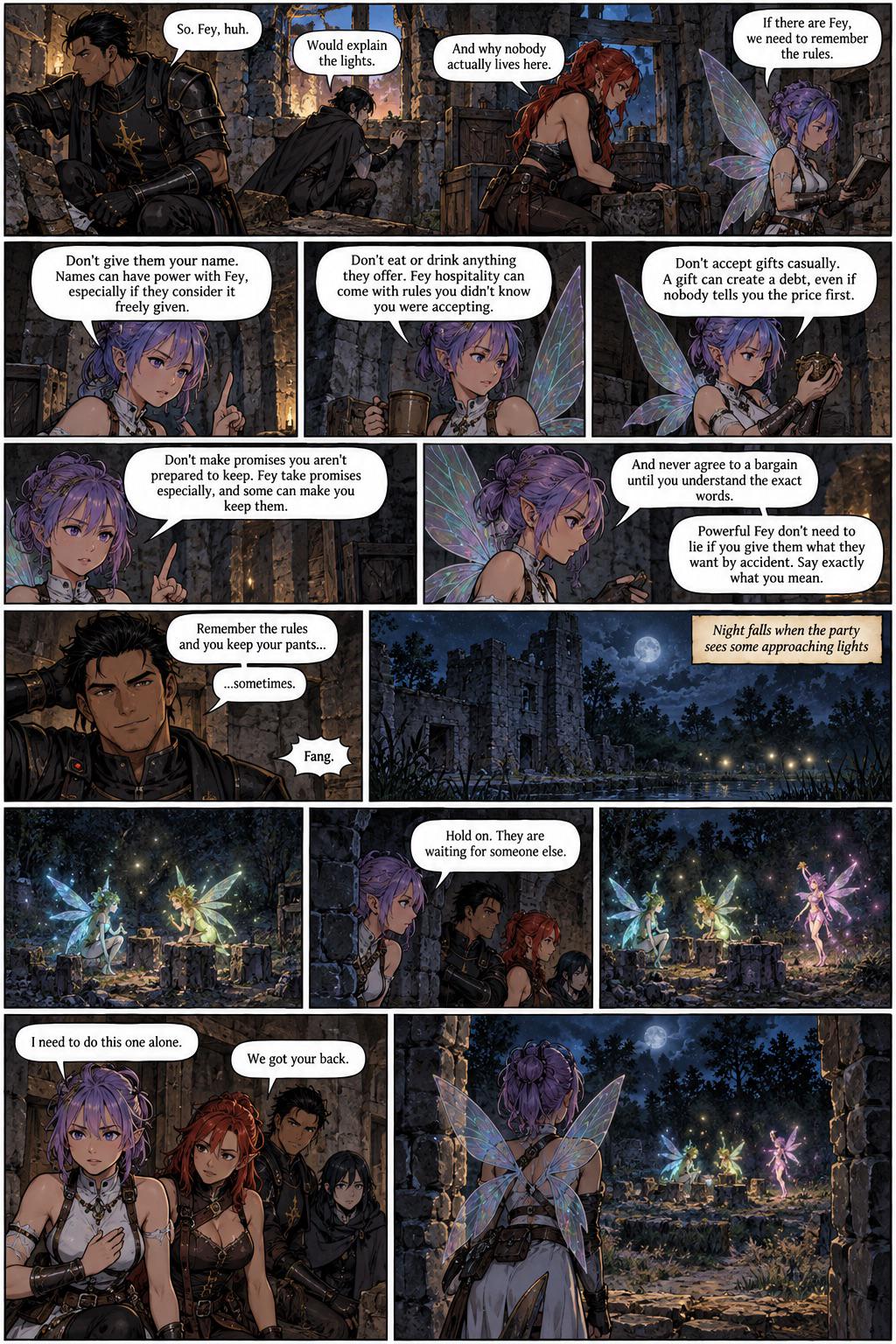
Here is the prompt that got me this comic. Even with the character sheets and locks, it got the canon apperances wrong. But for a first generation? I will take it
ASTRA & FANG — D&D COMIC
PAGE 1 — FEY ARRIVAL AT THE MOATHOUSE
GENERATION SCOPE
Generate exactly ONE finished comic page.
Do not generate Page 2.
Do not add, remove, merge, split, or reorder panels.
Do not improvise dialogue, characters, creatures, props, actions, or locations.
Current explicit user instructions for this page.
Current Astra & Fang D&D Production System.
Current campaign/transcript state.
Embedded IN-CHARACTER visual sheets:
- Fang
- Astra
- Cherry
- Nico
External D&D Character Sheets:
mechanics, current Level 1 equipment, inventory, abilities, and party state.
Approved D&D comic visual/style reference.
The IN-CHARACTER sheets are absolute visual authorities.
Do not redesign characters.
Do not copy obsolete/future equipment from concept art when it conflicts with current Level 1 state.
Portrait comic page.
EXACTLY 12 PANELS arranged as:
ROW 1:
1A — one FULL-WIDTH panel
ROW 2:
2A | 2B | 2C
ROW 3:
3A | 3B
ROW 4:
4A | 4B
4B should be wider than 4A.
ROW 5:
5A | 5B | 5C
ROW 6:
6A | 6B
6B is the strong page-ending panel.
Solid rectangular panel borders.
Clear gutters.
Readable visual flow from top-left to bottom-right.
Semi-realistic anime fantasy comic.
Grounded D&D fantasy rather than glossy heroic fantasy.
Detailed linework.
Natural adult anatomy.
Cinematic but restrained lighting.
Weathered stone, aged timber, dirt, vegetation, and believable ruined architecture.
Strong material differentiation.
Natural shadows.
No chibi proportions.
No exaggerated cartoon expressions.
No modern objects.
No unnecessary background clutter.
Maintain the established approved D&D comic rendering language.
Late afternoon progressing naturally into night.
The party is inside an abandoned ruined Moathouse.
Old stone construction.
Damaged timber.
Broken and weathered interior.
Openings allow the party to observe the exterior without standing conspicuously in the open.
Outside is the previously identified small Fey gathering spot.
Do not relocate the party between unrelated environments.
Rows 1–4A remain spatially coherent within the same Moathouse.
Exterior views must correspond to the same building and gathering area.
ELMO:
Elmo is outside standing watch.
He does NOT appear in any interior panel.
Do not place him with Fang, Astra, Cherry, or Nico during the Fey observation sequence.
FANG:
Use Fang's IN-CHARACTER visual sheet.
Warm brown skin.
Short slicked-back black hair.
Clean-shaven.
Adult male proportions.
6'2".
Current Grave Cleric / Order equipment only.
Black/charcoal armor language with appropriate gold insignia.
NO blue cloak.
NO superhero cape.
Rear/tabard fabric must not become a cape.
Left-handed when handedness is visually relevant.
ASTRA:
Use Astra's IN-CHARACTER visual sheet.
Adult woman, age 27.
Exactly 3'0" tall.
Fully adult natural proportions.
She is a fairy, NOT a child, doll, mascot, familiar, or chibi.
Preserve her established face, hair, wings, clothing/equipment, and silhouette.
Her smaller stature must remain believable relative to the adults without shrinking her into a tiny creature.
Astra understands Sylvan and Fey etiquette.
CHERRY:
Use Cherry's IN-CHARACTER visual sheet exactly.
Preserve adult anatomy, face, hair, silhouette, current equipment, and established design.
Do not genericize her into a fantasy rogue archetype.
NICO:
Use Nico's IN-CHARACTER visual sheet exactly.
Preserve adult anatomy, face, hair, silhouette, current equipment, and established design.
Nico must remain visually distinct from Fang.
Never substitute Fang for Nico because both have dark hair.
FEY:
Exactly THREE Fey total by the end of Page 1:
two sprites and one pixie.
The first TWO arrive together.
The PIXIE arrives afterward.
They are social visitors using a familiar meeting place.
They are not guards.
They are not hostile.
They are not occupying the Moathouse.
Do not add additional fairies.
LATE AFTERNOON.
Wide interior establishing shot of the ruined Moathouse.
Fang, Astra, Cherry, and Nico are taking a SHORT REST while casually INVESTIGATING DIFFERENT PARTS of the structure.
They are NOT seated together.
They are NOT standing in a conversation circle.
They should occupy separate areas of the same coherent interior.
Their physical behavior should suggest low-intensity examination during downtime:
looking at masonry, openings, damaged architecture, debris, or other existing structural details.
Do not invent important clues.
ELMO IS NOT PRESENT.
Dialogue:
FANG:
“So. Fey, huh.”
NICO:
“Would explain the lights.”
CHERRY:
“And why nobody actually lives here.”
ASTRA:
“If there are Fey, we need to remember the rules”
Astra's line is the final dialogue beat of the panel.
Continue the same short-rest investigation naturally.
Do not reset everyone into conversation poses.
Astra speaks while activity continues.
ASTRA:
“Don't give them your name. Names can have power with Fey, especially if they consider it freely given.”
Same continuous downtime/investigation.
ASTRA:
“Don't eat or drink anything they offer. Fey hospitality can come with rules you didn't know you were accepting.”
Same continuous downtime/investigation.
ASTRA:
“Don't accept gifts casually. A gift can create a debt, even if nobody tells you the price first.”
Continue natural investigation.
ASTRA:
“Don't make promises you aren't prepared to keep. Fey take promises seriously, and some can make you keep them.”
Astra continues.
FIRST ASTRA BUBBLE:
“And never agree to a bargain until you understand the exact words.”
SECOND, SEPARATE ASTRA BUBBLE:
“Powerful Fey don't need to lie if you give them what they want by accident. Say exactly what you mean.”
IMPORTANT:
“Powerful Fey” MUST begin the second bubble.
Do not combine these two bubbles.
Do not move “Powerful Fey” into the first bubble.
Interior Moathouse.
Fang gives his simplified summary.
FANG:
“Remember the rules and you keep your pants…”
Then a SMALL SIDE BUBBLE from Fang, visually subordinate and delivered like an afterthought:
FANG:
“…sometimes.”
Astra is OFF-PANEL.
ASTRA (OFF-PANEL):
“Fang.”
ALL THREE dialogue elements belong to PANEL 4A.
Do NOT move Astra's response into Panel 4B.
Do NOT move Fang's “…sometimes.” into Panel 4B.
Wider transition panel.
Exterior establishing view of the SAME Moathouse and surrounding area.
Night has fallen.
In the distance, the party can see SMALL APPROACHING LIGHTS moving toward the known Fey gathering spot.
NO CHARACTER DIALOGUE.
TEXT BOX EXACTLY:
“Night falls when the party sees some approaching lights”
The approaching lights resolve into TWO small Fey.
These are the TWO SPRITES.
They fly down and LAND AT THEIR USUAL GATHERING SPOT.
They behave comfortably and familiarly with the location.
The party remains concealed inside the Moathouse observing them.
Astra can hear and understand their Sylvan conversation.
No party dialogue.
Do NOT include the pixie yet.
View emphasizing Astra observing/listening from concealment.
Fang, Cherry, and Nico remain concealed nearby as spatially appropriate.
Astra has understood the sprites' Sylvan conversation.
ASTRA:
“Hold on. They are waiting for someone else.”
Nobody approaches.
Exterior gathering spot.
The THIRD Fey arrives.
This third Fey is the PIXIE.
The two sprites recognize the expected arrival.
The three are clearly meeting socially rather than preparing an attack.
The party remains concealed.
No party dialogue.
Exactly three Fey now exist:
two sprites + one pixie.
Inside the Moathouse.
Astra has observed enough to decide to make contact.
ASTRA:
“I need to do this one alone.”
CHERRY:
“We got your back”
Fang and Nico remain ready but do not interfere.
Do not add extra dialogue.
Strong wide closing panel.
CAMERA IS BEHIND ASTRA.
Astra is shown from the back as she leaves the Moathouse alone.
Camera remains near/inside the Moathouse, looking outward past Astra toward the gathering place.
The three Fey are visible farther ahead.
Fang, Cherry, and Nico remain behind inside the Moathouse.
Astra is ONLY LEAVING THE BUILDING.
She has NOT reached the Fey.
She has NOT greeted them.
She has NOT begun the negotiation.
MOST IMPORTANT:
THE FEY HAVE NOT RESPONDED TO ASTRA YET.
No Fey reaction.
No startled expressions.
No turning toward Astra.
No dialogue.
No greeting.
No approach from the Fey.
No acknowledgement of Astra's presence.
Page 2 will begin with their reaction.
END PAGE 1.
Preserve supplied wording exactly.
Do not rewrite dialogue.
Do not correct grammar.
Do not add speaker names inside bubbles.
Do not invent dialogue.
Bubble tails must terminate clearly at the speaking character's mouth.
Astra's Panel 4A “Fang.” is explicitly OFF-PANEL and therefore uses an appropriate off-panel bubble treatment without a false tail.
Panel 4B uses a narration TEXT BOX, not a speech bubble.
Keep text readable and contained within its assigned panel.
Allowed characters:
- Fang
- Astra
- Cherry
- Nico
- exactly two sprites
- exactly one pixie
Elmo may exist outside the building as established campaign state, but DO NOT depict him unless explicitly required by the composition.
Allowed environmental elements:
- ruined Moathouse architecture
- ordinary ruin debris
- existing vegetation
- gathering spot
- natural night environment
- Fey light/glow associated with the arriving sprites/pixie
NO extra party members.
NO Elmo inside.
NO extra Fey.
NO monsters.
NO wolves.
NO owlbear.
NO modern objects.
NO random weapons.
NO future-level equipment.
NO blue cloak on Fang.
NO Fang/Nico identity swapping.
NO childlike Astra.
NO tiny familiar-sized Astra.
NO generic chibi fairy anatomy.
NO party conversation circle during the short rest.
NO unnecessary seated-rest tableau.
NO invented magical effects during the rules lecture.
NO Fey hostility.
NO Fey response to Astra in Panel 6B.
NO Page 2 dialogue or events.
NO extra captions.
NO labels.
NO watermarks.
NO signatures.
EXACT panel count and geometry.
EXACT character identity.
EXACT character-sheet designs.
EXACT story chronology.
EXACT dialogue assignment.
Correct two-sprites-first / pixie-third arrival sequence.
Correct Page 6B camera behind Astra.
NO Fey reaction in 6B.
Spatial continuity of the Moathouse.
Established D&D comic visual style.
CONSISTENCY OVER CREATIVITY.
CONTINUITY OVER COMPOSITION.
DO NOT SOLVE DIFFICULT LAYOUTS BY CHANGING THE STORY.
r/aicomicsguild • u/Astra-Fang • Sep 06 '26

One of the biggest efficiency improvements I’ve found working with AI art is stopping the expectation that a single generation has to be perfect.
This comic is a good example.
I had one generation where I really liked the character performance and exaggerated speech bubbles. The text actually felt like someone singing — changing size and emphasis with the cadence instead of just sitting inside a generic bubble.
But another generation had a much better final panel. The wider framing made the karaoke-room reveal work, and the reactions from everyone around Fang were much stronger.
So I just combined them.
That sounds obvious, but it changes the way I approach generation considerably. Instead of regenerating an entire comic because one panel is weaker, I can treat each generation as a collection of usable parts.
One might nail the expression. Another gets the composition right. Another gets the bubble choreography. Another finally gives me the exact character consistency I need.
Take the best pieces and build the final page.
And do not hesitate to lock in on a single panel.
If Panels 1–3 are already good and Panel 4 sucks, stop asking it to regenerate the entire comic. You’re giving it three more opportunities to break things that were already correct. Generate Panel 4 by itself. Get exactly what you need. Composite it back in.
This is also useful when something is falsely tripping the filter. Making it panel-by-panel can get around that because the filter works on the total number of words, not the density of those words. So something that gets flagged as part of a dialogue-heavy four-panel generation may go through perfectly fine when you isolate the individual panel.
And as a bonus, you’re now giving the AI a much narrower problem to solve. Instead of balancing four compositions, four sets of expressions, all the dialogue, character consistency, bubble placement and the overall page layout, it only has to nail one panel.
Then composite it back into the finished page.
The larger lesson is that you don’t need to keep gambling completed work every time you hit regenerate.
Generation creates options. Compositing lets you keep the winners.
r/aicomicsguild • u/AiRonin79 • Sep 02 '26

Quick check-in — one line. New chapter, a page that’s fighting you, a technique you’re testing, whatever you’ve got going. Curious what the room’s making this week.

