r/acceptancecommitment • u/concreteutopian • Oct 24 '20
DJ for Thoughts - A great way to practice defusion

179
Upvotes
r/acceptancecommitment • u/concreteutopian • Oct 24 '20
r/acceptancecommitment • u/cowboybebop345 • Oct 10 '22
I've been reading psychology books for almost 3 years and ran into ACT with this reading.
One book called "introduction to ACT" is full of metaphors. One of them is called "bus metaphor". It tells you to imagine you're a bus driver. The passengers you're going to pick up are hostile and threatening. They will often call you a loser, tell you not to turn right, not to go that way etc., and if you decide to disobey, you'll have to face them.
Now imagine the driver is your mind and the passengers are your thoughts and feelings. Your thoughts and feelings will often tell you what to do and they will threat to give you discomfort if you decide not to comply with them. But guess what : THAT'S ALL THEY CAN DO. They're not conducting the bus, turning the wheel or changing the gears. You are.
How that applies to my life? I've always had anxiety about driving on highways. I've always thought I SHOULD be feeling peaceful to drive on a highway. I couldn't drive feeling anxious, uncertain etc. I was letting the passengers guide my bus.
So last Saturday I decided to let the passengers say what they wanted to say , but I decided to disobey them : I would travel to a nearby city to meet a person I've been talking Online. And so I did : the trip was discomfortable and had feelings of despair, fear, uncertainty etc. But I decided to drive anyway. I got to his city and met him. It was awesome. I went back to my city again with these feelings, but drove anyway. Now the anxiety is way weaker than before and I might date this person I met 🥰
r/acceptancecommitment • u/Recent_Beginning_822 • Jul 13 '25

This was inspired by steven hayes(or Russ Harris??) Radio doom and gloom metaphor, that draws a parallel between the mind and a shitty radio station. Just like a radio station, one can pay attention to the music on the background, or Just accept it and do with the noise, focus on more valuable activities.
This metaphor is specially handy for those who have intrusive self deprecating thoughts. Now every time i look at my arm, Im just reminded of it
r/acceptancecommitment • u/concreteutopian • Sep 11 '20

r/acceptancecommitment • u/underpursuit • Jun 25 '22
Sorry for my English first of all, I'm Brazilian:
Now that I've become a teacher and have been 24/7 busy with my values ( teaching and talking to different people ), I see how the values theory is true: you have a meaningful and fulfilled life once you achieve your values and commit to them.
I've been so happy this year : I graduated last year and applied for a teaching job at a local high school / vocational school. I've been hired, and since I learned to manage my emotions by reading up on ACT books, I reduced so much the experiential avoidance shyness used to trap me, and faced the high school classes and vocational school classes by doing what I always wanted. I was finally able to realize that feelings don't mean much and we cannot be paralysed by them.
r/acceptancecommitment • u/trynottodoom • Feb 28 '25

Shout out to r/hopeposting and u/Kirby pop for this gem
r/acceptancecommitment • u/tigrinekrevete • Apr 19 '25
If you had to pick one exercise to recommend to someone, what would it be?
For me it would be difficult passengers, the one where you imagine negative thoughts as passengers on a ship you're sailing. You don't have to throw them overboard. Just keep sailing towards what matters regardless of what they say. I found this very liberating.
r/acceptancecommitment • u/emkeystaar • Jan 30 '21

r/acceptancecommitment • u/MarleyL4 • Sep 02 '23
I’m so grateful to the people/person who came up with the detailed steps and techniques to ACT and to my care coordinator who introduced me to them. It is helping immensely with lifelong OCD. I especially like the bus metaphor. These arseholes are on MY bus and I get to decide where we’re going. Beep beep, motherfuckers. Much luck to all of you on your endeavours ❤️✌️
r/acceptancecommitment • u/testsubjext • Aug 12 '25
Idk. You know. gestures all of it.
Like it's nice and all to be defused or whatever but all the distraction and coping and small little steps and whatever are not doing much about the the fascists wrecking everything and being a real and immediate threat to my job and life as a trans person, a neurodivergent person, and is making all of it more difficult, because this kind of stress makes the executive functioning required to do all that much, much worse. You know.
And if you don't know, and if you like all the policies that harm me and others, "shut your mouth" is the kindest thing I can say.
Also like I'm sorry, if you say something like "well you just live under if", that doesn't qualify as worthwhile. Like I know. I am.
r/acceptancecommitment • u/hjrrockies • Jun 26 '22
I struggle with feeling dread about the future. Somewhere in my 20's, I started to feel haunted by a fear that I would never truly get "better". Even though I have made much progress since then, I find my mind returning to this pattern of thought and emotion frequently.
When I first learned ACT principles, I had a hard time with willingness. It wasn't clear to me why, but the thought of "be willing to experience your pain, rather than engaging in avoidance" often came with a flash of worry.
The other day, it finally occurred to me why: When I think of willingness, it reminds me of my fears towards the future: do I have to just resign myself to a life of pain? Does willingness mean giving up hope for getting better? Immediately, it was obvious: willingness is about my present experience, and the fear that arises when I consider willingness is just another part of my present experience that I can accept in a non-judgemental way.
This was a good step for me. I hope it might help someone else too.
r/acceptancecommitment • u/[deleted] • Feb 04 '24
I’m at the stage where this book feels like a slightly nuanced headfuck.
The following is my understanding of what I have read of the book so far in my own words. The hard part is living it out. It’s all kind of up in the air in my head at the moment. I still feel miserable a lot. I guess the point is to accept the fact that my misery is there instead of making it a problem?
Anyway, here’s my understanding:
What I get from the happiness trap is this: Painful thoughts and feelings will always appear, but the way you deal with them will change. You can rewire your brain to handle them effectively, and, instead of fighting or resigning to them, you accept that they are there and make peace with that fact. How you do that is use defusion strategies which show you that your feelings are nothing but physical sensations and your thoughts are only bits of language, written words or sounds. It all appears in your head and body.
Am I on the money here, or am I missing something?
r/acceptancecommitment • u/Holipopolla • Sep 27 '20

r/acceptancecommitment • u/Cluttie • Feb 26 '23
I thought I'd provide some thoughts on this, since I've been doing both over the years.
What I would say, is that both address different areas, and both are required for a balanced approach towards therapy.
ACT is really good at dealing with suffering and things like "unwanted thoughts". This is where I think CBT kind of fails, or at least isn't very effective, or sustainable.
On the other hand, where ACT falls apart is when it comes to pursuing valued actions. It's a very good framework for dealing with suffering, but terrible when it comes to whole "what next" question. It just doesn't provide much there.
This is where I think CBT come in, because it teaches you to look at things in an optimistic way, which is how you want to approach your valued action. It teaches you how to thrive, instead of just not suffer.
Would love to hear your thoughts.
r/acceptancecommitment • u/Khajiit_Boner • Oct 09 '25
Hi.
From my understanding, in ACT, you determine what your values are, then work to defuse from your thoughts/emotions and take actions in accordance with your values.
One thing I struggle with this and would love others' perspectives on is this: Sometimes I flat out just don't want to do something. I believe it's ultimately a personal choice that each person must make if they choose to take the action anyways and essentially "suck it up" and do the thing, or if self-care and rest is more important in that moment.
Is this correct? As someone who procrastinates a lot, hearing "yeah, sometimes you gotta just suck it up" honestly kind of sucks, but is kind of freeing. But also as someone who can be too hard on himself, it's hard to know when to just suck it up vs. giving myself a break.
I'm open to others' opinions. Thanks
r/acceptancecommitment • u/jjayeception • May 05 '25

I sincerely love Get Out of Your Mind and Into Your Life as much as the next guy, but does anyone know why the Gub-Gub is, you know, like that? Why are its arms/legs two violently different shapes? Why is it seemingly wearing lipstick? Where are its pupils? This is a real question I’m so genuinely curious if anyone knows if there’s a backstory here about the Gub-Gub’s appearance.
r/acceptancecommitment • u/Separate-Poem-6753 • Mar 18 '25

Found in the Mometrix book for NCE prep. I have now lost confidence in the entire book. If they get this wrong, what else can be wrong?
r/acceptancecommitment • u/Free_Economics3535 • Jan 13 '25
r/acceptancecommitment • u/Yeto_the_Yeti • May 04 '25
I've been practicing ACT for some time now but never really quite figured out how to accept the symptoms of my anxiety disorder. Recently I found the acceptance based approach created by dr. Claire Weekes and it helped me tremendously in dealing with my anxiety symptoms, since it's specifically targeted towards these. It teaches you to stop worrying about your symptoms (second fear) even though they might be highly unpleasant, which allows you to break the anxiety cycle. It's actually fascinating how her treatment supplements mindfulness and ACT perfectly even though hers has been used since the early 60's. There's enough to find on the internet about this method, but personally I found the video's of Samuel Eddy very useful as an introduction: https://youtube.com/playlist?list=PLRWr4VF71u_8jsOLbTX5n1P647oEl0z0b&si=lS3K7HKqwrs_dWEj Not trying to promote anything, just wanting to share what helped me with my practice :)
r/acceptancecommitment • u/concreteutopian • Dec 21 '23
Typically I only rein in specific cases where they arise, urging people to take questions about their specific case to a therapist instead of fielding random people on the internet, and I know some see this as a therapy vs self-help bias, which it partially true. The reason for my bias here is twofold:
I'm also frequently correcting misinformation about ACT (often aggressively held) being given as advice.
Sometimes this advice veers into clinical advice - making a recommendation on clinical matters without having the training or ethical frame in place.
This won't do.
For instance, I do have clinical training in ACT and other CBS therapies, but that doesn't mean I'm ethically allowed to give a diagnosis or recommendations to someone I am not treating, have not met, have not evaluated, etc. If I'm trained and yet ethically restricted from giving clinical advice to random people on the internet, no one here can ethically give clinical advice to random people on the internet.
Discuss the concepts of ACT? Absolutely.
Share personal stories of your experience of ACT or other CBS therapies? Sure.
Telling someone what is going on psychologically with them and what they should do? Nope.
I understand this is a grey area for people outside the therapy world, but because of that, I ask that you cut me some slack and assume I have the best intentions if I step in to redirect or limit a conversation. Nothing personal, I'm just trying to keep this a place where accurate information about ACT and behaviorism can be discussed while also minimizing the risk of harm to people looking for advice.
I will always, always suggest people find a therapist to work on their issues, learn new skills, take assessments, and develop insight and a working plan, and I don't think I'm wrong there. Can people do ACT by themselves? Of course, but this especially true when learning with a therapist with a conceptualization of your case. Taking off my mod hat and putting on my therapist hat, I think the widespread assumption that there is no real difference between self-help and therapy is not only incorrect, it's denial, experiential avoidance of the relational nature of therapy. And given that all of our emotions, our selves, and the ground of our thinking are relational by nature, this is a very large gap - a very sticky thought to be so fused to.
tl;dr Please be mindful of giving advice.
r/acceptancecommitment • u/dukuel • Sep 28 '22
Sorry for the catch tittle, but I believe I see a lot of confusion with ACT and values. I write this with the aim to clarify about it.
Being ACT a framework with a heavy contextual approach to human behavior.... we don't choose the path that gives us more happiness, but we choose within our context the path that offers less suffering or less discomfort. That's how experiential avoidance works in a very simplified way.
If we have only two paths and one is hard and the other is even more hard, we usually choose the less hard one. An example, someone have alcohol related problems, he can't become sober, alcoholism is not making him a happy guy but boozing is less hard than the effort and suffering required to become sober. After a year of problems.... the context change.... his wife give him a last word "it's the bottle or it's me". Then this person realize that being alone is even worse than the suffering and effort required for becoming a sober person. Then he chooses the second choice to remain with his wife. He wants the love of his wife.... one can say, "love is a value", but value is just a name, he doesn't even need to think about values to know what he already wants.
I say that introduction because I see a lot of post often in this subreddit that seems trying to understand values or struggle to finding values. Most of the times, this is a form of experiential avoidance. Doing what gives us connection to whatever is essential to who we want to become it's difficult, it requires lot of effort, we need all the effort and the hexaflex and accepting the suffering that comes wit. It comes without easy emotions or thoughts. Being happy means live with that reality (accept, or whatever word we want to use...) but we have to allow the suffering and the reality to be in a fulfilling life. That's one of the principles of ACT. What happens is that instead of doing what we want we have the inertia to go to the less suffering path. Is more comfortable to be at home or not taking risks than take the risk of purchase our desired life. We all have experiential avoidance with bigger or smaller degree. We usually enter into mind traps being the most common a "I need X so I can do Y" being X the least suffering path "I need to workout before I can say hello to that girl", "I need to buy a new computer for read better this pdf lesson so then I go to the exam", "I need to calm myself before I start this new task", "I need to find my values first so I can start doing the things"
Problem 1: Worrying about values is experiential avoidance
Trying to find values or worrying about our values is just a form of experiential avoidance.. It brings less suffering than doing valuable things. One of the traps above. It's the less hard path.
So how will I know what are my values then? I would reply, follow the latest trends on ACT. Forget about values, it's just a name. That guy who was an alcoholic didn't know anything about his values, but he know deep inside that he wanted his wife's love. Most of the times we know what stuff is important to us, we know deep inside without much effort what we want to become and what's important. And more important doing it becomes the first step.
Values are not as useful lately, it's maybe the most confusing part of ACT. What many researches now say is for simplifying it. There is only "towards moves" and "away moves", there are things that lead to who we want to become and things that go away to who we want to be. So they recommend a fast exercise because we already know what's important and who we want to become. Take a paper and a pencil, and write in less than 2 minutes what is important to you, what you want to become, what connects you to the ideal life you wish to fulfill yourself. And for every thing we do, we should only ask "is this going towards or away that stuff I wrote on the paper?". And start the action, the acceptance, live with the hexaflex starting today.
Problem 2: Transversal values
I will explain with an example. It's similar to procrastination... There is this person who say "I need to improve my health and look more attractive before trying to approach a potential partner". This person may want (value) to be healthy and look as good as he can. This is a leggit value, (I think most of us can agree that being healthy is a common standard valuable thing) . So this person is getting healthy, slim, he eat good food, wear clothes he enjoy. The problem is that while he is believing that he is following his values he may enter in a mind trap, as he always feels to be not cute enough to approach a potential partner, so he continues working out and improving his appearance like forever... following one of his values, but he is actually having experiential avoidance, as he will never approach that girl.
If finding love is important for this person he has to start today approaching potential partners!!
Edit: grammar
r/acceptancecommitment • u/dingding2855 • Dec 06 '24
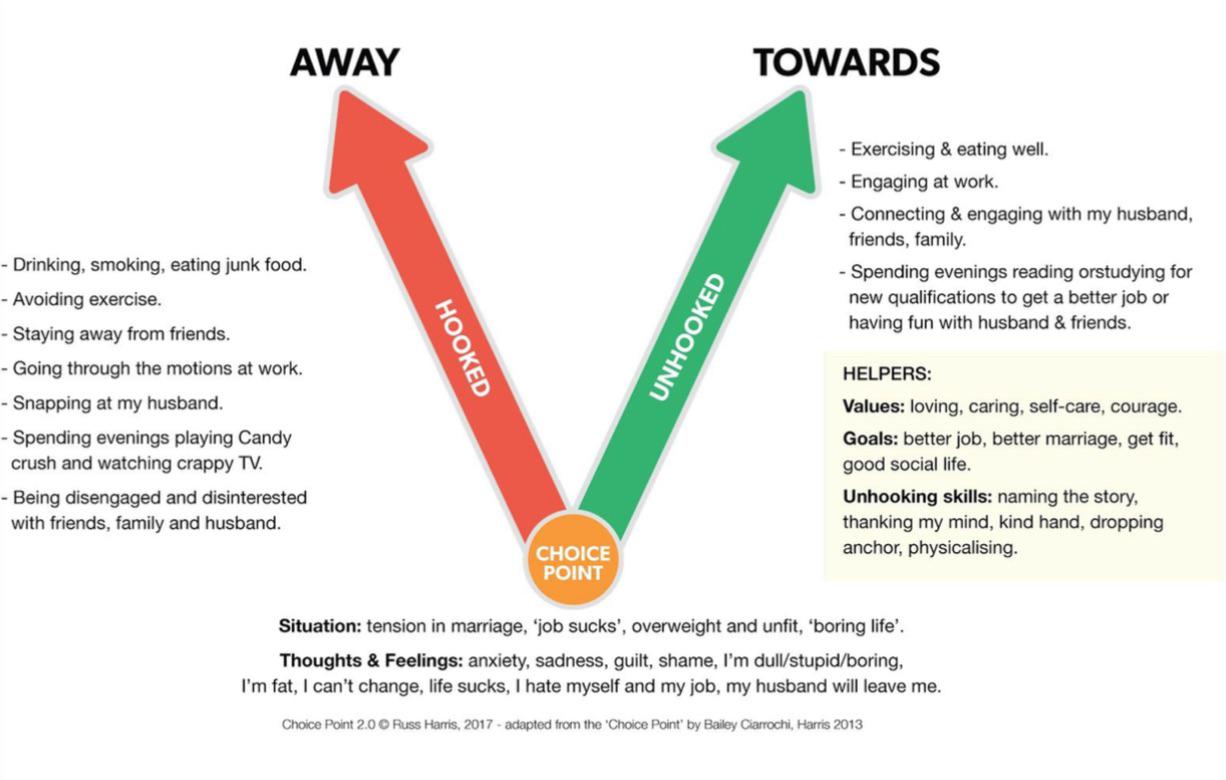
When it comes to the ACT choice point model (Russ Harris, Happiness Trap) with the “towards” and “away” actions, I’m curious about other people’s reflections about the “towards” moves.
Specifically, I’m curious about the effectiveness of invoking values that aren’t directly relevant to the choice point.
For example, if my core values are:
community and quality people connections
justice and integrity
organisation
determination and “seeing it through”
creative and courageous storytelling
And I have a situation where I’m disorganised and unprepared for something which threatens my expression of community and quality people connections, do my towards actions have to be in the same vein? Will it be way more effective to try to restore my ability to live out the particular values that were shaken in the situation?
OR would, for example, doing some creative and courageous storytelling about it be just as effective? Or “seeing through” something else on my plate? What about something even further disconnected from the situation like cleaning my oven which would be seeing something through?
This is just an example, but I’m curious about others’ thoughts and experiences using the choice point model. My hunch is that the towards actions are probably the most powerful when they touch the same values at play, but perhaps the best thing to do is anything that feels accessible.


