r/acceptancecommitment • • Apr 20 '26

Concepts and principles How ACT therapy can feel confusing from a patient’s perspective

0 Upvotes

ACT is starting to become more popular in the world of anxiety disorders, but many patients aren’t aware of some of the parts of ACT that genuinely sound confusing once you say them out loud.

This isn’t an attack on ACT — it’s just a patient’s perspective on parts of the model that felt confusing in practice.

Confusing aspect 1: ACT openly says it does not aim to reduce psychological distress. So if you’re being tormented by intrusive thoughts, ACT’s official stance is: we don’t aim to stop or reduce the impact those thoughts are having on you.

And in real ACT sessions, this is exactly what happens: when a patient talks about their distress, the therapist redirects away from it. That isn’t a misunderstanding — it’s the model in action.

For someone who is suffering, this feels bizarre. You go to therapy because you’re in distress, and the therapy says reducing distress isn’t the goal.

Confusing aspect 2: ACT seems to realise how strange their “we don’t aim to reduce psychological distress” stance sounds, so it adds a workaround: “We don’t directly aim to reduce your distress, but if you follow our method, the distress will reduce as a positive side effect.” In other words, ACT has to soften its own philosophy because the original version is too bizarre for any suffering person to accept. If your core model needs an immediate workaround just to stop clients walking out, that’s a sign the model can’t stand on its own.

Confusing aspect 3: ACT says that distress will reduce indirectly, but when you ask why, the explanation falls apart. You don’t get a mechanism — you get process labels like “psychological flexibility” or “reduced avoidance.” These aren’t explanations of why distress goes down; they’re just descriptions of what the person is doing.

And when you strip away the jargon, the honest answer is simply: “We don’t know why.” This isn’t me being harsh — ACT’s own literature openly states that it doesn’t claim to explain the mechanism behind symptom reduction. A therapy that relies on indirect symptom reduction should at least be able to explain the reduction it depends on.

Confusing aspect 4: After promising that distress will reduce as a positive side effect — and after offering no explanation for why that reduction happens — ACT introduces a new move: it says that symptom reduction isn’t the aim.

But if that’s true, then how does ACT define success?

ACT measures success by whether you keep functioning, not by whether your distress improves. ACT says pain can’t be reduced, so the only goal left is to keep functioning. But it is a medical fact that CBT — specifically ERP — reduces anxiety, which is one form of pain. So ACT is built on an incorrect assumption.

Confusing aspect 5: ACT’s underlying model comes from Relational Frame Theory (RFT). RFT explains how the mind links words and ideas together. For example, if a man loses his job, he might automatically link “men with jobs are providers” to “men who don’t provide are inadequate,” and from there to “I am inadequate.” No one teaches him those extra steps — the mind derives them automatically. That’s the kind of thing RFT is good at: how language creates chains of meaning.

But RFT mainly focuses on one part of what happens when a thought appears: how the conscious mind interprets its meaning. It doesn’t directly address the brain’s automatic danger‑interpretation — the fast, protective reaction that kicks in before you’ve had a chance to think. And for many people, that initial danger‑interpretation feels like the dominant part of the experience, long before the conscious mind gets involved.

So the real question is: what makes the brain’s alarm system fire in the first place?

This is where RFT becomes limited. RFT doesn’t explain why intrusive thoughts appear — it only explains how the mind links ideas together once the thought is already there. So ACT ends up focusing on how you relate to the thought, not why the thought is happening in the first place. And when you don’t understand why intrusive thoughts appear, you can’t change the conditions that trigger them — so they usually return in the future. ACT/RFT is like taking tablets to stop headaches without treating the ear infection that is causing them.

Confusing aspect 6: ACT assumes psychological flexibility — basically, the ability to stay calm and choose your actions even when your mind is screaming — is something you can maintain indefinitely. If you are off work and seeing a therapist, you have the space and energy to do what ACT requires.

But once your mental health improves, you return to your old life of work, family stress, exhaustion — and doing psychological flexibility in the way ACT expects just isn’t realistic anymore. Intrusive thoughts return, not because you “lost flexibility,” but because the underlying conditions that produced them never changed.

ACT has no mechanism for this, so for some patients relapse can end up being interpreted as a kind of “failure to stay psychologically flexible,” rather than as a predictable stress response — even though ACT doesn’t intend it that way.

I’m not saying ACT is useless. It can absolutely help people cope. It can reduce distress as a side‑effect. But coping and understanding are not the same thing. And if ACT is going to become more popular in treating intrusive thoughts and anxiety disorders, then patients deserve the full picture. Some people will find ACT enough. Others will feel like it helped them survive the storm but didn’t explain why the storm formed in the first place.

I’m genuinely curious how others experienced ACT. Did it help you cope but not stop the thoughts. Did relapse get framed as “you fused again.” Did the “we don’t target symptoms” stance feel strange or invalidating. Or did ACT feel complete for you, even without explaining where the thoughts came from.

r/acceptancecommitment • • Feb 14 '26

Questions Why Accepting My Feelings Didn’t Make Life Easier ? NSFW

4 Upvotes

I can’t understand the idea of “you can’t change a situation, but you can change how you feel about it.”

There’s a saying in my country that goes: “If you can’t resist rape, then enjoy it.

Okay, this is how I understand CBT.

So I turned to ACT looking for a more rational answer, but instead it feels like it’s telling me to accept the rape and not resist it, because resisting would cause suffering.

Someone will tell me, “No, that’s misleading. It tells you to accept the pain and move toward meaningful action.”

but if you live in a third-world country where you have to study long hours every single day because your only hope is to get into medical school, and in the end you still earn a salary that isn’t enough while working 12 hours a day, that feels like being raped every day, and you can’t say no.

I’m not saying it’s completely useless. It does seem helpful when the struggle is in the past, like old shame, embarrassment, or similar experiences that are no longer happening but still affect you mentally.

It would be one thing if acceptance-based therapy were marketed to people whose struggle has already passed but who are still dealing with it psychologically. But that’s not how it’s marketed. It’s marketed to people who are in an ongoing struggle.

I tried accepting my feelings and not fighting them, but I didn’t feel any change. The work in front of me is still hard.

ACT did not promise to change my feelings, but I expected it to increase my psychological flexibility after applying all its techniques.


r/acceptancecommitment • • Oct 28 '26

Does anyone else find defusion songs completely disturbing?

3 Upvotes

Exact examples of negative self-statements

“I am worthless.” — explicitly used as an example of a thought to sing to Happy Birthday.

“I am ugly.”

“I am a failure.”

“I am stupid.”

“I am a bad person.”

“I ruin everything.”

“I am broken.”

“I am helpless.”

“No one will ever love me.”

“I wish I wasn’t me.”

The research paper by Larsson and colleagues lists these as actual negative self-statements used in a study of cognitive defusion. Its exercise instructs participants to sing a chosen negative thought to the tune of Happy Birthday.

Why the hell are we telling people to sing their deepest pain and shame or "I'm a horrible person" or "No one will ever love me" to the tune of Happy Birthday, a song meant to celebrate their existence on the planet? And the goal is not to change the thought or to make it feel ridiculous or minimize it.

I don't care about the intent. I don't even think it works. But even if it did, I find it very disturbing. If someone had told me to sing any of those in a cartoon voice to the tune of happy birthday, I would be sobbing and deeply distressed.


r/acceptancecommitment • • Mar 11 '26

Why would somebody "do something anyway regardless of your beliefs about the world" that they believe is extremely likely to fail? Do you think beliefs don't limit the breadth of a person's imagined possible behaviour?

1 Upvotes

Let's say somebody grows up in a way that creates this strongly-held belief:

"Every couple hates each other, is miserable and fights all the time and this is what people prefer over being uncoupled"

According to ACT, their belief shouldn't influence their behaviour. They should just do whatever behaviour they want to do, regardless of their beliefs.

Ok, so let's say the person thinks it would be good if couples didn't hate each other and this is the life they'd like to live. But why would they attempt to follow this goal - which requires the input of other humans - if they fully believe it true that other humans all prefer to be in couples "who hate each other, are miserable and fight all the time"? Why would they follow a goal that according to their (incorrect, but they don't know it's incorrect) beliefs about the world is futile?

What's actually more likely to change their behaviour is to change their beliefs about the world (ie that they are incorrect about the chances of being in a non-hateful couple).

Interestingly, the ACT therapists who push this "changing beliefs is irrelevant" themselves have been benefiting from having beliefs which are conducive to a normative life (eg the ACT therapists who grow up knowing that not all couples hate each other, and then accordingly pursue relationships and marry at a young age. So they're benefiting from something, but then attempting to deny that benefit to others, by advocating against the shifting of beliefs).

Do ACT therapists really think that most people will follow goals that are extremely improbable or impossible? Humans have limited time and energy in their lifetime (since we're not immortal) - why would they put time and effort into goals that they think are extremely improbable, over ones that they think are more probable? The ACT idea of "do whatever you want regardless of beliefs about the world around you" ignores how humans actually operate. Humans operate on probabilities. Even when looking for a job, a human puts their effort into trying to get a job they prefer, but that also meets a level threshold of probability of getting the job. Nobody without any qualifications is sending 100 applications to be a professor - they're sending applications to jobs they think they have a higher probability of getting.

When somebody is given a gun that has 4 bullets and 1 empty chamber (russian roulette), if they're told that if they pull the trigger on themselves without being shot they'll win $50, if they fully believe that there are no bullets in the gun, they're more likely to pull the trigger based on there being less risk. The most reliable way to get them to pull the trigger is going to be to show them that there are no bullets in there, ie to change their beliefs. People act according to their beliefs about the world, and to claim it's possible to act the exact same way irrespective of beliefs is just playing make-believe about the human mind. Even if you counter argue with "they could think it's worth the risk no matter what, for the $50", this is still a belief about the value of their life versus the value of $50 - their beliefs are still dictating their behaviour.

Likewise when people interact with objects or with people, they do unconscious and conscious risk analyses based on their beliefs, and these determine how easy or difficult it is for them to perform an action (more risk=more fear=more mental energy needed to perform), which determines how likely they are to do the action. Say a person has 10 goals for the day, and based on the risk analysis caused by their beliefs, all 10 tasks are at the edge of their window of tolerance. They are much less likely to have the mental energy to do all 10 tasks compared to if they had different beliefs which create a different risk analysis which moves 9 of those 10 tasks comfortably into their window of tolerance - with 9 of the tasks now being perceived as low risk, they will be able to do more of the tasks because the tasks now require less mental energy. Ergo, their behaviour is dictated by their beliefs and the most reliable way to change behaviour is to change beliefs, where possible ("where possible" because sometimes it will be impossible to change beliefs. Eg if you see a human eat an orange, it will be hard to convince you that humans can't eat an orange).

Right now, there are billions of things you aren't trying to do, that you haven't even thought of. You haven't thought of them and aren't trying to do them because your beliefs do not make them seem possible. Your beliefs are such that you don't even consider doing billions of things (eg you aren't considering trying to teleport to Jupiter to buy an ice cream, because your beliefs don't make it seem possible, so you don't bother giving it thought, so you don't bother with the behaviour of trying to teleport).


r/acceptancecommitment • • Jun 09 '24

Questions Using AI to improve as a therapist

5 Upvotes

Hi, I would love to improve my skills as a therapist using AI, what prompts do you use and would recommend?

I specifically want it to behave/answer as a patient so i can detect and identify CRB1and CRB2s (Functional analytic psychotherapy) in its responses so i can implement it with real patients. I would like it to describe nonverbal changes too (movement, tension in the voice, eyes...).

Thanks!


r/acceptancecommitment • • May 31 '26

Is ACT itself opposed to truthfulness (as an ethic or value)?

0 Upvotes

Since stories about life are advised to he held based on whether they are helpful or not and not whether or not they are true. A person could commit lots of crimes against others, and tell themselves "I am a great person who acts justly" - this is helpful to them, albeit narcissistic (the entire idea of living by values also seems narcissistic to me. Instead of caring behaviours being driven by genuinely caring about others, decisions to act as if one cares are driven by "I'm following my values of seeing myself as a caring person because it serves my adherence to the ACT philosophy" rather than about genuine care for anyone else).

A very privileged person can, with ACT's blessing and lack of care for truthfulness, weave a story of them being less privileged than others who in actuality were less privileged. Society turns into a race to the bottom in terms of honesty, as when some people start lying to get ahead, others must join in to avoid being left behind (eg no politician wants to admit to their mistakes, because their opposition are not honest enough to admit to their own mistakes, so whoever is honest will end up looking much worse than their opposition. If 80% of people successfully exaggerate about themselves to get jobs, the remaining 20% will look much worse to employers unless they also begin exaggerating). This dishonesty also can be used to deepen inequalities, by causing more funding to go to people who already are better off and less to those who are worse off. And of course if I tell myself a story of being underprivileged, I am in effect telling other people they were privileged, so if it is a dishonest story, I am now encouraging others to view themselves through an inaccurate lens - I may be encouraging those who have face more hardship than me to view themselves as having faced less hardship, and thus be harming their self-esteem, all in the name of doing what is "workable" for my own life goals of feeling good and being successful.

A person could be truthful at work and not get socioeconomically ahead. This isn't workable, so would ACT advise them to become a liar and to exaggerate and lose humility?


r/acceptancecommitment • • Dec 15 '24

Questions Do you correct other clinicians who pronounce ACT incorrectly?

0 Upvotes

A lot of people I know pronounce it with each letter, instead of as one word. You know, they pronounce it like you'd pronounce the ACT college exams. I haven't corrected people because I don't like the idea they might argue about it.


r/acceptancecommitment • • Sep 08 '24

Concepts and principles ACT is deeply rooted in buddishm

19 Upvotes

Hi,

Concepts as "self-compassion", the "observing self", "acceptance of suffering", the importance of the present moment. All thise ideas come from buddishm. Why is this not stated more clearly in ACT?

Edit: thanks everyone for your contributions, resources and being civilized. My intento was just to have a constructive debate. I will add that I resonate a lot with behaviorism, RFT, ACT and buddishm.


r/acceptancecommitment • • Apr 16 '24

Questions Why the pronunciation insistence?

4 Upvotes

I’ve been suggested to look into ACT by a psychologist I am currently seeing, and I’m definitely intrigued.

Looking into it, multiple times I’ve seen it stressed that ACT is pronounced “as a word, and not the letters.” This just seems like a really weird thing to say to me, so I’m curious why I’ve now seen it across a few practitioners.

I mean CBT meant something very different to me before therapy and I don’t see people getting fussy over it…


r/acceptancecommitment • • May 01 '24

Questions A value that contradicts ACT itself- how would this be handled?

3 Upvotes

While not having gone through it directly, I have a therapist who uses similar principles that we have discussed using and I have read The Liberated Mind. And I feel like one of the key values I have is utterly irreconcilable with what ACT would have me do. For what it is worth, I am diagnosed with autism spectrum disorder with all that entails, including alexithymic traits and social anxiety.

See, it's the value of struggle. That even if a battle is unwinnable it is better to have fought it at all than to have assumed it to be insurmountable. That value in many ways has been absolutely critical to get me to my current state in life and in its absence the quality of said life would be noticeably worse in several different aspects. I have dealt with my social anxiety through avoidance when my strength was insufficient and direct confrontation when it was; like everyone else, my power over myself is not absolute but that means only that I must continue to increase that power. Though they have not always succeeded, I believe that said struggles have always pushed me in the right direction towards creating the connections I seek regardless of their outcome.

But acceptance as it is described in ACT (or at least my interpretation of it) is little different from simply letting the negative thoughts and feelings that I struggle with to do as they please with me. That if I cannot be the master of my inner world, I must be its willing slave instead. (To a degree I also resent being told to identify with my childhood self- the eight-year-old me Hayes speaks of is not me anymore and I view that identification as just shackling myself to my own past and denying my future). That I must embrace my own weakness even when I could instead become strong enough to overcome that weakness.

So how would I go about pursuing such a value according to ACT when the very things I do that uphold said value are branded "inflexible" and a cause of my issues? The entire "acceptance" part of it simply cannot coexist with the value that tells me that to unconditionally embrace the thoughts and feelings that I see as uninvited guests is to give them full power over me - a suggestion that I know from experience leads to meltdowns and overloads whose effects are unpleasant for all involved with them because that's what happened when I couldn't or wouldn't resist them. If those feelings proved to be transitory, it was only because eventually my mind grew too exhausted to process them any further and simply burned out.

But I can't imagine that I am the only person who has ever stumbled into this contradiction, hence why I ask the people here about it.

EDIT: I think I need to engage more carefully in some of the specific practices here, as my therapist has advised me that I am rushing into this faster than I ought to. I hope nobody minds if I ask further questions about them on other posts.


r/acceptancecommitment • • May 15 '23

Questions Question

1 Upvotes

It's just me who thinks it takes intensive deliberate practice to master ACT and 1 year.


r/acceptancecommitment • • Jan 28 '26

Questions There is something depressing about ACT

17 Upvotes

If I am not mistaken ACT implies that the symptoms that the person experiences will continue for the rest of their life and there is way of "eleminating" them. Am I correct? If so, that feels a bit depressing.


r/acceptancecommitment • • Jun 02 '26

Some "values" are surely also goals and not only values

4 Upvotes

According to ACT, values are not goals. They are only values, not goals. However, these are all also goals:

"Friendship" - it is a goal of having friends.

"Home" - it is the goal of having a space (through buying or renting a dwelling, which is a goal) to make into a home. Or if "home" is supposed to refer to having a tribe where one feels belonging, it is the goal of having this tribe. This is something you acquire (through either actively or by chance building it, oe being born into it). If someone has a house, they have the value of home. If they become homeless the next day, they no longer have it.

Family - same as friendship or home. It is something you acquire or are born into. Someone can have a group that is their family and they can all die in a hurricane, murder or genocide, and they now do not have this "value". Family is a goal as well as a value.

Romance - it is the goal of having someone to be romantic with (a partner in romance).


r/acceptancecommitment • • Jun 30 '26

I don’t feel entirely keen on acceptance and commitment therapy, because ACT makes comfortable emotions less enjoyable to me

14 Upvotes

ACT teaches people to name their emotion and acknowledge to themselves that it‘s just a feeling. It will pass. Nothing more, nothing less.

Now this mindset is pretty helpful if you‘re dealing with uncomfortable emotions like sadness, anxiety, anger etc. It has certainly helped me create a bit of distance between me and my anxiety and this technique has often helped me lower the intensitiy of my anxiety

The downside however is that this technique kind of also ruined some Moments for me where I actually felt good.

I was laying in bed the other day on my phone, eating breakfast and I felt Super relaxed. My Brain automatically went: „this relaxation is just a feeling, it will pass“ and then I was like: „oh…“ and then the intensity of my relaxation decreased and although that moment was still enjoyable, it became less enjoyable because of ACT.


r/acceptancecommitment • • Apr 29 '25

Any Life Coaches using ACT?

0 Upvotes

I'm a certified life coach and we learned about ACT in my program. It seems like ACT's nonlinear model and practical tools/exeecises would lend itself well to the coaching environment. But given that most of what I've seen (here and in other boards) is that it's therapists who use ACT, I'm wondering if anyone in this group a life coach who uses ACT? Or has anyone received life coaching from someone who used ACT?


r/acceptancecommitment • • Sep 29 '26

Questions For the psychotherapists

0 Upvotes

I can't see reading endless books as being very efficient. What do I do since I can't afford to go to school. To basically "become a psychotherapist" from home. But obviously I won't be accredit. I just want to basically learn everything I can to be as ready as possible for when I do decide to go in.

--

So I just was wondering if someone could tell me where to begin? AI can't do it and is surprisingly not in - depth and thinks I'm already a Wizz lol.


r/acceptancecommitment • • Oct 20 '26

Questions Is ACT supposed to make things easier?

6 Upvotes

Been trying to do ACT for about a month and a half now and I honestly feel like it's not really doing anything or even that helpful. I have ADHD, Depression, OCD, and mild Autism so it's a lot of things to deal with. I understand that the goal isn't to feel better, but I thought ACT would atleast make things easier to do but things are still as brutal and hard as ever. I still get daily low moods, feelings of loneliness, sadness, hopelessness, fused to my thoughts, etc and I know ACT isn't aimed to reduce those, but it's exhausting to do these things daily when you do feel those frequent low moods, negative thoughts, low energy, executive dysfunction, racing thoughts, etc.

I thought connecting to values would make things easier to start when you're not in the mood for it (like I typically am), but nope things feel just as difficult as before I even knew about ACT. I thought defusing from thoughts would make it easier to commit to actions and actually do them, but nope, same exact difficulty as before. I thought acceptance would make feelings easier to carry along when you want to actually do something differently, but nope still as difficult as before. And after dealing with this daily again and again, I just start to wonder, what's even the point of ACT if life is essentially the same as before I even knew about the concepts of ACT.

I always knew that even though I feel sad or unmotivated in the moment, that we can technically still act differently and choose different actions, that awareness was not my problem, my problem is actually DOING those things is almost impossibly difficult to start and do. I know of the example of thinking "I can't lift up my arm" and you just lift up your arm, and it's hard to describe but this problem is not as simple or easy as just doing that.

I'm just so exhausted at this point and I notice that I'm feeling down and hopeless because I realize that ACT won't consistently make these things easier since these are factors that aren't fully in my control in the first place. Does anyone have any advice or maybe I'm just misunderstanding some aspect of ACT that will help me get through this?


r/acceptancecommitment • • Aug 24 '26

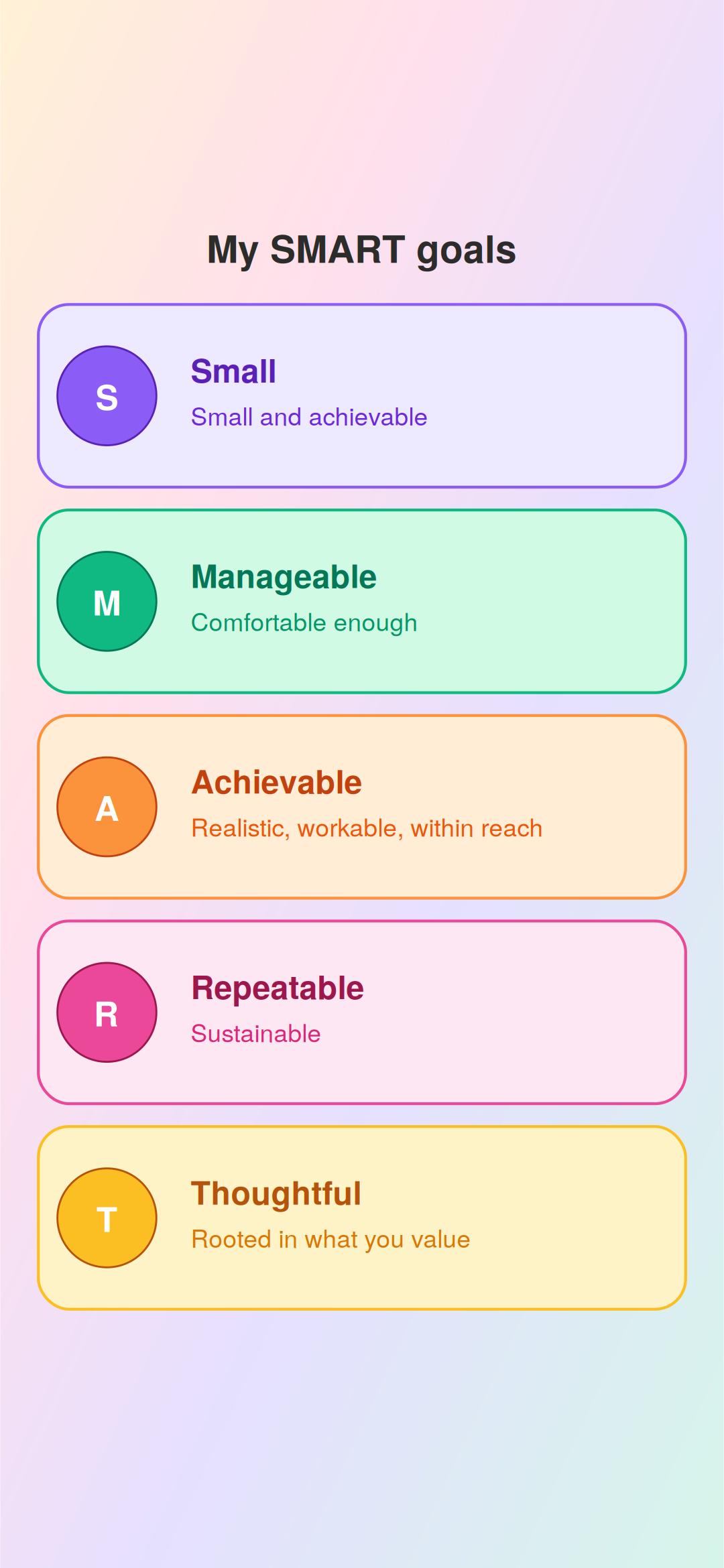
Concepts and principles I adopted S. M. A. R. T goals

Post image
24 Upvotes

I adapted smart goals. I found the conventional one too textbook. It didn't make sense and I found it nothing but stressful. So I adapted this based off different therapy I did. It applies to ACT I think....

I made it with ClaudeAI, when it was done gaslighting me.

More of a discussion thing. But it applies to ACT because it involves effective and committed action in a valued direction.


r/acceptancecommitment • • 24d ago

Concepts and principles Is this idea not really a part of ACT therapy?

3 Upvotes

I will preface this with stating very clearly that I am not talking about situations of abuse, neglect, harm, coercion, etc. I am talking about most of the "boundaries" people are trying to set with loved ones.

Idea; If someone does something that I don't like, that's my problem to work with. It's where I am still attached thinking about the way things "should" be. In my situation particularly I am talking about my marriage.

I've talked to 3 different therapist about this over the last few years and none of them really understood where I was coming from. Granted only the most recent one practices ACT. But they are really set on their idea of setting boundaries and then sticking with them. That idea just is so insane to me with marriage particularly because if there's no actual abuse or cheating (my only two absolute values), it's kinda what you signed up for getting married; By that I mean all the goods AND bad things about the other person.

I am trying to figure out how to actually change the way I look at things. How to really accept reality as it is today, and not dwell on things that happened in the past that I thought shouldn't have, but also things that didn't happen that I though should have.


r/acceptancecommitment • • Jan 12 '26

Questions Dealing with overwhelm

3 Upvotes

I've identified my main feelings as overwhelm. There's likely some burnout in there too.

With ACT, I know we usually go to our values and follow them to see what needs to be done and how to do it.

Part of my problem is that I'm overwhelmed by having to do things that aren't optional. I've been apartment-searching for months. I am not being too picky; it's just hard to find everything I need.

I had a couple of my specialists leave. I have to find doctors. That's a must, and have to be seen soon so I don't run out of meds.

The things that are "optional" are things like supporting a friend after the sudden death of her son or helping another friend after back surgery. Those are definitely based in my values around showing care. I have other things going on, too, mostly in the category of things I have to do. I'll add that I live alone, still don't know a lot of people in my new city, usually don't have much money, don't have a car.

I have tried offloading some tasks, like paying someone to go through apartment listings, but nobody I talked to seemed to understand. So it's all to me, and no wonder I feel like I'm staring at a wall and can't even pick out what's what anymore.

So what's the ACT way of getting through overwhelm when


r/acceptancecommitment • • Jun 16 '22

What sound does a gub gub make?

7 Upvotes

I read that section in the workbook a month ago. I am certain if, on my deathbed, Hayes comes and asks me what sound does a gub gub make, I'll remember the answer is "woo."


r/acceptancecommitment • • Oct 02 '24

30 second activity : ACT (Acceptance & Committment Therapy)

8 Upvotes

this 30 second activity is BUNK. LAME. TERRIBLE. You repeat a negative word from a negative thought over and over again for 30 seconds. IT SUCKS. why would someone do that? You get in a fight with your boss so you repeat over and over again 'jerk'??? that doesn't help one feel better at all. In fact it makes you angrier and MORE pissed off and sad.

Please someone tell me WHY this 30 second activity is supposed to be good OR how I'm doing it wrong???

I'd like to repeat the positive version of the interaction but why the negative???? URG>


r/acceptancecommitment • • Feb 16 '24

Questions Will ACT be of any use to me?

8 Upvotes

So. I've just started with ACT out of desperation, but there is a chance I'm wasting my time.

The core principle is values. Alright then. Among others, my two main values are health and youth. No, I cannot reframe it, and yes, I'm sure they are indeed deep, ingrained values.

Im not young anymore. I can't move towards this value for obvious reasons, and I can't bullshit myself into "age is just a number". Yeah, a number, an objective number, with all accumulated problems, tiredness, pain and sorrows. Free spirit of youth and opportunities are gone forever.

But whatever, this one is pretty stupid and childish, and the only way to do something about it is to gaslight yourself. I get it.

Health is where it gets interesting. I have a number of chronic conditions. My health will NOT get better, it can only become worse. It's not even about my ability to participate in life - it's that I can't feel like myself when I'm unhealthy, you understand what I mean? Im somehow supposed to strive towards my value, but the moment I'm in a quiet enough room, my tinnitus reminds me that this value is unachievable.

Side note: it's not just a silly game, I'm on a verge of completely giving up on life. There are other problems of course, but health is like a foundation of everything - I need it to feel like a human. I need it to have an opportunity to think about the future.

So? The values, which are the core of everything in ACT (as long as I understood correctly) are not achievable. Actually, the fact of their inachievabiluty is a torture in itself.

So?


r/acceptancecommitment • • Oct 06 '25

Questions Looking for good free program?

4 Upvotes

Note: I don't know if this violates the sub rules. I hope I don't get banned.

I can't find any free programs on YouTube. Can anyone share their psychwire account with me, or if they uploaded it to Drive, for example, can they share the link with me?

I live in a third world country so my income level does not allow me to buy anything


r/acceptancecommitment • • May 02 '24

Questions Cognitive defusion advice

4 Upvotes

After my last post, I've tried to engage more closely with the ACT principles and started to attempt some of the cognitive defusion exercises. However, they seem to constantly backfire on me.

When I do the task "I'm having the thought that X", I am immediately bombarded by a dozen other thoughts that all echo X in various flavors of "and the rest of me agrees with it", too many to handle at once. When I try to observe my thoughts externally, I find that I can only describe them as what they are not. And when I repeated them in a sing-song voice, I still end up focusing on the message itself over the way it is conveyed.

It doesn't help that several of the thoughts aren't verbal or even visual- they're more like primal emotions or impressions that bypass anything that can be called consciousness to go straight to my lizard brain. They're not even concepts so much as some kind of atavistic pre-concepts that language can't describe properly.

What am I doing wrong? Does this simply require extensive practice?