Hey gang, I saved my introduction for last and this whole thing really got away from me, so I’ll keep it brief: I’m Excalibur, commentator for All Elite Wrestling (watch Dynamite on TNT every Wednesday at 8/7c), and self-professed wrestling nerd. While I have not received my Wrestling Genius certificate, I’ve known Chris Hero for almost 20 years so I know he’s good for it.
As far as my wrestling tastes go, I appreciate pretty much everything, from dirt lot lucha to 60 minute epics at the Tokyo Dome, but my sweet spot is really 1990’s Japanese wrestling. The early 90’s saw the establishing of the Four Pillars in All Japan, the breakout of the Junior Heavyweights in New Japan, the incorporation of Lucha Libre into the Japanese style in Universal and later Michinoku Pro, the abundance of fantastic matches and rivalries in All Japan Women, and so much more. As we headed toward the 2000s most of those things would get completely disrupted, so 1998 was a pretty great year for professional wrestling.
When Hero first asked me to contribute I was a little nervous because he said I could talk about whatever I wanted. That was a lot of pressure, and I ended up stumbling into this particular match while doing research for the first idea I had (Koji Kanemoto vs. El Samurai from the Best of Super Junior IV Finals), and I’m pretty happy it worked out that way. This was such a left field pick that I told Hero there was no way he could guess which match I picked, even if I gave him the month, year, and country. I was right.
All Japan Pro Wrestling
July 15, 1998 – Osaka, Japan
The Scene
It’s a hot July night in 1998 and ~3,200 people have crammed into the Osaka Prefectural Gymnasium (now EDION Arena) for All Japan Pro Wrestling’s Summer Action Series Tour. Local favorite and then-freelancer Super Delfin will compete in the opening tag team contest, AJPW founder Giant Baba will take part in a 6-man tag team match, and in the main event, the Holy Demon Army (Akira Taue & Toshiaki Kawada, in their fifth reign as champions), will defend their AJPW World Tag Team Titles against Yoshihiro Takayama & Gary Albright. However, the match that brings us here is the semi-main event, with Masahito Kakihara taking on Kenta Kobashi.
Kenta Kobashi vs. Masahito Kakihara
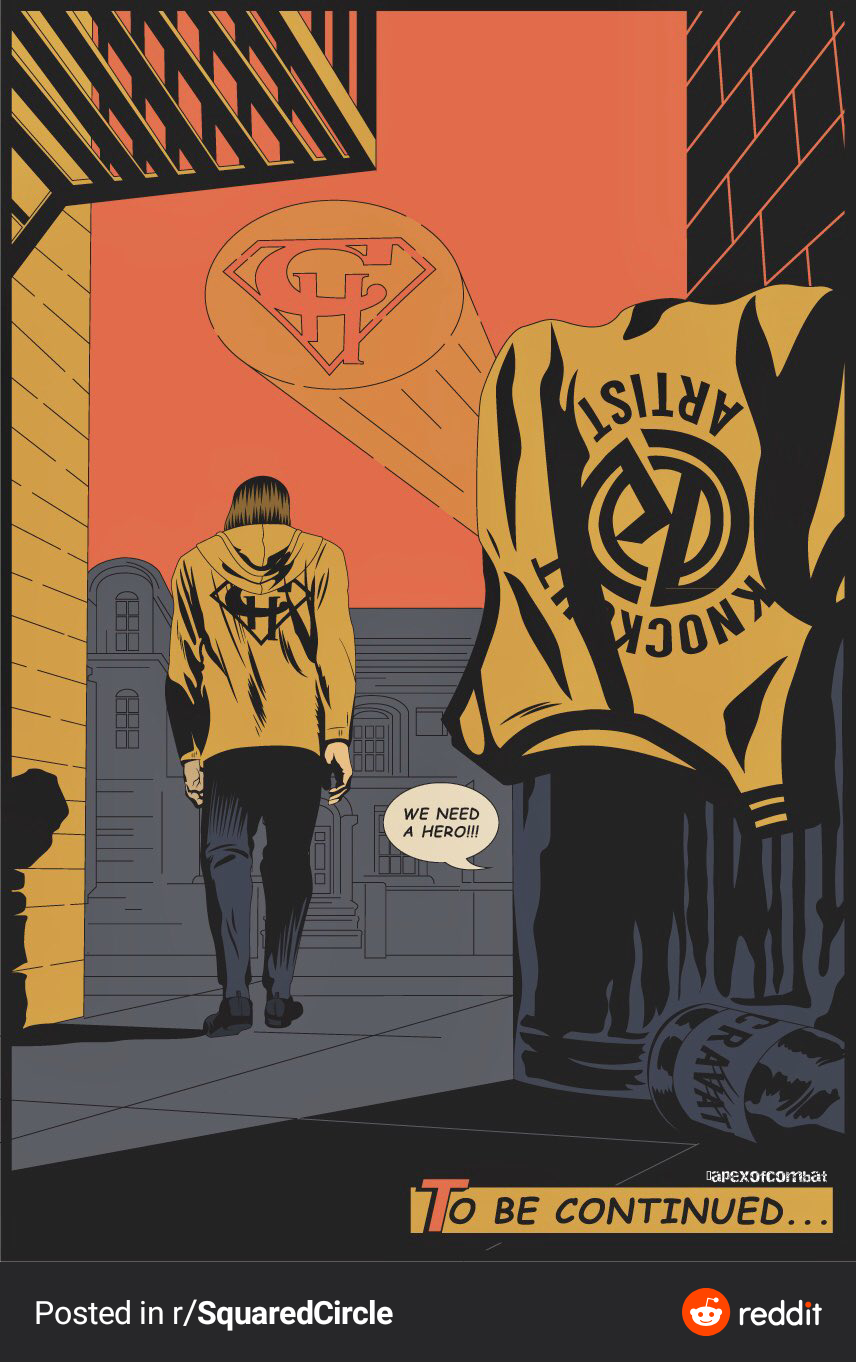
Orange wrestle-y guy vs. Yellow kick-y guy.
The Players
Today, if you were to ask many fans and wrestlers that grew up in the tape trading era who their favorite Japanese wrestler is, Kenta Kobashi would place high on many of those lists. Kobashi was part of the Four Pillars of All Japan Pro Wrestling (alongside Mitsuharu Misawa and the aforementioned Taue and Kawada), and a large part of that is due to the universal appeal of his in-ring fire. Through the early 90’s Kobashi was primarily a tag team wrestler, but in 1996 he won AJPW top singles title, the Triple Crown Championship (the unified PWF World Heavyweight Championship, NWA United National Championship, and NWA International Heavyweight Championship) for the first time and from that point on would focus on singles wrestling for the rest of his AJPW run (though occasionally still teaming, and winning championships, with Johnny Ace and Jun Akiyama).
Kobashi, like all of his Royal/King's Road brethren (practitioners of the AJPW style) had a full complement of moves that could finish a match, effectively ranging from a lariat honed by competing against the likes of Jumbo Tsuruta and Stan Hansen (a cannon) to the Burning Hammer, a sickening move that Kobashi only used a handful of his times in his career (a nuke, yet became ubiquitous on the US indy scene [because at the time we knew nothing]). A cannon will finish most opponents, but you need a nuke to take down Godzilla.
Not to take anything away from him, but it is unlikely that Masahito Kakihara would be a part of anyone’s top 5 list. Kakihara was a stand-out prospect in the promotion known as Newborn UWF in 1989, and continued his training under the legendary Billy Robinson at the Snakepit when the group transitioned into UWFi.
Sidebar: The original UWF was formed in 1984 when a group of wrestlers left New Japan Pro Wrestling to form an organization with a more martial arts based (or “shoot”) style, the first major organization to do so. UWF disintegrated after egos of many of the top stars got in the way, though just two years later many of those that returned to NJPW would leave once again to form Newborn UWF, which would once again close its doors in 1990. UWFi would become the most popular iteration of the group, opening in 1991 and engaging in a co-promotional feud with NJPW in 1995, eventually winding down for good at the end of 1996. Notable UWF/UWFi alumni include Yoshihiro Takayama, Kazushi Sakuraba, Gary Albright, Nobuhiko Takada, Vader, Masakatsu Funaki, Ken Shamrock, and Minoru Suzuki.
Kakihara was seen as a promising competitor by both UWFi and NJPW, notably scoring wins over Shinjiro Ohtani and Yuji Nagata, as well as Kensuke Sasaki at the interpromotional Tokyo Dome event in 1995. Kakihara would stay with UWFi until they shut down. He would spend 1997 as part of another UWF offshoot, Kingdom, then in early 1998 he would start with AJPW, teaming with his former UWF competitor (and good friend) Yoshihiro Takayama in his first match with the promotion. His first singles match in AJPW would take place on July 15, 1998, when he faced Kenta Kobashi.
The Match
While not a particularly remarkable pro-wrestling match in either man’s career, especially Kobashi’s, what drew me to this match was that it is a fantastic example of storytelling transcending language barriers. I was locked into Japanese wrestling in the 1990’s, despite understanding only a handful of Japanese words. This was a time when American wrestling was becoming very promo-heavy which I did not enjoy all that much, pushing me toward Japanese wrestling that much more.
If you were to show this match to someone that had no familiarity with either Kenta Kobashi or Masahito Kakihara, the story would be clear to the more observant in the first :10 seconds - Kobashi, the wrestler, stands flat-footed, attempting to get his hands on his opponent and grapple. Kakihara, the martial artist, is bouncing on the balls of his feet, constantly in motion in preparation for firing off a kick.
:25 seconds in, the wrestler pushes in and drives his opponent to the ropes, hoping to use his size and traditional pro-wrestling style to overwhelm his opponent, and then at :33 seconds we see the first kick and we’re off to the races. In :45 seconds the audience was shown everything they need to know about this match: Kakihara has landed a kick on the visibly injured knee of Kobashi, Kakihara has a tremendous speed and lower body striking advantage, and he has used all of those things to set up a suplex and cross arm breaker on his much larger opponent. The wrestler is in real trouble.
The fact that Kobashi is among the most popular wrestlers in Japan or that this is Kakihara’s first singles in AJPW reward the longer time fan, but in :45 seconds these two men allowed everyone in the audience to reach a point of understanding, which is the heart of pro-wrestling.
From there on the story of Kakihara’s striking and submission advantage plays out, with Kakihara punishing the right knee of Kobashi (which in and of itself it interesting because Kobashi has an orthodox stance and Kakihara southpaw, but Kakihara repeatedly goes after the far leg of Kobashi because he knows its injured), and when Kobashi does gain a submission advantage Kakihara quickly makes it to the ropes to force the break. This is both because Kakihara doesn’t have the pro-wrestling machismo of Kobashi, and better submission technique. Kobashi becomes increasingly desperate to escape the holds, finally resorting to using brute force, his chops, to force the break.
When Kobashi uses his upper body strikes he has Kakihara reeling, but Kakihara is able to put Kobashi on his back with three successive kicks. Kakihara uses those kicks to keep setting up submissions, whether it’s the middle kick to put Kobashi down and grab a submission on the mat, or the axe kick and almost a jabbing high kick to stagger Kobashi and bait him in for the flying cross arm breaker off the turnbuckle. There was real desperation on Kobashi’s face when he was locked into the the submission, and seemingly genuine relief when he made it to the ropes.
I’ve spent a lot of time describing what Kakihara is doing on offense, and that’s because Kobashi was selling Kakihara’s offense for about 85% of the match. Kenta Kobashi is the established star, the former Triple Crown Champion, and the much the larger man. Masahito Kakihara is the outsider, he’s never held a major championship, he’s wrestling his first singles in AJPW, and he’s the smaller man. In just a few minutes, Kobashi made Kakihara into a legitimate threat. This helps in the confines of the match itself and also Kakihara’s status in AJPW as a whole.
The finish comes when Kobashi hits a spinning chop that drops Kakihara to one knee. Kobashi, yelling at Kakihara, baits him into answering an upper body strike with an upper body strike. Kakihara gives up his entire gameplan in one moment, heatedly landing a pair of slaps on Kobashi which leads to Kakihara letting down his guard and ultimately to his undoing. Kobashi hits a single upper body strike, the burning lariat, and comes away with the victory. Yellow kick-y guy, remember? Kakihara forgot for a second, and it cost him.
The Video
https://www.youtube.com/watch?v=cvL77m929G8
Enjoy it!