r/WGU_CompSci • • Feb 07 '22

** START HERE ** BSCS MEGA POST

557 Upvotes

For more detailed info on any of the below topics, check out our wiki! https://www.reddit.com/r/WGU_CompSci/wiki/index/

This post was inspired by the growing number of amazing success stories accompanied with amazing advice. I could not pin it all! There has also been a growing amount of information I wanted pinned so I made this mega post ... A lot of this information is for students considering a BS Computer Science degree at WGU.

There is information for current students as well. Some of this information I mentioned previously (during more controversial times, lol). I'm attempting to put the highlights in one place.

Can I get a job right after graduation with no experience? A: Novice students who find SWE jobs shortly after graduation generally have at least two of the below:

  1. Are VERY good at networking or already have a network that can push their resume to the top of the pile.

  2. Have a solid portfolio or project that makes them stand out on paper and in interviews.

  3. Are VERY good at interviewing or know someone who can help coach or otherwise guide the candidate to slamming SWE-specific interviews.

-- For the rest of us, it takes many applications and getting the right pair of eyes on our resume at the right time. See our Employed flair; it usually includes what it took for those students to get their first job in the industry.

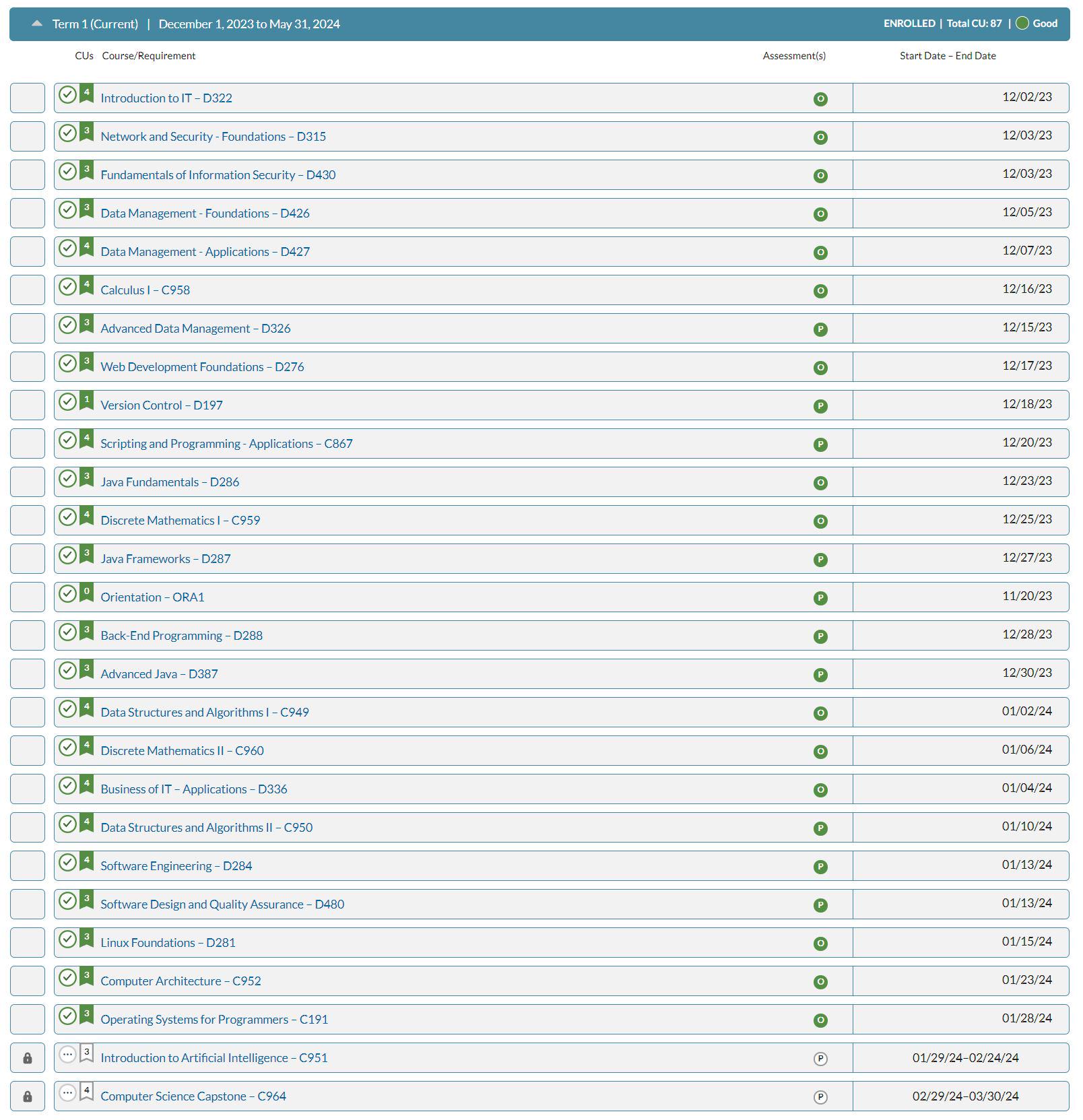
Can I complete the degree in one term?

A: Students who complete the program in one term usually:

  1. Have a heavy IT background (work in the industry or have a good deal of IT hobbies/side projects).

  2. Have a heavy CS background (work in the industry or have studied programming and algorithms prior to entering the program).

  3. Have a heavy Math background.

  4. Have no other obligations and love CS enough to devote the time needed to absorb and master the topics in a shorter period of time.

-- Reddit skews heavily to accelerators. Not every student is or can be one. There are many with the time but don't actually use the time given. There are many with less time but are able to use it more effectively. We can't determine which category you'll fall into by reading your short bio. It is not something I personally recommend.

BSCS TIPS

1. FIND YOUR COMMUNITY

In terms of stacking the odds in your favor, the best thing you can do for yourself at WGU is: learn to network and learn to foster professional relationships with aspiring and current engineers. WGU's greatest strength is that many of its students are already professionals in the industry or know professionals in the industry (if you are neither, you need to network your way in!). Many of these students/alumni are eager to help promising candidates. They are great resources to discover what you need to reach your goals and can offer a good deal of support and guidance.

A note on networking: if you find this idea awkward and scary, you likely waited too long to start. Get yourself out there. Write posts about what you're learning either by blogging or sharing resources/random facts. Ask for help. Offer help. Establish yourself as an increasingly capable developer. This will improve your ability to communicate about your experiences and make you more comfortable in the tech space. If you don't feel like you belong, that will reflect in your interviews.

2. CS & TECH FUNDAMENTALS

This is a good introduction to cs concepts. It will create a mind map of where your degree will lead and what to expect.  

It's important to understand the scope of the companies you're applying to, the products they're developing, and the tools they're using to develop/deploy products.

3. LEARN TO CODE 

This is going to be a controversial topic. I recommend learning to code before starting WGU. Learn one language well; then use WGU to improve your coding principles and projects. I've seen a few success stories of students who learned to code at WGU and get jobs after graduation; there are more success stories from students who received their coding background elsewhere. Web development used to be a hot topic in CS. I will say this much: capstone projects are simpler to complete as a web application and even if you have no interest in being a web developer, it is hardly a useless skill in this day and age. I list the following because they're free and cover a lot of ground. 

Full Bootcamp curriculums you can access for free (in alphabetical order):

I am biased towards 100Devs because it starts at 0 (your first lesson is how to learn). It covers soft skills and professional networking without skimping on the coding. It also covers the underlying CS behind the coding (threads, processes, execution context, etc.).

OTHER CODING RESOURCES:

FREE WGU Resources (check your student portal or ask your mentor)

Trial offers and discounts for JetBrains, Educative, and others

A FEW OTHER CODING NOTES:

Know your SOLID principles and at least read about software design patterns like MVC and DAO (bonus if you attempt to implement it in your WGU projects). Being able to discuss SOLID and OOP intelligently is important in interviews; you don't have to be able to do this before WGU but be sure you can do it by the time you graduate! Practice with any and all of the communities above. The more comfortable you are in doing this, the more confident you will be by the time you're ready to go on interviews. Your best practice will be walking a novice through the principles.

4. TRANSFER CREDITS

This section is for non-accelerators (students who only want to complete up to a few courses per month without paying full tuition for the privilege). There are a few recommendations on making the most of your money. Saylor exams are $25 each. Study can take up a lot of the lower level CS courses and provide a better introduction to the upper level courses than the WGU version.  Sophia has open book tests that are not proctored (mostly gen-eds). I won't recommend which courses to take this time. There are plenty of posts about that by now by many students. This is where you can take credits cheaper than WGU if you are not a super-accelerator. 

5. LEETCODE 

NOTE: Hacker Rank and Leetcode have free options but you will likely end up paying for one of these if you have to learn Leetcode. The further away you are from either coast, the less likely you'll need it. Do your research. 

Supplement WGU's DSA courses with - https://www.coursera.org/learn/algorithmic-toolbox then get some hands-on practice solving problems.

Redditor's guide to approaching LeetCode - https://www.reddit.com/r/cscareerquestions/comments/sgktuv/the_definitive_way_on_how_to_leetcode_properly/ (kind of controversial but other students are reporting more efficient success with this method)

6. INTERVIEWS

Practice

Guides

7. CAREER CENTER

Use the WGU career center for resume, cover letter, and possibly mock interview help. They also have a Handshake for networking. 

8. CAREER ADVICE FROM STUDENTS (give these a look and show them WGU love for not forgetting us after getting that offer!)

- STUDENT CAREER SOURCES

- CODING PROJECTS

Once your coding assignments pass rubric, upgrade it so that it no longer passes rubric. Make them useful. Explore a different tool or framework. Apply them to a problem that currently exists in your domain. Lastly, remove all WGU notes, instructions, and naming conventions. Congratulations, you now have portfolio projects you can add on GitHub and resume!

- GITHUB TIPS

A few simple things you can do to make your GitHub projects look more professional. Also, fill out those README files!

9. SAMPLE WGU CompSci RESUMES (that resulted in a job offer with no prior experience)

10. OTHER EMPLOYMENT SUCCESS STORIES

11. REFERRALS

If a friend, family member, or colleague brought you to WGU, give your enrollment counselor their name! We get referral swag. If you haven't requested info yet, it's free and there is no obligation to sign up: https://mbsy.co/3TRw3j

12. FREE RESOURCES

The Forage - Virtual Training/Experience

That is all, if you have anything to add or modify, please DM me or leave a reply. I will do my best to keep this updated.

A big thank you to everyone who has helped make this a thriving community; I appreciate you!


r/WGU_CompSci • • Dec 19 '23

NEW GRADUATE! Feels good to be a grad

Post image
446 Upvotes

Happy to answer any questions!


r/WGU_CompSci • • Aug 30 '23

NEW GRADUATE! Graduated and job-ulated

Post image
440 Upvotes

I did it! I graduated a month ago and start a junior software engineer job next week! It's a bit of a part cut from where I was in my previous career, but I was approaching the most I could earn there and I'm just getting started on this path. That's all. I'm proof that there are jobs for those of us with no experience in the field, making career changes in our 30s, or entering the job market without internships. I'd seen all sorts of discouraging posts about the job market and was worried, so here's one of encouragement for all of you. IT CAN BE DONE!


r/WGU_CompSci • • Aug 09 '23 Heartwarming Heart of Silver

D287 Java Frameworks D287 Java Frameworks Ultimate Project Guide

439 Upvotes

WGU students, by now you have likely experienced or heard how this course is low effort, half finished garbage. Well, since they can't be bothered to fix this course, it is up to us to help each other out. This post is my attempt to help fellow students with this project. After stumbling through this project for like a month and a half, I finally finished it and here is my best attempt at a guide.

Firstly, get your IntelliJ Ultimate downloaded, and get your project files on your local machine. Check out my previous post at to get through task step A: https://www.reddit.com/r/WGU_CompSci/comments/153wwv8/comment/jv17256/

Alright, so this project basically gives you a web application built using Spring with a Java backend and a myspace looking old school HTML user interface, and your job is to customize the code to meet a customers needs. You need to come up with a shop that will have 5 sample products, and 5 generic parts that can be combined to make those products. They give the example of a bicycle shop that has different bike types for products, like mountain bike/ road bike etc. and then generic parts for those such as seat, handlebars, gears etc. Do not overthink this, just choose something and keep it simple and generic.

To know what the heck is going on, here is some background info. To get something like this to work, it is convenient to use a framework, something to contain all your different files and get them to work together the way we want, while offering tools and libraries to simplify development and let us focus on the logic and features of the application we are creating. Often used with Spring is Spring boot, a sub project of Spring that simplifies things for us even more by using embedded web servers so you don't have to install and configure a separate web server, while also offering auto-configuration, so we have less to do manually to make sure that any files/classes etc that depend on other files/classes/methods etc have the information shared to be able to carry out their functions. This project uses a common design pattern known as MVC (model view controller). This is a way to organize an applications files based on its function which promotes organization, modularization, maintainability, reusability, testability, and improves development efficiency. Now if you have opened your project, it may seem overwhelming the amount of files in there, so I am going to try to tell you what files belong to what part of MVC, and a bit about what they do so you know what you are looking at.

Model: represents the applications data and business logic. Encapsulates the core functionality and rules of the app, including data manipulation, validation, and interactions with the database. The files for this project relating to the model are:

  • Entities: Found in src->main->java->com.example.demo->domain you have 4 .java files containing entities. These are your classes, for the different types of parts, and for products. Entities are marked with the annotation '@Entity' which tells Spring this is an entity, allowing it to work its magic to make these work the way we want overall for the application.

  • Repositories: Found in src->main->java->com.example.demo->repositories you have 4 repository .java files corresponding to the entity files. Repository files allow for CRUD (create read update delete) on the database. These files interact with the database and are marked with '@Repository'. Note that these files extend CrudRepository which eliminates the need for the annotation.

  • Service: Found in src->main->java->com.example.demo->service, there are service files and service implementation files. The service files contain declarations but not the definitions, while the implementation files have the definitions to implement the service. Services interact with repositories to retrieve and manipulate data.

  • Validators: Found in src->main->java->com.example.demo->validators, contains .java files that contains the actual validation logic, and annotation files that allow you to make a custom annotation to easily mark your other files with ('@CustomAnnotation') to get the validation enforced. Code that enforces validation rules and constraints for your data.

View: responsible for presenting the data to the user and handling user interactions. It encompasses the user interface elements, templates, and visual elements that users interact with. Views receive data from the Model and render it in a way that's suitable for presentation. Views also capture user input and pass it to the Controller for further processing. The files for the view layer are:

  • HTML Templates: src->main>resources->templates. These are all your html files that contain the format and structure for the webpages you see. This project uses Thymeleaf, a template engine that helps make dynamic html content.

  • CSS: found in src->main->resources->static->css. This provides additional styling for the webpages to enhance the look and feel.

Controller: These classes handle user requests, process input, interact with the Model, and determine which View should be rendered. Controllers are annotated with '@Controller'. In general, a controller in a Spring application is a class that handles incoming HTTP requests, processes them, and returns an appropriate HTTP response. Controllers typically have methods annotated with '@RequestMapping'(or other annotations like '@GetMapping','@PostMapping', etc.) to define the URL paths they handle and the HTTP methods they respond to. The controllers are found in src->main->java->com.example.demo->controllers.

Other Notable Files: There are some files that aren't included in MVC but are still important to recognize. These are:

  • BootStrapData.java: The purpose of this class is to provide initial data for testing and development, ensuring that there is data to work with when starting the application. This file is located at src->main->java->com.example.demo->bootstrap

  • application.properties: a configuration file in a Spring Boot application that allows you to configure various settings and properties for your application. It is used to customize the behavior of your application without requiring changes to the source code.

  • test files: located at src->test, contains files for testing your code.

  • .gitignore: this file is used to specify files and directories that you want ignored by git when tracking changes in your project. I did not use this file at all for this project. Is found in target directory.

  • mvn & mvnw: These are files used to ensure the right version of Maven is being used to build the project regardless of whether you have it installed or not. Maven is a build automation and project management tool that simplifies the process of managing and building software projects by providing a structured way to handle dependencies, compilation, testing, and packaging.

  • pom.xml: is the Project Object Model configuration file used by Maven to define project details, dependencies, and build settings for a Java project.

  • README.md: is used to provide a brief and informative description of a project, often found at the root of a repository, to help users understand its purpose and usage. We will be using this file to track the changes we make for task steps C thru J.

Alright, hopefully that helps, I was completely lost and overwhelmed at first but hopefully that gives you some background and helps you see how the pieces fit together. If it doesn't make sense yet, it will start to as you work through the project and see how things work together and interact. Anyway, on to the tasks!

NOTE: to view and test your web app, open your browser and go to localhost:8080. This will show you your webpage in its current state. You must run the application successfully in IntelliJ for this to work. You will be using this a lot to make sure your changes are working the way you want and you are meeting the requirements.

Task B: This part is super easy, they want you to create a README file, but there already is one! What I did here was I kept the nice WGU and D287 header stuff deleted the rest, and then I copy and pasted the task requirements from parts C to J so I could type my changes for each part under the step it is a part of.

NOTE: For tasks C - J you have to commit and push with a message to the remote repository after the completion of each step. You are allowed to push more often, but at a minimum you must push after each step is completed and put a brief meaningful message. At the end you will have to get the history and submit it with your zip file. I made a new branch to do all my changes to, and named it working_brach, as this is more common than doing work on the main branch. To make a new branch, go to the bottom right of the screen, click the current branch, and it will bring up some options. Click new branch, name it something like working_branch, and check the box for checkout branch so that you make it the branch you are working on.

Task C: For this step, you will be working in mainscreen.html. You will need to customize this page to reflect your custom shop choice, changing the titles and headers appropriately. Make sure to log the changes and locations on the README. Once you have coded this and ensured it works and looks right on your webpage, commit and push with a message. You can do this by clicking the git tab and then clicking commit, and it should bring up a commit window where your project window usually is, and then you can select what changes to commit, type your message, and select commit & push. Almost every time I did this, I got warnings and it stopped the push, and I had to click push anyway.

Task D: For this part you need to understand some basic html. This step you need to make an about page, and so you will need firstly a template, so create a new html template with all your other templates (when asked if you want to add your new file to git, always say yes). This file will be where you create all the visuals for your about page, where you describe briefly your business and who its for. I just put some super generic stuff about how we care about the customer and giving back etc. I copy and pasted the first 12 or so lines from another html template just so it had the same styling and structure info as the other webpages. I personally tried to match the look of mainscreen.html, but you can make it however you want. Remember to catalogue each change you make in the README.md file. For example, if you add a title for your about page, you would put something like: -about.html: added title 'About' on line 15. You need to say what file, have it under the correct task letter, and say what line(s) the change(s) is(are) on and what the change(s) is(are). When you are satisfied with your about.html, you will need to make a controller for it in the directory with all the other controllers. The controller is being used to map the URL to the corresponding webpage and guiding Spring on which template to utilize for rendering the content. Remember to annotate your controller with '@Controller' just like in the other controller classes, and you will also need the @GetMapping("name_of_about_template_here") in your class definition to connect the template and the url such that you can reach this page and see it by going to localhost:8080/about_template_name_here. Check out the other controller classes to get an idea how for this, or watch a video on it if needed. On mainscreen.html, you will need to add a button that takes you to the about page you created, I just copy and pasted similar code for other buttons and changed the link for it and name to make this work. Similarly, on your about html file you will want to add a link or a button back to the mainscreen. Once you have coded this and ensured it works and looks right on your webpage, commit and push with a message.

Task E: Now you need to add a sample inventory consisting of 5 products and 5 parts. There is commented out code in the BootStrapData.java file that gives you an example of how to create a part and a product (in separate spots), you can use that and change it to make 5 of each. You either need to add an if statement that checks if the parts count and products count is zero before adding the sample inventory, or you will need to comment your code out after the sample is added to your page so you don't keep adding duplicates. If you don't add the logic to check for this, make sure to make a note somewhere to uncomment this code back out before you submit your project, or it will get sent back as they will not see your sample database get loaded in. (Hint: I used variables for part count and product count and set them equal to their respective repository classes and used the .count() method to see if both were == 0 before adding the sample inventory). Once you are done, commit and push with a message. Make sure you are logging all your changes!

Task F: This step asks you to add a Buy Now button next to the update and delete buttons for your products. The button needs to decrease the inventory of the purchased product by one, and make no changes to the inventory of parts. You need to display a message for failure or success of a purchase. First I would add the button to mainscreen.html in the appropriate spot. There is a table in mainscreen.html that sets up the products table, you will see it referencing tempProduct.name, .price, .inv, and then you will see the update and delete buttons. You will want to add your Buy Now button in here. The button here is a bit tricky as you need it to map to /buyProduct URL (we will make the controller for this later) and you need to set it up for http POST request so it can access and update the inventory amount for purchased products. You also need to pass a hidden input field so that you can pass the tempProduct.id along to the controller. I would post the code for this but I don't want this post to get taken down lol. Next you need to make a new controller to handle the desired behavior of the buy now button. Once you make your controller, make sure to annotate it as a controller. For this controller I added a private ProductRepository object with an '@Autowired' annotation, as the ProductRepository provides methods for interacting with the database which we need to do to decrement the inventory by 1 after purchase, and the annotation injects an instance of ProductRepository into this controller, which allows it to use the methods it needs. Just like the other controllers, we are going to make a public String method, I called it buyProduct. For its input parameters, you need to use the '@RequestParam' annotation to be able to obtain the productID from the product that was purchased over on mainscreen. Next I created an Optional <Product> object that assigns its value to the .findById method of the product repository, using the productID obtained from '@RequestParam'. By using Optional<Product>, the code handles the possibility that the requested product might not exist in the database. It avoids directly returning null when the product is not found, which helps improve code readability and reduces the risk of NullPointerException. This object basically represents whether the product was found in the database or not. Using that, you can set up if statements based on whether that object.isPresent() is true or not, and if it is true, you can create a Product object and set it equal to the optional object.get(). You can then set up an additional if statement that checks if that products inventory (product.getInv) is above 0, if it is then you can set the inventory for it to its current value -1 (decrement the inventory like the instructions wanted). Make sure to save this new value using the product repository .save() method to save the new count to the repository. If this part of the code is reached, then the product had enough in stock to be purchased, its inventory was subtracted by one to reflect a purchase, and now you can generate a success message. There are many ways to do this (as is the case with most of the project), but I personally made a new html template both for a purchase success and a purchase error. You can use a redirect statement in your return statement to the url of your success page for the case that the purchase went through, or to your error page if it did not. You will need to add '@GetMapping' annotations and displayPurchaseSuccess (or error) methods that return to the appropriate url. After the controller is all setup, you make your html templates for the success and error pages if thats the way you chose to do. These can be super simple, basically mine just said purchase successful or purchase error in big letters when the page loaded. When everything is working and looking the way you want, commit and push with a message.

Task G: In this step you have to add max and min inventory fields for parts, modify your sample inventory to show the max and min inventory, and update both the part forms to have additional inputs for the max and min inventory. Then they want you to rename the database file, and add code that enforces that the inventory is between the max and min values. First go to Part.java, and add the minInv and maxInv fields (name em whatever you want), you can also use the same '@Min' annotation as the other fields to enforce that it cannot be below zero, and have a message with it. Be sure to also add a new constructor that includes these new fields, and make getter and setter functions for them. Next go back to BootStrapData.java and add max and min inventory values for your sample inventory parts. Then for both InhousePartForm and OutsourcedPartForm, add text inputs for both max and min inventory. You can probably figure out how to put it in there just by seeing how the other fields are put in there and copying it but changing as necessary. Then rename the database file, it will look something like this spring-boot-h2-db.mv.db you can find it in file explorer or finder and right click it and rename it to whatever you like. In the application.properties file, you will need to rename it there as well and make sure they match. Next I would create a method in Part.java that checks if an inventory is valid, by returning true if the inventory falls between the max and min values, and returns false otherwise. For both inhouse and outsourced part controller files, add logic that uses the isInvValid method you created to generate an error message if the inventory is outside of range. I used BindingResult to reject bad values with a message, look into this for the error messaging. Once this is working as expected and desired, commit and push with a message.

Task H: This step wants you to add additional error messages and more specific error messages, one for if the inventory is below the minimum, one for if the inventory is above the maximum, and one for if adding/updating a product would cause an associated part to fall below the minimum. This isn't too bad, adding some more if else type logic to both inhouse and outsourced part controllers will take care of the first two conditions I listed. For the last requirement, I edited EnufPartsValidator.java with some additional requirements in the if statement that returns false to check if any of the parts for the product would fall below their minimum if the product was made (Hint: p.getInv() - 1 < p.getMinInv()). I also updated the error message from ValidEnufParts to be more specific. When you are happy with the results and everything has been tested and working, commit with a message and push.

Task I: Add two unit tests to the PartTest class for the maximum and minimum inventory fields. The course resources has a video for this. You go to the file, and use the '@Test' annotation, and then make two tests that look similar to the tests already in this file. For min, you can set the minimumInv to a number that you expect to be the lowest to be used for the program, its just an arbitrary test number. Then you use partIn and set its value to the variable you just assigned, and use assertEquals() to make sure that it works as expected. Repeat for partOut. Do all this again but for maximumInv. Thats it for this one. When it is working, commit and push with message.

Task J: Remove the class files for any unused validators. This one was so simple it had me doubting myself. When you open the validators, it will tell you how many usages intellij recognized for them. One of them had no usages so I deleted that one. It was really that simple lol. Commit and push with a message. This is the last step that needs to be tracked in the read me.

Now double check you meet all the rubric requirements, watch the completed project video from the course resources and make sure you got all the right stuff, and when you are satisfied and everything is working, export your project to a ZIP. Next on Gitlab, go to the code tab on the left hand side, expand it with a click and then select repository graph. This shows your commit and push history and must be turned in. Use print button and then specify print to PDF, and save it to your computer. You must turn this in with your project ZIP. Finally, get the url for your gitlab by clicking the blue clone button and copying the https url. When you submit, you need the ZIP, the repository graph, and the URL.

I hope this guide helps, please let me know of any mistakes or typos, I wanted to do this quickly and move on to my next course. If you have questions feel free to ask, but just know I stumbled my way through this and by no means to I understand everything or am an expert. This guide does not constitute the right way, best way, only way, or most efficient way to do this project. It is just what worked for me. I tried to tell you as much as possible without just giving things away and getting in trouble lol. When you guys finish this course, make sure to let them know honestly how you feel about the course in the end of course survey! Best of luck.


r/WGU_CompSci • • Apr 20 '24

NEW GRADUATE! I did it!

Post image
378 Upvotes

The Reddit posts here helped a bunch! Thanks everyone!


r/WGU_CompSci • • Jul 29 '24

Employed I got a job offer for SWE no experience.

365 Upvotes

I finally did it, I got a job offer for a software engineer with zero experience in the field.

Title: Full-Stack Software Developer
Salary: $75,000
Relocation Assistance: $2500 (Moving to Dallas)

Here was how I made this happen:
I currently work in a somewhat wierd role where I tech support CNC machines. We are one of the larger CNC manufacturers in the US.

I built a portfolio with 3 full-stack applications(One of which was my capstone project with the AI.)

I reached out to my CEO and COO saying I really want to do software development now that I have my degree.
I told them I have a strong understanding of our organization and our product and could leverage that in software.

Turns out, my COO is working to get an entire operations/inventory/ticketing system software in the early stages of development (Like talks are just getting started). So I will be able to sit in all our meetings and contribute to this project. When the project is done, I will be continuing to maintain it and build features for my organization. The tech stack is: AWS/Vue/Node/Postgres. So, I'm moving to our headquarters in Dallas.

Very excited and wanted to share as you can find interesting opportunities in places you may never think!


r/WGU_CompSci • • Feb 01 '24

Update Almost got it done in 2 months... 2 classes to go!

Post image
317 Upvotes

r/WGU_CompSci • • Feb 18 '26

Ten years in the making…it’s my time to shine!!!

Post image
299 Upvotes

Ten years ago I went on my first date with now husband, the next day I woke up to start learning how to code “Hello World!” Program on code academy. I graduated a year before from brick and mortar stem program, and hated my major. I continued to work and change work environments. As I progressed in my career I never felt comfortable enough to stop working full time. I was always supported through my education endeavors by my husband albeit he was tired of the constant studying excuse. I took comp sci night classes before covid hit and finally in 2020 landed a job with a substantial education reimbursement benefit. I took two post grad data science and cloud certificates before finding out about WGU. I was skeptical about WGU and decided you can’t argue against regional accreditation. It took me 3 terms with a baby born during that time, but I was able to finish it all without incurring any debt. It was hard and stressful but now I have the ability to apply for remote jobs and build software programs that can change the world. This goal took ten years, but I’m glad I was able to finally accomplish this achievement.


r/WGU_CompSci • • Nov 27 '24

CELEBRATIONS I just Graduated in 1 Term and got a Job Offer in the same Day!

297 Upvotes

TLDR; I took all the courses possible through Sophia and just Discrete Math I through Study.com. I transferred those credits in and finished the other 72 credits through WGU. I received a job offer for a Software Dev position the day I received my graduation notification.

Finally! For anyone wondering if you can really finish your degree in one term, you totally can, with a couple of caveats. First, let me start by saying that throughout this journey, I have been a full-time student during the day, 8 hours a day, sometimes more, for 5 days a week. I worked nights part-time, and my amazing wife worked full-time. Without her, it probably would not have been possible to do it this fast. Second, I came into the degree after self-studying for 3 years, including taking some Udemy courses in math and data structures. This isn't a requirement by any means, but it did help immensely in a few courses. Additionally, I didn't take these courses as preparation for WGU, merely to further my own knowledge to pursue game development. The idea of WGU came to me only a year and a half ago. Finally, I took all the Sophia courses possible for transfer and Discrete Math I through Study.com.

This is all to say that I was set up for success when it actually came time for my degree. I had 72 credits to complete, which equated to 22 classes in 25 weeks. Discrete Math II and theCapstonee took me the longest, with Discrete taking around 9 days and theCapstonee taking around two and a half weeks. It should also be noted that I received an extension in order to finish myCapstonee which my mentor was instrumental in getting approved.

The last month I have been applying for jobs none stop. The lowest is 2 applications in one day, and the highest is over 10.

This morning I received an offer as a full time Software Developer for 75k to start, which may not be much to some but I get to work in a game engine so I'm happy about it. This is also my first tech job. My experience before was a freelance full-stack website, solo game dev projects, and the projects I built at WGU.

Then a few hours later I received the notification that I had passed Task 2 of the Capstone and was officially graduating!

For anyone that reads this and is currently still working towards their degree: keep going, you got this!

Good luck guys!


r/WGU_CompSci • • May 24 '23

NEW GRADUATE! Obligatory confetti post

Post image
287 Upvotes

I've been posting a lot about graduating lately. Please forgive this 51 year old man but there really isn't anyone else to share it with, besides my wife. Getting the confetti today made me smile. It's a good day!


r/WGU_CompSci • • Feb 06 '26

Accepted to Georgia Tech OMSCS (Fall 2026) after WGU CS

Post image
283 Upvotes

Just got accepted into Georgia Tech’s OMSCS for Fall 2026.

I earned my BS in Computer Science from WGU in 2024 while working full time, and this was the next goal I set for myself. Really grateful for WGU and the flexibility it gave me to make something like this possible.

If anyone from WGU is considering OMSCS or applying to grad school in general, happy to answer questions.


r/WGU_CompSci • • Dec 22 '23

NEW GRADUATE! Thank you God

Post image
280 Upvotes

r/WGU_CompSci • • Oct 25 '23

NEW GRADUATE! So surreal !

Post image
277 Upvotes

r/WGU_CompSci • • Aug 08 '25

NEW GRADUATE! Finally!

Post image
274 Upvotes

r/WGU_CompSci • • Jun 24 '25

Employed Started BSCS in July 2024, got a Junior Dev Offer today!

272 Upvotes

I always marveled at these posts and it's surreal to be able to make one about myself. I began coding in earnest in August 2023 and as stated in the title, I enrolled in WGU in July of 2024. Still will probably need two more terms to finish.

I wish I had some magic formula to give everyone but all I can specifically recommend is try to look for positions locally first which is what I did that ultimately paid off. From there track your applications, try to tailor your resumes, and keep networking. Beyond practicing coding problems the best thing I would say for interviews is to be able to be conversant about various programming and comp sci concepts. Be able to connect projects listed on your resume or any that you have done to the topic at the time.

Full disclosure, the assessment I was given wasn't the classic Leetcode problems we are all accustomed to but rather an adapted Advent of Code problem from a few years ago. The process is still the same though, think out loud, talk about your implementation as your work towards a solution.

I'll close by saying if I can do it, I know you all can. Two years prior I had to review Pre-Algebra. I started learning by using the old ass CS106A Intro to Programming course from Stanford and CS50x. WGU absolutely opened the door for me to even get an interview on top of what I learned through the courses. This reddit and the countless number of absolute saints on here with their guides and advice made the journey easier.

I am a 44 year old man who two years prior was working at the post office. It's an honorable job but I wanted to challenge myself and pursue a career in something that in the back of my mind I always wanted to do but had too much self-doubt. The best and scary part is, the challenge has just begun. Good luck to you all!


r/WGU_CompSci • • Oct 23 '25

NEW GRADUATE! My obligatory graduation post 🎊

Post image
268 Upvotes

Now to start the full-time grind on job applications 🫠


r/WGU_CompSci • • Nov 07 '23

NEW GRADUATE! I'm So Grateful! Thank you all for all your help!!!!

Post image
268 Upvotes

r/WGU_CompSci • • Oct 10 '24

NEW GRADUATE! I did it! So can you, keep going!

Post image
267 Upvotes

Mannnn I’ve been waiting to see this for 3 years… it’s so fulfilling to see. There were times I thought I wouldn’t make it through. I’m talking 4th attempts on exams (DSA II & Computer Architecture 🙄). For anyone for through CS and feel like you’re failing, take a breath, you will be okay. You’ve got this! Now for the real challenge, finding a job! Goodnight, night owls! 🦉hoot hoot


r/WGU_CompSci • • Feb 25 '21

Employed! Program Completed and Job Offer!!!

267 Upvotes

Good morning everyone! This sub has been so helpful during my time at WGU that I wanted to give back and share some advice.

My background: I currently work in the IT department of a lab. I am a laboratory information system analyst. I configure tests, profiles, and reports. I also lead projects and develop validation plans. I don't consider it "real" IT like but I use ternary operators for logic when building everything. I mentioned my project management experience and the use of ternary operators during interviews.

Education background: I already have a BS degree so all my general education classes transferred in. I took calculus through Straigherline. It took a month. I bought an older model CAS calculator off eBay for 40 dollars and it was worth its weight in gold.

WGU education: I completed the program in 11 months. I researched the courses here and in the course chatter for the best tips. The longest class was C993 (it has since been retired) and it took 5 weeks but I passed it the first time. If you have any questions about any specific classes, I will be more than happy to answer them.

Capstone: I used this Udemy course to learn about Machine Learning and Data Science. My biggest advice is to pick a data set that can easily be boiled down to numbers. I used Python, Jupyter Notebooks, and Dash Plotly to build the app and it is hosted on Heroku.

Resume: I used the resume service through WGU and while it was helpful, I found more help at r/cscareerquestions. They have a Daily Chat Thread on Tuesday where you can post an anonymized resume for people to give advice about. Here is my anonymized resume I used.

LinkedIn: LinkedIn is a very powerful tool. Have a good and professional-looking picture, have a great headline(mine was "Aspiring Software Engineer | Experience in Java, Python, and C++"), and a detailed About section that showcases your goals and languages and technologies that you know. Also, link your Github to your profile.

Github: All of your school projects should be on your Github. Give them generic names and do not mention that they are for WGU class XXXX. In the README section, I listed the key features of the repo and the languages and technologies used.

Interview prep: I used Firecode.io for studying algorithms and data structures. I enjoyed the simplistic layout. If you are going for a FAANG or Big N, you should probably go with Leetcode and use this list.

Job search: I used LinkedIn, Glassdoor, and Indeed to search for jobs. From mid-December to today, I applied to 575 jobs. I was looking strictly for remote jobs. I basically applied to every job that did not say "Senior" in the job title. My school of thought was "it is not my job to determine if I am qualified for the job...it is their job to do that". In fact, the job offer I received today was for a Software Engineer II. The main requirements were Agile development environment for 2 years (which I had at my current job) and 2 years of Java programming (I consider the 1 year of school as 1 year of experience). I was mainly looking for Software Engineering and Data Engineering jobs. This is a weird tip but when searching for remote jobs on LinkedIn, also look for Myrtle Point, Oregon. That is Remote, Oregon and I found that a lot of big-name companies posted their remote jobs like that for some reason. If I saw a job on any of those websites, I went to the website to apply to that specific job and also any other related jobs as well.

Interview: My two most promising interviews (ones that went past the initial HR screening) were more or less behavioral and very light technical interviews with the team and manager. For the basic behavioral questions, I had already planned my answers out in advance. For the technical ones, I was asked about my experience, technologies/languages, projects, and what I would do differently on the projects knowing what I know now. The biggest thing to do is show eagerness and a desire to learn and grow.

I think that covers about everything. If you have any questions, please feel free to ask!

Edit: I studied about 3-4 hours a day during the week and 8 hours a day on the weekend.


r/WGU_CompSci • • Mar 08 '24

NEW GRADUATE! Got my confetti today!!✨🎉

Post image
266 Upvotes

I just got my confetti today, i couldn’t thank enough for this subreddit and tips to get me through the degree.

I’m ready to walk at Anahiem. Who’s going to join the weekend? I would love to connect with you ✌🏻✨


r/WGU_CompSci • • Jul 02 '24

Employed 14 Months After WGU

259 Upvotes

Never really post here I thought i’d share.

December of 2022 I was making delicious chicken behind the canes register.

In January 2023 I began working as IT support for a local school district (19/hr)(6 months). Didn’t really learn much but it was during this time I pregamed Sophia/Study.com courses.

I began WGU on May 1st , then in June quit my job to focus on wgu and spend some time earning some certs ( Net+, sec+, AWS SAA). After I was done with the certs, I began applying and was able to land a remote gig in August troubleshooting scanner equipment over the phone (21/hr)(3 months).

I dialed in and gave it my all. I was able to finish all my classes a few days before October 1st. Shortly after I landed a Junior Sysadmin position and began working that November (32/hr)(8 months). Since then I’ve focused on tools/skills that are important in the sysadmin field. Earned the RHCSA,RHCE. Worked on projects and showcased my skills off using python, terraform, aws, ansible, and bash on github.

Today I accepted an offer for 110k as a Linux Admin. I’ve taken a week off from working on projects to start exploring the outdoors, hike, enjoy life. It’s a surreal feeling. Initially before the program I was set on becoming an swe, but circumstances changed and opportunities presented themselves.

Next goal is to keep developing my automation skills and eventually pivot into cloud/devops but with a strong foundation in Linux systems.

I’m proud of all of you who took the jump to start this program. It pays off in the end , and sometimes much quicker than expected.

Forgot to mention i’ll be starting OMSCS in August as well!

Good luck to all of you, this subreddit was the most important resource available to me during my one term.


r/WGU_CompSci • • Jun 10 '26

Obligatory Confetti post

Post image
254 Upvotes

I started on Jan 1, 2025 with about 45% of the degree transferred in from CLEP, Sophia, and Study.com. (It would have been closer to 75% but they reworked the degree just before I applied.) Now roughly 17 months later I finished my degree with no prior IT experience. It's not the fastest finish time. But I'm proud of myself considering I worked a full time salaried position that often had me traveling and working more than 40hrs a week.

This sub was the reason I never quit. Whenever I was discouraged, someone was there to answer a question. When I thought it was impossible, someone else posted that they got through it. When XYBooks was trash, one of you lovely people posted an external resource that made everything simple.


r/WGU_CompSci • • Sep 25 '25

INTERVIEWS Please don't do the bare minimum

254 Upvotes

I graduated recently and I'm going through the job search process right now (senior SWE). Lately I've felt really validated that I didn't just try to pass classes quickly without understanding the material.

There are some difficult classes in this program, but those tend to be the most worth it. Yes, even for job search. Discrete Math and Algorithms make you so much better in technical interviews. Networking, Comp Arch, and OS give you good background knowledge and help you with system design and domain knowledge questions. People don't expect you to know every detail, but being able to talk about these topics intelligently helps you stand out. Try your best to really understand the concepts you learn instead of testing and forgetting.

I'm really happy to report that this degree was really worth it even for a seasoned engineer like myself. But please do yourself a favor and maximize the value of your time at WGU. It will pay off.

ETA: I'm not necessarily saying go very slow and take extra semesters. I did it in one term. I'm just saying take a little bit of extra time where you can to really understand what you are learning, even if it's not 100%. Literally a few extra hours. At least focus on the classes I mentioned.


r/WGU_CompSci • • Aug 28 '24

NEW GRADUATE! Comp Sci Graduate (Finally)

Post image
253 Upvotes

I did it finally after two years. I transferred in all of my gen eds and just a couple of the comp Sci classes. I probably could have done it in just a year but I suffered through burnout most of the degree. I'm am.beyond ecstatic because aside from my children this is the greatest thing to ever happen to me. Thank you to all that post course guides om Reddit. I couldn't have did it without you. Words of encouragement for students going through the work. Take your time, don't overthink it, and don't think you have to be the Chad that gets the degree in a month.