r/UKmonarchs • u/Purple_Lie_563 • 5h ago
Photo Princess Victoria of Hesse and by Rhine photographed as Princess Charlotte of Wales in 1882

34
Upvotes
Apparently Queen Victoria thought that she looked like Charlotte.
r/UKmonarchs • u/Purple_Lie_563 • 5h ago
Apparently Queen Victoria thought that she looked like Charlotte.
r/UKmonarchs • u/dahliia_ • 17h ago

Ignoring the fact that she’d probably try to convert me to Christianity, I think we’d bond rather well over a cup of tea. Especially pre-Queen Mary (you can choose which time period you want to speak to them in). We’d definitely disagree on the women’s rights, so let’s keep the conversation lighthearted. I apparently don’t look very Pakistani, so I imagine that wouldn’t be an issue, but it probably would be if she found out for whatever reason. Oh, but meeting her would be super embarrassing, because she’s very tall and I’m very short.
Assuming you could communicate!
r/UKmonarchs • u/Ok-Ocelot-774 • 8h ago
From being able to lock up his ex-wife for doing the same thing he was doing (in order to keep her large dowry) to becoming King of Great Britain (as a middle-aged guy from Germany who wasn't prepared to be King of Great Britain in contrast to his mom being prepared to be Queen), George I is perhaps unfairly the luckiest man in history.
Imagine being James Stuart witnessing how George I could get away with a lot and have the throne he himself was exiled in France from having.
r/UKmonarchs • u/Excellent-Health7884 • 6h ago

r/UKmonarchs • u/Ok-Ocelot-774 • 16h ago
Imagine being the guy who was driving the carriage when you have the Prince of Wales ask you to take him and the heavily pregnant Princess of Wales to another palace miles away, even though Hampton Court Palace already could help the Princess of Wales give birth.
Imagine having to get to the palace during the night while you also have to deal with the Princess of Wales' contractions and how petty her husband is to prioritize getting back at his parents than his wife being okay.
Luckily, she made it alive to St James Palace, though they were also underprepared to help the Prince and Princess of Wales give birth to a child.
Hopefully, the Prince of Wales or even his father paid the driver well for the chaos he had to be put under.
r/UKmonarchs • u/allshookup1640 • 8h ago

You all eliminated James I with 36% of the votes!
I thought this would be a fun game for us all.
Find out who would be the ultimate winner in a Monarchs Battle Royale. Here's the rules!
Monarchs have to be between William I and Charles III. This was the most request timeline.
All Monarchs in this scenario are at their prime they were at any point DURING THEIR REIGNING YEARS, but they are fighting ALONE. No armies and no outside help.
All Monarchs in this scenario have one sword and one shield and that's it. Otherwise they have to rely on strength, cunning, and intelligence to get them through. Think of it like The Hunger Games, but with British Monarchs.
William and Mary fight TOGETHER as they are co-monarchs. They are the ONLY ones together! Keep that in mind.
Round FIFTEEN! Which British Monarch is eliminated next?
As always if you have any suggestions or requests to help the poll and make this more fun for everyone, please don’t hesitate to let me know!
Remember to be kind and civil and have fun!
r/UKmonarchs • u/ADHD-Norge • 3h ago
Several famous members of the Royal family have been in traffic incidents where no one was seriously injured. But are there any less famous members of the Royal family who have died or been seriously injured in traffic incidents? I am including every non-working royals who died after cars were invented.
I do know Diana was divorced before she died.
r/UKmonarchs • u/Cold-Palpitation-816 • 13h ago
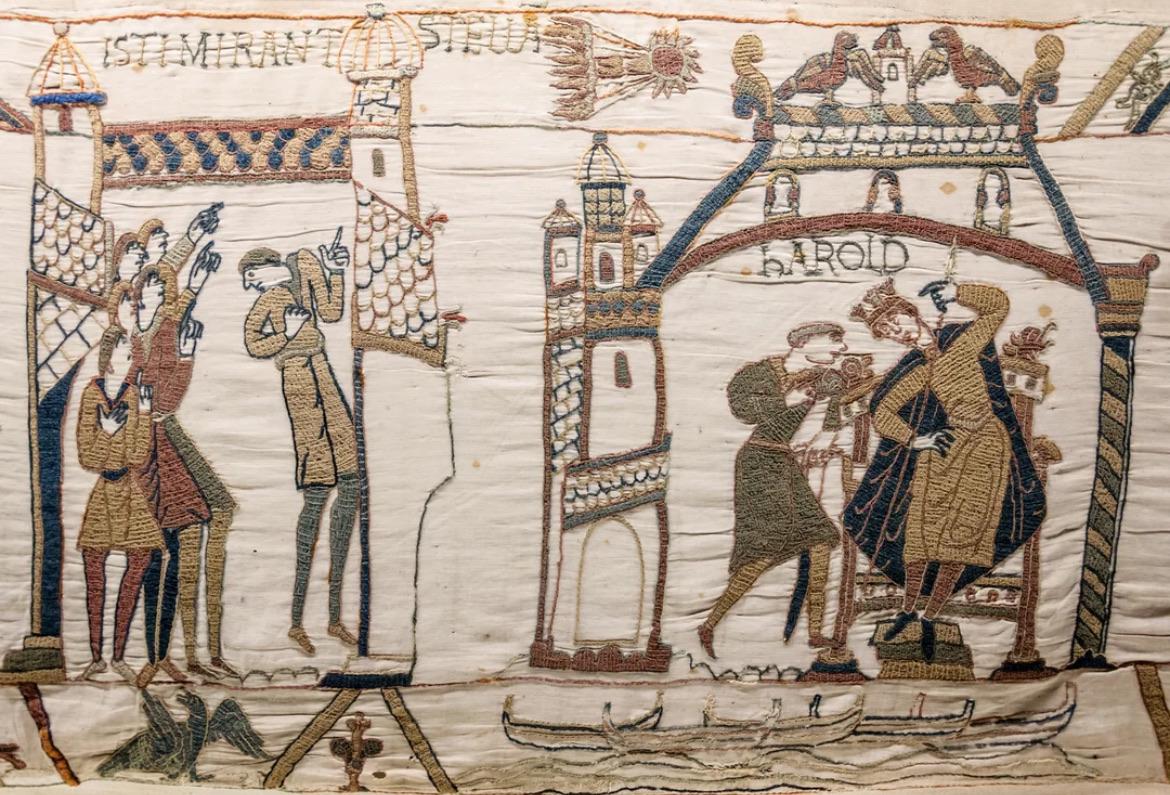
Posting the Halley’s Comet part of the tapestry instead of William because why not lol.
Seems most historians believe William intended to have a conciliatory approach toward the English elite — he did portray himself as (and perhaps truly believed he was) the natural heir. But the Anglos kept rebelling and William had no choice but to install Norman aristocrats across pretty much the entire country.
Do you buy it? Or was William using the rebellions as a pretext? Personally, I tend to believe he really did want to keep much of the original English elite. Makes administration easier, ruffles fewer feathers, etc. Of course, he’d be to rearrange some of the landholding to reward his top followers. But I don’t think the Bastard went into the project intending to be as transformational as he ended up being.
r/UKmonarchs • u/Green_tiger_7263 • 19h ago

r/UKmonarchs • u/Mission_Call_4083 • 22h ago

Part 1: The Real Anglo-Saxon Kings (800s–900s)
(Note: Queen Anne [reigned 1702–1714] united England and Scotland into Great Britain in 1707, sitting centuries later at the modern end of this chain—which stretches back through the Normans to these early English rulers:)
Alfred the Great (871–899) – King of Wessex who defended England against Viking invasion and laid the foundations for a united kingdom. (Following him, his grandson Athelstan, reigned 924–939, became the first true King of all England.)
Æthelwulf of Wessex – Father of Alfred the Great.
Egbert of Wessex – King who broke Mercian dominance and unified much of southern England.
Eahlmund of Kent – Under-king of Kent and father of Egbert.
Part 2: The House of Wessex & Early Warlords (495–700s)
Before "England" existed, these ancestors were regional chieftains and tribal warlords fighting for territory in post-Roman Britain:
5. Eafa
6. Eoppa (c. 706–797) – Prince of Wessex.
7. Ingild of Wessex (c. 672/680–718) – Brother of King Ine of Wessex.
8. Cenred of Wessex (c. 644–694)
9. Ceolwald of Wessex (c. 622–688)
10. Cuthwulf (592–648)
11. Cuthwine (565–594)
12. Ceawlin of Wessex (c. 530–593; reigned 560–592) – A powerful early West Saxon warlord.
13. Cynric of Wessex (c. 525–560; reigned 534–560)
14. Cerdic of Wessex (c. 467–534; reigned 519–534) – The legendary founder of the Kingdom of Wessex, who landed in Britain around 495 AD as a Germanic warlord rather than a palace-dwelling king.
Part 3: Where History Turns Into Norse Mythology (159–475 AD)
Once you step past Cerdic, written records disappear—and ancient royal scribes began blending real tribal memory with pagan Germanic mythology to prove kings had "divine" blood:
15. Elesa (c. 439–475)
16. Esla (c. 411–458)
17. Gewis (c. 380–420) – Mythical ancestor from whom the Gewissae (early West Saxons) took their name.
18. Wig (c. 355–395)
19. Freawine (c. 327–385)
20. Frithogar (c. 299–???)
21. Brond (c. 271–???)
22. Baeldaeg (c. 243–280) – Son of Woden in Anglo-Saxon royal genealogies (parallel to Baldr in Norse myth).
23. Woden / Odin (Wōdenaz) (c. 215–388) – Yes, the Norse/Germanic god of war and wisdom! Early Anglo-Saxon kings routinely placed Woden at the top of their family trees to claim divine right to rule.
24. Frealaf (c. 187–225)
25. Frithuwald (c. 159–190)
r/UKmonarchs • u/Green_tiger_7263 • 1d ago

r/UKmonarchs • u/dahliia_ • 2d ago

The two were (technically) successive queen consorts, as well as being mother and daughter-in-law. The two shared a warm relationship, with Henrietta referring to Catherine as ‘a saint’ and ‘the best creature in the world.’
r/UKmonarchs • u/allshookup1640 • 1d ago

You all eliminated Elizabeth I with 74% of the votes!
I thought this would be a fun game for us all.
Find out who would be the ultimate winner in a Monarchs Battle Royale. Here's the rules!
Monarchs have to be between William I and Charles III. This was the most request timeline.
All Monarchs in this scenario are at their prime they were at any point DURING THEIR REIGNING YEARS, but they are fighting ALONE. No armies and no outside help.
All Monarchs in this scenario have one sword and one shield and that's it. Otherwise they have to rely on strength, cunning, and intelligence to get them through. Think of it like The Hunger Games, but with British Monarchs.
William and Mary fight TOGETHER as they are co-monarchs. They are the ONLY ones together! Keep that in mind.
Round FOURTEEN! Which British Monarch is eliminated next?
As always if you have any suggestions or requests to help the poll and make this more fun for everyone, please don’t hesitate to let me know!
Remember to be kind and civil and have fun!
r/UKmonarchs • u/Green_tiger_7263 • 1d ago

r/UKmonarchs • u/kim_jong_un4 • 1d ago
My knowledge of Scottish, Welsh, and Irish monarchs is very limited, I don't know most of them. For English monarchs, I know very little about the ones before the Conquest. Post 1066, the monarch I know the least about is William II, followed closely by Henry I.
r/UKmonarchs • u/AllAboutHistoryBooks • 2d ago

On 25th November 1120 the White Ship left Barfleur in north-west Normandy, with a party of young Normans. King Henry I had left earlier on another ship. A mile out the White Ship foundered on a submerged rock. William Adelin, aged 17, his illegitimate half-siblings Richard and Matilda, William Bigod, Lucia Mahaut, brothers Geoffrey Aigle and Engenulf Aigle, half-brothers Richard and Ottiwel Avranches, brothers Ivo and William Grandesmil and Geoffrey Ridel were all drowned.
William Adelin was King Henry's only legitmate son and heir - he had more than twenty illegitimate children. His only other legitimate child was Matilda the Empress. King Henry married, three months after the disaster, Adeliza of Louvain, aged eighteen, thirty-five years his junior; there was no issue from their fourteen-year marriage. Following Henry's death in 1135 she married William D'Aubigny with whom she had seven children.
The 1321 image from British Library, Cotton MS Claudius D II, fol. 45v, on which the abbreviated Latin somewhat difficult to read. The upper circle appears to say '*Willelmum qui periit in mari' i.e. '*William, who perished at sea'. The middle circle '*Matildam imperatricem' i.e. '*Matilda the Empress'. Bottom right '*Henrici regis secundi' i.e. '*Of King Henry II'. Bottom left '*Ricardi qui obiit' i.e. '*Of Richard, who died'. The two diagonal lines between the Matilda circle and the two bottom circles saying 'Matrem' i.e. 'Mother'. The bottom left circle problematic since Matilda isn't known to have had a son called Richard.
Annals of Waverley: "During that voyage, two sons of King Henry, William and Richard, together with a daughter, a niece, Richard, Earl of Chester, his brother Othuel, and many members of the royal household, stewards, chamberlains, butlers and other servants, as well as an innumerable multitude of people, were shipwrecked on the Feast of St Catherine the Virgin [25th November]. Their death caused their friends a twofold grief, both because they had perished so suddenly and because the bodies of so few were recovered.
'And engulfs those descended from kings;
it slays the good men of the world.'"
**Annals of Margam: "**The son of King Henry, named William, perished at sea near Barfleur, along with all who were on the same ship, namely his brothers and sisters, the children of the aforesaid king, and certain counts, and many other nobles to the number of one hundred forty men and women. This happened on the 25th of November, and their bodies were not found."
In this voyage a sad disaster happened which caused much lamentation and innumerable tears to flow. Thomas, the son of Stephen, had obtained an audience of the king, and offering him a gold mark, said to him, "Stephen, the son of Airard, was my father, and during his whole life he was in your father's service as a mariner. He it was who conveyed your father to England in his own ship, when he crossed the sea to make war on Harold. He was employed by your father in services of this description as long as he lived, and gave him such satisfaction that he honoured him with liberal rewards, so that he lived in great credit and prosperity among those of his own class. My lord king, I ask you to employ me in the same service, having a vessel, called the Blanche-Nef [White Ship], which is fitted out in the best manner, and perfectly adapted to receive a royal retinue." The king replied: "I grant your request; but I have already selected a ship which suits me, and I shall not change: however, I entrust to you my sons, William and Richard, whom I love as myself, with many of the nobility of my realm."
The mariners were in great glee at hearing this, and greeting the king's son with fair words asked him to give them something to drink. The prince gave orders that they should have three muids. No sooner was the wine delivered to them than they had a great drinking bout, and pledging their comrades in full cups, indulged too much and became intoxicated. By the king's command many barons with their sons embarked in the Blanche-Nef, and there were in all, as far as I can learn, three hundred souls om board the ill-fated ship. But two monks of Tyron, Count Stephen, with two men-at-arms, William de Roumare, Rabel the chamberlain, Edward of Salisbury, and several others came on shore, having left the vessel upon observing that it was overcrowded with riotous and headstrong youths. The crew consisted of fifty experienced rowers, besides an armed marine force, who were very disorderly, and as soon as they got on board insolently took possession of the benches of the rowers, and being very drunk forgot their station, and scarcely paid respect to any one. Alas! How many, among the company embarked, were without the slightest feeling of devotion towards God, 'Who rules the storm, and calms the raging sea.'
They even drove away with contempt, amidst shouts of laughter, the priests who came to bless them, with the other ministers who carried the holy water; but they were speedily punished for their mockery. Besides the king's treasure and some casks of wine, there was no cargo in Thomas's ship, which was full of passengers; and they urged him to use his utmost endeavours to overtake the royal fleet which was already ploughing the waves. In his drunken folly, Thomas, confident in his seamanship and the skill of his crew, rashly boasted that he would soon leave behind him all the ships that had started before them. At last, he gave the signal for departure; the sailors seized the oars without a moment's delay, and, unconscious of the fate which was imminently impending, joyously handled the ropes and sails, and made the ship rush through the water at great rate. But as the drunken rowers exerted themselves to the utmost in pulling the oars, and the luckless pilot steered at random and got the ship out of its due course, the starboard bow of the Blanche-Nef struck violently on a huge rock, which is left dry, every day, when the tide is out, and covered by the waves at high water. Two planks having been shattered by the crash, the ship, alas! filled and went down.
At this fearful moment, the passengers and crew raised cries of distress, but their mouths were soon stopped by the swelling waves, and all perished together, except two who seized hold of the yard from which the sail was set. They hung on to it the greater part of the night, in earnest hope that they would receive aid in some shape or other. One of these men was a butcher of Rouen, of the name of Berold; the other, a young man of gentle birth whose name was Geoffrey, the son of Gilbert de I'Aigle.
The moon was at this time in her nineteenth day in the constellation of the Bull, and gave light to the world for nine hours, so that all objects on the surface of the sea were clearly visible to the sailors. Thomas, the master of this vessel, after his first plunge into the sea, gained fresh energy, and, recovering his senses, raised his head above the water, and perceiving the two men clinging to the yard-arm, cried out: "What has become of the king's son?" The shipwrecked men replied that he and all who were with him had perished. "Then," said he, "it is misery for me to live any longer." Having said this, he abandoned himself to his fate in utter despair, preferring to meet it at once, rather than face the rage of the king in his indignation for the loss of his children, or drag out his existence and expiate his crime in a dungeon. Meanwhile, Berold and Geoffrey, hanging by the yard-arm over the waters, called upon God to save them, and encouraging one another, waited in fearful anxiety for the end to which it should please him to bring their misery.
The night was bitterly cold and frosty, so that the young Geoffrey, after severe sufferings from the severity of the weather, lost his powers of endurance, and commending his companion to God, fell into the' sea and disappeared. Berold, however, who was the poorest man of all the company, and wore a sheep-skin dress, was the only one among so many who survived till the dawn of another day. In the morning, three fishermen took him into their skiff, and thus he only reached the land. Having a little revived, he related all the particulars of the sad event to the crowd of anxious inquirers, and lived afterwards for twenty years in good health.
r/UKmonarchs • u/t0mless • 2d ago

On this day, 25 November 1034, Malcolm II (Máel Coluim mac Cináeda), King of Scots, died after reigning since 1005. He was succeeded by his grandson Duncan I, the son of Bethóc and Crínán of Dunkeld.
Malcolm remains one of Scotland's more enigmatic early monarchs. Despite his long and consequential reign, relatively little contemporary evidence survives concerning his personality or policies. Medieval writers nevertheless remembered him as the Most Victorious King, the Destroyer, and the glory of western Europe.
The principal sources are the Annals of Ulster and Tigernach, the Anglo-Saxon Chronicle, the Durham histories associated with Symeon, Marianus Scotus, Rodulfus Glaber, Scottish king-lists, the Prophecy of Berchán and Orkneyinga saga. The Irish annals generally provide brief notices, while the Durham narratives reflect the interests of St Cuthbert's community. The later king-lists, saga and prophetic poem preserve traditions whose historical foundations are not always recoverable.
Malcolm was the son of Kenneth II (Cináed mac Maíl Coluim), King of Alba until his death in 995, and a grandson of Malcolm I. His mother's identity is unknown, although the Prophecy of Berchán suggests that she came from Leinster in Ireland. Dauvit Broun considers it possible that she belonged to the Uí Dúnlainge dynasty, although no surviving source securely identifies her family.
Malcolm's date of birth is similarly uncertain. He is sometimes assigned a birth around 954, making him approximately eighty years old at his death, but this cannot be established from contemporary evidence. Malcolm did not immediately succeed his father. Following Kenneth II's death in 995, the kingship passed to Constantine III, who was killed in 997 and succeeded by Kenneth III, a member of another branch of the royal dynasty.
The Annals of Tigernach, T995.3 and T997.1, record the violent deaths of Kenneth II and Constantine III. Scottish succession did not follow strict primogeniture: royal descent, military strength and aristocratic support all mattered.
Malcolm eventually challenged Kenneth III and secured the throne in 1005. The Annals of Ulster, U1005.5, record:
"A battle between the men of Albu themselves, in which fell the king of Albu, i.e. Cinaed son of Dub."
The annal does not identify Malcolm personally as Kenneth's killer, but later Scottish traditions associate his accession with Kenneth's defeat at Monzievaird in Strathearn. Kenneth III was Malcolm's first cousin, descended from Malcolm I through his son Dubh, while Malcolm II descended through Dubh's brother Kenneth II. His overthrow therefore represented the victory of one royal branch over another, rather than the uncontested accession of an undisputed heir.
Malcolm's early military career was not particularly encouraging. In 1006, shortly after securing the kingship, a Scottish army suffered a serious defeat against the English.
The Annals of Ulster, U1006.5, record:
"A battle between the men of Albu and the Saxons, and the Scots were defeated and a great number of their nobles left dead."
The annal does not identify Malcolm personally or specify where the battle occurred. However, historians have frequently connected it with a Scottish invasion of Northumbria and an unsuccessful siege of Durham.
A much fuller account survives in the twelfth-century work De Obsessione Dunelmi, or The Siege of Durham. According to this narrative, Malcolm invaded Northumbria, devastated the countryside and besieged Durham, where the religious community of St Cuthbert was established. Uhtred, son of Waltheof of Bamburgh, supposedly assembled an army and inflicted a crushing defeat upon the Scots.
The chronicler claims that Malcolm escaped with only a handful of followers, while Uhtred ordered the heads of the Scottish dead to be washed, their hair arranged, and the heads displayed around Durham's walls. Four women were supposedly employed to prepare them, each receiving a cow in payment.
The account is certainly memorable, but its details cannot be accepted uncritically. The narrative survives in a later text whose chronology is confused, and its presentation of Uhtred reflects Durham's interest in celebrating the defenders of St Cuthbert's community.
Bernard Meehan, in The Siege of Durham, the Battle of Carham and the Cession of Lothian (1976), questioned whether the siege narrative accurately describes the events of 1006, suggesting that different traditions concerning Scottish attacks on Durham may have become confused. A. A. M. Duncan defended the traditional identification of the defeat with Malcolm's campaign. The annals independently establish a major defeat; its identification with the siege and the more elaborate details depend upon problematic Durham evidence. See The Siege of Durham, the Battle of Carham and Gospatric's Writ for a comparison.
Malcolm's most celebrated military victory came at the Battle of Carham, traditionally dated to 1018. By this time, the political situation in northern England had changed considerably. The Danish conquest had brought Cnut to the English throne, while the death of Uhtred, conventionally dated to 1016, had disrupted the established balance of power in Northumbria.
The Historia Regum, associated with Symeon of Durham, records a battle between the Scots and Northumbrians near Carham on the River Tweed. Malcolm was supported by Owain the Bald, king of Strathclyde.
The chronicler explicitly states:
"Cum quo fuit in bello Eugenius Calvus rex Clutinensium."
That is, Owain the Bald, king of the Clyde Britons, fought alongside Malcolm. The relevant Latin passages and English translations are reproduced in The Battle of Carham – 1018.
Symeon's Libellus de Exordio provides a more elaborate account. It describes a comet appearing over Northumbria for thirty nights before the battle, supposedly foreshadowing a catastrophic defeat. The chronicler claims that almost the entire fighting population between the Tees and Tweed perished, together with many leading men. The language is plainly exaggerated, but the battle appears to have been remembered in Northumbria as an exceptionally serious disaster.
There is also a chronological difficulty. The Historia Regum names Uhtred as the Northumbrian commander, despite the Anglo-Saxon Chronicle placing his murder in 1016. Some historians consequently identify his brother Eadwulf Cudel as the more likely commander, while Duncan argued that Uhtred's death may have occurred later than traditionally believed.
The battle's territorial consequences are equally disputed. Carham has traditionally been credited with securing Lothian for the Scottish kingdom and establishing the Tweed as the frontier between Scotland and England. However, this interpretation rests partly upon a separate passage in De Obsessione Dunelmi, which claims that Eadwulf Cudel surrendered Lothian to the Scots out of fear of retaliation for his brother's earlier victories.
Crucially, that passage does not explicitly connect the concession to Carham. Neil McGuigan, in Lothian and the Scottish Kings (2024), challenges the conventional interpretation that the battle directly resulted in Lothian's transfer. He argues that later historians combined separate Durham traditions into a seemingly coherent territorial narrative which the surviving evidence does not actually establish.
Duncan and Alex Woolf place greater emphasis on Carham as a stage in consolidating Scottish authority south of the Forth. It was an important victory, but cannot securely be credited with establishing the modern Anglo-Scottish border.
Strathclyde remained a distinct Brittonic kingdom centred upon the Clyde valley and extending into the wider Cumbrian region.
Owain the Bald, Malcolm's ally at Carham, is the last securely identifiable king of the older Strathclyde royal dynasty. His disappearance from the historical record has frequently been connected with the kingdom's eventual incorporation into the developing Scottish monarchy. Older reconstructions sometimes suggest that Malcolm appointed his grandson Duncan as king of Strathclyde following Owain's death. However, no contemporary source establishes such an appointment.
Dauvit Broun, in his biography of Malcolm II, considers Duncan's supposed kingship unlikely, particularly because he does not appear among the rulers who submitted to Cnut and was remembered as relatively young when he died in 1040. The Scots Peerage goes further, suggesting that upon Duncan's death in 1040, his younger brother Maldred became king in turn, while other reconstructions instead suggest Maldred governed the southern part of the Cumbrian kingdom on behalf of his young nephew Malcolm.
Broun instead suggests that Malcolm II himself may have assumed control of Strathclyde, although this remains conjectural. The kingdom may also have become increasingly subordinate to Alba through a gradual process rather than a single conquest or succession.
Neither the date nor the precise mechanism by which Strathclyde lost its independent kingship is established.
Moray possessed its own powerful ruling dynasty. The Annals of Tigernach, T1020.8, record that Findláech mac Ruaidrí, Macbeth's father, was killed by the sons of his brother Máel Brigte. Nine years later, the Annals of Tigernach, T1020.8, records:
"Mael Colaim son of Mael Brighde son of Ruaidhrí, king of Scotland, died."
Malcolm II was still reigning in 1029, yet an Irish annalist identified a ruler of Moray as king of Alba.
Precisely what this title meant remains disputed. It may reflect a competing claim to the kingship, an alternative contemporary understanding of regional authority, or political circumstances which the surviving evidence does not adequately explain. Stewart Baldwin, in The Henry Project, suggests that Malcolm II may have ruled only part of Scotland for much of his reign, with the Moray dynasty exercising substantial independent authority.
According to the Orkneyinga saga, Sigurd the Stout, Earl of Orkney, married a daughter of King Malcolm. After Sigurd's death at Clontarf in 1014, Malcolm supposedly granted their son Thorfinn authority in Caithness.
The saga states:
"He married the daughter of Malcolm, King of Scots, and their son was Earl Thorfinn. [...] [Thorfinn] was then five winters old when Malcolm the Scot-king, his mother’s father, gave him the title of earl and Caithness as his lordship, as was written above; but he was fourteen winters when he had war levies out of his land, and harried on the realms of other chiefs"
If this was Malcolm II, the account suggests substantial influence in northern affairs through dynastic marriage. However, the saga was compiled around 1200–1230, and Máel Coluim mac Máel Brigte of Moray was also called king of Scotland.
Benjamin Hudson, in Kings of Celtic Scotland (1994), considered the possibility that the saga meant Malcolm of Moray. Stewart Baldwin favours Malcolm II on chronological grounds, while acknowledging uncertainty.
The Anglo-Saxon Chronicle, under 1031, records Cnut's expedition into Scotland and the submission of three kings: Malcolm, Mælbæþ and Iehmarc. Mælbæþ is generally identified with Macbeth, while Iehmarc may have been Echmarcach mac Ragnaill, a ruler active throughout the Irish Sea world. Their presence illustrates the political complexity of northern Britain.
Malcolm's submission should not necessarily be interpreted as permanent subjugation. Personal homage, diplomatic recognition and agreements between kings could establish political relationships without requiring the complete surrender of a kingdom's independence. There is also uncertainty over the chronology. Although the Anglo-Saxon Chronicle places the expedition in 1031, A. A. M. Duncan suggested that the events might actually belong to 1027, following Cnut's journey to Rome. Another perspective survives in the writings of Rodulfus Glaber, a Burgundian chronicler who describes a conflict between Cnut and Malcolm before their eventual reconciliation.
Interestingly, Rodulfus portrays Malcolm as a powerful and exceptionally devout Christian ruler. He also claims that Cnut became the baptismal sponsor of a son of Malcolm, although no other surviving source securely identifies such a son. This might reflect a genuine diplomatic arrangement, but the details of Rodulfus's account are confused, and it cannot be accepted uncritically.
Glaber credits Richard II of Normandy and his sister Emma, who married Æthelred II in 1002 and Cnut in 1017, with persuading Cnut to make peace with Malcolm:
"Persuasion of the aforesaid Richard, the duke of Rouen, and of [Richard's] sister."
If accurate, this suggests that the resolution of Anglo-Scottish conflict involved diplomatic mediation extending beyond the immediate borders of Britain. However, a serious chronological problem remains. Richard II died in 1026, whereas the Chronicle places Cnut's Scottish expedition in 1031, and even Duncan's proposed redating to 1027 would fall after Richard's death.
Glaber may therefore have conflated separate diplomatic episodes, incorrectly dated Richard's involvement, or preserved a tradition concerning an earlier settlement. Tom Licence, in Edward the Confessor: Last of the Royal Blood (2020), pp. 45–46, discusses the possible Norman background of Glaber's information and the political relationships linking Richard, Emma and Cnut.
Malcolm's reign coincided with the rise of Brian Boru and the Battle of Clontarf in 1014. Despite close Gaelic and maritime connections, no contemporary source establishes a personal alliance between the two kings.
The Annals of Ulster, U1014.2, include among the men killed on Brian's side:
"Domnall son of Eimen son of Cainnech, earl of Marr in Scotland."
This figure is generally identified as Domnall mac Eimín, a mormaer associated with Mar. His participation is particularly interesting because Sigurd the Stout of Orkney, Malcolm's possible son-in-law, fought on the opposing side and was also killed. Clare Downham, in Scottish Affairs and the Political Context of Cogadh Gaedhel re Gallaib (2017), suggests that Domnall may have fought for his own political interests rather than as an official representative of Malcolm.
No contemporary source securely identifies Malcolm's wife, her family or even her name. Several identities have been proposed.
Frederic von Bassen, writing in The Royall Cedar in 1688, identified Malcolm's wife as Gunnora, daughter of the second Duke of Normandy. This "second Duke of Normandy" presumably refers to Richard II, and not William Longsword. However, this identification is chronologically problematic and unsupported by the surviving Norman genealogical evidence. Richard II's mother was herself named Gunnor, but no daughter of Richard bearing that name is securely recorded.
Kelsey Jackson Williams's 2016 study of von Bassen demonstrates that The Royall Cedar incorporated extensive genealogical inventions, particularly to supply the identities and marriages of otherwise undocumented Scottish royal women. Williams's article, Joachim Frederik von Bassen: A Danish Scholar in Restoration Scotland, is available through the University of Stirling, including a freely accessible manuscript.
Another tradition connects Malcolm to Ireland. Alison Weir, in Britain's Royal Families: The Complete Genealogy (1989), describes his wife as an unnamed Irishwoman from Ossory, although the medieval basis for this claim is unclear. She does not identify the woman's name, father or precise family. Roger Chatterton-Newman, in Brian Boru, King of Ireland (1983), went further, identifying Malcolm as the husband of an unnamed daughter of Brian Boru.
Stewart Baldwin subsequently examined this claim and found that the relevant passages did not provide satisfactory historical documentation. His findings are discussed in The Henry Project's study of Brian Boru. The name Blanaid, sometimes assigned to this supposed daughter, appears to derive from historical fiction rather than an identifiable medieval source. We therefore cannot establish whether Malcolm's wife was Scottish, Irish, Norman or from another aristocratic family. Nor can we determine whether he married once or more than once.
Under the conventional reconstruction of three daughters, alongside a possible son, Malcolm's family may be presented as follows:
Bethóc (Beatrice) — Possibly Malcolm's eldest daughter, although her birth order is unknown. Marianus Scotus confirms that Duncan succeeded his maternal grandfather in 1034; later Scottish king-lists identify his parents as Bethóc and Crínán, abbot of Dunkeld. John of Fordun instead calls her Beatrice. Stewart Baldwin's study of Bethóc reproduces the relevant evidence.
Duncan I (d. 1040): Succeeded his grandfather as King of Scots in 1034 and was killed in conflict with Macbeth in 1040. His wife may have been named Suthen and relative of Earl Siward of Northumbria, according to an addition to a later Scottish king-list. His sons included Malcolm III and Donald III.
Maldred of Allerdale: Probably another son of Crínán, although Bethóc's maternity is unproven. He married Ealdgyth, daughter of Uhtred the Bold, Earl of Northumbria, and fathered Gospatric, ancestor of the Earls of Dunbar. His supposed death in the conflict against Macbeth in 1045 is uncertain.
Possible granddaughter — The Orkneyinga saga relates that Karl Hundason succeeded a King Malcolm and disputed Caithness with Thorfinn, appointing his nephew Moddan as earl. Moddan was killed at Thurso by Thorkell Fóstri, conventionally around 1040. If Karl was Duncan I, he had an otherwise unidentified sister (possibly a half-sister), whose parentage and husband's identity remain unknown.
Donada (Doada) — The traditional name given to Macbeth's supposed mother. Its earliest currently identified appearance is in Hector Boece's Scotorum Historia (1527), which calls her Doada and identifies her as a daughter of Malcolm II. Raphael Holinshed subsequently reproduced this genealogy in his Chronicles (1577). However, Boece erroneously identifies Macbeth's father as Sinel, thane of Glamis, rather than the historically attested Findláech mac Ruaidrí, ruler of Moray. Macbeth's possible relationship to Malcolm II is recorded considerably earlier. The late-thirteenth-century Chronicle of Huntingdon, associated with historical materials supplied to Edward I in 1291, describes Macbeth as a nepos of a King Malcolm. This Latin term can a variety of kinship but often can mean nephew or grandson, and the identity of the Malcolm intended is disputed. If Macbeth was indeed Malcolm II's grandson, his mother would presumably have been an otherwise unidentified daughter of the king, since his paternal ancestry is independently recorded.
Macbeth (d. 1057): Son of Findláech of Moray, king from 1040. He married Gruoch ingen Boite, widow of his cousin Gille Coemgáin, after the latter's death in 1032. Gruoch's father Boite was a son of a King Kenneth, either Kenneth III or Kenneth II. The marriage may have united Macbeth's Moray interests with Gruoch's royal claim. Notices of grants to St Serf's community at Loch Leven, surviving in later copies, identify Macbeth and Gruoch as king and queen and preserve their patronymics.
Olith (Alice) — Traditional names for the daughter of King Malcolm who married Sigurd the Stout. As discussed above, the Orkneyinga saga records the marriage but neither names her nor conclusively identifies her father. Alice appears in George Russell French's The Ancestry of Her Majesty Queen Victoria (1841), and Olith in M. E. Cumming Bruce's Family Records of the Bruces and the Cumyns (1870). Neither name is securely attested in a medieval source.
Thorfinn 'the Mighty' Sigurdsson (d. c. 1058/1065?): Son of Sigurd and his Scottish wife, he acquired a share of Orkney and authority in Caithness. He married Ingibjorg Finnsdóttir, daughter of Finn Árnason and grandniece of Norwegian kings Olaf II and Harald III. William P. L. Thomson, in Ingibjorg Jarlamóðir (2012), proposed an earlier death than the traditional 1065 date, allowing Ingibjorg to marry Malcolm Canmore before his accession in 1058. Thorfinn's sons Paul and Erlend succeeded him.
An unnamed possible son — Glaber's account of Cnut receiving Malcolm's son at the baptismal font is the only evidence for this child. His name, mother, age and fate are unknown. If he existed, he may have predeceased Malcolm or lacked sufficient support to challenge Duncan's succession.
Bethóc is the only daughter whose relationship to Malcolm is supported by early evidence of maternal succession alongside later genealogical testimony.
One of the most controversial aspects of Malcolm's reign concerns his apparent efforts to eliminate competing claims to the kingship, particularly during his final years. Malcolm had secured the throne by defeating Kenneth III in 1005. Later Scottish traditions also associate the death of Kenneth's supposed son Giric with the battle, although Dauvit Broun considers Giric's separate existence likely to result from scribal confusion in the king-lists.
The rivalry between the descendants of Kenneth II and Kenneth III may nevertheless have continued for several decades. Boite mac Cináeda, father of Gruoch, is traditionally identified as a son of Kenneth III. However, Broun argues that he was more probably a son of Kenneth II, which would instead make him Malcolm's brother or half-brother. John Cowan, in The Historical Macbeth and the Moray Question (1993), favours the identification with Kenneth III. If Boite belonged to Kenneth III's branch, Gruoch's presumed marriage to Gille Coemgáin of Moray may have connected a displaced royal line with one of the most powerful regional dynasties in northern Scotland.
In 1032, Gille Coemgáin was burned to death alongside fifty followers, as recorded in the Annals of Ulster, U1032.2. Some historians have associated his death with Malcolm's efforts to eliminate dynastic rivals, but the annals do not identify the perpetrators. Macbeth also had a possible motive, since Gille Coemgáin belonged to the family implicated in the killing of Macbeth's father, Findláech, in 1020. The following year, however, Malcolm's involvement in another killing is explicitly recorded.
The Annals of Ulster, U1033.7, state:
"The grandson of Baete son of Cinaed was killed by Mael Coluim son of Cinaed."
The victim's name, age and political position are unknown. A. A. M. Duncan, in Scotland: The Making of the Kingdom (1975), suggested that the text might contain a scribal error and originally have identified a son rather than grandson of Boite. Under the conventional reading, the victim may have been Gruoch's nephew; under Duncan's proposed correction, he could instead have been her brother. Some later genealogical compilations describe him as an infant, but the annals provide no evidence for his age.
The killing is particularly significant because it occurred only a year before Duncan's succession. It is therefore plausible that Malcolm was attempting to remove a potentially dangerous hereditary claimant, although the annals do not establish his motives. Another possible member of the extended royal kindred, Suibne mac Cináeda, king of the Gall-Ghàidheil, died in 1034. The Annals of Ulster record his death without identifying a cause, while the Annals of Tigernach say he was killed. Neither attributes his death to Malcolm, and his precise relationship to the Scottish royal family remains uncertain.
It would consequently be an exaggeration to conclude that Malcolm successfully exterminated Kenneth III's entire line. Gruoch survived him, and her presumed son Lulach became King of Scots in 1057. Broun has also suggested that Kenneth III's descendants may have survived through the family later associated with the earldom of Fife, although this genealogy remains disputed.
Perhaps Malcolm's most consequential achievement was securing the accession of his grandson Duncan I in November 1034. The eleventh-century chronicler Marianus Scotus records Malcolm's death and Duncan's succession:
"Moelcoluim rex Scotiae obiit 7. Kal. Decembr. Donchad filius filiae eius, sibi successit."
In English, Malcolm, king of Scotland, died on 25 November and was succeeded by Duncan, the son of his daughter.
The passage appears in Marianus's Chronicon, MGH Scriptores, volume 5. Later Scottish king-lists identify Duncan's parents as Bethóc and Crínán of Dunkeld. This succession has sometimes been presented as the moment when Malcolm abolished tanistry and introduced hereditary primogeniture. However, no contemporary evidence demonstrates that he introduced such a law or permanently changed the rules of Scottish succession.Duncan's royal descent, aristocratic support and connection to Crínán and the prestigious religious establishment at Dunkeld may have strengthened his position, but the precise succession arrangements are unknown.
The settlement did not prove permanent. Duncan was killed by Macbeth in 1040; attempts to restore Duncan's line followed in 1045 and 1054. Macbeth died in 1057, and Lulach briefly succeeded before Malcolm III killed him in 1058. Malcolm III restored the descendants of Duncan and Bethóc, but the succession crisis of 1093 again demonstrated that rival claims remained a feature of Scottish kingship. If Thorfinn was indeed Malcolm's grandson, his descendants also held Orkney and Caithness for generations; Maldred's descendants likewise became prominent in the Scottish nobility through the Earls of Dunbar.
Malcolm died on 25 November 1034, nearly thirty years after securing the kingship. The precise date comes from Marianus Scotus, while the Annals of Ulster, U1034.1, independently record:
"Mael Coluim son of Cinaed, king of Scotland, died."
Later Scottish king-lists locate his death at Glamis in Angus and record that he was buried on Iona, the traditional burial place of numerous early Scottish kings. However, the circumstances of his death remain uncertain.
The Irish annals do not state that Malcolm was murdered, although the same chronicles frequently identify rulers who died violently (a recurring pattern among early Scottish kings). The Prophecy of Berchán, meanwhile, appears to associate his final days with a violent confrontation involving kinslayers, while later Scottish historians such as John of Fordun and Andrew of Wyntoun developed accounts of his death at Glamis. No contemporary source identifies an assassin or establishes that Malcolm died during a conspiracy.
The Pictish carved stone at Glamis, sometimes associated with Malcolm's supposed grave, is also considerably older than his reign. Lloyd Laing's study of the Glamis carved stones places them in an earlier Pictish context rather than identifying them as memorials to Malcolm II. His reported burial on Iona is consistent with later Scottish royal tradition, but the precise location of his grave cannot be established.

The Scottish king-lists remember Malcolm as Rex Victoriosissimus, meaning 'the Most Victorious King.'
One version states:
"Malcolm mac Kynnat Rex victoriosissimus xxx a. reg. et mortuus est in Glamuernes et sepultus in Yona."
In other words, Malcolm, son of Kenneth, the most victorious king, reigned for thirty years, died at Glamis and was buried on Iona. Stewart Baldwin reproduces the passage in his study of Malcolm II, citing the corresponding king-lists in Marjorie Ogilvie Anderson's Kings and Kingship in Early Scotland. Despite Malcolm's recorded reverses, the Prophecy of Berchán, stanzas 78–85, also describes him as Forranach, conventionally translated as 'the Destroyer.' The poem introduces him as a fortunate warrior praised by poets, possessing:
"A wrathful heart that wages battle"
It subsequently describes him as a terror to Britons and foreigners, credits him with defeating ten armies, his supposedly adverse influence upon Ireland affecting Gaels and foreigners alike, and compares him to a wolfhound devouring Alba itself.
The imagery is not entirely condemnatory. The poem also describes him as a good king, suggesting that military success and destructive power could be celebrated simultaneously.
Forranach cannot securely be identified as a nickname used during Malcolm's lifetime or connected to a specific act. The poem credits him with thirty-five years of kingship rather than approximately twenty-nine. William Forbes Skene, in Chronicles of the Picts, Chronicles of the Scots (1867), p. cxlvii, compared Forranach with Rex Victoriosissimus; Benjamin T. Hudson provided a modern edition and commentary in Prophecy of Berchán (1996).
Perhaps the most extraordinary description, however, comes from the Annals of Tigernach, T1034.1, which commemorate Malcolm's death:
"Maolcoluim son of Cinaedh, king of Scotland, glory of the whole west of Europe, died."
This is unusually distinguished praise, especially when compared with the comparatively restrained obituaries of many other early Scottish kings. Nevertheless, such language does not establish that Malcolm was universally regarded as Europe's greatest king. Irish annalists employed elaborate expressions of praise for other rulers, including Brian Boru and Máel Sechnaill II.
These descriptions are not necessarily contradictory: military success and destructive power could be celebrated simultaneously. Malcolm's reputation may reflect achievements which the surviving sources record only imperfectly.
Malcolm emerges as a formidable, ambitious and politically resilient monarch. He gained the throne through violence, endured military reverses, won at Carham and maintained his kingship despite powerful neighbours and regional rivals. His traditionally advanced age makes his apparent activity particularly remarkable, although his birth date is uncertain.
His greatest demonstrable achievement was preserving his kingship for nearly thirty years and passing it to Duncan in 1034. His descendants eventually recovered the throne through Malcolm III. If the proposed relationships with Macbeth and Thorfinn are genuine, his dynastic influence extended still further.
His actions suggest determination, adaptability and a willingness to employ violence, while Glaber preserves a reputation for Christian devotion. His private character remains elusive. Though the Irish recording of his death seems to indicate he was well regarded.
Malcolm was neither an invincible conqueror nor simply a ruthless usurper, but a resourceful ruler whose achievements were accompanied by defeats, dynastic violence and continuing challenges to his authority.
Annals of Ulster, U1005.5 — Records the death of Kenneth III in a battle among the Scots.
Annals of Ulster, U1006.5 — Records a major Scottish defeat against the English.
Annals of Ulster, U1033.7 — Records Malcolm's killing of the grandson of Boite.
Annals of Ulster, U1034.1 — Records Malcolm's death.
Annals of Tigernach, T1020.8 — Records the killing of Findláech, father of Macbeth.
Annals of Tigernach, T1029.5 and T1034.1 — Records the death of Máel Coluim mac Máel Brigte and the extraordinary tribute to Malcolm II.
Anglo-Saxon Chronicle, 1016 and 1031 — Records Uhtred's death and Cnut's expedition to Scotland.
Historia Regum and Libellus de Exordio, passages concerning Carham — Reproduces the Latin passages and English translations concerning Carham. This is a modern transcription and discussion rather than a critical edition.
De Obsessione Dunelmi, passages concerning Durham — Provides translated passages and discusses their chronology, including the siege attributed to 1006.
Marianus Scotus, Chronicon, MGH Scriptores, vol. 5, p. 556 — Records Malcolm's death on 25 November and succession by his daughter's son.
Orkneyinga saga, translated by Hjaltalin and Goudie (1873) — Preserves the tradition that Sigurd the Stout married a daughter of King Malcolm.
For the Scottish king-lists and their textual relationships, see Marjorie Ogilvie Anderson's Kings and Kingship in Early Scotland (1973). The relevant entries identify Malcolm's death at Glamis, burial on Iona, and the parentage of Duncan I.
Dauvit Broun, "Malcolm II (d. 1034), King of Scots", Oxford Dictionary of National Biography (2004) — A modern scholarly biography assessing Malcolm's military campaigns, political authority and succession. Some material may require institutional access.
A. A. M. Duncan, The Kingship of the Scots, 842–1292: Succession and Independence (2002) — Particularly valuable for early Scottish kingship, succession and the chronology of Cnut's expedition.
A. A. M. Duncan, "The Battle of Carham, 1018", Scottish Historical Review 55 (1976), pp. 20–28 — Defends the traditional dating of Carham and reconsiders Uhtred's death.
Bernard Meehan, "The Siege of Durham, the Battle of Carham and the Cession of Lothian", Scottish Historical Review 55 (1976), pp. 1–19 — Challenges aspects of the Durham traditions and their chronology.
Alex Woolf, From Pictland to Alba, 789–1070 (2007) — A comprehensive modern study of the political transformation of early medieval Scotland.
Neil McGuigan, "Lothian and the Scottish Kings", History Scotland 24, no. 5 (2024) — Reconsiders the assumption that Carham directly resulted in the cession of Lothian.
Benjamin T. Hudson, Kings of Celtic Scotland (1994) — Particularly relevant for the political relationships between Alba, Moray and the northern territories.
Stewart Baldwin, The Henry Project: Malcolm II — A genealogical examination of Malcolm, his uncertain wife, children and connections with the Orkney dynasty.
Stewart Baldwin, The Henry Project: Bethóc of Scotland — Examines the evidence for Duncan I's maternal descent.
Stewart Baldwin, The Henry Project: Brian Boru — Investigates the unsupported tradition that Malcolm married Brian Boru's daughter.
Kelsey Jackson Williams, "Joachim Frederik von Bassen: A Danish Scholar in Restoration Scotland", Northern Studies 48 (2016), pp. 66–81 — Examines the historical methods and genealogical inventions found in The Royall Cedar.
Alison Weir, Britain's Royal Families: The Complete Genealogy (1989), p. 178 — Includes the unverified tradition of Malcolm marrying an unnamed Irishwoman from Ossory.
Lloyd Laing, "The Date and Context of the Glamis, Angus, Carved Pictish Stones", Proceedings of the Society of Antiquaries of Scotland 131 (2001), pp. 223–239 — Examines the dating and historical context of the Pictish stones sometimes associated with Malcolm's death.
r/UKmonarchs • u/Sea_Engineering_5773 • 2d ago

He seems to have been a successful king, with both the good and the bad of course, but he did hold his ground against France. How is he perceives today? Is he considered to be a usurper, or justified in his taking the throne? Or both? I am not from the UK so I would really like to know how he is seen nowadays.
r/UKmonarchs • u/Quick-Plum-3382 • 2d ago

Since I practically live on another continent, I'm not very close to what the British public actually thinks about this matter, as all I've ever heard is sympathy for Lady Di and disdain for King Charles III. However, for a while now, I've seen defenders of His Majesty arguing that the story wasn't simply a case of "villain vs. victim" and claiming that the widely spread version isn't truly faithful to the facts, so I would appreciate it if you could clarify how everything really happened.
(If the images I used turned out to be AI-generated, as happened on a previous occasion, please let me know and sorry in advance.)
r/UKmonarchs • u/VeterinarianOne1433 • 2d ago

34 years ago the Queen delivered her infamous 'Annus Horribilis' speech. Was 1992 *really* the monarchy's worst year under her reign?
r/UKmonarchs • u/allshookup1640 • 2d ago

You all eliminated Elizabeth II with 67% of the votes!
I thought this would be a fun game for us all.
Find out who would be the ultimate winner in a Monarchs Battle Royale. Here's the rules!
Monarchs have to be between William I and Charles III. This was the most request timeline.
All Monarchs in this scenario are at their prime they were at any point DURING THEIR REIGNING YEARS, but they are fighting ALONE. No armies and no outside help.
All Monarchs in this scenario have one sword and one shield and that's it. Otherwise they have to rely on strength, cunning, and intelligence to get them through. Think of it like The Hunger Games, but with British Monarchs.
William and Mary fight TOGETHER as they are co-monarchs. They are the ONLY ones together! Keep that in mind.
Round THIRTEEN! Which British Monarch is eliminated next?
As always if you have any suggestions or requests to help the poll and make this more fun for everyone, please don’t hesitate to let me know!
Remember to be kind and civil and have fun!
r/UKmonarchs • u/Green_tiger_7263 • 2d ago

r/UKmonarchs • u/Charles318Hill • 2d ago
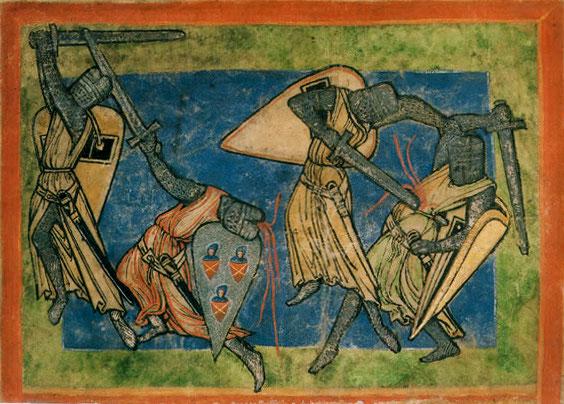
Misguided movie myths like to tell stories of medieval queens sitting inside stone towers doing needlework while their husbands marched off to war. The surviving Exchequer wardrobe books, Patent Rolls, and fourteenth-century chronicles tell a completely different story. When Edward II rode north into Scotland, his eighteen-year-old queen, Isabella of France, was running diplomatic backchannels, managing a parallel royal household, and eventually fighting her own way out of a coastal blockade by sea.
Start with June 1314, the month Robert the Bruce and Sir James Douglas shattered Edward II’s army at Bannockburn. Isabella was nowhere near Scotland, nor was she sitting idle. Just weeks earlier, in March and April 1314, she had crossed the Channel to Paris on a diplomatic mission to her father, King Philip IV, negotiating disputes over English-held Gascony; arriving the day after Templar Grand Master Jacques de Molay was executed and straight into the Tour de Nesle adultery scandal that brought down her French sisters-in-law.
By June 1314, while Edward II was panicking through the Scottish burns toward Dunbar Castle, Isabella’s surviving household accounts (the Exchequer compotus books kept by her wardrobe clerk and treasurer, preserved in the British Library and The National Archives) show her operating a mobile administrative court across southern England. Moving between Windsor, Eltham, and Canterbury, she hosted French envoys, paid messengers, audited estate revenues, and kept diplomatic lines open with Paris while her husband’s military reputation collapsed in the north.
Five years later, in 1319, Isabella moved closer to the front lines and nearly paid for it. While Edward besieged Berwick, Isabella stayed near York, where Scottish raiders launched a covert snatch-and-grab operation to kidnap the Queen of England and use her as a bargaining chip to end the war. English scouts caught a Scottish spy carrying the abduction plan just in time, forcing Isabella to evacuate south to Nottingham under armed guard.
The real breaking point came in October 1322, after Hugh Despenser the Younger had taken control of Edward’s court. Marching north again, Edward left Isabella behind at Tynemouth Priory, an exposed monastery on the Northumberland coast. On October 14, Robert the Bruce ambushed Edward at the Battle of Old Byland in Yorkshire, sending the King fleeing south so fast he abandoned his royal seal, silver plate, and luggage train.
Bruce’s raiders immediately swept toward Tynemouth, cutting off the roads south while Flemish privateers allied with the Scots patrolled the North Sea outside the harbor. Although Edward sent orders from Rievaulx dispatching troops under Sir Henri de Sully and the Earls of Richmond and Atholl to relieve her, the rescue force could not break through in time. Left without a garrison, Isabella’s own household knights commandeered a vessel and evacuated her down the coast to Scarborough by sea. Chroniclers record that the winter crossing was so brutal that two of Isabella’s ladies-in-waiting died; one during the voyage and a second shortly after reaching shore.
Four years later, in her 1326 invasion manifesto, Isabella weaponized Tynemouth against the regime, accusing Hugh Despenser of deliberately leaving her stranded on an undefended coast hoping the Scots would capture or kill her.
Between 1314 and 1322, Isabella’s wartime record was never about embroidery. It was household logistics, cross-Channel diplomacy, and maritime survival, the exact operational skills she used four years later when she landed at Orwell with an invasion fleet of her own.
Sources: Household Book of Queen Isabella (British Library / The National Archives Exchequer Accounts); Chronicon de Lanercost; Vita Edwardi Secundi; Rotuli Parliamentorum (1326–1327).
Isabella of France was far from the only English consort forced to operate outside the castle walls when royal authority cracked. Two other medieval queens, Matilda of Boulogne in 1141 and Philippa of Hainaut two centuries later in 1346, stepped directly into military logistics, troop mobilization, and battlefield command when their husbands were completely taken off the board.
Start with February 1141, during the civil war known as the Anarchy. At the Battle of Lincoln, King Stephen was unhorsed, captured, and hauled off in iron chains to Bristol Castle by the forces of his rival cousin, Empress Matilda. With the king locked in a dungeon and the royal administration collapsing, Empress Matilda marched on London to claim the crown—until Stephen’s queen, Matilda of Boulogne, organized a counter-offensive from the ground up.
Drawing on the wealth, ships, and Flemish mercenaries of her own inheritance as Countess of Boulogne, Queen Matilda rallied loyalist barons in Kent and marched straight toward London. Chronicles including the Gesta Stephani and William of Malmesbury’s Historia Novella record how her forces blockaded the Thames supply routes, stirred up the London citizenry to drive Empress Matilda out of the city before her coronation could take place, and trapped the rival army at the Rout of Winchester in September 1141. When Queen Matilda’s troops captured Robert of Gloucester, Empress Matilda’s half-brother and primary field commander, she controlled the exact bargaining chip needed to force a prisoner exchange that freed King Stephen from Bristol that November.
Two centuries later, in the autumn of 1346, Queen Philippa of Hainaut faced a different kind of crisis, not a captured husband, but an absent one. King Edward III had just won the Battle of Crécy in northern France and was completely bogged down in the grueling year-long siege of Calais, taking England’s main field army and senior commanders across the Channel with him.
Seeing England stripped of its frontline troops, King David II of Scotland, honoring the Auld Alliance with France, invaded northern England in October 1346 with roughly 12,000 men, burning through Cumberland and advancing toward Durham. While Archbishop William Zouche of York and northern lords like Henry Percy and Ralph Neville mustered the northern levies, Philippa moved north to York and Durham to anchor the royal presence behind the lines.
Chroniclers including Jean Froissart and the Lanercost writers describe Philippa riding out to review the English ranks outside Durham just before the Battle of Neville’s Cross on October 17, 1346, urging the men to defend the realm in Edward’s absence before retiring behind the lines to pray for the army. When the English longbowmen shattered the Scottish host and captured King David II himself, Philippa intervened directly in the aftermath, securing custody of the wounded Scottish king from his captor, John Coupland, and overseeing David’s transfer to the Tower of London while Edward III remained entrenched outside Calais.
In both 1141 and 1346, the crown survived not because the king fought his way out of trouble, but because the queen controlled the silver, supply lines, and high-value prisoners back home.
Sources: Gesta Stephani; William of Malmesbury, Historia Novella; Chronicon de Lanercost; Jean Froissart, Chronicles; Calendar of Patent Rolls (Edward III, 1346).
By the early sixteenth century, the administrative machinery behind an absent king had become far more formalized, and no consort demonstrated that better than Catherine of Aragon in the summer of 1513. When Henry VIII crossed the English Channel to invade France with roughly 30,000 men, he left Catherine behind with formal royal commissions naming her Governor of the Realm and Captain General of the Home Forces.
Surviving Exchequer warrants and state correspondence preserved in the Letters and Papers of Henry VIII show that Catherine treated those titles as an active quartermaster’s command rather than ceremonial window dressing. With the kingdom’s primary field army and heavy siege train tied up in northern France, King James IV of Scotland honored the Auld Alliance by marching south across the Tweed in August 1513 with one of the largest, best-equipped armies Scotland had ever assembled, backed by French artillery specialists and heavy brass cannons.
Working out of Richmond and Windsor, Catherine operated the rear-echelon logistics pipeline that kept the northern defense from buckling. State papers from August and September 1513 record her issuing direct orders to sheriffs and royal treasurers to raise emergency county levies, authorizing thousands of pounds in Exchequer silver for troop wages, and coordinating the overland transport of artillery, gunpowder, bows, and victuals north to Thomas Howard, Earl of Surrey. While Surrey commanded the vanguard in the field, Catherine raised a second reserve army in the Midlands, inspecting muster rolls and personally ordering banners and battle standards sewn for the reinforcements.
On September 9, 1513, Surrey’s forces met James IV at the Battle of Flodden in Northumberland. In brutal hand-to-hand fighting in the rain, the English billhooks and longbows annihilated the Scottish pike formations, wiping out the Scottish nobility and killing King James IV himself on the field—the last monarch in Britain to die in battle.
Catherine’s reaction in the immediate aftermath shows how clearly she viewed the victory as an operational triumph rather than a passive court event. Writing to Henry VIII in France on September 16, 1513, she reported that the victory had been far greater than even the capture of the French king would have been, adding that she was sending him a piece of James IV’s blood-soaked surcoat to use as a battle banner; and casually noting that she had originally thought of sending Henry the dead Scottish king’s body instead, before deciding against it because "our Englishmen's hearts would not suffer it."
Taken together, Isabella of France in 1322, Matilda of Boulogne in 1141, Philippa of Hainaut in 1346, and Catherine of Aragon in 1513 dismantle the quiet-queen trope from the ground up. Across four centuries, when medieval and early Tudor kings marched away or stumbled in the field, the queens left behind were not waiting passively for news; they were moving silver, marshaling ordnance, managing diplomatic intelligence, and keeping the crown intact behind the lines.
Sources: Letters and Papers, Foreign and Domestic, of the Reign of Henry VIII, Vol. 1 (1509–1514); British Library Cotton MS Vespasian F. III; Edward Hall, Hall’s Chronicle (1548).
r/UKmonarchs • u/Over-Willingness-933 • 3d ago

The pictures show him shaking hands with Edward III
