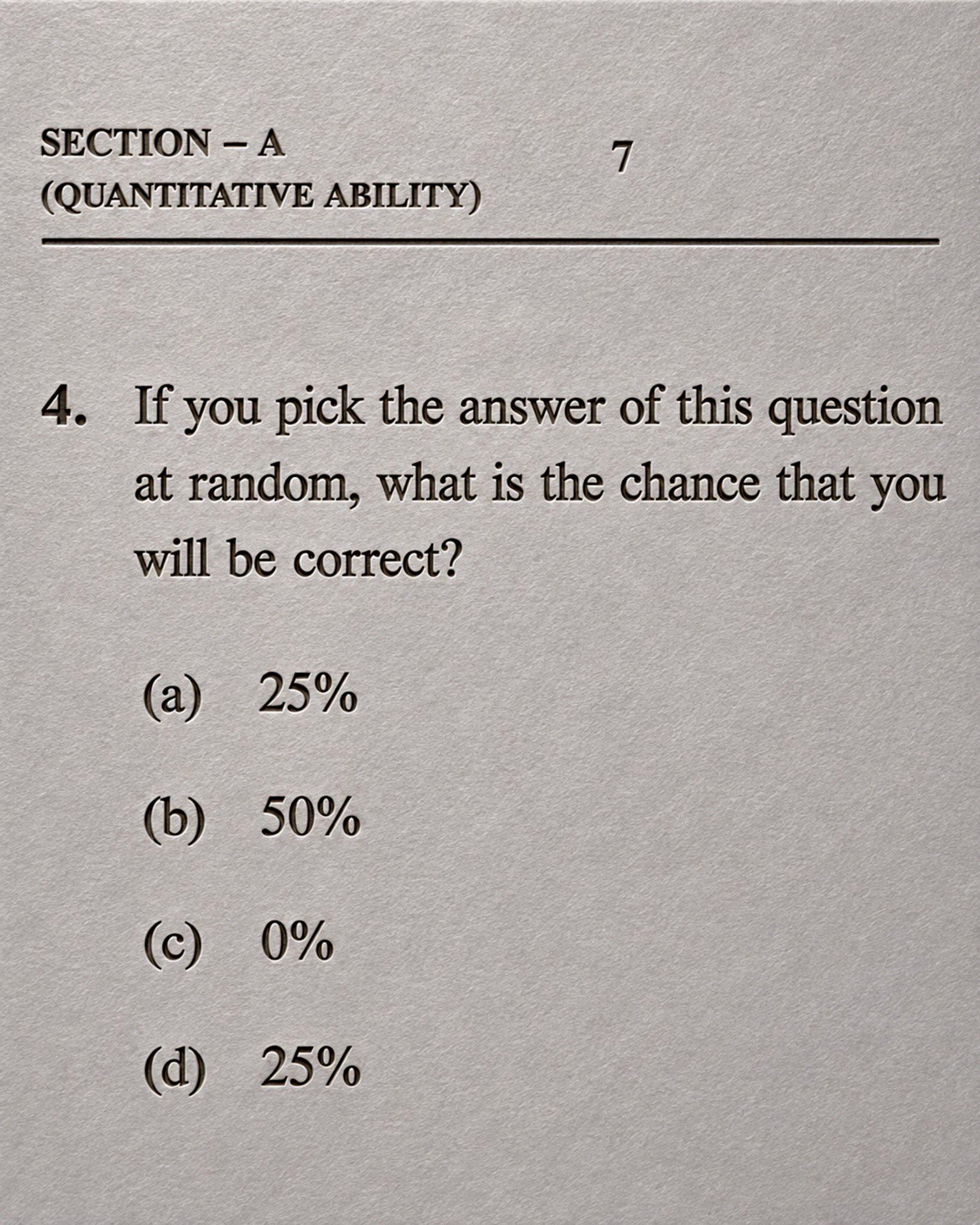
I’m sure the question maker thinks the right answer is 50%. The traditional answer to the question is 25%. Two out of four answers are 25% so therefore you have a 50% shot of getting it. I bet their logic stopped there.
Yeah if it’s 25% then it’s A and D, which means it’s 50%, which means it’s B, which means it’s 25%. Or maybe it’s circular reasoning which means there is no right answer, which makes it 0% which is C. But if it’s C, then that’s 25%…….. and on and on forever
No. I'm sorry, but this specific version doesn't work that way.
The answer is 25%, but that does not mean that both A and D are correct. It's a flawed test, clearly.
Which means you don't know WHICH 25% answer is the one that will be graded as correct.
Therefore it's either A or D, so if you're choosing you have a 50% chance, but if you're randomly picking it's still 25%, because you can choose D and be wrong while A is marked correct.
You started with the assumption that there is one correct answer. This question isn’t playing by normal test taking rules, so I do not agree that assumption is valid.
My assumption is based on how multiple choice tests work. It does not state "select all answers" so we can safely assume one answer is the correct answer. In fact we have to for the loop logic to even work.
Why do you assume the test is some special type rather than it's a flawed test? For the paradox to work it must be accurate, but that obviously cannot be because... Well.. the paradox.
Thus the test must be flawed, but there is still an answer key with one answer.
But a multiple choice test can have multiple correct answers even if you only need to pick one. It rarely does, because usually there's no point in making the test easier to randomly guess, but there's nothing inherently preventing it from having 2+ correct answers.
This is a precise question with an exact answer. The question maker did not overlook logic in its creation. Most of your logic is correct until you assess C. The logic does not go on and on forever... it stops at C. You've ruled out A, B, and D. For C to be wrong, it would need to give ANY percentage of being correct. C says there is a zero percent chance of randomly selecting the right answer. Since C says zero, and it should at least be 25%, C is the right answer.
We know A, B, and D are wrong. C's answer should be at least 25% because it is ¼ of the total number of answer choices. But its answer is 0%. Because C evaluates its own chances incorrectly, and all other answer choices are wrong, you have a 0% chance of selecting a correct answer, making C the correct answer.
This question tricks you into thinking that you're assessing Chance, which is why you're stuck at C being 1 of 4 options. You have to evaluate A, B, and D to realize you need to step out that logic and assess each letter's answer instead.
 1
33
u/jayron32 8d ago
It's a BS question where none of the answers is correct.