Not really. That statement would only be added if there are multiple correct answers AND you're required to get them all to get full points for the question. You can still have multiple correct answers to the question without that statement but you onlt need to pick one of them to properly answer the question.
You must not be from the US, because absolutely zero multiple choice tests here are set up that way.
Not to mention we KNOW that's not how this test works, otherwise the logical loop doesn't apply. If you're providing more than one answer it messes with all of the probability - same with multiple answers being correct. If either is true, the actual answer is 50% plain and simple. No loop.
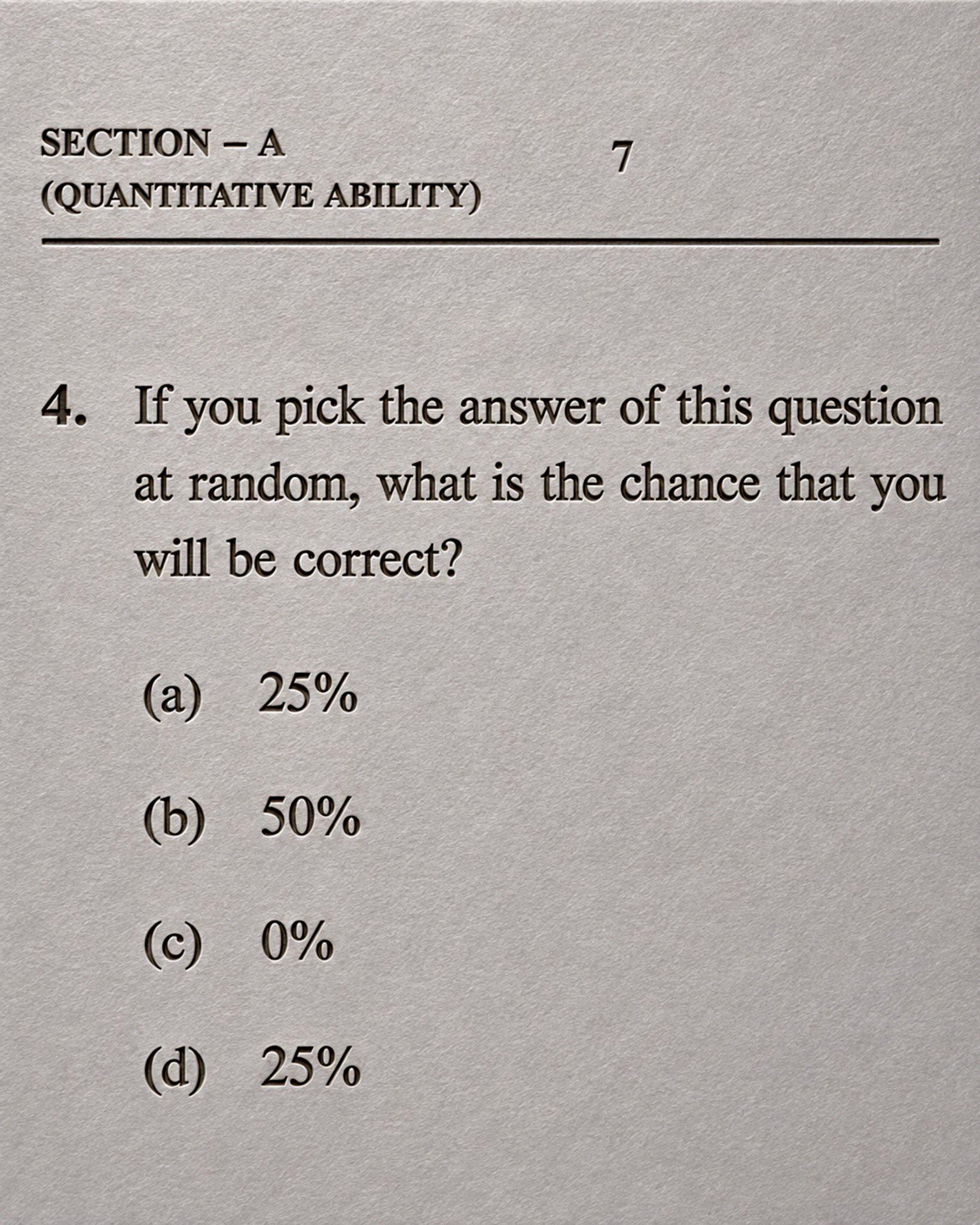
But we know the answers, it isn't like all 4 answers could theoretically be correct, we know what all of them are and which ones are "correct" under which circumstances. Initially the answer is 25% and there are 2 such answers so the actual answer is 50% which is 1 answer so it's again 25% and we have a paradox.
That's only true if there's only one answer that would be marked as correct.
You said there could be more than one right answer to this question, as in both A and D could be correct and we are supposed to choose both. That would mean you have a 50% chance to find a correct answer, meaning B would be the correct answer. It doesn't revert back to 25% because the answer to the question is 50%.
The paradox only exists because if the correct answer is 25%, you could answer A or D and get "full credit."
Your proposition that this question could have more than one "correct" answer is contradictory to the point of the paradox.
All that to say my point still stands: either A or D is correct. It cannot be both. And it isn't 50% because only A or D is correct, not both, according to the answer key. You have a 25% chance of getting the right answer at random.
If the question asked what are the odds of answering "a" question correctly, rather than "this" question correctly, it would be different. That's why I brought up that this particular version of the question has an answer: one of, but not both, A or D.
 1
1
u/Far-Two8659 8d ago
If this we're the case the question would specify to choose all that apply or all correct answers.