I'm expecting shitpost so much that I thought it was going to be something stupid like a tiny jack-in-the-box that opens and gives you the middle finger
Adding to that is that those IWC loupes use augmented reality to display information for any of those small parts they look at in a HUD overlay, and can do things like ensuring orientation of cogs/gears that would otherwise look identical on both sides.
They're garnets. They're there because they have very low friction and are very hard. So the watch doesn't lose energy to friction and lasts a long time because they don't wear out.
No, they just sit there. The parts that go on the garnet spin. The axle of the rotating part has to be supported by something, and they are far too tiny for ball bearings. So they use the stones to reduce friction. Otherwise the moving part would lose energy from friction with the stationary part. And the stationary part would get a lot of wear from the moving part.
It's essentially a stationary object that's purpose is to reduce friction. Like in the trucks of a skateboard, they have a bushing made of nylon that the hanger pivots around.
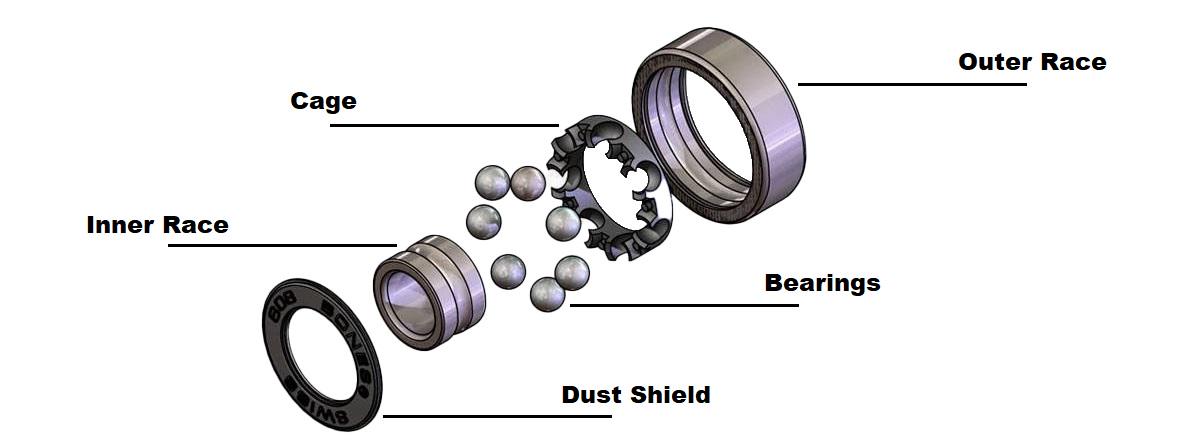
Not on any boards I have ever ridden on and that's a fair few. The axel is directly in contact with the inner bearing ring. The outer bearing ring is in contact with the wheels and the bearings between the two rings rotate. The trucks attach the axel to the board.
You're right, I will edit my comment with the correct anatomical terms. The part I was thinking of is the "hanger", which is a term I've never heard of.
On the other hand, if you've ridden skateboards, you should definitely know what bushings are, you can't really have a functional skateboard without them, not one that would be comfortable.
A bushing is a hollow, cylindrical lining or sleeve placed between two parts to reduce friction, absorb vibration, guide motion, or insulate a component
Rubies and sapphire are the standard in watch movements. They provide a smooth surface for function. Think of them as super smooth super long lasting ball bearings
Typically synthetic rubies. They are very highly polished inverse cone shapes, used as bearing surfaces for the metal shafts holding all the gears up. Pretty sure they use ruby mostly because it's a common synthetic gemstone used for certain laser systems, larger specialty bearings, and for certain abrasive surfaces. I have a ruby whetstone for around 4000 grit polishing. Also, I've seen lavender oil used as lubricant on the bearings for some of these watches for some reason.
Somehow everyone else missed this. They also have small ‘wells’ in them that hold oil. The oil in this particular gem set goes in between the cap stone and the hole stone, I think. Unless it’s not part of the balance. I’m a little upset they did show the part just before this because our guy likely applied oil to the open gem set and that takes a fucking ridiculous amount of precision. You have to apply a decimal point to the center of the flat part of the gem and if you mess it up it will capillary its way out the side when you put it back together. Still fresh in my mind just learned how to do this the other day. Really difficult and I consider myself dexterous.
Edit: yep it is the balance. Would really like to see what he did just before this.
Picture how a Spinning Top has a tiny little point and will spin for a long time, but only on a hard surface like a granite counter. Not quite as well on a soft wood table, but much better than a piece of rubber.
In a mechanical watch, many of those gears or wheels function kinda like the point of that top, called a pivot. The pivot is metal. Hard, but not as hard as synthetic ruby. They use those stones, or “jewels” as a bearing for the pivot. Very low frictional resistance and minimal wear. The tiniest drop of oil lubricates the motion further.
I have pocket watch movements that are 120 years old with this mechanism, and they still work having had little to no maintenance or use in the last 40 years. Simple concepts but peak tech during the Industrial Revolution, especially important to the expansion of railroads in the American West.
The jewels you see him installing are cap jewels. The little part that he bends holds the jewel in place while being flexible to absorb any shocks from dropping or quick movement. Without it, those shocks would bend or break the metal pivot point, which is a common failure mode of mechanical watches.
Disclaimer: for you proper horologists, I am attempting to explain this in laymen’s terms. I considered myself an amateur watchmaker at some point for several years before realizing that I was a tourist at best.
If you refer to the two round rubis he sets on the top before putting the rotor, they are part of the automatic mechanism which winds the barel. It's a bit different of a usual system. This use a double ratchet mechanism and the two stones read the shape of a cam located underneath the rotor and transmit the movement to the ratchet system. A bit old-fashioned but cool to look at.
The good thing about asking a question in a forum that might intrest others is if some person answers everyone has the answer instead of everyone having too google by their lonesome.
What a job, man. From my paltry experience doing precision tasks and getting annoyed with them, I can only imagine how frustrating doing something like this can be. It really takes a specific kind of temperament to do work like this, it’s impressive.
Huh. I absolutely LOVE the precision work in my technical field and would instantly jump at a chance to work on precision instruments or mechanics like this with such specialized tools and at such a small scale. I find the meticulous nature of the work soothing and allows you to reach flowstate fairly easily in the right conditions. This would be a dream job.
They’re extremely hard and extremely low friction so they last a long time without needing maintenance. They what the spinning parts rest on so they can move without losing hardly any momentum. Originally they were made from natural gems but now they’re lab grown.
They are only available for certified IWC technicians.
They have a camera that can display what you are looking at for an audience, but they also have augmented reality that recognises the individual components.
I love that the spring mechanism is visible on the face. I have a few old pocket watches and it’s very relaxing to watch the mechanism work and the gears turn. It’s truly mechanical beauty.
My wife bought me a couple "cheap" (comparatively) watched that have the open faces so you can see the mechanism. Love them but I gotta get both fixed. (The number overlay in the first one came loose from the main face and is just floating around. The other has a loose face in general).
My favorite is my Waltham Riverside A, made in 1917. When you open the back the action is almost fully exposed with fancy scrollwork and swirly stuff on the white gold filling. My wife got it for me for our first Christmas together. She worries when have the black open but I feel like they put so much effort into making it pretty that they must have wanted people to admire it.
Maybe, given it is Reddit, we can find someone skilled enough to make one for sale. Or 3d print. People in r/miniatures and r/booknooks and r/diorama, etc would love one.
Now from Hatchett Paperworks, World of Watches! Learn the history of watches! Build your own mechanical watch month by month! Free binder with part one!
Working with small things gives me SO much anxiety I just couldn’t. It’s like it makes me want to jump out of my skin and rock back and forth. I can’t hold still when precision is involved.
 1







217
u/ExtensionTruth4 8d ago •
I swear the first ten second I thought he was making a super precise sushi